Tag Archives: sap business one partner india

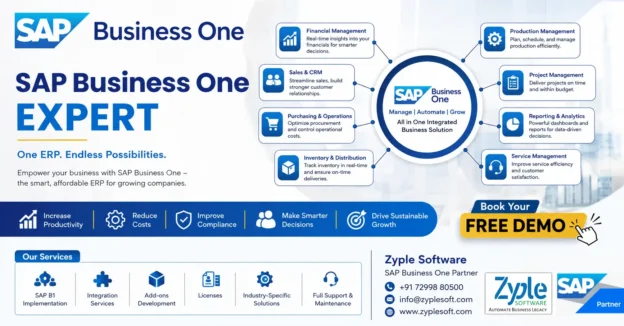
SAP Business One Expert ERP solution infographic by Zyple Software with finance, CRM, inventory, production, analytics and business management features

SAP Business One Expert

SAP Business One Expert for Industries/Businesses
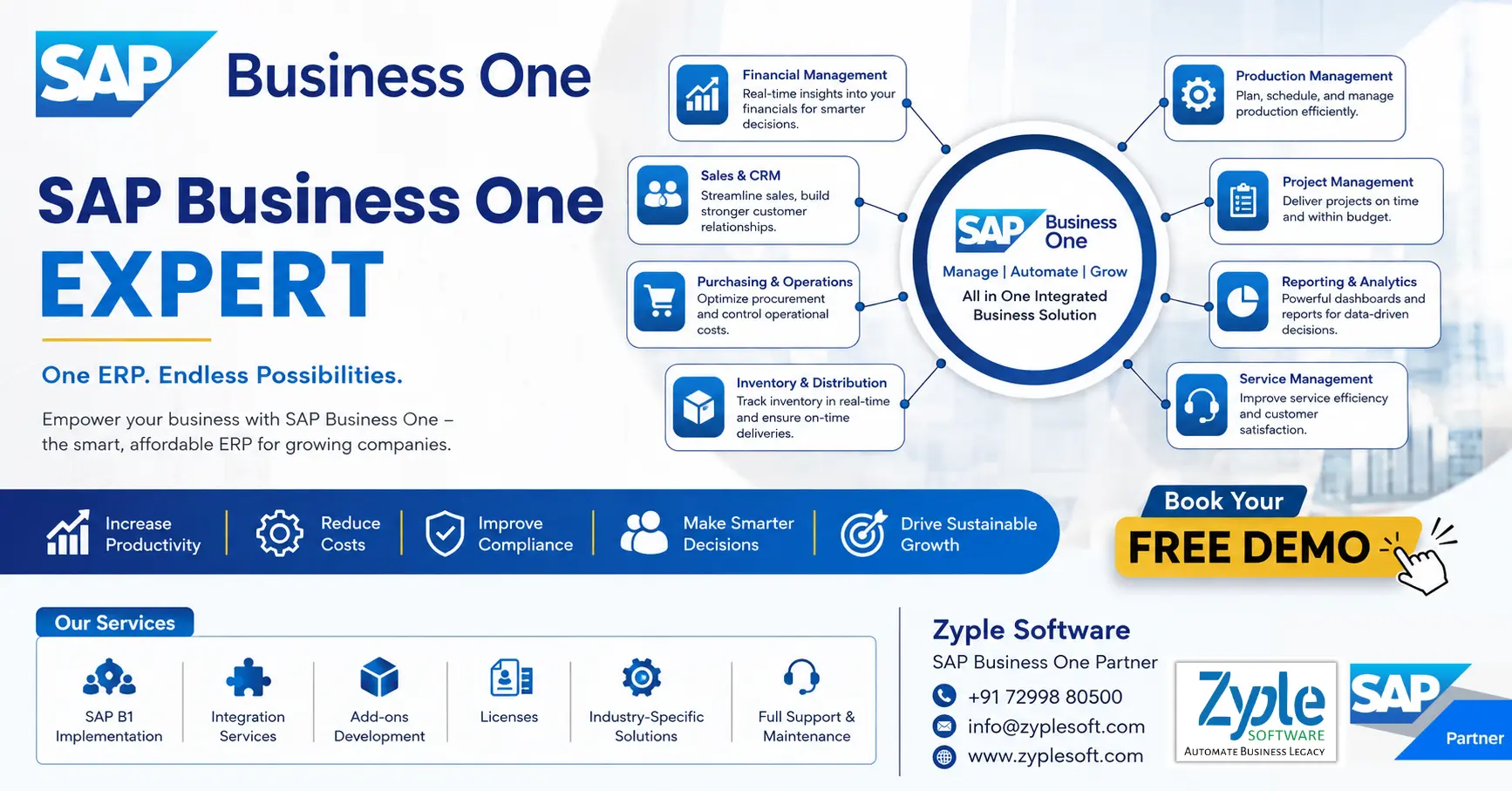
SAP Business One Expert ERP solution infographic by Zyple Software with finance, CRM, inventory, production, analytics and business management features

SAP Business One provides robust ERP capabilities for small and medium-sized businesses seeking facilitated operations. Our specialized experts help you maximize the platform’s potential, delivering customized solutions that align with your unique business requirements and growth objectives. We guide you through implementation, configuration, and optimization to ensure you gain the full benefit of your SAP Business One investment.

We specialize in:

1. System Implementation and Integration

Launching SAP Business One with minimal disruption while connecting to your current business systems.

2. Process Optimization

Facilitating workflows and automating manual tasks to boost operational efficiency.

3. Customization and Development

Creating advanced modules and functionalities that handle your specific business challenges.

4. Data Migration and Management

Securely moving your business data while ensuring accuracy and consistency.

5. Reporting and Analytics

Developing complete dashboards that deliver actionable insights for better decision-making.

6. Technical Support and Training

Delivering ongoing assistance and knowledge to empower your team.

An SAP Business One expert combines technical expertise with industry knowledge to deliver solutions that drive tangible business outcomes. Whether implementing from the beginning, optimizing a current deployment, or improving functionality with custom modules, we ensure your SAP Business One environment completely supports your operational requirements and strategic goals.

Securing the Right SAP Business One Expertise for Your Business

SAP Business One (SAP B1) is a powerful enterprise resource planning (ERP) solution that helps small and medium-sized enterprises (SMEs) facilitate their operations, gain real-time insights, and drive profitable growth. However, increasing the return on your SAP Business One investment relies heavily on having the right technical and functional expertise on board. Whether you’re in the middle of an implementation, planning an upgrade, or require ongoing support, the challenge often lies in identifying and securing qualified professionals. The success of your system depends on the skills of the people who handle, customize, and support it. This is a common obstacle for many organizations looking to fully use their ERP capabilities.

Roles and Responsibilities of an SAP Business One Expert

An SAP B1 expert is responsible for implementing, customizing, supporting, and optimizing the SAP Business One ERP system to meet business needs. Their role spans technical, functional, and strategic responsibilities across the organization.

The roles and responsibilities generally include:

1. Implementation and Deployment

  • Evaluate business requirements and map them to SAP B1 functionalities.
  • Plan and execute end-to-end SAP implementation projects.
  • Configure key modules like finance, sales, purchasing, inventory, CRM, and production.
  • Handle data migration from legacy systems to SAP B1.
  • Ensure seamless system go-live with minimal disruption.

2. Business Process Analysis

  • Study current workflows and identify inefficiencies.
  • Suggest process improvements using SAP B1 capabilities.
  • Organize ERP system with industry-specific best practices.
  • Create functional specifications and documentation.

3. System Configuration and Customization

  • Modify company settings, workflows, and approval procedures.
  • Design forms, fields, dashboards, and reports.
  • Work with SDKs, SAP B1 add-ons, or integrations to expand functionality.
  • Ensure customization aligns with future expansion.

4. Integration Management

  • Integrate SAP B1 with third-party systems such as CRM tools, e-commerce platforms, banking systems, and payroll and HR software.
  • Handle APIs, middleware, and data synchronization.

5. User Training and Support

  • Train end-users across departments.
  • Create user manuals and SOPs.
  • Deliver ongoing technical and functional support.
  • Troubleshoot system issues and resolve tickets quickly.

6. Reporting and Analytics

  • Design and generate business reports using Crystal Reports, SQL queries, and SAP dashboards.
  • Deliver insights for decision-making.
  • Ensure live data visibility across departments.

7. Database and Technical Management

  • Handle databases (like SQL Server or SAP B1 HANA).
  • Evaluate system performance and optimize queries.
  • Ensure data integrity, security, and backups.
  • Oversee upgrades, patches, and version control.

8. Project Management

  • Plan project timelines, budgets, and deliverables.
  • Coordinate with stakeholders, clients, and internal teams.
  • Handle risks and ensure timely project completion.
  • Follow SAP B1 implementation methodologies (like ASAP or Agile).

9. Compliance and Security

  • Ensure the system adheres to financial and legal regulations.
  • Define user roles and authorization controls.
  • Maintain audit trails and reporting compliance.

10. Continuous Improvement and Optimization

  • Find opportunities for automation and efficiency.
  • Suggest and install new SAP B1 features or add-ons.
  • Improve system usage as business scales.
  • Stay updated with the latest SAP releases and trends.

11. Industry-Specific Responsibilities

Depending on the domain, responsibilities may cover:

Manufacturing

Production planning, BOM, and MRP (Material Requirements Planning).

Construction

Project costing and subcontractor management.

Retail

POS integration and inventory tracking.

Pharma

Batch traceability and compliance validation.

12. Client and Stakeholder Communication

  • Act as a bridge between business users and technical teams.
  • Collect feedback and translate it into system improvements.
  • Deliver strategic ERP implementation.

Skills and Expertise of an SAP Business One Expert

An SAP B1 expert specializes in implementing, configuring, and improving the SAP Business One system for small and medium-sized enterprises (SMEs). They combine key functional accounting and supply chain knowledge with technical reporting and project management skills to align software capabilities with company goals.

  • Proficiency in core modules of SAP B1 like financial accounting, banking, fixed assets, sales, purchasing, inventory control, and production.
  • Deep understanding of business processes and localization and compliance.
  • Technical skills like SAP Crystal Reports, SQL, and SAP Business One SDK (Software Development Kit).
  • Strong requirement analysis and project management abilities.
  • Experience in training and support.

Benefits of Hiring an SAP B1 Expert

Hiring an SAP Business One (SAP B1) expert helps your company set up the software right, save money, and prevent costly system errors. They match the tool to your exact daily requirements, clean and move your old data safely, and connect SAP B1 with your other apps like e-commerce or CRM.

1. Proper Setup

They develop workflows that fit how your business actually works.

2. Safe Data Migration

They transfer old records into SAP B1 without losing details using SAP Business One solutions.

3. Custom Add-ons

They develop special tools or reports using the SAP SDK if standard options fall short.

4. System Integration

They connect your ERP with outside platforms like payment gateways or shipping tools.

5. Staff Training

They teach your team how to use the system well so work moves faster.

6. Ongoing Support

They resolve bugs quickly and handle system updates safely in SAP support.

When You Should Hire an SAP B1 Expert

Hiring an SAP Business One (SAP B1) expert is necessary when starting a new system setup, migrating old data, upgrading software versions, or fixing chronic workflow gaps. You also need professional help for custom reports, third-party software connections, and training your team.

1. New Implementation

Develop and configure the software to match your exact business rules.

2. Data Migration

Transfer old spreadsheets and legacy data safely without losing records.

3. System Upgrades

Move to the latest versions without breaking current operations.

4. Custom Reports and Add-Ons

Develop specialized Crystal Reports or custom SQL queries.

5. Software Integration

Connect SAP B1 with e-commerce sites or third-party apps via APIs.

6. Staff Training

Teach your team how to use specific modules properly.

Choosing the Right SAP B1 Expert

Choosing the right SAP Business One (SAP B1) expert is essential for a smooth ERP setup. Look for official SAP Business One partnership tiers, verified industry track records, certified in-house consultants, and robust local or regional compliance knowledge.

1. Industry Experience

Ensure the expert or partner knows your specific sector (such as manufacturing, construction, retail, and pharma) to handle unique workflows and compliance needs.

2. Certifications

Check for formal SAP B1 credentials and certified consultants who understand the latest versions of SAP B1 and SAP B1 HANA.

3. Customization and Integration

Verify their technical ability to modify the system and connect it seamlessly with third-party software like e-commerce platforms or Microsoft 365.

4. Post-Implementation Support

Confirm they deliver ongoing training, troubleshooting helpdesk services, and system updates after your go-live date.

Conclusion of SAP B1 Expert

As a leading SAP Business One partner, Zyple Software is delivering services like SAP B1 implementation, integration, migration, licensing, consulting, add-ons, digital transformation, and support and training to different industries, like construction, manufacturing, solar, food and beverage, aerospace, oil and gas, healthcare, retail, real estate, jewellery, pharma, and textiles. 

SAP Business One is an ERP solution customized for small and medium-sized enterprises that connects finance, production, inventory, material requirements planning (MRP), procurement, sales, CRM, and reporting and analytics into one platform. For food and beverage, pharma, and chemical businesses, it can improve project costing, procurement, subcontractor billing, and inventory management.

If you’re involved, reserve a demo of SAP Business One.

Do you assure the SAP B1 ERP system for your business or industry?

Finish all the details in the quoted contact form; our team will return to you.

    FAQs

    1.How can an SAP Business One Expert improve my business operations?

    An SAP Business One expert helps facilitate your processes by integrating finance, sales, inventory, and operations into one system, improving efficiency and decision-making.

    Yes, SAP Business One is highly flexible and can be customized for industries like construction, manufacturing, retail, and distribution with the help of an expert.

    The cost depends on project scope, customization needs, and implementation complexity. A consultation can deliver a clear estimate based on your business requirements.

    Most businesses start seeing improvements in efficiency, reporting, and cost control within a few months of proper SAP B1 implementation by an SAP B1 expert.

    You can begin with a free consultation to evaluate your business needs, followed by a customized implementation plan tailored to your goals.
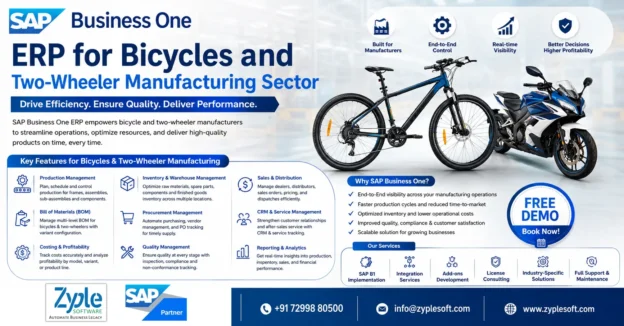
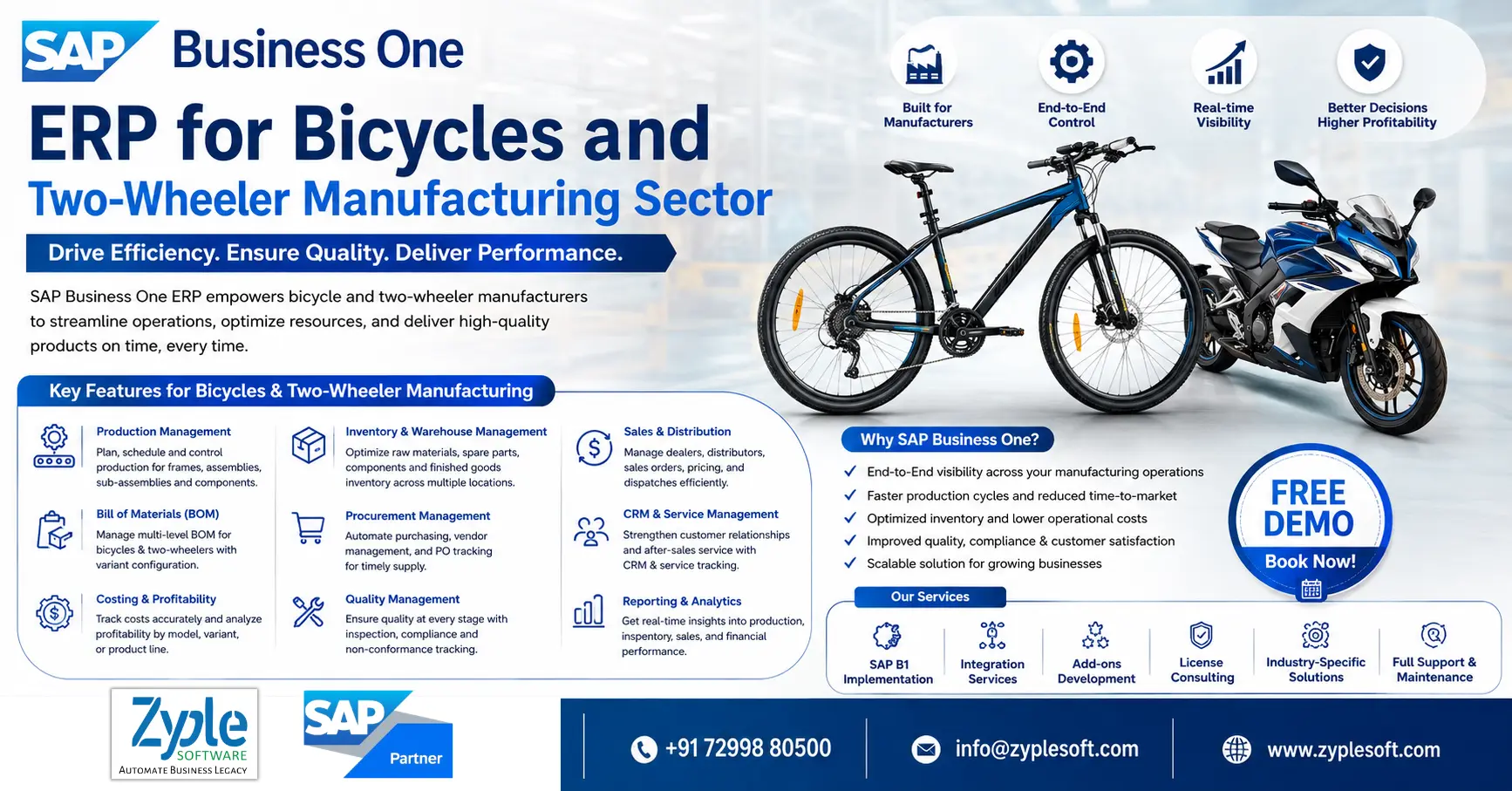
    SAP Business One ERP for Bicycles and Two-Wheeler Manufacturing Sector provide by zyple software– Production, Inventory, Quality and Cost Management

    SAP Business One for Bicycles and Two-Wheeler Manufacturing Sector

    SAP Business One ERP for Bicycles and Two-Wheeler Manufacturing Sector/Industry

    SAP Business One ERP for Bicycles and Two-Wheeler Manufacturing Sector provide by zyple software– Production, Inventory, Quality and Cost Management

    The bicycles and two-wheeler manufacturing industry is fast emerging and one of the main parts of the growing economy of the world. Like all industries, the bicycles and two-wheeler manufacturing industry is looking for approaches to minimize product lifecycle, save costs, and collaborate with dealers and customers to provide excellent services to the customers. With increased demand in this field, the industry faces challenges in improving customer satisfaction, marketing, and sales management; minimizing costs, and efficient supply chain management. SAP Business One ERP for bicycles and two-wheeler manufacturing serves this industry by delivering solutions that fulfill the need to provide innovative products and deliver utmost customer satisfaction.

    Challenges Faced By The Bicycles and Two-Wheeler Manufacturing Industry

    The bicycle and two-wheeler manufacturing sector faces a complex set of challenges, including overproduction crises, shifting consumer demands towards electric vehicles (EVs), supply chain volatility, and margin squeezes. These pressures have forced companies to adapt product strategies and pricing models.

    1. Inventory Surplus and Margin Squeezes

    Following a massive sales surplus, the global bicycle industry has struggled with bloated inventories and overproduction. This oversupply led to a crushing collapse of profits, with industry giants and smaller brands seeing net income drops exceeding 60 to 99% and facing bankruptcy.

    2. Electrification Pressures

    Traditional bicycle and internal combustion engine (ICE) motorcycle manufacturers are under immense pressure to switch to smart, electric bicycles (e-bikes) and electric two-wheelers (E2W). This involves huge investments in R&D, battery technologies, and localized supply chains.

    3. Volatility in Raw Materials

    Manufacturers continue to battle price hikes and shortages of key raw materials such as aluminum, steel, and lithium-ion batteries. Combined with fluctuating freight and global shifting costs, these factors seriously compress operating margins.

    4. Infrastructure and Regulatory Hurdles

    In highly localized markets like Bengaluru, the absence of dedicated, safe cycling lanes discourages widespread bicycle adoption. Also, the electric two-wheeler segment is challenged by possible regulatory changes on lithium-ion batteries, safety standard enforcements, and the need for rider education.

    5. Shifting Consumer Preferences and Competition

    Consumer demand is increasingly low. While basic roadster and commuter bikes are losing urban market share to motorized options, premium and recreational segments demand higher aesthetic quality, specialized components, and multi-speed capabilities.

    Here we are going to discuss about all features and SAP B1 modules in Bicycles and Two-Wheeler Manufacturing industry:

    Features of SAP Business One for Bicycles and Two-Wheeler Manufacturing Sector

    1. Production and Manufacturing Management

    • Bill of materials (BOM) for multi-level assemblies like frame, wheels, engine parts, and accessories.
    • Production orders, like manual and automatic, from sales demand.
    • It includes routing and stage-wise production tracking.
    • It includes work-in-progress (WIP) monitoring.
    • Sub-assembly management like gear systems, brake units, and engines.
    • Production costing, like material, labor, and overhead.
    • It includes rework and scrap management.
    • It includes real-time production tracking for better visibility.

    2. Material Requirements Planning (MRP)

    • It includes demand-based MRP planning for components and raw materials.
    • It includes auto-generation of purchase and production recommendations.
    • It includes lead-time planning for vendor supply.
    • It includes shortage and excess inventory alerts.
    • It includes forecast-driven production planning.

    3. Inventory and Warehouse Management

    • Multi-warehouse management, like plants, depots, and leadership.
    • Batch and serial number tracking is essential for engines and spare parts.
    • It includes bin location tracking.
    • Inventory valuation methods like FIFO and moving average.
    • It includes stock transfer between plants and warehouses.
    • It includes spare parts inventory control.

    4. Procurement and Supplier Management

    • It includes vendor management and supplier evaluation.
    • Purchase requisitions, purchase orders, and GRN to invoices cycle.
    • It includes vendor price comparison and contract pricing.
    • It includes procurement automation with approval workflows.
    • Raw material sourcing optimization like steel, rubber, and electronics.

    5. Financial Management and Cost Control

    • Complete accounting like general ledger, accounts receivable, and accounts payable.
    • It includes product-wise profitability analysis.
    • It includes cost center and profit center tracking.
    • It includes budgeting and expense control.
    • Fixed asset management like machinery and tools.
    • It includes multi-currency support for exports.
    • It includes real-time financial reporting.

    6. Sales and Distribution Management

    • It includes dealer and distribution management.
    • It includes dealer network pricing and discount structures.
    • It includes export documentation and compliance.
    • It includes demand forecasting based on sales trends.

    7. Quality Control and Compliance

    • It includes incoming material inspection.
    • In-process quality checks for assembly line checkpoints.
    • It includes final product inspection before dispatch.
    • It includes defect tracking and corrective actions.
    • It includes compliance with automotive industry standards.
    • It includes quality reporting and analytics.

    8. Supply Chain and Logistics Management

    • It includes end-to-end supply chain visibility.
    • It includes vendor-to-production-to-dealer tracking.
    • It includes logistics and shipment tracking.
    • It includes route planning and dispatch planning.
    • It includes inventory replenishment automation.

    9. Service and Warranty Management

    • It includes warranty tracking for bicycles and two-wheelers.
    • It includes service contract management.
    • It includes spare parts management.
    • It includes customer complaint and service request handling.
    • It includes AMC (Annual Maintenance Contract) support.

    10. Customer Relationship Management (CRM)

    • It includes dealer and customer database management.
    • It includes lead and opportunity tracking.
    • It includes after-sales service tracking.
    • It includes customer feedback and satisfaction analysis.
    • It includes marketing campaign management.

    11. Business Intelligence and Reporting

    • Real-time dashboards for production, sales, and inventory.
    • It includes custom MIS reports.
    • It includes profitability and cost analysis reports.
    • It includes drill-down analytics for decision-making.
    • It includes integration with Excel for advanced reporting.

    12. Mobility and Web Access

    • It includes a mobile app for sales and service teams.
    • It includes remote access to ERP data.
    • It includes real-time updates for field teams.
    • It includes web-based dashboards and approvals.

    13. Integration and Automation

    • It includes integration with IoT devices (machine data), barcode or RFID systems, third-party logistics, and e-commerce platforms.
    • It includes API-based integration with external systems.
    • It includes automated workflows and alerts.

    14. Human Resource and Workforce Management

    • It includes employee master data management.
    • It includes attendance and shift planning.
    • It includes labor cost allocation in production.
    • It includes performance tracking.

    15. Industry-Specific Capabilities

    • Variant management like different models, colors, and specs.
    • It includes engine or chassis number tracking.
    • It includes dealer stock visibility.
    • It includes spare parts lifecycle management.
    • It includes multi-location manufacturing plants.
    • It includes aftermarket service ecosystem management.

    Benefits of SAP Business One for Bicycles and Two-Wheeler Manufacturing Sector

    The ERP software, SAP Business One (SAP B1) system, facilitates the supply chain, automates production planning, and tightly integrates financials for bicycle and two-wheeler manufacturers. It delivers actionable control over multi-level bills of materials (BOMs), minimizes holding costs through automated material requirements planning (MRP), and enhances product traceability via serial number and batch tracking.

    1. Automated Material Requirements Planning (MRP)

    Accurately predicts component needs (chains, tires, frames, motors for e-bikes) based on historical data, forecasts, and live sales orders, minimizing the risk of stockouts and production delays with the SAP implementation process.

    2. Multi-Level Bill of Materials (BOM)

    Simplifies complex assembly structures by handling sub-assemblies (such as an assembled engine or wheelset) and finished goods on a single, easy-to-read production hierarchy.

    3. Quality Control and Traceability

    Integrates quality checkpoints throughout the assembly process using SAP solutions. Serial number and batch tracking enable manufacturers to map components to specific units, easing warranty management and enabling swift recalls if required.

    4. Integrated Financials and Taxation

    Seamlessly integrates shop-floor data with core accounting to automate payroll, monitor profit margins, and maintain compliance with regional tax requirements like GST and e-invoicing.

    5. Supply Chain and Vendor Management

    Strengthens coordination with multi-tier parts suppliers by automating procurement triggers, tracking lead times, and measuring vendor performance using SAP B1 add-on.

    6. Scalability and Customization

    Built to support expanding production lines or the shift to electric vehicles (EVs), the system easily scales. It can also be modified with industry-specific add-ons for job-work subcontracting and dealer networks.

    Conclusion of Bicycles and Two-Wheeler Manufacturing ERP

    As an experienced SAP Business One partner, Zyple Software is delivering services like SAP B1 implementation, licensing, integration, add-ons, and support to different industries, like construction, manufacturing, aerospace, jewellery, solar, food and beverage, retail, pharma, and textile industries. 

    SAP Business One is an ERP customized for small and medium-sized businesses that connects finance, procurement, sales, CRM, production, inventory, and reporting into one platform. For bicycles and two-wheeler manufacturing or any other companies, it can improve project costing, procurement, subcontractor billing, and inventory management.

    If you’re captivated, schedule a demo of SAP Business One.

    Do you seek the SAP B1 ERP solution for your business or industry?

    Finish all the details in the assigned contact form; our team will reach out to you.

      FAQs

      1.How can SAP Business One ERP improve efficiency in bicycle and two-wheeler manufacturing?

      SAP Business One automates core processes like production planning, inventory tracking, and procurement. This minimizes manual errors, improves production timelines, and helps manufacturers scale operations efficiently.

      The cost depends on factors such as the number of users, required modules, customization, and deployment (like cloud or on-premise). A consultation with a certified partner like Zyple Software can provide a tailored quote based on your business needs.

      SAP B1 implementation timelines generally range from a few weeks to a few months, depending on the complexity of your processes. With the right implementation partner like Zyple Software, deployment can be faster and more efficient.

      Yes, SAP Business One can be customized and extended with add-ons to achieve the unique requirements of bicycle and two-wheeler manufacturers, including production workflows and reporting needs.

      The best way to start is by scheduling a demo with an experienced SAP Business One partner like Zyple Software. They will assess your requirements, suggest the right solution, and guide you through implementation and training.

      Looking for digital Transformation for Your Bicycle and Two-Wheeler Manufacturing with SAP Business One – Book Your Free Demo Today with Zyple Software Team.

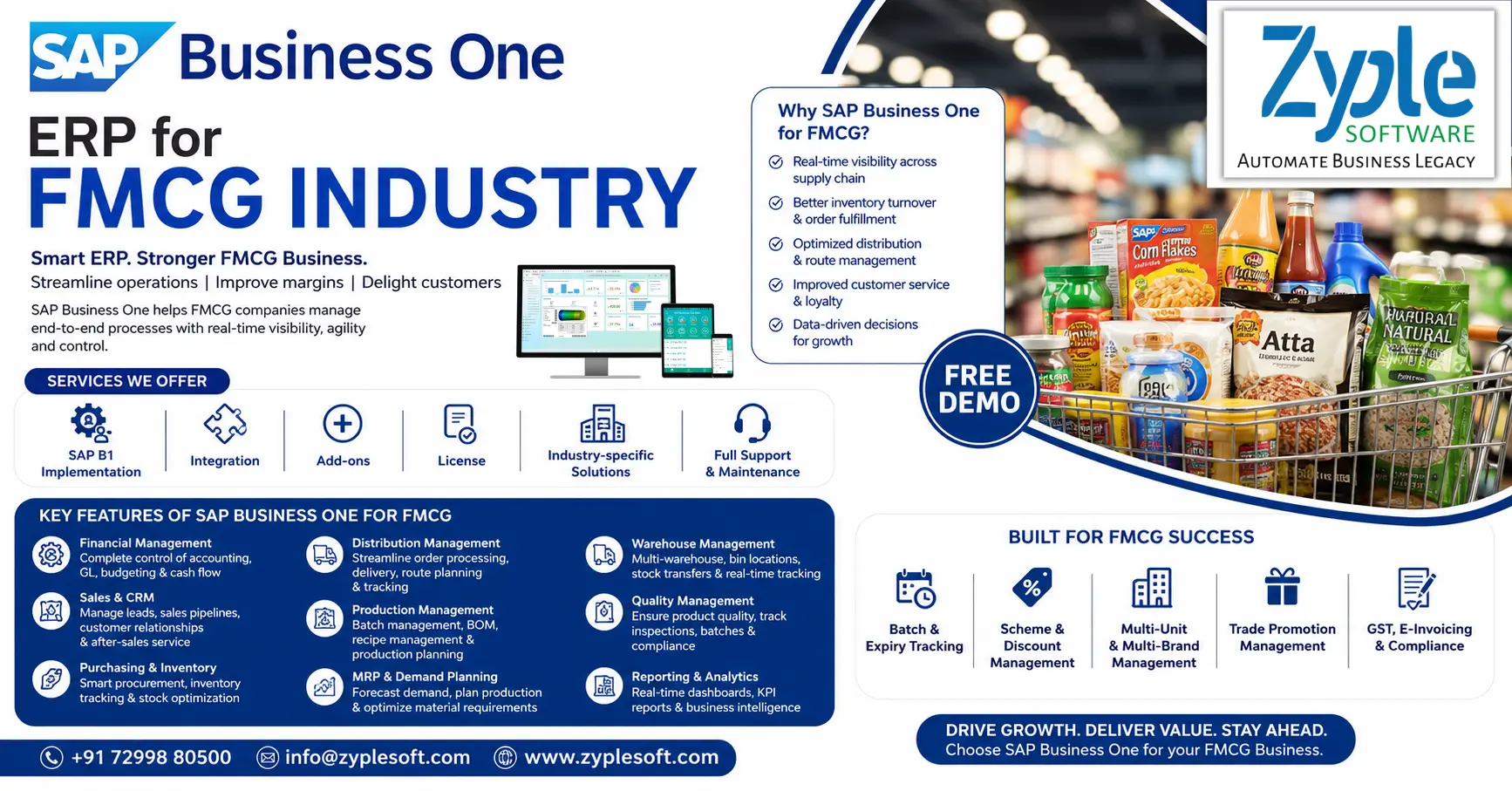
      SAP Business One ERP for FMCG Industry by Zyple Software featuring inventory management, batch tracking, warehouse management, sales, distribution, production planning, and Free Demo.

      SAP Business One ERP for FMCG Industry

      SAP Business One ERP for FMCG Industry

      SAP Business One ERP for FMCG Industry by Zyple Software featuring inventory management, batch tracking, warehouse management, sales, distribution, production planning, and Free Demo.

      The FMCG industry is in huge demand. The products in this industry often need to be sold fast before they perish. The success of the FMCG sector revolves around speed, accuracy, and efficiency. Businesses in this sector must ensure timely deliveries and handle huge deliveries. SAP Business One ERP for FMCG industry provides real-time business insights in the reports to optimize the business workflow.

      Challenges Faced By The FMCG Industry

      The fast-moving consumer goods (FMCG) industry faces serious challenges, including supply chain disruptions, rising raw material costs, and shifting consumer preferences.

      1. Supply Chain Disruptions

      Geopolitical tensions, inflation, and climate events create freight delays and material shortages.

      2. Thin Profit Margins

      High transportation and input costs decrease profitability across low-margin product lines.

      3. Inventory Complexities

      Short product shelf lives and seasonal demand surplus risk high waste or costly stockouts.

      4. Changing Demands

      Shoppers increasingly look for eco-friendly, clean-label, and health-conscious products.

      5. Rising Competition

      Local startup brands and retail private labels chip away at conventional market share.

      6. Omnichannel Integration

      Achieving consumer expectations smoothly across both physical and retail e-commerce channels strains legacy systems.

      Features of SAP Business One ERP for FMCG Industry

      1. Inventory and Warehouse Management

      • It includes real-time inventory tracking across multiple warehouses.
      • It includes batch-wise and serial number tracking.
      • It includes FIFO or FEFO (First Expiry First Out) stock management.
      • It includes automated stock replenishment and reorder levels.
      • It includes bin location management for optimized storage.
      • It includes barcode and QR code integration.

      2. Sales and Distribution Management

      • It includes end-to-end sales order processing.
      • Multi-channel distribution management like retailers, distributors, and wholesalers.
      • It includes pricing management with discounts, schemes, and promotions.
      • It includes sales forecasting and demand planning.
      • Mobile sales like van sales and route sales integration.
      • It includes real-time sales analytics and reporting.

      3. Production and Manufacturing Management

      • It includes bill of materials (BOM) management.
      • It includes production planning and scheduling.
      • Recipe and formula management for food and beverages.
      • It includes quality control and compliance tracking.
      • It includes real-time production monitoring.
      • It includes waste and by-product management.

      4. Procurement and Supplier Management

      • It includes automated purchase order creation.
      • It includes vendor management and evaluation.
      • It includes material requirement planning (MRP).
      • It includes procurement cycle tracking and approvals.

      5. Financial Management and Accounting

      • It includes general ledger, accounts payable, and accounts receivable.
      • It includes cost accounting and profitability analysis.
      • It includes budgeting and financial forecasting.
      • It includes GST and tax compliance.
      • It includes multi-currency and multi-branch financial consolidation.
      • It includes real-time financial dashboards.

      6. CRM (Customer Relationship Management)

      • It includes customer database and contract management.
      • It includes sales lead and opportunity tracking.
      • It includes customer buying behavior analysis.
      • It includes complaint and service management.
      • It includes loyalty programs and customer engagement tracking.

      7. Demand Planning and Forecasting

      • It includes AI-driven demand forecasting.
      • It includes seasonal and trend-based planning.
      • It includes demand vs. supply analysis.
      • It includes reduction of stockouts and overstocking.
      • It includes data-driven decision-making.

      8. Batch, Expiry, and Traceability Management

      • It includes expiry date tracking and alerts.
      • It includes batch recall management.
      • It includes compliance with food safety and regulatory standards.

      9. Reporting and Business Intelligence (BI)

      • It includes real-time dashboards and KPI tracking.
      • Customizable reports like sales, inventory, finance, and production.
      • It includes predictive analytics and insights.
      • It includes integration with Excel and other BI tools.
      • It includes drill-down reporting for better decision-making.

      10. Mobility and Cloud Capabilities

      • It includes mobile access for sales and management teams.
      • It includes cloud deployment for remote accessibility.
      • It includes real-time data synchronization.
      • It includes improved collaboration across departments.

      11. Compliance and Quality Control

      • Regulatory compliance for FMCG like FSSAI, GST, and more.
      • It includes quality inspection at multiple stages.
      • It includes audit trails and documentation.
      • It includes standard operating procedure (SOP) enforcement.

      12. Integration and Scalability

      • It includes integration with e-commerce platforms, CRM, and third-party tools.
      • It includes API-based connectivity.
      • It is scalable for growing FMCG businesses.
      • It includes custom add-ons for industry-specific needs.

      Importance of SAP Business One ERP for FMCG Industry

      The ERP software, SAP Business One, is essential for the fast-moving consumer goods (FMCG) industry because it improves inventory control, facilitates the supply chain, and automates financial and sales operations. It helps growing businesses manage high-volume transactions and fast-changing market demands with ease.

      1. Live Stock Tracking

      Provides real-time data on stock levels across multiple warehouses to avoid running out of popular items or keeping too much extra stock with the SAP implementation process.

      2. Batch and Lot Control

      Tracks production batches and expiration dates easily, which is very essential for food, drink, and personal care items.

      3. Supply Chain Speed

      Connects purchasing, production, and delivery so products move from factories to stores faster.

      4. Sales and CRM

      Handles customer orders, tracks pricing rules, and sets credit limits for different distributors and retailers using SAP solutions.

      5. Money and Tax Management

      Maintains all accounting, budgeting, and local tax rules in one clear place.

      Benefits of SAP Business One for FMCG Industry

      SAP Business One helps the fast-moving consumer goods (FMCG) industry by providing real-time inventory tracking, facilitated supply chain management, and integrated financial control. It enables growing consumer goods companies to reduce waste, prevent stockouts, and handle product batches efficiently.

      1. Real-Time Stock Visibility

      Monitors stock levels across multiple warehouses instantly.

      2. Batch and Lot Tracking

      Handles expiry dates and product traceability to minimize perishable waste.

      3. Automatic Reordering

      Triggers low-stock alerts to avoid production delays or empty shelves.

      4. Material Requirements Planning (MRP)

      Automates raw material planning based on actual demand using SAP Business One add-ons.

      5. Bill of Materials (BOM)

      It standardizes recipes and component lists for consistent product quality.

      6. Facilitated Distribution

      Improves procurement, manufacturing, and shipping workflows.

      7. Integrated CRM

      The SAP software maintains customer databases, tracking buying habits and order histories.

      8. Unified Accounting

      Integrates ledger, accounting, and local tax compliance into one dashboard.

      9. Business Analytics

      Generates fast, data-driven reports to find shifting market trends.

      Conclusion of FMCG ERP

      As a qualified SAP Business One partner, Zyple Software is delivering services like SAP B1 implementation, integration, migration, licensing, add-ons, digital transformation, and support to different industries, like construction, manufacturing, solar, food and beverage, aerospace, healthcare, retail,  jewellery, pharma, and textiles. 

      SAP Business One is an ERP software customized for small and medium-sized enterprises that connects finance, procurement, sales, CRM, production, inventory, and reporting into one platform. For FMCG or any other businesses, it can improve project costing, procurement, subcontractor billing, and inventory management.

      If you’re involved, register a SAP Business One demo.

      Do you search for the SAP B1 ERP software for your business or industry?

      Complete all the details in the displayed contact form; our team will get back to you.

        FAQs

        1.Why should FMCG companies choose SAP Business One over other ERP solutions?

        SAP Business One provides industry-specific features like batch tracking, expiry management, and distribution control, making it ideal for FMCG businesses. It delivers real-time insights and scalability, helping companies grow without switching systems.

        By automating inventory, procurement, and sales processes, SAP Business One reduces manual errors and wastage. This leads to better resource utilization, minimized inventory holding costs, and improved profit margins.

        Yes, SAP Business One can seamlessly connect with CRM, e-commerce platforms, and third-party applications. This ensures smooth data flow across departments and improves overall business efficiency.

        With the right implementation partner like Zyple Software, you get end-to-end services, including SAP B1 implementation, consultation, add-on development, data migration, training, and support to ensure a smooth and successful ERP deployment.

        You can connect with an authorized SAP B1 partner like Zyple Software to schedule a personalized demo. They will evaluate your business requirements, showcase relevant features, and guide you on the best implementation approach.

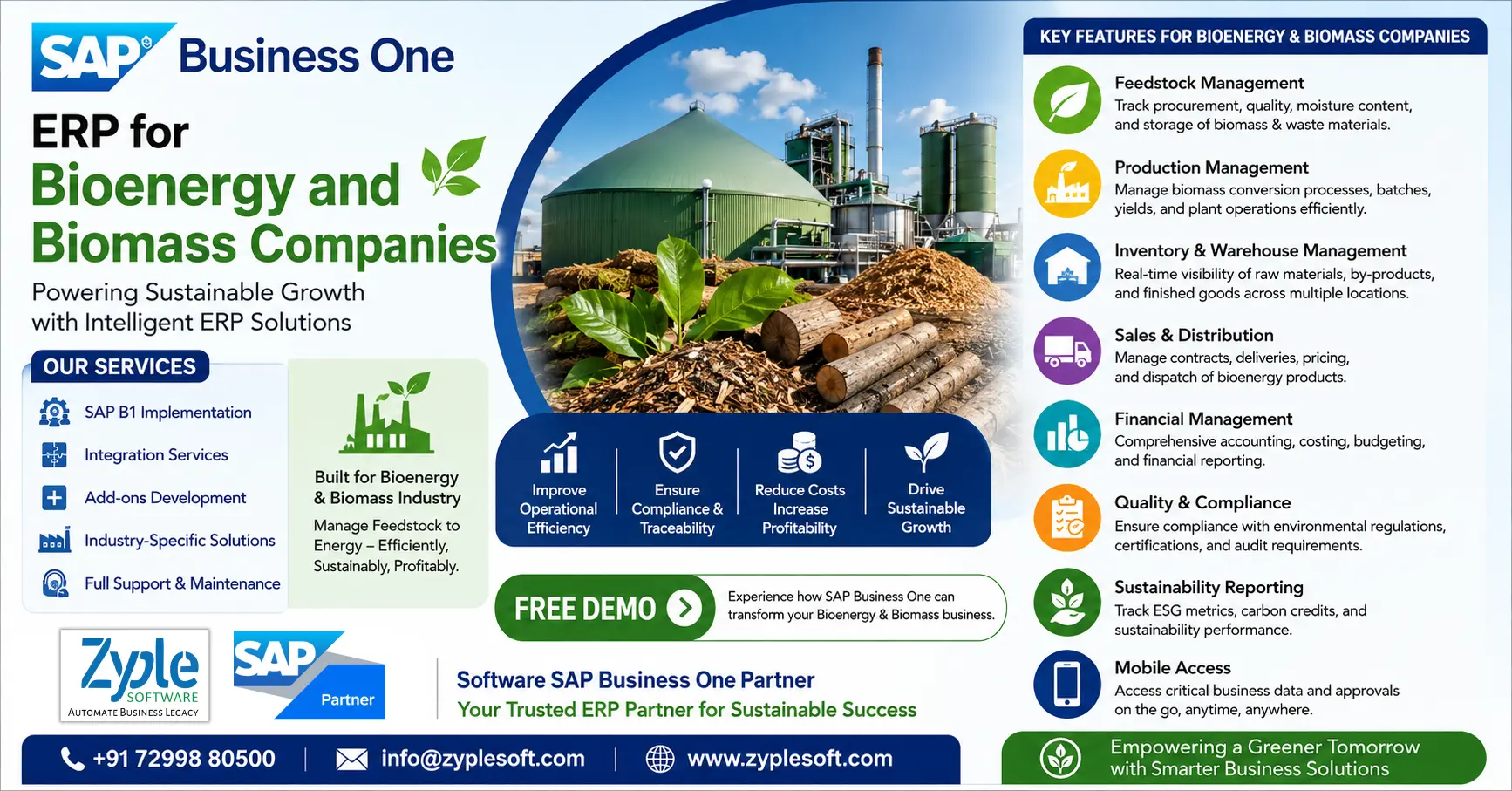
        SAP Business One ERP for Bioenergy and Biomass Companies

        SAP Business One ERP for Bioenergy and Biomass Companies

        SAP Business One ERP for Bioenergy and Biomass Industries

        SAP Business One ERP for Bioenergy and Biomass Companies

        The bioenergy and biomass industry has been around for centuries and continues to play an essential role in the global economy. However, the industry faces significant challenges, such as rising costs, increased competition, and evolving consumer demands. SAP Business One ERP for bioenergy and biomass companies can facilitate operations, optimize resources, and enable better decision-making.

        Challenges Faced By The Bioenergy and Biomass Companies

        The bioenergy and biomass companies face significant challenges, mainly driven by inconsistent supply chains, volatile raw material costs, and technological scalability. Low energy density and high moisture content can make transporting and storing feedstock expensive, while strict environmental regulations and evolving subsidies affect long-term financial viability.

        1. Supply Chain and Logistics

        Sourcing raw materials (e.g., agricultural residues and forestry waste) is heavily seasonal, resulting in supply inconsistencies and fluctuating fuel prices. Because raw biomass has low energy density, transporting wet or large feedstock over long distances is energetically unfavorable and cost-prohibitive.

        2. Technological Immaturity and Scale

        Transforming tough biorenewable biomass into high-grade biofuels or bioproducts is difficult due to defiant structures like lignin, involving complex, expensive pretreatment. Scaling these operations to match the output of petroleum refineries remains highly challenging.

        3. Policy and Regulatory Uncertainty

        The industry depends heavily on subsidies and carbon pricing frameworks. Changes in government policies, such as alterations to the EU’s Renewable Energy Directive or local tariff policies, create investment risks and complicate long-term operational feasibility.

        4. Land and Food Competition

        Using steady energy crops (e.g., corn and sugarcane) for first-generation biofuels often sparks concerns over food vs. fuel debates and land-use changes that can diminish biodiversity.

        5. Operational Risks

        Processing dry mass is an inherently difficult operation that carries severe risks of fire and explosion, demanding expensive built-in suppression technology and strict plant maintenance.

        Features of SAP Business One ERP for Bioenergy and Biomass Companies

        1. Financial and Cost Management

        • It includes general ledger and accounts payable and receivable automation.
        • Biomass project tracking, like feedstock, logistics, and processing.
        • It includes profitability analysis by plant, fuel type, or region.
        • It includes fixed asset management for machinery, boilers, and turbines.
        • It includes cash flow and investment monitoring.
        • SAP B1 modules delivers complete financial control and reporting for better decision-making.

        2. Raw Material (Biomass) Procurement Management

        • It includes vendor management for farmers, suppliers, and aggregators.
        • Procurement planning for biomass products like wood chips, agri-waste, and pellets.
        • It includes contract management with seasonal pricing.
        • Quality-based procurement like moisture percentage and calorific value.
        • It includes multi-location sourcing and supplier comparison.
        • It includes automated purchase orders and approvals.
        • Facilitates the entire procure-to-pay cycle efficiently.

        3. Inventory and Warehouse Management

        • It includes real-time tracking of biomass stock across yards and warehouses.
        • It includes batch and lot tracking for different biomass types.
        • Storage condition monitoring for moisture-sensitive materials.
        • It includes multi-warehouse and yard management.
        • It includes inventory valuation and wastage tracking.
        • It includes stock aging and shelf-life analysis.
        • Inventory and warehouse processes are completely integrated with accounting and operations.

        4. Production and Processing Management

        • It includes production order management for processing units.
        • It includes process tracking from raw biomass to finished energy product.
        • It includes by-product and waste management tracking.
        • It includes machine utilization and downtime tracking.
        • It includes energy output vs. input efficiency monitoring.
        • The production module allows structured manufacturing and process control.

        5. Material Requirements Planning (MRP)

        • It includes demand forecasting for biomass fuel.
        • It includes automated raw material planning based on production schedules.
        • Seasonal demand planning like winter fuel demand spikes.
        • It includes procurement recommendations based on stock levels.
        • Avoids stockouts or overstocking.
        • MRP helps improve procurement and production planning.

        6. Sales and Distribution Management

        • It includes sales order and contractor management for energy buyers.
        • It includes pricing management based on fuel type and calorific value.
        • Customer segmentation like industrial, power plants, and utilities.
        • It includes dispatch planning and delivery tracking.
        • It includes invoice generation and receivables tracking.
        • It includes export management for international biofuel supply.
        • It includes the entire sales cycle from quotation to payment.

        7. Logistics and Supply Chain Management

        • It includes transportation planning for biomass collection and delivery.
        • It includes route optimization for low-cost optimization.
        • It includes freight and landed cost calculations.
        • It includes integration with weighbridge systems.
        • It includes real-time shipment tracking.
        • It includes fleet and fuel consumption monitoring.

        8. Quality and Compliance Management

        • Quality testing for biomass like moisture, ash content, and calorific value.
        • It includes environmental compliance tracking.
        • Regulatory reporting like renewable energy norms and emissions.
        • Certification management like ISO and sustainability certifications.
        • It includes audit trails and documentation.

        9. Asset and Plant Maintenance

        • It includes maintenance scheduling for boilers, turbines, and conveyors.
        • It includes preventive and breakdown maintenance tracking.
        • It includes spare parts inventory tracking.
        • It includes equipment lifecycle tracking.
        • It includes downtime analysis and optimization.

        10. Project and Plant Management

        • It includes project costing for new bioenergy plants.
        • It includes CAPEX and OPEX tracking.
        • It includes resource allocation for plant setup.
        • It includes timeline and milestone monitoring.
        • It includes ROI tracking for renewable energy projects.

        11. CRM and Customer Lifecycle Management

        • Handles relationships with energy buyers and partners.
        • Tracks leads, contracts, and negotiations.
        • It includes service and support management.
        • It includes customer demand forecasting.
        • It includes after-sales service tracking.
        • SAP software includes complete CRM capabilities integrated with sales and service.

        12. Business Intelligence and Analytics

        • It includes real-time dashboards for production, sales, and finance.
        • KPI tracking like plant efficiency, yield, and cost per ton.
        • It includes predictive analytics for demand and supply.
        • It includes custom reports for management insights.
        • Allows data-driven decision-making with real-time insights.

        13. Sustainability and Energy Monitoring

        • Tracks renewable energy production output.
        • It includes carbon footprint and emission tracking.
        • It includes waste utilization and circular economy metrics.
        • It includes energy efficiency analysis.
        • It includes government subsidy and incentive tracking.

        14. Multi-Plant and Multi-Location Management

        • It includes centralized control over multiple biomass plants.
        • It includes inter-plant stock transfers.
        • Integrated financial reporting.
        • It includes regional performance comparison.

        15. Mobile and Remote Access

        • It includes a mobile app for field teams and plant managers.
        • It includes real-time access to inventory, sales, and production data.
        • It includes remote approvals and monitoring.
        • SAP B1 ERP supports mobile and web-based access for flexibility.

        16. Integration and Customization

        • Integration with IoT devices like sensors and energy meters.
        • It includes SCADA system integration for plant monitoring.
        • It includes third-party logistics and weighbridge integration.
        • It includes custom SAP B1 add-ons for bioenergy operations.
        • It includes API-based integration with external platforms.

        Benefits of SAP Business One ERP for Bioenergy and Biomass Enterprises

        The ERP software, SAP Business One (SAP B1) system, facilitates bioenergy and biomass operations by unifying supply chain, production, finance, and compliance into a single platform. It drives profitability by improving feedstock procurement, ensuring batch traceability, allowing predictive maintenance on processing equipment, and automating sustainability and regulatory keeping.

        1. End-to-End Feedstock Traceability

        Handles complex supply chains by tracking raw material biomass (e.g., agricultural residue, forestry byproducts) from supplier origin through conversion into biofuels using batch and serial number tracking.

        2. Automated Material Requirements Planning (MRP)

        Optimizes production planning by evaluating incoming biomass quantities, inventory levels, and outstanding sales orders to automatically trigger procurement or conversion processes with the SAP implementation process.

        3. Integrated Financials and Job Costing

        Connects operational data directly to accounting systems to calculate accurate, real-time job costs, margins, and project profitability across multiple plants or facilities.

        4. Predictive Maintenance and Asset Tracking

        Integrates with IoT platforms to track heavy machinery like digesters, boilers, and turbines. This automates maintenance schedules and avoids costly downtime using SAP solutions.

        5. Regulatory Compliance and ESG Reporting

        Simplifies audits and proves adherence to strict environmental standards by utilizing built-in tools to measure, document, and report on sustainability KPIs and carbon emissions.

        Conclusion of Bioenergy and Biomass ERP

        As an experienced SAP Business One partner in India, Zyple Software is delivering services like SAP B1 implementation, licensing, integration, add-ons, and support to different industries, like construction, manufacturing, solar, jewellery, food and beverage, aerospace, retail, pharma, and textiles. 

        SAP Business One is an ERP customized for small and medium-sized businesses that connects finance, production, procurement, inventory, sales, CRM, and reporting into one platform. For bioenergy and biomass or any other companies, it can improve project costing, procurement, subcontractor billing, and inventory management.

        If you’re interested, enroll a demo of SAP Business One.

        Do you look for the SAP B1 ERP software for your business or industry?

        Finish all the details in the arranged contact form; our team will get back to you.

          FAQs

          1.How can SAP Business One ERP improve efficiency in bioenergy and biomass operations?

          SAP Business One facilitates procurement, production, inventory, and financial processes into a single system, minimizing manual work and improving operational efficiency. It helps bioenergy companies improve biomass usage, minimize waste, and increase overall productivity.

          Yes, SAP Business One can be customized for meeting the specific needs of bioenergy companies, including biomass tracking, plant operations, compliance reporting, and energy production management, ensuring a perfect fit for your business.

          The cost depends on factors like number of users, deployment type (like cloud or on-premises), customization requirements, and implementation scope. A certified SAP Business One partner like Zyple Software can deliver a complete and accurate quotation based on your business needs.

          SAP B1 implementation timelines generally range from a few weeks to a few months, depending on business complexity, number of modules, and customization requirements. A structured SAP implementation approach ensures minimal disruption to your operations.

          You can request a free demo from an SAP Business One partner like Zyple Software to understand how the solution fits your bioenergy operations. The demo will showcase key features, industry-specific capabilities, and how it can handle your business challenges.

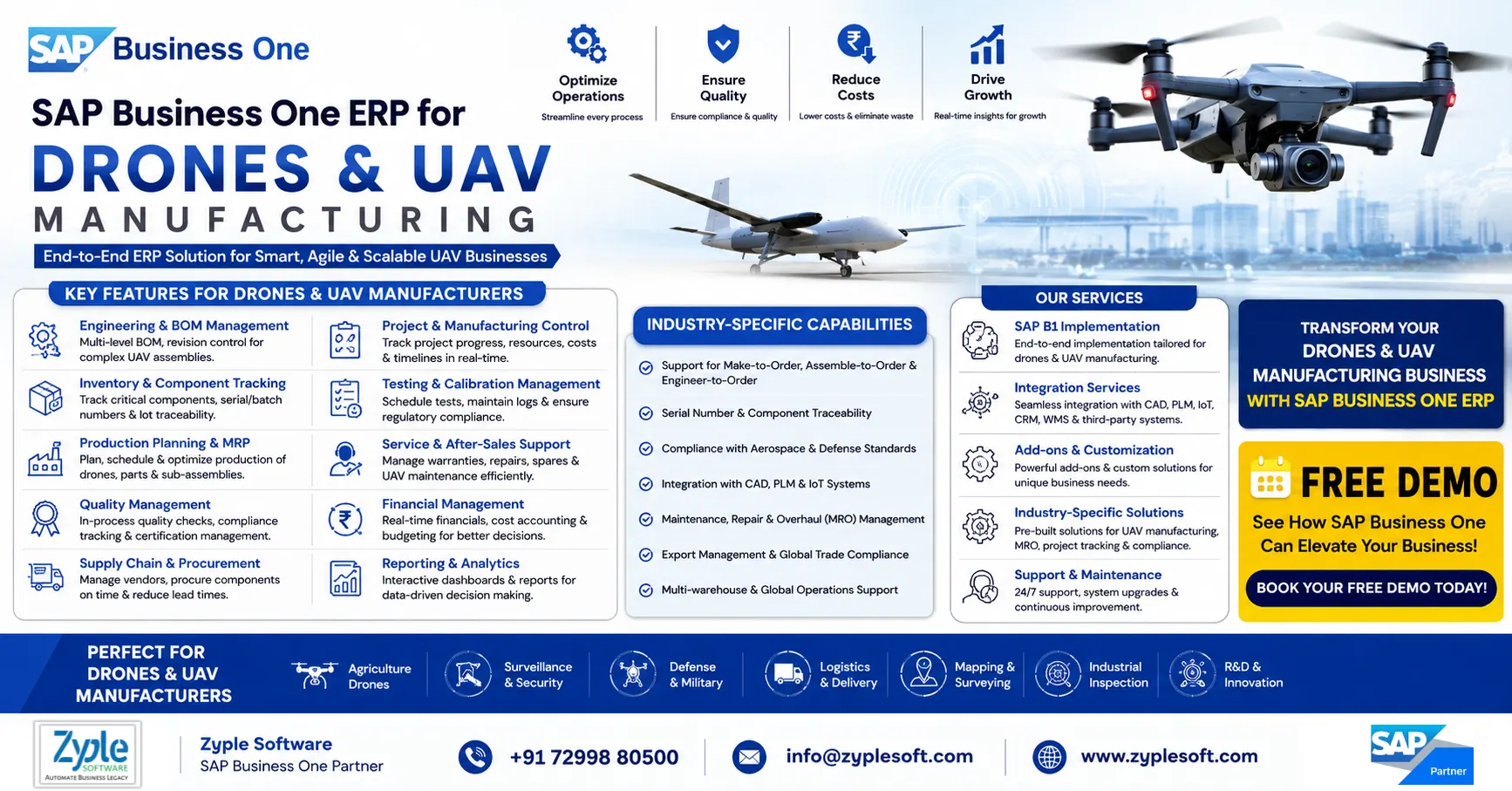
          SAP Business One ERP for Drones and UAV Manufacturing by Zyple Software featuring production planning, inventory management, BOM, quality control, serial number traceability, compliance, and manufacturing automation.

          SAP Business One ERP for Drones and UAV Manufacturing

          SAP Business One (B1) ERP for Drones and UAV Manufacturing

          SAP Business One ERP for Drones and UAV Manufacturing by Zyple Software featuring production planning, inventory management, BOM, quality control, serial number traceability, compliance, and manufacturing automation.

          The drones and UAV manufacturing industry, which includes things like aerial photography, surveillance, and farming, is growing. While drones are excellent, running a business in the drones and UAV manufacturing industry can be tricky. Handling everything from fleet coordination to regulatory compliance can become overwhelming. SAP Business One ERP for drones and UAV manufacturing can help drones and UAV manufacturing companies to simplify their work and reach new levels of success.

          Issues Faced By The Drones and UAV Manufacturing Sector

          The drones and UAV manufacturing industry faces significant challenges across supply chain dependencies, regulatory obstacles, and engineering limitations. Manufacturers struggle with reliance on imported microchips, sensors, and battery cells; scaling production without inflating costs; and complying with fragmented global airspace and certification rules.

          1. Supply Chain and Component Dependency

          Many regional UAV manufacturers depend heavily on foreign suppliers for essential components like GPS modules, battery cells, semiconductors, and high-performance cameras. This dependency creates serious vulnerabilities regarding both national security and supply chain disruptions. Developing an independent, domestically sourced non-red supply chain requires massive capital investment.

          2. Regulatory and Compliance Constraints

          Despite the rapid growth of the commercial drone market, government regulations often lag behind. Manufacturers face inconsistent airspace management, delays in gaining airworthiness certifications, and strict export controls. Navigating the complexities of local, national, and international laws significantly increases time-to-market.

          3. Engineering and Technological Challenges

          Designers continuously battle the trade-off between weight reduction and structural durability. Drones must be lightweight to increase flight efficiency and payload, yet powerful enough to withstand harsh environmental conditions. Also, improving battery endurance for continuous, long-range missions remains a primary engineering constraint.

          4. Privacy, Security, and Public Perception

          Because of the dual-use nature of UAVs, manufacturers face scrutiny regarding privacy, hacking, and unauthorized data collection. Instances of hobbyist drones entering restricted zones or being used for illegal activities lead to strict regulations and public skepticism.

          5. Skilled Workforce Shortage

          The rapid integration of artificial intelligence, edge computing, and 5G into drone platforms involves highly specialized knowledge. The industry faces a shortage of professional drone engineers, AI developers, and trained operators.

          Features of SAP Business One ERP for Drones and UAV Manufacturing

          1. Production Planning and Control (UAV Assembly)

          • Multi-level bill of materials (BOM) for drone components like motors, sensors, PCBs, and frames.
          • Routing and stage-wise production like assembly, testing, and calibration.
          • Production order creation, like manual or automated, from sales orders.
          • It includes real-time tracking of work-in-progress (WIP).
          • Assembly and sub-assembly, like propulsion systems and flight controllers.
          • It includes rework and repair order handling for defective UAV units.

          2. Material Requirements Planning (MRP)

          • It includes automated material planning based on demand forecasts.
          • Component shortage alerts for essential UAV parts like chips and batteries.
          • It includes procurement recommendations using the planning wizard.
          • It includes demand-supply balancing for high-value electronic components.
          • It includes lead time planning for imported drone parts.

          3. Inventory and Warehouse Management

          • Multi-warehouse management for raw materials, assembly, and finished drones.
          • It includes batch and serial number tracking for UAV traceability.
          • It includes real-time inventory visibility across locations.
          • It includes stock valuation and costing.
          • It includes inventory traceability for compliance and safety.

          4. Engineering and Product Lifecycle Support

          • It includes version control for drone designs and BOM revisions.
          • It includes engineering change management.
          • It includes prototype vs. production BOM handling.
          • It includes integration with CAD or PLM systems via add-ons.
          • Product configuration for different drone variants for defense, agriculture, and surveillance.

          5. Financial Management and Costing

          • End-to-end accounting like general ledger, accounts payable, and accounts receivable.
          • It includes profitability analysis per UAV model.
          • It includes budgeting and cost control for R&D projects.
          • It includes fixed asset management for machinery and testing equipment.

          6. Procurement and Supplier Management

          • It includes vendor management for electronics, sensors, and components.
          • It includes purchase order automation and approvals.
          • It includes supplier performance tracking.
          • Import management like duties, taxes, and multi-currency.
          • It includes quality-based vendor selection.

          7. Quality Control and Compliance

          • Incoming quality checks for components like battery safety and sensors.
          • It includes in-process inspection during UAV assembly.
          • It includes final testing and certification tracking.
          • It includes non-conformance and corrective action management.
          • It includes compliance with aerospace and defense standards.
          • It includes full product traceability for audits.

          8. Sales, CRM, and Project Management

          • It includes quotation management for customized UAV solutions.
          • Customer lifecycle tracking like defense, agriculture, and logistics clients.
          • Project-based sales like large UAV contracts.
          • It includes after-sales service and AMC tracking.

          9. Service and Maintenance Management

          • It includes UAV repair and maintenance tracking.
          • It includes warranty management for drones and components.
          • It includes service contracts and field service management.
          • It includes spare parts tracking and replacement history.
          • It includes maintenance schedules for deployed drains.

          10. Business Intelligence and Analytics

          • It includes real-time dashboards and KPIs.
          • It includes production efficiency and yield analysis.
          • It includes cost vs. revenue insights for every drone model.
          • It includes predictive analytics using SAP B1 HANA.
          • It includes custom reports and drill-down analysis.

          11. Supply Chain and Logistics Management

          • It includes end-to-end supply chain visibility.
          • It includes shipment and delivery tracking.
          • It includes integration with logistics partners.
          • It includes export documentation for international drone sales.
          • It includes demand forecasting and distribution planning.

          12. Mobility and Remote Access

          • It includes a web client for remote operations.
          • It includes real-time updates from the shop floor or warehouses.

          13. Integration and Industry 4.0 Capabilities

          • Integration with IoT devices like drone testing data and sensors.
          • It includes API-based integration with external systems.
          • It includes machine data collection from testing rigs.
          • It includes automation of workflows and approvals.
          • It includes cloud or on-premise deployment flexibility.

          14. Human Resource and Workforce Management

          • It includes employee data and workforce tracking.
          • It includes skill-based allocation for UAV assembly technicians.
          • It includes attendance and productivity monitoring.
          • It includes training management for specialized drone operations.

          15. Security and Data Management

          • It includes role-based access control.
          • It includes data encryption and secure transactions.
          • It includes audit trails for compliance.
          • It includes backup and disaster recovery.

          Benefits of SAP Business One ERP for Drones and UAV Manufacturing

          The ERP software, SAP Business One (SAP B1) system, facilitates the entire lifecycle of drone and UAV manufacturing by integrating design, production, supply chain, and financials. It helps businesses reduce margin surprises, comply with strict aviation safety compliances, and track components from raw material to final deployment.

          1. End-to-End Traceability and Compliance

          It tracks every part, batch, and serial number across the supply chain with the SAP implementation process. It securely stores compliance documents and ensures adherence to strict aviation standards (like AS9100 and DGCA regulations).

          2. Intelligent Production and BOMs

          Handles deeply nested, multi-level Bills of Materials (BOMs) and supports engineering change orders (ECOs) to safely apply rapid design upgrades to your drones.

          3. Automated Material Requirements Planning (MRP)

          Automatically calculates exactly what metals, composites, and electronics are required based on sales orders and forecasts, avoiding stock shortages or expensive excess inventory using SAP solutions.

          4. Project-Based Costing

          Treats every UAV build or defense contract as an individual project. It ties production to financials so you can closely evaluate the profitability of custom or large-scale orders.

          5. Real-Time Quality Control

          Connects quality checkpoints directly into the shop floor assembly process, logging inspection results and digital certificates at every stage.

          Conclusion of Drones and UAV Manufacturing ERP

          As a leading SAP Business One partner, Zyple Software is delivering services like SAP B1 implementation, licensing, integration, add-ons, and support to different industries, like construction, manufacturing, solar, aerospace, jewellery, food and beverage, retail, pharma, and textiles. 

          SAP Business One is an ERP customized for small and medium-sized businesses that connects finance, procurement, production, sales, CRM, inventory, and reporting into one platform. For drones and UAV manufacturing or any other companies, it can improve project costing, procurement, subcontractor billing, and inventory management.

          If you’re captivated, Book a SAP Business One Demo.

          Do you seek the SAP B1 ERP system for your business or industry?

          Finish all the details in the assigned contact form; our team will return to you.

            FAQs

            1.How can SAP Business One ERP improve efficiency in drone manufacturing operations?

            SAP Business One facilitates production planning, inventory control, and procurement processes, helping drone manufacturers minimize delays, optimize resources, and improve overall operational efficiency.

            Yes, SAP Business One is specifically customized for SMEs. It provides scalable features that help growing UAV businesses handle production, finances, and supply chain operations without complexity.

            Absolutely. SAP Business One delivers batch and serial number tracking, along with quality management features to ensure every drone component meets required standards and compliance.

            The cost depends on factors, such as number of users, customization, and deployment type. However, SAP Business One is affordable compared to traditional ERP systems and delivers strong ROI through improved efficiency and reduced operational costs.

            You can connect with a certified SAP Business One partner like Zyple Software to get a personalized demo, consultation, and pricing details customized for your drone manufacturing business requirements.

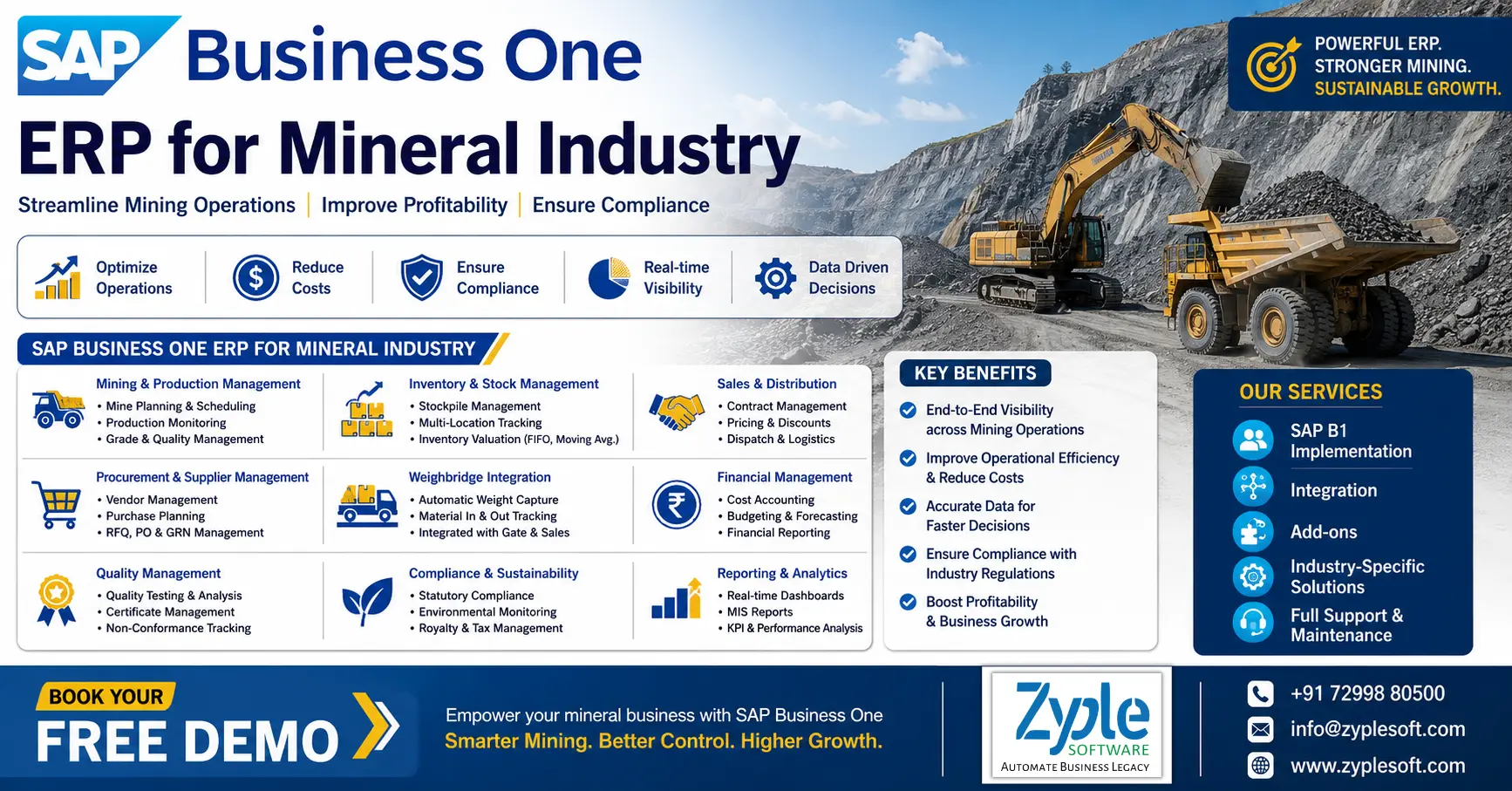
            SAP Business One ERP for Mineral Industry

            SAP Business One ERP for Mineral Industry

            SAP Business One ERP for Mineral Industry

            SAP Business One ERP for Mineral Industry

            The mineral industry is fast-paced and depends heavily on data. Mineral companies handle drilling schedules, blasting records, fleet operations, fuel usage, quarry production, material movement, and environmental compliance, all while ensuring maximum output and worker safety. SAP Business One ERP for mineral industry helps mineral companies improve their operations and grow sustainably.

            Challenges Faced By The Mineral Industry

            The mineral industry is undergoing a massive transformation, largely driven by increasing demand for essential minerals required for the clean energy transition. Today, mineral companies face a complex web of environmental, operational, and geopolitical challenges that threaten both profitability and sustainability growth.

            1. Environmental and Sustainability Demands

            The sector is heavily scrutinized for its environmental impact, including land degradation, water contamination, and greenhouse gas emissions. Achieving strict sustainability standards and transitioning to green mining practices is a major, yet necessary, operational shift.

            2. Declining Ore Grades and Cost Escalations

            Naturally occurring ore grades are dropping, meaning companies must process more rock to extract the same amount of valuable minerals. This involves exploring in more remote locations, which increases project costs and ongoing operational expenses.

            3. Geopolitical and Supply Chain Risks

            Trade conflicts, shifting government policies, and global tensions directly interrupt the supply of raw materials and technology. Geopolitical shifts and resource shortages have heightened supply chain risks for essential commodities like lithium and rare earths.

            4. The Skills Gap and Knowledge Loss

            As veteran miners retire, the industry faces an ongoing shortage of experienced workers who understand complex, modern mining technologies. Operating in remote locations further aggravates the difficulty of attracting and retaining specialized talent.

            5. Health, Safety, and Operational Hazards

            Mining requires inherently hazardous working conditions and complex geological formations. Ensuring worker safety around heavy machinery, explosives, and confined spaces remains a major, non-negotiable priority.

            6. Social License to Operate and Regulatory Compliance

            Mining projects are increasingly delayed by complex regulatory permitting and community opposition. Companies must navigate evolving regulations while building trust with local communities and indigenous populations who are directly affected by land use.

            Features of SAP Business One ERP for Mineral Industry

            1. Exploration and Mine Planning Management

            • It includes geological data tracking and mineral resource estimation.
            • It includes long-term and short-term mine planning.
            • It includes budgeting for exploration and feasibility studies.
            • It includes integration with survey and drilling data.
            • It includes capital expenditure (CAPEX) planning for mining projects.
            • Helps handle the entire lifecycle from exploration to production.

            2. Production and Extraction Management

            • It includes track drilling, blasting, excavation, and hauling.
            • Monitors ore extraction volumes and grades.
            • It includes crushing, screening, and beneficiation process tracking.
            • It includes production planning and scheduling.
            • It includes real-time production data collection.
            • SAP supports optimization of mining processes and production planning.

            3. Inventory and Stockpile Management

            • It includes raw material (ore), processed minerals, and by-product tracking.
            • Batch-wise and location-wise inventory, like stockpiles, yards, and warehouses.
            • It includes quality and grade-based inventory classification.
            • It includes automatic stock updates from weighbridge integration.
            • It includes minimum and maximum stock level alerts.

            4. Supply Chain and Logistics Management

            • End-to-end logistics from mine, plant, and port to customer.
            • It includes transport and fleet management.
            • It includes route planning and shipment tracking.
            • It includes bulk material handling and dispatch planning.
            • It includes vendor and contractor coordination.
            • It ensures a resilient supply chain and logistics optimization.

            5. Financial and Cost Management

            • It includes mine-wise and project-wise costing.
            • It includes production cost per ton analysis.
            • It includes budget vs. actual comparisons.
            • It includes asset depreciation and capital tracking.
            • Multi-location financial integration.
            • It includes GST and tax compliance.
            • Allows real-time financial visibility and forecasting.

            6. Asset and Equipment Management

            • Maintenenace scheduling, like preventive and breakdown.
            • It includes equipment lifecycle tracking.
            • It includes spare parts inventory management.
            • It includes machine downtime analysis.
            • It includes fuel consumption tracking.
            • Improves asset uptime and minimizes operational costs.

            7. Workforce and Contractor Management

            • It includes employee scheduling and shift planning.
            • It includes contractor and labor management.
            • It includes attendance and payroll integration.
            • It includes safety certifications and compliance tracking.
            • It includes workforce productivity analysis.
            • It supports workforce optimization and safety culture.

            8. Compliance, Safety, and Environmental Management

            • It includes mining permits and license tracking.
            • Environmental compliance, like pollution and land usage.
            • It includes safety incident reporting and audits.
            • It includes ESG (Environmental, Social, and Governance) reporting.
            • It includes regulatory documentation management.
            • Helps achieve strict mining regulations and sustainability goals.

            9. Sales, Contracts, and Commodity Management

            • Mineral sales contracts and pricing, like grade-based pricing.
            • It includes customer order management.
            • It includes dispatch, billing, and invoicing automation.
            • It includes commodity trading and contract lifecycle management.
            • It includes customer relationship management (CRM).

            10. Real-Time Analytics and Reporting

            • It includes real-time dashboards for production, finance, and logistics.
            • KPI tracking like cost per ton, output efficiency, and downtime.
            • It includes custom MIS and regulatory reports.
            • It includes data-driven decision-making.
            • Allows data-driven insights and performance optimization.

            11. Integrated End-to-End ERP Platform

            • It includes a single system integrating finance, production, inventory, and sales.
            • Eliminates data storage across departments.
            • It includes cloud or on-premise deployment.
            • It includes integration with IoT, weighbridges, GPS, and third-party tools.
            • Delivers enterprise-wide planning, execution, and reporting.

            Importance of SAP Business One ERP for Mineral Industry

            The ERP software, SAP Business One, is essential for the mineral industry, as it unifies disconnected operations into a single platform. It delivers immediate value by handling heavy machinery assets, optimizing complex supply chains, ensuring strict regulatory compliance, and centralizing real-time data for accurate financial and production planning.

            1. Integrated Financial Management

            Delivers robust budgeting, audit-ready reporting, and precise fixed-asset tracking to manage heavy extraction equipment and depreciation with the SAP implementation process.

            2. Supply Chain and Inventory Optimization

            Maintains optimal stock levels for essential spare parts and mining supplies to prevent costly production downtimes.

            3. Compliance and Safety

            Facilitates documentation and auditable data to help mining companies effortlessly meet strict environmental and labor regulations.

            4. Material Requirements Planning (MRP)

            Improves resource utilization by intelligently handling raw materials and aligning procurement with production schedules using SAP solutions.

            5. Real-Time Dashboards

            Replaces scattered spreadsheets with centralized analytics, providing leaders a clear mine-to-market view of cost performance and operational efficiency.

            Benefits of SAP Business One for Mining Industry

            SAP Business One (SAP B1) facilitates capital-intensive mining operations by integrating core processes like extraction planning, heavy equipment maintenance, procurement, and financial tracking. It delivers real-time data to help mining companies control costs, optimize supply chains, and ensure strict regulatory and ESG compliance.

            1. Financial Management and Cost Control

            The SAP software accurately tracks real-time costs of fuel, labor, and machinery. It uses built-in budgeting and profitability analyses to monitor expenses across individual projects or specific mine sites.

            2. Asset and Equipment Maintenance

            Reduces costly unplanned downtime by scheduling predictive and preventive maintenance for heavy mining machinery. Tracks equipment lifecycles and evaluates repair histories efficiently.

            3. Inventory and Supply Chain Orchestration

            Maintains optimal stock levels of crucial consumables and spare parts using SAP B1 add-ons. Facilitates procurement processes from purchase requests to supplier contracts and payment management.

            4. Regulatory and ESG Compliance

            Simplifies reporting for stringent labor laws and environmental standards. Captures safety logs and sustainability metrics to ensure audit readiness.

            5. Data-Driven Production Planning

            Uses production planning and integrated analytics to optimize extraction schedules based on market demand and resource availability.

            Conclusion of Mineral ERP

            As a qualified SAP Business One partner, Zyple Software is delivering services like SAP B1 implementation, licensing, integration, add-ons, and support to different industries, like construction, manufacturing, solar, jewellery, food and beverage, aerospace, retail, pharma, and textiles. 

            SAP Business One is an ERP customized for small and medium-sized businesses that connects finance, production, procurement, inventory, sales, CRM, and reporting into one platform. For mineral or any other companies, it can improve project costing, procurement, subcontractor billing, and inventory management.

            If you’re adaptable, appoint a demo of SAP Business One.

            Do you look for the SAP B1 ERP solution for your business or industry?

            Finish all the details in the arranged contact form; our team will reach out to you.

              FAQs

              1.What is SAP Business One and how does it benefit the mineral industry?

              SAP Business One is an integrated ERP solution customized for small and midsize businesses. For the mineral industry, it helps handle mining operations, inventory, procurement, sales, finance, and compliance in one system, improving efficiency and reducing operational costs.

              Yes, SAP Business One delivers real-time inventory tracking, batch and serial number management, and warehouse control. It enables mineral businesses to handle stockpiles, track material movement, and reduce losses due to mismanagement or theft.

              SAP Business One supports production planning, resource allocation, and equipment utilization. It helps evaluate extraction processes, handle raw material usage, and optimize production cycles to improve output and profitability.

              Absolutely. The system helps maintain accurate records, generate compliance reports, and monitor environmental and safety regulations. This ensures your business stays adherent to industry standards and government policies.

              You can start by consulting a certified SAP Business One partner like Zyple Software who will evaluate your business needs, provide a demo, and guide you through implementation, customization, and support to ensure a smooth digital transformation.

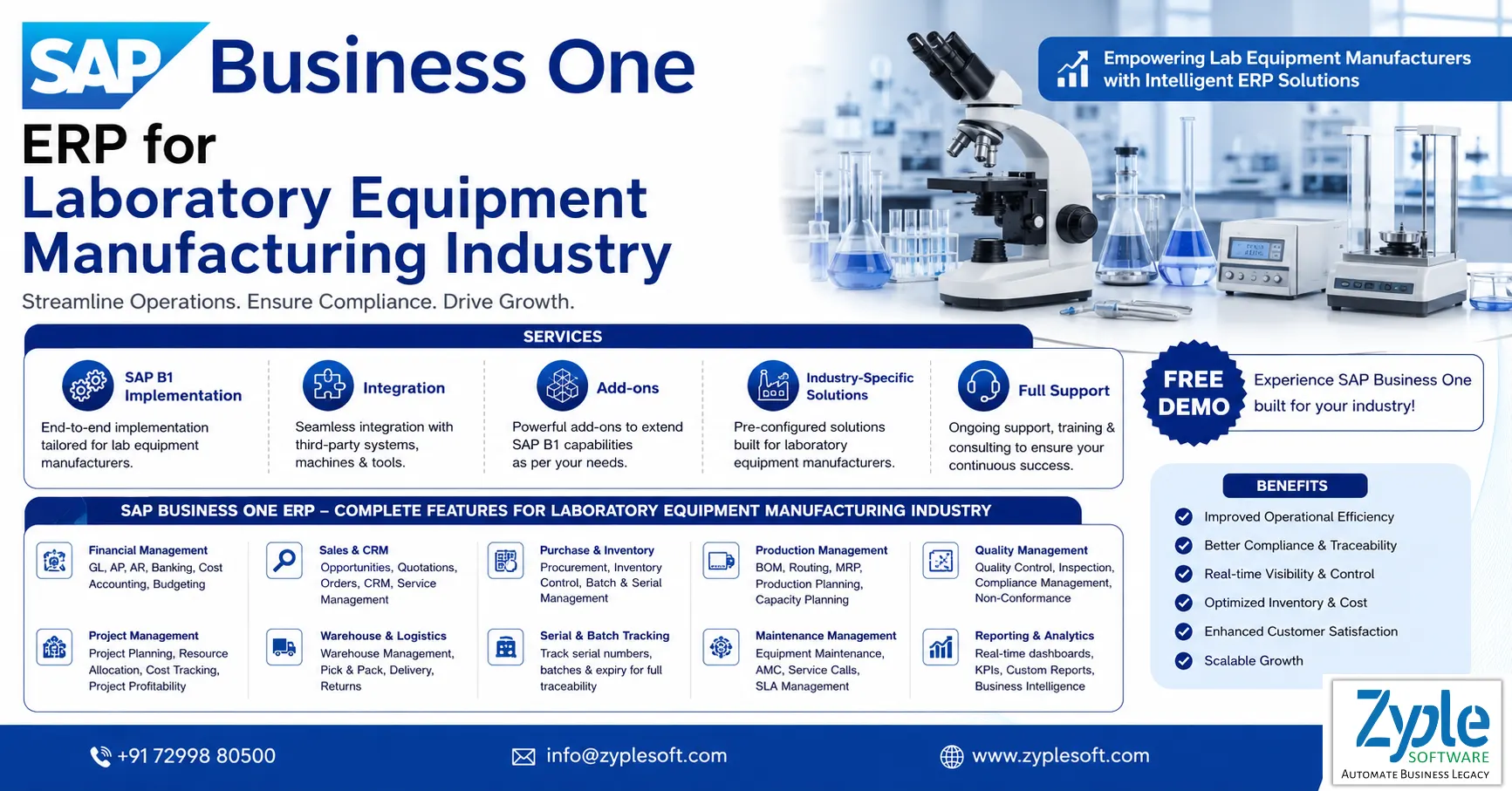
              SAP Business One ERP for Laboratory Equipment Manufacturing Industry infographic by Zyple Software featuring implementation, integration, add-ons, compliance, inventory, production, quality management, and analytics.

              SAP Business One ERP for Laboratory Equipment Manufacturing Industry

              SAP Business One ERP Software for Laboratory Equipment Manufacturing Industry

              SAP Business One ERP for Laboratory Equipment Manufacturing Industry infographic by Zyple Software featuring implementation, integration, add-ons, compliance, inventory, production, quality management, and analytics.

              The laboratory equipment manufacturing industry operates under strict quality standards, regulatory pressure, and rising competition. Manufacturers must handle complex production workflows, ensure complete traceability, and maintain consistent quality while scaling operations. SAP Business One ERP for laboratory equipment manufacturing delivers a structured ERP foundation to handle these challenges and support long-term growth without operational chaos.

              Challenges Faced By The Laboratory Equipment Manufacturing Industry

              The laboratory equipment manufacturing industry faces strict regulatory compliance, rapid technological obsolescence, and miniaturization demands. Companies struggle with supply chain disruptions, a shortage of skilled labor for complex mechatronic systems, and fierce global competition, all of which heavily squeeze profit margins and increase time to market.

              1. Strict Regulatory Compliance

              Manufacturers must handle evolving global standards such as GLP, GMP, and ISO certifications. Continuously updating designs to achieve these mandates creates massive administrative burdens.

              2. Component Shortages and Supply Chain

              The industry is heavily dependent on precise, specialized sub-components. Global supply chain volatility often results in prolonged lead times, inflating manufacturing and service costs.

              3. Skill Gaps in Development and Assembly

              Building complex mechatronic systems involves advanced specialist knowledge in software integration, automation, and electronics. Small and mid-scale manufacturers often lack the engineering manpower and high-end production infrastructure required to scale.

              4. Device Integration and Compatibility

              Laboratories frequently use instruments from different vendors. Disparate software systems, differing communication protocols, and the lack of universal standards hamper seamless data flow and integration.

              5. Equipment Downtime and Service Pressures

              Executives place huge pressure on equipment uptime to prevent costly research or sample losses. Extended resolution times for repairs and complex maintenance cycles severely affect operational efficiency and customer satisfaction.

              Features of SAP Business One ERP for Laboratory Equipment Manufacturing

              1. End-to-End Manufacturing Management

              • It includes bill of materials (BOM) for complex lab instruments.
              • It includes multi-level production orders and routing.
              • It includes production planning and control based on demand forecasts.
              • It includes batch and serial number tracking for precision components.
              • It includes real-time shop floor control and reporting.

              2. Quality Control and Compliance Management

              • It includes quality inspection at incoming, in-process, and final stages.
              • It includes non-conformance and corrective action tracking (CAPA).
              • It includes compliance with ISO, GMP, FDA, and calibration standards.
              • It includes audit trail and documentation management.
              • It includes calibration scheduling and tracking for lab equipment.

              3. Inventory and Warehouse Management

              • It includes real-time inventory tracking across warehouses.
              • It includes batch or lot traceability for service components.
              • It includes automated stock replenishment and reorder levels.
              • It includes handling of hazardous or sensitive materials.
              • It includes barcode and RFID integration.

              4. Product Lifecycle Management

              • It includes engineering change management.
              • It includes version control for product designs and specifications.
              • It includes integration with CAD systems.
              • It includes prototype and R&D cost tracking.

              5. Advanced Material Requirements Planning (MRP)

              • It includes demand-driven MRP for raw materials and components.
              • It includes forecasting based on historical sales and trends.
              • It includes supplier lead time management.
              • Reduces stockouts and excess inventory.

              6. Supplier and Procurement Management

              • It includes vendor evaluation and performance tracking.
              • It includes automated purchase requests and approvals.
              • It includes supplier pricing and contract management.
              • It includes integration with global supply chains.

              7. Financial Management and Cost Control

              • It includes real-time financial reporting and analytics.
              • Product costing like standard, moving average, and FIFO.
              • It includes budgeting and cost center tracking.
              • It includes multi-currency and multi-location support.
              • It includes GST compliance for India.

              8. Sales and Customer Relationship Management (CRM)

              • It includes lead and opportunity management.
              • It includes quotation and sales order automation.
              • It includes customer-specific pricing and contracts.
              • It includes after-sales service tracking for lab equipment.
              • It includes warranty and service contract management.

              9. Service and Maintenance Management

              • It includes installation and commissioning tracking.
              • It includes preventive and corrective maintenance scheduling.
              • It includes service call management.
              • It includes spare parts inventory integration.
              • It includes field service technician management.

              10. Business Intelligence and Reporting

              • It includes real-time dashboards and KPIs.
              • It includes custom reports for production, quality, and finance.
              • It includes predictive analytics for demand and maintenance.
              • It includes integration with Excel and analytics tools.

              11. Integration and Scalability

              • Seamless integration with third-party systems like LIMS, CAD, and MES.
              • It includes API-based connectivity.
              • It includes cloud and on-premise deployment options.
              • Adaptable for growing manufacturing businesses.

              12. Data Security and Regulatory Compliance

              • It includes role-based access control.
              • It includes data encryption and secure backups.
              • It includes compliance with industry regulations.
              • It includes full audit trails for traceability.

              13. Mobility and Remote Access

              • It includes remote access to dashboards and reports.
              • It includes real-time alerts and notifications.

              14. Customization and Industry-Specific Add-Ons

              • It includes customization workflows for laboratory equipment manufacturing.
              • It includes industry-specific SAP B1 add-ons for calibration and compliance.
              • It includes flexible user-defined fields and reports.

              15. Project Management Capabilities

              • Tracks R&D and custom equipment projects.
              • It includes budget vs. actual cost tracking.
              • It includes resource allocation and scheduling.
              • It includes milestone-based project monitoring.

              Importance of SAP Business One ERP for Laboratory Equipment Manufacturing

              The ERP software, SAP Business One (SAP B1) system, is essential for laboratory equipment manufacturers, as it unifies core processes, including finance, supply chain, and production, into a single source of truth. It allows highly precise manufacturing, strict regulatory compliance, and seamless tracking of expensive components, ultimately boosting operational efficiency and profit margins.

              1. Strict Regulatory Compliance

              The industry requires thorough quality control and traceability. SAP B1 automates quality checks, maintains audit-ready documentation, and monitors components so that manufacturers can easily adhere to global standards like ISO and FDA regulations.

              2. Precise Production Management

              Utilizing multi-level bill of materials (BOMs) and material requirements planning (MRP), the software helps handle complex assembly. It ensures you have the exact components needed to build precision instruments without holding excess stock using SAP implementation.

              3. Granular Traceability

              Every piece of lab equipment, from sensors to centrifuges, can be serialized. This enables manufacturers to trace the exact batch or serial number of an item from raw material procurement through to post-sales maintenance and service.

              4. Real-Time Financial and Inventory Visibility

              SAP B1 eliminates data silos. Real-time dashboards track machine utilization, labor costs, and project profitability, enabling leadership to make accurate, data-driven decisions.

              5. Supply Chain Optimization

              It reduces the risk of stock-outs or overstocking for specialized, often costly, materials required for lab equipment, ensuring on-time delivery and higher customer satisfaction using SAP solutions.

              Benefits of SAP Business One for Laboratory Equipment Manufacturing Industry

              SAP Business One (SAP B1) facilitates your lab equipment manufacturing by centralizing finance, supply chain, and production. It drives ROI through accurate BOM management, serial or batch traceability, and automated material requirements planning (MRP), minimizing carrying costs and ensuring strict industry compliance.

              1. Precision Manufacturing

              Utilizes powerful bill of materials (BOM) features to standardize production, control costs, and handle complex, multi-level assemblies required for sensitive scientific instruments.

              2. Total Traceability

              The SAP software tracks individual components, batches, and serial numbers from procurement to finished goods. This makes managing warranties and handling audits for ISO and regulatory compliance efficient.

              3. Optimized Inventory and Procurement

              The material requirements planning (MRP) system automatically computes purchasing and production needs based on forecasts and lead times, avoiding production delays and stockouts.

              4. Real-Time Analytics

              Unifies financial, sales, and operational data into customizable dashboards using SAP B1 add-ons. This allows data-driven decisions that immediately improve profit margins.

              5. Integrated CRM

              Strengthens customer relationships by managing leads, tracking after-sales service, and logging maintenance or calibration histories in a single platform.

              Conclusion of Laboratory Equipment Manufacturing ERP

              As a qualified SAP Business One partner, Zyple Software is providing services like SAP B1 implementation, integration, licensing, add-ons, and support to different industries like construction, manufacturing, retail, pharma, jewellery, solar, food and beverage, aerospace, and textile industries. SAP Business One is an ERP customized for small and medium-sized businesses that integrates finance, purchasing, sales, inventory, production, CRM, and reporting into a single platform. For solar panel and laboratory equipment manufacturing or any other companies, it can improve project costing, procurement, subcontractor billing, and inventory management.

              If you’re engaged, reserve a demo of SAP Business One.

              Do you necessitate the SAP B1 ERP system for your business or industry?

              Finish all the details in the described contact form; our team will get back to you.

                Frequently Asked Questions

                How can SAP Business One improve efficiency in my laboratory equipment manufacturing business?

                SAP Business One automates key processes like production planning, inventory control, and financial management, helping you minimize manual work, eliminate errors, and improve overall efficiency.

                Yes, SAP Business One is specifically designed for SMEs and growing manufacturers. It providesscalable features that adapt to your business size and complexity.

                The cost depends on factors like number of users, customization needs, and deployment type (like cloud or on-premises). We deliver customized pricing based on your requirements; reach out today for a free consultation and quote.

                The SAP B1 implementation timelines generallyrange from a few weeks to a few months, depending on your business processes. Speak with our team to get a clear project timeline customized for your needs.

                Absolutely! We provide live demos to help you understand how SAP Business One fits your laboratory equipment manufacturing processes.

                Infographic of SAP Business One ERP for Watches and Precision Instruments Industry by Zyple Software featuring implementation, integration, add-ons, inventory management, production planning, quality control, serial tracking, CRM, finance, and free demo.

                SAP Business One ERP for Watches and Precision Instruments Industry

                SAP Business One (B1) ERP for Watches and Precision Instruments Industry

                Infographic of SAP Business One ERP for Watches and Precision Instruments Industry by Zyple Software featuring implementation, integration, add-ons, inventory management, production planning, quality control, serial tracking, CRM, finance, and free demo.

                The watches and precision instruments industry operates in a precision-driven environment where product quality, component traceability, and efficient assembly processes are essential. Manufacturers must handle a wide range of small and specialized components such as movements, dials, hands, cases, straps, and batteries while maintaining strict quality standards and design consistency. 

                Traditional systems and manual processes often create challenges in tracking component inventory, handling multi-level bills of materials, coordinating assembly operations, and ensuring product traceability. SAP Business One ERP for watches and precision instruments delivers an integrated platform that connects production planning, component inventory, procurement, quality control, sales, and financial management, providing real-time visibility and operational control across the watch manufacturing cycle.

                Challenges Faced By The Watches and Precision Instruments Industry

                The watches and precision instruments industry faces severe challenges, mainly driven by surging raw material costs (e.g., gold), restrictive geopolitical tariffs on exports, and aggressive competition from multifunctional watches. Consequently, traditional watchmakers are battling declining demand in mid-tier segments, falling secondary market inventories, and recent job contradictions across manufacturing.

                1. Macroeconomic Pressures and Trade Barriers

                International trade wars, including heavy tariffs on Swiss products entering the US, are forcing major shifts in inventory management and supply chain operations. Rising prices for precious metals like gold and platinum directly inflate manufacturing costs, squeezing profit margins, especially for mid-tier luxury and mechanical brands. The strength of the Swiss Franc remains a constant pressure, making exported traditional timepieces significantly more expensive for global buyers.

                2. Technological Shifts and Smartwatch Disruption

                Smartwatches and fitness trackers have evolved into digital health ecosystems, providing biometric tracking like ECG and SpO2, GPS, and phone connectivity. Younger generations are growing accustomed to the daily utility of connected wearables, seriously cutting into the entry-level and mass-market traditional watch segments. While smartwatches dominate, traditional instruments still hold the advantage of longevity. Smart devices suffer from quick battery drain and require daily charging.

                3. Market Saturation and Inventory Struggles

                The pre-owned and secondary markets are experiencing a surplus, causing waiting lists to shrink and secondary-market prices for previously high-demand watches to drop. Watches are remaining on retailer shelves and in dealer cases for much longer, reducing inventory turnover and revenue flow. There is a growing consensus that the market has too many brands chasing the same limited pool of high-net-worth consumers.

                4. Innovation vs. Trading

                Many established brands face criticism for taking extended periods to update designs or integrate modern clasps and bracelets, enabling newer, nimbler competitors to gain traction. While companies explore automated processes and industry 4.0 to scale production, true haute horlogerie depends on master artisans. Hand-finishing places a natural ceiling on production efficiency and output. Luxury watchmakers who attempt to create their own smartwatches or digital ecosystems have historically struggled with poor adoption and mixed results.

                5. Consumer Shifts and Sustainability

                Younger consumers desire highly personalized products and customizable components rather than mass-produced heritage pieces. There is an increased demand for sustainable and ethical sourcing of materials like conflict-free metals and vegan straps, forcing brands to adapt their supply chains.

                Features of SAP Business One ERP for Watches and Precision Instruments

                1. Core Manufacturing and Production Management

                • It includes multi-level BOMs for complex watch parts and instrument parties.
                • Plans, releases, and tracks batch or discrete manufacturing.
                • Defines machining, calibration, polishing, and assembly steps.
                • Optimizes machine utilization like CNC, micro-machining, and assembly lines.
                • Monitors partially assembled components.
                • Aligns production with demand and delivery timelines.
                • Handles production across multiple facilities.

                2. Inventory and Warehouse Management

                • It includes raw materials, components, and finished goods.
                • Essential for the traceability of precision instruments.
                • It includes efficient storage of small and high-value parts.
                • Handles distribution centers and production stores.
                • Avoids shortages of essential micro-components.
                • It includes cycle counting and stock audits.

                3. Quality Control and Compliance

                • Defines QC parameters for each stage.
                • Tracks calibration of instruments and tools.
                • Detects and handles defects.
                • It includes ISO, CE, and industry-specific standards.
                • It includes end-to-end tracking from raw material to finished product.

                4. Financial Management and Cost Control

                • Fully automated financial processes like general ledger, accounts payable, and accounts receivable.
                • It includes accurate costing for precision components and assemblies.
                • Monitors manufacturing expenses.
                • Suitable for global exports.
                • Handles high-value machinery and tools.
                • It includes product-wise and batch-wise margins.

                5. Procurement and Supplier Management

                • Maintains supplier data for precision parts.
                • Automates procurement cycles.
                • Evaluates vendor performance.
                • Facilitated procurement workflow.
                • Ideal for global sourcing.

                6. Sales, CRM, and After-Sales Service

                • Handles distributors, retailers, and OEM clients.
                • Sales order management from quotation to delivery cycle.
                • Essential for watches and instruments.
                • It includes after-sales service management.
                • It includes customer analytics and forecasting.

                7. Business Intelligence and Analytics

                • Real-time dashboards and KPIs for production, quality, and sales insights.
                • Drill-down analytics and custom reports for operations.
                • It includes demand forecasting and planning.
                • Excel integration for advanced reporting capabilities.

                8. Production Planning and MRP (Material Requirements Planning)

                • Demand forecasting is based on sales and historical data.
                • Automates material procurement and production planning.
                • Ensures timely availability of precision parts.
                • Minimizes inventory holding costs.

                9. Engineering and Product Lifecycle Support

                • Engineering change management to handle design revisions.
                • Version control for BOMs tracks changes in product design.
                • It includes integration with CAD and PLM systems.
                • It includes prototype and custom order handling.

                10. Mobility, Integration, and Automation

                • It includes mobile access to ERP on the go.
                • It connects CNC and testing equipment using IoT and machine integration.
                • Automated workflows and alerts reduce manual intervention.
                • Third-party integration with MES, e-commerce, and logistics.

                11. Industry-Specific Capabilities for Watches and Precision Instruments

                • It includes high-precision traceability for micro-components.
                • It includes strong quality assurance and calibration tracking.
                • It includes efficient batch and serial production handling.
                • It includes support for global supply chains and exports.
                • It includes improved time-to-market for new designs.

                Benefits of SAP Business One ERP for Watches and Precision Instruments

                The ERP software, SAP Business One (SAP B1) system, is an affordable ERP designed for SMEs. It connects financials, sales, purchasing, and manufacturing into one platform. For the watch and precision instruments industry, it avoids material waste, automates serialized tracking of microscopic components, and ensures thorough quality control.

                1. Serial Number and Batch Traceability

                Every movement, gear, and micro-component is individually tracked from procurement to final assembly using SAP implementation. This ensures product authenticity and rapid root-cause analysis in case of defects.

                2. Precision BOM Management

                Oversees multi-level bills of materials (BOM) that are common in high-complication watchmaking. This outlines exact requirements for precise, high-value components.

                3. Quality Control and Compliance

                Implements strict tolerance checks and quality control (QC) tracking throughout the production process to maintain high luxury and mechanical standards.

                4. Reduced Inventory Costs

                Reduces overstocking and stockouts using real-time data to forecast material demands and synchronize your warehouse using SAP solutions.

                5. Integrated Financials

                Automates key accounting and standardizes currency conversions for imported jewels, metals, and global parts distribution.

                Conclusion of Watches and Precision Instruments ERP

                Zyple Software is the official SAP Business One partner in India specializing in implementation, digital transformation, licensing, integration, add-on solutions, migration, and consulting for the watches and precision instruments industry. By implementing SAP software, watch manufacturers gain a centralized platform to handle production, component inventory, quality control, sales, and finance with complete transparency and control. This integrated approach improves operational efficiency, improves product traceability, and supports scalable growth in a competitive precision manufacturing market.

                If you’re active, reserve a demo of SAP B1 for your company.

                Do you require the SAP B1 ERP software for your business or industry?

                Finish all the details in the given contact form; our team will return to you.

                  Frequently Asked Questions (FAQs)

                  1.How can SAP Business One ERP help minimize production errors in precision manufacturing?

                  SAP Business One improves accuracy through real-time data, automated workflows, and complete Bill of Materials (BOM). This reduces manual errors and ensures consistent quality, essential for precision instruments and watches.

                  Yes, SAP Business One is designed specifically for SMEs, providing a cost-effective ERP solution with scalable pricing. Businesses can start with necessary modules and expand as they grow.

                  SAP B1 implementation timelines vary based on complexity but generally range from a few weeks to months. With the right partner like Zyple Software, deployment can be fast and customized for your production needs.

                  Absolutely. The system provides real-time dashboards and reporting tools that give full visibility into inventory levels, production status, and order tracking, helping you make faster, data-driven decisions.

                  You can request a personalized demo from a certified SAP B1 partner like Zyple Software to see how the system fits your watch or precision instrument business. A consultation will help identify the suitable modules and implementation approach.

                  SAP Business One ERP for Toys and Recreational Products Industry

                  SAP Business One for Toys and Recreational Products Industry

                  SAP Business One ERP for Toys and Recreational Products Industry

                  SAP Business One ERP for Toys and Recreational Products Industry

                  The toys and recreational products industry in India is rapidly accepting digital transformation to stay competitive. Handling production, inventory, compliance, and finances manually or through disconnected systems often leads to inefficiencies and costly errors. SAP Business One ERP for toys and recreational products facilitates multi-level supply chains, accelerates order fulfillment, and delivers powerful inventory management to handle seasonal demand fluctuations and strict global safety compliances.

                  Challenges Faced By The Toys and Recreational Products Industry

                  1. Regulatory and Quality Compliance

                  Toys are governed by some of the world’s strict safety regulations. In regions like India, Quality Control Orders (QCOs) and mandatory Bureau of Indian Standards (BIS) testing have levelled the playing field against substandard imports, but small-scale manufacturers struggle to afford compliance testing. There is a notable lack of localized, certified testing facilities that achieve global quality standards.

                  2. Digital Disruption and Shifting Consumer Habits

                  The rapid digitalization of childhood means traditional toys are competing with video games, streaming platforms, and educational apps. The forever young phenomenon has adults promoting massive sales in collectibles. However, fads fade quickly, leaving companies with high-risk inventory. Mobile commerce and social media have revolutionized buying patterns, forcing conventional brick-and-mortar retailers to restructure their shopping experiences and online supply chains.

                  3. Supply Chain and Manufacturing Vulnerabilities

                  Many domestic manufacturers in regions like India are heavily dependent on imports (e.g., from Japan and South Korea) for raw materials and capital goods, exposing them to volatile trade policies and currency risks. Toy making remains largely a manual, labor-intensive process, especially for dolls and complex decor, yet the short lifecycle of popular toys makes long-term automation or mechanization difficult to justify financially. Transportation challenges, component shortages, and global health or geopolitical events continue to delay product launches.

                  4. Environmental and Sustainability Demands

                  Much of the industry relies on virgin plastics, generating massive waste. Leaders in the field face serious pressure to shift towards a circular economy.

                  5. Fragmented Market and Financial Constraints

                  The industry remains highly obsolete, with a large unorganized, MSME-driven sector holding a major market share in places like India. Smaller enterprises lack the capital to invest heavily in advanced technologies like artificial intelligence, 3D prototyping, and modern equipment.

                  Features of SAP Business One for Toys and Recreational Products

                  1. Production and Manufacturing Management

                  • Defines multi-level BOMs for toys with variants like color, size, and accessories.
                  • Creates and tracks production orders for batch, discrete, or kit-based toy manufacturing.
                  • Automatically plans raw materials like plastics, fabrics, and electronics based on demand forecasts.
                  • Monitors real-time production stages, labor usage, and machine efficiency.
                  • Ideal for toys with multiple SKUs like dolls, puzzles, and sports kits.
                  • Minimizes wastage from defective toys or failed quality checks.
                  • Helps handle seasonal spikes like festivals and holidays and rapid production cycles.

                  2. Inventory and Warehouse Management

                  • It includes real-time inventory tracking across warehouses.
                  • Batch and serial number tracking is essential for toy safety recalls.
                  • It includes bin location management for efficient storage of small items.
                  • It includes automatic stock replenishment.
                  • It includes multi warehouse management for distributors and retailers.
                  • Inventory valuation and costing procedures like FIFO and moving average.

                  3. Financial Management and Cost Control

                  • Product costing, like material, labor, and overheads.
                  • Profitability analysis by product line, like toys vs recreational items.
                  • It includes budgeting and cost control.
                  • It includes tax and GST compliance.
                  • It includes multi-currency support for export markets.

                  4. Sales, Distribution, and Retail Management

                  • It includes sales order management from quote, order, and delivery to invoice.
                  • It includes customer relationship management (CRM).
                  • It includes dealer and distributor management.
                  • E-commerce integration like Amazon, Flipkart, and Shopify.
                  • It includes seasonal demand forecasting.
                  • It includes promotions and discount management.
                  • Ideal for handling high seasonal demand like Diwali, Christmas, and summer vacations.

                  5. Quality Control and Compliance

                  • It includes incoming and in-process quality checks.
                  • It includes compliance with safety standards like ASTM, EN71, and BIS.
                  • It includes defect tracking and corrective actions.
                  • It includes batch traceability for recalls.
                  • It includes automated quality reports and certifications.
                  • Necessary for child safety regulations and export compliance.

                  6. Procurement and Supplier Management

                  • It includes vendor management and evaluation.
                  • It includes purchase order automation.
                  • Raw material planning like plastics, packaging, and electronics.
                  • It includes supplier price comparison and negotiation.
                  • It includes import and export documentation handling.
                  • It ensures smooth sourcing for multi-component toy manufacturing.

                  7. Business Intelligence (BI) and Analytics

                  • It includes real-time dashboards and KPIs.
                  • It includes sales and demand forecasting reports.
                  • It includes production efficiency analysis.
                  • It includes inventory aging and slow-moving items.
                  • It includes custom reports with Excel integration.
                  • It helps identify best-selling toys and optimize inventory.

                  8. Mobility and Cloud Access

                  • It includes a mobile app for sales and inventory.
                  • Cloud deployment like SAP B1 HANA.
                  • It includes remote access for distributors and field sales.

                  9. Integration and Scalability

                  • Third-party add-ons like PLM and advanced manufacturing.
                  • It includes API-based integrations.
                  • Adaptable for growing toy brands.
                  • It supports expansion from local manufacturing to global distribution.

                  10. Industry-Specific Features for Toys and Recreational Products

                  • Handles high SKU complexity like colors, sizes, and bundles.
                  • Manages seasonal production planning.
                  • It ensures child safety compliance and traceability.
                  • It optimizes distribution to retailers and e-commerce.
                  • It minimizes overstock and dead inventory.
                  • It supports product innovation cycles.

                  Benefits of SAP Business One for Toys and Recreational Products

                  1. Precision Inventory and Warehouse Control

                  Handles complex SKU types like sizes, colors, and materials, with real-time multi-warehouse tracking using SAP implementation. Automated stock updates avoid overstocking of off-season toys or stockouts during peak holiday seasons.

                  2. Safety and Compliance Tracking

                  Enforces strict regulatory standards such as BIS, CE, or ASTM, with end-to-end batch and serial number traceability. This guarantees rapid, targeted recalls if a material defect occurs.

                  3. Material Requirements Planning (MRP)

                  Optimize production planning by forecasting demand and aligning raw material procurement with manufacturing lead times. This decreases idle capacity and reduces production bottlenecks.

                  4. Seamless E-Commerce Integration

                  Connect your ERP to online marketplaces and digital storefronts using SAP solutions. This allows real-time synchronization of online orders, returns, and inventory levels.

                  5. Advanced Financial Management

                  Automate core accounting and track multi-level Bill of Materials (BOM) costs. Access real-time analytics to accurately measure product margins and analyze cost changes across your supply chain.

                  Conclusion of Toys and Recreational Products ERP

                  Zyple Software is the qualified SAP Business One partner in India specializing in implementation, digital transformation, licensing, integration, add-on solutions, migration, and consulting for the toys and recreational products industry. SAP Business One delivers a complete, scalable, and cost-effective ERP solution that empowers businesses to facilitate operations, improve production efficiency, ensure compliance, and make data-driven decisions.

                  If you’re engaged, go for a demo of SAP Business One.

                  Do you require the SAP B1 ERP solution for your business or industry?

                  Finish all the details in the given contact form; our team will reach out to you.

                    1.How much does SAP Business One cost for a toy manufacturing business?

                    The cost of SAP Business One depends on factors like number of users, deployment type like cloud, on-premise , and hybrid and required modules. For toy manufacturers, pricing is generally customized, so it’s best to request a customized quote based on your business needs.

                    Yes, SAP Business One is highly flexible and can be designed to handle product variations, seasonal demand, compliance requirements, and unique manufacturing processes specific to the toys industry.

                    SAP B1 implementation timelines vary depending on business complexity, but most toy manufacturers can go live within a few weeks to a couple of months with the right SAP B1 partner like Zyple Software.

                    Absolutely. You can request a free, no-obligation demo to see how SAP Business One ERP works for your toy manufacturing or distribution operations before making a decision.

                    A certified SAP B1 partner like Zyple Software provides continuous support, user training, system upgrades, and maintenance to ensure your ERP system runs smoothly and delivers long-term value.

                    SAP Business One ERP for Defense Equipment Manufacturing Industry

                    SAP Business One for Defense Equipment Manufacturing Industry

                    SAP Business One ERP for Defense Equipment Manufacturing Industry

                    SAP Business One ERP for Defense Equipment Manufacturing Industry

                    The defense equipment manufacturing sector operates under extreme precision, tight regulations, and complex supply chains. Handling production timelines, compliance requirements, and cost control manually can lead to inefficiencies and risks. SAP Business One for defense equipment manufacturing industry allows businesses to facilitate operations, maintain compliance, and improve decision-making through real-time data.

                    Challenges Faced By The Defense Equipment Manufacturing Industry

                    The defense equipment manufacturing industry faces serious challenges, including volatile supply chain disruptions, slow adaptation of advanced technologies like semiconductors and AI, heavy bureaucratic compliance, and high dependence on foreign transfer of technology (ToT). These factors cause continuous project delays, cost overruns, and vulnerability to geopolitical risks.

                    1. Supply Chain Fragility

                    Many companies are heavily reliant on foreign original equipment manufacturers (OEMs) for raw materials, rare earth metals, and essential sub-systems.

                    2. Technological and Innovation Gaps

                    Domestic manufacturers struggle with the heart and brain technologies. High-end sensors, AI systems, aero-engines, and advanced semiconductors generally lag behind modern threat capabilities. Foreign OEMs often restrict the sharing of intellectual property and core material technologies, delivering limited assembly licenses instead of true technological independence.

                    3. Bureaucracy and Procurement Obstacles

                    The procurement cycle, from the initial Request for Proposal (RFP) to final induction, often spans over a decade, delaying modernization.

                    4. Workforce and Skill Deficits

                    The industry suffers from a shortage of qualified personnel capable of operating, handling, and maintaining ultra-precise and evolving digital-engineering workflows.

                    Features of SAP Business One for Defense Equipment Manufacturing Industry

                    1. Advanced Manufacturing and Production Management

                    • It includes multi-level Bill of Materials (BOM) with revision control.
                    • Engineering change management is essential for defense specs.
                    • It includes production orders and shop floor control.
                    • It includes discrete, batch, and mixed-mode manufacturing support.
                    • It includes capacity planning and machine scheduling.
                    • It includes scrap, rework, and yield tracking.
                    • It ensures precision manufacturing for complex defense components.

                    2. Material Requirements Planning (MRP)

                    • It includes demand forecasting and planning.
                    • It includes automated procurement suggestions.
                    • It includes lead-time scheduling.
                    • It includes shortage and excess inventory alerts.
                    • It helps maintain uninterrupted supply chains in mission-critical production.

                    3. Inventory and Warehouse Management

                    • It includes real-time tracking of raw materials, WIP, and finished goods.
                    • Batch and serial number tracking is necessary for defense traceability.
                    • It includes bin location and quantity warehouse management.
                    • It includes automated stock valuation and movements.
                    • Allows full traceability of every component and assembly.

                    4. Compliance, Quality, and Traceability

                    • It includes quality control at every production stage.
                    • It includes audit trails and documentation.
                    • Regulatory compliance support like ISO and defense standards.
                    • It includes certificate generation and inspection reports.
                    • Essential for defense contracts and government audits.

                    5. Financial and Cost Management

                    • Integrated accounting like general ledger, accounts payable, and accounts receivable.
                    • It includes project-based costing and budget control.
                    • Cost breakdown like material, labor, and overhead.
                    • It includes profitability analysis per project or contract.

                    6. Project and Contract Management

                    • Project lifecycle tracking from planning and execution to delivery.
                    • It includes budget vs. actual cost monitoring.
                    • It includes milestone-based billing.
                    • It includes resource allocation.
                    • Suitable for long-term government and defense contracts.

                    7. Procurement and Supplier Management

                    • It includes vendor evaluation and management.
                    • It includes purchase order automation.
                    • It includes export and import documentation handling.
                    • It includes supplier compliance tracking.
                    • It strengthens defense supply chain reliability.

                    8. Sales and Customer Lifecycle Management

                    • It includes tender and quotation management.
                    • It includes opportunity and pipeline tracking.
                    • It includes a contract-based sales process.
                    • It includes after-sales service and maintenance tracking.
                    • It supports defense OEMs and government clients.

                    9. Service and Maintenance Management

                    • It includes equipment servicing and maintenance contracts.
                    • It includes field service management.
                    • It includes warranty tracking.
                    • It includes spare parts management.
                    • Necessary for lifecycle support of defense equipment.

                    10. Business Intelligence and Analytics

                    • It includes real-time dashboards and KPIs.
                    • It includes predictive analytics for demand and production.
                    • It includes custom reporting for audits and compliance.
                    • It includes drill-down analysis across departments.
                    • Allows faster, data-driven decision-making.

                    11. Mobility and Remote Access

                    • It includes web-based ERP access.
                    • Ideal for distributed defense operations.

                    12. Integration and Scalability

                    • It includes integration with MES, PLM, and IoT systems.
                    • It includes add-ons for aerospace and defense.
                    • It includes multi-location and multi-currency support.
                    • Adaptable for growing defense manufacturers.
                    • It supports modernization and digital transformation.

                    13. Centralized Data and Automation

                    • Single unified database without data storage.
                    • It includes automated workflows and alerts.
                    • It includes role-based access control for security.
                    • It ensures secure and efficient operations across departments.
                    These all features are offering by SAP B1 Consultant companies(Example- Zyple Software)

                    Importance of SAP Business One for Defense Equipment Manufacturing Industry

                    The ERP software, SAP Business One (SAP B1) system, is essential for defense equipment manufacturers because it replaces fragmented legacy systems with a single, highly secure, and compliant digital core. It ensures real-time cost control, strict adherence to defense regulations, and multi-level supply chain visibility.

                    1. Strict Regulatory Compliance

                    Defense manufacturing requires uncompromising adherence to stringent standards like AS9100 and strict safety guidelines. SAP B1 ERP supports required document controls, non-conformance tracking, and quality records directly within the workflow.

                    2. Deep BOM and Engineering Control

                    Defense equipment often demands massive, nested Bills of Materials (BOMs). SAP software provides complete version control and design change tracking so that engineering revisions are accounted for accurately at the shop floor level.

                    3. End-to-End Lot and Serial Traceability

                    Every raw material, sub-assembly, and finished tactical component can be identified. This ensures accountability across the supply chain, allowing instant audit trails and quality inspections.

                    4. Material Requirements Planning (MRP)

                    Defense supply chains have complex multi-tier reliances. SAP B1 automates MRP to ensure the right metals, electronics, and components are in stock without over-purchasing or facing expensive production delays.

                    5. Secure Project-Based Costing

                    SAP B1 ties production orders directly to financials to understand true costs per unit, job, or contract, reducing margin surprises.

                    6. Secure Cloud and Multi-Site Visibility

                    It provides secure, real-time visibility into operations across multiple plants, allowing manufacturers to monitor performance, manage vendors, and adjust to sudden demand shifts using SAP implementation.

                    Benefits of SAP Business One ERP for Defense Equipment Manufacturing Industry

                    The SAP Business One solution is a powerful, integrated ERP solution customized for defense manufacturing. It facilitates complex supply chains, automates production, and provides rigorous, multi-level traceability required to meet strict military and regulatory standards.

                    1. End-to-End Traceability

                    Maintains complete, digital records of every part and batch from creation to final shipment to ensure audit readiness and compliance with protocols.

                    2. Strict Quality Control

                    Integrates quality management workflows to evaluate engineering changes, record non-conformances, and maintain military-grade certifications.

                    3. Complex BOM Management

                    Manages nested, multi-level Bills of Materials (BOMs) with precise version control to eliminate errors.

                    4. Real-Time Job-Based Costing

                    Accurately calculates true costs per unit, milestone, or contract to protect profit margins and improve forecasting using SAP solutions.

                    5. Supplier and Procurement Control

                    Automates purchasing and manages multi-tier supply chains to prevent production obstacles.

                    Conclusion of Defense Equipment Manufacturing ERP

                    Zyple Software is a certified SAP Business One partner in India specializing in implementation, digital transformation, licensing, integration, add-on solutions, migration, and consulting for the defense equipment manufacturing industry. By unifying all essential business functions into a single, facilitated platform, SAP Business One ERP drives operational excellence, improves product quality, and delivers real-time insights for smarter decision-making.

                    If you’re interested, reserve a demo of SAP Business One.

                    Do you require the SAP B1 ERP system for your business or industry?

                    Finish all the details in the provided contact form; our team will return to you.

                      1.How can I get started with SAP Business One for my defense manufacturing business?

                      Getting started with SAP Business One requires a consultation to understand your manufacturing processes, compliance needs, and business goals. A certified SAP B1 partner like Zyple Software will guide you through planning, customization, and implementation.

                      Yes, SAP B1 partners like Zyple Software provide personalized demos of SAP Business One showcasing features like production planning, compliance tracking, and inventory management specific to defense manufacturing.

                      The cost of SAP Business One depends on the number of users, deployment type (cloud or on-premise), level of customization, and integration requirements with the current defense systems.

                      SAP Business One implementation timelines typically range from a few weeks to a few months, based on the complexity of operations and compliance requirements.

                      Yes, SAP B1 partners like Zyple Software deliver ongoing support, system maintenance, and user training to ensure you get maximum value from SAP Business One and maintain smooth operations.