SAP Business One (B1) ERP for Watches and Precision Instruments Industry
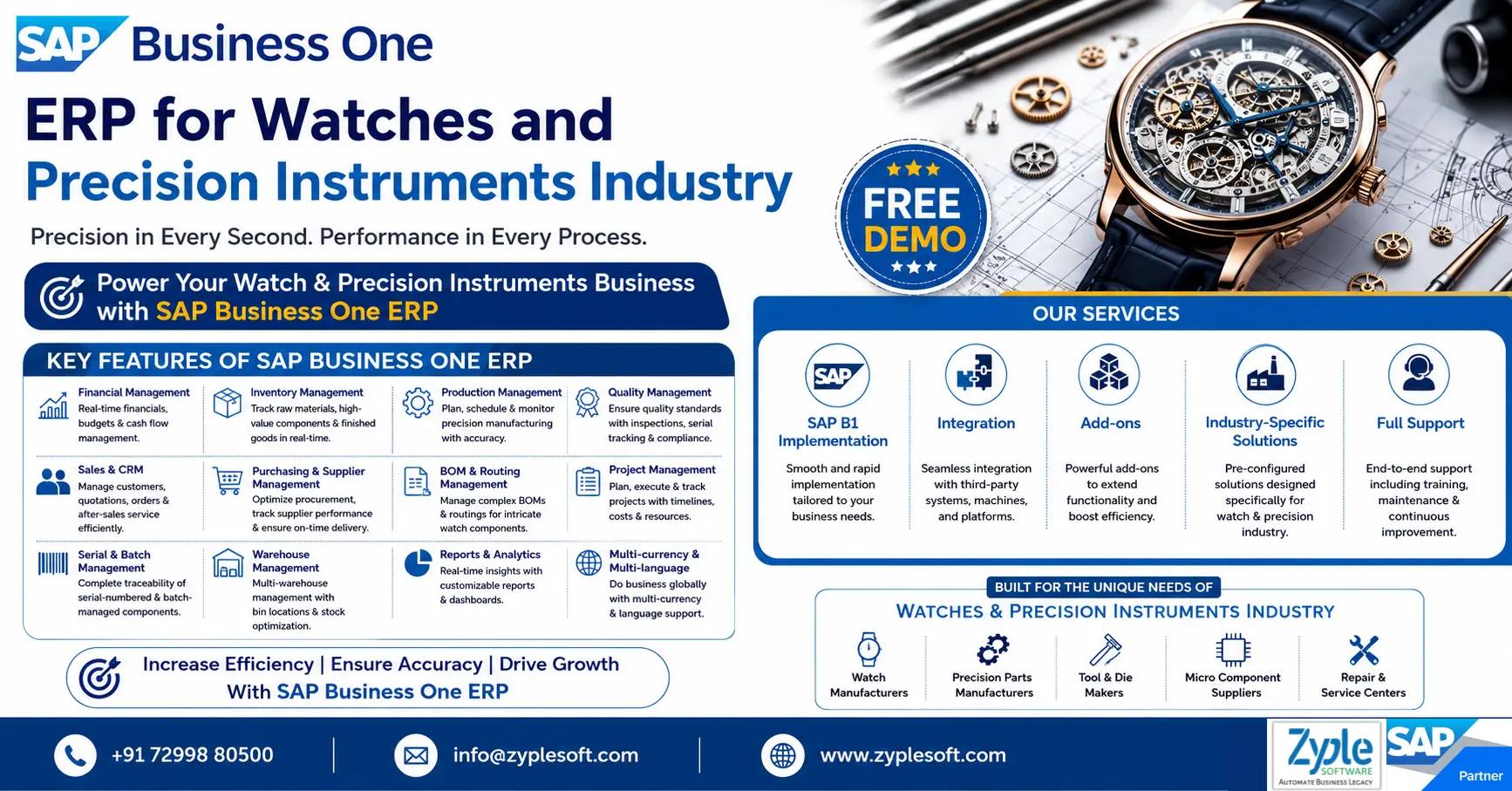
The watches and precision instruments industry operates in a precision-driven environment where product quality, component traceability, and efficient assembly processes are essential. Manufacturers must handle a wide range of small and specialized components such as movements, dials, hands, cases, straps, and batteries while maintaining strict quality standards and design consistency.
Traditional systems and manual processes often create challenges in tracking component inventory, handling multi-level bills of materials, coordinating assembly operations, and ensuring product traceability. SAP Business One ERP for watches and precision instruments delivers an integrated platform that connects production planning, component inventory, procurement, quality control, sales, and financial management, providing real-time visibility and operational control across the watch manufacturing cycle.
Challenges Faced By The Watches and Precision Instruments Industry
The watches and precision instruments industry faces severe challenges, mainly driven by surging raw material costs (e.g., gold), restrictive geopolitical tariffs on exports, and aggressive competition from multifunctional watches. Consequently, traditional watchmakers are battling declining demand in mid-tier segments, falling secondary market inventories, and recent job contradictions across manufacturing.
1. Macroeconomic Pressures and Trade Barriers
International trade wars, including heavy tariffs on Swiss products entering the US, are forcing major shifts in inventory management and supply chain operations. Rising prices for precious metals like gold and platinum directly inflate manufacturing costs, squeezing profit margins, especially for mid-tier luxury and mechanical brands. The strength of the Swiss Franc remains a constant pressure, making exported traditional timepieces significantly more expensive for global buyers.
2. Technological Shifts and Smartwatch Disruption
Smartwatches and fitness trackers have evolved into digital health ecosystems, providing biometric tracking like ECG and SpO2, GPS, and phone connectivity. Younger generations are growing accustomed to the daily utility of connected wearables, seriously cutting into the entry-level and mass-market traditional watch segments. While smartwatches dominate, traditional instruments still hold the advantage of longevity. Smart devices suffer from quick battery drain and require daily charging.
3. Market Saturation and Inventory Struggles
The pre-owned and secondary markets are experiencing a surplus, causing waiting lists to shrink and secondary-market prices for previously high-demand watches to drop. Watches are remaining on retailer shelves and in dealer cases for much longer, reducing inventory turnover and revenue flow. There is a growing consensus that the market has too many brands chasing the same limited pool of high-net-worth consumers.
4. Innovation vs. Trading
Many established brands face criticism for taking extended periods to update designs or integrate modern clasps and bracelets, enabling newer, nimbler competitors to gain traction. While companies explore automated processes and industry 4.0 to scale production, true haute horlogerie depends on master artisans. Hand-finishing places a natural ceiling on production efficiency and output. Luxury watchmakers who attempt to create their own smartwatches or digital ecosystems have historically struggled with poor adoption and mixed results.
5. Consumer Shifts and Sustainability
Younger consumers desire highly personalized products and customizable components rather than mass-produced heritage pieces. There is an increased demand for sustainable and ethical sourcing of materials like conflict-free metals and vegan straps, forcing brands to adapt their supply chains.
Features of SAP Business One ERP for Watches and Precision Instruments
1. Core Manufacturing and Production Management
- It includes multi-level BOMs for complex watch parts and instrument parties.
- Plans, releases, and tracks batch or discrete manufacturing.
- Defines machining, calibration, polishing, and assembly steps.
- Optimizes machine utilization like CNC, micro-machining, and assembly lines.
- Monitors partially assembled components.
- Aligns production with demand and delivery timelines.
- Handles production across multiple facilities.
2. Inventory and Warehouse Management
- It includes raw materials, components, and finished goods.
- Essential for the traceability of precision instruments.
- It includes efficient storage of small and high-value parts.
- Handles distribution centers and production stores.
- Avoids shortages of essential micro-components.
- It includes cycle counting and stock audits.
3. Quality Control and Compliance
- Defines QC parameters for each stage.
- Tracks calibration of instruments and tools.
- Detects and handles defects.
- It includes ISO, CE, and industry-specific standards.
- It includes end-to-end tracking from raw material to finished product.
4. Financial Management and Cost Control
- Fully automated financial processes like general ledger, accounts payable, and accounts receivable.
- It includes accurate costing for precision components and assemblies.
- Monitors manufacturing expenses.
- Suitable for global exports.
- Handles high-value machinery and tools.
- It includes product-wise and batch-wise margins.
5. Procurement and Supplier Management
- Maintains supplier data for precision parts.
- Automates procurement cycles.
- Evaluates vendor performance.
- Facilitated procurement workflow.
- Ideal for global sourcing.
6. Sales, CRM, and After-Sales Service
- Handles distributors, retailers, and OEM clients.
- Sales order management from quotation to delivery cycle.
- Essential for watches and instruments.
- It includes after-sales service management.
- It includes customer analytics and forecasting.
7. Business Intelligence and Analytics
- Real-time dashboards and KPIs for production, quality, and sales insights.
- Drill-down analytics and custom reports for operations.
- It includes demand forecasting and planning.
- Excel integration for advanced reporting capabilities.
8. Production Planning and MRP (Material Requirements Planning)
- Demand forecasting is based on sales and historical data.
- Automates material procurement and production planning.
- Ensures timely availability of precision parts.
- Minimizes inventory holding costs.
9. Engineering and Product Lifecycle Support
- Engineering change management to handle design revisions.
- Version control for BOMs tracks changes in product design.
- It includes integration with CAD and PLM systems.
- It includes prototype and custom order handling.
10. Mobility, Integration, and Automation
- It includes mobile access to ERP on the go.
- It connects CNC and testing equipment using IoT and machine integration.
- Automated workflows and alerts reduce manual intervention.
- Third-party integration with MES, e-commerce, and logistics.
11. Industry-Specific Capabilities for Watches and Precision Instruments
- It includes high-precision traceability for micro-components.
- It includes strong quality assurance and calibration tracking.
- It includes efficient batch and serial production handling.
- It includes support for global supply chains and exports.
- It includes improved time-to-market for new designs.
Benefits of SAP Business One ERP for Watches and Precision Instruments
The ERP software, SAP Business One (SAP B1) system, is an affordable ERP designed for SMEs. It connects financials, sales, purchasing, and manufacturing into one platform. For the watch and precision instruments industry, it avoids material waste, automates serialized tracking of microscopic components, and ensures thorough quality control.
1. Serial Number and Batch Traceability
Every movement, gear, and micro-component is individually tracked from procurement to final assembly using SAP implementation. This ensures product authenticity and rapid root-cause analysis in case of defects.
2. Precision BOM Management
Oversees multi-level bills of materials (BOM) that are common in high-complication watchmaking. This outlines exact requirements for precise, high-value components.
3. Quality Control and Compliance
Implements strict tolerance checks and quality control (QC) tracking throughout the production process to maintain high luxury and mechanical standards.
4. Reduced Inventory Costs
Reduces overstocking and stockouts using real-time data to forecast material demands and synchronize your warehouse using SAP solutions.
5. Integrated Financials
Automates key accounting and standardizes currency conversions for imported jewels, metals, and global parts distribution.
Conclusion of Watches and Precision Instruments ERP
Zyple Software is the official SAP Business One partner in India specializing in implementation, digital transformation, licensing, integration, add-on solutions, migration, and consulting for the watches and precision instruments industry. By implementing SAP software, watch manufacturers gain a centralized platform to handle production, component inventory, quality control, sales, and finance with complete transparency and control. This integrated approach improves operational efficiency, improves product traceability, and supports scalable growth in a competitive precision manufacturing market.
If you’re active, reserve a demo of SAP B1 for your company.
Do you require the SAP B1 ERP software for your business or industry?
Finish all the details in the given contact form; our team will return to you.
Frequently Asked Questions (FAQs)
1.How can SAP Business One ERP help minimize production errors in precision manufacturing?
SAP Business One improves accuracy through real-time data, automated workflows, and complete Bill of Materials (BOM). This reduces manual errors and ensures consistent quality, essential for precision instruments and watches.
2.Is SAP Business One ERP affordable for small and mid-sized watch manufacturers?
Yes, SAP Business One is designed specifically for SMEs, providing a cost-effective ERP solution with scalable pricing. Businesses can start with necessary modules and expand as they grow.
3.How quickly can SAP Business One be implemented in my manufacturing business?
SAP B1 implementation timelines vary based on complexity but generally range from a few weeks to months. With the right partner like Zyple Software, deployment can be fast and customized for your production needs.
4.Can SAP Business One deliver real-time insights into inventory and production?
Absolutely. The system provides real-time dashboards and reporting tools that give full visibility into inventory levels, production status, and order tracking, helping you make faster, data-driven decisions.
5.How can I get a demo or consultation for SAP Business One ERP?
You can request a personalized demo from a certified SAP B1 partner like Zyple Software to see how the system fits your watch or precision instrument business. A consultation will help identify the suitable modules and implementation approach.