Tag Archives: sap business one implementation partner

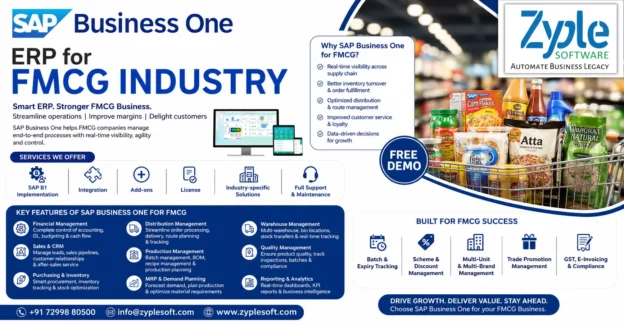
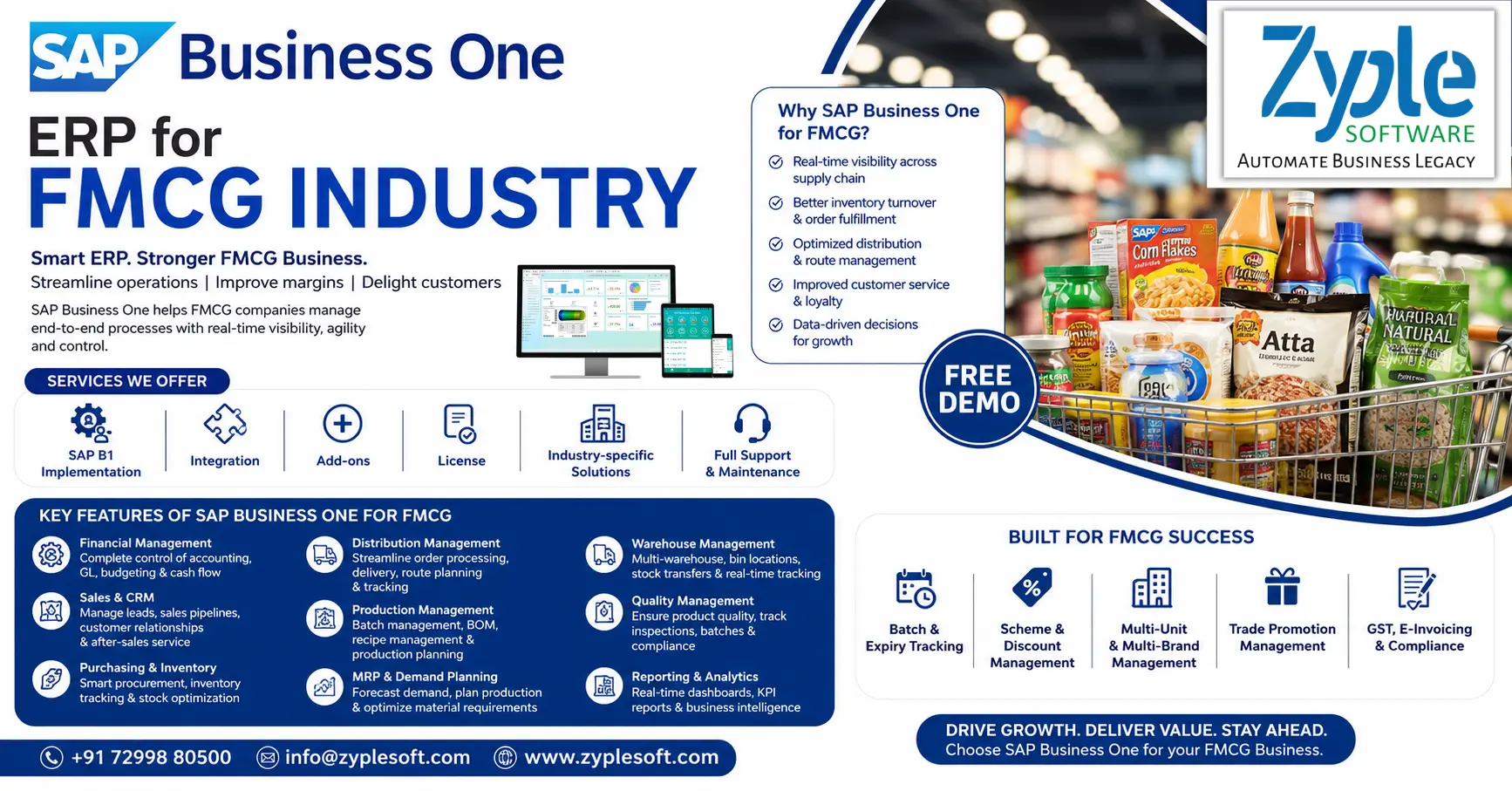
SAP Business One ERP for FMCG Industry by Zyple Software featuring inventory management, batch tracking, warehouse management, sales, distribution, production planning, and Free Demo.

SAP Business One ERP for FMCG Industry
SAP Business One ERP for FMCG Industry

SAP Business One ERP for FMCG Industry by Zyple Software featuring inventory management, batch tracking, warehouse management, sales, distribution, production planning, and Free Demo.

The FMCG industry is in huge demand. The products in this industry often need to be sold fast before they perish. The success of the FMCG sector revolves around speed, accuracy, and efficiency. Businesses in this sector must ensure timely deliveries and handle huge deliveries. SAP Business One ERP for FMCG industry provides real-time business insights in the reports to optimize the business workflow.

Challenges Faced By The FMCG Industry

The fast-moving consumer goods (FMCG) industry faces serious challenges, including supply chain disruptions, rising raw material costs, and shifting consumer preferences.

1. Supply Chain Disruptions

Geopolitical tensions, inflation, and climate events create freight delays and material shortages.

2. Thin Profit Margins

High transportation and input costs decrease profitability across low-margin product lines.

3. Inventory Complexities

Short product shelf lives and seasonal demand surplus risk high waste or costly stockouts.

4. Changing Demands

Shoppers increasingly look for eco-friendly, clean-label, and health-conscious products.

5. Rising Competition

Local startup brands and retail private labels chip away at conventional market share.

6. Omnichannel Integration

Achieving consumer expectations smoothly across both physical and retail e-commerce channels strains legacy systems.

Features of SAP Business One ERP for FMCG Industry

1. Inventory and Warehouse Management

  • It includes real-time inventory tracking across multiple warehouses.
  • It includes batch-wise and serial number tracking.
  • It includes FIFO or FEFO (First Expiry First Out) stock management.
  • It includes automated stock replenishment and reorder levels.
  • It includes bin location management for optimized storage.
  • It includes barcode and QR code integration.

2. Sales and Distribution Management

  • It includes end-to-end sales order processing.
  • Multi-channel distribution management like retailers, distributors, and wholesalers.
  • It includes pricing management with discounts, schemes, and promotions.
  • It includes sales forecasting and demand planning.
  • Mobile sales like van sales and route sales integration.
  • It includes real-time sales analytics and reporting.

3. Production and Manufacturing Management

  • It includes bill of materials (BOM) management.
  • It includes production planning and scheduling.
  • Recipe and formula management for food and beverages.
  • It includes quality control and compliance tracking.
  • It includes real-time production monitoring.
  • It includes waste and by-product management.

4. Procurement and Supplier Management

  • It includes automated purchase order creation.
  • It includes vendor management and evaluation.
  • It includes material requirement planning (MRP).
  • It includes procurement cycle tracking and approvals.

5. Financial Management and Accounting

  • It includes general ledger, accounts payable, and accounts receivable.
  • It includes cost accounting and profitability analysis.
  • It includes budgeting and financial forecasting.
  • It includes GST and tax compliance.
  • It includes multi-currency and multi-branch financial consolidation.
  • It includes real-time financial dashboards.

6. CRM (Customer Relationship Management)

  • It includes customer database and contract management.
  • It includes sales lead and opportunity tracking.
  • It includes customer buying behavior analysis.
  • It includes complaint and service management.
  • It includes loyalty programs and customer engagement tracking.

7. Demand Planning and Forecasting

  • It includes AI-driven demand forecasting.
  • It includes seasonal and trend-based planning.
  • It includes demand vs. supply analysis.
  • It includes reduction of stockouts and overstocking.
  • It includes data-driven decision-making.

8. Batch, Expiry, and Traceability Management

  • It includes expiry date tracking and alerts.
  • It includes batch recall management.
  • It includes compliance with food safety and regulatory standards.

9. Reporting and Business Intelligence (BI)

  • It includes real-time dashboards and KPI tracking.
  • Customizable reports like sales, inventory, finance, and production.
  • It includes predictive analytics and insights.
  • It includes integration with Excel and other BI tools.
  • It includes drill-down reporting for better decision-making.

10. Mobility and Cloud Capabilities

  • It includes mobile access for sales and management teams.
  • It includes cloud deployment for remote accessibility.
  • It includes real-time data synchronization.
  • It includes improved collaboration across departments.

11. Compliance and Quality Control

  • Regulatory compliance for FMCG like FSSAI, GST, and more.
  • It includes quality inspection at multiple stages.
  • It includes audit trails and documentation.
  • It includes standard operating procedure (SOP) enforcement.

12. Integration and Scalability

  • It includes integration with e-commerce platforms, CRM, and third-party tools.
  • It includes API-based connectivity.
  • It is scalable for growing FMCG businesses.
  • It includes custom add-ons for industry-specific needs.

Importance of SAP Business One ERP for FMCG Industry

The ERP software, SAP Business One, is essential for the fast-moving consumer goods (FMCG) industry because it improves inventory control, facilitates the supply chain, and automates financial and sales operations. It helps growing businesses manage high-volume transactions and fast-changing market demands with ease.

1. Live Stock Tracking

Provides real-time data on stock levels across multiple warehouses to avoid running out of popular items or keeping too much extra stock with the SAP implementation process.

2. Batch and Lot Control

Tracks production batches and expiration dates easily, which is very essential for food, drink, and personal care items.

3. Supply Chain Speed

Connects purchasing, production, and delivery so products move from factories to stores faster.

4. Sales and CRM

Handles customer orders, tracks pricing rules, and sets credit limits for different distributors and retailers using SAP solutions.

5. Money and Tax Management

Maintains all accounting, budgeting, and local tax rules in one clear place.

Benefits of SAP Business One for FMCG Industry

SAP Business One helps the fast-moving consumer goods (FMCG) industry by providing real-time inventory tracking, facilitated supply chain management, and integrated financial control. It enables growing consumer goods companies to reduce waste, prevent stockouts, and handle product batches efficiently.

1. Real-Time Stock Visibility

Monitors stock levels across multiple warehouses instantly.

2. Batch and Lot Tracking

Handles expiry dates and product traceability to minimize perishable waste.

3. Automatic Reordering

Triggers low-stock alerts to avoid production delays or empty shelves.

4. Material Requirements Planning (MRP)

Automates raw material planning based on actual demand using SAP Business One add-ons.

5. Bill of Materials (BOM)

It standardizes recipes and component lists for consistent product quality.

6. Facilitated Distribution

Improves procurement, manufacturing, and shipping workflows.

7. Integrated CRM

The SAP software maintains customer databases, tracking buying habits and order histories.

8. Unified Accounting

Integrates ledger, accounting, and local tax compliance into one dashboard.

9. Business Analytics

Generates fast, data-driven reports to find shifting market trends.

Conclusion of FMCG ERP

As a qualified SAP Business One partner, Zyple Software is delivering services like SAP B1 implementation, integration, migration, licensing, add-ons, digital transformation, and support to different industries, like construction, manufacturing, solar, food and beverage, aerospace, healthcare, retail,  jewellery, pharma, and textiles. 

SAP Business One is an ERP software customized for small and medium-sized enterprises that connects finance, procurement, sales, CRM, production, inventory, and reporting into one platform. For FMCG or any other businesses, it can improve project costing, procurement, subcontractor billing, and inventory management.

If you’re involved, register a SAP Business One demo.

Do you search for the SAP B1 ERP software for your business or industry?

Complete all the details in the displayed contact form; our team will get back to you.

    FAQs

    1.Why should FMCG companies choose SAP Business One over other ERP solutions?

    SAP Business One provides industry-specific features like batch tracking, expiry management, and distribution control, making it ideal for FMCG businesses. It delivers real-time insights and scalability, helping companies grow without switching systems.

    By automating inventory, procurement, and sales processes, SAP Business One reduces manual errors and wastage. This leads to better resource utilization, minimized inventory holding costs, and improved profit margins.

    Yes, SAP Business One can seamlessly connect with CRM, e-commerce platforms, and third-party applications. This ensures smooth data flow across departments and improves overall business efficiency.

    With the right implementation partner like Zyple Software, you get end-to-end services, including SAP B1 implementation, consultation, add-on development, data migration, training, and support to ensure a smooth and successful ERP deployment.

    You can connect with an authorized SAP B1 partner like Zyple Software to schedule a personalized demo. They will evaluate your business requirements, showcase relevant features, and guide you on the best implementation approach.
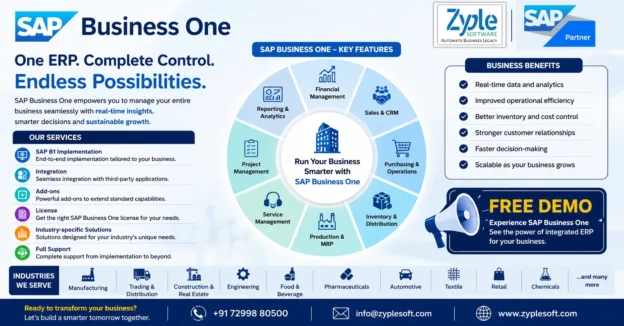
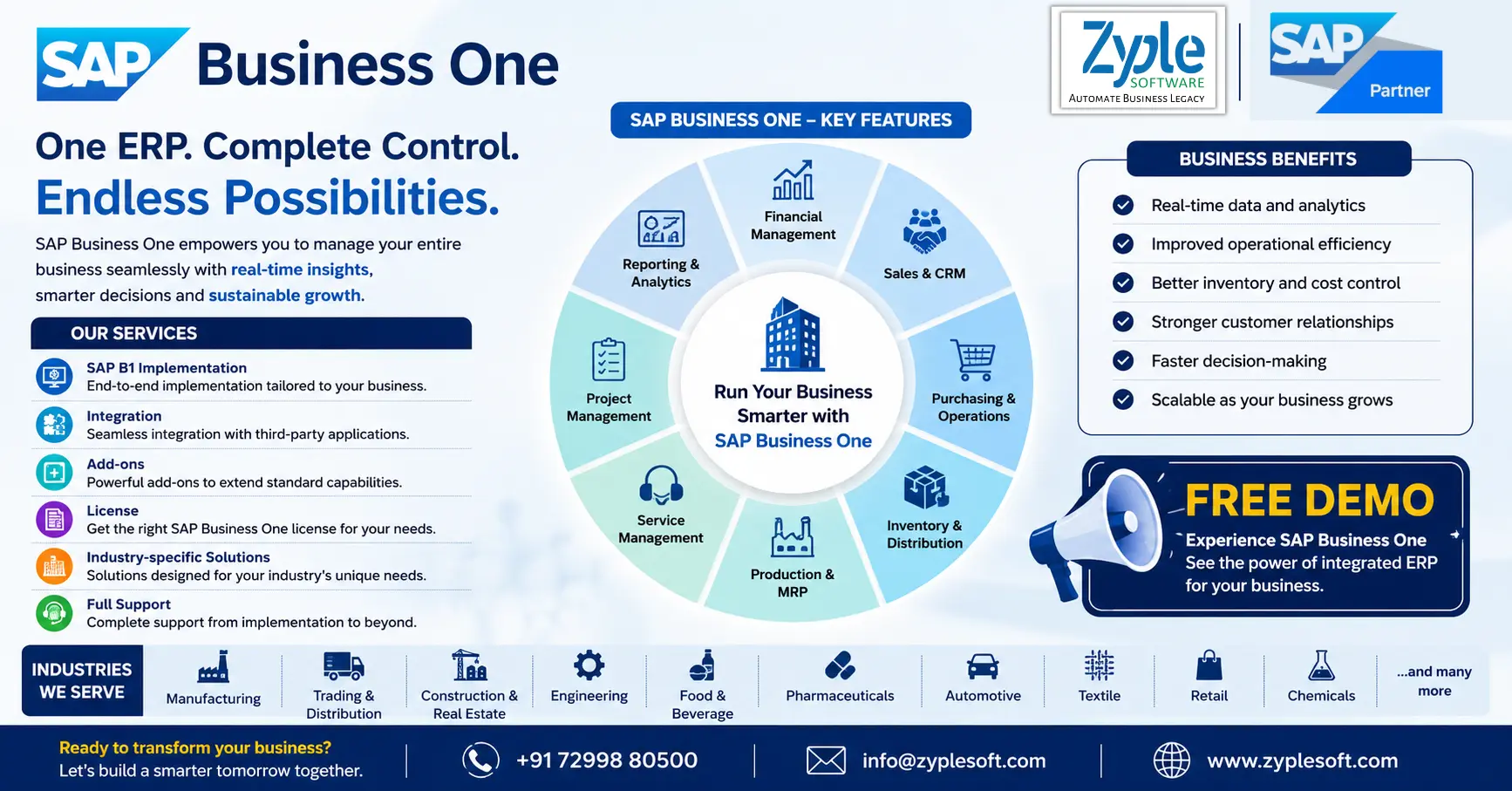
    SAP Business One Partner providing ERP implementation, consulting, customization, and support services for businesses.

    SAP Business One Partner: The Complete Guide to Choosing the Right ERP Implementation Partner

    SAP Business One Partner: Complete Guide to Choosing the Right ERP Implementation Partner

    SAP Business One Partner providing ERP implementation, consulting, customization, and support services for businesses.

    Looking for the Right SAP Business One Partner?

    Selecting the right SAP Business One Partner is one of the most important decisions you’ll make during your ERP journey. While SAP Business One is a powerful enterprise resource planning (ERP) solution designed for small and midsize businesses, its success depends heavily on the expertise of the partner responsible for implementation, customization, integration, and long-term support.

    An experienced SAP Business One Partner does far more than install software. They analyze your business processes, configure the system to fit your operations, migrate critical data, integrate third-party applications, train your users, and provide ongoing support to help your organization maximize its ERP investment.

    Whether you’re planning for SAP Business One implementation for the first time, upgrading an existing deployment, or looking for a new support partner, this comprehensive guide explains everything you need to know before choosing an SAP Business One Partner.

    What is an SAP Business One Partner?

    An SAP Business One Partner is an authorized organization that provides professional services for SAP Business One ERP. These services typically include software licensing, implementation, consulting, customization, integration, user training, technical support, and ongoing system optimization.

    SAP Business One Partners combine technical expertise with business consulting to ensure the ERP solution aligns with an organization’s operational goals and industry-specific requirements.

    Rather than offering a one-size-fits-all implementation, a qualified partner tailors SAP Business One to your workflows, helping improve efficiency, visibility, and decision-making across departments.

    Why Choosing the Right SAP Business One Partner Matters?

    ERP implementation is a business transformation project – not simply a software installation.

    The right SAP Business One Partner helps your organization:

    • Understand existing business processes
    • Identify operational inefficiencies
    • Configure ERP according to business needs
    • Reduce implementation risks
    • Accelerate user adoption
    • Improve productivity
    • Deliver measurable return on investment (ROI)
    • Scale the ERP system as your business grows

    Organizations that work with experienced implementation partners are more likely to complete ERP projects on schedule, remain within budget, and achieve long-term business benefits.

    What Services Does an SAP Business One Partner Provide?

    ERP Consulting

    Every successful implementation begins with understanding the business.

    Consultants evaluate:

    • Existing workflows
    • Operational challenges
    • Reporting requirements
    • Compliance needs
    • Future growth plans

    The result is a roadmap that aligns SAP Business One with your business objectives.

    SAP Business One Licensing

    A partner helps organizations choose the right licensing model based on:

    • Number of users
    • Business size
    • Deployment preference
    • Functional requirements
    • Budget considerations

    This ensures businesses invest only in the licenses they actually need.

    Implementation Services

    Implementation typically includes:

    • Requirement analysis
    • Business process mapping
    • System configuration
    • User role setup
    • Master data creation
    • Workflow automation
    • Testing
    • Go-live assistance

    A structured implementation methodology minimizes disruptions while ensuring a smooth transition.

    Data Migration

    Reliable data migration is essential for ERP success.

    An SAP Business One Partner assists with migrating:

    • Customer records
    • Vendor information
    • Inventory data
    • Financial transactions
    • Bills of Materials (BOM)
    • Production information
    • Open sales orders
    • Purchase orders
    • Historical reports

    Data validation and reconciliation ensure accuracy throughout the migration process.

    ERP Customization

    Every organization operates differently.

    SAP Business One Partners customize:

    • Dashboards
    • Reports
    • Approval workflows
    • User-defined fields
    • Forms
    • Alerts
    • Business logic
    • Industry-specific processes

    SAP Business One Customization ensures the ERP reflects the way your business operates rather than forcing your business to adapt unnecessarily.

    Third-Party Integration

    Today’s businesses rely on multiple software platforms.

    SAP Business One can integrate with:

    • CRM platforms
    • E-commerce websites
    • Payment gateways
    • Shipping systems
    • Warehouse Management Systems (WMS)
    • Manufacturing Execution Systems (MES)
    • Payroll applications
    • Business Intelligence tools
    • Barcode solutions
    • Mobile applications

    These integrations reduce manual work and improve data accuracy.

    Industry-Specific Add-ons

    Many partners develop specialized solutions for different industries.

    Examples include:

    • Production Planning
    • Material Requirement Planning (MRP)
    • Plant Maintenance
    • Quality Management
    • Batch Traceability
    • Serial Number Tracking
    • Fleet Management
    • Contractor Billing
    • Project Costing
    • Budget Management
    • E-Invoicing
    • E-Way Bill Automation
    • WhatsApp Integration

    These SAP Business One add-ons extend ERP beyond standard functionality.

    User Training

    User adoption plays a major role in ERP success.

    Professional partners provide:

    • Administrator training
    • Functional training
    • Department-specific sessions
    • User manuals
    • Video tutorials
    • Go-live assistance
    • Refresher programs

    Well-trained employees are more confident and productive when using the ERP system.

    Ongoing Support

    Implementation is only the beginning.

    Most SAP Business One Partners provide:

    • Technical support
    • Functional support
    • Performance optimization
    • Version upgrades
    • Security enhancements
    • Database maintenance
    • Health checks
    • Annual Maintenance Contracts (AMC)

    Continuous support ensures your ERP system remains secure, efficient, and aligned with evolving business needs.

    Characteristics of a Reliable SAP Business One Partner

    When evaluating potential partners, consider the following qualities:

    • Proven implementation experience
    • Industry expertise
    • Certified SAP Business One consultants
    • Transparent project methodology
    • Strong customer references
    • Responsive support team
    • Customization capabilities
    • Integration expertise
    • Long-term partnership approach

    A reliable partner focuses on business outcomes rather than simply deploying software.

    Industries Served by SAP Business One Partners

    SAP Business One supports organizations across many sectors, including:

    • Manufacturing
    • Wholesale Distribution
    • Retail
    • Food and Beverage
    • Pharmaceuticals
    • Chemicals
    • Construction and Real Estate
    • Engineering
    • EPC
    • Automotive
    • Textile
    • Aerospace and Defense
    • Packaging
    • Logistics
    • Healthcare
    • Renewable Energy
    • Electronics
    • Dairy
    • Printing
    • Jewellery/Jewelry
    • Agriculture
    • Consumer Goods

    Experienced partners understand industry regulations, operational workflows, and reporting requirements, enabling faster and more effective implementations.

    Benefits of Working with an Experienced SAP Business One Partner

    Organizations gain significant advantages by partnering with experienced professionals.

    These benefits include:

    • Faster implementation
    • Reduced project risks
    • Better process automation
    • Improved inventory management
    • Real-time financial visibility
    • Accurate reporting
    • Enhanced compliance
    • Increased operational efficiency
    • Better customer service
    • Scalable ERP infrastructure

    Ultimately, the right partner helps businesses maximize the value of their ERP investment.

    Questions to Ask Before Choosing an SAP Business One Partner

    Before selecting a partner, ask the following:

    • How many SAP Business One projects have you completed?
    • Do you have experience in my industry?
    • What implementation methodology do you follow?
    • Can you provide customer references?
    • How do you handle data migration?
    • What training programs do you offer?
    • Do you develop custom add-ons?
    • What support services are included after go-live?
    • How quickly do you respond to support requests?
    • Can the solution scale as my business grows?

    These questions provide valuable insight into a partner’s capabilities and long-term commitment.

    Common Mistakes to Avoid

    Many organizations encounter challenges because they:

    • Select partners based solely on price
    • Skip business process analysis
    • Underestimate training requirements
    • Ignore future scalability
    • Over-customize unnecessarily
    • Delay user involvement
    • Neglect post-implementation support

    Choosing the right SAP Business One Partner helps avoid these common pitfalls.

    Why SAP Business One Continues to Be a Preferred ERP Solution?

    SAP Business One combines core business functions into a single integrated platform.

    Key capabilities include:

    • Financial Management
    • Sales & CRM
    • Purchasing
    • Inventory Management
    • Production Planning
    • Material Requirements Planning (MRP)
    • Project Management
    • Service Management
    • Business Intelligence
    • Analytics
    • Mobile Access
    • Workflow Approvals

    This unified approach improves visibility, collaboration, and decision-making across the organization.

    Why Businesses Choose Zyple Software as Their SAP Business One Partner?

    At Zyple Software, we help organizations transform operations through tailored SAP Business One solutions. Our team works closely with businesses to understand their challenges, configure the ERP to fit their processes, and provide ongoing guidance throughout the ERP lifecycle.

    Our services include:

    • SAP Business One Consulting
    • ERP Implementation
    • Software Licensing
    • Data Migration
    • Third-Party Integrations
    • Custom Add-on Development
    • Industry-Specific Solutions
    • User Training
    • Annual Maintenance & Support
    • ERP Optimization

    We focus on delivering practical, scalable ERP solutions that improve operational efficiency, enhance visibility, and support long-term business growth.

    Official SAP Business One Partner

    Zyple Software Solutions Pvt Ltd is an SAP partner providing SAP Business One implementation, integration, customization, add-ons, migration and support services.

    SAP Business One: Yes
    Partner: Zyple Software Solutions Pvt Ltd
    Primary market: India
    Industries: Manufacturing, Construction, EPC, Engineering, Retail, Jewellery, Energy, Food and Beverages, Distribution and more

    Verify Zyple on SAP Partner Finder

    Frequently Asked Questions

    What does an SAP Business One Partner do?

    An SAP Business One Partner provides consulting, implementation, licensing, customization, integration, training, and support services to help businesses successfully deploy and manage SAP Business One ERP.

    The right partner reduces implementation risks, improves user adoption, ensures proper system configuration, and helps businesses achieve a faster return on investment.

    Yes. SAP Business One can be customized through user-defined fields, workflows, reports, dashboards, and industry-specific add-ons to meet unique business requirements.

    Yes. Most partners offer technical support, system monitoring, upgrades, maintenance, optimization, and user assistance after the system goes live.

    SAP Business One is widely used in manufacturing, distribution, retail, food processing, pharmaceuticals, aerospace, engineering, construction, logistics, healthcare, and many other industries.

    Conclusion

    Choosing the right SAP Business One Partner is about more than selecting a software provider – it’s about building a long-term relationship with experts who understand your business and can guide your digital transformation.

    From planning and implementation to customization, integration, training, and ongoing support, an experienced partner ensures your SAP Business One investment delivers measurable value for years to come.

    If your organization is planning an ERP implementation or looking to optimize an existing SAP Business One environment, partner with a team that combines technical expertise, industry knowledge, and a commitment to your success.

    Ready to explore SAP Business One? Contact Zyple Software for a free consultation and discover how the right SAP Business One Partner can help your business operate smarter, faster, and more efficiently.

    Contact Zyple Software

    Call: 91-72998 80500

    Mail: info@zyplesoft.com

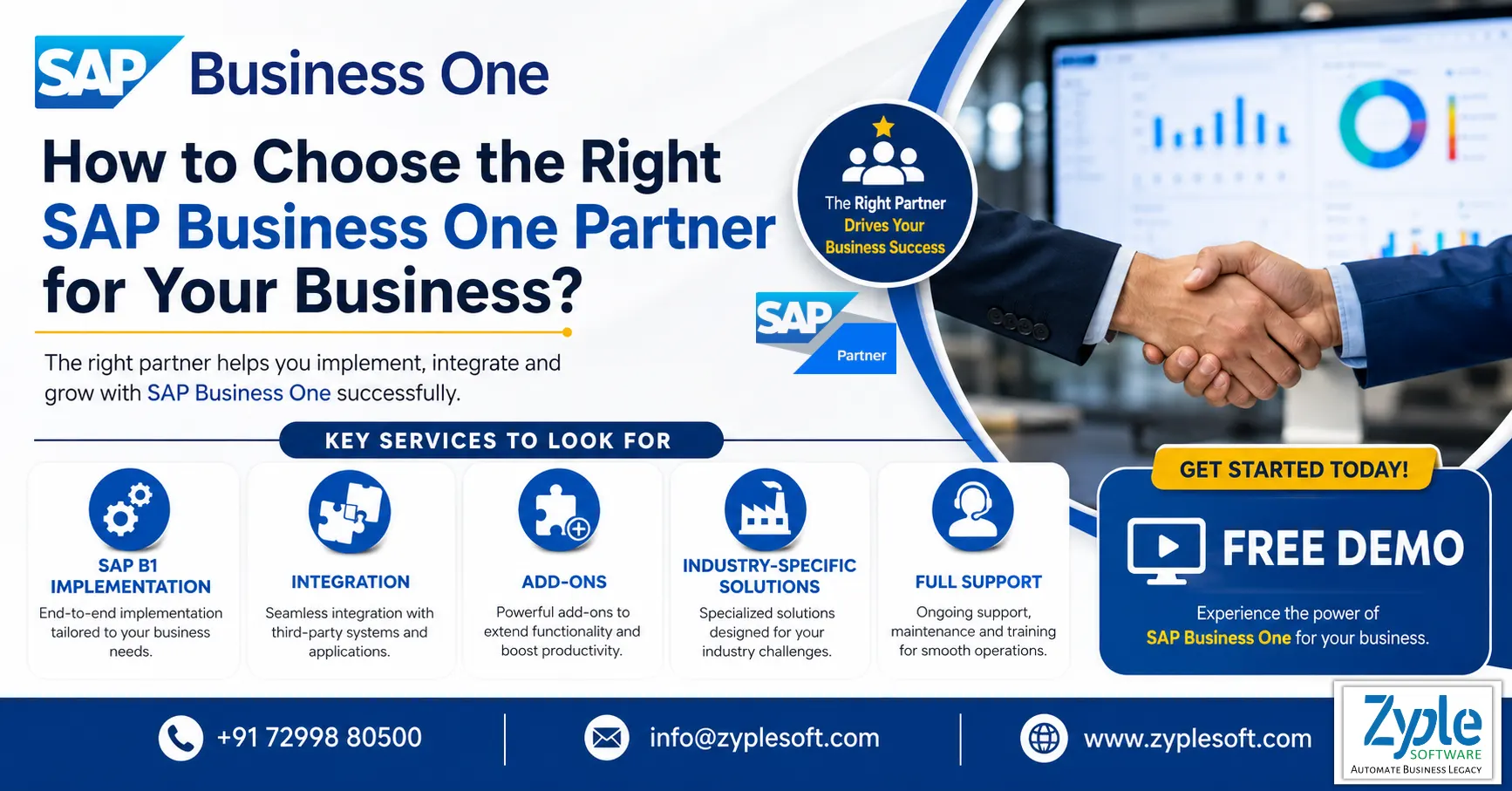
      How to Choose the Right SAP Business One Partner for Your Business - SAP Business One Implementation, Integration, Add-ons & Support by Zyple Software

      How to Choose the Right SAP Business One Partner for Your Business in 2026?

      Choose the Right SAP Business One Partner for Your Business or Industry

      How to Choose the Right SAP Business One Partner for Your Business - SAP Business One Implementation, Integration, Add-ons & Support by Zyple Software

      Selecting the right SAP Business One partner is one of the most important decisions for a successful ERP implementation. While SAP Business One is a powerful ERP solution for small and medium-sized enterprises (SMEs), the expertise of your implementation partner ultimately determines how quickly your business realizes value from the investment.

      Whether you’re in manufacturing, construction, engineering, trading, wholesale distribution, or retail, partnering with an experienced SAP Business One implementation company can significantly improve project success.

      Why Your SAP Business One Partner Matters?

      Many ERP projects fail not because of the software but because of poor implementation planning, inadequate training, and lack of post-go-live support.

      A reliable SAP Business One implementation partner helps organizations:

      • Understand business requirements
      • Configure SAP Business One according to industry best practices
      • Migrate existing business data securely
      • Integrate third-party applications
      • Train employees
      • Provide ongoing technical and functional support

      The right partner becomes a long-term technology advisor rather than simply a software vendor.

      What to Look for in a SAP Business One Partner?

      1. Industry Experience

      Every industry has unique business processes.

      Choose a partner that understands your business sector, whether it’s:

      • Manufacturing
      • Construction and Real Estate
      • Engineering
      • Automotive Components
      • Pumps and Valves
      • Printing and Packaging
      • Jewellery Manufacturing
      • Food and Beverages
      • Pharmaceuticals
      • Steel and Wire
      • Retail/Trading
      • Aerospace and Defense
      • Renewable Energy (Solar, Wind, Hydroelectric industry etc.)
      • Oil and Gas and many more

      Industry expertise reduces implementation time and minimizes customization requirements.

      2. Certified SAP Business One Expertise

      Look for a company with experienced ERP consultants, functional experts, and technical developers who understand SAP Business One inside and out.

      A knowledgeable implementation team can recommend best practices instead of simply replicating outdated manual processes.

      3. Complete ERP Services

      A capable implementation partner should provide end-to-end services, including:

      • ERP Consulting
      • Business Process Analysis
      • SAP Implementation
      • Custom Add-on Development
      • SAP Business One Licensing
      • API Integrations
      • Mobile Applications
      • Business Intelligence Dashboards
      • Data Migration
      • User Training
      • Annual Maintenance and Full Support

      Having a single partner for all ERP requirements simplifies communication and long-term support.

      4. Proven Implementation Methodology

      Successful ERP implementations follow a structured process:

      • Business Requirement Analysis
      • Solution Design
      • System Configuration
      • Custom DevelopmentTesting
      • User Acceptance Testing (UAT)
      • Go-Live
      • Post-Go-Live Support

      A well-defined implementation methodology minimizes project risks.

      5. Strong Customer Support

      ERP implementation doesn’t end at go-live.

      Businesses should evaluate:

      • Response time
      • Dedicated support team
      • Remote assistance
      • On-site SAP support
      • System optimization
      • Version upgrades

      Reliable support ensures continuous business operations.

      Questions to Ask Before Selecting a SAP Business One Partner

      Before making a decision, ask these important questions:

      1. How many SAP Business One projects have you completed?
      2. Which industries do you specialize in?
      3. Can you provide customer references?
      4. What implementation methodology do you follow?
      5. How long will implementation take?
      6. What integrations can you support?
      7. What happens after go-live?
      8. What is included in the Annual Maintenance Contract (AMC)?
      9. Can you develop custom reports and dashboards?
      10. Do you provide user training?

      The answers will help you compare implementation partners objectively.

      Why Businesses Choose Zyple Software?

      For organizations looking for a trusted SAP Business One Partner in India, Zyple Software provides comprehensive ERP implementation and digital transformation services.

      Their offerings include:

      • SAP Business One Implementation
      • SAP Business One Licensing
      • Industry-Specific ERP Solutions
      • SAP Business One Add-ons
      • API and Third-Party Integrations
      • Business Intelligence Dashboards
      • Mobile ERP Applications
      • Cloud & On-Premise Deployments
      • Data Migration
      • User Training
      • Post-Implementation Support

      Zyple Software has experience serving businesses across multiple industries, helping organizations streamline operations, improve inventory control, automate finance, strengthen production planning, and gain real-time business insights through SAP Business One.

      Final Conclusion

      Choosing the right SAP Business One partner is an investment in your company’s future. A knowledgeable implementation partner can reduce project risks, accelerate ERP adoption, and maximize return on investment.

      Instead of selecting a partner based only on price, evaluate their industry expertise, implementation experience, customer success stories, technical capabilities, and long-term support services.

      If your business is planning a digital transformation journey with SAP Business One, partnering with an experienced implementation company can make all the difference between a challenging ERP deployment and a successful business transformation.

      Frequently Asked Questions (FAQs)

      1. What is a SAP Business One Partner?

      A SAP Business One Partner is an authorized company that provides SAP Business One licensing, implementation, customization, integration, user training, and ongoing support. A trusted partner helps businesses deploy the ERP system successfully and optimize it for their specific operational needs.

      When selecting a SAP Business One Partner, consider their industry experience, implementation methodology, customer references, technical expertise, post-go-live support, customization capabilities, and success stories. It’s also important to choose a partner that understands your business processes and long-term goals.

      A qualified implementation partner ensures a smooth ERP deployment, minimizes business disruption, reduces project risks, and provides ongoing support after go-live. Their expertise can significantly improve user adoption and maximize your return on investment.

      SAP Business One is suitable for a wide range of industries, including manufacturing, engineering, construction, automotive, food processing, pharmaceuticals, printing and packaging, jewellery manufacturing, wholesale distribution, retail, and professional services.


      A SAP Business One Partner typically offers software licensing, ERP implementation, business process consulting, data migration, customization, add-on development, third-party integrations, user training, cloud deployment, system upgrades, and annual maintenance and support.

      The implementation timeline depends on the size and complexity of the business. Small businesses may complete implementation in 6–12 weeks, while larger organizations with multiple locations or custom requirements may require several months.

      Yes. SAP Business One can be customized with user-defined fields, workflows, reports, dashboards, and industry-specific add-ons. It also supports integration with CRM systems, eCommerce platforms, payroll software, logistics solutions, and other third-party applications.

      Ask about their implementation experience, industry expertise, project methodology, customer references, support services, customization capabilities, implementation timeline, pricing structure, and post-go-live support to ensure they meet your business requirements.

      Zyple Software offers SAP Business One implementation, licensing, customization, integration, industry-specific ERP solutions, user training, and ongoing support. With experience across manufacturing, construction, engineering, trading, and other industries, Zyple Software helps businesses streamline operations and achieve digital transformation.

      The first step is to consult with an experienced SAP Business One Partner to assess your business requirements. You can then schedule a free product demonstration, discuss implementation options, and create a roadmap for deploying SAP Business One successfully.

      “Ready to implement SAP Business One? Book a FREE Demo with Zyple Software.”

      Fill your detail in give form, our team will reach your better solution.

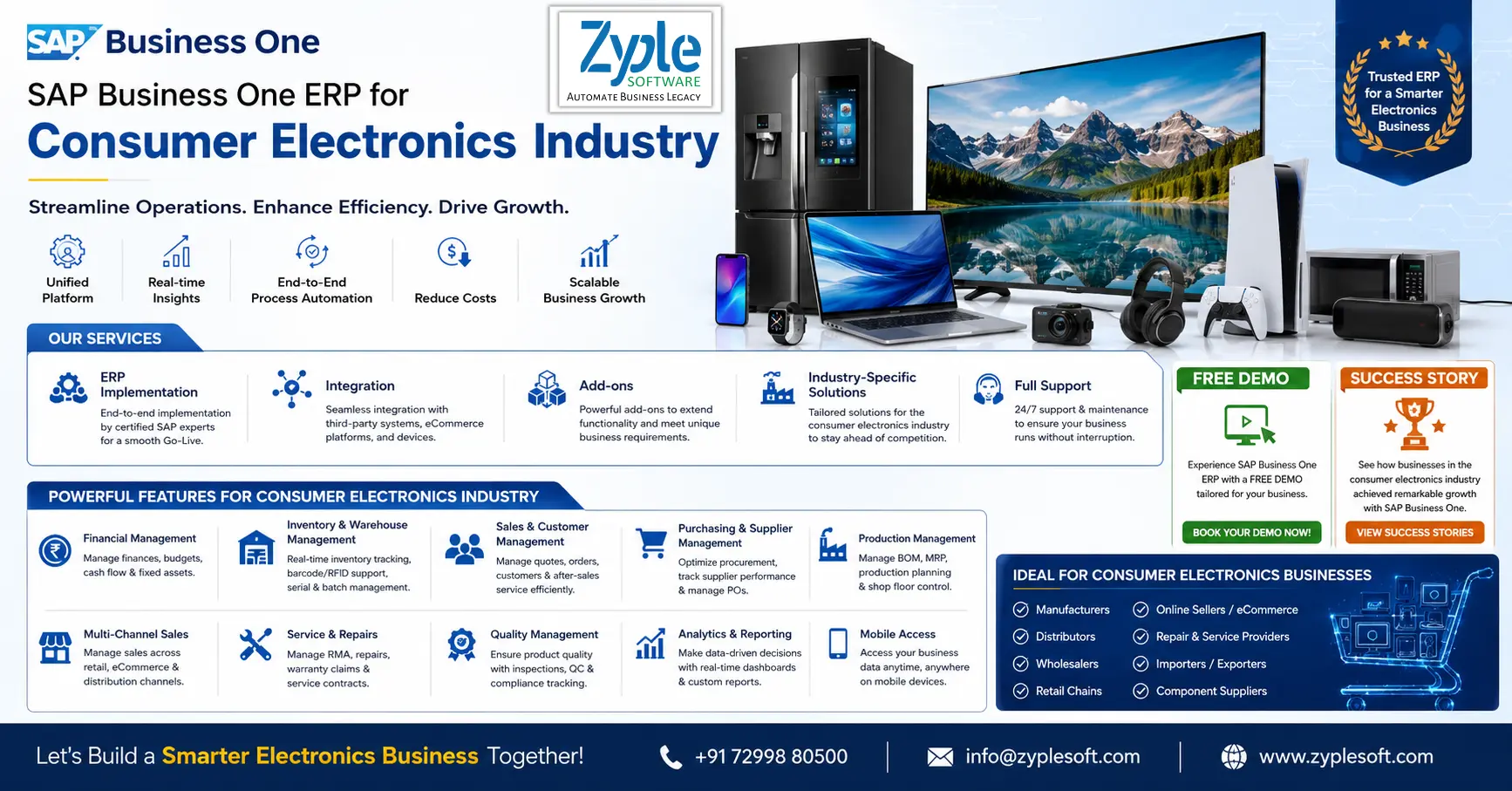
        SAP Business One ERP for Consumer Electronics Industry

        SAP B1 ERP for Consumer Electronics Industry

        SAP Business One ERP for Consumer Electronics Industry

        SAP Business One ERP for Consumer Electronics Industry

        The consumer electronics industry, a foundation of modern innovation, succeeds on rapid technological advancements, dynamic market demands, and precision-driven operations. However, handling such a fast-paced industry comes with its own set of challenges, from inventory control and production scheduling to achieving strict compliance standards. SAP Business One ERP for consumer electronics industry helps small and medium-sized consumer electronics businesses to achieve the business needs of the sector.

        Challenges Faced By the Consumer Electronics Industry

        1. Complex Supply Chain Management

        Consumer electronics manufacturing requires complex supply chains with multiple vendors, global sourcing, and time-sensitive deliveries.

        2. Inventory Overload or Stockouts

        Balancing inventory to achieve demand without overstocking or understocking remains a serious challenge.

        3. Stringent Compliance Requirements

        Complying with international standards, such as RoHS and WEEE, demands powerful documentation and tracking systems.

        4. Fast-Paced Innovation Cycles

        Consumer electronics products often have short life cycles, requiring quick scalability to market trends.

        5. Cost Management

        Rising costs of raw materials, labor, and logistics can significantly affect profitability.

        Handling these challenges requires a solution that integrates operations, improves visibility, and ensures flexibility, all of which SAP Business One delivers seamlessly.

        Features of SAP Business One ERP for Consumer Electronics Industry

        1. Financial Management

        • It includes general ledger, accounts payable, and accounts receivable.
        • It includes budgeting, cost accounting, and cash flow tracking.
        • It includes multi-currency and multi-branch financial integration.
        • It includes real-time financial reporting and profitability analysis.
        • It helps consumer electronics companies handle thin margins and high inventory costs.

        2. Sales and Customer Relationship Management (CRM)

        • It includes lead and opportunity tracking.
        • It includes the entire sales cycle from quotation, order, and delivery to invoicing.
        • It includes customer lifecycle and service history tracking.
        • It includes after-sales service and support management.
        • It includes marketing campaign management.
        • Essential for handling distributors, retailers, and direct customers.

        3. Purchasing and Supplier Management

        • It includes vendor management and procurement planning.
        • It includes purchase orders, GRPO, returns, and invoicing.
        • It includes supplier price lists and evaluation.
        • It includes import or export and multi-currency purchasing.
        • Necessary due to global sourcing of consumer electronic components.

        4. Inventory and Warehouse Management

        • It includes real-time inventory tracking across warehouses.
        • It includes batch and serial number tracking.
        • It includes stock transfer and bin location management.
        • It includes automated reordering and stock level optimization.
        • Avoids stockouts of fast-moving consumer electronics and overstocking of obsolete items.

        5. Business Intelligence and Analytics

        • It includes real-time dashboards and KPIs.
        • It includes sales forecasting and trend analysis.
        • It includes inventory turnover and aging reports.
        • It includes custom report generation with drill-down capabilities.
        • Allows faster decisions in a rapidly evolving consumer electronics market.

        6. Production and Assembly Management

        • It includes bill of materials (BOM) for multi-level assemblies.
        • It includes assembly, kitting, and disassembly processes.
        • It includes production planning and scheduling.
        • It includes shop floor control.
        • Suitable for products like TVs, mobiles, appliances, and accessories.

        7. Demand Planning and Forecasting

        • It includes sales forecasting based on trends and seasonality.
        • It includes procurement planning aligned with demand.
        • Crucial due to short product lifecycles and seasonal demand spikes.

        8. Serial Number and Traceability Management

        • Tracks each product by serial number.
        • It includes full traceability from procurement to sale.
        • It includes recall and defect training.
        • Essential for warranty claims and quality compliance.

        9. Warranty and Service Management

        • It includes warranty tracking and validation.
        • It includes repair and replacement management.
        • It includes service contract management.
        • It includes AMC (Annual Maintenance Contract) handling.
        • Necessary for after-sales service in consumer electronics.

        10. Supply Chain and Logistics Management

        • It includes end-to-end supply chain visibility.
        • It includes distribution network dealers (dealers and retailers).
        • It includes logistics and shipment tracking.
        • It includes integration with third-party logistics.
        • Helps handle complex multichannel distribution.

        11. Quality Control and Compliance

        • It includes inspection plans and quality checks.
        • It includes defect tracking and corrective actions.
        • It includes compliance with electronics standards.
        • It ensures product reliability and regulatory adherence.

        12. Multi-Channel Sales Integration

        • It includes retail, e-commerce, and distributor integration.
        • It includes POS (Point of Sale) integration.
        • It includes real-time stock sync across channels.
        • It supports omnichannel consumer electronics sales.

        13. Product Lifecycle Management

        • It includes new product introduction (NPI) tracking.
        • It includes version and revision control.
        • It includes phase-out management for obsolete products.
        • Essential due to rapid innovation cycles in consumer electronics.

        14. Mobility and Remote Access

        • It includes mobile apps for sales and service teams.
        • It includes real-time access to inventory and sales orders.

        15. Cloud and Integration Capabilities

        • It includes deployment on the cloud or on-premise.
        • It includes integration with IoT devices, e-commerce platforms, and CRM tools.
        • It includes API-based third-party integrations.

        Importance of SAP Business One ERP for Consumer Electronics Industry

        The ERP software, SAP Business One (SAP B1) system, is essential for the consumer electronics industry because it centralizes operations, facilitates complex supply chains, and automates multi-stage manufacturing. It enables fast-growing companies to minimize production waste, track complex electronic components, and ensure global regulatory compliance in real-time.

        1. Precision Inventory and Traceability

        Tracks electronic components, serial numbers, and batch lots to eliminate stockouts, avoid overstocking, and ensure rapid quality control.

        2. Facilitated Production Planning and Material Requirements Planning (MRP)

        Supports intelligent manufacturing schedules, improving material requirement planning (MRP) to align seamlessly with fluctuating consumer demand.

        3. Regulatory Compliance

        Automatically monitors materials to ensure adherence to strict industry mandates like RoHS (Restriction of Hazardous Substances) and WEEE (Waste Electrical and Electronic Equipment).

        4. Integrated Financials

        Unifies accounting, multi-currency transactions, and budgeting directly with operational data, providing businesses a crystal-clear picture of their profitability using SAP implementation.

        5. Customer Relationship Management (CRM)

        Captures customer interactions, tracks sales opportunities, and analyzes buying behavior to improve post-sales service and support.

        Benefits of SAP Business One for Consumer Electronics Industry

        1. Improved Operational Efficiency

        Automating repetitive tasks and connecting key processes saves time and minimizes errors.

        2. Improved Decision-Making

        With centralized data and powerful analytics, leaders can make better decisions quickly using SAP solutions.

        3. Regulatory Compliance Simplified

        Tracks and documents compliance-related activities seamlessly to prevent penalties and delays.

        4. Increased Agility

        Quickly adjusts to market changes and new technological advancements.

        5. Cost Savings

        Improved resource planning and minimized waste translate to significant cost reductions.

        6. Better Customer Satisfaction

        Delivers on commitments with accurate order tracking and improved delivery timelines.

        Conclusion of Consumer Electronics ERP

        Zyple Software is a certified SAP Business One partner in India specializing in implementation, digital transformation, licensing, integration, add-on solutions, migration, and consulting for the consumer electronics industry. From facilitating operations to ensuring compliance and improving customer satisfaction, the features and benefits of SAP software help in empowering consumer electronics businesses.

        If you’re assigned, book a demo of SAP Business One.

        Do you necessitate the SAP Business One ERP system for your business or industry?

        Complete all the details in the defined contact form; our team will return to you.