Tag Archives: SAP ERP Solutions

SAP Business One Expert ERP solution infographic by Zyple Software with finance, CRM, inventory, production, analytics and business management features

SAP Business One Expert

SAP Business One Expert for Industries/Businesses
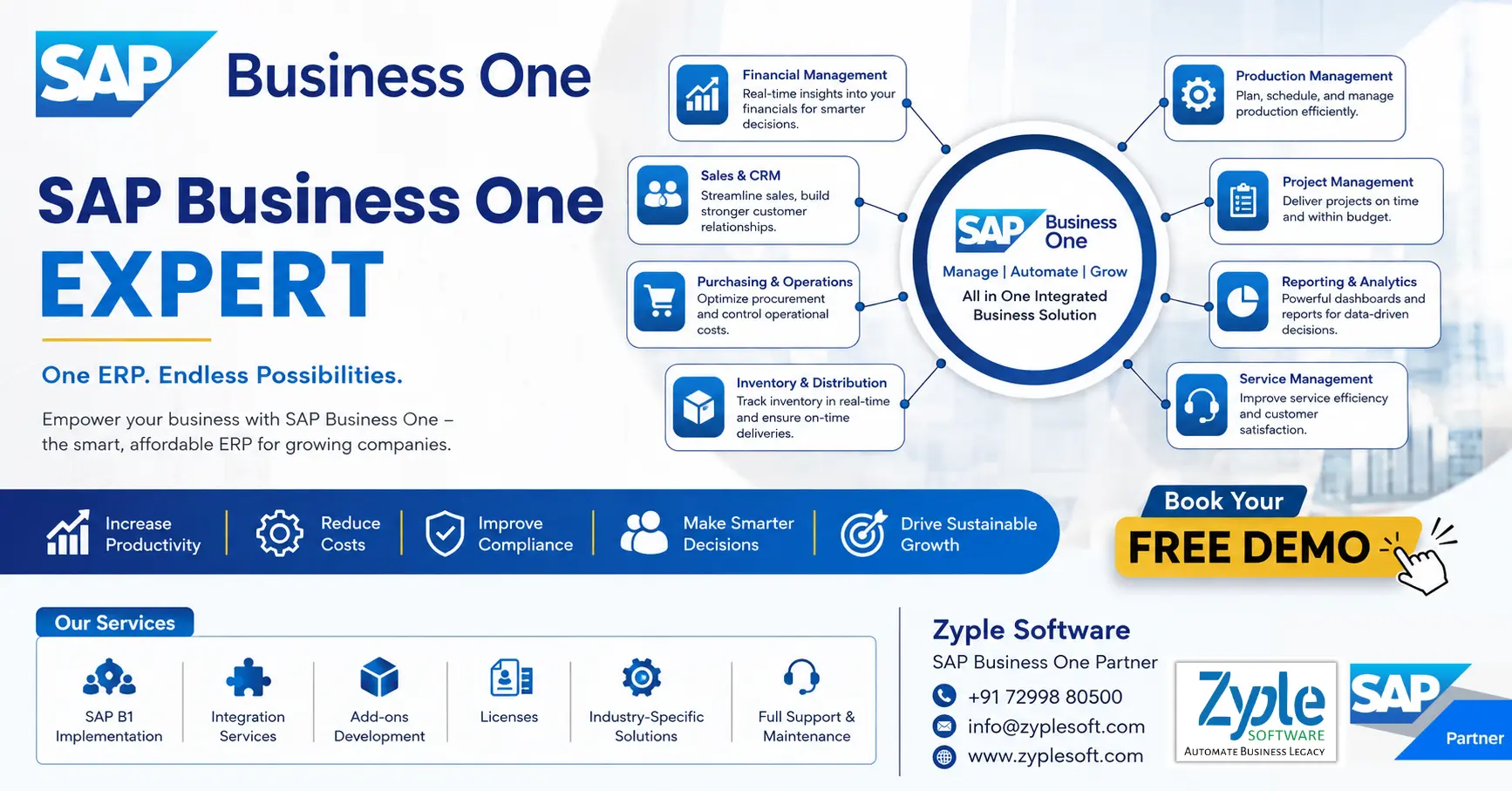
SAP Business One Expert ERP solution infographic by Zyple Software with finance, CRM, inventory, production, analytics and business management features

SAP Business One provides robust ERP capabilities for small and medium-sized businesses seeking facilitated operations. Our specialized experts help you maximize the platform’s potential, delivering customized solutions that align with your unique business requirements and growth objectives. We guide you through implementation, configuration, and optimization to ensure you gain the full benefit of your SAP Business One investment.

We specialize in:

1. System Implementation and Integration

Launching SAP Business One with minimal disruption while connecting to your current business systems.

2. Process Optimization

Facilitating workflows and automating manual tasks to boost operational efficiency.

3. Customization and Development

Creating advanced modules and functionalities that handle your specific business challenges.

4. Data Migration and Management

Securely moving your business data while ensuring accuracy and consistency.

5. Reporting and Analytics

Developing complete dashboards that deliver actionable insights for better decision-making.

6. Technical Support and Training

Delivering ongoing assistance and knowledge to empower your team.

An SAP Business One expert combines technical expertise with industry knowledge to deliver solutions that drive tangible business outcomes. Whether implementing from the beginning, optimizing a current deployment, or improving functionality with custom modules, we ensure your SAP Business One environment completely supports your operational requirements and strategic goals.

Securing the Right SAP Business One Expertise for Your Business

SAP Business One (SAP B1) is a powerful enterprise resource planning (ERP) solution that helps small and medium-sized enterprises (SMEs) facilitate their operations, gain real-time insights, and drive profitable growth. However, increasing the return on your SAP Business One investment relies heavily on having the right technical and functional expertise on board. Whether you’re in the middle of an implementation, planning an upgrade, or require ongoing support, the challenge often lies in identifying and securing qualified professionals. The success of your system depends on the skills of the people who handle, customize, and support it. This is a common obstacle for many organizations looking to fully use their ERP capabilities.

Roles and Responsibilities of an SAP Business One Expert

An SAP B1 expert is responsible for implementing, customizing, supporting, and optimizing the SAP Business One ERP system to meet business needs. Their role spans technical, functional, and strategic responsibilities across the organization.

The roles and responsibilities generally include:

1. Implementation and Deployment

  • Evaluate business requirements and map them to SAP B1 functionalities.
  • Plan and execute end-to-end SAP implementation projects.
  • Configure key modules like finance, sales, purchasing, inventory, CRM, and production.
  • Handle data migration from legacy systems to SAP B1.
  • Ensure seamless system go-live with minimal disruption.

2. Business Process Analysis

  • Study current workflows and identify inefficiencies.
  • Suggest process improvements using SAP B1 capabilities.
  • Organize ERP system with industry-specific best practices.
  • Create functional specifications and documentation.

3. System Configuration and Customization

  • Modify company settings, workflows, and approval procedures.
  • Design forms, fields, dashboards, and reports.
  • Work with SDKs, SAP B1 add-ons, or integrations to expand functionality.
  • Ensure customization aligns with future expansion.

4. Integration Management

  • Integrate SAP B1 with third-party systems such as CRM tools, e-commerce platforms, banking systems, and payroll and HR software.
  • Handle APIs, middleware, and data synchronization.

5. User Training and Support

  • Train end-users across departments.
  • Create user manuals and SOPs.
  • Deliver ongoing technical and functional support.
  • Troubleshoot system issues and resolve tickets quickly.

6. Reporting and Analytics

  • Design and generate business reports using Crystal Reports, SQL queries, and SAP dashboards.
  • Deliver insights for decision-making.
  • Ensure live data visibility across departments.

7. Database and Technical Management

  • Handle databases (like SQL Server or SAP B1 HANA).
  • Evaluate system performance and optimize queries.
  • Ensure data integrity, security, and backups.
  • Oversee upgrades, patches, and version control.

8. Project Management

  • Plan project timelines, budgets, and deliverables.
  • Coordinate with stakeholders, clients, and internal teams.
  • Handle risks and ensure timely project completion.
  • Follow SAP B1 implementation methodologies (like ASAP or Agile).

9. Compliance and Security

  • Ensure the system adheres to financial and legal regulations.
  • Define user roles and authorization controls.
  • Maintain audit trails and reporting compliance.

10. Continuous Improvement and Optimization

  • Find opportunities for automation and efficiency.
  • Suggest and install new SAP B1 features or add-ons.
  • Improve system usage as business scales.
  • Stay updated with the latest SAP releases and trends.

11. Industry-Specific Responsibilities

Depending on the domain, responsibilities may cover:

Manufacturing

Production planning, BOM, and MRP (Material Requirements Planning).

Construction

Project costing and subcontractor management.

Retail

POS integration and inventory tracking.

Pharma

Batch traceability and compliance validation.

12. Client and Stakeholder Communication

  • Act as a bridge between business users and technical teams.
  • Collect feedback and translate it into system improvements.
  • Deliver strategic ERP implementation.

Skills and Expertise of an SAP Business One Expert

An SAP B1 expert specializes in implementing, configuring, and improving the SAP Business One system for small and medium-sized enterprises (SMEs). They combine key functional accounting and supply chain knowledge with technical reporting and project management skills to align software capabilities with company goals.

  • Proficiency in core modules of SAP B1 like financial accounting, banking, fixed assets, sales, purchasing, inventory control, and production.
  • Deep understanding of business processes and localization and compliance.
  • Technical skills like SAP Crystal Reports, SQL, and SAP Business One SDK (Software Development Kit).
  • Strong requirement analysis and project management abilities.
  • Experience in training and support.

Benefits of Hiring an SAP B1 Expert

Hiring an SAP Business One (SAP B1) expert helps your company set up the software right, save money, and prevent costly system errors. They match the tool to your exact daily requirements, clean and move your old data safely, and connect SAP B1 with your other apps like e-commerce or CRM.

1. Proper Setup

They develop workflows that fit how your business actually works.

2. Safe Data Migration

They transfer old records into SAP B1 without losing details using SAP Business One solutions.

3. Custom Add-ons

They develop special tools or reports using the SAP SDK if standard options fall short.

4. System Integration

They connect your ERP with outside platforms like payment gateways or shipping tools.

5. Staff Training

They teach your team how to use the system well so work moves faster.

6. Ongoing Support

They resolve bugs quickly and handle system updates safely in SAP support.

When You Should Hire an SAP B1 Expert

Hiring an SAP Business One (SAP B1) expert is necessary when starting a new system setup, migrating old data, upgrading software versions, or fixing chronic workflow gaps. You also need professional help for custom reports, third-party software connections, and training your team.

1. New Implementation

Develop and configure the software to match your exact business rules.

2. Data Migration

Transfer old spreadsheets and legacy data safely without losing records.

3. System Upgrades

Move to the latest versions without breaking current operations.

4. Custom Reports and Add-Ons

Develop specialized Crystal Reports or custom SQL queries.

5. Software Integration

Connect SAP B1 with e-commerce sites or third-party apps via APIs.

6. Staff Training

Teach your team how to use specific modules properly.

Choosing the Right SAP B1 Expert

Choosing the right SAP Business One (SAP B1) expert is essential for a smooth ERP setup. Look for official SAP Business One partnership tiers, verified industry track records, certified in-house consultants, and robust local or regional compliance knowledge.

1. Industry Experience

Ensure the expert or partner knows your specific sector (such as manufacturing, construction, retail, and pharma) to handle unique workflows and compliance needs.

2. Certifications

Check for formal SAP B1 credentials and certified consultants who understand the latest versions of SAP B1 and SAP B1 HANA.

3. Customization and Integration

Verify their technical ability to modify the system and connect it seamlessly with third-party software like e-commerce platforms or Microsoft 365.

4. Post-Implementation Support

Confirm they deliver ongoing training, troubleshooting helpdesk services, and system updates after your go-live date.

Conclusion of SAP B1 Expert

As a leading SAP Business One partner, Zyple Software is delivering services like SAP B1 implementation, integration, migration, licensing, consulting, add-ons, digital transformation, and support and training to different industries, like construction, manufacturing, solar, food and beverage, aerospace, oil and gas, healthcare, retail, real estate, jewellery, pharma, and textiles. 

SAP Business One is an ERP solution customized for small and medium-sized enterprises that connects finance, production, inventory, material requirements planning (MRP), procurement, sales, CRM, and reporting and analytics into one platform. For food and beverage, pharma, and chemical businesses, it can improve project costing, procurement, subcontractor billing, and inventory management.

If you’re involved, reserve a demo of SAP Business One.

Do you assure the SAP B1 ERP system for your business or industry?

Finish all the details in the quoted contact form; our team will return to you.

    FAQs

    1.How can an SAP Business One Expert improve my business operations?

    An SAP Business One expert helps facilitate your processes by integrating finance, sales, inventory, and operations into one system, improving efficiency and decision-making.

    Yes, SAP Business One is highly flexible and can be customized for industries like construction, manufacturing, retail, and distribution with the help of an expert.

    The cost depends on project scope, customization needs, and implementation complexity. A consultation can deliver a clear estimate based on your business requirements.

    Most businesses start seeing improvements in efficiency, reporting, and cost control within a few months of proper SAP B1 implementation by an SAP B1 expert.

    You can begin with a free consultation to evaluate your business needs, followed by a customized implementation plan tailored to your goals.
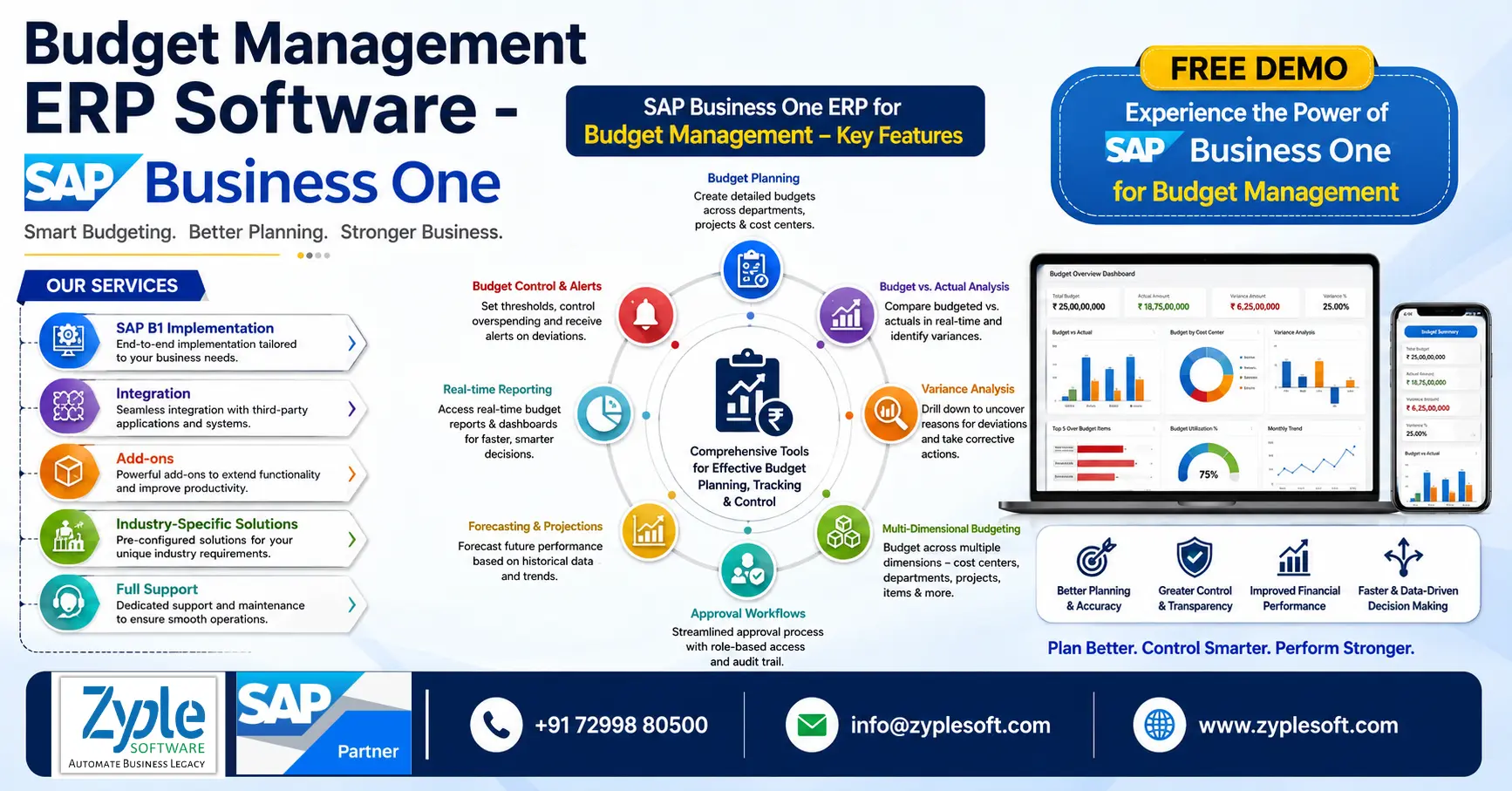
    Budget Management ERP Software - sap business one

    Budget Management ERP Software

    Budget Management ERP Software for Business

    Budget Management ERP Software - sap business one

    Handling budgets and tracking expenses can be a difficult task, but the emergence of enterprise resource planning (ERP) has made it easier and more accessible. With the budget management ERP software, businesses can efficiently handle their finances and ensure efficient resource management. Also, this ERP software is designed to help businesses stay on top of their budgeting needs and all the necessary calculations.

    What is Budget Management Software?

    Budget management software is software that integrates financial planning, forecasting, and real-time expense tracking to control costs and prevent budget overruns.

    Which is the Best ERP Software for Budget Management?

    SAP Business One is the best ERP software for budget management. The SAP Business One system serves as a powerful ERP software for budget management, allowing small and medium-sized enterprises (SMEs) to define, track, and control budgets in real-time. It enables annual or monthly budgeting, automated distribution methods, and proactive budget alerts or blocking of transactions that exceed predefined limits, ensuring financial control.

    Features of Budget Management ERP Software

    Here are the features of SAP Business One as budget management software:

    1. Budget Planning and Scenario Definition

    • Creates budget scenarios for different financial plans (annual, quarterly, and project-based).
    • Assigns budgets to general ledger accounts, departments, or cost centers.
    • Defines distribution methods (equal, percentage-based, and seasonal allocation).

    2. Budget Allocation and Distribution

    • Allocates budgets across time periods (monthly or yearly) and business units or branches.
    • It includes flexibility to distribute funds based on business priorities or historical data.

    3. Budget Control and Enforcement

    • Strong control mechanisms to avoid overspending, like blocking transactions that exceed budget, warning alerts before exceeding limits, and enabling transactions without warning (if configured).
    • Applies to purchase requests and orders, goods receipt, and accounting entries (invoices and journal entries).

    4. Real-Time Budget Monitoring

    • Tracks budget vs. actual spending in real-time.
    • Instant visibility into over-utilized budgets and remaining balances.
    • It helps improve financial discipline and forecasting accuracy.

    5. Integration with Financial Management

    • Entirely integrated with general ledger, accounts payable and receivable, and cost accounting.
    • It ensures every financial transaction is automatically validated against the budget.

    6. Multi-Level Budgeting

    • It supports department-wise budgets, project-based budgets, and company-wide budgets.
    • Allows hierarchical budget control across multiple entities.

    7. Budget Revision and Adjustments

    • Modifies budgets through updates, transfers between accounts, and supplementary allocations.
    • Maintains flexible budgets for changing business conditions.

    8. Budget Reporting and Analytics

    • Creates reports, such as budget vs. actual reports, profit and loss accounts with budget comparison, and variance analysis.
    • Uses dashboards and analytics for data-driven decision-making.

    9. Alerts and Workflow Automation

    • Automated notifications for budget overruns and threshold breaches.
    • It includes workflow-based approvals for budget-related transactions.

    10. Project and Cost Control Integration

    • Links budgets with projects and cost centers.
    • Monitors project profitability and cost deviations effectively.

    11. Multi-Currency and Global Budgeting

    • Handles budgets across multiple currencies and international operations.
    • Suitable for companies operating in different regions.

    12. Audit Trail and Compliance

    • Full traceability of budget creation and changes and approvals.
    • It ensures financial transparency and compliance.

    Importance of Budget Management Software

    The enterprise resource planning (ERP) software, SAP Business One (SAP B1) solution, is essential for increasing financial accuracy, allowing real-time tracking, and automating forecasting, which helps businesses prevent overspending and align resources with strategic goals. By replacing manual spreadsheets, SAP B1 improves collaboration, delivers data-driven insights for decision-making, and increases overall financial efficiency.

    1. Increased Accuracy and Efficiency

    Automates data entry and calculations, eliminating human error inherent in manual budgeting processes using SAP implementation.

    2. Real-Time Monitoring and Control

    Delivers live, instant access to financial data and expenses, allowing teams to spot overspending immediately and make adjustments.

    3. Improved Forecasting and Planning

    Utilizes historical data and predictive analytics for accurate financial modeling and strategic planning, rather than depending on guesswork.

    4. Improved Collaboration

    The SAP Business One system allows multiple team members to work on a single, shared, and secure version of the budget, breaking down organizational storage.

    5. Strategic Resource Allocation

    SAP B1 helps managers identify areas of overspending and reallocate funds effectively to improve profitability and achieve business goals.

    6. Regulatory Compliance

    The SAP B1 solution ensures better documentation and reporting for auditing and regulatory purposes.

    Benefits of Budget Management ERP Software

    1. Increased Visibility and Control

    The SAP Business One software improves visibility and provides control to enterprises. With inbuilt real-time financial reporting, enterprises can find discrepancies or issues, which can help trigger immediate corrective action. Increased visibility and control also enable better decision-making, as finance teams can analyze financial data and make precise predictions about future spending.

    2. Time Saving

    Manual budgeting is a time-consuming process, but SAP Business One is fast and accurate and can also automate a number of repetitive and daily tasks. Users can quickly create budgets, evaluate expenses, and generate reports without manual interventions, freeing up strategic resources for essential tasks such as analysis and planning.

    3. Cost Savings

    The SAP Business One system can help enterprises create cost savings opportunities by identifying areas of overspending and reducing unnecessary expenses. SAP solutions also help procurement teams to negotiate better pricing with vendors and suppliers, further minimizing costs. Furthermore, SAP B1 also provides advanced features such as automated approvals and alerts, which can help enterprises avoid spending more than required and at the same time keep the budget management process on track.

    4. Improved Accuracy

    With automated processes and real-time reporting, the SAP B1 ERP system can eliminate many of the errors that can occur with manual budgeting, thereby improving accuracy and reducing the risk of financial discrepancies in reporting.

    5. Forecasting and Planning

    Most enterprises choose the SAP Business One system that can assist them with forecasting and planning. This software can analyze the enterprise’s historical spending patterns and identify trends and help the supply chain team to create accurate budget projections and ensure that financial resources are allocated appropriately. This can become accessible for companies with large and complex supply chains, where keeping track of budget and expenses can be a significant challenge.

    6. Enhanced Collaboration

    Other than keeping track of expenses, SAP software can help supply chain professionals to facilitate their workflows and improve supply chain collaboration. This software is capable of delivering a centralized platform for budget tracking and reporting, with which it virtually eliminates the need for multiple spreadsheets and documents. This can allow teams located across geographies to share data and insights in real time, exponentially increasing the scope for collaboration.

    7. Scalability

    What SAP Business One does is scale up with that growth, which makes such software a suitable tool for enterprises looking to expand their operations.

    Conclusion of Budget Management ERP

    Zyple Software is a trusted SAP B1 partner in India specializing in implementation, digital transformation, migration, licensing, integration, add-on solutions, and consulting for manufacturing, construction, real estate, agriculture, logistics, financial services, retail, technology, energy, healthcare, infrastructure, EPC, and professional services industries. It delivers increased visibility and control and  improved collaboration and forecasting and planning capabilities, as well as saves time, minimizes costs, and improves accuracy.

    If you’re active, book a demo of SAP Business One.

    Are you aiming to find the SAP Business One ERP software for your business or industry?

    Fill in all the details in the figured contact form; our team will reach out to you.

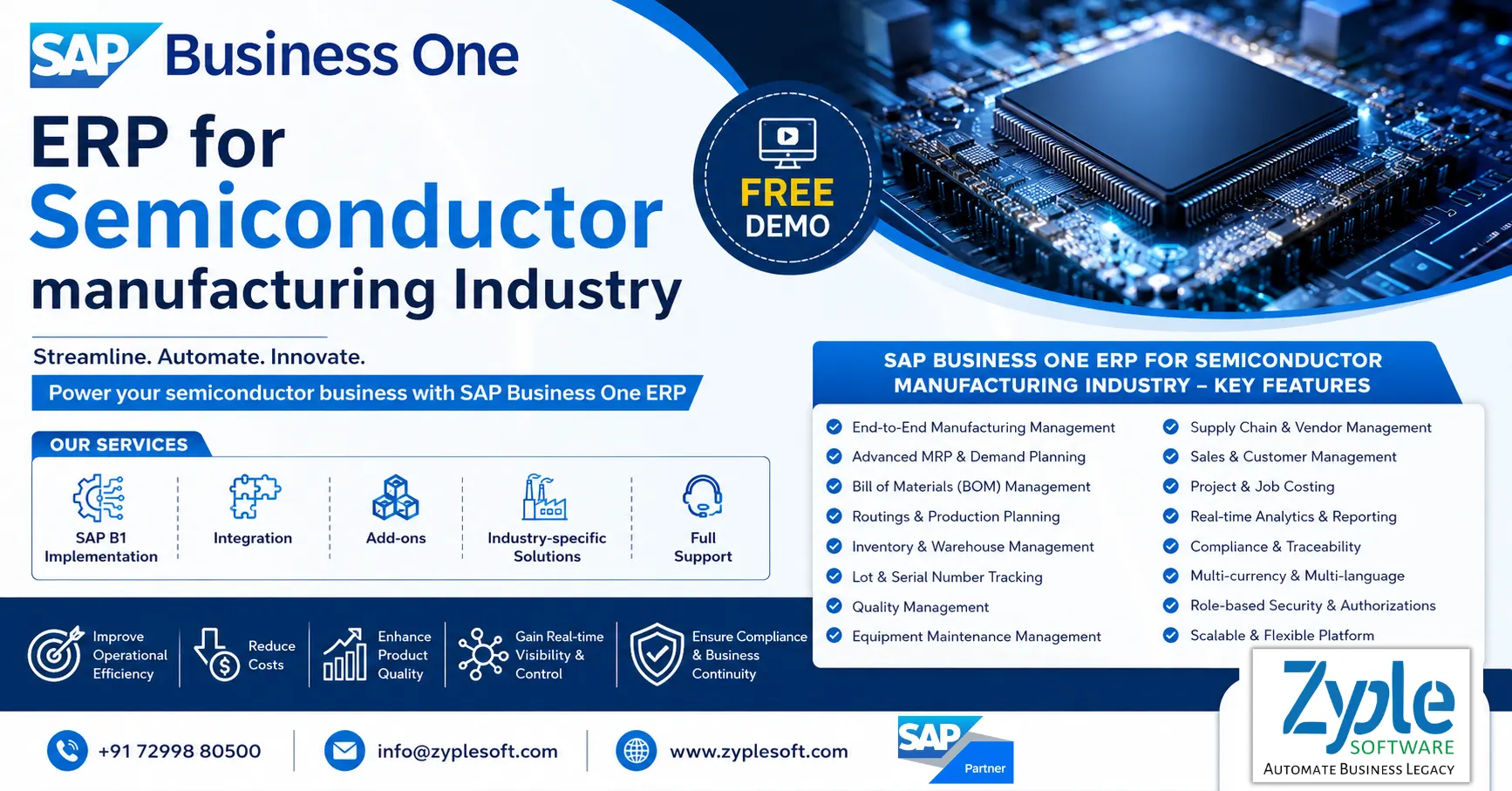
      SAP Business One ERP for Semiconductor Manufacturing Industry – Production Planning, Inventory Management, Quality Control, Supply Chain Management, and Business Automation by Zyple Software

      SAP Business One ERP for Semiconductor Manufacturing

      SAP Business One ERP for Semiconductor Manufacturing Industry

      SAP Business One ERP for Semiconductor Manufacturing Industry – Production Planning, Inventory Management, Quality Control, Supply Chain Management, and Business Automation by Zyple Software

      The semiconductor manufacturing industry is the backbone of modern technology, powering everything from smartphones to electric vehicles. But with rising demand, global supply chain disruptions, and complex manufacturing processes, chipmakers face significant issues. SAP Business One ERP for semiconductor manufacturing helps the semiconductor manufacturing industry to facilitate operations, improve productivity, and maintain quality.

      Challenges Faced By The Semiconductor Manufacturing Industry

      The semiconductor manufacturing industry faces massive barriers, including extreme capital costs, geopolitical supply chain vulnerabilities, and serious talent shortages. Also, the sector tackles demanding physical infrastructure needs, environmental compliance pressures, and the rapid pace of technological miniaturization.

      1. Massive Capital Expenditure

      Building a single advanced fabrication plant requires huge capital expenditure.

      2. Long Gestation Periods

      Factories take five to seven years to build, preventing quick returns on private investment.

      3. Geopolitical Concentration

      Over 60% of the global semiconductor manufacturing and nearly 100% of advanced sub-10nm chips are concentrated in Taiwan and South Korea.

      4. Supply Chain Fragility

      The industry heavily depends on limited resources for raw materials, rare earths, and specialized equipment like EUV lithiography.

      5. Serious Talent Shortages

      The industry faces a projected shortfall of hundreds and thousands of specialized chip engineers and process-critical fab staff globally.

      6. Intense Power and Infrastructure

      Fabs need uninterrupted 24/7 and huge infrastructure stability.

      7. Large Water Usage

      Producing a single wafer uses large volumes of ultrapure water, straining resources in drought-prone regions.

      8. Environmental Chemical Hazards

      The usage and disposal of toxic metals, hazard chemicals, and strict ESG compliance add significant operational expenses.

      9. Technological Miniaturization

      Shrinking transistors to the atomic level requires continuous R&D investments to solve extreme physics and heat barriers.

      Features of SAP Business One ERP for Semiconductor Manufacturing

      1. Financial Management

      • It includes general ledger, accounts receivable, accounts payable, and banking integration.
      • It includes budgeting, cost accounting, and financial forecasting.
      • It includes multi-currency and global compliance support.

      2. Sales and Customer Lifecycle Management

      • It includes lead and opportunity tracking.
      • It includes customer data and contract management.
      • It includes after-sales service and warranty tracking.

      3. Purchasing and Supplier Management

      • It includes vendor management and procurement automation.
      • It includes purchase orders, GRNs, invoicing, and returns.
      • It includes supplier performance tracking.

      4. Investment and Warehouse Management

      • Real-time inventory tracking like raw materials, work-in-progress, and finished goods.
      • It includes multi-warehouse and bin location management.
      • Batch or serial number tracking for traceability.

      5. Business Intelligence and Analytics

      • It includes real-time dashboards and KPIs.
      • It includes custom reports and predictive insights.
      • It includes drill-down analytics with Excel integration.

      6. End-to-End Production Planning

      • Production order creation, like manual and automated.
      • It includes multi-stage production cycle tracking.
      • It includes integration with sales and demand planning.

      7. Bill of Materials (BOM) Management

      • It includes multi-level BOMs for complex chip structures.
      • It includes component hierarchy and routing stages.
      • It includes version control for engineering changes.

      8. Material Requirements Planning (MRP)

      • It includes demand forecasting and planning.
      • It includes automated procurement suggestions.
      • It includes optimization of raw materials and components.

      9. Shop Floor Control

      • Tracks real-time production activities.
      • Monitors machine utilization and downtime.
      • Captures actual vs planned production data.

      10. Batch, Lot, and Serial Traceability

      • It includes end-to-end traceability from wafer to finished chip.
      • Tracks defects, recalls, and compliance.
      • Essential for semiconductor quality audits.

      11. Quality Control and Compliance

      • It includes in-process and final quality inspections.
      • It includes test result recording and validation.
      • It includes compliance with global semiconductor standards.

      12. Yield and Scrap Management

      • Monitors yield rates at every stage.
      • Minimizes scrap and rework.
      • Improves production efficiency.

      13. Engineering Change Management

      • Handles product lifecycle changes.
      • It includes version control for designs and BOMs.
      • It includes faster new product introduction (NPI).

      14. Production Costing

      • It includes standard and actual cost tracking.
      • It includes labor, material, and overhead cost allocation.
      • It includes real-time profitability analysis.

      15. Capacity and Resource Planning

      • It includes machine capacity planning.
      • It includes workforce allocation.
      • Obstacle identification.

      16. Just-In-Time (JIT) and Lean Manufacturing

      • Optimizes inventory levels.
      • Minimizes lead times and wastage.
      • Improves throughput efficiency.

      17. Supply Chain Management

      • It includes multi-tier supplier coordination.
      • It includes demand-supply synchronization.
      • It includes logistics and distribution planning.

      18. Multi-Location and Global Operations

      • Handles multiple plants and warehouses.
      • It includes localization for taxes and compliance.
      • It includes multi-currency transactions.

      19. SAP B1 HANA Integration

      • It includes in-memory for high-speed processing.
      • It includes real-time analytics and simulations.

      20. IoT and Machine Integration

      • Connects machines and sensors.
      • Captures real-time production data.
      • Allows smart factory capabilities.

      21. Mobile and Web Access

      • ERP access for mobile.
      • It includes remote monitoring of production and inventory.

      22. Workflow Automation

      • It includes approval workflows.
      • It includes alerts and notifications.
      • Minimized manual intervention.

      23. Real-Time Reporting

      • It includes production efficiency reports.
      • It includes cost and variance analysis.
      • It includes supply chain performance dashboards.

      Importance of SAP Business One ERP for Semiconductor Manufacturing

      The ERP software, SAP Business One (SAP B1) system, is essential because it unifies complex production, supply chain, and quality control into a single platform. It enables these capital-intensive businesses to reduce material waste, improve wafer yield, ensure strict regulatory compliance, and optimize costs.

      1. Precision Inventory Tracking

      Handles the microscopic supply chain of semiconductor manufacturing by tracking raw materials, WIP (Work-In-Progress), and wafers in real-time across multiple facilities using SAP implementation.

      2. Stringent Quality Control

      Features built-in QA tools that allow batch and serial number traceability, ensuring compliance with strict semiconductor-grade standards and precise product recalls if necessary.

      3. Advanced Production Scheduling

      Prioritizes tasks, assigns resources, handles complex Bills of Materials (BOMs), and tracks production cycles to maintain optimal throughput and avoid obstacles.

      4. Cost Management

      Delivers instant access to real-time financials and overhead controls, directly comparing actual expenditures against budgets to unlock essential cost-saving opportunities using SAP solutions.

      5. System Integration

      Seamlessly connects with Manufacturing Execution Systems (MES), testing tools, and IoT automation systems to ensure a seamless flow of data across the entire factory floor.

      Benefits of SAP Business One for Semiconductor Manufacturing

      SAP Business One delivers semiconductor manufacturers with a flexible, integrated ERP framework to handle complex production cycles, wafer lot tracking, and stringent quality control. It drives profitability by minimizing material waste, accelerating time-to-market, and optimizing procurement across multiple global plants.

      1. Precision Lot and Serial Traceability

      Monitors raw materials, wafers, and sub-assemblies across multiple manufacturing plants in real time to ensure end-to-end compliance and quality assurance.

      2. Advanced Production Scheduling

      Optimizes throughput and resource allocation by handling complex, multi-level Bills of Materials (BOMs) and monitoring strict production cycles.

      3. Supply Chain Optimization

      The SAP software reduces chip component shortages and avoid expensive overstocking through automated demand forecasting, vendor lead-time planning, and just-in-time procurement.

      4. Cost and Profit Management

      Facilitates financial operations with instant, real-time data, enabling you to track actual production costs versus budgets to improve margins in a highly competitive market.

      5. Equipment Integration

      Connects shop-floor manufacturing machinery directly into your ERP for better equipment utilization and predictive maintenance.

      Conclusion of Semiconductor Manufacturing ERP

      Zyple Software is an Official SAP Business One partner in India specializing in implementation, digital transformation, licensing, integration, add-on solutions, migration, and consulting for the semiconductor manufacturing industry. SAP Business One ERP delivers the automation, visibility, and control needed to achieve demand, maintain quality, and stay competitive.

      If you’re resilient, schedule a demo of SAP Business One.

      Do you seek the SAP Business One ERP system for your business or industry?

      Complete all the details in the designated contact form; our team will return to you.

        1. How can SAP Business One ERP minimize operational costs in semiconductor manufacturing?

        SAP Business One helps minimize costs by optimizing inventory levels, reducing material wastage, improving production planning, and automating manual processes. This results in better resource utilization and higher profitability.

        Yes, SAP Business One is specifically customized for growing small and medium-sized businesses. It delivers enterprise-level capabilities at an affordable cost, making it ideal for semiconductor companies looking to scale efficiently.

        Absolutely. SAP Business One can be designed for your specific workflows, including wafer processing, assembly, testing, and quality control. Industry-specific add-ons further improve its capabilities.

        Most semiconductor companies start seeing ROI within months due to improved efficiency, reduced errors, better inventory control, and improved decision-making with real-time data insights.

        Getting started is easy; connect with a certified SAP Business One partner like Zyple Software for a consultation, demo, and needs assessment. They will guide you through implementation, customization, and ongoing support designed for your semiconductor operations.