Tag Archives: zyple software sap partner

SAP Business One ERP for Drones and UAV Manufacturing by Zyple Software featuring production planning, inventory management, BOM, quality control, serial number traceability, compliance, and manufacturing automation.

SAP Business One ERP for Drones and UAV Manufacturing

SAP Business One (B1) ERP for Drones and UAV Manufacturing
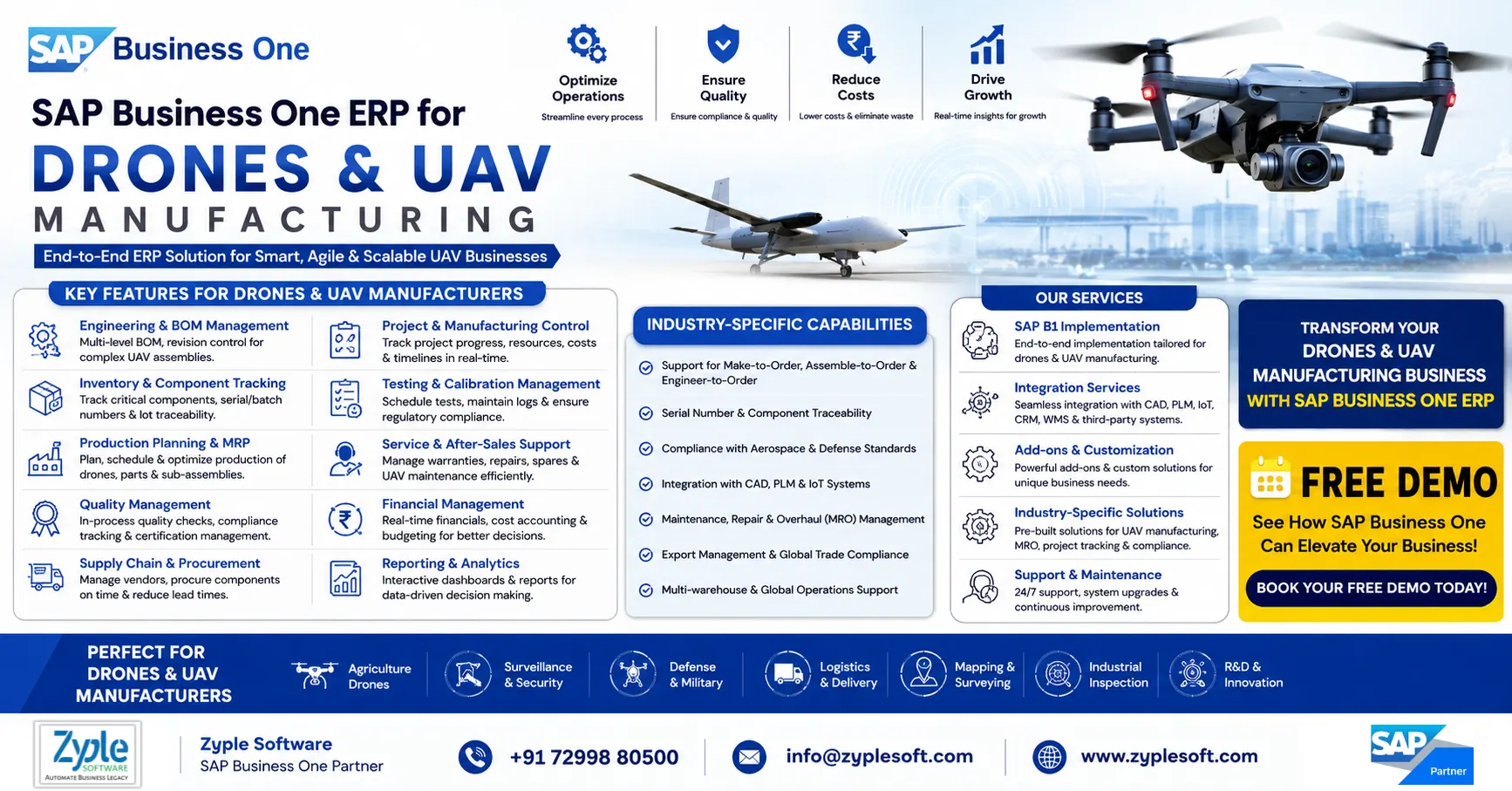
SAP Business One ERP for Drones and UAV Manufacturing by Zyple Software featuring production planning, inventory management, BOM, quality control, serial number traceability, compliance, and manufacturing automation.

The drones and UAV manufacturing industry, which includes things like aerial photography, surveillance, and farming, is growing. While drones are excellent, running a business in the drones and UAV manufacturing industry can be tricky. Handling everything from fleet coordination to regulatory compliance can become overwhelming. SAP Business One ERP for drones and UAV manufacturing can help drones and UAV manufacturing companies to simplify their work and reach new levels of success.

Issues Faced By The Drones and UAV Manufacturing Sector

The drones and UAV manufacturing industry faces significant challenges across supply chain dependencies, regulatory obstacles, and engineering limitations. Manufacturers struggle with reliance on imported microchips, sensors, and battery cells; scaling production without inflating costs; and complying with fragmented global airspace and certification rules.

1. Supply Chain and Component Dependency

Many regional UAV manufacturers depend heavily on foreign suppliers for essential components like GPS modules, battery cells, semiconductors, and high-performance cameras. This dependency creates serious vulnerabilities regarding both national security and supply chain disruptions. Developing an independent, domestically sourced non-red supply chain requires massive capital investment.

2. Regulatory and Compliance Constraints

Despite the rapid growth of the commercial drone market, government regulations often lag behind. Manufacturers face inconsistent airspace management, delays in gaining airworthiness certifications, and strict export controls. Navigating the complexities of local, national, and international laws significantly increases time-to-market.

3. Engineering and Technological Challenges

Designers continuously battle the trade-off between weight reduction and structural durability. Drones must be lightweight to increase flight efficiency and payload, yet powerful enough to withstand harsh environmental conditions. Also, improving battery endurance for continuous, long-range missions remains a primary engineering constraint.

4. Privacy, Security, and Public Perception

Because of the dual-use nature of UAVs, manufacturers face scrutiny regarding privacy, hacking, and unauthorized data collection. Instances of hobbyist drones entering restricted zones or being used for illegal activities lead to strict regulations and public skepticism.

5. Skilled Workforce Shortage

The rapid integration of artificial intelligence, edge computing, and 5G into drone platforms involves highly specialized knowledge. The industry faces a shortage of professional drone engineers, AI developers, and trained operators.

Features of SAP Business One ERP for Drones and UAV Manufacturing

1. Production Planning and Control (UAV Assembly)

  • Multi-level bill of materials (BOM) for drone components like motors, sensors, PCBs, and frames.
  • Routing and stage-wise production like assembly, testing, and calibration.
  • Production order creation, like manual or automated, from sales orders.
  • It includes real-time tracking of work-in-progress (WIP).
  • Assembly and sub-assembly, like propulsion systems and flight controllers.
  • It includes rework and repair order handling for defective UAV units.

2. Material Requirements Planning (MRP)

  • It includes automated material planning based on demand forecasts.
  • Component shortage alerts for essential UAV parts like chips and batteries.
  • It includes procurement recommendations using the planning wizard.
  • It includes demand-supply balancing for high-value electronic components.
  • It includes lead time planning for imported drone parts.

3. Inventory and Warehouse Management

  • Multi-warehouse management for raw materials, assembly, and finished drones.
  • It includes batch and serial number tracking for UAV traceability.
  • It includes real-time inventory visibility across locations.
  • It includes stock valuation and costing.
  • It includes inventory traceability for compliance and safety.

4. Engineering and Product Lifecycle Support

  • It includes version control for drone designs and BOM revisions.
  • It includes engineering change management.
  • It includes prototype vs. production BOM handling.
  • It includes integration with CAD or PLM systems via add-ons.
  • Product configuration for different drone variants for defense, agriculture, and surveillance.

5. Financial Management and Costing

  • End-to-end accounting like general ledger, accounts payable, and accounts receivable.
  • It includes profitability analysis per UAV model.
  • It includes budgeting and cost control for R&D projects.
  • It includes fixed asset management for machinery and testing equipment.

6. Procurement and Supplier Management

  • It includes vendor management for electronics, sensors, and components.
  • It includes purchase order automation and approvals.
  • It includes supplier performance tracking.
  • Import management like duties, taxes, and multi-currency.
  • It includes quality-based vendor selection.

7. Quality Control and Compliance

  • Incoming quality checks for components like battery safety and sensors.
  • It includes in-process inspection during UAV assembly.
  • It includes final testing and certification tracking.
  • It includes non-conformance and corrective action management.
  • It includes compliance with aerospace and defense standards.
  • It includes full product traceability for audits.

8. Sales, CRM, and Project Management

  • It includes quotation management for customized UAV solutions.
  • Customer lifecycle tracking like defense, agriculture, and logistics clients.
  • Project-based sales like large UAV contracts.
  • It includes after-sales service and AMC tracking.

9. Service and Maintenance Management

  • It includes UAV repair and maintenance tracking.
  • It includes warranty management for drones and components.
  • It includes service contracts and field service management.
  • It includes spare parts tracking and replacement history.
  • It includes maintenance schedules for deployed drains.

10. Business Intelligence and Analytics

  • It includes real-time dashboards and KPIs.
  • It includes production efficiency and yield analysis.
  • It includes cost vs. revenue insights for every drone model.
  • It includes predictive analytics using SAP B1 HANA.
  • It includes custom reports and drill-down analysis.

11. Supply Chain and Logistics Management

  • It includes end-to-end supply chain visibility.
  • It includes shipment and delivery tracking.
  • It includes integration with logistics partners.
  • It includes export documentation for international drone sales.
  • It includes demand forecasting and distribution planning.

12. Mobility and Remote Access

  • It includes a web client for remote operations.
  • It includes real-time updates from the shop floor or warehouses.

13. Integration and Industry 4.0 Capabilities

  • Integration with IoT devices like drone testing data and sensors.
  • It includes API-based integration with external systems.
  • It includes machine data collection from testing rigs.
  • It includes automation of workflows and approvals.
  • It includes cloud or on-premise deployment flexibility.

14. Human Resource and Workforce Management

  • It includes employee data and workforce tracking.
  • It includes skill-based allocation for UAV assembly technicians.
  • It includes attendance and productivity monitoring.
  • It includes training management for specialized drone operations.

15. Security and Data Management

  • It includes role-based access control.
  • It includes data encryption and secure transactions.
  • It includes audit trails for compliance.
  • It includes backup and disaster recovery.

Benefits of SAP Business One ERP for Drones and UAV Manufacturing

The ERP software, SAP Business One (SAP B1) system, facilitates the entire lifecycle of drone and UAV manufacturing by integrating design, production, supply chain, and financials. It helps businesses reduce margin surprises, comply with strict aviation safety compliances, and track components from raw material to final deployment.

1. End-to-End Traceability and Compliance

It tracks every part, batch, and serial number across the supply chain with the SAP implementation process. It securely stores compliance documents and ensures adherence to strict aviation standards (like AS9100 and DGCA regulations).

2. Intelligent Production and BOMs

Handles deeply nested, multi-level Bills of Materials (BOMs) and supports engineering change orders (ECOs) to safely apply rapid design upgrades to your drones.

3. Automated Material Requirements Planning (MRP)

Automatically calculates exactly what metals, composites, and electronics are required based on sales orders and forecasts, avoiding stock shortages or expensive excess inventory using SAP solutions.

4. Project-Based Costing

Treats every UAV build or defense contract as an individual project. It ties production to financials so you can closely evaluate the profitability of custom or large-scale orders.

5. Real-Time Quality Control

Connects quality checkpoints directly into the shop floor assembly process, logging inspection results and digital certificates at every stage.

Conclusion of Drones and UAV Manufacturing ERP

As a leading SAP Business One partner, Zyple Software is delivering services like SAP B1 implementation, licensing, integration, add-ons, and support to different industries, like construction, manufacturing, solar, aerospace, jewellery, food and beverage, retail, pharma, and textiles. 

SAP Business One is an ERP customized for small and medium-sized businesses that connects finance, procurement, production, sales, CRM, inventory, and reporting into one platform. For drones and UAV manufacturing or any other companies, it can improve project costing, procurement, subcontractor billing, and inventory management.

If you’re captivated, Book a SAP Business One Demo.

Do you seek the SAP B1 ERP system for your business or industry?

Finish all the details in the assigned contact form; our team will return to you.

    FAQs

    1.How can SAP Business One ERP improve efficiency in drone manufacturing operations?

    SAP Business One facilitates production planning, inventory control, and procurement processes, helping drone manufacturers minimize delays, optimize resources, and improve overall operational efficiency.

    Yes, SAP Business One is specifically customized for SMEs. It provides scalable features that help growing UAV businesses handle production, finances, and supply chain operations without complexity.

    Absolutely. SAP Business One delivers batch and serial number tracking, along with quality management features to ensure every drone component meets required standards and compliance.

    The cost depends on factors, such as number of users, customization, and deployment type. However, SAP Business One is affordable compared to traditional ERP systems and delivers strong ROI through improved efficiency and reduced operational costs.

    You can connect with a certified SAP Business One partner like Zyple Software to get a personalized demo, consultation, and pricing details customized for your drone manufacturing business requirements.
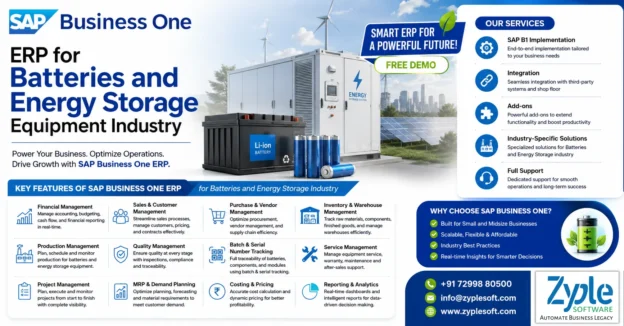
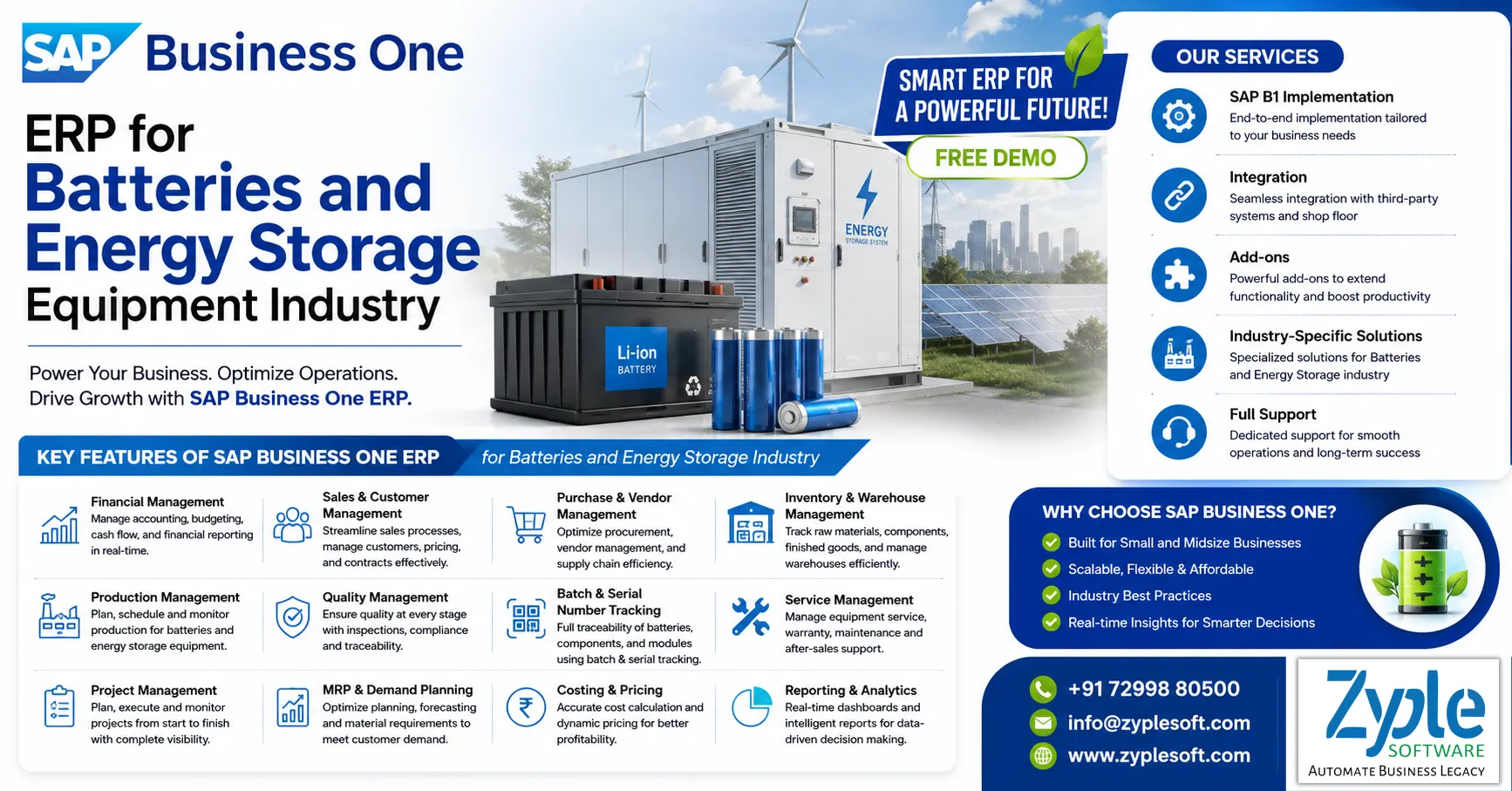
    SAP Business One ERP for Batteries and Energy Storage Equipment Industry by Zyple Software

    SAP Business One ERP for Batteries and Energy Storage Equipment Industry

    SAP Business One (B1) ERP for Batteries and Energy Storage Equipment Industry

    SAP Business One ERP for Batteries and Energy Storage Equipment Industry by Zyple Software

    The batteries and energy storage equipment industry operates in a precision-driven and compliance-heavy environment. Even small gaps in production data or inventory tracking can lead to serious consequences like failed audits, delayed shipments, or costly rework. SAP Business One ERP for batteries and energy storage equipment unifies financials, multi-level bills of materials (BOMS), and supply chains into a single platform to accelerate production, track inventory, and maintain global safety compliance.

    Challenges Faced By The Batteries and Energy Storage Equipment Industry

    The battery and energy storage equipment industry faces significant challenges, including volatile raw material costs, supply chain vulnerabilities, and strict safety concerns. Furthermore, rapid technological degradation, regulatory uncertainities, and complex end-of-life recycling requirements continue to challenge large-scale global deployment.

    1. Supply Chain Constraints and Material Sourcing

    The industry depends heavily on essential materials like lithium, cobalt, nickel, and graphite. Geopolitical concentrations in mining and refining expose manufacturers to price volatility and supply disruptions.

    2. Safety and Thermal Runaway

    Large-scale battery and energy storage equipment systems present significant fire risks and thermal runaway, leading to insurance and zoning challenges. For instance, municipalities globally have occasionally installed moratoriums on lithium-ion facilities due to combustion and pollution.

    3. Degradation and Lifespan

    Batteries experience capacity fading and degradation over charge-discharge cycles. This demands frequent replacements and complex cell-balancing capabilities to ensure optimal pack performance over a 10-to-15-year operational span.

    4. High Capital Costs and ROI Uncertainty

    Despite falling cell prices, total auxiliary integration, engineering, and setup costs remain high. Investors face uncertainties regarding long-term profitability, specifically when participating in fluctuating energy arbitrage markets.

    5. End-of-Life and Recycling

    Handling discarded equipment is an escalating environmental issue. Recycling infrastructure for large utility-scale batteries becomes less potent, and improper disposal can lead to toxic chemical and heavy metal soil contamination.

    6. Regulatory and Standard Gaps

    A lack of uniform international codes, standardization across different chemistries, and clear grid-interconnection rules complicate smooth integration.

    Features of SAP B1 ERP for Batteries and Energy Storage Equipment Business

    1. Production and Manufacturing Management

    • It includes multi-level bills of materials (BOM) for cells, modules, BMS, casing, and chemicals.
    • It includes production orders and shop floor control for battery assembly and pack building.
    • It includes material requirements planning (MRP) for raw materials like lithium, cobalt, and electrolytes.
    • Batch production and formula management are essential for chemical mixing processes.
    • It includes WIP (Work-in-Progress) tracking for multi-stage battery production.
    • Yield, scrap, and rework management are essential for defect control.
    • It includes capacity and resource planning for machines, labor, and production lines.
    • Production costing, like standard vs. actual with real-time recalculation.
    • It ensures efficient control over complex, multi-stage battery manufacturing.

    2. Inventory and Warehouse Management

    • It includes real-time tracking of raw materials, semi-finished, and finished goods.
    • Batch and serial number tracking for traceability is essential for batteries.
    • It includes multi-warehouse and bin location management.
    • It includes expiry and shelf-life tracking for chemicals and cells.
    • Stock valuation methods like FIFO, moving average, and standard costing.
    • It includes automated stock movements during production and dispatch.
    • It includes barcode and QR integration for warehouse operations.
    • Important for safety, compliance, and traceability in battery manufacturing.

    3. Quality Control and Compliance Management

    • It includes incoming, in-process, and final quality inspections.
    • It includes test result recording for voltage, capacity, and thermal stability.
    • Quality certificates and compliance documentation like ISO, BIS, and IEC.
    • It includes non-conformance and corrective action tracking.
    • It includes audit trails for regulatory compliance.
    • Helps achieve strict safety and environmental regulations.

    4. Procurement and Supplier Management

    • Vendor management for raw materials like lithium, nickel, separators, and more.
    • It includes purchase planning based on MRP recommendations.
    • It includes supplier price lists and contract management.
    • It includes automated purchase orders and approvals.
    • It includes import or export documentation handling.
    • It includes supplier performance tracking.
    • It includes stable sourcing in a volatile raw material market.

    5. Sales, Distribution, and Customer Management

    • End-to-end sales cycle from quotation, order, and delivery to invoice.
    • OEM and B2B customer management for EV manufacturers, utilities, and more.
    • After-sales service and warranty tracking are essential for batteries.
    • It includes pricing management for bulk and contract sales.
    • It includes demand forecasting for energy storage projects.
    • CRM for handling long-term contracts and projects.
    • It supports both industrial and project-based sales models.

    6. Financial Management and Cost Control

    • It includes general ledger, AP/AR, and banking integration.
    • It includes project-based costing for energy storage installations.
    • It includes budgeting and cost center tracking.
    • Profitability per analysis per product, like battery type and capacity.
    • It includes multi-currency support for global trade.
    • Taxation and compliance like GST and international regulations.
    • Helps handle thin margins and volatile input costs.

    7. Advanced Analytics and Business Intelligence (BI)

    • It includes real-time dashboards for production, inventory, and sales.
    • KPI tracking like yield, efficiency, defect rate, and cost per unit.
    • It includes predictive analytics for demand and procurement.
    • It includes custom reports and drill-down analysis.
    • It includes Excel integration for advanced reporting.
    • Allows data-driven decision-making across operations.

    8. Asset and Equipment Management

    • It includes maintenance tracking for machinery and equipment.
    • It includes downtime monitoring and preventive maintenance.
    • It includes asset lifecycle management.
    • It includes calibration tracking for testing equipment.
    • Crucial for high-value battery production equipment.

    9. Project Management

    • It includes project planning for solar and storage or grid-scale deployments.
    • It includes cost tracking per project.
    • It includes resource allocation and scheduling.
    • It includes milestone tracking and billing.
    • Suitable for EPC companies and large-scale storage deployments.

    10. Integration, Mobility, and Scalability

    • It includes web client for remote access.
    • It includes integration with IoT, BMS, and external systems.
    • It includes cloud or on-premises deployment.
    • It includes scalable architecture for a growing battery business.

    Benefits of SAP Business One ERP for Batteries and Energy Storage Equipment Industry

    The ERP software, SAP Business One (SAP B1) system, provides immense value to the battery and energy storage equipment industry by uniting engineering, procurement, production, and financials into one platform. It drives operational efficiency, improves complex supply chains, and ensures strict regulatory compliance and safety standards.

    1. End-to-End Traceability

    In the batteries and energy storage equipment industry, tracing individual components, chemical batches, and serial numbers is essential for safety and warranty management. SAP implementation tracks materials from supplier to customer, ensuring compliance and easy management of RMAs and recalls.

    2. Intelligent Production and MRP

    Material requirements planning (MRP) ensures you have the exact raw materials, like lithium, cell components, and inverters, required to meet production schedules without overstocking. This reduces idle time and optimizes the production ratio.

    3. Real-Time Project and Job Costing

    Engineering-to-order (ETO) companies can accurately estimate, track, and review profit margins. It delivers live visibility into labor, material overheads, and assembly costs, protecting profitability across large-scale energy projects using SAP solutions.

    4. Stringent Quality Control

    The system enables manufacturers to build incoming, in-process, and final quality checks directly into the routing operations. It documents testing procedures and blocks the movement or sale of non-compliant battery units.

    5. Lifecycle and Service Management

    The batteries and energy storage equipment industry involves ongoing evaluation. The SAP B1 system enables companies to track installed equipment, schedule preventive maintenance, and handle warranty lifecycles, minimizing downtime and reducing total cost of ownership.

    Conclusion of Batteries and Energy Storage Equipment ERP

    As an SAP Business One partner, Zyple Software is providing services like SAP B1 implementation, integration, licensing, add-ons, and support to different industries like construction, manufacturing, retail, pharma, aerospace, solar, jewellery, food and beverage, and textile industries. SAP Business One is an ERP designed for small and medium-sized businesses that integrates finance, purchasing, sales, inventory, production, CRM, and reporting into a single platform. For batteries and energy storage equipment or any other companies, it can improve project costing, procurement, subcontractor billing, and inventory management.

    If you’re flexible, book a demo of SAP B1 ERP with Zyple Software team.

    Do you demand the SAP B1 ERP software for your business or industry?

    Finish all the details in the defined contact form; our team will get back to you.

      Frequently Asked Questions

      1.How can SAP Business One improve efficiency in my battery manufacturing business?

      SAP Business One automates key processes like production planning, inventory management, and financial reporting. This reduces manual work, decreases errors, and improves overall operational efficiency, helping your business scale faster.

      Yes, SAP Business One is specifically customized for SMEs. It provides scalable features that grow with your business, making it ideal for startups and expanding battery and energy storage companies.

      Businesses generally see ROI through minimized operational costs, better inventory control, improved production efficiency, and faster decision-making with real-time insights.

      Yes, you can request a personalized demo customized for your manufacturing processes, helping you understand how the ERP fits your specific operational needs.

      You can begin by consulting a certified partner of SAP Business One like Zyple Software, who will evaluate your requirements, suggest the right solution, and guide you through implementation, training, and support.

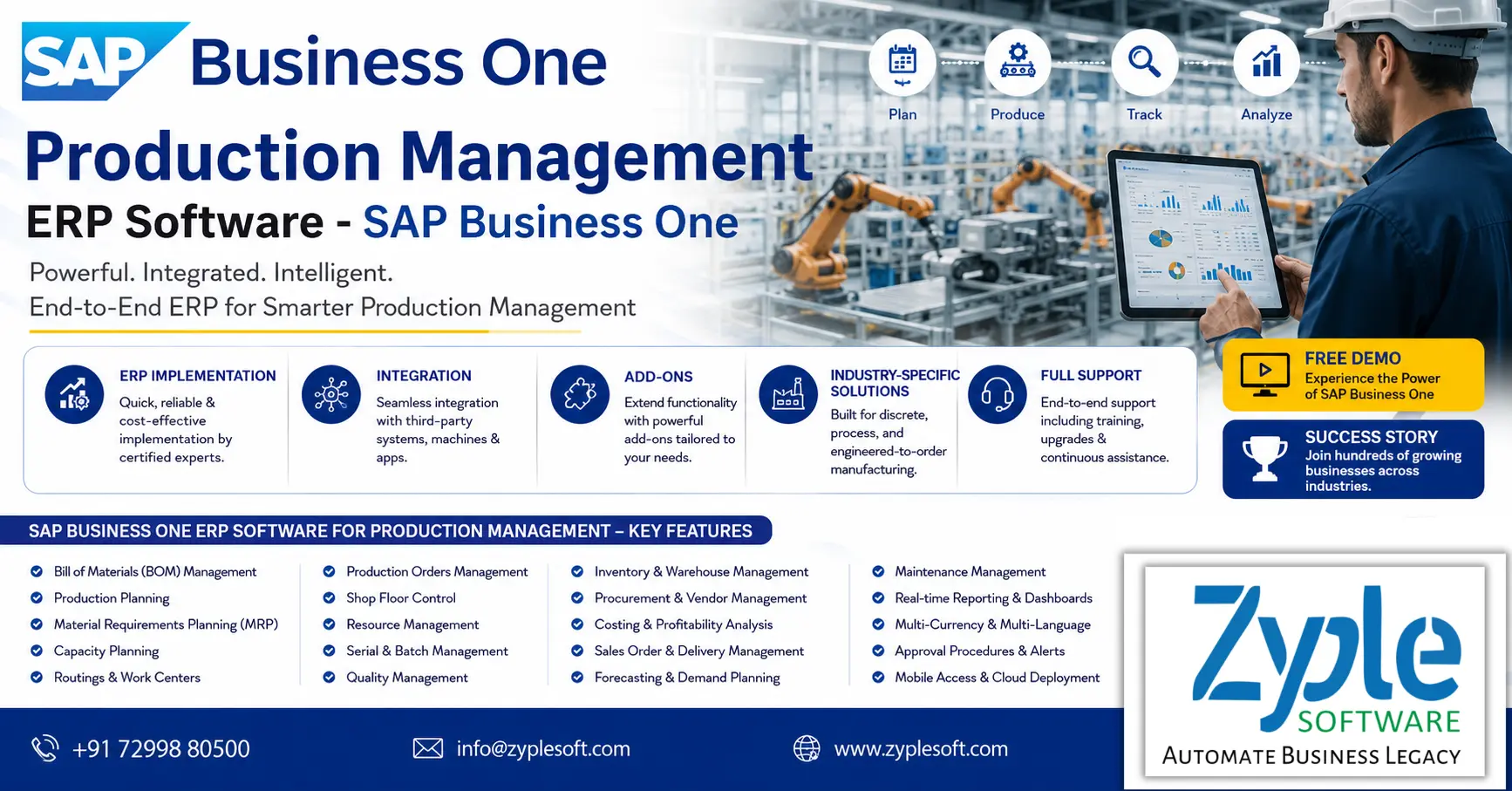
      Production Management ERP Software

      Production Management ERP Software

      Production Management ERP Software for Business

      Production Management ERP Software

      What is ERP in Production Management?

      Enterprise resource planning (ERP) is a software system that helps organizations facilitate their key business processes, including finance, HR, manufacturing, supply chain, sales, and procurement, with a unified view of activity and delivers a single source of truth. In this blog, we’ll discuss production management ERP software.

      What is Production Management Software?

      It is a software that facilitates manufacturing operations by integrating planning, scheduling, inventory, and quality control into a single platform. These systems allow manufacturers to improve shop floor efficiency, optimize traceability, and minimize human error, increasing overall profitability.

      Which Is the Best ERP Software for Production Management?

      SAP Business One is the best ERP software for production management. It is an inclusive, affordable solution designed for small and medium-sized manufacturers, delivering integrated production planning, material requirements planning (MRP), inventory control, and shop floor management. It facilitates manufacturing workflows from order-to-cash, providing real-time visibility, cost tracking, and improved operational efficiency.

      Features of Production Management ERP Software

      Here are the features of SAP B1 as production management software:

      1. Bill of Materials (BOM) Management

      • Creates multi-level BOMs defining raw materials, components, and resources required for production.
      • Hierarchical structures, sub-assemblies, and revisions are supported.
      • Accurate production planning and standardization are ensured.

      2. Production Order Management

      • Creates production orders manually or automatically from sales or MRP recommendations.
      • Tracks raw material consumption, labor and overhead costs, and production progress.
      • Handles the entire lifecycle from release to completion.

      3. Material Requirements Planning (MRP)

      • Automatically calculates material demand based on sales orders, forecasts, and inventory levels.
      • Creates purchase orders and production orders.
      • Helps prevent stock shortages and overstocking.

      4. Production Planning and Scheduling

      • Plans and handles production schedules and workflows.
      • Supports capacity planning, work center allocation, and lead-time optimization.
      • Allows better on-time delivery and resource utilization.

      5. Shop Floor Control

      • Real-time tracking of work-in-progress (WIP), production stages, and machine and labor activity.
      • Records scrap and rework and operation times.
      • Enhances visibility into shop-floor operations.

      6. Inventory and Warehouse Integration

      • Seamless integration with inventory like raw materials, work-in-progress (WIP), and finished goods.
      • Automatic stock updates when materials are issued and finished goods are received.
      • It supports multi-warehouse and bin management.

      7. Resource and Capacity Management

      • Defines and handles resources such as machines, labor, and tools.
      • Assigns resource capacity to production orders.
      • Analyzes capacity utilization and production obstacles.
      • Helps balance workload effortlessly.

      8. Production Costing and Variance Analysis

      • Defines standard production costs (materials, labor, and overhead).
      • Calculates actual production costs during execution.
      • Analyzes cost variance and profitability per product/order.

      9. Work-in-Progress (WIP) Tracking

      • Real-time tracking of semi-finished goods and production stages.
      • It includes automatic WIP accounting updates.
      • It helps monitor production efficiency and delays.

      10. Production Routing and Process Control

      • Defines production routes and operation sequences.
      • Handles process steps, machine usage, and time estimation.
      • It ensures standardized and optimized production flow.

      11. Subcontracting and External Processing

      • Handles outsourced production processes.
      • Tracks materials sent to vendors and received goods.
      • Maintains cost and process visibility.

      12. Quality and Compliance Support

      • Integrates quality checks within production stages.
      • Ensures compliance with industry standards.
      • Minimizes defects and rework.

      13. Real-Time Reporting and Analytics

      • It includes production dashboards and KPIs.
      • Reports on production, efficiency, and delays and obstacles.
      • Allows data-driven decision-making.

      14. End-to-End Production Integration

      • Fully integrated with finance, procurement, sales, and inventory.
      • Delivers complete visibility from raw material to finished goods.

      Importance of Production Management Software

      The enterprise resource planning (ERP) software, SAP Business One (SAP B1) system, is essential for modern manufacturing, driving efficiency, minimizing costs, and improving product quality through automation and real-time visibility. It increases resource allocation, facilitates workflows, and reduces obstacles, enabling SMEs and large manufacturers to improve productivity and meet strict deadlines.

      1. Improved Efficiency and Productivity

      Automates routine tasks and scheduling, allowing employees to focus on strategic initiatives. It minimizes downtime by optimizing machine and labor utilization.

      2. Cost Reduction and Waste Management

      Reduces waste, scraps, and excess inventory through better planning, minimizing operational costs and improving profitability.

      3. Increased Planning and Scheduling

      Provides real-time visibility into production schedules, helping handle capacity and meet customer deadlines.

      4. Quality Control and Traceability

      Allows real-time monitoring of production to ensure consistent quality and compliance, reducing the risks of human errors.

      5. Data-Driven Decision-Making

      Delivers analytics and tracking for KPIs, enabling faster and better decision-making.

      Benefits of Production Management System

      SAP software improves efficiency by automating workflows, increasing real-time visibility, minimizing waste, and optimizing resource scheduling. Main benefits include accelerated delivery times, improved quality control, accurate data-driven decisions, and minimized operating costs. It facilitates operations from inventory to shop floor for increased profitability.

      1. Improved Productivity and Efficiency

      Facilitates manufacturing processes to maximize output while minimizing idle time for machines and staff.

      2. Increased Real-Time Visibility

      Delivers inclusive tracking of production progress, enabling managers to identify obstacles, track KPIs, and make better, immediate decisions.

      3. Optimized Planning and Scheduling

      Allows better resource allocation and scheduling, enabling flexible, fast adjustments to orders and preventing obstacles.

      4. Quality Control and Waste Reduction

      Reduces defects through monitoring and maintains consistent quality standards, minimizing rework and material waste.

      5. Inventory Management

      Allows better management of inventory levels and material movement, minimizing carrying costs and preventing stock shortages.

      6. Analytical Decision-Making

      Collects and evaluates production data to provide insights into performance, costs, and opportunities for process improvement.

      7. Better Supply Chain Management

      Strengthens supplier management and automates procurement processes, ensuring prompt arrival of materials.

      8. Lower Production Costs

      Improves the entire manufacturing chain, leading to minimized overall costs and higher profitability.

      9. Increased Customer Satisfaction

      Ensures timely delivery by keeping production on schedule and increasing product quality.

      10. Scalability for Growth

      Supports business expansion through simulation tools and flexible, cloud-based systems that adapt to larger production volumes.

      Conclusion of Production Management ERP

      Zyple Software is an official SAP B1 Partner in India specializing in implementation, consulting, licensing, integration, add-on solutions, migration, digital transformation, and support.

      Zyple Software company has expertise in SAP Business One implementation for different industries like manufacturing, construction, real estate, agriculture, financial services, healthcare, retail, infrastructure, technology, energy, logistics, EPC, and professional services. SAP Business One facilitates processes and drives growth seamlessly with production management.

      If you’re excited, book an SAP Business One demo.

      Are you exciting for the SAP B1 ERP solution for your business or industry?

      Fill in all the details in the dispensed contact form; our team will get back to you.