SAP Business One ERP for Mineral Industry
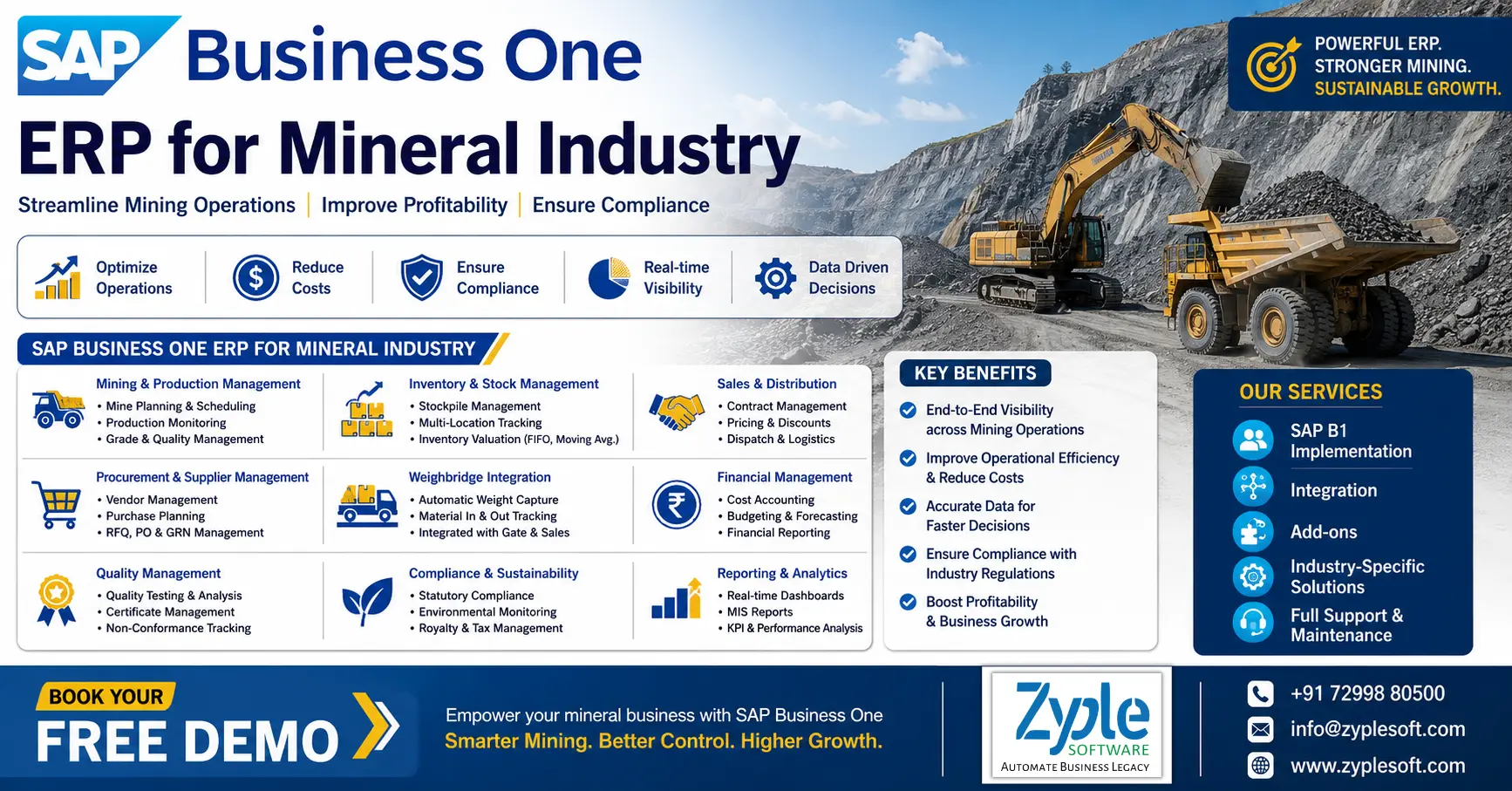
The mineral industry is fast-paced and depends heavily on data. Mineral companies handle drilling schedules, blasting records, fleet operations, fuel usage, quarry production, material movement, and environmental compliance, all while ensuring maximum output and worker safety. SAP Business One ERP for mineral industry helps mineral companies improve their operations and grow sustainably.
Challenges Faced By The Mineral Industry
The mineral industry is undergoing a massive transformation, largely driven by increasing demand for essential minerals required for the clean energy transition. Today, mineral companies face a complex web of environmental, operational, and geopolitical challenges that threaten both profitability and sustainability growth.
1. Environmental and Sustainability Demands
The sector is heavily scrutinized for its environmental impact, including land degradation, water contamination, and greenhouse gas emissions. Achieving strict sustainability standards and transitioning to green mining practices is a major, yet necessary, operational shift.
2. Declining Ore Grades and Cost Escalations
Naturally occurring ore grades are dropping, meaning companies must process more rock to extract the same amount of valuable minerals. This involves exploring in more remote locations, which increases project costs and ongoing operational expenses.
3. Geopolitical and Supply Chain Risks
Trade conflicts, shifting government policies, and global tensions directly interrupt the supply of raw materials and technology. Geopolitical shifts and resource shortages have heightened supply chain risks for essential commodities like lithium and rare earths.
4. The Skills Gap and Knowledge Loss
As veteran miners retire, the industry faces an ongoing shortage of experienced workers who understand complex, modern mining technologies. Operating in remote locations further aggravates the difficulty of attracting and retaining specialized talent.
5. Health, Safety, and Operational Hazards
Mining requires inherently hazardous working conditions and complex geological formations. Ensuring worker safety around heavy machinery, explosives, and confined spaces remains a major, non-negotiable priority.
6. Social License to Operate and Regulatory Compliance
Mining projects are increasingly delayed by complex regulatory permitting and community opposition. Companies must navigate evolving regulations while building trust with local communities and indigenous populations who are directly affected by land use.
Features of SAP Business One ERP for Mineral Industry
1. Exploration and Mine Planning Management
- It includes geological data tracking and mineral resource estimation.
- It includes long-term and short-term mine planning.
- It includes budgeting for exploration and feasibility studies.
- It includes integration with survey and drilling data.
- It includes capital expenditure (CAPEX) planning for mining projects.
- Helps handle the entire lifecycle from exploration to production.
2. Production and Extraction Management
- It includes track drilling, blasting, excavation, and hauling.
- Monitors ore extraction volumes and grades.
- It includes crushing, screening, and beneficiation process tracking.
- It includes production planning and scheduling.
- It includes real-time production data collection.
- SAP supports optimization of mining processes and production planning.
3. Inventory and Stockpile Management
- It includes raw material (ore), processed minerals, and by-product tracking.
- Batch-wise and location-wise inventory, like stockpiles, yards, and warehouses.
- It includes quality and grade-based inventory classification.
- It includes automatic stock updates from weighbridge integration.
- It includes minimum and maximum stock level alerts.
4. Supply Chain and Logistics Management
- End-to-end logistics from mine, plant, and port to customer.
- It includes transport and fleet management.
- It includes route planning and shipment tracking.
- It includes bulk material handling and dispatch planning.
- It includes vendor and contractor coordination.
- It ensures a resilient supply chain and logistics optimization.
5. Financial and Cost Management
- It includes mine-wise and project-wise costing.
- It includes production cost per ton analysis.
- It includes budget vs. actual comparisons.
- It includes asset depreciation and capital tracking.
- Multi-location financial integration.
- It includes GST and tax compliance.
- Allows real-time financial visibility and forecasting.
6. Asset and Equipment Management
- Maintenenace scheduling, like preventive and breakdown.
- It includes equipment lifecycle tracking.
- It includes spare parts inventory management.
- It includes machine downtime analysis.
- It includes fuel consumption tracking.
- Improves asset uptime and minimizes operational costs.
7. Workforce and Contractor Management
- It includes employee scheduling and shift planning.
- It includes contractor and labor management.
- It includes attendance and payroll integration.
- It includes safety certifications and compliance tracking.
- It includes workforce productivity analysis.
- It supports workforce optimization and safety culture.
8. Compliance, Safety, and Environmental Management
- It includes mining permits and license tracking.
- Environmental compliance, like pollution and land usage.
- It includes safety incident reporting and audits.
- It includes ESG (Environmental, Social, and Governance) reporting.
- It includes regulatory documentation management.
- Helps achieve strict mining regulations and sustainability goals.
9. Sales, Contracts, and Commodity Management
- Mineral sales contracts and pricing, like grade-based pricing.
- It includes customer order management.
- It includes dispatch, billing, and invoicing automation.
- It includes commodity trading and contract lifecycle management.
- It includes customer relationship management (CRM).
10. Real-Time Analytics and Reporting
- It includes real-time dashboards for production, finance, and logistics.
- KPI tracking like cost per ton, output efficiency, and downtime.
- It includes custom MIS and regulatory reports.
- It includes data-driven decision-making.
- Allows data-driven insights and performance optimization.
11. Integrated End-to-End ERP Platform
- It includes a single system integrating finance, production, inventory, and sales.
- Eliminates data storage across departments.
- It includes cloud or on-premise deployment.
- It includes integration with IoT, weighbridges, GPS, and third-party tools.
- Delivers enterprise-wide planning, execution, and reporting.
Importance of SAP Business One ERP for Mineral Industry
The ERP software, SAP Business One, is essential for the mineral industry, as it unifies disconnected operations into a single platform. It delivers immediate value by handling heavy machinery assets, optimizing complex supply chains, ensuring strict regulatory compliance, and centralizing real-time data for accurate financial and production planning.
1. Integrated Financial Management
Delivers robust budgeting, audit-ready reporting, and precise fixed-asset tracking to manage heavy extraction equipment and depreciation with the SAP implementation process.
2. Supply Chain and Inventory Optimization
Maintains optimal stock levels for essential spare parts and mining supplies to prevent costly production downtimes.
3. Compliance and Safety
Facilitates documentation and auditable data to help mining companies effortlessly meet strict environmental and labor regulations.
4. Material Requirements Planning (MRP)
Improves resource utilization by intelligently handling raw materials and aligning procurement with production schedules using SAP solutions.
5. Real-Time Dashboards
Replaces scattered spreadsheets with centralized analytics, providing leaders a clear mine-to-market view of cost performance and operational efficiency.
Benefits of SAP Business One for Mining Industry
SAP Business One (SAP B1) facilitates capital-intensive mining operations by integrating core processes like extraction planning, heavy equipment maintenance, procurement, and financial tracking. It delivers real-time data to help mining companies control costs, optimize supply chains, and ensure strict regulatory and ESG compliance.
1. Financial Management and Cost Control
The SAP software accurately tracks real-time costs of fuel, labor, and machinery. It uses built-in budgeting and profitability analyses to monitor expenses across individual projects or specific mine sites.
2. Asset and Equipment Maintenance
Reduces costly unplanned downtime by scheduling predictive and preventive maintenance for heavy mining machinery. Tracks equipment lifecycles and evaluates repair histories efficiently.
3. Inventory and Supply Chain Orchestration
Maintains optimal stock levels of crucial consumables and spare parts using SAP B1 add-ons. Facilitates procurement processes from purchase requests to supplier contracts and payment management.
4. Regulatory and ESG Compliance
Simplifies reporting for stringent labor laws and environmental standards. Captures safety logs and sustainability metrics to ensure audit readiness.
5. Data-Driven Production Planning
Uses production planning and integrated analytics to optimize extraction schedules based on market demand and resource availability.
Conclusion of Mineral ERP
As a qualified SAP Business One partner, Zyple Software is delivering services like SAP B1 implementation, licensing, integration, add-ons, and support to different industries, like construction, manufacturing, solar, jewellery, food and beverage, aerospace, retail, pharma, and textiles.
SAP Business One is an ERP customized for small and medium-sized businesses that connects finance, production, procurement, inventory, sales, CRM, and reporting into one platform. For mineral or any other companies, it can improve project costing, procurement, subcontractor billing, and inventory management.
If you’re adaptable, appoint a demo of SAP Business One.
Do you look for the SAP B1 ERP solution for your business or industry?
Finish all the details in the arranged contact form; our team will reach out to you.
FAQs
1.What is SAP Business One and how does it benefit the mineral industry?
SAP Business One is an integrated ERP solution customized for small and midsize businesses. For the mineral industry, it helps handle mining operations, inventory, procurement, sales, finance, and compliance in one system, improving efficiency and reducing operational costs.
2.Can SAP Business One handle inventory and stockpile management for minerals?
Yes, SAP Business One delivers real-time inventory tracking, batch and serial number management, and warehouse control. It enables mineral businesses to handle stockpiles, track material movement, and reduce losses due to mismanagement or theft.
3.How does SAP Business One help in managing mining operations and production?
SAP Business One supports production planning, resource allocation, and equipment utilization. It helps evaluate extraction processes, handle raw material usage, and optimize production cycles to improve output and profitability.
4.Is SAP Business One suitable for handling compliance and regulatory requirements in the mineral industry?
Absolutely. The system helps maintain accurate records, generate compliance reports, and monitor environmental and safety regulations. This ensures your business stays adherent to industry standards and government policies.
5.How can I get started with SAP Business One for my mineral business?
You can start by consulting a certified SAP Business One partner like Zyple Software who will evaluate your business needs, provide a demo, and guide you through implementation, customization, and support to ensure a smooth digital transformation.