
Tag Archives: Industry-Specific ERP Solutions

SAP Business One Expert ERP solution infographic by Zyple Software with finance, CRM, inventory, production, analytics and business management features

SAP Business One Expert

SAP Business One Expert for Industries/Businesses
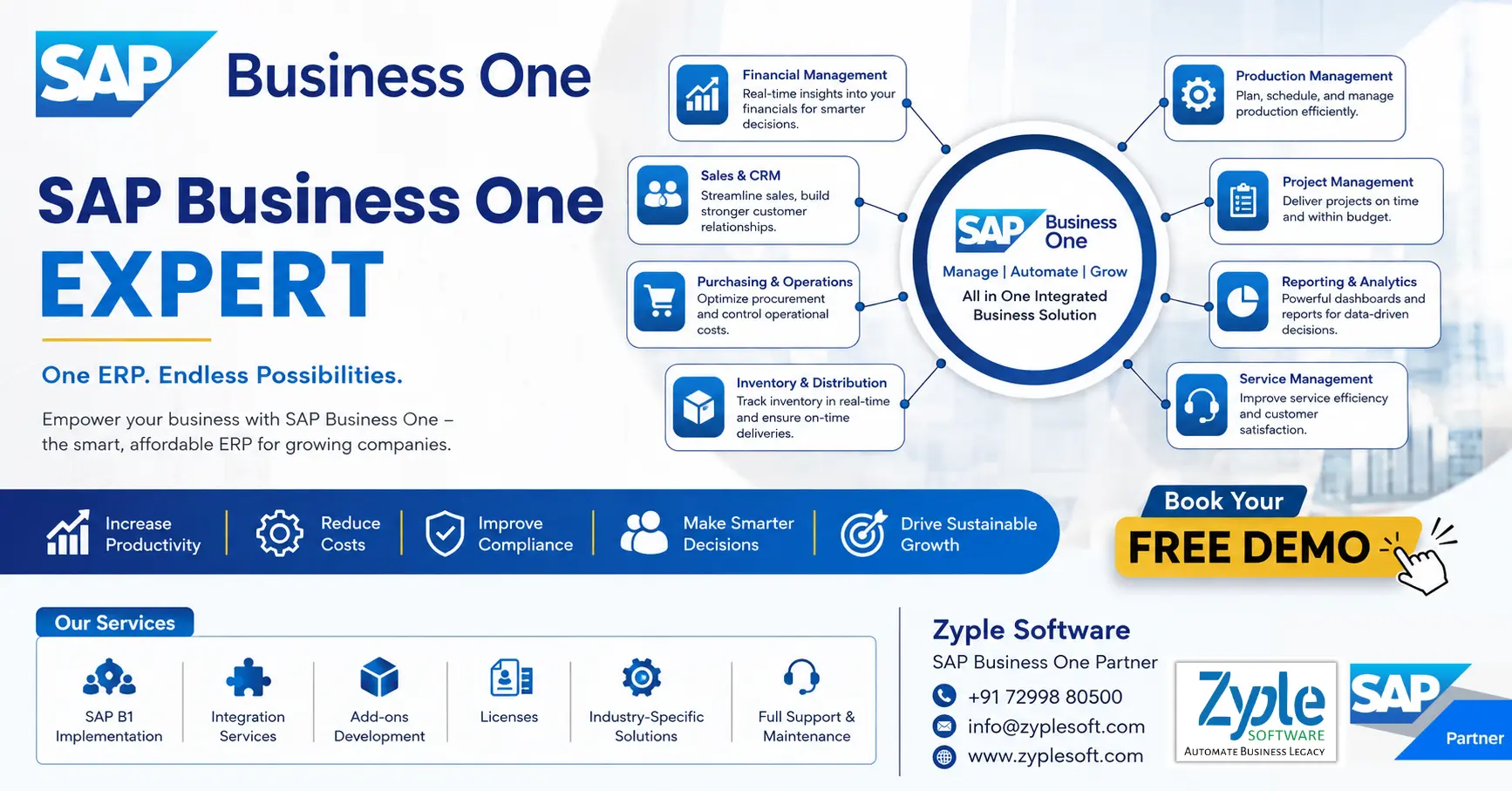
SAP Business One Expert ERP solution infographic by Zyple Software with finance, CRM, inventory, production, analytics and business management features

SAP Business One provides robust ERP capabilities for small and medium-sized businesses seeking facilitated operations. Our specialized experts help you maximize the platform’s potential, delivering customized solutions that align with your unique business requirements and growth objectives. We guide you through implementation, configuration, and optimization to ensure you gain the full benefit of your SAP Business One investment.

We specialize in:

1. System Implementation and Integration

Launching SAP Business One with minimal disruption while connecting to your current business systems.

2. Process Optimization

Facilitating workflows and automating manual tasks to boost operational efficiency.

3. Customization and Development

Creating advanced modules and functionalities that handle your specific business challenges.

4. Data Migration and Management

Securely moving your business data while ensuring accuracy and consistency.

5. Reporting and Analytics

Developing complete dashboards that deliver actionable insights for better decision-making.

6. Technical Support and Training

Delivering ongoing assistance and knowledge to empower your team.

An SAP Business One expert combines technical expertise with industry knowledge to deliver solutions that drive tangible business outcomes. Whether implementing from the beginning, optimizing a current deployment, or improving functionality with custom modules, we ensure your SAP Business One environment completely supports your operational requirements and strategic goals.

Securing the Right SAP Business One Expertise for Your Business

SAP Business One (SAP B1) is a powerful enterprise resource planning (ERP) solution that helps small and medium-sized enterprises (SMEs) facilitate their operations, gain real-time insights, and drive profitable growth. However, increasing the return on your SAP Business One investment relies heavily on having the right technical and functional expertise on board. Whether you’re in the middle of an implementation, planning an upgrade, or require ongoing support, the challenge often lies in identifying and securing qualified professionals. The success of your system depends on the skills of the people who handle, customize, and support it. This is a common obstacle for many organizations looking to fully use their ERP capabilities.

Roles and Responsibilities of an SAP Business One Expert

An SAP B1 expert is responsible for implementing, customizing, supporting, and optimizing the SAP Business One ERP system to meet business needs. Their role spans technical, functional, and strategic responsibilities across the organization.

The roles and responsibilities generally include:

1. Implementation and Deployment

  • Evaluate business requirements and map them to SAP B1 functionalities.
  • Plan and execute end-to-end SAP implementation projects.
  • Configure key modules like finance, sales, purchasing, inventory, CRM, and production.
  • Handle data migration from legacy systems to SAP B1.
  • Ensure seamless system go-live with minimal disruption.

2. Business Process Analysis

  • Study current workflows and identify inefficiencies.
  • Suggest process improvements using SAP B1 capabilities.
  • Organize ERP system with industry-specific best practices.
  • Create functional specifications and documentation.

3. System Configuration and Customization

  • Modify company settings, workflows, and approval procedures.
  • Design forms, fields, dashboards, and reports.
  • Work with SDKs, SAP B1 add-ons, or integrations to expand functionality.
  • Ensure customization aligns with future expansion.

4. Integration Management

  • Integrate SAP B1 with third-party systems such as CRM tools, e-commerce platforms, banking systems, and payroll and HR software.
  • Handle APIs, middleware, and data synchronization.

5. User Training and Support

  • Train end-users across departments.
  • Create user manuals and SOPs.
  • Deliver ongoing technical and functional support.
  • Troubleshoot system issues and resolve tickets quickly.

6. Reporting and Analytics

  • Design and generate business reports using Crystal Reports, SQL queries, and SAP dashboards.
  • Deliver insights for decision-making.
  • Ensure live data visibility across departments.

7. Database and Technical Management

  • Handle databases (like SQL Server or SAP B1 HANA).
  • Evaluate system performance and optimize queries.
  • Ensure data integrity, security, and backups.
  • Oversee upgrades, patches, and version control.

8. Project Management

  • Plan project timelines, budgets, and deliverables.
  • Coordinate with stakeholders, clients, and internal teams.
  • Handle risks and ensure timely project completion.
  • Follow SAP B1 implementation methodologies (like ASAP or Agile).

9. Compliance and Security

  • Ensure the system adheres to financial and legal regulations.
  • Define user roles and authorization controls.
  • Maintain audit trails and reporting compliance.

10. Continuous Improvement and Optimization

  • Find opportunities for automation and efficiency.
  • Suggest and install new SAP B1 features or add-ons.
  • Improve system usage as business scales.
  • Stay updated with the latest SAP releases and trends.

11. Industry-Specific Responsibilities

Depending on the domain, responsibilities may cover:

Manufacturing

Production planning, BOM, and MRP (Material Requirements Planning).

Construction

Project costing and subcontractor management.

Retail

POS integration and inventory tracking.

Pharma

Batch traceability and compliance validation.

12. Client and Stakeholder Communication

  • Act as a bridge between business users and technical teams.
  • Collect feedback and translate it into system improvements.
  • Deliver strategic ERP implementation.

Skills and Expertise of an SAP Business One Expert

An SAP B1 expert specializes in implementing, configuring, and improving the SAP Business One system for small and medium-sized enterprises (SMEs). They combine key functional accounting and supply chain knowledge with technical reporting and project management skills to align software capabilities with company goals.

  • Proficiency in core modules of SAP B1 like financial accounting, banking, fixed assets, sales, purchasing, inventory control, and production.
  • Deep understanding of business processes and localization and compliance.
  • Technical skills like SAP Crystal Reports, SQL, and SAP Business One SDK (Software Development Kit).
  • Strong requirement analysis and project management abilities.
  • Experience in training and support.

Benefits of Hiring an SAP B1 Expert

Hiring an SAP Business One (SAP B1) expert helps your company set up the software right, save money, and prevent costly system errors. They match the tool to your exact daily requirements, clean and move your old data safely, and connect SAP B1 with your other apps like e-commerce or CRM.

1. Proper Setup

They develop workflows that fit how your business actually works.

2. Safe Data Migration

They transfer old records into SAP B1 without losing details using SAP Business One solutions.

3. Custom Add-ons

They develop special tools or reports using the SAP SDK if standard options fall short.

4. System Integration

They connect your ERP with outside platforms like payment gateways or shipping tools.

5. Staff Training

They teach your team how to use the system well so work moves faster.

6. Ongoing Support

They resolve bugs quickly and handle system updates safely in SAP support.

When You Should Hire an SAP B1 Expert

Hiring an SAP Business One (SAP B1) expert is necessary when starting a new system setup, migrating old data, upgrading software versions, or fixing chronic workflow gaps. You also need professional help for custom reports, third-party software connections, and training your team.

1. New Implementation

Develop and configure the software to match your exact business rules.

2. Data Migration

Transfer old spreadsheets and legacy data safely without losing records.

3. System Upgrades

Move to the latest versions without breaking current operations.

4. Custom Reports and Add-Ons

Develop specialized Crystal Reports or custom SQL queries.

5. Software Integration

Connect SAP B1 with e-commerce sites or third-party apps via APIs.

6. Staff Training

Teach your team how to use specific modules properly.

Choosing the Right SAP B1 Expert

Choosing the right SAP Business One (SAP B1) expert is essential for a smooth ERP setup. Look for official SAP Business One partnership tiers, verified industry track records, certified in-house consultants, and robust local or regional compliance knowledge.

1. Industry Experience

Ensure the expert or partner knows your specific sector (such as manufacturing, construction, retail, and pharma) to handle unique workflows and compliance needs.

2. Certifications

Check for formal SAP B1 credentials and certified consultants who understand the latest versions of SAP B1 and SAP B1 HANA.

3. Customization and Integration

Verify their technical ability to modify the system and connect it seamlessly with third-party software like e-commerce platforms or Microsoft 365.

4. Post-Implementation Support

Confirm they deliver ongoing training, troubleshooting helpdesk services, and system updates after your go-live date.

Conclusion of SAP B1 Expert

As a leading SAP Business One partner, Zyple Software is delivering services like SAP B1 implementation, integration, migration, licensing, consulting, add-ons, digital transformation, and support and training to different industries, like construction, manufacturing, solar, food and beverage, aerospace, oil and gas, healthcare, retail, real estate, jewellery, pharma, and textiles. 

SAP Business One is an ERP solution customized for small and medium-sized enterprises that connects finance, production, inventory, material requirements planning (MRP), procurement, sales, CRM, and reporting and analytics into one platform. For food and beverage, pharma, and chemical businesses, it can improve project costing, procurement, subcontractor billing, and inventory management.

If you’re involved, reserve a demo of SAP Business One.

Do you assure the SAP B1 ERP system for your business or industry?

Finish all the details in the quoted contact form; our team will return to you.

    FAQs

    1.How can an SAP Business One Expert improve my business operations?

    An SAP Business One expert helps facilitate your processes by integrating finance, sales, inventory, and operations into one system, improving efficiency and decision-making.

    Yes, SAP Business One is highly flexible and can be customized for industries like construction, manufacturing, retail, and distribution with the help of an expert.

    The cost depends on project scope, customization needs, and implementation complexity. A consultation can deliver a clear estimate based on your business requirements.

    Most businesses start seeing improvements in efficiency, reporting, and cost control within a few months of proper SAP B1 implementation by an SAP B1 expert.

    You can begin with a free consultation to evaluate your business needs, followed by a customized implementation plan tailored to your goals.
    SAP Business One ERP for Biscuit and Snacks Manufacturing by Zyple Software - Production, Inventory, Batch Traceability & Quality Management

    SAP Business One ERP for Biscuit and Snacks Manufacturing

    SAP Business One ERP for Biscuit & Snacks Manufacturing Industry

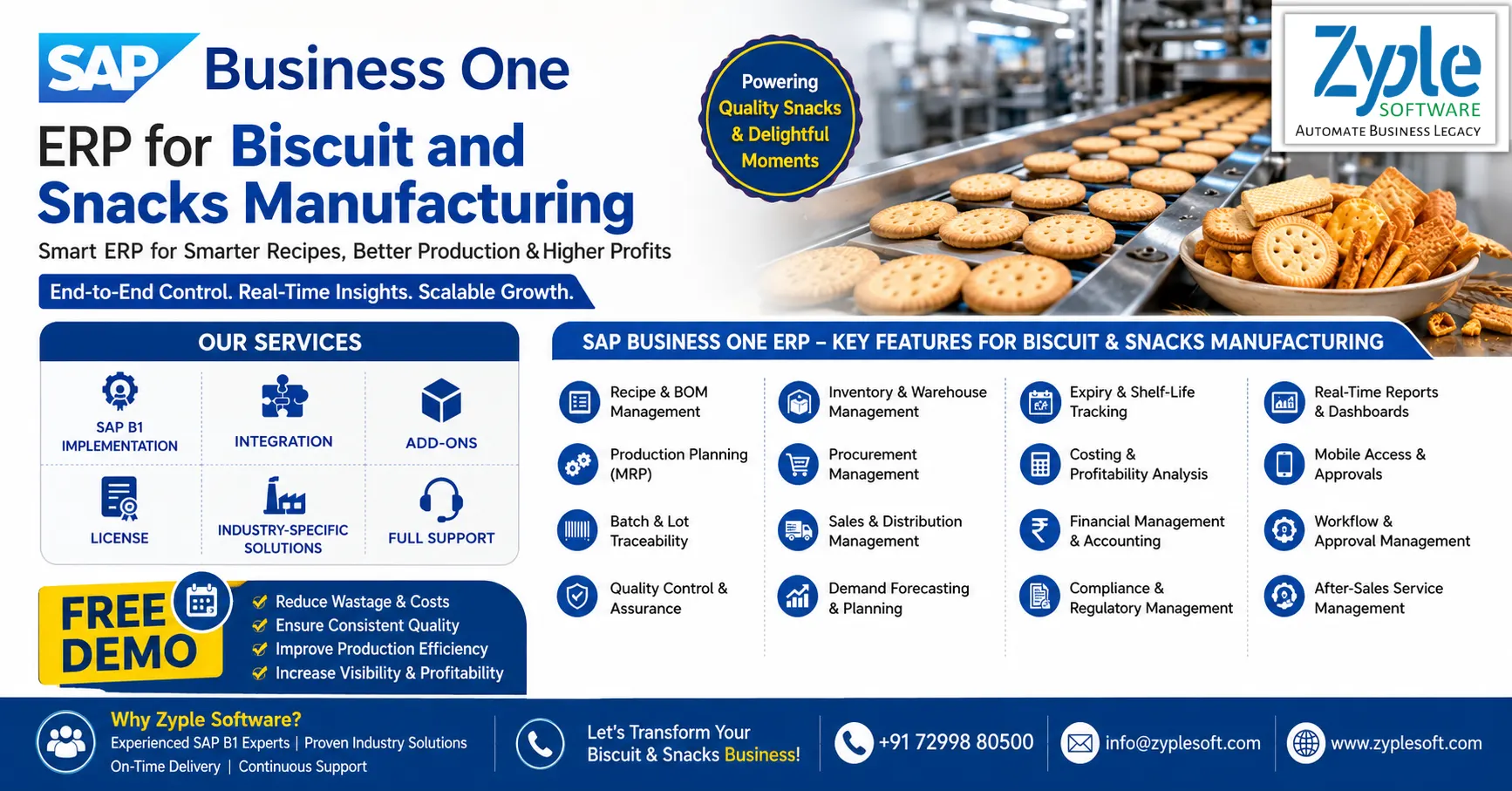
    SAP Business One ERP for Biscuit and Snacks Manufacturing by Zyple Software - Production, Inventory, Batch Traceability & Quality Management

    The global biscuit and snacks manufacturing industry has developed mostly in recent years, involving more and more customers to participate. The industry is exploding the global demand and thereby leading to a rapid rise in the biscuit and snack prices. The key challenges faced by this industry include increased demand for variety and innovation, low-profit margins, product traceability, and quality governmental regulations. SAP Business One ERP for biscuit and snacks manufacturing helps in all aspects of manufacturing and distribution in the industry.

    Challenges Faced By The Biscuit and Snacks Manufacturing Industry

    The biscuit and snacks manufacturing industry faces major challenges, mainly volatility in raw material prices, shifting consumer health preferences, and supply chain disruptions. These pressures increase operational expenses and force rapid product reformulation.

    1. Price Volatility

    Uncertain costs for key commodities like wheat flour, sugar, edible oils, and packaging materials squeeze profit margins.

    2. Operational Inefficiencies

    High energy consumption during baking and manual handling errors result in batch rejections and waste.

    3. Logistics Bottlenecks

    Fuel price fluctuations and complex distribution networks delay prompt delivery to fragmented retail markets.

    4. Health Consciousness

    Rising preference for low-sugar, high-fiber, gluten-free, or fortified functional snacks forces brands to change traditional recipes.

    5. Convenience Formats

    Increased demand for single-serve, resealable, and on-the-go packaging requires high-speed wrapping technology adjustments.

    6. Loss of Impulse Buys

    Growth in online grocery shopping minimizes traditional store check-out impulse purchases.

    7. Food Safety and Compliance

    Stringent hygiene standards, accurate labeling laws, and local tax changes increase administrative and financial burdens.

    8. Quality Consistency

    Handling dough elasticity, baking temperatures, and preventing physical or chemical contaminants during mass production requires continuous monitoring.

    Features of SAP Business One ERP for Biscuit and Snacks Manufacturing

    1. Recipe and Formulation Management

    • Creates and handles recipes like bill of materials (BOM) for biscuits, wafers, chips, and more.
    • Controls ingredients, quantities, flavors, and variations.
    • Handles multi-level BOMs from raw materials and semi-finished to finished goods.
    • Automatic cost calculation per batch or product.
    • It includes recipe modification without disrupting production.
    • Essential for maintaining taste consistency across batches.

    2. Production Planning and Manufacturing Control

    • Creates and handles production orders, like manual or auto, from sales demand.
    • Tracks raw material consumption, labor, and machine usage.
    • Monitors real-time production status (batch-wise).
    • Optimizes production scheduling and capacity planning.
    • Handles co-products and by-products like crumbs, water reuse, and more.
    • It ensures smooth production of high-volume snack items.

    3. Batch Management and Traceability

    • Complete batch and lot tracking from raw materials to finished biscuits and snacks.
    • Assigns batch numbers, expiry dates, and production dates.
    • Allows instant product recall management.
    • Necessary for food safety and compliance like FSSAI and HACCP.

    4. Shelf-Life and Expiry Management

    • Handles expiry dates and shelf life for perishable products.
    • It supports the FEFO (First Expiry First Out) inventory method.
    • Prevents sale or usage of expired stock.
    • It includes alerts for near-expiry inventory.
    • Minimizes waste in fast-moving snack inventory.

    5. Quality Control and Compliance

    • Defines quality inspection checkpoints from raw material and production to packaging.
    • Records test results, moisture levels, taste, and texture checks.
    • Handles QC status like approved, rejected, and quarantined.
    • Maintains food safety compliance like HACCP and FSSAI standards.

    6. Inventory and Warehouse Management

    • It includes real-time inventory tracking across warehouses.
    • Handles multiple units of measurement like kg, grams, and cartons.
    • Minimizes wastage, pilferage, and overstocking.
    • Supports cold storage and dry storage tracking.

    7. Procurement and Vendor Management

    • Automates raw material procurement planning.
    • Handles vendor pricing, quality, and delivery performance.
    • Generates purchase orders based on MRP suggestions.
    • Tracks supplier batches for traceability.
    • It ensures an uninterrupted supply of ingredients.

    8. Material Requirements Planning (MRP)

    • Forecasts demand for biscuits and snacks.
    • Auto-calculates required raw materials and production quantities.
    • Minimizes stock shortages and excess inventory.
    • Aligns production with market demand.

    9. Costing and Profitability Analysis

    • Calculates batch-wise production cost.
    • Tracks raw material price fluctuation impact.
    • Analyzes profit margins per product like cookies, chips, and more.
    • Controls wastage and overhead costs.
    • It helps improve profitability in a price-sensitive biscuit and snacks market.

    10. Sales, Distribution, and CRM

    • Handles distributor and dealer network.
    • Oversees bulk orders, retail orders, and exports.
    • It includes real-time order tracking and fulfillment.
    • Maintains customer pricing, discounts, and schemes.
    • It includes integrated CRM for customer engagement.

    11. Packaging and Dispatch Management

    • Plans packaging based on SKU sizes like small packs, family packs, and cartons.
    • Tracks packing material consumption.
    • Optimizes dispatch planning and logistics.

    12. Waste and By-Product Management

    • Tracks production waste like burnt biscuits, breakage, and crumbs.
    • It includes reuse or account for by-products.
    • Improves yield optimization.

    13. Real-Time Reporting and Analytics

    • Dashboards for production performance, inventory levels, sales trends, and profit margins.
    • Makes data-driven decisions instantly.
    • Generates compliance and audit reports.

    Importance of SAP Business One ERP for Biscuit and Snacks Manufacturing

    The ERP software, SAP Business One, is essential for the biscuit and snacks manufacturing industry because it delivers precise recipe and batch management, strict shelf-life inventory control, and automated compliance.

    1. Bill of Materials

    Handles the exact proportion of flour, sugar, oils, and flavorings for every batch with the SAP B1 implementation process.

    2. Process Repeatability

    It ensures uniform taste, texture, and weight across large production runs.

    3. Yield Optimization

    Tracks scrap and waste to increase output per kilogram of raw material.

    4. FEFO Tracking

    Uses First-Expired First-Out (FEFO) principles to move perishable raw ingredients and finished crispy goods before staleness sets in.

    5. Real-Time Stock Visibility

    Avoids production halts due to sudden shortages of essential packaging or baking materials.

    6. Lot Traceability

    Tracks specific batches from local supplier delivery to retail distributor shelf in case of quick recalls using SAP solutions.

    7. Food Safety Compliance

    Achieves hygiene and safety guidelines like HACCP, ISO, and local food safety laws.

    8. Quality Checkpoints

    The SAP software tests raw material quality upon entry and runs checks during packaging stages.

    9. Allergen Management

    Evaluates and labels components like gluten, nuts, or dairy accurately.

    10. Material Requirements Planning (MRP)

    Forecasts when to buy raw ingredients based on seasonal snack demands and historical sales.

    11. Distribution Control

    Handles distributor network, volume-based pricing, and retail trade schemes efficiently.

    Benefits of SAP Business One for Biscuit and Snacks Manufacturing

    SAP Business One delivers essential benefits for biscuit and snack makers through batch and recipe management, lot traceability, and automated inventory control.

    1. Precise Formulations

    Handles multi-level bills of materials (BOMs) for exact flour, sugar, oil, and flavoring ratios.

    2. Consistent Quality

    Ensures uniform taste, texture, and baking standards across every production run using SAP Business One add-ons.

    3. FEFO Logic

    Uses First-Expiry-First-Out (FEFO) stock rotation to move short-shelf-life ingredients and finished packs.

    4. Real-Time Visibility

    Tracks raw materials and packaging supplies to avoid sudden stockouts.

    5. Waste Reduction

    Issues automated alerts for aging stock to prevent spoilage.

    6. End-to-End Tracking

    Connects raw material lot numbers straight to finished biscuit or snack packets.

    7. Audit Readiness

    Maintains digital logs for quality checks, essential control points, and food safety rules (like FSSAI, HACCP, or ISO).

    8. Smart Scheduling

    Facilitates factory shifts and machine use to minimize baking downtime.

    9. Live Costing

    Tracks active material and labor expenses to protect profit margins on tight-margin snacks.

    Conclusion of Biscuit and Snacks Manufacturing ERP

    As an experienced SAP Business One partner in India, Zyple Software is delivering services like SAP B1 implementation, integration, migration, licensing, add-ons, digital transformation, and support to different industries, like construction, manufacturing, solar, food and beverage, aerospace, heathcare, retail, jewellery, pharma, and textiles. 

    SAP Business One is an ERP software customized for small and medium-sized enterprises that connects finance, procurement, sales, CRM, production, inventory, and reporting into one platform. For biscuit and snacks manufacturing or any other businesses, it can improve project costing, procurement, subcontractor billing, and inventory management.

    If you’re interested, register a SAP Business One demo.

    Do you search for the SAP B1 ERP solution for your business or industry?

    Complete all the details in the displayed contact form; our team will reach out to you.

      FAQs

      1.How does SAP Business One help biscuit and snacks manufacturers manage production efficiently?

      SAP Business One facilitates the entire production cycle by integrating raw material planning, batch processing, and real-time production tracking. It helps manufacturers optimize recipes, minimize wastage, and ensure consistent product quality across batches, which is essential in the food industry.

      Yes, SAP Business One provides advanced batch and lot tracking features that allow manufacturers to monitor product movement from raw materials to finished goods. It also supports expiry date tracking, ensuring compliance with food safety regulations and minimizing the risk of expired inventory.

      SAP Business One delivers real-time visibility into inventory levels, helping manufacturers maintain optimal stock of raw materials like flour, sugar, and oils. It automates procurement processes, avoids stockouts or overstocking, and ensures smooth coordination with suppliers and distributors.

      Absolutely. SAP Business One is specifically designed for small and medium-sized businesses. It provides scalable solutions that grow with your business, making it ideal for manufacturers looking to digitize operations without investing in overly complex systems.

      SAP Business One allows better cost control through accurate production costing, waste reduction, and efficient resource utilization. With real-time analytics and reporting, businesses can make data-driven decisions to increase margins and overall profitability.