
Tag Archives: Zyple Software SAP Business One Partner

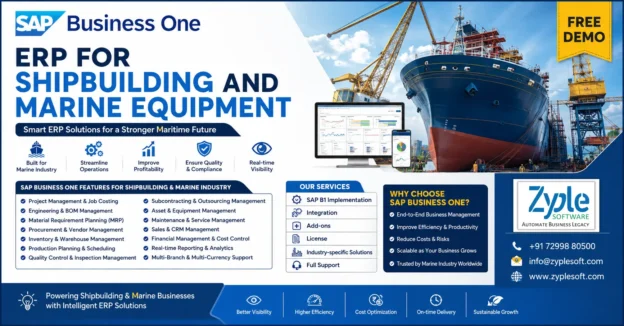
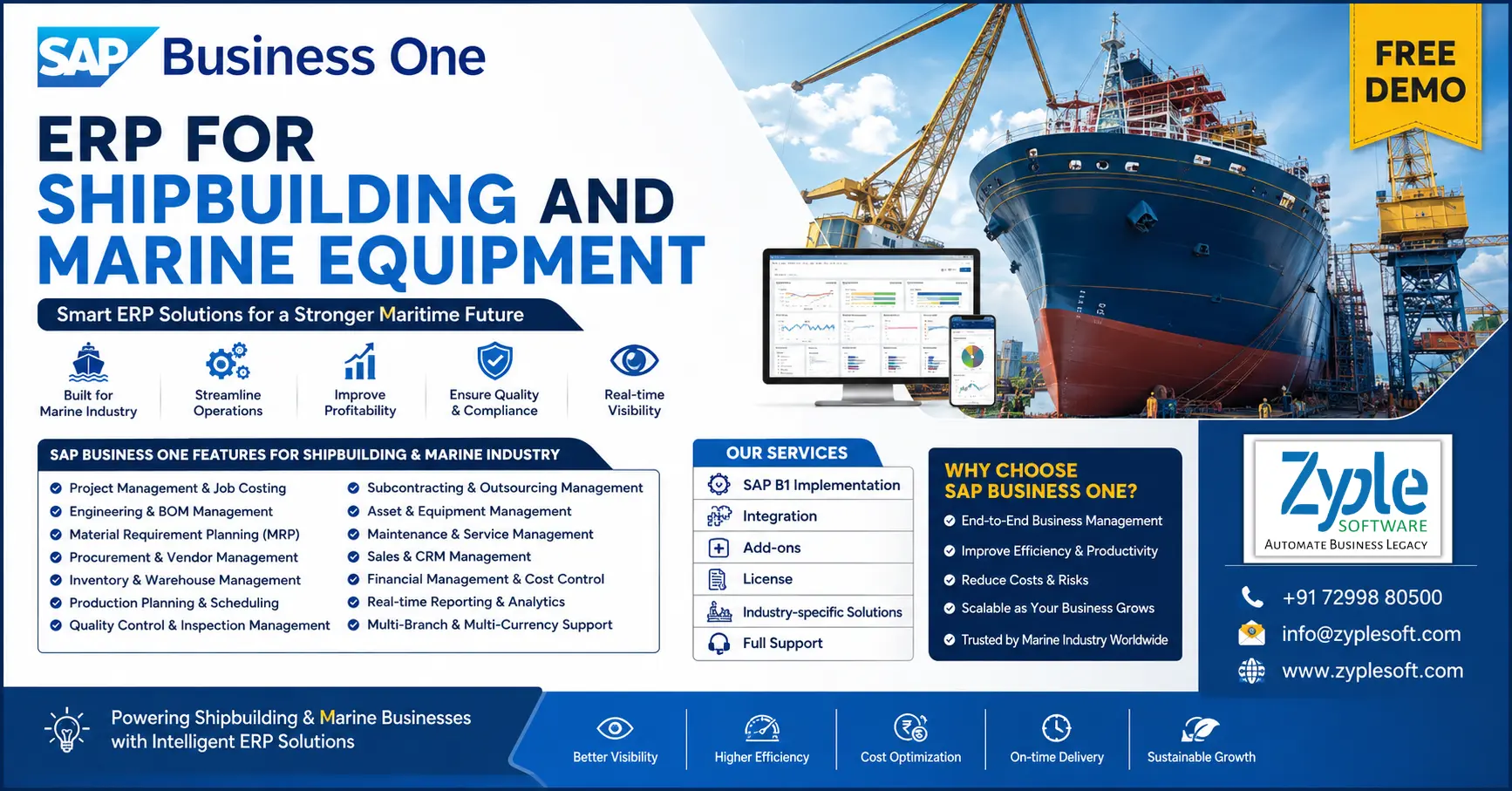
SAP Business One ERP for Shipbuilding and Marine Equipment by Zyple Software featuring project management, inventory control, procurement, production planning, asset management, and marine industry ERP solutions.

SAP Business One for Shipbuilding and Marine Equipment

SAP Business One ERP for Shipbuilding and Marine Equipment Industry
SAP Business One ERP for Shipbuilding and Marine Equipment by Zyple Software featuring project management, inventory control, procurement, production planning, asset management, and marine industry ERP solutions.

The shipbuilding and marine equipment industry has always faced unique challenges, from handling complex projects to optimizing resource usage and ensuring compliance with different regulations. In this competitive market, companies need an efficient, scalable solution to facilitate operations and increase profitability. SAP Business One ERP for shipbuilding and marine equipment delivers a complete set of tools to handle everything from inventory and procurement to production and finance.

Challenges Faced By The Shipbuilding and Marine Equipment Industry

1. High Financial and Capital Barriers

Developing and upgrading shipyards with modern infrastructure like advanced dry docks requires huge upfront capital with long gestation and payback periods. Local players often lack access to the low-cost, state-backed credit that global competitors enjoy, increasing the cost of construction.

2. Supply Chain and Equipment Sourcing

Shipbuilders are often heavily reliant on foreign suppliers for essential marine equipment, marine-grade steel, and navigation technology. This results in longer lead times and higher vulnerability to global supply chain disruptions.

3. Technological and Operational Complexities

The industry has historically depended on tying milestone payments to cutting steel, which disincentivizes front-loading the digital-modeling process. This results in increased errors, extensive rework, and cascading obstacles on the production floor. Adapting to modern environmental regulations, such as implementing green shipping supply chains and eco-friendly propulsion technologies, involves massive research and development investments and workforce upskilling.

4. Market Competitiveness and Execution

Inconsistent build-quality standards and longer construction timelines make domestically produced vessels less competitive in global commercial markets.

Empower your shipbuilding and marine equipment business with following features and SAP Business One implementation by Zyple Software to streamline project management, procurement, production, inventory, quality, and financial operations through a single intelligent ERP platform.

Features of SAP Business One for Shipbuilding and Marine Equipment

1. Project-Based Shipbuilding Management

  • End-to-end project lifecycle management from design, procurement, and assembly to delivery.
  • It includes project-wise costing and profitability tracking.
  • It includes a WBS (Work Breakdown Structure) for ship components.
  • It includes budget vs. actual cost monitoring.
  • It includes multi-phase project billing and milestone tracking.
  • Helps shipyards handle multiple vessels under construction simultaneously.

2. Advanced Production and Manufacturing Control

  • Bill of materials (BOM) for multi-level assemblies like hull, engine, and electronics.
  • It includes routing and production planning.
  • It includes material requirements planning (MRP) for large builds.
  • It includes shop floor control and job work tracking.
  • It includes rework, scrap, and yield monitoring.
  • Minimizes delays and improves production efficiency.

3. Procurement and Vendor Management

  • It includes a supplier or vendor database with certifications.
  • RFQ, purchase order, and GRN to invoice cycle.
  • It includes vendor comparison and selection.
  • It includes import procurement and multi-currency handling.
  • It ensures timely availability of essential marine components.

4. Inventory and Warehouse Management

  • It includes multi-warehouse and yard management.
  • It includes spare parts and maintenance inventory tracking.
  • It improves stock accuracy and minimizes shortages.

5. Quality Control and Compliance

  • Certification tracking like ISO, marine compliance, and more.
  • It includes non-conformance and corrective actions.
  • It includes audit-ready documentation.
  • It ensures compliance with maritime regulations.

6. Asset and Equipment Management

  • It includes fixed asset lifecycle management.
  • It includes equipment maintenance scheduling.
  • It includes depreciation and utilization tracking.
  • It includes dockyard equipment monitoring.
  • It improves asset utilization and minimizes downtime.

7. Financial Management and Cost Control

  • It includes general ledger, accounts payable, accounts receivable, and banking.
  • It includes project-based accounting.
  • Cost center allocation per vessel or contract.
  • It includes cash flow forecasting.
  • It includes multi-currency and global taxation support.

8. Sales and Contract Management

  • It includes lead and opportunity management.
  • It includes contract lifecycle management.
  • It includes the quotation, order, and delivery-to-invoice cycle.
  • It includes after-sales service and warranty tracking.
  • It includes customer lifecycle management (CLM).
  • It improves customer engagement and contract visibility.

9. Service and Maintenance Management

  • It includes service contracts and AMC management.
  • It includes repair and maintenance tracking.
  • It includes spare parts consumption tracking.
  • It includes field service scheduling.
  • It supports post-delivery vessel maintenance services.

10. Supply Chain and Logistics Management

  • It includes material movement tracking.
  • It includes yard logistics and dispatch planning.
  • It includes shipment tracking and export documentation.
  • It includes integration with logistics partners.
  • It ensures smooth supply chain operations.

11. Business Intelligence and Real-Time Analytics

  • It includes real-time dashboards and KPIs.
  • It includes project profitability reports.
  • It includes cost variance analysis.
  • It includes predictive insights using analytics.
  • Helps management make faster, better decisions.

12. Document Management and Engineering Integration

  • It includes CAD drawings and document linking.
  • It includes version control for engineering changes.
  • It includes document approval workflows.
  • It includes a centralized data repository.
  • It ensures accuracy and collaboration across teams.

13. Human Resource and Workforce Management

  • It includes employee records and payroll integration.
  • It includes workforce allocation per project.
  • It includes labor cost tracking.
  • It includes shift and overtime management.
  • It improves workforce productivity and cost control.

14. Mobility and Remote Access

  • It includes real-time updates from the shop floor.
  • It includes cloud deployment options.
  • Allows operations from anywhere.

15. Customization and Industry Add-Ons

  • It includes shipbuilding-specific SAP business one add-ons.
  • It includes integration with IoT sensors and marine systems.
  • It includes custom dashboards for vessel tracking.
  • It includes API integrations with third-party tools.
  • It is highly flexible to fit unique shipyard requirements.

Benefits of SAP Business One for Shipment and Marine Equipment

The ERP software, SAP Business One (SAP B1) system, provides end-to-end operational visibility for the shipment, maritime, and marine equipment industries. It replaces disconnected legacy systems with a single, scalable platform that optimizes fleet maintenance, automates procurement and logistics, and provides real-time financial oversight to increase profitability and on-time delivery.

1. Improved Fleet and Maintenance Control

Schedules preventive maintenance, tracks equipment performance in real-time, and reduces costly vessel or machinery downtime using SAP implementation.

2. Optimized Supply Chain and Inventory

Automates procurement directly from sales orders and track specific parts like BP Catalog numbers or batch IDs for shipbuilding and repairs.

3. Facilitated Order-to-Cash

Unifies processes from freight quotation to shipping, invoicing, and carrier management (often improved via certified logistics add-ons).

4. Real-Time Financial Oversight

Integrates multi-currency financial data, contract management, and complex supplier agreements into interactive dashboards for faster decision-making using SAP solutions.

5. Regulatory Compliance

Generates the precise, complete documentation required for shipbuilding, international shipping, and marine safety regulations.

Conclusion of Shipping and Marine Equipment Industry

Zyple Software is an expert SAP Business One partner in India specializing in implementation, digital transformation, licensing, integration, add-on solutions, migration, and consulting for the shipping and marine equipment industry. From handling complex projects to optimizing supply chains and ensuring financial compliance, SAP software delivers the comprehensive, customized solutions you need to thrive.

Do you need the SAP B1 ERP solution for your business or industry?

Finish all the details in the provided contact form; our team will reach out to you.

    FAQs

    1.How can SAP Business One be designed specifically for shipbuilding operations?

    SAP Business One can be customized with industry-specific modules for project-based manufacturing, vessel tracking, and marine compliance, ensuring it aligns perfectly with your shipbuilding workflows.

    SAP B1 implementation generally takes 3 to 6 months, depending on business complexity, number of users, and required integrations.

    Companies generally see ROI through:

    • Improved project cost control.
    • Reduced material wastage.
    • Better production efficiency.
    • Faster decision-making with real-time insights.

    No, SAP Business One is customized with a user-friendly interface. Proper training and support from an implementation partner ensure your team can use it effectively.

    You can begin by requesting a free demo and consultation from an authorized SAP B1 partner like Zyple Software, who will evaluate your requirements and propose a customized solution.

    Are you ready to streamline your shipbuilding and marine equipment operations? Contact for SAP Business One demo with Zyple Software today and discover how intelligent ERP can boost productivity, reduce costs, and accelerate business growth.
    SAP Business One ERP for Mineral Industry

    SAP Business One ERP for Mineral Industry

    SAP Business One ERP for Mineral Industry

    SAP Business One ERP for Mineral Industry

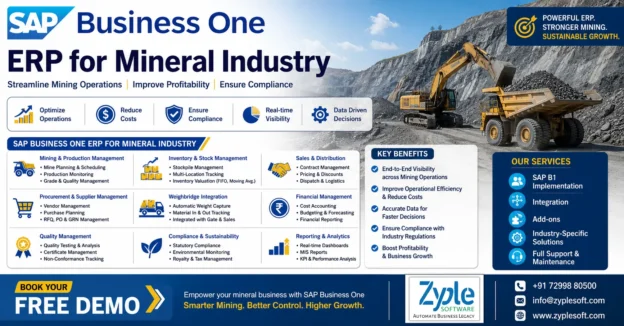
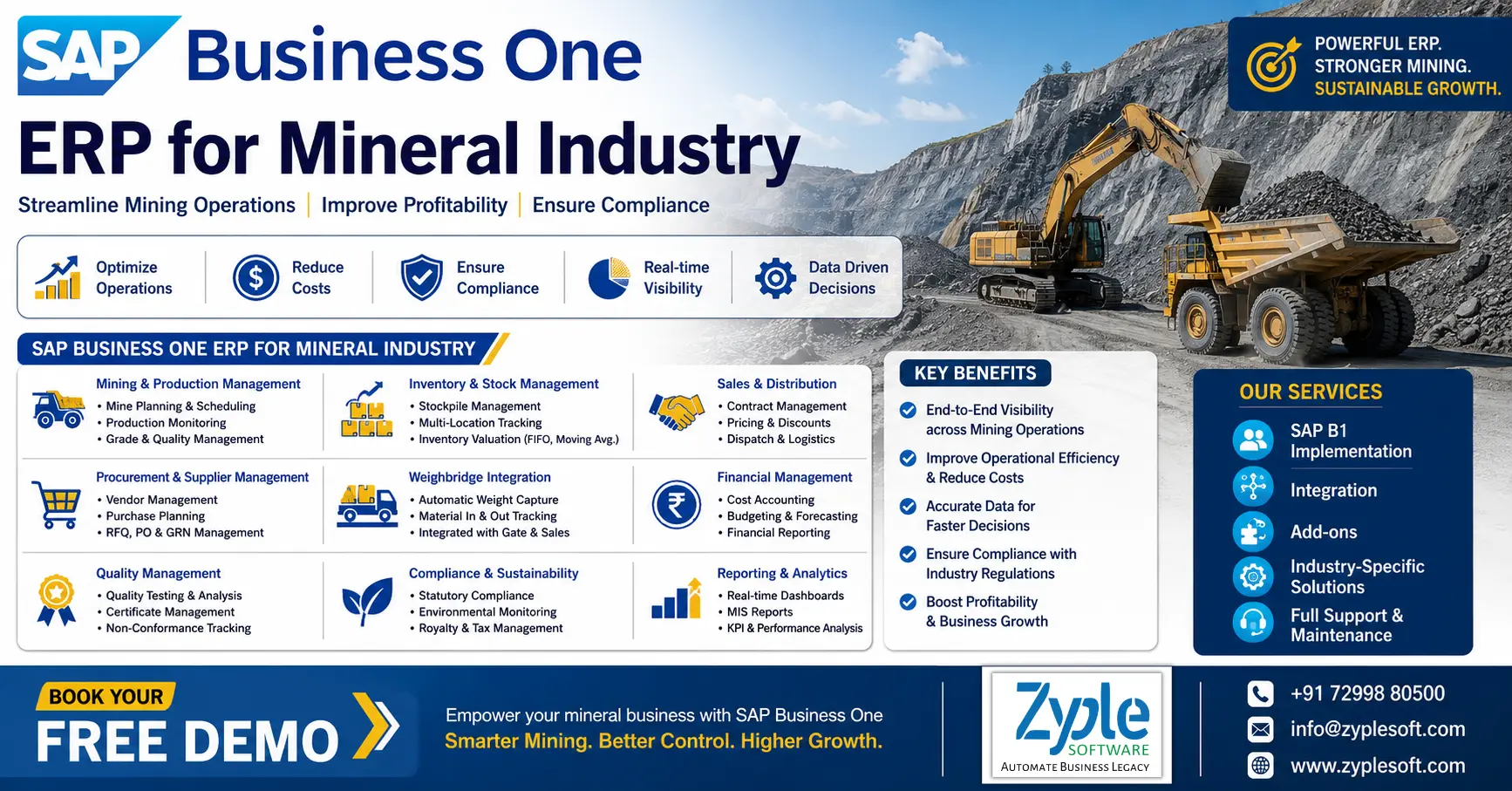
    The mineral industry is fast-paced and depends heavily on data. Mineral companies handle drilling schedules, blasting records, fleet operations, fuel usage, quarry production, material movement, and environmental compliance, all while ensuring maximum output and worker safety. SAP Business One ERP for mineral industry helps mineral companies improve their operations and grow sustainably.

    Challenges Faced By The Mineral Industry

    The mineral industry is undergoing a massive transformation, largely driven by increasing demand for essential minerals required for the clean energy transition. Today, mineral companies face a complex web of environmental, operational, and geopolitical challenges that threaten both profitability and sustainability growth.

    1. Environmental and Sustainability Demands

    The sector is heavily scrutinized for its environmental impact, including land degradation, water contamination, and greenhouse gas emissions. Achieving strict sustainability standards and transitioning to green mining practices is a major, yet necessary, operational shift.

    2. Declining Ore Grades and Cost Escalations

    Naturally occurring ore grades are dropping, meaning companies must process more rock to extract the same amount of valuable minerals. This involves exploring in more remote locations, which increases project costs and ongoing operational expenses.

    3. Geopolitical and Supply Chain Risks

    Trade conflicts, shifting government policies, and global tensions directly interrupt the supply of raw materials and technology. Geopolitical shifts and resource shortages have heightened supply chain risks for essential commodities like lithium and rare earths.

    4. The Skills Gap and Knowledge Loss

    As veteran miners retire, the industry faces an ongoing shortage of experienced workers who understand complex, modern mining technologies. Operating in remote locations further aggravates the difficulty of attracting and retaining specialized talent.

    5. Health, Safety, and Operational Hazards

    Mining requires inherently hazardous working conditions and complex geological formations. Ensuring worker safety around heavy machinery, explosives, and confined spaces remains a major, non-negotiable priority.

    6. Social License to Operate and Regulatory Compliance

    Mining projects are increasingly delayed by complex regulatory permitting and community opposition. Companies must navigate evolving regulations while building trust with local communities and indigenous populations who are directly affected by land use.

    Features of SAP Business One ERP for Mineral Industry

    1. Exploration and Mine Planning Management

    • It includes geological data tracking and mineral resource estimation.
    • It includes long-term and short-term mine planning.
    • It includes budgeting for exploration and feasibility studies.
    • It includes integration with survey and drilling data.
    • It includes capital expenditure (CAPEX) planning for mining projects.
    • Helps handle the entire lifecycle from exploration to production.

    2. Production and Extraction Management

    • It includes track drilling, blasting, excavation, and hauling.
    • Monitors ore extraction volumes and grades.
    • It includes crushing, screening, and beneficiation process tracking.
    • It includes production planning and scheduling.
    • It includes real-time production data collection.
    • SAP supports optimization of mining processes and production planning.

    3. Inventory and Stockpile Management

    • It includes raw material (ore), processed minerals, and by-product tracking.
    • Batch-wise and location-wise inventory, like stockpiles, yards, and warehouses.
    • It includes quality and grade-based inventory classification.
    • It includes automatic stock updates from weighbridge integration.
    • It includes minimum and maximum stock level alerts.

    4. Supply Chain and Logistics Management

    • End-to-end logistics from mine, plant, and port to customer.
    • It includes transport and fleet management.
    • It includes route planning and shipment tracking.
    • It includes bulk material handling and dispatch planning.
    • It includes vendor and contractor coordination.
    • It ensures a resilient supply chain and logistics optimization.

    5. Financial and Cost Management

    • It includes mine-wise and project-wise costing.
    • It includes production cost per ton analysis.
    • It includes budget vs. actual comparisons.
    • It includes asset depreciation and capital tracking.
    • Multi-location financial integration.
    • It includes GST and tax compliance.
    • Allows real-time financial visibility and forecasting.

    6. Asset and Equipment Management

    • Maintenenace scheduling, like preventive and breakdown.
    • It includes equipment lifecycle tracking.
    • It includes spare parts inventory management.
    • It includes machine downtime analysis.
    • It includes fuel consumption tracking.
    • Improves asset uptime and minimizes operational costs.

    7. Workforce and Contractor Management

    • It includes employee scheduling and shift planning.
    • It includes contractor and labor management.
    • It includes attendance and payroll integration.
    • It includes safety certifications and compliance tracking.
    • It includes workforce productivity analysis.
    • It supports workforce optimization and safety culture.

    8. Compliance, Safety, and Environmental Management

    • It includes mining permits and license tracking.
    • Environmental compliance, like pollution and land usage.
    • It includes safety incident reporting and audits.
    • It includes ESG (Environmental, Social, and Governance) reporting.
    • It includes regulatory documentation management.
    • Helps achieve strict mining regulations and sustainability goals.

    9. Sales, Contracts, and Commodity Management

    • Mineral sales contracts and pricing, like grade-based pricing.
    • It includes customer order management.
    • It includes dispatch, billing, and invoicing automation.
    • It includes commodity trading and contract lifecycle management.
    • It includes customer relationship management (CRM).

    10. Real-Time Analytics and Reporting

    • It includes real-time dashboards for production, finance, and logistics.
    • KPI tracking like cost per ton, output efficiency, and downtime.
    • It includes custom MIS and regulatory reports.
    • It includes data-driven decision-making.
    • Allows data-driven insights and performance optimization.

    11. Integrated End-to-End ERP Platform

    • It includes a single system integrating finance, production, inventory, and sales.
    • Eliminates data storage across departments.
    • It includes cloud or on-premise deployment.
    • It includes integration with IoT, weighbridges, GPS, and third-party tools.
    • Delivers enterprise-wide planning, execution, and reporting.

    Importance of SAP Business One ERP for Mineral Industry

    The ERP software, SAP Business One, is essential for the mineral industry, as it unifies disconnected operations into a single platform. It delivers immediate value by handling heavy machinery assets, optimizing complex supply chains, ensuring strict regulatory compliance, and centralizing real-time data for accurate financial and production planning.

    1. Integrated Financial Management

    Delivers robust budgeting, audit-ready reporting, and precise fixed-asset tracking to manage heavy extraction equipment and depreciation with the SAP implementation process.

    2. Supply Chain and Inventory Optimization

    Maintains optimal stock levels for essential spare parts and mining supplies to prevent costly production downtimes.

    3. Compliance and Safety

    Facilitates documentation and auditable data to help mining companies effortlessly meet strict environmental and labor regulations.

    4. Material Requirements Planning (MRP)

    Improves resource utilization by intelligently handling raw materials and aligning procurement with production schedules using SAP solutions.

    5. Real-Time Dashboards

    Replaces scattered spreadsheets with centralized analytics, providing leaders a clear mine-to-market view of cost performance and operational efficiency.

    Benefits of SAP Business One for Mining Industry

    SAP Business One (SAP B1) facilitates capital-intensive mining operations by integrating core processes like extraction planning, heavy equipment maintenance, procurement, and financial tracking. It delivers real-time data to help mining companies control costs, optimize supply chains, and ensure strict regulatory and ESG compliance.

    1. Financial Management and Cost Control

    The SAP software accurately tracks real-time costs of fuel, labor, and machinery. It uses built-in budgeting and profitability analyses to monitor expenses across individual projects or specific mine sites.

    2. Asset and Equipment Maintenance

    Reduces costly unplanned downtime by scheduling predictive and preventive maintenance for heavy mining machinery. Tracks equipment lifecycles and evaluates repair histories efficiently.

    3. Inventory and Supply Chain Orchestration

    Maintains optimal stock levels of crucial consumables and spare parts using SAP B1 add-ons. Facilitates procurement processes from purchase requests to supplier contracts and payment management.

    4. Regulatory and ESG Compliance

    Simplifies reporting for stringent labor laws and environmental standards. Captures safety logs and sustainability metrics to ensure audit readiness.

    5. Data-Driven Production Planning

    Uses production planning and integrated analytics to optimize extraction schedules based on market demand and resource availability.

    Conclusion of Mineral ERP

    As a qualified SAP Business One partner, Zyple Software is delivering services like SAP B1 implementation, licensing, integration, add-ons, and support to different industries, like construction, manufacturing, solar, jewellery, food and beverage, aerospace, retail, pharma, and textiles. 

    SAP Business One is an ERP customized for small and medium-sized businesses that connects finance, production, procurement, inventory, sales, CRM, and reporting into one platform. For mineral or any other companies, it can improve project costing, procurement, subcontractor billing, and inventory management.

    If you’re adaptable, appoint a demo of SAP Business One.

    Do you look for the SAP B1 ERP solution for your business or industry?

    Finish all the details in the arranged contact form; our team will reach out to you.

      FAQs

      1.What is SAP Business One and how does it benefit the mineral industry?

      SAP Business One is an integrated ERP solution customized for small and midsize businesses. For the mineral industry, it helps handle mining operations, inventory, procurement, sales, finance, and compliance in one system, improving efficiency and reducing operational costs.

      Yes, SAP Business One delivers real-time inventory tracking, batch and serial number management, and warehouse control. It enables mineral businesses to handle stockpiles, track material movement, and reduce losses due to mismanagement or theft.

      SAP Business One supports production planning, resource allocation, and equipment utilization. It helps evaluate extraction processes, handle raw material usage, and optimize production cycles to improve output and profitability.

      Absolutely. The system helps maintain accurate records, generate compliance reports, and monitor environmental and safety regulations. This ensures your business stays adherent to industry standards and government policies.

      You can start by consulting a certified SAP Business One partner like Zyple Software who will evaluate your business needs, provide a demo, and guide you through implementation, customization, and support to ensure a smooth digital transformation.