Tag Archives: SAP Business One inventory management

SAP Business One ERP for Managing Multi-Level BOMs

Best ERP for Managing Multi-Level BOMs

Best ERP for Managing Multi-Level BOMs - SAP Business One
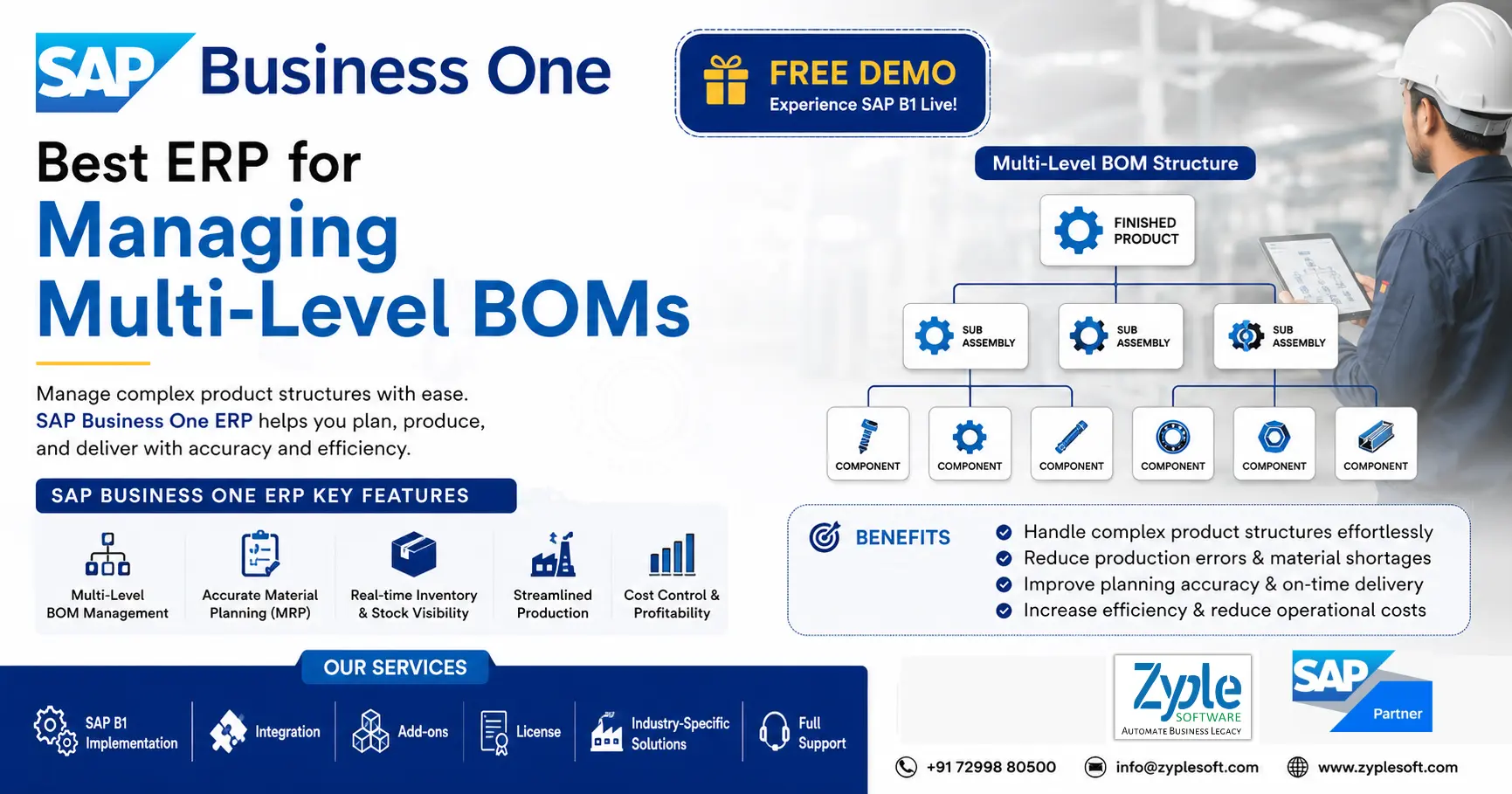
SAP Business One ERP for Managing Multi-Level BOMs

A bill of materials is crucially the complete recipe for a finished product, including every raw material, sub-component, assembly, and purchased part required to develop it. In a simple manufacturing environment, a single-level BOM may be adequate. But in discrete manufacturing, where products require multiple sub-assemblies, each containing their own components, you are handling a multi-level BOM structure. In this blog, we are going to discuss about the best ERP for managing multi-level BOMs.

Why Manual BOM Management Always Fails at Scale?

Manual BOM management tends to work until it doesn’t. The failure is occasionally sudden. It gathers quietly through minor version discrepancies, overlooked change notices, and data entered inconsistently across departments. Here is how the breakdown usually happens:

1. Version Control Becomes Unmanageable

When engineering issues a design change, that update needs to flow through procurement, production, costing, and inventory simultaneously. In a manual environment, some teams receive the update late, and some don’t receive it at all. Production ends up running against an obsolete BOM while engineering has already moved to the next revision.

2. Data Storage Drives Costly Disconnects

Engineering maintains a single version of the BOM. Procurement operates from a different export. Production uses a printed copy from the previous quarter. Finance uses yet another alternative version for costing. These storages are not theoretical; they are standard operating procedure in companies that have not yet adopted ERP BOM management. Each storage creates a risk of inconsistency, and inconsistency at the BOM level translates directly into production errors.

3. Change Management is Reactive, Not Proactive

Engineering change orders in manual systems are frequently communicated through email chains or shared documents. There is no automated propogation, no impact analysis, and no system-imposed approval workflow. Teams identify changes after the fact, sometimes after materials have already been ordered or components machined to the wrong specification.

SAP Business One As Best ERP For Managing Multi-Level BOMs

SAP Business One (SAP B1) handles multi-level bills of materials (BOMs) efficiently by embedding sub-assemblies within a parent production BOM. It connects structural layers to real-time inventory, accurate material requirements planning (MRP), and integrated shop-floor routing, making it an ideal ERP for small and medium-sized manufacturing enterprises.

How SAP Business One ERP Solves Multi-Level BOM Complexity

The SAP Business One system does not simply digitize your current BOM spreadsheets. It primarily changes how BOM data is created, maintained, and consumed across your organization.

1. A Single, Centralized BOM Repository

Every department, like engineering, procurement, production, and finance, works from the same BOM. There is one version of SAP B1, always current, accessible in real-time. When a change is approved, it generates automatically for every function that depends on that data. This is the cornerstone of accurate SAP B1 ERP BOM management.

2. Multi-Level BOM Expansion and Breakdown

Modern ERP systems like SAP B1 support complete multi-level BOM expansion, the ability to trace a finished product down through every sub-assembly and component, and calculating total material requirements at every level. They also support breakdown, identifying where a specific component is used across all products. This is essential for manufacturing resource planning, specifically when a common component is shared across multiple product lines and a shortage needs to be evaluated for impact.

3. Automated Engineering Change Management

When an engineering change is initiated, the SAP B1 ERP system imposes a structured workflow, like approval routing, impact evaluation, effective dating, and automatic update of all impacted BOMs. There are no more email chains and version confusions. The SAP software ensures every stakeholder is notified and every downstream document is updated.

4. Real-Time Integration with Production and Inventory

SAP Business One ERP for production planning connects BOM data directly to work orders, material requirements planning (MRP), and inventory transactions. When a production order is released, the system automatically tracks current inventory against BOM requirements, creates material requisitions for shortfalls, and schedules production based on component availability. This integration eliminates the lag between planning and execution that is indigenous in manual environments.

5. Accurate Costing At Every Level

Because the SAP B1 ERP maintains accurate BOMs with current component costs, standard costing and actual costing both reveal reality. Operations heads and finance teams can see product margins with confidence, allowing better pricing decisions and more effective cost control.

How Zyple Software Helps Manufacturers Take Control of BOM Complexity?

Zyple Software specializes in the SAP implementation process for manufacturing businesses, from initial assessment and system design to go-live and post-implementation support. The company brings deep expertise in SAP B1 ERP for discrete manufacturing, having worked with production-intensive organizations across industries, including industrial equipment, engineered components, and process-adjacent manufacturing.

1. BOM Configuration

Zyple Software works directly with your engineering and operations teams to map current BOM structures into the ERP, clean historical data, and establish governance standards that prevent data quality issues from recurring. This is challenging work, but it is foundational, and doing it correctly from the start defines the success of every downstream function.

2. Manufacturing Process Automation

Beyond BOM management, Zyple Software modifies manufacturing process automation across work order management, capacity planning, quality control, and inventory tracking. The goal is a connected operation where every process from order receipt to shipment runs on accurate, live data.

3. Continuous Support and Optimization

Manufacturing businesses evolve as products change, volumes scale, and new product lines are added. Zyple Software delivers continuous support to ensure your ERP continues to reflect your actual operations and proactively suggests improvements as your business grows.

Benefits of Using SAP Business One for Managing Multi-Level BOMs

The ERP software, SAP Business One, handles multi-level Bills of Materials (BOMs) by creating a clear, nested hierarchy of parent items, sub-assemblies, and raw materials. This structure facilitates production planning, automates material requirements, rolls up exact product costs, and tracks inventory across every single tier of assembly.

1. Accurate Material Requirements Planning (MRP)

The system looks at multi-level dependencies to calculate exact raw material needs and sub-assembly counts based on current demand using SAP solutions.

2. Sub-Assembly Stock Tracking

You can evaluate work-in-progress (WIP) and semi-finished goods independently as they move through various production stages.

3. Precise Cost Roll-Ups

Costs automatically aggregate from raw materials up through sub-assemblies to define the true standard cost of the final product.

4. Step-by-Step Routing Control

You can group line items by stages and map distinct machine and labor requirements to specific assembly tiers using SAP Business One add-ons.

5. Mass Updates

You can add, remove, or change component lines across different dependent BOM structures at the same time.

6. Integrated Financials

Every stock issue, receipt, and production step automatically connects to the general ledger for real-time margin tracking.

7. Reduced Obstacles

Clear visibility into lower-level component availability avoids unexpected production delays on the main assembly line.

Conclusion of SAP Business One for Handling Multi-Level BOMs

As a trusted SAP Business One partner, Zyple Software is delivering services like SAP B1 implementation, integration, migration, licensing, add-ons, digital transformation, and support to different industries, like construction, manufacturing, solar, food and beverage, aerospace, healthcare, retail,  jewellery, pharma, and textiles. 

SAP Business One is an ERP software customized for small and medium-sized enterprises that connects finance, production, inventory, procurement, sales, CRM, and reporting into one platform. For manufacturing businesses, it can improve project costing, procurement, subcontractor billing, and inventory management.

If you’re available, register a demo of SAP Business One.

Do you insist on the SAP B1 ERP software for your business or industry?

Finish all the details in the classified contact form; our team will get back to you.

    FAQs

    1.How does SAP Business One handle multi-level Bills of Materials (BOMs)?

    SAP Business One efficiently handles multi-level BOMs by allowing businesses to define complex product structures with multiple sub-assemblies and components. It delivers complete visibility into each level of production, ensuring accurate planning, costing, and material requirements across all stages.

    Yes, SAP Business One supports version control and engineering change management for BOMs. This enables manufacturers to update components, revise structures, and maintain historical records without disrupting ongoing production processes.

    With consolidated MRP (Material Requirements Planning), SAP Business One automatically calculates demand for raw materials and sub-assemblies across all BOM levels. This helps minimize shortages, avoid overstocking, and ensures smooth production workflows.

    Absolutely. SAP Business One is widely used in industries like construction, automotive, electronics, machinery, and industrial manufacturing where multi-level BOMs are necessary. It ensures precise control over production, costing, and inventory at every level.

    Using SAP Business One for multi-level BOMs offers benefits such as improved production accuracy, real-time inventory tracking, minimized operational costs, better decision-making, and seamless integration with finance, procurement, and sales modules.
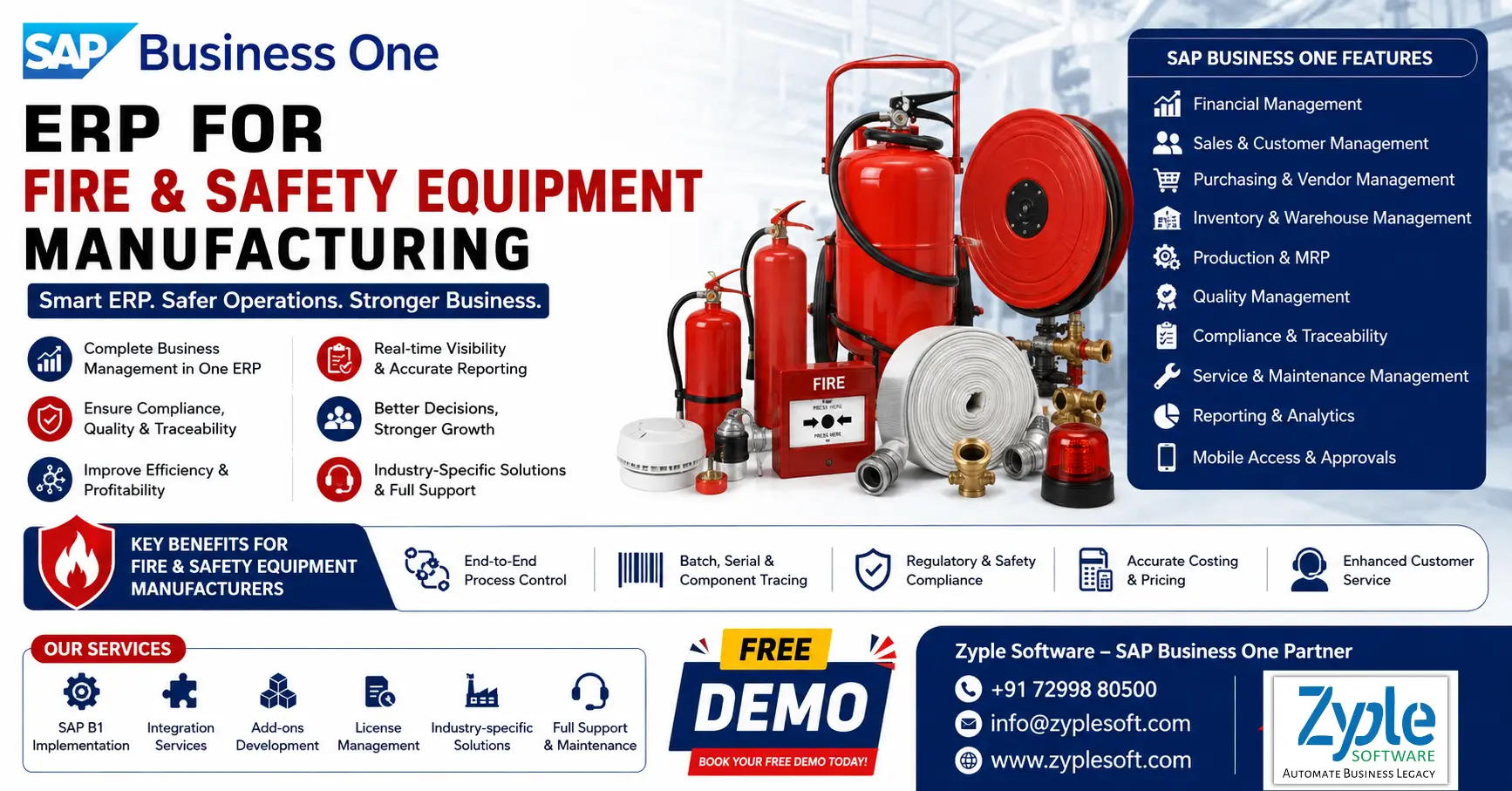
    SAP Business One ERP for Fire and Safety Equipment Manufacturing with production, inventory, MRP, quality, compliance, and traceability features

    SAP Business One ERP for Fire and Safety Equipment Manufacturing

    SAP Business One ERP for Fire and Safety Equipment Manufacturing

    SAP Business One ERP for Fire and Safety Equipment Manufacturing with production, inventory, MRP, quality, compliance, and traceability features

    The fire and safety equipment manufacturing industry faces huge pressure due to its large scope of work, which involves project management, heavy machinery loading, shipping, warehousing, and other responsibilities. Due to growing logistics issues, fire and safety equipment manufacturing businesses need a system that unifies different company departments. SAP Business One ERP for fire and safety equipment manufacturing unites processes and helps in boosting production and efficiency.

    Challenges Faced By the Fire and Safety Equipment Manufacturing Industry

    The fire and safety equipment manufacturing industry faces serious challenges, primarily driven by fluctuating supply chains, rapidly evolving international safety regulations, and the high cost of R&D for IoT-integrated systems. These challenges demand that manufacturers continuously adapt to survive in a highly compliance-driven market.

    1. Stringent and Evolving Regulations

    Manufacturers must navigate continuously shifting global standards (such as updated ISO 16112 and NFPA 2112 certifications) for flame-resistant clothing and active fire systems. Maintaining compliance involves ongoing testing and heavy financial investment.

    2. Supply Chain Volatility

    The production of fire suppression agents (such as foam, clean agents, and chemical flame retardants) and electronic components heavily depends on global supply chains. Disruptions lead to fluctuating raw material costs and production delays.

    3. Cost Sensitivity vs. Advanced Tech

    Customers, especially small-to-medium enterprises (SMEs), often prioritize low-cost, traditional equipment over modern, IoT-integrated, or AI-based detection systems. This makes it difficult for manufacturers to recover the costs of building premium, high-tech safety gear.

    4. Shifting Environmental Madates

    Regulations regarding the environmental impact of safety chemicals are becoming strict. A notable example is the phase-out and restriction of certain FPAS (per- and polyfluoroalkyl substances) in firefighting foams, forcing manufacturers to research and develop eco-friendly alternatives without compromising effectiveness.

    5. Counterfeit Competition

    The market is often flooded with cheaper, non-certified imitation products. These counterfeits undercut legitimate manufacturers, reduce profit margins, and pose massive risks to end-users.

    Let’s discuss some features with SAP B1 modules for fire and safety equipment manufacturing industry.

    Features of SAP Business One ERP for Fire and Safety Equipment Manufacturing

    1. Core Manufacturing and Production Management

    • It includes multi-level BOMs for extinguishers, alarms, PPE kits, and more, with version control.
    • Optimizes batch production of cylinders, valves, and hoses.
    • Auto-calculates raw material needs based on demand forecasts.
    • Tracks manufacturing orders, rework, and maintenance tasks.
    • It includes real-time monitoring of operations, labor, and machine usage.
    • It includes visibility into partially completed fire safety products.
    • It balances workloads across machines and production lines.

    2. Production Engineering and Equipment

    • Configures custom fire safety systems like hydrant systems and alarm panels.
    • Tracks design updates for safety compliance.
    • Handles multiple product variants like sizes, pressure ratings, and certifications.
    • Handles components like valves, nozzles, and sensors.

    3. Inventory and Warehouse Management

    • Real-time inventory tracking for raw materials, WIP, and finished goods.
    • Batch and serial number tracking is essential for fire safety compliance and traceability.
    • Bin location management helps in efficient warehouse organization.
    • Stock replenishment automation avoids shortages of essential safety components.
    • It includes accurate costing for each product line.
    • Goods receipt and dispatch integration helps in seamless logistics flow.

    4. Quality Management and Compliance

    • It includes incoming, in-process, and final quality inspections.
    • Defect and non-conformance tracking identify faults and corrective actions.
    • Regulatory compliance management supports ISO, BIS, and NFPA standards.
    • Complete traceability for safety audits.
    • Lot traceability tracks every unit for recalls or service history.

    5. Procurement and Supply Chain Management

    • Supplier management handles vendors for cylinders, chemicals, and electronics.
    • Purchase order automation facilitates the procurement cycle.
    • Demand forecasting predicts demand for fire safety.
    • Supply chain visibility tracks materials from supplier to production.
    • It includes multi-location warehouse management.

    6. Financial Management and Cost Control

    • Integrated accounting like general ledger, accounts payable, accounts receivable, and journal entries.
    • Tracks production costs per batch or product.
    • It includes budgeting and financial planning.
    • It includes cash flow management.
    • Fixed asset management like machines and testing equipment.
    • Profitability analysis like product-wise margin tracking.

    7. Business Intelligence and Reporting

    • Real-time dashboards and KPIs for production, sales, and inventory insights.
    • Customized reports for safety compliance and operations.
    • Predictive analytics for demand and production forecasting.
    • Drill-down analysis identifies inefficiencies quickly.

    8. Sales, CRM, and Service Management

    • Lead and opportunity management to track B2B clients, like industries and construction firms.
    • It includes quotation and order management.
    • It includes customer lifecycle management.
    • It includes AMC contracts for fire equipment servicing.
    • Warranty tracking for extinguishers, alarms, and safety systems.
    • Service call management for maintenance and inspections.

    9. Maintenance and Asset Management

    • Preventive maintenance scheduling for machines and testing equipment.
    • It includes breakdown and maintenance tracking.
    • It includes asset lifecycle management.
    • Downtime analysis reduces production interruptions.

    10. Integration and Smart Manufacturing (Industry 4.0)

    • MES integration helps in connecting ERP with shop floor systems.
    • IoT integration to monitor machines and production lines.
    • API and third-party integration with CRM, logistics, and compliance systems.
    • It includes cloud and on-premise deployment options.

    11. Mobility and Access

    • Mobile apps for sales, inventory, and approvals on the go.
    • Web client access for browser-based ERP usage.
    • It includes real-time alerts and notifications.

    12. Security and Compliance

    • It includes role-based access control.
    • It includes data security and encryption.
    • It includes audit logs and regulatory compliance.
    • It includes multi-branch and multi-currency support.

    Importance of SAP Business One ERP for Fire and Safety Equipment Manufacturing

    The ERP software, SAP Business One (SAP B1) system, is a purpose-built ERP that facilitates fire and safety manufacturing by centralizing core processes, such as inventory, procurement, and financials. It improves production, increases strict quality control, and ensures compliance with industry-specific safety standards.

    1. Strict Regulatory Compliance

    Fire and safety equipment must achieve thorough safety and quality benchmarks (e.g., CE, UL, ISO, or ISI marks in India). SAP Business One evaluates batch numbers and serial numbers, ensuring end-to-end component traceability. This allows seamless auditing and compliance management.

    2. Automated Material Requirements Planning (MRP)

    The platform accurately calculates raw materials based on exact production orders and sales forecasts. This prevents component shortages while reducing excess holding costs for expensive metals, chemicals, and electronic sensors using SAP implementation.

    3. Bill of Materials (BOM) Management

    Safety equipment requires complex, multi-level assemblies. SAP B1 centralizes BOMs, enabling manufacturers to define exact quantities of raw materials and sub-assemblies required, minimizing manufacturing errors and material waste.

    4. Quality Control Integration

    The system enforces strict quality checks across every stage of production, from inspecting to testing final output (e.g., pressure testing extinguishers).

    5. Supply Chain and Inventory Control

    Real-time tracking of warehouse inventory ensures that essential safety parts are always on hand. It helps prevent stockouts of specialized components that could otherwise delay the fulfillment of life-saving equipment using SAP solutions.

    6. Equipment and Asset Maintenance

    Ensures that the manufacturing machinery and testing equipment themselves remain calibrated, safe, and completely operational to comply with manufacturing mandates.

    Benefits of SAP Business One for Fire and Safety Equipment Manufacturing

    SAP Business One facilitates the fire and safety equipment manufacturing industry by integrating essential operations like inventory, production, and financials. It ensures life-saving equipment meets strict regulatory standards, optimizes supply chains, and allows material requirements planning (MRP) to prevent shortages of essential raw materials.

    1. Strict Regulatory Compliance and Traceability

    Fire safety products (e.g., extinguishers, fire alarms, and sprinkler systems) require strict compliance with industry and quality regulations. SAP software tracks products through serial numbers and batch tracking, making it easy to recall parts, handle warranty claims, and pass government audits.

    2. Advanced BOM (Bill of Materials) Management

    Fire systems involve complex assembly. SAP B1’s BOM management enables manufacturers standardize production and control costs by precisely mapping out sub-assemblies, labor, and materials.

    3. Real-Time Inventory Visibility

    Handles components, such as metal, valves, chemicals, and electronic sensors, across multiple warehouses. Real-time tracking minimizes carrying costs and ensures essential parts are never out of stock when building life-saving equipment using SAP B1 add-ons.

    4. Supply Chain and Production Planning

    Aligns your purchasing directly with sales forecasts and production schedules. This ensures you always have the right components in stock to fulfill both standard orders and custom Engineer-to-Order (ETO) specifications.

    5. Financial Control and Costing

    Centralizes financial management to track expenses, identifies cost-saving opportunities, and calculates profit margins on specific fire safety products or large-scale contract bids.

    Conclusion of Fire and Safety Equipment Manufacturing ERP

    As a qualified SAP Business One partner, Zyple Software is providing services like SAP B1 implementation, integration, licensing, add-ons, and support to different industries like construction, manufacturing, retail, pharma, aerospace, jewellery, solar, food and beverage, and textile industries. SAP Business One is an ERP designed for small and medium-sized businesses that integrates finance, purchasing, sales, inventory, production, CRM, and reporting into a single platform. For solar panel and fire and safety equipment manufacturing or any other companies, it can improve project costing, procurement, subcontractor billing, and inventory management.

    If you’re involved, reserve a demo of SAP Business One.

    Do you demand the SAP B1 ERP system for your business or industry?

    Finish all the details in the defined contact form; our team will return to you.

      FAQs

      Is SAP Business One the right ERP for my fire and safety equipment manufacturing business?

      SAP Business One is ideal for small and medium-sized manufacturers looking to facilitate operations, improve compliance, and gain real-time visibility. A quick consultation can help evaluate if it fits your specific business needs.

      The cost depends on factors like number of users, customization, and deployment type (like cloud or on-premises). Request a personalized quote to get an accurate estimate customized for your business requirements.

      SAP B1 implementation timelines generally range from a few weeks to a few months depending on complexity. The complete project plan can be shared after understanding your current processes.

      Yes, SAP Business One can be customized to support industry-specific needs like compliance tracking, batch management, service contracts, and safety inspections. Book a demo to see how it works for your operations.

      Yes, ongoing support, user training, and system optimization services are delivered to ensure smooth adoption and long-term success.

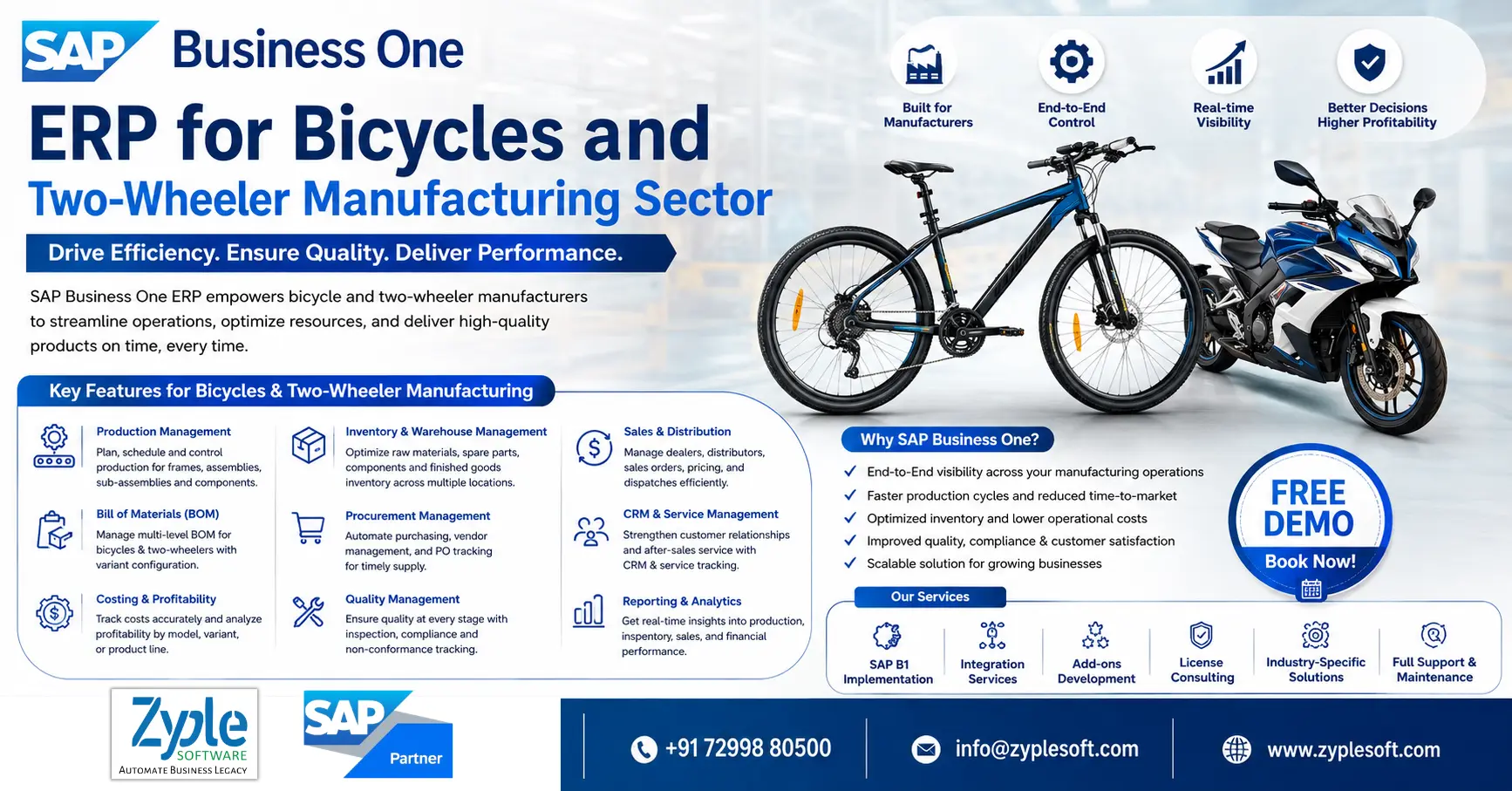
      SAP Business One ERP for Bicycles and Two-Wheeler Manufacturing Sector provide by zyple software– Production, Inventory, Quality and Cost Management

      SAP Business One for Bicycles and Two-Wheeler Manufacturing Sector

      SAP Business One ERP for Bicycles and Two-Wheeler Manufacturing Sector/Industry

      SAP Business One ERP for Bicycles and Two-Wheeler Manufacturing Sector provide by zyple software– Production, Inventory, Quality and Cost Management

      The bicycles and two-wheeler manufacturing industry is fast emerging and one of the main parts of the growing economy of the world. Like all industries, the bicycles and two-wheeler manufacturing industry is looking for approaches to minimize product lifecycle, save costs, and collaborate with dealers and customers to provide excellent services to the customers. With increased demand in this field, the industry faces challenges in improving customer satisfaction, marketing, and sales management; minimizing costs, and efficient supply chain management. SAP Business One ERP for bicycles and two-wheeler manufacturing serves this industry by delivering solutions that fulfill the need to provide innovative products and deliver utmost customer satisfaction.

      Challenges Faced By The Bicycles and Two-Wheeler Manufacturing Industry

      The bicycle and two-wheeler manufacturing sector faces a complex set of challenges, including overproduction crises, shifting consumer demands towards electric vehicles (EVs), supply chain volatility, and margin squeezes. These pressures have forced companies to adapt product strategies and pricing models.

      1. Inventory Surplus and Margin Squeezes

      Following a massive sales surplus, the global bicycle industry has struggled with bloated inventories and overproduction. This oversupply led to a crushing collapse of profits, with industry giants and smaller brands seeing net income drops exceeding 60 to 99% and facing bankruptcy.

      2. Electrification Pressures

      Traditional bicycle and internal combustion engine (ICE) motorcycle manufacturers are under immense pressure to switch to smart, electric bicycles (e-bikes) and electric two-wheelers (E2W). This involves huge investments in R&D, battery technologies, and localized supply chains.

      3. Volatility in Raw Materials

      Manufacturers continue to battle price hikes and shortages of key raw materials such as aluminum, steel, and lithium-ion batteries. Combined with fluctuating freight and global shifting costs, these factors seriously compress operating margins.

      4. Infrastructure and Regulatory Hurdles

      In highly localized markets like Bengaluru, the absence of dedicated, safe cycling lanes discourages widespread bicycle adoption. Also, the electric two-wheeler segment is challenged by possible regulatory changes on lithium-ion batteries, safety standard enforcements, and the need for rider education.

      5. Shifting Consumer Preferences and Competition

      Consumer demand is increasingly low. While basic roadster and commuter bikes are losing urban market share to motorized options, premium and recreational segments demand higher aesthetic quality, specialized components, and multi-speed capabilities.

      Here we are going to discuss about all features and SAP B1 modules in Bicycles and Two-Wheeler Manufacturing industry:

      Features of SAP Business One for Bicycles and Two-Wheeler Manufacturing Sector

      1. Production and Manufacturing Management

      • Bill of materials (BOM) for multi-level assemblies like frame, wheels, engine parts, and accessories.
      • Production orders, like manual and automatic, from sales demand.
      • It includes routing and stage-wise production tracking.
      • It includes work-in-progress (WIP) monitoring.
      • Sub-assembly management like gear systems, brake units, and engines.
      • Production costing, like material, labor, and overhead.
      • It includes rework and scrap management.
      • It includes real-time production tracking for better visibility.

      2. Material Requirements Planning (MRP)

      • It includes demand-based MRP planning for components and raw materials.
      • It includes auto-generation of purchase and production recommendations.
      • It includes lead-time planning for vendor supply.
      • It includes shortage and excess inventory alerts.
      • It includes forecast-driven production planning.

      3. Inventory and Warehouse Management

      • Multi-warehouse management, like plants, depots, and leadership.
      • Batch and serial number tracking is essential for engines and spare parts.
      • It includes bin location tracking.
      • Inventory valuation methods like FIFO and moving average.
      • It includes stock transfer between plants and warehouses.
      • It includes spare parts inventory control.

      4. Procurement and Supplier Management

      • It includes vendor management and supplier evaluation.
      • Purchase requisitions, purchase orders, and GRN to invoices cycle.
      • It includes vendor price comparison and contract pricing.
      • It includes procurement automation with approval workflows.
      • Raw material sourcing optimization like steel, rubber, and electronics.

      5. Financial Management and Cost Control

      • Complete accounting like general ledger, accounts receivable, and accounts payable.
      • It includes product-wise profitability analysis.
      • It includes cost center and profit center tracking.
      • It includes budgeting and expense control.
      • Fixed asset management like machinery and tools.
      • It includes multi-currency support for exports.
      • It includes real-time financial reporting.

      6. Sales and Distribution Management

      • It includes dealer and distribution management.
      • It includes dealer network pricing and discount structures.
      • It includes export documentation and compliance.
      • It includes demand forecasting based on sales trends.

      7. Quality Control and Compliance

      • It includes incoming material inspection.
      • In-process quality checks for assembly line checkpoints.
      • It includes final product inspection before dispatch.
      • It includes defect tracking and corrective actions.
      • It includes compliance with automotive industry standards.
      • It includes quality reporting and analytics.

      8. Supply Chain and Logistics Management

      • It includes end-to-end supply chain visibility.
      • It includes vendor-to-production-to-dealer tracking.
      • It includes logistics and shipment tracking.
      • It includes route planning and dispatch planning.
      • It includes inventory replenishment automation.

      9. Service and Warranty Management

      • It includes warranty tracking for bicycles and two-wheelers.
      • It includes service contract management.
      • It includes spare parts management.
      • It includes customer complaint and service request handling.
      • It includes AMC (Annual Maintenance Contract) support.

      10. Customer Relationship Management (CRM)

      • It includes dealer and customer database management.
      • It includes lead and opportunity tracking.
      • It includes after-sales service tracking.
      • It includes customer feedback and satisfaction analysis.
      • It includes marketing campaign management.

      11. Business Intelligence and Reporting

      • Real-time dashboards for production, sales, and inventory.
      • It includes custom MIS reports.
      • It includes profitability and cost analysis reports.
      • It includes drill-down analytics for decision-making.
      • It includes integration with Excel for advanced reporting.

      12. Mobility and Web Access

      • It includes a mobile app for sales and service teams.
      • It includes remote access to ERP data.
      • It includes real-time updates for field teams.
      • It includes web-based dashboards and approvals.

      13. Integration and Automation

      • It includes integration with IoT devices (machine data), barcode or RFID systems, third-party logistics, and e-commerce platforms.
      • It includes API-based integration with external systems.
      • It includes automated workflows and alerts.

      14. Human Resource and Workforce Management

      • It includes employee master data management.
      • It includes attendance and shift planning.
      • It includes labor cost allocation in production.
      • It includes performance tracking.

      15. Industry-Specific Capabilities

      • Variant management like different models, colors, and specs.
      • It includes engine or chassis number tracking.
      • It includes dealer stock visibility.
      • It includes spare parts lifecycle management.
      • It includes multi-location manufacturing plants.
      • It includes aftermarket service ecosystem management.

      Benefits of SAP Business One for Bicycles and Two-Wheeler Manufacturing Sector

      The ERP software, SAP Business One (SAP B1) system, facilitates the supply chain, automates production planning, and tightly integrates financials for bicycle and two-wheeler manufacturers. It delivers actionable control over multi-level bills of materials (BOMs), minimizes holding costs through automated material requirements planning (MRP), and enhances product traceability via serial number and batch tracking.

      1. Automated Material Requirements Planning (MRP)

      Accurately predicts component needs (chains, tires, frames, motors for e-bikes) based on historical data, forecasts, and live sales orders, minimizing the risk of stockouts and production delays with the SAP implementation process.

      2. Multi-Level Bill of Materials (BOM)

      Simplifies complex assembly structures by handling sub-assemblies (such as an assembled engine or wheelset) and finished goods on a single, easy-to-read production hierarchy.

      3. Quality Control and Traceability

      Integrates quality checkpoints throughout the assembly process using SAP solutions. Serial number and batch tracking enable manufacturers to map components to specific units, easing warranty management and enabling swift recalls if required.

      4. Integrated Financials and Taxation

      Seamlessly integrates shop-floor data with core accounting to automate payroll, monitor profit margins, and maintain compliance with regional tax requirements like GST and e-invoicing.

      5. Supply Chain and Vendor Management

      Strengthens coordination with multi-tier parts suppliers by automating procurement triggers, tracking lead times, and measuring vendor performance using SAP B1 add-on.

      6. Scalability and Customization

      Built to support expanding production lines or the shift to electric vehicles (EVs), the system easily scales. It can also be modified with industry-specific add-ons for job-work subcontracting and dealer networks.

      Conclusion of Bicycles and Two-Wheeler Manufacturing ERP

      As an experienced SAP Business One partner, Zyple Software is delivering services like SAP B1 implementation, licensing, integration, add-ons, and support to different industries, like construction, manufacturing, aerospace, jewellery, solar, food and beverage, retail, pharma, and textile industries. 

      SAP Business One is an ERP customized for small and medium-sized businesses that connects finance, procurement, sales, CRM, production, inventory, and reporting into one platform. For bicycles and two-wheeler manufacturing or any other companies, it can improve project costing, procurement, subcontractor billing, and inventory management.

      If you’re captivated, schedule a demo of SAP Business One.

      Do you seek the SAP B1 ERP solution for your business or industry?

      Finish all the details in the assigned contact form; our team will reach out to you.

        FAQs

        1.How can SAP Business One ERP improve efficiency in bicycle and two-wheeler manufacturing?

        SAP Business One automates core processes like production planning, inventory tracking, and procurement. This minimizes manual errors, improves production timelines, and helps manufacturers scale operations efficiently.

        The cost depends on factors such as the number of users, required modules, customization, and deployment (like cloud or on-premise). A consultation with a certified partner like Zyple Software can provide a tailored quote based on your business needs.

        SAP B1 implementation timelines generally range from a few weeks to a few months, depending on the complexity of your processes. With the right implementation partner like Zyple Software, deployment can be faster and more efficient.

        Yes, SAP Business One can be customized and extended with add-ons to achieve the unique requirements of bicycle and two-wheeler manufacturers, including production workflows and reporting needs.

        The best way to start is by scheduling a demo with an experienced SAP Business One partner like Zyple Software. They will assess your requirements, suggest the right solution, and guide you through implementation and training.

        Looking for digital Transformation for Your Bicycle and Two-Wheeler Manufacturing with SAP Business One – Book Your Free Demo Today with Zyple Software Team.