SAP Business One ERP Software for Laboratory Equipment Manufacturing Industry
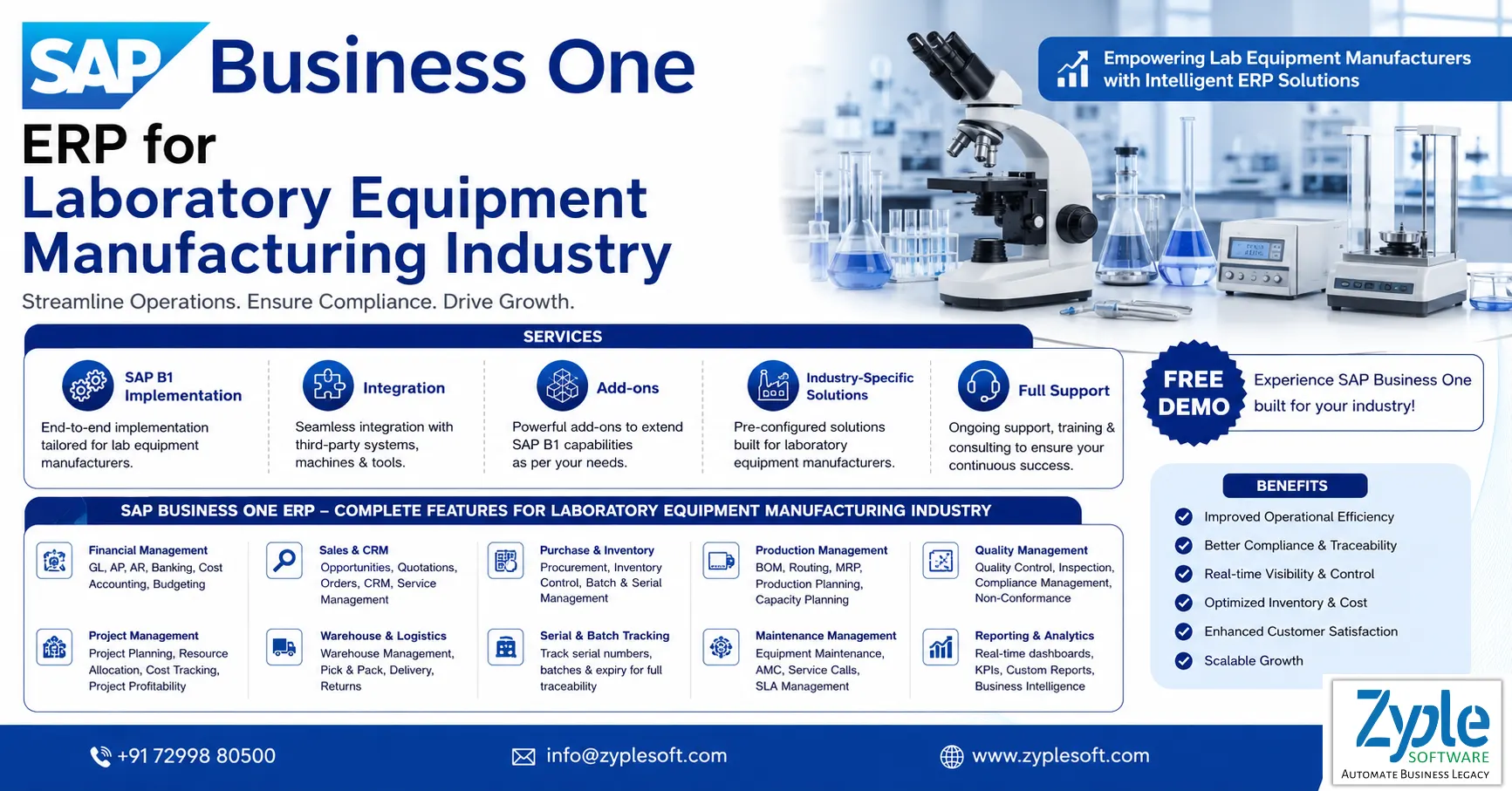
The laboratory equipment manufacturing industry operates under strict quality standards, regulatory pressure, and rising competition. Manufacturers must handle complex production workflows, ensure complete traceability, and maintain consistent quality while scaling operations. SAP Business One ERP for laboratory equipment manufacturing delivers a structured ERP foundation to handle these challenges and support long-term growth without operational chaos.
Challenges Faced By The Laboratory Equipment Manufacturing Industry
The laboratory equipment manufacturing industry faces strict regulatory compliance, rapid technological obsolescence, and miniaturization demands. Companies struggle with supply chain disruptions, a shortage of skilled labor for complex mechatronic systems, and fierce global competition, all of which heavily squeeze profit margins and increase time to market.
1. Strict Regulatory Compliance
Manufacturers must handle evolving global standards such as GLP, GMP, and ISO certifications. Continuously updating designs to achieve these mandates creates massive administrative burdens.
2. Component Shortages and Supply Chain
The industry is heavily dependent on precise, specialized sub-components. Global supply chain volatility often results in prolonged lead times, inflating manufacturing and service costs.
3. Skill Gaps in Development and Assembly
Building complex mechatronic systems involves advanced specialist knowledge in software integration, automation, and electronics. Small and mid-scale manufacturers often lack the engineering manpower and high-end production infrastructure required to scale.
4. Device Integration and Compatibility
Laboratories frequently use instruments from different vendors. Disparate software systems, differing communication protocols, and the lack of universal standards hamper seamless data flow and integration.
5. Equipment Downtime and Service Pressures
Executives place huge pressure on equipment uptime to prevent costly research or sample losses. Extended resolution times for repairs and complex maintenance cycles severely affect operational efficiency and customer satisfaction.
Features of SAP Business One ERP for Laboratory Equipment Manufacturing
1. End-to-End Manufacturing Management
- It includes bill of materials (BOM) for complex lab instruments.
- It includes multi-level production orders and routing.
- It includes production planning and control based on demand forecasts.
- It includes batch and serial number tracking for precision components.
- It includes real-time shop floor control and reporting.
2. Quality Control and Compliance Management
- It includes quality inspection at incoming, in-process, and final stages.
- It includes non-conformance and corrective action tracking (CAPA).
- It includes compliance with ISO, GMP, FDA, and calibration standards.
- It includes audit trail and documentation management.
- It includes calibration scheduling and tracking for lab equipment.
3. Inventory and Warehouse Management
- It includes real-time inventory tracking across warehouses.
- It includes batch or lot traceability for service components.
- It includes automated stock replenishment and reorder levels.
- It includes handling of hazardous or sensitive materials.
- It includes barcode and RFID integration.
4. Product Lifecycle Management
- It includes engineering change management.
- It includes version control for product designs and specifications.
- It includes integration with CAD systems.
- It includes prototype and R&D cost tracking.
5. Advanced Material Requirements Planning (MRP)
- It includes demand-driven MRP for raw materials and components.
- It includes forecasting based on historical sales and trends.
- It includes supplier lead time management.
- Reduces stockouts and excess inventory.
6. Supplier and Procurement Management
- It includes vendor evaluation and performance tracking.
- It includes automated purchase requests and approvals.
- It includes supplier pricing and contract management.
- It includes integration with global supply chains.
7. Financial Management and Cost Control
- It includes real-time financial reporting and analytics.
- Product costing like standard, moving average, and FIFO.
- It includes budgeting and cost center tracking.
- It includes multi-currency and multi-location support.
- It includes GST compliance for India.
8. Sales and Customer Relationship Management (CRM)
- It includes lead and opportunity management.
- It includes quotation and sales order automation.
- It includes customer-specific pricing and contracts.
- It includes after-sales service tracking for lab equipment.
- It includes warranty and service contract management.
9. Service and Maintenance Management
- It includes installation and commissioning tracking.
- It includes preventive and corrective maintenance scheduling.
- It includes service call management.
- It includes spare parts inventory integration.
- It includes field service technician management.
10. Business Intelligence and Reporting
- It includes real-time dashboards and KPIs.
- It includes custom reports for production, quality, and finance.
- It includes predictive analytics for demand and maintenance.
- It includes integration with Excel and analytics tools.
11. Integration and Scalability
- Seamless integration with third-party systems like LIMS, CAD, and MES.
- It includes API-based connectivity.
- It includes cloud and on-premise deployment options.
- Adaptable for growing manufacturing businesses.
12. Data Security and Regulatory Compliance
- It includes role-based access control.
- It includes data encryption and secure backups.
- It includes compliance with industry regulations.
- It includes full audit trails for traceability.
13. Mobility and Remote Access
- It includes remote access to dashboards and reports.
- It includes real-time alerts and notifications.
14. Customization and Industry-Specific Add-Ons
- It includes customization workflows for laboratory equipment manufacturing.
- It includes industry-specific SAP B1 add-ons for calibration and compliance.
- It includes flexible user-defined fields and reports.
15. Project Management Capabilities
- Tracks R&D and custom equipment projects.
- It includes budget vs. actual cost tracking.
- It includes resource allocation and scheduling.
- It includes milestone-based project monitoring.
Importance of SAP Business One ERP for Laboratory Equipment Manufacturing
The ERP software, SAP Business One (SAP B1) system, is essential for laboratory equipment manufacturers, as it unifies core processes, including finance, supply chain, and production, into a single source of truth. It allows highly precise manufacturing, strict regulatory compliance, and seamless tracking of expensive components, ultimately boosting operational efficiency and profit margins.
1. Strict Regulatory Compliance
The industry requires thorough quality control and traceability. SAP B1 automates quality checks, maintains audit-ready documentation, and monitors components so that manufacturers can easily adhere to global standards like ISO and FDA regulations.
2. Precise Production Management
Utilizing multi-level bill of materials (BOMs) and material requirements planning (MRP), the software helps handle complex assembly. It ensures you have the exact components needed to build precision instruments without holding excess stock using SAP implementation.
3. Granular Traceability
Every piece of lab equipment, from sensors to centrifuges, can be serialized. This enables manufacturers to trace the exact batch or serial number of an item from raw material procurement through to post-sales maintenance and service.
4. Real-Time Financial and Inventory Visibility
SAP B1 eliminates data silos. Real-time dashboards track machine utilization, labor costs, and project profitability, enabling leadership to make accurate, data-driven decisions.
5. Supply Chain Optimization
It reduces the risk of stock-outs or overstocking for specialized, often costly, materials required for lab equipment, ensuring on-time delivery and higher customer satisfaction using SAP solutions.
Benefits of SAP Business One for Laboratory Equipment Manufacturing Industry
SAP Business One (SAP B1) facilitates your lab equipment manufacturing by centralizing finance, supply chain, and production. It drives ROI through accurate BOM management, serial or batch traceability, and automated material requirements planning (MRP), minimizing carrying costs and ensuring strict industry compliance.
1. Precision Manufacturing
Utilizes powerful bill of materials (BOM) features to standardize production, control costs, and handle complex, multi-level assemblies required for sensitive scientific instruments.
2. Total Traceability
The SAP software tracks individual components, batches, and serial numbers from procurement to finished goods. This makes managing warranties and handling audits for ISO and regulatory compliance efficient.
3. Optimized Inventory and Procurement
The material requirements planning (MRP) system automatically computes purchasing and production needs based on forecasts and lead times, avoiding production delays and stockouts.
4. Real-Time Analytics
Unifies financial, sales, and operational data into customizable dashboards using SAP B1 add-ons. This allows data-driven decisions that immediately improve profit margins.
5. Integrated CRM
Strengthens customer relationships by managing leads, tracking after-sales service, and logging maintenance or calibration histories in a single platform.
Conclusion of Laboratory Equipment Manufacturing ERP
As a qualified SAP Business One partner, Zyple Software is providing services like SAP B1 implementation, integration, licensing, add-ons, and support to different industries like construction, manufacturing, retail, pharma, jewellery, solar, food and beverage, aerospace, and textile industries. SAP Business One is an ERP customized for small and medium-sized businesses that integrates finance, purchasing, sales, inventory, production, CRM, and reporting into a single platform. For solar panel and laboratory equipment manufacturing or any other companies, it can improve project costing, procurement, subcontractor billing, and inventory management.
If you’re engaged, reserve a demo of SAP Business One.
Do you necessitate the SAP B1 ERP system for your business or industry?
Finish all the details in the described contact form; our team will get back to you.
Frequently Asked Questions
How can SAP Business One improve efficiency in my laboratory equipment manufacturing business?
SAP Business One automates key processes like production planning, inventory control, and financial management, helping you minimize manual work, eliminate errors, and improve overall efficiency.
Is SAP Business One suitable for small and medium-sized lab equipment manufacturers?
Yes, SAP Business One is specifically designed for SMEs and growing manufacturers. It providesscalable features that adapt to your business size and complexity.
What is the cost of implementing SAP Business One for my business?
The cost depends on factors like number of users, customization needs, and deployment type (like cloud or on-premises). We deliver customized pricing based on your requirements; reach out today for a free consultation and quote.
How quickly can SAP Business One be implemented in my manufacturing unit?
The SAP B1 implementation timelines generallyrange from a few weeks to a few months, depending on your business processes. Speak with our team to get a clear project timeline customized for your needs.
Can I get a demo of SAP Business One before making a decision?
Absolutely! We provide live demos to help you understand how SAP Business One fits your laboratory equipment manufacturing processes.