Tag Archives: sap business one for manufacturing

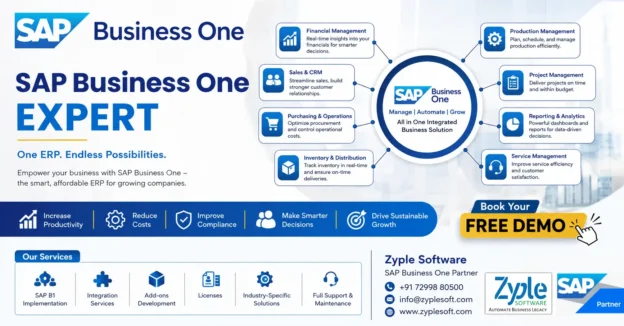
SAP Business One Expert ERP solution infographic by Zyple Software with finance, CRM, inventory, production, analytics and business management features

SAP Business One Expert

SAP Business One Expert for Industries/Businesses
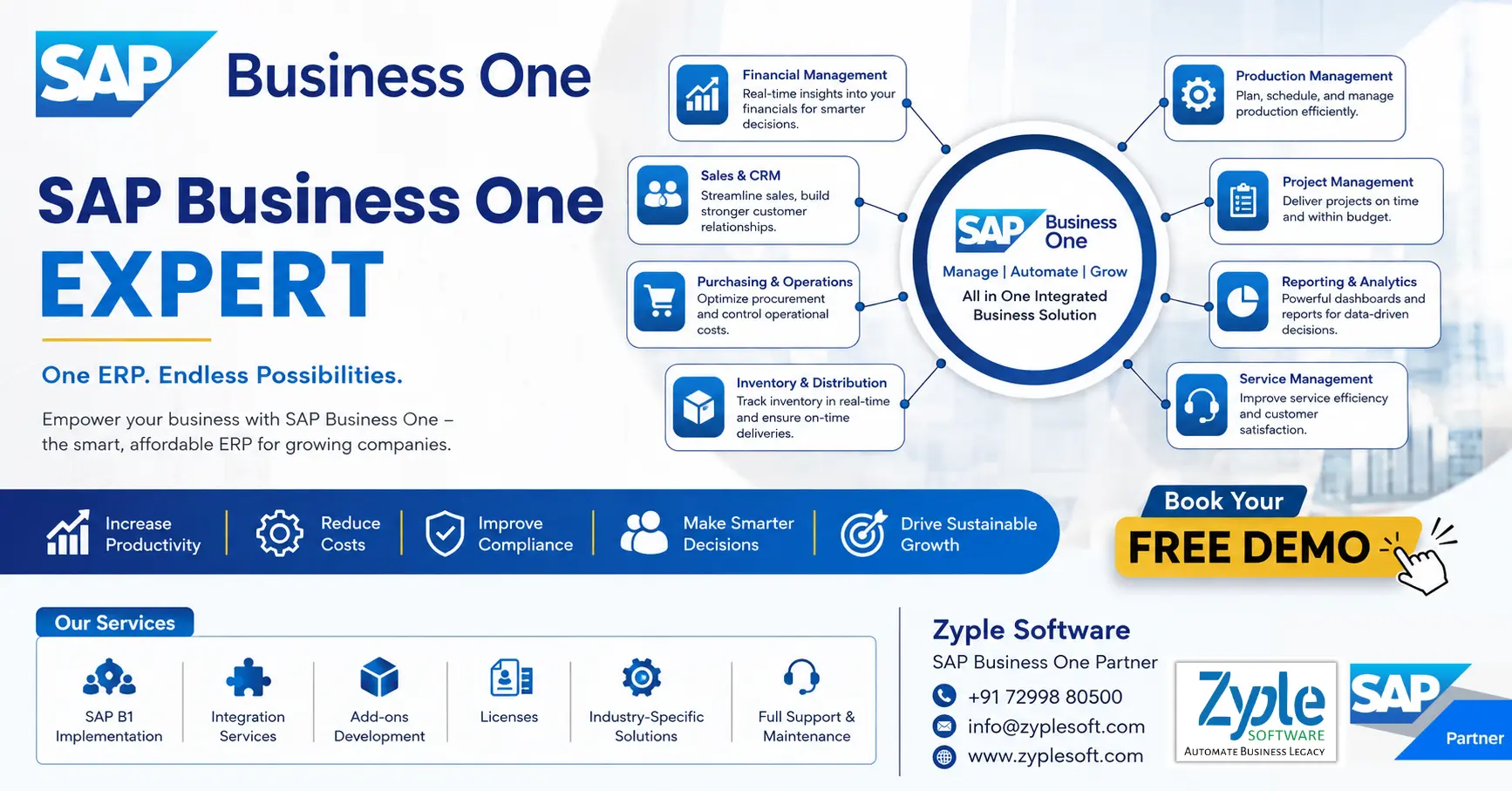
SAP Business One Expert ERP solution infographic by Zyple Software with finance, CRM, inventory, production, analytics and business management features

SAP Business One provides robust ERP capabilities for small and medium-sized businesses seeking facilitated operations. Our specialized experts help you maximize the platform’s potential, delivering customized solutions that align with your unique business requirements and growth objectives. We guide you through implementation, configuration, and optimization to ensure you gain the full benefit of your SAP Business One investment.

We specialize in:

1. System Implementation and Integration

Launching SAP Business One with minimal disruption while connecting to your current business systems.

2. Process Optimization

Facilitating workflows and automating manual tasks to boost operational efficiency.

3. Customization and Development

Creating advanced modules and functionalities that handle your specific business challenges.

4. Data Migration and Management

Securely moving your business data while ensuring accuracy and consistency.

5. Reporting and Analytics

Developing complete dashboards that deliver actionable insights for better decision-making.

6. Technical Support and Training

Delivering ongoing assistance and knowledge to empower your team.

An SAP Business One expert combines technical expertise with industry knowledge to deliver solutions that drive tangible business outcomes. Whether implementing from the beginning, optimizing a current deployment, or improving functionality with custom modules, we ensure your SAP Business One environment completely supports your operational requirements and strategic goals.

Securing the Right SAP Business One Expertise for Your Business

SAP Business One (SAP B1) is a powerful enterprise resource planning (ERP) solution that helps small and medium-sized enterprises (SMEs) facilitate their operations, gain real-time insights, and drive profitable growth. However, increasing the return on your SAP Business One investment relies heavily on having the right technical and functional expertise on board. Whether you’re in the middle of an implementation, planning an upgrade, or require ongoing support, the challenge often lies in identifying and securing qualified professionals. The success of your system depends on the skills of the people who handle, customize, and support it. This is a common obstacle for many organizations looking to fully use their ERP capabilities.

Roles and Responsibilities of an SAP Business One Expert

An SAP B1 expert is responsible for implementing, customizing, supporting, and optimizing the SAP Business One ERP system to meet business needs. Their role spans technical, functional, and strategic responsibilities across the organization.

The roles and responsibilities generally include:

1. Implementation and Deployment

  • Evaluate business requirements and map them to SAP B1 functionalities.
  • Plan and execute end-to-end SAP implementation projects.
  • Configure key modules like finance, sales, purchasing, inventory, CRM, and production.
  • Handle data migration from legacy systems to SAP B1.
  • Ensure seamless system go-live with minimal disruption.

2. Business Process Analysis

  • Study current workflows and identify inefficiencies.
  • Suggest process improvements using SAP B1 capabilities.
  • Organize ERP system with industry-specific best practices.
  • Create functional specifications and documentation.

3. System Configuration and Customization

  • Modify company settings, workflows, and approval procedures.
  • Design forms, fields, dashboards, and reports.
  • Work with SDKs, SAP B1 add-ons, or integrations to expand functionality.
  • Ensure customization aligns with future expansion.

4. Integration Management

  • Integrate SAP B1 with third-party systems such as CRM tools, e-commerce platforms, banking systems, and payroll and HR software.
  • Handle APIs, middleware, and data synchronization.

5. User Training and Support

  • Train end-users across departments.
  • Create user manuals and SOPs.
  • Deliver ongoing technical and functional support.
  • Troubleshoot system issues and resolve tickets quickly.

6. Reporting and Analytics

  • Design and generate business reports using Crystal Reports, SQL queries, and SAP dashboards.
  • Deliver insights for decision-making.
  • Ensure live data visibility across departments.

7. Database and Technical Management

  • Handle databases (like SQL Server or SAP B1 HANA).
  • Evaluate system performance and optimize queries.
  • Ensure data integrity, security, and backups.
  • Oversee upgrades, patches, and version control.

8. Project Management

  • Plan project timelines, budgets, and deliverables.
  • Coordinate with stakeholders, clients, and internal teams.
  • Handle risks and ensure timely project completion.
  • Follow SAP B1 implementation methodologies (like ASAP or Agile).

9. Compliance and Security

  • Ensure the system adheres to financial and legal regulations.
  • Define user roles and authorization controls.
  • Maintain audit trails and reporting compliance.

10. Continuous Improvement and Optimization

  • Find opportunities for automation and efficiency.
  • Suggest and install new SAP B1 features or add-ons.
  • Improve system usage as business scales.
  • Stay updated with the latest SAP releases and trends.

11. Industry-Specific Responsibilities

Depending on the domain, responsibilities may cover:

Manufacturing

Production planning, BOM, and MRP (Material Requirements Planning).

Construction

Project costing and subcontractor management.

Retail

POS integration and inventory tracking.

Pharma

Batch traceability and compliance validation.

12. Client and Stakeholder Communication

  • Act as a bridge between business users and technical teams.
  • Collect feedback and translate it into system improvements.
  • Deliver strategic ERP implementation.

Skills and Expertise of an SAP Business One Expert

An SAP B1 expert specializes in implementing, configuring, and improving the SAP Business One system for small and medium-sized enterprises (SMEs). They combine key functional accounting and supply chain knowledge with technical reporting and project management skills to align software capabilities with company goals.

  • Proficiency in core modules of SAP B1 like financial accounting, banking, fixed assets, sales, purchasing, inventory control, and production.
  • Deep understanding of business processes and localization and compliance.
  • Technical skills like SAP Crystal Reports, SQL, and SAP Business One SDK (Software Development Kit).
  • Strong requirement analysis and project management abilities.
  • Experience in training and support.

Benefits of Hiring an SAP B1 Expert

Hiring an SAP Business One (SAP B1) expert helps your company set up the software right, save money, and prevent costly system errors. They match the tool to your exact daily requirements, clean and move your old data safely, and connect SAP B1 with your other apps like e-commerce or CRM.

1. Proper Setup

They develop workflows that fit how your business actually works.

2. Safe Data Migration

They transfer old records into SAP B1 without losing details using SAP Business One solutions.

3. Custom Add-ons

They develop special tools or reports using the SAP SDK if standard options fall short.

4. System Integration

They connect your ERP with outside platforms like payment gateways or shipping tools.

5. Staff Training

They teach your team how to use the system well so work moves faster.

6. Ongoing Support

They resolve bugs quickly and handle system updates safely in SAP support.

When You Should Hire an SAP B1 Expert

Hiring an SAP Business One (SAP B1) expert is necessary when starting a new system setup, migrating old data, upgrading software versions, or fixing chronic workflow gaps. You also need professional help for custom reports, third-party software connections, and training your team.

1. New Implementation

Develop and configure the software to match your exact business rules.

2. Data Migration

Transfer old spreadsheets and legacy data safely without losing records.

3. System Upgrades

Move to the latest versions without breaking current operations.

4. Custom Reports and Add-Ons

Develop specialized Crystal Reports or custom SQL queries.

5. Software Integration

Connect SAP B1 with e-commerce sites or third-party apps via APIs.

6. Staff Training

Teach your team how to use specific modules properly.

Choosing the Right SAP B1 Expert

Choosing the right SAP Business One (SAP B1) expert is essential for a smooth ERP setup. Look for official SAP Business One partnership tiers, verified industry track records, certified in-house consultants, and robust local or regional compliance knowledge.

1. Industry Experience

Ensure the expert or partner knows your specific sector (such as manufacturing, construction, retail, and pharma) to handle unique workflows and compliance needs.

2. Certifications

Check for formal SAP B1 credentials and certified consultants who understand the latest versions of SAP B1 and SAP B1 HANA.

3. Customization and Integration

Verify their technical ability to modify the system and connect it seamlessly with third-party software like e-commerce platforms or Microsoft 365.

4. Post-Implementation Support

Confirm they deliver ongoing training, troubleshooting helpdesk services, and system updates after your go-live date.

Conclusion of SAP B1 Expert

As a leading SAP Business One partner, Zyple Software is delivering services like SAP B1 implementation, integration, migration, licensing, consulting, add-ons, digital transformation, and support and training to different industries, like construction, manufacturing, solar, food and beverage, aerospace, oil and gas, healthcare, retail, real estate, jewellery, pharma, and textiles. 

SAP Business One is an ERP solution customized for small and medium-sized enterprises that connects finance, production, inventory, material requirements planning (MRP), procurement, sales, CRM, and reporting and analytics into one platform. For food and beverage, pharma, and chemical businesses, it can improve project costing, procurement, subcontractor billing, and inventory management.

If you’re involved, reserve a demo of SAP Business One.

Do you assure the SAP B1 ERP system for your business or industry?

Finish all the details in the quoted contact form; our team will return to you.

    FAQs

    1.How can an SAP Business One Expert improve my business operations?

    An SAP Business One expert helps facilitate your processes by integrating finance, sales, inventory, and operations into one system, improving efficiency and decision-making.

    Yes, SAP Business One is highly flexible and can be customized for industries like construction, manufacturing, retail, and distribution with the help of an expert.

    The cost depends on project scope, customization needs, and implementation complexity. A consultation can deliver a clear estimate based on your business requirements.

    Most businesses start seeing improvements in efficiency, reporting, and cost control within a few months of proper SAP B1 implementation by an SAP B1 expert.

    You can begin with a free consultation to evaluate your business needs, followed by a customized implementation plan tailored to your goals.
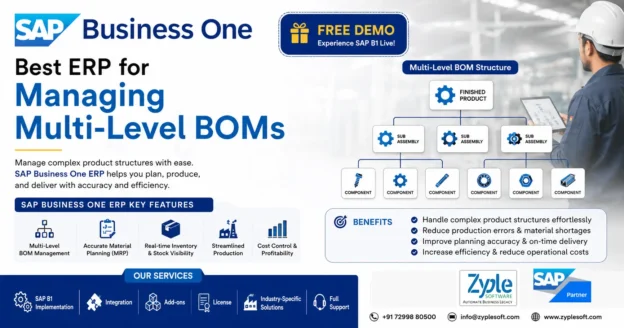
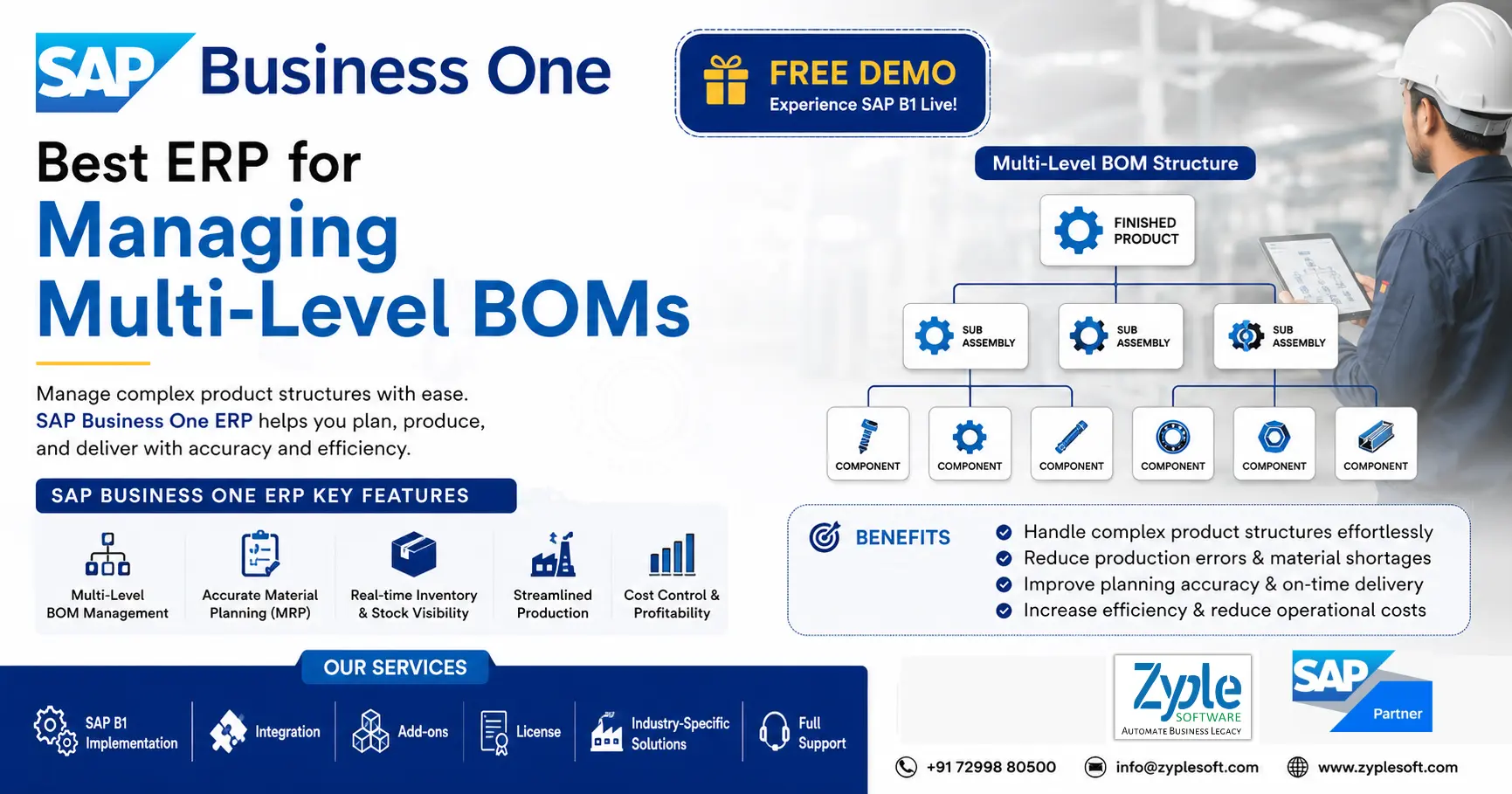
    SAP Business One ERP for Managing Multi-Level BOMs

    Best ERP for Managing Multi-Level BOMs

    Best ERP for Managing Multi-Level BOMs - SAP Business One

    SAP Business One ERP for Managing Multi-Level BOMs

    A bill of materials is crucially the complete recipe for a finished product, including every raw material, sub-component, assembly, and purchased part required to develop it. In a simple manufacturing environment, a single-level BOM may be adequate. But in discrete manufacturing, where products require multiple sub-assemblies, each containing their own components, you are handling a multi-level BOM structure. In this blog, we are going to discuss about the best ERP for managing multi-level BOMs.

    Why Manual BOM Management Always Fails at Scale?

    Manual BOM management tends to work until it doesn’t. The failure is occasionally sudden. It gathers quietly through minor version discrepancies, overlooked change notices, and data entered inconsistently across departments. Here is how the breakdown usually happens:

    1. Version Control Becomes Unmanageable

    When engineering issues a design change, that update needs to flow through procurement, production, costing, and inventory simultaneously. In a manual environment, some teams receive the update late, and some don’t receive it at all. Production ends up running against an obsolete BOM while engineering has already moved to the next revision.

    2. Data Storage Drives Costly Disconnects

    Engineering maintains a single version of the BOM. Procurement operates from a different export. Production uses a printed copy from the previous quarter. Finance uses yet another alternative version for costing. These storages are not theoretical; they are standard operating procedure in companies that have not yet adopted ERP BOM management. Each storage creates a risk of inconsistency, and inconsistency at the BOM level translates directly into production errors.

    3. Change Management is Reactive, Not Proactive

    Engineering change orders in manual systems are frequently communicated through email chains or shared documents. There is no automated propogation, no impact analysis, and no system-imposed approval workflow. Teams identify changes after the fact, sometimes after materials have already been ordered or components machined to the wrong specification.

    SAP Business One As Best ERP For Managing Multi-Level BOMs

    SAP Business One (SAP B1) handles multi-level bills of materials (BOMs) efficiently by embedding sub-assemblies within a parent production BOM. It connects structural layers to real-time inventory, accurate material requirements planning (MRP), and integrated shop-floor routing, making it an ideal ERP for small and medium-sized manufacturing enterprises.

    How SAP Business One ERP Solves Multi-Level BOM Complexity

    The SAP Business One system does not simply digitize your current BOM spreadsheets. It primarily changes how BOM data is created, maintained, and consumed across your organization.

    1. A Single, Centralized BOM Repository

    Every department, like engineering, procurement, production, and finance, works from the same BOM. There is one version of SAP B1, always current, accessible in real-time. When a change is approved, it generates automatically for every function that depends on that data. This is the cornerstone of accurate SAP B1 ERP BOM management.

    2. Multi-Level BOM Expansion and Breakdown

    Modern ERP systems like SAP B1 support complete multi-level BOM expansion, the ability to trace a finished product down through every sub-assembly and component, and calculating total material requirements at every level. They also support breakdown, identifying where a specific component is used across all products. This is essential for manufacturing resource planning, specifically when a common component is shared across multiple product lines and a shortage needs to be evaluated for impact.

    3. Automated Engineering Change Management

    When an engineering change is initiated, the SAP B1 ERP system imposes a structured workflow, like approval routing, impact evaluation, effective dating, and automatic update of all impacted BOMs. There are no more email chains and version confusions. The SAP software ensures every stakeholder is notified and every downstream document is updated.

    4. Real-Time Integration with Production and Inventory

    SAP Business One ERP for production planning connects BOM data directly to work orders, material requirements planning (MRP), and inventory transactions. When a production order is released, the system automatically tracks current inventory against BOM requirements, creates material requisitions for shortfalls, and schedules production based on component availability. This integration eliminates the lag between planning and execution that is indigenous in manual environments.

    5. Accurate Costing At Every Level

    Because the SAP B1 ERP maintains accurate BOMs with current component costs, standard costing and actual costing both reveal reality. Operations heads and finance teams can see product margins with confidence, allowing better pricing decisions and more effective cost control.

    How Zyple Software Helps Manufacturers Take Control of BOM Complexity?

    Zyple Software specializes in the SAP implementation process for manufacturing businesses, from initial assessment and system design to go-live and post-implementation support. The company brings deep expertise in SAP B1 ERP for discrete manufacturing, having worked with production-intensive organizations across industries, including industrial equipment, engineered components, and process-adjacent manufacturing.

    1. BOM Configuration

    Zyple Software works directly with your engineering and operations teams to map current BOM structures into the ERP, clean historical data, and establish governance standards that prevent data quality issues from recurring. This is challenging work, but it is foundational, and doing it correctly from the start defines the success of every downstream function.

    2. Manufacturing Process Automation

    Beyond BOM management, Zyple Software modifies manufacturing process automation across work order management, capacity planning, quality control, and inventory tracking. The goal is a connected operation where every process from order receipt to shipment runs on accurate, live data.

    3. Continuous Support and Optimization

    Manufacturing businesses evolve as products change, volumes scale, and new product lines are added. Zyple Software delivers continuous support to ensure your ERP continues to reflect your actual operations and proactively suggests improvements as your business grows.

    Benefits of Using SAP Business One for Managing Multi-Level BOMs

    The ERP software, SAP Business One, handles multi-level Bills of Materials (BOMs) by creating a clear, nested hierarchy of parent items, sub-assemblies, and raw materials. This structure facilitates production planning, automates material requirements, rolls up exact product costs, and tracks inventory across every single tier of assembly.

    1. Accurate Material Requirements Planning (MRP)

    The system looks at multi-level dependencies to calculate exact raw material needs and sub-assembly counts based on current demand using SAP solutions.

    2. Sub-Assembly Stock Tracking

    You can evaluate work-in-progress (WIP) and semi-finished goods independently as they move through various production stages.

    3. Precise Cost Roll-Ups

    Costs automatically aggregate from raw materials up through sub-assemblies to define the true standard cost of the final product.

    4. Step-by-Step Routing Control

    You can group line items by stages and map distinct machine and labor requirements to specific assembly tiers using SAP Business One add-ons.

    5. Mass Updates

    You can add, remove, or change component lines across different dependent BOM structures at the same time.

    6. Integrated Financials

    Every stock issue, receipt, and production step automatically connects to the general ledger for real-time margin tracking.

    7. Reduced Obstacles

    Clear visibility into lower-level component availability avoids unexpected production delays on the main assembly line.

    Conclusion of SAP Business One for Handling Multi-Level BOMs

    As a trusted SAP Business One partner, Zyple Software is delivering services like SAP B1 implementation, integration, migration, licensing, add-ons, digital transformation, and support to different industries, like construction, manufacturing, solar, food and beverage, aerospace, healthcare, retail,  jewellery, pharma, and textiles. 

    SAP Business One is an ERP software customized for small and medium-sized enterprises that connects finance, production, inventory, procurement, sales, CRM, and reporting into one platform. For manufacturing businesses, it can improve project costing, procurement, subcontractor billing, and inventory management.

    If you’re available, register a demo of SAP Business One.

    Do you insist on the SAP B1 ERP software for your business or industry?

    Finish all the details in the classified contact form; our team will get back to you.

      FAQs

      1.How does SAP Business One handle multi-level Bills of Materials (BOMs)?

      SAP Business One efficiently handles multi-level BOMs by allowing businesses to define complex product structures with multiple sub-assemblies and components. It delivers complete visibility into each level of production, ensuring accurate planning, costing, and material requirements across all stages.

      Yes, SAP Business One supports version control and engineering change management for BOMs. This enables manufacturers to update components, revise structures, and maintain historical records without disrupting ongoing production processes.

      With consolidated MRP (Material Requirements Planning), SAP Business One automatically calculates demand for raw materials and sub-assemblies across all BOM levels. This helps minimize shortages, avoid overstocking, and ensures smooth production workflows.

      Absolutely. SAP Business One is widely used in industries like construction, automotive, electronics, machinery, and industrial manufacturing where multi-level BOMs are necessary. It ensures precise control over production, costing, and inventory at every level.

      Using SAP Business One for multi-level BOMs offers benefits such as improved production accuracy, real-time inventory tracking, minimized operational costs, better decision-making, and seamless integration with finance, procurement, and sales modules.

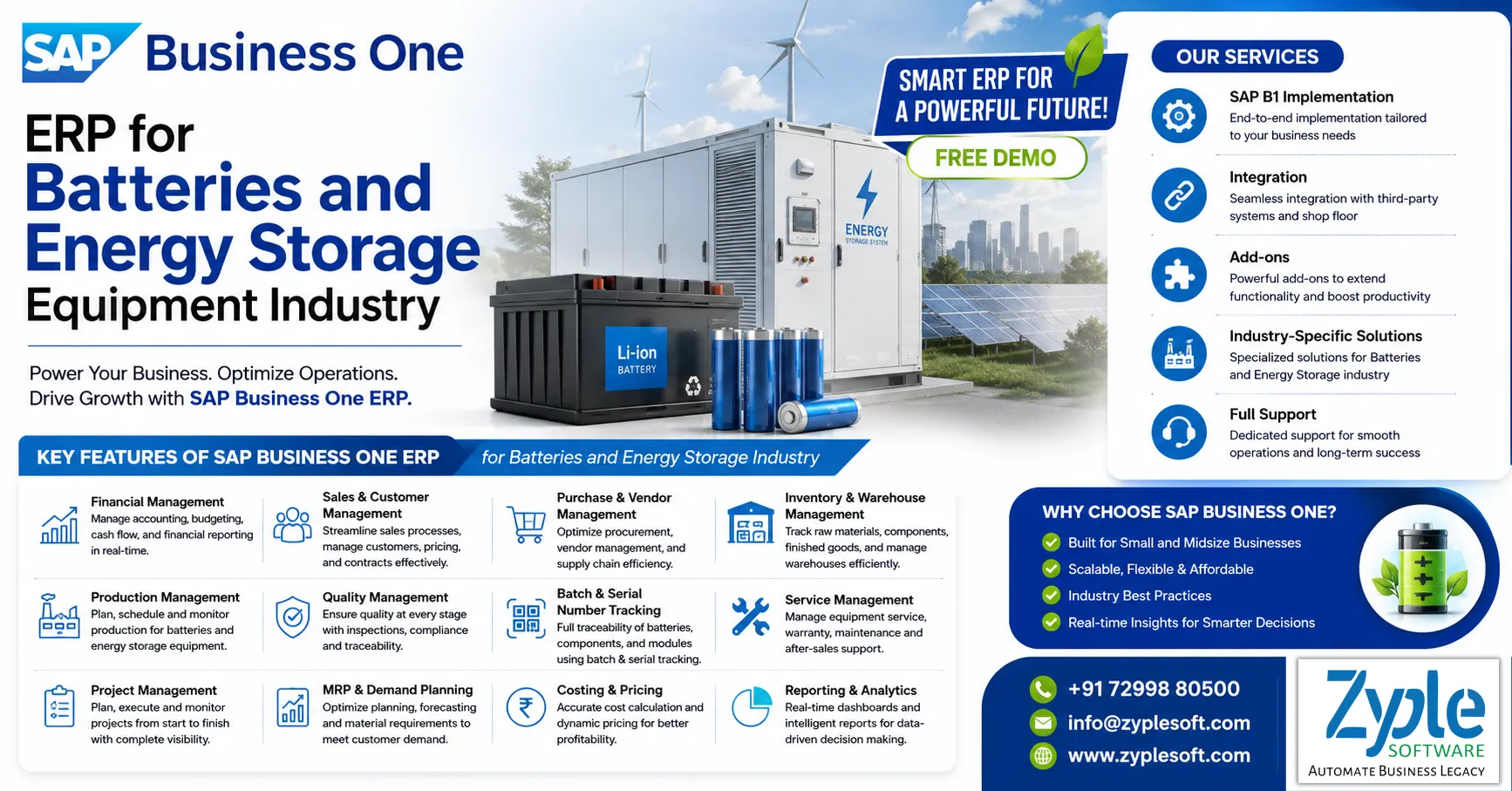
      SAP Business One ERP for Batteries and Energy Storage Equipment Industry by Zyple Software

      SAP Business One ERP for Batteries and Energy Storage Equipment Industry

      SAP Business One (B1) ERP for Batteries and Energy Storage Equipment Industry

      SAP Business One ERP for Batteries and Energy Storage Equipment Industry by Zyple Software

      The batteries and energy storage equipment industry operates in a precision-driven and compliance-heavy environment. Even small gaps in production data or inventory tracking can lead to serious consequences like failed audits, delayed shipments, or costly rework. SAP Business One ERP for batteries and energy storage equipment unifies financials, multi-level bills of materials (BOMS), and supply chains into a single platform to accelerate production, track inventory, and maintain global safety compliance.

      Challenges Faced By The Batteries and Energy Storage Equipment Industry

      The battery and energy storage equipment industry faces significant challenges, including volatile raw material costs, supply chain vulnerabilities, and strict safety concerns. Furthermore, rapid technological degradation, regulatory uncertainities, and complex end-of-life recycling requirements continue to challenge large-scale global deployment.

      1. Supply Chain Constraints and Material Sourcing

      The industry depends heavily on essential materials like lithium, cobalt, nickel, and graphite. Geopolitical concentrations in mining and refining expose manufacturers to price volatility and supply disruptions.

      2. Safety and Thermal Runaway

      Large-scale battery and energy storage equipment systems present significant fire risks and thermal runaway, leading to insurance and zoning challenges. For instance, municipalities globally have occasionally installed moratoriums on lithium-ion facilities due to combustion and pollution.

      3. Degradation and Lifespan

      Batteries experience capacity fading and degradation over charge-discharge cycles. This demands frequent replacements and complex cell-balancing capabilities to ensure optimal pack performance over a 10-to-15-year operational span.

      4. High Capital Costs and ROI Uncertainty

      Despite falling cell prices, total auxiliary integration, engineering, and setup costs remain high. Investors face uncertainties regarding long-term profitability, specifically when participating in fluctuating energy arbitrage markets.

      5. End-of-Life and Recycling

      Handling discarded equipment is an escalating environmental issue. Recycling infrastructure for large utility-scale batteries becomes less potent, and improper disposal can lead to toxic chemical and heavy metal soil contamination.

      6. Regulatory and Standard Gaps

      A lack of uniform international codes, standardization across different chemistries, and clear grid-interconnection rules complicate smooth integration.

      Features of SAP B1 ERP for Batteries and Energy Storage Equipment Business

      1. Production and Manufacturing Management

      • It includes multi-level bills of materials (BOM) for cells, modules, BMS, casing, and chemicals.
      • It includes production orders and shop floor control for battery assembly and pack building.
      • It includes material requirements planning (MRP) for raw materials like lithium, cobalt, and electrolytes.
      • Batch production and formula management are essential for chemical mixing processes.
      • It includes WIP (Work-in-Progress) tracking for multi-stage battery production.
      • Yield, scrap, and rework management are essential for defect control.
      • It includes capacity and resource planning for machines, labor, and production lines.
      • Production costing, like standard vs. actual with real-time recalculation.
      • It ensures efficient control over complex, multi-stage battery manufacturing.

      2. Inventory and Warehouse Management

      • It includes real-time tracking of raw materials, semi-finished, and finished goods.
      • Batch and serial number tracking for traceability is essential for batteries.
      • It includes multi-warehouse and bin location management.
      • It includes expiry and shelf-life tracking for chemicals and cells.
      • Stock valuation methods like FIFO, moving average, and standard costing.
      • It includes automated stock movements during production and dispatch.
      • It includes barcode and QR integration for warehouse operations.
      • Important for safety, compliance, and traceability in battery manufacturing.

      3. Quality Control and Compliance Management

      • It includes incoming, in-process, and final quality inspections.
      • It includes test result recording for voltage, capacity, and thermal stability.
      • Quality certificates and compliance documentation like ISO, BIS, and IEC.
      • It includes non-conformance and corrective action tracking.
      • It includes audit trails for regulatory compliance.
      • Helps achieve strict safety and environmental regulations.

      4. Procurement and Supplier Management

      • Vendor management for raw materials like lithium, nickel, separators, and more.
      • It includes purchase planning based on MRP recommendations.
      • It includes supplier price lists and contract management.
      • It includes automated purchase orders and approvals.
      • It includes import or export documentation handling.
      • It includes supplier performance tracking.
      • It includes stable sourcing in a volatile raw material market.

      5. Sales, Distribution, and Customer Management

      • End-to-end sales cycle from quotation, order, and delivery to invoice.
      • OEM and B2B customer management for EV manufacturers, utilities, and more.
      • After-sales service and warranty tracking are essential for batteries.
      • It includes pricing management for bulk and contract sales.
      • It includes demand forecasting for energy storage projects.
      • CRM for handling long-term contracts and projects.
      • It supports both industrial and project-based sales models.

      6. Financial Management and Cost Control

      • It includes general ledger, AP/AR, and banking integration.
      • It includes project-based costing for energy storage installations.
      • It includes budgeting and cost center tracking.
      • Profitability per analysis per product, like battery type and capacity.
      • It includes multi-currency support for global trade.
      • Taxation and compliance like GST and international regulations.
      • Helps handle thin margins and volatile input costs.

      7. Advanced Analytics and Business Intelligence (BI)

      • It includes real-time dashboards for production, inventory, and sales.
      • KPI tracking like yield, efficiency, defect rate, and cost per unit.
      • It includes predictive analytics for demand and procurement.
      • It includes custom reports and drill-down analysis.
      • It includes Excel integration for advanced reporting.
      • Allows data-driven decision-making across operations.

      8. Asset and Equipment Management

      • It includes maintenance tracking for machinery and equipment.
      • It includes downtime monitoring and preventive maintenance.
      • It includes asset lifecycle management.
      • It includes calibration tracking for testing equipment.
      • Crucial for high-value battery production equipment.

      9. Project Management

      • It includes project planning for solar and storage or grid-scale deployments.
      • It includes cost tracking per project.
      • It includes resource allocation and scheduling.
      • It includes milestone tracking and billing.
      • Suitable for EPC companies and large-scale storage deployments.

      10. Integration, Mobility, and Scalability

      • It includes web client for remote access.
      • It includes integration with IoT, BMS, and external systems.
      • It includes cloud or on-premises deployment.
      • It includes scalable architecture for a growing battery business.

      Benefits of SAP Business One ERP for Batteries and Energy Storage Equipment Industry

      The ERP software, SAP Business One (SAP B1) system, provides immense value to the battery and energy storage equipment industry by uniting engineering, procurement, production, and financials into one platform. It drives operational efficiency, improves complex supply chains, and ensures strict regulatory compliance and safety standards.

      1. End-to-End Traceability

      In the batteries and energy storage equipment industry, tracing individual components, chemical batches, and serial numbers is essential for safety and warranty management. SAP implementation tracks materials from supplier to customer, ensuring compliance and easy management of RMAs and recalls.

      2. Intelligent Production and MRP

      Material requirements planning (MRP) ensures you have the exact raw materials, like lithium, cell components, and inverters, required to meet production schedules without overstocking. This reduces idle time and optimizes the production ratio.

      3. Real-Time Project and Job Costing

      Engineering-to-order (ETO) companies can accurately estimate, track, and review profit margins. It delivers live visibility into labor, material overheads, and assembly costs, protecting profitability across large-scale energy projects using SAP solutions.

      4. Stringent Quality Control

      The system enables manufacturers to build incoming, in-process, and final quality checks directly into the routing operations. It documents testing procedures and blocks the movement or sale of non-compliant battery units.

      5. Lifecycle and Service Management

      The batteries and energy storage equipment industry involves ongoing evaluation. The SAP B1 system enables companies to track installed equipment, schedule preventive maintenance, and handle warranty lifecycles, minimizing downtime and reducing total cost of ownership.

      Conclusion of Batteries and Energy Storage Equipment ERP

      As an SAP Business One partner, Zyple Software is providing services like SAP B1 implementation, integration, licensing, add-ons, and support to different industries like construction, manufacturing, retail, pharma, aerospace, solar, jewellery, food and beverage, and textile industries. SAP Business One is an ERP designed for small and medium-sized businesses that integrates finance, purchasing, sales, inventory, production, CRM, and reporting into a single platform. For batteries and energy storage equipment or any other companies, it can improve project costing, procurement, subcontractor billing, and inventory management.

      If you’re flexible, book a demo of SAP B1 ERP with Zyple Software team.

      Do you demand the SAP B1 ERP software for your business or industry?

      Finish all the details in the defined contact form; our team will get back to you.

        Frequently Asked Questions

        1.How can SAP Business One improve efficiency in my battery manufacturing business?

        SAP Business One automates key processes like production planning, inventory management, and financial reporting. This reduces manual work, decreases errors, and improves overall operational efficiency, helping your business scale faster.

        Yes, SAP Business One is specifically customized for SMEs. It provides scalable features that grow with your business, making it ideal for startups and expanding battery and energy storage companies.

        Businesses generally see ROI through minimized operational costs, better inventory control, improved production efficiency, and faster decision-making with real-time insights.

        Yes, you can request a personalized demo customized for your manufacturing processes, helping you understand how the ERP fits your specific operational needs.

        You can begin by consulting a certified partner of SAP Business One like Zyple Software, who will evaluate your requirements, suggest the right solution, and guide you through implementation, training, and support.

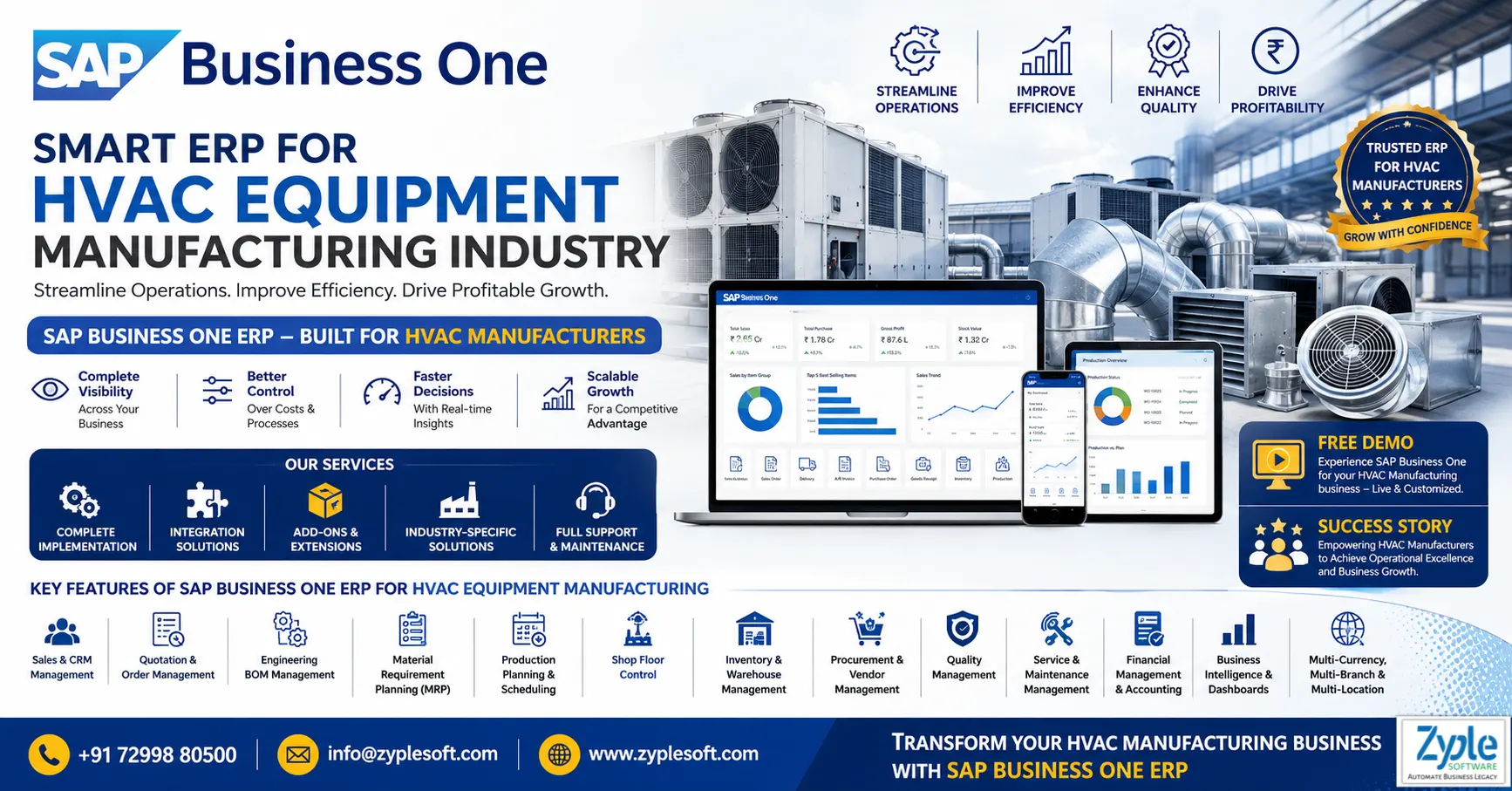
        SAP Business One ERP for HVAC Equipment Manufacturing

        SAP Business One for HVAC Equipment Manufacturing Industry

        SAP Business One ERP for HVAC Equipment Manufacturing Industry

        SAP Business One ERP for HVAC Equipment Manufacturing

        The HVAC(Heating, Ventilation, and Air Conditioning) equipment manufacturing industry is one of the most versatile industries around the world, which undergoes continuous development. With the new players in this competitive industry, the HVAC equipment manufacturing industry requires innovative software solutions to handle and integrate every business process efficiently. SAP Business One ERP for HVAC equipment manufacturing handles every aspect of the HVAC equipment manufacturing industry from any part of the world.

        Challenges Faced By The HVAC Equipment Manufacturing Industry

        The HVAC equipment manufacturing industry faces significant challenges, including rising raw material costs, shifting environmental mandates like stringent energy efficiency standards, and a severe shortage of skilled labor. Also, manufacturers must heavily invest in R&D to integrate complex IoT and AI technologies while navigating global supply chain disruptions.

        1. Strict Regulatory and Environmental Compliance

        Manufacturers are forced to adjust to rapid changes in global environmental policies. The mandatory phase-down of high global warming potential (GWP) refrigerants (like older HFCs) to new A2L-classified refrigerants involves redesigning entire product lines and retooling factories to achieve updated safety and efficiency standards.

        2. Volatile Material Costs

        Unpredictable fluctuations in the cost of raw materials, specifically copper, steel, and aluminium, heavily compress profit margins.

        3. Labor Shortage and Talent Gap

        As experienced technicians and engineers retire, the industry suffers loss of institutional knowledge. Building and producing modern, highly advanced HVAC equipment requires specialized skills that the current labor pool often lacks.

        4. Technological Integration (IoT and AI)

        There is immense pressure to transition from traditional heating and cooling equipment to smart, connected HVAC-R (Heating, Ventilation, Air Conditioning, and Refrigeration) systems. This requires large investments in advanced electronics, software development, predictive maintenance capabilities, and handling cybersecurity for connected devices.

        5. Supply Chain Disruption

        Over-dependence on a complex global network for specialized components, such as microchips and compressors leaves manufacturers vulnerable to shipping delays and manufacturing obstacles.

        Features of SAP Business One ERP for HVAC Equipment Manufacturing

        1. Production Planning and Control

        • Multi-level bill of materials (BOM) for HVAC units like compressors, coils, fans, and ducts.
        • It includes production orders with routing and stage-wise tracking.
        • It includes make-to-order (MTO) and make-to-stock (MTS) support.
        • It includes capacity planning for fabrication, assembly, and testing.
        • It includes real-time production status and work-in-progress (WIP) monitoring.

        2. Inventory and Warehouse Management

        • It includes batch and serial number tracking for compressors, motors, and control units.
        • It includes multi-warehouse and bin location management.
        • It includes inventory valuation methods like FIFO and moving average.
        • It includes automated stock replenishment and MRP.
        • It includes spare parts inventory control for after-sales service.

        3. Procurement and Vendor Management

        • It includes vendor quotation comparison and selection.
        • It includes purchase order automation.
        • Supplier performance tracking like quality and delivery timelines.
        • It includes raw material procurement for coils, sheet metal, and insulation materials.
        • It includes subcontracting management for outsourced fabrication.

        4. Sales and Distribution Management

        • Quotation management for HVAC projects like commercial and residential.
        • It includes sales order processing with pricing, discounts, and taxes.
        • It includes dealer and distributor management.
        • It includes integration with CRM for lead-to-order conversion.
        • It includes delivery scheduling and logistics tracking.

        5. Service and Maintenance Management

        • It includes installation and commissioning tracking.
        • Preventive maintenance scheduling like AMC contractors.
        • It includes service call management and technician assignment.
        • It includes warranty and service history tracking.
        • It includes spare parts consumption during service operations.

        6. Financial Management

        • It includes general ledger, accounts payable, and accounts receivable.
        • It includes cost accounting for HVAC accounts and projects.
        • It includes budgeting and financial forecasting.
        • It includes profitability analysis by product line or project.
        • It includes multi-currency and multi-tax compliance.

        7. Quality Control and Compliance

        • It includes incoming, in-process, and final quality inspections.
        • It includes non-conformance and corrective action tracking.
        • It includes compliance with ISO and HVAC industry standards.
        • Testing data recording like cooling efficiency, airflow, and more.
        • It includes audit trail and documentation management.

        8. Reporting and Analytics

        • It includes custom MIS reports for decision-making.
        • KPI tracking like production efficiency and server response timing.
        • It includes predictive insights using historical data.
        • It includes integration with analytics tools like Power BI.

        9. Integration and Scalability

        • It includes integration with CAD, IoT-enabled HVAC systems, and third-party apps.
        • It includes API-based connectivity for e-commerce and mobile apps.
        • It includes cloud and on-premise deployment options.
        • It includes scalability for multi-plant operations.

        Importance of SAP Business One ERP for HVAC Equipment Manufacturing

        The ERP software, SAP Business One (SAP B1) system, is important for the HVAC manufacturing industry because it unifies complex production, supply chain, and field service operations into a single system. It eliminates information storage, helping businesses optimize component inventory, facilitate engineer-to-order (ETO) workflows, and ensure compliance with strict industry regulations.

        1. Complex Bill of Materials (BOM) Management

        HVAC systems feature complex assemblies like compressors, coils, motors, and more. SAP Business One connects design and engineering with production, handling multi-level BOMs accurately.

        2. Material Requirements Planning (MRP)

        Automatically calculates exactly what raw materials and parts are required, factoring in lead times to prevent production delays or costly overstocking.

        3. Inventory Control and Serial Tracking

        Delivers real-time visibility into stock levels using SAP implementation. It handles batch and serial numbers to trace individual components, which is essential for warranty tracking and compliance.

        4. Shop Floor Control

        Manages production schedules and work orders. This helps in eliminating obstacles and ensures the efficient use of both labor and machine resources.

        5. Field Service and Warranty Oversight

        Seamlessly integrates the manufacturing floor with post-sale service operations, handling contract renewals, field service calls, and service-level agreements (SLAs).

        Benefits of SAP Business One for HVAC Equipment Manufacturing

        SAP Business One centralizes operations for HVAC equipment manufacturers, connecting sales, inventory, and financials. It minimizes material waste and speeds up delivery times by facilitating supply chains and automating workflows. The platform also simplifies compliance with industry regulations and improves equipment bills of materials (BOMs).

        1. Accurate BOM Management

        Manages complex HVAC assemblies and sub-assemblies so you can track the raw materials like copper, steel, and refrigerants required for custom and standard units using SAP solutions.

        2. Improved Material Requirements Planning (MRP)

        Automatically calculates purchasing and production needs based on historical sales and active orders, avoiding stockouts and over-purchasing.

        3. Integrated Quality Control (QC)

        Tracks component defects and ensures manufacturing units achieve environmental, energy efficiency, and regulatory standards.

        4. Supply Chain Synchronization

        Integrates procurement with sales orders, enabling you to quickly check vendor lead times and track shipping costs.

        5. Project and Cost Tracking

        The SAP software estimates costs more accurately and monitors work-in-progress (WIP) in real-time to protect your margins on large commercial projects.

        6. Mobile Field Integration

        Enables field technicians and sales teams to access inventory data, handle service calls, and process orders on the go.

        Conclusion of HVAC Equipment Manufacturing ERP

        Zyple Software is a certified SAP Business One partner in India specializing in implementation, digital transformation, licensing, integration, add-on solutions, migration, and consulting for the pumps and valves manufacturing industry. SAP Business One ERP can be useful in several aspects of manufacturing, which include physical accounting, warehouse management of products, scheduling, location, management, warehousing, and various aspects.

        If you’re flexible, schedule a demo of SAP Business One.

        Do you order the SAP Business One ERP solution for your business or industry?

        Complete all the details in the described contact form; our team will reach out to you.

          FAQs

          1.How can SAP Business One ERP improve efficiency in HVAC manufacturing?

          SAP Business One facilitates key operations like production, inventory, procurement, and finance into a single platform. HVAC manufacturers can minimize manual work, eliminate errors, and gain real-time visibility, helping improve overall operational efficiency and faster decision-making.

          Yes, SAP Business One can be customized to meet the specific needs of HVAC manufacturing, including complex BOMs, project-based manufacturing, and service management.

          Most HVAC manufacturers experience improved productivity, minimized inventory costs, and better resource utilization. This leads to faster ROI through cost savings, improved efficiency, and increased customer satisfaction.

          The SAP B1 implementation timelines vary based on business complexity, but with an experienced partner, HVAC manufacturers can typically go live within a few weeks to a few months, ensuring minimal disruption to operations.

          You can request a personalized demo from an authorized SAP B1 partner like Zyple Software to see how SAP Business One fits your HVAC operations. A demo helps you understand features, workflows, and benefits particular to your business before making a decision.

          SAP Business One ERP Transforms Manufacturing Operations

          SAP Business One ERP Transforms Manufacturing Operations

          How SAP Business One ERP Transforms Manufacturing Operations

          SAP Business One ERP Transforms Manufacturing Operations

          What if an important production line stops because a minor component is out of stock? Statistics reveal that a significant percentage of manufacturers face such problems due to inventory inaccuracies. It leads to a loss in revenue because of production delays. SAP Business One for manufacturing has emerged as a robust solution to these challenges.

          As the manufacturing industry is succeeding at a rapid pace, manufacturers need advanced business management solutions. As a powerful and reliable manufacturing ERP, SAP Business One can provide a unified platform to overcome production hurdles and improve inventory accuracy. It is also useful for getting real-time visibility across various operations.

          In this post, we will dig deep into the challenges of the manufacturing sector and how SAP Business One can support manufacturers in overcoming them.

          What are the challenges of the manufacturing sector?

          Manufacturing is a complex sector with moderate regulations and high competition. It poses various challenges to manufacturers, including:

          1. Complexities in Bills of Materials

          This is one of the most crucial challenges for manufacturers. Manufacturers find it complex to manage Bills of Materials and routing due to numerous components involved. It is always a challenge to maintain accuracy across BOMs and ensure compliance with predefined routes.

          2. Production Planning Hurdles

          Production planning and scheduling pose a hurdle in the cycle if not handled correctly. Manufacturers might struggle to understand resource improvement and production capacity management. Lack of proper planning can hamper operations and cause unwanted delays.

          3. Inventory Management Issues

          Managing inventory is a consistent issue for manufacturers. It demands maintaining a subtle balance between different factors like raw materials, work in progress, and finished goods. Issues in inventory management can result in incurring holding costs or risking stoppages.

          4. Lack of Consistency in Quality Control

          Ensuring consistency in quality control at every stage of the manufacturing lifecycle is crucial. However, it needs robust tools and techniques to monitor standards at different stages. Manufacturing companies need to maintain consistency and handle any deviations proactively.

          5. Supply Chain Management Issues

          The manufacturing sector needs powerful and consistent supply chains. However, complexities like a lack of coordination with multiple suppliers and issues in handling lead times can create hurdles. When manufacturers rely on external partners, these issues can significantly disrupt their operations.

          6. Ineffective Cost Control

          Accurate monitoring of all manufacturing expenses, from raw materials to overhead, is essential to understand profitability. Inefficient monitoring of these expenses can make cost control ineffective, and manufacturers may struggle to minimize operational costs.

          Other challenges of the manufacturing sector are a lack of real-time visibility and accurate reporting. It makes it difficult to gain insights into KPIs on time and make better decisions. Let’s understand the role of SAP Business One for manufacturing and how it overcomes these challenges.

          Capabilities of SAP Business One for Manufacturing Sector Challenges

          SAP Business One has advanced features with seamless functionality to support the manufacturing sector in different ways. Here are some reasons SAP B1 is suitable ERP software for the manufacturing sector:

          1. Handles BOM and Routing Complexity

          Powerful inbuilt tools in SAP Business One can manage the complexities of BOMs and production routing. It has multi-level BOM functionality to define complex structures with different tiers of sub-assemblies and components.

          Furthermore, visual production routing functionality allows manufacturers to define and visualize the sequence of operations. The version control feature is useful to manage different versions of BOMs and routings.

          2. Facilitated Production Planning and Scheduling

          SAP Business One has a suite of features for improving production planning and scheduling. One of the key components is Material Requirements Planning (MRP), which calculates the material requirements automatically.

          Capacity planning is beneficial for defining the capacity of various work centers, including machines and assembly lines.

          3. Provides Work Order Management

          Work Order Management is a central place to manage all aspects of a specific production order. In SAP Business One, this feature saves the details about the items to be produced, quantities, due dates, and the BOM.

          Moreover, it has routing information and allocated resources with the real-time status of the order. Work orders can act as a central control document for the entire production process.

          4. Improves Inventory Management

          This is one of the biggest business advantages of SAP Business One for manufacturing industry. This tool provides inclusive features for managing inventory across the entire supply chain. Real-time inventory tracking can provide an up-to-the-minute view of inventory levels across all locations using SAP solutions.

          Other related features like serial & batch number management and warehouse management can help manufacturers manage different warehouses efficiently.

          5. Ensures Quality Control

          With SAP Business One, manufacturers can guarantee quality control throughout the production cycle. A dedicated quality control feature can define the specific tests and checks for different stages of production.

          Furthermore, SAP Business One has integration capabilities with external quality management systems. These capabilities allow manufacturing companies to get a seamless flow of quality-related data.

          6. Improves Supply Chain Management

          Manufacturers can address the challenges related to supply chain management with the help of SAP B1 tools to streamline interactions. Purchase order management and vendor master data are useful for managing relationships.

          Furthermore, the SRM (Supplier Relationship Management) feature helps manufacturers manage and improve their relations with key suppliers. This feature can monitor supplier performance and manage communication.

          7. Increases Cost Control

          Robust features for tracking and analyzing manufacturing costs can save money and track production costs at every stage. The labor costs module is capable of consolidating with time and attendance systems.

          Moreover, ‘Overhead Allocation’ functionality is beneficial in distributing indirect costs to specific products or cost centers. Manufacturers can know a more accurate picture of the total cost of each item using this functionality.

          Apart from these capabilities, SAP Business One offers a wide range of reporting to get standard and customized reports on different operations. This can boost visibility in various departments. A trusted and official SAP Partner can mention other benefits of SAP Business One for manufacturing industry.

          Success Stories of SAP Business One for Manufacturing

          SAP Business One can bring transformative changes in manufacturing operations. As a reliable manufacturing ERP, it can help small and medium-sized companies handle the process on a single platform. Here are the real-world examples of SAP implementation in the manufacturing sector.

          • A medium-sized automotive component supplier company was struggling with dispersed systems for managing inventory and sales orders. The company faced frequent delays in production due to material shortages, inaccuracies in inventory, and supply chain issues.

          Implementation of SAP B1 allowed the company to gain a turnaround with facilitated processes and complete control over inventory.

          • A small-scale healthcare device manufacturer had issues with production planning and scheduling. This led to missed deadlines with increased operational costs.

          The healthcare device manufacturing company implemented SAP B1 and utilized its MRP functionality to automate material planning. It also helped the company improve supplier relations and minimize costs.

          Both these ‘before and after’ scenarios outline the importance of SAP Business One in the manufacturing sector. As a unified platform, SAP B1 provides real-time insights, facilitates workflows, and improves management of inventory and supply chains. This results in greater productivity over the period.

          Role of Zyple Software in Getting Benefits of SAP Business One

          As a trusted and official SAP Business One Partner, we provide manufacturers a customized and user-friendly SAP B1 solution. We, at Zyple Software, assist manufacturing companies to facilitate their operations and minimize associated costs. Our expert SAP professionals research thoroughly on business objectives and market trends before developing a designed solution.

          As a leading ERP solutions provider in India and the UAE, we offer our global clientele high-end SAP Business One solutions that can offer real-time insights into all the operations for making data-driven decisions. We have achieved a milestone of over 50+ successful implementations of SAP Business One to date. Our decades of IT experience and cutting-edge tools can support companies using the benefits of SAP B1 for the manufacturing industry.

          Conclusion of SAP Business One for Manufacturing Operations in 2026

          The manufacturing sector is challenging and full of opportunities at the same time. It is better to use an advanced manufacturing ERP like SAP Business One to overcome these challenges and get a competitive edge. Manufacturers need to find the suitable ERP solution provider to gain the advantage of SAP Business One for the manufacturing industry.

          Read more: https://www.zyplesoft.com/discrete-manufacturing/