Tag Archives: SAP Business One Consulting

SAP Business One ERP for FMCG Industry by Zyple Software featuring inventory management, batch tracking, warehouse management, sales, distribution, production planning, and Free Demo.

SAP Business One ERP for FMCG Industry
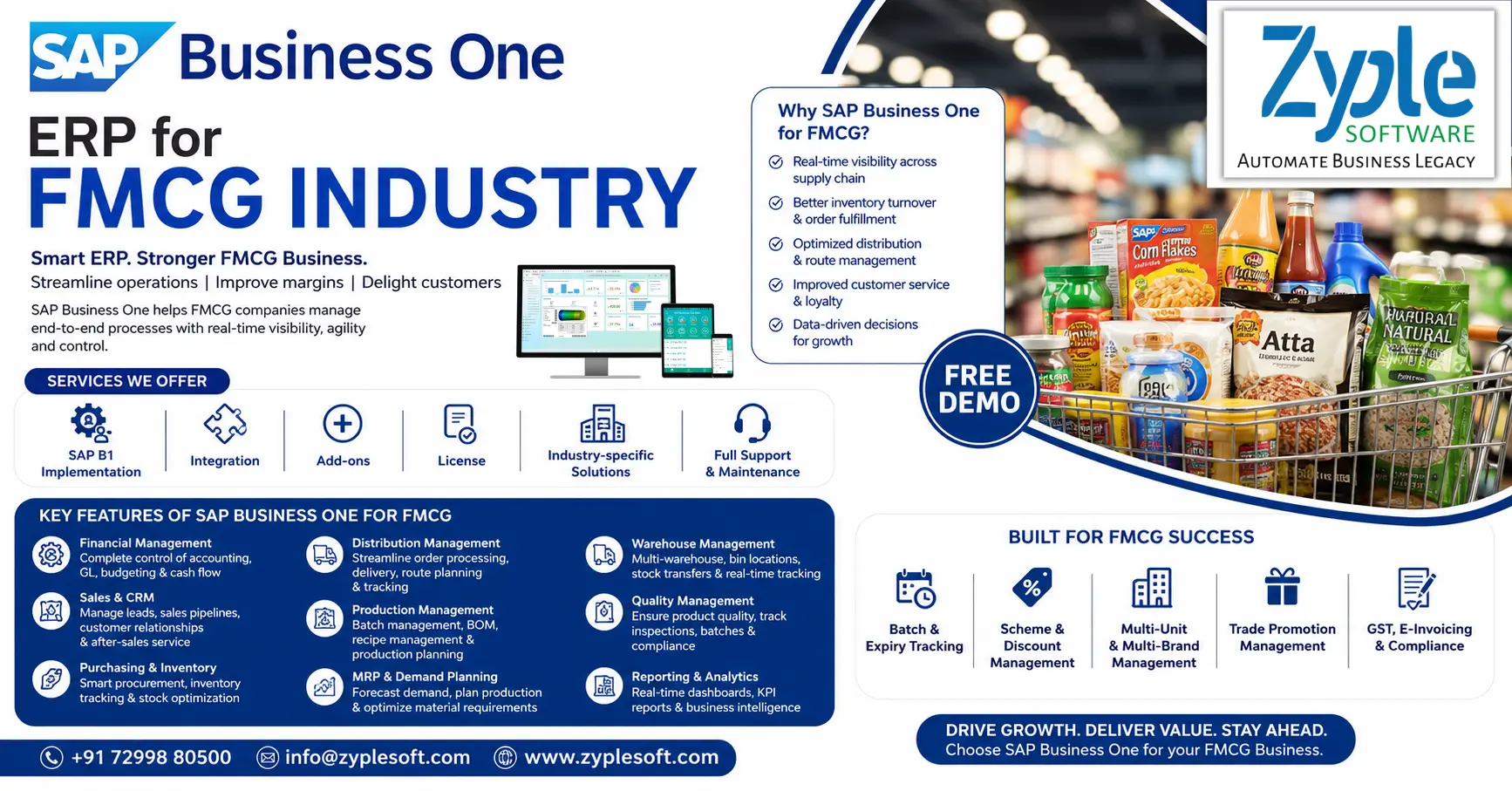
SAP Business One ERP for FMCG Industry

SAP Business One ERP for FMCG Industry by Zyple Software featuring inventory management, batch tracking, warehouse management, sales, distribution, production planning, and Free Demo.

The FMCG industry is in huge demand. The products in this industry often need to be sold fast before they perish. The success of the FMCG sector revolves around speed, accuracy, and efficiency. Businesses in this sector must ensure timely deliveries and handle huge deliveries. SAP Business One ERP for FMCG industry provides real-time business insights in the reports to optimize the business workflow.

Challenges Faced By The FMCG Industry

The fast-moving consumer goods (FMCG) industry faces serious challenges, including supply chain disruptions, rising raw material costs, and shifting consumer preferences.

1. Supply Chain Disruptions

Geopolitical tensions, inflation, and climate events create freight delays and material shortages.

2. Thin Profit Margins

High transportation and input costs decrease profitability across low-margin product lines.

3. Inventory Complexities

Short product shelf lives and seasonal demand surplus risk high waste or costly stockouts.

4. Changing Demands

Shoppers increasingly look for eco-friendly, clean-label, and health-conscious products.

5. Rising Competition

Local startup brands and retail private labels chip away at conventional market share.

6. Omnichannel Integration

Achieving consumer expectations smoothly across both physical and retail e-commerce channels strains legacy systems.

Features of SAP Business One ERP for FMCG Industry

1. Inventory and Warehouse Management

  • It includes real-time inventory tracking across multiple warehouses.
  • It includes batch-wise and serial number tracking.
  • It includes FIFO or FEFO (First Expiry First Out) stock management.
  • It includes automated stock replenishment and reorder levels.
  • It includes bin location management for optimized storage.
  • It includes barcode and QR code integration.

2. Sales and Distribution Management

  • It includes end-to-end sales order processing.
  • Multi-channel distribution management like retailers, distributors, and wholesalers.
  • It includes pricing management with discounts, schemes, and promotions.
  • It includes sales forecasting and demand planning.
  • Mobile sales like van sales and route sales integration.
  • It includes real-time sales analytics and reporting.

3. Production and Manufacturing Management

  • It includes bill of materials (BOM) management.
  • It includes production planning and scheduling.
  • Recipe and formula management for food and beverages.
  • It includes quality control and compliance tracking.
  • It includes real-time production monitoring.
  • It includes waste and by-product management.

4. Procurement and Supplier Management

  • It includes automated purchase order creation.
  • It includes vendor management and evaluation.
  • It includes material requirement planning (MRP).
  • It includes procurement cycle tracking and approvals.

5. Financial Management and Accounting

  • It includes general ledger, accounts payable, and accounts receivable.
  • It includes cost accounting and profitability analysis.
  • It includes budgeting and financial forecasting.
  • It includes GST and tax compliance.
  • It includes multi-currency and multi-branch financial consolidation.
  • It includes real-time financial dashboards.

6. CRM (Customer Relationship Management)

  • It includes customer database and contract management.
  • It includes sales lead and opportunity tracking.
  • It includes customer buying behavior analysis.
  • It includes complaint and service management.
  • It includes loyalty programs and customer engagement tracking.

7. Demand Planning and Forecasting

  • It includes AI-driven demand forecasting.
  • It includes seasonal and trend-based planning.
  • It includes demand vs. supply analysis.
  • It includes reduction of stockouts and overstocking.
  • It includes data-driven decision-making.

8. Batch, Expiry, and Traceability Management

  • It includes expiry date tracking and alerts.
  • It includes batch recall management.
  • It includes compliance with food safety and regulatory standards.

9. Reporting and Business Intelligence (BI)

  • It includes real-time dashboards and KPI tracking.
  • Customizable reports like sales, inventory, finance, and production.
  • It includes predictive analytics and insights.
  • It includes integration with Excel and other BI tools.
  • It includes drill-down reporting for better decision-making.

10. Mobility and Cloud Capabilities

  • It includes mobile access for sales and management teams.
  • It includes cloud deployment for remote accessibility.
  • It includes real-time data synchronization.
  • It includes improved collaboration across departments.

11. Compliance and Quality Control

  • Regulatory compliance for FMCG like FSSAI, GST, and more.
  • It includes quality inspection at multiple stages.
  • It includes audit trails and documentation.
  • It includes standard operating procedure (SOP) enforcement.

12. Integration and Scalability

  • It includes integration with e-commerce platforms, CRM, and third-party tools.
  • It includes API-based connectivity.
  • It is scalable for growing FMCG businesses.
  • It includes custom add-ons for industry-specific needs.

Importance of SAP Business One ERP for FMCG Industry

The ERP software, SAP Business One, is essential for the fast-moving consumer goods (FMCG) industry because it improves inventory control, facilitates the supply chain, and automates financial and sales operations. It helps growing businesses manage high-volume transactions and fast-changing market demands with ease.

1. Live Stock Tracking

Provides real-time data on stock levels across multiple warehouses to avoid running out of popular items or keeping too much extra stock with the SAP implementation process.

2. Batch and Lot Control

Tracks production batches and expiration dates easily, which is very essential for food, drink, and personal care items.

3. Supply Chain Speed

Connects purchasing, production, and delivery so products move from factories to stores faster.

4. Sales and CRM

Handles customer orders, tracks pricing rules, and sets credit limits for different distributors and retailers using SAP solutions.

5. Money and Tax Management

Maintains all accounting, budgeting, and local tax rules in one clear place.

Benefits of SAP Business One for FMCG Industry

SAP Business One helps the fast-moving consumer goods (FMCG) industry by providing real-time inventory tracking, facilitated supply chain management, and integrated financial control. It enables growing consumer goods companies to reduce waste, prevent stockouts, and handle product batches efficiently.

1. Real-Time Stock Visibility

Monitors stock levels across multiple warehouses instantly.

2. Batch and Lot Tracking

Handles expiry dates and product traceability to minimize perishable waste.

3. Automatic Reordering

Triggers low-stock alerts to avoid production delays or empty shelves.

4. Material Requirements Planning (MRP)

Automates raw material planning based on actual demand using SAP Business One add-ons.

5. Bill of Materials (BOM)

It standardizes recipes and component lists for consistent product quality.

6. Facilitated Distribution

Improves procurement, manufacturing, and shipping workflows.

7. Integrated CRM

The SAP software maintains customer databases, tracking buying habits and order histories.

8. Unified Accounting

Integrates ledger, accounting, and local tax compliance into one dashboard.

9. Business Analytics

Generates fast, data-driven reports to find shifting market trends.

Conclusion of FMCG ERP

As a qualified SAP Business One partner, Zyple Software is delivering services like SAP B1 implementation, integration, migration, licensing, add-ons, digital transformation, and support to different industries, like construction, manufacturing, solar, food and beverage, aerospace, healthcare, retail,  jewellery, pharma, and textiles. 

SAP Business One is an ERP software customized for small and medium-sized enterprises that connects finance, procurement, sales, CRM, production, inventory, and reporting into one platform. For FMCG or any other businesses, it can improve project costing, procurement, subcontractor billing, and inventory management.

If you’re involved, register a SAP Business One demo.

Do you search for the SAP B1 ERP software for your business or industry?

Complete all the details in the displayed contact form; our team will get back to you.

    FAQs

    1.Why should FMCG companies choose SAP Business One over other ERP solutions?

    SAP Business One provides industry-specific features like batch tracking, expiry management, and distribution control, making it ideal for FMCG businesses. It delivers real-time insights and scalability, helping companies grow without switching systems.

    By automating inventory, procurement, and sales processes, SAP Business One reduces manual errors and wastage. This leads to better resource utilization, minimized inventory holding costs, and improved profit margins.

    Yes, SAP Business One can seamlessly connect with CRM, e-commerce platforms, and third-party applications. This ensures smooth data flow across departments and improves overall business efficiency.

    With the right implementation partner like Zyple Software, you get end-to-end services, including SAP B1 implementation, consultation, add-on development, data migration, training, and support to ensure a smooth and successful ERP deployment.

    You can connect with an authorized SAP B1 partner like Zyple Software to schedule a personalized demo. They will evaluate your business requirements, showcase relevant features, and guide you on the best implementation approach.
    SAP Business One implementation services provider helping businesses deploy ERP software with consulting, integration, customization, migration, and ongoing support

    SAP Business One Implementation Services Provider

    Best SAP Business One Implementation Services Provider

    SAP Business One implementation services provider helping businesses deploy ERP software with consulting, integration, customization, migration, and ongoing support

    Digital transformation is no longer optional for growing businesses. Companies need real-time visibility into finance, inventory, production, procurement, sales, and customer operations. This is where SAP Business One becomes one of the most trusted ERP solutions for small and medium-sized enterprises (SMEs).

    However, purchasing ERP software alone is not enough. Success depends largely on selecting the right SAP Business One implementation services provider.

    An experienced implementation partner ensures that your ERP is configured correctly, integrated seamlessly with existing systems, customized to match business processes, and supported long after go-live.

    This comprehensive guide explains everything you need to know before selecting a SAP Business One implementation company.

    What is SAP Business One?

    SAP Business One is an integrated Enterprise Resource Planning (ERP) solution designed specifically for SMEs. It connects every department into a single platform including:

    • Financial Management
    • Sales & CRM
    • Purchasing
    • Inventory Management
    • Warehouse Management
    • Production Planning
    • Material Requirements Planning (MRP)
    • Project Management
    • Service Management
    • Business Intelligence
    • Analytics & Dashboards

    Instead of using disconnected software and spreadsheets, businesses gain a centralized system for complete operational control.

    Who is a SAP Business One Implementation Services Provider?

    A SAP Business One implementation services provider is an authorized consulting company that helps organizations successfully deploy SAP Business One ERP.

    Their responsibilities typically include:

    • Business process analysis
    • ERP consulting
    • Requirement gathering
    • Solution design
    • SAP Business One licensing
    • Installation & configuration
    • Master data migration
    • Customization
    • Add-on development
    • Third-party integrations
    • User training
    • Go-live support
    • Annual maintenance
    • Performance optimization

    A professional SAP Business One partner minimizes risks while maximizing ROI.

    Why Professional Implementation Matters?

    Many ERP failures occur because organizations underestimate implementation complexity.

    Professional implementation helps businesses avoid:

    • Incorrect financial setup
    • Poor inventory configuration
    • Data migration issues
    • User adoption problems
    • Reporting inaccuracies
    • Workflow disruptions
    • Cost overruns
    • Delayed implementation

    A certified implementation partner follows proven methodologies to reduce project risks.

    SAP Business One Implementation Process

    1. Business Requirement Analysis

    The project begins with understanding existing workflows.

    Consultants evaluate:

    • Finance
    • Procurement
    • Sales
    • Inventory
    • Manufacturing
    • CRM
    • Supply Chain
    • Reporting

    The objective is to identify operational gaps and automation opportunities.

    2. Solution Design

    Based on requirements, consultants create a roadmap including:

    • Module selection
    • Approval workflows
    • User roles
    • Business processes
    • Reports
    • Dashboards
    • Integrations

    3. System Configuration

    Implementation specialists configure SAP Business One according to business requirements.

    Configuration includes:

    • Company setup
    • Financial settings
    • Tax configuration
    • Warehouses
    • Inventory valuation
    • Item groups
    • Pricing
    • Approval processes
    • Production settings

    4. Data Migration

    Historical business data is migrated carefully, including:

    • Customers
    • Vendors
    • Items
    • Opening balances
    • Bills of Materials
    • Assets
    • Transactions

    Data validation ensures accuracy before go-live.

    5. Integration Services

    Businesses often integrate SAP Business One with:

    • E-commerce platforms
    • Banking systems
    • Barcode systems
    • CRM software
    • Payroll software
    • HRMS
    • Logistics platforms
    • Payment gateways
    • Business Intelligence tools
    • Government portals

    6. User Training

    Training ensures employees can effectively use the ERP.

    Training typically covers:

    • Finance users
    • Purchase teams
    • Inventory staff
    • Production planners
    • Sales executives
    • Management users

    7. Go-Live Support

    After deployment, implementation consultants monitor:

    • System performance
    • User issues
    • Transaction accuracy
    • Reports
    • Data validation

    8. Post Implementation Support

    Long-term services include:

    • Performance tuning
    • Version upgrades
    • Feature enhancements
    • Technical support
    • Functional consulting
    • Process improvements

    Industries Served by SAP Business One

    SAP Business One supports multiple industries including:
    • Manufacturing
    • Construction
    • EPC Companies
    • Real Estate
    • Trading
    • Distribution
    • Retail
    • Pharmaceuticals
    • Food Processing
    • FMCG
    • Chemicals
    • Textile
    • Engineering
    • Electronics
    • Aerospace and Defense
    • Medical Devices
    • Packaging
    • Logistics
    • Agriculture
    • Mining
    • Renewable Energy
    • Solar EPC
    • Steel
    • Jewellery
    • Automotive Components

     Benefits of Choosing an Experienced SAP Business One Implementation Services Provider

    Faster Deployment

    Experienced consultants reduce implementation time using proven templates and best practices.

    Lower Project Risk

    Professional planning prevents implementation failures.

    Business Process Optimization

    Rather than simply installing software, experienced consultants improve operational efficiency.

    Better ROI

    Correct SAP implementation increases productivity while reducing operational costs.

    Accurate Reporting

    Management gains real-time dashboards and decision-making insights.

    Regulatory Compliance

    Implementation partners configure tax rules, GST, audit reports, and statutory requirements correctly.
     

    Essential Implementation Services

    A complete SAP Business One implementation company should provide:
    • ERP Consulting
    • GAP Analysis
    • Business Process Mapping
    • SAP Business One Licensing
    • Database Setup
    • HANA Migration
    • SQL Migration
    • Data Cleansing
    • Master Data Migration
    • Financial Setup
    • Production Configuration
    • Inventory Setup
    • Warehouse Configuration
    • CRM Configuration
    • Approval Workflows
    • Dashboard Development
    • Crystal Reports
    • Power BI Integration
    • Mobile Access
    • Add-ons
    • API Integration
    • User Training
    • Go-Live Support
    • Annual Maintenance
    • Remote Support
    • Onsite Support

     Features to Look for in an Implementation Partner

    Choose a provider that offers:
    • Certified SAP Business One consultants
    • Industry-specific expertise
    • Proven implementation methodology
    • Strong customer references
    • Post-go-live support
    • Custom development capability
    • Integration expertise
    • Transparent pricing
    • Dedicated project manager
    • Local and remote support

    Questions to Ask Before Hiring a SAP Business One Implementation Services Provider

    • How many SAP Business One implementations have you completed?
    • Do you specialize in our industry?
    • Are your consultants SAP certified?
    • What implementation methodology do you follow?
    • How do you handle data migration?
    • What integrations can you develop?
    • What is included in post-go-live support?
    • Can you provide customer references?
    • What is your average implementation timeline?
    • What ongoing maintenance services do you offer?

    Future Trends in SAP Business One Implementation

    Businesses increasingly expect ERP solutions that include:
    • AI-powered analytics
    • Predictive forecasting
    • Cloud deployment
    • Mobile ERP
    • IoT integration
    • Machine connectivity
    • Digital approvals
    • Automated workflows
    • Intelligent dashboards
    • Real-time business insights
    Implementation partners who understand these technologies help businesses stay competitive.
     

    Why Businesses Choose Experienced SAP Business One Partners?

    The right implementation provider delivers more than software installation. For Example: Zyple Software is the best choice in SAP Business One partner. They become a long-term technology partner who understands your operations, aligns ERP with business goals, and supports continuous improvement.
     
    Whether you operate in manufacturing, construction, distribution, retail, or professional services, investing in expert SAP Business One implementation services leads to better operational visibility, improved efficiency, and sustainable growth.
     

    Why Choose Zyple Software as Your SAP Business One Implementation Services Provider?

    When selecting a SAP Business One implementation partner, experience, industry knowledge, and long-term support are essential. Zyple Software is a trusted SAP Business One implementation services provider that helps small and medium-sized businesses streamline operations through tailored SAP solutions.
     
    With extensive experience across industries such as construction, manufacturing, engineering, EPC, aerospace and defense, trading, distribution, retail, pharmaceuticals, food processing, jewellery, renewable energy, and project-based businesses, Zyple Software delivers implementations designed around each organization’s unique business processes rather than a one-size-fits-all approach

    Conclusion

    Selecting the right SAP Business One implementation services provider is one of the most important decisions in your ERP journey. A knowledgeable partner ensures a smooth implementation, faster user adoption, reliable reporting, and long-term business value.
     
    Instead of focusing only on implementation cost, evaluate expertise, industry knowledge, support capabilities, integration experience, and customer success stories. A strategic implementation partner can transform SAP Business One into a powerful platform that supports your company’s growth for years to come.

    Frequently Asked Questions (FAQs)

    1. What does a SAP Business One implementation services provider do?

    They manage the complete ERP deployment, including consulting, planning, installation, configuration, data migration, integration, user training, go-live assistance, and ongoing support.

    Small businesses often complete implementation in 4–8 weeks, while larger or highly customized projects can take several months.

    Manufacturing, construction, trading, retail, distribution, pharmaceuticals, food processing, aerospace and defense, jewellery, engineering, logistics, renewable energy, and many other industries use SAP Business One successfully.

    Yes. It supports integrations with CRM systems, eCommerce platforms, banking software, payroll, HRMS, logistics solutions, barcode systems, payment gateways, and custom applications.

    A skilled partner reduces project risks, shortens deployment time, improves user adoption, ensures accurate configuration, and maximizes the long-term return on your ERP investment.

    Let us fill all details in contact form, Our team will contact soon with best solutions as per your business needs.

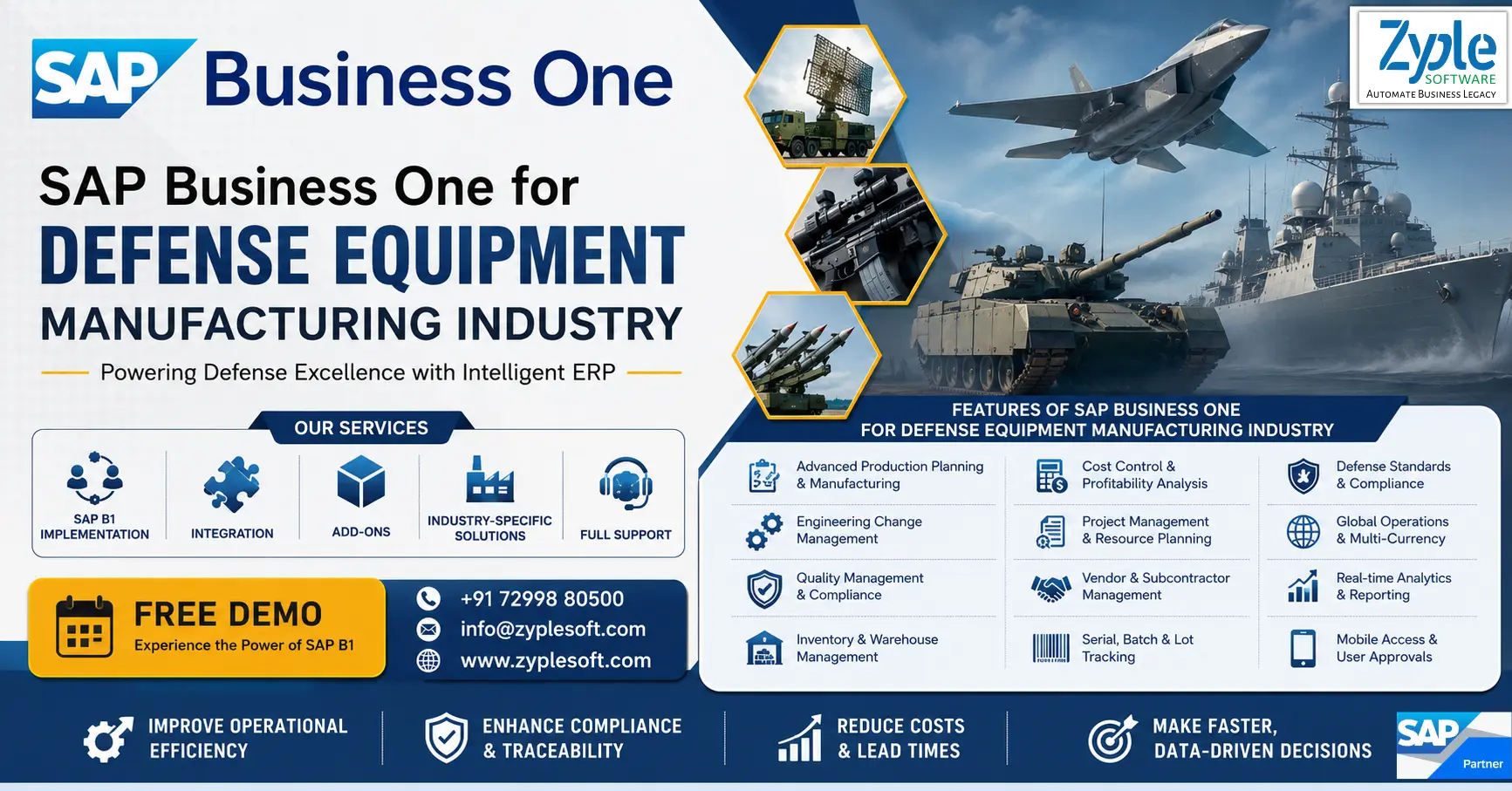
      SAP Business One ERP for Defense Equipment Manufacturing Industry

      SAP Business One for Defense Equipment Manufacturing Industry

      SAP Business One ERP for Defense Equipment Manufacturing Industry

      SAP Business One ERP for Defense Equipment Manufacturing Industry

      The defense equipment manufacturing sector operates under extreme precision, tight regulations, and complex supply chains. Handling production timelines, compliance requirements, and cost control manually can lead to inefficiencies and risks. SAP Business One for defense equipment manufacturing industry allows businesses to facilitate operations, maintain compliance, and improve decision-making through real-time data.

      Challenges Faced By The Defense Equipment Manufacturing Industry

      The defense equipment manufacturing industry faces serious challenges, including volatile supply chain disruptions, slow adaptation of advanced technologies like semiconductors and AI, heavy bureaucratic compliance, and high dependence on foreign transfer of technology (ToT). These factors cause continuous project delays, cost overruns, and vulnerability to geopolitical risks.

      1. Supply Chain Fragility

      Many companies are heavily reliant on foreign original equipment manufacturers (OEMs) for raw materials, rare earth metals, and essential sub-systems.

      2. Technological and Innovation Gaps

      Domestic manufacturers struggle with the heart and brain technologies. High-end sensors, AI systems, aero-engines, and advanced semiconductors generally lag behind modern threat capabilities. Foreign OEMs often restrict the sharing of intellectual property and core material technologies, delivering limited assembly licenses instead of true technological independence.

      3. Bureaucracy and Procurement Obstacles

      The procurement cycle, from the initial Request for Proposal (RFP) to final induction, often spans over a decade, delaying modernization.

      4. Workforce and Skill Deficits

      The industry suffers from a shortage of qualified personnel capable of operating, handling, and maintaining ultra-precise and evolving digital-engineering workflows.

      Features of SAP Business One for Defense Equipment Manufacturing Industry

      1. Advanced Manufacturing and Production Management

      • It includes multi-level Bill of Materials (BOM) with revision control.
      • Engineering change management is essential for defense specs.
      • It includes production orders and shop floor control.
      • It includes discrete, batch, and mixed-mode manufacturing support.
      • It includes capacity planning and machine scheduling.
      • It includes scrap, rework, and yield tracking.
      • It ensures precision manufacturing for complex defense components.

      2. Material Requirements Planning (MRP)

      • It includes demand forecasting and planning.
      • It includes automated procurement suggestions.
      • It includes lead-time scheduling.
      • It includes shortage and excess inventory alerts.
      • It helps maintain uninterrupted supply chains in mission-critical production.

      3. Inventory and Warehouse Management

      • It includes real-time tracking of raw materials, WIP, and finished goods.
      • Batch and serial number tracking is necessary for defense traceability.
      • It includes bin location and quantity warehouse management.
      • It includes automated stock valuation and movements.
      • Allows full traceability of every component and assembly.

      4. Compliance, Quality, and Traceability

      • It includes quality control at every production stage.
      • It includes audit trails and documentation.
      • Regulatory compliance support like ISO and defense standards.
      • It includes certificate generation and inspection reports.
      • Essential for defense contracts and government audits.

      5. Financial and Cost Management

      • Integrated accounting like general ledger, accounts payable, and accounts receivable.
      • It includes project-based costing and budget control.
      • Cost breakdown like material, labor, and overhead.
      • It includes profitability analysis per project or contract.

      6. Project and Contract Management

      • Project lifecycle tracking from planning and execution to delivery.
      • It includes budget vs. actual cost monitoring.
      • It includes milestone-based billing.
      • It includes resource allocation.
      • Suitable for long-term government and defense contracts.

      7. Procurement and Supplier Management

      • It includes vendor evaluation and management.
      • It includes purchase order automation.
      • It includes export and import documentation handling.
      • It includes supplier compliance tracking.
      • It strengthens defense supply chain reliability.

      8. Sales and Customer Lifecycle Management

      • It includes tender and quotation management.
      • It includes opportunity and pipeline tracking.
      • It includes a contract-based sales process.
      • It includes after-sales service and maintenance tracking.
      • It supports defense OEMs and government clients.

      9. Service and Maintenance Management

      • It includes equipment servicing and maintenance contracts.
      • It includes field service management.
      • It includes warranty tracking.
      • It includes spare parts management.
      • Necessary for lifecycle support of defense equipment.

      10. Business Intelligence and Analytics

      • It includes real-time dashboards and KPIs.
      • It includes predictive analytics for demand and production.
      • It includes custom reporting for audits and compliance.
      • It includes drill-down analysis across departments.
      • Allows faster, data-driven decision-making.

      11. Mobility and Remote Access

      • It includes web-based ERP access.
      • Ideal for distributed defense operations.

      12. Integration and Scalability

      • It includes integration with MES, PLM, and IoT systems.
      • It includes add-ons for aerospace and defense.
      • It includes multi-location and multi-currency support.
      • Adaptable for growing defense manufacturers.
      • It supports modernization and digital transformation.

      13. Centralized Data and Automation

      • Single unified database without data storage.
      • It includes automated workflows and alerts.
      • It includes role-based access control for security.
      • It ensures secure and efficient operations across departments.
      These all features are offering by SAP B1 Consultant companies(Example- Zyple Software)

      Importance of SAP Business One for Defense Equipment Manufacturing Industry

      The ERP software, SAP Business One (SAP B1) system, is essential for defense equipment manufacturers because it replaces fragmented legacy systems with a single, highly secure, and compliant digital core. It ensures real-time cost control, strict adherence to defense regulations, and multi-level supply chain visibility.

      1. Strict Regulatory Compliance

      Defense manufacturing requires uncompromising adherence to stringent standards like AS9100 and strict safety guidelines. SAP B1 ERP supports required document controls, non-conformance tracking, and quality records directly within the workflow.

      2. Deep BOM and Engineering Control

      Defense equipment often demands massive, nested Bills of Materials (BOMs). SAP software provides complete version control and design change tracking so that engineering revisions are accounted for accurately at the shop floor level.

      3. End-to-End Lot and Serial Traceability

      Every raw material, sub-assembly, and finished tactical component can be identified. This ensures accountability across the supply chain, allowing instant audit trails and quality inspections.

      4. Material Requirements Planning (MRP)

      Defense supply chains have complex multi-tier reliances. SAP B1 automates MRP to ensure the right metals, electronics, and components are in stock without over-purchasing or facing expensive production delays.

      5. Secure Project-Based Costing

      SAP B1 ties production orders directly to financials to understand true costs per unit, job, or contract, reducing margin surprises.

      6. Secure Cloud and Multi-Site Visibility

      It provides secure, real-time visibility into operations across multiple plants, allowing manufacturers to monitor performance, manage vendors, and adjust to sudden demand shifts using SAP implementation.

      Benefits of SAP Business One ERP for Defense Equipment Manufacturing Industry

      The SAP Business One solution is a powerful, integrated ERP solution customized for defense manufacturing. It facilitates complex supply chains, automates production, and provides rigorous, multi-level traceability required to meet strict military and regulatory standards.

      1. End-to-End Traceability

      Maintains complete, digital records of every part and batch from creation to final shipment to ensure audit readiness and compliance with protocols.

      2. Strict Quality Control

      Integrates quality management workflows to evaluate engineering changes, record non-conformances, and maintain military-grade certifications.

      3. Complex BOM Management

      Manages nested, multi-level Bills of Materials (BOMs) with precise version control to eliminate errors.

      4. Real-Time Job-Based Costing

      Accurately calculates true costs per unit, milestone, or contract to protect profit margins and improve forecasting using SAP solutions.

      5. Supplier and Procurement Control

      Automates purchasing and manages multi-tier supply chains to prevent production obstacles.

      Conclusion of Defense Equipment Manufacturing ERP

      Zyple Software is a certified SAP Business One partner in India specializing in implementation, digital transformation, licensing, integration, add-on solutions, migration, and consulting for the defense equipment manufacturing industry. By unifying all essential business functions into a single, facilitated platform, SAP Business One ERP drives operational excellence, improves product quality, and delivers real-time insights for smarter decision-making.

      If you’re interested, reserve a demo of SAP Business One.

      Do you require the SAP B1 ERP system for your business or industry?

      Finish all the details in the provided contact form; our team will return to you.

        1.How can I get started with SAP Business One for my defense manufacturing business?

        Getting started with SAP Business One requires a consultation to understand your manufacturing processes, compliance needs, and business goals. A certified SAP B1 partner like Zyple Software will guide you through planning, customization, and implementation.

        Yes, SAP B1 partners like Zyple Software provide personalized demos of SAP Business One showcasing features like production planning, compliance tracking, and inventory management specific to defense manufacturing.

        The cost of SAP Business One depends on the number of users, deployment type (cloud or on-premise), level of customization, and integration requirements with the current defense systems.

        SAP Business One implementation timelines typically range from a few weeks to a few months, based on the complexity of operations and compliance requirements.

        Yes, SAP B1 partners like Zyple Software deliver ongoing support, system maintenance, and user training to ensure you get maximum value from SAP Business One and maintain smooth operations.