Tag Archives: digital transformation

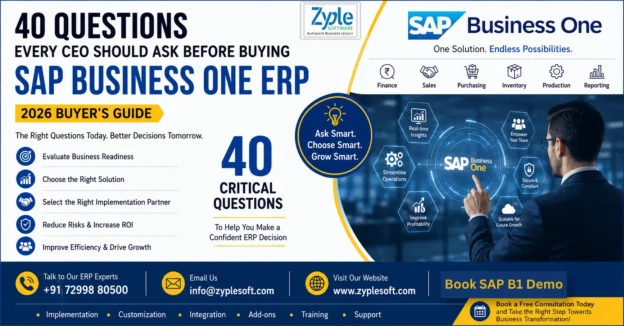
CEO evaluating SAP Business One ERP implementation with 40 essential questions covering ERP selection, implementation, ROI, manufacturing, construction, and business growth.

40 Questions Every CEO Should Ask Before Buying SAP Business One ERP (Complete Buyer’s Guide)

40 Questions Every CEO Should Ask Before Buying SAP Business One ERP (2026 Buyer's Guide)
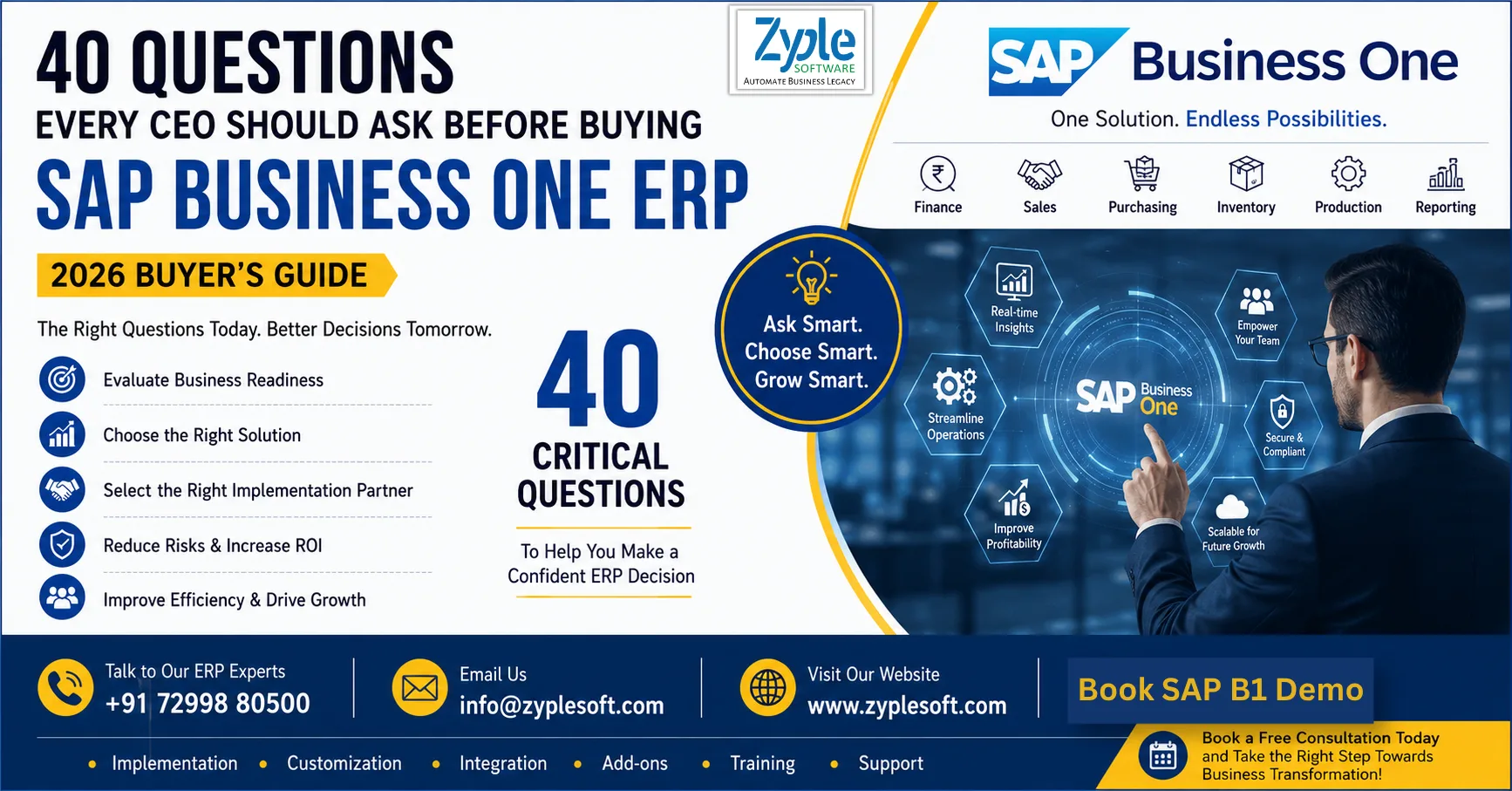
CEO evaluating SAP Business One ERP implementation with 40 essential questions covering ERP selection, implementation, ROI, manufacturing, construction, and business growth.

Thinking About Buying SAP Business One ERP? Read This First.

Choosing an Enterprise Resource Planning (ERP) solution is one of the most important business decisions you’ll make. Unlike purchasing office software or hardware, an ERP system becomes the foundation of your company’s finance, sales, purchasing, inventory, manufacturing, projects, customer service, and reporting.

A successful ERP implementation can improve efficiency, increase profitability, and provide complete visibility into your business. A poor implementation, however, can lead to cost overruns, low user adoption, delayed projects, and operational disruptions.

While SAP Business One is one of the world’s leading ERP solutions for small and medium-sized businesses, success depends on asking the right questions before signing the contract, not after implementation begins.

After working with companies across manufacturing, construction, engineering, trading, food processing, pharmaceuticals, and other industries, one thing becomes clear: organizations that evaluate their ERP investment carefully are more likely to achieve successful outcomes.

This guide presents 40 practical questions every CEO should ask before buying SAP Business One ERP. These questions are designed to help you evaluate your business readiness, implementation strategy, vendor selection, costs, and long-term return on investment.

Whether you’re replacing spreadsheets, upgrading from accounting software, or implementing SAP ERP for the first time, this guide will help you make a more informed decision.


Why ERP Projects Succeed or Fail?

Research and industry experience consistently show that ERP projects are more successful when organizations:

  • Define clear business objectives.
  • Involve leadership from the beginning.
  • Choose an implementation partner with relevant industry experience.
  • Prepare accurate master data.
  • Train users effectively.
  • Measure success using business KPIs.

Conversely, projects often struggle when companies:

  • Focus only on software features.
  • Choose the lowest-cost implementation partner.
  • Underestimate change management.
  • Skip process documentation.
  • Rush implementation without proper planning.

The following questions are intended to help you avoid these common pitfalls.


Business Strategy and ERP Readiness

Question 1. Why do we need an ERP system now?

Before evaluating any software, define the business problem you’re trying to solve.

Common reasons include:

  • Business growth has outpaced current systems.
  • Too many manual processes.
  • Inventory inaccuracies.
  • Delayed financial reporting.
  • Poor visibility into operations.
  • Multiple disconnected software applications.
  • Difficulty managing multiple branches or warehouses.

If your only reason is “everyone else is implementing ERP,” reconsider. A successful ERP project starts with clear business objectives.


Question 2. What business challenges should SAP Business One solve?

ERP should solve measurable business problems – not simply replace existing software.

Examples include:

  • Manual purchase approvals
  • Inventory mismatches
  • Slow order processing
  • Production delays
  • Project cost overruns
  • Duplicate data entry
  • Lack of real-time reporting

List your top five operational challenges and prioritize them before evaluating ERP vendors.


Question 3. What are our business goals over the next five years?

Your ERP should support your future – not just your present.

Ask yourself:

  • Will we open additional branches?
  • Will production capacity increase?
  • Will we export internationally?
  • Will we expand into new product lines?
  • Will we require better business analytics?
  • Will we increase our workforce?

Choosing an ERP that can scale reduces future migration costs.


Question 4. Are our existing systems limiting growth?

Many SMEs rely on a combination of:

  • Excel spreadsheets
  • Accounting software
  • Standalone inventory systems
  • Manual production planning
  • Separate CRM solutions

As businesses grow, these disconnected systems create duplicate work, inconsistent data, and delayed decision-making.

Ask yourself:

Are we managing our business or managing spreadsheets?


Question 5. Which departments will benefit most from ERP?

ERP is not just for finance.

It should improve collaboration across:

  • Finance
  • Sales
  • Purchasing
  • Inventory
  • Warehouse
  • Manufacturing
  • Projects
  • Customer Service
  • Senior Management

The broader the adoption, the greater the long-term business value.


Business Process Evaluation

Question 6. Which processes consume the most employee time?

Time is money.

Identify repetitive manual activities such as:

  • Purchase approvals
  • Invoice creation
  • Inventory reconciliation
  • Production scheduling
  • Sales reporting
  • Customer follow-ups

These are often the first opportunities for automation.


Question 7. Which business processes create the highest operational costs?

Focus on activities that directly affect profitability.

Examples:

  • Excess inventory
  • Material wastage
  • Production downtime
  • Delayed procurement
  • Manual reporting
  • Emergency purchasing
  • Rework due to inaccurate data

Reducing these costs often delivers a measurable ERP ROI.


Question 8. Can management access real-time information?

Ask yourself:

Can I see, right now,

  • Today’s sales?
  • Inventory availability?
  • Outstanding receivables?
  • Cash flow?
  • Production status?
  • Project profitability?

If the answer is no, decision-making becomes reactive rather than proactive.

One of the biggest strengths of SAP Business One is centralized, real-time business visibility.


Question 9. Is our business data accurate?

ERP is only as reliable as the data it contains.

Review your:

  • Customer master
  • Vendor master
  • Item master
  • Price lists
  • Bills of Materials (BOM)
  • Warehouse records
  • Financial accounts

Data cleansing before implementation reduces errors and accelerates go-live.


Question 10. Are we relying too much on Excel?

Excel is a valuable business tool but it should not run your business.

Common risks include:

  • Formula errors
  • Multiple file versions
  • No audit trail
  • Manual consolidation
  • Limited collaboration
  • Inconsistent reporting

If critical decisions depend on spreadsheets maintained by a few individuals, it’s a sign your business may benefit from an integrated ERP system.


Leadership & Business Planning

Question 11. What KPIs should improve after ERP implementation?

ERP success should be measured using business outcomes.

Examples include:

  • Inventory Accuracy
  • On-Time Delivery
  • Production Efficiency
  • Gross Profit Margin
  • Procurement Cycle Time
  • Cash Flow
  • Customer Satisfaction
  • Financial Closing Time

Establish baseline metrics before implementation so you can measure improvement afterward.


Question 12. What ROI do we expect from SAP Business One?

Don’t focus only on implementation cost.

Evaluate expected benefits such as:

  • Reduced inventory carrying costs
  • Lower operational expenses
  • Faster invoicing
  • Better procurement planning
  • Increased employee productivity
  • Improved customer service
  • Better management reporting

A successful ERP investment should create long-term business value.


Question 13. Are we prepared for organizational change?

ERP implementation changes the way people work.

Ask:

  • Are employees ready for new processes?
  • Do we have a training plan?
  • Have department heads been involved?
  • How will we communicate the change?

Technology succeeds when people adopt it.


Question 14. Do we have executive sponsorship?

ERP implementation requires active leadership.

The CEO should:

  • Define business objectives.
  • Approve major decisions.
  • Remove organizational barriers.
  • Monitor project progress.
  • Promote user adoption.

Projects with visible executive involvement generally experience stronger alignment and accountability.


Question 15. Who will own the ERP project internally?

Every successful ERP implementation needs an internal project leader.

This person should:

  • Coordinate departments.
  • Work closely with the implementation partner.
  • Track milestones.
  • Manage internal communication.
  • Escalate issues when needed.
  • Ensure project timelines remain on track.

Without clear ownership, even well-planned ERP projects can lose momentum.

Evaluating SAP Business One ERP

Question 16. Is SAP Business One designed for businesses like ours?

Not every ERP solution is built for every organization.

SAP Business One is designed primarily for small and medium-sized enterprises (SMEs) that require enterprise-level capabilities while maintaining operational simplicity.

Ask yourself:

  • Are we an SME planning to scale?
  • Do we need better financial visibility?
  • Are multiple departments using different software?
  • Do we require integrated reporting?
  • Will ERP support our growth for the next 7–10 years?

Choosing software that matches your company’s size and complexity helps avoid unnecessary implementation costs and future migrations.


Question 17. Does SAP Business One support our industry?

Industry expertise matters.

A manufacturing company has different requirements than a construction contractor or wholesale distributor.

Before selecting SAP Business One, ask your implementation partner whether they have experience in your industry.

Examples include:

Manufacturing

  • Bill of Materials (BOM)
  • Material Requirement Planning (MRP)
  • Production Orders
  • Quality Control
  • Batch Management
Companies evaluating SAP Business One Manufacturing ERP should verify support for production planning, Bill of Materials (BOM), MRP, shop floor reporting, quality management, and production costing.

Construction & EPC

  • Project Costing
  • Budget Management
  • Contractor Billing
  • Work-in-Progress (WIP)
  • Equipment Tracking
Organizations looking for SAP Business One Construction ERP should evaluate project costing, subcontractor billing, budget control, procurement, work-in-progress (WIP), and equipment management.

Trading & Distribution

  • Multi-Warehouse Management
  • Inventory Planning
  • Procurement
  • Barcode Integration
  • Customer Pricing

A partner who understands your industry can recommend proven workflows instead of unnecessary customizations.


Question 18. Can SAP Business One grow with our business?

Before making a decision, ask your implementation partner to explain how the SAP Business One Implementation process will be planned for your organization’s future growth. A structured implementation methodology reduces project risk and improves user adoption.

Your ERP should support future expansion without requiring replacement.

Evaluate whether it can handle:

  • Additional users
  • New branches
  • Multiple warehouses
  • Higher transaction volumes
  • New business units
  • International operations
  • Multiple legal entities

A scalable ERP protects your investment as your organization grows.


Question 19. Should we choose SAP Business One HANA or SQL?

One of the first technical decisions involves selecting the database platform.

SAP HANA

Best suited for businesses that require:

  • Faster reporting
  • Real-time analytics
  • Large data processing
  • Advanced dashboards

Microsoft SQL

Often appropriate for businesses looking for:

  • Lower infrastructure investment
  • Familiar database technology
  • Reliable transactional performance

The right choice depends on your reporting needs, IT strategy, budget, and expected business growth.


Question 20. Should we choose Cloud or On-Premise deployment?

Deployment strategy affects cost, security, accessibility, and IT management.

Cloud Deployment

Advantages include:

  • Lower infrastructure investment
  • Remote accessibility
  • Automatic backups
  • Easier scalability
  • Reduced IT maintenance

On-Premise Deployment

Advantages include:

  • Greater infrastructure control
  • Internal hosting
  • Organization-specific security policies
  • Integration with existing local systems

Discuss both options with your implementation partner before making a decision.

Never rely on a generic presentation. Request an industry-specific SAP Business One Demo using your own products, customers, and business workflows. A personalized demonstration helps management evaluate whether the solution fits real operational requirements.


Functional Capabilities

Question 21. Does SAP Business One cover all our core business processes?

Create a checklist of every process your organization performs daily.

Typical modules include:

  • Financial Management
  • Sales
  • Purchasing
  • Inventory Management
  • CRM
  • Production
  • Project Management
  • Service Management
  • Fixed Assets
  • Banking
  • Reporting

Any missing functionality should be identified before implementation begins.


Question 22. Can SAP Business One automate repetitive tasks?

Automation reduces manual work and minimizes human error.

Examples include:

  • Purchase approvals
  • Sales approvals
  • Inventory replenishment
  • Email notifications
  • Credit limit approvals
  • Payment approvals
  • Workflow alerts

Automation improves productivity while increasing operational consistency.


Question 23. Does SAP Business One provide real-time reporting?

Executives should not wait until month-end to understand business performance.

Ask whether the system provides dashboards for:

  • Sales
  • Inventory
  • Cash Flow
  • Accounts Receivable
  • Accounts Payable
  • Profitability
  • Production
  • Projects

Real-time visibility enables faster and more informed decisions.


Question 24. Can it integrate with our existing software?

Many businesses extend SAP Business One with industry-specific SAP Business One Add-ons for payroll, contractor billing, weighbridge integration, WhatsApp, barcode systems, fleet management, and manufacturing execution systems (MES).

Most businesses already use multiple applications.

Examples include:

  • Payroll
  • HRMS
  • Banking
  • CRM
  • E-commerce
  • WhatsApp
  • Barcode Systems
  • Power BI
  • Microsoft 365
  • Manufacturing Execution Systems (MES)

Understanding integration capabilities early helps avoid future surprises.


Question 25. Can SAP Business One support mobile users?

Business decisions no longer happen only from office desktops.

Ask whether managers can:

  • Approve purchase requests
  • Review dashboards
  • Access customer information
  • Monitor inventory
  • View financial reports
  • Track project progress

Mobile accessibility improves responsiveness and supports distributed teams.


Security & Compliance

Question 26. How secure is SAP Business One?

Business information is one of your most valuable assets.

Evaluate:

  • User permissions
  • Role-based security
  • Approval workflows
  • Audit trails
  • Password policies
  • Data backups
  • Disaster recovery

A secure ERP helps protect sensitive financial and operational data.


Question 27. Does SAP Business One support statutory compliance?

For businesses operating in India or internationally, compliance is critical.

Ask your implementation partner about support for:

  • GST
  • E-Invoicing
  • E-Way Bills
  • Tax reporting
  • Financial audits
  • Regulatory reporting

Compliance requirements should be discussed before implementation – not after go-live.


Question 28. Can we customize SAP Business One without creating upgrade issues?

Every business has unique processes.

However, excessive customization may increase implementation complexity and future maintenance.

Ask:

  • Can this requirement be handled through configuration?
  • Is customization really necessary?
  • Will upgrades remain straightforward?

The goal should be to use standard functionality wherever possible and customize only where it delivers clear business value.


Technology & Future Readiness

Question 29. Can SAP Business One support our digital transformation strategy?

ERP should be more than a replacement for existing software.

It should support future initiatives such as:

  • AI-powered reporting
  • Business Intelligence
  • IoT integrations
  • Paperless approvals
  • Digital workflows
  • Advanced analytics
  • Customer portals
  • Supplier portals

A future-ready ERP enables continuous innovation.


Question 30. What should we evaluate during a live SAP Business One demonstration?

A product demonstration should focus on your business – not generic slides.

Ask the consultant to demonstrate:

  • Sales Order to Delivery process
  • Purchase workflow
  • Inventory transactions
  • Production planning
  • Project costing
  • Financial reporting
  • Dashboard creation
  • Approval workflows
  • Mobile application
  • Industry-specific scenarios

Whenever possible, request the demo using examples from your own business.

This helps determine whether SAP Business One can support your actual operations rather than theoretical workflows.


Choosing the Right SAP Business One Implementation Partner

Question 31. Is the implementation partner experienced in our industry?

This question is often more important than the software itself.

Ask the implementation partner:

  • Have you implemented SAP Business One for businesses similar to ours?
  • Do you understand our manufacturing or construction processes?
  • Can you demonstrate industry workflows?
  • Can you explain common challenges?

For example:

A manufacturing company should expect demonstrations covering:

  • BOM
  • MRP
  • Production Orders
  • Production Costing
  • Quality Management

A construction company should expect demonstrations covering:

  • Project Costing
  • Budget Control
  • BOQ
  • Contractor Billing
  • Equipment Management
  • Work-in-Progress

Industry experience reduces project risks and shortens implementation time.


Question 32. Can the partner provide real customer references?

Ask to review SAP Business One Success Stories from businesses similar to yours. Case studies demonstrating measurable improvements in inventory accuracy, financial reporting, or production efficiency provide stronger evidence than marketing brochures alone.

Every implementation partner claims they are experienced.

Ask for proof.

Request:

  • Customer case studies
  • Client references
  • Video testimonials
  • Industry-specific success stories
  • Go-live examples

If possible, speak directly with an existing customer.

Ask questions such as:

  • Was the implementation completed on time?
  • Was the budget maintained?
  • How responsive is support?
  • Would you choose the same partner again?

These conversations often reveal more than a sales presentation.


Question 33. What is included in the implementation cost?

One of the biggest mistakes companies make is comparing only software prices. Understanding SAP Business One Pricing requires evaluating licenses, implementation services, training, integrations, support, and future scalability – not just the initial investment.

ERP pricing should be transparent.

Ask for a detailed proposal covering:

  • Software licenses
  • Implementation services
  • Data migration
  • User training
  • Reports
  • Dashboards
  • Integrations
  • Customization
  • Go-live support
  • Documentation

Understanding the complete scope helps avoid misunderstandings later.


Question 34. What ongoing support is available after Go-Live?

Long-term success depends on reliable SAP Business One Support, including issue resolution, system health checks, user assistance, upgrades, and continuous process optimization.

Go-live is the beginning of your ERP journey – not the end.

Clarify:

  • Support hours
  • Response times
  • Issue escalation
  • Annual Maintenance Contract (AMC)
  • Version upgrades
  • User assistance
  • Remote support
  • On-site support (if required)

Reliable post-implementation support is essential for long-term success.


Question 35. How will success be measured?

Many ERP projects finish on schedule but fail to improve business performance.

Define measurable KPIs before implementation.

Examples include:

  • Inventory Accuracy above 98%
  • Month-end closing reduced from 10 days to 3 days
  • Procurement approval time reduced by 60%
  • Production planning accuracy improved
  • Customer order processing time reduced
  • Improved cash flow visibility

Measure business outcomes – not just project completion.


Common Mistakes CEOs Make Before Buying ERP

Even experienced business leaders sometimes underestimate ERP implementation.

Here are ten common mistakes to avoid.

Mistake 1

Choosing the lowest-priced implementation partner instead of evaluating expertise and industry experience.


Mistake 2

Focusing only on software features rather than business objectives.


Mistake 3

Underestimating user training and change management.

Employees need time, training, and support to adopt new systems successfully.


Mistake 4

Ignoring data quality before implementation.

Incorrect master data leads to inaccurate reports and operational issues.


Mistake 5

Expecting ERP to solve inefficient business processes without process improvement.

ERP supports good processes – it doesn’t automatically fix poor ones.


Mistake 6

Customizing everything instead of using standard functionality.

Excessive customization increases complexity and future maintenance.


Mistake 7

Not involving department heads in the evaluation process.

ERP impacts finance, purchasing, sales, warehouse, production, and management.

Cross-functional involvement improves implementation success.


Mistake 8

Not defining measurable business goals.

If success isn’t defined before implementation, it becomes difficult to measure ROI afterward.


Mistake 9

Selecting ERP without considering future business growth.

Choose software that supports expansion, additional users, multiple branches, and new business opportunities.


Mistake 10

Treating ERP as an IT project instead of a business transformation initiative.

Successful ERP projects are driven by business leadership—not just technology teams.


CEO ERP Decision Checklist

Before approving your SAP Business One investment, confirm the following.

Business Readiness

  • Clear business objectives defined
  • Current operational challenges documented
  • Future growth plans identified
  • Executive sponsorship established

Software Evaluation

  • SAP Business One fits our industry
  • Required modules are available
  • Integration requirements confirmed
  • Cloud or On-Premise deployment selected
  • Security requirements reviewed

Implementation Planning

  • Implementation scope documented
  • Timeline agreed
  • Budget approved
  • Data migration strategy finalized
  • User training planned

Partner Evaluation

  • Industry experience verified
  • Customer references checked
  • Support services reviewed
  • Implementation methodology understood
  • Long-term partnership evaluated

Final Thoughts

Buying SAP Business One ERP is not simply purchasing software but it’s investing in the future of your business.

The right ERP can help you:

  • Improve operational efficiency
  • Increase profitability
  • Gain real-time business visibility
  • Standardize business processes
  • Support informed decision-making
  • Scale confidently as your organization grows

However, software alone doesn’t guarantee success.

The combination of clear business objectives, committed leadership, high-quality data, user adoption, and an experienced implementation partner has the greatest influence on project outcomes.

By answering these 40 questions, CEOs can evaluate ERP opportunities more effectively, reduce implementation risks, and make decisions aligned with their long-term business strategy.

Frequently Asked Questions

Is SAP Business One suitable for manufacturing companies?

Yes. SAP Business One supports manufacturing with features such as Bill of Materials (BOM), Material Requirements Planning (MRP), Production Orders, Batch Management, and Production Costing. Many manufacturers also extend it with industry-specific add-ons where required.


Can SAP Business One manage construction projects?

Yes. Construction and EPC companies commonly use SAP Business One for project costing, procurement, budgeting, contractor billing, inventory management, and financial reporting. Additional functionality may be provided through specialized add-ons depending on project requirements.


How long does SAP Business One implementation take?

Implementation time depends on company size, business complexity, and project scope. Many small to medium-sized projects are completed within a few months, while larger, multi-location implementations may require additional time.


What is the biggest reason ERP projects fail?

Common reasons include unclear business objectives, poor data quality, insufficient user training, limited executive involvement, and selecting an implementation partner without relevant industry experience.


How do I choose the right SAP Business One implementation partner?

Look for an authorized SAP partner with experience in your industry, proven customer references, a structured implementation methodology, transparent pricing, and reliable post-go-live support.


Conclusion

Selecting the right ERP is one of the most important strategic decisions for any growing business. Rather than focusing only on software features or pricing, CEOs should evaluate business readiness, implementation approach, long-term scalability, and partner expertise.

SAP Business One can support finance, sales, purchasing, inventory, manufacturing, projects, and analytics within a single integrated platform. When combined with clear planning and an experienced implementation partner, it can help organizations improve operational performance and support sustainable growth.

If you’re evaluating SAP Business One for your organization, use these 40 questions as a practical framework for discussions with your leadership team and potential implementation partners.


About Zyple Software

Zyple Software is an SAP Business One partner helping organizations streamline business operations through ERP solutions, industry-specific add-ons, system integration, implementation services, and ongoing support.

Whether you’re in manufacturing, construction, engineering, trading, or another industry, the first step is understanding your business processes and identifying the ERP approach that best fits your goals.

Book a Free SAP Business One Consultation

During your consultation, you can:

  • Review your current business processes
  • Discuss ERP readiness
  • Explore industry-specific SAP Business One demonstrations
  • Understand implementation timelines
  • Review implementation considerations
  • Learn about relevant SAP Business One add-ons

Contact Zyple Software

If your organization is evaluating SAP Business One, fill your details in given form or schedule a consultation with Zyple Software. Whether you need SAP Business One Implementation, an industry-specific SAP Business One Demo, guidance on SAP Business One Pricing, expert SAP Business One Support, or advice on selecting the right SAP Business One Add-ons, our team can help you assess your requirements and plan your ERP journey.

    CEO ERP Evaluation Comparison Table

    Before investing in SAP Business One ERP, use this checklist to evaluate your organization's readiness and ensure you're asking the right questions during the selection process.

    Evaluation Area Question to Ask Why It Matters
    Business Goals Have we clearly defined why we need an ERP system? Ensures the ERP project aligns with business objectives instead of simply replacing existing software.
    Industry Fit Does SAP Business One support our industry-specific processes? Reduces unnecessary customization and speeds up implementation.
    Implementation Partner Does the implementation partner have proven experience in our industry? Experienced partners reduce project risks and improve implementation success.
    Deployment Should we choose Cloud or On-Premise deployment? Impacts infrastructure costs, accessibility, security, and long-term scalability.
    Integration Can SAP Business One integrate with our existing applications? Eliminates duplicate data entry and improves operational efficiency.
    Data Migration Is our business data clean and ready for migration? High-quality master data leads to smoother implementation and accurate reporting.
    User Adoption Have we planned user training and change management? Well-trained employees increase ERP adoption and maximize ROI.
    Implementation Cost Do we understand the complete implementation cost? Helps avoid unexpected expenses during the project lifecycle.
    Support What post-Go-Live support will we receive? Reliable support ensures long-term business continuity and continuous improvement.
    Return on Investment How will we measure ERP success after implementation? Defines measurable KPIs such as productivity, profitability, inventory accuracy, and reporting efficiency.
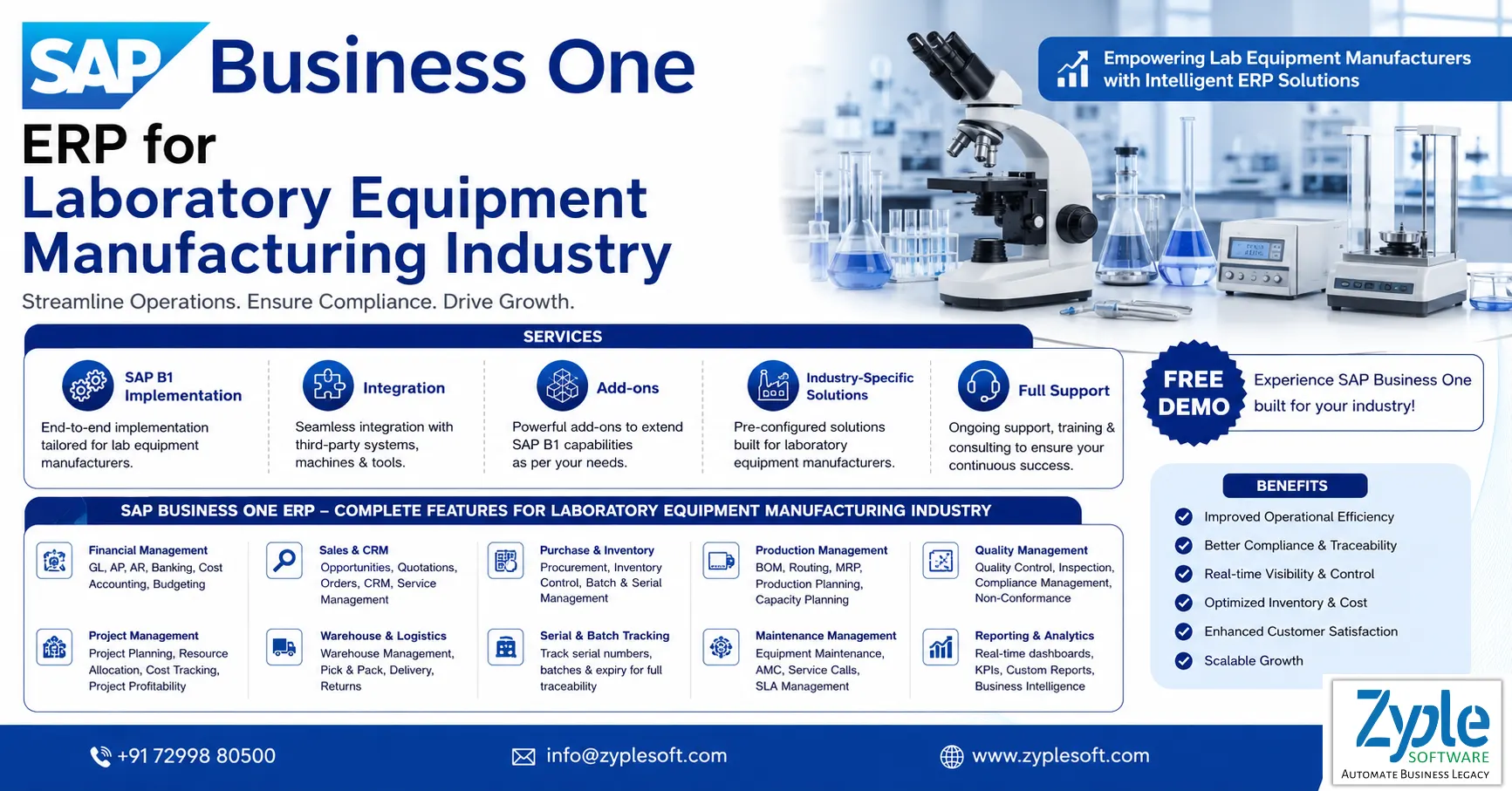
    SAP Business One ERP for Laboratory Equipment Manufacturing Industry infographic by Zyple Software featuring implementation, integration, add-ons, compliance, inventory, production, quality management, and analytics.

    SAP Business One ERP for Laboratory Equipment Manufacturing Industry

    SAP Business One ERP Software for Laboratory Equipment Manufacturing Industry

    SAP Business One ERP for Laboratory Equipment Manufacturing Industry infographic by Zyple Software featuring implementation, integration, add-ons, compliance, inventory, production, quality management, and analytics.

    The laboratory equipment manufacturing industry operates under strict quality standards, regulatory pressure, and rising competition. Manufacturers must handle complex production workflows, ensure complete traceability, and maintain consistent quality while scaling operations. SAP Business One ERP for laboratory equipment manufacturing delivers a structured ERP foundation to handle these challenges and support long-term growth without operational chaos.

    Challenges Faced By The Laboratory Equipment Manufacturing Industry

    The laboratory equipment manufacturing industry faces strict regulatory compliance, rapid technological obsolescence, and miniaturization demands. Companies struggle with supply chain disruptions, a shortage of skilled labor for complex mechatronic systems, and fierce global competition, all of which heavily squeeze profit margins and increase time to market.

    1. Strict Regulatory Compliance

    Manufacturers must handle evolving global standards such as GLP, GMP, and ISO certifications. Continuously updating designs to achieve these mandates creates massive administrative burdens.

    2. Component Shortages and Supply Chain

    The industry is heavily dependent on precise, specialized sub-components. Global supply chain volatility often results in prolonged lead times, inflating manufacturing and service costs.

    3. Skill Gaps in Development and Assembly

    Building complex mechatronic systems involves advanced specialist knowledge in software integration, automation, and electronics. Small and mid-scale manufacturers often lack the engineering manpower and high-end production infrastructure required to scale.

    4. Device Integration and Compatibility

    Laboratories frequently use instruments from different vendors. Disparate software systems, differing communication protocols, and the lack of universal standards hamper seamless data flow and integration.

    5. Equipment Downtime and Service Pressures

    Executives place huge pressure on equipment uptime to prevent costly research or sample losses. Extended resolution times for repairs and complex maintenance cycles severely affect operational efficiency and customer satisfaction.

    Features of SAP Business One ERP for Laboratory Equipment Manufacturing

    1. End-to-End Manufacturing Management

    • It includes bill of materials (BOM) for complex lab instruments.
    • It includes multi-level production orders and routing.
    • It includes production planning and control based on demand forecasts.
    • It includes batch and serial number tracking for precision components.
    • It includes real-time shop floor control and reporting.

    2. Quality Control and Compliance Management

    • It includes quality inspection at incoming, in-process, and final stages.
    • It includes non-conformance and corrective action tracking (CAPA).
    • It includes compliance with ISO, GMP, FDA, and calibration standards.
    • It includes audit trail and documentation management.
    • It includes calibration scheduling and tracking for lab equipment.

    3. Inventory and Warehouse Management

    • It includes real-time inventory tracking across warehouses.
    • It includes batch or lot traceability for service components.
    • It includes automated stock replenishment and reorder levels.
    • It includes handling of hazardous or sensitive materials.
    • It includes barcode and RFID integration.

    4. Product Lifecycle Management

    • It includes engineering change management.
    • It includes version control for product designs and specifications.
    • It includes integration with CAD systems.
    • It includes prototype and R&D cost tracking.

    5. Advanced Material Requirements Planning (MRP)

    • It includes demand-driven MRP for raw materials and components.
    • It includes forecasting based on historical sales and trends.
    • It includes supplier lead time management.
    • Reduces stockouts and excess inventory.

    6. Supplier and Procurement Management

    • It includes vendor evaluation and performance tracking.
    • It includes automated purchase requests and approvals.
    • It includes supplier pricing and contract management.
    • It includes integration with global supply chains.

    7. Financial Management and Cost Control

    • It includes real-time financial reporting and analytics.
    • Product costing like standard, moving average, and FIFO.
    • It includes budgeting and cost center tracking.
    • It includes multi-currency and multi-location support.
    • It includes GST compliance for India.

    8. Sales and Customer Relationship Management (CRM)

    • It includes lead and opportunity management.
    • It includes quotation and sales order automation.
    • It includes customer-specific pricing and contracts.
    • It includes after-sales service tracking for lab equipment.
    • It includes warranty and service contract management.

    9. Service and Maintenance Management

    • It includes installation and commissioning tracking.
    • It includes preventive and corrective maintenance scheduling.
    • It includes service call management.
    • It includes spare parts inventory integration.
    • It includes field service technician management.

    10. Business Intelligence and Reporting

    • It includes real-time dashboards and KPIs.
    • It includes custom reports for production, quality, and finance.
    • It includes predictive analytics for demand and maintenance.
    • It includes integration with Excel and analytics tools.

    11. Integration and Scalability

    • Seamless integration with third-party systems like LIMS, CAD, and MES.
    • It includes API-based connectivity.
    • It includes cloud and on-premise deployment options.
    • Adaptable for growing manufacturing businesses.

    12. Data Security and Regulatory Compliance

    • It includes role-based access control.
    • It includes data encryption and secure backups.
    • It includes compliance with industry regulations.
    • It includes full audit trails for traceability.

    13. Mobility and Remote Access

    • It includes remote access to dashboards and reports.
    • It includes real-time alerts and notifications.

    14. Customization and Industry-Specific Add-Ons

    • It includes customization workflows for laboratory equipment manufacturing.
    • It includes industry-specific SAP B1 add-ons for calibration and compliance.
    • It includes flexible user-defined fields and reports.

    15. Project Management Capabilities

    • Tracks R&D and custom equipment projects.
    • It includes budget vs. actual cost tracking.
    • It includes resource allocation and scheduling.
    • It includes milestone-based project monitoring.

    Importance of SAP Business One ERP for Laboratory Equipment Manufacturing

    The ERP software, SAP Business One (SAP B1) system, is essential for laboratory equipment manufacturers, as it unifies core processes, including finance, supply chain, and production, into a single source of truth. It allows highly precise manufacturing, strict regulatory compliance, and seamless tracking of expensive components, ultimately boosting operational efficiency and profit margins.

    1. Strict Regulatory Compliance

    The industry requires thorough quality control and traceability. SAP B1 automates quality checks, maintains audit-ready documentation, and monitors components so that manufacturers can easily adhere to global standards like ISO and FDA regulations.

    2. Precise Production Management

    Utilizing multi-level bill of materials (BOMs) and material requirements planning (MRP), the software helps handle complex assembly. It ensures you have the exact components needed to build precision instruments without holding excess stock using SAP implementation.

    3. Granular Traceability

    Every piece of lab equipment, from sensors to centrifuges, can be serialized. This enables manufacturers to trace the exact batch or serial number of an item from raw material procurement through to post-sales maintenance and service.

    4. Real-Time Financial and Inventory Visibility

    SAP B1 eliminates data silos. Real-time dashboards track machine utilization, labor costs, and project profitability, enabling leadership to make accurate, data-driven decisions.

    5. Supply Chain Optimization

    It reduces the risk of stock-outs or overstocking for specialized, often costly, materials required for lab equipment, ensuring on-time delivery and higher customer satisfaction using SAP solutions.

    Benefits of SAP Business One for Laboratory Equipment Manufacturing Industry

    SAP Business One (SAP B1) facilitates your lab equipment manufacturing by centralizing finance, supply chain, and production. It drives ROI through accurate BOM management, serial or batch traceability, and automated material requirements planning (MRP), minimizing carrying costs and ensuring strict industry compliance.

    1. Precision Manufacturing

    Utilizes powerful bill of materials (BOM) features to standardize production, control costs, and handle complex, multi-level assemblies required for sensitive scientific instruments.

    2. Total Traceability

    The SAP software tracks individual components, batches, and serial numbers from procurement to finished goods. This makes managing warranties and handling audits for ISO and regulatory compliance efficient.

    3. Optimized Inventory and Procurement

    The material requirements planning (MRP) system automatically computes purchasing and production needs based on forecasts and lead times, avoiding production delays and stockouts.

    4. Real-Time Analytics

    Unifies financial, sales, and operational data into customizable dashboards using SAP B1 add-ons. This allows data-driven decisions that immediately improve profit margins.

    5. Integrated CRM

    Strengthens customer relationships by managing leads, tracking after-sales service, and logging maintenance or calibration histories in a single platform.

    Conclusion of Laboratory Equipment Manufacturing ERP

    As a qualified SAP Business One partner, Zyple Software is providing services like SAP B1 implementation, integration, licensing, add-ons, and support to different industries like construction, manufacturing, retail, pharma, jewellery, solar, food and beverage, aerospace, and textile industries. SAP Business One is an ERP customized for small and medium-sized businesses that integrates finance, purchasing, sales, inventory, production, CRM, and reporting into a single platform. For solar panel and laboratory equipment manufacturing or any other companies, it can improve project costing, procurement, subcontractor billing, and inventory management.

    If you’re engaged, reserve a demo of SAP Business One.

    Do you necessitate the SAP B1 ERP system for your business or industry?

    Finish all the details in the described contact form; our team will get back to you.

      Frequently Asked Questions

      How can SAP Business One improve efficiency in my laboratory equipment manufacturing business?

      SAP Business One automates key processes like production planning, inventory control, and financial management, helping you minimize manual work, eliminate errors, and improve overall efficiency.

      Yes, SAP Business One is specifically designed for SMEs and growing manufacturers. It providesscalable features that adapt to your business size and complexity.

      The cost depends on factors like number of users, customization needs, and deployment type (like cloud or on-premises). We deliver customized pricing based on your requirements; reach out today for a free consultation and quote.

      The SAP B1 implementation timelines generallyrange from a few weeks to a few months, depending on your business processes. Speak with our team to get a clear project timeline customized for your needs.

      Absolutely! We provide live demos to help you understand how SAP Business One fits your laboratory equipment manufacturing processes.

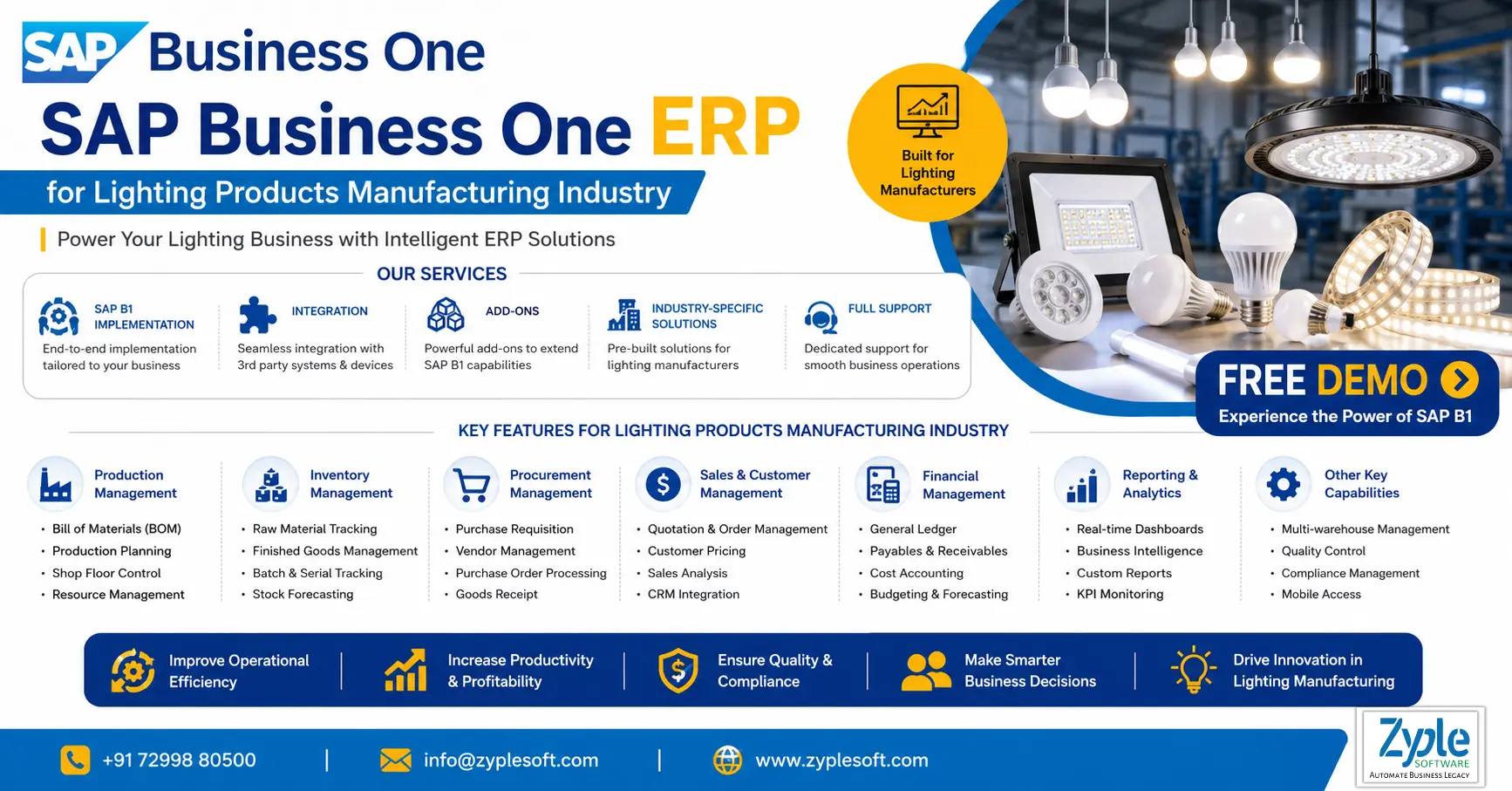
      SAP Business One ERP for Lighting Products Manufacturing Industry

      SAP Business One for Lighting Products Manufacturing Industry

      SAP Business One ERP for Lighting Products Manufacturing Industry

      SAP Business One ERP for Lighting Products Manufacturing Industry

      The lighting products manufacturing industry is at the forefront of the global shift towards energy-efficient and enivironmentally friendly lighting solutions. The lighting technology has rapidly gained popularity for its energy-saving capabilities and long-lasting performance, making it an important part of modern lighting solutions for homes, businesses, and industries. SAP Business One ERP for lighting products manufacturing can significantly improve efficiency, cost control, quality management, and overall business performance in the lighting products manufacturing industry.

      Challenges Faced By The Lighting Products Manufacturing Industry

      1. Supply Chain and Raw Material Volatility

      Heavy dependence on global electronic components leaves manufacturers vulnerable to semiconductor and LED chip shortages. Geopolitical shifts and transportation obstacles frequently drive up freight costs and extend lead times. Pricing instability for necessary raw materials like aluminium, copper, and plastics squeezes profit margins.

      2. Market Pressures and Fierce Competition

      Local manufacturers struggle, as the market is flooded with low-cost, mass-produced lighting products, specifically from overseas competitors. High taxation rates can lead to revenue leakage, while evolving global efficiency standards involve continuous redesigns and recertification.

      3. Technological Shifts and Product Evolution

      Developing IoT-enabled, integrated smart lights is resource-intensive. Consumers now require high a Color Rendering Index (CRI) and flicker-free performance, forcing manufacturers to upgrade quality control measures. Industrial applications involve specialized fixtures built to withstand extreme temperatures, moisture, and corrosive chemicals, increasing manufacturing complexity.

      4. Sustainability and the Circular Economy

      There is a growing demand for products customized for easy repair, modularity, and recyclability. Compliance with environmental regulations regarding electronic waste involves modifying traditional production lines.

      5. Labor and Automation Constraints

      As lighting technology becomes more complex, finding technicians and engineers capable of handling advanced manufacturing processes is challenging. Companies face pressure to invest in robotics and lights out manufacturing to minimize human error and labor costs, though the initial capital expenditure remains a barrier for many.

      Features of SAP Business One ERP for Lighting Products Manufacturing

      1. Core Financial Management

      • It includes general ledger and accounts payable and receivable.
      • Cost center accounting for product lines like LED bulbs, panels, and fixtures.
      • It includes fixed asset management for machinery and tooling.
      • It includes bank reconciliation and GST compliance.
      • Tracks profitability per lighting product, project, or distribution channel.

      2. Sales and Customer Relationship Management (CRM)

      • Lead and opportunity management, like projects, distributors, and contractors.
      • It includes a quotation for order management.
      • Pricing management like bulk, dealer, and project-based.
      • It includes after-sales service and warranty tracking.
      • It includes customer lifecycle management.
      • Handles B2B sales for real estate, infrastructure, and retail lighting projects.

      3. Purchasing and Vendor Management

      • It includes supplier quotation comparison.
      • It includes purchase order automation.
      • It includes vendor evaluation and performance tracking.
      • It includes multi-currency procurement.
      • It includes import and export documentation support.
      • It includes efficient sourcing of LED chips, drivers, housing, and electronic components.

      4. Inventory and Warehouse Management

      • Batch and serial number tracking is essential for LED components.
      • It includes multi-warehouse and bin location management.
      • It includes stock valuation and ageing analysis.
      • It includes automated reorder levels.

      5. Bill of Materials (BOM) Management

      • It includes multi-level BOMs for complex lighting assemblies.
      • It includes version control and engineering change management.
      • It includes sub-assembly and phantom BOM support.
      • Handles BOM for LED panel lights, street lights, or smart lighting systems.

      6. Production Planning and Control

      • It includes production order management.
      • It includes material requirements planning (MRP).
      • It includes demand forecasting and scheduling.
      • Capacity planning for machines and labor.
      • It includes shop floor control.
      • Plans production for seasonal demand like festive lighting and infrastructure projects.

      7. Manufacturing Execution and Shop Floor Management

      • It includes routing and operations tracking.
      • It includes work-in-progress (WIP) tracking.
      • It includes machine utilization monitoring.
      • It includes real-time production updates.
      • Monitors assembly lines for LED bulbs, drivers, and fixtures.

      8. Quality Control and Compliance

      • Test result recording like lumen output, voltage, and heat resistance.
      • It includes compliance with BIS and ISO standards.
      • It includes automated quality documentation.

      9. Product Costing and Profitability

      • It includes standard and actual costing.
      • It includes margin analysis per product.
      • It includes cost simulation for new designs.
      • It calculates the exact cost of LED fixtures and optimizes pricing.

      10. Warehouse and Logistics Management

      • It includes goods receipt and dispatch management.
      • It includes pick, pack, and ship processes.
      • It includes delivery route planning.
      • It includes integration with logistics providers.
      • It includes efficient distribution to dealers, retailers, and project sites.

      11. Business Intelligence (BI) and Analytics

      • It includes real-time dashboards and KPIs.
      • It includes sales, production, and real-time analytics.
      • It includes drill-down reporting.
      • It includes Excel integration and visualization tools.
      • Identifies top-selling lighting products and demand trends.

      12. Project Management (Lighting Projects)

      • It includes project costing and budgeting.
      • It includes resource allocation.
      • It includes timeline tracking.
      • It includes integration with sales and procurement.
      • Handles turnkey lighting projects like commercial projects and smart cities.

      13. Service Management and Warranty Tracking

      • It includes service contract management.
      • It includes warranty tracking for lighting products.
      • It includes complaint and repair management.
      • It includes field service scheduling.
      • Handles warranty claims for LED lights and fixtures.

      14. Mobility and Web Access

      • It includes mobile apps for sales and service teams.
      • It includes web-based access for remote operations.
      • It includes real-time updates on inventory and updates.
      • Sales teams can evaluate stock and place orders on-site.

      15. Integration and Scalability

      • Integration with SAP B1 HANA.
      • It includes API integration with e-commerce and IoT devices.
      • It includes add-ons for industry-specific needs.
      • It includes cloud or on-premise deployment.
      • Integrates smart lighting systems or IoT-enabled products.

      16. Production Cost Optimization and Planning

      • It includes machine planning and scheduling.
      • It includes just-in-time (JIT) production.
      • It includes FIFO inventory management.
      • It includes resource optimization.
      • Minimizes wastage in LED manufacturing and optimizes production cycles.

      17. Batch Production and Traceability

      • It includes batch and lot tracking for components.
      • It includes full traceability from raw material to finished goods.
      • It includes recall management.
      • Tracks defective batches of LED drivers or chips quickly.

      Benefits of SAP Business One ERP for Lighting Products Manufacturing

      The ERP software, SAP Business One (SAP B1) system, delivers specialized modules tailored for lighting and LED manufacturers. It optimizes production planning, inventory tracking, and supply chain management to reduce operational costs and waste. By connecting shop-floor actions to financials, it generates real-time reports to ensure compliance and improve overall profit margins.

      1. Accurate Bill of Materials (BOM) and Routing

      Lighting fixtures often require complex sub-assemblies like LED drivers, heat sinks, housings, and diffusers. SAP implementation handles multi-level BOMs, standardizing production and helping manufacturers track exact material usage while cutting down on scrap and rework.

      2. Facilitated Material Requirements Planning (MRP)

      The MRP engine automatically evaluates sales forecasts, current stock, and lead times to calculate exactly when and how much raw material to purchase. This avoids over-purchasing while ensuring you never face stockouts during large production runs.

      3. Complete Traceability and Quality Control

      Components like LED chips and drivers must comply with safety and performance certifications. SAP B1 supports strict lot and serial number tracking, allowing end-to-end traceability from raw material to finished product, which simplifies warranty management and defect root-cause analysis.

      4. Real-Time Inventory and Cost Management

      SAP solutions deliver continuous visibility into warehouse operations, managing stock levels of raw materials, work-in-progress (WIP), and finished goods. By linking material usage, labor, and overhead directly to the general ledger, it calculates accurate Cost of Goods Sold (COGS), which is essential for smart pricing and margin analysis.

      5. Compliance and Regulatory Alignment

      The lighting industry frequently adjusts to energy efficiency and environmental mandates like RoHS, CE, and BIS. SAP B1 helps businesses evaluate regulatory documentation and compliance-related activities within a centralized and audit-ready system.

      Conclusion of Lighting Products Manufacturing ERP

      Zyple Software is a certified SAP Business One partner in India specializing in implementation, digital transformation, licensing, integration, add-on solutions, migration, and consulting for the lighting products manufacturing industry. SAP software is an out-of-the-box solution and is developed by keeping in mind the specific requirements and complexities of lighting products manufacturing businesses.

      If you’re engaged, arrange a demo of SAP Business One.

      Do you want the SAP B1 ERP software for your business or industry?

      Finish all the details in the given contact form; our team will return to you.

        1.How can SAP Business One improve efficiency in my lighting manufacturing business?

        SAP Business One facilitates your entire operation, from procurement of components like LEDs and drivers to production, inventory, and sales. It eliminates manual processes, minimizes errors, and gives real-time visibility, helping you increase productivity and reduce operational costs.


        Unlike generic ERP systems, SAP Business One provides built-in manufacturing, inventory, and financial management in one platform. It is scalable, cost-effective for SMEs, and can be designed specifically for lighting product assembly and component tracking.

        Most lighting manufacturers start seeing measurable ROI within a few months through better inventory control, minimized wastage, improved production planning, and faster order fulfillment.

        Yes, SAP Business One ERP has an intuitive interface and role-based dashboards, making it easy for shop floor workers, warehouse staff, and management to adopt with minimal training.

        You can connect with an authorized SAP B1 partner, like Zyple Software, who will evaluate your requirements, provide a customized demo, and guide you through pricing, implementation, and support options.

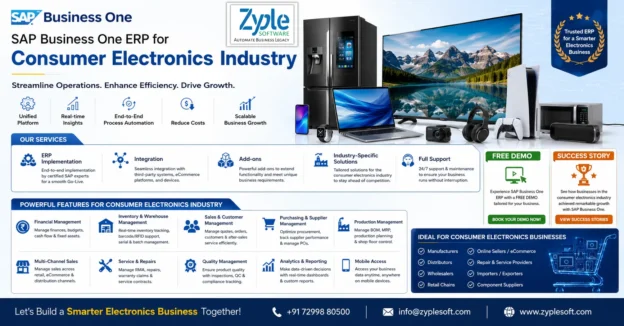
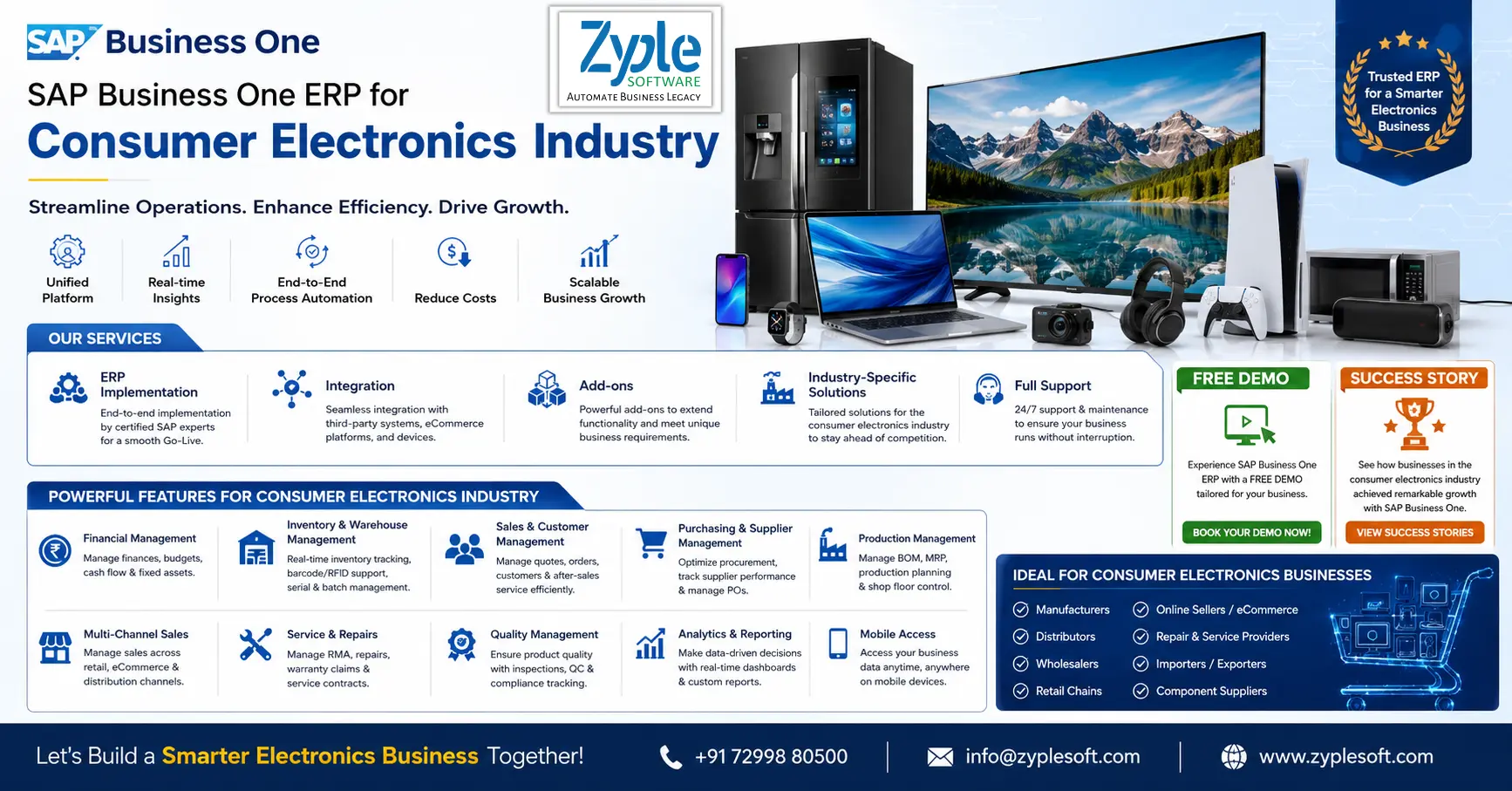
        SAP Business One ERP for Consumer Electronics Industry

        SAP B1 ERP for Consumer Electronics Industry

        SAP Business One ERP for Consumer Electronics Industry

        SAP Business One ERP for Consumer Electronics Industry

        The consumer electronics industry, a foundation of modern innovation, succeeds on rapid technological advancements, dynamic market demands, and precision-driven operations. However, handling such a fast-paced industry comes with its own set of challenges, from inventory control and production scheduling to achieving strict compliance standards. SAP Business One ERP for consumer electronics industry helps small and medium-sized consumer electronics businesses to achieve the business needs of the sector.

        Challenges Faced By the Consumer Electronics Industry

        1. Complex Supply Chain Management

        Consumer electronics manufacturing requires complex supply chains with multiple vendors, global sourcing, and time-sensitive deliveries.

        2. Inventory Overload or Stockouts

        Balancing inventory to achieve demand without overstocking or understocking remains a serious challenge.

        3. Stringent Compliance Requirements

        Complying with international standards, such as RoHS and WEEE, demands powerful documentation and tracking systems.

        4. Fast-Paced Innovation Cycles

        Consumer electronics products often have short life cycles, requiring quick scalability to market trends.

        5. Cost Management

        Rising costs of raw materials, labor, and logistics can significantly affect profitability.

        Handling these challenges requires a solution that integrates operations, improves visibility, and ensures flexibility, all of which SAP Business One delivers seamlessly.

        Features of SAP Business One ERP for Consumer Electronics Industry

        1. Financial Management

        • It includes general ledger, accounts payable, and accounts receivable.
        • It includes budgeting, cost accounting, and cash flow tracking.
        • It includes multi-currency and multi-branch financial integration.
        • It includes real-time financial reporting and profitability analysis.
        • It helps consumer electronics companies handle thin margins and high inventory costs.

        2. Sales and Customer Relationship Management (CRM)

        • It includes lead and opportunity tracking.
        • It includes the entire sales cycle from quotation, order, and delivery to invoicing.
        • It includes customer lifecycle and service history tracking.
        • It includes after-sales service and support management.
        • It includes marketing campaign management.
        • Essential for handling distributors, retailers, and direct customers.

        3. Purchasing and Supplier Management

        • It includes vendor management and procurement planning.
        • It includes purchase orders, GRPO, returns, and invoicing.
        • It includes supplier price lists and evaluation.
        • It includes import or export and multi-currency purchasing.
        • Necessary due to global sourcing of consumer electronic components.

        4. Inventory and Warehouse Management

        • It includes real-time inventory tracking across warehouses.
        • It includes batch and serial number tracking.
        • It includes stock transfer and bin location management.
        • It includes automated reordering and stock level optimization.
        • Avoids stockouts of fast-moving consumer electronics and overstocking of obsolete items.

        5. Business Intelligence and Analytics

        • It includes real-time dashboards and KPIs.
        • It includes sales forecasting and trend analysis.
        • It includes inventory turnover and aging reports.
        • It includes custom report generation with drill-down capabilities.
        • Allows faster decisions in a rapidly evolving consumer electronics market.

        6. Production and Assembly Management

        • It includes bill of materials (BOM) for multi-level assemblies.
        • It includes assembly, kitting, and disassembly processes.
        • It includes production planning and scheduling.
        • It includes shop floor control.
        • Suitable for products like TVs, mobiles, appliances, and accessories.

        7. Demand Planning and Forecasting

        • It includes sales forecasting based on trends and seasonality.
        • It includes procurement planning aligned with demand.
        • Crucial due to short product lifecycles and seasonal demand spikes.

        8. Serial Number and Traceability Management

        • Tracks each product by serial number.
        • It includes full traceability from procurement to sale.
        • It includes recall and defect training.
        • Essential for warranty claims and quality compliance.

        9. Warranty and Service Management

        • It includes warranty tracking and validation.
        • It includes repair and replacement management.
        • It includes service contract management.
        • It includes AMC (Annual Maintenance Contract) handling.
        • Necessary for after-sales service in consumer electronics.

        10. Supply Chain and Logistics Management

        • It includes end-to-end supply chain visibility.
        • It includes distribution network dealers (dealers and retailers).
        • It includes logistics and shipment tracking.
        • It includes integration with third-party logistics.
        • Helps handle complex multichannel distribution.

        11. Quality Control and Compliance

        • It includes inspection plans and quality checks.
        • It includes defect tracking and corrective actions.
        • It includes compliance with electronics standards.
        • It ensures product reliability and regulatory adherence.

        12. Multi-Channel Sales Integration

        • It includes retail, e-commerce, and distributor integration.
        • It includes POS (Point of Sale) integration.
        • It includes real-time stock sync across channels.
        • It supports omnichannel consumer electronics sales.

        13. Product Lifecycle Management

        • It includes new product introduction (NPI) tracking.
        • It includes version and revision control.
        • It includes phase-out management for obsolete products.
        • Essential due to rapid innovation cycles in consumer electronics.

        14. Mobility and Remote Access

        • It includes mobile apps for sales and service teams.
        • It includes real-time access to inventory and sales orders.

        15. Cloud and Integration Capabilities

        • It includes deployment on the cloud or on-premise.
        • It includes integration with IoT devices, e-commerce platforms, and CRM tools.
        • It includes API-based third-party integrations.

        Importance of SAP Business One ERP for Consumer Electronics Industry

        The ERP software, SAP Business One (SAP B1) system, is essential for the consumer electronics industry because it centralizes operations, facilitates complex supply chains, and automates multi-stage manufacturing. It enables fast-growing companies to minimize production waste, track complex electronic components, and ensure global regulatory compliance in real-time.

        1. Precision Inventory and Traceability

        Tracks electronic components, serial numbers, and batch lots to eliminate stockouts, avoid overstocking, and ensure rapid quality control.

        2. Facilitated Production Planning and Material Requirements Planning (MRP)

        Supports intelligent manufacturing schedules, improving material requirement planning (MRP) to align seamlessly with fluctuating consumer demand.

        3. Regulatory Compliance

        Automatically monitors materials to ensure adherence to strict industry mandates like RoHS (Restriction of Hazardous Substances) and WEEE (Waste Electrical and Electronic Equipment).

        4. Integrated Financials

        Unifies accounting, multi-currency transactions, and budgeting directly with operational data, providing businesses a crystal-clear picture of their profitability using SAP implementation.

        5. Customer Relationship Management (CRM)

        Captures customer interactions, tracks sales opportunities, and analyzes buying behavior to improve post-sales service and support.

        Benefits of SAP Business One for Consumer Electronics Industry

        1. Improved Operational Efficiency

        Automating repetitive tasks and connecting key processes saves time and minimizes errors.

        2. Improved Decision-Making

        With centralized data and powerful analytics, leaders can make better decisions quickly using SAP solutions.

        3. Regulatory Compliance Simplified

        Tracks and documents compliance-related activities seamlessly to prevent penalties and delays.

        4. Increased Agility

        Quickly adjusts to market changes and new technological advancements.

        5. Cost Savings

        Improved resource planning and minimized waste translate to significant cost reductions.

        6. Better Customer Satisfaction

        Delivers on commitments with accurate order tracking and improved delivery timelines.

        Conclusion of Consumer Electronics ERP

        Zyple Software is a certified SAP Business One partner in India specializing in implementation, digital transformation, licensing, integration, add-on solutions, migration, and consulting for the consumer electronics industry. From facilitating operations to ensuring compliance and improving customer satisfaction, the features and benefits of SAP software help in empowering consumer electronics businesses.

        If you’re assigned, book a demo of SAP Business One.

        Do you necessitate the SAP Business One ERP system for your business or industry?

        Complete all the details in the defined contact form; our team will return to you.

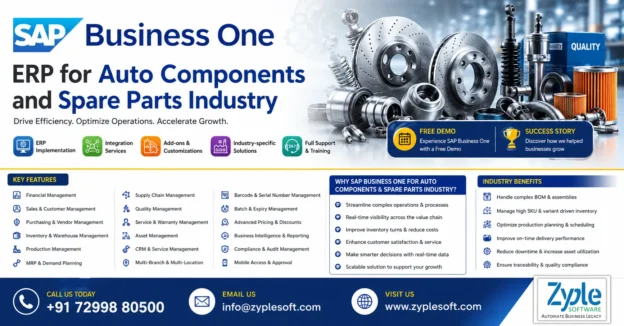
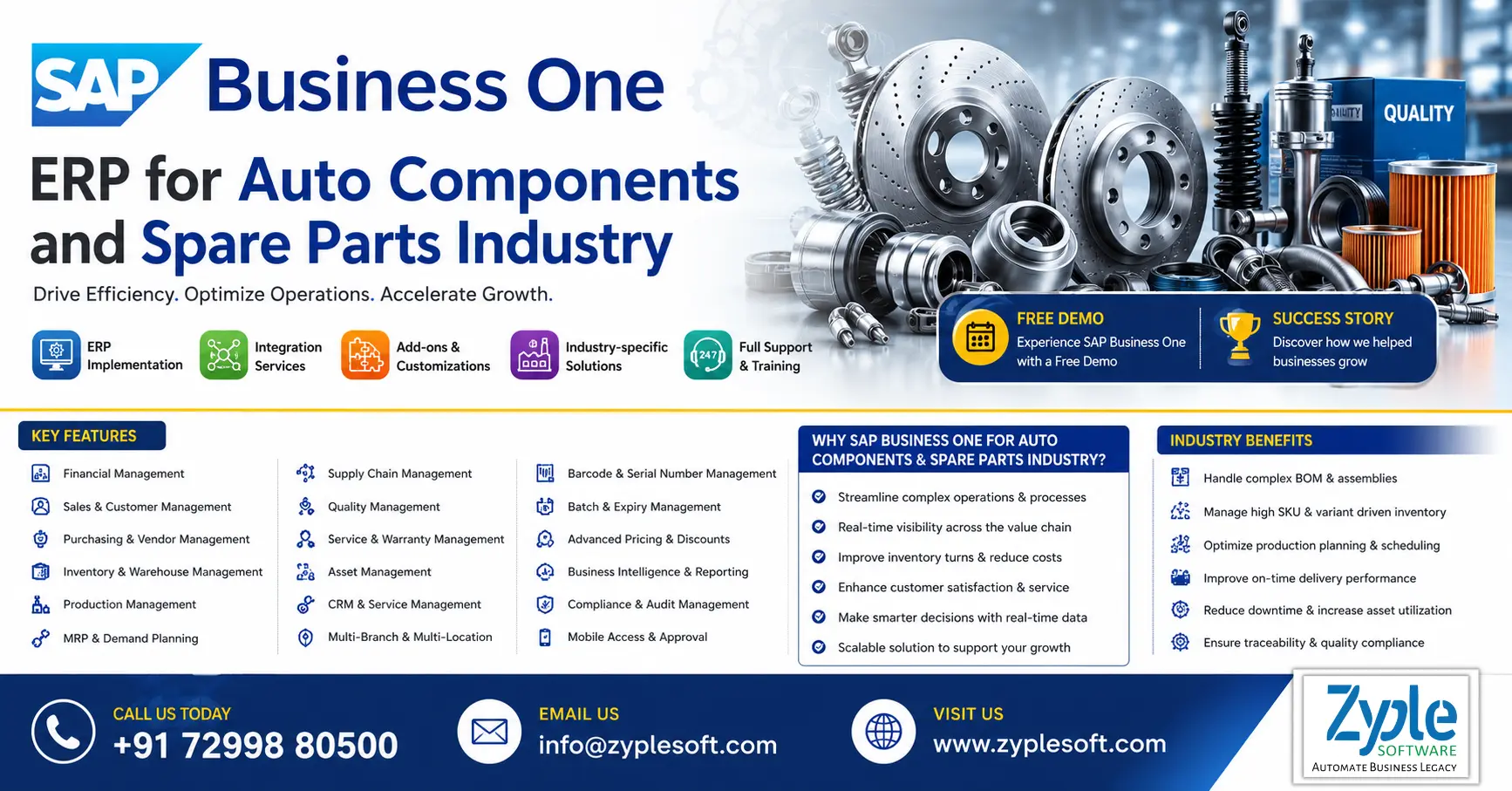
          SAP Business One ERP for Auto Components and Spare Parts industry

          SAP Business One ERP for Auto Components and Spare Parts Industry

          SAP Business One ERP for Auto Components and Spare Parts Industry

          SAP Business One ERP for Auto Components and Spare Parts industry

          The auto components and spare parts industry requires precise inventory management, cost tracking, and facilitated processes. The continuously changing market dynamics of the auto components and spare parts sector have always presented a series of challenges to cope with. SAP Business One ERP for auto component and spare part plays an important role in helping auto components and spare parts businesses implement a cost-effective ERP solution designed for these needs.

          Challenges Faced By the Auto Components and Spare Parts Industry

          The auto components and spare parts industry faces serious challenges, mainly driven by rapid technology shifts towards electric vehicles (EVs), supply chain volatility, and high raw material costs. Key hurdles include handling complex inventory, navigating strict regulatory compliance, managing counterfeiting, and investing in new technology for automation and electrification.

          1. Technology Transition (EV Shift)

          The transition to electric vehicles involves huge investment, as EVs have fewer moving parts than internal combustion engines, making many traditional components obsolete.

          2. Supply Chain Disruptions

          Shortages of essential components like semiconductors, raw material fluctuations, and logistics delays impede production schedules.

          3. Inventory Management and Diversity

          Manufacturers struggle with the high diversity of parts, resulting in high storage costs, risk of obsolescence, and the need for complex inventory management systems.

          4. Counterfeit Products

          A massive influx of fake, lower-quality products affects revenue and damages brand reputation.

          5. Regulatory Compliance

          Navigating strict international and local regulations on safety, emissions, and importing or exporting components.

          6. Cost Pressures

          High inflation, rising labor costs, and competitive pricing pressures minimize profit margins.

          7. Skilled Labor Shortages

          Growing difficulty in finding skilled technicians to manage advanced electronics and diagnostic technologies.

          Features of SAP Business One ERP for Auto Components and Spare Parts

          1. Production Planning and Bill of Materials (BOM)

          • Handles multi-level BOMs for complex auto components (assemblies, sub-assemblies, and spare kits).
          • Tracks raw materials, machining processes, and labor costs.
          • Manages job work or subcontracting (common in auto component manufacturing).
          • Optimizes production scheduling.
          • Ideal for industries producing parts like brake systems, engine components, fasteners, and more.

          2. Inventory and Spare Parts Management

          • It includes real-time stock visibility across warehouses.
          • Handles batch and serial number tracking (essential for traceability).
          • Manages fast-moving and slow-moving spare parts efficiently.
          • Supports multi-warehouse and bin location management.

          3. Procurement and Vendor Management

          • Handles multiple suppliers and price lists.
          • Tracks vendor performance and quality.
          • Ensures timely procurement of raw materials and spare parts.
          • Essential for auto industries relying on multiple-tier suppliers.

          4. Sales and Distribution Management

          • The entire order-to-cash cycle from quotation, order, and delivery to invoice.
          • It includes customer-specific pricing and discounts.
          • It includes dealer and distributor management.
          • It includes sales forecasting and pipeline tracking.
          • It includes integration with CRM and marketing campaigns.
          • Multi-channel sales, including retail, wholesale, and e-commerce integration.
          • Necessary for spare parts wholesalers and automotive distributors.

          5. Material Requirements Planning (MRP)

          • It includes an automated MRP wizard to plan procurement and production.
          • Demand forecasting subject to sales orders and historical data.
          • Auto-generation of purchase orders and production orders.
          • It includes lead-time scheduling for suppliers.
          • Helps prevent stockouts and overstocking in spare parts distribution.
          • Essential for handling thousands of spare parts.

          6. Spare Parts Traceability and Compliance

          • It includes batch or serial traceability for each component.
          • Tracks parts from the supplier and warehouse to the customer.
          • It includes quality inspection and rejection handling.
          • It includes compliance with automotive standards.
          • It includes recall management support.
          • Essential for safety-critical components.

          7. Quality Control Management

          • It includes incoming, in-process, and final inspection.
          • It includes quality test parameters for parts.
          • It includes non-conformance tracking.
          • It includes vendor quality analysis.
          • It includes integration with production.
          • It ensures consistent product quality in manufacturing.

          8. Service and Warranty Management

          • It includes warranty tracking and claim management.
          • It includes service contracts and AMC management.
          • It includes service call logging and resolution.
          • It includes spare parts consumption during service.
          • It includes after-sales service tracking.
          • Essential for dealers, service centers, and OEMs.

          9. Financial Management and Accounting

          • It includes general, accounts payable, accounts receivable, and taxation.
          • It includes cost accounting for production.
          • It includes profitability analysis by product or consumer.
          • It includes budgeting and cash flow management.
          • It includes multi-currency and multi-branch accounting.
          • Delivers full financial control over operations.

          10. Business Intelligence and Reporting

          • It includes real-time dashboards and KPIs.
          • It includes sales, inventory, and production analytics.
          • It includes custom reports and Excel integration.
          • It includes demand vs. supply analysis.
          • It includes profitability reports.
          • Allows data-driven decision-making.

          11. Multi-Branch and Multi-Location Management

          • Handles multiple warehouses, plants, and branches.
          • Integrated reporting across locations.
          • It includes inter-branch transactions.
          • Ideal for automotive companies with multiple depots.

          12. Integration and Automation

          • Integration with CRM systems, e-commerce platforms, and logistics and payment gateways.
          • It includes automated workflows and approvals.
          • It includes API-based integrations.

          13. Mobile and Web Access

          • It includes mobile apps for sales and service teams.
          • It includes real-time access everywhere.

          14. Industry-Specific Automotive Capabilities

          • It includes parts lifecycle management from procurement and sale to service.
          • It includes vendor and dealer collaboration.
          • It includes aftermarket spare parts management.
          • It includes demand planning for seasonal parts.
          • It includes logistics and distribution optimization.
          • Support for OEM suppliers, tier-1 or tier-2 manufacturers, and spare parts distributors.

          Importance of SAP Business One ERP for Auto Components and Spare Parts

          The enterprise resource planning (ERP) software, SAP Business One (SAP B1) system, is essential for the auto components and spare parts industry by delivering end-to-end operational visibility, real-time inventory management, and facilitated production tracking. It allows manufacturers to handle complex supply chains, maintain precise compliance, and minimize stockouts, directly increasing profitability and efficiency.

          1. Real-Time Inventory and Warehouse Management

          Automates stock tracking, minimizes carrying costs, and eliminates overstocking through accurate demand forecasting and barcode scanning.

          2. Improved Production Planning

          Connects shop floor processes to optimize production, identify obstacles in real-time, and improve overall manufacturing efficiency.

          3. Complete Supply Chain Control

          Gives visibility from initial supplier procurement to final dealer delivery, ensuring timely delivery of raw materials using SAP implementation.

          4. Quality Control and Compliance

          Allows precise tracking of parts, lots, and serial numbers, necessary for strict automotive quality regulations and reducing recall risks.

          5. Financial Accuracy and Reporting

          Provides integrated financial management for monitoring margins, tracking supplier costs, and handling complex, multi-currency transactions.

          6. Customer and Dealer Management

          Facilitates sales processes, allowing customized pricing, discount management, and improved customer service, which increases satisfaction using SAP solutions.

          Benefits of SAP Business One for Auto Components and Spare Parts

          SAP Business One (SAP B1) delivers auto component manufacturers and spare part dealers an integrated, scalable ERP solution to optimize supply chains, handle complex inventory, and improve profitability. It allows real-time tracking of parts, improves production planning, and ensures compliance with industry standards, leading to improved customer satisfaction and lower operational costs.

          1. Facilitated Inventory Management

          Real-time visibility and barcode scanning optimize stock levels, minimizing carrying costs and reducing stockouts.

          2. Improved Production and Planning

          Allows efficient material requirements planning (MRP), handling production schedules, and tracking raw materials to finished components.

          3. Complete Supply Chain Visibility

          Integrates suppliers, manufacturers, and customers, allowing accurate, timely deliveries and forecasting.

          4. Quality Control and Compliance

          The SAP software ensures compliance with ISO standards and supports electronic data interchange (EDI) to handle high-quality standards and vendor communication.

          5. Integrated Financials and CRM

          Automates financial processes and delivers complete insights into profitability, pricing, and sales performance.

          Conclusion of Auto Components and Spare Parts ERP

          Zyple Software is a certified SAP Business One partner in India specializing in implementation, digital transformation, migration, licensing, integration, add-on solutions, and consulting for the auto component and spare parts industry. The SAP Business One solution is customized to benefit auto components and spare parts companies in different ways including effective inventory management, materials requirement planning, quality control, and supply chain management.

          If you’re proficient, book a demo of SAP Business One.

          Do you demand the SAP Business One ERP system for your business or industry?

          Complete all the details in the provided contact form; our team will return to you.

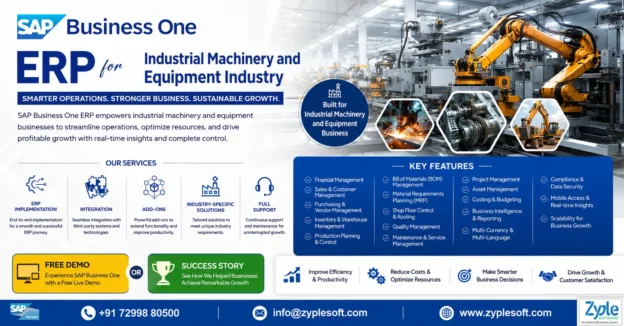
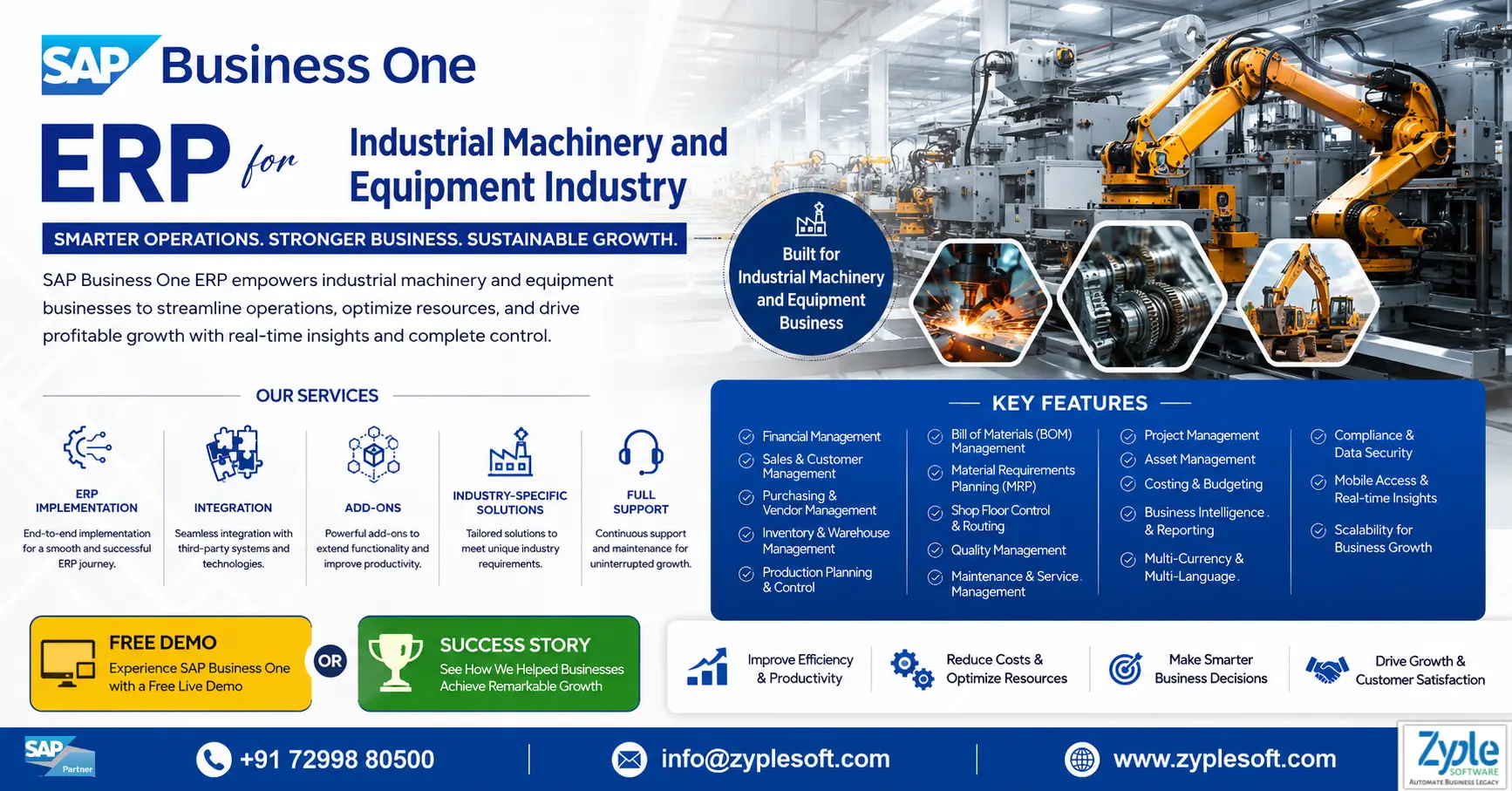
            SAP Business One ERP for Industrial Machinery and Equipment industry

            SAP B1 ERP for Industrial Machinery and Equipment Industry

            SAP Business One ERP for Industrial Machinery and Equipment Industry

            SAP Business One ERP for Industrial Machinery and Equipment industry

            The industrial machinery and equipment industry faces huge pressure due to its vast scope of work, which requires project management, heavy machinery loading, shipping, warehousing, and other responsibilities. This sector probably has logistics issues and needs a system that unifies different company departments. SAP Business One ERP for industrial machinery and equipment unites processes and helps in boosting production and efficiency.

            Challenges Faced By The Industrial Machinery and Equipment Industry

            The industrial machinery and equipment industry faces significant challenges, mainly driven by supply chain volatility, rising costs, the need for rapid digital transformation, and increasing demand for customized, sustainable solutions. Key barriers include handling skilled labor shortages, navigating geopolitical trade issues, and integrating AI and IoT for predictive maintenance.

            1. Supply Chain Disruptions and Cost Inflation

            Manufacturers are battling volatile raw material prices and logistics constraints, urging widespread cost-cutting and pricing adjustments to maintain margins.

            2. Rapid Digitization and Tech Integration

            Adopting AI, IoT connectivity, and cloud-based systems for machinery is necessary. Companies must upgrade legacy systems to provide smart, connected equipment, with many struggling to integrate data from disparate systems.

            3. Customization vs. Standardized Production

            There is high demand for specialized machinery, which often conflicts with the requirement to maintain standardized, high-volume production efficiency.

            4. Skilled Labor Shortages

            A significant gap exists between required skills and available talent, impacting productivity, technical support, and innovation capacity.

            5. Market Volatility and Increased Competition

            Global economic shifts, including overcapacity in India, create rising competitive pressure and price sensitivity.

            Features of SAP Business One ERP for Industrial Machinery and Equipment

            1. Engineer-To-Order and Make-to-Order Manufacturing

            • Handles custom machinery production based on client specifications.
            • Manages multi-level bills of materials (BOM) and complex product structures.
            • Integrates with CAD/PDM systems for design-to-production flow.
            • Tracks engineering changes (ECR/ECO).
            • Supports long production cycles and staged manufacturing.

            2. Production Planning and Shop Floor Control

            • It includes advanced production planning and scheduling.
            • Optimizes machine capacity and resource utilization.
            • Handles work orders, routing, and operations.
            • Monitors work-in-progress (WIP) in real-time.
            • Minimizes scrap, rework, and downtime.

            3. Project-Based Manufacturing and Costing

            • Executes project-driven manufacturing.
            • Tracks costs by project, job, or order.
            • Monitors budget vs. actuals.
            • Analyzes order-wise and project-wise profitability.
            • Handles milestones, billing, and timelines.

            4. Inventory, Spare Parts, and Warehouse Management

            • It includes real-time visibility across warehouses.
            • Handles raw materials, WIP, and finished goods.
            • Tracks spare parts and service inventory.
            • Supports batch or serial number tracking.
            • Optimizes stock levels and minimizes stockouts.

            5. Procurement and Supplier Management

            • It includes an end-to-end procure-to-pay cycle.
            • It includes vendor evaluation and supplier performance tracking.
            • Handles purchase orders, GRNs, and invoices.
            • Controls material costs and lead times.
            • Ensures product compliance in sourcing.

            6. Sales, CRM, and Order Management

            • Handles long sales cycle for capital equipment.
            • Tracks leads, opportunities, and quotations.
            • Configures complex pricing and contracts.
            • Maintains a complete customer lifecycle.
            • Forecasts sales pipeline and demand.

            7. Service and Maintenance Management (After-Sales)

            • Handles installation, AMC, and warranty contracts.
            • Tracks service calls and field service operations.
            • Schedules preventive and breakdown maintenance.
            • Maintains installed base and equipment history.
            • Improves customer service and uptime.

            8. Asset and Equipment Lifecycle Management

            • Tracks machines, tools, and capital equipment.
            • Monitors asset depreciation and lifecycle costs.
            • Handles equipment usage and maintenance schedules.
            • Improves asset utilization and ROI.

            9. Financial Management and Cost Control

            • It includes integrated accounting, accounts receivable, accounts payable, and general ledger.
            • Controls production and project costs.
            • Tracks cash flow and profitability.
            • Automates financial reporting and compliance.

            10. Quality Control and Compliance

            • Defines quality inspection plans.
            • Performs incoming, in-process, and final inspections.
            • Ensures compliance with industry standards.
            • Tracks defects, rework, and corrective actions.

            11. Supply Chain and Distribution Management

            • Optimizes logistics and distribution of heavy equipment.
            • Handles multi-location operations (plants, warehouses, and branches).
            • Improves delivery timelines and order fulfillment.
            • Minimizes supply chain costs.

            12. Business Intelligence and Real-Time Analytics

            • It includes real-time dashboards and KPIs.
            • It includes drill-down analytics across departments.
            • It includes custom reports and forecasting.
            • It includes data-driven decision-making.

            13. Integration and Automation

            • Integrates with CAD, IoT, MES, barcode or RFID systems.
            • Automates production, procurement, and finance workflows.
            • Connects with third-party applications and e-commerce.
            • Allows digital transformation in manufacturing.

            14. Multi-Branch and Global Operations

            • Handles multiple plants, warehouses, and subsidiaries.
            • Supports multi-currency and multi-tax structures.
            • Integrates financials across locations.
            • Standardizes processes enterprise-wide.

            15. Mobility and Cloud Access

            • It includes access to ERP via mobile apps and web client.
            • Allows remote approvals and monitoring.
            • Supports field service and sales teams on the go.

            Importance of SAP Business One ERP for Industrial Machinery and Equipment

            The enterprise resource planning (ERP) software, SAP Business One (SAP B1) system, is essential for industrial machinery and equipment manufacturers by delivering an integrated, scalable ERP solution that handles complex engineer-to-order (ETO) processes, improves production scheduling, and increases inventory accuracy simultaneously. It boosts operational efficiency by connecting departments, providing accurate cost tracking, and strengthening quality control, which helps manufacturers minimize waste, handle complex BOMs (Bills of Materials), and comply with regulatory standards.

            1. Project-Based Production Management

            Supports complex manufacturing models such as engineer-to-order (ETO), make-to-order (MTO), and assembly, enabling customized production for specific customer machines.

            2. Real-Time Data Visibility and Control

            Integrates departments like procurement, engineering, finance, and shop floor on a single database, eliminating storage and delivering real-time insights into production and inventory using SAP implementation.

            3. Material Requirements Planning (MRP)

            Allows efficient material planning, minimizing obstacles and stockout situations while optimizing inventory situations.

            4. Quality Control and Compliance

            Implements efficient material planning, ensuring compliance with industry standards and safety regulations.

            5. Improved Shop Floor Activity

            Delivers visibility into work orders, machine utilization, and labor productivity to optimize output.

            Benefits of SAP Business One for Industrial Machinery and Equipment

            SAP Business One (SAP B1) provides industrial machinery and equipment manufacturers an inclusive, scalable ERP solution that facilitates production, improves inventory control, and increases profitability. It dleivers real-time visibility from procurement to assembly (including ETO and MTO), ensuring optimal machine utilization and improved compliance with industry standards.

            1. Optimized Production and Planning

            Supports complex manufacturing processes such as engineer-to-order (ETO) and make-to-order (MTO). It facilitates BOM (Bill of Materials) management, production orders, and scheduling to reduce lead times using SAP solutions.

            2. Real-Time Inventory and Supply Chain Management

            Tracks raw materials, work-in-progress, and finished goods in real-time, minimizing carrying costs and preventing stockouts.

            3. Improved Cost Control and Profitability

            Provides complete financial tracking, helping companies calculate true product costs, analyze profit margins, and reduce waste.

            4. Improved Efficiency and Productivity

            Automates key processes, from procurement to final delivery, minimizing manual labor and facilitating operations.

            5. Data-Driven Decision-Making

            Provides actionable insights through real-time reporting, enabling managers to monitor KPIs, machine utilization, and worker productivity.

            6. Scalability for Growth

            As a customized solution for small to medium-sized manufacturers, SAP software provides the flexibility to adapt to expanding production lines or new locations without requiring a complete system replacement.

            Conclusion of Industrial Machinery and Equipment ERP

            Zyple Software is a certified SAP Business One partner in India specializing in implementation, digital transformation, licensing, integration, add-on solutions, migration, and consulting for the industrial machinery and equipment industry. With real-time insights and scalable processes, SAP Business One allows industrial machinery and equipment companies to increase efficiency, improve efficiency, and grow confidently in a highly competitive market.

            If you’re expert, book a demo of SAP Business One.

            Do you necessitate the SAP Business One ERP software for your business or industry?

            Complete all the details in the defined contact form; our team will get back to you.

              SAP Business One erp for Maritime Industry

              SAP Business One for Maritime Industry

              SAP Business One ERP for Maritime Industry

              SAP Business One erp for Maritime Industry

              The maritime industry plays an important role in global trade, requiring accuracy and efficiency at every step. SAP Business One for maritime industry helps handle challenges like fleet management, regulatory compliance, and rising operational costs. SAP Business One ERP delivers designed solutions to facilitate logistics, improve customer relationships, and increase supply chain efficiency. With SAP B1 implementation, maritime companies can gain real-time insights, minimize operational costs, and boost performance.

              Key Challenges in the Maritime Industry

              The maritime industry is struggling with the range of challenges that require forward-thinking solutions for growth and efficiency. Companies must handle issues such as fleet optimization, rising operational costs, and compliance with stringent environmental regulations. The rapid pace of technological change, along with the need for smooth data integration, intensifies the pressure to remain competitive. To succeed, maritime businesses must focus on improving operational workflows, increasing customer experience, and adopting innovative digital tools. 

              Here are the key challenges confronting the maritime sector:

              1. Rising Operational Costs

              Rising fuel prices damage budgets, forcing maritime operators to seek innovative strategies for cost management and efficiency improvements.

              2. Supply Chain Disruptions

              Unforeseen disruptions in global supply chains can obstruct timely operations, necessitating flexible strategies to reduce impacts on maritime logistics.

              3. Safety and Security Risks

              Ensuring the safety of personnel and vessels amid rising security threats requires thorough risk management and training programs.

              4. Increased Competition

              The maritime industry is highly competitive, demanding businesses to innovate and deliver value-added services to stay ahead.

              Features of SAP Business One for Maritime Industry

              1. Fleet Management

              Tracking, managing, and improving vehicle operations, including maintenance, fuel consumption, driver performance, and leasing.

              2. Finance and Accounting

              Automating key financial processes like general ledger, journal entries, budgeting, and bank reconciliation.

              3. Production

              Handling the end-to-end manufacturing process, including bills of materials (BOM) management, production orders, resource planning, and goods movements.

              4. Purchasing

              Handling the entire lifecycle of acquiring goods and services, from vendor selection to final payment.

              5. Operation Management

              Facilitating core processes, such as inventory, purchasing, production, and sales, into one system.

              6. Manufacturing Integration

              Integrating the ERP system with shop-floor systems, such as Manufacturing Execution Systems (MES), PLCs, and IoT devices, to synchronize production data, automate inventory updates, and gain real-time visibility.

              7. Customized Report

              It is a designed data analysis tool customized to display specific business metrics, KPIs, or information not available in standard, out-of-the-box reports.

              8. Business Intelligence and Analytics

              Real-time data analysis allows small and medium-sized enterprises (SMEs) to monitor performance, visualize data via dashboards, and make better decisions.

              9. Forecasting

              Predicting future customer demand, allowing businesses to optimize inventory levels, production schedules, and purchasing to avoid stockouts or excess stock.

              10. Cost Management

              Tracking, allocating, and analyzing expenses and revenues across different business units, departments, or projects to monitor profitability.

              11. Sales and CRM

              Handling the entire customer lifecycle, from initial lead, through sales opportunities, to quotations and orders.

              12. Cash Flow Management

              Real-time tracking and forecasting of incoming and outgoing money to maintain liquidity and guarantee financial stability.

              13. Business Planning

              Facilitating core processes to allow data-driven decision-making through real-time reporting, supporting on-premise or cloud deployment.

              14. Bank Integrations

              Secure, automated connection between the ERP system and banking platforms, allowing seamless, direct exchange of financial data.

              15. Business Partners

              Represents the master data for all external identities in a company interacts with customers, vendors (suppliers), and leads.

              16. Add-Ons

              Extensions that connect directly into the core ERP system to deliver specialized, industry-specific, or improved functionality.

              Importance of SAP Business One for Maritime Industry

              SAP Business One (SAP B1) is important for the maritime industry, providing an integrated, real-time ERP solution that facilitates shipbuilding, inventory, and supply chain operations. It improves project management, minimizes costs through automation, and ensures compliance with maritime regulations. Important reasons include improved data visibility, optimized resource management, and scalable, accurate financial reporting for shipyards and marine services using SAP implementation.

              1. Integrated Project Management

              Handles complex ship construction projects from planning to delivery, tracking milestones and costs in real-time.

              2. Operational Efficiency and Automation

              Automates procurement, inventory management, and supplier communication, minimizing manual workload and errors.

              3. Improved Resource Management

              Allows accurate, real-time monitoring of resources (materials, labor, and machinery) to avoid waste and minimize operational costs.

              4. Financial Control and Compliance

              Delivers accurate, audit-ready financial data and helps in managing industry-specific regulatory standards, minimizing penalties.

              5. Real-Time Analytics and Reporting

              Provides powerful dashboards for analyzing KPIs, helping managers make data-driven decisions on production and sales.

              6. Scalability for Growth

              Supports the expanding requirements of maritime businesses, including improved project complexity, through a scalable, flexible platform.

              7. Supply Chain Optimization

              Facilitates logistics by coordinating procurement and warehousing, improving overall profitability.

              Benefits of SAP Business One ERP for Maritime Industry

              SAP Business One (SAP B1) provides maritime companies a centralized, scalable SAP solutions to optimize fleet operations, manage complex shipbuilding projects, and improve supply chain efficiency. Core benefits include real-time financial oversight, improved inventory control, automated procurement, and regulatory compliance, ensuring increased profitability, minimized downtime, and faster on-time deliveries.

              1. Operational Capabilities and Digital Transformation

              Facilitates processes from order-to-cash, including purchase order generation from sales orders, minimizing manual inaccuracies and accelerating workflows.

              2. Inventory and Logistics Management

              Optimizes inventory levels for shipyards, preventing overstocking, and improves supply chain visibility for logistics, including tracking BP catalog numbers (vendor or customer part numbers).

              3. Improved Fleet and Maintenance Control

              Allows scheduling of preventive maintenance and real-time monitoring of vessel status to reduce costly downtime.

              4. Financial and Contract Management

              Allows tracking of freight contracts and supplier agreements, delivering detailed profitability analysis, financial reporting, and automated payment scheduling.

              5. Real-Time Data and Reporting

              Delivers 360-degree visibility into operations via interactive dashboards, allowing better, faster decision-making for managing complex, long-term projects.

              6. Ease of Use and Integration

              Grows with the business, enabling the addition of users and functionalities, ensuring a future-proof investment.

              Conclusion of Maritime ERP

              As a certified SAP Business One partner, Zyple Software brings unparalleled expertise and dedication to businesses seeking seamless SAP Business One services.

              Do you pursue ERP software for your business or industry?

              Fill in all the details in the allocated form; our team will get back to you.

                How to Buy SAP B1 Software

                How to Buy SAP B1 Software?

                How to Buy SAP Business One (SAP B1) Software in India?

                How to Buy SAP B1 Software

                What is SAP Business One ERP?

                The ERP system, SAP Business One (SAP B1) ERP, is a cost-effective, integrated ERP software solution designed for small and medium-sized enterprises (SMEs) and fast-growing companies to manage key operations, including finance, sales, CRM, inventory, and production in one system. It facilitates workflows and delivers real-time analytics to improve decision-making, providing flexible, scalable deployment on-premises or in the cloud. Here, we will discuss how to buy SAP B1 software.

                How to Buy SAP B1 Software Online?

                The Process of buying SAP Business One (SAP B1) software online is primarily done through the official SAP store, where you can identify, configure, and purchase solutions directly. The process involves choosing the appropriate license type (professional or limited), modifying user counts, and integrating with Zyple Software for implementation.

                1. Visit the SAP Store

                Navigate to the SAP store and ensure your country/region is properly selected to see relevant pricing and partners like Zyple Software.

                2. Search and Select

                Use the search bar to find SAP Business One.

                3. Configuration of License

                Choose between a perpetual license or a subscription model based on user types (Professional vs. Limited).

                4. Buy or Integrate

                Click “Buy Now” to purchase directly or “Get It Now” to integrate with a partner like Zyple Software to discuss requirements and implementation.

                5. Payment & Access

                Finish the final payment process. For cloud-based options, you may receive access details directly, while on-premise solutions will involve coordination with Zyple.

                How to Buy SAP Business One Software in India?

                To buy SAP Business One (SAP B1) software in India, you must engage Zyple Software to conduct a needs evaluation, customize, and implement the software. The major steps include choosing a deployment model (cloud or on-premise) and selecting user licenses (professional or limited).

                1. Identify an Authorized Partner

                Contact Zyple Software, a certified SAP Business One partner in India, to receive customized quotes, as they manage sales, implementation, and support.

                2. Needs Evaluation and Demo

                Request an inclusive demonstration and a needs evaluation to define which modules (finance, CRM, and inventory) your business requires.

                3. Choosing a Licensing Model

                This includes two types of SAP B1 licensing models:

                • Professional Users: It is the type of SAP Business One licensing model where users have full access to all modules.
                • Limited Users: It is the type of SAP Business One licensing model where users have specific or limited access to modules like CRM, finance, and logistics.

                4. Choose Deployment Process

                Choose between on-premise (perpetual license) and cloud (subscription model).

                5. Installation & Full Support

                Work with Zyple to design the system to your requirements and set up continuous maintenance.

                Know About Customized SAP Business One Pricing India

                We understand that the SAP Business One price in India varies based on factors such as company size, user count, data complexity, and user needs. As your trusted SAP B1 partner in India, we specialize in licensing and crafting personalized blueprints to outline the exact SAP Business One pricing for your organization.

                With decades of experience, we navigate you through the complexities of SAP B1 software price and licensing costs, considering factors like purchasing process, database options (SAP B1 SQL or SAP B1 HANA), hosting preferences (cloud or on-premise), and necessary maintenance and support. If you’re concerned, book an SAP B1 demo.

                Whether you’re in manufacturing, construction, real estate, retail, pharmaceuticals, textiles, logistics, energy or any other sector, our customized approach ensures that the SAP Business One cost remains within budget and aligns perfectly with your unique business model and SAP B1 pricing.

                Not only licensing, but when it comes to SAP implementation, our company delivers excellent support and services to different industries like manufacturing, construction, real estate, retail, pharmaceutical, textile, professional services, aerospace and defense, and more to help them cater to their requirements with the growing competition.

                Key Factors That Impact SAP Business One Price in India

                1. Deployment Models like Cloud and On-Premise

                One of the biggest SAP B1 pricing factors is how you choose to launch SAP Business One like on-premise or the cloud.

                Every model has its own cost structure and long-term financial implications.

                2. Number of Users and License Types

                SAP Business One’s pricing differs based on

                • Number of users accessing the SAP B1 system.
                • Type of users (Professional and Limited).

                Businesses can improve costs by selecting the right type of user licenses instead of assigning full access to everyone.

                3. Business Size and Industry Requirements

                The overall cost depends largely on:

                • Size of the organization.
                • Industry-specific needs (manufacturing, construction, real estate, retail, pharmaceutical, textile, professional services, aerospace and defense, and more).

                Some industries may require additional configurations or compliance features, which can impact pricing.

                4. Customization and Add-On Development

                SAP Business One can be improved with:

                • Industry-specific add-ons.
                • Process automation and integrations.

                The level of customization directly impacts the final project cost.

                5. Implementation and Consulting Services

                SAP B1 ERP pricing is not only about SAP Business One licenses; SAP B1 implementation services play a crucial role in the following:

                • System modification.
                • Data migration.
                • User training.
                • Go-live support.

                A structured and expert-led implementation ensures improved ROI and long-term success.

                6. Support, Annual Maintenance Costs, and Managed Services

                Post-implementation costs include:.

                • Support.
                • System upgrades.
                • Performance optimization.
                • Continuous improvements.

                Choosing a reliable SAP partner, Zyple Software, helps reduce these costs while ensuring system stability.

                Types of SAP Business One Licenses

                Experience personalized guidance from experts to navigate SAP Business One price in India, along with maintenance, SAP support, and implementation. Select from a variety of SAP Business One licenses, including professional and limited licenses, designed for your business requirements.

                1. Professional License

                With professional SAP Business One licenses, you can gain the full spectrum of SAP Business One’s capabilities, allowing access to all modules or features. Select between flexible subscription or perpetual license options to match your business needs seamlessly by delivering the most affordable SAP Business One cost. It is the SAP B1 ERP license suitable for users who need complete access to the system, like managers and decision-makers.

                2. Limited License

                In SAP Business One limited licenses, the offerings deliver focused solutions across three areas, such as CRM, financial, and logistics. Every option provides a unique blend of modules and features to handle specific business needs. This type of SAP B1 license helps you to find the ideal fit for your requirements. It is the SAP B1 ERP license suitable for users who require access only to some modules in the SAP B1 system.

                Are you looking for SAP Business One Software for your any business or industry?

                Fill in all the details in the specified contact form; our team will reach out to you.

                  Choose SAP ERP Implementation Partner

                  Choose SAP ERP Implementation Partner

                  How to Choose SAP ERP Implementation Partner?

                  Choose SAP ERP Implementation Partner

                  Selecting the right SAP ERP implementation partner is one of the most critical decisions your business will make.

                  An ERP system like SAP Business One can transform operations but only if implemented correctly. The wrong partner can lead to delays, cost overruns, user resistance, and underutilized systems.

                  How do you choose the right SAP ERP implementation partner?

                  1. Check Industry-Specific Experience (Not Just SAP Knowledge)

                  Many firms say they “implement SAP.” That’s not enough.

                  A strong implementation partner should understand:

                  • Your industry workflows
                  • Compliance requirements
                  • Operational bottlenecks
                  • Reporting expectations
                  • Growth challenges

                  For example:

                  1. Manufacturing requires BOM, production planning, and MRP expertise
                  2. Retail needs POS integration and multi-branch consolidation
                  3. Construction requires project cost tracking and milestone billing
                  4. Pharma demands batch tracking and regulatory compliance

                  ERP success depends on domain knowledge but not just technical setup.

                  2. Verify SAP Authorization and Partnership Status

                  Ensure the partner is officially aligned with SAP SE.

                  Ask:

                  • Are they an authorized SAP partner?
                  • Do they have certified SAP consultants?
                  • How many SAP projects have they completed?

                  Certification ensures access to proper implementation methodologies, updates, and support standards.

                  3️. Evaluate Implementation Methodology

                  A professional SAP Business partner should follow a structured process:

                  • Requirement study and gap analysis
                  • Solution blueprint
                  • System configuration
                  • Data migration
                  • User training
                  • Go-live support
                  • Post-implementation optimization

                  If the partner can not clearly explain their methodology, that’s a red flag.

                  4. Look for Industry Case Studies

                  Real results matter more than promises.

                  Ask for:

                  • Case studies
                  • Client references
                  • Before-and-after performance improvements
                  • ROI metrics

                  Examples of measurable outcomes:

                  • 20–30% inventory reduction
                  • Improved working capital visibility
                  • Faster month-end financial closing
                  • Reduced manual errors

                  A credible partner will have proof of success.

                  5. Assess Customization and Add-On Capability

                  Every business has unique processes.

                  Your SAP ERP partner should:

                  • Offer industry-specific add-ons
                  • Provide integration capabilities
                  • Customize reports & dashboards
                  • Connect with third-party systems

                  A one-size-fits-all approach rarely works.

                  6. Understand Post-Implementation Support

                  ERP implementation does not end at go-live.

                  Ask:

                  1. Do they offer ongoing support?
                  2. What are their SLA terms?
                  3. Is there a dedicated support team?
                  4. Do they provide system optimization services?

                  Strong post-go-live support determines long-term success.

                  7. Evaluate Local & Regional Presence

                  For Indian businesses especially, a partner with local market understanding offers advantages:

                  • Knowledge of GST compliance
                  • Indian taxation structure
                  • Regional business practices
                  • Faster on-site support

                  If you’re operating in India, choosing a SAP ERP partner with strong Indian market experience is critical.

                  8. Transparency in Costing

                  Avoid vague pricing structures.

                  A reliable SAP ERP implementation partner should clearly explain:

                  • License cost
                  • Implementation cost
                  • Customization charges
                  • Annual maintenance
                  • Support fees

                  Transparency prevents budget surprises.

                  9. Scalability for Future Growth

                  ERP is a long-term investment.

                  Ensure the partner can support:

                  • Multi-branch expansion
                  • Multi-currency operations
                  • Increased transaction volume
                  • Advanced analytics
                  • Industry compliance evolution

                  The right partner prepares your ERP for the next 5–10 years.

                  Why Choosing the Right SAP ERP Partner Matters?

                  ERP implementation impacts:

                  • Financial visibility
                  • Operational efficiency
                  • Inventory management
                  • Compliance
                  • Customer satisfaction

                  The right partner like Zyple Software becomes a long-term strategic advisor  –  not just a software installer.

                  Final Conclusion

                  Choosing the right SAP ERP implementation partner is not about selecting the cheapest option.

                  It’s about selecting:

                  • Industry expertise
                  • Proven methodology
                  • Transparent pricing
                  • Long-term support capability
                  • Strong SAP ecosystem alignment

                  If you’re evaluating SAP ERP for Manufacturing, Retail, Construction, Real estate, Pharma, Textile, or other industries in India, take time to assess your implementation partner carefully.

                  A well-implemented SAP ERP system can transform your business.
                  The right partner makes all the difference.

                  Let us fill your detail in contact form. A right implementation partner will contact you soon as per your business needs.

                    manufacturing erp

                    Manufacturing ERP for Industry

                    Manufacturing ERP Software for Companies

                    manufacturing erp

                    It is a specialized software system designed to help manufacturers manage and integrate different business processes, including production planning, supply chain management, and inventory management, into a single, unified platform. It facilitates operations, improves efficiency, and provides real-time insights into metrics, ultimately boosting productivity and profitability.

                    Best ERP Software for Manufacturing in India

                    SAP Business One is a comprehensive ERP software for manufacturing in India, specifically for small to medium-sized enterprises (SMEs). It provides a comprehensive suite of tools for managing various aspects of a manufacturing business, from production planning to sales and financials, all within a single integrated system.

                    Features of Manufacturing ERP

                    1. Inventory

                    Gain real-time visibility into stock levels, minimizing overstock and stockouts while optimizing inventory costs.

                    2. Production Management

                    Facilitate your workflows and reduce manual tasks to improve efficiency and focus on strategic initiatives.

                    3. Planning and Scheduling

                    Improve operational efficiency with detailed work order tracking and production timeline management.

                    4. Order Management

                    Track orders from creation to fulfillment, ensuring on-time delivery and increased customer satisfaction.

                    5. Quality and Inspection

                    Digitize quality checks, covering inward, in-process, and final inspections, for real-time tracking.

                    6. Tool Management

                    Expand the lifespan of tools with detailed tracking of usage and maintenance schedules.

                    7. Purchase

                    Facilitate processes with automated workflows and vendor management for timely purchasing.

                    8. Maintenance

                    Analyze downtime to identify patterns and execute corrective measures, boosting efficiency.

                    9. Subcontracting

                    Oversee outsourced production smoothly with real-time visibility into every stage of the process.

                    10. Costing

                    Understanding expenses at every stage of manufacturing is crucial for profitability and efficiency.

                    Types of ERP Software in the Manufacturing Industry

                    Different types of ERP systems are available today to cater to the requirements of a manufacturing company based on their size and functionality. The best manufacturing ERP solution is the one that supports adaptive manufacturing enterprises and can adjust to change and thus provides a competitive advantage to the business.

                    On-Premise Software

                    This type of manufacturing ERP software on implementation needs support, control, and ownership of the system, including the risk and cost related to managing hardware and system infrastructure for manufacturers.

                    Cloud-Based ERP Software

                    Manufacturers having this type of software have a flexible yet inclusive system with consistent updates, support, training, and even customization options.

                    Hybrid ERP

                    Setting up a hybrid ERP provides manufacturers with a fusion of on-premise and cloud-based hosting and deployment services. This system provides users the flexibility to migrate between delivery models or integrate benefits that do not come with the existing implementations.

                    Benefits of Manufacturing ERP Software

                    This ERP software improves business processes, provides accurate real-time data, and reduces costs. Here are some of the key benefits of an ERP system for manufacturers.

                    Real-Time Data

                    Real-time data has revolutionized the manufacturing industry by evolving how shops are managed and goods are manufactured. Real-time data provided by manufacturing ERP systems lets you know which of your production processes, machines, work centers, and product lines are operating at high levels of quality and efficiency, which enables you to make changes quickly and fix any issues before they get out of hand.

                    Real-time lets you continuously track, control, and fine-tune your shop for maximum efficiency. With this, you can manage your shop floor schedule, consistently improve product quality, and maintain your equipment to create a high-performing manufacturing plant.

                    Improved Efficiency

                    Manufacturing ERP systems help maximize your shop’s efficiency by facilitating your business processes. All shops use QR codes on all items to facilitate inventory tracking, making it easy to scan items in and out and maintain accurate records. Inventory management has significantly improved with SAP Business One ERP, helping to improve efficiency and expand production. This ERP software facilitates your tasks and business processes so you can do things quicker, greater, and more consistently.

                    Improved Operational Efficiency

                    Spend and invest wisely and see the results. ERP systems provide integrated financial insights that recognize areas where costs can be reduced. These systems are customized with tools that support accurate budgeting and financial forecasting. Identify the most profitable product lines and find the suitable pricing strategies to increase revenue.

                    Better Supply Chain Visibility

                    Manage resources more efficiently. SAP solutions provide a comprehensive view of supplier performance and procurement needs and monitor inventory levels to ensure they remain at the right levels. This avoids any holding costs or stockouts. The demand planning features align production with demand forecasts to prevent any overproduction or missed sales opportunities.

                    Regulatory Compliance and Quality Control

                    Stay ahead of possible issues across the board. ERP systems minimize legal risks or compliance issues by continuously monitoring production processes. They keep comprehensive and accurate records of operations to avoid any potential challenges around audits or compliance checks. Companies use the software to stay within the bounds of regulatory frameworks.

                    How to Choose the Best Manufacturing ERP System

                    To choose the best manufacturing ERP system, business leaders must understand what they need. By considering these steps, leaders can assess potential ERP systems based on what would benefit their operation, rather than evaluating a one-size-fits-all list of criteria.

                    1. Understand Your Business Needs

                    A business can’t build and implement an ERP system without having a clear understanding of what the system will need to do. Many manufacturers start this process by collaborating with different stakeholders to create a list of must-have ERP features. They do this by deciding what data to track, what processes to facilitate, and what reports and monitoring will be required to continuously improve operations. This process involves identifying the enterprise’s operational strengths and weaknesses, growth strategies, and specific inventory and production requirements.

                    2. Assess Features and Functionalities

                    Once a business has arranged its needs and goals, these can be met with the features of an ERP solution. If a manufacturer plans to facilitate inventory management, it should seek an ERP system with advanced inventory functionalities, such as product sorting, order tracking, and warehouse controls. They should also assess the ease of use, integration capabilities with existing systems, and long-term scalability. Scalability is important because it ensures that the type of ERP system chosen can adapt and grow alongside the business, accommodating future expansion and evolving requirements. This foresight can help reduce downtime and frustration during the transition as the business evolves.

                    3. Assess Vendors

                    Manufacturers must also consider such factors as the vendor’s reputation, its experience in the manufacturing industry, and its customer service capabilities. For instance, it’s important to select a vendor that, in addition to providing a robust ERP system, also provides comprehensive support during SAP implementation and beyond. Also, manufacturers might want to consider the vendor’s financial stability, how long its product has been on the market, and whether it’s committed to updating or improving their ERP system from both a technology and security standpoint.

                    4. Assess Total Cost of Ownership

                    The total cost of ownership (TCO) of an ERP includes the initial purchase price and all costs associated with the system, such as implementation, training, operation, maintenance, and upgrades. Therefore, manufacturers must plan and budget for direct costs, like software licenses and hardware, and indirect costs, like the cost of temporarily shifting staff from their usual jobs to roles focused on establishing the ERP system during its rollout.

                    5. Assess Technological Advancements

                    Advanced technologies, including cloud computing, artificial intelligence (AI), machine learning, and internet of things (IoT) devices, can offer significant advantages in terms of user-friendliness, real-time data analysis, predictive maintenance, and more.

                    6. Manage Implementation and change

                    The time and resources required to implement an ERP system should be primarily considered when weighing alternatives. Once the ERP solution is fully integrated, business leaders can use the system to break down traditionally stored processes, such as order processing, financials, and inventory management, to facilitate operations and provide a detailed sight of the company.

                    7. Evaluate ROI

                    Evaluating possible return on investment (ROI) involves comparing the financial gains resulting from implementing the ERP system against the total cost of ownership. Given the significant investment generally associated with implementing an ERP solution, manufacturers must carefully calculate ROI to determine the value of the system as a whole, its specific features, and the modules that will prove most valuable.

                    8. Consider Legal and Compliance Issues

                    For many manufacturers, especially those providing diverse or sensitive products, tracking the legal and compliance requirements associated with their products can be a challenge. To overcome this, manufacturers should select an ERP system that allows them to customize compliance requirements to reflect all relevant industry regulations, standards, and laws, and create reliable records showing this compliance.

                    Conclusion of Manufacturing ERP Software

                    Zyple Software provides SAP Business One ERP services, where manufacturers gain a comprehensive platform for managing complex business processes that cater to the manufacturing industry. It is customizable to help manufacturers handle their industry’s specific and unique challenges, with the flexibility required to continue to adapt as the business grows and the industry evolves, either of which can cause a company to require new tools and features in the long run.

                    Read more: SAP Business One for Manufacturing 

                    If you are looking for Manufacturing ERP, then fill your details in contact form. we will contact you.