SAP Business One Solutions Guide for Businesses or Industries
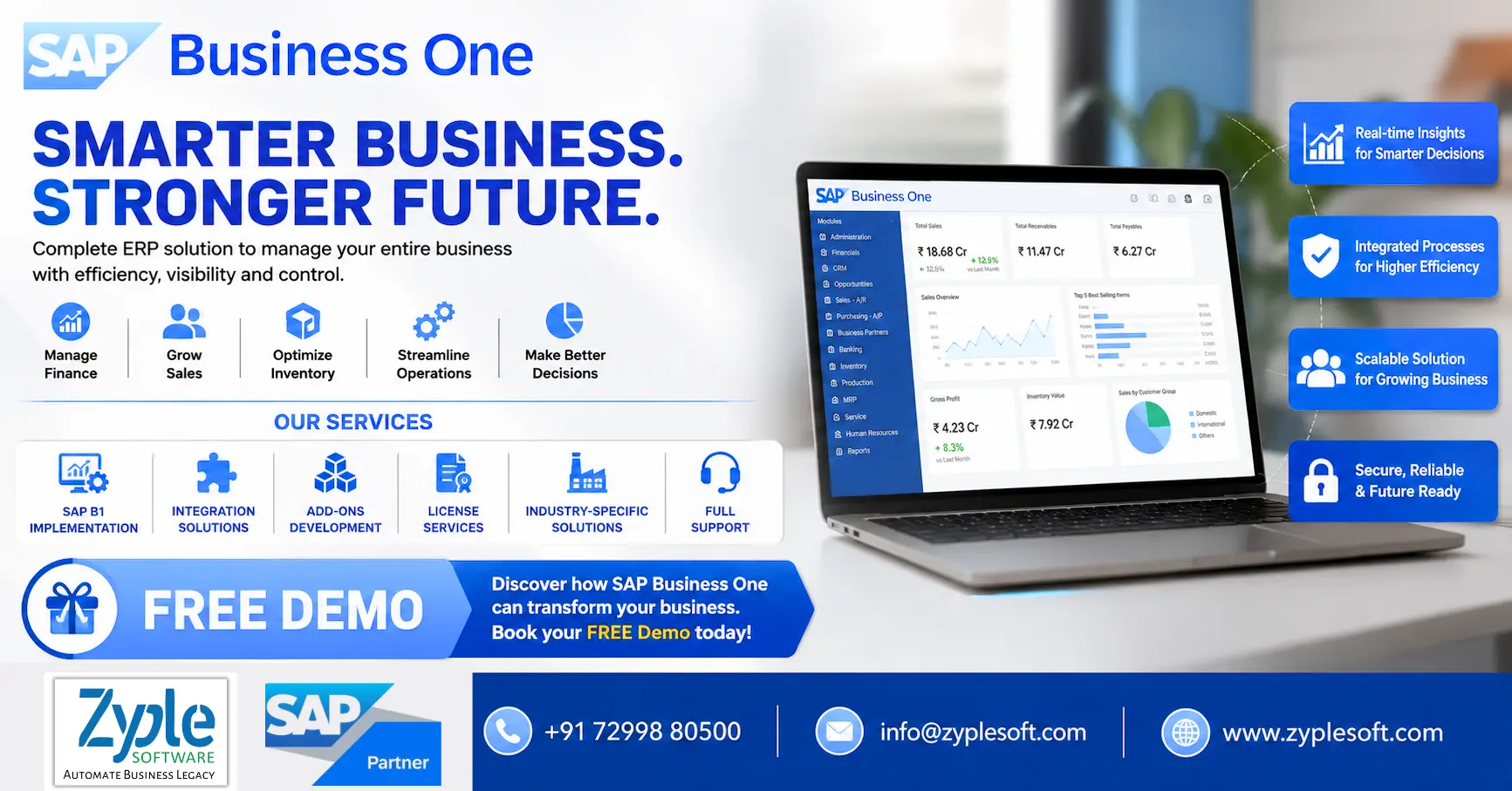
Running a growing business with disconnected spreadsheets, multiple software systems, manual approvals, and limited visibility can make even simple decisions difficult. SAP Business One solutions help small and midsize businesses bring finance, sales, purchasing, inventory, production, projects, and reporting into one integrated ERP platform.
Instead of managing different departments with separate systems, businesses can use SAP Business One ERP to create a connected flow of information across the organization.
For companies planning ERP implementation, the bigger question is not simply “Do we need an ERP?” but rather:
“Which SAP Business One solution is right for our industry, processes, users, and growth plans?”
This guide explains the major SAP Business One solutions, their benefits, industry applications, implementation considerations, and how to choose the right SAP Business One partner.
What Are SAP Business One Solutions?
SAP Business One solutions are ERP-based business management solutions designed to help small and midsize companies manage their core operations from a centralized platform.
Depending on the organization’s requirements, SAP Business One can support:
- Financial management
- Accounting
- Sales and CRM
- Purchasing
- Inventory management
- Warehouse management
- Production planning
- Material Requirements Planning (MRP)
- Project management
- Service management
- Business intelligence and reporting
- Approval workflows
- Customer management
- Distribution
- Multi-branch operations
- Integration with external applications
The major advantage is that these functions can work together rather than operating as isolated systems.
For example, a sales order can influence inventory requirements, purchasing, production planning, delivery, invoicing, and financial reporting.
That connected process can significantly reduce manual data entry and improve management visibility.
Why Businesses Need SAP Business One Solutions?
1. Data Is Scattered Across Systems
2. Inventory Visibility Is Limited
- What inventory is available?
- Where is the stock located?
- Which items are moving slowly?
- What should be reordered?
- What is committed to customers?
- What materials are required for production?
3. Manual Processes Consume Time
4. Management Reports Take Too Long
5. Business Growth Becomes Difficult
Key SAP Business One Solutions
1. SAP Business One Financial Management
- General ledger
- Accounts payable
- Accounts receivable
- Journal entries
- Banking
- Fixed assets
- Cost accounting
- Budgets
- Financial reporting
- Tax-related processes
- Cash flow visibility
2. SAP Business One Sales and CRM
- Leads
- Business partners
- Sales opportunities
- Quotations
- Sales orders
- Deliveries
- Invoices
- Customer history
- Sales activities
- Sales reporting
3. SAP Business One Inventory Management
- Item master data
- Multiple warehouses
- Stock transfers
- Batch management
- Serial numbers
- Inventory transactions
- Goods receipts
- Goods issues
- Stock counting
- Inventory valuation
- Reorder planning
4. SAP Business One Purchasing and Procurement
5. SAP Business One Manufacturing & Production
- Bill of Materials
- Production orders
- Material planning
- MRP
- Production scheduling
- Material availability
- Work-in-progress tracking
- Production costing
- Inventory consumption
- Finished goods management
6. SAP Business One MRP Solution
- What materials are required?
- How much material is needed?
- When should materials be purchased?
- Which existing stock can be used?
- What production requirements are coming up?
7. SAP Business One Warehouse & Distribution Solution
- Multiple warehouses
- Stock transfers
- Inventory availability
- Goods receipts
- Goods issues
- Pick and pack processes
- Delivery management
- Batch and serial tracking
- Distribution workflows
8. SAP Business One Project Management
- Project budgets
- Project activities
- Resources
- Expenses
- Revenue
- Project costs
- Project profitability
9. SAP Business One Service Management
- Service calls
- Customer equipment
- Warranty information
- Service contracts
- Technician activities
- Service history
- Response tracking
10. SAP Business One Reporting & Analytics
- Sales performance
- Profitability
- Inventory
- Purchasing
- Receivables
- Payables
- Cash flow
- Production
- Customer performance
- Supplier performance
Industry-Specific SAP Business One Solutions
Manufacturing
- BOM
- Production
- MRP
- Quality
- Inventory
- Subcontracting
- Costing
- Procurement
Construction & EPC
- Project management
- Contractor billing
- Procurement
- Budget management
- Material tracking
- Cost control
- Project profitability
Trading & Distribution
- Inventory management
- Sales
- Purchasing
- Warehouse management
- Batch/serial tracking
- Distribution
- Customer management
Retail
- Inventory
- Purchasing
- Sales
- Multi-location operations
- Customer management
- Financial management
- Third-party integrations
Pharma & Healthcare
- Batch tracking
- Expiry management
- Quality processes
- Inventory
- Procurement
- Sales
- Compliance-oriented workflows
Food & Beverage
- Batch management
- Production
- Recipe/BOM management
- Expiry tracking
- Quality
- Inventory
- Procurement
Engineering & Project-Based Businesses
- Projects
- Procurement
- Inventory
- Resources
- Costs
- Billing
- Financials
SAP Business One Integrations
- CRM systems
- E-commerce platforms
- Banking systems
- Payment gateways
- Payroll systems
- Biometric attendance systems
- Manufacturing systems
- MES
- Weighbridge systems
- Logistics platforms
- WhatsApp/business communication solutions
- E-invoicing systems
- E-commerce marketplaces
SAP Business One Add-On Solutions
- Tender & Bid Management
- Contractor Billing
- Legal Management
- Weighbridge Integration
- Liaison Management
- Budget Management
- Plant Maintenance
- Quality Management
- Subcontracting
- Fleet Management
- Manufacturing Execution System (MES)
- Payroll
- WhatsApp Integration
- Costing & Estimation
- E-Invoice & E-Way Bill
- CCTV Integration
SAP Business One HANA vs SQL
- Number of users
- Transaction volume
- Reporting requirements
- Analytics requirements
- Existing IT infrastructure
- Integration architecture
- Budget
- Long-term growth plans
SAP Business One Cloud vs On-Premise
Cloud Deployment
- Remote accessibility
- Reduced infrastructure management
- Scalability
- Centralized administration
- Easier access for distributed teams
On-Premise Deployment
How SAP Business One Can Improve Business Operations?
Reduce Manual Data Entry
Improve Data Visibility
Strengthen Inventory Control
Improve Financial Visibility
Accelerate Reporting
Improve Process Control
How Much Does SAP Business One Cost
- Number and type of users
- Deployment model
- Database platform
- Number of branches
- Number of warehouses
- Required modules
- Industry requirements
- Integrations
- Customizations
- Add-ons
- Data migration
- Implementation scope
- Training
- Support and AMC
How to Choose the Right SAP Business One Partner?
Does the partner understand your industry?
Can they handle integrations?
Do they provide implementation and support?
- User training
- Technical support
- Upgrades
- Enhancements
- Add-ons
- Integration support
- Process optimization
Do they provide a clear implementation roadmap?
Can they demonstrate relevant projects?
Why Choose Zyple Software for SAP Business One Solutions?
- SAP Business One implementation
- SAP B1 licenses
- SAP B1 integration
- SAP B1 add-ons
- Industry-specific ERP solutions
- Data migration
- Customization
- ERP consulting
- User training
- Post-implementation support
- AMC and ongoing ERP support
SAP Business One Implementation Process
1. Business Requirement Analysis
2. Solution Design
3. Configuration & Development
4. Data Migration
5. Testing
6. Training
7. Go-Live
8. Post-Go-Live Support
Is SAP Business One Right for Your Business?
- Rapid business growth
- Increasing transaction volumes
- Multiple warehouses
- Multiple branches
- Complex inventory requirements
- Manufacturing challenges
- Spreadsheet dependency
- Poor management reporting
- Disconnected business applications
- Manual approval processes
- Difficulty tracking profitability
- Limited financial visibility
Frequently Asked Questions About SAP Business One Solutions
What is SAP Business One?
SAP Business One is an ERP solution designed primarily for small and midsize businesses to manage core functions such as finance, sales, purchasing, inventory, production, projects, service, and reporting.
What industries use SAP Business One?
SAP Business One can be implemented across manufacturing, trading, distribution, retail, construction, engineering, professional services, food and beverage, pharmaceuticals, healthcare, and many other industries.
Can SAP Business One be customized?
Yes. SAP Business One can be extended through configurations, integrations, custom development, and industry-specific add-ons where required.
Can SAP Business One integrate with other software?
Yes. SAP Business One can be integrated with other business applications depending on technical and business requirements.
Is SAP Business One suitable for manufacturing?
Yes. Manufacturing organizations can use functionality related to BOMs, production orders, MRP, inventory, procurement, costing, and production planning.
Can SAP Business One manage multiple warehouses?
Yes. SAP Business One provides inventory and warehouse management capabilities for organizations operating multiple warehouses.
How long does SAP Business One implementation take?
Implementation time varies considerably depending on the company’s size, number of users, modules, integrations, data migration requirements, customizations, and project complexity.
How do I get an SAP Business One demo?
Businesses can contact an SAP Business One partner like Zyple Software to discuss their requirements and request a product demonstration tailored to their processes.
Final Thoughts
Choosing an ERP system is a major business decision. The right SAP Business One solution should not simply digitize existing processes—it should help the organization create more connected, controlled, and scalable operations.
From financial management and inventory to manufacturing, procurement, CRM, projects, reporting, integrations, and industry-specific add-ons, SAP Business One can provide a centralized platform for managing critical business operations.
However, the success of an ERP project depends heavily on proper requirement analysis, implementation methodology, industry expertise, user adoption, integrations, and long-term support.
If your business is currently managing operations through spreadsheets or multiple disconnected systems, now may be the right time to evaluate whether SAP Business One can help you move toward a more integrated ERP environment.
Ready to Explore SAP Business One?
Get a FREE SAP Business One Demo and Business Process Consultation from Zyple Software.
Contact: +91 72998 80500
Mail: info@zyplesoft.com
Website: www.zyplesoft.com
SAP B1 Implementation | Integration | Add-Ons | License | Industry-Specific Solutions | Full Support
Fill your details in below contact form, Our team will contact you soon with best solutions.