Tag Archives: SAP Business One Support

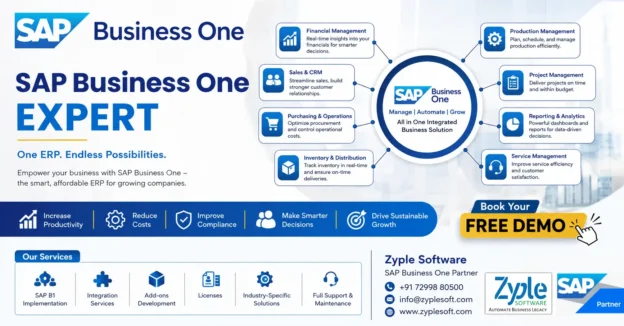
SAP Business One Expert ERP solution infographic by Zyple Software with finance, CRM, inventory, production, analytics and business management features

SAP Business One Expert

SAP Business One Expert for Industries/Businesses
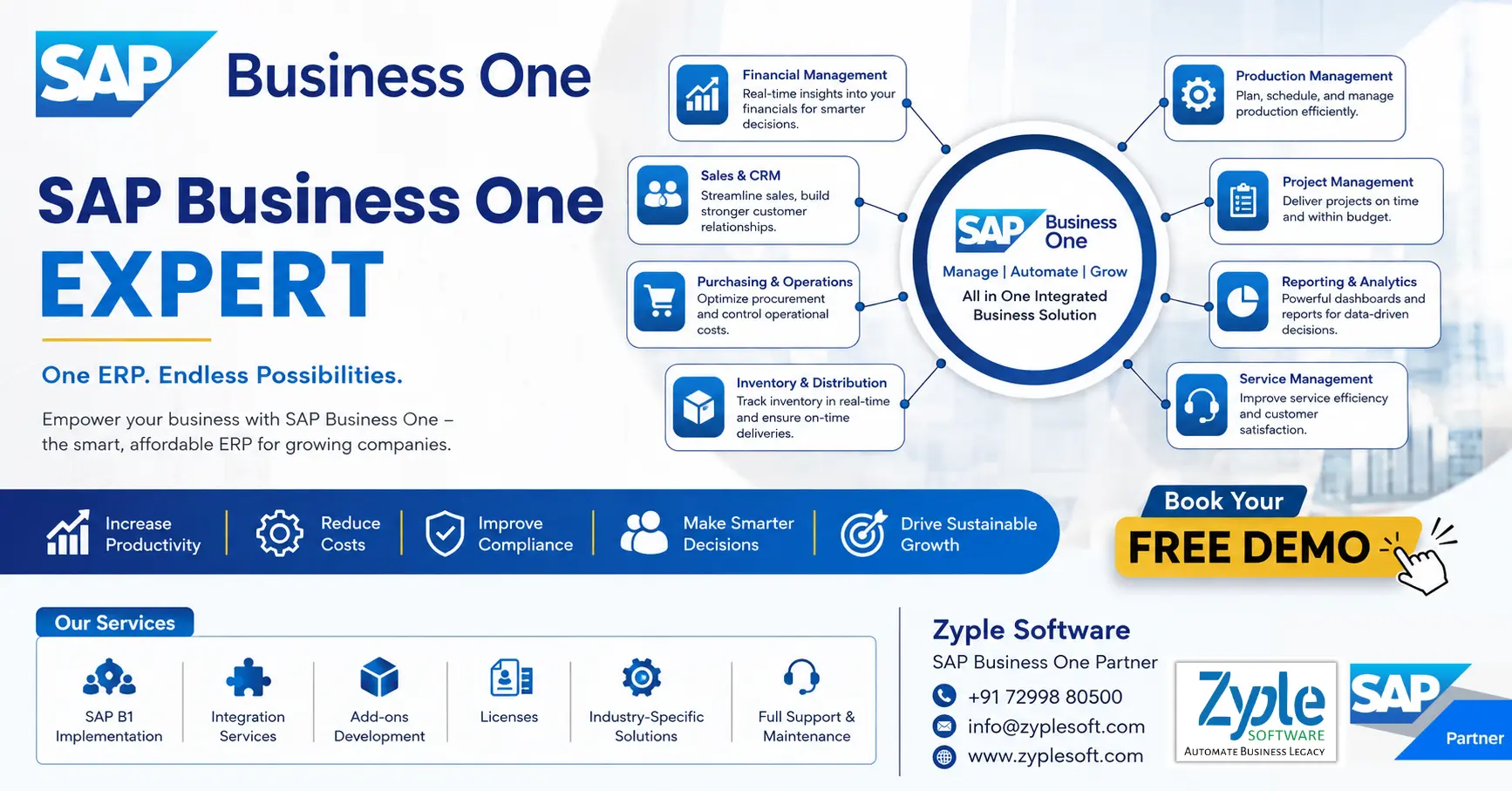
SAP Business One Expert ERP solution infographic by Zyple Software with finance, CRM, inventory, production, analytics and business management features

SAP Business One provides robust ERP capabilities for small and medium-sized businesses seeking facilitated operations. Our specialized experts help you maximize the platform’s potential, delivering customized solutions that align with your unique business requirements and growth objectives. We guide you through implementation, configuration, and optimization to ensure you gain the full benefit of your SAP Business One investment.

We specialize in:

1. System Implementation and Integration

Launching SAP Business One with minimal disruption while connecting to your current business systems.

2. Process Optimization

Facilitating workflows and automating manual tasks to boost operational efficiency.

3. Customization and Development

Creating advanced modules and functionalities that handle your specific business challenges.

4. Data Migration and Management

Securely moving your business data while ensuring accuracy and consistency.

5. Reporting and Analytics

Developing complete dashboards that deliver actionable insights for better decision-making.

6. Technical Support and Training

Delivering ongoing assistance and knowledge to empower your team.

An SAP Business One expert combines technical expertise with industry knowledge to deliver solutions that drive tangible business outcomes. Whether implementing from the beginning, optimizing a current deployment, or improving functionality with custom modules, we ensure your SAP Business One environment completely supports your operational requirements and strategic goals.

Securing the Right SAP Business One Expertise for Your Business

SAP Business One (SAP B1) is a powerful enterprise resource planning (ERP) solution that helps small and medium-sized enterprises (SMEs) facilitate their operations, gain real-time insights, and drive profitable growth. However, increasing the return on your SAP Business One investment relies heavily on having the right technical and functional expertise on board. Whether you’re in the middle of an implementation, planning an upgrade, or require ongoing support, the challenge often lies in identifying and securing qualified professionals. The success of your system depends on the skills of the people who handle, customize, and support it. This is a common obstacle for many organizations looking to fully use their ERP capabilities.

Roles and Responsibilities of an SAP Business One Expert

An SAP B1 expert is responsible for implementing, customizing, supporting, and optimizing the SAP Business One ERP system to meet business needs. Their role spans technical, functional, and strategic responsibilities across the organization.

The roles and responsibilities generally include:

1. Implementation and Deployment

  • Evaluate business requirements and map them to SAP B1 functionalities.
  • Plan and execute end-to-end SAP implementation projects.
  • Configure key modules like finance, sales, purchasing, inventory, CRM, and production.
  • Handle data migration from legacy systems to SAP B1.
  • Ensure seamless system go-live with minimal disruption.

2. Business Process Analysis

  • Study current workflows and identify inefficiencies.
  • Suggest process improvements using SAP B1 capabilities.
  • Organize ERP system with industry-specific best practices.
  • Create functional specifications and documentation.

3. System Configuration and Customization

  • Modify company settings, workflows, and approval procedures.
  • Design forms, fields, dashboards, and reports.
  • Work with SDKs, SAP B1 add-ons, or integrations to expand functionality.
  • Ensure customization aligns with future expansion.

4. Integration Management

  • Integrate SAP B1 with third-party systems such as CRM tools, e-commerce platforms, banking systems, and payroll and HR software.
  • Handle APIs, middleware, and data synchronization.

5. User Training and Support

  • Train end-users across departments.
  • Create user manuals and SOPs.
  • Deliver ongoing technical and functional support.
  • Troubleshoot system issues and resolve tickets quickly.

6. Reporting and Analytics

  • Design and generate business reports using Crystal Reports, SQL queries, and SAP dashboards.
  • Deliver insights for decision-making.
  • Ensure live data visibility across departments.

7. Database and Technical Management

  • Handle databases (like SQL Server or SAP B1 HANA).
  • Evaluate system performance and optimize queries.
  • Ensure data integrity, security, and backups.
  • Oversee upgrades, patches, and version control.

8. Project Management

  • Plan project timelines, budgets, and deliverables.
  • Coordinate with stakeholders, clients, and internal teams.
  • Handle risks and ensure timely project completion.
  • Follow SAP B1 implementation methodologies (like ASAP or Agile).

9. Compliance and Security

  • Ensure the system adheres to financial and legal regulations.
  • Define user roles and authorization controls.
  • Maintain audit trails and reporting compliance.

10. Continuous Improvement and Optimization

  • Find opportunities for automation and efficiency.
  • Suggest and install new SAP B1 features or add-ons.
  • Improve system usage as business scales.
  • Stay updated with the latest SAP releases and trends.

11. Industry-Specific Responsibilities

Depending on the domain, responsibilities may cover:

Manufacturing

Production planning, BOM, and MRP (Material Requirements Planning).

Construction

Project costing and subcontractor management.

Retail

POS integration and inventory tracking.

Pharma

Batch traceability and compliance validation.

12. Client and Stakeholder Communication

  • Act as a bridge between business users and technical teams.
  • Collect feedback and translate it into system improvements.
  • Deliver strategic ERP implementation.

Skills and Expertise of an SAP Business One Expert

An SAP B1 expert specializes in implementing, configuring, and improving the SAP Business One system for small and medium-sized enterprises (SMEs). They combine key functional accounting and supply chain knowledge with technical reporting and project management skills to align software capabilities with company goals.

  • Proficiency in core modules of SAP B1 like financial accounting, banking, fixed assets, sales, purchasing, inventory control, and production.
  • Deep understanding of business processes and localization and compliance.
  • Technical skills like SAP Crystal Reports, SQL, and SAP Business One SDK (Software Development Kit).
  • Strong requirement analysis and project management abilities.
  • Experience in training and support.

Benefits of Hiring an SAP B1 Expert

Hiring an SAP Business One (SAP B1) expert helps your company set up the software right, save money, and prevent costly system errors. They match the tool to your exact daily requirements, clean and move your old data safely, and connect SAP B1 with your other apps like e-commerce or CRM.

1. Proper Setup

They develop workflows that fit how your business actually works.

2. Safe Data Migration

They transfer old records into SAP B1 without losing details using SAP Business One solutions.

3. Custom Add-ons

They develop special tools or reports using the SAP SDK if standard options fall short.

4. System Integration

They connect your ERP with outside platforms like payment gateways or shipping tools.

5. Staff Training

They teach your team how to use the system well so work moves faster.

6. Ongoing Support

They resolve bugs quickly and handle system updates safely in SAP support.

When You Should Hire an SAP B1 Expert

Hiring an SAP Business One (SAP B1) expert is necessary when starting a new system setup, migrating old data, upgrading software versions, or fixing chronic workflow gaps. You also need professional help for custom reports, third-party software connections, and training your team.

1. New Implementation

Develop and configure the software to match your exact business rules.

2. Data Migration

Transfer old spreadsheets and legacy data safely without losing records.

3. System Upgrades

Move to the latest versions without breaking current operations.

4. Custom Reports and Add-Ons

Develop specialized Crystal Reports or custom SQL queries.

5. Software Integration

Connect SAP B1 with e-commerce sites or third-party apps via APIs.

6. Staff Training

Teach your team how to use specific modules properly.

Choosing the Right SAP B1 Expert

Choosing the right SAP Business One (SAP B1) expert is essential for a smooth ERP setup. Look for official SAP Business One partnership tiers, verified industry track records, certified in-house consultants, and robust local or regional compliance knowledge.

1. Industry Experience

Ensure the expert or partner knows your specific sector (such as manufacturing, construction, retail, and pharma) to handle unique workflows and compliance needs.

2. Certifications

Check for formal SAP B1 credentials and certified consultants who understand the latest versions of SAP B1 and SAP B1 HANA.

3. Customization and Integration

Verify their technical ability to modify the system and connect it seamlessly with third-party software like e-commerce platforms or Microsoft 365.

4. Post-Implementation Support

Confirm they deliver ongoing training, troubleshooting helpdesk services, and system updates after your go-live date.

Conclusion of SAP B1 Expert

As a leading SAP Business One partner, Zyple Software is delivering services like SAP B1 implementation, integration, migration, licensing, consulting, add-ons, digital transformation, and support and training to different industries, like construction, manufacturing, solar, food and beverage, aerospace, oil and gas, healthcare, retail, real estate, jewellery, pharma, and textiles. 

SAP Business One is an ERP solution customized for small and medium-sized enterprises that connects finance, production, inventory, material requirements planning (MRP), procurement, sales, CRM, and reporting and analytics into one platform. For food and beverage, pharma, and chemical businesses, it can improve project costing, procurement, subcontractor billing, and inventory management.

If you’re involved, reserve a demo of SAP Business One.

Do you assure the SAP B1 ERP system for your business or industry?

Finish all the details in the quoted contact form; our team will return to you.

    FAQs

    1.How can an SAP Business One Expert improve my business operations?

    An SAP Business One expert helps facilitate your processes by integrating finance, sales, inventory, and operations into one system, improving efficiency and decision-making.

    Yes, SAP Business One is highly flexible and can be customized for industries like construction, manufacturing, retail, and distribution with the help of an expert.

    The cost depends on project scope, customization needs, and implementation complexity. A consultation can deliver a clear estimate based on your business requirements.

    Most businesses start seeing improvements in efficiency, reporting, and cost control within a few months of proper SAP B1 implementation by an SAP B1 expert.

    You can begin with a free consultation to evaluate your business needs, followed by a customized implementation plan tailored to your goals.
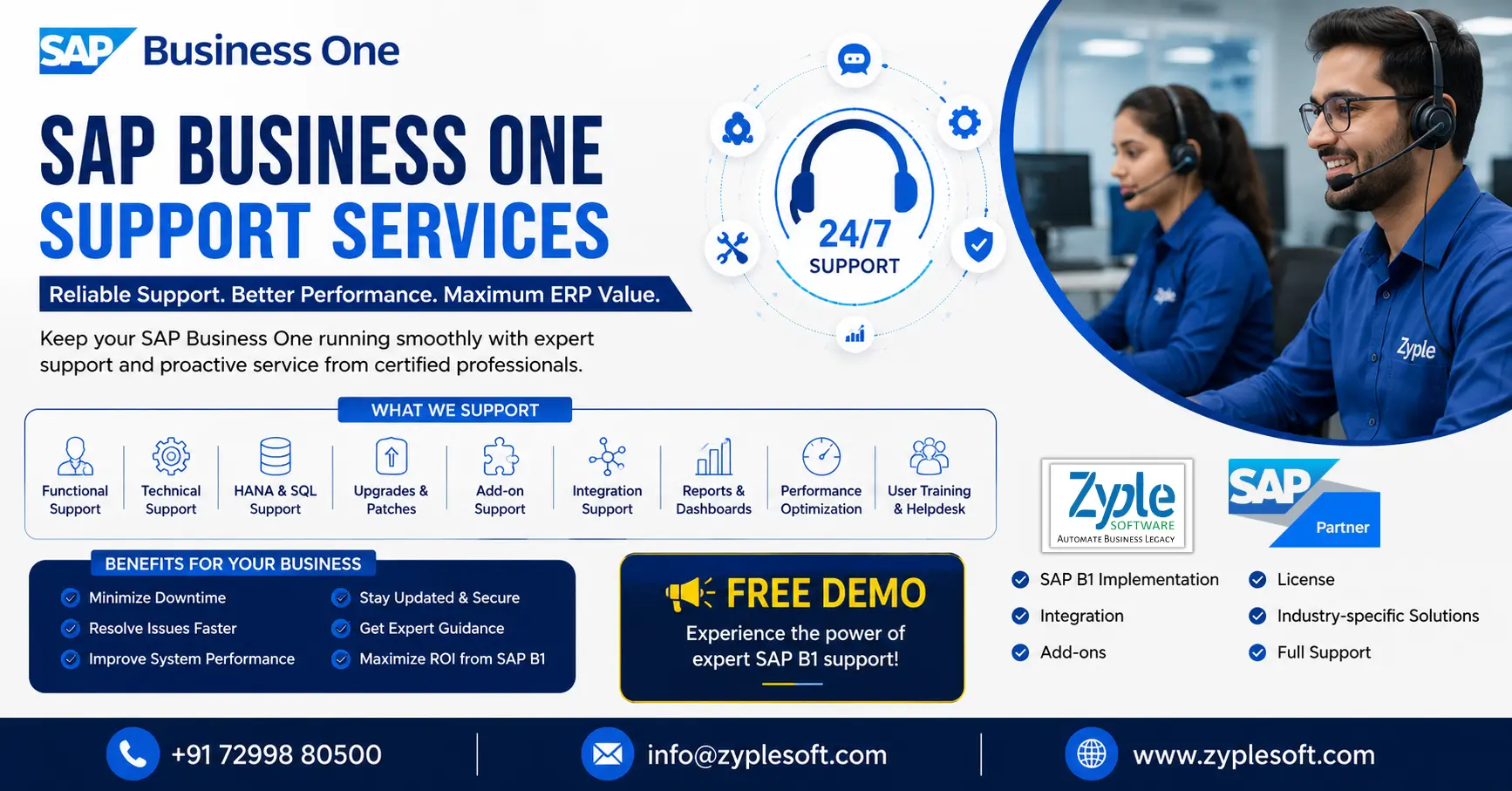
    SAP Business One Support Services by Zyple Software – SAP B1 functional and technical support, implementation, upgrades, integration, add-ons and ERP optimization

    SAP Business One Support Services

    SAP Business One Support Services for Businesses or Industries

    SAP Business One Support Services by Zyple Software – SAP B1 functional and technical support, implementation, upgrades, integration, add-ons and ERP optimization

    SAP Business One support services help businesses keep their ERP system stable, secure, updated, optimized, and aligned with changing business requirements. A reliable SAP Business One support partner provides more than troubleshooting—it helps users resolve functional and technical issues, improve system performance, manage upgrades, support integrations and add-ons, and continuously optimize business processes.

    For companies using SAP Business One on SAP HANA or Microsoft SQL Server, professional post-go-live support can reduce operational disruptions and help users get more value from their ERP investment.

    What Are SAP Business One Support Services?

    SAP Business One support services are ongoing functional, technical, and application-management services provided after SAP implementation and go-live.

    A typical support engagement can include:

    • SAP Business One functional support
    • Technical and database support
    • SAP HANA and SQL Server support
    • Error and issue resolution
    • Performance optimization
    • User support and training
    • SAP Business One upgrades and patches
    • Add-on support
    • Third-party integration support
    • Report and dashboard support
    • Crystal Reports support
    • Business process optimization
    • Data and transaction troubleshooting
    • Backup and system-health assistance
    • License and system administration assistance
    • Customization and enhancement support

    SAP itself describes Business One support as a partner-led model, with SAP providing support platforms, tools, updates, and escalation mechanisms.

    Why is SAP Business One Support Important?

    Implementing SAP Business One is only the beginning of an ERP journey. After go-live, businesses continuously add users, products, warehouses, branches, reports, integrations, add-ons, and new processes.

    Without structured ERP support, even a small configuration or technical problem can affect purchasing, inventory, production, sales, finance, or reporting.

    Professional SAP Business One support helps businesses:

    1. Reduce ERP downtime
    2. Resolve issues faster
    3. Improve system performance
    4. Keep the ERP environment updated
    5. Support users with functional problems
    6. Maintain integrations and add-ons
    7. Improve reporting and dashboards
    8. Optimize business processes
    9. Reduce dependency on internal IT teams
    10.Get greater value from SAP Business One

    SAP also provides feature packages, support packages, patches, and hotfixes as part of its release and maintenance strategy. 

    SAP Business One Support Services We Provide

    1. SAP Business One Functional Support

    Functional support helps users solve day-to-day SAP Business One problems related to business processes and application configuration.

    Our functional support can cover:
    • Financial accounting
    • Sales and CRM
    • Purchasing
    • Inventory management
    • Warehouse management
    • Production
    • MRP
    • Business partner management
    • Banking
    • Fixed assets
    • Service management
    • Project management
    • Approval processes
    • Pricing and discounts
    • Tax configuration
    • Payment processing
    • Reports and analytics
    Instead of simply fixing an error, the objective is to identify the business process behind the issue and recommend the appropriate SAP Business One solution.

    2. SAP Business One Technical Support

    Technical issues can affect application availability, connectivity, performance, integrations, databases, and users.

    SAP Business One technical support can include:
    • Server troubleshooting
    • Database troubleshooting
    • SAP Business One service issues
    • Client connectivity
    • License server issues
    • System Landscape Directory issues
    • Integration Service issues
    • Backup-related assistance
    • Performance troubleshooting
    • User-access issues
    • Installation problems
    • Patch-related issues
    • System configuration
    SAP provides technical documentation covering implementation, management, security, hardware requirements, deployment options, and integration for SAP Business One.

    3. SAP HANA and SQL Database Support

    SAP Business One environments may operate on SAP HANA or Microsoft SQL Server.

    Our support approach can include:

    SAP Business One HANA Support

    • HANA database monitoring
    • Performance analysis
    • Query troubleshooting
    • Database health checks
    • Backup verification
    • Memory and resource analysis
    • HANA-related application issues
    • HANA reporting support

    SAP Business One SQL Support

    • SQL database troubleshooting
    • Query performance analysis
    • Database maintenance
    • Backup assistance
    • Connectivity issues
    • SQL-related application errors
    • Performance optimization
    Database-level support should always be handled carefully because database changes can directly affect ERP transactions and business data.

    4. SAP Business One Upgrade and Patch Support

    Keeping SAP Business One updated is an important part of ERP lifecycle management.

    SAP provides defined upgrade paths and delivers feature packages, support packages, patches, and hotfixes.

    Our upgrade support can include:
    • Current-version assessment
    • Compatibility checking
    • Pre-upgrade health check
    • Database backup verification
    • Add-on compatibility review
    • Customization assessment
    • Test environment preparation
    • Upgrade execution
    • Post-upgrade validation
    • User acceptance testing
    • Issue resolution
    • Production go-live support
    SAP documentation also recommends performing a trial run before an upgrade to identify errors or warnings before the production upgrade.

    Important: An SAP Business One upgrade should not be treated as a simple software installation. The database, add-ons, integrations, customizations, infrastructure, and business processes should be assessed before production deployment.

    5. SAP Business One Performance Optimization

    Is your SAP Business One system becoming slow?

    Performance problems can occur because of several factors, including database workload, infrastructure, queries, reports, integrations, add-ons, network conditions, or inefficient processes.

    A performance assessment can examine:
    • Slow transactions
    • Database performance
    • Long-running queries
    • Reports taking too long
    • User login performance
    • Integration performance
    • Add-on performance
    • Server resources
    • Network connectivity
    • Database growth
    • System configuration
    The goal is to identify the root cause rather than repeatedly treating the symptoms.

    6. SAP Business One Add-On Support

    Many companies extend SAP Business One using industry-specific or business-specific add-ons.

    Support can include:
    • Add-on installation
    • Configuration
    • Troubleshooting
    • Version compatibility
    • Upgrade compatibility
    • Integration issues
    • Performance issues
    • Custom enhancement requirements
    Common business add-ons may cover:
    • E-invoice and E-Way Bill
    • GST
    • Payroll
    • Fleet management
    • Weighbridge
    • CCTV integration
    • Quality management
    • Plant maintenance
    • Subcontracting
    • MES
    • Tender management
    • Contractor billing
    • WhatsApp integration
    • Budget management
    • Costing and estimation
    A SAP Business One partner should evaluate the relationship between SAP B1, the add-on, database, and external systems before making changes.

    7. SAP Business One Integration Support

    Modern businesses rarely operate with ERP alone.

    SAP Business One may need to exchange information with:
    • E-commerce platforms
    • CRM systems
    • Payroll systems
    • Banking platforms
    • Payment gateways
    • Biometric attendance systems
    • Warehouse systems
    • Manufacturing systems
    • Mobile applications
    • Logistics platforms
    • E-invoicing systems
    • E-commerce marketplaces
    • Third-party APIs
    SAP Business One provides integration capabilities for scenarios including third-party solutions, electronic data interchange, cloud extensions, collaboration, and Web services.

    Our integration support focuses on maintaining reliable data flow between SAP Business One and connected applications.

    8. SAP Business One Reporting and Crystal Reports Support

    Accurate reporting is one of the most important reasons businesses use ERP systems.

    Support can cover:
    • Crystal Reports
    • Financial reports
    • Sales reports
    • Purchase reports
    • Inventory reports
    • Production reports
    • Management dashboards
    • MIS reports
    • Customized reports
    • SQL queries
    • KPI reporting
    • Exception reports
    We help businesses convert reporting requirements into practical SAP Business One reports instead of maintaining disconnected Excel files for every department.

    9. SAP Business One User Support and Training

    ERP problems are not always technical problems.

    Sometimes users need help understanding the correct process.

    Support can include:
    • End-user assistance
    • Super-user support
    • Process training
    • New-user onboarding
    • Department-specific trainingTransaction guidance
    • SOP creation
    • Report training
    • Best-practice guidance
    This helps organizations reduce recurring support tickets caused by incorrect processes or lack of user knowledge.

    10. SAP Business One Health Check

    A periodic SAP Business One health check can identify issues before they become major operational problems.

    A health check may evaluate:

    Functional Health

    • Finance
    • Sales
    • Purchasing
    • Inventory
    • Production
    • MRP
    • CRM
    • Service
    • Approvals

    Technical Health

    • Database
    • Server
    • Services
    • Connectivity
    • Backups
    • Performance

    Application Health

    • Add-ons
    • Integrations
    • Customizations
    • Reports
    • User permissions
    • Master data

    Business Health

    • Process bottlenecks
    • Manual work
    • Excel dependency
    • Duplicate data entry
    • Approval delays
    • Reporting gaps
    The result is a prioritized action plan showing what should be fixed immediately, what should be optimized, and what can be improved later.

    SAP Business One Support for Manufacturing Companies

    Manufacturing businesses often require specialized ERP support because their SAP Business One environment may include production, MRP, BOMs, inventory, subcontracting, quality, costing, and shop-floor integrations.

    Support can cover:
    • Bill of Materials
    • Production orders
    • MRP
    • Material planning
    • Inventory transactions
    • Batch and serial management
    • Subcontracting
    • Production costing
    • Quality processes
    • Machine or MES integration
    • Warehouse processes
    • Production reporting
    For manufacturers, ERP support should combine technical expertise with knowledge of manufacturing processes.

    SAP Business One Support for Construction Businesses

    Support deliver:
    • Project and Job Costing
    • Construction Inventory Management
    • Procurement and Vendor Management
    • Subcontractor Management
    • BOQ and Contractor Billing
    • Multi-Project and Site Management
    • Financial and Accounting Support
    • Approval Workflow Management
    • Real-Time Reports and Dashboards
    • Construction Add-ons and Integrations
    • Technical Troubleshooting and Maintenance
    • Post-Go-Live Support and ERP Optimization
    SAP Business One for Construction helps to manage entire operations such as projects, costs, materials, procurement, subcontractors, billing, and finances in one integrated ERP system.

    SAP Business One Support for Trading and Distribution

    Trading and distribution companies often depend heavily on inventory accuracy, purchasing, sales orders, warehouse operations, pricing, and logistics.

    Support can include:
    • Multi-warehouse management
    • Inventory reconciliation
    • Stock transfer
    • Sales order processing
    • Purchase order processing
    • Pricing
    • Batch management
    • Serial number management
    • Delivery processes
    • Returns
    • Distribution reporting
    • E-commerce integration

    SAP Business One Support for Multi-Branch and Multi-Plant Businesses

    Growing organizations may operate multiple branches, warehouses, plants, or legal entities.

    Support can help with:
    • Branch configuration
    • Inter-branch processes
    • Warehouse management
    • Consolidated reporting
    • User authorization
    • Data synchronization
    • Intercompany processes
    • Integration
    • Centralized dashboards
    • Multi-location reporting
    The objective is to keep different business locations connected while maintaining appropriate controls and visibility.

    SAP Business One Support Process

    A structured support process can follow these steps:

    1. Issue Registration → 2. Impact Assessment → 3. Root-Cause Investigation → 4. Solution Planning → 5. Testing → 6. Resolution → 7. User Validation → 8. Closure → 9. Preventive Action

    This approach helps prevent the same problem from repeatedly returning.

    What Is Included in SAP Business One Annual Support?

    Depending on the support agreement, an annual SAP Business One support package can include:
    • Functional support
    • Technical support
    • Remote troubleshooting
    • User assistance
    • Database assistance
    • Upgrade support
    • Patch support
    • Add-on support
    • Integration support
    • Report support
    • Performance monitoring
    • Health checks
    • Training
    • Process optimization
    The exact scope, SLA, support hours, and exclusions should be agreed upon before signing the support contract.

    SAP Business One Support vs. ERP Implementation

    These are different services.
    SAP Business One Implementation SAP Business One Support
    Deploys the ERP Maintains and improves the ERP
    Business process mapping Ongoing issue resolution
    Initial configuration Continuous configuration support
    Data migration Data and transaction troubleshooting
    User training Ongoing user assistance
    Go-live Post-go-live operations
    Initial integrations Integration maintenance
    Initial reports Report enhancements

    Businesses that already have SAP Business One do not necessarily need another implementation. In many cases, they need an experienced support and optimization partner.

    How to Choose the Right SAP Business One Support Partner?

    Before selecting a support partner, ask these questions:

    1. Does the partner understand your industry?

    Manufacturing, pharma, construction, trading, retail, food processing, engineering, and other industries have different ERP requirements.

    2. Can they support both functional and technical issues?

    A support team should understand both the business process and the underlying ERP environment.

    3. Can they support your SAP Business One version?

    Version, database, platform, add-ons, and integrations should be reviewed before support begins.

    4. Can they support integrations and add-ons?

    A third-party integration can become a critical part of your ERP operation.

    5. Do they provide proactive support?

    Good support should not always begin after something breaks. Periodic health checks and preventive maintenance can identify risks earlier.

    6. Do they provide documented SLAs?

    Response times, support hours, escalation procedures, and exclusions should be clearly documented.

    7. Can they support future growth?

    Your support partner should be capable of helping with additional users, warehouses, branches, integrations, reports, add-ons, and process changes.

    Why Choose Zyple Software for SAP Business One Support?

    Zyple Software provides SAP Business One services for businesses that need ongoing ERP support, optimization, integration, and enhancement.

    Our SAP Business One support approach can cover the complete ERP lifecycle from post-go-live assistance and issue resolution to upgrades, integrations, add-ons, reporting, and process optimization.

    Our SAP Business One Services Include:

    • SAP Business One implementation
    • SAP Business One support
    • SAP Business One upgrade
    • SAP Business One integration
    • SAP Business One add-ons
    • SAP Business One license assistance
    • SAP Business One customization
    • SAP HANA support
    • SQL support
    • Data migration
    • Industry-specific ERP solutions
    • ERP health checks
    • Reporting and analytics
    • User training
    • Ongoing ERP maintenance

    Whether you are facing a recurring SAP Business One issue, slow system performance, integration problems, reporting challenges, outdated processes, or require ongoing ERP assistance, a structured support engagement can help you keep your SAP Business One environment reliable and business-ready.

    Frequently Asked Questions About SAP Business One Support

    What are SAP Business One support services?

    SAP Business One support services are ongoing functional and technical services that help businesses maintain, troubleshoot, optimize, upgrade, integrate, and improve their SAP Business One ERP system after implementation.

    Companies need SAP Business One support to resolve ERP issues, assist users, maintain integrations and add-ons, improve performance, manage updates, support business changes, and reduce operational disruptions.

    Yes. Upgrade support can include version assessment, compatibility checks, testing, database preparation, add-on validation, upgrade execution, and post-upgrade verification. SAP provides defined upgrade paths and ongoing feature packages and updates.

    Yes. SAP Business One environments running on SAP HANA can require database, application, performance, reporting, integration, and infrastructure-related support.

    Yes. SAP Business One on Microsoft SQL Server can be supported for application issues, database performance, connectivity, reporting, backups, integrations, and other technical requirements.

    Yes. Support can include installation, configuration, troubleshooting, compatibility assessment, integration, and enhancement of SAP Business One add-ons.

    Yes. Integration support can cover third-party applications, APIs, e-commerce, payroll, biometric systems, banking, logistics, payment systems, and other connected business applications.

    Yes. A structured performance assessment can identify database, infrastructure, query, report, integration, add-on, configuration, or process-related bottlenecks and recommend corrective actions.

    Yes. Post-go-live support is an important part of the ERP lifecycle. Businesses can use ongoing support for issue resolution, optimization, upgrades, user assistance, integrations, reports, and enhancements.

    SAP Business One follows a partner-led support model. Customers typically work with their SAP Business One partner as the first point of contact, while SAP provides support infrastructure, tools, documentation, updates, and escalation mechanisms.

    There is no universal interval for every company, but periodic ERP health checks are useful for identifying performance, security, integration, database, reporting, configuration, and process issues before they become larger problems.

    Get Reliable SAP Business One Support

    With the right SAP Business One support partner, businesses can maintain system stability, resolve issues faster, improve user productivity, optimize processes, and continuously enhance their ERP environment.

    Looking for SAP Business One support in India? Contact Zyple Software for SAP Business One implementation, integration, add-ons, upgrades, licensing assistance, industry-specific solutions, and ongoing support.

    Book a Free SAP Business One Demo for Support Consultation today.

    Zyple Software – SAP Business One Partner
    Call: +91 72998 80500
    Mail: info@zyplesoft.com

    Fill all details in given form, Zyple Software will contact you soon, for SAP Business One Support Service.

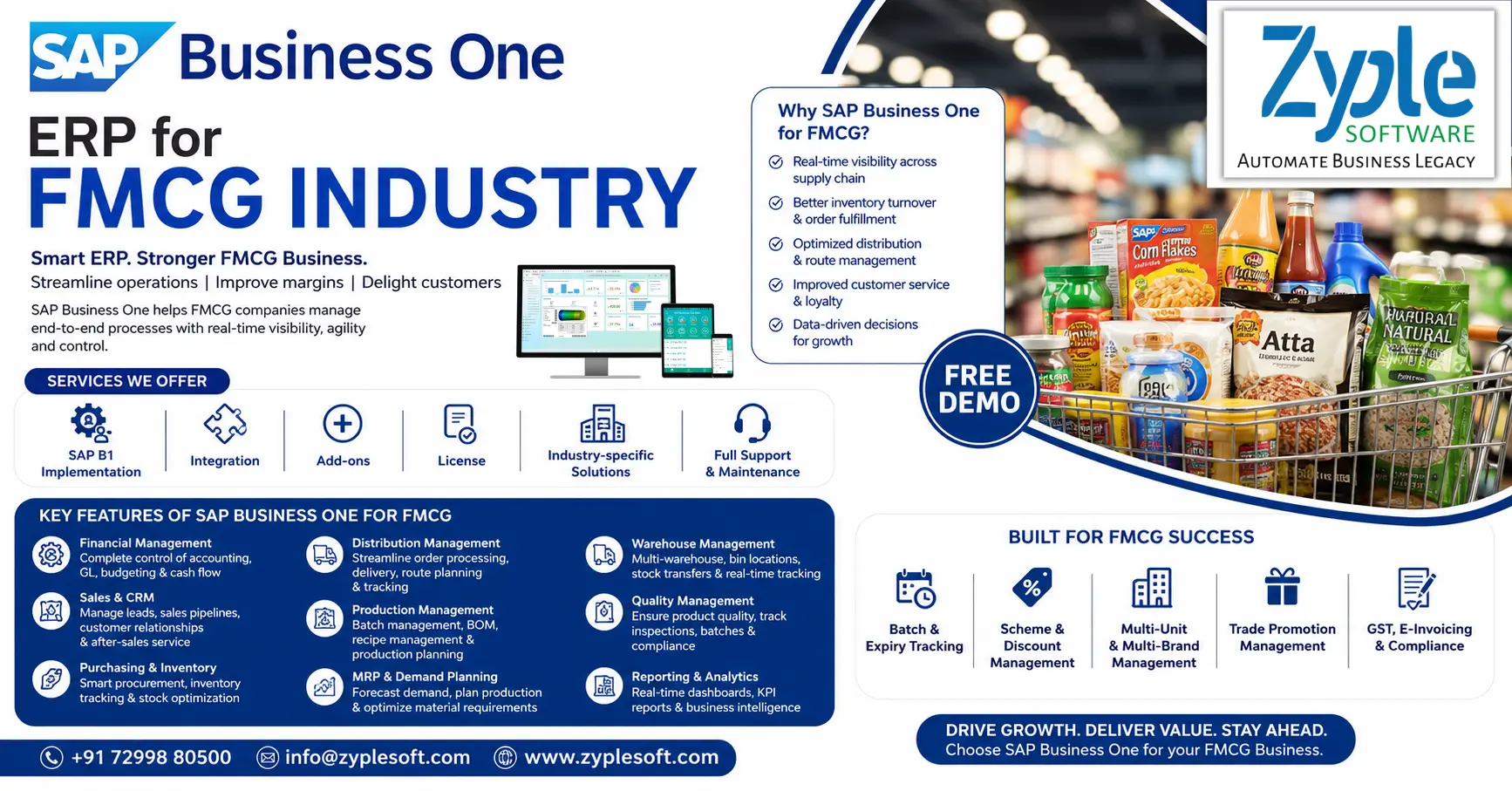
      SAP Business One ERP for FMCG Industry by Zyple Software featuring inventory management, batch tracking, warehouse management, sales, distribution, production planning, and Free Demo.

      SAP Business One ERP for FMCG Industry

      SAP Business One ERP for FMCG Industry

      SAP Business One ERP for FMCG Industry by Zyple Software featuring inventory management, batch tracking, warehouse management, sales, distribution, production planning, and Free Demo.

      The FMCG industry is in huge demand. The products in this industry often need to be sold fast before they perish. The success of the FMCG sector revolves around speed, accuracy, and efficiency. Businesses in this sector must ensure timely deliveries and handle huge deliveries. SAP Business One ERP for FMCG industry provides real-time business insights in the reports to optimize the business workflow.

      Challenges Faced By The FMCG Industry

      The fast-moving consumer goods (FMCG) industry faces serious challenges, including supply chain disruptions, rising raw material costs, and shifting consumer preferences.

      1. Supply Chain Disruptions

      Geopolitical tensions, inflation, and climate events create freight delays and material shortages.

      2. Thin Profit Margins

      High transportation and input costs decrease profitability across low-margin product lines.

      3. Inventory Complexities

      Short product shelf lives and seasonal demand surplus risk high waste or costly stockouts.

      4. Changing Demands

      Shoppers increasingly look for eco-friendly, clean-label, and health-conscious products.

      5. Rising Competition

      Local startup brands and retail private labels chip away at conventional market share.

      6. Omnichannel Integration

      Achieving consumer expectations smoothly across both physical and retail e-commerce channels strains legacy systems.

      Features of SAP Business One ERP for FMCG Industry

      1. Inventory and Warehouse Management

      • It includes real-time inventory tracking across multiple warehouses.
      • It includes batch-wise and serial number tracking.
      • It includes FIFO or FEFO (First Expiry First Out) stock management.
      • It includes automated stock replenishment and reorder levels.
      • It includes bin location management for optimized storage.
      • It includes barcode and QR code integration.

      2. Sales and Distribution Management

      • It includes end-to-end sales order processing.
      • Multi-channel distribution management like retailers, distributors, and wholesalers.
      • It includes pricing management with discounts, schemes, and promotions.
      • It includes sales forecasting and demand planning.
      • Mobile sales like van sales and route sales integration.
      • It includes real-time sales analytics and reporting.

      3. Production and Manufacturing Management

      • It includes bill of materials (BOM) management.
      • It includes production planning and scheduling.
      • Recipe and formula management for food and beverages.
      • It includes quality control and compliance tracking.
      • It includes real-time production monitoring.
      • It includes waste and by-product management.

      4. Procurement and Supplier Management

      • It includes automated purchase order creation.
      • It includes vendor management and evaluation.
      • It includes material requirement planning (MRP).
      • It includes procurement cycle tracking and approvals.

      5. Financial Management and Accounting

      • It includes general ledger, accounts payable, and accounts receivable.
      • It includes cost accounting and profitability analysis.
      • It includes budgeting and financial forecasting.
      • It includes GST and tax compliance.
      • It includes multi-currency and multi-branch financial consolidation.
      • It includes real-time financial dashboards.

      6. CRM (Customer Relationship Management)

      • It includes customer database and contract management.
      • It includes sales lead and opportunity tracking.
      • It includes customer buying behavior analysis.
      • It includes complaint and service management.
      • It includes loyalty programs and customer engagement tracking.

      7. Demand Planning and Forecasting

      • It includes AI-driven demand forecasting.
      • It includes seasonal and trend-based planning.
      • It includes demand vs. supply analysis.
      • It includes reduction of stockouts and overstocking.
      • It includes data-driven decision-making.

      8. Batch, Expiry, and Traceability Management

      • It includes expiry date tracking and alerts.
      • It includes batch recall management.
      • It includes compliance with food safety and regulatory standards.

      9. Reporting and Business Intelligence (BI)

      • It includes real-time dashboards and KPI tracking.
      • Customizable reports like sales, inventory, finance, and production.
      • It includes predictive analytics and insights.
      • It includes integration with Excel and other BI tools.
      • It includes drill-down reporting for better decision-making.

      10. Mobility and Cloud Capabilities

      • It includes mobile access for sales and management teams.
      • It includes cloud deployment for remote accessibility.
      • It includes real-time data synchronization.
      • It includes improved collaboration across departments.

      11. Compliance and Quality Control

      • Regulatory compliance for FMCG like FSSAI, GST, and more.
      • It includes quality inspection at multiple stages.
      • It includes audit trails and documentation.
      • It includes standard operating procedure (SOP) enforcement.

      12. Integration and Scalability

      • It includes integration with e-commerce platforms, CRM, and third-party tools.
      • It includes API-based connectivity.
      • It is scalable for growing FMCG businesses.
      • It includes custom add-ons for industry-specific needs.

      Importance of SAP Business One ERP for FMCG Industry

      The ERP software, SAP Business One, is essential for the fast-moving consumer goods (FMCG) industry because it improves inventory control, facilitates the supply chain, and automates financial and sales operations. It helps growing businesses manage high-volume transactions and fast-changing market demands with ease.

      1. Live Stock Tracking

      Provides real-time data on stock levels across multiple warehouses to avoid running out of popular items or keeping too much extra stock with the SAP implementation process.

      2. Batch and Lot Control

      Tracks production batches and expiration dates easily, which is very essential for food, drink, and personal care items.

      3. Supply Chain Speed

      Connects purchasing, production, and delivery so products move from factories to stores faster.

      4. Sales and CRM

      Handles customer orders, tracks pricing rules, and sets credit limits for different distributors and retailers using SAP solutions.

      5. Money and Tax Management

      Maintains all accounting, budgeting, and local tax rules in one clear place.

      Benefits of SAP Business One for FMCG Industry

      SAP Business One helps the fast-moving consumer goods (FMCG) industry by providing real-time inventory tracking, facilitated supply chain management, and integrated financial control. It enables growing consumer goods companies to reduce waste, prevent stockouts, and handle product batches efficiently.

      1. Real-Time Stock Visibility

      Monitors stock levels across multiple warehouses instantly.

      2. Batch and Lot Tracking

      Handles expiry dates and product traceability to minimize perishable waste.

      3. Automatic Reordering

      Triggers low-stock alerts to avoid production delays or empty shelves.

      4. Material Requirements Planning (MRP)

      Automates raw material planning based on actual demand using SAP Business One add-ons.

      5. Bill of Materials (BOM)

      It standardizes recipes and component lists for consistent product quality.

      6. Facilitated Distribution

      Improves procurement, manufacturing, and shipping workflows.

      7. Integrated CRM

      The SAP software maintains customer databases, tracking buying habits and order histories.

      8. Unified Accounting

      Integrates ledger, accounting, and local tax compliance into one dashboard.

      9. Business Analytics

      Generates fast, data-driven reports to find shifting market trends.

      Conclusion of FMCG ERP

      As a qualified SAP Business One partner, Zyple Software is delivering services like SAP B1 implementation, integration, migration, licensing, add-ons, digital transformation, and support to different industries, like construction, manufacturing, solar, food and beverage, aerospace, healthcare, retail,  jewellery, pharma, and textiles. 

      SAP Business One is an ERP software customized for small and medium-sized enterprises that connects finance, procurement, sales, CRM, production, inventory, and reporting into one platform. For FMCG or any other businesses, it can improve project costing, procurement, subcontractor billing, and inventory management.

      If you’re involved, register a SAP Business One demo.

      Do you search for the SAP B1 ERP software for your business or industry?

      Complete all the details in the displayed contact form; our team will get back to you.

        FAQs

        1.Why should FMCG companies choose SAP Business One over other ERP solutions?

        SAP Business One provides industry-specific features like batch tracking, expiry management, and distribution control, making it ideal for FMCG businesses. It delivers real-time insights and scalability, helping companies grow without switching systems.

        By automating inventory, procurement, and sales processes, SAP Business One reduces manual errors and wastage. This leads to better resource utilization, minimized inventory holding costs, and improved profit margins.

        Yes, SAP Business One can seamlessly connect with CRM, e-commerce platforms, and third-party applications. This ensures smooth data flow across departments and improves overall business efficiency.

        With the right implementation partner like Zyple Software, you get end-to-end services, including SAP B1 implementation, consultation, add-on development, data migration, training, and support to ensure a smooth and successful ERP deployment.

        You can connect with an authorized SAP B1 partner like Zyple Software to schedule a personalized demo. They will evaluate your business requirements, showcase relevant features, and guide you on the best implementation approach.

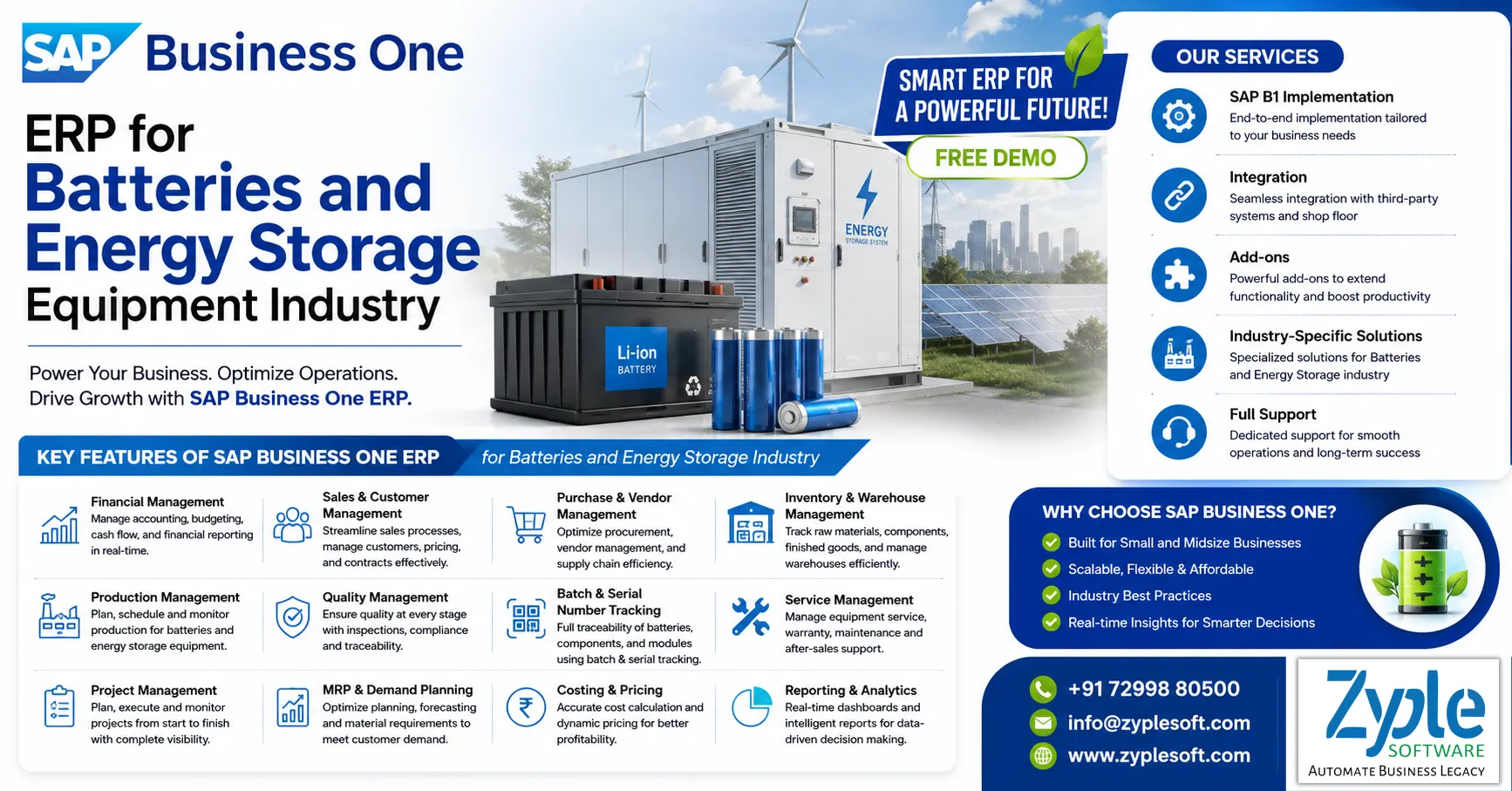
        SAP Business One ERP for Batteries and Energy Storage Equipment Industry by Zyple Software

        SAP Business One ERP for Batteries and Energy Storage Equipment Industry

        SAP Business One (B1) ERP for Batteries and Energy Storage Equipment Industry

        SAP Business One ERP for Batteries and Energy Storage Equipment Industry by Zyple Software

        The batteries and energy storage equipment industry operates in a precision-driven and compliance-heavy environment. Even small gaps in production data or inventory tracking can lead to serious consequences like failed audits, delayed shipments, or costly rework. SAP Business One ERP for batteries and energy storage equipment unifies financials, multi-level bills of materials (BOMS), and supply chains into a single platform to accelerate production, track inventory, and maintain global safety compliance.

        Challenges Faced By The Batteries and Energy Storage Equipment Industry

        The battery and energy storage equipment industry faces significant challenges, including volatile raw material costs, supply chain vulnerabilities, and strict safety concerns. Furthermore, rapid technological degradation, regulatory uncertainities, and complex end-of-life recycling requirements continue to challenge large-scale global deployment.

        1. Supply Chain Constraints and Material Sourcing

        The industry depends heavily on essential materials like lithium, cobalt, nickel, and graphite. Geopolitical concentrations in mining and refining expose manufacturers to price volatility and supply disruptions.

        2. Safety and Thermal Runaway

        Large-scale battery and energy storage equipment systems present significant fire risks and thermal runaway, leading to insurance and zoning challenges. For instance, municipalities globally have occasionally installed moratoriums on lithium-ion facilities due to combustion and pollution.

        3. Degradation and Lifespan

        Batteries experience capacity fading and degradation over charge-discharge cycles. This demands frequent replacements and complex cell-balancing capabilities to ensure optimal pack performance over a 10-to-15-year operational span.

        4. High Capital Costs and ROI Uncertainty

        Despite falling cell prices, total auxiliary integration, engineering, and setup costs remain high. Investors face uncertainties regarding long-term profitability, specifically when participating in fluctuating energy arbitrage markets.

        5. End-of-Life and Recycling

        Handling discarded equipment is an escalating environmental issue. Recycling infrastructure for large utility-scale batteries becomes less potent, and improper disposal can lead to toxic chemical and heavy metal soil contamination.

        6. Regulatory and Standard Gaps

        A lack of uniform international codes, standardization across different chemistries, and clear grid-interconnection rules complicate smooth integration.

        Features of SAP B1 ERP for Batteries and Energy Storage Equipment Business

        1. Production and Manufacturing Management

        • It includes multi-level bills of materials (BOM) for cells, modules, BMS, casing, and chemicals.
        • It includes production orders and shop floor control for battery assembly and pack building.
        • It includes material requirements planning (MRP) for raw materials like lithium, cobalt, and electrolytes.
        • Batch production and formula management are essential for chemical mixing processes.
        • It includes WIP (Work-in-Progress) tracking for multi-stage battery production.
        • Yield, scrap, and rework management are essential for defect control.
        • It includes capacity and resource planning for machines, labor, and production lines.
        • Production costing, like standard vs. actual with real-time recalculation.
        • It ensures efficient control over complex, multi-stage battery manufacturing.

        2. Inventory and Warehouse Management

        • It includes real-time tracking of raw materials, semi-finished, and finished goods.
        • Batch and serial number tracking for traceability is essential for batteries.
        • It includes multi-warehouse and bin location management.
        • It includes expiry and shelf-life tracking for chemicals and cells.
        • Stock valuation methods like FIFO, moving average, and standard costing.
        • It includes automated stock movements during production and dispatch.
        • It includes barcode and QR integration for warehouse operations.
        • Important for safety, compliance, and traceability in battery manufacturing.

        3. Quality Control and Compliance Management

        • It includes incoming, in-process, and final quality inspections.
        • It includes test result recording for voltage, capacity, and thermal stability.
        • Quality certificates and compliance documentation like ISO, BIS, and IEC.
        • It includes non-conformance and corrective action tracking.
        • It includes audit trails for regulatory compliance.
        • Helps achieve strict safety and environmental regulations.

        4. Procurement and Supplier Management

        • Vendor management for raw materials like lithium, nickel, separators, and more.
        • It includes purchase planning based on MRP recommendations.
        • It includes supplier price lists and contract management.
        • It includes automated purchase orders and approvals.
        • It includes import or export documentation handling.
        • It includes supplier performance tracking.
        • It includes stable sourcing in a volatile raw material market.

        5. Sales, Distribution, and Customer Management

        • End-to-end sales cycle from quotation, order, and delivery to invoice.
        • OEM and B2B customer management for EV manufacturers, utilities, and more.
        • After-sales service and warranty tracking are essential for batteries.
        • It includes pricing management for bulk and contract sales.
        • It includes demand forecasting for energy storage projects.
        • CRM for handling long-term contracts and projects.
        • It supports both industrial and project-based sales models.

        6. Financial Management and Cost Control

        • It includes general ledger, AP/AR, and banking integration.
        • It includes project-based costing for energy storage installations.
        • It includes budgeting and cost center tracking.
        • Profitability per analysis per product, like battery type and capacity.
        • It includes multi-currency support for global trade.
        • Taxation and compliance like GST and international regulations.
        • Helps handle thin margins and volatile input costs.

        7. Advanced Analytics and Business Intelligence (BI)

        • It includes real-time dashboards for production, inventory, and sales.
        • KPI tracking like yield, efficiency, defect rate, and cost per unit.
        • It includes predictive analytics for demand and procurement.
        • It includes custom reports and drill-down analysis.
        • It includes Excel integration for advanced reporting.
        • Allows data-driven decision-making across operations.

        8. Asset and Equipment Management

        • It includes maintenance tracking for machinery and equipment.
        • It includes downtime monitoring and preventive maintenance.
        • It includes asset lifecycle management.
        • It includes calibration tracking for testing equipment.
        • Crucial for high-value battery production equipment.

        9. Project Management

        • It includes project planning for solar and storage or grid-scale deployments.
        • It includes cost tracking per project.
        • It includes resource allocation and scheduling.
        • It includes milestone tracking and billing.
        • Suitable for EPC companies and large-scale storage deployments.

        10. Integration, Mobility, and Scalability

        • It includes web client for remote access.
        • It includes integration with IoT, BMS, and external systems.
        • It includes cloud or on-premises deployment.
        • It includes scalable architecture for a growing battery business.

        Benefits of SAP Business One ERP for Batteries and Energy Storage Equipment Industry

        The ERP software, SAP Business One (SAP B1) system, provides immense value to the battery and energy storage equipment industry by uniting engineering, procurement, production, and financials into one platform. It drives operational efficiency, improves complex supply chains, and ensures strict regulatory compliance and safety standards.

        1. End-to-End Traceability

        In the batteries and energy storage equipment industry, tracing individual components, chemical batches, and serial numbers is essential for safety and warranty management. SAP implementation tracks materials from supplier to customer, ensuring compliance and easy management of RMAs and recalls.

        2. Intelligent Production and MRP

        Material requirements planning (MRP) ensures you have the exact raw materials, like lithium, cell components, and inverters, required to meet production schedules without overstocking. This reduces idle time and optimizes the production ratio.

        3. Real-Time Project and Job Costing

        Engineering-to-order (ETO) companies can accurately estimate, track, and review profit margins. It delivers live visibility into labor, material overheads, and assembly costs, protecting profitability across large-scale energy projects using SAP solutions.

        4. Stringent Quality Control

        The system enables manufacturers to build incoming, in-process, and final quality checks directly into the routing operations. It documents testing procedures and blocks the movement or sale of non-compliant battery units.

        5. Lifecycle and Service Management

        The batteries and energy storage equipment industry involves ongoing evaluation. The SAP B1 system enables companies to track installed equipment, schedule preventive maintenance, and handle warranty lifecycles, minimizing downtime and reducing total cost of ownership.

        Conclusion of Batteries and Energy Storage Equipment ERP

        As an SAP Business One partner, Zyple Software is providing services like SAP B1 implementation, integration, licensing, add-ons, and support to different industries like construction, manufacturing, retail, pharma, aerospace, solar, jewellery, food and beverage, and textile industries. SAP Business One is an ERP designed for small and medium-sized businesses that integrates finance, purchasing, sales, inventory, production, CRM, and reporting into a single platform. For batteries and energy storage equipment or any other companies, it can improve project costing, procurement, subcontractor billing, and inventory management.

        If you’re flexible, book a demo of SAP B1 ERP with Zyple Software team.

        Do you demand the SAP B1 ERP software for your business or industry?

        Finish all the details in the defined contact form; our team will get back to you.

          Frequently Asked Questions

          1.How can SAP Business One improve efficiency in my battery manufacturing business?

          SAP Business One automates key processes like production planning, inventory management, and financial reporting. This reduces manual work, decreases errors, and improves overall operational efficiency, helping your business scale faster.

          Yes, SAP Business One is specifically customized for SMEs. It provides scalable features that grow with your business, making it ideal for startups and expanding battery and energy storage companies.

          Businesses generally see ROI through minimized operational costs, better inventory control, improved production efficiency, and faster decision-making with real-time insights.

          Yes, you can request a personalized demo customized for your manufacturing processes, helping you understand how the ERP fits your specific operational needs.

          You can begin by consulting a certified partner of SAP Business One like Zyple Software, who will evaluate your requirements, suggest the right solution, and guide you through implementation, training, and support.

          How to Choose the Right SAP Business One Partner for Your Business - SAP Business One Implementation, Integration, Add-ons & Support by Zyple Software

          How to Choose the Right SAP Business One Partner for Your Business in 2026?

          Choose the Right SAP Business One Partner for Your Business or Industry

          How to Choose the Right SAP Business One Partner for Your Business - SAP Business One Implementation, Integration, Add-ons & Support by Zyple Software

          Selecting the right SAP Business One partner is one of the most important decisions for a successful ERP implementation. While SAP Business One is a powerful ERP solution for small and medium-sized enterprises (SMEs), the expertise of your implementation partner ultimately determines how quickly your business realizes value from the investment.

          Whether you’re in manufacturing, construction, engineering, trading, wholesale distribution, or retail, partnering with an experienced SAP Business One implementation company can significantly improve project success.

          Why Your SAP Business One Partner Matters?

          Many ERP projects fail not because of the software but because of poor implementation planning, inadequate training, and lack of post-go-live support.

          A reliable SAP Business One implementation partner helps organizations:

          • Understand business requirements
          • Configure SAP Business One according to industry best practices
          • Migrate existing business data securely
          • Integrate third-party applications
          • Train employees
          • Provide ongoing technical and functional support

          The right partner becomes a long-term technology advisor rather than simply a software vendor.

          What to Look for in a SAP Business One Partner?

          1. Industry Experience

          Every industry has unique business processes.

          Choose a partner that understands your business sector, whether it’s:

          • Manufacturing
          • Construction and Real Estate
          • Engineering
          • Automotive Components
          • Pumps and Valves
          • Printing and Packaging
          • Jewellery Manufacturing
          • Food and Beverages
          • Pharmaceuticals
          • Steel and Wire
          • Retail/Trading
          • Aerospace and Defense
          • Renewable Energy (Solar, Wind, Hydroelectric industry etc.)
          • Oil and Gas and many more

          Industry expertise reduces implementation time and minimizes customization requirements.

          2. Certified SAP Business One Expertise

          Look for a company with experienced ERP consultants, functional experts, and technical developers who understand SAP Business One inside and out.

          A knowledgeable implementation team can recommend best practices instead of simply replicating outdated manual processes.

          3. Complete ERP Services

          A capable implementation partner should provide end-to-end services, including:

          • ERP Consulting
          • Business Process Analysis
          • SAP Implementation
          • Custom Add-on Development
          • SAP Business One Licensing
          • API Integrations
          • Mobile Applications
          • Business Intelligence Dashboards
          • Data Migration
          • User Training
          • Annual Maintenance and Full Support

          Having a single partner for all ERP requirements simplifies communication and long-term support.

          4. Proven Implementation Methodology

          Successful ERP implementations follow a structured process:

          • Business Requirement Analysis
          • Solution Design
          • System Configuration
          • Custom DevelopmentTesting
          • User Acceptance Testing (UAT)
          • Go-Live
          • Post-Go-Live Support

          A well-defined implementation methodology minimizes project risks.

          5. Strong Customer Support

          ERP implementation doesn’t end at go-live.

          Businesses should evaluate:

          • Response time
          • Dedicated support team
          • Remote assistance
          • On-site SAP support
          • System optimization
          • Version upgrades

          Reliable support ensures continuous business operations.

          Questions to Ask Before Selecting a SAP Business One Partner

          Before making a decision, ask these important questions:

          1. How many SAP Business One projects have you completed?
          2. Which industries do you specialize in?
          3. Can you provide customer references?
          4. What implementation methodology do you follow?
          5. How long will implementation take?
          6. What integrations can you support?
          7. What happens after go-live?
          8. What is included in the Annual Maintenance Contract (AMC)?
          9. Can you develop custom reports and dashboards?
          10. Do you provide user training?

          The answers will help you compare implementation partners objectively.

          Why Businesses Choose Zyple Software?

          For organizations looking for a trusted SAP Business One Partner in India, Zyple Software provides comprehensive ERP implementation and digital transformation services.

          Their offerings include:

          • SAP Business One Implementation
          • SAP Business One Licensing
          • Industry-Specific ERP Solutions
          • SAP Business One Add-ons
          • API and Third-Party Integrations
          • Business Intelligence Dashboards
          • Mobile ERP Applications
          • Cloud & On-Premise Deployments
          • Data Migration
          • User Training
          • Post-Implementation Support

          Zyple Software has experience serving businesses across multiple industries, helping organizations streamline operations, improve inventory control, automate finance, strengthen production planning, and gain real-time business insights through SAP Business One.

          Final Conclusion

          Choosing the right SAP Business One partner is an investment in your company’s future. A knowledgeable implementation partner can reduce project risks, accelerate ERP adoption, and maximize return on investment.

          Instead of selecting a partner based only on price, evaluate their industry expertise, implementation experience, customer success stories, technical capabilities, and long-term support services.

          If your business is planning a digital transformation journey with SAP Business One, partnering with an experienced implementation company can make all the difference between a challenging ERP deployment and a successful business transformation.

          Frequently Asked Questions (FAQs)

          1. What is a SAP Business One Partner?

          A SAP Business One Partner is an authorized company that provides SAP Business One licensing, implementation, customization, integration, user training, and ongoing support. A trusted partner helps businesses deploy the ERP system successfully and optimize it for their specific operational needs.

          When selecting a SAP Business One Partner, consider their industry experience, implementation methodology, customer references, technical expertise, post-go-live support, customization capabilities, and success stories. It’s also important to choose a partner that understands your business processes and long-term goals.

          A qualified implementation partner ensures a smooth ERP deployment, minimizes business disruption, reduces project risks, and provides ongoing support after go-live. Their expertise can significantly improve user adoption and maximize your return on investment.

          SAP Business One is suitable for a wide range of industries, including manufacturing, engineering, construction, automotive, food processing, pharmaceuticals, printing and packaging, jewellery manufacturing, wholesale distribution, retail, and professional services.


          A SAP Business One Partner typically offers software licensing, ERP implementation, business process consulting, data migration, customization, add-on development, third-party integrations, user training, cloud deployment, system upgrades, and annual maintenance and support.

          The implementation timeline depends on the size and complexity of the business. Small businesses may complete implementation in 6–12 weeks, while larger organizations with multiple locations or custom requirements may require several months.

          Yes. SAP Business One can be customized with user-defined fields, workflows, reports, dashboards, and industry-specific add-ons. It also supports integration with CRM systems, eCommerce platforms, payroll software, logistics solutions, and other third-party applications.

          Ask about their implementation experience, industry expertise, project methodology, customer references, support services, customization capabilities, implementation timeline, pricing structure, and post-go-live support to ensure they meet your business requirements.

          Zyple Software offers SAP Business One implementation, licensing, customization, integration, industry-specific ERP solutions, user training, and ongoing support. With experience across manufacturing, construction, engineering, trading, and other industries, Zyple Software helps businesses streamline operations and achieve digital transformation.

          The first step is to consult with an experienced SAP Business One Partner to assess your business requirements. You can then schedule a free product demonstration, discuss implementation options, and create a roadmap for deploying SAP Business One successfully.

          “Ready to implement SAP Business One? Book a FREE Demo with Zyple Software.”

          Fill your detail in give form, our team will reach your better solution.