Tag Archives: SAP B1 Integration

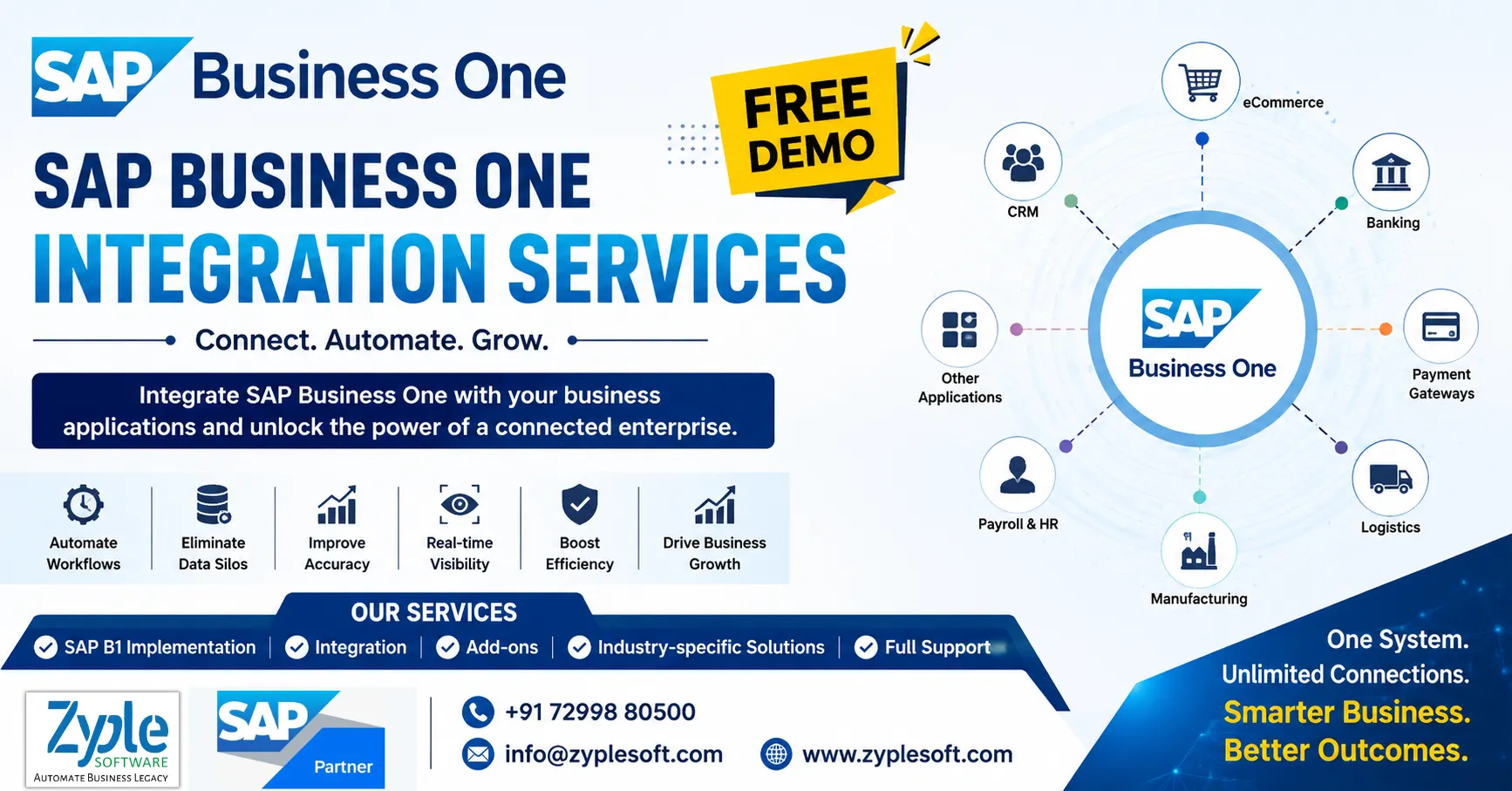
SAP Business One integration service by zyple software

What is SAP Business One Integration Services?

SAP Business One Integration Services for Industries
SAP Business One integration service by zyple software

SAP Business One Integration enables businesses to connect their ERP system with the applications, platforms, databases, and operational systems they use every day. Zyple Software provides SAP Business One integration services to help organizations create a connected digital ecosystem where business information can move accurately and efficiently between SAP Business One and third-party applications.

From eCommerce and CRM platforms to payment gateways, payroll systems, manufacturing solutions, logistics applications, banking platforms, and custom software, our team helps businesses integrate SAP Business One with the systems that support their operations.

With the right integration strategy, businesses can reduce duplicate data entry, improve data accuracy, automate workflows, and gain better visibility across departments.

Looking for SAP Business One integration for your business? Talk to Zyple Software for a customized integration assessment and SAP Business One demo.

What Is SAP Business One Integration?

SAP Business One Integration is the process of connecting SAP Business One ERP with external software, applications, databases, websites, or business platforms so that information can be exchanged between systems.

For example, when a customer places an order through an eCommerce website, integration can automatically transfer the order information to SAP Business One. Similarly, inventory, customer information, invoices, payment status, and shipment details can be synchronized between connected systems.

Instead of maintaining separate information in multiple applications, integration creates a connected flow of data.

A typical SAP Business One integration can connect:

  • SAP Business One with CRM software
  • SAP Business One with eCommerce websites
  • SAP Business One with WooCommerce
  • SAP Business One with payment gateways
  • SAP Business One with banking systems
  • SAP Business One with payroll software
  • SAP Business One with manufacturing applications
  • SAP Business One with warehouse management systems
  • SAP Business One with logistics and transportation systems
  • SAP Business One with third-party APIs
  • SAP Business One with mobile applications
  • SAP Business One with custom business applications

Why Integrate SAP Business One With Other Systems?

Modern businesses rarely operate with ERP alone. Sales, finance, manufacturing, eCommerce, logistics, HR, customer service, and management teams often use different applications.

Without integration, employees may have to enter the same information into multiple systems. This can increase manual work and create inconsistent or outdated data.

SAP Business One integration helps create a connected environment where information can flow between systems based on defined business rules.

Key benefits include:

Reduce Manual Data Entry

Automate the transfer of information between SAP Business One and other applications.

Improve Data Accuracy

Reduce errors caused by repeatedly entering customer, product, order, inventory, or financial information.

Automate Business Processes

Create automated workflows for sales orders, invoices, payments, inventory updates, production processes, and other activities.

Improve Real-Time Visibility

Give management and employees access to more consistent business information across connected systems.

Connect Different Departments

Bring sales, finance, inventory, purchasing, production, logistics, and service processes closer together.

Increase Operational Efficiency

Reduce repetitive administrative activities and allow employees to focus on higher-value work.

Support Business Growth

Build an integration architecture that can accommodate new applications and business requirements as the organization grows.

SAP Business One Integration Services by Zyple Software

SAP Business One Partner – Zyple Software provides end-to-end SAP Business One integration services based on the organization’s applications, workflows, data requirements, and industry processes.

Our integration approach can include requirement analysis, solution architecture, API integration, data mapping, development, testing, deployment, monitoring, and ongoing support.

1. SAP Business One API Integration

Connect SAP Business One with external applications using APIs and integration technologies.

API-based integration can be used for:
  • Customer synchronization
  • Product and item synchronization
  • Sales order integration
  • Purchase order integration
  • Inventory synchronization
  • Invoice integration
  • Payment updates
  • Business partner information
  • Shipment information
  • Custom workflows

2. SAP Business One eCommerce Integration

Connect your online store with SAP Business One to synchronize critical business information.

An eCommerce integration can connect:

Website → Orders → SAP Business One → Inventory → Invoice → Shipment

Depending on the business requirement, information such as products, prices, customers, stock availability, orders, invoices, and shipment status can be exchanged between the systems.

This is particularly useful for businesses managing high volumes of online orders.

3. SAP Business One WooCommerce Integration

For businesses using WooCommerce, SAP Business One integration can help connect the online store with ERP operations.

Possible integration areas include:
  • Product master synchronization
  • Customer synchronization
  • Stock availability
  • Sales orders
  • Order status
  • Pricing
  • Tax information
  • Invoices
  • Shipping information
  • Payment status
The objective is to reduce manual order processing and maintain better synchronization between the online store and ERP.

4. SAP Business One CRM Integration

Connect SAP Business One with CRM platforms to improve the flow of customer and sales information.

CRM integration can help synchronize:
  • Leads
  • Customers
  • Contacts
  • Opportunities
  • Sales activities
  • Quotations
  • Orders
  • Customer communication data
This enables sales teams and finance teams to work with connected customer information.

5. SAP Business One Payment Gateway Integration

Payment gateway integration can connect online payment transactions with SAP Business One.

Depending on the solution architecture, payment information can be transferred to the ERP for reconciliation, order processing, customer account updates, and financial reporting.

This can be valuable for businesses processing payments through online channels.

6. SAP Business One Banking Integration

Banking integration can help businesses connect financial transactions and banking processes with SAP Business One.

Integration possibilities may include:
  • Bank transaction synchronization
  • Payment processing
  • Collection information
  • Bank reconciliation
  • Customer payment updates
  • Vendor payment information
The exact functionality depends on the banking platform, APIs, security requirements, and business process.

7. SAP Business One Payroll and HRMS Integration

Organizations using dedicated HRMS or payroll applications can integrate relevant employee and financial information with SAP Business One.

Integration can help reduce repetitive data entry between HRMS, payroll, accounting, and ERP systems.

Possible integration areas include:
  • Employee information
  • Salary-related accounting information
  • Attendance data
  • Payroll transactions
  • Department information
  • Cost centers

8. SAP Business One Manufacturing Integration

Manufacturing organizations may need SAP Business One to communicate with production systems, machines, MES platforms, quality systems, or other manufacturing applications.

Integration can support information exchange involving:
  • Production orders
  • Bill of Materials
  • Material consumption
  • Production status
  • Inventory
  • Work-in-progress
  • Machine or production data
  • Quality information
Zyple Software can design integration solutions around the organization’s manufacturing workflow.

9. SAP Business One Warehouse and Logistics Integration

Connect SAP Business One with warehouse, transportation, logistics, barcode, fleet, or third-party logistics applications.

Possible integration areas include:
  • Inventory movements
  • Goods receipt
  • Goods issue
  • Stock transfers
  • Barcode information
  • Delivery status
  • Shipment information
  • Vehicle or fleet information
  • Warehouse transactions
This can help improve coordination between ERP, warehouse, and logistics operations.

SAP Business One Integration for Different Industries

Integration requirements differ from one industry to another. Zyple Software develops integration solutions around the business processes and applications used by each organization.

Manufacturing

Integrate SAP Business One with production, MES, quality, warehouse, machine, and planning systems.

Construction & Infrastructure

Connect SAP Business One with project management, contractor billing, procurement, inventory, finance, and specialized construction applications.

EPC

Integrate ERP with project systems, procurement platforms, inventory applications, subcontracting systems, and financial processes.

Trading & Distribution

Connect SAP Business One with eCommerce, CRM, logistics, warehouse, payment, and marketplace platforms.

Retail

Integrate ERP with POS, eCommerce, inventory, payment, customer loyalty, and retail applications.

Pharmaceutical

Connect SAP Business One with quality, inventory, compliance, distribution, and specialized pharmaceutical systems.

Food and Beverage

Integrate production, batch management, quality, warehouse, sales, distribution, and logistics applications.

Textile

Connect SAP Business One with production, inventory, sales, purchase, warehouse, and textile-specific applications.

SAP Business One Integration Process

At Zyple Software, we follow a structured approach to SAP Business One integration.

Step 1: Business Requirement Analysis

We understand your existing applications, business processes, data flows, integration requirements, and operational challenges.

Step 2: System & Data Assessment

Our team identifies the systems that need to communicate with SAP Business One and determines the information that needs to be exchanged.

Step 3: Integration Architecture

We define the integration approach, APIs, data mapping, authentication, workflows, synchronization frequency, and error-handling mechanisms.

Step 4: Development & Configuration

The required integration components are developed and configured according to the approved solution architecture.

Step 5: Data Mapping

Fields and business objects between SAP Business One and the external system are mapped according to business requirements.

Step 6: Testing

The integration is tested for data accuracy, workflow functionality, performance, security, and exception handling.

Step 7: Deployment

After successful testing and approval, the integration solution is deployed into the production environment.

Step 8: Support & Optimization

Zyple Software provides ongoing support and helps optimize integrations as applications, APIs, and business processes evolve.

SAP Business One Integration With APIs

APIs are an important component of modern ERP integration. They allow applications to communicate and exchange information through defined interfaces.

Depending on the integration requirement, SAP Business One can be connected with external applications using appropriate SAP integration technologies and APIs.

A properly designed API integration should consider:
  • Authentication
  • Authorization
  • Data mapping
  • Request and response handling
  • Error management
  • Data validation
  • Synchronization frequency
  • Logging
  • Security
  • Scalability
Zyple Software evaluates these requirements before designing the integration architecture.

SAP Business One Integration With SAP HANA

Businesses running SAP Business One on HANA may have integration requirements involving external applications, databases, reporting platforms, analytics systems, and custom solutions.

Zyple Software can help organizations evaluate their SAP Business One HANA environment and determine the appropriate integration approach based on their technical and business requirements.

Custom SAP Business One Integration

Every organization has a different technology environment. Standard integrations may not always address specific business requirements.

Zyple Software develops custom SAP Business One integration solutions for organizations that need specialized workflows or connections with proprietary applications.

Custom integration can be considered when you need:
  • Custom API connectivity
  • Industry-specific workflows
  • Legacy system integration
  • Custom application integration
  • Multi-system data synchronization
  • Specialized reporting integration
  • Automated business workflows
  • Mobile application integration

SAP Business One Integration Challenges We Help Solve

Businesses often approach us when they experience problems such as:
  • Duplicate data entry
  • Disconnected business applications
  • Manual order processing
  • Inventory synchronization issues
  • Delayed financial information
  • Multiple customer databases
  • Manual invoice creation
  • Lack of system-to-system automation
  • Data inconsistencies
  • Legacy software limitations
  • Difficulty connecting custom applications
  • Limited visibility across business processes
Our goal is to identify the root cause and design an integration solution that fits the organization’s actual workflow.

Why Choose Zyple Software for SAP Business One Integration?

Zyple Software combines SAP Business One implementation, integration, add-ons, customization, and support to provide businesses with a complete ERP technology solution.

Our capabilities include:
  • SAP Business One implementation
  • SAP Business One integration
  • SAP B1 API integration
  • SAP Business One customization
  • SAP Business One add-on development
  • Third-party application integration
  • Data migration
  • ERP process automation
  • Industry-specific solutions
  • SAP Business One support
Our team focuses on understanding the business process first and then selecting the appropriate technology and integration approach.

SAP Business One Integration FAQs

What is SAP Business One integration?

SAP Business One integration connects the ERP with external applications, platforms, databases, websites, APIs, and business systems so that information can be exchanged between them.

Businesses use integration to reduce manual data entry, automate workflows, improve information accuracy, connect different applications, and create better visibility across operations.

Yes. SAP Business One can be integrated with eCommerce platforms to exchange information such as products, customers, orders, inventory, invoices, payments, and shipping information.

Yes. A customized WooCommerce and SAP Business One integration can synchronize relevant online-store and ERP information based on the business requirements.

Yes. CRM integration can connect leads, customers, contacts, opportunities, quotations, sales orders, and other relevant information between systems.

Yes. Zyple Software can design custom integration solutions for proprietary applications, legacy systems, industry-specific software, and other business platforms.

Yes. Zyple Software provides integration implementation, customization, troubleshooting, maintenance, and ongoing SAP Business One support.

Build a Connected Business With SAP Business One

Your ERP should not operate as an isolated system.

By connecting SAP Business One with CRM, eCommerce, banking, payroll, warehouse, manufacturing, logistics, payment, and custom applications, your organization can create a more connected and automated business environment.

Zyple Software helps businesses plan, develop, implement, and support SAP Business One integration solutions based on their technology environment and industry requirements.

Ready to Integrate SAP Business One With Your Business Applications?

Book a Free SAP Business One Integration Consultation with Zyple Software.

Zyple Software – SAP Business One Partner
Call Us: +91 72998 80500
Mail: info@zyplesoft.com
Website: www.zyplesoft.com

Services: SAP Business One Implementation | Integration | Add-ons | Customization | Industry Solutions | Support

Are you looking for any SAP Business One Integration? Kindly fill your details in below given form; Our team will contact you with better solutions.
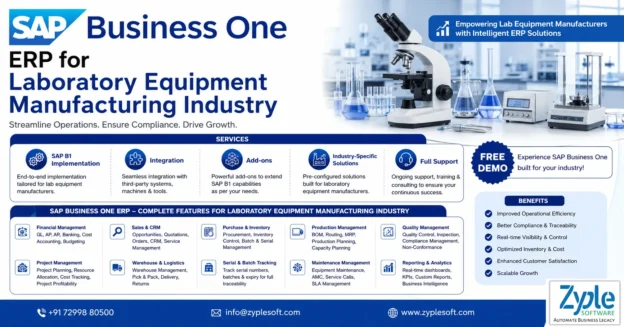
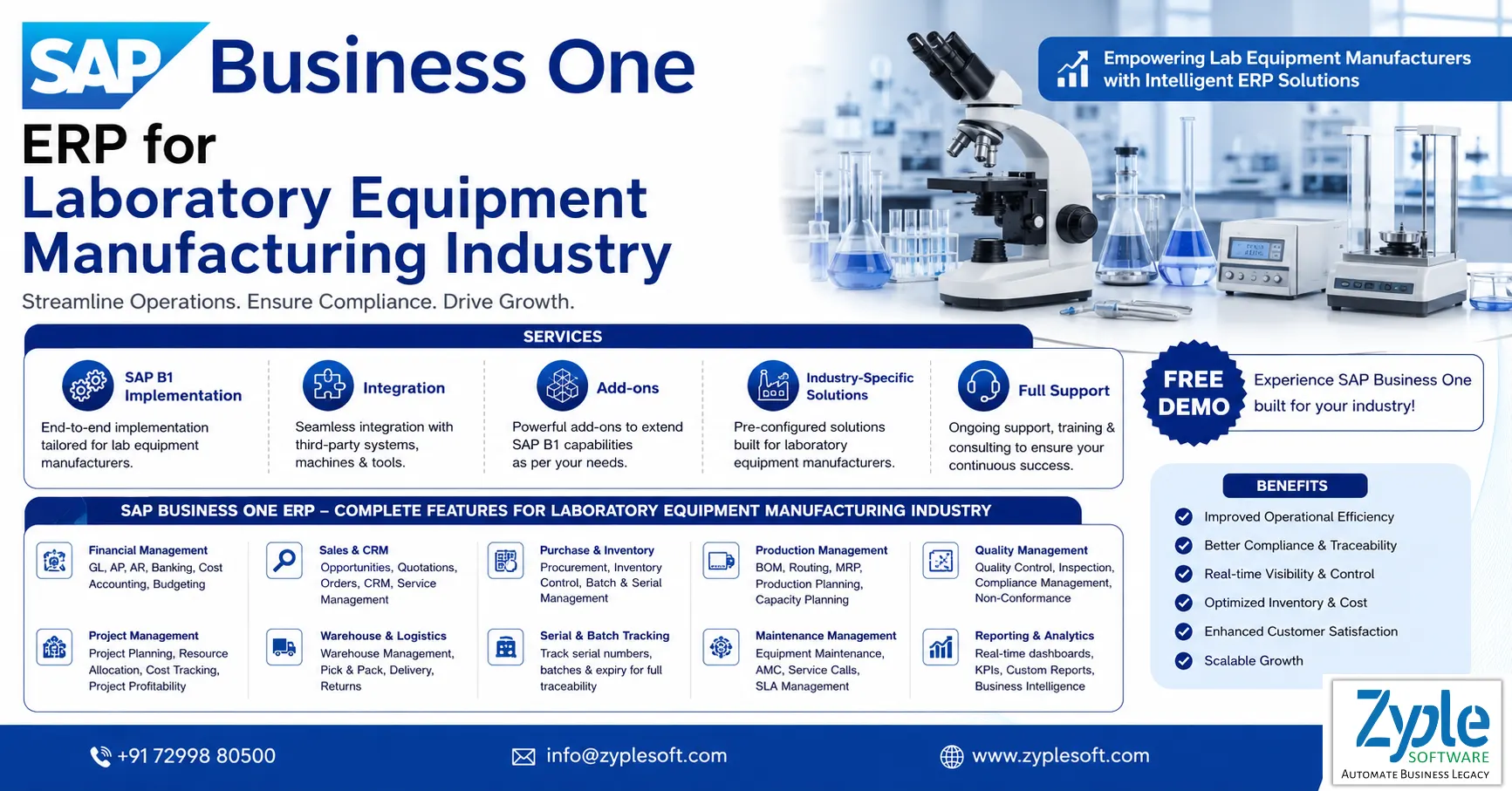
    SAP Business One ERP for Laboratory Equipment Manufacturing Industry infographic by Zyple Software featuring implementation, integration, add-ons, compliance, inventory, production, quality management, and analytics.

    SAP Business One ERP for Laboratory Equipment Manufacturing Industry

    SAP Business One ERP Software for Laboratory Equipment Manufacturing Industry

    SAP Business One ERP for Laboratory Equipment Manufacturing Industry infographic by Zyple Software featuring implementation, integration, add-ons, compliance, inventory, production, quality management, and analytics.

    The laboratory equipment manufacturing industry operates under strict quality standards, regulatory pressure, and rising competition. Manufacturers must handle complex production workflows, ensure complete traceability, and maintain consistent quality while scaling operations. SAP Business One ERP for laboratory equipment manufacturing delivers a structured ERP foundation to handle these challenges and support long-term growth without operational chaos.

    Challenges Faced By The Laboratory Equipment Manufacturing Industry

    The laboratory equipment manufacturing industry faces strict regulatory compliance, rapid technological obsolescence, and miniaturization demands. Companies struggle with supply chain disruptions, a shortage of skilled labor for complex mechatronic systems, and fierce global competition, all of which heavily squeeze profit margins and increase time to market.

    1. Strict Regulatory Compliance

    Manufacturers must handle evolving global standards such as GLP, GMP, and ISO certifications. Continuously updating designs to achieve these mandates creates massive administrative burdens.

    2. Component Shortages and Supply Chain

    The industry is heavily dependent on precise, specialized sub-components. Global supply chain volatility often results in prolonged lead times, inflating manufacturing and service costs.

    3. Skill Gaps in Development and Assembly

    Building complex mechatronic systems involves advanced specialist knowledge in software integration, automation, and electronics. Small and mid-scale manufacturers often lack the engineering manpower and high-end production infrastructure required to scale.

    4. Device Integration and Compatibility

    Laboratories frequently use instruments from different vendors. Disparate software systems, differing communication protocols, and the lack of universal standards hamper seamless data flow and integration.

    5. Equipment Downtime and Service Pressures

    Executives place huge pressure on equipment uptime to prevent costly research or sample losses. Extended resolution times for repairs and complex maintenance cycles severely affect operational efficiency and customer satisfaction.

    Features of SAP Business One ERP for Laboratory Equipment Manufacturing

    1. End-to-End Manufacturing Management

    • It includes bill of materials (BOM) for complex lab instruments.
    • It includes multi-level production orders and routing.
    • It includes production planning and control based on demand forecasts.
    • It includes batch and serial number tracking for precision components.
    • It includes real-time shop floor control and reporting.

    2. Quality Control and Compliance Management

    • It includes quality inspection at incoming, in-process, and final stages.
    • It includes non-conformance and corrective action tracking (CAPA).
    • It includes compliance with ISO, GMP, FDA, and calibration standards.
    • It includes audit trail and documentation management.
    • It includes calibration scheduling and tracking for lab equipment.

    3. Inventory and Warehouse Management

    • It includes real-time inventory tracking across warehouses.
    • It includes batch or lot traceability for service components.
    • It includes automated stock replenishment and reorder levels.
    • It includes handling of hazardous or sensitive materials.
    • It includes barcode and RFID integration.

    4. Product Lifecycle Management

    • It includes engineering change management.
    • It includes version control for product designs and specifications.
    • It includes integration with CAD systems.
    • It includes prototype and R&D cost tracking.

    5. Advanced Material Requirements Planning (MRP)

    • It includes demand-driven MRP for raw materials and components.
    • It includes forecasting based on historical sales and trends.
    • It includes supplier lead time management.
    • Reduces stockouts and excess inventory.

    6. Supplier and Procurement Management

    • It includes vendor evaluation and performance tracking.
    • It includes automated purchase requests and approvals.
    • It includes supplier pricing and contract management.
    • It includes integration with global supply chains.

    7. Financial Management and Cost Control

    • It includes real-time financial reporting and analytics.
    • Product costing like standard, moving average, and FIFO.
    • It includes budgeting and cost center tracking.
    • It includes multi-currency and multi-location support.
    • It includes GST compliance for India.

    8. Sales and Customer Relationship Management (CRM)

    • It includes lead and opportunity management.
    • It includes quotation and sales order automation.
    • It includes customer-specific pricing and contracts.
    • It includes after-sales service tracking for lab equipment.
    • It includes warranty and service contract management.

    9. Service and Maintenance Management

    • It includes installation and commissioning tracking.
    • It includes preventive and corrective maintenance scheduling.
    • It includes service call management.
    • It includes spare parts inventory integration.
    • It includes field service technician management.

    10. Business Intelligence and Reporting

    • It includes real-time dashboards and KPIs.
    • It includes custom reports for production, quality, and finance.
    • It includes predictive analytics for demand and maintenance.
    • It includes integration with Excel and analytics tools.

    11. Integration and Scalability

    • Seamless integration with third-party systems like LIMS, CAD, and MES.
    • It includes API-based connectivity.
    • It includes cloud and on-premise deployment options.
    • Adaptable for growing manufacturing businesses.

    12. Data Security and Regulatory Compliance

    • It includes role-based access control.
    • It includes data encryption and secure backups.
    • It includes compliance with industry regulations.
    • It includes full audit trails for traceability.

    13. Mobility and Remote Access

    • It includes remote access to dashboards and reports.
    • It includes real-time alerts and notifications.

    14. Customization and Industry-Specific Add-Ons

    • It includes customization workflows for laboratory equipment manufacturing.
    • It includes industry-specific SAP B1 add-ons for calibration and compliance.
    • It includes flexible user-defined fields and reports.

    15. Project Management Capabilities

    • Tracks R&D and custom equipment projects.
    • It includes budget vs. actual cost tracking.
    • It includes resource allocation and scheduling.
    • It includes milestone-based project monitoring.

    Importance of SAP Business One ERP for Laboratory Equipment Manufacturing

    The ERP software, SAP Business One (SAP B1) system, is essential for laboratory equipment manufacturers, as it unifies core processes, including finance, supply chain, and production, into a single source of truth. It allows highly precise manufacturing, strict regulatory compliance, and seamless tracking of expensive components, ultimately boosting operational efficiency and profit margins.

    1. Strict Regulatory Compliance

    The industry requires thorough quality control and traceability. SAP B1 automates quality checks, maintains audit-ready documentation, and monitors components so that manufacturers can easily adhere to global standards like ISO and FDA regulations.

    2. Precise Production Management

    Utilizing multi-level bill of materials (BOMs) and material requirements planning (MRP), the software helps handle complex assembly. It ensures you have the exact components needed to build precision instruments without holding excess stock using SAP implementation.

    3. Granular Traceability

    Every piece of lab equipment, from sensors to centrifuges, can be serialized. This enables manufacturers to trace the exact batch or serial number of an item from raw material procurement through to post-sales maintenance and service.

    4. Real-Time Financial and Inventory Visibility

    SAP B1 eliminates data silos. Real-time dashboards track machine utilization, labor costs, and project profitability, enabling leadership to make accurate, data-driven decisions.

    5. Supply Chain Optimization

    It reduces the risk of stock-outs or overstocking for specialized, often costly, materials required for lab equipment, ensuring on-time delivery and higher customer satisfaction using SAP solutions.

    Benefits of SAP Business One for Laboratory Equipment Manufacturing Industry

    SAP Business One (SAP B1) facilitates your lab equipment manufacturing by centralizing finance, supply chain, and production. It drives ROI through accurate BOM management, serial or batch traceability, and automated material requirements planning (MRP), minimizing carrying costs and ensuring strict industry compliance.

    1. Precision Manufacturing

    Utilizes powerful bill of materials (BOM) features to standardize production, control costs, and handle complex, multi-level assemblies required for sensitive scientific instruments.

    2. Total Traceability

    The SAP software tracks individual components, batches, and serial numbers from procurement to finished goods. This makes managing warranties and handling audits for ISO and regulatory compliance efficient.

    3. Optimized Inventory and Procurement

    The material requirements planning (MRP) system automatically computes purchasing and production needs based on forecasts and lead times, avoiding production delays and stockouts.

    4. Real-Time Analytics

    Unifies financial, sales, and operational data into customizable dashboards using SAP B1 add-ons. This allows data-driven decisions that immediately improve profit margins.

    5. Integrated CRM

    Strengthens customer relationships by managing leads, tracking after-sales service, and logging maintenance or calibration histories in a single platform.

    Conclusion of Laboratory Equipment Manufacturing ERP

    As a qualified SAP Business One partner, Zyple Software is providing services like SAP B1 implementation, integration, licensing, add-ons, and support to different industries like construction, manufacturing, retail, pharma, jewellery, solar, food and beverage, aerospace, and textile industries. SAP Business One is an ERP customized for small and medium-sized businesses that integrates finance, purchasing, sales, inventory, production, CRM, and reporting into a single platform. For solar panel and laboratory equipment manufacturing or any other companies, it can improve project costing, procurement, subcontractor billing, and inventory management.

    If you’re engaged, reserve a demo of SAP Business One.

    Do you necessitate the SAP B1 ERP system for your business or industry?

    Finish all the details in the described contact form; our team will get back to you.

      Frequently Asked Questions

      How can SAP Business One improve efficiency in my laboratory equipment manufacturing business?

      SAP Business One automates key processes like production planning, inventory control, and financial management, helping you minimize manual work, eliminate errors, and improve overall efficiency.

      Yes, SAP Business One is specifically designed for SMEs and growing manufacturers. It providesscalable features that adapt to your business size and complexity.

      The cost depends on factors like number of users, customization needs, and deployment type (like cloud or on-premises). We deliver customized pricing based on your requirements; reach out today for a free consultation and quote.

      The SAP B1 implementation timelines generallyrange from a few weeks to a few months, depending on your business processes. Speak with our team to get a clear project timeline customized for your needs.

      Absolutely! We provide live demos to help you understand how SAP Business One fits your laboratory equipment manufacturing processes.

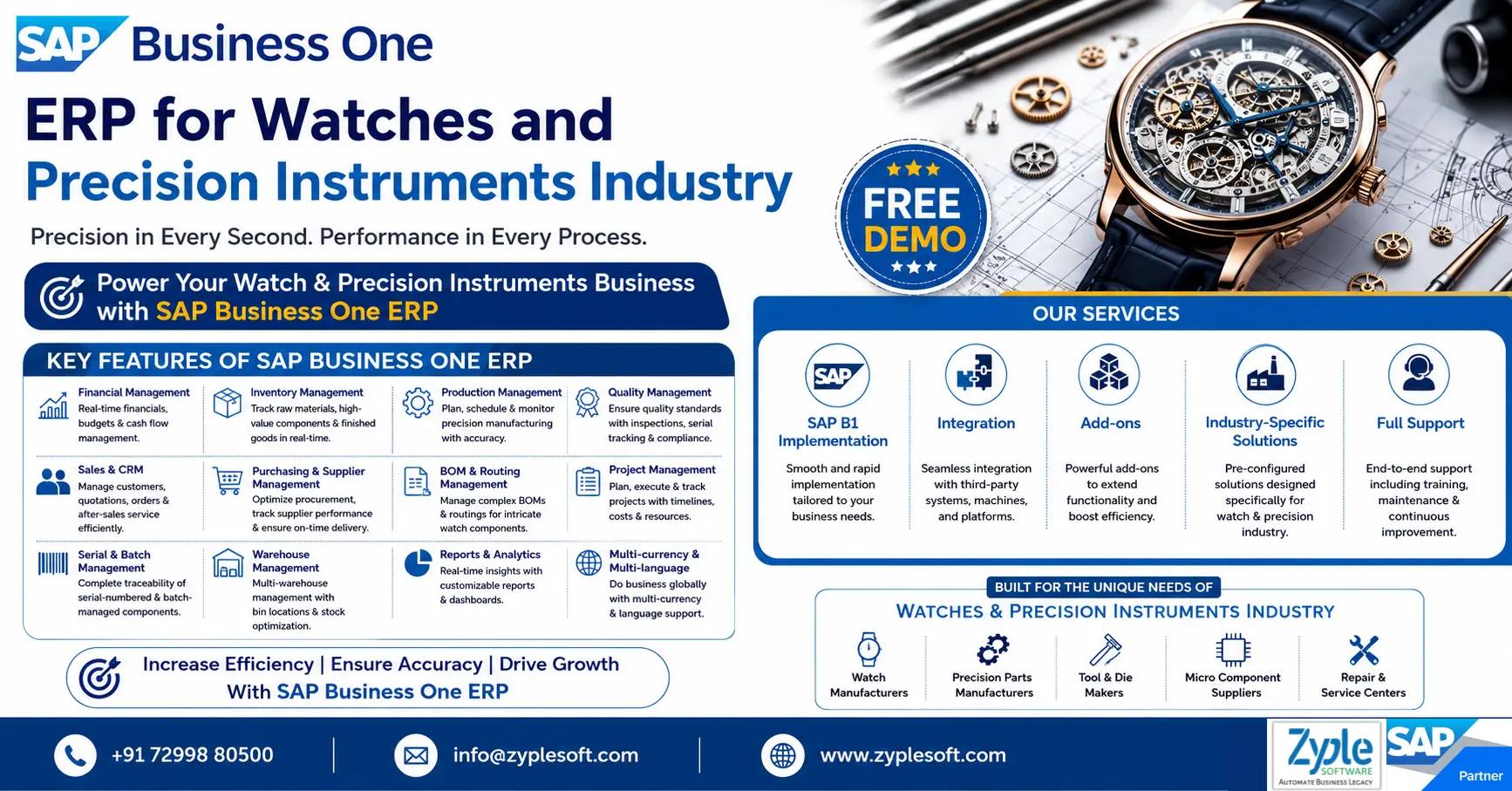
      Infographic of SAP Business One ERP for Watches and Precision Instruments Industry by Zyple Software featuring implementation, integration, add-ons, inventory management, production planning, quality control, serial tracking, CRM, finance, and free demo.

      SAP Business One ERP for Watches and Precision Instruments Industry

      SAP Business One (B1) ERP for Watches and Precision Instruments Industry

      Infographic of SAP Business One ERP for Watches and Precision Instruments Industry by Zyple Software featuring implementation, integration, add-ons, inventory management, production planning, quality control, serial tracking, CRM, finance, and free demo.

      The watches and precision instruments industry operates in a precision-driven environment where product quality, component traceability, and efficient assembly processes are essential. Manufacturers must handle a wide range of small and specialized components such as movements, dials, hands, cases, straps, and batteries while maintaining strict quality standards and design consistency. 

      Traditional systems and manual processes often create challenges in tracking component inventory, handling multi-level bills of materials, coordinating assembly operations, and ensuring product traceability. SAP Business One ERP for watches and precision instruments delivers an integrated platform that connects production planning, component inventory, procurement, quality control, sales, and financial management, providing real-time visibility and operational control across the watch manufacturing cycle.

      Challenges Faced By The Watches and Precision Instruments Industry

      The watches and precision instruments industry faces severe challenges, mainly driven by surging raw material costs (e.g., gold), restrictive geopolitical tariffs on exports, and aggressive competition from multifunctional watches. Consequently, traditional watchmakers are battling declining demand in mid-tier segments, falling secondary market inventories, and recent job contradictions across manufacturing.

      1. Macroeconomic Pressures and Trade Barriers

      International trade wars, including heavy tariffs on Swiss products entering the US, are forcing major shifts in inventory management and supply chain operations. Rising prices for precious metals like gold and platinum directly inflate manufacturing costs, squeezing profit margins, especially for mid-tier luxury and mechanical brands. The strength of the Swiss Franc remains a constant pressure, making exported traditional timepieces significantly more expensive for global buyers.

      2. Technological Shifts and Smartwatch Disruption

      Smartwatches and fitness trackers have evolved into digital health ecosystems, providing biometric tracking like ECG and SpO2, GPS, and phone connectivity. Younger generations are growing accustomed to the daily utility of connected wearables, seriously cutting into the entry-level and mass-market traditional watch segments. While smartwatches dominate, traditional instruments still hold the advantage of longevity. Smart devices suffer from quick battery drain and require daily charging.

      3. Market Saturation and Inventory Struggles

      The pre-owned and secondary markets are experiencing a surplus, causing waiting lists to shrink and secondary-market prices for previously high-demand watches to drop. Watches are remaining on retailer shelves and in dealer cases for much longer, reducing inventory turnover and revenue flow. There is a growing consensus that the market has too many brands chasing the same limited pool of high-net-worth consumers.

      4. Innovation vs. Trading

      Many established brands face criticism for taking extended periods to update designs or integrate modern clasps and bracelets, enabling newer, nimbler competitors to gain traction. While companies explore automated processes and industry 4.0 to scale production, true haute horlogerie depends on master artisans. Hand-finishing places a natural ceiling on production efficiency and output. Luxury watchmakers who attempt to create their own smartwatches or digital ecosystems have historically struggled with poor adoption and mixed results.

      5. Consumer Shifts and Sustainability

      Younger consumers desire highly personalized products and customizable components rather than mass-produced heritage pieces. There is an increased demand for sustainable and ethical sourcing of materials like conflict-free metals and vegan straps, forcing brands to adapt their supply chains.

      Features of SAP Business One ERP for Watches and Precision Instruments

      1. Core Manufacturing and Production Management

      • It includes multi-level BOMs for complex watch parts and instrument parties.
      • Plans, releases, and tracks batch or discrete manufacturing.
      • Defines machining, calibration, polishing, and assembly steps.
      • Optimizes machine utilization like CNC, micro-machining, and assembly lines.
      • Monitors partially assembled components.
      • Aligns production with demand and delivery timelines.
      • Handles production across multiple facilities.

      2. Inventory and Warehouse Management

      • It includes raw materials, components, and finished goods.
      • Essential for the traceability of precision instruments.
      • It includes efficient storage of small and high-value parts.
      • Handles distribution centers and production stores.
      • Avoids shortages of essential micro-components.
      • It includes cycle counting and stock audits.

      3. Quality Control and Compliance

      • Defines QC parameters for each stage.
      • Tracks calibration of instruments and tools.
      • Detects and handles defects.
      • It includes ISO, CE, and industry-specific standards.
      • It includes end-to-end tracking from raw material to finished product.

      4. Financial Management and Cost Control

      • Fully automated financial processes like general ledger, accounts payable, and accounts receivable.
      • It includes accurate costing for precision components and assemblies.
      • Monitors manufacturing expenses.
      • Suitable for global exports.
      • Handles high-value machinery and tools.
      • It includes product-wise and batch-wise margins.

      5. Procurement and Supplier Management

      • Maintains supplier data for precision parts.
      • Automates procurement cycles.
      • Evaluates vendor performance.
      • Facilitated procurement workflow.
      • Ideal for global sourcing.

      6. Sales, CRM, and After-Sales Service

      • Handles distributors, retailers, and OEM clients.
      • Sales order management from quotation to delivery cycle.
      • Essential for watches and instruments.
      • It includes after-sales service management.
      • It includes customer analytics and forecasting.

      7. Business Intelligence and Analytics

      • Real-time dashboards and KPIs for production, quality, and sales insights.
      • Drill-down analytics and custom reports for operations.
      • It includes demand forecasting and planning.
      • Excel integration for advanced reporting capabilities.

      8. Production Planning and MRP (Material Requirements Planning)

      • Demand forecasting is based on sales and historical data.
      • Automates material procurement and production planning.
      • Ensures timely availability of precision parts.
      • Minimizes inventory holding costs.

      9. Engineering and Product Lifecycle Support

      • Engineering change management to handle design revisions.
      • Version control for BOMs tracks changes in product design.
      • It includes integration with CAD and PLM systems.
      • It includes prototype and custom order handling.

      10. Mobility, Integration, and Automation

      • It includes mobile access to ERP on the go.
      • It connects CNC and testing equipment using IoT and machine integration.
      • Automated workflows and alerts reduce manual intervention.
      • Third-party integration with MES, e-commerce, and logistics.

      11. Industry-Specific Capabilities for Watches and Precision Instruments

      • It includes high-precision traceability for micro-components.
      • It includes strong quality assurance and calibration tracking.
      • It includes efficient batch and serial production handling.
      • It includes support for global supply chains and exports.
      • It includes improved time-to-market for new designs.

      Benefits of SAP Business One ERP for Watches and Precision Instruments

      The ERP software, SAP Business One (SAP B1) system, is an affordable ERP designed for SMEs. It connects financials, sales, purchasing, and manufacturing into one platform. For the watch and precision instruments industry, it avoids material waste, automates serialized tracking of microscopic components, and ensures thorough quality control.

      1. Serial Number and Batch Traceability

      Every movement, gear, and micro-component is individually tracked from procurement to final assembly using SAP implementation. This ensures product authenticity and rapid root-cause analysis in case of defects.

      2. Precision BOM Management

      Oversees multi-level bills of materials (BOM) that are common in high-complication watchmaking. This outlines exact requirements for precise, high-value components.

      3. Quality Control and Compliance

      Implements strict tolerance checks and quality control (QC) tracking throughout the production process to maintain high luxury and mechanical standards.

      4. Reduced Inventory Costs

      Reduces overstocking and stockouts using real-time data to forecast material demands and synchronize your warehouse using SAP solutions.

      5. Integrated Financials

      Automates key accounting and standardizes currency conversions for imported jewels, metals, and global parts distribution.

      Conclusion of Watches and Precision Instruments ERP

      Zyple Software is the official SAP Business One partner in India specializing in implementation, digital transformation, licensing, integration, add-on solutions, migration, and consulting for the watches and precision instruments industry. By implementing SAP software, watch manufacturers gain a centralized platform to handle production, component inventory, quality control, sales, and finance with complete transparency and control. This integrated approach improves operational efficiency, improves product traceability, and supports scalable growth in a competitive precision manufacturing market.

      If you’re active, reserve a demo of SAP B1 for your company.

      Do you require the SAP B1 ERP software for your business or industry?

      Finish all the details in the given contact form; our team will return to you.

        Frequently Asked Questions (FAQs)

        1.How can SAP Business One ERP help minimize production errors in precision manufacturing?

        SAP Business One improves accuracy through real-time data, automated workflows, and complete Bill of Materials (BOM). This reduces manual errors and ensures consistent quality, essential for precision instruments and watches.

        Yes, SAP Business One is designed specifically for SMEs, providing a cost-effective ERP solution with scalable pricing. Businesses can start with necessary modules and expand as they grow.

        SAP B1 implementation timelines vary based on complexity but generally range from a few weeks to months. With the right partner like Zyple Software, deployment can be fast and customized for your production needs.

        Absolutely. The system provides real-time dashboards and reporting tools that give full visibility into inventory levels, production status, and order tracking, helping you make faster, data-driven decisions.

        You can request a personalized demo from a certified SAP B1 partner like Zyple Software to see how the system fits your watch or precision instrument business. A consultation will help identify the suitable modules and implementation approach.