Tag Archives: SAP Business One HANA

SAP Business One Expert ERP solution infographic by Zyple Software with finance, CRM, inventory, production, analytics and business management features

SAP Business One Expert

SAP Business One Expert for Industries/Businesses
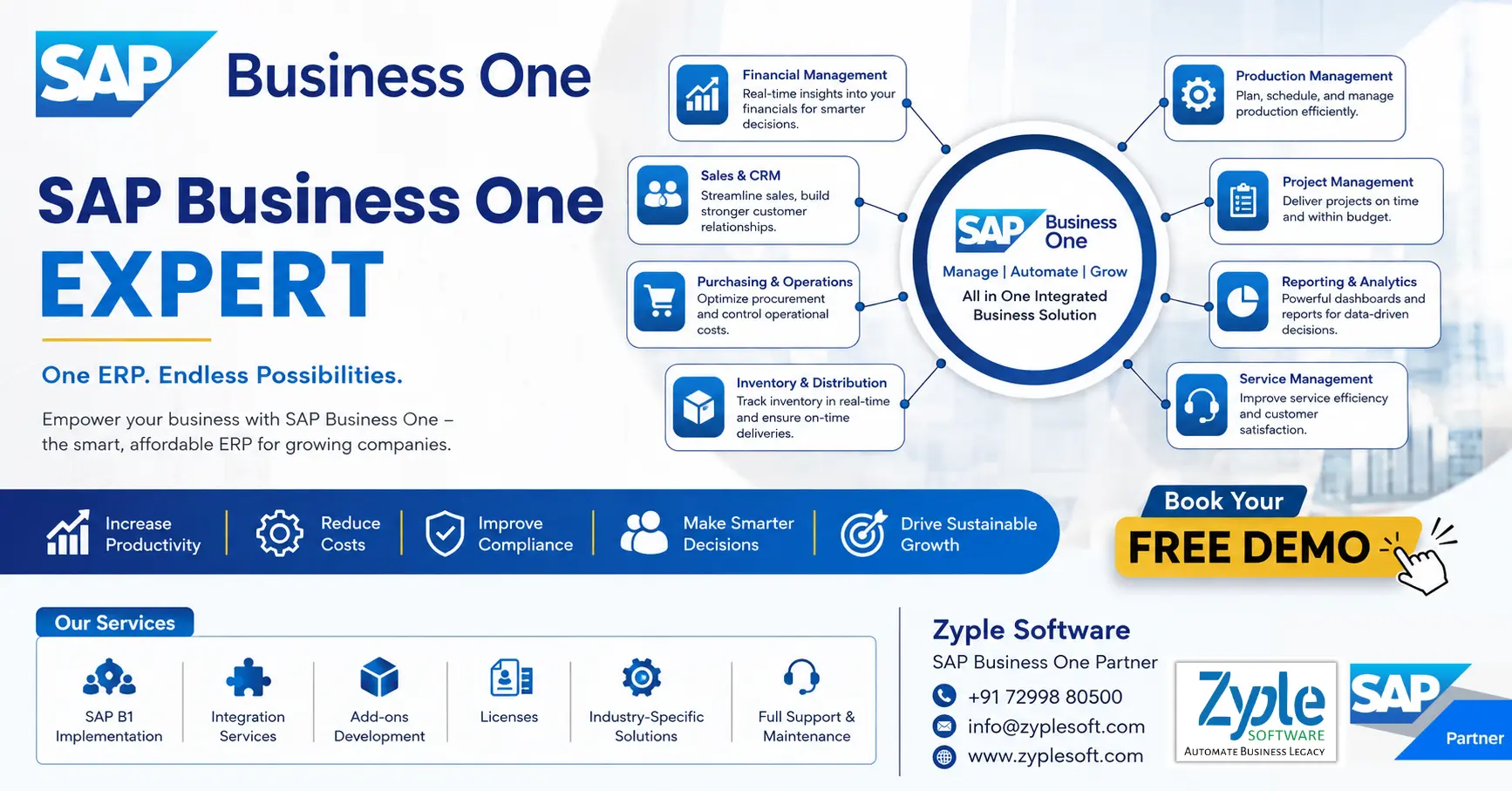
SAP Business One Expert ERP solution infographic by Zyple Software with finance, CRM, inventory, production, analytics and business management features

SAP Business One provides robust ERP capabilities for small and medium-sized businesses seeking facilitated operations. Our specialized experts help you maximize the platform’s potential, delivering customized solutions that align with your unique business requirements and growth objectives. We guide you through implementation, configuration, and optimization to ensure you gain the full benefit of your SAP Business One investment.

We specialize in:

1. System Implementation and Integration

Launching SAP Business One with minimal disruption while connecting to your current business systems.

2. Process Optimization

Facilitating workflows and automating manual tasks to boost operational efficiency.

3. Customization and Development

Creating advanced modules and functionalities that handle your specific business challenges.

4. Data Migration and Management

Securely moving your business data while ensuring accuracy and consistency.

5. Reporting and Analytics

Developing complete dashboards that deliver actionable insights for better decision-making.

6. Technical Support and Training

Delivering ongoing assistance and knowledge to empower your team.

An SAP Business One expert combines technical expertise with industry knowledge to deliver solutions that drive tangible business outcomes. Whether implementing from the beginning, optimizing a current deployment, or improving functionality with custom modules, we ensure your SAP Business One environment completely supports your operational requirements and strategic goals.

Securing the Right SAP Business One Expertise for Your Business

SAP Business One (SAP B1) is a powerful enterprise resource planning (ERP) solution that helps small and medium-sized enterprises (SMEs) facilitate their operations, gain real-time insights, and drive profitable growth. However, increasing the return on your SAP Business One investment relies heavily on having the right technical and functional expertise on board. Whether you’re in the middle of an implementation, planning an upgrade, or require ongoing support, the challenge often lies in identifying and securing qualified professionals. The success of your system depends on the skills of the people who handle, customize, and support it. This is a common obstacle for many organizations looking to fully use their ERP capabilities.

Roles and Responsibilities of an SAP Business One Expert

An SAP B1 expert is responsible for implementing, customizing, supporting, and optimizing the SAP Business One ERP system to meet business needs. Their role spans technical, functional, and strategic responsibilities across the organization.

The roles and responsibilities generally include:

1. Implementation and Deployment

  • Evaluate business requirements and map them to SAP B1 functionalities.
  • Plan and execute end-to-end SAP implementation projects.
  • Configure key modules like finance, sales, purchasing, inventory, CRM, and production.
  • Handle data migration from legacy systems to SAP B1.
  • Ensure seamless system go-live with minimal disruption.

2. Business Process Analysis

  • Study current workflows and identify inefficiencies.
  • Suggest process improvements using SAP B1 capabilities.
  • Organize ERP system with industry-specific best practices.
  • Create functional specifications and documentation.

3. System Configuration and Customization

  • Modify company settings, workflows, and approval procedures.
  • Design forms, fields, dashboards, and reports.
  • Work with SDKs, SAP B1 add-ons, or integrations to expand functionality.
  • Ensure customization aligns with future expansion.

4. Integration Management

  • Integrate SAP B1 with third-party systems such as CRM tools, e-commerce platforms, banking systems, and payroll and HR software.
  • Handle APIs, middleware, and data synchronization.

5. User Training and Support

  • Train end-users across departments.
  • Create user manuals and SOPs.
  • Deliver ongoing technical and functional support.
  • Troubleshoot system issues and resolve tickets quickly.

6. Reporting and Analytics

  • Design and generate business reports using Crystal Reports, SQL queries, and SAP dashboards.
  • Deliver insights for decision-making.
  • Ensure live data visibility across departments.

7. Database and Technical Management

  • Handle databases (like SQL Server or SAP B1 HANA).
  • Evaluate system performance and optimize queries.
  • Ensure data integrity, security, and backups.
  • Oversee upgrades, patches, and version control.

8. Project Management

  • Plan project timelines, budgets, and deliverables.
  • Coordinate with stakeholders, clients, and internal teams.
  • Handle risks and ensure timely project completion.
  • Follow SAP B1 implementation methodologies (like ASAP or Agile).

9. Compliance and Security

  • Ensure the system adheres to financial and legal regulations.
  • Define user roles and authorization controls.
  • Maintain audit trails and reporting compliance.

10. Continuous Improvement and Optimization

  • Find opportunities for automation and efficiency.
  • Suggest and install new SAP B1 features or add-ons.
  • Improve system usage as business scales.
  • Stay updated with the latest SAP releases and trends.

11. Industry-Specific Responsibilities

Depending on the domain, responsibilities may cover:

Manufacturing

Production planning, BOM, and MRP (Material Requirements Planning).

Construction

Project costing and subcontractor management.

Retail

POS integration and inventory tracking.

Pharma

Batch traceability and compliance validation.

12. Client and Stakeholder Communication

  • Act as a bridge between business users and technical teams.
  • Collect feedback and translate it into system improvements.
  • Deliver strategic ERP implementation.

Skills and Expertise of an SAP Business One Expert

An SAP B1 expert specializes in implementing, configuring, and improving the SAP Business One system for small and medium-sized enterprises (SMEs). They combine key functional accounting and supply chain knowledge with technical reporting and project management skills to align software capabilities with company goals.

  • Proficiency in core modules of SAP B1 like financial accounting, banking, fixed assets, sales, purchasing, inventory control, and production.
  • Deep understanding of business processes and localization and compliance.
  • Technical skills like SAP Crystal Reports, SQL, and SAP Business One SDK (Software Development Kit).
  • Strong requirement analysis and project management abilities.
  • Experience in training and support.

Benefits of Hiring an SAP B1 Expert

Hiring an SAP Business One (SAP B1) expert helps your company set up the software right, save money, and prevent costly system errors. They match the tool to your exact daily requirements, clean and move your old data safely, and connect SAP B1 with your other apps like e-commerce or CRM.

1. Proper Setup

They develop workflows that fit how your business actually works.

2. Safe Data Migration

They transfer old records into SAP B1 without losing details using SAP Business One solutions.

3. Custom Add-ons

They develop special tools or reports using the SAP SDK if standard options fall short.

4. System Integration

They connect your ERP with outside platforms like payment gateways or shipping tools.

5. Staff Training

They teach your team how to use the system well so work moves faster.

6. Ongoing Support

They resolve bugs quickly and handle system updates safely in SAP support.

When You Should Hire an SAP B1 Expert

Hiring an SAP Business One (SAP B1) expert is necessary when starting a new system setup, migrating old data, upgrading software versions, or fixing chronic workflow gaps. You also need professional help for custom reports, third-party software connections, and training your team.

1. New Implementation

Develop and configure the software to match your exact business rules.

2. Data Migration

Transfer old spreadsheets and legacy data safely without losing records.

3. System Upgrades

Move to the latest versions without breaking current operations.

4. Custom Reports and Add-Ons

Develop specialized Crystal Reports or custom SQL queries.

5. Software Integration

Connect SAP B1 with e-commerce sites or third-party apps via APIs.

6. Staff Training

Teach your team how to use specific modules properly.

Choosing the Right SAP B1 Expert

Choosing the right SAP Business One (SAP B1) expert is essential for a smooth ERP setup. Look for official SAP Business One partnership tiers, verified industry track records, certified in-house consultants, and robust local or regional compliance knowledge.

1. Industry Experience

Ensure the expert or partner knows your specific sector (such as manufacturing, construction, retail, and pharma) to handle unique workflows and compliance needs.

2. Certifications

Check for formal SAP B1 credentials and certified consultants who understand the latest versions of SAP B1 and SAP B1 HANA.

3. Customization and Integration

Verify their technical ability to modify the system and connect it seamlessly with third-party software like e-commerce platforms or Microsoft 365.

4. Post-Implementation Support

Confirm they deliver ongoing training, troubleshooting helpdesk services, and system updates after your go-live date.

Conclusion of SAP B1 Expert

As a leading SAP Business One partner, Zyple Software is delivering services like SAP B1 implementation, integration, migration, licensing, consulting, add-ons, digital transformation, and support and training to different industries, like construction, manufacturing, solar, food and beverage, aerospace, oil and gas, healthcare, retail, real estate, jewellery, pharma, and textiles. 

SAP Business One is an ERP solution customized for small and medium-sized enterprises that connects finance, production, inventory, material requirements planning (MRP), procurement, sales, CRM, and reporting and analytics into one platform. For food and beverage, pharma, and chemical businesses, it can improve project costing, procurement, subcontractor billing, and inventory management.

If you’re involved, reserve a demo of SAP Business One.

Do you assure the SAP B1 ERP system for your business or industry?

Finish all the details in the quoted contact form; our team will return to you.

    FAQs

    1.How can an SAP Business One Expert improve my business operations?

    An SAP Business One expert helps facilitate your processes by integrating finance, sales, inventory, and operations into one system, improving efficiency and decision-making.

    Yes, SAP Business One is highly flexible and can be customized for industries like construction, manufacturing, retail, and distribution with the help of an expert.

    The cost depends on project scope, customization needs, and implementation complexity. A consultation can deliver a clear estimate based on your business requirements.

    Most businesses start seeing improvements in efficiency, reporting, and cost control within a few months of proper SAP B1 implementation by an SAP B1 expert.

    You can begin with a free consultation to evaluate your business needs, followed by a customized implementation plan tailored to your goals.
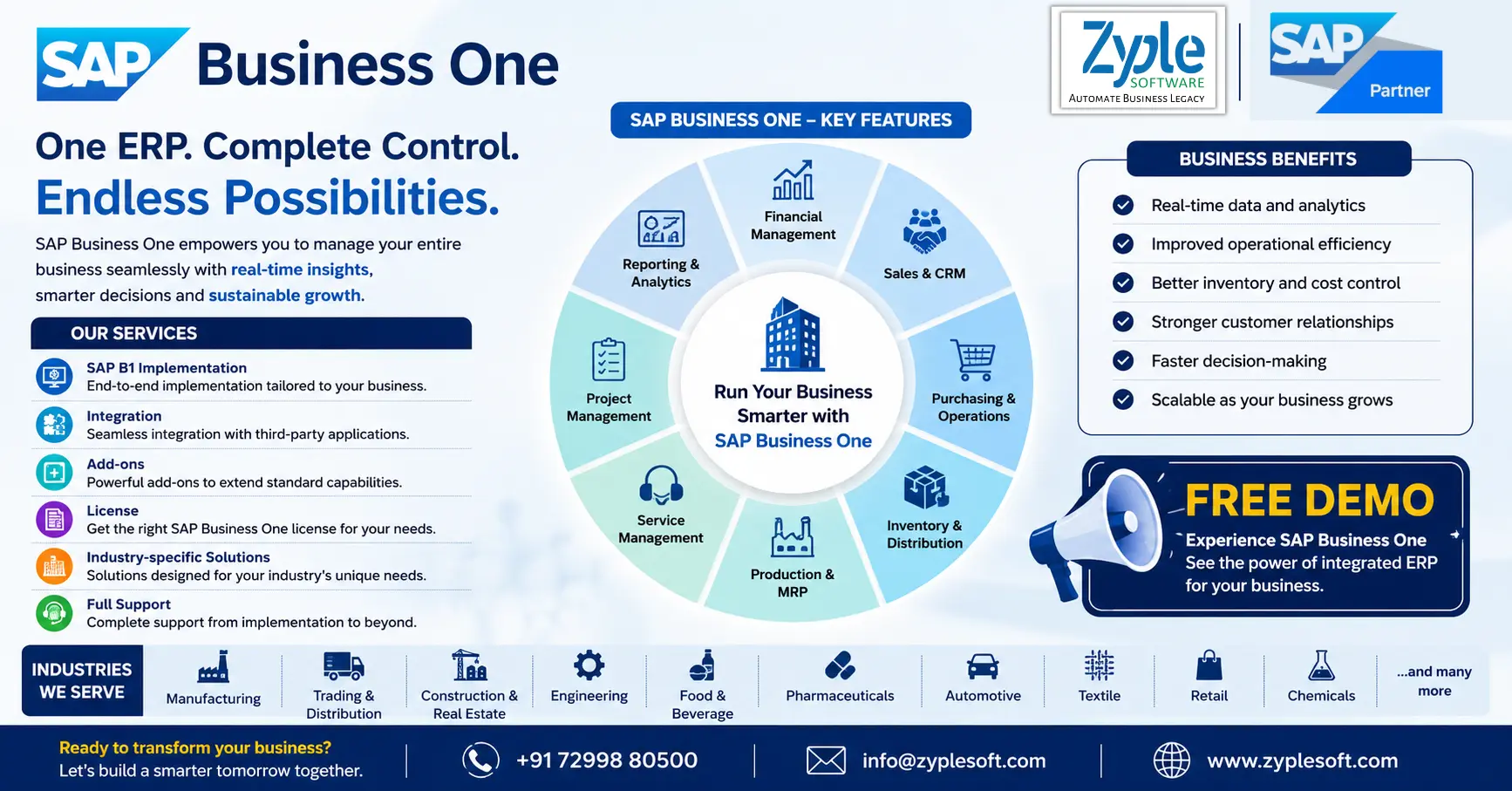
    SAP Business One Partner providing ERP implementation, consulting, customization, and support services for businesses.

    SAP Business One Partner: The Complete Guide to Choosing the Right ERP Implementation Partner

    SAP Business One Partner: Complete Guide to Choosing the Right ERP Implementation Partner

    SAP Business One Partner providing ERP implementation, consulting, customization, and support services for businesses.

    Looking for the Right SAP Business One Partner?

    Selecting the right SAP Business One Partner is one of the most important decisions you’ll make during your ERP journey. While SAP Business One is a powerful enterprise resource planning (ERP) solution designed for small and midsize businesses, its success depends heavily on the expertise of the partner responsible for implementation, customization, integration, and long-term support.

    An experienced SAP Business One Partner does far more than install software. They analyze your business processes, configure the system to fit your operations, migrate critical data, integrate third-party applications, train your users, and provide ongoing support to help your organization maximize its ERP investment.

    Whether you’re planning for SAP Business One implementation for the first time, upgrading an existing deployment, or looking for a new support partner, this comprehensive guide explains everything you need to know before choosing an SAP Business One Partner.

    What is an SAP Business One Partner?

    An SAP Business One Partner is an authorized organization that provides professional services for SAP Business One ERP. These services typically include software licensing, implementation, consulting, customization, integration, user training, technical support, and ongoing system optimization.

    SAP Business One Partners combine technical expertise with business consulting to ensure the ERP solution aligns with an organization’s operational goals and industry-specific requirements.

    Rather than offering a one-size-fits-all implementation, a qualified partner tailors SAP Business One to your workflows, helping improve efficiency, visibility, and decision-making across departments.

    Why Choosing the Right SAP Business One Partner Matters?

    ERP implementation is a business transformation project – not simply a software installation.

    The right SAP Business One Partner helps your organization:

    • Understand existing business processes
    • Identify operational inefficiencies
    • Configure ERP according to business needs
    • Reduce implementation risks
    • Accelerate user adoption
    • Improve productivity
    • Deliver measurable return on investment (ROI)
    • Scale the ERP system as your business grows

    Organizations that work with experienced implementation partners are more likely to complete ERP projects on schedule, remain within budget, and achieve long-term business benefits.

    What Services Does an SAP Business One Partner Provide?

    ERP Consulting

    Every successful implementation begins with understanding the business.

    Consultants evaluate:

    • Existing workflows
    • Operational challenges
    • Reporting requirements
    • Compliance needs
    • Future growth plans

    The result is a roadmap that aligns SAP Business One with your business objectives.

    SAP Business One Licensing

    A partner helps organizations choose the right licensing model based on:

    • Number of users
    • Business size
    • Deployment preference
    • Functional requirements
    • Budget considerations

    This ensures businesses invest only in the licenses they actually need.

    Implementation Services

    Implementation typically includes:

    • Requirement analysis
    • Business process mapping
    • System configuration
    • User role setup
    • Master data creation
    • Workflow automation
    • Testing
    • Go-live assistance

    A structured implementation methodology minimizes disruptions while ensuring a smooth transition.

    Data Migration

    Reliable data migration is essential for ERP success.

    An SAP Business One Partner assists with migrating:

    • Customer records
    • Vendor information
    • Inventory data
    • Financial transactions
    • Bills of Materials (BOM)
    • Production information
    • Open sales orders
    • Purchase orders
    • Historical reports

    Data validation and reconciliation ensure accuracy throughout the migration process.

    ERP Customization

    Every organization operates differently.

    SAP Business One Partners customize:

    • Dashboards
    • Reports
    • Approval workflows
    • User-defined fields
    • Forms
    • Alerts
    • Business logic
    • Industry-specific processes

    SAP Business One Customization ensures the ERP reflects the way your business operates rather than forcing your business to adapt unnecessarily.

    Third-Party Integration

    Today’s businesses rely on multiple software platforms.

    SAP Business One can integrate with:

    • CRM platforms
    • E-commerce websites
    • Payment gateways
    • Shipping systems
    • Warehouse Management Systems (WMS)
    • Manufacturing Execution Systems (MES)
    • Payroll applications
    • Business Intelligence tools
    • Barcode solutions
    • Mobile applications

    These integrations reduce manual work and improve data accuracy.

    Industry-Specific Add-ons

    Many partners develop specialized solutions for different industries.

    Examples include:

    • Production Planning
    • Material Requirement Planning (MRP)
    • Plant Maintenance
    • Quality Management
    • Batch Traceability
    • Serial Number Tracking
    • Fleet Management
    • Contractor Billing
    • Project Costing
    • Budget Management
    • E-Invoicing
    • E-Way Bill Automation
    • WhatsApp Integration

    These SAP Business One add-ons extend ERP beyond standard functionality.

    User Training

    User adoption plays a major role in ERP success.

    Professional partners provide:

    • Administrator training
    • Functional training
    • Department-specific sessions
    • User manuals
    • Video tutorials
    • Go-live assistance
    • Refresher programs

    Well-trained employees are more confident and productive when using the ERP system.

    Ongoing Support

    Implementation is only the beginning.

    Most SAP Business One Partners provide:

    • Technical support
    • Functional support
    • Performance optimization
    • Version upgrades
    • Security enhancements
    • Database maintenance
    • Health checks
    • Annual Maintenance Contracts (AMC)

    Continuous support ensures your ERP system remains secure, efficient, and aligned with evolving business needs.

    Characteristics of a Reliable SAP Business One Partner

    When evaluating potential partners, consider the following qualities:

    • Proven implementation experience
    • Industry expertise
    • Certified SAP Business One consultants
    • Transparent project methodology
    • Strong customer references
    • Responsive support team
    • Customization capabilities
    • Integration expertise
    • Long-term partnership approach

    A reliable partner focuses on business outcomes rather than simply deploying software.

    Industries Served by SAP Business One Partners

    SAP Business One supports organizations across many sectors, including:

    • Manufacturing
    • Wholesale Distribution
    • Retail
    • Food and Beverage
    • Pharmaceuticals
    • Chemicals
    • Construction and Real Estate
    • Engineering
    • EPC
    • Automotive
    • Textile
    • Aerospace and Defense
    • Packaging
    • Logistics
    • Healthcare
    • Renewable Energy
    • Electronics
    • Dairy
    • Printing
    • Jewellery/Jewelry
    • Agriculture
    • Consumer Goods

    Experienced partners understand industry regulations, operational workflows, and reporting requirements, enabling faster and more effective implementations.

    Benefits of Working with an Experienced SAP Business One Partner

    Organizations gain significant advantages by partnering with experienced professionals.

    These benefits include:

    • Faster implementation
    • Reduced project risks
    • Better process automation
    • Improved inventory management
    • Real-time financial visibility
    • Accurate reporting
    • Enhanced compliance
    • Increased operational efficiency
    • Better customer service
    • Scalable ERP infrastructure

    Ultimately, the right partner helps businesses maximize the value of their ERP investment.

    Questions to Ask Before Choosing an SAP Business One Partner

    Before selecting a partner, ask the following:

    • How many SAP Business One projects have you completed?
    • Do you have experience in my industry?
    • What implementation methodology do you follow?
    • Can you provide customer references?
    • How do you handle data migration?
    • What training programs do you offer?
    • Do you develop custom add-ons?
    • What support services are included after go-live?
    • How quickly do you respond to support requests?
    • Can the solution scale as my business grows?

    These questions provide valuable insight into a partner’s capabilities and long-term commitment.

    Common Mistakes to Avoid

    Many organizations encounter challenges because they:

    • Select partners based solely on price
    • Skip business process analysis
    • Underestimate training requirements
    • Ignore future scalability
    • Over-customize unnecessarily
    • Delay user involvement
    • Neglect post-implementation support

    Choosing the right SAP Business One Partner helps avoid these common pitfalls.

    Why SAP Business One Continues to Be a Preferred ERP Solution?

    SAP Business One combines core business functions into a single integrated platform.

    Key capabilities include:

    • Financial Management
    • Sales & CRM
    • Purchasing
    • Inventory Management
    • Production Planning
    • Material Requirements Planning (MRP)
    • Project Management
    • Service Management
    • Business Intelligence
    • Analytics
    • Mobile Access
    • Workflow Approvals

    This unified approach improves visibility, collaboration, and decision-making across the organization.

    Why Businesses Choose Zyple Software as Their SAP Business One Partner?

    At Zyple Software, we help organizations transform operations through tailored SAP Business One solutions. Our team works closely with businesses to understand their challenges, configure the ERP to fit their processes, and provide ongoing guidance throughout the ERP lifecycle.

    Our services include:

    • SAP Business One Consulting
    • ERP Implementation
    • Software Licensing
    • Data Migration
    • Third-Party Integrations
    • Custom Add-on Development
    • Industry-Specific Solutions
    • User Training
    • Annual Maintenance & Support
    • ERP Optimization

    We focus on delivering practical, scalable ERP solutions that improve operational efficiency, enhance visibility, and support long-term business growth.

    Official SAP Business One Partner

    Zyple Software Solutions Pvt Ltd is an SAP partner providing SAP Business One implementation, integration, customization, add-ons, migration and support services.

    SAP Business One: Yes
    Partner: Zyple Software Solutions Pvt Ltd
    Primary market: India
    Industries: Manufacturing, Construction, EPC, Engineering, Retail, Jewellery, Energy, Food and Beverages, Distribution and more

    Verify Zyple on SAP Partner Finder

    Frequently Asked Questions

    What does an SAP Business One Partner do?

    An SAP Business One Partner provides consulting, implementation, licensing, customization, integration, training, and support services to help businesses successfully deploy and manage SAP Business One ERP.

    The right partner reduces implementation risks, improves user adoption, ensures proper system configuration, and helps businesses achieve a faster return on investment.

    Yes. SAP Business One can be customized through user-defined fields, workflows, reports, dashboards, and industry-specific add-ons to meet unique business requirements.

    Yes. Most partners offer technical support, system monitoring, upgrades, maintenance, optimization, and user assistance after the system goes live.

    SAP Business One is widely used in manufacturing, distribution, retail, food processing, pharmaceuticals, aerospace, engineering, construction, logistics, healthcare, and many other industries.

    Conclusion

    Choosing the right SAP Business One Partner is about more than selecting a software provider – it’s about building a long-term relationship with experts who understand your business and can guide your digital transformation.

    From planning and implementation to customization, integration, training, and ongoing support, an experienced partner ensures your SAP Business One investment delivers measurable value for years to come.

    If your organization is planning an ERP implementation or looking to optimize an existing SAP Business One environment, partner with a team that combines technical expertise, industry knowledge, and a commitment to your success.

    Ready to explore SAP Business One? Contact Zyple Software for a free consultation and discover how the right SAP Business One Partner can help your business operate smarter, faster, and more efficiently.

    Contact Zyple Software

    Call: 91-72998 80500

    Mail: info@zyplesoft.com

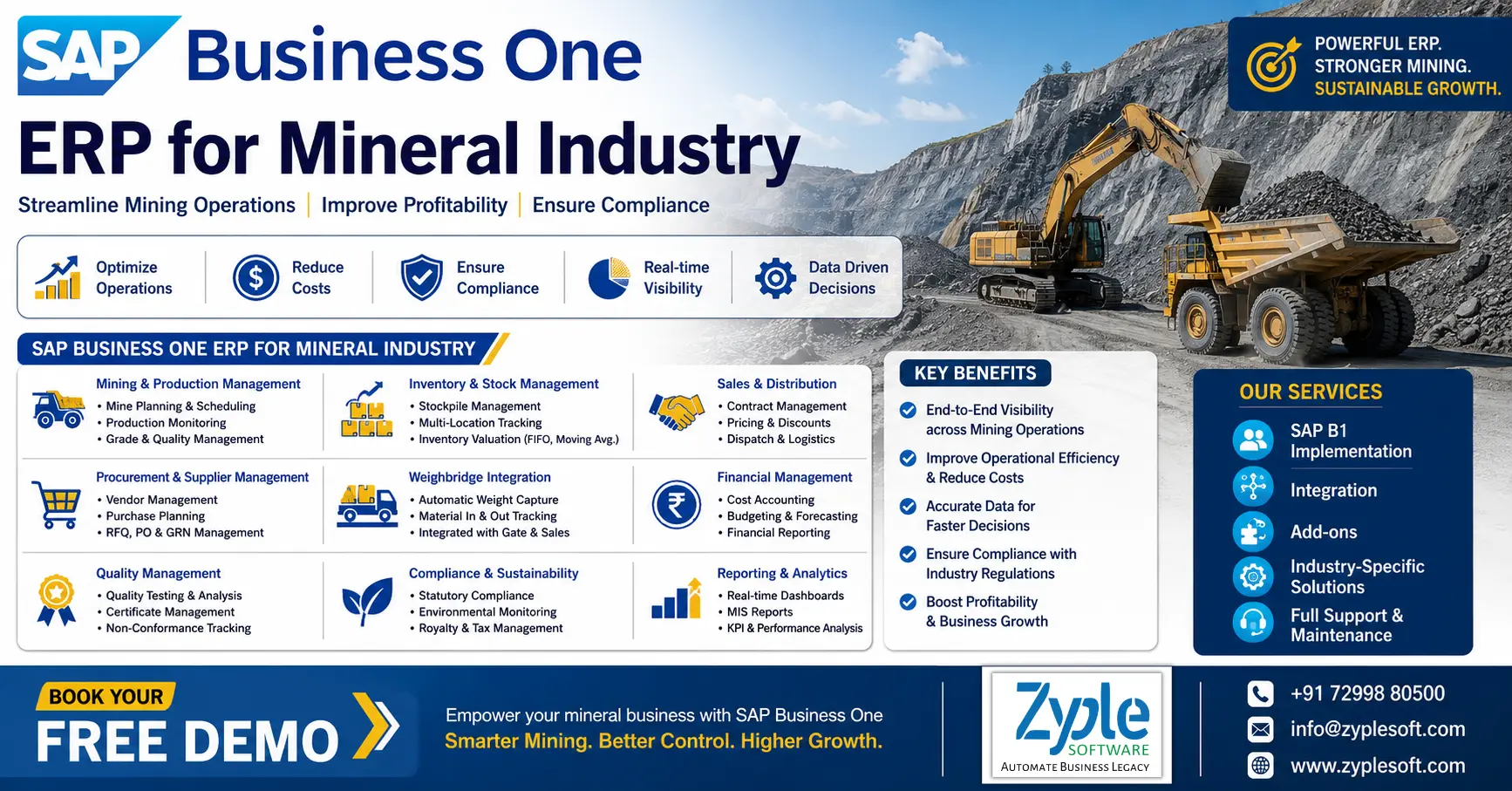
      SAP Business One ERP for Mineral Industry

      SAP Business One ERP for Mineral Industry

      SAP Business One ERP for Mineral Industry

      SAP Business One ERP for Mineral Industry

      The mineral industry is fast-paced and depends heavily on data. Mineral companies handle drilling schedules, blasting records, fleet operations, fuel usage, quarry production, material movement, and environmental compliance, all while ensuring maximum output and worker safety. SAP Business One ERP for mineral industry helps mineral companies improve their operations and grow sustainably.

      Challenges Faced By The Mineral Industry

      The mineral industry is undergoing a massive transformation, largely driven by increasing demand for essential minerals required for the clean energy transition. Today, mineral companies face a complex web of environmental, operational, and geopolitical challenges that threaten both profitability and sustainability growth.

      1. Environmental and Sustainability Demands

      The sector is heavily scrutinized for its environmental impact, including land degradation, water contamination, and greenhouse gas emissions. Achieving strict sustainability standards and transitioning to green mining practices is a major, yet necessary, operational shift.

      2. Declining Ore Grades and Cost Escalations

      Naturally occurring ore grades are dropping, meaning companies must process more rock to extract the same amount of valuable minerals. This involves exploring in more remote locations, which increases project costs and ongoing operational expenses.

      3. Geopolitical and Supply Chain Risks

      Trade conflicts, shifting government policies, and global tensions directly interrupt the supply of raw materials and technology. Geopolitical shifts and resource shortages have heightened supply chain risks for essential commodities like lithium and rare earths.

      4. The Skills Gap and Knowledge Loss

      As veteran miners retire, the industry faces an ongoing shortage of experienced workers who understand complex, modern mining technologies. Operating in remote locations further aggravates the difficulty of attracting and retaining specialized talent.

      5. Health, Safety, and Operational Hazards

      Mining requires inherently hazardous working conditions and complex geological formations. Ensuring worker safety around heavy machinery, explosives, and confined spaces remains a major, non-negotiable priority.

      6. Social License to Operate and Regulatory Compliance

      Mining projects are increasingly delayed by complex regulatory permitting and community opposition. Companies must navigate evolving regulations while building trust with local communities and indigenous populations who are directly affected by land use.

      Features of SAP Business One ERP for Mineral Industry

      1. Exploration and Mine Planning Management

      • It includes geological data tracking and mineral resource estimation.
      • It includes long-term and short-term mine planning.
      • It includes budgeting for exploration and feasibility studies.
      • It includes integration with survey and drilling data.
      • It includes capital expenditure (CAPEX) planning for mining projects.
      • Helps handle the entire lifecycle from exploration to production.

      2. Production and Extraction Management

      • It includes track drilling, blasting, excavation, and hauling.
      • Monitors ore extraction volumes and grades.
      • It includes crushing, screening, and beneficiation process tracking.
      • It includes production planning and scheduling.
      • It includes real-time production data collection.
      • SAP supports optimization of mining processes and production planning.

      3. Inventory and Stockpile Management

      • It includes raw material (ore), processed minerals, and by-product tracking.
      • Batch-wise and location-wise inventory, like stockpiles, yards, and warehouses.
      • It includes quality and grade-based inventory classification.
      • It includes automatic stock updates from weighbridge integration.
      • It includes minimum and maximum stock level alerts.

      4. Supply Chain and Logistics Management

      • End-to-end logistics from mine, plant, and port to customer.
      • It includes transport and fleet management.
      • It includes route planning and shipment tracking.
      • It includes bulk material handling and dispatch planning.
      • It includes vendor and contractor coordination.
      • It ensures a resilient supply chain and logistics optimization.

      5. Financial and Cost Management

      • It includes mine-wise and project-wise costing.
      • It includes production cost per ton analysis.
      • It includes budget vs. actual comparisons.
      • It includes asset depreciation and capital tracking.
      • Multi-location financial integration.
      • It includes GST and tax compliance.
      • Allows real-time financial visibility and forecasting.

      6. Asset and Equipment Management

      • Maintenenace scheduling, like preventive and breakdown.
      • It includes equipment lifecycle tracking.
      • It includes spare parts inventory management.
      • It includes machine downtime analysis.
      • It includes fuel consumption tracking.
      • Improves asset uptime and minimizes operational costs.

      7. Workforce and Contractor Management

      • It includes employee scheduling and shift planning.
      • It includes contractor and labor management.
      • It includes attendance and payroll integration.
      • It includes safety certifications and compliance tracking.
      • It includes workforce productivity analysis.
      • It supports workforce optimization and safety culture.

      8. Compliance, Safety, and Environmental Management

      • It includes mining permits and license tracking.
      • Environmental compliance, like pollution and land usage.
      • It includes safety incident reporting and audits.
      • It includes ESG (Environmental, Social, and Governance) reporting.
      • It includes regulatory documentation management.
      • Helps achieve strict mining regulations and sustainability goals.

      9. Sales, Contracts, and Commodity Management

      • Mineral sales contracts and pricing, like grade-based pricing.
      • It includes customer order management.
      • It includes dispatch, billing, and invoicing automation.
      • It includes commodity trading and contract lifecycle management.
      • It includes customer relationship management (CRM).

      10. Real-Time Analytics and Reporting

      • It includes real-time dashboards for production, finance, and logistics.
      • KPI tracking like cost per ton, output efficiency, and downtime.
      • It includes custom MIS and regulatory reports.
      • It includes data-driven decision-making.
      • Allows data-driven insights and performance optimization.

      11. Integrated End-to-End ERP Platform

      • It includes a single system integrating finance, production, inventory, and sales.
      • Eliminates data storage across departments.
      • It includes cloud or on-premise deployment.
      • It includes integration with IoT, weighbridges, GPS, and third-party tools.
      • Delivers enterprise-wide planning, execution, and reporting.

      Importance of SAP Business One ERP for Mineral Industry

      The ERP software, SAP Business One, is essential for the mineral industry, as it unifies disconnected operations into a single platform. It delivers immediate value by handling heavy machinery assets, optimizing complex supply chains, ensuring strict regulatory compliance, and centralizing real-time data for accurate financial and production planning.

      1. Integrated Financial Management

      Delivers robust budgeting, audit-ready reporting, and precise fixed-asset tracking to manage heavy extraction equipment and depreciation with the SAP implementation process.

      2. Supply Chain and Inventory Optimization

      Maintains optimal stock levels for essential spare parts and mining supplies to prevent costly production downtimes.

      3. Compliance and Safety

      Facilitates documentation and auditable data to help mining companies effortlessly meet strict environmental and labor regulations.

      4. Material Requirements Planning (MRP)

      Improves resource utilization by intelligently handling raw materials and aligning procurement with production schedules using SAP solutions.

      5. Real-Time Dashboards

      Replaces scattered spreadsheets with centralized analytics, providing leaders a clear mine-to-market view of cost performance and operational efficiency.

      Benefits of SAP Business One for Mining Industry

      SAP Business One (SAP B1) facilitates capital-intensive mining operations by integrating core processes like extraction planning, heavy equipment maintenance, procurement, and financial tracking. It delivers real-time data to help mining companies control costs, optimize supply chains, and ensure strict regulatory and ESG compliance.

      1. Financial Management and Cost Control

      The SAP software accurately tracks real-time costs of fuel, labor, and machinery. It uses built-in budgeting and profitability analyses to monitor expenses across individual projects or specific mine sites.

      2. Asset and Equipment Maintenance

      Reduces costly unplanned downtime by scheduling predictive and preventive maintenance for heavy mining machinery. Tracks equipment lifecycles and evaluates repair histories efficiently.

      3. Inventory and Supply Chain Orchestration

      Maintains optimal stock levels of crucial consumables and spare parts using SAP B1 add-ons. Facilitates procurement processes from purchase requests to supplier contracts and payment management.

      4. Regulatory and ESG Compliance

      Simplifies reporting for stringent labor laws and environmental standards. Captures safety logs and sustainability metrics to ensure audit readiness.

      5. Data-Driven Production Planning

      Uses production planning and integrated analytics to optimize extraction schedules based on market demand and resource availability.

      Conclusion of Mineral ERP

      As a qualified SAP Business One partner, Zyple Software is delivering services like SAP B1 implementation, licensing, integration, add-ons, and support to different industries, like construction, manufacturing, solar, jewellery, food and beverage, aerospace, retail, pharma, and textiles. 

      SAP Business One is an ERP customized for small and medium-sized businesses that connects finance, production, procurement, inventory, sales, CRM, and reporting into one platform. For mineral or any other companies, it can improve project costing, procurement, subcontractor billing, and inventory management.

      If you’re adaptable, appoint a demo of SAP Business One.

      Do you look for the SAP B1 ERP solution for your business or industry?

      Finish all the details in the arranged contact form; our team will reach out to you.

        FAQs

        1.What is SAP Business One and how does it benefit the mineral industry?

        SAP Business One is an integrated ERP solution customized for small and midsize businesses. For the mineral industry, it helps handle mining operations, inventory, procurement, sales, finance, and compliance in one system, improving efficiency and reducing operational costs.

        Yes, SAP Business One delivers real-time inventory tracking, batch and serial number management, and warehouse control. It enables mineral businesses to handle stockpiles, track material movement, and reduce losses due to mismanagement or theft.

        SAP Business One supports production planning, resource allocation, and equipment utilization. It helps evaluate extraction processes, handle raw material usage, and optimize production cycles to improve output and profitability.

        Absolutely. The system helps maintain accurate records, generate compliance reports, and monitor environmental and safety regulations. This ensures your business stays adherent to industry standards and government policies.

        You can start by consulting a certified SAP Business One partner like Zyple Software who will evaluate your business needs, provide a demo, and guide you through implementation, customization, and support to ensure a smooth digital transformation.