Tag Archives: Production Planning ERP

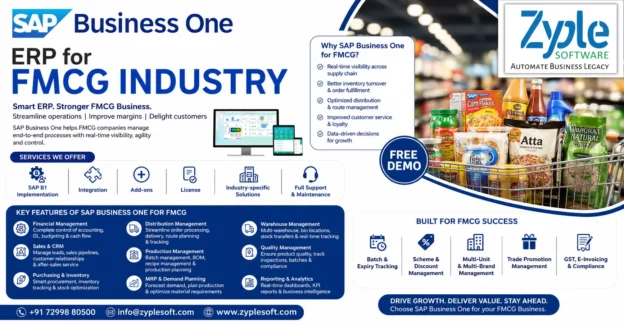
SAP Business One ERP for FMCG Industry by Zyple Software featuring inventory management, batch tracking, warehouse management, sales, distribution, production planning, and Free Demo.

SAP Business One ERP for FMCG Industry
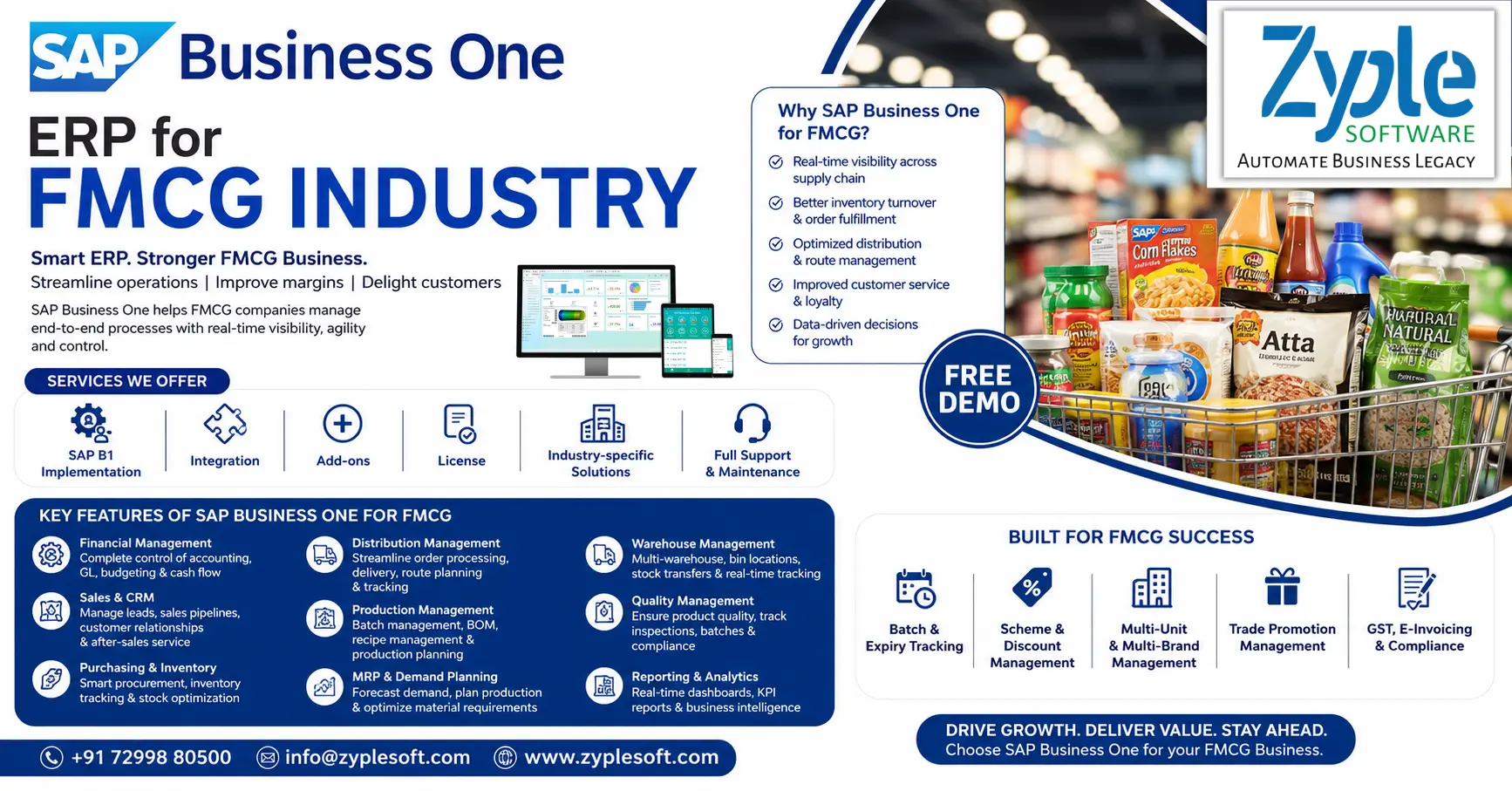
SAP Business One ERP for FMCG Industry

SAP Business One ERP for FMCG Industry by Zyple Software featuring inventory management, batch tracking, warehouse management, sales, distribution, production planning, and Free Demo.

The FMCG industry is in huge demand. The products in this industry often need to be sold fast before they perish. The success of the FMCG sector revolves around speed, accuracy, and efficiency. Businesses in this sector must ensure timely deliveries and handle huge deliveries. SAP Business One ERP for FMCG industry provides real-time business insights in the reports to optimize the business workflow.

Challenges Faced By The FMCG Industry

The fast-moving consumer goods (FMCG) industry faces serious challenges, including supply chain disruptions, rising raw material costs, and shifting consumer preferences.

1. Supply Chain Disruptions

Geopolitical tensions, inflation, and climate events create freight delays and material shortages.

2. Thin Profit Margins

High transportation and input costs decrease profitability across low-margin product lines.

3. Inventory Complexities

Short product shelf lives and seasonal demand surplus risk high waste or costly stockouts.

4. Changing Demands

Shoppers increasingly look for eco-friendly, clean-label, and health-conscious products.

5. Rising Competition

Local startup brands and retail private labels chip away at conventional market share.

6. Omnichannel Integration

Achieving consumer expectations smoothly across both physical and retail e-commerce channels strains legacy systems.

Features of SAP Business One ERP for FMCG Industry

1. Inventory and Warehouse Management

  • It includes real-time inventory tracking across multiple warehouses.
  • It includes batch-wise and serial number tracking.
  • It includes FIFO or FEFO (First Expiry First Out) stock management.
  • It includes automated stock replenishment and reorder levels.
  • It includes bin location management for optimized storage.
  • It includes barcode and QR code integration.

2. Sales and Distribution Management

  • It includes end-to-end sales order processing.
  • Multi-channel distribution management like retailers, distributors, and wholesalers.
  • It includes pricing management with discounts, schemes, and promotions.
  • It includes sales forecasting and demand planning.
  • Mobile sales like van sales and route sales integration.
  • It includes real-time sales analytics and reporting.

3. Production and Manufacturing Management

  • It includes bill of materials (BOM) management.
  • It includes production planning and scheduling.
  • Recipe and formula management for food and beverages.
  • It includes quality control and compliance tracking.
  • It includes real-time production monitoring.
  • It includes waste and by-product management.

4. Procurement and Supplier Management

  • It includes automated purchase order creation.
  • It includes vendor management and evaluation.
  • It includes material requirement planning (MRP).
  • It includes procurement cycle tracking and approvals.

5. Financial Management and Accounting

  • It includes general ledger, accounts payable, and accounts receivable.
  • It includes cost accounting and profitability analysis.
  • It includes budgeting and financial forecasting.
  • It includes GST and tax compliance.
  • It includes multi-currency and multi-branch financial consolidation.
  • It includes real-time financial dashboards.

6. CRM (Customer Relationship Management)

  • It includes customer database and contract management.
  • It includes sales lead and opportunity tracking.
  • It includes customer buying behavior analysis.
  • It includes complaint and service management.
  • It includes loyalty programs and customer engagement tracking.

7. Demand Planning and Forecasting

  • It includes AI-driven demand forecasting.
  • It includes seasonal and trend-based planning.
  • It includes demand vs. supply analysis.
  • It includes reduction of stockouts and overstocking.
  • It includes data-driven decision-making.

8. Batch, Expiry, and Traceability Management

  • It includes expiry date tracking and alerts.
  • It includes batch recall management.
  • It includes compliance with food safety and regulatory standards.

9. Reporting and Business Intelligence (BI)

  • It includes real-time dashboards and KPI tracking.
  • Customizable reports like sales, inventory, finance, and production.
  • It includes predictive analytics and insights.
  • It includes integration with Excel and other BI tools.
  • It includes drill-down reporting for better decision-making.

10. Mobility and Cloud Capabilities

  • It includes mobile access for sales and management teams.
  • It includes cloud deployment for remote accessibility.
  • It includes real-time data synchronization.
  • It includes improved collaboration across departments.

11. Compliance and Quality Control

  • Regulatory compliance for FMCG like FSSAI, GST, and more.
  • It includes quality inspection at multiple stages.
  • It includes audit trails and documentation.
  • It includes standard operating procedure (SOP) enforcement.

12. Integration and Scalability

  • It includes integration with e-commerce platforms, CRM, and third-party tools.
  • It includes API-based connectivity.
  • It is scalable for growing FMCG businesses.
  • It includes custom add-ons for industry-specific needs.

Importance of SAP Business One ERP for FMCG Industry

The ERP software, SAP Business One, is essential for the fast-moving consumer goods (FMCG) industry because it improves inventory control, facilitates the supply chain, and automates financial and sales operations. It helps growing businesses manage high-volume transactions and fast-changing market demands with ease.

1. Live Stock Tracking

Provides real-time data on stock levels across multiple warehouses to avoid running out of popular items or keeping too much extra stock with the SAP implementation process.

2. Batch and Lot Control

Tracks production batches and expiration dates easily, which is very essential for food, drink, and personal care items.

3. Supply Chain Speed

Connects purchasing, production, and delivery so products move from factories to stores faster.

4. Sales and CRM

Handles customer orders, tracks pricing rules, and sets credit limits for different distributors and retailers using SAP solutions.

5. Money and Tax Management

Maintains all accounting, budgeting, and local tax rules in one clear place.

Benefits of SAP Business One for FMCG Industry

SAP Business One helps the fast-moving consumer goods (FMCG) industry by providing real-time inventory tracking, facilitated supply chain management, and integrated financial control. It enables growing consumer goods companies to reduce waste, prevent stockouts, and handle product batches efficiently.

1. Real-Time Stock Visibility

Monitors stock levels across multiple warehouses instantly.

2. Batch and Lot Tracking

Handles expiry dates and product traceability to minimize perishable waste.

3. Automatic Reordering

Triggers low-stock alerts to avoid production delays or empty shelves.

4. Material Requirements Planning (MRP)

Automates raw material planning based on actual demand using SAP Business One add-ons.

5. Bill of Materials (BOM)

It standardizes recipes and component lists for consistent product quality.

6. Facilitated Distribution

Improves procurement, manufacturing, and shipping workflows.

7. Integrated CRM

The SAP software maintains customer databases, tracking buying habits and order histories.

8. Unified Accounting

Integrates ledger, accounting, and local tax compliance into one dashboard.

9. Business Analytics

Generates fast, data-driven reports to find shifting market trends.

Conclusion of FMCG ERP

As a qualified SAP Business One partner, Zyple Software is delivering services like SAP B1 implementation, integration, migration, licensing, add-ons, digital transformation, and support to different industries, like construction, manufacturing, solar, food and beverage, aerospace, healthcare, retail,  jewellery, pharma, and textiles. 

SAP Business One is an ERP software customized for small and medium-sized enterprises that connects finance, procurement, sales, CRM, production, inventory, and reporting into one platform. For FMCG or any other businesses, it can improve project costing, procurement, subcontractor billing, and inventory management.

If you’re involved, register a SAP Business One demo.

Do you search for the SAP B1 ERP software for your business or industry?

Complete all the details in the displayed contact form; our team will get back to you.

    FAQs

    1.Why should FMCG companies choose SAP Business One over other ERP solutions?

    SAP Business One provides industry-specific features like batch tracking, expiry management, and distribution control, making it ideal for FMCG businesses. It delivers real-time insights and scalability, helping companies grow without switching systems.

    By automating inventory, procurement, and sales processes, SAP Business One reduces manual errors and wastage. This leads to better resource utilization, minimized inventory holding costs, and improved profit margins.

    Yes, SAP Business One can seamlessly connect with CRM, e-commerce platforms, and third-party applications. This ensures smooth data flow across departments and improves overall business efficiency.

    With the right implementation partner like Zyple Software, you get end-to-end services, including SAP B1 implementation, consultation, add-on development, data migration, training, and support to ensure a smooth and successful ERP deployment.

    You can connect with an authorized SAP B1 partner like Zyple Software to schedule a personalized demo. They will evaluate your business requirements, showcase relevant features, and guide you on the best implementation approach.
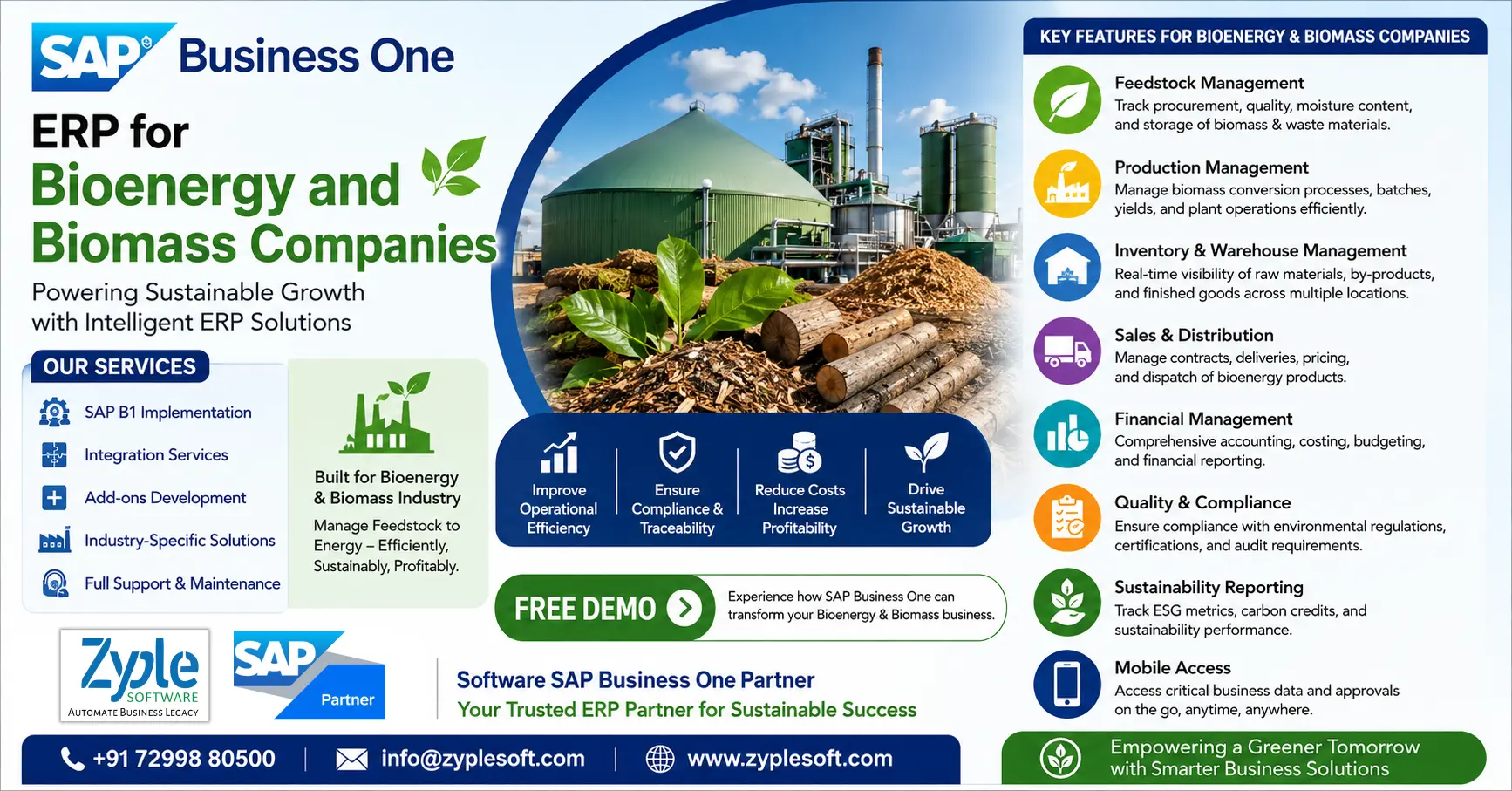
    SAP Business One ERP for Bioenergy and Biomass Companies

    SAP Business One ERP for Bioenergy and Biomass Companies

    SAP Business One ERP for Bioenergy and Biomass Industries

    SAP Business One ERP for Bioenergy and Biomass Companies

    The bioenergy and biomass industry has been around for centuries and continues to play an essential role in the global economy. However, the industry faces significant challenges, such as rising costs, increased competition, and evolving consumer demands. SAP Business One ERP for bioenergy and biomass companies can facilitate operations, optimize resources, and enable better decision-making.

    Challenges Faced By The Bioenergy and Biomass Companies

    The bioenergy and biomass companies face significant challenges, mainly driven by inconsistent supply chains, volatile raw material costs, and technological scalability. Low energy density and high moisture content can make transporting and storing feedstock expensive, while strict environmental regulations and evolving subsidies affect long-term financial viability.

    1. Supply Chain and Logistics

    Sourcing raw materials (e.g., agricultural residues and forestry waste) is heavily seasonal, resulting in supply inconsistencies and fluctuating fuel prices. Because raw biomass has low energy density, transporting wet or large feedstock over long distances is energetically unfavorable and cost-prohibitive.

    2. Technological Immaturity and Scale

    Transforming tough biorenewable biomass into high-grade biofuels or bioproducts is difficult due to defiant structures like lignin, involving complex, expensive pretreatment. Scaling these operations to match the output of petroleum refineries remains highly challenging.

    3. Policy and Regulatory Uncertainty

    The industry depends heavily on subsidies and carbon pricing frameworks. Changes in government policies, such as alterations to the EU’s Renewable Energy Directive or local tariff policies, create investment risks and complicate long-term operational feasibility.

    4. Land and Food Competition

    Using steady energy crops (e.g., corn and sugarcane) for first-generation biofuels often sparks concerns over food vs. fuel debates and land-use changes that can diminish biodiversity.

    5. Operational Risks

    Processing dry mass is an inherently difficult operation that carries severe risks of fire and explosion, demanding expensive built-in suppression technology and strict plant maintenance.

    Features of SAP Business One ERP for Bioenergy and Biomass Companies

    1. Financial and Cost Management

    • It includes general ledger and accounts payable and receivable automation.
    • Biomass project tracking, like feedstock, logistics, and processing.
    • It includes profitability analysis by plant, fuel type, or region.
    • It includes fixed asset management for machinery, boilers, and turbines.
    • It includes cash flow and investment monitoring.
    • SAP B1 modules delivers complete financial control and reporting for better decision-making.

    2. Raw Material (Biomass) Procurement Management

    • It includes vendor management for farmers, suppliers, and aggregators.
    • Procurement planning for biomass products like wood chips, agri-waste, and pellets.
    • It includes contract management with seasonal pricing.
    • Quality-based procurement like moisture percentage and calorific value.
    • It includes multi-location sourcing and supplier comparison.
    • It includes automated purchase orders and approvals.
    • Facilitates the entire procure-to-pay cycle efficiently.

    3. Inventory and Warehouse Management

    • It includes real-time tracking of biomass stock across yards and warehouses.
    • It includes batch and lot tracking for different biomass types.
    • Storage condition monitoring for moisture-sensitive materials.
    • It includes multi-warehouse and yard management.
    • It includes inventory valuation and wastage tracking.
    • It includes stock aging and shelf-life analysis.
    • Inventory and warehouse processes are completely integrated with accounting and operations.

    4. Production and Processing Management

    • It includes production order management for processing units.
    • It includes process tracking from raw biomass to finished energy product.
    • It includes by-product and waste management tracking.
    • It includes machine utilization and downtime tracking.
    • It includes energy output vs. input efficiency monitoring.
    • The production module allows structured manufacturing and process control.

    5. Material Requirements Planning (MRP)

    • It includes demand forecasting for biomass fuel.
    • It includes automated raw material planning based on production schedules.
    • Seasonal demand planning like winter fuel demand spikes.
    • It includes procurement recommendations based on stock levels.
    • Avoids stockouts or overstocking.
    • MRP helps improve procurement and production planning.

    6. Sales and Distribution Management

    • It includes sales order and contractor management for energy buyers.
    • It includes pricing management based on fuel type and calorific value.
    • Customer segmentation like industrial, power plants, and utilities.
    • It includes dispatch planning and delivery tracking.
    • It includes invoice generation and receivables tracking.
    • It includes export management for international biofuel supply.
    • It includes the entire sales cycle from quotation to payment.

    7. Logistics and Supply Chain Management

    • It includes transportation planning for biomass collection and delivery.
    • It includes route optimization for low-cost optimization.
    • It includes freight and landed cost calculations.
    • It includes integration with weighbridge systems.
    • It includes real-time shipment tracking.
    • It includes fleet and fuel consumption monitoring.

    8. Quality and Compliance Management

    • Quality testing for biomass like moisture, ash content, and calorific value.
    • It includes environmental compliance tracking.
    • Regulatory reporting like renewable energy norms and emissions.
    • Certification management like ISO and sustainability certifications.
    • It includes audit trails and documentation.

    9. Asset and Plant Maintenance

    • It includes maintenance scheduling for boilers, turbines, and conveyors.
    • It includes preventive and breakdown maintenance tracking.
    • It includes spare parts inventory tracking.
    • It includes equipment lifecycle tracking.
    • It includes downtime analysis and optimization.

    10. Project and Plant Management

    • It includes project costing for new bioenergy plants.
    • It includes CAPEX and OPEX tracking.
    • It includes resource allocation for plant setup.
    • It includes timeline and milestone monitoring.
    • It includes ROI tracking for renewable energy projects.

    11. CRM and Customer Lifecycle Management

    • Handles relationships with energy buyers and partners.
    • Tracks leads, contracts, and negotiations.
    • It includes service and support management.
    • It includes customer demand forecasting.
    • It includes after-sales service tracking.
    • SAP software includes complete CRM capabilities integrated with sales and service.

    12. Business Intelligence and Analytics

    • It includes real-time dashboards for production, sales, and finance.
    • KPI tracking like plant efficiency, yield, and cost per ton.
    • It includes predictive analytics for demand and supply.
    • It includes custom reports for management insights.
    • Allows data-driven decision-making with real-time insights.

    13. Sustainability and Energy Monitoring

    • Tracks renewable energy production output.
    • It includes carbon footprint and emission tracking.
    • It includes waste utilization and circular economy metrics.
    • It includes energy efficiency analysis.
    • It includes government subsidy and incentive tracking.

    14. Multi-Plant and Multi-Location Management

    • It includes centralized control over multiple biomass plants.
    • It includes inter-plant stock transfers.
    • Integrated financial reporting.
    • It includes regional performance comparison.

    15. Mobile and Remote Access

    • It includes a mobile app for field teams and plant managers.
    • It includes real-time access to inventory, sales, and production data.
    • It includes remote approvals and monitoring.
    • SAP B1 ERP supports mobile and web-based access for flexibility.

    16. Integration and Customization

    • Integration with IoT devices like sensors and energy meters.
    • It includes SCADA system integration for plant monitoring.
    • It includes third-party logistics and weighbridge integration.
    • It includes custom SAP B1 add-ons for bioenergy operations.
    • It includes API-based integration with external platforms.

    Benefits of SAP Business One ERP for Bioenergy and Biomass Enterprises

    The ERP software, SAP Business One (SAP B1) system, facilitates bioenergy and biomass operations by unifying supply chain, production, finance, and compliance into a single platform. It drives profitability by improving feedstock procurement, ensuring batch traceability, allowing predictive maintenance on processing equipment, and automating sustainability and regulatory keeping.

    1. End-to-End Feedstock Traceability

    Handles complex supply chains by tracking raw material biomass (e.g., agricultural residue, forestry byproducts) from supplier origin through conversion into biofuels using batch and serial number tracking.

    2. Automated Material Requirements Planning (MRP)

    Optimizes production planning by evaluating incoming biomass quantities, inventory levels, and outstanding sales orders to automatically trigger procurement or conversion processes with the SAP implementation process.

    3. Integrated Financials and Job Costing

    Connects operational data directly to accounting systems to calculate accurate, real-time job costs, margins, and project profitability across multiple plants or facilities.

    4. Predictive Maintenance and Asset Tracking

    Integrates with IoT platforms to track heavy machinery like digesters, boilers, and turbines. This automates maintenance schedules and avoids costly downtime using SAP solutions.

    5. Regulatory Compliance and ESG Reporting

    Simplifies audits and proves adherence to strict environmental standards by utilizing built-in tools to measure, document, and report on sustainability KPIs and carbon emissions.

    Conclusion of Bioenergy and Biomass ERP

    As an experienced SAP Business One partner in India, Zyple Software is delivering services like SAP B1 implementation, licensing, integration, add-ons, and support to different industries, like construction, manufacturing, solar, jewellery, food and beverage, aerospace, retail, pharma, and textiles. 

    SAP Business One is an ERP customized for small and medium-sized businesses that connects finance, production, procurement, inventory, sales, CRM, and reporting into one platform. For bioenergy and biomass or any other companies, it can improve project costing, procurement, subcontractor billing, and inventory management.

    If you’re interested, enroll a demo of SAP Business One.

    Do you look for the SAP B1 ERP software for your business or industry?

    Finish all the details in the arranged contact form; our team will get back to you.

      FAQs

      1.How can SAP Business One ERP improve efficiency in bioenergy and biomass operations?

      SAP Business One facilitates procurement, production, inventory, and financial processes into a single system, minimizing manual work and improving operational efficiency. It helps bioenergy companies improve biomass usage, minimize waste, and increase overall productivity.

      Yes, SAP Business One can be customized for meeting the specific needs of bioenergy companies, including biomass tracking, plant operations, compliance reporting, and energy production management, ensuring a perfect fit for your business.

      The cost depends on factors like number of users, deployment type (like cloud or on-premises), customization requirements, and implementation scope. A certified SAP Business One partner like Zyple Software can deliver a complete and accurate quotation based on your business needs.

      SAP B1 implementation timelines generally range from a few weeks to a few months, depending on business complexity, number of modules, and customization requirements. A structured SAP implementation approach ensures minimal disruption to your operations.

      You can request a free demo from an SAP Business One partner like Zyple Software to understand how the solution fits your bioenergy operations. The demo will showcase key features, industry-specific capabilities, and how it can handle your business challenges.

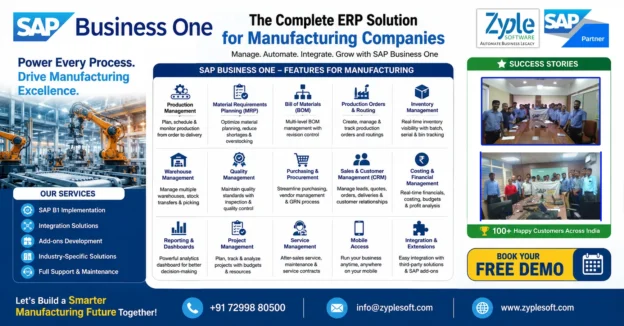
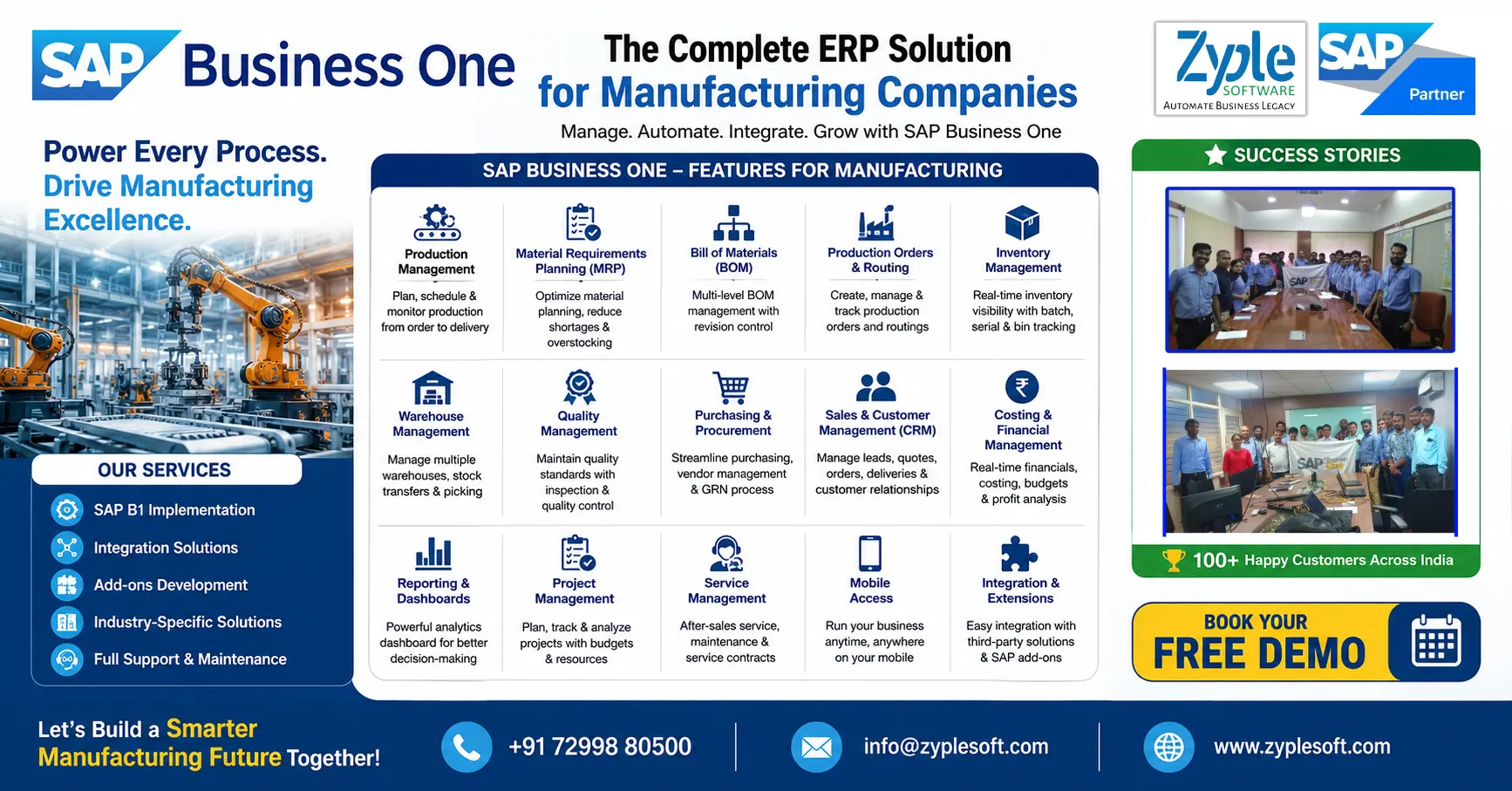
      Best ERP Software for Manufacturing in India using SAP Business One

      Best ERP Software for Manufacturing in India (2026 Complete Guide)

      Best ERP Software for Manufacturing in India - SAP Business One

      Best ERP Software for Manufacturing in India using SAP Business One

      Manufacturing in India is evolving rapidly. Rising raw material costs, increasing customer expectations, strict compliance requirements, and global competition are forcing manufacturers to move beyond spreadsheets and disconnected software. Whether you manufacture automotive components, pharmaceuticals, food products, machinery, textiles, chemicals, electronics, or fabricated metals, having the right ERP software is no longer optional but it’s essential. In this comprehensive guide, we will explore the best ERP software for manufacturing in India, the features you should look for, implementation considerations, pricing factors, and why SAP Business One has become one of the most preferred ERP solutions for small and medium-sized manufacturers.

      What is Manufacturing ERP Software?

      Manufacturing ERP (Enterprise Resource Planning) software is an integrated business management system that connects every department of your manufacturing business into one centralized platform.

      Instead of managing separate software for production, inventory, finance, purchasing, sales, quality, and warehouse operations, an ERP system provides a single source of truth.

      A manufacturing ERP helps businesses:

      • Plan production efficiently
      • Track raw materials and finished goods
      • Reduce inventory costs
      • Improve on-time delivery
      • Monitor machine utilization
      • Control manufacturing costs
      • Automate purchasing
      • Manage vendors
      • Improve financial visibility
      • Make faster business decisions

      Why Indian Manufacturers Need ERP Software?

      Many manufacturers still rely on Excel sheets, manual processes, and disconnected applications.
       
      This creates several challenges:
      • Inventory mismatches
      • Stock shortages
      • Excess inventory
      • Delayed production
      • Poor production planning
      • Inaccurate costing
      • Manual purchase approvals
      • Difficult GST compliance
      • Lack of real-time reports
      • Limited visibility across multiple plants
      An ERP system eliminates these challenges by automating and integrating business processes.
       

      Key Features to Look for in Manufacturing ERP

      When selecting ERP software, ensure it includes the following capabilities.

      1. Production Planning

      Plan production based on:

      • Sales Orders
      • Demand Forecasts
      • Available Inventory
      • Capacity Planning
      • Material Availability

      2. Material Requirements Planning (MRP)

      MRP helps manufacturers automatically calculate:
      • Raw material requirement
      • Purchase quantities
      • Production schedules
      • Stock shortages
      • Supplier requirements
      This reduces stock-outs and overstocking.

      3. Bill of Materials (BOM)

      An ERP should support:
      • Multi-level BOM
      • Alternate BOM
      • Revision control
      • Engineering changes
      • Cost calculation

      4. Production Orders

      Manage:
      • Work Orders
      • Routing
      • Stage-wise production
      • Machine allocation
      • Labor tracking
      • Production completion

      5. Inventory Management

      Real-time inventory tracking includes:
      • Batch Management
      • Serial Number Tracking
      • Bin Locations
      • Multiple Warehouses
      • Stock Transfers
      • Goods Receipt
      • Goods Issue
      • Cycle Counting

      6. Procurement Management

      Automate purchasing through:
      • Purchase Requests
      • RFQs
      • Purchase Orders
      • Vendor Comparison
      • Goods Receipt
      • Vendor Performance

      7. Sales & Customer Management

      Manage:
      • Quotations
      • Sales Orders
      • Dispatch
      • Invoicing
      • Customer Credit Limits
      • CRM

      8. Quality Control

      Quality modules should support:
      • Incoming Inspection
      • In-process Inspection
      • Final Inspection
      • Rejection Analysis
      • NCR Management
      • CAPA

      -9. Warehouse Management

      Modern ERP systems include:
      • Barcode Scanning
      • Mobile Inventory
      • Warehouse Transfers
      • Pick Lists
      • Packing
      • Shipping

      10. Financial Management

      Complete financial integration including:
      • General Ledger
      • Accounts Payable
      • Accounts Receivable
      • Banking
      • GST
      • Fixed Assets
      • Cost Centers
      • Budgeting

      Best ERP Software for Manufacturing in India

      SAP Business One

      SAP Business One is one of the leading ERP solutions for small and medium-sized manufacturers in India.
       
      It integrates every business process into one system, including finance, manufacturing, purchasing, inventory, sales, CRM, service, analytics, and reporting.
       

      Manufacturing Features

      • Material Requirements Planning (MRP)
      • Production Orders
      • Multi-Level BOM
      • Batch Tracking
      • Serial Number Management
      • Production Costing
      • Capacity Planning
      • Quality Integration
      • Warehouse Management
      • Mobile Access
      • Dashboards
      • Approval Workflows
      • Real-Time Analytics

      Industries Supported

      SAP Business One is widely used by:
      • Automotive
      • Engineering
      • Machinery
      • Food Processing
      • Pharmaceuticals
      • Chemicals
      • Plastics
      • Packaging
      • Electrical Equipment
      • Electronics
      • Textile
      • Furniture
      • Metal Fabrication
      • Wire & Cable
      • Aerospace Suppliers

      Advantages

      • Global ERP from SAP
      • Scalable as business grows
      • Available on SAP HANA and Microsoft SQL
      • Cloud and On-Premise deployment
      • Strong partner ecosystem in India
      • Extensive manufacturing add-ons
      • Excellent reporting capabilities

      Why SAP Business One Stands Out?

      Unlike many ERP systems that require multiple third-party applications, SAP Business One provides an integrated platform.
       
      Manufacturers gain:
      • Real-time dashboard
      • Live inventory visibility
      • Automated procurement
      • Faster production planning
      • Better customer service
      • Reduced operational costs
      • Improved profitability

      Industries Using SAP Business One in India

      SAP Business One is widely implemented across:
      • Steel Manufacturing
      • Wire Manufacturing
      • Construction Materials
      • Solar Manufacturing
      • Pharmaceutical Manufacturing
      • Food Manufacturing
      • Dairy Processing
      • Textile Manufacturing
      • Furniture Manufacturing
      • Packaging Industry
      • Chemical Industry
      • Electronics Manufacturing
      • Industrial Equipment
      • Auto Components
      • Plastic Manufacturing

      Benefits of Manufacturing ERP

      A modern ERP solution delivers measurable business benefits.

      Improved Inventory Accuracy

      Track inventory in real time and eliminate manual errors.

      Better Production Planning

      Optimize production schedules and improve machine utilization.

      Reduced Manufacturing Costs

      Control material usage, labor costs, and production overhead.

      Faster Decision Making

      Real-time dashboards provide complete business visibility.

      Improved Customer Satisfaction

      Deliver products on time with accurate inventory and production planning.

      Complete Financial Visibility

      Finance, inventory, and production remain synchronized.

      Regulatory Compliance

      Simplify GST, audit trails, and financial reporting.
       

      Choosing the Right ERP

      Before investing, evaluate the following:
      • Industry-specific functionality
      • Production complexity
      • Number of users
      • Number of manufacturing plants
      • Scalability
      • Mobile capabilities
      • Reporting tools
      • Integration options
      • Implementation partner experience
      • Post-implementation support

      ERP Implementation Best Practices

      Successful ERP implementation requires:
       
      1. Business process mapping
      2. Data cleansing
      3. Master data preparation
      4. User training
      5. Pilot testing
      6. Go-live planning
      7. Continuous optimization
       
      Selecting an experienced implementation partner is just as important as selecting the ERP software itself.

      Why Choose Zyple Software for SAP Business One?

      Zyple Software is an experienced SAP Business One partner helping manufacturers digitize their operations with industry-specific ERP solutions.
       
      Our services include:
      • SAP Business One Implementation
      • Manufacturing ERP Consulting
      • SAP Business One Customization
      • ERP Data Migration
      • SAP Business One Integration
      • Industry-Specific Add-ons
      • Production Planning Solutions
      • MRP Optimization
      • SAP Business One License
      • Warehouse Management
      • User Training
      • Annual Support & Maintenance
      We serve manufacturers across engineering, construction materials, pharmaceuticals, food processing, chemicals, packaging, retail, aerospace, and many other industries.

      Last Conclusion

      Choosing the best ERP software for manufacturing in India is a strategic decision that impacts every aspect of your business—from procurement and production to inventory, finance, and customer satisfaction.
       
      For manufacturers looking for a scalable, proven, and feature-rich solution, SAP Business One offers a powerful platform that streamlines operations, improves productivity, and supports long-term growth. By partnering with an experienced implementation provider, businesses can accelerate deployment, reduce risks, and maximize return on investment.
       
      Book a FREE demo for SAP Business One with Zyple Software and discover how a modern manufacturing ERP can help improve efficiency, reduce costs, and drive profitable growth.
       
      If you are ready for ERP for manufacturing industry, fill your contact details in below form, Zyple team will contact you as soon as possible with better solution.

        Frequently Asked Questions (FAQs)

        Which ERP software is best for manufacturing in India?

        SAP Business One is widely regarded as one of the best ERP solutions for small and medium-sized manufacturers due to its comprehensive manufacturing, inventory, finance, and production planning capabilities.

        The cost depends on deployment type, number of users, implementation scope, customizations, and support requirements. A professional assessment helps determine the total investment.

        Yes. Modern ERP solutions such as SAP Business One are specifically designed for growing small and medium-sized manufacturers.

        Yes. Most modern ERP systems support multiple plants, warehouses, branches, and legal entities.

        Yes. Leading ERP systems provide GST-compliant financial processes, taxation, invoicing, and reporting.

        Yes. SAP Business One can integrate with barcode scanners, weighbridges, MES, IoT devices, quality systems, e-commerce platforms, and third-party business applications.

        Generally between 8–20 weeks depending on project complexity.

        Success Story: SAP Business One ERP Software for Manufacturing Industry implemented by Zyple Software

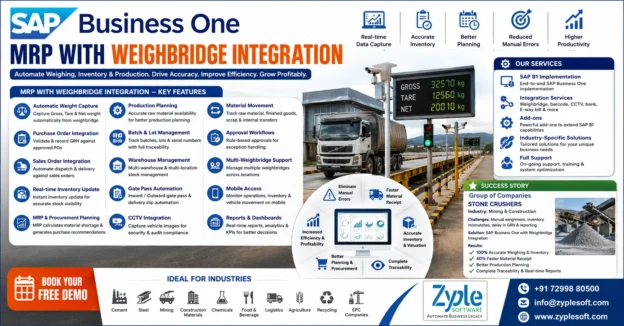
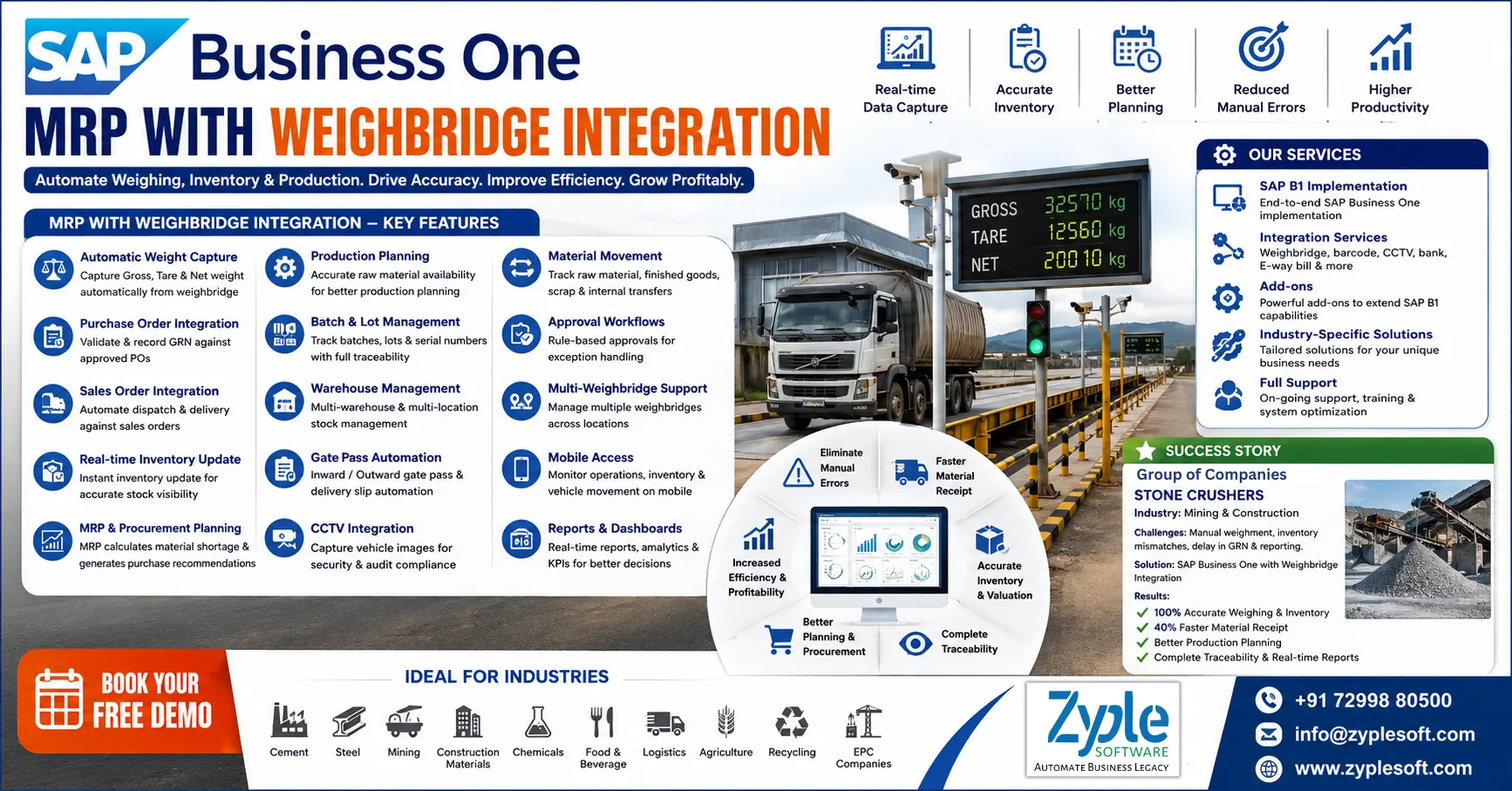
        MRP Software with Weighbridge Integration

        MRP Software with Weighbridge Integration: Eliminate Manual Errors and Automate Material Management

        MRP Software with Weighbridge Integration: A Complete Guide for Industries

        MRP Software with Weighbridge Integration

        In industries, raw material accuracy directly impacts production planning, inventory valuation, procurement, and profitability. Yet many organizations still rely on manual weighbridge entries, paper slips, or disconnected software, resulting in inventory mismatches, production delays, and revenue leakage.

        Integrating MRP (Material Requirements Planning) software with a weighbridge system eliminates these challenges by automatically capturing vehicle weights and updating ERP transactions in real time.

        Whether you are in steel, cement, chemicals, mining, construction materials, food processing, agriculture, logistics, paper, plastics, or recycling, weighbridge integration helps create a seamless flow of information from gate entry to financial reporting.

        What is MRP Software with Weighbridge Integration?

        MRP software with weighbridge integration connects your electronic weighbridge directly with your ERP system.

        Instead of manually entering weights into spreadsheets or ERP, vehicle weights are automatically transferred into the system during:

        • Raw material receipt
        • Finished goods dispatch
        • Scrap movement
        • Inter-plant transfer
        • Customer delivery
        • Vendor returns
        • Production consumption

        The result is a single source of truth for inventory, procurement, production, finance, and logistics.

        How MRP Software Works with a Weighbridge?

        A fully integrated solution automates the entire material movement process.

        Step 1: Vehicle Registration

        The vehicle enters the factory.

        The operator selects:

        • Supplier
        • Customer
        • Purchase Order
        • Sales Order
        • Material
        • Transporter

        Step 2: Automatic Weight Capture

        The weighbridge captures:

        • Gross Weight
        • Tare Weight
        • Net Weight

        No manual typing required.

        Step 3: ERP Validation

        The ERP validates:

        • Purchase Order quantity
        • Delivery schedule
        • Material code
        • Vendor
        • Customer
        • Warehouse

        Step 4: Inventory Update

        Once validated:

        • Goods Receipt Note (GRN) is created
        • Inventory updates automatically
        • Batch/Lot numbers assigned
        • Stock valuation updated
        • MRP recalculated

        Step 5: Financial Posting

        The ERP automatically generates:

        • Inventory Journal
        • Vendor Liability
        • Cost Accounting Entry
        • Financial Posting

        No duplicate accounting work.

        Step 6: Reporting

        Management receives real-time reports including:

        • Daily inward quantity
        • Daily outward quantity
        • Vehicle turnaround time
        • Supplier performance
        • Material consumption
        • Stock availability
        • Production planning

        Key Features of MRP Software with Weighbridge Integration

        Automatic Weight Capture

        Vehicle weights are captured directly from the weighbridge indicator.

        Purchase Order Integration

        The system verifies incoming quantities against approved purchase orders.

        Sales Order Integration

        Outgoing dispatches are validated against customer orders.

        Goods Receipt Automation

        GRNs are generated instantly after successful weighing.

        Goods Issue Automation

        Finished goods dispatches update inventory automatically.

        Real-Time Inventory

        Every transaction updates inventory immediately.

        Material Requirement Planning (MRP)

        Updated inventory helps MRP calculate:

        • Material shortages
        • Purchase recommendations
        • Production requirements
        • Reorder levels

        Production Planning

        Production teams receive accurate raw material availability.

        Warehouse Management

        Warehouse stock remains synchronized with physical inventory.

        Batch and Lot Tracking

        Supports:

        • Batch Management
        • Lot Traceability
        • Serial Number Tracking

        CCTV Integration

        Capture vehicle images automatically during weighing for enhanced security and audit trails.

        Gate Pass Automation

        Automatically generate:

        • Inward Gate Pass
        • Outward Gate Pass
        • Dispatch Slip

        QR Code & Barcode Support

        Enable faster identification of:

        • Materials
        • Vehicles
        • Drivers
        • Purchase Orders

        Multi-Weighbridge Support

        Manage multiple weighbridges across:

        • Factories
        • Plants
        • Branches
        • Warehouses

        Multi-Location Inventory

        Track stock movement across different business locations in real time.

        Approval Workflow

        Approve exceptional transactions based on weight tolerances or predefined business rules.

        Mobile Access

        Managers can monitor:

        • Vehicle movements
        • Material receipts
        • Dispatch status
        • Inventory levels

        from anywhere.

        Benefits of MRP Software with Weighbridge Integration

        Eliminate Manual Errors

        Automatic data capture reduces typing mistakes.

        Faster Material Receipt

        Vehicles spend less time waiting at the weighbridge.

        Accurate Inventory

        Inventory always reflects actual material movement.

        Better Production Planning

        MRP calculations are based on accurate stock levels.

        Reduced Material Loss

        Prevent unauthorized material movement.

        Faster Procurement Decisions

        Procurement teams receive accurate replenishment recommendations.

        Improved Customer Deliveries

        Dispatch teams have accurate stock visibility.

        Complete Traceability

        Track every vehicle, weight, material, supplier, and customer.

        Higher Operational Efficiency

        Reduce paperwork and manual intervention.

        Better Decision Making

        Management dashboards provide real-time operational insights.

        Industries That Benefit from Weighbridge Integration

        This solution is ideal for:

        • Steel Manufacturing
        • Cement Plants
        • Ready Mix Concrete (RMC)
        • Infra Construction and Materials
        • Mining
        • Stone Crushers
        • Chemicals
        • Fertilizers
        • Food Processing
        • Dairy
        • Rice Mills
        • Sugar Mills
        • Paper and Pulp
        • Packaging
        • Plastics
        • Agriculture
        • Recycling
        • Waste Management
        • Logistics
        • Warehousing
        • EPC Companies

        SAP Business One MRP with Weighbridge Integration

        SAP Business One offers powerful MRP capabilities that become even more effective when integrated with a weighbridge system.

        The integrated solution enables:

        • Automated Goods Receipt PO
        • Automated Delivery
        • Inventory synchronization
        • Production planning
        • Purchase planning
        • Batch management
        • Cost accounting
        • Financial integration
        • Real-time dashboards
        • Mobile reporting
        • Approval workflows
        • Analytics and KPIs

        This provides manufacturers with complete visibility across procurement, inventory, production, warehouse operations, sales, and finance from a single platform.

        Why Choose Zyple Software?

        Zyple Software specializes in SAP Business One implementation, customization, and weighbridge integration for construction, manufacturing and process industries.

        Our expertise includes:

        • SAP Business One Implementation
        • Weighbridge Integration
        • SAP Business One Add-ons
        • MRP Optimization
        • Production Planning
        • Inventory Management
        • Warehouse Automation
        • CCTV Integration
        • Gate Pass Automation
        • Mobile Applications
        • Business Intelligence Dashboards
        • Ongoing SAP Support

        We help businesses to improve operations with inventory accuracy, reduce manual work, and make data-driven decisions through integrated ERP solutions.

        Go for Conclusion

        For manufacturers dealing with bulk materials, MRP software with weighbridge integration is more than a convenience but it is a strategic investment. By automating weight capture, synchronizing inventory in real time, and connecting procurement, production, warehouse, logistics, and finance, businesses can reduce manual errors, improve planning accuracy, and increase operational efficiency.

        When implemented with SAP Business One, this integration delivers end-to-end visibility, stronger inventory control, faster decision-making, and measurable productivity gains. Organizations looking to modernize their operations and support scalable growth can benefit significantly from an integrated MRP and weighbridge solution.

        Frequently Asked Questions (FAQs)

        1. What is weighbridge integration in ERP?

        It connects the electronic weighbridge directly with the ERP system, enabling automatic weight capture and inventory updates without manual data entry.

        By providing real-time inventory updates, MRP can generate more accurate purchase recommendations, production plans, and reorder calculations.

        Yes. SAP Business One can integrate with most digital weighbridge indicators through customized connectors or certified add-ons.

        Yes. Automated weight capture minimizes manual errors, improves stock accuracy, and reduces inventory variances.

        Industries handling bulk materials such as steel, cement, mining, chemicals, food processing, agriculture, logistics, construction materials, and recycling gain significant benefits.

        Yes. Many implementations combine weighbridge integration with CCTV image capture for enhanced security and compliance.

        Yes. The solution can support multiple plants, warehouses, and weighbridges while providing centralized reporting.

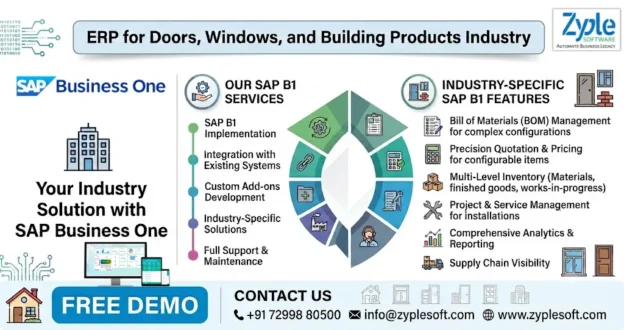
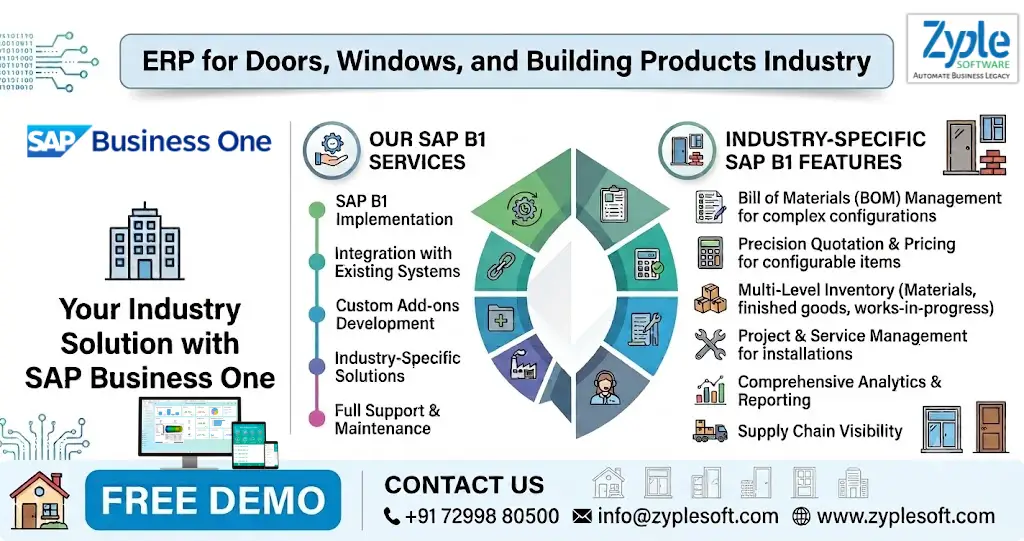
          SAP Business One ERP for Doors, Windows, and Building Products industry by zyple software

          SAP Business One ERP for Doors, Windows, and Building Products Industry

          SAP Business One (B1) ERP for Doors, Windows, and Building Products Industry

          SAP Business One ERP for Doors, Windows, and Building Products industry by zyple software

          The doors, windows, and building products industry, being a versatile sector in the world, goes through continuous development. Innovative software solutions are important for the doors, windows, and building products industry to maintain the huge and dynamic competition and also to integrate business processes effectively. SAP Business One ERP for doors, windows, and building products helps the doors, windows, and building products to handle every aspect of their business efficiently.

          Challenges Faced By The Doors, Windows, and Building Products Industry

          The doors, windows, and building products industry faces a confluence of chronic labor shortages, fluctuating raw material costs, and tightening energy-efficiency regulations. Companies must adjust to shifting consumer demands while handling supply chain disruptions and navigating the transition towards digitized, sustainable manufacturing.

          1. Chronic Labor and Skill Shortages

          Finding and retaining certified, skilled trainers remains a major obstacle. Improper sealing and installation of fenestration can lead to moisture infiltration, mold, and minimized thermal performance. An aging workforce paired with a lack of vocational training results in higher onboarding costs and inconsistent work quality on job sites. Labor deficits throughout the supply chain delay order fulfillment and minimize manufacturer flexibility to scale productivity.

          2. Material Volatility and Supply Chain Pressures

          The costs of necessary raw materials, such as aluminum, timber, and glass, remain highly unpredictable. The industry faces continuous pressure from import duties and an influx of cheap, lower-quality products, which forces local and organized manufacturers to continuously adjust their pricing models. Global trade uncertainities and shifting tariff structures complicate forecasting and inventory management.

          3. Stringent Energy and Environmental Regulations

          Governments are enforcing aggressive energy efficiency and zero-emission goals. This forces manufacturers to quickly phase out older, less efficient products like outdated aluminum frames in favor of thermally-broken systems. Achieving consumer and regulatory expectations for recycled, sustainably sourced, and highly recyclable materials such as uPVC and advanced fiberglass involves significant R&D investment.

          4. Technological Integration and Digitization

          Consumers increasingly require smart, connected features, including motorized blinds, automated locking systems, and integrated sensors. Manufacturing these products involves new technological capabilities and higher production costs. The shift towards digital transformation seperates industry winners from losers. Manufacturers and dealers must improve their digital presence, as many homeowners finish the majority of their buying journey and research prior to ever contacting a company. Building material manufacturers are increasingly challenged to switch from being simple component suppliers to complete systems providers, requiring heavy investments in software, digital planning, and supply chain integration.

          Features of SAP Business One ERP for Doors, Windows, and Building Products Industry

          1. Customer Relationship Management

          • It includes lead and opportunity management.
          • It includes customer inquiry tracking.
          • It includes dealer and distribution management.
          • It includes sales quotation management.
          • It includes customer communication history.
          • It includes after-sales service management.
          • It includes complaint and warranty tracking.

          2. Sales Management

          • It includes multi-level quotation creation.
          • It includes door and window configuration-based quotations.
          • It includes sales order processing.
          • It includes contract-based pricing.
          • It includes project-wise sales management.
          • It includes delivery scheduling.
          • It includes partial deliveries.
          • It includes sales returns management.
          • It includes credit limit management.

          3. Product Configuration

          • Configures doors and windows based on dimensions, material, frame type, glass type, hardware selection, color, and finish.
          • It includes automatic pricing based on configuration.
          • It includes custom product variants.
          • It includes engineering change management.

          4. Bill of Materials (BOM) Management

          • It includes multi-level BOM.
          • It includes configurable BOM.
          • It includes phantom BOM.
          • It includes revision control.
          • It includes component substitution.
          • It includes version management.
          • It includes cost roll-up.

          5. Production Planning

          • It includes production order management.
          • It includes make-to-order manufacturing.
          • It includes make-to-stock manufacturing.
          • It includes production scheduling.
          • It includes capacity planning.
          • It includes work center allocation.
          • It includes machine scheduling.
          • It includes resource planning.

          6. Inventory Management

          • It includes raw material inventory.
          • It includes finished goods inventory.
          • It includes work-in-progress (WIP) tracking.
          • It includes multi warehouse management.
          • It includes bin location management.
          • It includes stock transfer.
          • It includes stock reservation.
          • It includes inventory valuation.
          • It includes inventory counting.

          7. Material Requirements Planning (MRP)

          • It includes demand forecasting.
          • It includes raw material planning.
          • It includes purchase recommendations.
          • It includes production recommendations.
          • It includes shortage analysis.
          • It includes safety stock planning.
          • It includes automatic replenishment.

          8. Batch and Serial Number Tracking

          • It includes glass batch tracking.
          • It includes aluminium profile tracking.
          • It includes hardware traceability.
          • It includes finished product serial numbers.
          • It includes complete product genealogy.
          • It includes recall management.

          9. Warehouse Management

          • It includes barcode-enabled inventory.
          • It includes bin management.
          • It includes goods receipt.
          • It includes goods issue.
          • It includes picking lists.
          • It includes packing management.
          • It includes warehouse transfers.
          • It includes cycle counting.

          10. Procurement Management

          • It includes vendor management.
          • It includes purchase requisitions.
          • It includes purchase quotations.
          • It includes purchase orders.
          • It includes goods receipt PO (GRPO).
          • It includes vendor price comparison.
          • It includes supplier evaluation.
          • It includes blanket purchase agreements.

          11. Manufacturing Execution

          • It includes shop floor control.
          • It includes production issue and receipt.
          • It includes labor tracking.
          • It includes machine utilization.
          • It includes production variance analysis.
          • It includes scrap recording.
          • It includes rework management.
          • It includes yield monitoring.

          12. Quality Control

          • It includes incoming material inspection.
          • It includes in-process quality checks.
          • It includes final product inspection.
          • It includes glass quality verification.
          • It includes hardware quality testing.
          • It includes non-conformance management.
          • It includes quality certificates.
          • It includes CAPA tracking.

          13. Cost Management

          • It includes standard costing.
          • It includes actual costing.
          • It includes material cost analysis.
          • It includes labor costing.
          • It includes machine costing.
          • It includes job costing.
          • It includes product profitability.
          • It includes variance analysis.

          14. Project Management

          • It includes building project tracking.
          • It includes site-wise costing.
          • It includes installation scheduling.
          • It includes budget monitoring.
          • It includes resource allocation.
          • It includes milestone tracking.
          • It includes project profitability.
          • It includes contractor coordination.

          15. Installation Management

          • It includes Installation scheduling
          • It includes Technician assignment
          • It includes Site visit planning
          • It includes Installation status tracking
          • It includes Completion reports
          • It includes Customer sign-off
          • It includes Installation checklists

          16. Service Management

          • It includes warranty management.
          • It includes AMC management.
          • It includes service call management.
          • It includes repair tracking.
          • It includes replacement management.
          • It includes spare parts management.
          • It includes field service scheduling.

          17. Financial Management

          • It includes general ledger.
          • It includes accounts payable.
          • It includes accounts receivable.
          • It includes fixed assets.
          • It includes bank reconciliation.
          • It includes cash flow management.
          • It includes budget management.
          • It includes multi-currency accounting.

          18. GST and Tax Compliance

          • It includes GST-ready invoicin
          • It includes tax calculations.
          • It includes e-invoicing integration.
          • It includes e-way bill support.
          • It includes TDS/TCS management.
          • It includes compliance reporting.

          19. Supply Chain Management

          • It includes supplier collaboratio
          • It includes procurement planning.
          • It includes inventory optimization.
          • It includes logistics coordination.
          • It includes dispatch planning.
          • It includes shipment tracking.

          20. Pricing Management

          • It includes customer-specific pricing.
          • It includes dealer pricing.
          • It includes project pricing.
          • It includes volume discounts.
          • It includes promotional pricing.
          • It includes price lists.
          • It includes approval workflows.

          21. Document Management

          • It includes CAD drawing attachment.
          • It includes technical specifications.
          • It includes installation manuals.
          • It includes purchase documents.
          • It includes sales documents.
          • It includes quality certificates.
          • It includes customer contracts.

          22. Approval Workflows

          • It includes purchase approval.
          • It includes sales discount approval.
          • It includes credit approval.
          • It includes production approval.
          • It includes payment approval.
          • It includes expense approval.

          23. Business Intelligence and Dashboards

          • It includes sales dashboards.
          • It includes production dashboards.
          • It includes inventory dashboards.
          • It includes financial dashboards.
          • It includes procurement analytics.
          • It includes customer analytics.
          • It includes profitability reports.
          • It includes executive KPIs.

          24. Reporting

          • It includes sales reports.
          • It includes production reports.
          • It includes inventory reports.
          • It includes cost reports.
          • It includes profit analysis.
          • It includes purchase reports.
          • It includes GST reports.
          • It includes project reports.
          • It includes service reports.

          25. Mobile Access

          • It includes sales order entry.
          • It includes customer information.
          • It includes inventory lookup.
          • It includes approval management.
          • It includes service updates.
          • It includes dashboard access.
          • It includes mobile reporting.

          26. Multi-Branch Management

          • It includes branch-wise inventory.
          • It includes inter-branch transfers.
          • It includes consolidated financials.
          • It includes branch profitability.
          • It includes centralized reporting.

          27. Multi-Currency and International Business

          • It includes foreign currency transactions.
          • It includes export documentation.
          • It includes import management.
          • It includes exchange rate management.
          • It includes international tax support.

          28. Integration Capabilities

          • It includes CAD software integration.
          • It includes estimation software integration.
          • It includes e-commerce integration.
          • It includes barcode scanners.
          • It includes business intelligencetools.
          • It includes shipping providers.
          • It includes banking systems.
          • It includes Microsoft Office integration.

          29. Security and User Management

          • It includes role-based permissions.
          • It includes user authorization.
          • It includes audit trail.
          • It includes data securit
          • It includes approval hierarchy.
          • It includes electronic signatures.

          30. SAP Business One Web Client

          • It includes browser-based ERP access.
          • It includes sales document creation.
          • It includes approval workflows.
          • It includes dashboard access.
          • It includes activity management.
          • It includes real-time reportin

          Benefits of SAP Business One ERP for Doors, Windows, and Building Products

          The ERP software, SAP Business One system, delivers doors, windows, and building products companies with an integrated platform that connects sales, production, inventory, and finance. Key benefits include optimized material requirements planning (MRP) to minimize waste, automated custom-order processing, and real-time inventory tracking.

          1. Configurable Manufacturing

          Easily handles unique Bills of Materials (BOMs) and routings for custom-sized windows and doors, minimizing production bottlenecks and material waste with the SAP implementation process.

          2. Optimized Inventory and Procurement

          Uses MRP to forecast demand and automate purchasing. This helps prevent stock shortages of raw materials like lumber, glass, and aluminum, while reducing carrying costs.

          3. Facilitated Order-to-Cash

          Integrates your sales quotes directly to the shop floor and accounting. This accelerates the pricing, production, and delivery of custom building materials, leading to faster fulfillment with the SAP solutions process.

          4. Accurate Costing and Margin Analysis

          Connects labor, raw material usage, and overhead directly into the ledger, giving you a precise Cost of Goods Sold (COGS) to improve pricing strategies.

          5. Centralized CRM

          Handles leads, tracks interactions with contractors and architects, and provides robust post-sales support in one system using SAP B1 add-ons.

          6. Advanced Traceability

          Employs batch and serial number tracking for compliance with building codes and to allow faster, more controlled quality-control recalls if necessary.

          Conclusion of Doors, Windows, and Building Products ERP

          Best SAP Business One partner – Zyple Software is delivering services like SAP B1 implementation, integration, licensing, add-ons, and support to different industries, like construction, manufacturing, jewellery, food and beverage, retail, pharma, solar, aerospace, and textile industries. 

          SAP Business One is an ERP customized for small and medium-sized businesses that connects finance, procurement, sales, inventory, production, CRM, and reporting into a single platform. For doors, windows, and building products or any other companies, it can improve project costing, procurement, subcontractor billing, and inventory management.

          If you’re adaptable, reserve a demo in SAP Business One.

          Do you request the SAP B1 ERP software for your business or industry?

          Finish all the details in the designated contact form; our team will return to you.

            Frequently Asked Questions (FAQs)

            1.How can SAP Business One ERP improve profitability in doors and windows manufacturing?

            SAP Business One helps minimize material wastage, optimize production planning, and deliver real-time financial insights, allowing manufacturers to control costs and improve overall profitability.

            Yes, SAP Business One is specifically customized for SMEs. It scales with your business and can be designed to achieve the unique needs of doors, windows, and building product manufacturers.

            Yes, most SAP Business One partners provide personalized demos customized for your industry. The demo helps you understand how the system fits your business processes before making a decision.

            SAP B1 implementation timelines vary, but with the right partner like Zyple Software, most businesses can go live within a few weeks to a few months depending on complexity and customization needs.

            Look for a partner with experience in your industry like Zyple Software with proven implementation success and strong post-implementation support to ensure long-term value from your ERP investment.

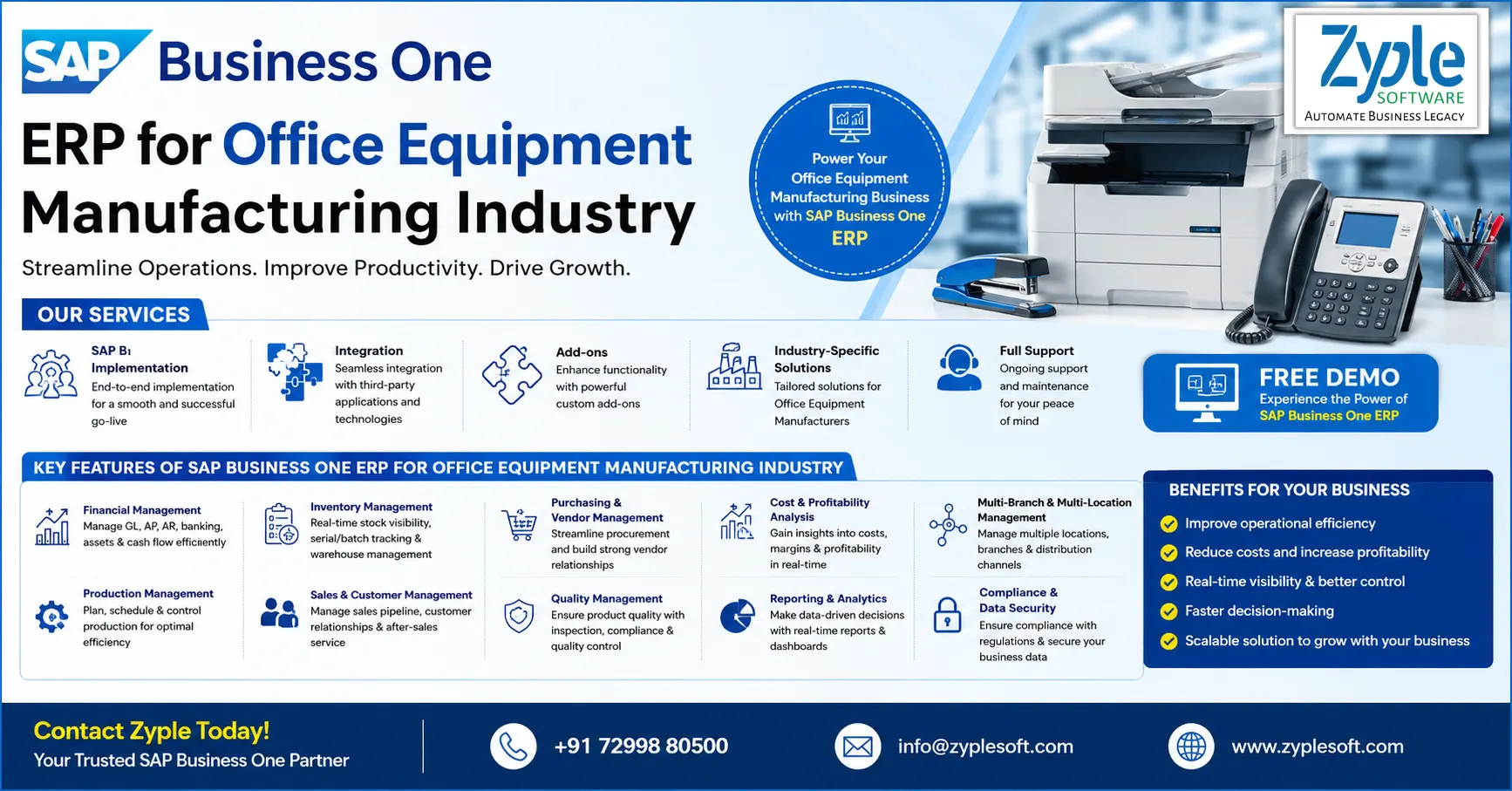
            SAP Business One ERP for Office Equipment Manufacturing industry provide by zyple software

            SAP Business One ERP for Office Equipment Manufacturing Industry

            SAP Business One (B1) ERP for Office Equipment Manufacturing Industry

            SAP Business One ERP for Office Equipment Manufacturing industry provide by zyple software

            Running an office equipment manufacturing business is a hassle to facilitate the business’s operations. So, until you have a proper check on all the processes like production, planning, batch costing, costing of raw material, and other things, it becomes a problem to decide.SAP Business One ERP for office equipment manufacturing helps office equipment manufacturing businesses handle different aspects of the business operations seamlessly.

            Now, the main question, how SAP business one can help for industry? Because every industry have different opertaions.

            So, Zyple Software Team is a good into SAP Business One implementation as per industry operation’s needs.

            Challenges Faced By The Office Equipment Manufacturing Industry

            Office equipment makers face stiff price competition and supply chain delays that hinder profits. They struggle with outdated technologies becoming obsolete quickly. They also face pressure to build eco-friendly products. Finally, they need to deal with a worker shortage for skilled technical jobs.

            1. Fast Tech Changes

            Gadgets get old very fast. Think of this like upgrading your phone every year; companies have to continuously refresh their product lines.

            2. Supply Chain Snarls

            Missing parts, like computer chips or plastics, can stop whole factories. This happens because parts come from all over the world. Delays cause a loss of revenue and delay shipments to buyers.

            3. Green Pressures

            Companies are pushed to minimize their carbon footprint. They must use recycled materials and save energy to achieve strict laws. If they fail, they might face fines or lose customers.

            4. Worker Shortage

            There are not enough people who know how to build or fix smart, modern office machines. Factories require workers trained in robotics and computers.

            5. Price Wars

            Many makers provide similar basic products. This forces prices down and hinders profit margins. Companies must find ways to make their items special.

            Features of SAP Business One ERP for Office Equipment Manufacturing Industry

            1. Production Planning and Control

            • It includes production orders with real-time status tracking.
            • It includes capacity planning and scheduling.
            • It includes routing and work center management.

            2. Inventory and Warehouse Management

            • It includes real-time inventory tracking across warehouses.
            • Batch and serial number tracking is essential for office electronics.
            • It includes bin location management.
            • It includes automated stock replenishment.
            • Inventory valuation methods like FIFO and moving average.

            3. Procurement and Supplier Management

            • It includes purchase requisitions and purchase orders.
            • It includes supplier or vendor evaluation and management.
            • It includes blanket agreements for recurring purchases.
            • It includes automated procurement workflows.
            • Landed cost calculation is essential for imported components.

            4. Sales and Customer Relationship Management (CRM)

            • It includes lead and opportunity management.
            • It includes quotation and sales order purchasing.
            • It includes customer service and support tracking.
            • It includes pricing management and discount structures.
            • It includes integration with service contracts for office equipment maintenance.

            5. Financial Management and Accounting

            • It includes fixed asset accounting.
            • It includes multi-currency support.
            • It includes budgeting and financial reporting.
            • It includes GST compliance and statutory reporting.

            6. Quality Control and Compliance

            • It includes non-conformance and corrective action tracking.
            • It includes quality certificates and compliance documentation.
            • It includes audit trails for regulatory compliance.

            7. Service Management (After-Sales Support)

            • It includes service call management for equipment repairs.
            • It includes warranty and AMC (Annual Maintenance Contract) tracking.
            • It includes spare parts management.
            • It includes technician scheduling and dispatch.
            • Installed base management for tracking customer equipment.

            8. Bill of Materials (BOM) and Product Data Management

            • It includes multi-level and variant BOMs.
            • It includes engineering change management (ECM).
            • It includes version control of product structures.
            • It includes product lifecycle tracking.

            9. Reporting and Business Intelligence

            • It includes real-time dashboards and KPIs.
            • It includes customizable reports.
            • It includes integration with analytics tools.
            • It includes predictive insights for demand and production.

            10. Project Management

            • It includes project planning and execution.
            • It includes cost tracking and budgeting.
            • It includes resource allocation.
            • It includes milestone and timeline tracking.

            11. Integration and Automation

            • It includes API-based integration with third-party tools.
            • It includes EDI integration for suppliers and distributors.
            • It includes workflow automation and approvals.
            • It includes IoT integration for smart manufacturing.

            12. Mobility and Cloud Access

            • It includes cloud deployment options.
            • It includes remote access to ERP data.
            • It includes real-time alerts and notifications.

            Importance of SAP Business One ERP for Office Equipment Manufacturing

            The ERP software, SAP Business One (SAP B1) system, is a complete, centralized ERP for office equipment manufacturing that drives efficiency in the office equipment manufacturing industry by tightly integrating financials, inventory, and supply chain management. It enables businesses to optimize complex production processes, minimize operational costs, and accurately track production margins.

            1. Optimized Bill of Materials (BOMs)

            Accurately handles multi-level BOMs required for complex office machines, ensuring exact raw material tracking for everything from heavy-duty printers to ergonomic furniture with SAP implementation process.

            2. Automated Material Requirements Planning (MRP)

            Prevents expensive production delays and inventory shortages by automatically calculating material needs based on sales forecasts and production schedules.

            3. Accurate Costing and Margin Analysis

            Links shop-floor actions, labor, and material usage directly to the general ledger, providing real-time insight into the true Cost of Goods Sold (COGS).

            4. Real-Time Inventory and Supply Chain Visibility

            Tracks stock levels across different warehouses to reduce carrying costs and accelerate order fulfillment using SAP solutions.

            5. Quality Assurance and Traceability

            Incorporates quality control checkpoints throughout the manufacturing cycle to achieve compliance standards and minimize defects.

            Benefits of SAP Business One for Office Equipment Manufacturing

            SAP Business One acts as a centralized ERP solution designed to facilitate production, inventory, and finances. For office equipment manufacturers, it eliminates data storage by connecting procurement, shop-floor production, sales, and accounting, which dramatically minimizes manual work and improves operational efficiency.

            1. Material Requirements Planning (MRP)

            The SAP software automatically calculates exactly what raw materials (metals, plastics, electronics) and components are required for production based on sales forecasts, reducing over-purchasing and production delays.

            2. Bill of Materials (BOM) Management

            Standardizes multi-level assemblies, ensuring consistency across complex products like office chairs, desks, and automated filing systems.

            3. Real-Time Inventory Control

            Tracks stock movements across different warehouses, using serial and batch tracking to monitor high-value components or finished office hardware, thereby preventing stockouts and overstocking.

            4. Accurate Production Costing

            Ties every shop floor action (labor, machine time, and materials) directly to the general ledger, eliminating month-end surprises and ensuring accurate, profitable pricing using SAP B1 add-ons.

            5. Integrated CRM and Sales Order Management

            Links customer orders directly to the production line, accelerating delivery times and improving customer satisfaction.

            Conclusion of Office Equipment Manufacturing ERP

            As a certified SAP Business One partner, Zyple Software is providing services like SAP B1 implementation, integration, licensing, add-ons, and support to different industries like construction, manufacturing, retail, pharma, jewellery, solar, food and beverage, aerospace, and textile industries. 

            SAP Business One is an ERP customized for small and medium-sized businesses that integrates finance, procurement, sales, inventory, production, CRM, and reporting into a single platform. For office equipment manufacturing or any other companies, it can improve project costing, procurement, subcontractor billing, and inventory management.

            If you’re active, reserve a demo of SAP Business One.

            Do you necessitate the SAP B1 ERP solution for your business or industry?

            Finish all the details in the described contact form; our team will reach out to you.

              FAQ (Frequently Asked Question)

              1.How can SAP Business One minimize operational costs in office equipment manufacturing?

              SAP Business One facilitates production, inventory, and procurement processes, reducing waste, minimizing manual errors, and lowering overall operational costs.

              Yes, SAP Business One can be customized with industry-specific add-ons and customizations to match your unique production workflows, reporting needs, and business processes.

              SAP B1 implementation timelines vary based on business size and complexity, but most office equipment manufacturers can go live within a few weeks to a few months with the right partner.

              Absolutely. SAP Business One delivers real-time dashboards and reports, helping you monitor production status, stock levels, and order fulfillment instantly.

              You can request a free demo or consultation from a qualified SAP Business One partner like Zyple Software to understand how the solution fits your business and calculate ROI before implementation.

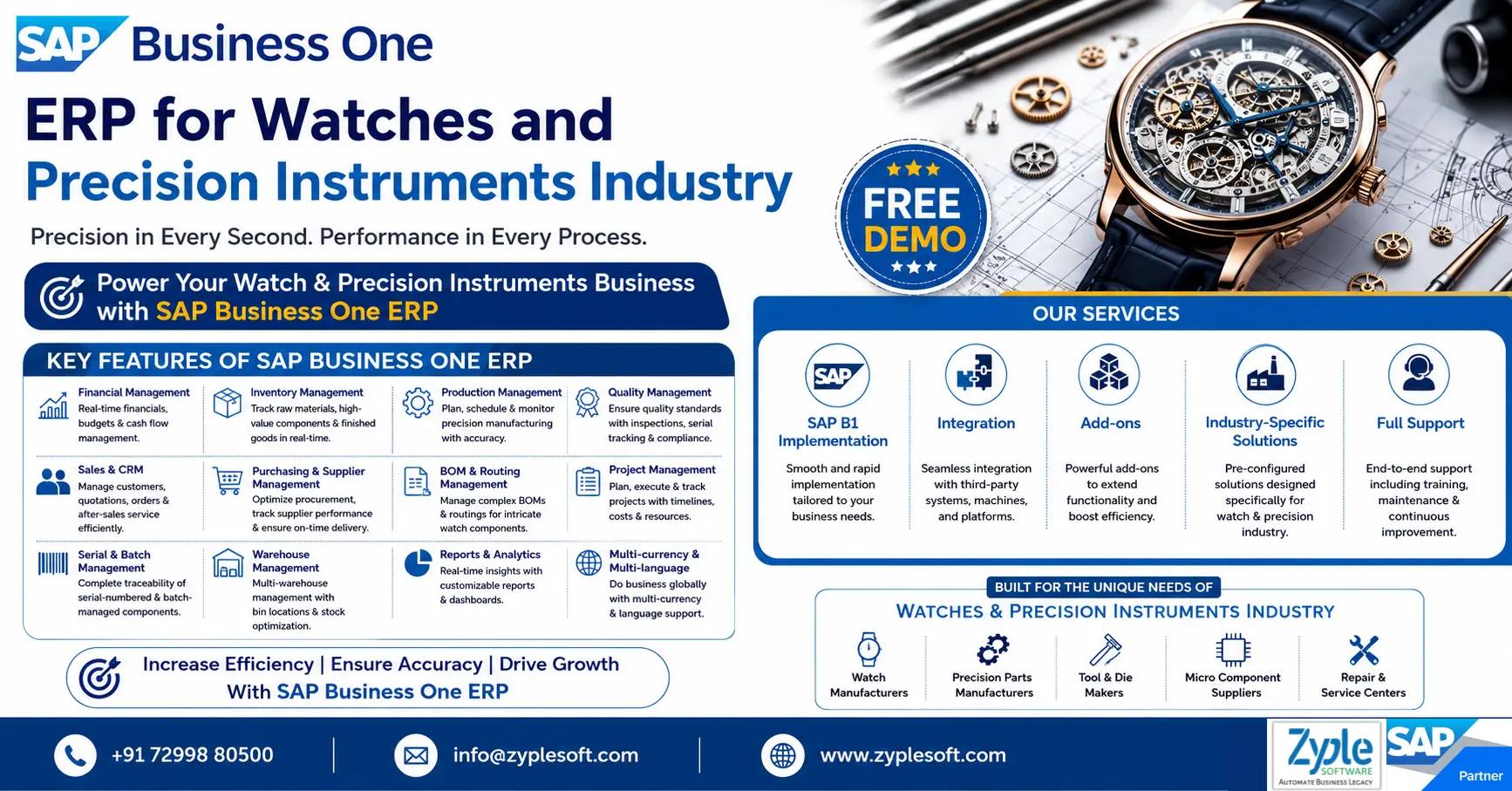
              Infographic of SAP Business One ERP for Watches and Precision Instruments Industry by Zyple Software featuring implementation, integration, add-ons, inventory management, production planning, quality control, serial tracking, CRM, finance, and free demo.

              SAP Business One ERP for Watches and Precision Instruments Industry

              SAP Business One (B1) ERP for Watches and Precision Instruments Industry

              Infographic of SAP Business One ERP for Watches and Precision Instruments Industry by Zyple Software featuring implementation, integration, add-ons, inventory management, production planning, quality control, serial tracking, CRM, finance, and free demo.

              The watches and precision instruments industry operates in a precision-driven environment where product quality, component traceability, and efficient assembly processes are essential. Manufacturers must handle a wide range of small and specialized components such as movements, dials, hands, cases, straps, and batteries while maintaining strict quality standards and design consistency. 

              Traditional systems and manual processes often create challenges in tracking component inventory, handling multi-level bills of materials, coordinating assembly operations, and ensuring product traceability. SAP Business One ERP for watches and precision instruments delivers an integrated platform that connects production planning, component inventory, procurement, quality control, sales, and financial management, providing real-time visibility and operational control across the watch manufacturing cycle.

              Challenges Faced By The Watches and Precision Instruments Industry

              The watches and precision instruments industry faces severe challenges, mainly driven by surging raw material costs (e.g., gold), restrictive geopolitical tariffs on exports, and aggressive competition from multifunctional watches. Consequently, traditional watchmakers are battling declining demand in mid-tier segments, falling secondary market inventories, and recent job contradictions across manufacturing.

              1. Macroeconomic Pressures and Trade Barriers

              International trade wars, including heavy tariffs on Swiss products entering the US, are forcing major shifts in inventory management and supply chain operations. Rising prices for precious metals like gold and platinum directly inflate manufacturing costs, squeezing profit margins, especially for mid-tier luxury and mechanical brands. The strength of the Swiss Franc remains a constant pressure, making exported traditional timepieces significantly more expensive for global buyers.

              2. Technological Shifts and Smartwatch Disruption

              Smartwatches and fitness trackers have evolved into digital health ecosystems, providing biometric tracking like ECG and SpO2, GPS, and phone connectivity. Younger generations are growing accustomed to the daily utility of connected wearables, seriously cutting into the entry-level and mass-market traditional watch segments. While smartwatches dominate, traditional instruments still hold the advantage of longevity. Smart devices suffer from quick battery drain and require daily charging.

              3. Market Saturation and Inventory Struggles

              The pre-owned and secondary markets are experiencing a surplus, causing waiting lists to shrink and secondary-market prices for previously high-demand watches to drop. Watches are remaining on retailer shelves and in dealer cases for much longer, reducing inventory turnover and revenue flow. There is a growing consensus that the market has too many brands chasing the same limited pool of high-net-worth consumers.

              4. Innovation vs. Trading

              Many established brands face criticism for taking extended periods to update designs or integrate modern clasps and bracelets, enabling newer, nimbler competitors to gain traction. While companies explore automated processes and industry 4.0 to scale production, true haute horlogerie depends on master artisans. Hand-finishing places a natural ceiling on production efficiency and output. Luxury watchmakers who attempt to create their own smartwatches or digital ecosystems have historically struggled with poor adoption and mixed results.

              5. Consumer Shifts and Sustainability

              Younger consumers desire highly personalized products and customizable components rather than mass-produced heritage pieces. There is an increased demand for sustainable and ethical sourcing of materials like conflict-free metals and vegan straps, forcing brands to adapt their supply chains.

              Features of SAP Business One ERP for Watches and Precision Instruments

              1. Core Manufacturing and Production Management

              • It includes multi-level BOMs for complex watch parts and instrument parties.
              • Plans, releases, and tracks batch or discrete manufacturing.
              • Defines machining, calibration, polishing, and assembly steps.
              • Optimizes machine utilization like CNC, micro-machining, and assembly lines.
              • Monitors partially assembled components.
              • Aligns production with demand and delivery timelines.
              • Handles production across multiple facilities.

              2. Inventory and Warehouse Management

              • It includes raw materials, components, and finished goods.
              • Essential for the traceability of precision instruments.
              • It includes efficient storage of small and high-value parts.
              • Handles distribution centers and production stores.
              • Avoids shortages of essential micro-components.
              • It includes cycle counting and stock audits.

              3. Quality Control and Compliance

              • Defines QC parameters for each stage.
              • Tracks calibration of instruments and tools.
              • Detects and handles defects.
              • It includes ISO, CE, and industry-specific standards.
              • It includes end-to-end tracking from raw material to finished product.

              4. Financial Management and Cost Control

              • Fully automated financial processes like general ledger, accounts payable, and accounts receivable.
              • It includes accurate costing for precision components and assemblies.
              • Monitors manufacturing expenses.
              • Suitable for global exports.
              • Handles high-value machinery and tools.
              • It includes product-wise and batch-wise margins.

              5. Procurement and Supplier Management

              • Maintains supplier data for precision parts.
              • Automates procurement cycles.
              • Evaluates vendor performance.
              • Facilitated procurement workflow.
              • Ideal for global sourcing.

              6. Sales, CRM, and After-Sales Service

              • Handles distributors, retailers, and OEM clients.
              • Sales order management from quotation to delivery cycle.
              • Essential for watches and instruments.
              • It includes after-sales service management.
              • It includes customer analytics and forecasting.

              7. Business Intelligence and Analytics

              • Real-time dashboards and KPIs for production, quality, and sales insights.
              • Drill-down analytics and custom reports for operations.
              • It includes demand forecasting and planning.
              • Excel integration for advanced reporting capabilities.

              8. Production Planning and MRP (Material Requirements Planning)

              • Demand forecasting is based on sales and historical data.
              • Automates material procurement and production planning.
              • Ensures timely availability of precision parts.
              • Minimizes inventory holding costs.

              9. Engineering and Product Lifecycle Support

              • Engineering change management to handle design revisions.
              • Version control for BOMs tracks changes in product design.
              • It includes integration with CAD and PLM systems.
              • It includes prototype and custom order handling.

              10. Mobility, Integration, and Automation

              • It includes mobile access to ERP on the go.
              • It connects CNC and testing equipment using IoT and machine integration.
              • Automated workflows and alerts reduce manual intervention.
              • Third-party integration with MES, e-commerce, and logistics.

              11. Industry-Specific Capabilities for Watches and Precision Instruments

              • It includes high-precision traceability for micro-components.
              • It includes strong quality assurance and calibration tracking.
              • It includes efficient batch and serial production handling.
              • It includes support for global supply chains and exports.
              • It includes improved time-to-market for new designs.

              Benefits of SAP Business One ERP for Watches and Precision Instruments

              The ERP software, SAP Business One (SAP B1) system, is an affordable ERP designed for SMEs. It connects financials, sales, purchasing, and manufacturing into one platform. For the watch and precision instruments industry, it avoids material waste, automates serialized tracking of microscopic components, and ensures thorough quality control.

              1. Serial Number and Batch Traceability

              Every movement, gear, and micro-component is individually tracked from procurement to final assembly using SAP implementation. This ensures product authenticity and rapid root-cause analysis in case of defects.

              2. Precision BOM Management

              Oversees multi-level bills of materials (BOM) that are common in high-complication watchmaking. This outlines exact requirements for precise, high-value components.

              3. Quality Control and Compliance

              Implements strict tolerance checks and quality control (QC) tracking throughout the production process to maintain high luxury and mechanical standards.

              4. Reduced Inventory Costs

              Reduces overstocking and stockouts using real-time data to forecast material demands and synchronize your warehouse using SAP solutions.

              5. Integrated Financials

              Automates key accounting and standardizes currency conversions for imported jewels, metals, and global parts distribution.

              Conclusion of Watches and Precision Instruments ERP

              Zyple Software is the official SAP Business One partner in India specializing in implementation, digital transformation, licensing, integration, add-on solutions, migration, and consulting for the watches and precision instruments industry. By implementing SAP software, watch manufacturers gain a centralized platform to handle production, component inventory, quality control, sales, and finance with complete transparency and control. This integrated approach improves operational efficiency, improves product traceability, and supports scalable growth in a competitive precision manufacturing market.

              If you’re active, reserve a demo of SAP B1 for your company.

              Do you require the SAP B1 ERP software for your business or industry?

              Finish all the details in the given contact form; our team will return to you.

                Frequently Asked Questions (FAQs)

                1.How can SAP Business One ERP help minimize production errors in precision manufacturing?

                SAP Business One improves accuracy through real-time data, automated workflows, and complete Bill of Materials (BOM). This reduces manual errors and ensures consistent quality, essential for precision instruments and watches.

                Yes, SAP Business One is designed specifically for SMEs, providing a cost-effective ERP solution with scalable pricing. Businesses can start with necessary modules and expand as they grow.

                SAP B1 implementation timelines vary based on complexity but generally range from a few weeks to months. With the right partner like Zyple Software, deployment can be fast and customized for your production needs.

                Absolutely. The system provides real-time dashboards and reporting tools that give full visibility into inventory levels, production status, and order tracking, helping you make faster, data-driven decisions.

                You can request a personalized demo from a certified SAP B1 partner like Zyple Software to see how the system fits your watch or precision instrument business. A consultation will help identify the suitable modules and implementation approach.
                SAP Business One ERP for Batteries and Energy Storage Equipment Industry by Zyple Software

                SAP Business One ERP for Batteries and Energy Storage Equipment Industry

                SAP Business One (B1) ERP for Batteries and Energy Storage Equipment Industry

                SAP Business One ERP for Batteries and Energy Storage Equipment Industry by Zyple Software

                The batteries and energy storage equipment industry operates in a precision-driven and compliance-heavy environment. Even small gaps in production data or inventory tracking can lead to serious consequences like failed audits, delayed shipments, or costly rework. SAP Business One ERP for batteries and energy storage equipment unifies financials, multi-level bills of materials (BOMS), and supply chains into a single platform to accelerate production, track inventory, and maintain global safety compliance.

                Challenges Faced By The Batteries and Energy Storage Equipment Industry

                The battery and energy storage equipment industry faces significant challenges, including volatile raw material costs, supply chain vulnerabilities, and strict safety concerns. Furthermore, rapid technological degradation, regulatory uncertainities, and complex end-of-life recycling requirements continue to challenge large-scale global deployment.

                1. Supply Chain Constraints and Material Sourcing

                The industry depends heavily on essential materials like lithium, cobalt, nickel, and graphite. Geopolitical concentrations in mining and refining expose manufacturers to price volatility and supply disruptions.

                2. Safety and Thermal Runaway

                Large-scale battery and energy storage equipment systems present significant fire risks and thermal runaway, leading to insurance and zoning challenges. For instance, municipalities globally have occasionally installed moratoriums on lithium-ion facilities due to combustion and pollution.

                3. Degradation and Lifespan

                Batteries experience capacity fading and degradation over charge-discharge cycles. This demands frequent replacements and complex cell-balancing capabilities to ensure optimal pack performance over a 10-to-15-year operational span.

                4. High Capital Costs and ROI Uncertainty

                Despite falling cell prices, total auxiliary integration, engineering, and setup costs remain high. Investors face uncertainties regarding long-term profitability, specifically when participating in fluctuating energy arbitrage markets.

                5. End-of-Life and Recycling

                Handling discarded equipment is an escalating environmental issue. Recycling infrastructure for large utility-scale batteries becomes less potent, and improper disposal can lead to toxic chemical and heavy metal soil contamination.

                6. Regulatory and Standard Gaps

                A lack of uniform international codes, standardization across different chemistries, and clear grid-interconnection rules complicate smooth integration.

                Features of SAP B1 ERP for Batteries and Energy Storage Equipment Business

                1. Production and Manufacturing Management

                • It includes multi-level bills of materials (BOM) for cells, modules, BMS, casing, and chemicals.
                • It includes production orders and shop floor control for battery assembly and pack building.
                • It includes material requirements planning (MRP) for raw materials like lithium, cobalt, and electrolytes.
                • Batch production and formula management are essential for chemical mixing processes.
                • It includes WIP (Work-in-Progress) tracking for multi-stage battery production.
                • Yield, scrap, and rework management are essential for defect control.
                • It includes capacity and resource planning for machines, labor, and production lines.
                • Production costing, like standard vs. actual with real-time recalculation.
                • It ensures efficient control over complex, multi-stage battery manufacturing.

                2. Inventory and Warehouse Management

                • It includes real-time tracking of raw materials, semi-finished, and finished goods.
                • Batch and serial number tracking for traceability is essential for batteries.
                • It includes multi-warehouse and bin location management.
                • It includes expiry and shelf-life tracking for chemicals and cells.
                • Stock valuation methods like FIFO, moving average, and standard costing.
                • It includes automated stock movements during production and dispatch.
                • It includes barcode and QR integration for warehouse operations.
                • Important for safety, compliance, and traceability in battery manufacturing.

                3. Quality Control and Compliance Management

                • It includes incoming, in-process, and final quality inspections.
                • It includes test result recording for voltage, capacity, and thermal stability.
                • Quality certificates and compliance documentation like ISO, BIS, and IEC.
                • It includes non-conformance and corrective action tracking.
                • It includes audit trails for regulatory compliance.
                • Helps achieve strict safety and environmental regulations.

                4. Procurement and Supplier Management

                • Vendor management for raw materials like lithium, nickel, separators, and more.
                • It includes purchase planning based on MRP recommendations.
                • It includes supplier price lists and contract management.
                • It includes automated purchase orders and approvals.
                • It includes import or export documentation handling.
                • It includes supplier performance tracking.
                • It includes stable sourcing in a volatile raw material market.

                5. Sales, Distribution, and Customer Management

                • End-to-end sales cycle from quotation, order, and delivery to invoice.
                • OEM and B2B customer management for EV manufacturers, utilities, and more.
                • After-sales service and warranty tracking are essential for batteries.
                • It includes pricing management for bulk and contract sales.
                • It includes demand forecasting for energy storage projects.
                • CRM for handling long-term contracts and projects.
                • It supports both industrial and project-based sales models.

                6. Financial Management and Cost Control

                • It includes general ledger, AP/AR, and banking integration.
                • It includes project-based costing for energy storage installations.
                • It includes budgeting and cost center tracking.
                • Profitability per analysis per product, like battery type and capacity.
                • It includes multi-currency support for global trade.
                • Taxation and compliance like GST and international regulations.
                • Helps handle thin margins and volatile input costs.

                7. Advanced Analytics and Business Intelligence (BI)

                • It includes real-time dashboards for production, inventory, and sales.
                • KPI tracking like yield, efficiency, defect rate, and cost per unit.
                • It includes predictive analytics for demand and procurement.
                • It includes custom reports and drill-down analysis.
                • It includes Excel integration for advanced reporting.
                • Allows data-driven decision-making across operations.

                8. Asset and Equipment Management

                • It includes maintenance tracking for machinery and equipment.
                • It includes downtime monitoring and preventive maintenance.
                • It includes asset lifecycle management.
                • It includes calibration tracking for testing equipment.
                • Crucial for high-value battery production equipment.

                9. Project Management

                • It includes project planning for solar and storage or grid-scale deployments.
                • It includes cost tracking per project.
                • It includes resource allocation and scheduling.
                • It includes milestone tracking and billing.
                • Suitable for EPC companies and large-scale storage deployments.

                10. Integration, Mobility, and Scalability

                • It includes web client for remote access.
                • It includes integration with IoT, BMS, and external systems.
                • It includes cloud or on-premises deployment.
                • It includes scalable architecture for a growing battery business.

                Benefits of SAP Business One ERP for Batteries and Energy Storage Equipment Industry

                The ERP software, SAP Business One (SAP B1) system, provides immense value to the battery and energy storage equipment industry by uniting engineering, procurement, production, and financials into one platform. It drives operational efficiency, improves complex supply chains, and ensures strict regulatory compliance and safety standards.

                1. End-to-End Traceability

                In the batteries and energy storage equipment industry, tracing individual components, chemical batches, and serial numbers is essential for safety and warranty management. SAP implementation tracks materials from supplier to customer, ensuring compliance and easy management of RMAs and recalls.

                2. Intelligent Production and MRP

                Material requirements planning (MRP) ensures you have the exact raw materials, like lithium, cell components, and inverters, required to meet production schedules without overstocking. This reduces idle time and optimizes the production ratio.

                3. Real-Time Project and Job Costing

                Engineering-to-order (ETO) companies can accurately estimate, track, and review profit margins. It delivers live visibility into labor, material overheads, and assembly costs, protecting profitability across large-scale energy projects using SAP solutions.

                4. Stringent Quality Control

                The system enables manufacturers to build incoming, in-process, and final quality checks directly into the routing operations. It documents testing procedures and blocks the movement or sale of non-compliant battery units.

                5. Lifecycle and Service Management

                The batteries and energy storage equipment industry involves ongoing evaluation. The SAP B1 system enables companies to track installed equipment, schedule preventive maintenance, and handle warranty lifecycles, minimizing downtime and reducing total cost of ownership.

                Conclusion of Batteries and Energy Storage Equipment ERP

                As an SAP Business One partner, Zyple Software is providing services like SAP B1 implementation, integration, licensing, add-ons, and support to different industries like construction, manufacturing, retail, pharma, aerospace, solar, jewellery, food and beverage, and textile industries. SAP Business One is an ERP designed for small and medium-sized businesses that integrates finance, purchasing, sales, inventory, production, CRM, and reporting into a single platform. For batteries and energy storage equipment or any other companies, it can improve project costing, procurement, subcontractor billing, and inventory management.

                If you’re flexible, book a demo of SAP B1 ERP with Zyple Software team.

                Do you demand the SAP B1 ERP software for your business or industry?

                Finish all the details in the defined contact form; our team will get back to you.

                  Frequently Asked Questions

                  1.How can SAP Business One improve efficiency in my battery manufacturing business?

                  SAP Business One automates key processes like production planning, inventory management, and financial reporting. This reduces manual work, decreases errors, and improves overall operational efficiency, helping your business scale faster.

                  Yes, SAP Business One is specifically customized for SMEs. It provides scalable features that grow with your business, making it ideal for startups and expanding battery and energy storage companies.

                  Businesses generally see ROI through minimized operational costs, better inventory control, improved production efficiency, and faster decision-making with real-time insights.

                  Yes, you can request a personalized demo customized for your manufacturing processes, helping you understand how the ERP fits your specific operational needs.

                  You can begin by consulting a certified partner of SAP Business One like Zyple Software, who will evaluate your requirements, suggest the right solution, and guide you through implementation, training, and support.

                  SAP Business One ERP for Toys and Recreational Products Industry

                  SAP Business One for Toys and Recreational Products Industry

                  SAP Business One ERP for Toys and Recreational Products Industry

                  SAP Business One ERP for Toys and Recreational Products Industry

                  The toys and recreational products industry in India is rapidly accepting digital transformation to stay competitive. Handling production, inventory, compliance, and finances manually or through disconnected systems often leads to inefficiencies and costly errors. SAP Business One ERP for toys and recreational products facilitates multi-level supply chains, accelerates order fulfillment, and delivers powerful inventory management to handle seasonal demand fluctuations and strict global safety compliances.

                  Challenges Faced By The Toys and Recreational Products Industry

                  1. Regulatory and Quality Compliance

                  Toys are governed by some of the world’s strict safety regulations. In regions like India, Quality Control Orders (QCOs) and mandatory Bureau of Indian Standards (BIS) testing have levelled the playing field against substandard imports, but small-scale manufacturers struggle to afford compliance testing. There is a notable lack of localized, certified testing facilities that achieve global quality standards.

                  2. Digital Disruption and Shifting Consumer Habits

                  The rapid digitalization of childhood means traditional toys are competing with video games, streaming platforms, and educational apps. The forever young phenomenon has adults promoting massive sales in collectibles. However, fads fade quickly, leaving companies with high-risk inventory. Mobile commerce and social media have revolutionized buying patterns, forcing conventional brick-and-mortar retailers to restructure their shopping experiences and online supply chains.

                  3. Supply Chain and Manufacturing Vulnerabilities

                  Many domestic manufacturers in regions like India are heavily dependent on imports (e.g., from Japan and South Korea) for raw materials and capital goods, exposing them to volatile trade policies and currency risks. Toy making remains largely a manual, labor-intensive process, especially for dolls and complex decor, yet the short lifecycle of popular toys makes long-term automation or mechanization difficult to justify financially. Transportation challenges, component shortages, and global health or geopolitical events continue to delay product launches.

                  4. Environmental and Sustainability Demands

                  Much of the industry relies on virgin plastics, generating massive waste. Leaders in the field face serious pressure to shift towards a circular economy.

                  5. Fragmented Market and Financial Constraints

                  The industry remains highly obsolete, with a large unorganized, MSME-driven sector holding a major market share in places like India. Smaller enterprises lack the capital to invest heavily in advanced technologies like artificial intelligence, 3D prototyping, and modern equipment.

                  Features of SAP Business One for Toys and Recreational Products

                  1. Production and Manufacturing Management

                  • Defines multi-level BOMs for toys with variants like color, size, and accessories.
                  • Creates and tracks production orders for batch, discrete, or kit-based toy manufacturing.
                  • Automatically plans raw materials like plastics, fabrics, and electronics based on demand forecasts.
                  • Monitors real-time production stages, labor usage, and machine efficiency.
                  • Ideal for toys with multiple SKUs like dolls, puzzles, and sports kits.
                  • Minimizes wastage from defective toys or failed quality checks.
                  • Helps handle seasonal spikes like festivals and holidays and rapid production cycles.

                  2. Inventory and Warehouse Management

                  • It includes real-time inventory tracking across warehouses.
                  • Batch and serial number tracking is essential for toy safety recalls.
                  • It includes bin location management for efficient storage of small items.
                  • It includes automatic stock replenishment.
                  • It includes multi warehouse management for distributors and retailers.
                  • Inventory valuation and costing procedures like FIFO and moving average.

                  3. Financial Management and Cost Control

                  • Product costing, like material, labor, and overheads.
                  • Profitability analysis by product line, like toys vs recreational items.
                  • It includes budgeting and cost control.
                  • It includes tax and GST compliance.
                  • It includes multi-currency support for export markets.

                  4. Sales, Distribution, and Retail Management

                  • It includes sales order management from quote, order, and delivery to invoice.
                  • It includes customer relationship management (CRM).
                  • It includes dealer and distributor management.
                  • E-commerce integration like Amazon, Flipkart, and Shopify.
                  • It includes seasonal demand forecasting.
                  • It includes promotions and discount management.
                  • Ideal for handling high seasonal demand like Diwali, Christmas, and summer vacations.

                  5. Quality Control and Compliance

                  • It includes incoming and in-process quality checks.
                  • It includes compliance with safety standards like ASTM, EN71, and BIS.
                  • It includes defect tracking and corrective actions.
                  • It includes batch traceability for recalls.
                  • It includes automated quality reports and certifications.
                  • Necessary for child safety regulations and export compliance.

                  6. Procurement and Supplier Management

                  • It includes vendor management and evaluation.
                  • It includes purchase order automation.
                  • Raw material planning like plastics, packaging, and electronics.
                  • It includes supplier price comparison and negotiation.
                  • It includes import and export documentation handling.
                  • It ensures smooth sourcing for multi-component toy manufacturing.

                  7. Business Intelligence (BI) and Analytics

                  • It includes real-time dashboards and KPIs.
                  • It includes sales and demand forecasting reports.
                  • It includes production efficiency analysis.
                  • It includes inventory aging and slow-moving items.
                  • It includes custom reports with Excel integration.
                  • It helps identify best-selling toys and optimize inventory.

                  8. Mobility and Cloud Access

                  • It includes a mobile app for sales and inventory.
                  • Cloud deployment like SAP B1 HANA.
                  • It includes remote access for distributors and field sales.

                  9. Integration and Scalability

                  • Third-party add-ons like PLM and advanced manufacturing.
                  • It includes API-based integrations.
                  • Adaptable for growing toy brands.
                  • It supports expansion from local manufacturing to global distribution.

                  10. Industry-Specific Features for Toys and Recreational Products

                  • Handles high SKU complexity like colors, sizes, and bundles.
                  • Manages seasonal production planning.
                  • It ensures child safety compliance and traceability.
                  • It optimizes distribution to retailers and e-commerce.
                  • It minimizes overstock and dead inventory.
                  • It supports product innovation cycles.

                  Benefits of SAP Business One for Toys and Recreational Products

                  1. Precision Inventory and Warehouse Control

                  Handles complex SKU types like sizes, colors, and materials, with real-time multi-warehouse tracking using SAP implementation. Automated stock updates avoid overstocking of off-season toys or stockouts during peak holiday seasons.

                  2. Safety and Compliance Tracking

                  Enforces strict regulatory standards such as BIS, CE, or ASTM, with end-to-end batch and serial number traceability. This guarantees rapid, targeted recalls if a material defect occurs.

                  3. Material Requirements Planning (MRP)

                  Optimize production planning by forecasting demand and aligning raw material procurement with manufacturing lead times. This decreases idle capacity and reduces production bottlenecks.

                  4. Seamless E-Commerce Integration

                  Connect your ERP to online marketplaces and digital storefronts using SAP solutions. This allows real-time synchronization of online orders, returns, and inventory levels.

                  5. Advanced Financial Management

                  Automate core accounting and track multi-level Bill of Materials (BOM) costs. Access real-time analytics to accurately measure product margins and analyze cost changes across your supply chain.

                  Conclusion of Toys and Recreational Products ERP

                  Zyple Software is the qualified SAP Business One partner in India specializing in implementation, digital transformation, licensing, integration, add-on solutions, migration, and consulting for the toys and recreational products industry. SAP Business One delivers a complete, scalable, and cost-effective ERP solution that empowers businesses to facilitate operations, improve production efficiency, ensure compliance, and make data-driven decisions.

                  If you’re engaged, go for a demo of SAP Business One.

                  Do you require the SAP B1 ERP solution for your business or industry?

                  Finish all the details in the given contact form; our team will reach out to you.

                    1.How much does SAP Business One cost for a toy manufacturing business?

                    The cost of SAP Business One depends on factors like number of users, deployment type like cloud, on-premise , and hybrid and required modules. For toy manufacturers, pricing is generally customized, so it’s best to request a customized quote based on your business needs.

                    Yes, SAP Business One is highly flexible and can be designed to handle product variations, seasonal demand, compliance requirements, and unique manufacturing processes specific to the toys industry.

                    SAP B1 implementation timelines vary depending on business complexity, but most toy manufacturers can go live within a few weeks to a couple of months with the right SAP B1 partner like Zyple Software.

                    Absolutely. You can request a free, no-obligation demo to see how SAP Business One ERP works for your toy manufacturing or distribution operations before making a decision.

                    A certified SAP B1 partner like Zyple Software provides continuous support, user training, system upgrades, and maintenance to ensure your ERP system runs smoothly and delivers long-term value.

                    SAP Business One ERP for Appliances and White Goods Manufacturing Industry

                    SAP Business One for Appliances and White Goods Manufacturing Industry

                    SAP Business One ERP for Appliances and White Goods Manufacturing industry

                    SAP Business One ERP for Appliances and White Goods Manufacturing Industry

                    As the appliances and white goods manufacturing industry grows exponentially, it has become tiresome and challenging to handle multiple operations all around the world, along with the business processes. Moreover, with a large industry like appliance and white goods manufacturing, integrating different departments and tackling any issues that occur also requires also requires so much time and effort. SAP Business One ERP for appliances and white goods manufacturing not only improves efficiency but also increases the quality of products of the appliances and white goods industry.

                    Challenges Faced By The Appliances and White Goods Manufacturing Industry

                    The appliances and white goods manufacturing industry faces significant operational and market hurdles, mainly driven by supply chain vulnerabilities, heavy import dependencies for essential components, and shrinking margins from fierce global competition. Manufacturers also struggle with a shortage of skilled labor, complex regulatory compliance, and quick technological shifts.

                    1. High Import Dependence

                    The industry relies heavily on international suppliers for essential components, such as semiconductors, high-end electronic chips, and specialized compressors. This dependency leaves supply chains highly vulnerable to geopolitical tensions and global shipping delays.

                    2. Regulatory and Compliance Hurdles

                    Navigating complex local and international regulations, including thorough testing and certification frameworks (like Bureau of Indian Standards in India), often causes production obstacles and increases manufacturing costs.

                    3. Skilled Labor Shortage

                    Modern appliance manufacturing involves highly trained personnel to operate, maintain, and program advanced automated machinery. A noticeable skills gap slows the adoption of cutting-edge production lines.

                    4. Continuously Shifting Consumer Demands

                    Consumers are demanding smarter, connected devices with shorter product lifecycles. To maintain economies of scale, manufacturers must frequently update product lines while keeping retail prices competitive.

                    5. Inventory Management Issues

                    Manual tracking, inaccurate stock forecasting, and handling high product variations lead to poor resource utilization and increased carrying costs.

                    Features of SAP Business One ERP for Appliances and White Goods Manufacturing

                    1. Financial Management and Cost Control

                    • It includes general ledger, accounts payable and receivable, and journal entry automation.
                    • It includes fixed asset management for plant machinery and equipment.
                    • It includes real-time financial reporting and profitability analysis.
                    • It helps manufacturers track product-wise margins and production costs.

                    2. Sales and Customer Lifecycle Management

                    • Lead and opportunity tracking, like dealer and distribution networks.
                    • Sales quotation, order, and delivery to the invoicing cycle.
                    • After-sales service is essential for appliance warranty.
                    • It includes CRM with a complete customer and dealer database.
                    • It supports service-heavy white goods business models.

                    3. Purchasing and Supplier Management

                    • It includes purchase requisitions, purchase orders, and GRNs.
                    • It includes vendor evaluation and supplier performance tracking.
                    • Multi-currency procurement is crucial for imported components.
                    • It includes automated invoice matching and accounts payable.
                    • It ensures smooth sourcing of electronics, compressors, motors, and more.

                    4. Inventory and Warehouse Management

                    • It includes real-time inventory tracking across multiple warehouses.
                    • Batch and serial number tracking is essential for appliance parts.
                    • It includes bin location and warehouse optimization.
                    • It includes automatic stock updates with production and sales.
                    • Minimizes stockouts and excess inventory.

                    5. Bill of Materials (BOM) Management

                    • Multi-level BOMs for complex appliances like PCB, motor, and casing.
                    • It includes version control for product variants and models.
                    • It includes engineering change management.
                    • It ensures accurate product structure and costing.

                    6. Production Planning and Control

                    • Production order creation, like manual and automated.
                    • It includes work order scheduling based on demand.
                    • It includes shop-floor level tracking of production stages.
                    • It includes real-time monitoring of work-in-progress (WIP).
                    • It improves assembly-line efficiency and throughput efficiency.

                    7. Material Requirements Planning (MRP)

                    • It includes demand forecasting based on sales orders and history.
                    • It includes auto-calculation of raw material requirements.
                    • It includes procurement and production recommendations.
                    • It includes capacity planning for machines and labor.
                    • Prevents delays in production due to material shortages.

                    8. Production Costing and Variance Analysis

                    • It includes a standard vs. actual cost comparison.
                    • It includes labor, machine, and overhead cost tracking.
                    • It includes scrap and wastage monitoring.
                    • It includes product-wise profitability.
                    • Essential for cost-sensitive white goods manufacturing.

                    9. Quality Control and Compliance

                    • It includes incoming material quality checks.
                    • In-process inspection like assembly line testing.
                    • It includes finished goods quality assurance.
                    • Compliance tracking like BIS, ISO, energy ratings, and more.
                    • It ensures product reliability and regulatory compliance.

                    10. Batch Production and Serial Tracking

                    • Serial number tracking for appliances due to warranty and service.
                    • It includes batch traceability and components.
                    • It includes recall management.
                    • Necessary for after-sales service and warranty claims.

                    11. Sales and Distribution Management

                    • Multi-channel distribution, like dealers, retailers, and e-commerce.
                    • It includes pricing management and discount structures.
                    • It includes delivery scheduling and logistics tracking.

                    12. Demand Planning and Forecasting

                    • It includes historical sales analysis.
                    • Seasonal demand planning is crucial for ACs and refrigerators.
                    • It includes automated replenishment.

                    13. Import and Export Management

                    • It includes documentation for international trade.
                    • It includes customs, duties, and compliance tracking.
                    • It includes multi-location and multi-currency operations.
                    • Ideal for companies sourcing globally.

                    14. Real-Time Dashboards and Reporting

                    • It includes production efficiency dashboards.
                    • It includes sales and inventory KPIs.
                    • It includes financial and operational reports.
                    • It includes drill-down analytics for decision-making.
                    • Allows data-driven manufacturing decisions.

                    15. Business Intelligence (BI)

                    • It includes custom report creation.
                    • It includes integration with Excel and analytics tools.
                    • It includes predictive insights using historical data.

                    16. Mobile and Web Access

                    • It includes mobile apps for sales and management teams.
                    • It includes remote monitoring of operations.
                    • It includes web-based ERP access.
                    • Handles operations anytime, anywhere.

                    17. Workflow Automation

                    • Approval workflows like purchase, production, and finance.
                    • It includes alerts and notifications.
                    • Minimized manual errors and faster processing.

                    Benefits of SAP Business One ERP for Appliances and White Goods Manufacturing

                    The ERP software, SAP Business One (SAP B1) system, benefits white goods and appliance manufacturing by connecting sales, procurement, and production into a unified platform. It improves material requirements planning (MRP) to prevent stockouts of essential components, ensures strict quality control and traceability, and delivers real-time cost-to-manufacture analysis to protect your profit margins.

                    1. Advanced Material Requirements Planning (MRP)

                    Automatically calculates exactly what raw materials like compressors, motors, and control boards are required based on sales forecasts and production schedules, ensuring Just-In-Time (JIT) availability while avoiding overstocking using SAP implementation.

                    2. Real-Time Cost Recalculation

                    Monitors real-time labor, machine, and material usage to recalculate production costs accurately. This is essential for margin analysis and smart pricing in a highly competitive appliance market.

                    3. Quality Control and Compliance

                    Integrates strict quality checkpoints throughout the assembly line to handle defect tracking, warranty compliance, and regulatory standards.

                    4. Multi-Level Bill of Materials (BOM)

                    Easily manages complex assemblies by linking sub-assemblies to the main finished appliance, enabling both standard builds and customizable product variations using SAP solutions.

                    5. Supply Chain and Supplier Management

                    Evaluates and compares vendors based on lead times and past performance, optimizing the procurement of bulk materials and reducing carrying costs.

                    Conclusion of Appliances and White Goods Manufacturing ERP

                    Zyple Software is a certified SAP Business One partner in India specializing in implementation, digital transformation, licensing, integration, add-on solutions, migration, and consulting for the semiconductor manufacturing industry. Better sales and more customers are the key goals of the appliances and white goods industry, and SAP software makes you achieve these goals easier and quicker.

                    If you’re involved, arrange a demo of SAP Business One.

                    Do you want the SAP B1 ERP solution for your business or industry?

                    Finish all the details in the given contact form; our team will reach out to you.

                      How can SAP Business One minimize operational costs in white goods manufacturing?

                      SAP Business One helps minimize costs by optimizing inventory levels, reducing production waste, and improving procurement planning. With updated data insights, manufacturers can make smarter decisions that directly impact profitability.

                      Yes, SAP Business One ERP is highly customizable. It can be designed for matching specific manufacturing processes, compliance requirements, and reporting needs of appliance and white goods companies, ensuring a perfect fit for your operations.

                      The SAP B1 implementation timelines vary based on business size and complexity, but most small to medium-sized appliance manufacturers can go live within a few weeks to a few months with the right implementation partner.

                      Absolutely. SAP Business One uses historical data and analytics to improve demand forecasting, helping manufacturers align production with market demand and prevent overstocking or stockouts.

                      Getting started is simple: connect with the best SAP Business One partner, like Zyple Software, for a consultation, business assessment, and demo. This helps you understand how the solution can be customized for your appliance manufacturing needs.