Tag Archives: Quality Control ERP

SAP Business One ERP for 3D Printing Equipment Manufacturing by Zyple Software – Production, Inventory, Quality Control, Procurement, Sales & Finance

SAP Business One ERP for 3D Printing Equipment Manufacturing

SAP Business One ERP for 3D Printing Equipment Manufacturing Industry
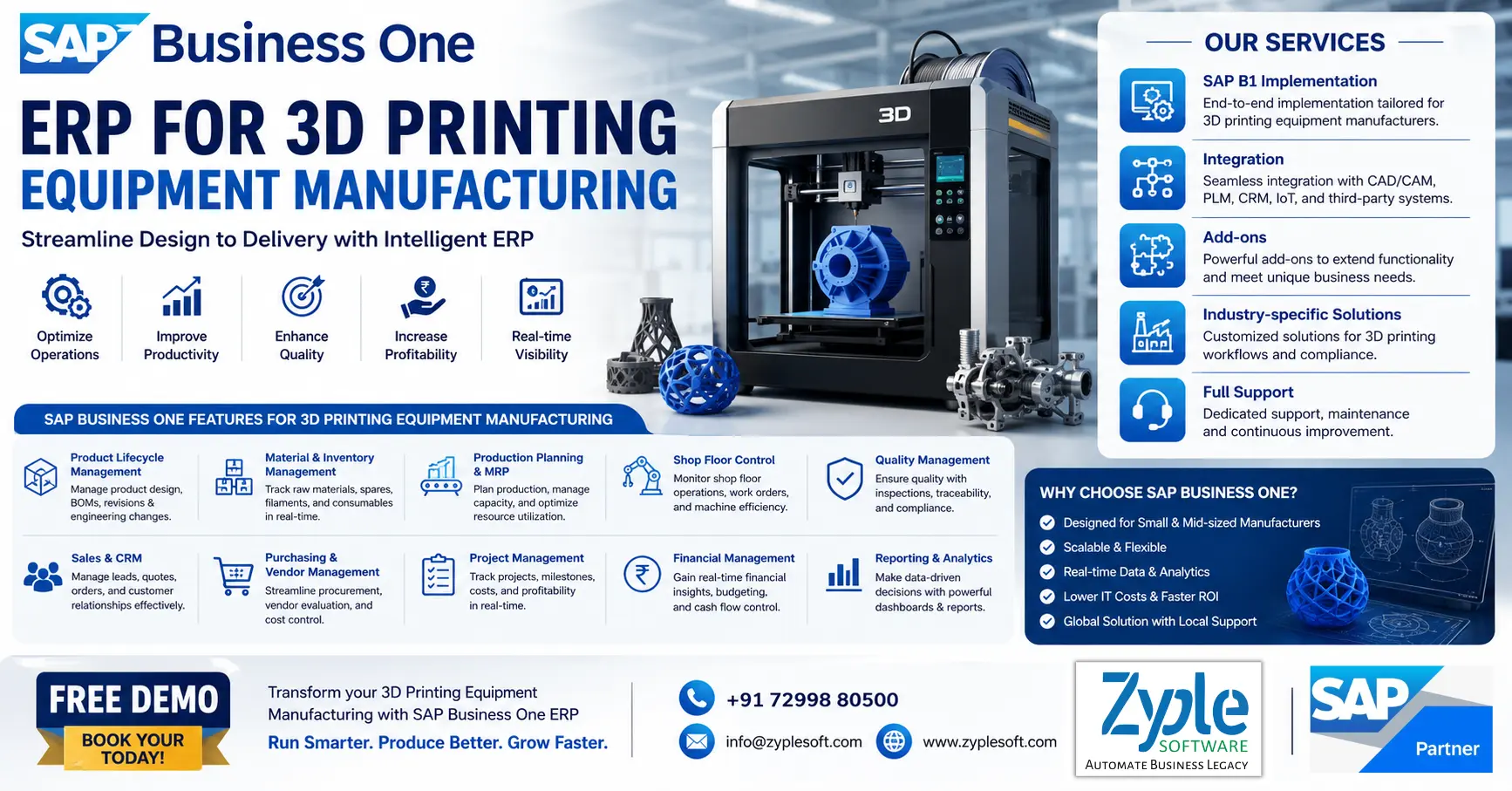
SAP Business One ERP for 3D Printing Equipment Manufacturing by Zyple Software – Production, Inventory, Quality Control, Procurement, Sales & Finance

The 3D printing equipment manufacturing industry is changing quickly, and the only way to stay ahead of the competition is to seamlessly integrate innovative manufacturing technologies. Since they frequently demand more resources than larger organizations, small and medium-sized 3D printing equipment manufacturing businesses face specific challenges in this area. SAP Business One ERP for 3D printing equipment manufacturing helps the 3D printing equipment manufacturing businesses to efficiently utilize these technologies, optimize workflows, and improve productivity.

Challenges Faced By The 3D Printing Equipment Manufacturing Industry

The 3D printing equipment manufacturing industry faces severe challenges, including prohibitive capital costs, slow production speeds for mass manufacturing, and limited material selections. Also, manufacturers struggle with labor-intensive post-processing, lack of standardized regulations, intellectual property (IP) vulnerabilities, and skilled workforce shortages.

1. High Initial Investment

Industrial-grade 3D printers involve substantial upfront capital. This high barrier to entry restricts wider adoption among small and medium-sized enterprises (SMEs) and often results in slower ROI for businesses replacing traditional assembly lines.

2. Scalability and Speed Limitations

While excellent for rapid prototyping and custom one-offs, 3D printing struggles to compete with traditional methods like injection molding or CNC machining when scaling for mass manufacturing.

3. Material Constraints

Additive manufacturing depends on a narrower spectrum of printable materials compared to traditional manufacturing. The industry faces ongoing pressure to develop powerful metal alloys and advanced polymers that maintain structural integrity and mechanical properties.

4. Labor-Intensive Post-Processing

Most printed parts are not ready-to-use right off the build plate. Post-processing, such as support removal, surface smoothing, heat treatment, and cleaning, remains heavily manual and time-consuming, driving up operational costs.

5. Lack of Standardization

The absence of universally accepted international standards makes it difficult for regulated sectors like aerospace and defense, automotive, and healthcare to develop consistent quality assurance and regulatory compliance.

6. Intellectual Property (IP) Risks

Because designs are digitized and easily shared, companies continuously battle the risk of IP theft, unauthorized replication, and counterfeiting.

7. Workforce Gaps

Operating and maintaining high-end additive manufacturing hardware involves specialized knowledge. A shortage of trained engineers and technicians capable of optimizing workflows and printer mechanics continues to hinder broader industrial integration.

Features of SAP Business One ERP for 3D Printing Equipment Manufacturing

1. Production Planning and Control

  • It includes a multi-level bill of materials (BOM) for complex 3D printer components.
  • It includes production order management for custom and batch management.
  • It includes routing and work center management for additive manufacturing processes.
  • It includes capacity planning and scheduling for optimized machine utilization.
  • It includes real-time production tracking and variance analysis.

2. Product Lifestyle and Engineering Integration

  • It includes integration with CAD or PLM systems for design-to-production flows.
  • It includes engineering change management (ECM) for rapid product iterations.
  • It includes version control for 3D printer models and components.
  • It includes prototype and R&D cost tracking.
  • It includes document management for design files and specifications.

3. Inventory and Material Management

  • It includes real-time inventory tracking of filaments, resins, and powders.
  • It includes batch and serial number tracking for traceability.
  • It includes warehouse management with bin locations and barcode scanning.
  • It includes multi-warehouse and multi-location inventory control.

4. Sales, CRM, and Project Management

  • CRM for handling OEM clients, distributors, and B2B customers.
  • It includes quotation management for customized 3D printing equipment.
  • It includes sales order processing with configurable products.
  • It includes project management for custom builds and installations.
  • It includes opportunity tracking and sales pipeline visibility.

5. Service and Maintenance Management

  • It includes installation and commissioning management for 3D printers.
  • It includes preventive and corrective maintenance scheduling.
  • It includes service contract and warranty management.
  • It includes spare parts tracking and service inventory.
  • It includes mobile service management for field technicians.

6. Financial Management and Costing

  • End-to-end financial accounting like general ledger, accounts payable, accounts receivable, and banking.
  • It includes product costing for high-value 3D printers and components.
  • SAP B1 modules help in budgeting and financial forecasting.
  • It includes multi-currency and multi-country financial management.
  • It includes profitability analysis by product, customer, or project.

7. Supply Chain and Procurement

  • It includes vendor management for specialized components and materials.
  • It includes purchase order automation and approval workflows.
  • It includes supplier evaluation and performance tracking.
  • It includes supply chain visibility and demand planning.
  • It includes integration with logistics and shipping providers.

8. Quality Control and Compliance

  • It includes quality inspection at incoming, in-process, and final stages.
  • It includes non-conformance and corrective action management.
  • It includes compliance with ISO and industry standards.
  • It includes test result recording and quality documentation.
  • It includes traceability for materials and finished goods.

9. Analytics and Reporting

  • It includes real-time dashboards and KPI monitoring.
  • It includes customizable reports for manufacturing, sales, and finance.
  • It includes predictive analytics for demand and production planning.
  • It includes drill-down insights for decision-making.
  • It includes integration with business intelligence tools.

10. Integration, Mobility, and Scalability

  • It includes integration with IoT-enabled 3D printers and sensors.
  • It includes API-based integration with third-party apps.
  • It includes cloud and on-premise deployment options.
  • It includes mobile access for real-time operations management.
  • It includes scalable architecture for growing manufacturing businesses.

Importance of SAP Business One ERP for 3D Printing Equipment Manufacturing

The ERP software, SAP Business One system, is essential for the 3D printing equipment manufacturing industry, as it unifies complex supply chains, optimizes complex bills of materials (BOMs), and delivers real-time tracking of specialized parts. It transforms disconnected workflows into facilitated, automated operations.

Handling production for additive manufacturing requires various precise electrical and mechanical components. SAP Business One provides essential tools customized for this specialized manufacturing sector.

1. Advanced Material Requirements Planning (MRP)

Automatically calculates raw material (e.g., metals, resins, and filaments) needs based on sales forecasts and production lead times to avoid overstocking or downtime with the SAP implementation process.

2. BOM and Engineering Integration

Handles multi-level BOMs, allowing engineering changes to be tracked and updated directly in the system to support flexible product iterations.

3. Serial and Batch Traceability

Evaluates specific components throughout the assembly process for better quality control, compliance, and quick component recalls if necessary.

4. Cost Estimation and Profitability

Captures real-time costs of raw materials, labor, and overhead to ensure profitable pricing of industrial-grade 3D printers using SAP solutions.

5. Integrated CRM and Sales

Connects your sales pipeline to production, enabling better handling of engineer-to-order (ETO) or configure-to-order (CTO) customer requests.

Benefits of SAP Business One for 3D Printing Equipment Manufacturing

The SAP Business One solution streamlines operations for 3D printing equipment manufacturers by centralizing production, inventory, and financials. It eliminates data silos, automates material planning, and ensures the exact components are available to assemble complex, highly customized machinery on time.

1. Precise Bill of Materials (BOM) Management

3D printers require complex mechanical, electronic, and software assemblies. SAP software enables you to build multi-level BOMs to track every sub-assembly and raw material accurately.

2. Automated Material Requirements Planning (MRP)

Prevents expensive production obstacles. The MRP wizard forecasts demand, evaluates stock levels, and automatically triggers purchase orders or production schedules.

3. Serial and Batch Traceability

Easily tracks high-value parts, extruder nozzles, or laser components by their serial numbers from procurement to the final assembled machine for better quality control using SAP B1 add-ons.

4. Order-Driven Production

Seamlessly converts sales orders for custom-built 3D printers directly into production orders without manual data entry.

5. Real-Time Costing

Instantly views the actual material, labor, and overhead costs associated with a specific machine, giving you accurate profit margin analysis on every sale.

Conclusion of 3D Printing Equipment Manufacturing ERP

As a Top SAP Business One partner, Zyple Software is delivering services like SAP B1 implementation, licensing, integration, add-ons, and support to different industries, like construction, manufacturing, solar, jewellery, food and beverage, aerospace, retail, pharma, and textiles. 

SAP Business One is an ERP customized for small and medium-sized businesses that connects finance, procurement, inventory, production, sales, CRM, and reporting into one platform. For 3D printing equipment manufacturing or any other companies, it can improve project costing, procurement, subcontractor billing, and inventory management.

If you’re adaptable, reserve a demo of SAP Business One.

Do you look for the SAP B1 ERP system for your business or industry?

Finish all the details in the arranged contact form; our team will return to you.

    FAQs

    1.How can SAP Business One ERP improve efficiency in my 3D printing equipment manufacturing business?

    SAP Business One streamlines your entire operation, from production planning and inventory management to sales and finance, helping you reduce delays, optimize resources, and increase overall productivity. With real-time insights, you can make faster and smarter business decisions.

    Yes, SAP Business One is highly flexible and can be tailored to your unique manufacturing processes, including custom machine configurations, material tracking, and workflow automation for 3D printing operations.

    The cost depends on factors like the number of users, required modules, and customization needs. However, SAP Business One is a cost-effective ERP solution for small and medium-sized manufacturers, offering high ROI through improved efficiency and reduced operational costs.

    SAP B1 implementation timelines generally range from a few weeks to a few months, depending on the complexity of your processes. With the right SAP B1 implementation partner like Zyple Software, the deployment can be smooth and quick.

    You can request a personalized demo from an authorized SAP Business One partner like Zyple Software. An SAP B1 demo will help you understand how the ERP fits your business needs and how it can transform your manufacturing operations.
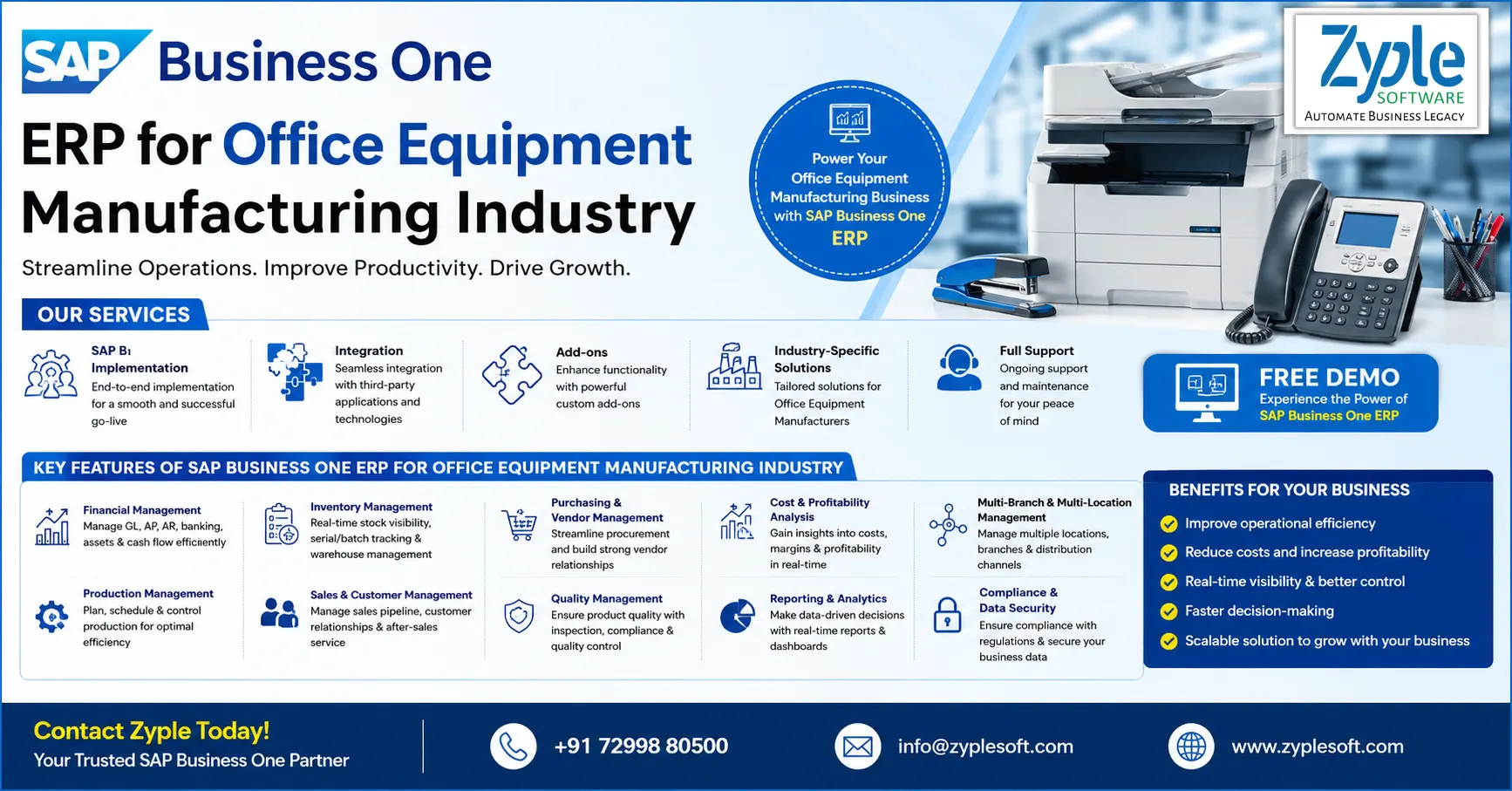
    SAP Business One ERP for Office Equipment Manufacturing industry provide by zyple software

    SAP Business One ERP for Office Equipment Manufacturing Industry

    SAP Business One (B1) ERP for Office Equipment Manufacturing Industry

    SAP Business One ERP for Office Equipment Manufacturing industry provide by zyple software

    Running an office equipment manufacturing business is a hassle to facilitate the business’s operations. So, until you have a proper check on all the processes like production, planning, batch costing, costing of raw material, and other things, it becomes a problem to decide.SAP Business One ERP for office equipment manufacturing helps office equipment manufacturing businesses handle different aspects of the business operations seamlessly.

    Now, the main question, how SAP business one can help for industry? Because every industry have different opertaions.

    So, Zyple Software Team is a good into SAP Business One implementation as per industry operation’s needs.

    Challenges Faced By The Office Equipment Manufacturing Industry

    Office equipment makers face stiff price competition and supply chain delays that hinder profits. They struggle with outdated technologies becoming obsolete quickly. They also face pressure to build eco-friendly products. Finally, they need to deal with a worker shortage for skilled technical jobs.

    1. Fast Tech Changes

    Gadgets get old very fast. Think of this like upgrading your phone every year; companies have to continuously refresh their product lines.

    2. Supply Chain Snarls

    Missing parts, like computer chips or plastics, can stop whole factories. This happens because parts come from all over the world. Delays cause a loss of revenue and delay shipments to buyers.

    3. Green Pressures

    Companies are pushed to minimize their carbon footprint. They must use recycled materials and save energy to achieve strict laws. If they fail, they might face fines or lose customers.

    4. Worker Shortage

    There are not enough people who know how to build or fix smart, modern office machines. Factories require workers trained in robotics and computers.

    5. Price Wars

    Many makers provide similar basic products. This forces prices down and hinders profit margins. Companies must find ways to make their items special.

    Features of SAP Business One ERP for Office Equipment Manufacturing Industry

    1. Production Planning and Control

    • It includes production orders with real-time status tracking.
    • It includes capacity planning and scheduling.
    • It includes routing and work center management.

    2. Inventory and Warehouse Management

    • It includes real-time inventory tracking across warehouses.
    • Batch and serial number tracking is essential for office electronics.
    • It includes bin location management.
    • It includes automated stock replenishment.
    • Inventory valuation methods like FIFO and moving average.

    3. Procurement and Supplier Management

    • It includes purchase requisitions and purchase orders.
    • It includes supplier or vendor evaluation and management.
    • It includes blanket agreements for recurring purchases.
    • It includes automated procurement workflows.
    • Landed cost calculation is essential for imported components.

    4. Sales and Customer Relationship Management (CRM)

    • It includes lead and opportunity management.
    • It includes quotation and sales order purchasing.
    • It includes customer service and support tracking.
    • It includes pricing management and discount structures.
    • It includes integration with service contracts for office equipment maintenance.

    5. Financial Management and Accounting

    • It includes fixed asset accounting.
    • It includes multi-currency support.
    • It includes budgeting and financial reporting.
    • It includes GST compliance and statutory reporting.

    6. Quality Control and Compliance

    • It includes non-conformance and corrective action tracking.
    • It includes quality certificates and compliance documentation.
    • It includes audit trails for regulatory compliance.

    7. Service Management (After-Sales Support)

    • It includes service call management for equipment repairs.
    • It includes warranty and AMC (Annual Maintenance Contract) tracking.
    • It includes spare parts management.
    • It includes technician scheduling and dispatch.
    • Installed base management for tracking customer equipment.

    8. Bill of Materials (BOM) and Product Data Management

    • It includes multi-level and variant BOMs.
    • It includes engineering change management (ECM).
    • It includes version control of product structures.
    • It includes product lifecycle tracking.

    9. Reporting and Business Intelligence

    • It includes real-time dashboards and KPIs.
    • It includes customizable reports.
    • It includes integration with analytics tools.
    • It includes predictive insights for demand and production.

    10. Project Management

    • It includes project planning and execution.
    • It includes cost tracking and budgeting.
    • It includes resource allocation.
    • It includes milestone and timeline tracking.

    11. Integration and Automation

    • It includes API-based integration with third-party tools.
    • It includes EDI integration for suppliers and distributors.
    • It includes workflow automation and approvals.
    • It includes IoT integration for smart manufacturing.

    12. Mobility and Cloud Access

    • It includes cloud deployment options.
    • It includes remote access to ERP data.
    • It includes real-time alerts and notifications.

    Importance of SAP Business One ERP for Office Equipment Manufacturing

    The ERP software, SAP Business One (SAP B1) system, is a complete, centralized ERP for office equipment manufacturing that drives efficiency in the office equipment manufacturing industry by tightly integrating financials, inventory, and supply chain management. It enables businesses to optimize complex production processes, minimize operational costs, and accurately track production margins.

    1. Optimized Bill of Materials (BOMs)

    Accurately handles multi-level BOMs required for complex office machines, ensuring exact raw material tracking for everything from heavy-duty printers to ergonomic furniture with SAP implementation process.

    2. Automated Material Requirements Planning (MRP)

    Prevents expensive production delays and inventory shortages by automatically calculating material needs based on sales forecasts and production schedules.

    3. Accurate Costing and Margin Analysis

    Links shop-floor actions, labor, and material usage directly to the general ledger, providing real-time insight into the true Cost of Goods Sold (COGS).

    4. Real-Time Inventory and Supply Chain Visibility

    Tracks stock levels across different warehouses to reduce carrying costs and accelerate order fulfillment using SAP solutions.

    5. Quality Assurance and Traceability

    Incorporates quality control checkpoints throughout the manufacturing cycle to achieve compliance standards and minimize defects.

    Benefits of SAP Business One for Office Equipment Manufacturing

    SAP Business One acts as a centralized ERP solution designed to facilitate production, inventory, and finances. For office equipment manufacturers, it eliminates data storage by connecting procurement, shop-floor production, sales, and accounting, which dramatically minimizes manual work and improves operational efficiency.

    1. Material Requirements Planning (MRP)

    The SAP software automatically calculates exactly what raw materials (metals, plastics, electronics) and components are required for production based on sales forecasts, reducing over-purchasing and production delays.

    2. Bill of Materials (BOM) Management

    Standardizes multi-level assemblies, ensuring consistency across complex products like office chairs, desks, and automated filing systems.

    3. Real-Time Inventory Control

    Tracks stock movements across different warehouses, using serial and batch tracking to monitor high-value components or finished office hardware, thereby preventing stockouts and overstocking.

    4. Accurate Production Costing

    Ties every shop floor action (labor, machine time, and materials) directly to the general ledger, eliminating month-end surprises and ensuring accurate, profitable pricing using SAP B1 add-ons.

    5. Integrated CRM and Sales Order Management

    Links customer orders directly to the production line, accelerating delivery times and improving customer satisfaction.

    Conclusion of Office Equipment Manufacturing ERP

    As a certified SAP Business One partner, Zyple Software is providing services like SAP B1 implementation, integration, licensing, add-ons, and support to different industries like construction, manufacturing, retail, pharma, jewellery, solar, food and beverage, aerospace, and textile industries. 

    SAP Business One is an ERP customized for small and medium-sized businesses that integrates finance, procurement, sales, inventory, production, CRM, and reporting into a single platform. For office equipment manufacturing or any other companies, it can improve project costing, procurement, subcontractor billing, and inventory management.

    If you’re active, reserve a demo of SAP Business One.

    Do you necessitate the SAP B1 ERP solution for your business or industry?

    Finish all the details in the described contact form; our team will reach out to you.

      FAQ (Frequently Asked Question)

      1.How can SAP Business One minimize operational costs in office equipment manufacturing?

      SAP Business One facilitates production, inventory, and procurement processes, reducing waste, minimizing manual errors, and lowering overall operational costs.

      Yes, SAP Business One can be customized with industry-specific add-ons and customizations to match your unique production workflows, reporting needs, and business processes.

      SAP B1 implementation timelines vary based on business size and complexity, but most office equipment manufacturers can go live within a few weeks to a few months with the right partner.

      Absolutely. SAP Business One delivers real-time dashboards and reports, helping you monitor production status, stock levels, and order fulfillment instantly.

      You can request a free demo or consultation from a qualified SAP Business One partner like Zyple Software to understand how the solution fits your business and calculate ROI before implementation.

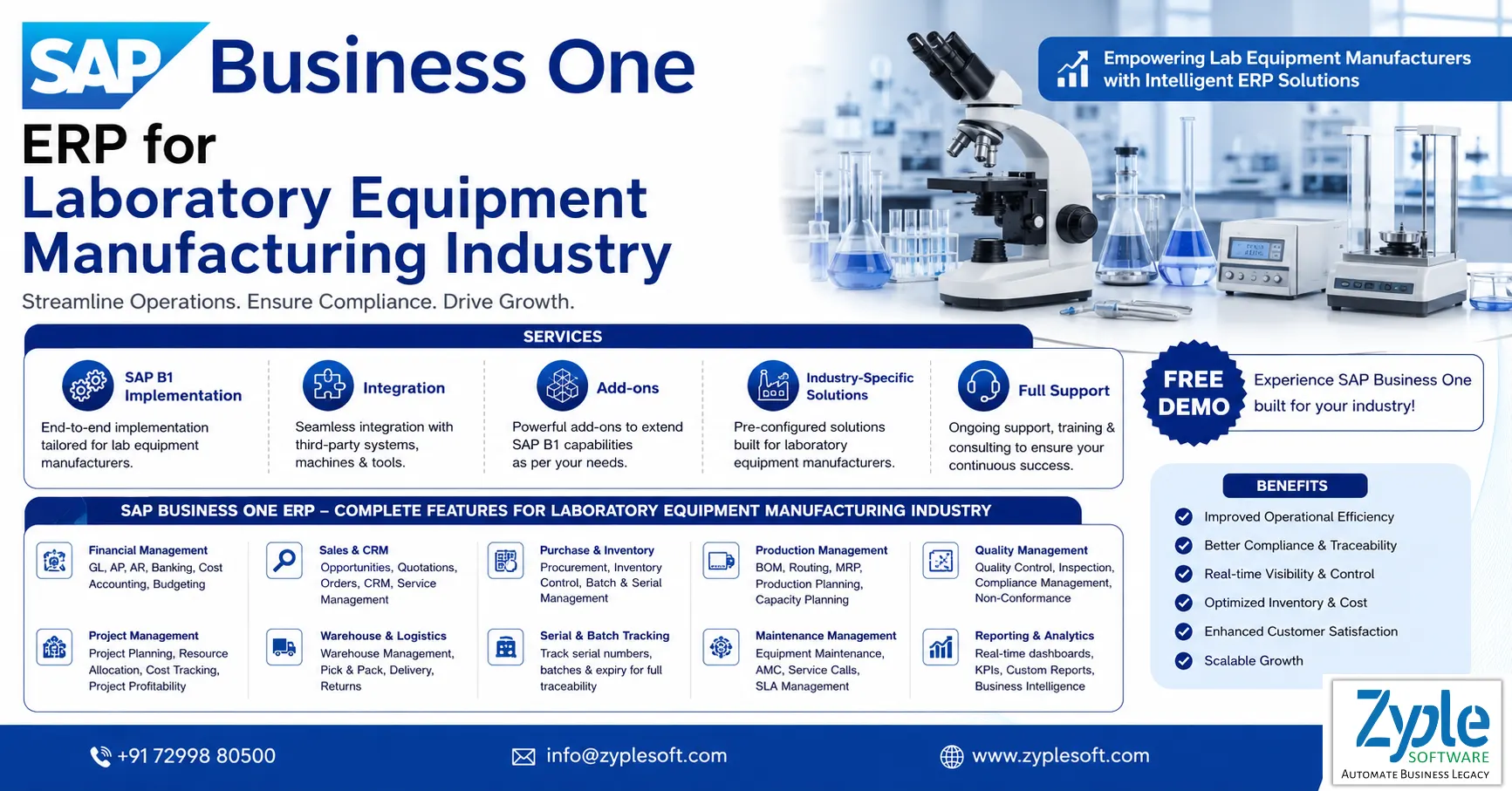
      SAP Business One ERP for Laboratory Equipment Manufacturing Industry infographic by Zyple Software featuring implementation, integration, add-ons, compliance, inventory, production, quality management, and analytics.

      SAP Business One ERP for Laboratory Equipment Manufacturing Industry

      SAP Business One ERP Software for Laboratory Equipment Manufacturing Industry

      SAP Business One ERP for Laboratory Equipment Manufacturing Industry infographic by Zyple Software featuring implementation, integration, add-ons, compliance, inventory, production, quality management, and analytics.

      The laboratory equipment manufacturing industry operates under strict quality standards, regulatory pressure, and rising competition. Manufacturers must handle complex production workflows, ensure complete traceability, and maintain consistent quality while scaling operations. SAP Business One ERP for laboratory equipment manufacturing delivers a structured ERP foundation to handle these challenges and support long-term growth without operational chaos.

      Challenges Faced By The Laboratory Equipment Manufacturing Industry

      The laboratory equipment manufacturing industry faces strict regulatory compliance, rapid technological obsolescence, and miniaturization demands. Companies struggle with supply chain disruptions, a shortage of skilled labor for complex mechatronic systems, and fierce global competition, all of which heavily squeeze profit margins and increase time to market.

      1. Strict Regulatory Compliance

      Manufacturers must handle evolving global standards such as GLP, GMP, and ISO certifications. Continuously updating designs to achieve these mandates creates massive administrative burdens.

      2. Component Shortages and Supply Chain

      The industry is heavily dependent on precise, specialized sub-components. Global supply chain volatility often results in prolonged lead times, inflating manufacturing and service costs.

      3. Skill Gaps in Development and Assembly

      Building complex mechatronic systems involves advanced specialist knowledge in software integration, automation, and electronics. Small and mid-scale manufacturers often lack the engineering manpower and high-end production infrastructure required to scale.

      4. Device Integration and Compatibility

      Laboratories frequently use instruments from different vendors. Disparate software systems, differing communication protocols, and the lack of universal standards hamper seamless data flow and integration.

      5. Equipment Downtime and Service Pressures

      Executives place huge pressure on equipment uptime to prevent costly research or sample losses. Extended resolution times for repairs and complex maintenance cycles severely affect operational efficiency and customer satisfaction.

      Features of SAP Business One ERP for Laboratory Equipment Manufacturing

      1. End-to-End Manufacturing Management

      • It includes bill of materials (BOM) for complex lab instruments.
      • It includes multi-level production orders and routing.
      • It includes production planning and control based on demand forecasts.
      • It includes batch and serial number tracking for precision components.
      • It includes real-time shop floor control and reporting.

      2. Quality Control and Compliance Management

      • It includes quality inspection at incoming, in-process, and final stages.
      • It includes non-conformance and corrective action tracking (CAPA).
      • It includes compliance with ISO, GMP, FDA, and calibration standards.
      • It includes audit trail and documentation management.
      • It includes calibration scheduling and tracking for lab equipment.

      3. Inventory and Warehouse Management

      • It includes real-time inventory tracking across warehouses.
      • It includes batch or lot traceability for service components.
      • It includes automated stock replenishment and reorder levels.
      • It includes handling of hazardous or sensitive materials.
      • It includes barcode and RFID integration.

      4. Product Lifecycle Management

      • It includes engineering change management.
      • It includes version control for product designs and specifications.
      • It includes integration with CAD systems.
      • It includes prototype and R&D cost tracking.

      5. Advanced Material Requirements Planning (MRP)

      • It includes demand-driven MRP for raw materials and components.
      • It includes forecasting based on historical sales and trends.
      • It includes supplier lead time management.
      • Reduces stockouts and excess inventory.

      6. Supplier and Procurement Management

      • It includes vendor evaluation and performance tracking.
      • It includes automated purchase requests and approvals.
      • It includes supplier pricing and contract management.
      • It includes integration with global supply chains.

      7. Financial Management and Cost Control

      • It includes real-time financial reporting and analytics.
      • Product costing like standard, moving average, and FIFO.
      • It includes budgeting and cost center tracking.
      • It includes multi-currency and multi-location support.
      • It includes GST compliance for India.

      8. Sales and Customer Relationship Management (CRM)

      • It includes lead and opportunity management.
      • It includes quotation and sales order automation.
      • It includes customer-specific pricing and contracts.
      • It includes after-sales service tracking for lab equipment.
      • It includes warranty and service contract management.

      9. Service and Maintenance Management

      • It includes installation and commissioning tracking.
      • It includes preventive and corrective maintenance scheduling.
      • It includes service call management.
      • It includes spare parts inventory integration.
      • It includes field service technician management.

      10. Business Intelligence and Reporting

      • It includes real-time dashboards and KPIs.
      • It includes custom reports for production, quality, and finance.
      • It includes predictive analytics for demand and maintenance.
      • It includes integration with Excel and analytics tools.

      11. Integration and Scalability

      • Seamless integration with third-party systems like LIMS, CAD, and MES.
      • It includes API-based connectivity.
      • It includes cloud and on-premise deployment options.
      • Adaptable for growing manufacturing businesses.

      12. Data Security and Regulatory Compliance

      • It includes role-based access control.
      • It includes data encryption and secure backups.
      • It includes compliance with industry regulations.
      • It includes full audit trails for traceability.

      13. Mobility and Remote Access

      • It includes remote access to dashboards and reports.
      • It includes real-time alerts and notifications.

      14. Customization and Industry-Specific Add-Ons

      • It includes customization workflows for laboratory equipment manufacturing.
      • It includes industry-specific SAP B1 add-ons for calibration and compliance.
      • It includes flexible user-defined fields and reports.

      15. Project Management Capabilities

      • Tracks R&D and custom equipment projects.
      • It includes budget vs. actual cost tracking.
      • It includes resource allocation and scheduling.
      • It includes milestone-based project monitoring.

      Importance of SAP Business One ERP for Laboratory Equipment Manufacturing

      The ERP software, SAP Business One (SAP B1) system, is essential for laboratory equipment manufacturers, as it unifies core processes, including finance, supply chain, and production, into a single source of truth. It allows highly precise manufacturing, strict regulatory compliance, and seamless tracking of expensive components, ultimately boosting operational efficiency and profit margins.

      1. Strict Regulatory Compliance

      The industry requires thorough quality control and traceability. SAP B1 automates quality checks, maintains audit-ready documentation, and monitors components so that manufacturers can easily adhere to global standards like ISO and FDA regulations.

      2. Precise Production Management

      Utilizing multi-level bill of materials (BOMs) and material requirements planning (MRP), the software helps handle complex assembly. It ensures you have the exact components needed to build precision instruments without holding excess stock using SAP implementation.

      3. Granular Traceability

      Every piece of lab equipment, from sensors to centrifuges, can be serialized. This enables manufacturers to trace the exact batch or serial number of an item from raw material procurement through to post-sales maintenance and service.

      4. Real-Time Financial and Inventory Visibility

      SAP B1 eliminates data silos. Real-time dashboards track machine utilization, labor costs, and project profitability, enabling leadership to make accurate, data-driven decisions.

      5. Supply Chain Optimization

      It reduces the risk of stock-outs or overstocking for specialized, often costly, materials required for lab equipment, ensuring on-time delivery and higher customer satisfaction using SAP solutions.

      Benefits of SAP Business One for Laboratory Equipment Manufacturing Industry

      SAP Business One (SAP B1) facilitates your lab equipment manufacturing by centralizing finance, supply chain, and production. It drives ROI through accurate BOM management, serial or batch traceability, and automated material requirements planning (MRP), minimizing carrying costs and ensuring strict industry compliance.

      1. Precision Manufacturing

      Utilizes powerful bill of materials (BOM) features to standardize production, control costs, and handle complex, multi-level assemblies required for sensitive scientific instruments.

      2. Total Traceability

      The SAP software tracks individual components, batches, and serial numbers from procurement to finished goods. This makes managing warranties and handling audits for ISO and regulatory compliance efficient.

      3. Optimized Inventory and Procurement

      The material requirements planning (MRP) system automatically computes purchasing and production needs based on forecasts and lead times, avoiding production delays and stockouts.

      4. Real-Time Analytics

      Unifies financial, sales, and operational data into customizable dashboards using SAP B1 add-ons. This allows data-driven decisions that immediately improve profit margins.

      5. Integrated CRM

      Strengthens customer relationships by managing leads, tracking after-sales service, and logging maintenance or calibration histories in a single platform.

      Conclusion of Laboratory Equipment Manufacturing ERP

      As a qualified SAP Business One partner, Zyple Software is providing services like SAP B1 implementation, integration, licensing, add-ons, and support to different industries like construction, manufacturing, retail, pharma, jewellery, solar, food and beverage, aerospace, and textile industries. SAP Business One is an ERP customized for small and medium-sized businesses that integrates finance, purchasing, sales, inventory, production, CRM, and reporting into a single platform. For solar panel and laboratory equipment manufacturing or any other companies, it can improve project costing, procurement, subcontractor billing, and inventory management.

      If you’re engaged, reserve a demo of SAP Business One.

      Do you necessitate the SAP B1 ERP system for your business or industry?

      Finish all the details in the described contact form; our team will get back to you.

        Frequently Asked Questions

        How can SAP Business One improve efficiency in my laboratory equipment manufacturing business?

        SAP Business One automates key processes like production planning, inventory control, and financial management, helping you minimize manual work, eliminate errors, and improve overall efficiency.

        Yes, SAP Business One is specifically designed for SMEs and growing manufacturers. It providesscalable features that adapt to your business size and complexity.

        The cost depends on factors like number of users, customization needs, and deployment type (like cloud or on-premises). We deliver customized pricing based on your requirements; reach out today for a free consultation and quote.

        The SAP B1 implementation timelines generallyrange from a few weeks to a few months, depending on your business processes. Speak with our team to get a clear project timeline customized for your needs.

        Absolutely! We provide live demos to help you understand how SAP Business One fits your laboratory equipment manufacturing processes.

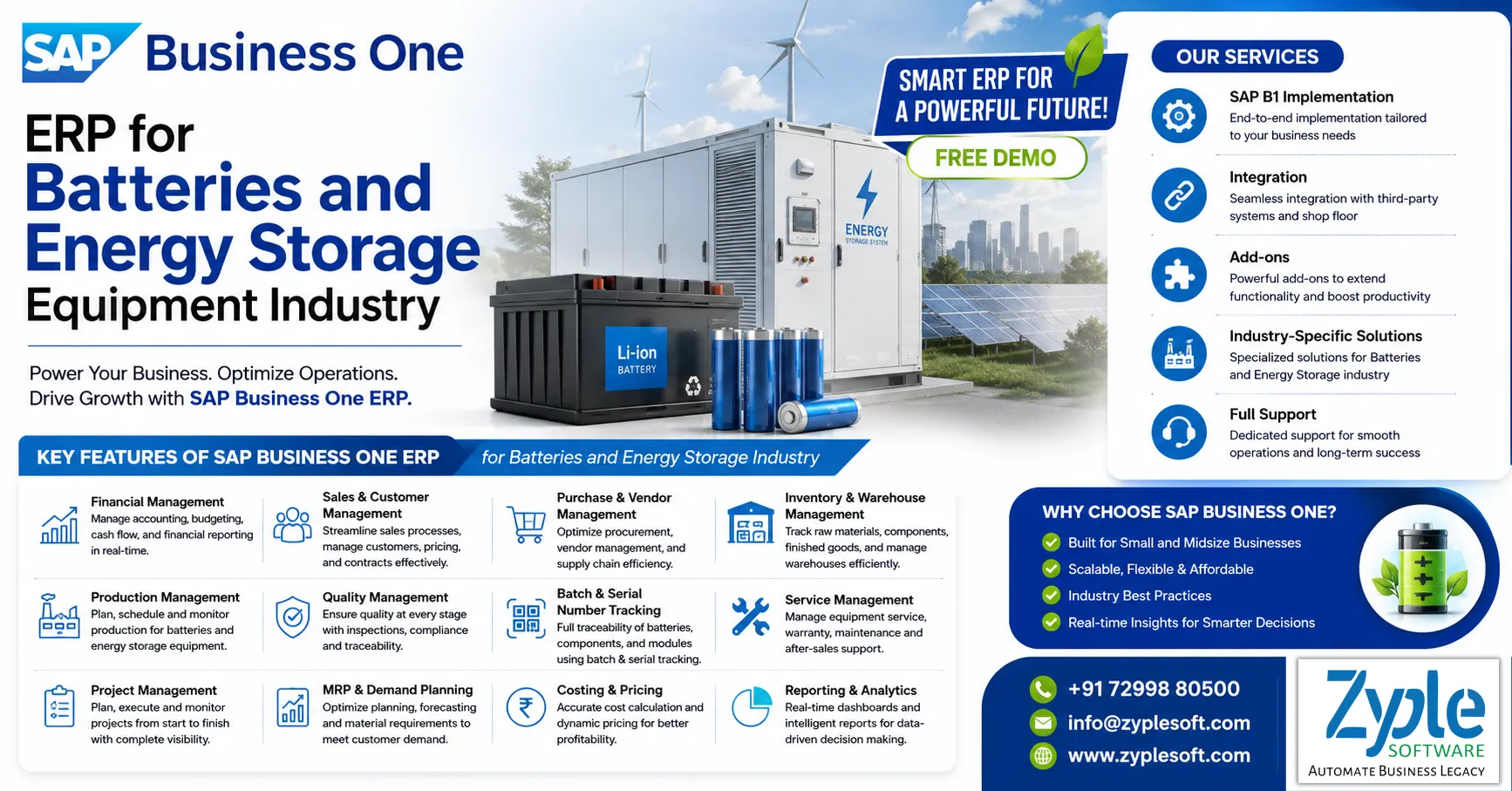
        SAP Business One ERP for Batteries and Energy Storage Equipment Industry by Zyple Software

        SAP Business One ERP for Batteries and Energy Storage Equipment Industry

        SAP Business One (B1) ERP for Batteries and Energy Storage Equipment Industry

        SAP Business One ERP for Batteries and Energy Storage Equipment Industry by Zyple Software

        The batteries and energy storage equipment industry operates in a precision-driven and compliance-heavy environment. Even small gaps in production data or inventory tracking can lead to serious consequences like failed audits, delayed shipments, or costly rework. SAP Business One ERP for batteries and energy storage equipment unifies financials, multi-level bills of materials (BOMS), and supply chains into a single platform to accelerate production, track inventory, and maintain global safety compliance.

        Challenges Faced By The Batteries and Energy Storage Equipment Industry

        The battery and energy storage equipment industry faces significant challenges, including volatile raw material costs, supply chain vulnerabilities, and strict safety concerns. Furthermore, rapid technological degradation, regulatory uncertainities, and complex end-of-life recycling requirements continue to challenge large-scale global deployment.

        1. Supply Chain Constraints and Material Sourcing

        The industry depends heavily on essential materials like lithium, cobalt, nickel, and graphite. Geopolitical concentrations in mining and refining expose manufacturers to price volatility and supply disruptions.

        2. Safety and Thermal Runaway

        Large-scale battery and energy storage equipment systems present significant fire risks and thermal runaway, leading to insurance and zoning challenges. For instance, municipalities globally have occasionally installed moratoriums on lithium-ion facilities due to combustion and pollution.

        3. Degradation and Lifespan

        Batteries experience capacity fading and degradation over charge-discharge cycles. This demands frequent replacements and complex cell-balancing capabilities to ensure optimal pack performance over a 10-to-15-year operational span.

        4. High Capital Costs and ROI Uncertainty

        Despite falling cell prices, total auxiliary integration, engineering, and setup costs remain high. Investors face uncertainties regarding long-term profitability, specifically when participating in fluctuating energy arbitrage markets.

        5. End-of-Life and Recycling

        Handling discarded equipment is an escalating environmental issue. Recycling infrastructure for large utility-scale batteries becomes less potent, and improper disposal can lead to toxic chemical and heavy metal soil contamination.

        6. Regulatory and Standard Gaps

        A lack of uniform international codes, standardization across different chemistries, and clear grid-interconnection rules complicate smooth integration.

        Features of SAP B1 ERP for Batteries and Energy Storage Equipment Business

        1. Production and Manufacturing Management

        • It includes multi-level bills of materials (BOM) for cells, modules, BMS, casing, and chemicals.
        • It includes production orders and shop floor control for battery assembly and pack building.
        • It includes material requirements planning (MRP) for raw materials like lithium, cobalt, and electrolytes.
        • Batch production and formula management are essential for chemical mixing processes.
        • It includes WIP (Work-in-Progress) tracking for multi-stage battery production.
        • Yield, scrap, and rework management are essential for defect control.
        • It includes capacity and resource planning for machines, labor, and production lines.
        • Production costing, like standard vs. actual with real-time recalculation.
        • It ensures efficient control over complex, multi-stage battery manufacturing.

        2. Inventory and Warehouse Management

        • It includes real-time tracking of raw materials, semi-finished, and finished goods.
        • Batch and serial number tracking for traceability is essential for batteries.
        • It includes multi-warehouse and bin location management.
        • It includes expiry and shelf-life tracking for chemicals and cells.
        • Stock valuation methods like FIFO, moving average, and standard costing.
        • It includes automated stock movements during production and dispatch.
        • It includes barcode and QR integration for warehouse operations.
        • Important for safety, compliance, and traceability in battery manufacturing.

        3. Quality Control and Compliance Management

        • It includes incoming, in-process, and final quality inspections.
        • It includes test result recording for voltage, capacity, and thermal stability.
        • Quality certificates and compliance documentation like ISO, BIS, and IEC.
        • It includes non-conformance and corrective action tracking.
        • It includes audit trails for regulatory compliance.
        • Helps achieve strict safety and environmental regulations.

        4. Procurement and Supplier Management

        • Vendor management for raw materials like lithium, nickel, separators, and more.
        • It includes purchase planning based on MRP recommendations.
        • It includes supplier price lists and contract management.
        • It includes automated purchase orders and approvals.
        • It includes import or export documentation handling.
        • It includes supplier performance tracking.
        • It includes stable sourcing in a volatile raw material market.

        5. Sales, Distribution, and Customer Management

        • End-to-end sales cycle from quotation, order, and delivery to invoice.
        • OEM and B2B customer management for EV manufacturers, utilities, and more.
        • After-sales service and warranty tracking are essential for batteries.
        • It includes pricing management for bulk and contract sales.
        • It includes demand forecasting for energy storage projects.
        • CRM for handling long-term contracts and projects.
        • It supports both industrial and project-based sales models.

        6. Financial Management and Cost Control

        • It includes general ledger, AP/AR, and banking integration.
        • It includes project-based costing for energy storage installations.
        • It includes budgeting and cost center tracking.
        • Profitability per analysis per product, like battery type and capacity.
        • It includes multi-currency support for global trade.
        • Taxation and compliance like GST and international regulations.
        • Helps handle thin margins and volatile input costs.

        7. Advanced Analytics and Business Intelligence (BI)

        • It includes real-time dashboards for production, inventory, and sales.
        • KPI tracking like yield, efficiency, defect rate, and cost per unit.
        • It includes predictive analytics for demand and procurement.
        • It includes custom reports and drill-down analysis.
        • It includes Excel integration for advanced reporting.
        • Allows data-driven decision-making across operations.

        8. Asset and Equipment Management

        • It includes maintenance tracking for machinery and equipment.
        • It includes downtime monitoring and preventive maintenance.
        • It includes asset lifecycle management.
        • It includes calibration tracking for testing equipment.
        • Crucial for high-value battery production equipment.

        9. Project Management

        • It includes project planning for solar and storage or grid-scale deployments.
        • It includes cost tracking per project.
        • It includes resource allocation and scheduling.
        • It includes milestone tracking and billing.
        • Suitable for EPC companies and large-scale storage deployments.

        10. Integration, Mobility, and Scalability

        • It includes web client for remote access.
        • It includes integration with IoT, BMS, and external systems.
        • It includes cloud or on-premises deployment.
        • It includes scalable architecture for a growing battery business.

        Benefits of SAP Business One ERP for Batteries and Energy Storage Equipment Industry

        The ERP software, SAP Business One (SAP B1) system, provides immense value to the battery and energy storage equipment industry by uniting engineering, procurement, production, and financials into one platform. It drives operational efficiency, improves complex supply chains, and ensures strict regulatory compliance and safety standards.

        1. End-to-End Traceability

        In the batteries and energy storage equipment industry, tracing individual components, chemical batches, and serial numbers is essential for safety and warranty management. SAP implementation tracks materials from supplier to customer, ensuring compliance and easy management of RMAs and recalls.

        2. Intelligent Production and MRP

        Material requirements planning (MRP) ensures you have the exact raw materials, like lithium, cell components, and inverters, required to meet production schedules without overstocking. This reduces idle time and optimizes the production ratio.

        3. Real-Time Project and Job Costing

        Engineering-to-order (ETO) companies can accurately estimate, track, and review profit margins. It delivers live visibility into labor, material overheads, and assembly costs, protecting profitability across large-scale energy projects using SAP solutions.

        4. Stringent Quality Control

        The system enables manufacturers to build incoming, in-process, and final quality checks directly into the routing operations. It documents testing procedures and blocks the movement or sale of non-compliant battery units.

        5. Lifecycle and Service Management

        The batteries and energy storage equipment industry involves ongoing evaluation. The SAP B1 system enables companies to track installed equipment, schedule preventive maintenance, and handle warranty lifecycles, minimizing downtime and reducing total cost of ownership.

        Conclusion of Batteries and Energy Storage Equipment ERP

        As an SAP Business One partner, Zyple Software is providing services like SAP B1 implementation, integration, licensing, add-ons, and support to different industries like construction, manufacturing, retail, pharma, aerospace, solar, jewellery, food and beverage, and textile industries. SAP Business One is an ERP designed for small and medium-sized businesses that integrates finance, purchasing, sales, inventory, production, CRM, and reporting into a single platform. For batteries and energy storage equipment or any other companies, it can improve project costing, procurement, subcontractor billing, and inventory management.

        If you’re flexible, book a demo of SAP B1 ERP with Zyple Software team.

        Do you demand the SAP B1 ERP software for your business or industry?

        Finish all the details in the defined contact form; our team will get back to you.

          Frequently Asked Questions

          1.How can SAP Business One improve efficiency in my battery manufacturing business?

          SAP Business One automates key processes like production planning, inventory management, and financial reporting. This reduces manual work, decreases errors, and improves overall operational efficiency, helping your business scale faster.

          Yes, SAP Business One is specifically customized for SMEs. It provides scalable features that grow with your business, making it ideal for startups and expanding battery and energy storage companies.

          Businesses generally see ROI through minimized operational costs, better inventory control, improved production efficiency, and faster decision-making with real-time insights.

          Yes, you can request a personalized demo customized for your manufacturing processes, helping you understand how the ERP fits your specific operational needs.

          You can begin by consulting a certified partner of SAP Business One like Zyple Software, who will evaluate your requirements, suggest the right solution, and guide you through implementation, training, and support.

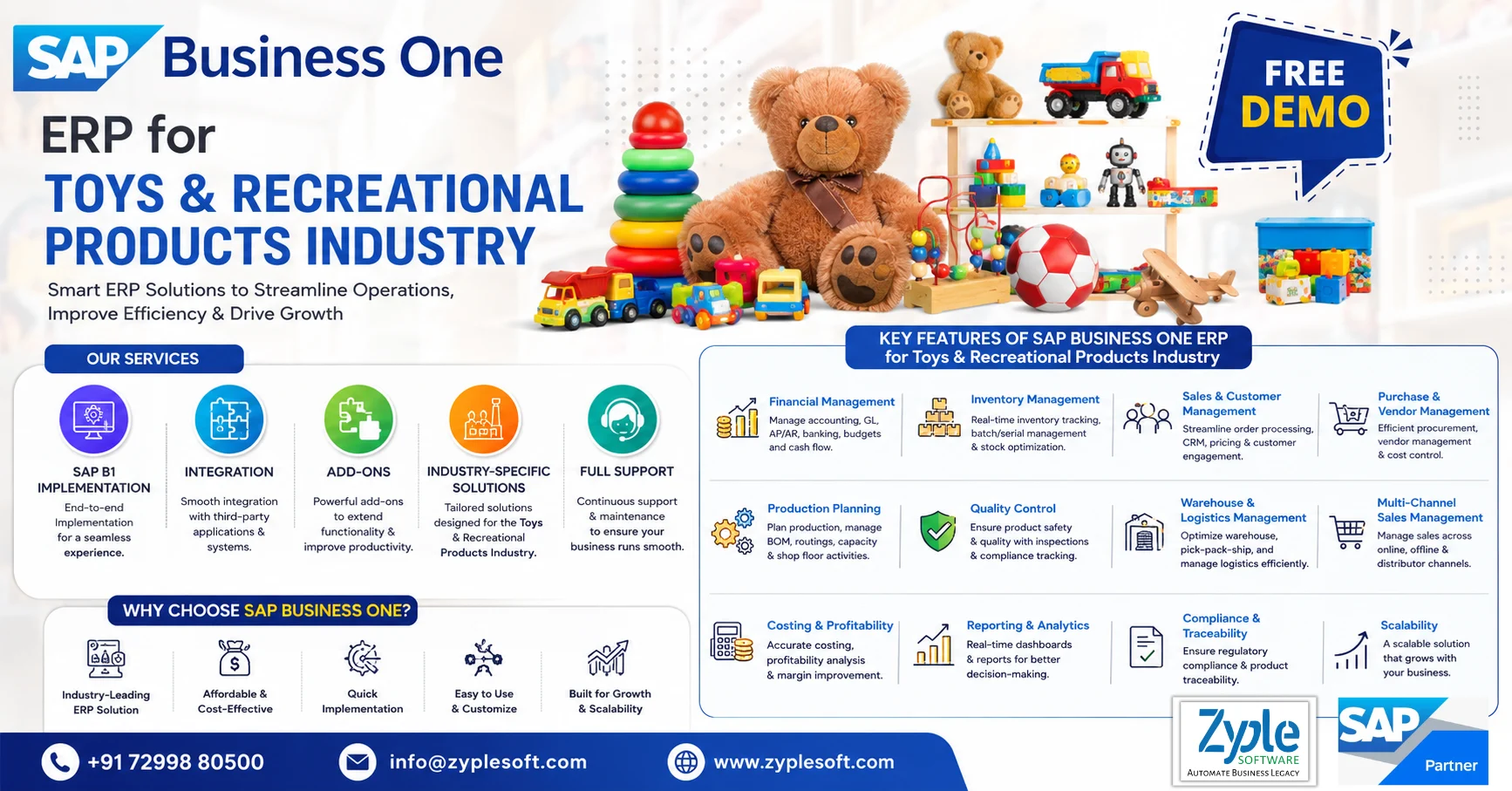
          SAP Business One ERP for Toys and Recreational Products Industry

          SAP Business One for Toys and Recreational Products Industry

          SAP Business One ERP for Toys and Recreational Products Industry

          SAP Business One ERP for Toys and Recreational Products Industry

          The toys and recreational products industry in India is rapidly accepting digital transformation to stay competitive. Handling production, inventory, compliance, and finances manually or through disconnected systems often leads to inefficiencies and costly errors. SAP Business One ERP for toys and recreational products facilitates multi-level supply chains, accelerates order fulfillment, and delivers powerful inventory management to handle seasonal demand fluctuations and strict global safety compliances.

          Challenges Faced By The Toys and Recreational Products Industry

          1. Regulatory and Quality Compliance

          Toys are governed by some of the world’s strict safety regulations. In regions like India, Quality Control Orders (QCOs) and mandatory Bureau of Indian Standards (BIS) testing have levelled the playing field against substandard imports, but small-scale manufacturers struggle to afford compliance testing. There is a notable lack of localized, certified testing facilities that achieve global quality standards.

          2. Digital Disruption and Shifting Consumer Habits

          The rapid digitalization of childhood means traditional toys are competing with video games, streaming platforms, and educational apps. The forever young phenomenon has adults promoting massive sales in collectibles. However, fads fade quickly, leaving companies with high-risk inventory. Mobile commerce and social media have revolutionized buying patterns, forcing conventional brick-and-mortar retailers to restructure their shopping experiences and online supply chains.

          3. Supply Chain and Manufacturing Vulnerabilities

          Many domestic manufacturers in regions like India are heavily dependent on imports (e.g., from Japan and South Korea) for raw materials and capital goods, exposing them to volatile trade policies and currency risks. Toy making remains largely a manual, labor-intensive process, especially for dolls and complex decor, yet the short lifecycle of popular toys makes long-term automation or mechanization difficult to justify financially. Transportation challenges, component shortages, and global health or geopolitical events continue to delay product launches.

          4. Environmental and Sustainability Demands

          Much of the industry relies on virgin plastics, generating massive waste. Leaders in the field face serious pressure to shift towards a circular economy.

          5. Fragmented Market and Financial Constraints

          The industry remains highly obsolete, with a large unorganized, MSME-driven sector holding a major market share in places like India. Smaller enterprises lack the capital to invest heavily in advanced technologies like artificial intelligence, 3D prototyping, and modern equipment.

          Features of SAP Business One for Toys and Recreational Products

          1. Production and Manufacturing Management

          • Defines multi-level BOMs for toys with variants like color, size, and accessories.
          • Creates and tracks production orders for batch, discrete, or kit-based toy manufacturing.
          • Automatically plans raw materials like plastics, fabrics, and electronics based on demand forecasts.
          • Monitors real-time production stages, labor usage, and machine efficiency.
          • Ideal for toys with multiple SKUs like dolls, puzzles, and sports kits.
          • Minimizes wastage from defective toys or failed quality checks.
          • Helps handle seasonal spikes like festivals and holidays and rapid production cycles.

          2. Inventory and Warehouse Management

          • It includes real-time inventory tracking across warehouses.
          • Batch and serial number tracking is essential for toy safety recalls.
          • It includes bin location management for efficient storage of small items.
          • It includes automatic stock replenishment.
          • It includes multi warehouse management for distributors and retailers.
          • Inventory valuation and costing procedures like FIFO and moving average.

          3. Financial Management and Cost Control

          • Product costing, like material, labor, and overheads.
          • Profitability analysis by product line, like toys vs recreational items.
          • It includes budgeting and cost control.
          • It includes tax and GST compliance.
          • It includes multi-currency support for export markets.

          4. Sales, Distribution, and Retail Management

          • It includes sales order management from quote, order, and delivery to invoice.
          • It includes customer relationship management (CRM).
          • It includes dealer and distributor management.
          • E-commerce integration like Amazon, Flipkart, and Shopify.
          • It includes seasonal demand forecasting.
          • It includes promotions and discount management.
          • Ideal for handling high seasonal demand like Diwali, Christmas, and summer vacations.

          5. Quality Control and Compliance

          • It includes incoming and in-process quality checks.
          • It includes compliance with safety standards like ASTM, EN71, and BIS.
          • It includes defect tracking and corrective actions.
          • It includes batch traceability for recalls.
          • It includes automated quality reports and certifications.
          • Necessary for child safety regulations and export compliance.

          6. Procurement and Supplier Management

          • It includes vendor management and evaluation.
          • It includes purchase order automation.
          • Raw material planning like plastics, packaging, and electronics.
          • It includes supplier price comparison and negotiation.
          • It includes import and export documentation handling.
          • It ensures smooth sourcing for multi-component toy manufacturing.

          7. Business Intelligence (BI) and Analytics

          • It includes real-time dashboards and KPIs.
          • It includes sales and demand forecasting reports.
          • It includes production efficiency analysis.
          • It includes inventory aging and slow-moving items.
          • It includes custom reports with Excel integration.
          • It helps identify best-selling toys and optimize inventory.

          8. Mobility and Cloud Access

          • It includes a mobile app for sales and inventory.
          • Cloud deployment like SAP B1 HANA.
          • It includes remote access for distributors and field sales.

          9. Integration and Scalability

          • Third-party add-ons like PLM and advanced manufacturing.
          • It includes API-based integrations.
          • Adaptable for growing toy brands.
          • It supports expansion from local manufacturing to global distribution.

          10. Industry-Specific Features for Toys and Recreational Products

          • Handles high SKU complexity like colors, sizes, and bundles.
          • Manages seasonal production planning.
          • It ensures child safety compliance and traceability.
          • It optimizes distribution to retailers and e-commerce.
          • It minimizes overstock and dead inventory.
          • It supports product innovation cycles.

          Benefits of SAP Business One for Toys and Recreational Products

          1. Precision Inventory and Warehouse Control

          Handles complex SKU types like sizes, colors, and materials, with real-time multi-warehouse tracking using SAP implementation. Automated stock updates avoid overstocking of off-season toys or stockouts during peak holiday seasons.

          2. Safety and Compliance Tracking

          Enforces strict regulatory standards such as BIS, CE, or ASTM, with end-to-end batch and serial number traceability. This guarantees rapid, targeted recalls if a material defect occurs.

          3. Material Requirements Planning (MRP)

          Optimize production planning by forecasting demand and aligning raw material procurement with manufacturing lead times. This decreases idle capacity and reduces production bottlenecks.

          4. Seamless E-Commerce Integration

          Connect your ERP to online marketplaces and digital storefronts using SAP solutions. This allows real-time synchronization of online orders, returns, and inventory levels.

          5. Advanced Financial Management

          Automate core accounting and track multi-level Bill of Materials (BOM) costs. Access real-time analytics to accurately measure product margins and analyze cost changes across your supply chain.

          Conclusion of Toys and Recreational Products ERP

          Zyple Software is the qualified SAP Business One partner in India specializing in implementation, digital transformation, licensing, integration, add-on solutions, migration, and consulting for the toys and recreational products industry. SAP Business One delivers a complete, scalable, and cost-effective ERP solution that empowers businesses to facilitate operations, improve production efficiency, ensure compliance, and make data-driven decisions.

          If you’re engaged, go for a demo of SAP Business One.

          Do you require the SAP B1 ERP solution for your business or industry?

          Finish all the details in the given contact form; our team will reach out to you.

            1.How much does SAP Business One cost for a toy manufacturing business?

            The cost of SAP Business One depends on factors like number of users, deployment type like cloud, on-premise , and hybrid and required modules. For toy manufacturers, pricing is generally customized, so it’s best to request a customized quote based on your business needs.

            Yes, SAP Business One is highly flexible and can be designed to handle product variations, seasonal demand, compliance requirements, and unique manufacturing processes specific to the toys industry.

            SAP B1 implementation timelines vary depending on business complexity, but most toy manufacturers can go live within a few weeks to a couple of months with the right SAP B1 partner like Zyple Software.

            Absolutely. You can request a free, no-obligation demo to see how SAP Business One ERP works for your toy manufacturing or distribution operations before making a decision.

            A certified SAP B1 partner like Zyple Software provides continuous support, user training, system upgrades, and maintenance to ensure your ERP system runs smoothly and delivers long-term value.

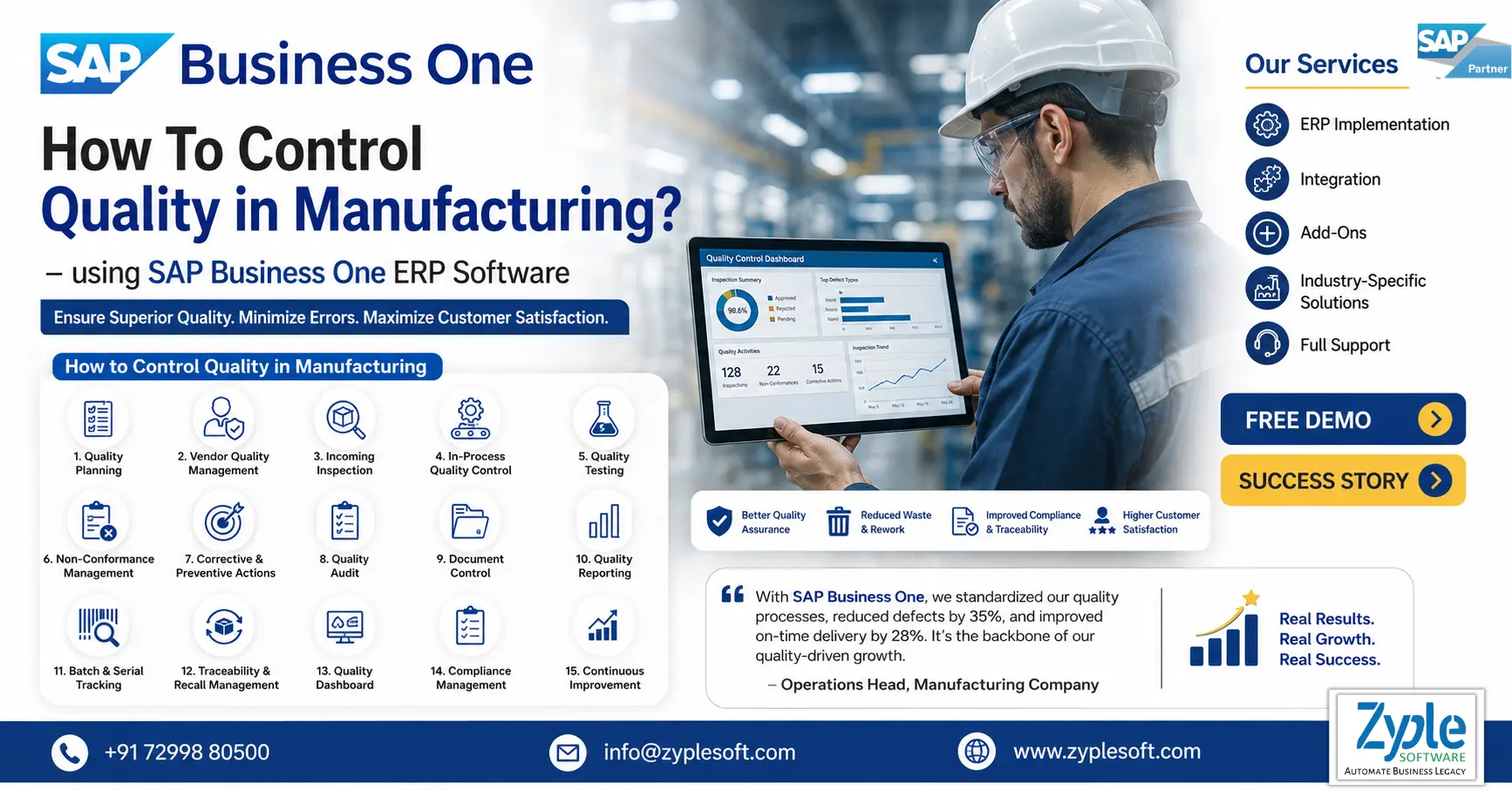
            Quality control in Manufacturing

            How To Control Quality in Manufacturing?

            How To Control Quality in Manufacturing Industry?

            Quality control in Manufacturing

            When you make something, you better guarantee there’s nothing faulty about the product. If your customer purchases your product and it doesn’t work, at best, you’ll lose, and at worst, you’ll be served with lawsuit. Here, quality control in manufacturing is crucial. Here, we’ll discuss how to control quality in manufacturing.

            What is Quality Control?

            Quality control is a process that helps deliver products as planned or helps ensure project deliverables achieve stakeholder requirements. It requires that the company support an environment where everyone, from management to employees, is performing their jobs as perfectly as possible.

            What is Quality Control in Manufacturing?

            Quality control in manufacturing refers to the processes and systems used to ensure that products achieve specific requirements and are consistent and reliable. This requires planning, designing, implementing, and maintaining a system that provides confidence in a product’s design and production.

            Importance of Quality Control in Manufacturing Using SAP B1

            Quality control (QC) in manufacturing using SAP Business One (SAP B1) is essential for ensuring product consistency, minimizing wastage, and automating compliance. It delivers real-time inspection, inventory traceability, and quality management of incoming materials, production stages, and finished goods, preventing defective products from reaching customers.

            1. Integrated Quality Inspection Points

            SAP B1 ERP delivers quality control add-ons that enable inspections at different stages, including goods receipt, purchase order, production receipt, and delivery.

            2. Minimized Rework and Costs

            By inspecting raw materials and components, companies can avoid defective materials from entering production, minimizing rework, waste, and overall operating expenses.

            3. Improved Traceability and Compliance

            The system delivers full traceability from procurement to final delivery, helping businesses meet strict industry standards, such as ISO, BIS, or CDSCO. 

            4. Improved Product Consistency

            Automated inspection checklists ensure that every batch meets defined quality standards and is compliant, which boosts customer satisfaction and minimizes warranty claims.

            5. Real-time Reporting and Analysis

            Manufacturers gain instant visibility into quality metrics, allowing them to identify trends, analyze non-conformances, and take prompt corrective actions.

            Benefits of Quality Control in Manufacturing Using SAP Business One

            Manufacturing quality is a standard goal for most businesses in the market, but it is only sometimes a key priority. Depending on their output or brand, different companies have different expectations about their suitable cost of quality. Regardless of those differences, all organizations can accumulate significant benefits by implementing strong quality control practices. That’s because better quality control doesn’t only improve outcomes; it can do so more cost-effectively. It enables you to invest smarter, not more, in quality efforts while reaping all the benefits of solid quality processes.

            1. Improved Safety

            Ensuring products are made to specification results in safer end products. This is essential in the automotive, aerospace, and pharmaceutical industries, where safety is foremost. Effective quality control helps reduce the risk of malfunctions and accidents associated with faulty products.

            2. Contributes To Overall Positive Branding

            High-quality products improve a company’s reputation. Consistent delivery of reliable and effective products guarantees positive customer perceptions using SAP implementation.

            3. Increased Customer Loyalty

            By ensuring product quality, companies can develop a devout customer base. Loyal customers are also likely to recommend your products to others, further expanding the market reach.

            4. Decreased Liability Risk

            Effective quality control minimizes the risks of product failures that can lead to recalls and legal issues. This saves the company from possible financial liabilities and protects its image from the negative publicity associated with recalls.

            5. Automated Inspection Workflows

            SAP B1 can automatically trigger inspection tasks when goods are received from suppliers or during production, moving items to designated “QC warehouses” to avoid premature use. 

            6. Increased Traceability

            The system allows batch-wise or lot traceability, essential for audits and tracking material quality from purchase to finished goods using SAP solutions. 

            7. Minimized Operational Costs

            By detecting defective materials or products early, before, during, and after production, companies minimize rework and waste. 

            8. Optimal Supplier Management

            The quality control data helps evaluate suppliers based on defect rates, delivery accuracy, and material consistency. 

            9. Regulatory Compliance

            Centralized documentation and automated reports make it easier to achieve industry regulations. 

            10. Improved Product Consistency

            Automated testing against predefined, consistent criteria leads to higher quality finished products and improved customer satisfaction.

            Types of Quality Control Methods

            1. Quality Control Methods and Techniques

            There are different ways to implement good quality control. Every approach has its own set of tools and skills, and they are often used in combination to ensure the highest quality of products in manufacturing.

            2. Total Quality Management (TQM)

            TQM is an inclusive and structured approach to organizational management that seeks to improve the quality of products and services through continuous refinements in response to continuous feedback. Customer demands define TQM requirements, and the organization endeavors to achieve those with zero defects.

            3. Statistical Quality Control (SQC)

            SQC requires using statistical methods to monitor and control a process. This helps identify and handle variations in the manufacturing process that might lead to defects, thus ensuring product quality.

            4. 100% Inspection Method

            This method requires inspecting every single product part or assembly for defects. While resource-intensive, it can be essential in environments where defects can lead to significant safety or functionality issues (e.g., automotive, medical device, and heavy equipment manufacturers).

            5. Six Sigma

            This quality control method works at improving existing processes, products, or services by discovering and eliminating defects in order to facilitate manufacturing. The purpose is that the manufacturing process will have little to no variance. Six Sigma works by defining the problem, measuring the existing process, and analyzing the root cause of variations and defects to identify the issues. It increases processes by eliminating the root cause of these defects and controlling the process to stay on track.

            6. X-Bar Chart

            An X-bar chart is used in quality control to track the mean of successive samples of a constant size. The Y-axis evaluates the degree to which the deviation of the tested attribute is acceptable. This control chart is used for characteristics that can be measured on a consistent scale. That includes such things as weight, temperature, thickness, and more. However, it is rarely used alone and is often coupled with an R-chart, which is used to determine the stability and predictability of a process.

            7. Lean Quality Control

            Lean quality control is a production quality control approach that places customer value at the center of every decision, focusing relentlessly on eliminating waste, reducing waiting times, and streamlining every step of the production process.

            Lean quality controlworks by systematically identifying and removing anything that does not add direct value for the customer, including overproduction, unnecessary inventory, long wait times between production steps, and costly rework cycles.

            Conclusion of Quality Control in Manufacturing Using SAP Business One

            Zyple Software is an authorized SAP B1 partner in India specializing in implementation, digital transformation, migration, licensing, add-on solutions, integration, and consulting for the manufacturing industry. The SAP B1 system places equal emphasis on finding faults and correcting them rapidly without delays. It facilitates compliance audits, supports regulatory traceability requirements, and guarantees consistent quality control for manufacturing operations of every scale.

            Are you endeavoring to find the SAP Business One ERP system for your business or industry?

            Fill in all the details in the decided contact form; our team will return to you.