Author Archives: Zyple Software

Best SAP Business One Implementation Partner for Construction Companies

Best SAP Business One Implementation Partner for Construction Companies

Best SAP Business One Implementation Partner for Construction Companies (2026 Guide)
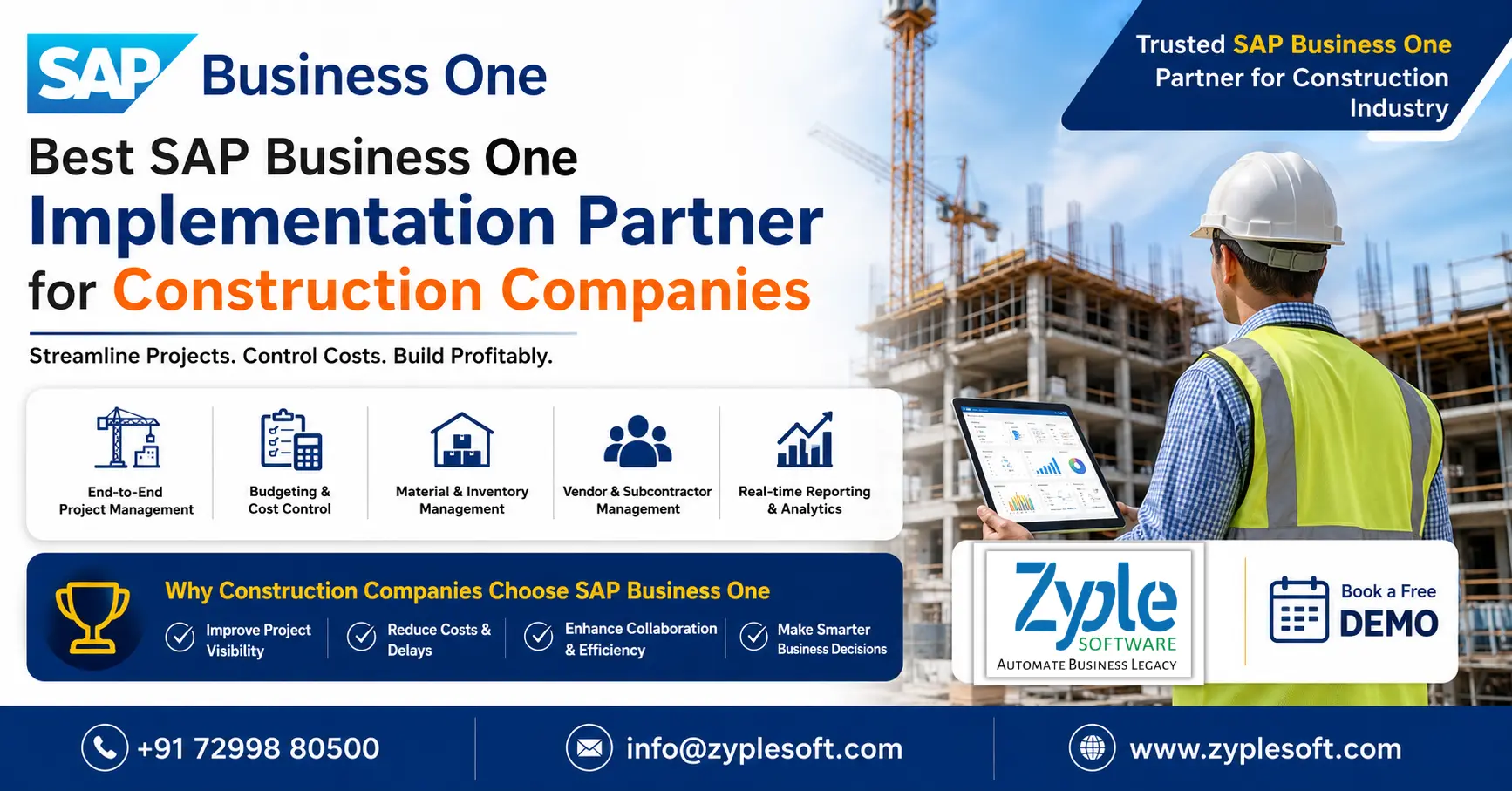
Best SAP Business One Implementation Partner for Construction Companies

Construction companies operate in one of the most complex business environments. Managing multiple projects, subcontractors, procurement, inventory, equipment, contracts, and finances across different locations requires more than accounting software or spreadsheets.

This is why many growing construction businesses choose SAP Business One ERP.

However, purchasing SAP Business One is only the first step. The real success of your ERP project depends on choosing the right SAP Business One implementation partner.

In this guide, we’ll explain what makes an implementation partner suitable for the construction industry, the features your ERP should include, and why experienced industry-specific implementation is essential.

Why Construction Companies Need SAP Business One?

Construction businesses face challenges that generic ERP systems often fail to solve.

Common problems include:

  • Delayed project costing
  • Material shortages at project sites
  • Budget overruns
  • Manual purchase approvals
  • Equipment utilization issues
  • Poor visibility into project profitability
  • Multiple disconnected software systems
  • Difficulty tracking subcontractor expenses
  • Cash flow management

SAP Business One centralizes these processes into one integrated ERP platform.

Key benefits include:

  • Real-time financial reporting
  • Project-wise profitability
  • Procurement automation
  • Inventory management
  • Vendor management
  • Site-wise material tracking
  • Budget monitoring
  • Equipment cost tracking
  • Document management
  • GST and statutory compliance

Why Choosing the Right SAP Business One Implementation Partner Matters?

SAP Business One is the same software regardless of the reseller, but implementation quality, customization, training, and long-term support vary significantly between partners. Industry expertise, implementation methodology, certified consultants, and post-go-live support are among the most important evaluation criteria.
 
A good implementation partner will:
  • Understand construction workflows
  • Configure ERP according to your business
  • Reduce implementation risks
  • Complete projects on time
  • Train your employees
  • Provide long-term support
  • Deliver measurable ROI
A poor implementation often results in:
  • Budget overruns
  • User resistance
  • Delayed go-live
  • Incorrect reports
  • Low ERP adoption
  • Expensive rework

What to Look for in a SAP Business One Construction Partner?

1. Construction Industry Experience

Choose a SAP Business One partner that has implemented ERP for:
  • Civil contractors
  • Infrastructure companies
  • Builders & developers
  • Interior contractors
  • Road construction
  • Industrial projects
  • EPC contractors
Industry knowledge dramatically reduces implementation time.

2. Project Costing Expertise

Your partner should configure:
  • Project budgeting
  • Cost centers
  • WBS mapping
  • Material consumption
  • Labor costing
  • Equipment expenses
  • Contractor billing

3. Procurement Automation

Construction companies generate hundreds of purchase requests.
 
Your ERP partner should automate:
  • Purchase Requests
  • RFQs
  • Vendor Comparison
  • Purchase Orders
  • Goods Receipt
  • Vendor Payments

4. Inventory Across Multiple Sites

Construction materials move continuously.
 
Your ERP should support:
  • Multiple warehouses
  • Site transfers
  • Batch tracking
  • Material issue & return
  • Stock valuation
  • Reorder planning

5. Equipment & Asset Management

An experienced implementation partner can integrate:
  • Machinery maintenance
  • Equipment allocation
  • Fuel consumption
  • Spare parts inventory
  • AMC schedules

6. Construction-Specific Customization

Every construction company has unique workflows.
 
A capable partner should provide:
  • BOQ Management
  • Contractor Billing
  • Work Order Tracking
  • Project Approvals
  • Material Indents
  • Daily Progress Reports
  • Tender Management
  • Budget Control
  • Equipment Cost Tracking

7. Data Migration Expertise

Migration should include:
  • Customers
  • Vendors
  • Materials
  • Projects
  • Financial Masters
  • Opening Balances
  • Inventory

8. User Training

Successful ERP adoption depends on training.
 
Training should cover:
  • Finance Team
  • Procurement
  • Stores
  • Project Managers
  • Site Engineers
  • Directors

9. Post Go-Live Support

The ERP journey doesn’t end after implementation.
 
Choose a partner offering:
  • Dedicated Support Team
  • Remote Assistance
  • On-site Visits
  • Performance Optimization
  • Version Upgrades
  • User Training

Features Construction Companies Should Expect

A construction-focused SAP Business One implementation should cover:

Financial Management

  • General Ledger
  • Accounts Payable
  • Accounts Receivable
  • Cash Flow
  • Banking
  • Budgeting

 Project Management

  • Project Tracking
  • Project Profitability
  • Cost Centers
  • Budget Monitoring 

Procurement

  • Purchase Requests
  • Vendor Evaluation
  • Purchase Orders
  • Approval Workflow 

Inventory

  • Multi-site Inventory
  • Warehouse Management
  • Batch Tracking
  • Material Consumption 

Reporting

  • Live Dashboards
  • KPI Reports
  • MIS Reports
  • Project Reports

 CRM

  • Lead Management
  • Customer Follow-up
  • Opportunity Management

Why Construction Companies Choose Zyple Software?

For construction businesses looking for an implementation partner, Zyple Software focuses on industry-specific SAP solutions rather than one-size-fits-all deployments.
 
Key strengths include:
  • SAP Business One implementation
  • Industry-specific ERP customization
  • Construction-focused workflows
  • Project costing solutions
  • Procurement automation
  • Inventory management
  • Add-on development
  • ERP integration services
  • User training
  • Dedicated post-go-live support
The team also provides specialized SAP Business One add-ons such as contractor billing, budget management, plant maintenance, quality management, weighbridge integration, and project-focused solutions designed to support construction and infrastructure businesses.
 

Questions to Ask Before Selecting a Partner

Before signing an ERP agreement, ask:
  1. How many construction companies have you implemented?
  2. Can you provide customer references?
  3. Do you offer construction-specific add-ons?
  4. Who will manage our implementation?
  5. What is your implementation methodology?
  6. How long is post-go-live support?
  7. Do you provide user training?
  8. Can you integrate third-party software?
  9. What is included in the project scope?
  10. What additional costs should we expect?

Implementation Best Practices

To maximize ROI:
  • Define clear project goals
  • Clean your master data
  • Standardize business processes
  • Train users early
  • Assign internal project owners
  • Monitor KPIs after go-live
  • Schedule regular ERP reviews

Final Conclusion

Choosing the best SAP Business One implementation partner is about more than comparing prices. The right partner understands construction operations, follows a proven implementation methodology, provides long-term support, and aligns the ERP with your business goals. Evaluate experience, industry expertise, implementation approach, and post-go-live services before making a decision. Organizations that invest in a knowledgeable implementation partner are more likely to achieve faster adoption, better process control, and stronger returns from SAP Business One.

Frequently Asked Questions

Which is the best SAP Business One implementation partner for construction?

The best partner is one with proven construction industry experience, certified SAP consultants, successful implementations, customization capabilities, and strong post-go-live support.

Most construction ERP implementations take approximately 3–9 months, depending on company size, process complexity, data migration, and customizations.

Yes. SAP Business One supports project-wise budgeting, costing, procurement, inventory, profitability analysis, and financial reporting across multiple projects.

Yes. SAP Business One is widely used by EPC, infrastructure, civil engineering, and contracting companies because it integrates finance, procurement, inventory, and project management into one platform.

Evaluate industry experience, consultant certifications, implementation methodology, customer references, customization expertise, support services, and total project scope – not just the initial price.

If you are interested in SAP Business One for Construction industry, fill your details im contact form, Zyple Software Team will contact you soon with best solution.
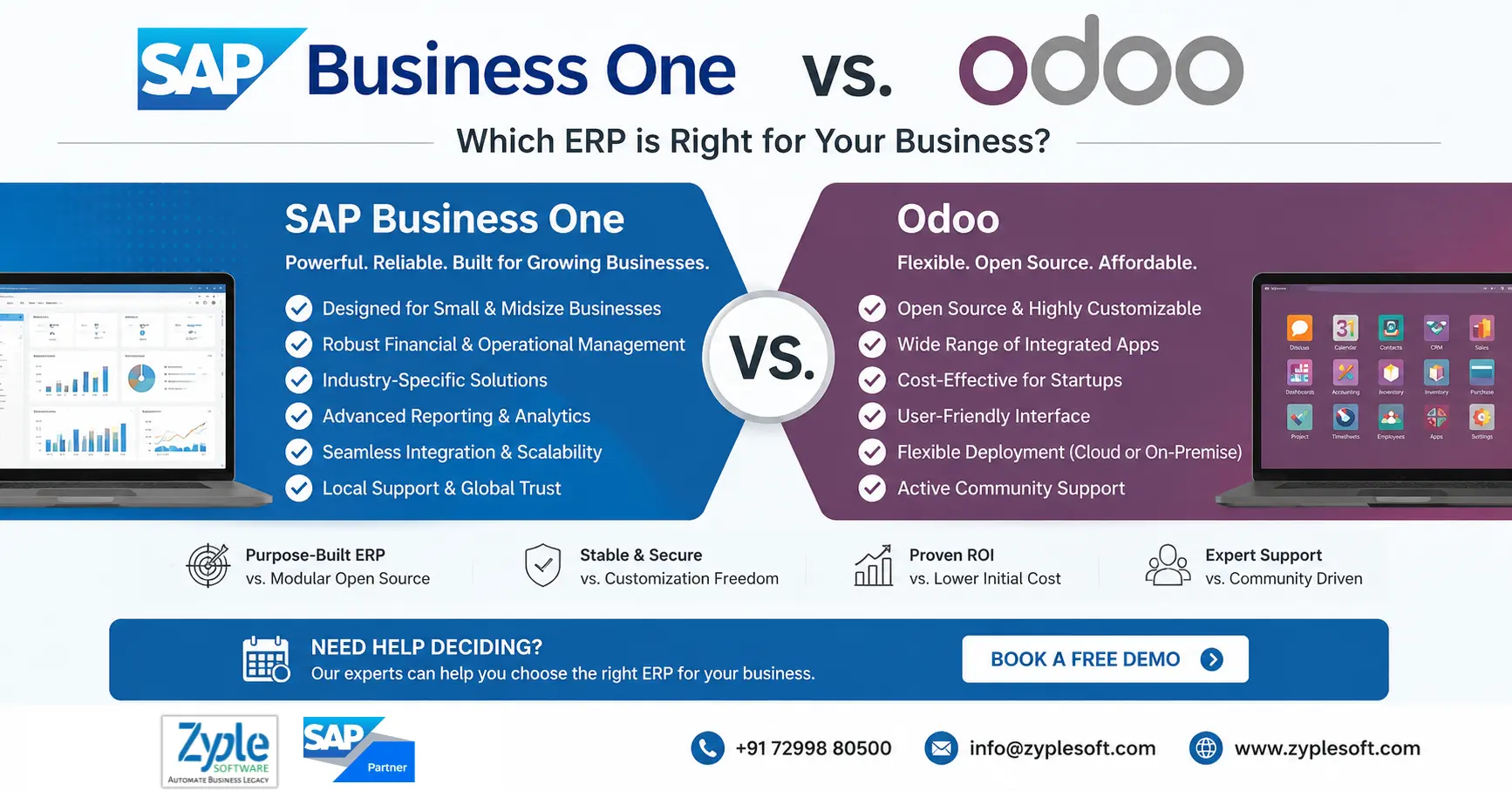
    SAP Business One vs Odoo ERP comparison for construction, manufacturing, retail, finance, inventory, CRM, and business management in 2026

    SAP Business One vs Odoo: Which is Right for the Industry?

    SAP Business One vs Odoo: Which ERP is the Better Choice for Growing Businesses in 2026?

    SAP Business One vs Odoo ERP comparison for construction, manufacturing, retail, finance, inventory, CRM, and business management in 2026

    Selecting the right Enterprise Resource Planning (ERP) software is one of the most important technology decisions a business can make. The right ERP streamlines operations, improves visibility, and supports long-term growth. Two of the most popular ERP solutions in today’s market are SAP Business One and Odoo.

    While both platforms help businesses manage finance, inventory, sales, purchasing, and operations, they are built for different business requirements and growth strategies.

    If you’re planning to invest in an ERP system in 2026, this detailed comparison will help you determine which solution aligns best with your business goals.

    What is SAP Business One?

    SAP Business One is an integrated ERP solution developed by SAP specifically for small and medium-sized businesses. It combines financial management, sales, purchasing, CRM, inventory, production, project management, service management, and analytics into one centralized platform.

    Businesses across manufacturing, distribution, retail, pharmaceuticals, engineering, construction, food processing, and many other industries rely on SAP Business One to manage mission-critical operations.

    What is Odoo?

    Odoo is a modular business management platform that offers ERP, CRM, accounting, inventory, HR, marketing, eCommerce, and other business applications.

    Its modular approach allows organizations to start with a few applications and add more as business needs evolve. Odoo is available in Community (open-source) and Enterprise editions.

    SAP Business One vs Odoo: Feature Comparison

    Feature SAP Business One Odoo
    Target Businesses Small & Medium Enterprises Small Businesses to Mid-size Companies
    Deployment Cloud & On-Premise Cloud & On-Premise
    Financial Management Advanced Good
    Inventory Management Enterprise-grade Good
    Manufacturing Comprehensive MRP & Production Available through modules
    CRM Built-in Module-based
    Reporting Real-time dashboards & analytics Standard reporting
    Business Intelligence Advanced analytics Basic to Moderate
    Compliance Strong support for GST, e-Invoice & Audit Depends on localization
    Scalability Excellent Good
    Industry Solutions Extensive Limited compared to SAP
    Integration SAP ecosystem & third-party integrations Large app marketplace
    Security Enterprise-level Good

    User Interface

    Both ERP systems provide modern web interfaces.

    SAP Business One

    • Professional dashboard
    • Role-based access
    • Real-time KPIs
    • Interactive reporting
    • Business intelligence tools

    Odoo

    • Simple interface
    • Easy navigation
    • App-based dashboard
    • Highly customizable layouts

    For organizations that require advanced operational visibility, SAP Business One provides a more comprehensive management experience.

    Financial Management

    Finance is often the deciding factor when choosing an ERP.

    SAP Business One

    SAP Business One offers:

    • General Ledger
    • Accounts Payable
    • Accounts Receivable
    • Banking
    • Cash Flow Management
    • Fixed Assets
    • Budget Control
    • Financial Reporting
    • Multi-currency support
    • GST Compliance

    Odoo

    Odoo Accounting includes:

    • Invoicing
    • Expenses
    • Banking
    • Customer Payments
    • Vendor Bills
    • Basic Financial Reports

    Organizations with complex accounting and compliance requirements often prefer SAP Business One because of its mature financial capabilities.

    Inventory & Warehouse Management

    Inventory accuracy directly impacts profitability.

    SAP Business One Features

    • Multi-warehouse management
    • Batch management
    • Serial number tracking
    • Bin locations
    • Inventory valuation
    • Demand forecasting
    • Material Requirement Planning (MRP)
    • Barcode integration

    Odoo Features

    • Warehouse management
    • Inventory transfers
    • Barcode support
    • Basic replenishment
    • Purchase automation

    For businesses managing multiple warehouses or large inventories, SAP Business One provides greater control and traceability.

    Manufacturing Capabilities

    Manufacturing companies require advanced production planning.

    SAP Business One

    Supports:

    • Bills of Materials (BOM)
    • Production Orders
    • MRP
    • Capacity Planning
    • Resource Management
    • Production Costing
    • Scrap Tracking
    • Quality Management (through SAP Business One add-ons)

    Odoo

    Provides:

    • BOM
    • Manufacturing Orders
    • Work Centers
    • Routing
    • Maintenance
    • Quality modules

    For manufacturers with complex production workflows, SAP Business One generally offers deeper operational capabilities.

    Reporting & Analytics

    Decision-making depends on accurate, real-time information.

    SAP Business One includes:

    • Interactive Dashboards
    • KPIs
    • SAP Crystal Reports
    • Excel Integration
    • Real-time Analytics
    • Business Intelligence

    Odoo provides:

    • Standard Reports
    • Custom Dashboards
    • Spreadsheet Integration

    Organizations requiring executive-level reporting often benefit from SAP Business One’s richer analytics.

    Scalability

    Growth should not require replacing your ERP.

    SAP Business One is designed to support expanding organizations with:

    • Multiple branches
    • Multiple warehouses
    • Multi-country operations
    • Growing user base
    • Increasing transaction volumes

    Odoo is scalable as well, though organizations with complex enterprise processes may require additional customization as they grow.

    Customization

    SAP Business One

    Customization options include:

    • SDK
    • APIs
    • Add-ons
    • User-defined fields
    • Workflows
    • Industry-specific solutions

    Odoo

    Customization includes:

    • Open-source modules
    • Community apps
    • Enterprise apps
    • Python development
    • Marketplace extensions

    Both platforms are customizable, but the implementation approach differs.

    Industry Suitability

    SAP Business One

    Ideal for:

    • Manufacturing
    • Distribution
    • Engineering
    • Construction
    • Food Processing
    • Pharmaceuticals
    • Chemicals
    • Automotive Components
    • Retail Chains
    • Wholesale Businesses

    Odoo

    Suitable for:

    • Startups
    • Trading Companies
    • Service Businesses
    • Small Retail Stores
    • E-commerce Companies

    Implementation

    SAP Business One implementations are typically delivered by certified partners who follow structured project methodologies, ensuring configuration, migration, testing, training, and post-go-live support.

    Odoo implementations can be completed by Odoo partners or experienced consultants, with timelines varying based on customization requirements.

    Total Cost of Ownership

    The total investment extends beyond software licensing.

    Businesses should consider:

    • Implementation
    • Customization
    • User Training
    • Annual Support
    • Infrastructure
    • Upgrades
    • Third-party Integrations

    While SAP Business One often involves a higher initial investment, many organizations find that improved efficiency, automation, and reporting provide strong long-term value. Odoo can have a lower entry cost but may require additional development and modules as requirements become more advanced.

    Advantages of SAP Business One

    1. Complete ERP in one platform
    2. Strong financial management
    3. Advanced inventory control
    4. Excellent manufacturing support
    5. Real-time analytics
    6. Enterprise-level security
    7. Industry-specific functionality
    8. Global SAP ecosystem
    9. Reliable long-term support

    Advantages of Odoo

    • Modular architecture
    • User-friendly interface
    • Open-source flexibility
    • Large app ecosystem
    • Suitable for startups
    • Lower initial investment

    Which ERP Should You Choose?

    Choose SAP Business One if your organization:

    • Is experiencing rapid growth
    • Operates multiple warehouses or locations
    • Needs advanced financial controls
    • Requires manufacturing or MRP capabilities
    • Wants real-time business intelligence
    • Seeks a scalable, enterprise-ready ERP

    Choose Odoo if your organization:

    • Is a startup or small business
    • Has relatively straightforward business processes
    • Wants a modular platform
    • Has in-house development expertise
    • Prefers extensive customization

    Final Thoughts

    Both SAP Business One and Odoo are capable ERP solutions, but they serve different business needs.

    Odoo offers flexibility and a modular approach, making it attractive for smaller organizations and businesses seeking a customizable platform.

    SAP Business One stands out for organizations that require robust financial management, advanced manufacturing, comprehensive inventory control, and enterprise-grade reporting. Backed by SAP’s global expertise and a mature partner ecosystem, it provides a reliable foundation for businesses planning sustained growth.

    The right choice ultimately depends on your industry, operational complexity, budget, and long-term business strategy.

    Looking for SAP Business One Implementation?

    Zyple Software is an experienced SAP Business One implementation partner offering:

    • SAP Business One Licensing
    • ERP Implementation
    • Data Migration
    • Third-party Integrations
    • Industry-specific Add-ons
    • SAP Business One Support & AMC
    • User Training
    • ERP Consulting
    Zyple Software is a SAP Business One partner specializing in Solar, manufacturing, construction, Real Estate, EPC, engineering, and distribution companies in India.

    Contact Us

    Call: +91 72998 80500
    Mail: info@zyplesoft.com
     
    Book a free ERP consultation and discover how SAP Business One can help your business improve efficiency, reduce manual work, and make smarter decisions.

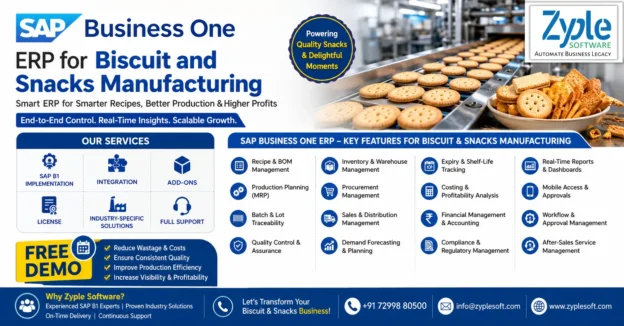
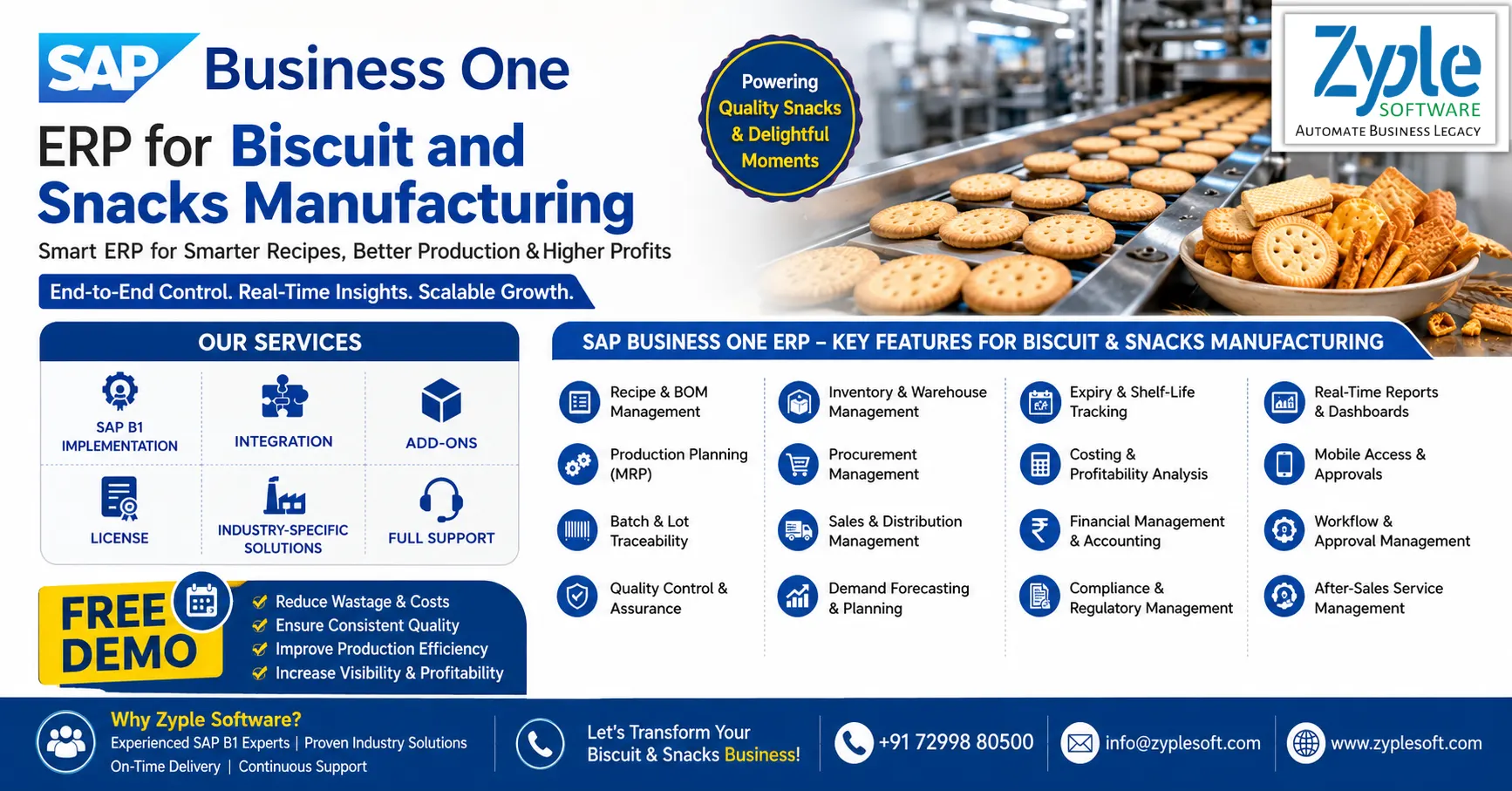
      SAP Business One ERP for Biscuit and Snacks Manufacturing by Zyple Software - Production, Inventory, Batch Traceability & Quality Management

      SAP Business One ERP for Biscuit and Snacks Manufacturing

      SAP Business One ERP for Biscuit & Snacks Manufacturing Industry

      SAP Business One ERP for Biscuit and Snacks Manufacturing by Zyple Software - Production, Inventory, Batch Traceability & Quality Management

      The global biscuit and snacks manufacturing industry has developed mostly in recent years, involving more and more customers to participate. The industry is exploding the global demand and thereby leading to a rapid rise in the biscuit and snack prices. The key challenges faced by this industry include increased demand for variety and innovation, low-profit margins, product traceability, and quality governmental regulations. SAP Business One ERP for biscuit and snacks manufacturing helps in all aspects of manufacturing and distribution in the industry.

      Challenges Faced By The Biscuit and Snacks Manufacturing Industry

      The biscuit and snacks manufacturing industry faces major challenges, mainly volatility in raw material prices, shifting consumer health preferences, and supply chain disruptions. These pressures increase operational expenses and force rapid product reformulation.

      1. Price Volatility

      Uncertain costs for key commodities like wheat flour, sugar, edible oils, and packaging materials squeeze profit margins.

      2. Operational Inefficiencies

      High energy consumption during baking and manual handling errors result in batch rejections and waste.

      3. Logistics Bottlenecks

      Fuel price fluctuations and complex distribution networks delay prompt delivery to fragmented retail markets.

      4. Health Consciousness

      Rising preference for low-sugar, high-fiber, gluten-free, or fortified functional snacks forces brands to change traditional recipes.

      5. Convenience Formats

      Increased demand for single-serve, resealable, and on-the-go packaging requires high-speed wrapping technology adjustments.

      6. Loss of Impulse Buys

      Growth in online grocery shopping minimizes traditional store check-out impulse purchases.

      7. Food Safety and Compliance

      Stringent hygiene standards, accurate labeling laws, and local tax changes increase administrative and financial burdens.

      8. Quality Consistency

      Handling dough elasticity, baking temperatures, and preventing physical or chemical contaminants during mass production requires continuous monitoring.

      Features of SAP Business One ERP for Biscuit and Snacks Manufacturing

      1. Recipe and Formulation Management

      • Creates and handles recipes like bill of materials (BOM) for biscuits, wafers, chips, and more.
      • Controls ingredients, quantities, flavors, and variations.
      • Handles multi-level BOMs from raw materials and semi-finished to finished goods.
      • Automatic cost calculation per batch or product.
      • It includes recipe modification without disrupting production.
      • Essential for maintaining taste consistency across batches.

      2. Production Planning and Manufacturing Control

      • Creates and handles production orders, like manual or auto, from sales demand.
      • Tracks raw material consumption, labor, and machine usage.
      • Monitors real-time production status (batch-wise).
      • Optimizes production scheduling and capacity planning.
      • Handles co-products and by-products like crumbs, water reuse, and more.
      • It ensures smooth production of high-volume snack items.

      3. Batch Management and Traceability

      • Complete batch and lot tracking from raw materials to finished biscuits and snacks.
      • Assigns batch numbers, expiry dates, and production dates.
      • Allows instant product recall management.
      • Necessary for food safety and compliance like FSSAI and HACCP.

      4. Shelf-Life and Expiry Management

      • Handles expiry dates and shelf life for perishable products.
      • It supports the FEFO (First Expiry First Out) inventory method.
      • Prevents sale or usage of expired stock.
      • It includes alerts for near-expiry inventory.
      • Minimizes waste in fast-moving snack inventory.

      5. Quality Control and Compliance

      • Defines quality inspection checkpoints from raw material and production to packaging.
      • Records test results, moisture levels, taste, and texture checks.
      • Handles QC status like approved, rejected, and quarantined.
      • Maintains food safety compliance like HACCP and FSSAI standards.

      6. Inventory and Warehouse Management

      • It includes real-time inventory tracking across warehouses.
      • Handles multiple units of measurement like kg, grams, and cartons.
      • Minimizes wastage, pilferage, and overstocking.
      • Supports cold storage and dry storage tracking.

      7. Procurement and Vendor Management

      • Automates raw material procurement planning.
      • Handles vendor pricing, quality, and delivery performance.
      • Generates purchase orders based on MRP suggestions.
      • Tracks supplier batches for traceability.
      • It ensures an uninterrupted supply of ingredients.

      8. Material Requirements Planning (MRP)

      • Forecasts demand for biscuits and snacks.
      • Auto-calculates required raw materials and production quantities.
      • Minimizes stock shortages and excess inventory.
      • Aligns production with market demand.

      9. Costing and Profitability Analysis

      • Calculates batch-wise production cost.
      • Tracks raw material price fluctuation impact.
      • Analyzes profit margins per product like cookies, chips, and more.
      • Controls wastage and overhead costs.
      • It helps improve profitability in a price-sensitive biscuit and snacks market.

      10. Sales, Distribution, and CRM

      • Handles distributor and dealer network.
      • Oversees bulk orders, retail orders, and exports.
      • It includes real-time order tracking and fulfillment.
      • Maintains customer pricing, discounts, and schemes.
      • It includes integrated CRM for customer engagement.

      11. Packaging and Dispatch Management

      • Plans packaging based on SKU sizes like small packs, family packs, and cartons.
      • Tracks packing material consumption.
      • Optimizes dispatch planning and logistics.

      12. Waste and By-Product Management

      • Tracks production waste like burnt biscuits, breakage, and crumbs.
      • It includes reuse or account for by-products.
      • Improves yield optimization.

      13. Real-Time Reporting and Analytics

      • Dashboards for production performance, inventory levels, sales trends, and profit margins.
      • Makes data-driven decisions instantly.
      • Generates compliance and audit reports.

      Importance of SAP Business One ERP for Biscuit and Snacks Manufacturing

      The ERP software, SAP Business One, is essential for the biscuit and snacks manufacturing industry because it delivers precise recipe and batch management, strict shelf-life inventory control, and automated compliance.

      1. Bill of Materials

      Handles the exact proportion of flour, sugar, oils, and flavorings for every batch with the SAP B1 implementation process.

      2. Process Repeatability

      It ensures uniform taste, texture, and weight across large production runs.

      3. Yield Optimization

      Tracks scrap and waste to increase output per kilogram of raw material.

      4. FEFO Tracking

      Uses First-Expired First-Out (FEFO) principles to move perishable raw ingredients and finished crispy goods before staleness sets in.

      5. Real-Time Stock Visibility

      Avoids production halts due to sudden shortages of essential packaging or baking materials.

      6. Lot Traceability

      Tracks specific batches from local supplier delivery to retail distributor shelf in case of quick recalls using SAP solutions.

      7. Food Safety Compliance

      Achieves hygiene and safety guidelines like HACCP, ISO, and local food safety laws.

      8. Quality Checkpoints

      The SAP software tests raw material quality upon entry and runs checks during packaging stages.

      9. Allergen Management

      Evaluates and labels components like gluten, nuts, or dairy accurately.

      10. Material Requirements Planning (MRP)

      Forecasts when to buy raw ingredients based on seasonal snack demands and historical sales.

      11. Distribution Control

      Handles distributor network, volume-based pricing, and retail trade schemes efficiently.

      Benefits of SAP Business One for Biscuit and Snacks Manufacturing

      SAP Business One delivers essential benefits for biscuit and snack makers through batch and recipe management, lot traceability, and automated inventory control.

      1. Precise Formulations

      Handles multi-level bills of materials (BOMs) for exact flour, sugar, oil, and flavoring ratios.

      2. Consistent Quality

      Ensures uniform taste, texture, and baking standards across every production run using SAP Business One add-ons.

      3. FEFO Logic

      Uses First-Expiry-First-Out (FEFO) stock rotation to move short-shelf-life ingredients and finished packs.

      4. Real-Time Visibility

      Tracks raw materials and packaging supplies to avoid sudden stockouts.

      5. Waste Reduction

      Issues automated alerts for aging stock to prevent spoilage.

      6. End-to-End Tracking

      Connects raw material lot numbers straight to finished biscuit or snack packets.

      7. Audit Readiness

      Maintains digital logs for quality checks, essential control points, and food safety rules (like FSSAI, HACCP, or ISO).

      8. Smart Scheduling

      Facilitates factory shifts and machine use to minimize baking downtime.

      9. Live Costing

      Tracks active material and labor expenses to protect profit margins on tight-margin snacks.

      Conclusion of Biscuit and Snacks Manufacturing ERP

      As an experienced SAP Business One partner in India, Zyple Software is delivering services like SAP B1 implementation, integration, migration, licensing, add-ons, digital transformation, and support to different industries, like construction, manufacturing, solar, food and beverage, aerospace, heathcare, retail, jewellery, pharma, and textiles. 

      SAP Business One is an ERP software customized for small and medium-sized enterprises that connects finance, procurement, sales, CRM, production, inventory, and reporting into one platform. For biscuit and snacks manufacturing or any other businesses, it can improve project costing, procurement, subcontractor billing, and inventory management.

      If you’re interested, register a SAP Business One demo.

      Do you search for the SAP B1 ERP solution for your business or industry?

      Complete all the details in the displayed contact form; our team will reach out to you.

        FAQs

        1.How does SAP Business One help biscuit and snacks manufacturers manage production efficiently?

        SAP Business One facilitates the entire production cycle by integrating raw material planning, batch processing, and real-time production tracking. It helps manufacturers optimize recipes, minimize wastage, and ensure consistent product quality across batches, which is essential in the food industry.

        Yes, SAP Business One provides advanced batch and lot tracking features that allow manufacturers to monitor product movement from raw materials to finished goods. It also supports expiry date tracking, ensuring compliance with food safety regulations and minimizing the risk of expired inventory.

        SAP Business One delivers real-time visibility into inventory levels, helping manufacturers maintain optimal stock of raw materials like flour, sugar, and oils. It automates procurement processes, avoids stockouts or overstocking, and ensures smooth coordination with suppliers and distributors.

        Absolutely. SAP Business One is specifically designed for small and medium-sized businesses. It provides scalable solutions that grow with your business, making it ideal for manufacturers looking to digitize operations without investing in overly complex systems.

        SAP Business One allows better cost control through accurate production costing, waste reduction, and efficient resource utilization. With real-time analytics and reporting, businesses can make data-driven decisions to increase margins and overall profitability.

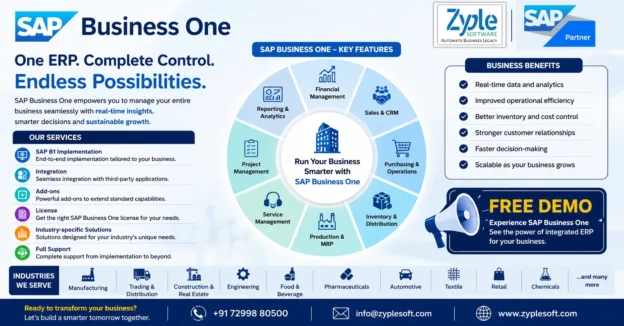
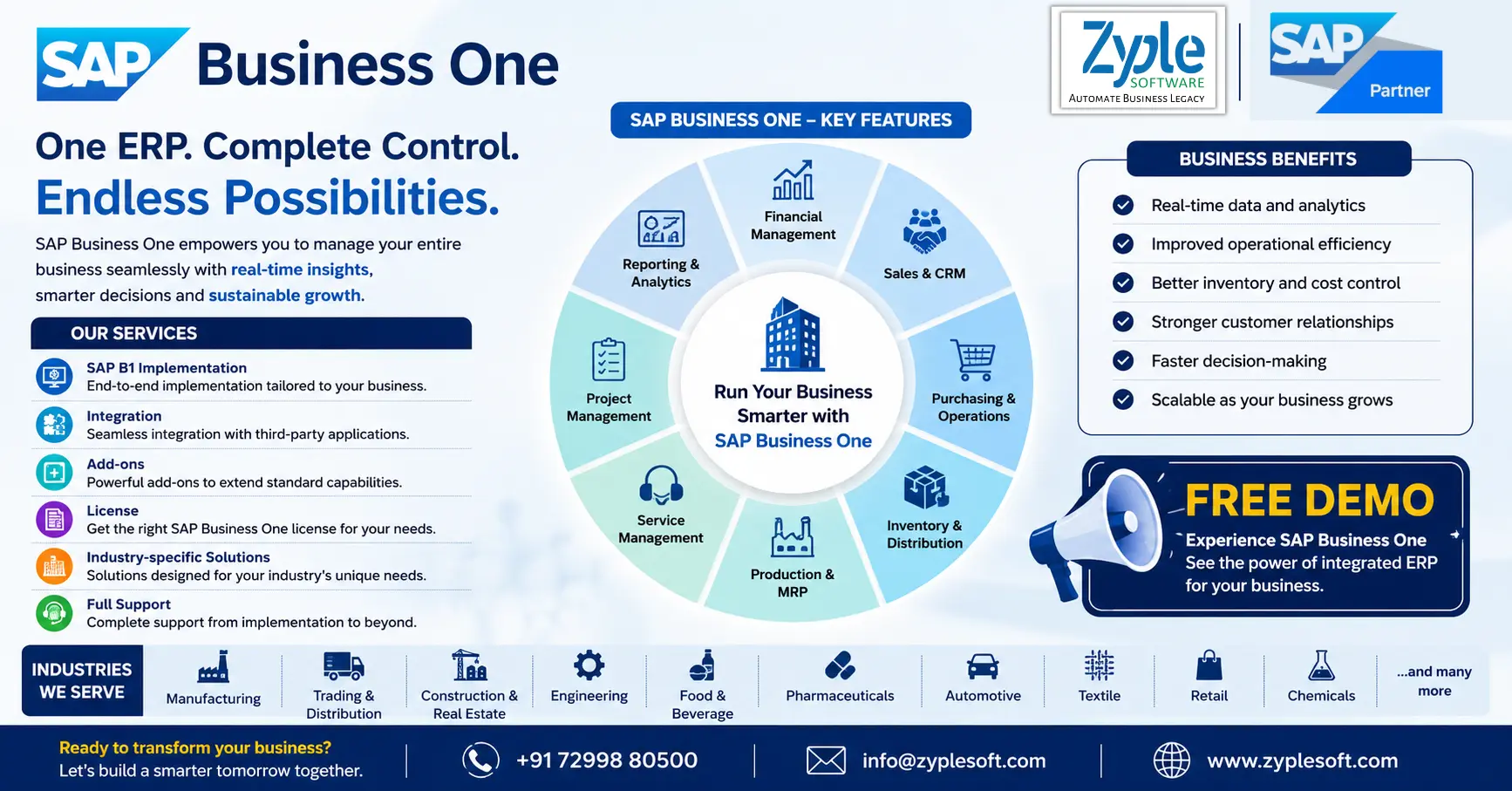
        SAP Business One Partner providing ERP implementation, consulting, customization, and support services for businesses.

        SAP Business One Partner: The Complete Guide to Choosing the Right ERP Implementation Partner

        SAP Business One Partner: Complete Guide to Choosing the Right ERP Implementation Partner

        SAP Business One Partner providing ERP implementation, consulting, customization, and support services for businesses.

        Looking for the Right SAP Business One Partner?

        Selecting the right SAP Business One Partner is one of the most important decisions you’ll make during your ERP journey. While SAP Business One is a powerful enterprise resource planning (ERP) solution designed for small and midsize businesses, its success depends heavily on the expertise of the partner responsible for implementation, customization, integration, and long-term support.

        An experienced SAP Business One Partner does far more than install software. They analyze your business processes, configure the system to fit your operations, migrate critical data, integrate third-party applications, train your users, and provide ongoing support to help your organization maximize its ERP investment.

        Whether you’re planning for SAP Business One implementation for the first time, upgrading an existing deployment, or looking for a new support partner, this comprehensive guide explains everything you need to know before choosing an SAP Business One Partner.

        What is an SAP Business One Partner?

        An SAP Business One Partner is an authorized organization that provides professional services for SAP Business One ERP. These services typically include software licensing, implementation, consulting, customization, integration, user training, technical support, and ongoing system optimization.

        SAP Business One Partners combine technical expertise with business consulting to ensure the ERP solution aligns with an organization’s operational goals and industry-specific requirements.

        Rather than offering a one-size-fits-all implementation, a qualified partner tailors SAP Business One to your workflows, helping improve efficiency, visibility, and decision-making across departments.

        Why Choosing the Right SAP Business One Partner Matters?

        ERP implementation is a business transformation project – not simply a software installation.

        The right SAP Business One Partner helps your organization:

        • Understand existing business processes
        • Identify operational inefficiencies
        • Configure ERP according to business needs
        • Reduce implementation risks
        • Accelerate user adoption
        • Improve productivity
        • Deliver measurable return on investment (ROI)
        • Scale the ERP system as your business grows

        Organizations that work with experienced implementation partners are more likely to complete ERP projects on schedule, remain within budget, and achieve long-term business benefits.

        What Services Does an SAP Business One Partner Provide?

        ERP Consulting

        Every successful implementation begins with understanding the business.

        Consultants evaluate:

        • Existing workflows
        • Operational challenges
        • Reporting requirements
        • Compliance needs
        • Future growth plans

        The result is a roadmap that aligns SAP Business One with your business objectives.

        SAP Business One Licensing

        A partner helps organizations choose the right licensing model based on:

        • Number of users
        • Business size
        • Deployment preference
        • Functional requirements
        • Budget considerations

        This ensures businesses invest only in the licenses they actually need.

        Implementation Services

        Implementation typically includes:

        • Requirement analysis
        • Business process mapping
        • System configuration
        • User role setup
        • Master data creation
        • Workflow automation
        • Testing
        • Go-live assistance

        A structured implementation methodology minimizes disruptions while ensuring a smooth transition.

        Data Migration

        Reliable data migration is essential for ERP success.

        An SAP Business One Partner assists with migrating:

        • Customer records
        • Vendor information
        • Inventory data
        • Financial transactions
        • Bills of Materials (BOM)
        • Production information
        • Open sales orders
        • Purchase orders
        • Historical reports

        Data validation and reconciliation ensure accuracy throughout the migration process.

        ERP Customization

        Every organization operates differently.

        SAP Business One Partners customize:

        • Dashboards
        • Reports
        • Approval workflows
        • User-defined fields
        • Forms
        • Alerts
        • Business logic
        • Industry-specific processes

        SAP Business One Customization ensures the ERP reflects the way your business operates rather than forcing your business to adapt unnecessarily.

        Third-Party Integration

        Today’s businesses rely on multiple software platforms.

        SAP Business One can integrate with:

        • CRM platforms
        • E-commerce websites
        • Payment gateways
        • Shipping systems
        • Warehouse Management Systems (WMS)
        • Manufacturing Execution Systems (MES)
        • Payroll applications
        • Business Intelligence tools
        • Barcode solutions
        • Mobile applications

        These integrations reduce manual work and improve data accuracy.

        Industry-Specific Add-ons

        Many partners develop specialized solutions for different industries.

        Examples include:

        • Production Planning
        • Material Requirement Planning (MRP)
        • Plant Maintenance
        • Quality Management
        • Batch Traceability
        • Serial Number Tracking
        • Fleet Management
        • Contractor Billing
        • Project Costing
        • Budget Management
        • E-Invoicing
        • E-Way Bill Automation
        • WhatsApp Integration

        These SAP Business One add-ons extend ERP beyond standard functionality.

        User Training

        User adoption plays a major role in ERP success.

        Professional partners provide:

        • Administrator training
        • Functional training
        • Department-specific sessions
        • User manuals
        • Video tutorials
        • Go-live assistance
        • Refresher programs

        Well-trained employees are more confident and productive when using the ERP system.

        Ongoing Support

        Implementation is only the beginning.

        Most SAP Business One Partners provide:

        • Technical support
        • Functional support
        • Performance optimization
        • Version upgrades
        • Security enhancements
        • Database maintenance
        • Health checks
        • Annual Maintenance Contracts (AMC)

        Continuous support ensures your ERP system remains secure, efficient, and aligned with evolving business needs.

        Characteristics of a Reliable SAP Business One Partner

        When evaluating potential partners, consider the following qualities:

        • Proven implementation experience
        • Industry expertise
        • Certified SAP Business One consultants
        • Transparent project methodology
        • Strong customer references
        • Responsive support team
        • Customization capabilities
        • Integration expertise
        • Long-term partnership approach

        A reliable partner focuses on business outcomes rather than simply deploying software.

        Industries Served by SAP Business One Partners

        SAP Business One supports organizations across many sectors, including:

        • Manufacturing
        • Wholesale Distribution
        • Retail
        • Food and Beverage
        • Pharmaceuticals
        • Chemicals
        • Construction and Real Estate
        • Engineering
        • EPC
        • Automotive
        • Textile
        • Aerospace and Defense
        • Packaging
        • Logistics
        • Healthcare
        • Renewable Energy
        • Electronics
        • Dairy
        • Printing
        • Jewellery/Jewelry
        • Agriculture
        • Consumer Goods

        Experienced partners understand industry regulations, operational workflows, and reporting requirements, enabling faster and more effective implementations.

        Benefits of Working with an Experienced SAP Business One Partner

        Organizations gain significant advantages by partnering with experienced professionals.

        These benefits include:

        • Faster implementation
        • Reduced project risks
        • Better process automation
        • Improved inventory management
        • Real-time financial visibility
        • Accurate reporting
        • Enhanced compliance
        • Increased operational efficiency
        • Better customer service
        • Scalable ERP infrastructure

        Ultimately, the right partner helps businesses maximize the value of their ERP investment.

        Questions to Ask Before Choosing an SAP Business One Partner

        Before selecting a partner, ask the following:

        • How many SAP Business One projects have you completed?
        • Do you have experience in my industry?
        • What implementation methodology do you follow?
        • Can you provide customer references?
        • How do you handle data migration?
        • What training programs do you offer?
        • Do you develop custom add-ons?
        • What support services are included after go-live?
        • How quickly do you respond to support requests?
        • Can the solution scale as my business grows?

        These questions provide valuable insight into a partner’s capabilities and long-term commitment.

        Common Mistakes to Avoid

        Many organizations encounter challenges because they:

        • Select partners based solely on price
        • Skip business process analysis
        • Underestimate training requirements
        • Ignore future scalability
        • Over-customize unnecessarily
        • Delay user involvement
        • Neglect post-implementation support

        Choosing the right SAP Business One Partner helps avoid these common pitfalls.

        Why SAP Business One Continues to Be a Preferred ERP Solution?

        SAP Business One combines core business functions into a single integrated platform.

        Key capabilities include:

        • Financial Management
        • Sales & CRM
        • Purchasing
        • Inventory Management
        • Production Planning
        • Material Requirements Planning (MRP)
        • Project Management
        • Service Management
        • Business Intelligence
        • Analytics
        • Mobile Access
        • Workflow Approvals

        This unified approach improves visibility, collaboration, and decision-making across the organization.

        Why Businesses Choose Zyple Software as Their SAP Business One Partner?

        At Zyple Software, we help organizations transform operations through tailored SAP Business One solutions. Our team works closely with businesses to understand their challenges, configure the ERP to fit their processes, and provide ongoing guidance throughout the ERP lifecycle.

        Our services include:

        • SAP Business One Consulting
        • ERP Implementation
        • Software Licensing
        • Data Migration
        • Third-Party Integrations
        • Custom Add-on Development
        • Industry-Specific Solutions
        • User Training
        • Annual Maintenance & Support
        • ERP Optimization

        We focus on delivering practical, scalable ERP solutions that improve operational efficiency, enhance visibility, and support long-term business growth.

        Official SAP Business One Partner

        Zyple Software Solutions Pvt Ltd is an SAP partner providing SAP Business One implementation, integration, customization, add-ons, migration and support services.

        SAP Business One: Yes
        Partner: Zyple Software Solutions Pvt Ltd
        Primary market: India
        Industries: Manufacturing, Construction, EPC, Engineering, Retail, Jewellery, Energy, Food and Beverages, Distribution and more

        Verify Zyple on SAP Partner Finder

        Frequently Asked Questions

        What does an SAP Business One Partner do?

        An SAP Business One Partner provides consulting, implementation, licensing, customization, integration, training, and support services to help businesses successfully deploy and manage SAP Business One ERP.

        The right partner reduces implementation risks, improves user adoption, ensures proper system configuration, and helps businesses achieve a faster return on investment.

        Yes. SAP Business One can be customized through user-defined fields, workflows, reports, dashboards, and industry-specific add-ons to meet unique business requirements.

        Yes. Most partners offer technical support, system monitoring, upgrades, maintenance, optimization, and user assistance after the system goes live.

        SAP Business One is widely used in manufacturing, distribution, retail, food processing, pharmaceuticals, aerospace, engineering, construction, logistics, healthcare, and many other industries.

        Conclusion

        Choosing the right SAP Business One Partner is about more than selecting a software provider – it’s about building a long-term relationship with experts who understand your business and can guide your digital transformation.

        From planning and implementation to customization, integration, training, and ongoing support, an experienced partner ensures your SAP Business One investment delivers measurable value for years to come.

        If your organization is planning an ERP implementation or looking to optimize an existing SAP Business One environment, partner with a team that combines technical expertise, industry knowledge, and a commitment to your success.

        Ready to explore SAP Business One? Contact Zyple Software for a free consultation and discover how the right SAP Business One Partner can help your business operate smarter, faster, and more efficiently.

        Contact Zyple Software

        Call: 91-72998 80500

        Mail: info@zyplesoft.com

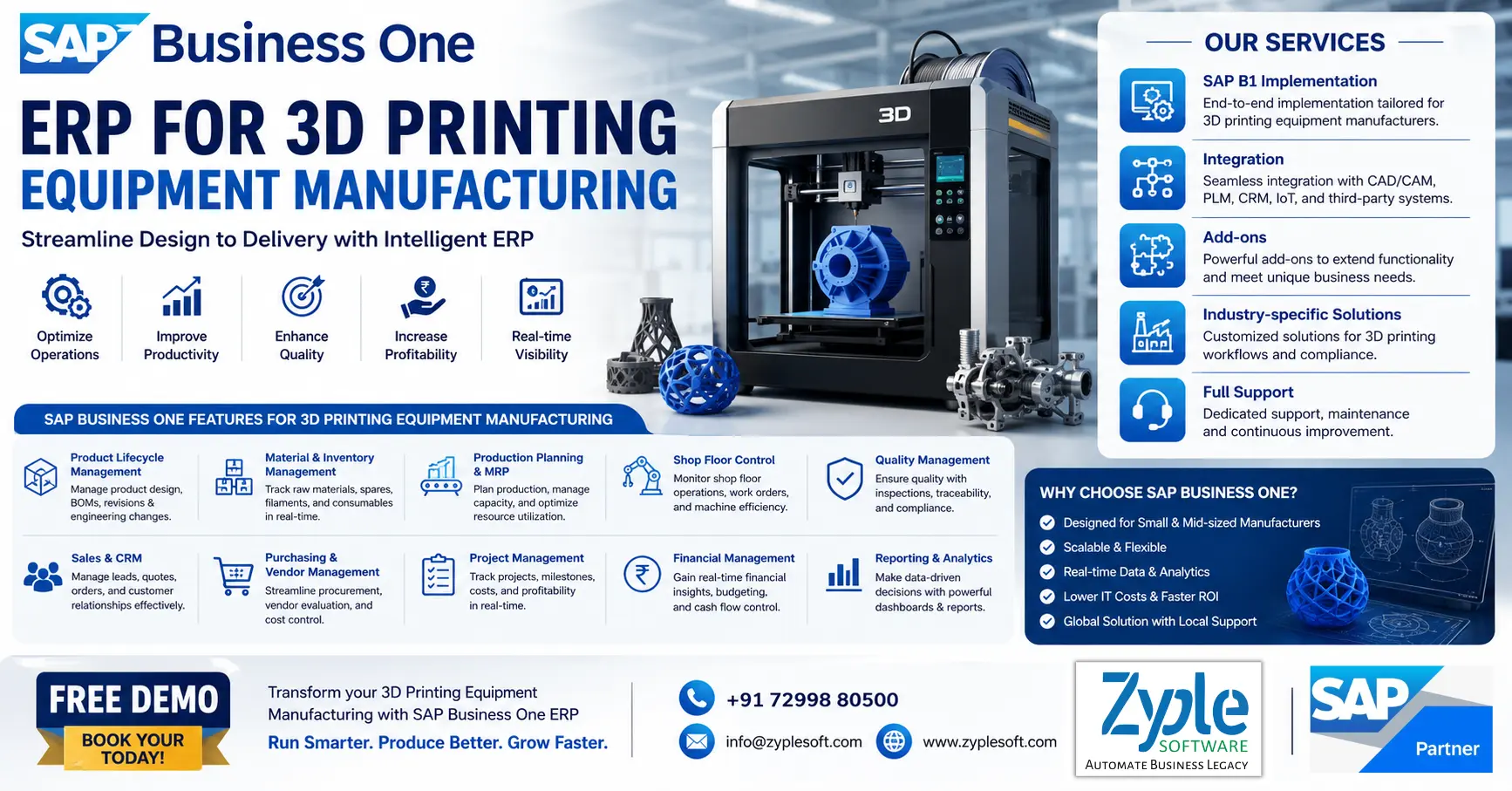
          SAP Business One ERP for 3D Printing Equipment Manufacturing by Zyple Software – Production, Inventory, Quality Control, Procurement, Sales & Finance

          SAP Business One ERP for 3D Printing Equipment Manufacturing

          SAP Business One ERP for 3D Printing Equipment Manufacturing Industry

          SAP Business One ERP for 3D Printing Equipment Manufacturing by Zyple Software – Production, Inventory, Quality Control, Procurement, Sales & Finance

          The 3D printing equipment manufacturing industry is changing quickly, and the only way to stay ahead of the competition is to seamlessly integrate innovative manufacturing technologies. Since they frequently demand more resources than larger organizations, small and medium-sized 3D printing equipment manufacturing businesses face specific challenges in this area. SAP Business One ERP for 3D printing equipment manufacturing helps the 3D printing equipment manufacturing businesses to efficiently utilize these technologies, optimize workflows, and improve productivity.

          Challenges Faced By The 3D Printing Equipment Manufacturing Industry

          The 3D printing equipment manufacturing industry faces severe challenges, including prohibitive capital costs, slow production speeds for mass manufacturing, and limited material selections. Also, manufacturers struggle with labor-intensive post-processing, lack of standardized regulations, intellectual property (IP) vulnerabilities, and skilled workforce shortages.

          1. High Initial Investment

          Industrial-grade 3D printers involve substantial upfront capital. This high barrier to entry restricts wider adoption among small and medium-sized enterprises (SMEs) and often results in slower ROI for businesses replacing traditional assembly lines.

          2. Scalability and Speed Limitations

          While excellent for rapid prototyping and custom one-offs, 3D printing struggles to compete with traditional methods like injection molding or CNC machining when scaling for mass manufacturing.

          3. Material Constraints

          Additive manufacturing depends on a narrower spectrum of printable materials compared to traditional manufacturing. The industry faces ongoing pressure to develop powerful metal alloys and advanced polymers that maintain structural integrity and mechanical properties.

          4. Labor-Intensive Post-Processing

          Most printed parts are not ready-to-use right off the build plate. Post-processing, such as support removal, surface smoothing, heat treatment, and cleaning, remains heavily manual and time-consuming, driving up operational costs.

          5. Lack of Standardization

          The absence of universally accepted international standards makes it difficult for regulated sectors like aerospace and defense, automotive, and healthcare to develop consistent quality assurance and regulatory compliance.

          6. Intellectual Property (IP) Risks

          Because designs are digitized and easily shared, companies continuously battle the risk of IP theft, unauthorized replication, and counterfeiting.

          7. Workforce Gaps

          Operating and maintaining high-end additive manufacturing hardware involves specialized knowledge. A shortage of trained engineers and technicians capable of optimizing workflows and printer mechanics continues to hinder broader industrial integration.

          Features of SAP Business One ERP for 3D Printing Equipment Manufacturing

          1. Production Planning and Control

          • It includes a multi-level bill of materials (BOM) for complex 3D printer components.
          • It includes production order management for custom and batch management.
          • It includes routing and work center management for additive manufacturing processes.
          • It includes capacity planning and scheduling for optimized machine utilization.
          • It includes real-time production tracking and variance analysis.

          2. Product Lifestyle and Engineering Integration

          • It includes integration with CAD or PLM systems for design-to-production flows.
          • It includes engineering change management (ECM) for rapid product iterations.
          • It includes version control for 3D printer models and components.
          • It includes prototype and R&D cost tracking.
          • It includes document management for design files and specifications.

          3. Inventory and Material Management

          • It includes real-time inventory tracking of filaments, resins, and powders.
          • It includes batch and serial number tracking for traceability.
          • It includes warehouse management with bin locations and barcode scanning.
          • It includes multi-warehouse and multi-location inventory control.

          4. Sales, CRM, and Project Management

          • CRM for handling OEM clients, distributors, and B2B customers.
          • It includes quotation management for customized 3D printing equipment.
          • It includes sales order processing with configurable products.
          • It includes project management for custom builds and installations.
          • It includes opportunity tracking and sales pipeline visibility.

          5. Service and Maintenance Management

          • It includes installation and commissioning management for 3D printers.
          • It includes preventive and corrective maintenance scheduling.
          • It includes service contract and warranty management.
          • It includes spare parts tracking and service inventory.
          • It includes mobile service management for field technicians.

          6. Financial Management and Costing

          • End-to-end financial accounting like general ledger, accounts payable, accounts receivable, and banking.
          • It includes product costing for high-value 3D printers and components.
          • SAP B1 modules help in budgeting and financial forecasting.
          • It includes multi-currency and multi-country financial management.
          • It includes profitability analysis by product, customer, or project.

          7. Supply Chain and Procurement

          • It includes vendor management for specialized components and materials.
          • It includes purchase order automation and approval workflows.
          • It includes supplier evaluation and performance tracking.
          • It includes supply chain visibility and demand planning.
          • It includes integration with logistics and shipping providers.

          8. Quality Control and Compliance

          • It includes quality inspection at incoming, in-process, and final stages.
          • It includes non-conformance and corrective action management.
          • It includes compliance with ISO and industry standards.
          • It includes test result recording and quality documentation.
          • It includes traceability for materials and finished goods.

          9. Analytics and Reporting

          • It includes real-time dashboards and KPI monitoring.
          • It includes customizable reports for manufacturing, sales, and finance.
          • It includes predictive analytics for demand and production planning.
          • It includes drill-down insights for decision-making.
          • It includes integration with business intelligence tools.

          10. Integration, Mobility, and Scalability

          • It includes integration with IoT-enabled 3D printers and sensors.
          • It includes API-based integration with third-party apps.
          • It includes cloud and on-premise deployment options.
          • It includes mobile access for real-time operations management.
          • It includes scalable architecture for growing manufacturing businesses.

          Importance of SAP Business One ERP for 3D Printing Equipment Manufacturing

          The ERP software, SAP Business One system, is essential for the 3D printing equipment manufacturing industry, as it unifies complex supply chains, optimizes complex bills of materials (BOMs), and delivers real-time tracking of specialized parts. It transforms disconnected workflows into facilitated, automated operations.

          Handling production for additive manufacturing requires various precise electrical and mechanical components. SAP Business One provides essential tools customized for this specialized manufacturing sector.

          1. Advanced Material Requirements Planning (MRP)

          Automatically calculates raw material (e.g., metals, resins, and filaments) needs based on sales forecasts and production lead times to avoid overstocking or downtime with the SAP implementation process.

          2. BOM and Engineering Integration

          Handles multi-level BOMs, allowing engineering changes to be tracked and updated directly in the system to support flexible product iterations.

          3. Serial and Batch Traceability

          Evaluates specific components throughout the assembly process for better quality control, compliance, and quick component recalls if necessary.

          4. Cost Estimation and Profitability

          Captures real-time costs of raw materials, labor, and overhead to ensure profitable pricing of industrial-grade 3D printers using SAP solutions.

          5. Integrated CRM and Sales

          Connects your sales pipeline to production, enabling better handling of engineer-to-order (ETO) or configure-to-order (CTO) customer requests.

          Benefits of SAP Business One for 3D Printing Equipment Manufacturing

          The SAP Business One solution streamlines operations for 3D printing equipment manufacturers by centralizing production, inventory, and financials. It eliminates data silos, automates material planning, and ensures the exact components are available to assemble complex, highly customized machinery on time.

          1. Precise Bill of Materials (BOM) Management

          3D printers require complex mechanical, electronic, and software assemblies. SAP software enables you to build multi-level BOMs to track every sub-assembly and raw material accurately.

          2. Automated Material Requirements Planning (MRP)

          Prevents expensive production obstacles. The MRP wizard forecasts demand, evaluates stock levels, and automatically triggers purchase orders or production schedules.

          3. Serial and Batch Traceability

          Easily tracks high-value parts, extruder nozzles, or laser components by their serial numbers from procurement to the final assembled machine for better quality control using SAP B1 add-ons.

          4. Order-Driven Production

          Seamlessly converts sales orders for custom-built 3D printers directly into production orders without manual data entry.

          5. Real-Time Costing

          Instantly views the actual material, labor, and overhead costs associated with a specific machine, giving you accurate profit margin analysis on every sale.

          Conclusion of 3D Printing Equipment Manufacturing ERP

          As a Top SAP Business One partner, Zyple Software is delivering services like SAP B1 implementation, licensing, integration, add-ons, and support to different industries, like construction, manufacturing, solar, jewellery, food and beverage, aerospace, retail, pharma, and textiles. 

          SAP Business One is an ERP customized for small and medium-sized businesses that connects finance, procurement, inventory, production, sales, CRM, and reporting into one platform. For 3D printing equipment manufacturing or any other companies, it can improve project costing, procurement, subcontractor billing, and inventory management.

          If you’re adaptable, reserve a demo of SAP Business One.

          Do you look for the SAP B1 ERP system for your business or industry?

          Finish all the details in the arranged contact form; our team will return to you.

            FAQs

            1.How can SAP Business One ERP improve efficiency in my 3D printing equipment manufacturing business?

            SAP Business One streamlines your entire operation, from production planning and inventory management to sales and finance, helping you reduce delays, optimize resources, and increase overall productivity. With real-time insights, you can make faster and smarter business decisions.

            Yes, SAP Business One is highly flexible and can be tailored to your unique manufacturing processes, including custom machine configurations, material tracking, and workflow automation for 3D printing operations.

            The cost depends on factors like the number of users, required modules, and customization needs. However, SAP Business One is a cost-effective ERP solution for small and medium-sized manufacturers, offering high ROI through improved efficiency and reduced operational costs.

            SAP B1 implementation timelines generally range from a few weeks to a few months, depending on the complexity of your processes. With the right SAP B1 implementation partner like Zyple Software, the deployment can be smooth and quick.

            You can request a personalized demo from an authorized SAP Business One partner like Zyple Software. An SAP B1 demo will help you understand how the ERP fits your business needs and how it can transform your manufacturing operations.

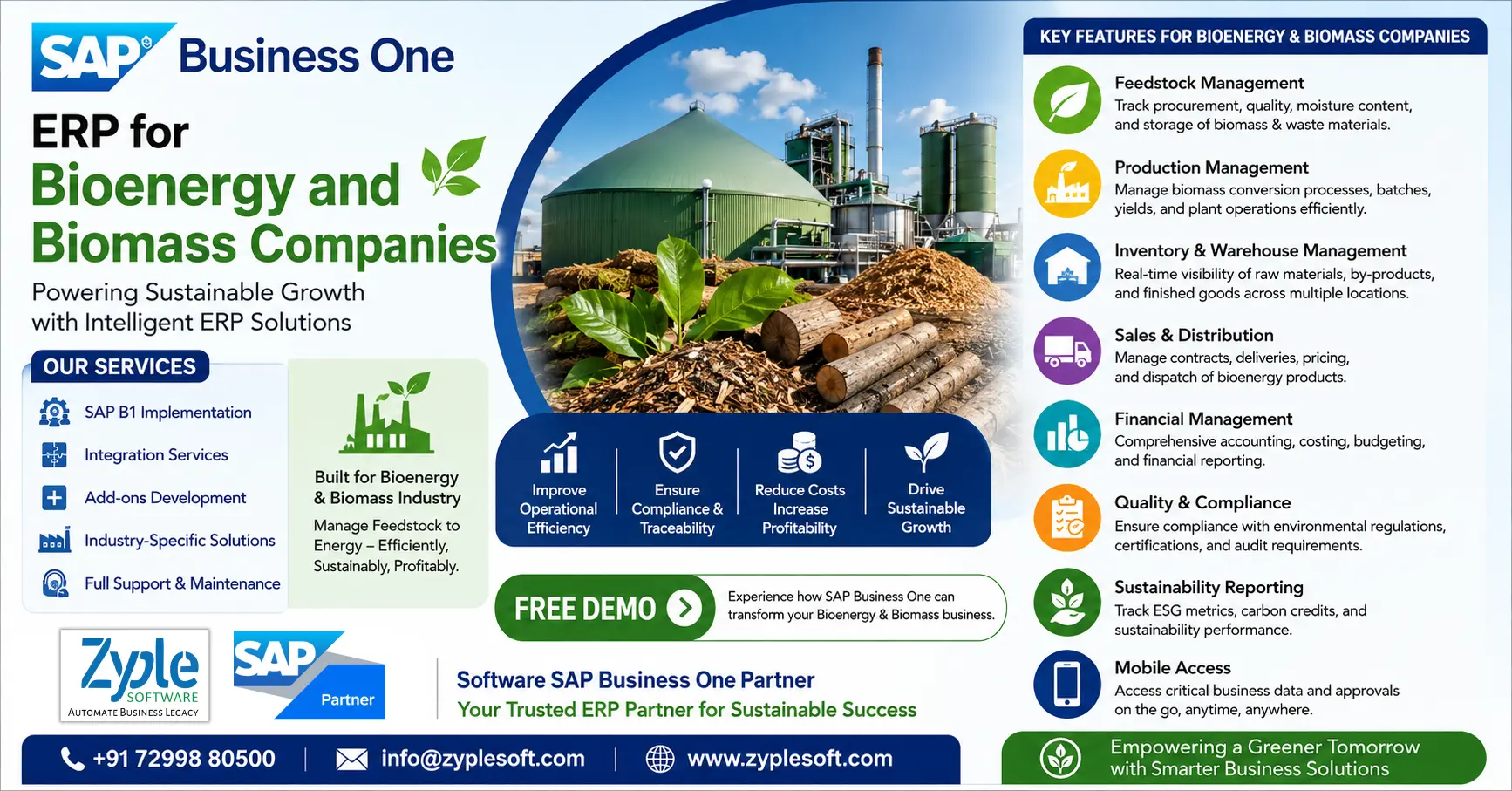
            SAP Business One ERP for Bioenergy and Biomass Companies

            SAP Business One ERP for Bioenergy and Biomass Companies

            SAP Business One ERP for Bioenergy and Biomass Industries

            SAP Business One ERP for Bioenergy and Biomass Companies

            The bioenergy and biomass industry has been around for centuries and continues to play an essential role in the global economy. However, the industry faces significant challenges, such as rising costs, increased competition, and evolving consumer demands. SAP Business One ERP for bioenergy and biomass companies can facilitate operations, optimize resources, and enable better decision-making.

            Challenges Faced By The Bioenergy and Biomass Companies

            The bioenergy and biomass companies face significant challenges, mainly driven by inconsistent supply chains, volatile raw material costs, and technological scalability. Low energy density and high moisture content can make transporting and storing feedstock expensive, while strict environmental regulations and evolving subsidies affect long-term financial viability.

            1. Supply Chain and Logistics

            Sourcing raw materials (e.g., agricultural residues and forestry waste) is heavily seasonal, resulting in supply inconsistencies and fluctuating fuel prices. Because raw biomass has low energy density, transporting wet or large feedstock over long distances is energetically unfavorable and cost-prohibitive.

            2. Technological Immaturity and Scale

            Transforming tough biorenewable biomass into high-grade biofuels or bioproducts is difficult due to defiant structures like lignin, involving complex, expensive pretreatment. Scaling these operations to match the output of petroleum refineries remains highly challenging.

            3. Policy and Regulatory Uncertainty

            The industry depends heavily on subsidies and carbon pricing frameworks. Changes in government policies, such as alterations to the EU’s Renewable Energy Directive or local tariff policies, create investment risks and complicate long-term operational feasibility.

            4. Land and Food Competition

            Using steady energy crops (e.g., corn and sugarcane) for first-generation biofuels often sparks concerns over food vs. fuel debates and land-use changes that can diminish biodiversity.

            5. Operational Risks

            Processing dry mass is an inherently difficult operation that carries severe risks of fire and explosion, demanding expensive built-in suppression technology and strict plant maintenance.

            Features of SAP Business One ERP for Bioenergy and Biomass Companies

            1. Financial and Cost Management

            • It includes general ledger and accounts payable and receivable automation.
            • Biomass project tracking, like feedstock, logistics, and processing.
            • It includes profitability analysis by plant, fuel type, or region.
            • It includes fixed asset management for machinery, boilers, and turbines.
            • It includes cash flow and investment monitoring.
            • SAP B1 modules delivers complete financial control and reporting for better decision-making.

            2. Raw Material (Biomass) Procurement Management

            • It includes vendor management for farmers, suppliers, and aggregators.
            • Procurement planning for biomass products like wood chips, agri-waste, and pellets.
            • It includes contract management with seasonal pricing.
            • Quality-based procurement like moisture percentage and calorific value.
            • It includes multi-location sourcing and supplier comparison.
            • It includes automated purchase orders and approvals.
            • Facilitates the entire procure-to-pay cycle efficiently.

            3. Inventory and Warehouse Management

            • It includes real-time tracking of biomass stock across yards and warehouses.
            • It includes batch and lot tracking for different biomass types.
            • Storage condition monitoring for moisture-sensitive materials.
            • It includes multi-warehouse and yard management.
            • It includes inventory valuation and wastage tracking.
            • It includes stock aging and shelf-life analysis.
            • Inventory and warehouse processes are completely integrated with accounting and operations.

            4. Production and Processing Management

            • It includes production order management for processing units.
            • It includes process tracking from raw biomass to finished energy product.
            • It includes by-product and waste management tracking.
            • It includes machine utilization and downtime tracking.
            • It includes energy output vs. input efficiency monitoring.
            • The production module allows structured manufacturing and process control.

            5. Material Requirements Planning (MRP)

            • It includes demand forecasting for biomass fuel.
            • It includes automated raw material planning based on production schedules.
            • Seasonal demand planning like winter fuel demand spikes.
            • It includes procurement recommendations based on stock levels.
            • Avoids stockouts or overstocking.
            • MRP helps improve procurement and production planning.

            6. Sales and Distribution Management

            • It includes sales order and contractor management for energy buyers.
            • It includes pricing management based on fuel type and calorific value.
            • Customer segmentation like industrial, power plants, and utilities.
            • It includes dispatch planning and delivery tracking.
            • It includes invoice generation and receivables tracking.
            • It includes export management for international biofuel supply.
            • It includes the entire sales cycle from quotation to payment.

            7. Logistics and Supply Chain Management

            • It includes transportation planning for biomass collection and delivery.
            • It includes route optimization for low-cost optimization.
            • It includes freight and landed cost calculations.
            • It includes integration with weighbridge systems.
            • It includes real-time shipment tracking.
            • It includes fleet and fuel consumption monitoring.

            8. Quality and Compliance Management

            • Quality testing for biomass like moisture, ash content, and calorific value.
            • It includes environmental compliance tracking.
            • Regulatory reporting like renewable energy norms and emissions.
            • Certification management like ISO and sustainability certifications.
            • It includes audit trails and documentation.

            9. Asset and Plant Maintenance

            • It includes maintenance scheduling for boilers, turbines, and conveyors.
            • It includes preventive and breakdown maintenance tracking.
            • It includes spare parts inventory tracking.
            • It includes equipment lifecycle tracking.
            • It includes downtime analysis and optimization.

            10. Project and Plant Management

            • It includes project costing for new bioenergy plants.
            • It includes CAPEX and OPEX tracking.
            • It includes resource allocation for plant setup.
            • It includes timeline and milestone monitoring.
            • It includes ROI tracking for renewable energy projects.

            11. CRM and Customer Lifecycle Management

            • Handles relationships with energy buyers and partners.
            • Tracks leads, contracts, and negotiations.
            • It includes service and support management.
            • It includes customer demand forecasting.
            • It includes after-sales service tracking.
            • SAP software includes complete CRM capabilities integrated with sales and service.

            12. Business Intelligence and Analytics

            • It includes real-time dashboards for production, sales, and finance.
            • KPI tracking like plant efficiency, yield, and cost per ton.
            • It includes predictive analytics for demand and supply.
            • It includes custom reports for management insights.
            • Allows data-driven decision-making with real-time insights.

            13. Sustainability and Energy Monitoring

            • Tracks renewable energy production output.
            • It includes carbon footprint and emission tracking.
            • It includes waste utilization and circular economy metrics.
            • It includes energy efficiency analysis.
            • It includes government subsidy and incentive tracking.

            14. Multi-Plant and Multi-Location Management

            • It includes centralized control over multiple biomass plants.
            • It includes inter-plant stock transfers.
            • Integrated financial reporting.
            • It includes regional performance comparison.

            15. Mobile and Remote Access

            • It includes a mobile app for field teams and plant managers.
            • It includes real-time access to inventory, sales, and production data.
            • It includes remote approvals and monitoring.
            • SAP B1 ERP supports mobile and web-based access for flexibility.

            16. Integration and Customization

            • Integration with IoT devices like sensors and energy meters.
            • It includes SCADA system integration for plant monitoring.
            • It includes third-party logistics and weighbridge integration.
            • It includes custom SAP B1 add-ons for bioenergy operations.
            • It includes API-based integration with external platforms.

            Benefits of SAP Business One ERP for Bioenergy and Biomass Enterprises

            The ERP software, SAP Business One (SAP B1) system, facilitates bioenergy and biomass operations by unifying supply chain, production, finance, and compliance into a single platform. It drives profitability by improving feedstock procurement, ensuring batch traceability, allowing predictive maintenance on processing equipment, and automating sustainability and regulatory keeping.

            1. End-to-End Feedstock Traceability

            Handles complex supply chains by tracking raw material biomass (e.g., agricultural residue, forestry byproducts) from supplier origin through conversion into biofuels using batch and serial number tracking.

            2. Automated Material Requirements Planning (MRP)

            Optimizes production planning by evaluating incoming biomass quantities, inventory levels, and outstanding sales orders to automatically trigger procurement or conversion processes with the SAP implementation process.

            3. Integrated Financials and Job Costing

            Connects operational data directly to accounting systems to calculate accurate, real-time job costs, margins, and project profitability across multiple plants or facilities.

            4. Predictive Maintenance and Asset Tracking

            Integrates with IoT platforms to track heavy machinery like digesters, boilers, and turbines. This automates maintenance schedules and avoids costly downtime using SAP solutions.

            5. Regulatory Compliance and ESG Reporting

            Simplifies audits and proves adherence to strict environmental standards by utilizing built-in tools to measure, document, and report on sustainability KPIs and carbon emissions.

            Conclusion of Bioenergy and Biomass ERP

            As an experienced SAP Business One partner in India, Zyple Software is delivering services like SAP B1 implementation, licensing, integration, add-ons, and support to different industries, like construction, manufacturing, solar, jewellery, food and beverage, aerospace, retail, pharma, and textiles. 

            SAP Business One is an ERP customized for small and medium-sized businesses that connects finance, production, procurement, inventory, sales, CRM, and reporting into one platform. For bioenergy and biomass or any other companies, it can improve project costing, procurement, subcontractor billing, and inventory management.

            If you’re interested, enroll a demo of SAP Business One.

            Do you look for the SAP B1 ERP software for your business or industry?

            Finish all the details in the arranged contact form; our team will get back to you.

              FAQs

              1.How can SAP Business One ERP improve efficiency in bioenergy and biomass operations?

              SAP Business One facilitates procurement, production, inventory, and financial processes into a single system, minimizing manual work and improving operational efficiency. It helps bioenergy companies improve biomass usage, minimize waste, and increase overall productivity.

              Yes, SAP Business One can be customized for meeting the specific needs of bioenergy companies, including biomass tracking, plant operations, compliance reporting, and energy production management, ensuring a perfect fit for your business.

              The cost depends on factors like number of users, deployment type (like cloud or on-premises), customization requirements, and implementation scope. A certified SAP Business One partner like Zyple Software can deliver a complete and accurate quotation based on your business needs.

              SAP B1 implementation timelines generally range from a few weeks to a few months, depending on business complexity, number of modules, and customization requirements. A structured SAP implementation approach ensures minimal disruption to your operations.

              You can request a free demo from an SAP Business One partner like Zyple Software to understand how the solution fits your bioenergy operations. The demo will showcase key features, industry-specific capabilities, and how it can handle your business challenges.

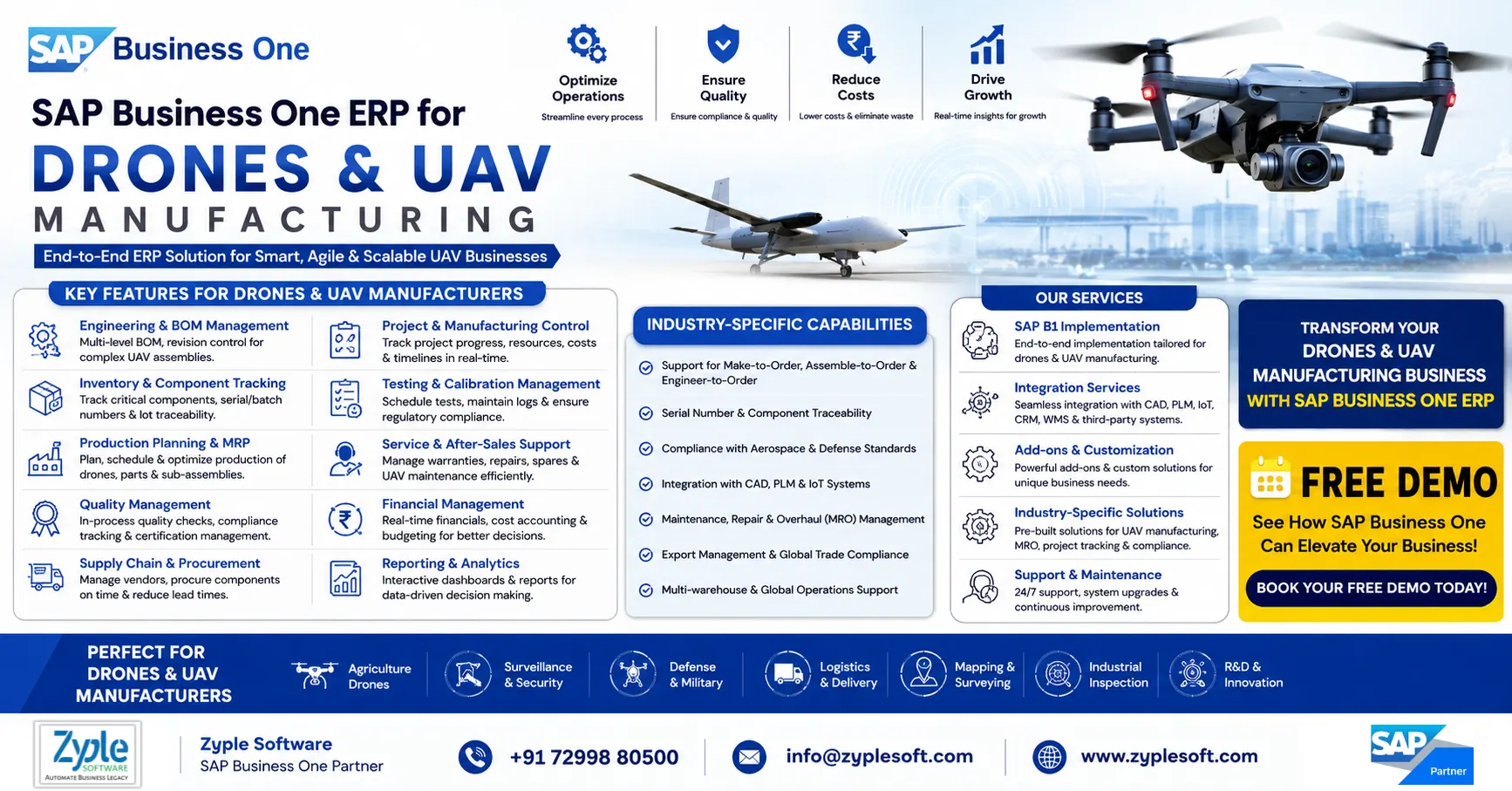
              SAP Business One ERP for Drones and UAV Manufacturing by Zyple Software featuring production planning, inventory management, BOM, quality control, serial number traceability, compliance, and manufacturing automation.

              SAP Business One ERP for Drones and UAV Manufacturing

              SAP Business One (B1) ERP for Drones and UAV Manufacturing

              SAP Business One ERP for Drones and UAV Manufacturing by Zyple Software featuring production planning, inventory management, BOM, quality control, serial number traceability, compliance, and manufacturing automation.

              The drones and UAV manufacturing industry, which includes things like aerial photography, surveillance, and farming, is growing. While drones are excellent, running a business in the drones and UAV manufacturing industry can be tricky. Handling everything from fleet coordination to regulatory compliance can become overwhelming. SAP Business One ERP for drones and UAV manufacturing can help drones and UAV manufacturing companies to simplify their work and reach new levels of success.

              Issues Faced By The Drones and UAV Manufacturing Sector

              The drones and UAV manufacturing industry faces significant challenges across supply chain dependencies, regulatory obstacles, and engineering limitations. Manufacturers struggle with reliance on imported microchips, sensors, and battery cells; scaling production without inflating costs; and complying with fragmented global airspace and certification rules.

              1. Supply Chain and Component Dependency

              Many regional UAV manufacturers depend heavily on foreign suppliers for essential components like GPS modules, battery cells, semiconductors, and high-performance cameras. This dependency creates serious vulnerabilities regarding both national security and supply chain disruptions. Developing an independent, domestically sourced non-red supply chain requires massive capital investment.

              2. Regulatory and Compliance Constraints

              Despite the rapid growth of the commercial drone market, government regulations often lag behind. Manufacturers face inconsistent airspace management, delays in gaining airworthiness certifications, and strict export controls. Navigating the complexities of local, national, and international laws significantly increases time-to-market.

              3. Engineering and Technological Challenges

              Designers continuously battle the trade-off between weight reduction and structural durability. Drones must be lightweight to increase flight efficiency and payload, yet powerful enough to withstand harsh environmental conditions. Also, improving battery endurance for continuous, long-range missions remains a primary engineering constraint.

              4. Privacy, Security, and Public Perception

              Because of the dual-use nature of UAVs, manufacturers face scrutiny regarding privacy, hacking, and unauthorized data collection. Instances of hobbyist drones entering restricted zones or being used for illegal activities lead to strict regulations and public skepticism.

              5. Skilled Workforce Shortage

              The rapid integration of artificial intelligence, edge computing, and 5G into drone platforms involves highly specialized knowledge. The industry faces a shortage of professional drone engineers, AI developers, and trained operators.

              Features of SAP Business One ERP for Drones and UAV Manufacturing

              1. Production Planning and Control (UAV Assembly)

              • Multi-level bill of materials (BOM) for drone components like motors, sensors, PCBs, and frames.
              • Routing and stage-wise production like assembly, testing, and calibration.
              • Production order creation, like manual or automated, from sales orders.
              • It includes real-time tracking of work-in-progress (WIP).
              • Assembly and sub-assembly, like propulsion systems and flight controllers.
              • It includes rework and repair order handling for defective UAV units.

              2. Material Requirements Planning (MRP)

              • It includes automated material planning based on demand forecasts.
              • Component shortage alerts for essential UAV parts like chips and batteries.
              • It includes procurement recommendations using the planning wizard.
              • It includes demand-supply balancing for high-value electronic components.
              • It includes lead time planning for imported drone parts.

              3. Inventory and Warehouse Management

              • Multi-warehouse management for raw materials, assembly, and finished drones.
              • It includes batch and serial number tracking for UAV traceability.
              • It includes real-time inventory visibility across locations.
              • It includes stock valuation and costing.
              • It includes inventory traceability for compliance and safety.

              4. Engineering and Product Lifecycle Support

              • It includes version control for drone designs and BOM revisions.
              • It includes engineering change management.
              • It includes prototype vs. production BOM handling.
              • It includes integration with CAD or PLM systems via add-ons.
              • Product configuration for different drone variants for defense, agriculture, and surveillance.

              5. Financial Management and Costing

              • End-to-end accounting like general ledger, accounts payable, and accounts receivable.
              • It includes profitability analysis per UAV model.
              • It includes budgeting and cost control for R&D projects.
              • It includes fixed asset management for machinery and testing equipment.

              6. Procurement and Supplier Management

              • It includes vendor management for electronics, sensors, and components.
              • It includes purchase order automation and approvals.
              • It includes supplier performance tracking.
              • Import management like duties, taxes, and multi-currency.
              • It includes quality-based vendor selection.

              7. Quality Control and Compliance

              • Incoming quality checks for components like battery safety and sensors.
              • It includes in-process inspection during UAV assembly.
              • It includes final testing and certification tracking.
              • It includes non-conformance and corrective action management.
              • It includes compliance with aerospace and defense standards.
              • It includes full product traceability for audits.

              8. Sales, CRM, and Project Management

              • It includes quotation management for customized UAV solutions.
              • Customer lifecycle tracking like defense, agriculture, and logistics clients.
              • Project-based sales like large UAV contracts.
              • It includes after-sales service and AMC tracking.

              9. Service and Maintenance Management

              • It includes UAV repair and maintenance tracking.
              • It includes warranty management for drones and components.
              • It includes service contracts and field service management.
              • It includes spare parts tracking and replacement history.
              • It includes maintenance schedules for deployed drains.

              10. Business Intelligence and Analytics

              • It includes real-time dashboards and KPIs.
              • It includes production efficiency and yield analysis.
              • It includes cost vs. revenue insights for every drone model.
              • It includes predictive analytics using SAP B1 HANA.
              • It includes custom reports and drill-down analysis.

              11. Supply Chain and Logistics Management

              • It includes end-to-end supply chain visibility.
              • It includes shipment and delivery tracking.
              • It includes integration with logistics partners.
              • It includes export documentation for international drone sales.
              • It includes demand forecasting and distribution planning.

              12. Mobility and Remote Access

              • It includes a web client for remote operations.
              • It includes real-time updates from the shop floor or warehouses.

              13. Integration and Industry 4.0 Capabilities

              • Integration with IoT devices like drone testing data and sensors.
              • It includes API-based integration with external systems.
              • It includes machine data collection from testing rigs.
              • It includes automation of workflows and approvals.
              • It includes cloud or on-premise deployment flexibility.

              14. Human Resource and Workforce Management

              • It includes employee data and workforce tracking.
              • It includes skill-based allocation for UAV assembly technicians.
              • It includes attendance and productivity monitoring.
              • It includes training management for specialized drone operations.

              15. Security and Data Management

              • It includes role-based access control.
              • It includes data encryption and secure transactions.
              • It includes audit trails for compliance.
              • It includes backup and disaster recovery.

              Benefits of SAP Business One ERP for Drones and UAV Manufacturing

              The ERP software, SAP Business One (SAP B1) system, facilitates the entire lifecycle of drone and UAV manufacturing by integrating design, production, supply chain, and financials. It helps businesses reduce margin surprises, comply with strict aviation safety compliances, and track components from raw material to final deployment.

              1. End-to-End Traceability and Compliance

              It tracks every part, batch, and serial number across the supply chain with the SAP implementation process. It securely stores compliance documents and ensures adherence to strict aviation standards (like AS9100 and DGCA regulations).

              2. Intelligent Production and BOMs

              Handles deeply nested, multi-level Bills of Materials (BOMs) and supports engineering change orders (ECOs) to safely apply rapid design upgrades to your drones.

              3. Automated Material Requirements Planning (MRP)

              Automatically calculates exactly what metals, composites, and electronics are required based on sales orders and forecasts, avoiding stock shortages or expensive excess inventory using SAP solutions.

              4. Project-Based Costing

              Treats every UAV build or defense contract as an individual project. It ties production to financials so you can closely evaluate the profitability of custom or large-scale orders.

              5. Real-Time Quality Control

              Connects quality checkpoints directly into the shop floor assembly process, logging inspection results and digital certificates at every stage.

              Conclusion of Drones and UAV Manufacturing ERP

              As a leading SAP Business One partner, Zyple Software is delivering services like SAP B1 implementation, licensing, integration, add-ons, and support to different industries, like construction, manufacturing, solar, aerospace, jewellery, food and beverage, retail, pharma, and textiles. 

              SAP Business One is an ERP customized for small and medium-sized businesses that connects finance, procurement, production, sales, CRM, inventory, and reporting into one platform. For drones and UAV manufacturing or any other companies, it can improve project costing, procurement, subcontractor billing, and inventory management.

              If you’re captivated, Book a SAP Business One Demo.

              Do you seek the SAP B1 ERP system for your business or industry?

              Finish all the details in the assigned contact form; our team will return to you.

                FAQs

                1.How can SAP Business One ERP improve efficiency in drone manufacturing operations?

                SAP Business One facilitates production planning, inventory control, and procurement processes, helping drone manufacturers minimize delays, optimize resources, and improve overall operational efficiency.

                Yes, SAP Business One is specifically customized for SMEs. It provides scalable features that help growing UAV businesses handle production, finances, and supply chain operations without complexity.

                Absolutely. SAP Business One delivers batch and serial number tracking, along with quality management features to ensure every drone component meets required standards and compliance.

                The cost depends on factors, such as number of users, customization, and deployment type. However, SAP Business One is affordable compared to traditional ERP systems and delivers strong ROI through improved efficiency and reduced operational costs.

                You can connect with a certified SAP Business One partner like Zyple Software to get a personalized demo, consultation, and pricing details customized for your drone manufacturing business requirements.

                SAP Business One ERP for Mineral Industry

                SAP Business One ERP for Mineral Industry

                SAP Business One ERP for Mineral Industry

                SAP Business One ERP for Mineral Industry

                The mineral industry is fast-paced and depends heavily on data. Mineral companies handle drilling schedules, blasting records, fleet operations, fuel usage, quarry production, material movement, and environmental compliance, all while ensuring maximum output and worker safety. SAP Business One ERP for mineral industry helps mineral companies improve their operations and grow sustainably.

                Challenges Faced By The Mineral Industry

                The mineral industry is undergoing a massive transformation, largely driven by increasing demand for essential minerals required for the clean energy transition. Today, mineral companies face a complex web of environmental, operational, and geopolitical challenges that threaten both profitability and sustainability growth.

                1. Environmental and Sustainability Demands

                The sector is heavily scrutinized for its environmental impact, including land degradation, water contamination, and greenhouse gas emissions. Achieving strict sustainability standards and transitioning to green mining practices is a major, yet necessary, operational shift.

                2. Declining Ore Grades and Cost Escalations

                Naturally occurring ore grades are dropping, meaning companies must process more rock to extract the same amount of valuable minerals. This involves exploring in more remote locations, which increases project costs and ongoing operational expenses.

                3. Geopolitical and Supply Chain Risks

                Trade conflicts, shifting government policies, and global tensions directly interrupt the supply of raw materials and technology. Geopolitical shifts and resource shortages have heightened supply chain risks for essential commodities like lithium and rare earths.

                4. The Skills Gap and Knowledge Loss

                As veteran miners retire, the industry faces an ongoing shortage of experienced workers who understand complex, modern mining technologies. Operating in remote locations further aggravates the difficulty of attracting and retaining specialized talent.

                5. Health, Safety, and Operational Hazards

                Mining requires inherently hazardous working conditions and complex geological formations. Ensuring worker safety around heavy machinery, explosives, and confined spaces remains a major, non-negotiable priority.

                6. Social License to Operate and Regulatory Compliance

                Mining projects are increasingly delayed by complex regulatory permitting and community opposition. Companies must navigate evolving regulations while building trust with local communities and indigenous populations who are directly affected by land use.

                Features of SAP Business One ERP for Mineral Industry

                1. Exploration and Mine Planning Management

                • It includes geological data tracking and mineral resource estimation.
                • It includes long-term and short-term mine planning.
                • It includes budgeting for exploration and feasibility studies.
                • It includes integration with survey and drilling data.
                • It includes capital expenditure (CAPEX) planning for mining projects.
                • Helps handle the entire lifecycle from exploration to production.

                2. Production and Extraction Management

                • It includes track drilling, blasting, excavation, and hauling.
                • Monitors ore extraction volumes and grades.
                • It includes crushing, screening, and beneficiation process tracking.
                • It includes production planning and scheduling.
                • It includes real-time production data collection.
                • SAP supports optimization of mining processes and production planning.

                3. Inventory and Stockpile Management

                • It includes raw material (ore), processed minerals, and by-product tracking.
                • Batch-wise and location-wise inventory, like stockpiles, yards, and warehouses.
                • It includes quality and grade-based inventory classification.
                • It includes automatic stock updates from weighbridge integration.
                • It includes minimum and maximum stock level alerts.

                4. Supply Chain and Logistics Management

                • End-to-end logistics from mine, plant, and port to customer.
                • It includes transport and fleet management.
                • It includes route planning and shipment tracking.
                • It includes bulk material handling and dispatch planning.
                • It includes vendor and contractor coordination.
                • It ensures a resilient supply chain and logistics optimization.

                5. Financial and Cost Management

                • It includes mine-wise and project-wise costing.
                • It includes production cost per ton analysis.
                • It includes budget vs. actual comparisons.
                • It includes asset depreciation and capital tracking.
                • Multi-location financial integration.
                • It includes GST and tax compliance.
                • Allows real-time financial visibility and forecasting.

                6. Asset and Equipment Management

                • Maintenenace scheduling, like preventive and breakdown.
                • It includes equipment lifecycle tracking.
                • It includes spare parts inventory management.
                • It includes machine downtime analysis.
                • It includes fuel consumption tracking.
                • Improves asset uptime and minimizes operational costs.

                7. Workforce and Contractor Management

                • It includes employee scheduling and shift planning.
                • It includes contractor and labor management.
                • It includes attendance and payroll integration.
                • It includes safety certifications and compliance tracking.
                • It includes workforce productivity analysis.
                • It supports workforce optimization and safety culture.

                8. Compliance, Safety, and Environmental Management

                • It includes mining permits and license tracking.
                • Environmental compliance, like pollution and land usage.
                • It includes safety incident reporting and audits.
                • It includes ESG (Environmental, Social, and Governance) reporting.
                • It includes regulatory documentation management.
                • Helps achieve strict mining regulations and sustainability goals.

                9. Sales, Contracts, and Commodity Management

                • Mineral sales contracts and pricing, like grade-based pricing.
                • It includes customer order management.
                • It includes dispatch, billing, and invoicing automation.
                • It includes commodity trading and contract lifecycle management.
                • It includes customer relationship management (CRM).

                10. Real-Time Analytics and Reporting

                • It includes real-time dashboards for production, finance, and logistics.
                • KPI tracking like cost per ton, output efficiency, and downtime.
                • It includes custom MIS and regulatory reports.
                • It includes data-driven decision-making.
                • Allows data-driven insights and performance optimization.

                11. Integrated End-to-End ERP Platform

                • It includes a single system integrating finance, production, inventory, and sales.
                • Eliminates data storage across departments.
                • It includes cloud or on-premise deployment.
                • It includes integration with IoT, weighbridges, GPS, and third-party tools.
                • Delivers enterprise-wide planning, execution, and reporting.

                Importance of SAP Business One ERP for Mineral Industry

                The ERP software, SAP Business One, is essential for the mineral industry, as it unifies disconnected operations into a single platform. It delivers immediate value by handling heavy machinery assets, optimizing complex supply chains, ensuring strict regulatory compliance, and centralizing real-time data for accurate financial and production planning.

                1. Integrated Financial Management

                Delivers robust budgeting, audit-ready reporting, and precise fixed-asset tracking to manage heavy extraction equipment and depreciation with the SAP implementation process.

                2. Supply Chain and Inventory Optimization

                Maintains optimal stock levels for essential spare parts and mining supplies to prevent costly production downtimes.

                3. Compliance and Safety

                Facilitates documentation and auditable data to help mining companies effortlessly meet strict environmental and labor regulations.

                4. Material Requirements Planning (MRP)

                Improves resource utilization by intelligently handling raw materials and aligning procurement with production schedules using SAP solutions.

                5. Real-Time Dashboards

                Replaces scattered spreadsheets with centralized analytics, providing leaders a clear mine-to-market view of cost performance and operational efficiency.

                Benefits of SAP Business One for Mining Industry

                SAP Business One (SAP B1) facilitates capital-intensive mining operations by integrating core processes like extraction planning, heavy equipment maintenance, procurement, and financial tracking. It delivers real-time data to help mining companies control costs, optimize supply chains, and ensure strict regulatory and ESG compliance.

                1. Financial Management and Cost Control

                The SAP software accurately tracks real-time costs of fuel, labor, and machinery. It uses built-in budgeting and profitability analyses to monitor expenses across individual projects or specific mine sites.

                2. Asset and Equipment Maintenance

                Reduces costly unplanned downtime by scheduling predictive and preventive maintenance for heavy mining machinery. Tracks equipment lifecycles and evaluates repair histories efficiently.

                3. Inventory and Supply Chain Orchestration

                Maintains optimal stock levels of crucial consumables and spare parts using SAP B1 add-ons. Facilitates procurement processes from purchase requests to supplier contracts and payment management.

                4. Regulatory and ESG Compliance

                Simplifies reporting for stringent labor laws and environmental standards. Captures safety logs and sustainability metrics to ensure audit readiness.

                5. Data-Driven Production Planning

                Uses production planning and integrated analytics to optimize extraction schedules based on market demand and resource availability.

                Conclusion of Mineral ERP

                As a qualified SAP Business One partner, Zyple Software is delivering services like SAP B1 implementation, licensing, integration, add-ons, and support to different industries, like construction, manufacturing, solar, jewellery, food and beverage, aerospace, retail, pharma, and textiles. 

                SAP Business One is an ERP customized for small and medium-sized businesses that connects finance, production, procurement, inventory, sales, CRM, and reporting into one platform. For mineral or any other companies, it can improve project costing, procurement, subcontractor billing, and inventory management.

                If you’re adaptable, appoint a demo of SAP Business One.

                Do you look for the SAP B1 ERP solution for your business or industry?

                Finish all the details in the arranged contact form; our team will reach out to you.

                  FAQs

                  1.What is SAP Business One and how does it benefit the mineral industry?

                  SAP Business One is an integrated ERP solution customized for small and midsize businesses. For the mineral industry, it helps handle mining operations, inventory, procurement, sales, finance, and compliance in one system, improving efficiency and reducing operational costs.

                  Yes, SAP Business One delivers real-time inventory tracking, batch and serial number management, and warehouse control. It enables mineral businesses to handle stockpiles, track material movement, and reduce losses due to mismanagement or theft.

                  SAP Business One supports production planning, resource allocation, and equipment utilization. It helps evaluate extraction processes, handle raw material usage, and optimize production cycles to improve output and profitability.

                  Absolutely. The system helps maintain accurate records, generate compliance reports, and monitor environmental and safety regulations. This ensures your business stays adherent to industry standards and government policies.

                  You can start by consulting a certified SAP Business One partner like Zyple Software who will evaluate your business needs, provide a demo, and guide you through implementation, customization, and support to ensure a smooth digital transformation.

                  Best ERP Software for Manufacturing in India using SAP Business One

                  Best ERP Software for Manufacturing in India (2026 Complete Guide)

                  Best ERP Software for Manufacturing in India - SAP Business One

                  Best ERP Software for Manufacturing in India using SAP Business One

                  Manufacturing in India is evolving rapidly. Rising raw material costs, increasing customer expectations, strict compliance requirements, and global competition are forcing manufacturers to move beyond spreadsheets and disconnected software. Whether you manufacture automotive components, pharmaceuticals, food products, machinery, textiles, chemicals, electronics, or fabricated metals, having the right ERP software is no longer optional but it’s essential. In this comprehensive guide, we will explore the best ERP software for manufacturing in India, the features you should look for, implementation considerations, pricing factors, and why SAP Business One has become one of the most preferred ERP solutions for small and medium-sized manufacturers.

                  What is Manufacturing ERP Software?

                  Manufacturing ERP (Enterprise Resource Planning) software is an integrated business management system that connects every department of your manufacturing business into one centralized platform.

                  Instead of managing separate software for production, inventory, finance, purchasing, sales, quality, and warehouse operations, an ERP system provides a single source of truth.

                  A manufacturing ERP helps businesses:

                  • Plan production efficiently
                  • Track raw materials and finished goods
                  • Reduce inventory costs
                  • Improve on-time delivery
                  • Monitor machine utilization
                  • Control manufacturing costs
                  • Automate purchasing
                  • Manage vendors
                  • Improve financial visibility
                  • Make faster business decisions

                  Why Indian Manufacturers Need ERP Software?

                  Many manufacturers still rely on Excel sheets, manual processes, and disconnected applications.
                   
                  This creates several challenges:
                  • Inventory mismatches
                  • Stock shortages
                  • Excess inventory
                  • Delayed production
                  • Poor production planning
                  • Inaccurate costing
                  • Manual purchase approvals
                  • Difficult GST compliance
                  • Lack of real-time reports
                  • Limited visibility across multiple plants
                  An ERP system eliminates these challenges by automating and integrating business processes.
                   

                  Key Features to Look for in Manufacturing ERP

                  When selecting ERP software, ensure it includes the following capabilities.

                  1. Production Planning

                  Plan production based on:

                  • Sales Orders
                  • Demand Forecasts
                  • Available Inventory
                  • Capacity Planning
                  • Material Availability

                  2. Material Requirements Planning (MRP)

                  MRP helps manufacturers automatically calculate:
                  • Raw material requirement
                  • Purchase quantities
                  • Production schedules
                  • Stock shortages
                  • Supplier requirements
                  This reduces stock-outs and overstocking.

                  3. Bill of Materials (BOM)

                  An ERP should support:
                  • Multi-level BOM
                  • Alternate BOM
                  • Revision control
                  • Engineering changes
                  • Cost calculation

                  4. Production Orders

                  Manage:
                  • Work Orders
                  • Routing
                  • Stage-wise production
                  • Machine allocation
                  • Labor tracking
                  • Production completion

                  5. Inventory Management

                  Real-time inventory tracking includes:
                  • Batch Management
                  • Serial Number Tracking
                  • Bin Locations
                  • Multiple Warehouses
                  • Stock Transfers
                  • Goods Receipt
                  • Goods Issue
                  • Cycle Counting

                  6. Procurement Management

                  Automate purchasing through:
                  • Purchase Requests
                  • RFQs
                  • Purchase Orders
                  • Vendor Comparison
                  • Goods Receipt
                  • Vendor Performance

                  7. Sales & Customer Management

                  Manage:
                  • Quotations
                  • Sales Orders
                  • Dispatch
                  • Invoicing
                  • Customer Credit Limits
                  • CRM

                  8. Quality Control

                  Quality modules should support:
                  • Incoming Inspection
                  • In-process Inspection
                  • Final Inspection
                  • Rejection Analysis
                  • NCR Management
                  • CAPA

                  -9. Warehouse Management

                  Modern ERP systems include:
                  • Barcode Scanning
                  • Mobile Inventory
                  • Warehouse Transfers
                  • Pick Lists
                  • Packing
                  • Shipping

                  10. Financial Management

                  Complete financial integration including:
                  • General Ledger
                  • Accounts Payable
                  • Accounts Receivable
                  • Banking
                  • GST
                  • Fixed Assets
                  • Cost Centers
                  • Budgeting

                  Best ERP Software for Manufacturing in India

                  SAP Business One

                  SAP Business One is one of the leading ERP solutions for small and medium-sized manufacturers in India.
                   
                  It integrates every business process into one system, including finance, manufacturing, purchasing, inventory, sales, CRM, service, analytics, and reporting.
                   

                  Manufacturing Features

                  • Material Requirements Planning (MRP)
                  • Production Orders
                  • Multi-Level BOM
                  • Batch Tracking
                  • Serial Number Management
                  • Production Costing
                  • Capacity Planning
                  • Quality Integration
                  • Warehouse Management
                  • Mobile Access
                  • Dashboards
                  • Approval Workflows
                  • Real-Time Analytics

                  Industries Supported

                  SAP Business One is widely used by:
                  • Automotive
                  • Engineering
                  • Machinery
                  • Food Processing
                  • Pharmaceuticals
                  • Chemicals
                  • Plastics
                  • Packaging
                  • Electrical Equipment
                  • Electronics
                  • Textile
                  • Furniture
                  • Metal Fabrication
                  • Wire & Cable
                  • Aerospace Suppliers

                  Advantages

                  • Global ERP from SAP
                  • Scalable as business grows
                  • Available on SAP HANA and Microsoft SQL
                  • Cloud and On-Premise deployment
                  • Strong partner ecosystem in India
                  • Extensive manufacturing add-ons
                  • Excellent reporting capabilities

                  Why SAP Business One Stands Out?

                  Unlike many ERP systems that require multiple third-party applications, SAP Business One provides an integrated platform.
                   
                  Manufacturers gain:
                  • Real-time dashboard
                  • Live inventory visibility
                  • Automated procurement
                  • Faster production planning
                  • Better customer service
                  • Reduced operational costs
                  • Improved profitability

                  Industries Using SAP Business One in India

                  SAP Business One is widely implemented across:
                  • Steel Manufacturing
                  • Wire Manufacturing
                  • Construction Materials
                  • Solar Manufacturing
                  • Pharmaceutical Manufacturing
                  • Food Manufacturing
                  • Dairy Processing
                  • Textile Manufacturing
                  • Furniture Manufacturing
                  • Packaging Industry
                  • Chemical Industry
                  • Electronics Manufacturing
                  • Industrial Equipment
                  • Auto Components
                  • Plastic Manufacturing

                  Benefits of Manufacturing ERP

                  A modern ERP solution delivers measurable business benefits.

                  Improved Inventory Accuracy

                  Track inventory in real time and eliminate manual errors.

                  Better Production Planning

                  Optimize production schedules and improve machine utilization.

                  Reduced Manufacturing Costs

                  Control material usage, labor costs, and production overhead.

                  Faster Decision Making

                  Real-time dashboards provide complete business visibility.

                  Improved Customer Satisfaction

                  Deliver products on time with accurate inventory and production planning.

                  Complete Financial Visibility

                  Finance, inventory, and production remain synchronized.

                  Regulatory Compliance

                  Simplify GST, audit trails, and financial reporting.
                   

                  Choosing the Right ERP

                  Before investing, evaluate the following:
                  • Industry-specific functionality
                  • Production complexity
                  • Number of users
                  • Number of manufacturing plants
                  • Scalability
                  • Mobile capabilities
                  • Reporting tools
                  • Integration options
                  • Implementation partner experience
                  • Post-implementation support

                  ERP Implementation Best Practices

                  Successful ERP implementation requires:
                   
                  1. Business process mapping
                  2. Data cleansing
                  3. Master data preparation
                  4. User training
                  5. Pilot testing
                  6. Go-live planning
                  7. Continuous optimization
                   
                  Selecting an experienced implementation partner is just as important as selecting the ERP software itself.

                  Why Choose Zyple Software for SAP Business One?

                  Zyple Software is an experienced SAP Business One partner helping manufacturers digitize their operations with industry-specific ERP solutions.
                   
                  Our services include:
                  • SAP Business One Implementation
                  • Manufacturing ERP Consulting
                  • SAP Business One Customization
                  • ERP Data Migration
                  • SAP Business One Integration
                  • Industry-Specific Add-ons
                  • Production Planning Solutions
                  • MRP Optimization
                  • SAP Business One License
                  • Warehouse Management
                  • User Training
                  • Annual Support & Maintenance
                  We serve manufacturers across engineering, construction materials, pharmaceuticals, food processing, chemicals, packaging, retail, aerospace, and many other industries.

                  Last Conclusion

                  Choosing the best ERP software for manufacturing in India is a strategic decision that impacts every aspect of your business—from procurement and production to inventory, finance, and customer satisfaction.
                   
                  For manufacturers looking for a scalable, proven, and feature-rich solution, SAP Business One offers a powerful platform that streamlines operations, improves productivity, and supports long-term growth. By partnering with an experienced implementation provider, businesses can accelerate deployment, reduce risks, and maximize return on investment.
                   
                  Book a FREE demo for SAP Business One with Zyple Software and discover how a modern manufacturing ERP can help improve efficiency, reduce costs, and drive profitable growth.
                   
                  If you are ready for ERP for manufacturing industry, fill your contact details in below form, Zyple team will contact you as soon as possible with better solution.

                    Frequently Asked Questions (FAQs)

                    Which ERP software is best for manufacturing in India?

                    SAP Business One is widely regarded as one of the best ERP solutions for small and medium-sized manufacturers due to its comprehensive manufacturing, inventory, finance, and production planning capabilities.

                    The cost depends on deployment type, number of users, implementation scope, customizations, and support requirements. A professional assessment helps determine the total investment.

                    Yes. Modern ERP solutions such as SAP Business One are specifically designed for growing small and medium-sized manufacturers.

                    Yes. Most modern ERP systems support multiple plants, warehouses, branches, and legal entities.

                    Yes. Leading ERP systems provide GST-compliant financial processes, taxation, invoicing, and reporting.

                    Yes. SAP Business One can integrate with barcode scanners, weighbridges, MES, IoT devices, quality systems, e-commerce platforms, and third-party business applications.

                    Generally between 8–20 weeks depending on project complexity.

                    Success Story: SAP Business One ERP Software for Manufacturing Industry implemented by Zyple Software

                    MRP Software with Weighbridge Integration

                    MRP Software with Weighbridge Integration: Eliminate Manual Errors and Automate Material Management

                    MRP Software with Weighbridge Integration: A Complete Guide for Industries

                    MRP Software with Weighbridge Integration

                    In industries, raw material accuracy directly impacts production planning, inventory valuation, procurement, and profitability. Yet many organizations still rely on manual weighbridge entries, paper slips, or disconnected software, resulting in inventory mismatches, production delays, and revenue leakage.

                    Integrating MRP (Material Requirements Planning) software with a weighbridge system eliminates these challenges by automatically capturing vehicle weights and updating ERP transactions in real time.

                    Whether you are in steel, cement, chemicals, mining, construction materials, food processing, agriculture, logistics, paper, plastics, or recycling, weighbridge integration helps create a seamless flow of information from gate entry to financial reporting.

                    What is MRP Software with Weighbridge Integration?

                    MRP software with weighbridge integration connects your electronic weighbridge directly with your ERP system.

                    Instead of manually entering weights into spreadsheets or ERP, vehicle weights are automatically transferred into the system during:

                    • Raw material receipt
                    • Finished goods dispatch
                    • Scrap movement
                    • Inter-plant transfer
                    • Customer delivery
                    • Vendor returns
                    • Production consumption

                    The result is a single source of truth for inventory, procurement, production, finance, and logistics.

                    How MRP Software Works with a Weighbridge?

                    A fully integrated solution automates the entire material movement process.

                    Step 1: Vehicle Registration

                    The vehicle enters the factory.

                    The operator selects:

                    • Supplier
                    • Customer
                    • Purchase Order
                    • Sales Order
                    • Material
                    • Transporter

                    Step 2: Automatic Weight Capture

                    The weighbridge captures:

                    • Gross Weight
                    • Tare Weight
                    • Net Weight

                    No manual typing required.

                    Step 3: ERP Validation

                    The ERP validates:

                    • Purchase Order quantity
                    • Delivery schedule
                    • Material code
                    • Vendor
                    • Customer
                    • Warehouse

                    Step 4: Inventory Update

                    Once validated:

                    • Goods Receipt Note (GRN) is created
                    • Inventory updates automatically
                    • Batch/Lot numbers assigned
                    • Stock valuation updated
                    • MRP recalculated

                    Step 5: Financial Posting

                    The ERP automatically generates:

                    • Inventory Journal
                    • Vendor Liability
                    • Cost Accounting Entry
                    • Financial Posting

                    No duplicate accounting work.

                    Step 6: Reporting

                    Management receives real-time reports including:

                    • Daily inward quantity
                    • Daily outward quantity
                    • Vehicle turnaround time
                    • Supplier performance
                    • Material consumption
                    • Stock availability
                    • Production planning

                    Key Features of MRP Software with Weighbridge Integration

                    Automatic Weight Capture

                    Vehicle weights are captured directly from the weighbridge indicator.

                    Purchase Order Integration

                    The system verifies incoming quantities against approved purchase orders.

                    Sales Order Integration

                    Outgoing dispatches are validated against customer orders.

                    Goods Receipt Automation

                    GRNs are generated instantly after successful weighing.

                    Goods Issue Automation

                    Finished goods dispatches update inventory automatically.

                    Real-Time Inventory

                    Every transaction updates inventory immediately.

                    Material Requirement Planning (MRP)

                    Updated inventory helps MRP calculate:

                    • Material shortages
                    • Purchase recommendations
                    • Production requirements
                    • Reorder levels

                    Production Planning

                    Production teams receive accurate raw material availability.

                    Warehouse Management

                    Warehouse stock remains synchronized with physical inventory.

                    Batch and Lot Tracking

                    Supports:

                    • Batch Management
                    • Lot Traceability
                    • Serial Number Tracking

                    CCTV Integration

                    Capture vehicle images automatically during weighing for enhanced security and audit trails.

                    Gate Pass Automation

                    Automatically generate:

                    • Inward Gate Pass
                    • Outward Gate Pass
                    • Dispatch Slip

                    QR Code & Barcode Support

                    Enable faster identification of:

                    • Materials
                    • Vehicles
                    • Drivers
                    • Purchase Orders

                    Multi-Weighbridge Support

                    Manage multiple weighbridges across:

                    • Factories
                    • Plants
                    • Branches
                    • Warehouses

                    Multi-Location Inventory

                    Track stock movement across different business locations in real time.

                    Approval Workflow

                    Approve exceptional transactions based on weight tolerances or predefined business rules.

                    Mobile Access

                    Managers can monitor:

                    • Vehicle movements
                    • Material receipts
                    • Dispatch status
                    • Inventory levels

                    from anywhere.

                    Benefits of MRP Software with Weighbridge Integration

                    Eliminate Manual Errors

                    Automatic data capture reduces typing mistakes.

                    Faster Material Receipt

                    Vehicles spend less time waiting at the weighbridge.

                    Accurate Inventory

                    Inventory always reflects actual material movement.

                    Better Production Planning

                    MRP calculations are based on accurate stock levels.

                    Reduced Material Loss

                    Prevent unauthorized material movement.

                    Faster Procurement Decisions

                    Procurement teams receive accurate replenishment recommendations.

                    Improved Customer Deliveries

                    Dispatch teams have accurate stock visibility.

                    Complete Traceability

                    Track every vehicle, weight, material, supplier, and customer.

                    Higher Operational Efficiency

                    Reduce paperwork and manual intervention.

                    Better Decision Making

                    Management dashboards provide real-time operational insights.

                    Industries That Benefit from Weighbridge Integration

                    This solution is ideal for:

                    • Steel Manufacturing
                    • Cement Plants
                    • Ready Mix Concrete (RMC)
                    • Infra Construction and Materials
                    • Mining
                    • Stone Crushers
                    • Chemicals
                    • Fertilizers
                    • Food Processing
                    • Dairy
                    • Rice Mills
                    • Sugar Mills
                    • Paper and Pulp
                    • Packaging
                    • Plastics
                    • Agriculture
                    • Recycling
                    • Waste Management
                    • Logistics
                    • Warehousing
                    • EPC Companies

                    SAP Business One MRP with Weighbridge Integration

                    SAP Business One offers powerful MRP capabilities that become even more effective when integrated with a weighbridge system.

                    The integrated solution enables:

                    • Automated Goods Receipt PO
                    • Automated Delivery
                    • Inventory synchronization
                    • Production planning
                    • Purchase planning
                    • Batch management
                    • Cost accounting
                    • Financial integration
                    • Real-time dashboards
                    • Mobile reporting
                    • Approval workflows
                    • Analytics and KPIs

                    This provides manufacturers with complete visibility across procurement, inventory, production, warehouse operations, sales, and finance from a single platform.

                    Why Choose Zyple Software?

                    Zyple Software specializes in SAP Business One implementation, customization, and weighbridge integration for construction, manufacturing and process industries.

                    Our expertise includes:

                    • SAP Business One Implementation
                    • Weighbridge Integration
                    • SAP Business One Add-ons
                    • MRP Optimization
                    • Production Planning
                    • Inventory Management
                    • Warehouse Automation
                    • CCTV Integration
                    • Gate Pass Automation
                    • Mobile Applications
                    • Business Intelligence Dashboards
                    • Ongoing SAP Support

                    We help businesses to improve operations with inventory accuracy, reduce manual work, and make data-driven decisions through integrated ERP solutions.

                    Go for Conclusion

                    For manufacturers dealing with bulk materials, MRP software with weighbridge integration is more than a convenience but it is a strategic investment. By automating weight capture, synchronizing inventory in real time, and connecting procurement, production, warehouse, logistics, and finance, businesses can reduce manual errors, improve planning accuracy, and increase operational efficiency.

                    When implemented with SAP Business One, this integration delivers end-to-end visibility, stronger inventory control, faster decision-making, and measurable productivity gains. Organizations looking to modernize their operations and support scalable growth can benefit significantly from an integrated MRP and weighbridge solution.

                    Frequently Asked Questions (FAQs)

                    1. What is weighbridge integration in ERP?

                    It connects the electronic weighbridge directly with the ERP system, enabling automatic weight capture and inventory updates without manual data entry.

                    By providing real-time inventory updates, MRP can generate more accurate purchase recommendations, production plans, and reorder calculations.

                    Yes. SAP Business One can integrate with most digital weighbridge indicators through customized connectors or certified add-ons.

                    Yes. Automated weight capture minimizes manual errors, improves stock accuracy, and reduces inventory variances.

                    Industries handling bulk materials such as steel, cement, mining, chemicals, food processing, agriculture, logistics, construction materials, and recycling gain significant benefits.

                    Yes. Many implementations combine weighbridge integration with CCTV image capture for enhanced security and compliance.

                    Yes. The solution can support multiple plants, warehouses, and weighbridges while providing centralized reporting.