Tag Archives: inventory management

What is ERP implementation – ERP implementation process, benefits, cost and best practices

What is ERP Implementation? A Complete Guide to ERP Implementation, Process, Cost, Benefits and Best Practices

What is ERP Implementation? A Complete Guide
What is ERP implementation – ERP implementation process, benefits, cost and best practices

ERP implementation is the process of planning, configuring, customizing, testing, deploying, and continuously supporting an Enterprise Resource Planning (ERP) system so that it fits an organization’s business processes and helps manage operations from a centralized platform.

For businesses evaluating ERP software, understanding what ERP implementation means, how the implementation process works, how much it costs, how long it takes, and what can cause an ERP project to fail is just as important as choosing the ERP product itself.

An ERP system can connect finance, sales, purchasing, inventory, production, projects, customer management, service, reporting, and other business functions. But buying ERP software alone does not create business value. The real value comes from implementing it correctly.

This guide explains ERP implementation from the perspective of business owners, CEOs, CFOs, CIOs, IT managers, and operational teams.

What is ERP Implementation?

ERP implementation is the structured process of introducing an ERP software system into a business and making it operational.

It typically includes:

  • Understanding current business processes
  • Defining ERP requirements
  • Selecting the appropriate ERP solution
  • Designing future business processes
  • Configuring the ERP system
  • Developing required customizations
  • Integrating other applications
  • Migrating existing data
  • Setting up users and permissions
  • Testing business processes
  • Training employees
  • Going live
  • Providing post-implementation support
  • Continuously improving the ERP environment

In simple terms:

ERP software is the technology. ERP implementation is the process of making that technology work for the business.

A successful ERP implementation should not simply replace spreadsheets or old software. It should improve how information flows through the organization.

Why is ERP Implementation Important?

As companies grow, information often becomes fragmented across spreadsheets, accounting software, CRM applications, emails, production systems, and department-specific tools.

This can create problems such as:

  • Duplicate data entry
  • Inaccurate reports
  • Inventory discrepancies
  • Delayed financial information
  • Poor visibility into profitability
  • Manual approvals
  • Difficulties tracking projects
  • Limited production visibility
  • Lack of real-time business information
  • Dependency on spreadsheets
  • Poor coordination between departments

ERP implementation addresses these problems by creating a connected business environment.

For example, when a sales order is entered into an ERP system, it can potentially affect inventory availability, purchasing requirements, production planning, delivery, invoicing, receivables, and financial reporting.

Instead of asking different departments for separate reports, management can work from a common source of business information.

How Does ERP Implementation Work?

Although every ERP project is different, a typical ERP implementation follows several stages.

1. Business Requirement Analysis

The implementation begins by understanding the organization.

The implementation team studies:

  • Company structure
  • Industries and business models
  • Existing applications
  • Current workflows
  • Approval processes
  • Reporting requirements
  • Financial processes
  • Inventory processes
  • Sales processes
  • Purchasing processes
  • Production requirements
  • Project management requirements
  • Integration requirements
  • Compliance requirements

The objective is to understand what the business actually needs, rather than simply configuring software based on assumptions.

2. ERP Planning and Project Definition

Once requirements are understood, the organization defines the implementation scope.

The project plan normally identifies:

  • Implementation objectives
  • Modules required
  • Locations and branches
  • Number of users
  • Data migration requirements
  • Integrations
  • Custom development
  • Project milestones
  • Responsibilities
  • Training requirements
  • Testing strategy
  • Go-live strategy
  • Support requirements

A clearly defined scope helps prevent uncontrolled expansion of the project.

3. ERP Configuration

ERP configuration involves setting up the system according to the organization’s approved business processes.

Configuration may include:

  • Company settings
  • Financial periods
  • Chart of accounts
  • Tax configuration
  • Warehouses
  • Items
  • Customers
  • Vendors
  • Price lists
  • Approval workflows
  • User roles
  • Numbering series
  • Inventory settings
  • Purchasing rules
  • Sales processes
  • Production parameters
  • Reporting structures

Good configuration uses the ERP’s standard capabilities wherever practical.

ERP Customization vs Configuration

One of the most important decisions during ERP implementation is determining what should be configured and what should be customized.

  1. Configuration: Configuration means using the existing ERP functionality to meet business requirements.
  2. Customization: Customization involves modifying or extending the standard ERP functionality through development, add-ons, extensions, or specialized solutions.

Businesses should avoid unnecessary customization.

A useful principle is:

Configure where possible. Customize where necessary.

Excessive customization can increase implementation cost, testing requirements, maintenance effort, and future upgrade complexity.

4. Data Migration

Data migration involves transferring relevant information from existing systems into the new ERP.

Typical data may include:

  • Customer master data
  • Vendor master data
  • Item master data
  • Opening balances
  • Inventory balances
  • Price lists
  • Bills of materials
  • Outstanding receivables
  • Outstanding payables
  • Fixed assets
  • Historical transactions where required

Data migration should not be treated as a simple copy-and-paste exercise.

Before importing data, organizations should:

  1. Identify required data.
  2. Remove duplicate records.
  3. Correct inaccurate information.
  4. Standardize formats.
  5. Validate mandatory fields.
  6. Map old fields to new ERP fields.
  7. Test the migration.
  8. Reconcile migrated information
  9. Poor-quality master data can damage an otherwise successful ERP implementation.

5. ERP Integration

Most modern businesses use multiple applications.

An ERP system may need to communicate with:

  • CRM systems
  • E-commerce platforms
  • Banking systems
  • Payroll applications
  • Manufacturing systems
  • Warehouse management systems
  • Point-of-sale systems
  • Payment gateways
  • Logistics platforms
  • Tax systems
  • Business intelligence tools
  • Mobile applications

ERP integration allows information to move between systems without unnecessary manual data entry.

For example, an e-commerce order could potentially flow into the ERP, where inventory, customer information, invoicing, and fulfillment processes are updated.

6. ERP Testing

Testing is one of the most critical stages of ERP implementation.

The objective is to verify that the system works correctly before employees depend on it for daily operations.

Testing may include:

  1. Unit Testing: Individual functions or configurations are tested.
  2. Integration Testing: Different modules and connected applications are tested together.
  3. User Acceptance Testing: Actual business users test real-world scenarios and confirm whether the system meets their requirements
  4. Data Validation: Migrated information is checked for accuracy and completeness.
  5. Performance Testing: The system is evaluated under expected operational conditions.

A practical ERP test should follow actual business scenarios rather than testing isolated screens only.

For example:

Quotation → Sales Order → Delivery → Invoice → Payment → Financial Reporting

This validates the complete business flow.

7. Employee Training

ERP implementation changes how employees perform their jobs.

Therefore, employee training should happen before go-live.

Training can cover:

  • Daily transactions
  • Approvals
  • Reporting
  • Inventory processes
  • Purchasing
  • Sales
  • Finance
  • Production
  • Project management
  • User roles
  • Error handling
  • Standard operating procedures

Training should be role-based.

A warehouse employee does not need the same training as a CFO.

8. ERP Go-Live

Go-live is the point at which the organization begins using the new ERP system for actual business operations.

There are several go-live approaches.

Big Bang

The organization moves to the new ERP across the business at one time.

Advantage: Faster transition.

Risk: Higher operational pressure if major problems occur.

Phased Implementation

Different departments, locations, or processes move to the ERP in stages.

Advantage: Lower transition risk.

Risk:The implementation can take longer.

Pilot Implementation

The ERP is first introduced in a limited business environment.

The organization learns from the pilot before expanding the implementation.

The right approach depends on business complexity, risk tolerance, locations, users, and project scope.

What Happens After ERP Go-Live?

ERP implementation does not end on the day of go-live.
 
The post-go-live period is often called hypercare.
 
During this period, the implementation team closely monitors:
  • User issues
  • Transaction errors
  • Reports
  • Integrations
  • Data problems
  • Performance
  • Workflow issues
  • Configuration gaps
After stabilization, the organization enters ongoing ERP support and optimization.
 
This may include:
  • System upgrades
  • New integrations
  • Additional reports
  • New add-ons
  • Process improvements
  • User training
  • Performance optimization
  • Security reviews

How Long Does ERP Implementation Take?

There is no universal ERP implementation timeline.
 
A small and relatively straightforward implementation may take a few months, while a complex multi-location or highly customized implementation can take significantly longer.
 
The timeline depends on factors such as:
  • Number of users
  • Number of branches
  • Number of warehouses
  • Modules required
  • Business complexity
  • Data volume
  • Data quality
  • Integrations
  • Customizations
  • Reporting requirements
  • User availability
  • Decision-making speed
  • Training requirements
  • Scope changes
A better approach than asking “How many months does ERP implementation take?” is to ask:
 
“What scope are we implementing, and what dependencies determine the timeline?”
 

How Much Does ERP Implementation Cost?

ERP implementation cost varies significantly from company to company.
 
The total investment can include:
  • ERP software licenses
  • Cloud subscription
  • Implementation services
  • Consulting
  • Data migration
  • Customization
  • Integration
  • Add-ons
  • Infrastructure
  • Training
  • Testing
  • Support
  • Annual maintenance
  • Future upgrades
Therefore, the ERP license price alone should not be considered the total ERP project cost.
 
A useful way to evaluate the investment is through Total Cost of Ownership (TCO).
 
ERP TCO can include:
 
Software + Implementation + Infrastructure + Integration + Customization + Training + Support + Upgrades
 
Businesses should compare the expected total cost with measurable business benefits.
 

What Are the Benefits of ERP Implementation?

A well-planned ERP implementation can provide several benefits.

1. Centralized Business Data

Instead of maintaining information across disconnected systems, organizations can work from a centralized business platform.

2. Better Financial Visibility

Management can gain improved visibility into:
  • Revenue
  • Expenses
  • Receivables
  • Payables
  • Cash flow
  • Budgets
  • Profitability

3. Improved Inventory Management

ERP can help businesses monitor:
  • Stock levels
  • Warehouse movements
  • Batch information
  • Serial numbers
  • Reorder requirements
  • Inventory valuation

4. Better Decision-Making

Management dashboards and reports can provide faster access to business information.

5. Reduced Manual Work

Automating repetitive processes can reduce unnecessary data entry.

6. Improved Process Control

Approval workflows and standardized processes can create better operational control.

7. Better Scalability

A properly implemented ERP can support business growth by creating standardized processes across departments and locations.

8. Improved Customer Service

Sales, inventory, delivery, invoicing, and customer information can be connected to improve customer visibility.
 

What Are the Biggest ERP Implementation Challenges?

ERP implementation can fail even when the software itself is capable.
 
Common challenges include:

1. Unclear Requirements

If the organization does not clearly define its requirements, the project can become difficult to control.

2. Poor Data Quality

Incorrect or duplicate master data can create problems after go-live.

3. Employee Resistance

Employees may resist changing familiar processes.

4. Excessive Customization

Too much customization can increase cost and complexity.

5. Lack of Management Involvement

ERP implementation is a business transformation project, not merely an IT project.

6. Scope Creep

Adding requirements continuously without adjusting the project plan can affect budget and timeline.

7. Inadequate Testing

Insufficient testing can cause operational problems after go-live.

8. Weak Training

Employees need to understand not only which buttons to click but also how the new processes work.
 

Who Should Be Involved in an ERP Implementation?

ERP implementation requires collaboration between business and technology teams.
 
A typical implementation team may include:
  • CEO or business sponsor
  • CFO or finance lead
  • CIO/IT manager
  • Project manager
  • Functional consultants
  • Technical consultants
  • Department heads
  • Key users
  • Data migration team
  • Integration specialists
  • ERP vendor/implementation partner
The most successful ERP projects have strong involvement from business users.
 

What Is the Role of an ERP Implementation Partner?

An ERP implementation partner helps the organization plan, configure, customize, test, deploy, and support the ERP system.
 
A good implementation partner like Zyple software should understand both:
 
ERP technology + the customer’s business processes.
 
Depending on the project, the partner may provide:
  • Requirement analysis
  • Solution design
  • ERP configuration
  • Customization
  • Integration
  • Data migration
  • Testing
  • Training
  • Go-live support
  • Post-go-live support
  • ERP optimization
When selecting a partner, businesses should evaluate experience, industry knowledge, implementation methodology, technical capabilities, support model, references, and long-term availability.
 

ERP Implementation Best Practices

The following practices can significantly improve ERP project outcomes.

1. Define measurable objectives

Do not implement ERP simply because competitors are using ERP.
 
Define business outcomes such as:
  • Reduce manual data entry
  • Improve inventory accuracy
  • Shorten reporting time
  • Improve project profitability visibility
  • Reduce order processing time

2. Get executive sponsorship

Senior management should actively support the project.

3. Keep requirements business-focused

Focus on business outcomes instead of requesting customization for every existing habit.

4. Clean data before migration

Do not move unnecessary problems from the old system into the new system.

5. Involve key users early

Key users can identify practical process issues before go-live.

6. Test real business scenarios

Testing should reflect actual operations.

7. Invest in training

User adoption is a major component of ERP success.

8. Control scope

Every new requirement should be evaluated for business value, cost, timeline, and risk.

9. Plan post-go-live support

Employees need support while they become comfortable with the new system.

10. Measure ERP performance

After implementation, track whether the project is producing the expected business improvements.
 

ERP Implementation for Different Industries

ERP implementation is not identical across industries.

Manufacturing

Manufacturing organizations may require:
  • Bill of materials
  • Production planning
  • MRP
  • Shop-floor processes
  • Quality management
  • Inventory management
  • Subcontracting
  • Production costing

Construction and EPC

Construction and EPC businesses may focus on:
  • Project-wise accounting
  • Budget management
  • Procurement
  • Subcontracting
  • Contractor billing
  • Material tracking
  • Project profitability
  • Site-wise expenses
  • Project reporting

Pharma and Process Industries

These organizations may require:
  • Batch management
  • Expiry tracking
  • Quality processes
  • Traceability
  • Inventory controls
  • Production planning
  • Compliance-oriented reporting

Trading and Distribution

Key requirements can include:
  • Inventory
  • Purchasing
  • Sales
  • Warehouse management
  • Pricing
  • Distribution
  • Customer management
  • Financial control
This is why an ERP implementation should be designed around the company’s industry and processes rather than using a one-size-fits-all approach.
 

What Is SAP Business One Implementation?

SAP Business One implementation is the process of deploying and configuring SAP Business One for small and midsize businesses.
 
SAP Business One can bring together business areas such as:
  • Financial Management
  • Sales and CRM
  • Purchasing
  • Inventory and Distribution
  • Production
  • MRP
  • Project Management
  • Service Management
  • Reporting and Analytics
An implementation can also include integrations, industry-specific solutions, add-ons, data migration, user training, and ongoing support.
 
For organizations evaluating SAP Business One, the implementation partner’s industry experience and understanding of business processes can be as important as the software itself.
 

ERP Implementation Checklist

Before going live, an organization should confirm:
  • Business requirements are documented
  • ERP scope is approved
  • Master data is cleaned
  • Data migration has been tested
  • User roles are configured
  • Workflows are tested
  • Integrations are working
  • Reports are validated
  • Business scenarios are tested
  • Users are trained
  • Opening balances are reconciled
  • Backup and recovery procedures are established
  • Support responsibilities are defined
  • Go-live plan is approved
  • Post-go-live support is available

How Do You Measure ERP Implementation Success?

ERP success should be measured using business outcomes rather than simply asking whether the software went live.
 
Useful KPIs include:
  • Inventory accuracy
  • Order processing time
  • Purchase cycle time
  • Month-end closing time
  • Report generation time
  • Accounts receivable days
  • Accounts payable processing time
  • Production efficiency
  • Forecast accuracy
  • Employee productivity
  • Customer response time
  • Project profitability visibility
For example, if management previously waited several days for consolidated reports and can now access reliable information much faster, that is a measurable ERP benefit.
 

ERP Implementation vs ERP Software: What’s the Difference?

These terms are often confused.
 
ERP Software ERP Implementation
The technology platform The process of deploying the platform
Provides functionality Makes functionality relevant to the business
Purchased or subscribed to Planned, configured, and deployed
Includes modules Includes configuration, migration, testing, and training
Can be standardized Must consider business-specific requirements

Buying ERP software is only the beginning. Implementation determines how effectively the organization can use it.

Final Conclusion: ERP Implementation is a Business Transformation Project

ERP implementation should not be treated as simply installing software.

It is a business transformation initiative that can affect finance, sales, procurement, inventory, manufacturing, projects, customer service, reporting, and management decision-making.

The best ERP implementations combine:

Right ERP + Clear Requirements + Clean Data + Practical Processes + Strong Implementation Partner + User Adoption + Continuous Improvement

Before selecting an ERP system, businesses should therefore evaluate not only “Which ERP should we buy?” but also:

“How will this ERP improve our business, and who will help us implement it successfully?”

For companies considering SAP Business One, a structured implementation assessment can help identify the right modules, integrations, industry-specific requirements, implementation approach, and expected business outcomes before the project begins.

Frequently Asked Questions About ERP Implementation

What is ERP implementation in simple words?

ERP implementation is the process of setting up an ERP system, moving business data into it, configuring business processes, training employees, testing the system, and putting it into daily use.

The timeline depends on company size, users, modules, locations, data, integrations, customization, and business complexity. There is no single timeline that applies to every organization.

Cost depends on software licensing or subscription, implementation services, customization, integrations, migration, training, infrastructure, and support.

Common causes include unclear requirements, poor data, weak project management, excessive customization, insufficient testing, inadequate training, scope creep, and lack of management involvement.

No. ERP affects multiple departments and business processes, so finance, operations, sales, procurement, management, IT, and other stakeholders should participate.

There is no single factor, but clear business requirements, strong executive sponsorship, clean data, user involvement, disciplined project management, and effective training are critical.

Customization should be used when there is a genuine business requirement that cannot be addressed effectively through standard configuration or suitable extensions.

Evaluate industry experience, ERP expertise, implementation methodology, project team, references, integration capability, customization approach, training, support model, and long-term service capability.

Looking for SAP Business One Implementation?

Zyple Software – SAP Business One Partner provides SAP Business One implementation, integration, migration, add-ons, industry-specific solutions, and ongoing support for businesses.

Book a Free SAP Business One Demo

Call: +91 72998 80500
Mail:  info@zyplesoft.com
website: www.zyplesoft.com

If you are intereted in ERP implementation for your business, fill your details in form, Zyple Software will contact you.
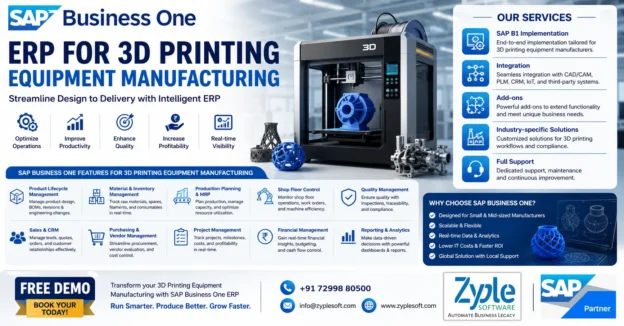
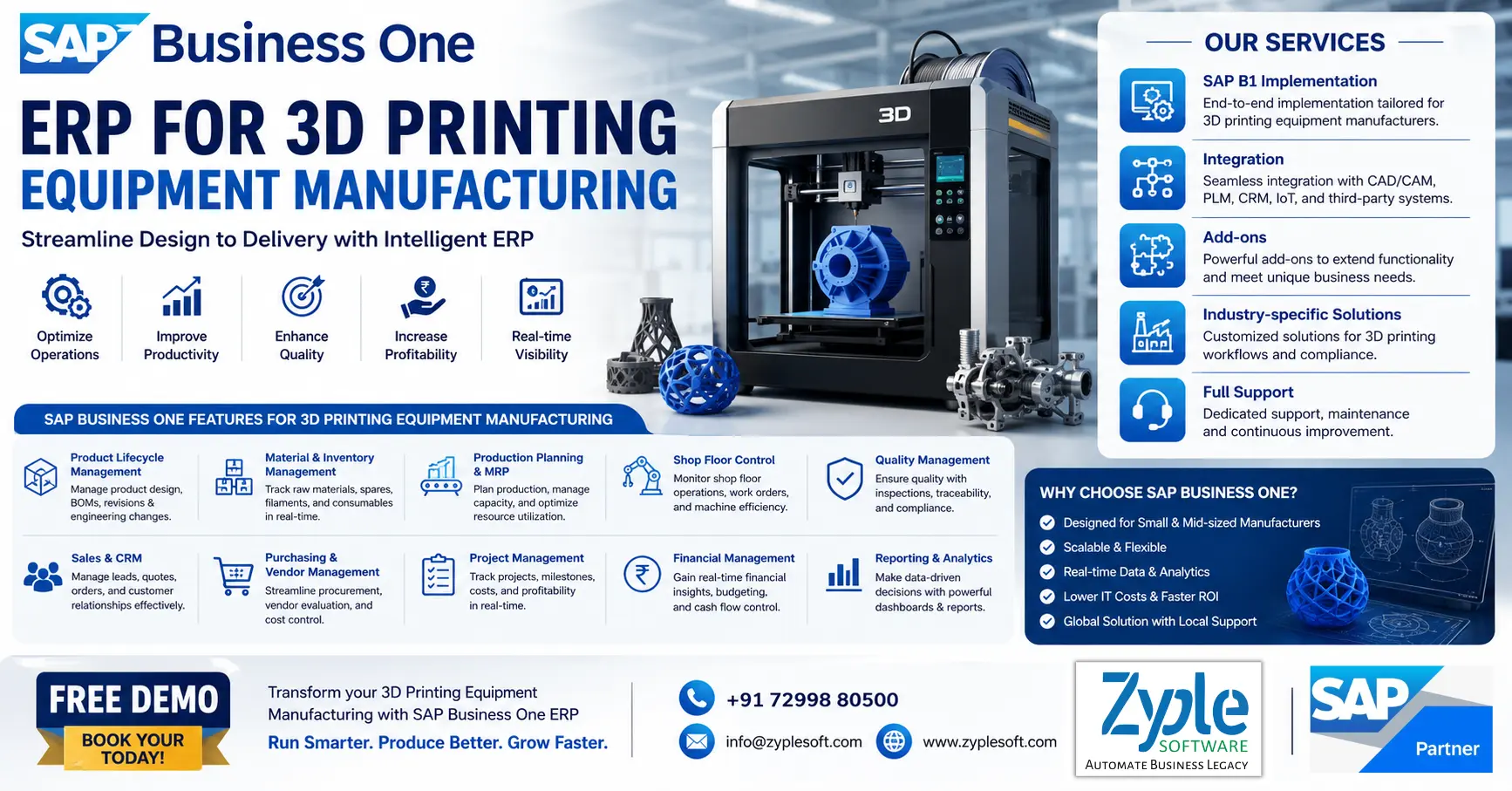
    SAP Business One ERP for 3D Printing Equipment Manufacturing by Zyple Software – Production, Inventory, Quality Control, Procurement, Sales & Finance

    SAP Business One ERP for 3D Printing Equipment Manufacturing

    SAP Business One ERP for 3D Printing Equipment Manufacturing Industry

    SAP Business One ERP for 3D Printing Equipment Manufacturing by Zyple Software – Production, Inventory, Quality Control, Procurement, Sales & Finance

    The 3D printing equipment manufacturing industry is changing quickly, and the only way to stay ahead of the competition is to seamlessly integrate innovative manufacturing technologies. Since they frequently demand more resources than larger organizations, small and medium-sized 3D printing equipment manufacturing businesses face specific challenges in this area. SAP Business One ERP for 3D printing equipment manufacturing helps the 3D printing equipment manufacturing businesses to efficiently utilize these technologies, optimize workflows, and improve productivity.

    Challenges Faced By The 3D Printing Equipment Manufacturing Industry

    The 3D printing equipment manufacturing industry faces severe challenges, including prohibitive capital costs, slow production speeds for mass manufacturing, and limited material selections. Also, manufacturers struggle with labor-intensive post-processing, lack of standardized regulations, intellectual property (IP) vulnerabilities, and skilled workforce shortages.

    1. High Initial Investment

    Industrial-grade 3D printers involve substantial upfront capital. This high barrier to entry restricts wider adoption among small and medium-sized enterprises (SMEs) and often results in slower ROI for businesses replacing traditional assembly lines.

    2. Scalability and Speed Limitations

    While excellent for rapid prototyping and custom one-offs, 3D printing struggles to compete with traditional methods like injection molding or CNC machining when scaling for mass manufacturing.

    3. Material Constraints

    Additive manufacturing depends on a narrower spectrum of printable materials compared to traditional manufacturing. The industry faces ongoing pressure to develop powerful metal alloys and advanced polymers that maintain structural integrity and mechanical properties.

    4. Labor-Intensive Post-Processing

    Most printed parts are not ready-to-use right off the build plate. Post-processing, such as support removal, surface smoothing, heat treatment, and cleaning, remains heavily manual and time-consuming, driving up operational costs.

    5. Lack of Standardization

    The absence of universally accepted international standards makes it difficult for regulated sectors like aerospace and defense, automotive, and healthcare to develop consistent quality assurance and regulatory compliance.

    6. Intellectual Property (IP) Risks

    Because designs are digitized and easily shared, companies continuously battle the risk of IP theft, unauthorized replication, and counterfeiting.

    7. Workforce Gaps

    Operating and maintaining high-end additive manufacturing hardware involves specialized knowledge. A shortage of trained engineers and technicians capable of optimizing workflows and printer mechanics continues to hinder broader industrial integration.

    Features of SAP Business One ERP for 3D Printing Equipment Manufacturing

    1. Production Planning and Control

    • It includes a multi-level bill of materials (BOM) for complex 3D printer components.
    • It includes production order management for custom and batch management.
    • It includes routing and work center management for additive manufacturing processes.
    • It includes capacity planning and scheduling for optimized machine utilization.
    • It includes real-time production tracking and variance analysis.

    2. Product Lifestyle and Engineering Integration

    • It includes integration with CAD or PLM systems for design-to-production flows.
    • It includes engineering change management (ECM) for rapid product iterations.
    • It includes version control for 3D printer models and components.
    • It includes prototype and R&D cost tracking.
    • It includes document management for design files and specifications.

    3. Inventory and Material Management

    • It includes real-time inventory tracking of filaments, resins, and powders.
    • It includes batch and serial number tracking for traceability.
    • It includes warehouse management with bin locations and barcode scanning.
    • It includes multi-warehouse and multi-location inventory control.

    4. Sales, CRM, and Project Management

    • CRM for handling OEM clients, distributors, and B2B customers.
    • It includes quotation management for customized 3D printing equipment.
    • It includes sales order processing with configurable products.
    • It includes project management for custom builds and installations.
    • It includes opportunity tracking and sales pipeline visibility.

    5. Service and Maintenance Management

    • It includes installation and commissioning management for 3D printers.
    • It includes preventive and corrective maintenance scheduling.
    • It includes service contract and warranty management.
    • It includes spare parts tracking and service inventory.
    • It includes mobile service management for field technicians.

    6. Financial Management and Costing

    • End-to-end financial accounting like general ledger, accounts payable, accounts receivable, and banking.
    • It includes product costing for high-value 3D printers and components.
    • SAP B1 modules help in budgeting and financial forecasting.
    • It includes multi-currency and multi-country financial management.
    • It includes profitability analysis by product, customer, or project.

    7. Supply Chain and Procurement

    • It includes vendor management for specialized components and materials.
    • It includes purchase order automation and approval workflows.
    • It includes supplier evaluation and performance tracking.
    • It includes supply chain visibility and demand planning.
    • It includes integration with logistics and shipping providers.

    8. Quality Control and Compliance

    • It includes quality inspection at incoming, in-process, and final stages.
    • It includes non-conformance and corrective action management.
    • It includes compliance with ISO and industry standards.
    • It includes test result recording and quality documentation.
    • It includes traceability for materials and finished goods.

    9. Analytics and Reporting

    • It includes real-time dashboards and KPI monitoring.
    • It includes customizable reports for manufacturing, sales, and finance.
    • It includes predictive analytics for demand and production planning.
    • It includes drill-down insights for decision-making.
    • It includes integration with business intelligence tools.

    10. Integration, Mobility, and Scalability

    • It includes integration with IoT-enabled 3D printers and sensors.
    • It includes API-based integration with third-party apps.
    • It includes cloud and on-premise deployment options.
    • It includes mobile access for real-time operations management.
    • It includes scalable architecture for growing manufacturing businesses.

    Importance of SAP Business One ERP for 3D Printing Equipment Manufacturing

    The ERP software, SAP Business One system, is essential for the 3D printing equipment manufacturing industry, as it unifies complex supply chains, optimizes complex bills of materials (BOMs), and delivers real-time tracking of specialized parts. It transforms disconnected workflows into facilitated, automated operations.

    Handling production for additive manufacturing requires various precise electrical and mechanical components. SAP Business One provides essential tools customized for this specialized manufacturing sector.

    1. Advanced Material Requirements Planning (MRP)

    Automatically calculates raw material (e.g., metals, resins, and filaments) needs based on sales forecasts and production lead times to avoid overstocking or downtime with the SAP implementation process.

    2. BOM and Engineering Integration

    Handles multi-level BOMs, allowing engineering changes to be tracked and updated directly in the system to support flexible product iterations.

    3. Serial and Batch Traceability

    Evaluates specific components throughout the assembly process for better quality control, compliance, and quick component recalls if necessary.

    4. Cost Estimation and Profitability

    Captures real-time costs of raw materials, labor, and overhead to ensure profitable pricing of industrial-grade 3D printers using SAP solutions.

    5. Integrated CRM and Sales

    Connects your sales pipeline to production, enabling better handling of engineer-to-order (ETO) or configure-to-order (CTO) customer requests.

    Benefits of SAP Business One for 3D Printing Equipment Manufacturing

    The SAP Business One solution streamlines operations for 3D printing equipment manufacturers by centralizing production, inventory, and financials. It eliminates data silos, automates material planning, and ensures the exact components are available to assemble complex, highly customized machinery on time.

    1. Precise Bill of Materials (BOM) Management

    3D printers require complex mechanical, electronic, and software assemblies. SAP software enables you to build multi-level BOMs to track every sub-assembly and raw material accurately.

    2. Automated Material Requirements Planning (MRP)

    Prevents expensive production obstacles. The MRP wizard forecasts demand, evaluates stock levels, and automatically triggers purchase orders or production schedules.

    3. Serial and Batch Traceability

    Easily tracks high-value parts, extruder nozzles, or laser components by their serial numbers from procurement to the final assembled machine for better quality control using SAP B1 add-ons.

    4. Order-Driven Production

    Seamlessly converts sales orders for custom-built 3D printers directly into production orders without manual data entry.

    5. Real-Time Costing

    Instantly views the actual material, labor, and overhead costs associated with a specific machine, giving you accurate profit margin analysis on every sale.

    Conclusion of 3D Printing Equipment Manufacturing ERP

    As a Top SAP Business One partner, Zyple Software is delivering services like SAP B1 implementation, licensing, integration, add-ons, and support to different industries, like construction, manufacturing, solar, jewellery, food and beverage, aerospace, retail, pharma, and textiles. 

    SAP Business One is an ERP customized for small and medium-sized businesses that connects finance, procurement, inventory, production, sales, CRM, and reporting into one platform. For 3D printing equipment manufacturing or any other companies, it can improve project costing, procurement, subcontractor billing, and inventory management.

    If you’re adaptable, reserve a demo of SAP Business One.

    Do you look for the SAP B1 ERP system for your business or industry?

    Finish all the details in the arranged contact form; our team will return to you.

      FAQs

      1.How can SAP Business One ERP improve efficiency in my 3D printing equipment manufacturing business?

      SAP Business One streamlines your entire operation, from production planning and inventory management to sales and finance, helping you reduce delays, optimize resources, and increase overall productivity. With real-time insights, you can make faster and smarter business decisions.

      Yes, SAP Business One is highly flexible and can be tailored to your unique manufacturing processes, including custom machine configurations, material tracking, and workflow automation for 3D printing operations.

      The cost depends on factors like the number of users, required modules, and customization needs. However, SAP Business One is a cost-effective ERP solution for small and medium-sized manufacturers, offering high ROI through improved efficiency and reduced operational costs.

      SAP B1 implementation timelines generally range from a few weeks to a few months, depending on the complexity of your processes. With the right SAP B1 implementation partner like Zyple Software, the deployment can be smooth and quick.

      You can request a personalized demo from an authorized SAP Business One partner like Zyple Software. An SAP B1 demo will help you understand how the ERP fits your business needs and how it can transform your manufacturing operations.

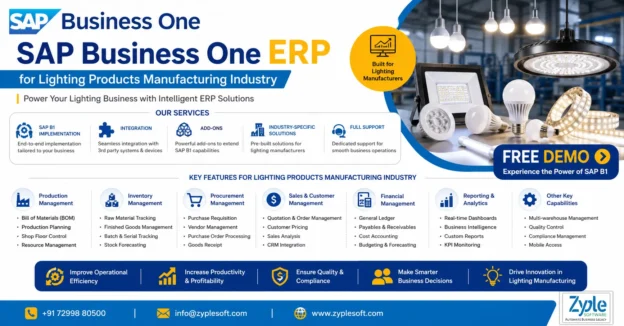
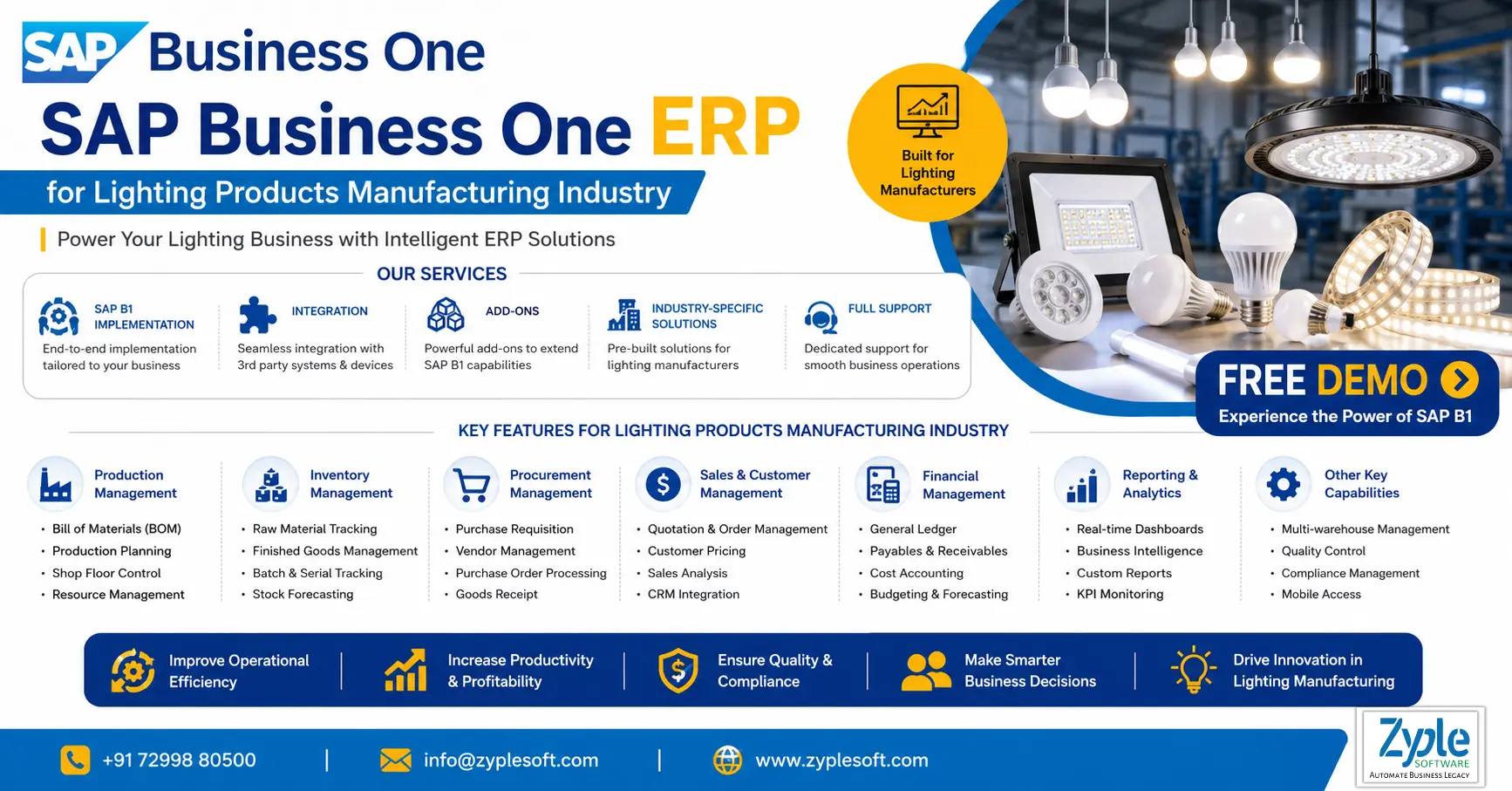
      SAP Business One ERP for Lighting Products Manufacturing Industry

      SAP Business One for Lighting Products Manufacturing Industry

      SAP Business One ERP for Lighting Products Manufacturing Industry

      SAP Business One ERP for Lighting Products Manufacturing Industry

      The lighting products manufacturing industry is at the forefront of the global shift towards energy-efficient and enivironmentally friendly lighting solutions. The lighting technology has rapidly gained popularity for its energy-saving capabilities and long-lasting performance, making it an important part of modern lighting solutions for homes, businesses, and industries. SAP Business One ERP for lighting products manufacturing can significantly improve efficiency, cost control, quality management, and overall business performance in the lighting products manufacturing industry.

      Challenges Faced By The Lighting Products Manufacturing Industry

      1. Supply Chain and Raw Material Volatility

      Heavy dependence on global electronic components leaves manufacturers vulnerable to semiconductor and LED chip shortages. Geopolitical shifts and transportation obstacles frequently drive up freight costs and extend lead times. Pricing instability for necessary raw materials like aluminium, copper, and plastics squeezes profit margins.

      2. Market Pressures and Fierce Competition

      Local manufacturers struggle, as the market is flooded with low-cost, mass-produced lighting products, specifically from overseas competitors. High taxation rates can lead to revenue leakage, while evolving global efficiency standards involve continuous redesigns and recertification.

      3. Technological Shifts and Product Evolution

      Developing IoT-enabled, integrated smart lights is resource-intensive. Consumers now require high a Color Rendering Index (CRI) and flicker-free performance, forcing manufacturers to upgrade quality control measures. Industrial applications involve specialized fixtures built to withstand extreme temperatures, moisture, and corrosive chemicals, increasing manufacturing complexity.

      4. Sustainability and the Circular Economy

      There is a growing demand for products customized for easy repair, modularity, and recyclability. Compliance with environmental regulations regarding electronic waste involves modifying traditional production lines.

      5. Labor and Automation Constraints

      As lighting technology becomes more complex, finding technicians and engineers capable of handling advanced manufacturing processes is challenging. Companies face pressure to invest in robotics and lights out manufacturing to minimize human error and labor costs, though the initial capital expenditure remains a barrier for many.

      Features of SAP Business One ERP for Lighting Products Manufacturing

      1. Core Financial Management

      • It includes general ledger and accounts payable and receivable.
      • Cost center accounting for product lines like LED bulbs, panels, and fixtures.
      • It includes fixed asset management for machinery and tooling.
      • It includes bank reconciliation and GST compliance.
      • Tracks profitability per lighting product, project, or distribution channel.

      2. Sales and Customer Relationship Management (CRM)

      • Lead and opportunity management, like projects, distributors, and contractors.
      • It includes a quotation for order management.
      • Pricing management like bulk, dealer, and project-based.
      • It includes after-sales service and warranty tracking.
      • It includes customer lifecycle management.
      • Handles B2B sales for real estate, infrastructure, and retail lighting projects.

      3. Purchasing and Vendor Management

      • It includes supplier quotation comparison.
      • It includes purchase order automation.
      • It includes vendor evaluation and performance tracking.
      • It includes multi-currency procurement.
      • It includes import and export documentation support.
      • It includes efficient sourcing of LED chips, drivers, housing, and electronic components.

      4. Inventory and Warehouse Management

      • Batch and serial number tracking is essential for LED components.
      • It includes multi-warehouse and bin location management.
      • It includes stock valuation and ageing analysis.
      • It includes automated reorder levels.

      5. Bill of Materials (BOM) Management

      • It includes multi-level BOMs for complex lighting assemblies.
      • It includes version control and engineering change management.
      • It includes sub-assembly and phantom BOM support.
      • Handles BOM for LED panel lights, street lights, or smart lighting systems.

      6. Production Planning and Control

      • It includes production order management.
      • It includes material requirements planning (MRP).
      • It includes demand forecasting and scheduling.
      • Capacity planning for machines and labor.
      • It includes shop floor control.
      • Plans production for seasonal demand like festive lighting and infrastructure projects.

      7. Manufacturing Execution and Shop Floor Management

      • It includes routing and operations tracking.
      • It includes work-in-progress (WIP) tracking.
      • It includes machine utilization monitoring.
      • It includes real-time production updates.
      • Monitors assembly lines for LED bulbs, drivers, and fixtures.

      8. Quality Control and Compliance

      • Test result recording like lumen output, voltage, and heat resistance.
      • It includes compliance with BIS and ISO standards.
      • It includes automated quality documentation.

      9. Product Costing and Profitability

      • It includes standard and actual costing.
      • It includes margin analysis per product.
      • It includes cost simulation for new designs.
      • It calculates the exact cost of LED fixtures and optimizes pricing.

      10. Warehouse and Logistics Management

      • It includes goods receipt and dispatch management.
      • It includes pick, pack, and ship processes.
      • It includes delivery route planning.
      • It includes integration with logistics providers.
      • It includes efficient distribution to dealers, retailers, and project sites.

      11. Business Intelligence (BI) and Analytics

      • It includes real-time dashboards and KPIs.
      • It includes sales, production, and real-time analytics.
      • It includes drill-down reporting.
      • It includes Excel integration and visualization tools.
      • Identifies top-selling lighting products and demand trends.

      12. Project Management (Lighting Projects)

      • It includes project costing and budgeting.
      • It includes resource allocation.
      • It includes timeline tracking.
      • It includes integration with sales and procurement.
      • Handles turnkey lighting projects like commercial projects and smart cities.

      13. Service Management and Warranty Tracking

      • It includes service contract management.
      • It includes warranty tracking for lighting products.
      • It includes complaint and repair management.
      • It includes field service scheduling.
      • Handles warranty claims for LED lights and fixtures.

      14. Mobility and Web Access

      • It includes mobile apps for sales and service teams.
      • It includes web-based access for remote operations.
      • It includes real-time updates on inventory and updates.
      • Sales teams can evaluate stock and place orders on-site.

      15. Integration and Scalability

      • Integration with SAP B1 HANA.
      • It includes API integration with e-commerce and IoT devices.
      • It includes add-ons for industry-specific needs.
      • It includes cloud or on-premise deployment.
      • Integrates smart lighting systems or IoT-enabled products.

      16. Production Cost Optimization and Planning

      • It includes machine planning and scheduling.
      • It includes just-in-time (JIT) production.
      • It includes FIFO inventory management.
      • It includes resource optimization.
      • Minimizes wastage in LED manufacturing and optimizes production cycles.

      17. Batch Production and Traceability

      • It includes batch and lot tracking for components.
      • It includes full traceability from raw material to finished goods.
      • It includes recall management.
      • Tracks defective batches of LED drivers or chips quickly.

      Benefits of SAP Business One ERP for Lighting Products Manufacturing

      The ERP software, SAP Business One (SAP B1) system, delivers specialized modules tailored for lighting and LED manufacturers. It optimizes production planning, inventory tracking, and supply chain management to reduce operational costs and waste. By connecting shop-floor actions to financials, it generates real-time reports to ensure compliance and improve overall profit margins.

      1. Accurate Bill of Materials (BOM) and Routing

      Lighting fixtures often require complex sub-assemblies like LED drivers, heat sinks, housings, and diffusers. SAP implementation handles multi-level BOMs, standardizing production and helping manufacturers track exact material usage while cutting down on scrap and rework.

      2. Facilitated Material Requirements Planning (MRP)

      The MRP engine automatically evaluates sales forecasts, current stock, and lead times to calculate exactly when and how much raw material to purchase. This avoids over-purchasing while ensuring you never face stockouts during large production runs.

      3. Complete Traceability and Quality Control

      Components like LED chips and drivers must comply with safety and performance certifications. SAP B1 supports strict lot and serial number tracking, allowing end-to-end traceability from raw material to finished product, which simplifies warranty management and defect root-cause analysis.

      4. Real-Time Inventory and Cost Management

      SAP solutions deliver continuous visibility into warehouse operations, managing stock levels of raw materials, work-in-progress (WIP), and finished goods. By linking material usage, labor, and overhead directly to the general ledger, it calculates accurate Cost of Goods Sold (COGS), which is essential for smart pricing and margin analysis.

      5. Compliance and Regulatory Alignment

      The lighting industry frequently adjusts to energy efficiency and environmental mandates like RoHS, CE, and BIS. SAP B1 helps businesses evaluate regulatory documentation and compliance-related activities within a centralized and audit-ready system.

      Conclusion of Lighting Products Manufacturing ERP

      Zyple Software is a certified SAP Business One partner in India specializing in implementation, digital transformation, licensing, integration, add-on solutions, migration, and consulting for the lighting products manufacturing industry. SAP software is an out-of-the-box solution and is developed by keeping in mind the specific requirements and complexities of lighting products manufacturing businesses.

      If you’re engaged, arrange a demo of SAP Business One.

      Do you want the SAP B1 ERP software for your business or industry?

      Finish all the details in the given contact form; our team will return to you.

        1.How can SAP Business One improve efficiency in my lighting manufacturing business?

        SAP Business One facilitates your entire operation, from procurement of components like LEDs and drivers to production, inventory, and sales. It eliminates manual processes, minimizes errors, and gives real-time visibility, helping you increase productivity and reduce operational costs.


        Unlike generic ERP systems, SAP Business One provides built-in manufacturing, inventory, and financial management in one platform. It is scalable, cost-effective for SMEs, and can be designed specifically for lighting product assembly and component tracking.

        Most lighting manufacturers start seeing measurable ROI within a few months through better inventory control, minimized wastage, improved production planning, and faster order fulfillment.

        Yes, SAP Business One ERP has an intuitive interface and role-based dashboards, making it easy for shop floor workers, warehouse staff, and management to adopt with minimal training.

        You can connect with an authorized SAP B1 partner, like Zyple Software, who will evaluate your requirements, provide a customized demo, and guide you through pricing, implementation, and support options.