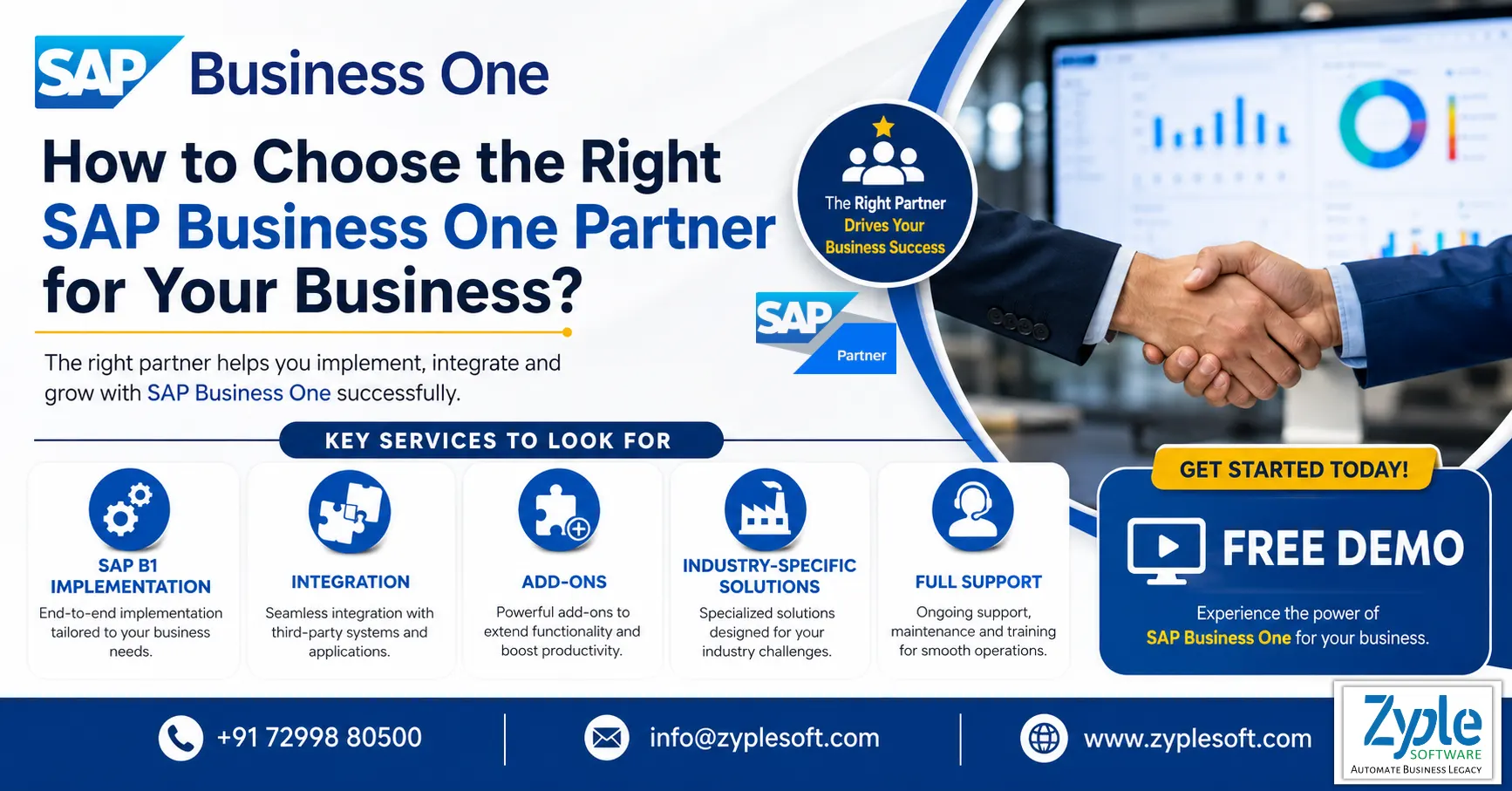
Choosing the Right SAP Business One Implementation Partner
Question 31. Is the implementation partner experienced in our industry?
This question is often more important than the software itself.
Ask the implementation partner:
- Have you implemented SAP Business One for businesses similar to ours?
- Do you understand our manufacturing or construction processes?
- Can you demonstrate industry workflows?
- Can you explain common challenges?
For example:
A manufacturing company should expect demonstrations covering:
- BOM
- MRP
- Production Orders
- Production Costing
- Quality Management
A construction company should expect demonstrations covering:
- Project Costing
- Budget Control
- BOQ
- Contractor Billing
- Equipment Management
- Work-in-Progress
Industry experience reduces project risks and shortens implementation time.
Question 32. Can the partner provide real customer references?
Ask to review SAP Business One Success Stories from businesses similar to yours. Case studies demonstrating measurable improvements in inventory accuracy, financial reporting, or production efficiency provide stronger evidence than marketing brochures alone.
Every implementation partner claims they are experienced.
Ask for proof.
Request:
- Customer case studies
- Client references
- Video testimonials
- Industry-specific success stories
- Go-live examples
If possible, speak directly with an existing customer.
Ask questions such as:
- Was the implementation completed on time?
- Was the budget maintained?
- How responsive is support?
- Would you choose the same partner again?
These conversations often reveal more than a sales presentation.
Question 33. What is included in the implementation cost?
One of the biggest mistakes companies make is comparing only software prices. Understanding SAP Business One Pricing requires evaluating licenses, implementation services, training, integrations, support, and future scalability – not just the initial investment.
ERP pricing should be transparent.
Ask for a detailed proposal covering:
- Software licenses
- Implementation services
- Data migration
- User training
- Reports
- Dashboards
- Integrations
- Customization
- Go-live support
- Documentation
Understanding the complete scope helps avoid misunderstandings later.
Question 34. What ongoing support is available after Go-Live?
Long-term success depends on reliable SAP Business One Support, including issue resolution, system health checks, user assistance, upgrades, and continuous process optimization.
Go-live is the beginning of your ERP journey – not the end.
Clarify:
- Support hours
- Response times
- Issue escalation
- Annual Maintenance Contract (AMC)
- Version upgrades
- User assistance
- Remote support
- On-site support (if required)
Reliable post-implementation support is essential for long-term success.
Question 35. How will success be measured?
Many ERP projects finish on schedule but fail to improve business performance.
Define measurable KPIs before implementation.
Examples include:
- Inventory Accuracy above 98%
- Month-end closing reduced from 10 days to 3 days
- Procurement approval time reduced by 60%
- Production planning accuracy improved
- Customer order processing time reduced
- Improved cash flow visibility
Measure business outcomes – not just project completion.
Common Mistakes CEOs Make Before Buying ERP
Even experienced business leaders sometimes underestimate ERP implementation.
Here are ten common mistakes to avoid.
Mistake 1
Choosing the lowest-priced implementation partner instead of evaluating expertise and industry experience.
Mistake 2
Focusing only on software features rather than business objectives.
Mistake 3
Underestimating user training and change management.
Employees need time, training, and support to adopt new systems successfully.
Mistake 4
Ignoring data quality before implementation.
Incorrect master data leads to inaccurate reports and operational issues.
Mistake 5
Expecting ERP to solve inefficient business processes without process improvement.
ERP supports good processes – it doesn’t automatically fix poor ones.
Mistake 6
Customizing everything instead of using standard functionality.
Excessive customization increases complexity and future maintenance.
Mistake 7
Not involving department heads in the evaluation process.
ERP impacts finance, purchasing, sales, warehouse, production, and management.
Cross-functional involvement improves implementation success.
Mistake 8
Not defining measurable business goals.
If success isn’t defined before implementation, it becomes difficult to measure ROI afterward.
Mistake 9
Selecting ERP without considering future business growth.
Choose software that supports expansion, additional users, multiple branches, and new business opportunities.
Mistake 10
Treating ERP as an IT project instead of a business transformation initiative.
Successful ERP projects are driven by business leadership—not just technology teams.
CEO ERP Decision Checklist
Before approving your SAP Business One investment, confirm the following.
Business Readiness
- Clear business objectives defined
- Current operational challenges documented
- Future growth plans identified
- Executive sponsorship established
Software Evaluation
- SAP Business One fits our industry
- Required modules are available
- Integration requirements confirmed
- Cloud or On-Premise deployment selected
- Security requirements reviewed
Implementation Planning
- Implementation scope documented
- Timeline agreed
- Budget approved
- Data migration strategy finalized
- User training planned
Partner Evaluation
- Industry experience verified
- Customer references checked
- Support services reviewed
- Implementation methodology understood
- Long-term partnership evaluated
Final Thoughts
Buying SAP Business One ERP is not simply purchasing software but it’s investing in the future of your business.
The right ERP can help you:
- Improve operational efficiency
- Increase profitability
- Gain real-time business visibility
- Standardize business processes
- Support informed decision-making
- Scale confidently as your organization grows
However, software alone doesn’t guarantee success.
The combination of clear business objectives, committed leadership, high-quality data, user adoption, and an experienced implementation partner has the greatest influence on project outcomes.
By answering these 40 questions, CEOs can evaluate ERP opportunities more effectively, reduce implementation risks, and make decisions aligned with their long-term business strategy.
Frequently Asked Questions
Is SAP Business One suitable for manufacturing companies?
Yes. SAP Business One supports manufacturing with features such as Bill of Materials (BOM), Material Requirements Planning (MRP), Production Orders, Batch Management, and Production Costing. Many manufacturers also extend it with industry-specific add-ons where required.
Can SAP Business One manage construction projects?
Yes. Construction and EPC companies commonly use SAP Business One for project costing, procurement, budgeting, contractor billing, inventory management, and financial reporting. Additional functionality may be provided through specialized add-ons depending on project requirements.
How long does SAP Business One implementation take?
Implementation time depends on company size, business complexity, and project scope. Many small to medium-sized projects are completed within a few months, while larger, multi-location implementations may require additional time.
What is the biggest reason ERP projects fail?
Common reasons include unclear business objectives, poor data quality, insufficient user training, limited executive involvement, and selecting an implementation partner without relevant industry experience.
How do I choose the right SAP Business One implementation partner?
Look for an authorized SAP partner with experience in your industry, proven customer references, a structured implementation methodology, transparent pricing, and reliable post-go-live support.
Conclusion
Selecting the right ERP is one of the most important strategic decisions for any growing business. Rather than focusing only on software features or pricing, CEOs should evaluate business readiness, implementation approach, long-term scalability, and partner expertise.
SAP Business One can support finance, sales, purchasing, inventory, manufacturing, projects, and analytics within a single integrated platform. When combined with clear planning and an experienced implementation partner, it can help organizations improve operational performance and support sustainable growth.
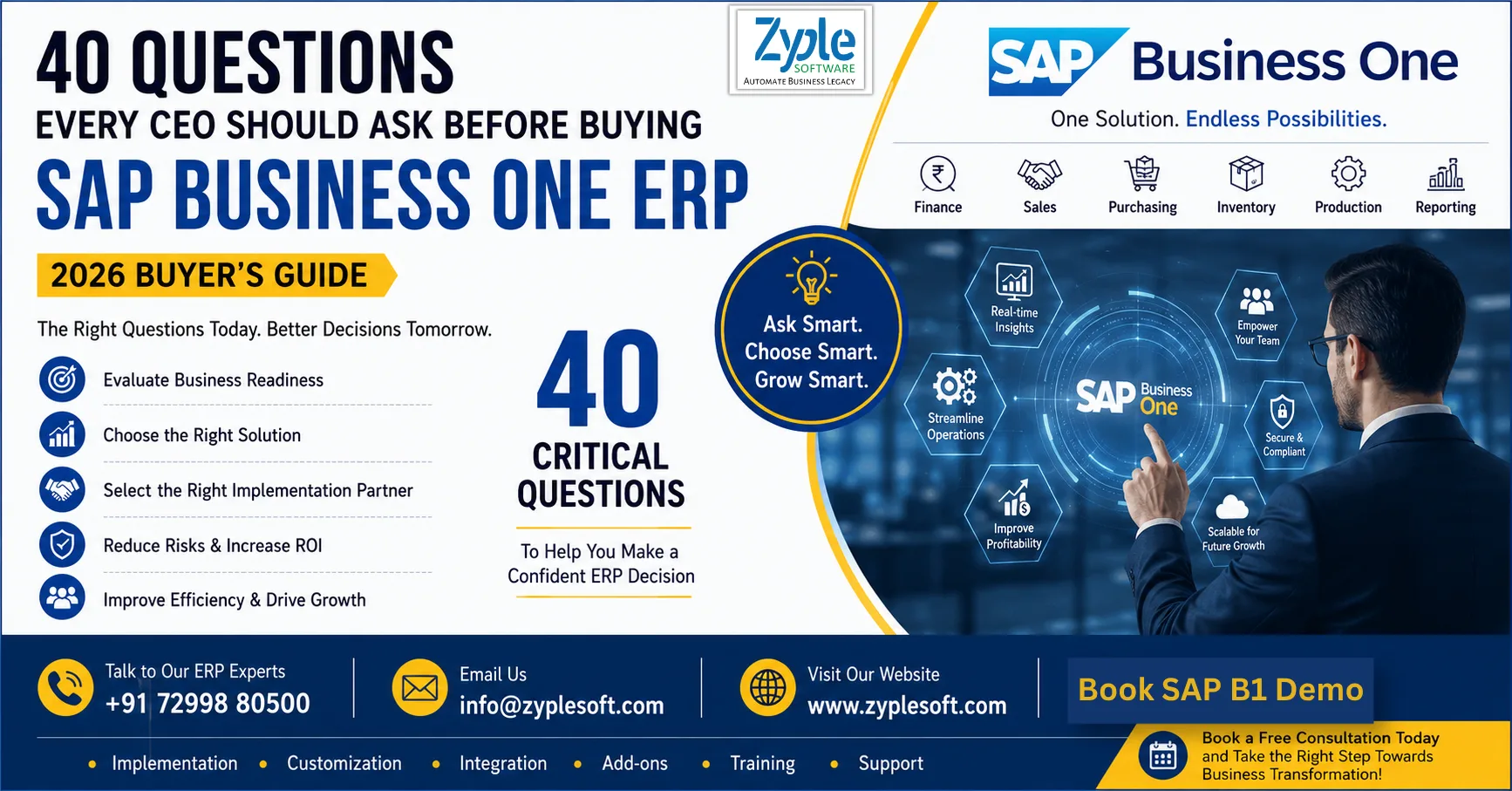
If you’re evaluating SAP Business One for your organization, use these 40 questions as a practical framework for discussions with your leadership team and potential implementation partners.
About Zyple Software
Zyple Software is an SAP Business One partner helping organizations streamline business operations through ERP solutions, industry-specific add-ons, system integration, implementation services, and ongoing support.
Whether you’re in manufacturing, construction, engineering, trading, or another industry, the first step is understanding your business processes and identifying the ERP approach that best fits your goals.
Book a Free SAP Business One Consultation
During your consultation, you can:
- Review your current business processes
- Discuss ERP readiness
- Explore industry-specific SAP Business One demonstrations
- Understand implementation timelines
- Review implementation considerations
- Learn about relevant SAP Business One add-ons
Contact Zyple Software
If your organization is evaluating SAP Business One, fill your details in given form or schedule a consultation with Zyple Software. Whether you need SAP Business One Implementation, an industry-specific SAP Business One Demo, guidance on SAP Business One Pricing, expert SAP Business One Support, or advice on selecting the right SAP Business One Add-ons, our team can help you assess your requirements and plan your ERP journey.