SAP Business One ERP for Biscuit & Snacks Manufacturing Industry
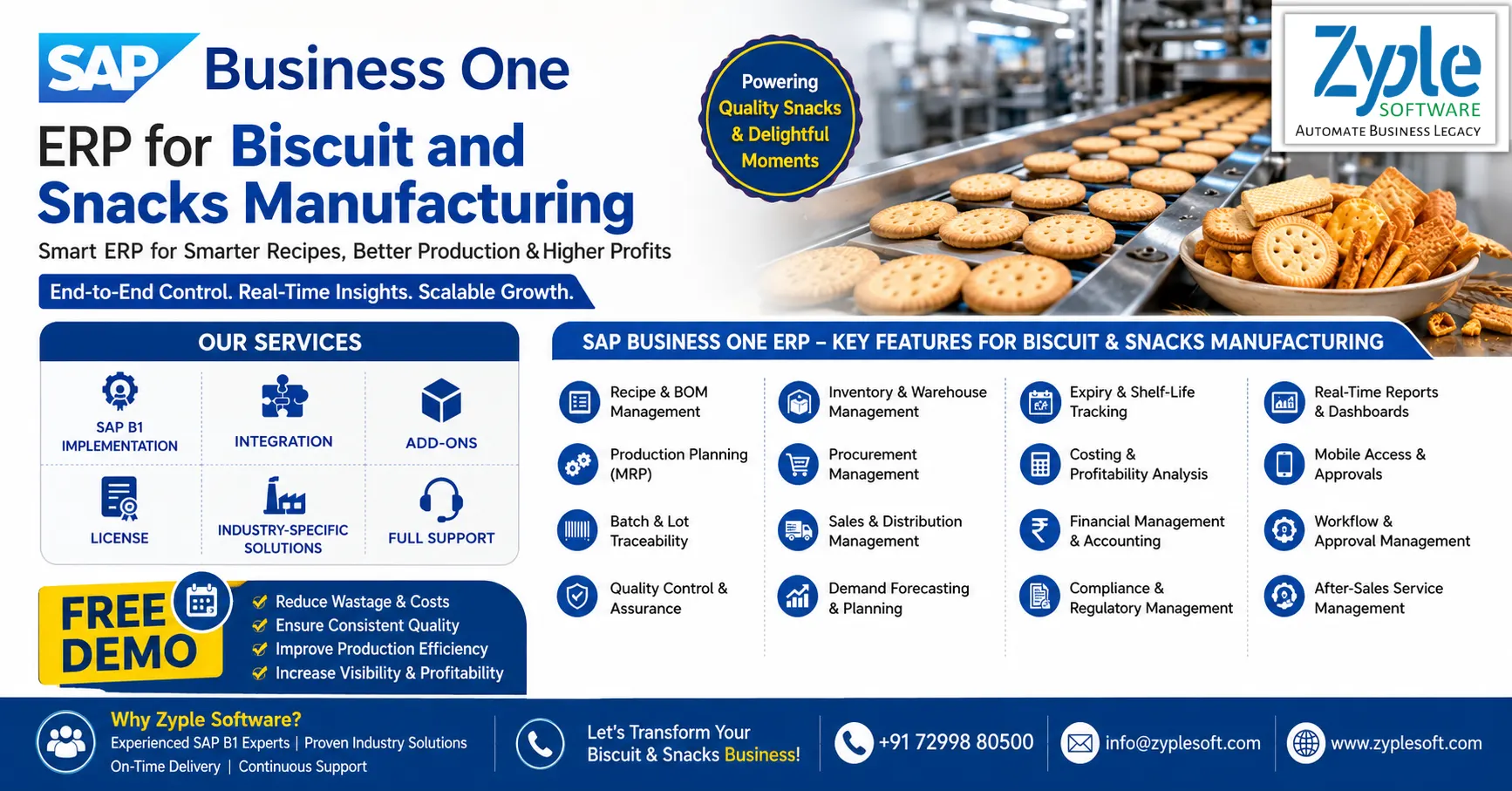
The global biscuit and snacks manufacturing industry has developed mostly in recent years, involving more and more customers to participate. The industry is exploding the global demand and thereby leading to a rapid rise in the biscuit and snack prices. The key challenges faced by this industry include increased demand for variety and innovation, low-profit margins, product traceability, and quality governmental regulations. SAP Business One ERP for biscuit and snacks manufacturing helps in all aspects of manufacturing and distribution in the industry.
Challenges Faced By The Biscuit and Snacks Manufacturing Industry
The biscuit and snacks manufacturing industry faces major challenges, mainly volatility in raw material prices, shifting consumer health preferences, and supply chain disruptions. These pressures increase operational expenses and force rapid product reformulation.
1. Price Volatility
Uncertain costs for key commodities like wheat flour, sugar, edible oils, and packaging materials squeeze profit margins.
2. Operational Inefficiencies
High energy consumption during baking and manual handling errors result in batch rejections and waste.
3. Logistics Bottlenecks
Fuel price fluctuations and complex distribution networks delay prompt delivery to fragmented retail markets.
4. Health Consciousness
Rising preference for low-sugar, high-fiber, gluten-free, or fortified functional snacks forces brands to change traditional recipes.
5. Convenience Formats
Increased demand for single-serve, resealable, and on-the-go packaging requires high-speed wrapping technology adjustments.
6. Loss of Impulse Buys
Growth in online grocery shopping minimizes traditional store check-out impulse purchases.
7. Food Safety and Compliance
Stringent hygiene standards, accurate labeling laws, and local tax changes increase administrative and financial burdens.
8. Quality Consistency
Handling dough elasticity, baking temperatures, and preventing physical or chemical contaminants during mass production requires continuous monitoring.
Features of SAP Business One ERP for Biscuit and Snacks Manufacturing
1. Recipe and Formulation Management
- Creates and handles recipes like bill of materials (BOM) for biscuits, wafers, chips, and more.
- Controls ingredients, quantities, flavors, and variations.
- Handles multi-level BOMs from raw materials and semi-finished to finished goods.
- Automatic cost calculation per batch or product.
- It includes recipe modification without disrupting production.
- Essential for maintaining taste consistency across batches.
2. Production Planning and Manufacturing Control
- Creates and handles production orders, like manual or auto, from sales demand.
- Tracks raw material consumption, labor, and machine usage.
- Monitors real-time production status (batch-wise).
- Optimizes production scheduling and capacity planning.
- Handles co-products and by-products like crumbs, water reuse, and more.
- It ensures smooth production of high-volume snack items.
3. Batch Management and Traceability
- Complete batch and lot tracking from raw materials to finished biscuits and snacks.
- Assigns batch numbers, expiry dates, and production dates.
- Allows instant product recall management.
- Necessary for food safety and compliance like FSSAI and HACCP.
4. Shelf-Life and Expiry Management
- Handles expiry dates and shelf life for perishable products.
- It supports the FEFO (First Expiry First Out) inventory method.
- Prevents sale or usage of expired stock.
- It includes alerts for near-expiry inventory.
- Minimizes waste in fast-moving snack inventory.
5. Quality Control and Compliance
- Defines quality inspection checkpoints from raw material and production to packaging.
- Records test results, moisture levels, taste, and texture checks.
- Handles QC status like approved, rejected, and quarantined.
- Maintains food safety compliance like HACCP and FSSAI standards.
6. Inventory and Warehouse Management
- It includes real-time inventory tracking across warehouses.
- Handles multiple units of measurement like kg, grams, and cartons.
- Minimizes wastage, pilferage, and overstocking.
- Supports cold storage and dry storage tracking.
7. Procurement and Vendor Management
- Automates raw material procurement planning.
- Handles vendor pricing, quality, and delivery performance.
- Generates purchase orders based on MRP suggestions.
- Tracks supplier batches for traceability.
- It ensures an uninterrupted supply of ingredients.
8. Material Requirements Planning (MRP)
- Forecasts demand for biscuits and snacks.
- Auto-calculates required raw materials and production quantities.
- Minimizes stock shortages and excess inventory.
- Aligns production with market demand.
9. Costing and Profitability Analysis
- Calculates batch-wise production cost.
- Tracks raw material price fluctuation impact.
- Analyzes profit margins per product like cookies, chips, and more.
- Controls wastage and overhead costs.
- It helps improve profitability in a price-sensitive biscuit and snacks market.
10. Sales, Distribution, and CRM
- Handles distributor and dealer network.
- Oversees bulk orders, retail orders, and exports.
- It includes real-time order tracking and fulfillment.
- Maintains customer pricing, discounts, and schemes.
- It includes integrated CRM for customer engagement.
11. Packaging and Dispatch Management
- Plans packaging based on SKU sizes like small packs, family packs, and cartons.
- Tracks packing material consumption.
- Optimizes dispatch planning and logistics.
12. Waste and By-Product Management
- Tracks production waste like burnt biscuits, breakage, and crumbs.
- It includes reuse or account for by-products.
- Improves yield optimization.
13. Real-Time Reporting and Analytics
- Dashboards for production performance, inventory levels, sales trends, and profit margins.
- Makes data-driven decisions instantly.
- Generates compliance and audit reports.
Importance of SAP Business One ERP for Biscuit and Snacks Manufacturing
The ERP software, SAP Business One, is essential for the biscuit and snacks manufacturing industry because it delivers precise recipe and batch management, strict shelf-life inventory control, and automated compliance.
1. Bill of Materials
Handles the exact proportion of flour, sugar, oils, and flavorings for every batch with the SAP B1 implementation process.
2. Process Repeatability
It ensures uniform taste, texture, and weight across large production runs.
3. Yield Optimization
Tracks scrap and waste to increase output per kilogram of raw material.
4. FEFO Tracking
Uses First-Expired First-Out (FEFO) principles to move perishable raw ingredients and finished crispy goods before staleness sets in.
5. Real-Time Stock Visibility
Avoids production halts due to sudden shortages of essential packaging or baking materials.
6. Lot Traceability
Tracks specific batches from local supplier delivery to retail distributor shelf in case of quick recalls using SAP solutions.
7. Food Safety Compliance
Achieves hygiene and safety guidelines like HACCP, ISO, and local food safety laws.
8. Quality Checkpoints
The SAP software tests raw material quality upon entry and runs checks during packaging stages.
9. Allergen Management
Evaluates and labels components like gluten, nuts, or dairy accurately.
10. Material Requirements Planning (MRP)
Forecasts when to buy raw ingredients based on seasonal snack demands and historical sales.
11. Distribution Control
Handles distributor network, volume-based pricing, and retail trade schemes efficiently.
Benefits of SAP Business One for Biscuit and Snacks Manufacturing
SAP Business One delivers essential benefits for biscuit and snack makers through batch and recipe management, lot traceability, and automated inventory control.
1. Precise Formulations
Handles multi-level bills of materials (BOMs) for exact flour, sugar, oil, and flavoring ratios.
2. Consistent Quality
Ensures uniform taste, texture, and baking standards across every production run using SAP Business One add-ons.
3. FEFO Logic
Uses First-Expiry-First-Out (FEFO) stock rotation to move short-shelf-life ingredients and finished packs.
4. Real-Time Visibility
Tracks raw materials and packaging supplies to avoid sudden stockouts.
5. Waste Reduction
Issues automated alerts for aging stock to prevent spoilage.
6. End-to-End Tracking
Connects raw material lot numbers straight to finished biscuit or snack packets.
7. Audit Readiness
Maintains digital logs for quality checks, essential control points, and food safety rules (like FSSAI, HACCP, or ISO).
8. Smart Scheduling
Facilitates factory shifts and machine use to minimize baking downtime.
9. Live Costing
Tracks active material and labor expenses to protect profit margins on tight-margin snacks.
Conclusion of Biscuit and Snacks Manufacturing ERP
As an experienced SAP Business One partner in India, Zyple Software is delivering services like SAP B1 implementation, integration, migration, licensing, add-ons, digital transformation, and support to different industries, like construction, manufacturing, solar, food and beverage, aerospace, heathcare, retail, jewellery, pharma, and textiles.
SAP Business One is an ERP software customized for small and medium-sized enterprises that connects finance, procurement, sales, CRM, production, inventory, and reporting into one platform. For biscuit and snacks manufacturing or any other businesses, it can improve project costing, procurement, subcontractor billing, and inventory management.
If you’re interested, register a SAP Business One demo.
Do you search for the SAP B1 ERP solution for your business or industry?
Complete all the details in the displayed contact form; our team will reach out to you.
FAQs
1.How does SAP Business One help biscuit and snacks manufacturers manage production efficiently?
SAP Business One facilitates the entire production cycle by integrating raw material planning, batch processing, and real-time production tracking. It helps manufacturers optimize recipes, minimize wastage, and ensure consistent product quality across batches, which is essential in the food industry.
2.Can SAP Business One handle batch tracking and expiry management for snacks manufacturing?
Yes, SAP Business One provides advanced batch and lot tracking features that allow manufacturers to monitor product movement from raw materials to finished goods. It also supports expiry date tracking, ensuring compliance with food safety regulations and minimizing the risk of expired inventory.
3.How does SAP Business One improve inventory and supply chain management in the biscuit and snacks manufacturing industry?
SAP Business One delivers real-time visibility into inventory levels, helping manufacturers maintain optimal stock of raw materials like flour, sugar, and oils. It automates procurement processes, avoids stockouts or overstocking, and ensures smooth coordination with suppliers and distributors.
4.Is SAP Business One suitable for small and medium-sized biscuit and snacks manufacturers?
Absolutely. SAP Business One is specifically designed for small and medium-sized businesses. It provides scalable solutions that grow with your business, making it ideal for manufacturers looking to digitize operations without investing in overly complex systems.
5.How can SAP Business One help improve profitability in biscuit and snacks manufacturing?
SAP Business One allows better cost control through accurate production costing, waste reduction, and efficient resource utilization. With real-time analytics and reporting, businesses can make data-driven decisions to increase margins and overall profitability.