
SAP Business One vs Odoo: Which ERP is the Better Choice for Growing Businesses in 2026?
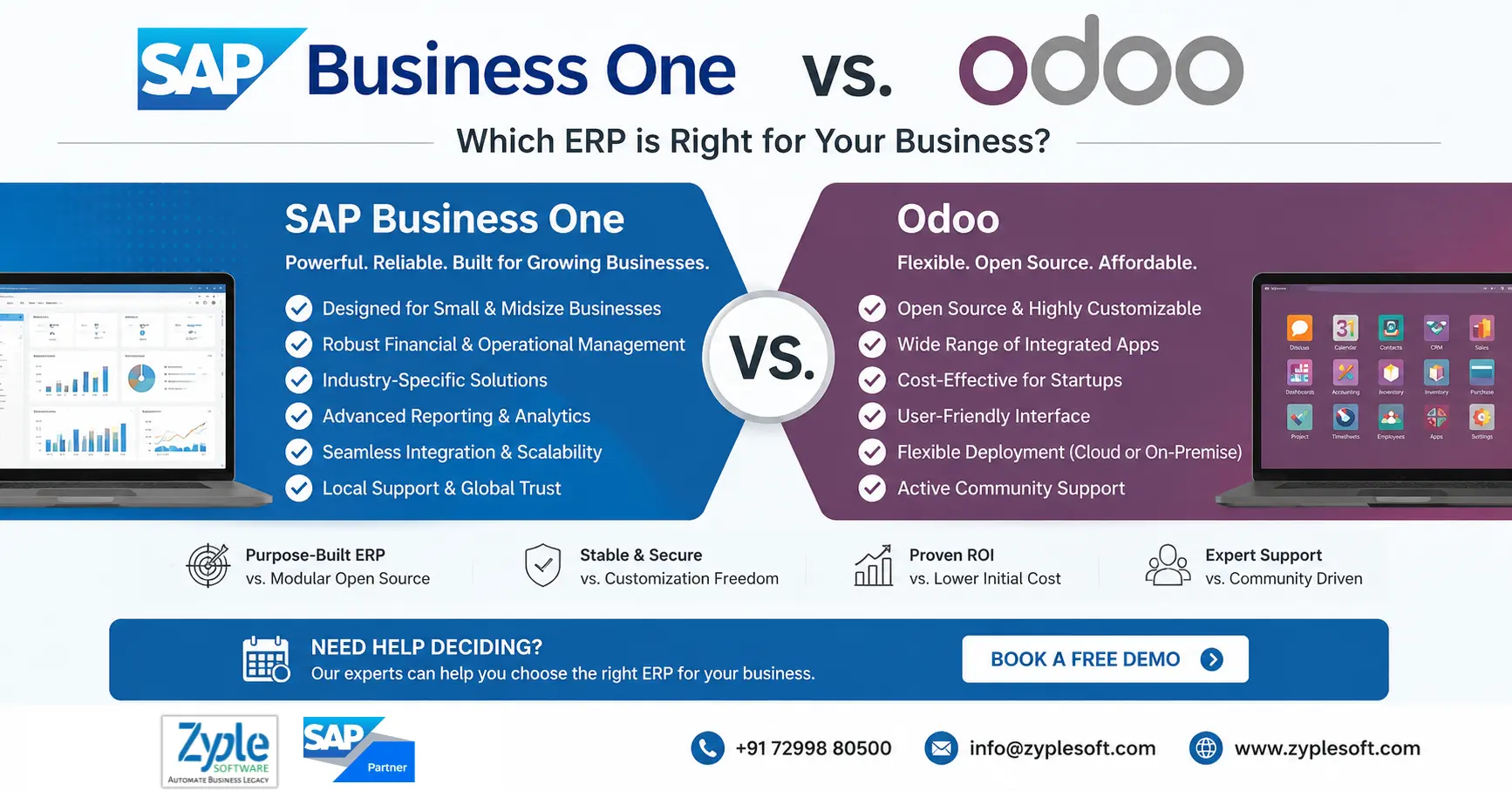
Selecting the right Enterprise Resource Planning (ERP) software is one of the most important technology decisions a business can make. The right ERP streamlines operations, improves visibility, and supports long-term growth. Two of the most popular ERP solutions in today’s market are SAP Business One and Odoo.
While both platforms help businesses manage finance, inventory, sales, purchasing, and operations, they are built for different business requirements and growth strategies.
If you’re planning to invest in an ERP system in 2026, this detailed comparison will help you determine which solution aligns best with your business goals.
What is SAP Business One?
SAP Business One is an integrated ERP solution developed by SAP specifically for small and medium-sized businesses. It combines financial management, sales, purchasing, CRM, inventory, production, project management, service management, and analytics into one centralized platform.
Businesses across manufacturing, distribution, retail, pharmaceuticals, engineering, construction, food processing, and many other industries rely on SAP Business One to manage mission-critical operations.
What is Odoo?
Odoo is a modular business management platform that offers ERP, CRM, accounting, inventory, HR, marketing, eCommerce, and other business applications.
Its modular approach allows organizations to start with a few applications and add more as business needs evolve. Odoo is available in Community (open-source) and Enterprise editions.
SAP Business One vs Odoo: Feature Comparison
| Feature | SAP Business One | Odoo |
|---|---|---|
| Target Businesses | Small & Medium Enterprises | Small Businesses to Mid-size Companies |
| Deployment | Cloud & On-Premise | Cloud & On-Premise |
| Financial Management | Advanced | Good |
| Inventory Management | Enterprise-grade | Good |
| Manufacturing | Comprehensive MRP & Production | Available through modules |
| CRM | Built-in | Module-based |
| Reporting | Real-time dashboards & analytics | Standard reporting |
| Business Intelligence | Advanced analytics | Basic to Moderate |
| Compliance | Strong support for GST, e-Invoice & Audit | Depends on localization |
| Scalability | Excellent | Good |
| Industry Solutions | Extensive | Limited compared to SAP |
| Integration | SAP ecosystem & third-party integrations | Large app marketplace |
| Security | Enterprise-level | Good |
User Interface
Both ERP systems provide modern web interfaces.
SAP Business One
- Professional dashboard
- Role-based access
- Real-time KPIs
- Interactive reporting
- Business intelligence tools
Odoo
- Simple interface
- Easy navigation
- App-based dashboard
- Highly customizable layouts
For organizations that require advanced operational visibility, SAP Business One provides a more comprehensive management experience.
Financial Management
Finance is often the deciding factor when choosing an ERP.
SAP Business One
SAP Business One offers:
- General Ledger
- Accounts Payable
- Accounts Receivable
- Banking
- Cash Flow Management
- Fixed Assets
- Budget Control
- Financial Reporting
- Multi-currency support
- GST Compliance
Odoo
Odoo Accounting includes:
- Invoicing
- Expenses
- Banking
- Customer Payments
- Vendor Bills
- Basic Financial Reports
Organizations with complex accounting and compliance requirements often prefer SAP Business One because of its mature financial capabilities.
Inventory & Warehouse Management
Inventory accuracy directly impacts profitability.
SAP Business One Features
- Multi-warehouse management
- Batch management
- Serial number tracking
- Bin locations
- Inventory valuation
- Demand forecasting
- Material Requirement Planning (MRP)
- Barcode integration
Odoo Features
- Warehouse management
- Inventory transfers
- Barcode support
- Basic replenishment
- Purchase automation
For businesses managing multiple warehouses or large inventories, SAP Business One provides greater control and traceability.
Manufacturing Capabilities
Manufacturing companies require advanced production planning.
SAP Business One
Supports:
- Bills of Materials (BOM)
- Production Orders
- MRP
- Capacity Planning
- Resource Management
- Production Costing
- Scrap Tracking
- Quality Management (through SAP Business One add-ons)
Odoo
Provides:
- BOM
- Manufacturing Orders
- Work Centers
- Routing
- Maintenance
- Quality modules
For manufacturers with complex production workflows, SAP Business One generally offers deeper operational capabilities.
Reporting & Analytics
Decision-making depends on accurate, real-time information.
SAP Business One includes:
- Interactive Dashboards
- KPIs
- SAP Crystal Reports
- Excel Integration
- Real-time Analytics
- Business Intelligence
Odoo provides:
- Standard Reports
- Custom Dashboards
- Spreadsheet Integration
Organizations requiring executive-level reporting often benefit from SAP Business One’s richer analytics.
Scalability
Growth should not require replacing your ERP.
SAP Business One is designed to support expanding organizations with:
- Multiple branches
- Multiple warehouses
- Multi-country operations
- Growing user base
- Increasing transaction volumes
Odoo is scalable as well, though organizations with complex enterprise processes may require additional customization as they grow.
Customization
SAP Business One
Customization options include:
- SDK
- APIs
- Add-ons
- User-defined fields
- Workflows
- Industry-specific solutions
Odoo
Customization includes:
- Open-source modules
- Community apps
- Enterprise apps
- Python development
- Marketplace extensions
Both platforms are customizable, but the implementation approach differs.
Industry Suitability
SAP Business One
Ideal for:
- Manufacturing
- Distribution
- Engineering
- Construction
- Food Processing
- Pharmaceuticals
- Chemicals
- Automotive Components
- Retail Chains
- Wholesale Businesses
Odoo
Suitable for:
- Startups
- Trading Companies
- Service Businesses
- Small Retail Stores
- E-commerce Companies
Implementation
SAP Business One implementations are typically delivered by certified partners who follow structured project methodologies, ensuring configuration, migration, testing, training, and post-go-live support.
Odoo implementations can be completed by Odoo partners or experienced consultants, with timelines varying based on customization requirements.
Total Cost of Ownership
The total investment extends beyond software licensing.
Businesses should consider:
- Implementation
- Customization
- User Training
- Annual Support
- Infrastructure
- Upgrades
- Third-party Integrations
While SAP Business One often involves a higher initial investment, many organizations find that improved efficiency, automation, and reporting provide strong long-term value. Odoo can have a lower entry cost but may require additional development and modules as requirements become more advanced.
Advantages of SAP Business One
- Complete ERP in one platform
- Strong financial management
- Advanced inventory control
- Excellent manufacturing support
- Real-time analytics
- Enterprise-level security
- Industry-specific functionality
- Global SAP ecosystem
- Reliable long-term support
Advantages of Odoo
- Modular architecture
- User-friendly interface
- Open-source flexibility
- Large app ecosystem
- Suitable for startups
- Lower initial investment
Which ERP Should You Choose?
Choose SAP Business One if your organization:
- Is experiencing rapid growth
- Operates multiple warehouses or locations
- Needs advanced financial controls
- Requires manufacturing or MRP capabilities
- Wants real-time business intelligence
- Seeks a scalable, enterprise-ready ERP
Choose Odoo if your organization:
- Is a startup or small business
- Has relatively straightforward business processes
- Wants a modular platform
- Has in-house development expertise
- Prefers extensive customization
Final Thoughts
Both SAP Business One and Odoo are capable ERP solutions, but they serve different business needs.
Odoo offers flexibility and a modular approach, making it attractive for smaller organizations and businesses seeking a customizable platform.
SAP Business One stands out for organizations that require robust financial management, advanced manufacturing, comprehensive inventory control, and enterprise-grade reporting. Backed by SAP’s global expertise and a mature partner ecosystem, it provides a reliable foundation for businesses planning sustained growth.
The right choice ultimately depends on your industry, operational complexity, budget, and long-term business strategy.
Looking for SAP Business One Implementation?
Zyple Software is an experienced SAP Business One implementation partner offering:
- SAP Business One Licensing
- ERP Implementation
- Data Migration
- Third-party Integrations
- Industry-specific Add-ons
- SAP Business One Support & AMC
- User Training
- ERP Consulting