Tag Archives: SAP Business One Manufacturing

Best ERP Software for Manufacturing in India using SAP Business One

Best ERP Software for Manufacturing in India (2026 Complete Guide)

Best ERP Software for Manufacturing in India - SAP Business One
Best ERP Software for Manufacturing in India using SAP Business One

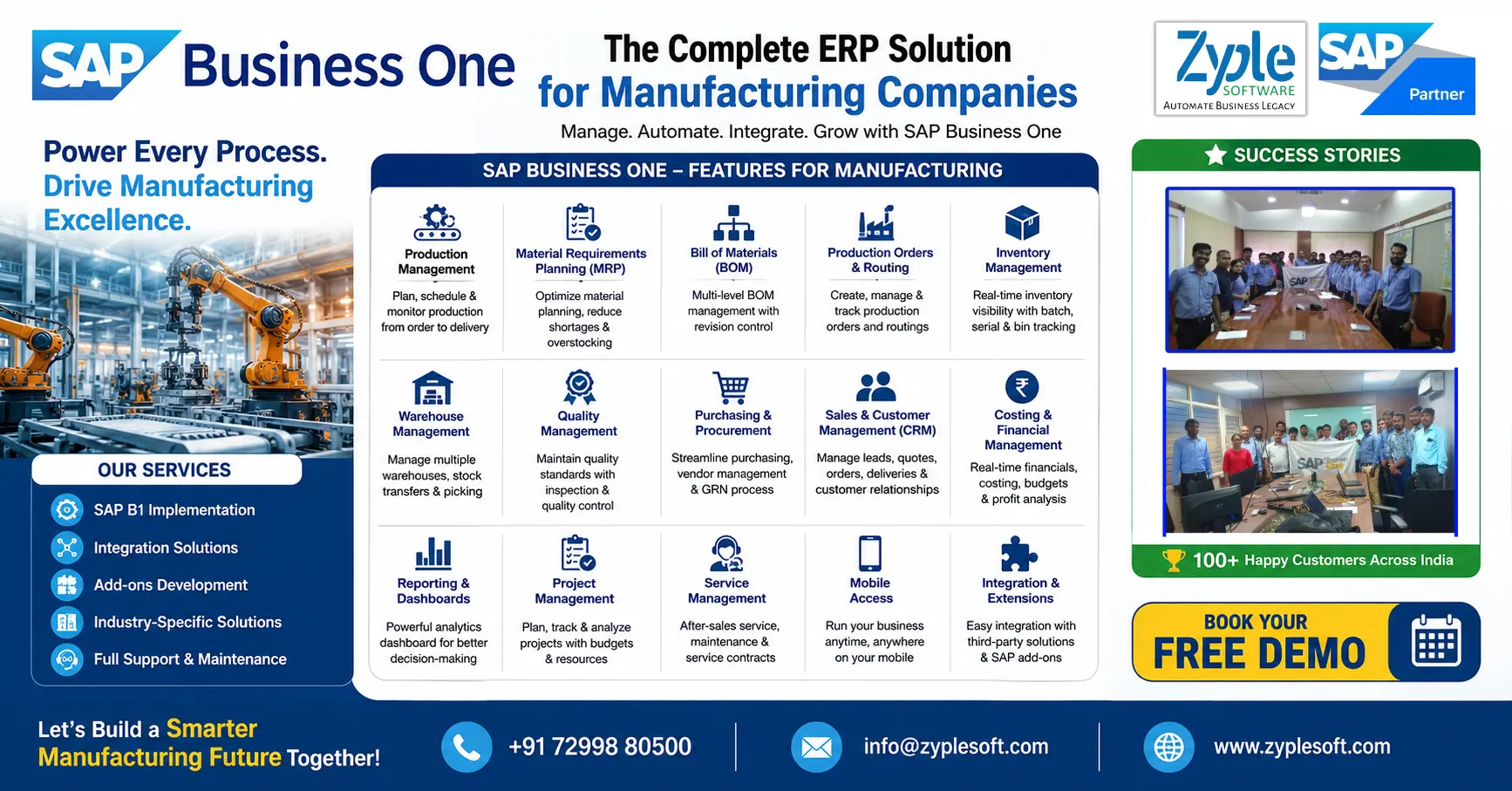
Manufacturing in India is evolving rapidly. Rising raw material costs, increasing customer expectations, strict compliance requirements, and global competition are forcing manufacturers to move beyond spreadsheets and disconnected software. Whether you manufacture automotive components, pharmaceuticals, food products, machinery, textiles, chemicals, electronics, or fabricated metals, having the right ERP software is no longer optional but it’s essential. In this comprehensive guide, we will explore the best ERP software for manufacturing in India, the features you should look for, implementation considerations, pricing factors, and why SAP Business One has become one of the most preferred ERP solutions for small and medium-sized manufacturers.

What is Manufacturing ERP Software?

Manufacturing ERP (Enterprise Resource Planning) software is an integrated business management system that connects every department of your manufacturing business into one centralized platform.

Instead of managing separate software for production, inventory, finance, purchasing, sales, quality, and warehouse operations, an ERP system provides a single source of truth.

A manufacturing ERP helps businesses:

  • Plan production efficiently
  • Track raw materials and finished goods
  • Reduce inventory costs
  • Improve on-time delivery
  • Monitor machine utilization
  • Control manufacturing costs
  • Automate purchasing
  • Manage vendors
  • Improve financial visibility
  • Make faster business decisions

Why Indian Manufacturers Need ERP Software?

Many manufacturers still rely on Excel sheets, manual processes, and disconnected applications.
 
This creates several challenges:
  • Inventory mismatches
  • Stock shortages
  • Excess inventory
  • Delayed production
  • Poor production planning
  • Inaccurate costing
  • Manual purchase approvals
  • Difficult GST compliance
  • Lack of real-time reports
  • Limited visibility across multiple plants
An ERP system eliminates these challenges by automating and integrating business processes.
 

Key Features to Look for in Manufacturing ERP

When selecting ERP software, ensure it includes the following capabilities.

1. Production Planning

Plan production based on:

  • Sales Orders
  • Demand Forecasts
  • Available Inventory
  • Capacity Planning
  • Material Availability

2. Material Requirements Planning (MRP)

MRP helps manufacturers automatically calculate:
  • Raw material requirement
  • Purchase quantities
  • Production schedules
  • Stock shortages
  • Supplier requirements
This reduces stock-outs and overstocking.

3. Bill of Materials (BOM)

An ERP should support:
  • Multi-level BOM
  • Alternate BOM
  • Revision control
  • Engineering changes
  • Cost calculation

4. Production Orders

Manage:
  • Work Orders
  • Routing
  • Stage-wise production
  • Machine allocation
  • Labor tracking
  • Production completion

5. Inventory Management

Real-time inventory tracking includes:
  • Batch Management
  • Serial Number Tracking
  • Bin Locations
  • Multiple Warehouses
  • Stock Transfers
  • Goods Receipt
  • Goods Issue
  • Cycle Counting

6. Procurement Management

Automate purchasing through:
  • Purchase Requests
  • RFQs
  • Purchase Orders
  • Vendor Comparison
  • Goods Receipt
  • Vendor Performance

7. Sales & Customer Management

Manage:
  • Quotations
  • Sales Orders
  • Dispatch
  • Invoicing
  • Customer Credit Limits
  • CRM

8. Quality Control

Quality modules should support:
  • Incoming Inspection
  • In-process Inspection
  • Final Inspection
  • Rejection Analysis
  • NCR Management
  • CAPA

-9. Warehouse Management

Modern ERP systems include:
  • Barcode Scanning
  • Mobile Inventory
  • Warehouse Transfers
  • Pick Lists
  • Packing
  • Shipping

10. Financial Management

Complete financial integration including:
  • General Ledger
  • Accounts Payable
  • Accounts Receivable
  • Banking
  • GST
  • Fixed Assets
  • Cost Centers
  • Budgeting

Best ERP Software for Manufacturing in India

SAP Business One

SAP Business One is one of the leading ERP solutions for small and medium-sized manufacturers in India.
 
It integrates every business process into one system, including finance, manufacturing, purchasing, inventory, sales, CRM, service, analytics, and reporting.
 

Manufacturing Features

  • Material Requirements Planning (MRP)
  • Production Orders
  • Multi-Level BOM
  • Batch Tracking
  • Serial Number Management
  • Production Costing
  • Capacity Planning
  • Quality Integration
  • Warehouse Management
  • Mobile Access
  • Dashboards
  • Approval Workflows
  • Real-Time Analytics

Industries Supported

SAP Business One is widely used by:
  • Automotive
  • Engineering
  • Machinery
  • Food Processing
  • Pharmaceuticals
  • Chemicals
  • Plastics
  • Packaging
  • Electrical Equipment
  • Electronics
  • Textile
  • Furniture
  • Metal Fabrication
  • Wire & Cable
  • Aerospace Suppliers

Advantages

  • Global ERP from SAP
  • Scalable as business grows
  • Available on SAP HANA and Microsoft SQL
  • Cloud and On-Premise deployment
  • Strong partner ecosystem in India
  • Extensive manufacturing add-ons
  • Excellent reporting capabilities

Why SAP Business One Stands Out?

Unlike many ERP systems that require multiple third-party applications, SAP Business One provides an integrated platform.
 
Manufacturers gain:
  • Real-time dashboard
  • Live inventory visibility
  • Automated procurement
  • Faster production planning
  • Better customer service
  • Reduced operational costs
  • Improved profitability

Industries Using SAP Business One in India

SAP Business One is widely implemented across:
  • Steel Manufacturing
  • Wire Manufacturing
  • Construction Materials
  • Solar Manufacturing
  • Pharmaceutical Manufacturing
  • Food Manufacturing
  • Dairy Processing
  • Textile Manufacturing
  • Furniture Manufacturing
  • Packaging Industry
  • Chemical Industry
  • Electronics Manufacturing
  • Industrial Equipment
  • Auto Components
  • Plastic Manufacturing

Benefits of Manufacturing ERP

A modern ERP solution delivers measurable business benefits.

Improved Inventory Accuracy

Track inventory in real time and eliminate manual errors.

Better Production Planning

Optimize production schedules and improve machine utilization.

Reduced Manufacturing Costs

Control material usage, labor costs, and production overhead.

Faster Decision Making

Real-time dashboards provide complete business visibility.

Improved Customer Satisfaction

Deliver products on time with accurate inventory and production planning.

Complete Financial Visibility

Finance, inventory, and production remain synchronized.

Regulatory Compliance

Simplify GST, audit trails, and financial reporting.
 

Choosing the Right ERP

Before investing, evaluate the following:
  • Industry-specific functionality
  • Production complexity
  • Number of users
  • Number of manufacturing plants
  • Scalability
  • Mobile capabilities
  • Reporting tools
  • Integration options
  • Implementation partner experience
  • Post-implementation support

ERP Implementation Best Practices

Successful ERP implementation requires:
 
1. Business process mapping
2. Data cleansing
3. Master data preparation
4. User training
5. Pilot testing
6. Go-live planning
7. Continuous optimization
 
Selecting an experienced implementation partner is just as important as selecting the ERP software itself.

Why Choose Zyple Software for SAP Business One?

Zyple Software is an experienced SAP Business One partner helping manufacturers digitize their operations with industry-specific ERP solutions.
 
Our services include:
  • SAP Business One Implementation
  • Manufacturing ERP Consulting
  • SAP Business One Customization
  • ERP Data Migration
  • SAP Business One Integration
  • Industry-Specific Add-ons
  • Production Planning Solutions
  • MRP Optimization
  • SAP Business One License
  • Warehouse Management
  • User Training
  • Annual Support & Maintenance
We serve manufacturers across engineering, construction materials, pharmaceuticals, food processing, chemicals, packaging, retail, aerospace, and many other industries.

Last Conclusion

Choosing the best ERP software for manufacturing in India is a strategic decision that impacts every aspect of your business—from procurement and production to inventory, finance, and customer satisfaction.
 
For manufacturers looking for a scalable, proven, and feature-rich solution, SAP Business One offers a powerful platform that streamlines operations, improves productivity, and supports long-term growth. By partnering with an experienced implementation provider, businesses can accelerate deployment, reduce risks, and maximize return on investment.
 
Book a FREE demo for SAP Business One with Zyple Software and discover how a modern manufacturing ERP can help improve efficiency, reduce costs, and drive profitable growth.
 
If you are ready for ERP for manufacturing industry, fill your contact details in below form, Zyple team will contact you as soon as possible with better solution.

    Frequently Asked Questions (FAQs)

    Which ERP software is best for manufacturing in India?

    SAP Business One is widely regarded as one of the best ERP solutions for small and medium-sized manufacturers due to its comprehensive manufacturing, inventory, finance, and production planning capabilities.

    The cost depends on deployment type, number of users, implementation scope, customizations, and support requirements. A professional assessment helps determine the total investment.

    Yes. Modern ERP solutions such as SAP Business One are specifically designed for growing small and medium-sized manufacturers.

    Yes. Most modern ERP systems support multiple plants, warehouses, branches, and legal entities.

    Yes. Leading ERP systems provide GST-compliant financial processes, taxation, invoicing, and reporting.

    Yes. SAP Business One can integrate with barcode scanners, weighbridges, MES, IoT devices, quality systems, e-commerce platforms, and third-party business applications.

    Generally between 8–20 weeks depending on project complexity.
    Success Story: SAP Business One ERP Software for Manufacturing Industry implemented by Zyple Software

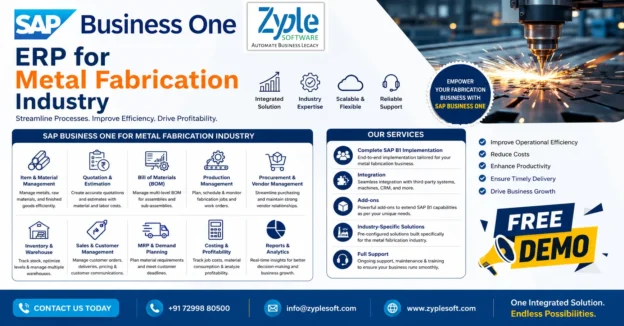
    SAP Business One ERP for Metal Fabrication Industry infographic showcasing production management, inventory control, BOM management, procurement, costing, reporting, implementation services, integration, add-ons, support, and free demo by Zyple Software.

    SAP Business One for Metal Fabrication Industry

    SAP Business One ERP for Metal Fabrication Industry

    SAP Business One ERP for Metal Fabrication Industry infographic showcasing production management, inventory control, BOM management, procurement, costing, reporting, implementation services, integration, add-ons, support, and free demo by Zyple Software.

    In the ever-evolving landscape of the metal fabrication industry, staying ahead of the curve is important for success. The metal fabrication industry is under constant pressure to improve efficiency, handle costs effectively, and ensure smooth operational flow. SAP Business One ERP for metal fabrication handles these challenges by providing a complete solution to optimize production, inventory, and financial management.

    Challenges Faced By The Metal Fabrication Industry

    The metal fabrication industry faces serious hurdles, notably severe skilled labor shortages, fluctuating raw material costs, and complex supply chain disruptions. Also, operators must navigate strict decarbonization mandates, the integration of automation tech, and rising demands for highly customized parts.

    1. Skilled Labor Shortages

    Finding certified welders, machinists, and assemblers remains a top challenge, driving many businesses to invest heavily in in-house training and advanced automation.

    2. Supply Chain Disruptions

    Fabricators struggle with material shortages, stock availability, and fluctuating costs (especially for steel and base metals), which delays production schedules.

    3. Energy and Production Costs

    Metal processing is highly energy-intensive. Rising power costs and the need for expensive, compliant environment equipment crush profit margins.

    4. Quality and Waste Control

    Common technical issues like inaccurate blending, tool wear, and poor edge finishes lead to expensive rework and excessive scrap.

    5. Decarbonization and Green Steel

    The industry faces a massive push to minimize carbon dioxide emissions and embrace green manufacturing, forcing secondary steel facilities to adapt and update legacy equipment.

    6. Changing Customer Demands

    There is a growing pressure to produce high-mix, low-volume custom parts on faster timelines, increasing the complexity of shop-floor scheduling.

    Features of SAP Business One ERP for Metal Fabrication Industry

    1. Production Planning and Shop Floor Control

    • It includes bill of materials (BOM) management for complex assemblies.
    • Routing and operation sequencing like cutting, bending, welding, and machining.
    • It includes work order creation, release, and tracking.
    • It includes real-time shop floor visibility.
    • It includes machine capacity planning and scheduling.
    • Minimized downtime and optimized resource utilization.

    2. Raw Material and Inventory Management

    • Handles metal grades, sizes, thickness, and dimensions.
    • Batch or lot tracking like heat numbers, coils, and sheets.
    • It includes real-time inventory visibility across warehouses.
    • It includes scrap and waste management.
    • It includes bin location and warehouse management.
    • It includes automatic replenishment.

    3. Procurement and Supplier Management

    • It includes automated purchase requisitions and purchase orders.
    • It includes vendor comparison and price management.
    • It includes raw material procurement planning based on production demand.
    • It includes integration with inventory and finance.
    • It includes multi-currency and tax handling for global sourcing.

    4. Sales and Customer Relationship Management (CRM)

    • It includes lead and opportunity management.
    • It includes quotation management for custom fabrication jobs.
    • Customer order management, like make-to-order and engineer-to-order.
    • It includes after-sales service and contract management.
    • It includes integration with production for accurate delivery times.

    5. Job Costing and Profitability Analysis

    • Accurate job-wise costing, like material, labor, and machine time.
    • Tracks work-in-progress (WIP).
    • It includes margin analysis per order or project.
    • It includes cost variance tracking and control.
    • It helps improve pricing and profitability decisions.

    6. Financial Management and Accounting

    • It includes general ledger, accounts payable, and accounts receivable.
    • It includes cash flow management and budgeting.
    • It includes fixed asset accounting.
    • It includes bank reconciliation and GST compliance.
    • It includes real-time financial reporting and audit trials.

    7. Quality Control and Compliance

    • It includes inspection plans at multiple production stages.
    • Quality check dimensions for dimensions, weight, finish, and tolerance.
    • It includes non-conformance tracking and corrective actions.
    • Compliance with industry standards like ISO and fabrication specs.
    • It includes batch traceability for quality audits.

    8. Production Cost Control and Material Optimization

    • Minimizes material wastage and scrap.
    • Optimizes cutting plans and material utilization.
    • Tracks yield losses and improves efficiency.
    • Controls over production, time, cost, and consumption.

    9. Project and Contract Management

    • Suitable for custom fabrication projects.
    • Tracks project timelines, budgets, and resources.
    • Links projects with procurement, production, and finance.
    • Monitors project profitability in real-time.

    10. Business Intelligence and Real-Time Analytics

    • It includes real-time dashboards and KPI monitoring.
    • It includes production efficiency analysis.
    • It includes inventory and sales insights.
    • It includes custom reports using Excel integration.
    • It includes data-driven decision-making.

    11. Multi-Warehouse and Logistics Management

    • Handles multiple warehouses and yards.
    • Tracks inward and outward movement of materials.
    • It includes delivery scheduling and dispatch planning.
    • It includes integration with transportation and logistics.

    12. Integration and Automation

    • It includes seamless integration of production, inventory, finance, and sales.
    • It includes automated workflows and approvals.
    • It includes integration with CAD, MES, and IoT (via add-ons).
    • It includes e-invoicing, GST, and compliance automation.

    13. Mobile and Cloud Access

    • It includes a mobile app for real-time business access.
    • It includes cloud or on-premises deployment.
    • It includes remote monitoring of production and sales.
    • Decision-making can be done anywhere, anytime.

    14. Industry-Specific Capabilities for Metal Fabrication

    • Handles cutting, welding, bending, and machining workflows.
    • It includes support for make-to-order and engineer-to-order production.
    • Weight-based inventory tracking is common in steels and metals.
    • It includes fast quotations for custom fabrication jobs.
    • Complete traceability from raw material to finished goods.

    Benefits of SAP Business One ERP for Metal Fabrication

    The ERP software, SAP Business One (SAP B1) system, facilitates metal fabrication by replacing fragmented systems with a unified platform. It connects shop-floor operations with financials, allowing fabricators to generate accurate quotes, optimize raw material nesting, track batches from purchase to delivery, and control project costs.

    1. Accurate Job Costing

    Gains real-time visibility into material, labor, and machine overheads. This ensures your price quotes are competitive while protecting profit margins using SAP implementation.

    2. Material Optimization and Nesting

    Through industry-specific add-ons, you can track raw metals (sheets, plates, and pipes) by batch or heat numbers and optimize cutting or nesting processes to decrease waste.

    3. Integrated Production Planning

    Seamlessly manage work orders, allocate resources, and schedule shop-floor production to eliminate obstacles and ensure on-time delivery.

    4. End-to-End Traceability

    Track materials from the initial supplier purchase through production and onto final delivery, which is essential for quality control and industry compliance.

    5. Optimized Inventory Management

    Maintain ideal stock levels of expensive raw materials, minimizing carrying costs and preventing stockouts using SAP solutions.

    Conclusion of Metal Fabrication ERP

    Zyple Software is an official SAP Business One partner in India specializing in implementation, digital transformation, licensing, integration, add-on solutions, migration, and consulting for the metal fabrication industry. By implementing SAP software, metal fabrication businesses can facilitate their processes, minimize inefficiencies, and gain better control over their operations, allowing them to scale and grow in a competitive market.

    If you’re fascinated, schedule a demo of SAP Business One.

    Do you command the SAP Business One ERP system for your business or industry?

    Complete all the details in the defined contact form; our team will return to you.

      FAQs for Metal fabrication

      How can SAP Business One improve efficiency in metal fabrication operations?

      SAP Business One automates key processes like production planning, inventory tracking, and order management. This minimizes manual errors, improves workflow visibility, and helps metal fabricators deliver projects faster and more efficiently.

      Yes, it supports make-to-order (MTO) and engineer-to-order (ETO) processes, enabling businesses to manage custom designs, job costing, and project timelines with precision.

      With real-time inventory tracking and accurate demand planning, SAP Business One reduces overstocking and shortages, helping minimize scrap, optimize material usage, and control overall production costs.

      Absolutely. It is designed for small and medium-sized businesses and scales as your operations grow, making it a cost-effective ERP solution for expanding fabrication companies.

      You can start by consulting a certified SAP Business One partner like Zyple Software, who will evaluate your requirements, provide a demo, and guide you through implementation, customization, and support.