Author Archives: Zyple Software

SAP Business One ERP for Printing and Packaging Equipment industry

SAP Business One for Printing and Packaging Equipment Industry

SAP Business One ERP for Printing and Packaging Equipment Industry
SAP Business One ERP for Printing and Packaging Equipment industry

The printing and packaging equipment industry requires speed, accuracy, and cost discipline. To deal with quick-turn orders, design changes, tight tolerances, and shrinking margins while trying to stay on schedule and under budget, the printing and packaging equipment industry needs a powerful ERP solution. SAP Business One ERP for printing and packaging equipment helps the printing and packaging equipment industry to facilitate processes, reduce waste, and track every detail, from quoting and design to production and dispatch.

Issues Faced By The Printing and Packaging Equipment Industry

The printing and packaging equipment industry faces serious challenges driven by the stricter global sustainability laws, a severe shortage of skilled operators, and the high costs of digital technology migration.

Manufacturers and operators are forced to reconsider traditional engineering workflows to maintain profitability amid volatile raw material costs and rapid technological evolution.

1. Stricter Environmental Regulations

Equipment must adjust to global mandates like the European Union’s Printing and Packaging Waste Regulation (PPWR) and the US Extended Producer Responsibility (EPR) laws. Press designs must prioritize lower energy usage, minimal ink waste, and accurate chemical control to minimize overall carbon footprints.

2. Labor Shortages and Software Complexity

Most of the packaging end-users report difficulties finding experienced machinery technicians and operators. Manufacturers are forced to build smarter, more autonomous interfaces to let low-experience workers perform complex multi-step processes safely. Outdated hardware struggles to mesh with modern, data-driven AI scheduling platforms and asset management ecosystems.

3. Financial Constraints of Digital Migration

Industrial printing machinery depreciates slowly, making complete facility overhauls economically impossible for smaller firms. Manufacturers must develop modular motor upgrades and components that can retrofit into decades-old present hardware.

4. Demand for Personalization and Rapid Turnarounds

High growth in personalized e-commerce packaging forces machinery to manage shorter, highly variable print runs efficiently. Shifting from a few massive print orders to thousands of tiny, customized orders causes planning errors and administrative obstacles.

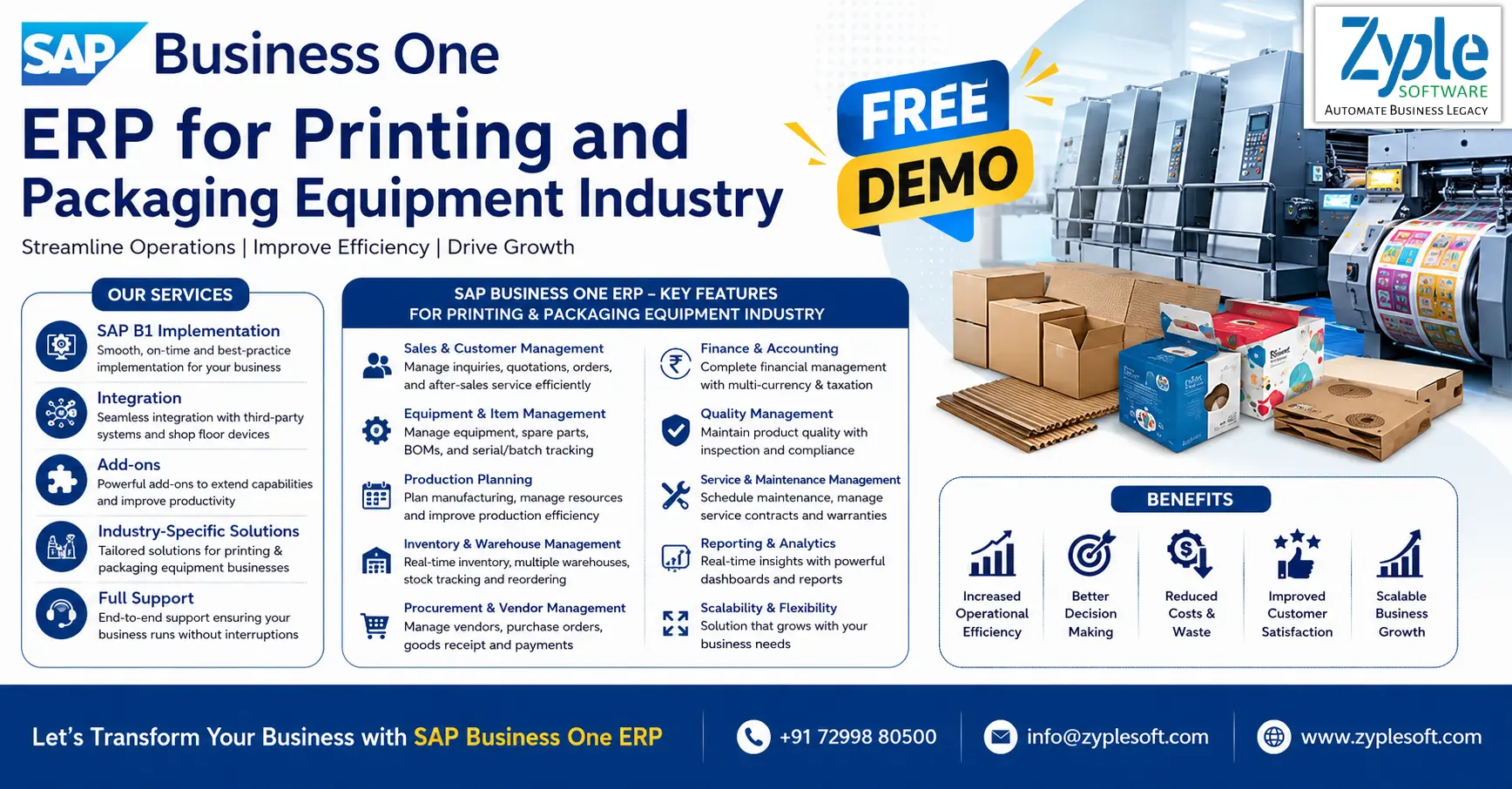
Features of SAP Business One ERP for Printing and Packaging Equipment

1. Production Planning and Job Management

  • Advanced production planning and scheduling for print jobs like offset, flexo, digital, and gravure.
  • Job-based manufacturing, like make-to-order (MTO) and batch production handling.
  • It includes a multi-level bill of materials (BOM) for packaging structures.
  • Machine capacity planning like printers, cutters, laminators, and die cutters.
  • It includes production routing and workflow tracking.
  • It includes real-time shop floor visibility.
  • It includes production logbook management.
  • Helps minimize downtime, optimize machine utilization, and ensure on-time delivery.

2. Estimation, Costing, and Job Profitability

  • It includes pre-production job estimation and quotation.
  • It includes accurate material, labor, and machine costing.
  • It includes real-time job costing vs. actual cost tracking.
  • It includes profitability analysis per job or order.
  • It includes waste and scrap cost monitoring.
  • Essential for printing businesses where margins depend on precise cost control.

3. Raw Material and Inventory Management

  • It includes multi-location and warehouse management.
  • It includes real-time stock visibility and valuation.
  • It includes WIP (Work-In-Progress) tracking.
  • It includes barcode or RFID integration.
  • It ensures minimal wastage and accurate stock control.

4. Sales, CRM, and Order Management

  • Entire quote-to-cash cycle from quotation, order, and delivery to invoice.
  • It includes customer-specific pricing and contracts.
  • It includes sales forecasting and opportunity tracking.
  • It includes customer communication and CRM integration.
  • It includes after-sales service and compliant management.
  • It improves customer satisfaction and repeat business.

5. Procurement and Vendor Management

  • It includes automated purchase requisitions and purchase orders.
  • It includes supplier price comparison and evaluation.
  • It includes approval workflows for procurement.
  • It includes accounts payable automation.
  • It ensures timely procurement of raw materials like paper, ink, and packaging substrates.

6. Quality Control and Compliance

  • Quality parameter tracking like GSM, thickness, color accuracy, and durability.
  • It includes compliance with industry standards.
  • It includes non-conformance and rejection management.
  • Important for maintaining print consistency and packaging strength.

7. Warehouse, Dispatch, and Logistics

  • It includes bin-level warehouse management.
  • It includes packaging, labeling, and packaging slip generation.
  • It includes dispatch planning and shipment tracking.
  • It includes loading optimization and transport management.
  • It includes integration with barcode scanning systems.
  • It ensures faster and error-free deliveries.

8. Financial Management and Accounting

  • It includes general ledger, journal entries, and financial reporting.
  • It includes accounts receivable and payable automation.
  • It includes cost center and profit center accounting.
  • It includes budgeting and cash flow management.
  • It includes multi-currency and tax compliance.
  • Delivers complete financial control and visibility.

9. Business Intelligence (BI) and Reporting

  • It includes real-time dashboards and KPIs.
  • It includes custom MIS reports.
  • It includes drill-down analytics and data visualization.
  • It includes profitability, production efficiency, and sales analysis.
  • Allows data-driven decision-making.

10. Machine Integration and Automation

  • It includes integration with printing and packaging machines.
  • It includes IoT-enabled production monitoring via add-ons.
  • It includes automated data capture from the shop floor.
  • Minimized manual data entry.
  • It improves accuracy and operational efficiency.

11. Document Management and Printing

  • It includes document layouts using Crystal Reports.
  • It includes automated document printing workflows.
  • It supports high-volume document generation for printing businesses.

12. Multi-Unit and Multi-UOM Handling

  • It supports multiple units of measurement (UOM).
  • It includes conversion between sheets, rolls, kg, meters, and more.
  • Important for packaging and paper-based industries.

13. Service and Maintenance Management

  • It includes equipment service scheduling.
  • It includes maintenance tracking for printing machines.
  • It includes customer complaint handling.

14. Mobility and Web Access

  • It includes mobile app for sales and management.
  • It includes web-based access for remote monitoring.
  • It includes real-time updates from anywhere.

15. Scalability and Deployment Flexibility

  • It includes cloud, on-premises, or hybrid deployments.
  • Easy adaptability as business grows.
  • It includes integration with third-party systems and add-ons.

Benefits of SAP Business One ERP for Printing and Packaging Equipment

The ERP software, SAP Business One (SAP B1) system, facilitates the printing and packaging equipment industry by replacing disconnected systems with a single, unified ERP. It improves production planning, eliminates manual errors, reduces material waste, and ensures strict regulatory and quality compliance across your entire supply chain.

1. Advanced Production Scheduling

Automates job scheduling and material procurement, improving machine usage and minimizing costly equipment downtime.

2. Inventory and Lot Traceability

Tracks raw materials like inks, papers, and films and work-in-progress (WIP) across multiple bins and warehouses to prevent stockouts and excess stock using SAP implementation.

3. Waste Reduction

Improves material usage and calculates accurate cost estimations, leading to drastically reduced material waste and improved profit margins.

4. Quality Control and Compliance

Maintains quality parameters like GSM and thickness at every stage of production and ensures ISO and regulatory compliance.

5. Financial and Taxation Integration

Automates invoicing and localized taxation rules, such as GST for Indian manufacturers, facilitating your accounting and reporting using SAP solutions.

6. Real-Time Analytics and CRM

Delivers actionable Key Performance Indicator (KPI) dashboards and historical sales data, allowing you to proactively engage customers and track production efficiency.

Conclusion of Printing and Packaging Equipment ERP

Zyple Software is a certified SAP Business One partner in India specializing in implementation, digital transformation, licensing, integration, add-on solutions, migration, and consulting for the printing and packaging equipment industry. The SAP software stands out as an ERP solution that supports growth and competitiveness in the printing and packaging equipment sector.

SAP Business One (B1) is an ERP designed for small and midsize businesses that integrates finance, purchasing, sales, inventory, production, CRM, and reporting into a single platform. For Printing and Packaging Equipment companies, it can improve project costing, procurement, subcontractor billing, and inventory management.

If you’re flexible, schedule a demo of SAP Business One.

Do you mandate the SAP Business One ERP system for your business or industry?

Complete all the details in the delivered contact form; our team will return to you.

    1.How much does SAP Business One cost for printing and packaging equipment enterprises?

    The cost differs based on the number of users, customization requirements, and deployment type (cloud or on-premise).

    Yes, you can request a free demo customized for your printing and packaging operations. A demo helps you understand how the system will fit your workflows before making a decision.

    SAP B1 implementation generally takes 6 to 12 weeks, depending on the complexity of your processes, data migration needs, and level of customization required.

    Yes, SAP Business One provides flexible deployment options, including cloud, on-premise, and hybrid models, allowing you to choose what best suits your IT infrastructure.

    Yes, certified SAP B1 partners like Zyple Software deliver end-to-end support, including user training, system maintenance, and ongoing assistance to ensure smooth operations and maximum ROI.
    SAP Business One ERP for Toys and Recreational Products Industry

    SAP Business One for Toys and Recreational Products Industry

    SAP Business One ERP for Toys and Recreational Products Industry

    SAP Business One ERP for Toys and Recreational Products Industry

    The toys and recreational products industry in India is rapidly accepting digital transformation to stay competitive. Handling production, inventory, compliance, and finances manually or through disconnected systems often leads to inefficiencies and costly errors. SAP Business One ERP for toys and recreational products facilitates multi-level supply chains, accelerates order fulfillment, and delivers powerful inventory management to handle seasonal demand fluctuations and strict global safety compliances.

    Challenges Faced By The Toys and Recreational Products Industry

    1. Regulatory and Quality Compliance

    Toys are governed by some of the world’s strict safety regulations. In regions like India, Quality Control Orders (QCOs) and mandatory Bureau of Indian Standards (BIS) testing have levelled the playing field against substandard imports, but small-scale manufacturers struggle to afford compliance testing. There is a notable lack of localized, certified testing facilities that achieve global quality standards.

    2. Digital Disruption and Shifting Consumer Habits

    The rapid digitalization of childhood means traditional toys are competing with video games, streaming platforms, and educational apps. The forever young phenomenon has adults promoting massive sales in collectibles. However, fads fade quickly, leaving companies with high-risk inventory. Mobile commerce and social media have revolutionized buying patterns, forcing conventional brick-and-mortar retailers to restructure their shopping experiences and online supply chains.

    3. Supply Chain and Manufacturing Vulnerabilities

    Many domestic manufacturers in regions like India are heavily dependent on imports (e.g., from Japan and South Korea) for raw materials and capital goods, exposing them to volatile trade policies and currency risks. Toy making remains largely a manual, labor-intensive process, especially for dolls and complex decor, yet the short lifecycle of popular toys makes long-term automation or mechanization difficult to justify financially. Transportation challenges, component shortages, and global health or geopolitical events continue to delay product launches.

    4. Environmental and Sustainability Demands

    Much of the industry relies on virgin plastics, generating massive waste. Leaders in the field face serious pressure to shift towards a circular economy.

    5. Fragmented Market and Financial Constraints

    The industry remains highly obsolete, with a large unorganized, MSME-driven sector holding a major market share in places like India. Smaller enterprises lack the capital to invest heavily in advanced technologies like artificial intelligence, 3D prototyping, and modern equipment.

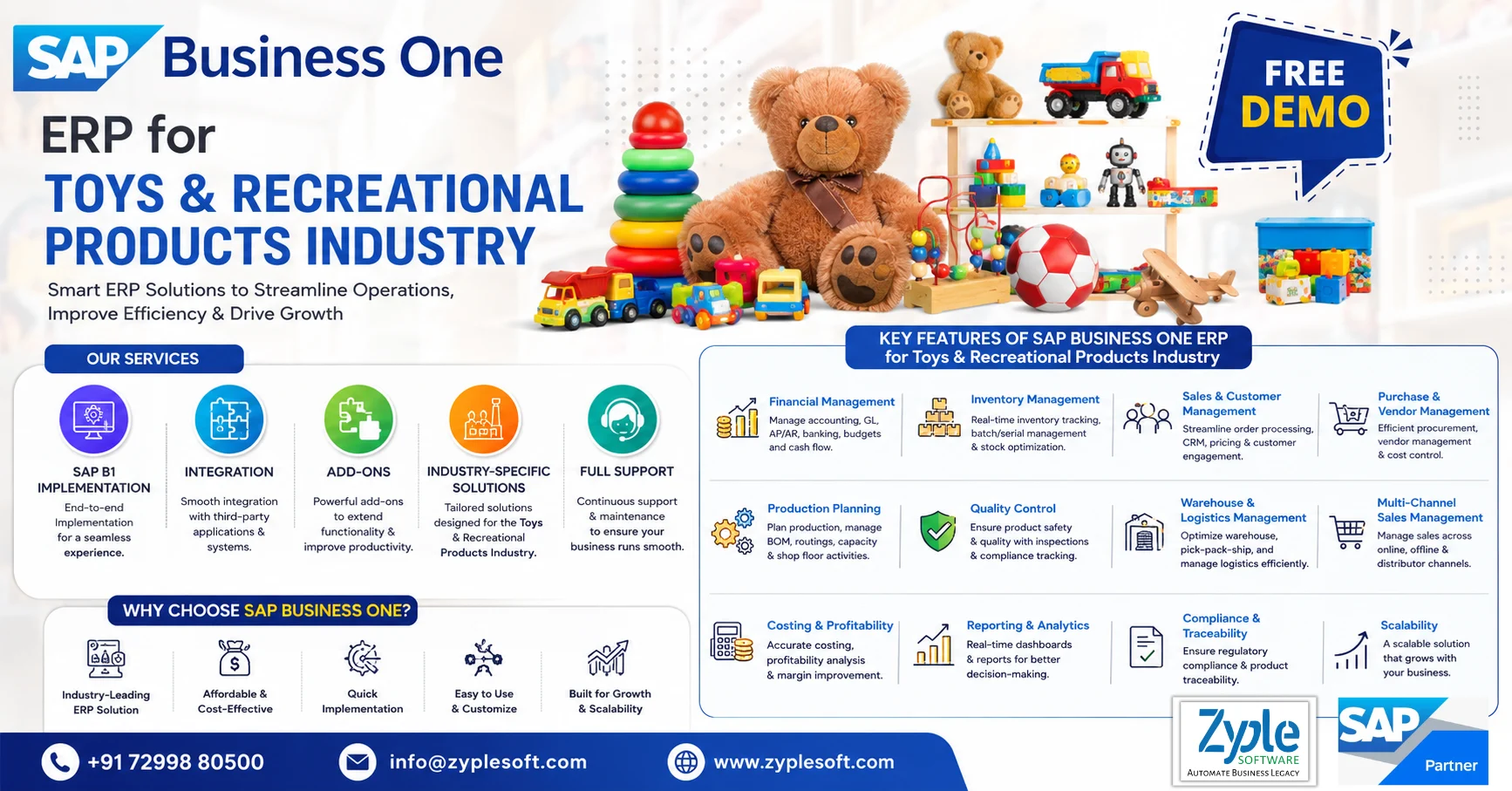
    Features of SAP Business One for Toys and Recreational Products

    1. Production and Manufacturing Management

    • Defines multi-level BOMs for toys with variants like color, size, and accessories.
    • Creates and tracks production orders for batch, discrete, or kit-based toy manufacturing.
    • Automatically plans raw materials like plastics, fabrics, and electronics based on demand forecasts.
    • Monitors real-time production stages, labor usage, and machine efficiency.
    • Ideal for toys with multiple SKUs like dolls, puzzles, and sports kits.
    • Minimizes wastage from defective toys or failed quality checks.
    • Helps handle seasonal spikes like festivals and holidays and rapid production cycles.

    2. Inventory and Warehouse Management

    • It includes real-time inventory tracking across warehouses.
    • Batch and serial number tracking is essential for toy safety recalls.
    • It includes bin location management for efficient storage of small items.
    • It includes automatic stock replenishment.
    • It includes multi warehouse management for distributors and retailers.
    • Inventory valuation and costing procedures like FIFO and moving average.

    3. Financial Management and Cost Control

    • Product costing, like material, labor, and overheads.
    • Profitability analysis by product line, like toys vs recreational items.
    • It includes budgeting and cost control.
    • It includes tax and GST compliance.
    • It includes multi-currency support for export markets.

    4. Sales, Distribution, and Retail Management

    • It includes sales order management from quote, order, and delivery to invoice.
    • It includes customer relationship management (CRM).
    • It includes dealer and distributor management.
    • E-commerce integration like Amazon, Flipkart, and Shopify.
    • It includes seasonal demand forecasting.
    • It includes promotions and discount management.
    • Ideal for handling high seasonal demand like Diwali, Christmas, and summer vacations.

    5. Quality Control and Compliance

    • It includes incoming and in-process quality checks.
    • It includes compliance with safety standards like ASTM, EN71, and BIS.
    • It includes defect tracking and corrective actions.
    • It includes batch traceability for recalls.
    • It includes automated quality reports and certifications.
    • Necessary for child safety regulations and export compliance.

    6. Procurement and Supplier Management

    • It includes vendor management and evaluation.
    • It includes purchase order automation.
    • Raw material planning like plastics, packaging, and electronics.
    • It includes supplier price comparison and negotiation.
    • It includes import and export documentation handling.
    • It ensures smooth sourcing for multi-component toy manufacturing.

    7. Business Intelligence (BI) and Analytics

    • It includes real-time dashboards and KPIs.
    • It includes sales and demand forecasting reports.
    • It includes production efficiency analysis.
    • It includes inventory aging and slow-moving items.
    • It includes custom reports with Excel integration.
    • It helps identify best-selling toys and optimize inventory.

    8. Mobility and Cloud Access

    • It includes a mobile app for sales and inventory.
    • Cloud deployment like SAP B1 HANA.
    • It includes remote access for distributors and field sales.

    9. Integration and Scalability

    • Third-party add-ons like PLM and advanced manufacturing.
    • It includes API-based integrations.
    • Adaptable for growing toy brands.
    • It supports expansion from local manufacturing to global distribution.

    10. Industry-Specific Features for Toys and Recreational Products

    • Handles high SKU complexity like colors, sizes, and bundles.
    • Manages seasonal production planning.
    • It ensures child safety compliance and traceability.
    • It optimizes distribution to retailers and e-commerce.
    • It minimizes overstock and dead inventory.
    • It supports product innovation cycles.

    Benefits of SAP Business One for Toys and Recreational Products

    1. Precision Inventory and Warehouse Control

    Handles complex SKU types like sizes, colors, and materials, with real-time multi-warehouse tracking using SAP implementation. Automated stock updates avoid overstocking of off-season toys or stockouts during peak holiday seasons.

    2. Safety and Compliance Tracking

    Enforces strict regulatory standards such as BIS, CE, or ASTM, with end-to-end batch and serial number traceability. This guarantees rapid, targeted recalls if a material defect occurs.

    3. Material Requirements Planning (MRP)

    Optimize production planning by forecasting demand and aligning raw material procurement with manufacturing lead times. This decreases idle capacity and reduces production bottlenecks.

    4. Seamless E-Commerce Integration

    Connect your ERP to online marketplaces and digital storefronts using SAP solutions. This allows real-time synchronization of online orders, returns, and inventory levels.

    5. Advanced Financial Management

    Automate core accounting and track multi-level Bill of Materials (BOM) costs. Access real-time analytics to accurately measure product margins and analyze cost changes across your supply chain.

    Conclusion of Toys and Recreational Products ERP

    Zyple Software is the qualified SAP Business One partner in India specializing in implementation, digital transformation, licensing, integration, add-on solutions, migration, and consulting for the toys and recreational products industry. SAP Business One delivers a complete, scalable, and cost-effective ERP solution that empowers businesses to facilitate operations, improve production efficiency, ensure compliance, and make data-driven decisions.

    If you’re engaged, go for a demo of SAP Business One.

    Do you require the SAP B1 ERP solution for your business or industry?

    Finish all the details in the given contact form; our team will reach out to you.

      1.How much does SAP Business One cost for a toy manufacturing business?

      The cost of SAP Business One depends on factors like number of users, deployment type like cloud, on-premise , and hybrid and required modules. For toy manufacturers, pricing is generally customized, so it’s best to request a customized quote based on your business needs.

      Yes, SAP Business One is highly flexible and can be designed to handle product variations, seasonal demand, compliance requirements, and unique manufacturing processes specific to the toys industry.

      SAP B1 implementation timelines vary depending on business complexity, but most toy manufacturers can go live within a few weeks to a couple of months with the right SAP B1 partner like Zyple Software.

      Absolutely. You can request a free, no-obligation demo to see how SAP Business One ERP works for your toy manufacturing or distribution operations before making a decision.

      A certified SAP B1 partner like Zyple Software provides continuous support, user training, system upgrades, and maintenance to ensure your ERP system runs smoothly and delivers long-term value.

      SAP Business One ERP for Sports Goods Manufacturing industry

      SAP Business One for Sports Goods Manufacturing Industry

      SAP Business One ERP for Sports Goods Manufacturing Industry​

      SAP Business One ERP for Sports Goods Manufacturing industry

      The sports goods manufacturing sector is rapidly growing in India due to increasing domestic demand, global exports, fitness awareness, and expansion of sports infrastructure. Handling production, inventory, warehouse operations, dispatch tracking, and customer orders manually often creates operational ineffectiveness, inventory mismatches, production delays, and reporting inaccuracies. SAP Business One ERP for sports goods manufacturing helps sports goods manufacturing businesses centralize operations, automate workflows, and increase business visibility through a single platform.

      Issues Faced By The Sports Goods Manufacturing Industry

      The sports goods manufacturing industry faces significant challenges, including rising raw material costs, regulatory compliance burdens, and intense global price competition. Companies also struggle with shifting consumer expectations, technological upgrades, and supply chain inefficiencies that strain profitability, especially for smaller enterprises.

      1. High Input Costs and Supply Chain Constraints

      Sourcing high-performance materials like specialized polymers and carbon composites increases costs. High customs duties on imported materials compound this issue. Poor infrastructure and distance from large shipping ports increase freight costs and delay deliveries. Supply chain vulnerabilities, factory shutdowns, and shifting energy prices lead to production bottlenecks and inventory issues.

      2. Global Competition and Profit Margins

      Manufacturers face steep competition from low-cost production hubs, eroding domestic and global market share. Because consumers are sensitive to price hikes, manufacturers struggle to pass on increased production and labor costs, reducing profit margins.

      3. Compliance and Quality Standards

      High-performance gear involves thorough, expensive certifications from international sports bodies to compete globally. Achieving safety and ergonomic requirements involves advanced manufacturing tech, which many MSMEs lack the capital investment for.

      4. Branding and Market Shifts

      Smaller manufacturing hubs, specifically in clusters like Jalandhar and Meerut, often produce for larger anchor brands rather than developing their own labels, limiting global recognition. Buyers now expect sustainability, ethical sourcing, and integrated brand values, involving manufacturers in adapting their business models.

      Features of SAP Business One ERP for Sports Goods Manufacturing

      1. Bill of Materials (BOM) Management

      • Multi-level bill of materials (BOMs) for complex sports equipment like bicycles and gym machines.
      • It includes version control for design changes.
      • It includes component substitution for material flexibility.

      2. Production Planning and Scheduling

      • It includes forecast-based and order-based production planning.
      • It includes MRP (Materials Requirements Planning) for raw materials.

      3. Shop Floor Control

      • It includes real-time tracking of production stages.
      • It includes work order management.
      • It includes labor and machine time tracking.

      4. Real-Time Inventory Tracking

      • Tracks raw materials like rubbers, plastics, and metals and finished goods.
      • Batch and serial number tracking is essential for sports gear quality.

      5. Multi-Warehouse Management

      • Handles stock across multiple warehouses and retail outlets.
      • It includes automated stock transfers.

      6. Inventory Optimization

      • It includes safety stock levels.
      • It includes reorder point automation.
      • It includes demand-driven replenishment.

      7. Order Management

      • It includes sales quotations, orders, and invoicing.
      • It includes integration with distributors, dealers, and retailers.

      8. Pricing and Discount Management

      • It includes customer-specific pricing.
      • Seasonal discounts are essential for sports seasons and events.

      9. Returns and Warranty Handling

      • Handles product returns and replacements.
      • It includes warranty tracking for sports equipment.

      10. Accounting and Financial Control

      • It includes multi-currency support for exports.

      11. Cost Accounting

      • Tracks production costs per product.

      12. Quality Management

      • It includes defect tracking and corrective actions.

      13. Compliance and Certifications

      • Maintains compliance with industry standards like ISO and safety standards.
      • It includes an audit trail for traceability.

      14. Procurement Management

      • It includes vendor management.
      • It includes purchase requests, orders, and approvals.

      15. Supplier Performance Tracking

      • Evaluates vendors based on quality, delivery time, and cost.

      16. Logistics and Distributors

      • It includes shipment planning.
      • It includes integration with logistics providers.

      17. Real-Time Dashboards

      • It includes production KPIs, sales trends, and inventory levels.

      18. Advanced Analytics

      • It includes demand forecasting based on historical sales.
      • It includes seasonal trend analysis like cricket season spikes.

      19. Custom Reports

      • Customized reports for management decision-making.

      20. Customer Data Management

      • It includes centralized customer database.

      21. Sales Opportunity Tracking

      • It includes lead and opportunity management.

      22. After-Sales Service

      • It includes service contracts and customer support.

      23. Customization and Add-Ons

      • It includes industry-specific add-ons for sports manufacturing.
      • It includes user-defined fields and workflows.

      24. Integration Capabilities

      • It includes API-based integration with third-party tools.

      25. Mobile Apps

      • It includes sales and inventory access on mobile devices.

      26. Cloud Deployment

      • Available on the cloud for adaptability and remote access.

      27. Role-Based Authorization

      • Secures access control for different departments.

      28. Data Backup and Recovery

      • It includes automated backups and disaster recovery.

      Importance of SAP Business One for Sports Goods Manufacturing

      The ERP software, SAP Business One system, is essential for the sports goods manufacturing industry because it unites inventory control, production planning, and supply chain management into a single platform. It enables brands to facilitate complex production processes, minimize raw material waste, and quickly fulfill fluctuating global demands.

      1. Accurate Demand Forecasting

      Uses historic sales data and upcoming sporting event schedules to forecast the correct demand for seasonal gear and apparel, avoiding overstocking or stockouts using SAP implementation.

      2. Material Requirements Planning (MRP)

      Facilitates the procurement of specialized raw materials, like carbon fiber, synthetic leathers, and high-tech fabrics, based on precise lead times and real-time production requirements.

      3. Complex Bill of Materials (BOM) and Kitting

      Easily handles the production of discrete sports equipment like cricket gear, baseball bats, or tennis rackets, as well as grouped sports kits, tracking auto-batch generation and multi-item packaging using SAP solutions.

      4. Rigorous Quality Control

      Integrates quality control checkpoints across multiple production stages to ensure only safe, superior-quality athletic gear and protective equipment leave the factory.

      5. Global Compliance and Financials

      Handles multi-currency transactions and diverse regional tax compliances like GST billing efficiently across international borders.

      Benefits of SAP Business One ERP for Sports Goods Manufacturing

      SAP Business One ERP facilitates sports goods manufacturing by integrating production, inventory, and sales into one platform. It reduces material waste, accelerates order fulfillment through automated planning, ensures strict quality control for sports equipment, and delivers real-time financial visibility to drive profitability.

      1. Automated Material Requirements Planning (MRP)

      Automatically calculates exactly which raw materials like leather, carbon fiber, and rubber are required and when to purchase them based on sales orders and bill of materials (BOMs).

      2. Complex BOM and Scrap Management

      Handles multi-level BOMs efficiently while tracking and minimizing scrap or recycle waste commonly produced during cutting and molding processes.

      3. Quality Management and Compliance

      The SAP software sets strict quality control benchmarks and inspection checkpoints at individual stages of production to ensure safety and performance standards for athletes.

      4. Real-Time Inventory Tracking

      Delivers total visibility of stock levels, work-in-progress, and finished goods across multiple warehouses to prevent seasonal stockouts or overstocking.

      5. Integration Financials and GST

      Automatically ties every procurement and sales transaction to the general ledger, ensuring accurate costing, pricing insights, and compliant GST invoicing.

      Conclusion of Sports Goods Manufacturing ERP

      Zyple Software is the best SAP Business One partner in India specializing in implementation, digital transformation, licensing, integration, add-on solutions, migration, and consulting for the sports goods manufacturing industry. The SAP Business One system helps sports goods manufacturing businesses improve efficiency, inventory management, and long-term operational scalability.

      If you’re involved, reserve a demo of SAP Business One.

      Do you want the SAP B1 ERP system for your business or industry?

      Finish all the details in the given contact form; our team will get back to you.

        1.How quickly can SAP Business One be implemented for a sports goods manufacturing business?

        The SAP Business One implementation timelines generally range from a few weeks to months, depending on your business size and complexity. With the right partner like Zyple Software, you can achieve a smooth and fast deployment customized for your manufacturing needs.

        The cost of SAP B1 implementation varies based on the number of users, required modules, and customization. However, SAP Business One provides a cost-effective solution with a strong ROI by improving efficiency, reducing waste, and enhancing decision-making.

        Yes, SAP Business One is highly customizable. It can be customized for handling unique requirements such as seasonal demand, product variations, and specialized production workflows common in sports goods manufacturing.

        SAP Business One supports seamless integration with third-party applications like e-commerce platforms, CRM systems, and warehouse solutions, ensuring a unified business ecosystem without disrupting your current operations.

        You can request a personalized demo from an authorized SAP B1 partner like Zyple Software. A demo will showcase how SAP Business One can handle your specific challenges and help you evaluate its fit for your business before investing.

        SAP Business One ERP for Defense Equipment Manufacturing Industry

        SAP Business One for Defense Equipment Manufacturing Industry

        SAP Business One ERP for Defense Equipment Manufacturing Industry

        SAP Business One ERP for Defense Equipment Manufacturing Industry

        The defense equipment manufacturing sector operates under extreme precision, tight regulations, and complex supply chains. Handling production timelines, compliance requirements, and cost control manually can lead to inefficiencies and risks. SAP Business One for defense equipment manufacturing industry allows businesses to facilitate operations, maintain compliance, and improve decision-making through real-time data.

        Challenges Faced By The Defense Equipment Manufacturing Industry

        The defense equipment manufacturing industry faces serious challenges, including volatile supply chain disruptions, slow adaptation of advanced technologies like semiconductors and AI, heavy bureaucratic compliance, and high dependence on foreign transfer of technology (ToT). These factors cause continuous project delays, cost overruns, and vulnerability to geopolitical risks.

        1. Supply Chain Fragility

        Many companies are heavily reliant on foreign original equipment manufacturers (OEMs) for raw materials, rare earth metals, and essential sub-systems.

        2. Technological and Innovation Gaps

        Domestic manufacturers struggle with the heart and brain technologies. High-end sensors, AI systems, aero-engines, and advanced semiconductors generally lag behind modern threat capabilities. Foreign OEMs often restrict the sharing of intellectual property and core material technologies, delivering limited assembly licenses instead of true technological independence.

        3. Bureaucracy and Procurement Obstacles

        The procurement cycle, from the initial Request for Proposal (RFP) to final induction, often spans over a decade, delaying modernization.

        4. Workforce and Skill Deficits

        The industry suffers from a shortage of qualified personnel capable of operating, handling, and maintaining ultra-precise and evolving digital-engineering workflows.

        Features of SAP Business One for Defense Equipment Manufacturing Industry

        1. Advanced Manufacturing and Production Management

        • It includes multi-level Bill of Materials (BOM) with revision control.
        • Engineering change management is essential for defense specs.
        • It includes production orders and shop floor control.
        • It includes discrete, batch, and mixed-mode manufacturing support.
        • It includes capacity planning and machine scheduling.
        • It includes scrap, rework, and yield tracking.
        • It ensures precision manufacturing for complex defense components.

        2. Material Requirements Planning (MRP)

        • It includes demand forecasting and planning.
        • It includes automated procurement suggestions.
        • It includes lead-time scheduling.
        • It includes shortage and excess inventory alerts.
        • It helps maintain uninterrupted supply chains in mission-critical production.

        3. Inventory and Warehouse Management

        • It includes real-time tracking of raw materials, WIP, and finished goods.
        • Batch and serial number tracking is necessary for defense traceability.
        • It includes bin location and quantity warehouse management.
        • It includes automated stock valuation and movements.
        • Allows full traceability of every component and assembly.

        4. Compliance, Quality, and Traceability

        • It includes quality control at every production stage.
        • It includes audit trails and documentation.
        • Regulatory compliance support like ISO and defense standards.
        • It includes certificate generation and inspection reports.
        • Essential for defense contracts and government audits.

        5. Financial and Cost Management

        • Integrated accounting like general ledger, accounts payable, and accounts receivable.
        • It includes project-based costing and budget control.
        • Cost breakdown like material, labor, and overhead.
        • It includes profitability analysis per project or contract.

        6. Project and Contract Management

        • Project lifecycle tracking from planning and execution to delivery.
        • It includes budget vs. actual cost monitoring.
        • It includes milestone-based billing.
        • It includes resource allocation.
        • Suitable for long-term government and defense contracts.

        7. Procurement and Supplier Management

        • It includes vendor evaluation and management.
        • It includes purchase order automation.
        • It includes export and import documentation handling.
        • It includes supplier compliance tracking.
        • It strengthens defense supply chain reliability.

        8. Sales and Customer Lifecycle Management

        • It includes tender and quotation management.
        • It includes opportunity and pipeline tracking.
        • It includes a contract-based sales process.
        • It includes after-sales service and maintenance tracking.
        • It supports defense OEMs and government clients.

        9. Service and Maintenance Management

        • It includes equipment servicing and maintenance contracts.
        • It includes field service management.
        • It includes warranty tracking.
        • It includes spare parts management.
        • Necessary for lifecycle support of defense equipment.

        10. Business Intelligence and Analytics

        • It includes real-time dashboards and KPIs.
        • It includes predictive analytics for demand and production.
        • It includes custom reporting for audits and compliance.
        • It includes drill-down analysis across departments.
        • Allows faster, data-driven decision-making.

        11. Mobility and Remote Access

        • It includes web-based ERP access.
        • Ideal for distributed defense operations.

        12. Integration and Scalability

        • It includes integration with MES, PLM, and IoT systems.
        • It includes add-ons for aerospace and defense.
        • It includes multi-location and multi-currency support.
        • Adaptable for growing defense manufacturers.
        • It supports modernization and digital transformation.

        13. Centralized Data and Automation

        • Single unified database without data storage.
        • It includes automated workflows and alerts.
        • It includes role-based access control for security.
        • It ensures secure and efficient operations across departments.
        These all features are offering by SAP B1 Consultant companies(Example- Zyple Software)

        Importance of SAP Business One for Defense Equipment Manufacturing Industry

        The ERP software, SAP Business One (SAP B1) system, is essential for defense equipment manufacturers because it replaces fragmented legacy systems with a single, highly secure, and compliant digital core. It ensures real-time cost control, strict adherence to defense regulations, and multi-level supply chain visibility.

        1. Strict Regulatory Compliance

        Defense manufacturing requires uncompromising adherence to stringent standards like AS9100 and strict safety guidelines. SAP B1 ERP supports required document controls, non-conformance tracking, and quality records directly within the workflow.

        2. Deep BOM and Engineering Control

        Defense equipment often demands massive, nested Bills of Materials (BOMs). SAP software provides complete version control and design change tracking so that engineering revisions are accounted for accurately at the shop floor level.

        3. End-to-End Lot and Serial Traceability

        Every raw material, sub-assembly, and finished tactical component can be identified. This ensures accountability across the supply chain, allowing instant audit trails and quality inspections.

        4. Material Requirements Planning (MRP)

        Defense supply chains have complex multi-tier reliances. SAP B1 automates MRP to ensure the right metals, electronics, and components are in stock without over-purchasing or facing expensive production delays.

        5. Secure Project-Based Costing

        SAP B1 ties production orders directly to financials to understand true costs per unit, job, or contract, reducing margin surprises.

        6. Secure Cloud and Multi-Site Visibility

        It provides secure, real-time visibility into operations across multiple plants, allowing manufacturers to monitor performance, manage vendors, and adjust to sudden demand shifts using SAP implementation.

        Benefits of SAP Business One ERP for Defense Equipment Manufacturing Industry

        The SAP Business One solution is a powerful, integrated ERP solution customized for defense manufacturing. It facilitates complex supply chains, automates production, and provides rigorous, multi-level traceability required to meet strict military and regulatory standards.

        1. End-to-End Traceability

        Maintains complete, digital records of every part and batch from creation to final shipment to ensure audit readiness and compliance with protocols.

        2. Strict Quality Control

        Integrates quality management workflows to evaluate engineering changes, record non-conformances, and maintain military-grade certifications.

        3. Complex BOM Management

        Manages nested, multi-level Bills of Materials (BOMs) with precise version control to eliminate errors.

        4. Real-Time Job-Based Costing

        Accurately calculates true costs per unit, milestone, or contract to protect profit margins and improve forecasting using SAP solutions.

        5. Supplier and Procurement Control

        Automates purchasing and manages multi-tier supply chains to prevent production obstacles.

        Conclusion of Defense Equipment Manufacturing ERP

        Zyple Software is a certified SAP Business One partner in India specializing in implementation, digital transformation, licensing, integration, add-on solutions, migration, and consulting for the defense equipment manufacturing industry. By unifying all essential business functions into a single, facilitated platform, SAP Business One ERP drives operational excellence, improves product quality, and delivers real-time insights for smarter decision-making.

        If you’re interested, reserve a demo of SAP Business One.

        Do you require the SAP B1 ERP system for your business or industry?

        Finish all the details in the provided contact form; our team will return to you.

          1.How can I get started with SAP Business One for my defense manufacturing business?

          Getting started with SAP Business One requires a consultation to understand your manufacturing processes, compliance needs, and business goals. A certified SAP B1 partner like Zyple Software will guide you through planning, customization, and implementation.

          Yes, SAP B1 partners like Zyple Software provide personalized demos of SAP Business One showcasing features like production planning, compliance tracking, and inventory management specific to defense manufacturing.

          The cost of SAP Business One depends on the number of users, deployment type (cloud or on-premise), level of customization, and integration requirements with the current defense systems.

          SAP Business One implementation timelines typically range from a few weeks to a few months, based on the complexity of operations and compliance requirements.

          Yes, SAP B1 partners like Zyple Software deliver ongoing support, system maintenance, and user training to ensure you get maximum value from SAP Business One and maintain smooth operations.

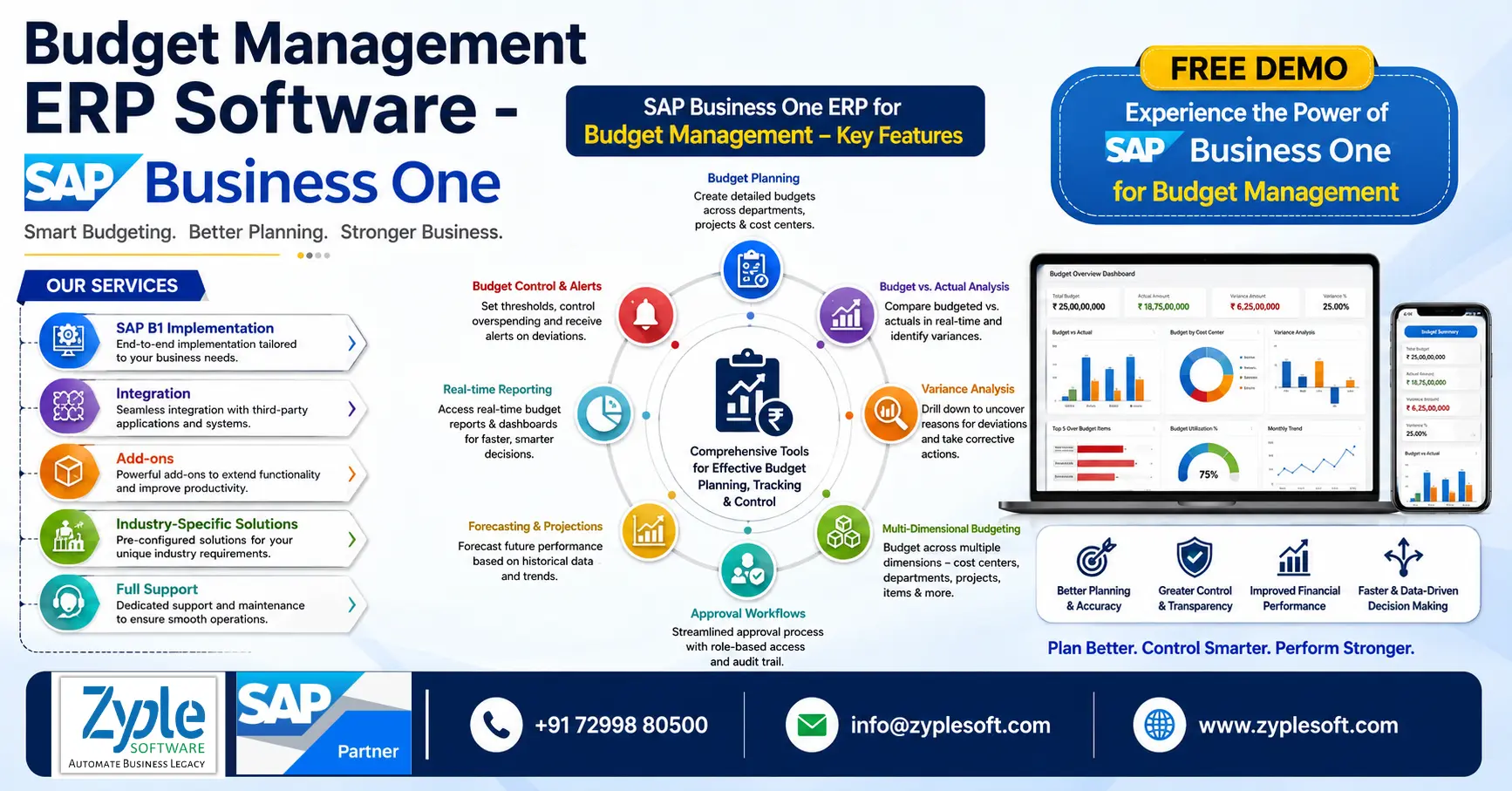
          Budget Management ERP Software - sap business one

          Budget Management ERP Software

          Budget Management ERP Software for Business

          Budget Management ERP Software - sap business one

          Handling budgets and tracking expenses can be a difficult task, but the emergence of enterprise resource planning (ERP) has made it easier and more accessible. With the budget management ERP software, businesses can efficiently handle their finances and ensure efficient resource management. Also, this ERP software is designed to help businesses stay on top of their budgeting needs and all the necessary calculations.

          What is Budget Management Software?

          Budget management software is software that integrates financial planning, forecasting, and real-time expense tracking to control costs and prevent budget overruns.

          Which is the Best ERP Software for Budget Management?

          SAP Business One is the best ERP software for budget management. The SAP Business One system serves as a powerful ERP software for budget management, allowing small and medium-sized enterprises (SMEs) to define, track, and control budgets in real-time. It enables annual or monthly budgeting, automated distribution methods, and proactive budget alerts or blocking of transactions that exceed predefined limits, ensuring financial control.

          Features of Budget Management ERP Software

          Here are the features of SAP Business One as budget management software:

          1. Budget Planning and Scenario Definition

          • Creates budget scenarios for different financial plans (annual, quarterly, and project-based).
          • Assigns budgets to general ledger accounts, departments, or cost centers.
          • Defines distribution methods (equal, percentage-based, and seasonal allocation).

          2. Budget Allocation and Distribution

          • Allocates budgets across time periods (monthly or yearly) and business units or branches.
          • It includes flexibility to distribute funds based on business priorities or historical data.

          3. Budget Control and Enforcement

          • Strong control mechanisms to avoid overspending, like blocking transactions that exceed budget, warning alerts before exceeding limits, and enabling transactions without warning (if configured).
          • Applies to purchase requests and orders, goods receipt, and accounting entries (invoices and journal entries).

          4. Real-Time Budget Monitoring

          • Tracks budget vs. actual spending in real-time.
          • Instant visibility into over-utilized budgets and remaining balances.
          • It helps improve financial discipline and forecasting accuracy.

          5. Integration with Financial Management

          • Entirely integrated with general ledger, accounts payable and receivable, and cost accounting.
          • It ensures every financial transaction is automatically validated against the budget.

          6. Multi-Level Budgeting

          • It supports department-wise budgets, project-based budgets, and company-wide budgets.
          • Allows hierarchical budget control across multiple entities.

          7. Budget Revision and Adjustments

          • Modifies budgets through updates, transfers between accounts, and supplementary allocations.
          • Maintains flexible budgets for changing business conditions.

          8. Budget Reporting and Analytics

          • Creates reports, such as budget vs. actual reports, profit and loss accounts with budget comparison, and variance analysis.
          • Uses dashboards and analytics for data-driven decision-making.

          9. Alerts and Workflow Automation

          • Automated notifications for budget overruns and threshold breaches.
          • It includes workflow-based approvals for budget-related transactions.

          10. Project and Cost Control Integration

          • Links budgets with projects and cost centers.
          • Monitors project profitability and cost deviations effectively.

          11. Multi-Currency and Global Budgeting

          • Handles budgets across multiple currencies and international operations.
          • Suitable for companies operating in different regions.

          12. Audit Trail and Compliance

          • Full traceability of budget creation and changes and approvals.
          • It ensures financial transparency and compliance.

          Importance of Budget Management Software

          The enterprise resource planning (ERP) software, SAP Business One (SAP B1) solution, is essential for increasing financial accuracy, allowing real-time tracking, and automating forecasting, which helps businesses prevent overspending and align resources with strategic goals. By replacing manual spreadsheets, SAP B1 improves collaboration, delivers data-driven insights for decision-making, and increases overall financial efficiency.

          1. Increased Accuracy and Efficiency

          Automates data entry and calculations, eliminating human error inherent in manual budgeting processes using SAP implementation.

          2. Real-Time Monitoring and Control

          Delivers live, instant access to financial data and expenses, allowing teams to spot overspending immediately and make adjustments.

          3. Improved Forecasting and Planning

          Utilizes historical data and predictive analytics for accurate financial modeling and strategic planning, rather than depending on guesswork.

          4. Improved Collaboration

          The SAP Business One system allows multiple team members to work on a single, shared, and secure version of the budget, breaking down organizational storage.

          5. Strategic Resource Allocation

          SAP B1 helps managers identify areas of overspending and reallocate funds effectively to improve profitability and achieve business goals.

          6. Regulatory Compliance

          The SAP B1 solution ensures better documentation and reporting for auditing and regulatory purposes.

          Benefits of Budget Management ERP Software

          1. Increased Visibility and Control

          The SAP Business One software improves visibility and provides control to enterprises. With inbuilt real-time financial reporting, enterprises can find discrepancies or issues, which can help trigger immediate corrective action. Increased visibility and control also enable better decision-making, as finance teams can analyze financial data and make precise predictions about future spending.

          2. Time Saving

          Manual budgeting is a time-consuming process, but SAP Business One is fast and accurate and can also automate a number of repetitive and daily tasks. Users can quickly create budgets, evaluate expenses, and generate reports without manual interventions, freeing up strategic resources for essential tasks such as analysis and planning.

          3. Cost Savings

          The SAP Business One system can help enterprises create cost savings opportunities by identifying areas of overspending and reducing unnecessary expenses. SAP solutions also help procurement teams to negotiate better pricing with vendors and suppliers, further minimizing costs. Furthermore, SAP B1 also provides advanced features such as automated approvals and alerts, which can help enterprises avoid spending more than required and at the same time keep the budget management process on track.

          4. Improved Accuracy

          With automated processes and real-time reporting, the SAP B1 ERP system can eliminate many of the errors that can occur with manual budgeting, thereby improving accuracy and reducing the risk of financial discrepancies in reporting.

          5. Forecasting and Planning

          Most enterprises choose the SAP Business One system that can assist them with forecasting and planning. This software can analyze the enterprise’s historical spending patterns and identify trends and help the supply chain team to create accurate budget projections and ensure that financial resources are allocated appropriately. This can become accessible for companies with large and complex supply chains, where keeping track of budget and expenses can be a significant challenge.

          6. Enhanced Collaboration

          Other than keeping track of expenses, SAP software can help supply chain professionals to facilitate their workflows and improve supply chain collaboration. This software is capable of delivering a centralized platform for budget tracking and reporting, with which it virtually eliminates the need for multiple spreadsheets and documents. This can allow teams located across geographies to share data and insights in real time, exponentially increasing the scope for collaboration.

          7. Scalability

          What SAP Business One does is scale up with that growth, which makes such software a suitable tool for enterprises looking to expand their operations.

          Conclusion of Budget Management ERP

          Zyple Software is a trusted SAP B1 partner in India specializing in implementation, digital transformation, migration, licensing, integration, add-on solutions, and consulting for manufacturing, construction, real estate, agriculture, logistics, financial services, retail, technology, energy, healthcare, infrastructure, EPC, and professional services industries. It delivers increased visibility and control and  improved collaboration and forecasting and planning capabilities, as well as saves time, minimizes costs, and improves accuracy.

          If you’re active, book a demo of SAP Business One.

          Are you aiming to find the SAP Business One ERP software for your business or industry?

          Fill in all the details in the figured contact form; our team will reach out to you.

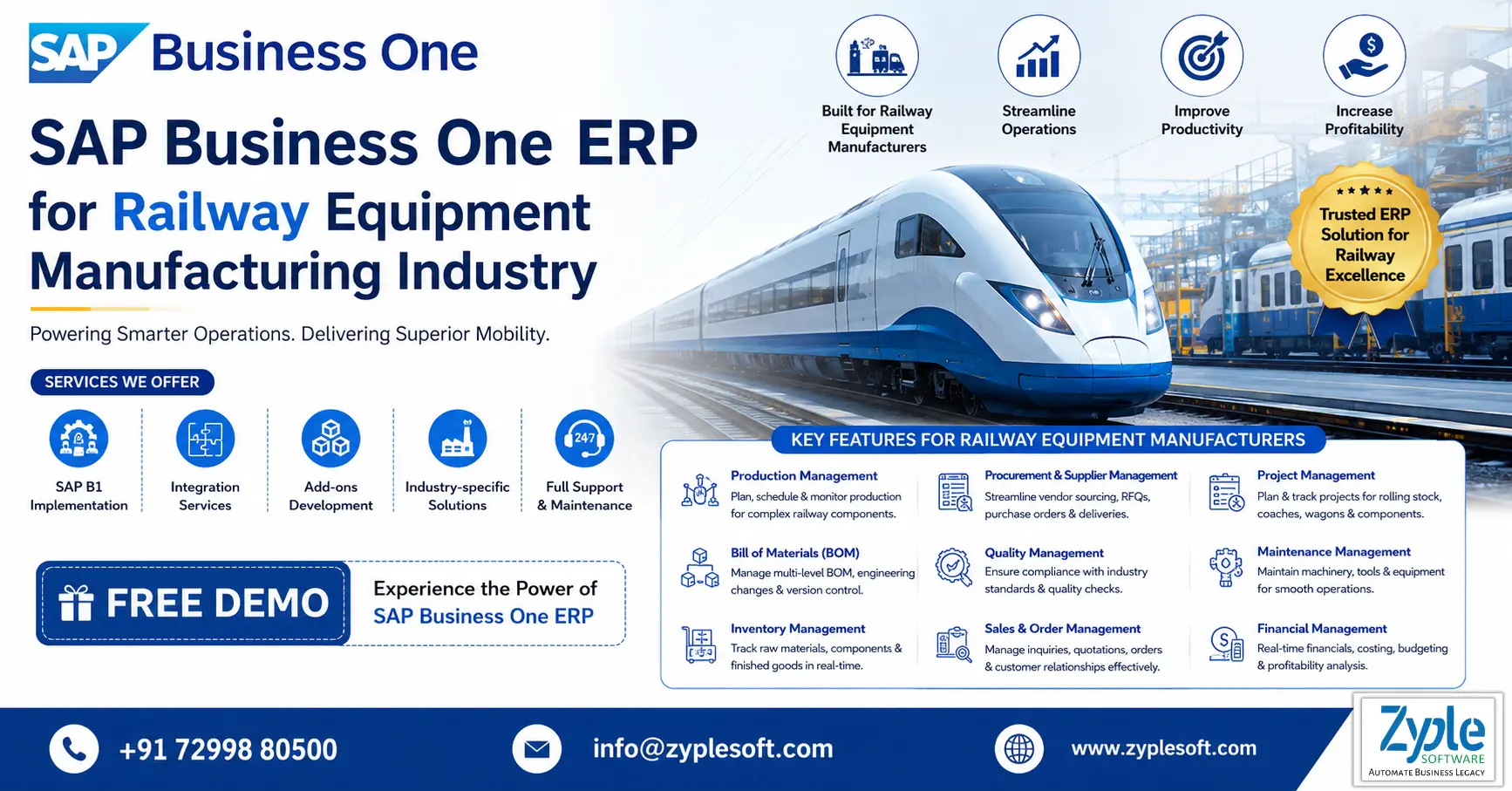
            SAP Business One ERP for Railway Equipment Manufacturing industry

            SAP Business One for Railway Equipment Manufacturing

            SAP Business One ERP for Railway Equipment Manufacturing Industry

            SAP Business One ERP for Railway Equipment Manufacturing industry

            The railway equipment manufacturing industry faces huge pressure due to its large scope of work, which requires project management, heavy machinery loading, and other responsibilities. The railway equipment manufacturing industry needs a system that unifies different company departments. SAP Business One ERP for railway equipment manufacturing unites processes and helps in boosting production and efficiency.

            Challenges Faced By The Railway Equipment Manufacturing Industry

            The railway equipment manufacturing industry faces significant challenges, mainly fluctuating raw material costs, technological gaps, and stiff global competition. Also, manufacturers struggle with supply chain inefficiencies, strict sustainable development regulations, and a shortage of skilled technical workers.

            1. Raw Material Volatility

            The availability of high-grade raw materials like specialized steel and alloys at competitive prices is a key obstacle. Fluctuations in costs directly affect profit margins.

            2. Technological and Digital Gaps

            Smaller and legacy facilities often struggle to adjust to modern, high-precision engineering. There is continuous pressure to integrate advanced technologies like AI-driven diagnostics, robotics, and IoT sensors into traditional manufacturing processes.

            3. Global Competition and Tendering

            Local manufacturers face intense competition from big international players. In markets like India, the lowest-bid tendering culture forces a compromise on equipment quality to achieve tight budget constraints.

            4. Supply Chain and Inventory Management

            Inefficiencies in the supply chain, combined with delayed vendor payments and poor inventory management, cause production obstacles.

            5. Strict Sustainability Regulations

            With global targets to minimize carbon footprints, the sector is under pressure to shift towards green tech, hybrid or electric propulsion solutions, and eco-friendly manufacturing materials.

            Features of SAP Business One ERP for Railway Equipment Manufacturing

            1. Core Manufacturing and Production Management

            • Bill of materials (BOM) management like multi-level and complex assemblies.
            • It includes production orders and work orders.
            • It includes routing and operation sequencing.
            • Engineer-to-Order (ETO) and Make-to-Order (MTO) support for custom railway components.
            • It includes shop floor control and work-in-progress (WIP) tracking.
            • It includes scrap, rework, and yield management.
            • Production cost calculation, like planned vs. actual.
            • Suitable for handling large, complex assemblies like bogies, braking systems, couplers, and signalling equipment.

            2. Advanced Production Planning and Scheduling

            • It includes material requirements planning (MRP).
            • Capacity planning, like machines and labor.
            • It includes production scheduling and sequencing.
            • Demand forecasting based on contracts and tenders.
            • It includes lead time and resource optimization.
            • Essential for railway manufacturers dealing with long production cycles and strict delivery timelines.

            3. Project-Based Manufacturing and Contract Management

            • Project lifecycle management from tender and execution to delivery.
            • It includes milestone-based billing.
            • It includes project costing and profitability tracking.
            • It includes budget vs actual analysis.
            • It includes integration with production and procurement.
            • Ideal for government railway contracts, EPC projects, and custom builds.

            4. Inventory and Warehouse Management

            • It includes multi-warehouse and bin location management.
            • Batch and serial number tracking for traceability.
            • It includes raw material, WIP, and finished goods tracking.
            • It includes spare parts and maintenance inventory.
            • It includes automated stock replenishment.
            • FIFO and JIT inventory strategies.
            • It ensures full traceability of safety-critical railway components.

            5. Procurement and Supply Chain Management

            • It includes vendor management and evaluation.
            • It includes purchase requisitions and approvals.
            • It includes subcontracting management.
            • It includes import and export documentation.
            • It includes multi-currency procurement.
            • It includes supplier performance tracking.
            • Helps handle complex supplier networks for metals, electronics, and fabricated parts.

            6. Quality Control and Compliance

            • It includes incoming, in-process, and final quality inspections.
            • It includes quality test templates and parameters.
            • It includes non-conformance and corrective actions.
            • Compliance with railway standards like ISO, IRIS, RDSO, and more.
            • It includes automatic certification and documentation generation.
            • Important for the high-safety and regulatory-heavy railway industry.

            7. Engineering Change and Product Lifecycle Management

            • It includes Engineering Change Requests (ECR) and Orders (ECO).
            • It includes version control of BOMs and drawings.
            • It includes integration with CAD or PDM systems.
            • It includes lifecycle tracking from design to production.
            • It supports frequent design changes in railway components.

            8. Financial Management and Cost Control

            • It includes general ledger, AP/AR, and banking.
            • It includes cost center and profit center accounting.
            • It includes project-based costing.
            • Fixed asset management, like machinery and tools.
            • It includes budgeting and financial forecasting.
            • Allows accurate costing of high-value railway equipment.

            9. Sales, CRM, and After-Sales Equipment

            • It includes tender and quotation management.
            • It includes sales order processing.
            • It includes customer lifecycle management (CLM).
            • It includes service contracts and warranty tracking.
            • It includes maintenance and repair service management.
            • Ideal for long-term railway maintenance contracts and AMC services.

            10. Asset and Maintenance Management

            • It includes machine maintenance scheduling.
            • It includes breakdown tracking and downtime analysis.
            • It includes preventive maintenance planning.
            • It includes equipment lifecycle management.
            • Important for heavy machinery used in fabrication and assembly.

            11. Business Intelligence (BI) and Analytics

            • It includes real-time dashboards and KPIs.
            • It includes production efficiency analysis.
            • It includes cost and profitability reports.
            • It includes custom report builder.
            • It includes Excel integration and drill-down analytics.
            • It helps leaders make data-driven decisions across operations.

            12. Mobility and Integration

            • It includes mobile access for the shop floor and management.
            • It includes web client for remote operations.
            • It includes integration with IoT, MES, CAD, and third-party apps.
            • It includes cloud or on-premise deployment options.

            13. Compliance, Documentation, and Traceability

            • It includes audit trails for all transactions.
            • Document management like drawings and certificates.
            • It includes regulatory compliance tracking.
            • It includes full traceability from raw material to finished product.

            14. Scalability and Industry-Specific Add-Ons

            • It includes add-ons for heavy engineering and rail manufacturing.
            • It includes multi-branch and multi-location support.
            • Localization like GST, taxation, and export rules.
            • It is scalable for growing manufacturing units.

            Benefits of SAP Business One ERP for Railway Equipment Manufacturing

            The ERP software, SAP Business One (SAP B1) system, facilitates the railway equipment manufacturing industry by integrating project management, supply chain, and financials into a single system. It specifically improves Engineer-to-Order (ETO) capabilities, ensures strict regulatory compliance, and optimizes the after-sales servicing of high-value capital assets.

            1. Engineer-to-Order (ETO) Support

            Seamlessly integrates with CAD software to automate the generation of Bills of Materials (BOMs) from complex railway design drawings, ensuring accuracy during custom production runs using SAP implementation.

            2. Strict Traceability and Compliance

            Implements batch and serial number tracking across all sub-assemblies and raw materials. This is essential for meeting strict railway safety and quality standards.

            3. Automated Material Requirements Planning (MRP)

            Automatically calculates exactly when and what raw materials (e.g., specialized steel, electronic components) are required. This avoids production delays and reduces excess inventory carrying costs.

            4. Precise Project Costing

            Connects all shop floor activities, such as labor, machine hours, and material usage, directly to the general ledger. This delivers real-time visibility into the exact cost of goods sold (COGS) and profit margins per project using SAP solutions.

            5. Lifecycle and Warranty Management

            Handles equipment servicing, tracks maintenance contracts (AMC), and maps spare parts consumption. This drastically increases after-sales customer support.

            Conclusion of Railway Equipment Manufacturing ERP

            Zyple Software is the Top SAP Business One partner in India specializing in implementation, digital transformation, licensing, integration, add-on solutions, migration, and consulting for the railway equipment manufacturing industry. This is when choosing a powerful SAP software can benefit manufacturing companies. It can be beneficial in several aspects of manufacturing, which include physical accounting, warehouse management of products, scheduling, location, management, warehousing, and numerous others.

            If you’re active, arrange a demo of SAP Business One.

            Do you need the SAP B1 ERP software for your business or industry?

            Finish all the details in the provided contact form; our team will get back to you.

              FAQs related to Railway Equipment Manufacturing Industry ERP

              1.What is the cost of implementing SAP Business One for railway equipment manufacturing?

              The cost depends on factors like number of users, customization level, and deployment type like cloud or on-premise. A personalized consultation helps determine the correct pricing based on your manufacturing complexity.

              Yes, SAP Business One can be customized for support industry-specific needs such as complex BOMs, project-based manufacturing, compliance tracking, and heavy engineering workflows.

              SAP B1 implementation timelines generally range from a few weeks to a few months, depending on business size, data migration, and customization requirements. Choosing an experienced implementation partner like Zyple Software can speed up the process.

              Yes, SAP Business One is available in both cloud, on-premises, and hybrid models. Cloud deployment provides flexibility, remote access, and lower upfront infrastructure costs, making it ideal for growing manufacturers.

              You can request a free demo from an authorized SAP B1 partner like Zyple Software. The demo will showcase how SAP Business One can facilitate your production, inventory, and financial processes based on your specific requirements.

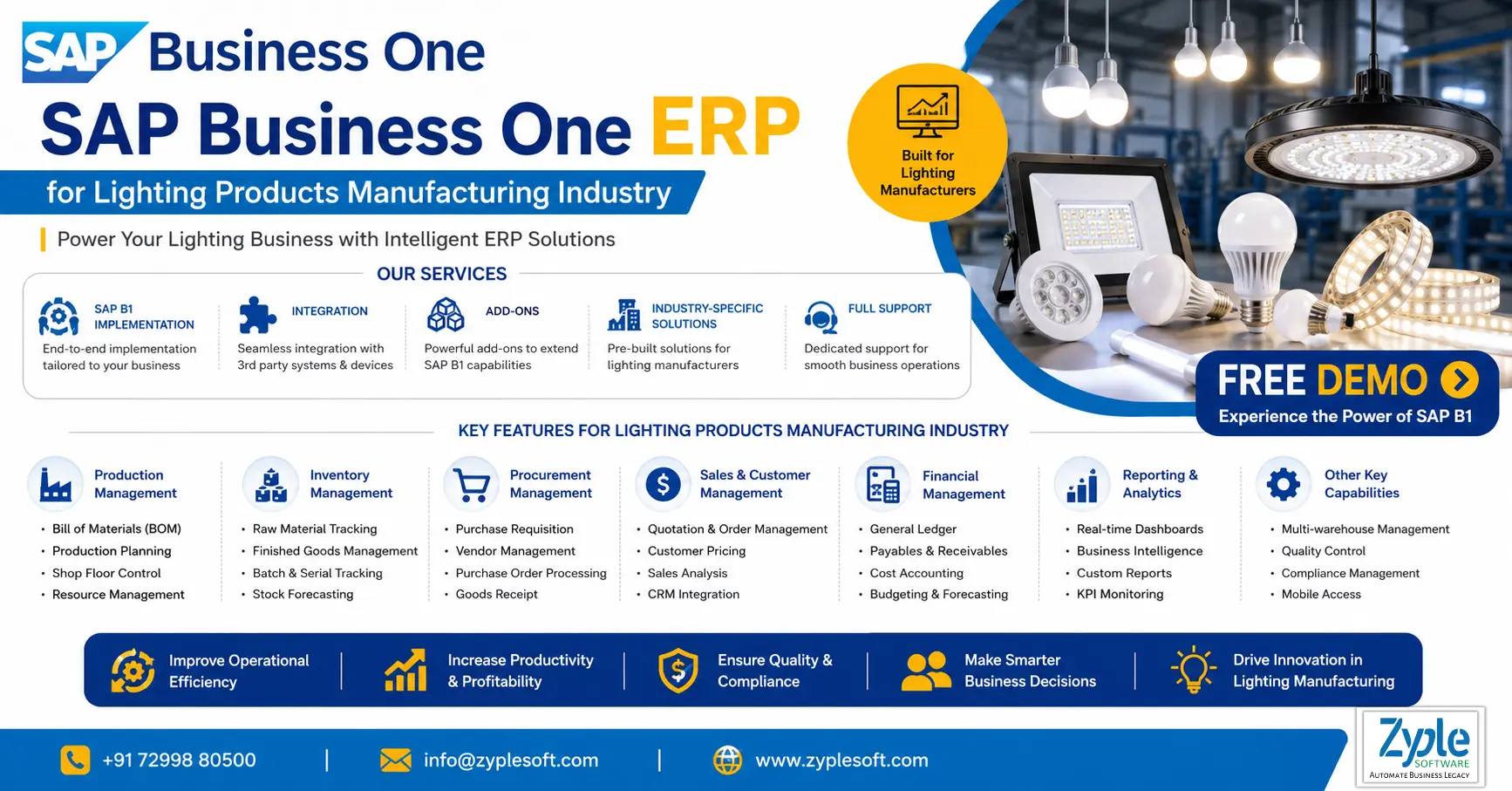
              SAP Business One ERP for Lighting Products Manufacturing Industry

              SAP Business One for Lighting Products Manufacturing Industry

              SAP Business One ERP for Lighting Products Manufacturing Industry

              SAP Business One ERP for Lighting Products Manufacturing Industry

              The lighting products manufacturing industry is at the forefront of the global shift towards energy-efficient and enivironmentally friendly lighting solutions. The lighting technology has rapidly gained popularity for its energy-saving capabilities and long-lasting performance, making it an important part of modern lighting solutions for homes, businesses, and industries. SAP Business One ERP for lighting products manufacturing can significantly improve efficiency, cost control, quality management, and overall business performance in the lighting products manufacturing industry.

              Challenges Faced By The Lighting Products Manufacturing Industry

              1. Supply Chain and Raw Material Volatility

              Heavy dependence on global electronic components leaves manufacturers vulnerable to semiconductor and LED chip shortages. Geopolitical shifts and transportation obstacles frequently drive up freight costs and extend lead times. Pricing instability for necessary raw materials like aluminium, copper, and plastics squeezes profit margins.

              2. Market Pressures and Fierce Competition

              Local manufacturers struggle, as the market is flooded with low-cost, mass-produced lighting products, specifically from overseas competitors. High taxation rates can lead to revenue leakage, while evolving global efficiency standards involve continuous redesigns and recertification.

              3. Technological Shifts and Product Evolution

              Developing IoT-enabled, integrated smart lights is resource-intensive. Consumers now require high a Color Rendering Index (CRI) and flicker-free performance, forcing manufacturers to upgrade quality control measures. Industrial applications involve specialized fixtures built to withstand extreme temperatures, moisture, and corrosive chemicals, increasing manufacturing complexity.

              4. Sustainability and the Circular Economy

              There is a growing demand for products customized for easy repair, modularity, and recyclability. Compliance with environmental regulations regarding electronic waste involves modifying traditional production lines.

              5. Labor and Automation Constraints

              As lighting technology becomes more complex, finding technicians and engineers capable of handling advanced manufacturing processes is challenging. Companies face pressure to invest in robotics and lights out manufacturing to minimize human error and labor costs, though the initial capital expenditure remains a barrier for many.

              Features of SAP Business One ERP for Lighting Products Manufacturing

              1. Core Financial Management

              • It includes general ledger and accounts payable and receivable.
              • Cost center accounting for product lines like LED bulbs, panels, and fixtures.
              • It includes fixed asset management for machinery and tooling.
              • It includes bank reconciliation and GST compliance.
              • Tracks profitability per lighting product, project, or distribution channel.

              2. Sales and Customer Relationship Management (CRM)

              • Lead and opportunity management, like projects, distributors, and contractors.
              • It includes a quotation for order management.
              • Pricing management like bulk, dealer, and project-based.
              • It includes after-sales service and warranty tracking.
              • It includes customer lifecycle management.
              • Handles B2B sales for real estate, infrastructure, and retail lighting projects.

              3. Purchasing and Vendor Management

              • It includes supplier quotation comparison.
              • It includes purchase order automation.
              • It includes vendor evaluation and performance tracking.
              • It includes multi-currency procurement.
              • It includes import and export documentation support.
              • It includes efficient sourcing of LED chips, drivers, housing, and electronic components.

              4. Inventory and Warehouse Management

              • Batch and serial number tracking is essential for LED components.
              • It includes multi-warehouse and bin location management.
              • It includes stock valuation and ageing analysis.
              • It includes automated reorder levels.

              5. Bill of Materials (BOM) Management

              • It includes multi-level BOMs for complex lighting assemblies.
              • It includes version control and engineering change management.
              • It includes sub-assembly and phantom BOM support.
              • Handles BOM for LED panel lights, street lights, or smart lighting systems.

              6. Production Planning and Control

              • It includes production order management.
              • It includes material requirements planning (MRP).
              • It includes demand forecasting and scheduling.
              • Capacity planning for machines and labor.
              • It includes shop floor control.
              • Plans production for seasonal demand like festive lighting and infrastructure projects.

              7. Manufacturing Execution and Shop Floor Management

              • It includes routing and operations tracking.
              • It includes work-in-progress (WIP) tracking.
              • It includes machine utilization monitoring.
              • It includes real-time production updates.
              • Monitors assembly lines for LED bulbs, drivers, and fixtures.

              8. Quality Control and Compliance

              • Test result recording like lumen output, voltage, and heat resistance.
              • It includes compliance with BIS and ISO standards.
              • It includes automated quality documentation.

              9. Product Costing and Profitability

              • It includes standard and actual costing.
              • It includes margin analysis per product.
              • It includes cost simulation for new designs.
              • It calculates the exact cost of LED fixtures and optimizes pricing.

              10. Warehouse and Logistics Management

              • It includes goods receipt and dispatch management.
              • It includes pick, pack, and ship processes.
              • It includes delivery route planning.
              • It includes integration with logistics providers.
              • It includes efficient distribution to dealers, retailers, and project sites.

              11. Business Intelligence (BI) and Analytics

              • It includes real-time dashboards and KPIs.
              • It includes sales, production, and real-time analytics.
              • It includes drill-down reporting.
              • It includes Excel integration and visualization tools.
              • Identifies top-selling lighting products and demand trends.

              12. Project Management (Lighting Projects)

              • It includes project costing and budgeting.
              • It includes resource allocation.
              • It includes timeline tracking.
              • It includes integration with sales and procurement.
              • Handles turnkey lighting projects like commercial projects and smart cities.

              13. Service Management and Warranty Tracking

              • It includes service contract management.
              • It includes warranty tracking for lighting products.
              • It includes complaint and repair management.
              • It includes field service scheduling.
              • Handles warranty claims for LED lights and fixtures.

              14. Mobility and Web Access

              • It includes mobile apps for sales and service teams.
              • It includes web-based access for remote operations.
              • It includes real-time updates on inventory and updates.
              • Sales teams can evaluate stock and place orders on-site.

              15. Integration and Scalability

              • Integration with SAP B1 HANA.
              • It includes API integration with e-commerce and IoT devices.
              • It includes add-ons for industry-specific needs.
              • It includes cloud or on-premise deployment.
              • Integrates smart lighting systems or IoT-enabled products.

              16. Production Cost Optimization and Planning

              • It includes machine planning and scheduling.
              • It includes just-in-time (JIT) production.
              • It includes FIFO inventory management.
              • It includes resource optimization.
              • Minimizes wastage in LED manufacturing and optimizes production cycles.

              17. Batch Production and Traceability

              • It includes batch and lot tracking for components.
              • It includes full traceability from raw material to finished goods.
              • It includes recall management.
              • Tracks defective batches of LED drivers or chips quickly.

              Benefits of SAP Business One ERP for Lighting Products Manufacturing

              The ERP software, SAP Business One (SAP B1) system, delivers specialized modules tailored for lighting and LED manufacturers. It optimizes production planning, inventory tracking, and supply chain management to reduce operational costs and waste. By connecting shop-floor actions to financials, it generates real-time reports to ensure compliance and improve overall profit margins.

              1. Accurate Bill of Materials (BOM) and Routing

              Lighting fixtures often require complex sub-assemblies like LED drivers, heat sinks, housings, and diffusers. SAP implementation handles multi-level BOMs, standardizing production and helping manufacturers track exact material usage while cutting down on scrap and rework.

              2. Facilitated Material Requirements Planning (MRP)

              The MRP engine automatically evaluates sales forecasts, current stock, and lead times to calculate exactly when and how much raw material to purchase. This avoids over-purchasing while ensuring you never face stockouts during large production runs.

              3. Complete Traceability and Quality Control

              Components like LED chips and drivers must comply with safety and performance certifications. SAP B1 supports strict lot and serial number tracking, allowing end-to-end traceability from raw material to finished product, which simplifies warranty management and defect root-cause analysis.

              4. Real-Time Inventory and Cost Management

              SAP solutions deliver continuous visibility into warehouse operations, managing stock levels of raw materials, work-in-progress (WIP), and finished goods. By linking material usage, labor, and overhead directly to the general ledger, it calculates accurate Cost of Goods Sold (COGS), which is essential for smart pricing and margin analysis.

              5. Compliance and Regulatory Alignment

              The lighting industry frequently adjusts to energy efficiency and environmental mandates like RoHS, CE, and BIS. SAP B1 helps businesses evaluate regulatory documentation and compliance-related activities within a centralized and audit-ready system.

              Conclusion of Lighting Products Manufacturing ERP

              Zyple Software is a certified SAP Business One partner in India specializing in implementation, digital transformation, licensing, integration, add-on solutions, migration, and consulting for the lighting products manufacturing industry. SAP software is an out-of-the-box solution and is developed by keeping in mind the specific requirements and complexities of lighting products manufacturing businesses.

              If you’re engaged, arrange a demo of SAP Business One.

              Do you want the SAP B1 ERP software for your business or industry?

              Finish all the details in the given contact form; our team will return to you.

                1.How can SAP Business One improve efficiency in my lighting manufacturing business?

                SAP Business One facilitates your entire operation, from procurement of components like LEDs and drivers to production, inventory, and sales. It eliminates manual processes, minimizes errors, and gives real-time visibility, helping you increase productivity and reduce operational costs.


                Unlike generic ERP systems, SAP Business One provides built-in manufacturing, inventory, and financial management in one platform. It is scalable, cost-effective for SMEs, and can be designed specifically for lighting product assembly and component tracking.

                Most lighting manufacturers start seeing measurable ROI within a few months through better inventory control, minimized wastage, improved production planning, and faster order fulfillment.

                Yes, SAP Business One ERP has an intuitive interface and role-based dashboards, making it easy for shop floor workers, warehouse staff, and management to adopt with minimal training.

                You can connect with an authorized SAP B1 partner, like Zyple Software, who will evaluate your requirements, provide a customized demo, and guide you through pricing, implementation, and support options.

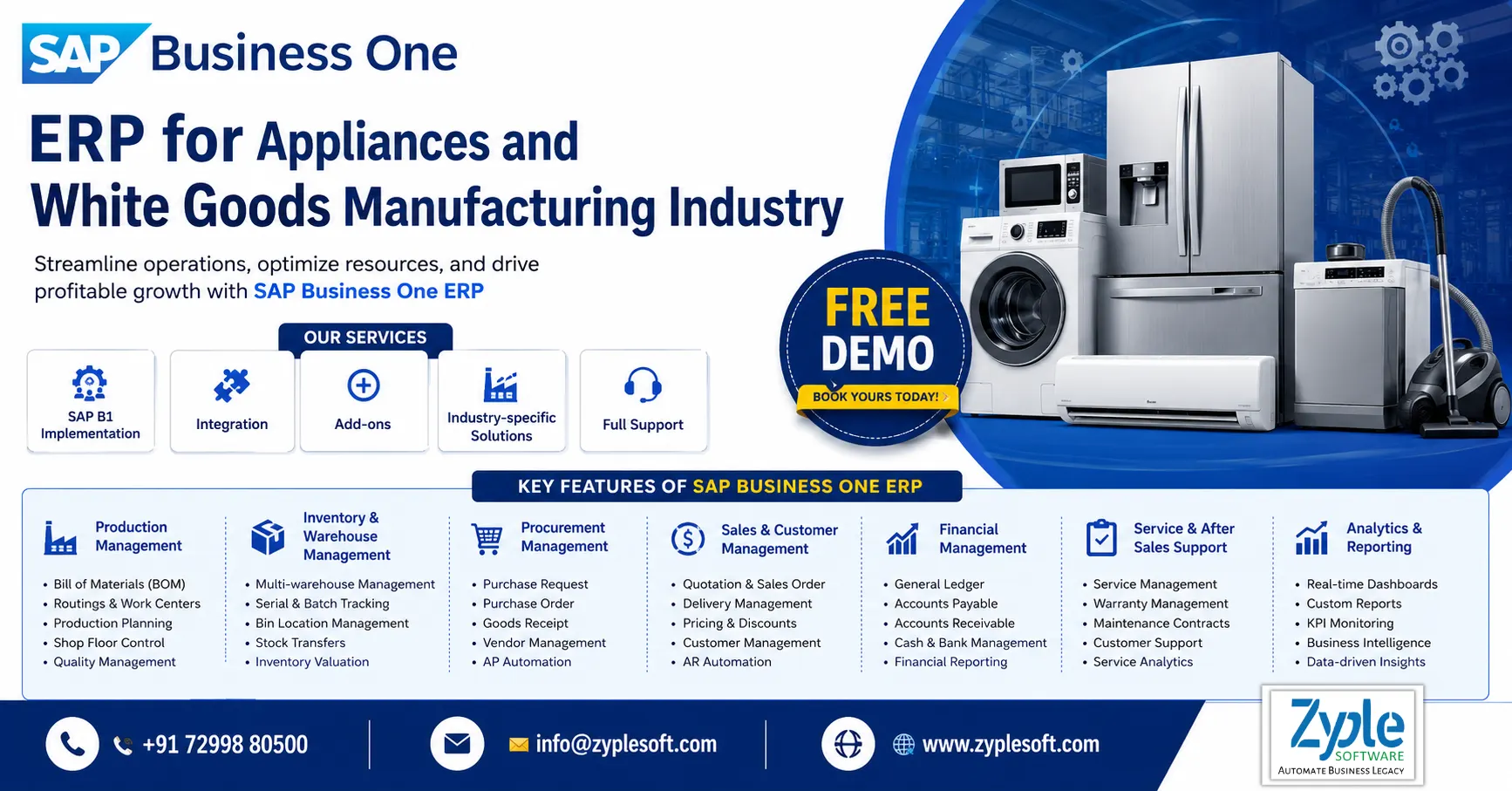
                SAP Business One ERP for Appliances and White Goods Manufacturing Industry

                SAP Business One for Appliances and White Goods Manufacturing Industry

                SAP Business One ERP for Appliances and White Goods Manufacturing industry

                SAP Business One ERP for Appliances and White Goods Manufacturing Industry

                As the appliances and white goods manufacturing industry grows exponentially, it has become tiresome and challenging to handle multiple operations all around the world, along with the business processes. Moreover, with a large industry like appliance and white goods manufacturing, integrating different departments and tackling any issues that occur also requires also requires so much time and effort. SAP Business One ERP for appliances and white goods manufacturing not only improves efficiency but also increases the quality of products of the appliances and white goods industry.

                Challenges Faced By The Appliances and White Goods Manufacturing Industry

                The appliances and white goods manufacturing industry faces significant operational and market hurdles, mainly driven by supply chain vulnerabilities, heavy import dependencies for essential components, and shrinking margins from fierce global competition. Manufacturers also struggle with a shortage of skilled labor, complex regulatory compliance, and quick technological shifts.

                1. High Import Dependence

                The industry relies heavily on international suppliers for essential components, such as semiconductors, high-end electronic chips, and specialized compressors. This dependency leaves supply chains highly vulnerable to geopolitical tensions and global shipping delays.

                2. Regulatory and Compliance Hurdles

                Navigating complex local and international regulations, including thorough testing and certification frameworks (like Bureau of Indian Standards in India), often causes production obstacles and increases manufacturing costs.

                3. Skilled Labor Shortage

                Modern appliance manufacturing involves highly trained personnel to operate, maintain, and program advanced automated machinery. A noticeable skills gap slows the adoption of cutting-edge production lines.

                4. Continuously Shifting Consumer Demands

                Consumers are demanding smarter, connected devices with shorter product lifecycles. To maintain economies of scale, manufacturers must frequently update product lines while keeping retail prices competitive.

                5. Inventory Management Issues

                Manual tracking, inaccurate stock forecasting, and handling high product variations lead to poor resource utilization and increased carrying costs.

                Features of SAP Business One ERP for Appliances and White Goods Manufacturing

                1. Financial Management and Cost Control

                • It includes general ledger, accounts payable and receivable, and journal entry automation.
                • It includes fixed asset management for plant machinery and equipment.
                • It includes real-time financial reporting and profitability analysis.
                • It helps manufacturers track product-wise margins and production costs.

                2. Sales and Customer Lifecycle Management

                • Lead and opportunity tracking, like dealer and distribution networks.
                • Sales quotation, order, and delivery to the invoicing cycle.
                • After-sales service is essential for appliance warranty.
                • It includes CRM with a complete customer and dealer database.
                • It supports service-heavy white goods business models.

                3. Purchasing and Supplier Management

                • It includes purchase requisitions, purchase orders, and GRNs.
                • It includes vendor evaluation and supplier performance tracking.
                • Multi-currency procurement is crucial for imported components.
                • It includes automated invoice matching and accounts payable.
                • It ensures smooth sourcing of electronics, compressors, motors, and more.

                4. Inventory and Warehouse Management

                • It includes real-time inventory tracking across multiple warehouses.
                • Batch and serial number tracking is essential for appliance parts.
                • It includes bin location and warehouse optimization.
                • It includes automatic stock updates with production and sales.
                • Minimizes stockouts and excess inventory.

                5. Bill of Materials (BOM) Management

                • Multi-level BOMs for complex appliances like PCB, motor, and casing.
                • It includes version control for product variants and models.
                • It includes engineering change management.
                • It ensures accurate product structure and costing.

                6. Production Planning and Control

                • Production order creation, like manual and automated.
                • It includes work order scheduling based on demand.
                • It includes shop-floor level tracking of production stages.
                • It includes real-time monitoring of work-in-progress (WIP).
                • It improves assembly-line efficiency and throughput efficiency.

                7. Material Requirements Planning (MRP)

                • It includes demand forecasting based on sales orders and history.
                • It includes auto-calculation of raw material requirements.
                • It includes procurement and production recommendations.
                • It includes capacity planning for machines and labor.
                • Prevents delays in production due to material shortages.

                8. Production Costing and Variance Analysis

                • It includes a standard vs. actual cost comparison.
                • It includes labor, machine, and overhead cost tracking.
                • It includes scrap and wastage monitoring.
                • It includes product-wise profitability.
                • Essential for cost-sensitive white goods manufacturing.

                9. Quality Control and Compliance

                • It includes incoming material quality checks.
                • In-process inspection like assembly line testing.
                • It includes finished goods quality assurance.
                • Compliance tracking like BIS, ISO, energy ratings, and more.
                • It ensures product reliability and regulatory compliance.

                10. Batch Production and Serial Tracking

                • Serial number tracking for appliances due to warranty and service.
                • It includes batch traceability and components.
                • It includes recall management.
                • Necessary for after-sales service and warranty claims.

                11. Sales and Distribution Management

                • Multi-channel distribution, like dealers, retailers, and e-commerce.
                • It includes pricing management and discount structures.
                • It includes delivery scheduling and logistics tracking.

                12. Demand Planning and Forecasting

                • It includes historical sales analysis.
                • Seasonal demand planning is crucial for ACs and refrigerators.
                • It includes automated replenishment.

                13. Import and Export Management

                • It includes documentation for international trade.
                • It includes customs, duties, and compliance tracking.
                • It includes multi-location and multi-currency operations.
                • Ideal for companies sourcing globally.

                14. Real-Time Dashboards and Reporting

                • It includes production efficiency dashboards.
                • It includes sales and inventory KPIs.
                • It includes financial and operational reports.
                • It includes drill-down analytics for decision-making.
                • Allows data-driven manufacturing decisions.

                15. Business Intelligence (BI)

                • It includes custom report creation.
                • It includes integration with Excel and analytics tools.
                • It includes predictive insights using historical data.

                16. Mobile and Web Access

                • It includes mobile apps for sales and management teams.
                • It includes remote monitoring of operations.
                • It includes web-based ERP access.
                • Handles operations anytime, anywhere.

                17. Workflow Automation

                • Approval workflows like purchase, production, and finance.
                • It includes alerts and notifications.
                • Minimized manual errors and faster processing.

                Benefits of SAP Business One ERP for Appliances and White Goods Manufacturing

                The ERP software, SAP Business One (SAP B1) system, benefits white goods and appliance manufacturing by connecting sales, procurement, and production into a unified platform. It improves material requirements planning (MRP) to prevent stockouts of essential components, ensures strict quality control and traceability, and delivers real-time cost-to-manufacture analysis to protect your profit margins.

                1. Advanced Material Requirements Planning (MRP)

                Automatically calculates exactly what raw materials like compressors, motors, and control boards are required based on sales forecasts and production schedules, ensuring Just-In-Time (JIT) availability while avoiding overstocking using SAP implementation.

                2. Real-Time Cost Recalculation

                Monitors real-time labor, machine, and material usage to recalculate production costs accurately. This is essential for margin analysis and smart pricing in a highly competitive appliance market.

                3. Quality Control and Compliance

                Integrates strict quality checkpoints throughout the assembly line to handle defect tracking, warranty compliance, and regulatory standards.

                4. Multi-Level Bill of Materials (BOM)

                Easily manages complex assemblies by linking sub-assemblies to the main finished appliance, enabling both standard builds and customizable product variations using SAP solutions.

                5. Supply Chain and Supplier Management

                Evaluates and compares vendors based on lead times and past performance, optimizing the procurement of bulk materials and reducing carrying costs.

                Conclusion of Appliances and White Goods Manufacturing ERP

                Zyple Software is a certified SAP Business One partner in India specializing in implementation, digital transformation, licensing, integration, add-on solutions, migration, and consulting for the semiconductor manufacturing industry. Better sales and more customers are the key goals of the appliances and white goods industry, and SAP software makes you achieve these goals easier and quicker.

                If you’re involved, arrange a demo of SAP Business One.

                Do you want the SAP B1 ERP solution for your business or industry?

                Finish all the details in the given contact form; our team will reach out to you.

                  How can SAP Business One minimize operational costs in white goods manufacturing?

                  SAP Business One helps minimize costs by optimizing inventory levels, reducing production waste, and improving procurement planning. With updated data insights, manufacturers can make smarter decisions that directly impact profitability.

                  Yes, SAP Business One ERP is highly customizable. It can be designed for matching specific manufacturing processes, compliance requirements, and reporting needs of appliance and white goods companies, ensuring a perfect fit for your operations.

                  The SAP B1 implementation timelines vary based on business size and complexity, but most small to medium-sized appliance manufacturers can go live within a few weeks to a few months with the right implementation partner.

                  Absolutely. SAP Business One uses historical data and analytics to improve demand forecasting, helping manufacturers align production with market demand and prevent overstocking or stockouts.

                  Getting started is simple: connect with the best SAP Business One partner, like Zyple Software, for a consultation, business assessment, and demo. This helps you understand how the solution can be customized for your appliance manufacturing needs.

                  SAP Business One ERP for Semiconductor Manufacturing Industry – Production Planning, Inventory Management, Quality Control, Supply Chain Management, and Business Automation by Zyple Software

                  SAP Business One ERP for Semiconductor Manufacturing

                  SAP Business One ERP for Semiconductor Manufacturing Industry

                  SAP Business One ERP for Semiconductor Manufacturing Industry – Production Planning, Inventory Management, Quality Control, Supply Chain Management, and Business Automation by Zyple Software

                  The semiconductor manufacturing industry is the backbone of modern technology, powering everything from smartphones to electric vehicles. But with rising demand, global supply chain disruptions, and complex manufacturing processes, chipmakers face significant issues. SAP Business One ERP for semiconductor manufacturing helps the semiconductor manufacturing industry to facilitate operations, improve productivity, and maintain quality.

                  Challenges Faced By The Semiconductor Manufacturing Industry

                  The semiconductor manufacturing industry faces massive barriers, including extreme capital costs, geopolitical supply chain vulnerabilities, and serious talent shortages. Also, the sector tackles demanding physical infrastructure needs, environmental compliance pressures, and the rapid pace of technological miniaturization.

                  1. Massive Capital Expenditure

                  Building a single advanced fabrication plant requires huge capital expenditure.

                  2. Long Gestation Periods

                  Factories take five to seven years to build, preventing quick returns on private investment.

                  3. Geopolitical Concentration

                  Over 60% of the global semiconductor manufacturing and nearly 100% of advanced sub-10nm chips are concentrated in Taiwan and South Korea.

                  4. Supply Chain Fragility

                  The industry heavily depends on limited resources for raw materials, rare earths, and specialized equipment like EUV lithiography.

                  5. Serious Talent Shortages

                  The industry faces a projected shortfall of hundreds and thousands of specialized chip engineers and process-critical fab staff globally.

                  6. Intense Power and Infrastructure

                  Fabs need uninterrupted 24/7 and huge infrastructure stability.

                  7. Large Water Usage

                  Producing a single wafer uses large volumes of ultrapure water, straining resources in drought-prone regions.

                  8. Environmental Chemical Hazards

                  The usage and disposal of toxic metals, hazard chemicals, and strict ESG compliance add significant operational expenses.

                  9. Technological Miniaturization

                  Shrinking transistors to the atomic level requires continuous R&D investments to solve extreme physics and heat barriers.

                  Features of SAP Business One ERP for Semiconductor Manufacturing

                  1. Financial Management

                  • It includes general ledger, accounts receivable, accounts payable, and banking integration.
                  • It includes budgeting, cost accounting, and financial forecasting.
                  • It includes multi-currency and global compliance support.

                  2. Sales and Customer Lifecycle Management

                  • It includes lead and opportunity tracking.
                  • It includes customer data and contract management.
                  • It includes after-sales service and warranty tracking.

                  3. Purchasing and Supplier Management

                  • It includes vendor management and procurement automation.
                  • It includes purchase orders, GRNs, invoicing, and returns.
                  • It includes supplier performance tracking.

                  4. Investment and Warehouse Management

                  • Real-time inventory tracking like raw materials, work-in-progress, and finished goods.
                  • It includes multi-warehouse and bin location management.
                  • Batch or serial number tracking for traceability.

                  5. Business Intelligence and Analytics

                  • It includes real-time dashboards and KPIs.
                  • It includes custom reports and predictive insights.
                  • It includes drill-down analytics with Excel integration.

                  6. End-to-End Production Planning

                  • Production order creation, like manual and automated.
                  • It includes multi-stage production cycle tracking.
                  • It includes integration with sales and demand planning.

                  7. Bill of Materials (BOM) Management

                  • It includes multi-level BOMs for complex chip structures.
                  • It includes component hierarchy and routing stages.
                  • It includes version control for engineering changes.

                  8. Material Requirements Planning (MRP)

                  • It includes demand forecasting and planning.
                  • It includes automated procurement suggestions.
                  • It includes optimization of raw materials and components.

                  9. Shop Floor Control

                  • Tracks real-time production activities.
                  • Monitors machine utilization and downtime.
                  • Captures actual vs planned production data.

                  10. Batch, Lot, and Serial Traceability

                  • It includes end-to-end traceability from wafer to finished chip.
                  • Tracks defects, recalls, and compliance.
                  • Essential for semiconductor quality audits.

                  11. Quality Control and Compliance

                  • It includes in-process and final quality inspections.
                  • It includes test result recording and validation.
                  • It includes compliance with global semiconductor standards.

                  12. Yield and Scrap Management

                  • Monitors yield rates at every stage.
                  • Minimizes scrap and rework.
                  • Improves production efficiency.

                  13. Engineering Change Management

                  • Handles product lifecycle changes.
                  • It includes version control for designs and BOMs.
                  • It includes faster new product introduction (NPI).

                  14. Production Costing

                  • It includes standard and actual cost tracking.
                  • It includes labor, material, and overhead cost allocation.
                  • It includes real-time profitability analysis.

                  15. Capacity and Resource Planning

                  • It includes machine capacity planning.
                  • It includes workforce allocation.
                  • Obstacle identification.

                  16. Just-In-Time (JIT) and Lean Manufacturing

                  • Optimizes inventory levels.
                  • Minimizes lead times and wastage.
                  • Improves throughput efficiency.

                  17. Supply Chain Management

                  • It includes multi-tier supplier coordination.
                  • It includes demand-supply synchronization.
                  • It includes logistics and distribution planning.

                  18. Multi-Location and Global Operations

                  • Handles multiple plants and warehouses.
                  • It includes localization for taxes and compliance.
                  • It includes multi-currency transactions.

                  19. SAP B1 HANA Integration

                  • It includes in-memory for high-speed processing.
                  • It includes real-time analytics and simulations.

                  20. IoT and Machine Integration

                  • Connects machines and sensors.
                  • Captures real-time production data.
                  • Allows smart factory capabilities.

                  21. Mobile and Web Access

                  • ERP access for mobile.
                  • It includes remote monitoring of production and inventory.

                  22. Workflow Automation

                  • It includes approval workflows.
                  • It includes alerts and notifications.
                  • Minimized manual intervention.

                  23. Real-Time Reporting

                  • It includes production efficiency reports.
                  • It includes cost and variance analysis.
                  • It includes supply chain performance dashboards.

                  Importance of SAP Business One ERP for Semiconductor Manufacturing

                  The ERP software, SAP Business One (SAP B1) system, is essential because it unifies complex production, supply chain, and quality control into a single platform. It enables these capital-intensive businesses to reduce material waste, improve wafer yield, ensure strict regulatory compliance, and optimize costs.

                  1. Precision Inventory Tracking

                  Handles the microscopic supply chain of semiconductor manufacturing by tracking raw materials, WIP (Work-In-Progress), and wafers in real-time across multiple facilities using SAP implementation.

                  2. Stringent Quality Control

                  Features built-in QA tools that allow batch and serial number traceability, ensuring compliance with strict semiconductor-grade standards and precise product recalls if necessary.

                  3. Advanced Production Scheduling

                  Prioritizes tasks, assigns resources, handles complex Bills of Materials (BOMs), and tracks production cycles to maintain optimal throughput and avoid obstacles.

                  4. Cost Management

                  Delivers instant access to real-time financials and overhead controls, directly comparing actual expenditures against budgets to unlock essential cost-saving opportunities using SAP solutions.

                  5. System Integration

                  Seamlessly connects with Manufacturing Execution Systems (MES), testing tools, and IoT automation systems to ensure a seamless flow of data across the entire factory floor.

                  Benefits of SAP Business One for Semiconductor Manufacturing

                  SAP Business One delivers semiconductor manufacturers with a flexible, integrated ERP framework to handle complex production cycles, wafer lot tracking, and stringent quality control. It drives profitability by minimizing material waste, accelerating time-to-market, and optimizing procurement across multiple global plants.

                  1. Precision Lot and Serial Traceability

                  Monitors raw materials, wafers, and sub-assemblies across multiple manufacturing plants in real time to ensure end-to-end compliance and quality assurance.

                  2. Advanced Production Scheduling

                  Optimizes throughput and resource allocation by handling complex, multi-level Bills of Materials (BOMs) and monitoring strict production cycles.

                  3. Supply Chain Optimization

                  The SAP software reduces chip component shortages and avoid expensive overstocking through automated demand forecasting, vendor lead-time planning, and just-in-time procurement.

                  4. Cost and Profit Management

                  Facilitates financial operations with instant, real-time data, enabling you to track actual production costs versus budgets to improve margins in a highly competitive market.

                  5. Equipment Integration

                  Connects shop-floor manufacturing machinery directly into your ERP for better equipment utilization and predictive maintenance.

                  Conclusion of Semiconductor Manufacturing ERP

                  Zyple Software is an Official SAP Business One partner in India specializing in implementation, digital transformation, licensing, integration, add-on solutions, migration, and consulting for the semiconductor manufacturing industry. SAP Business One ERP delivers the automation, visibility, and control needed to achieve demand, maintain quality, and stay competitive.

                  If you’re resilient, schedule a demo of SAP Business One.

                  Do you seek the SAP Business One ERP system for your business or industry?

                  Complete all the details in the designated contact form; our team will return to you.

                    1. How can SAP Business One ERP minimize operational costs in semiconductor manufacturing?

                    SAP Business One helps minimize costs by optimizing inventory levels, reducing material wastage, improving production planning, and automating manual processes. This results in better resource utilization and higher profitability.

                    Yes, SAP Business One is specifically customized for growing small and medium-sized businesses. It delivers enterprise-level capabilities at an affordable cost, making it ideal for semiconductor companies looking to scale efficiently.

                    Absolutely. SAP Business One can be designed for your specific workflows, including wafer processing, assembly, testing, and quality control. Industry-specific add-ons further improve its capabilities.

                    Most semiconductor companies start seeing ROI within months due to improved efficiency, reduced errors, better inventory control, and improved decision-making with real-time data insights.

                    Getting started is easy; connect with a certified SAP Business One partner like Zyple Software for a consultation, demo, and needs assessment. They will guide you through implementation, customization, and ongoing support designed for your semiconductor operations.

                    SAP Business One ERP for Power and Energy Equipment Industry

                    SAP Business One for Power and Energy Equipment Industry

                    SAP Business One ERP for Power and Energy Equipment Industry

                    SAP Business One ERP for Power and Energy Equipment Industry

                    In today’s fast-paced world, the power and energy equipment industry faces a unique set of challenges, including fluctuating demand, regulatory complexities, and the need for advanced technology to facilitate operations. To stay competitive, companies require a powerful, scalable ERP software solution that can help them handle resources efficiently, improve decision-making, and increase their operational performance. SAP Business One ERP for power and energy equipment to optimize the resources and operations of the businesses.

                    Challenges Faced By The Power and Energy Equipment Industry

                    The power and energy equipment industry faces serious challenges driven by the skyrocketing electricity demand for AI and data centers, supply chain bottlenecks, aging infrastructure, and aggressive grid decarbonization. Equipment manufacturers are pressed to innovate rapidly while handling raw material constraints and geopolitical shifts.

                    1. The AI Load Surge

                    The explosive growth of hyperscale data centers and reindustrialization has triggered a historic rise in power demand, leading to long lead times for essential electrical equipment like transformers, switchgear, and turbines.

                    2. Material Constraints

                    Manufacturers depend on complex, global supply chains for essential minerals like lithium, copper, cobalt, and silicon, making them vulnerable to geopolitical friction, trade policies, and price volatility.

                    3. Testing and Certification

                    A shortage of standardized testing facilities and certification obstacles delay the launch of newly manufactured equipment.

                    4. Aging Infrastructure

                    Much of the world’s high-voltage grid was built decades ago and is ill-equipped to manage modern two-way power flows or the integration of intermittent renewables like wind and solar.

                    5. Equipment Upgrades

                    Grid operators involve huge investments in dynamic reactive power compensation, high-voltage direct current (HVDC) systems, and massive utility-scale battery storage to balance grids.

                    6. Environmental Pressures

                    Traditional switchgear equipment has long relied on sulfur hexafluoride (SF6), a potent greenhouse gas. Finding technical equipment that maintains high reliability without the carbon footprint is a key engineering challenge.

                    7. Stringent Net-Zero Mandates

                    Government policies and global net-zero commitments force equipment makers to continuously overhaul product lines to achieve higher energy efficiency and sustainability standards.

                    8. Cybersecurity Vulnerabilities

                    As grids become increasingly digitized, intelligent, and interconnected, manufacturers of energy equipment are forced to embed advanced cybersecurity features into operational technology (OT) to avoid infrastructure attacks.

                    9. Project Viability and Tariffs

                    The high capital expenditure needed for R&D and manufacturing capacity expansion clashes with pressures to maintain energy and equipment costs affordably.

                    10. Workforce Gaps

                    The industry faces an essential brain drain due to an aging workforce, coupled with a lack of specialized engineering and trade skills needed to build and maintain next-generation grid infrastructure.

                    Features of SAP Business One ERP for Power and Energy Equipment

                    1. Financial Management and Compliance

                    • It includes general ledger, journal entries, and AP/AR automation.
                    • It includes multi-currency and multi-branch financial management.
                    • It includes budgeting, cost accounting, and profitability tracking.
                    • Fixed asset management which is essential for heavy equipment and plants.
                    • It includes taxation (GST), audit trials, and regulatory compliance.
                    • It includes real-time financial reporting and dashboards.
                    • It helps energy companies control capital-intensive operations and regulatory reporting efficiently.

                    2. Procurement and Vendor Management

                    • It includes purchase requisitions, RFQs, and purchase orders.
                    • It includes vendor evaluation and performance tracking.
                    • It includes contract and rate agreement management.
                    • It includes automated approval workflows.
                    • It includes integration with inventory and finance.
                    • Essential for handling large-scale procurement of turbines, transformers, cables, solar panels, and more.

                    3. Inventory and Warehouse Management

                    • Real-time inventory tracking like raw materials, WIP, and finished goods.
                    • Batch or serial number tracking for equipment traceability.
                    • It includes multi-warehouse and bin location management.
                    • It includes stock valuation and reorder planning.
                    • It includes spare parts and component tracking.
                    • It ensures accurate stock visibility and avoids downtime in power projects.

                    4. Production Planning and Manufacturing

                    • It includes bill of materials (BOM) management.
                    • It includes production orders and scheduling.
                    • It includes material requirements planning (MRP).
                    • It includes shop floor control and resource utilization.
                    • It includes subcontracting and job work management.
                    • Suitable for manufacturing electrical panels, transformers, generators, and energy equipment.

                    5. Project and EPC Management

                    • It includes project planning and execution tracking.
                    • It includes budget vs. actual cost monitoring.
                    • Resource allocation like labor, machines, and materials.
                    • It includes milestone-based billing.
                    • It includes integration with procurement and finance.
                    • Essential for EPC (Engineering, Procurement, and Construction) energy products like solar plants and substations.

                    6. Sales and CRM (Customer Relationship Management)

                    • It includes lead and opportunity management.
                    • It includes quotations on order management.
                    • It includes customer contract and pricing management.
                    • It includes after-sales service tracking.
                    • It includes customer interaction history.
                    • It supports B2B sales of heavy electrical equipment and long sales cycle.

                    7. Service and Maintenance Management

                    • It includes equipment installation tracking.
                    • It includes AMC (Annual Maintenance Contract).
                    • It includes service calls and warranty management.
                    • It includes field service tracking.
                    • It includes spare parts consumption tracking.
                    • Important for after-sales service of power equipment and renewable installations.

                    8. Supply Chain and Distribution Management

                    • It includes end-to-end supply chain visibility.
                    • It includes logistics and dispatch planning.
                    • It includes demand forecasting.
                    • It includes supplier-to-customer traceability.
                    • It includes integration with distributors and dealers.
                    • It helps optimize energy equipment distribution networks and project deliveries.

                    9. Quality Control and Planning

                    • It includes incoming, in-process, and final quality checks.
                    • It includes compliance with industry standards like ISO and safety norms.
                    • It includes inspection plans and defect planning.
                    • It includes documentation and certification management.
                    • Essential for high-reliability equipment like transformers, switchgear, and solar systems.

                    10. Asset and Equipment Management

                    • It includes fixed asset lifecycle management.
                    • It includes depreciation tracking.
                    • It includes maintenance scheduling.
                    • It includes asset performance monitoring.
                    • It supports power plants, heavy machinery, and infrastructure assets.

                    11. Business Intelligence (BI) and Analytics

                    • It includes real-time dashboards and KPIs.
                    • It includes custom reports and analytics.
                    • It includes profitability analysis by project or product.
                    • It includes demand and cost forecasting.
                    • It includes Excel integration and data visualization.
                    • Allows data-driven decisions in volatile energy markets.

                    12. Mobility and Remote Access

                    • It includes mobile apps for sales and service teams.
                    • It includes web-based ERP access.
                    • It includes real-time updates from project sites.
                    • Ideal for field engineers, site managers, and remote energy projects.

                    13. Integration and Scalability

                    • It includes integration with IoT, SCADA, and external systems.
                    • It includes SAP B1 HANA in-memory platform support.
                    • It includes API-based integrations.
                    • It includes add-ons for industry-specific needs.
                    • Allows smart energy operations and digital transformation.

                    14. Multi-Location and Multi-Branch Management

                    • It includes centralized control of multiple plants or sites.
                    • It includes inter-branch transactions.
                    • It includes consolidated financial reporting.
                    • Suitable for companies operating across multiple power plants or regions.

                    15. Industry-Specific Capabilities

                    • It includes project costing for solar or renewable installations.
                    • It includes equipment lifecycle tracking.
                    • It includes regulatory and compliance reporting.
                    • It includes energy distribution and demand planning.
                    • End-to-end operations visibility from finance, procurement, and production to distribution.
                    • Delivers complete control over energy equipment lifecycle.

                    Benefits of SAP Business One ERP for Power and Energy Equipment

                    The ERP software, SAP Business One (SAP B1) system, facilitates the power and energy equipment industry by unifying engineering, procurement, production, and financials. It reduces operational costs, accelerates time-to-market, and optimizes complex supply chains while ensuring strict regulatory compliance.

                    1. Engineering-to-Order (ETO) Support

                    Handles custom specifications, CAD integration, and precise assembly processes required for heavy power equipment using SAP implementation.

                    2. Predictive Maintenance and Asset Tracking

                    Monitors equipment lifecycles and schedules preventive maintenance to prevent expensive downtimes.

                    3. Stringent Traceability

                    Evaluates component batches and serial numbers to uphold safety standards and quality control inspections.

                    4. Accurate Project Costing

                    Delivers real-time tracking of labor, material, and overhead costs to protect project profit margins using SAP solutions.

                    5. Financial and Regulatory Alignment

                    Automates financial reporting and documentation to easily comply with local and international compliance standards.

                    6. Supply Chain Resilience

                    Optimizes inventory levels, automates purchasing, and manages vendor relationships to avoid component shortages.

                    Conclusion of Power and Energy Equipment ERP

                    Zyple Software is a certified SAP Business One partner in India specializing in implementation, digital transformation, licensing, integration, add-on solutions, migration, and consulting for the power and energy equipment industry. By adopting SAP software, power and energy equipment manufacturers gain a centralized platform to manage engineering, production, quality, inventory, procurement, and finance with complete transparency and control.

                    If you’re scalable, schedule a demo of SAP Business One.

                    Do you seek the SAP Business One ERP solution for your business or industry?

                    Complete all the details in the designated contact form; our team will reach out to you.

                      1.How much does SAP Business One cost for power and energy equipment businesses?

                      The cost of SAP Business One depends on factors like number of users, deployment type (cloud or on-premise), and customization needs.

                      The SAP implementation typically takes 2 to 6 months, depending on the complexity of your operations, data migration, and integration requirements. A proper assessment can deliver a more precise timeline.

                      Yes, SAP Business One is highly flexible and can be designed to support project-based manufacturing, equipment tracking, compliance management, and industry-specific workflows.

                      Yes, SAP Business One provides both cloud and on-premise deployment options. Cloud deployment allows remote access, scalability, and reduced IT infrastructure costs.

                      You can request a free demo from an authorized SAP B1 partner like Zyple Software to see how SAP Business One fits your business processes and helps improve efficiency and profitability.