Tag Archives: Digital Transformation Manufacturing

SAP Business One ERP for Semiconductor Manufacturing Industry – Production Planning, Inventory Management, Quality Control, Supply Chain Management, and Business Automation by Zyple Software

SAP Business One ERP for Semiconductor Manufacturing

SAP Business One ERP for Semiconductor Manufacturing Industry
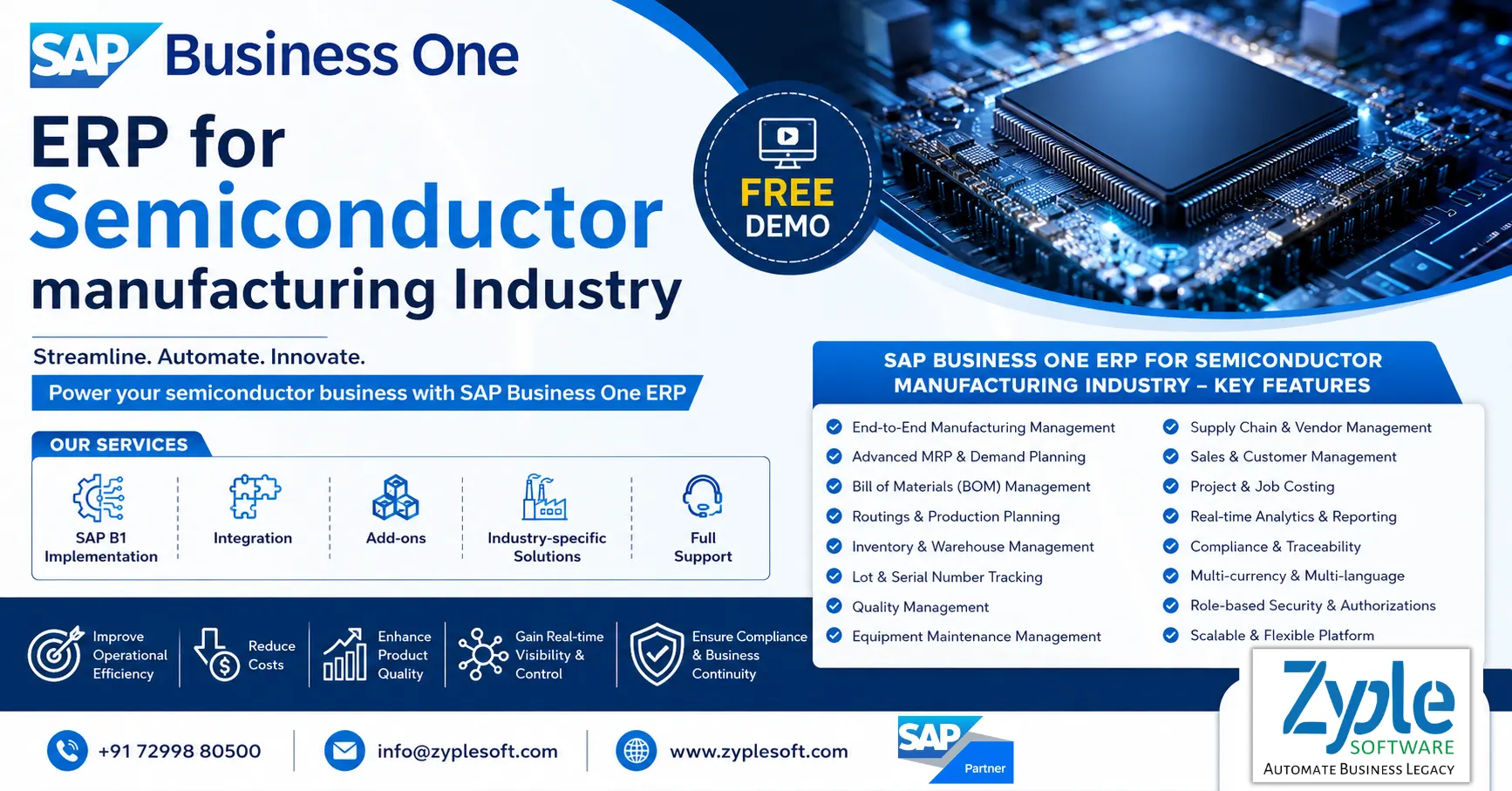
SAP Business One ERP for Semiconductor Manufacturing Industry – Production Planning, Inventory Management, Quality Control, Supply Chain Management, and Business Automation by Zyple Software

The semiconductor manufacturing industry is the backbone of modern technology, powering everything from smartphones to electric vehicles. But with rising demand, global supply chain disruptions, and complex manufacturing processes, chipmakers face significant issues. SAP Business One ERP for semiconductor manufacturing helps the semiconductor manufacturing industry to facilitate operations, improve productivity, and maintain quality.

Challenges Faced By The Semiconductor Manufacturing Industry

The semiconductor manufacturing industry faces massive barriers, including extreme capital costs, geopolitical supply chain vulnerabilities, and serious talent shortages. Also, the sector tackles demanding physical infrastructure needs, environmental compliance pressures, and the rapid pace of technological miniaturization.

1. Massive Capital Expenditure

Building a single advanced fabrication plant requires huge capital expenditure.

2. Long Gestation Periods

Factories take five to seven years to build, preventing quick returns on private investment.

3. Geopolitical Concentration

Over 60% of the global semiconductor manufacturing and nearly 100% of advanced sub-10nm chips are concentrated in Taiwan and South Korea.

4. Supply Chain Fragility

The industry heavily depends on limited resources for raw materials, rare earths, and specialized equipment like EUV lithiography.

5. Serious Talent Shortages

The industry faces a projected shortfall of hundreds and thousands of specialized chip engineers and process-critical fab staff globally.

6. Intense Power and Infrastructure

Fabs need uninterrupted 24/7 and huge infrastructure stability.

7. Large Water Usage

Producing a single wafer uses large volumes of ultrapure water, straining resources in drought-prone regions.

8. Environmental Chemical Hazards

The usage and disposal of toxic metals, hazard chemicals, and strict ESG compliance add significant operational expenses.

9. Technological Miniaturization

Shrinking transistors to the atomic level requires continuous R&D investments to solve extreme physics and heat barriers.

Features of SAP Business One ERP for Semiconductor Manufacturing

1. Financial Management

  • It includes general ledger, accounts receivable, accounts payable, and banking integration.
  • It includes budgeting, cost accounting, and financial forecasting.
  • It includes multi-currency and global compliance support.

2. Sales and Customer Lifecycle Management

  • It includes lead and opportunity tracking.
  • It includes customer data and contract management.
  • It includes after-sales service and warranty tracking.

3. Purchasing and Supplier Management

  • It includes vendor management and procurement automation.
  • It includes purchase orders, GRNs, invoicing, and returns.
  • It includes supplier performance tracking.

4. Investment and Warehouse Management

  • Real-time inventory tracking like raw materials, work-in-progress, and finished goods.
  • It includes multi-warehouse and bin location management.
  • Batch or serial number tracking for traceability.

5. Business Intelligence and Analytics

  • It includes real-time dashboards and KPIs.
  • It includes custom reports and predictive insights.
  • It includes drill-down analytics with Excel integration.

6. End-to-End Production Planning

  • Production order creation, like manual and automated.
  • It includes multi-stage production cycle tracking.
  • It includes integration with sales and demand planning.

7. Bill of Materials (BOM) Management

  • It includes multi-level BOMs for complex chip structures.
  • It includes component hierarchy and routing stages.
  • It includes version control for engineering changes.

8. Material Requirements Planning (MRP)

  • It includes demand forecasting and planning.
  • It includes automated procurement suggestions.
  • It includes optimization of raw materials and components.

9. Shop Floor Control

  • Tracks real-time production activities.
  • Monitors machine utilization and downtime.
  • Captures actual vs planned production data.

10. Batch, Lot, and Serial Traceability

  • It includes end-to-end traceability from wafer to finished chip.
  • Tracks defects, recalls, and compliance.
  • Essential for semiconductor quality audits.

11. Quality Control and Compliance

  • It includes in-process and final quality inspections.
  • It includes test result recording and validation.
  • It includes compliance with global semiconductor standards.

12. Yield and Scrap Management

  • Monitors yield rates at every stage.
  • Minimizes scrap and rework.
  • Improves production efficiency.

13. Engineering Change Management

  • Handles product lifecycle changes.
  • It includes version control for designs and BOMs.
  • It includes faster new product introduction (NPI).

14. Production Costing

  • It includes standard and actual cost tracking.
  • It includes labor, material, and overhead cost allocation.
  • It includes real-time profitability analysis.

15. Capacity and Resource Planning

  • It includes machine capacity planning.
  • It includes workforce allocation.
  • Obstacle identification.

16. Just-In-Time (JIT) and Lean Manufacturing

  • Optimizes inventory levels.
  • Minimizes lead times and wastage.
  • Improves throughput efficiency.

17. Supply Chain Management

  • It includes multi-tier supplier coordination.
  • It includes demand-supply synchronization.
  • It includes logistics and distribution planning.

18. Multi-Location and Global Operations

  • Handles multiple plants and warehouses.
  • It includes localization for taxes and compliance.
  • It includes multi-currency transactions.

19. SAP B1 HANA Integration

  • It includes in-memory for high-speed processing.
  • It includes real-time analytics and simulations.

20. IoT and Machine Integration

  • Connects machines and sensors.
  • Captures real-time production data.
  • Allows smart factory capabilities.

21. Mobile and Web Access

  • ERP access for mobile.
  • It includes remote monitoring of production and inventory.

22. Workflow Automation

  • It includes approval workflows.
  • It includes alerts and notifications.
  • Minimized manual intervention.

23. Real-Time Reporting

  • It includes production efficiency reports.
  • It includes cost and variance analysis.
  • It includes supply chain performance dashboards.

Importance of SAP Business One ERP for Semiconductor Manufacturing

The ERP software, SAP Business One (SAP B1) system, is essential because it unifies complex production, supply chain, and quality control into a single platform. It enables these capital-intensive businesses to reduce material waste, improve wafer yield, ensure strict regulatory compliance, and optimize costs.

1. Precision Inventory Tracking

Handles the microscopic supply chain of semiconductor manufacturing by tracking raw materials, WIP (Work-In-Progress), and wafers in real-time across multiple facilities using SAP implementation.

2. Stringent Quality Control

Features built-in QA tools that allow batch and serial number traceability, ensuring compliance with strict semiconductor-grade standards and precise product recalls if necessary.

3. Advanced Production Scheduling

Prioritizes tasks, assigns resources, handles complex Bills of Materials (BOMs), and tracks production cycles to maintain optimal throughput and avoid obstacles.

4. Cost Management

Delivers instant access to real-time financials and overhead controls, directly comparing actual expenditures against budgets to unlock essential cost-saving opportunities using SAP solutions.

5. System Integration

Seamlessly connects with Manufacturing Execution Systems (MES), testing tools, and IoT automation systems to ensure a seamless flow of data across the entire factory floor.

Benefits of SAP Business One for Semiconductor Manufacturing

SAP Business One delivers semiconductor manufacturers with a flexible, integrated ERP framework to handle complex production cycles, wafer lot tracking, and stringent quality control. It drives profitability by minimizing material waste, accelerating time-to-market, and optimizing procurement across multiple global plants.

1. Precision Lot and Serial Traceability

Monitors raw materials, wafers, and sub-assemblies across multiple manufacturing plants in real time to ensure end-to-end compliance and quality assurance.

2. Advanced Production Scheduling

Optimizes throughput and resource allocation by handling complex, multi-level Bills of Materials (BOMs) and monitoring strict production cycles.

3. Supply Chain Optimization

The SAP software reduces chip component shortages and avoid expensive overstocking through automated demand forecasting, vendor lead-time planning, and just-in-time procurement.

4. Cost and Profit Management

Facilitates financial operations with instant, real-time data, enabling you to track actual production costs versus budgets to improve margins in a highly competitive market.

5. Equipment Integration

Connects shop-floor manufacturing machinery directly into your ERP for better equipment utilization and predictive maintenance.

Conclusion of Semiconductor Manufacturing ERP

Zyple Software is an Official SAP Business One partner in India specializing in implementation, digital transformation, licensing, integration, add-on solutions, migration, and consulting for the semiconductor manufacturing industry. SAP Business One ERP delivers the automation, visibility, and control needed to achieve demand, maintain quality, and stay competitive.

If you’re resilient, schedule a demo of SAP Business One.

Do you seek the SAP Business One ERP system for your business or industry?

Complete all the details in the designated contact form; our team will return to you.

    1. How can SAP Business One ERP minimize operational costs in semiconductor manufacturing?

    SAP Business One helps minimize costs by optimizing inventory levels, reducing material wastage, improving production planning, and automating manual processes. This results in better resource utilization and higher profitability.

    Yes, SAP Business One is specifically customized for growing small and medium-sized businesses. It delivers enterprise-level capabilities at an affordable cost, making it ideal for semiconductor companies looking to scale efficiently.

    Absolutely. SAP Business One can be designed for your specific workflows, including wafer processing, assembly, testing, and quality control. Industry-specific add-ons further improve its capabilities.

    Most semiconductor companies start seeing ROI within months due to improved efficiency, reduced errors, better inventory control, and improved decision-making with real-time data insights.

    Getting started is easy; connect with a certified SAP Business One partner like Zyple Software for a consultation, demo, and needs assessment. They will guide you through implementation, customization, and ongoing support designed for your semiconductor operations.
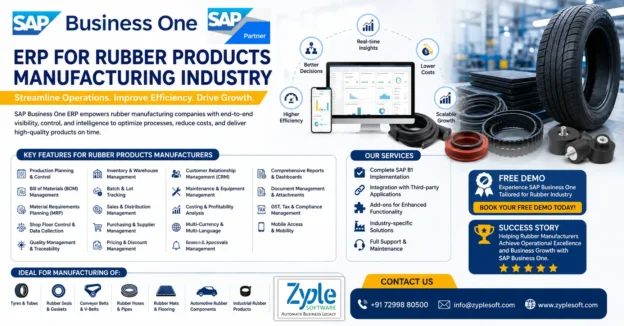
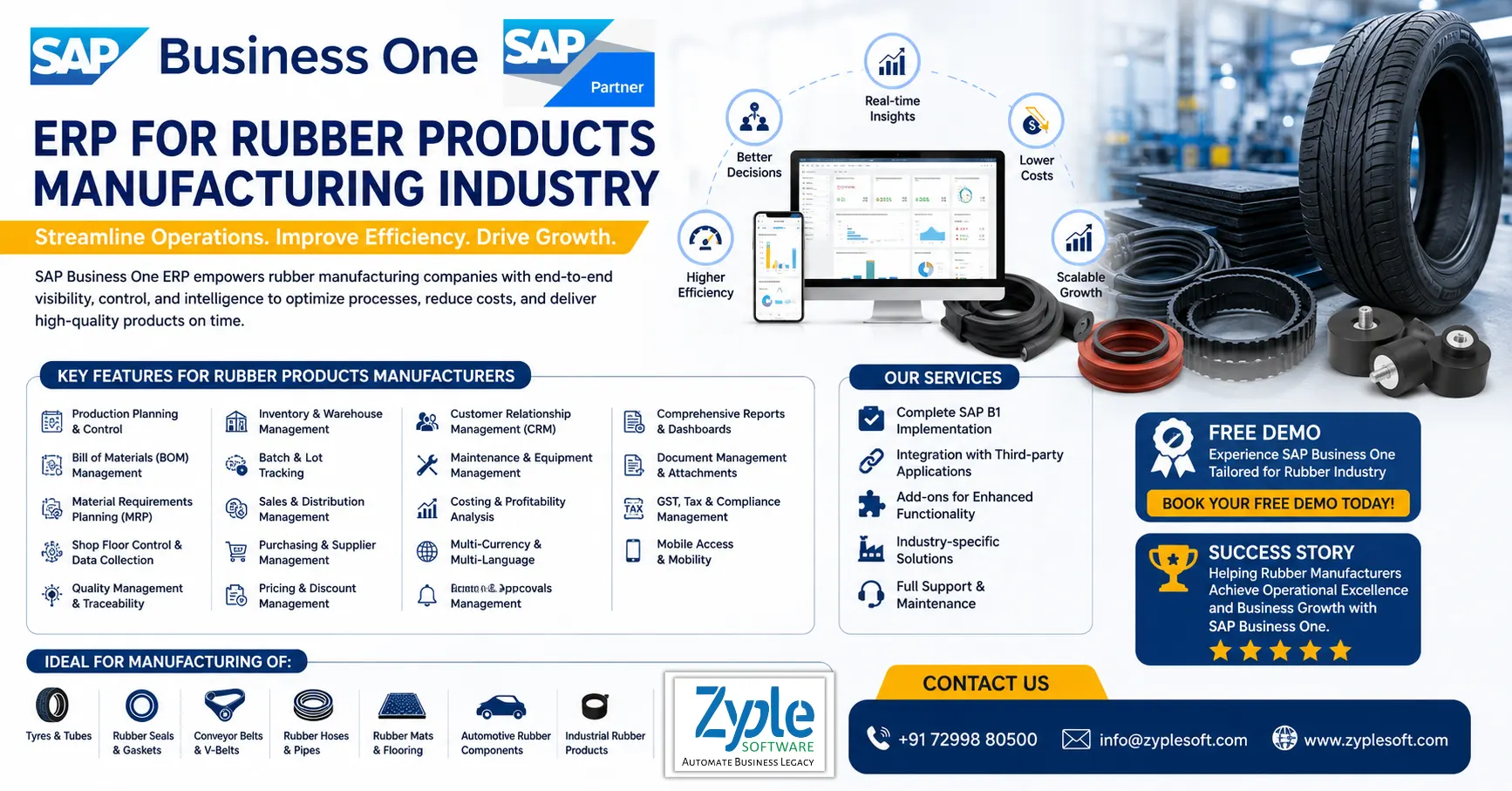
    SAP Business One ERP for Rubber Products Manufacturing industry

    SAP B1 ERP for Rubber Products Manufacturing Industry

    SAP Business One ERP for Rubber Products Manufacturing Industry

    SAP Business One ERP for Rubber Products Manufacturing industry

    In today’s competitive rubber products manufacturing landscape, facilitating operations and optimizing costs are important for success. Rubber product manufacturers often struggle with disconnected systems across compounding, mixing, calendering, building, curing, inspection, inventory, and finance. These gaps result in poor traceability, inaccurate costing, production inefficiencies, and delayed decision-making. SAP Business One ERP for rubber products manufacturing delivers a unified platform that integrates production, formulation, inventory, quality, traceability, sales, and finance, providing real-time visibility and operational control across the rubber product manufacturing cycle.

    Challenges Faced By The Rubber Products Manufacturing Industry

    The rubber products manufacturing industry tackles volatile raw material prices, severe supply chain disruptions, rising energy costs, and stringent environmental regulations. These pressures force manufacturers to optimize formulations consistently and adopt precision-driven processes to maintain profitability.

    1. Unstable Raw Material Prices and Supply Chain Disruptions

    Prices are highly reliant on agricultural conditions, climate change, and geopolitical shifts, leading to unpredictable spot pricing. Synthetic alternatives depend heavily on crude oil prices. Geopolitical tensions or supply bottlenecks quickly inflate production and procurement expenes. In India, free imports and inverted duty structures undercut domestic manufacturers, reducing profit margins.

    2. High Energy and Operational Expenses

    Methods like polymer refinement and vulcanization consume a large amount of thermal and electrical energy. Rising global energy bills directly increase the cost of goods sold. Maintaining exact dimensional tolerances and handling mold wear involves consistent equipment calibration. Failing to do so causes expensive part defects and material waste.

    3. Technical and Compounding Complexities

    Selecting the right rubber compound is crucial, as different materials behave uniquely under high pressure and temperature. Misjudgements often result in poor mechanical properties, shrinkage, or curing failures. Because rubber service properties are highly specific, strict quality control and testing are mandatory to ensure products achieve performance standards.

    4. Labor Shortages and Technical Expertise

    Operating advanced injection molding and consistent extrusion machinery requires specialized technical expertise. The industry faces a growing shortage of skilled labor to handle modern equipment and complex quality systems.

    5. Sustainability and Environmental Regulations

    Rubber is extremely difficult to recycle. Manufacturers face increasing regulatory pressure to develop sustainable, eco-friendly rubber compounds and to reduce production waste.

    6. Operational and Structural Hurdles

    Especially in developing markets, a large portion of the sector consists of micro and small-scale units. These businesses often struggle with antiquated machinery, limited access to working capital, and insufficient technical advisory support.

    Features of SAP Business One ERP for Rubber Products Manufacturing

    1. Production and Manufacturing Management

    • It includes bill of materials (BOM) with multi-level structures for rubber compounds and formulations.
    • Production orders manual and auto-generated from sales or MRP.
    • Batch or process manufacturing support for mixing, curing, and molding.
    • It includes routing and stage-wise production tracking.
    • It includes work-in-progress (WIP) tracking.

    2. Formula and Batch Management

    • It includes recipe or formula management for rubber compounds.
    • Batch-wise production tracking for lot traceability.
    • Raw material proportion control for chemicals, carbon black, and more.
    • It includes version control for formulations.
    • It includes shelf-life and expiry tracking.
    • It includes batch consistency and repeatability.

    3. Inventory and Warehouse Management

    • It includes real-time inventory tracking like raw material, work-in-progress, and finished goods.
    • It includes batch or lot and serial number tracking.
    • It includes bin location management.
    • It includes multi-warehouse management.
    • It includes goods receipt, issue, and transfer.
    • It includes minimum stock and reorder level planning.
    • It includes barcode and RFID integration.
    • It includes scrap and waste tracking.

    4. Material Requirements Planning (MRP)

    • It includes demand forecasting based on sales orders.
    • It includes automatic generation of purchase and production orders.
    • It includes lead time planning for raw materials.
    • Capacity planning like machines and labor.
    • Avoids stockouts and overstocking.
    • It includes just-in-time (JIT) planning support.

    5. Quality Control and Compliance

    • It includes incoming, in-process, and final quality checks.
    • Tests parameters, recording hardness, tensile strength, and more.
    • It includes quality certificate generation.
    • It includes compliance with ISO and industry standards.
    • It includes nonconformance and corrective action tracking.
    • It includes batch traceability for recalls.

    6. Costing and Financial Management

    • It includes standard and actual costing.
    • It includes batch-wise and product-wise cost analysis.
    • It includes profitability tracking per order or product.
    • It includes integration with accounting like general ledger, accounts payable, and accounts receivable.
    • It includes budgeting and expense control.
    • It includes GST and tax compliance.

    7. Procurement and Supplier Management

    • It includes purchase requisitions and approvals.
    • It includes vendor management and evaluation.
    • It includes raw material procurement planning.
    • It includes price comparison and supplier quotations.
    • It includes import or export documentation.
    • It includes automated purchase order creation.

    8. Sales and Customer Relationship Management (CRM)

    • It includes lead and opportunity management.
    • It includes the sales quotation to invoice cycle.
    • It includes customer order tracking.
    • It includes pricing and discount management.
    • It includes after-sales service and warranty management.
    • It includes customer communication history.

    9. Business Intelligence and Reporting

    • It includes real-time dashboards and KPIs.
    • It includes production efficiency reports.
    • It includes inventory and stock aging reports.
    • It includes cost and profitability analysis.
    • It includes custom report creation.
    • It includes drill-down analytics with Excel integration.

    10. Supply Chain and Logistics Management

    • It includes end-to-end supply chain visibility.
    • It includes order-to-delivery tracking.
    • It includes logistics and shipment planning.
    • It includes demand-supply balancing.
    • It includes multi-location distribution management.
    • It includes vendor-to-customer integration.

    11. Plant Maintenance and Asset Management

    • It includes machine maintenance scheduling.
    • It includes breakdown tracking.
    • It includes spare parts inventory.
    • It includes equipment lifecycle management.
    • It includes preventive maintenance alerts.

    12. Mobility and Integration

    • It includes mobile access for sales and management.
    • It includes integration with IoT and machines.
    • It includes API-based third-party integrations.
    • It includes e-commerce and MES integration.
    • It includes cloud and on-premise deployment options.

    13. Traceability and Compliance

    • It includes batch genealogy tracking.
    • It includes a recall management system.
    • It includes regulatory compliance reporting.
    • It includes audit trial for all transactions.

    14. Customization and Add-Ons

    • It includes industry-specific add-ons for rubber product manufacturing industry.
    • It includes custom workflows and approvals.
    • It includes user-defined fields and reports.
    • It includes integration with weighing scales and lab systems.
    • It includes localization for Indian compliance.

    Benefits of SAP Business One ERP for Rubber Products Manufacturing

    The ERP software, SAP Business One (SAP B1) system, is a complete ERP solution designed for rubber product manufacturing. It improves production planning, tracks batch-wise raw material inventory, and enforces stringent quality control.

    1. Batch and Lot Traceability

    Tracks rubber compounds, additives, and finished molded goods (like o-rings and seals) from procurement through production using SAP implementation. This guarantees full compliance and quick recalls if necessary.

    2. Material Waste Reduction

    Optimizes chemical recipes and raw material usage during mixing and extrusion processes to reduce scrap and reduce production costs.

    3. Quality Control Management

    Embeds thorough quality checks throughout the production lifecycle. Tracks defects, measures tolerances, and ensures all products achieve industry regulations before they leave the shop floor.

    4. Real-Time Inventory Management

    Prevents material shortages and surplus stock with real-time tracking across multiple warehouses. The SAP software ensures uninterrupted production lines by forecasting restocking needs based on historical data.

    5. Facilitated Production Planning

    Automates and improves the master production schedule. Handles complex multi-step manufacturing processes, from compounding to vulcanization and curing, efficiently.

    6. Accurate Costing

    Gain real-time visibility into actual vs. estimated costs, helping you understand profitability by specific product line, batch, or customer segment using SAP solutions.

    Conclusion of Rubber Products Manufacturing ERP

    Zyple Software is a certified SAP Business One partner in India specializing in implementation, digital transformation, licensing, integration, add-on solutions, migration, and consulting for the plastic product manufacturing industry. By seamlessly integrating production, inventory, finance, and customer management, the SAP B1 system enables businesses with real-time insights and smarter decision-making capabilities.

    If you’re engaged, schedule a demo of SAP Business One.

    Do you command the SAP Business One ERP solution for your business or industry?

    Complete all the details in the defined contact form; our team will reach out to you.

      FAQs

      1.What are the main benefits of SAP Business One for rubber product manufacturers?

      SAP Business One helps rubber manufacturers facilitate production planning, handle raw materials like polymers and chemicals, minimize wastage, and gain real-time visibility into operations. It increases quality control, batch traceability, and overall operational efficiency.

      Yes, SAP Business One provides robust batch management features that enable manufacturers to track raw materials and finished goods. It ensures quality compliance by monitoring production stages and maintaining complete inspection records.

      The system delivers real-time inventory tracking, automated stock updates, and demand forecasting. This helps prevent overstocking or shortages of essential materials like rubber compounds, additives, and chemicals.

      Absolutely. SAP Business One is designed specifically for SMEs and can be customized to achieve the unique requirements of rubber manufacturers, offering scalability as the business grows.

      By optimizing resource utilization, minimizing material waste, improving production scheduling, and automating manual processes, SAP Business One significantly reduces operational and production costs.

      Zyple Software

      Quality control in Manufacturing

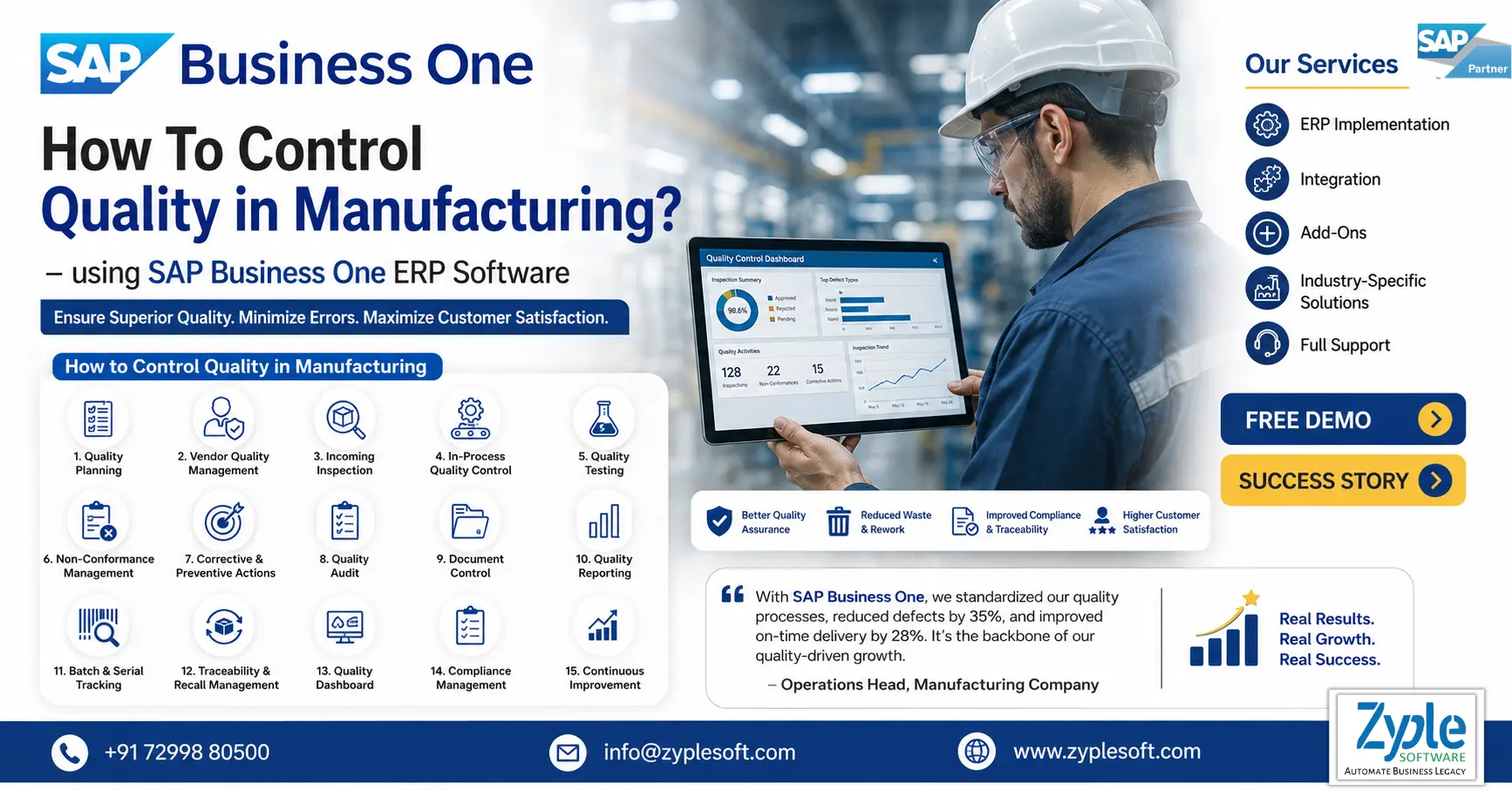
      How To Control Quality in Manufacturing?

      How To Control Quality in Manufacturing Industry?

      Quality control in Manufacturing

      When you make something, you better guarantee there’s nothing faulty about the product. If your customer purchases your product and it doesn’t work, at best, you’ll lose, and at worst, you’ll be served with lawsuit. Here, quality control in manufacturing is crucial. Here, we’ll discuss how to control quality in manufacturing.

      What is Quality Control?

      Quality control is a process that helps deliver products as planned or helps ensure project deliverables achieve stakeholder requirements. It requires that the company support an environment where everyone, from management to employees, is performing their jobs as perfectly as possible.

      What is Quality Control in Manufacturing?

      Quality control in manufacturing refers to the processes and systems used to ensure that products achieve specific requirements and are consistent and reliable. This requires planning, designing, implementing, and maintaining a system that provides confidence in a product’s design and production.

      Importance of Quality Control in Manufacturing Using SAP B1

      Quality control (QC) in manufacturing using SAP Business One (SAP B1) is essential for ensuring product consistency, minimizing wastage, and automating compliance. It delivers real-time inspection, inventory traceability, and quality management of incoming materials, production stages, and finished goods, preventing defective products from reaching customers.

      1. Integrated Quality Inspection Points

      SAP B1 ERP delivers quality control add-ons that enable inspections at different stages, including goods receipt, purchase order, production receipt, and delivery.

      2. Minimized Rework and Costs

      By inspecting raw materials and components, companies can avoid defective materials from entering production, minimizing rework, waste, and overall operating expenses.

      3. Improved Traceability and Compliance

      The system delivers full traceability from procurement to final delivery, helping businesses meet strict industry standards, such as ISO, BIS, or CDSCO. 

      4. Improved Product Consistency

      Automated inspection checklists ensure that every batch meets defined quality standards and is compliant, which boosts customer satisfaction and minimizes warranty claims.

      5. Real-time Reporting and Analysis

      Manufacturers gain instant visibility into quality metrics, allowing them to identify trends, analyze non-conformances, and take prompt corrective actions.

      Benefits of Quality Control in Manufacturing Using SAP Business One

      Manufacturing quality is a standard goal for most businesses in the market, but it is only sometimes a key priority. Depending on their output or brand, different companies have different expectations about their suitable cost of quality. Regardless of those differences, all organizations can accumulate significant benefits by implementing strong quality control practices. That’s because better quality control doesn’t only improve outcomes; it can do so more cost-effectively. It enables you to invest smarter, not more, in quality efforts while reaping all the benefits of solid quality processes.

      1. Improved Safety

      Ensuring products are made to specification results in safer end products. This is essential in the automotive, aerospace, and pharmaceutical industries, where safety is foremost. Effective quality control helps reduce the risk of malfunctions and accidents associated with faulty products.

      2. Contributes To Overall Positive Branding

      High-quality products improve a company’s reputation. Consistent delivery of reliable and effective products guarantees positive customer perceptions using SAP implementation.

      3. Increased Customer Loyalty

      By ensuring product quality, companies can develop a devout customer base. Loyal customers are also likely to recommend your products to others, further expanding the market reach.

      4. Decreased Liability Risk

      Effective quality control minimizes the risks of product failures that can lead to recalls and legal issues. This saves the company from possible financial liabilities and protects its image from the negative publicity associated with recalls.

      5. Automated Inspection Workflows

      SAP B1 can automatically trigger inspection tasks when goods are received from suppliers or during production, moving items to designated “QC warehouses” to avoid premature use. 

      6. Increased Traceability

      The system allows batch-wise or lot traceability, essential for audits and tracking material quality from purchase to finished goods using SAP solutions. 

      7. Minimized Operational Costs

      By detecting defective materials or products early, before, during, and after production, companies minimize rework and waste. 

      8. Optimal Supplier Management

      The quality control data helps evaluate suppliers based on defect rates, delivery accuracy, and material consistency. 

      9. Regulatory Compliance

      Centralized documentation and automated reports make it easier to achieve industry regulations. 

      10. Improved Product Consistency

      Automated testing against predefined, consistent criteria leads to higher quality finished products and improved customer satisfaction.

      Types of Quality Control Methods

      1. Quality Control Methods and Techniques

      There are different ways to implement good quality control. Every approach has its own set of tools and skills, and they are often used in combination to ensure the highest quality of products in manufacturing.

      2. Total Quality Management (TQM)

      TQM is an inclusive and structured approach to organizational management that seeks to improve the quality of products and services through continuous refinements in response to continuous feedback. Customer demands define TQM requirements, and the organization endeavors to achieve those with zero defects.

      3. Statistical Quality Control (SQC)

      SQC requires using statistical methods to monitor and control a process. This helps identify and handle variations in the manufacturing process that might lead to defects, thus ensuring product quality.

      4. 100% Inspection Method

      This method requires inspecting every single product part or assembly for defects. While resource-intensive, it can be essential in environments where defects can lead to significant safety or functionality issues (e.g., automotive, medical device, and heavy equipment manufacturers).

      5. Six Sigma

      This quality control method works at improving existing processes, products, or services by discovering and eliminating defects in order to facilitate manufacturing. The purpose is that the manufacturing process will have little to no variance. Six Sigma works by defining the problem, measuring the existing process, and analyzing the root cause of variations and defects to identify the issues. It increases processes by eliminating the root cause of these defects and controlling the process to stay on track.

      6. X-Bar Chart

      An X-bar chart is used in quality control to track the mean of successive samples of a constant size. The Y-axis evaluates the degree to which the deviation of the tested attribute is acceptable. This control chart is used for characteristics that can be measured on a consistent scale. That includes such things as weight, temperature, thickness, and more. However, it is rarely used alone and is often coupled with an R-chart, which is used to determine the stability and predictability of a process.

      7. Lean Quality Control

      Lean quality control is a production quality control approach that places customer value at the center of every decision, focusing relentlessly on eliminating waste, reducing waiting times, and streamlining every step of the production process.

      Lean quality controlworks by systematically identifying and removing anything that does not add direct value for the customer, including overproduction, unnecessary inventory, long wait times between production steps, and costly rework cycles.

      Conclusion of Quality Control in Manufacturing Using SAP Business One

      Zyple Software is an authorized SAP B1 partner in India specializing in implementation, digital transformation, migration, licensing, add-on solutions, integration, and consulting for the manufacturing industry. The SAP B1 system places equal emphasis on finding faults and correcting them rapidly without delays. It facilitates compliance audits, supports regulatory traceability requirements, and guarantees consistent quality control for manufacturing operations of every scale.

      Are you endeavoring to find the SAP Business One ERP system for your business or industry?

      Fill in all the details in the decided contact form; our team will return to you.