SAP Business One ERP for Printing and Packaging Equipment Industry
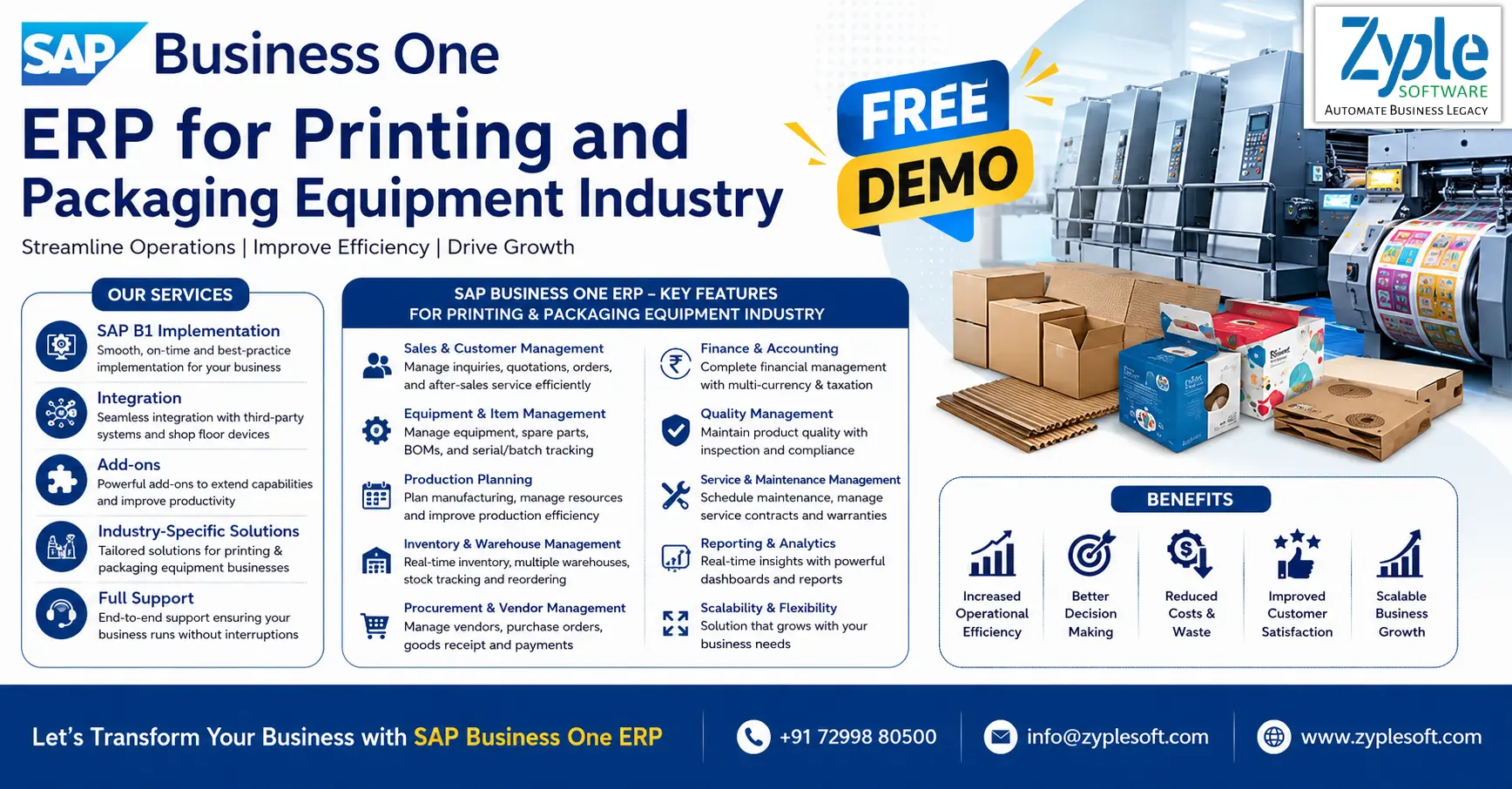
The printing and packaging equipment industry requires speed, accuracy, and cost discipline. To deal with quick-turn orders, design changes, tight tolerances, and shrinking margins while trying to stay on schedule and under budget, the printing and packaging equipment industry needs a powerful ERP solution. SAP Business One ERP for printing and packaging equipment helps the printing and packaging equipment industry to facilitate processes, reduce waste, and track every detail, from quoting and design to production and dispatch.
Issues Faced By The Printing and Packaging Equipment Industry
The printing and packaging equipment industry faces serious challenges driven by the stricter global sustainability laws, a severe shortage of skilled operators, and the high costs of digital technology migration.
Manufacturers and operators are forced to reconsider traditional engineering workflows to maintain profitability amid volatile raw material costs and rapid technological evolution.
1. Stricter Environmental Regulations
Equipment must adjust to global mandates like the European Union’s Printing and Packaging Waste Regulation (PPWR) and the US Extended Producer Responsibility (EPR) laws. Press designs must prioritize lower energy usage, minimal ink waste, and accurate chemical control to minimize overall carbon footprints.
2. Labor Shortages and Software Complexity
Most of the packaging end-users report difficulties finding experienced machinery technicians and operators. Manufacturers are forced to build smarter, more autonomous interfaces to let low-experience workers perform complex multi-step processes safely. Outdated hardware struggles to mesh with modern, data-driven AI scheduling platforms and asset management ecosystems.
3. Financial Constraints of Digital Migration
Industrial printing machinery depreciates slowly, making complete facility overhauls economically impossible for smaller firms. Manufacturers must develop modular motor upgrades and components that can retrofit into decades-old present hardware.
4. Demand for Personalization and Rapid Turnarounds
High growth in personalized e-commerce packaging forces machinery to manage shorter, highly variable print runs efficiently. Shifting from a few massive print orders to thousands of tiny, customized orders causes planning errors and administrative obstacles.
Features of SAP Business One ERP for Printing and Packaging Equipment
1. Production Planning and Job Management
- Advanced production planning and scheduling for print jobs like offset, flexo, digital, and gravure.
- Job-based manufacturing, like make-to-order (MTO) and batch production handling.
- It includes a multi-level bill of materials (BOM) for packaging structures.
- Machine capacity planning like printers, cutters, laminators, and die cutters.
- It includes production routing and workflow tracking.
- It includes real-time shop floor visibility.
- It includes production logbook management.
- Helps minimize downtime, optimize machine utilization, and ensure on-time delivery.
2. Estimation, Costing, and Job Profitability
- It includes pre-production job estimation and quotation.
- It includes accurate material, labor, and machine costing.
- It includes real-time job costing vs. actual cost tracking.
- It includes profitability analysis per job or order.
- It includes waste and scrap cost monitoring.
- Essential for printing businesses where margins depend on precise cost control.
3. Raw Material and Inventory Management
- It includes multi-location and warehouse management.
- It includes real-time stock visibility and valuation.
- It includes WIP (Work-In-Progress) tracking.
- It includes barcode or RFID integration.
- It ensures minimal wastage and accurate stock control.
4. Sales, CRM, and Order Management
- Entire quote-to-cash cycle from quotation, order, and delivery to invoice.
- It includes customer-specific pricing and contracts.
- It includes sales forecasting and opportunity tracking.
- It includes customer communication and CRM integration.
- It includes after-sales service and compliant management.
- It improves customer satisfaction and repeat business.
5. Procurement and Vendor Management
- It includes automated purchase requisitions and purchase orders.
- It includes supplier price comparison and evaluation.
- It includes approval workflows for procurement.
- It includes accounts payable automation.
- It ensures timely procurement of raw materials like paper, ink, and packaging substrates.
6. Quality Control and Compliance
- Quality parameter tracking like GSM, thickness, color accuracy, and durability.
- It includes compliance with industry standards.
- It includes non-conformance and rejection management.
- Important for maintaining print consistency and packaging strength.
7. Warehouse, Dispatch, and Logistics
- It includes bin-level warehouse management.
- It includes packaging, labeling, and packaging slip generation.
- It includes dispatch planning and shipment tracking.
- It includes loading optimization and transport management.
- It includes integration with barcode scanning systems.
- It ensures faster and error-free deliveries.
8. Financial Management and Accounting
- It includes general ledger, journal entries, and financial reporting.
- It includes accounts receivable and payable automation.
- It includes cost center and profit center accounting.
- It includes budgeting and cash flow management.
- It includes multi-currency and tax compliance.
- Delivers complete financial control and visibility.
9. Business Intelligence (BI) and Reporting
- It includes real-time dashboards and KPIs.
- It includes custom MIS reports.
- It includes drill-down analytics and data visualization.
- It includes profitability, production efficiency, and sales analysis.
- Allows data-driven decision-making.
10. Machine Integration and Automation
- It includes integration with printing and packaging machines.
- It includes IoT-enabled production monitoring via add-ons.
- It includes automated data capture from the shop floor.
- Minimized manual data entry.
- It improves accuracy and operational efficiency.
11. Document Management and Printing
- It includes document layouts using Crystal Reports.
- It includes automated document printing workflows.
- It supports high-volume document generation for printing businesses.
12. Multi-Unit and Multi-UOM Handling
- It supports multiple units of measurement (UOM).
- It includes conversion between sheets, rolls, kg, meters, and more.
- Important for packaging and paper-based industries.
13. Service and Maintenance Management
- It includes equipment service scheduling.
- It includes maintenance tracking for printing machines.
- It includes customer complaint handling.
14. Mobility and Web Access
- It includes mobile app for sales and management.
- It includes web-based access for remote monitoring.
- It includes real-time updates from anywhere.
15. Scalability and Deployment Flexibility
- It includes cloud, on-premises, or hybrid deployments.
- Easy adaptability as business grows.
- It includes integration with third-party systems and add-ons.
Benefits of SAP Business One ERP for Printing and Packaging Equipment
The ERP software, SAP Business One (SAP B1) system, facilitates the printing and packaging equipment industry by replacing disconnected systems with a single, unified ERP. It improves production planning, eliminates manual errors, reduces material waste, and ensures strict regulatory and quality compliance across your entire supply chain.
1. Advanced Production Scheduling
Automates job scheduling and material procurement, improving machine usage and minimizing costly equipment downtime.
2. Inventory and Lot Traceability
Tracks raw materials like inks, papers, and films and work-in-progress (WIP) across multiple bins and warehouses to prevent stockouts and excess stock using SAP implementation.
3. Waste Reduction
Improves material usage and calculates accurate cost estimations, leading to drastically reduced material waste and improved profit margins.
4. Quality Control and Compliance
Maintains quality parameters like GSM and thickness at every stage of production and ensures ISO and regulatory compliance.
5. Financial and Taxation Integration
Automates invoicing and localized taxation rules, such as GST for Indian manufacturers, facilitating your accounting and reporting using SAP solutions.
6. Real-Time Analytics and CRM
Delivers actionable Key Performance Indicator (KPI) dashboards and historical sales data, allowing you to proactively engage customers and track production efficiency.
Conclusion of Printing and Packaging Equipment ERP
Zyple Software is a certified SAP Business One partner in India specializing in implementation, digital transformation, licensing, integration, add-on solutions, migration, and consulting for the printing and packaging equipment industry. The SAP software stands out as an ERP solution that supports growth and competitiveness in the printing and packaging equipment sector.
SAP Business One (B1) is an ERP designed for small and midsize businesses that integrates finance, purchasing, sales, inventory, production, CRM, and reporting into a single platform. For Printing and Packaging Equipment companies, it can improve project costing, procurement, subcontractor billing, and inventory management.
If you’re flexible, schedule a demo of SAP Business One.
Do you mandate the SAP Business One ERP system for your business or industry?
Complete all the details in the delivered contact form; our team will return to you.
1.How much does SAP Business One cost for printing and packaging equipment enterprises?
The cost differs based on the number of users, customization requirements, and deployment type (cloud or on-premise).
2.Can I get a free demo of SAP Business One for my business?
Yes, you can request a free demo customized for your printing and packaging operations. A demo helps you understand how the system will fit your workflows before making a decision.
3.How long does it take for SAP Business One implementation?
SAP B1 implementation generally takes 6 to 12 weeks, depending on the complexity of your processes, data migration needs, and level of customization required.
4.Is SAP Business One available in different options?
Yes, SAP Business One provides flexible deployment options, including cloud, on-premise, and hybrid models, allowing you to choose what best suits your IT infrastructure.
5.Do you deliver support and training after implementation?
Yes, certified SAP B1 partners like Zyple Software deliver end-to-end support, including user training, system maintenance, and ongoing assistance to ensure smooth operations and maximum ROI.