SAP Business One ERP for Sports Goods Manufacturing Industry
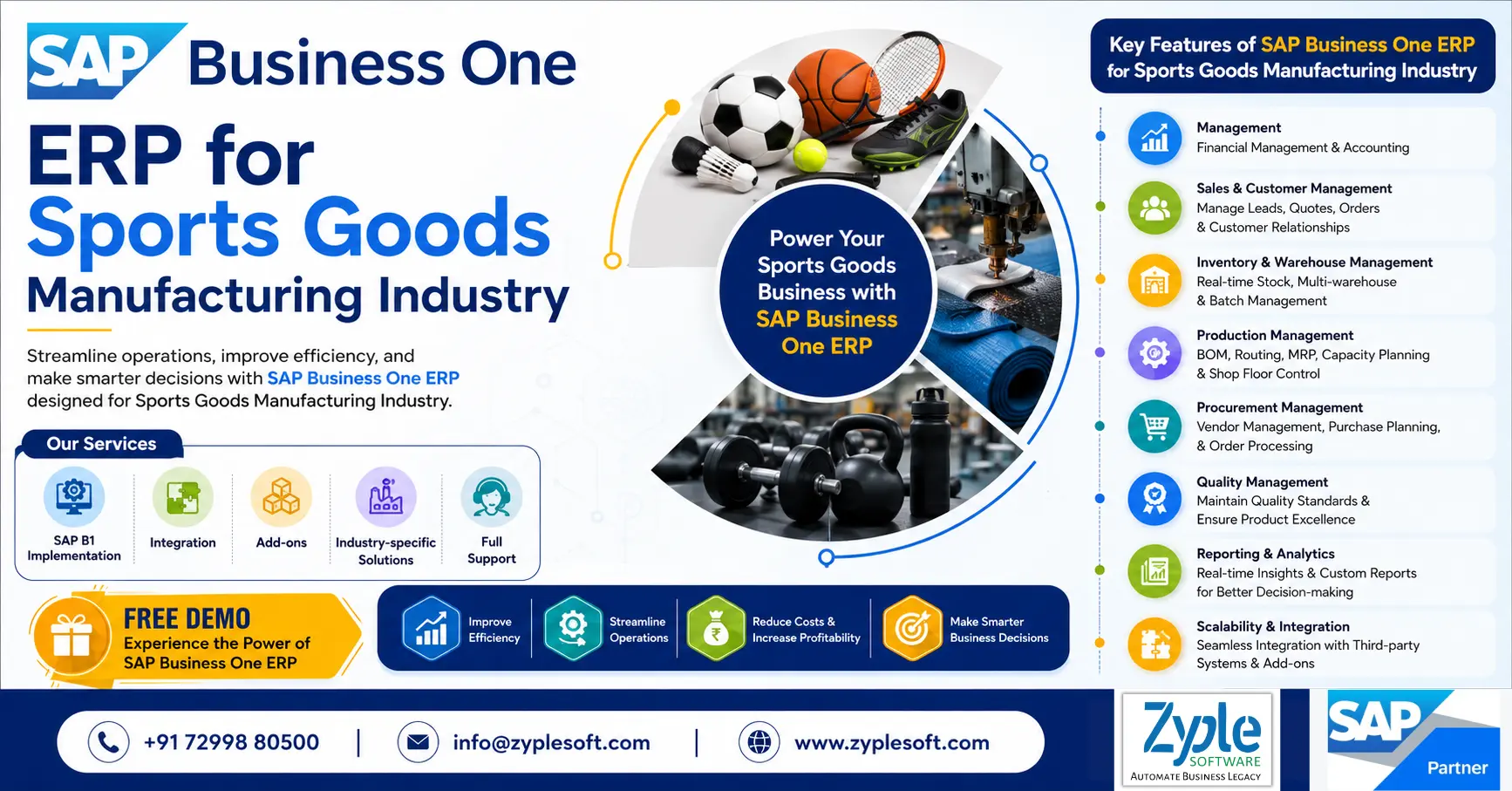
The sports goods manufacturing sector is rapidly growing in India due to increasing domestic demand, global exports, fitness awareness, and expansion of sports infrastructure. Handling production, inventory, warehouse operations, dispatch tracking, and customer orders manually often creates operational ineffectiveness, inventory mismatches, production delays, and reporting inaccuracies. SAP Business One ERP for sports goods manufacturing helps sports goods manufacturing businesses centralize operations, automate workflows, and increase business visibility through a single platform.
Issues Faced By The Sports Goods Manufacturing Industry
The sports goods manufacturing industry faces significant challenges, including rising raw material costs, regulatory compliance burdens, and intense global price competition. Companies also struggle with shifting consumer expectations, technological upgrades, and supply chain inefficiencies that strain profitability, especially for smaller enterprises.
1. High Input Costs and Supply Chain Constraints
Sourcing high-performance materials like specialized polymers and carbon composites increases costs. High customs duties on imported materials compound this issue. Poor infrastructure and distance from large shipping ports increase freight costs and delay deliveries. Supply chain vulnerabilities, factory shutdowns, and shifting energy prices lead to production bottlenecks and inventory issues.
2. Global Competition and Profit Margins
Manufacturers face steep competition from low-cost production hubs, eroding domestic and global market share. Because consumers are sensitive to price hikes, manufacturers struggle to pass on increased production and labor costs, reducing profit margins.
3. Compliance and Quality Standards
High-performance gear involves thorough, expensive certifications from international sports bodies to compete globally. Achieving safety and ergonomic requirements involves advanced manufacturing tech, which many MSMEs lack the capital investment for.
4. Branding and Market Shifts
Smaller manufacturing hubs, specifically in clusters like Jalandhar and Meerut, often produce for larger anchor brands rather than developing their own labels, limiting global recognition. Buyers now expect sustainability, ethical sourcing, and integrated brand values, involving manufacturers in adapting their business models.
Features of SAP Business One ERP for Sports Goods Manufacturing
1. Bill of Materials (BOM) Management
- Multi-level bill of materials (BOMs) for complex sports equipment like bicycles and gym machines.
- It includes version control for design changes.
- It includes component substitution for material flexibility.
2. Production Planning and Scheduling
- It includes forecast-based and order-based production planning.
- It includes MRP (Materials Requirements Planning) for raw materials.
3. Shop Floor Control
- It includes real-time tracking of production stages.
- It includes work order management.
- It includes labor and machine time tracking.
4. Real-Time Inventory Tracking
- Tracks raw materials like rubbers, plastics, and metals and finished goods.
- Batch and serial number tracking is essential for sports gear quality.
5. Multi-Warehouse Management
- Handles stock across multiple warehouses and retail outlets.
- It includes automated stock transfers.
6. Inventory Optimization
- It includes safety stock levels.
- It includes reorder point automation.
- It includes demand-driven replenishment.
7. Order Management
- It includes sales quotations, orders, and invoicing.
- It includes integration with distributors, dealers, and retailers.
8. Pricing and Discount Management
- It includes customer-specific pricing.
- Seasonal discounts are essential for sports seasons and events.
9. Returns and Warranty Handling
- Handles product returns and replacements.
- It includes warranty tracking for sports equipment.
10. Accounting and Financial Control
- It includes multi-currency support for exports.
11. Cost Accounting
- Tracks production costs per product.
12. Quality Management
- It includes defect tracking and corrective actions.
13. Compliance and Certifications
- Maintains compliance with industry standards like ISO and safety standards.
- It includes an audit trail for traceability.
14. Procurement Management
- It includes vendor management.
- It includes purchase requests, orders, and approvals.
15. Supplier Performance Tracking
- Evaluates vendors based on quality, delivery time, and cost.
16. Logistics and Distributors
- It includes shipment planning.
- It includes integration with logistics providers.
17. Real-Time Dashboards
- It includes production KPIs, sales trends, and inventory levels.
18. Advanced Analytics
- It includes demand forecasting based on historical sales.
- It includes seasonal trend analysis like cricket season spikes.
19. Custom Reports
- Customized reports for management decision-making.
20. Customer Data Management
- It includes centralized customer database.
21. Sales Opportunity Tracking
- It includes lead and opportunity management.
22. After-Sales Service
- It includes service contracts and customer support.
23. Customization and Add-Ons
- It includes industry-specific add-ons for sports manufacturing.
- It includes user-defined fields and workflows.
24. Integration Capabilities
- It includes API-based integration with third-party tools.
25. Mobile Apps
- It includes sales and inventory access on mobile devices.
26. Cloud Deployment
- Available on the cloud for adaptability and remote access.
27. Role-Based Authorization
- Secures access control for different departments.
28. Data Backup and Recovery
- It includes automated backups and disaster recovery.
Importance of SAP Business One for Sports Goods Manufacturing
The ERP software, SAP Business One system, is essential for the sports goods manufacturing industry because it unites inventory control, production planning, and supply chain management into a single platform. It enables brands to facilitate complex production processes, minimize raw material waste, and quickly fulfill fluctuating global demands.
1. Accurate Demand Forecasting
Uses historic sales data and upcoming sporting event schedules to forecast the correct demand for seasonal gear and apparel, avoiding overstocking or stockouts using SAP implementation.
2. Material Requirements Planning (MRP)
Facilitates the procurement of specialized raw materials, like carbon fiber, synthetic leathers, and high-tech fabrics, based on precise lead times and real-time production requirements.
3. Complex Bill of Materials (BOM) and Kitting
Easily handles the production of discrete sports equipment like cricket gear, baseball bats, or tennis rackets, as well as grouped sports kits, tracking auto-batch generation and multi-item packaging using SAP solutions.
4. Rigorous Quality Control
Integrates quality control checkpoints across multiple production stages to ensure only safe, superior-quality athletic gear and protective equipment leave the factory.
5. Global Compliance and Financials
Handles multi-currency transactions and diverse regional tax compliances like GST billing efficiently across international borders.
Benefits of SAP Business One ERP for Sports Goods Manufacturing
SAP Business One ERP facilitates sports goods manufacturing by integrating production, inventory, and sales into one platform. It reduces material waste, accelerates order fulfillment through automated planning, ensures strict quality control for sports equipment, and delivers real-time financial visibility to drive profitability.
1. Automated Material Requirements Planning (MRP)
Automatically calculates exactly which raw materials like leather, carbon fiber, and rubber are required and when to purchase them based on sales orders and bill of materials (BOMs).
2. Complex BOM and Scrap Management
Handles multi-level BOMs efficiently while tracking and minimizing scrap or recycle waste commonly produced during cutting and molding processes.
3. Quality Management and Compliance
The SAP software sets strict quality control benchmarks and inspection checkpoints at individual stages of production to ensure safety and performance standards for athletes.
4. Real-Time Inventory Tracking
Delivers total visibility of stock levels, work-in-progress, and finished goods across multiple warehouses to prevent seasonal stockouts or overstocking.
5. Integration Financials and GST
Automatically ties every procurement and sales transaction to the general ledger, ensuring accurate costing, pricing insights, and compliant GST invoicing.
Conclusion of Sports Goods Manufacturing ERP
Zyple Software is the best SAP Business One partner in India specializing in implementation, digital transformation, licensing, integration, add-on solutions, migration, and consulting for the sports goods manufacturing industry. The SAP Business One system helps sports goods manufacturing businesses improve efficiency, inventory management, and long-term operational scalability.
If you’re involved, reserve a demo of SAP Business One.
Do you want the SAP B1 ERP system for your business or industry?
Finish all the details in the given contact form; our team will get back to you.
1.How quickly can SAP Business One be implemented for a sports goods manufacturing business?
The SAP Business One implementation timelines generally range from a few weeks to months, depending on your business size and complexity. With the right partner like Zyple Software, you can achieve a smooth and fast deployment customized for your manufacturing needs.
2.What is the cost of implementing SAP Business One for sports goods manufacturers?
The cost of SAP B1 implementation varies based on the number of users, required modules, and customization. However, SAP Business One provides a cost-effective solution with a strong ROI by improving efficiency, reducing waste, and enhancing decision-making.
3.Can SAP Business One ERP be customized for my specific sports goods manufacturing processes?
Yes, SAP Business One is highly customizable. It can be customized for handling unique requirements such as seasonal demand, product variations, and specialized production workflows common in sports goods manufacturing.
4.Will SAP Business One integrate with my current systems and tools?
SAP Business One supports seamless integration with third-party applications like e-commerce platforms, CRM systems, and warehouse solutions, ensuring a unified business ecosystem without disrupting your current operations.
5.How can I get a demo of SAP Business One for my sports goods manufacturing business?
You can request a personalized demo from an authorized SAP B1 partner like Zyple Software. A demo will showcase how SAP Business One can handle your specific challenges and help you evaluate its fit for your business before investing.