
Tag Archives: SAP Business One ERP Implementation

SAP Business One implementation services provider helping businesses deploy ERP software with consulting, integration, customization, migration, and ongoing support

SAP Business One Implementation Services Provider

Best SAP Business One Implementation Services Provider
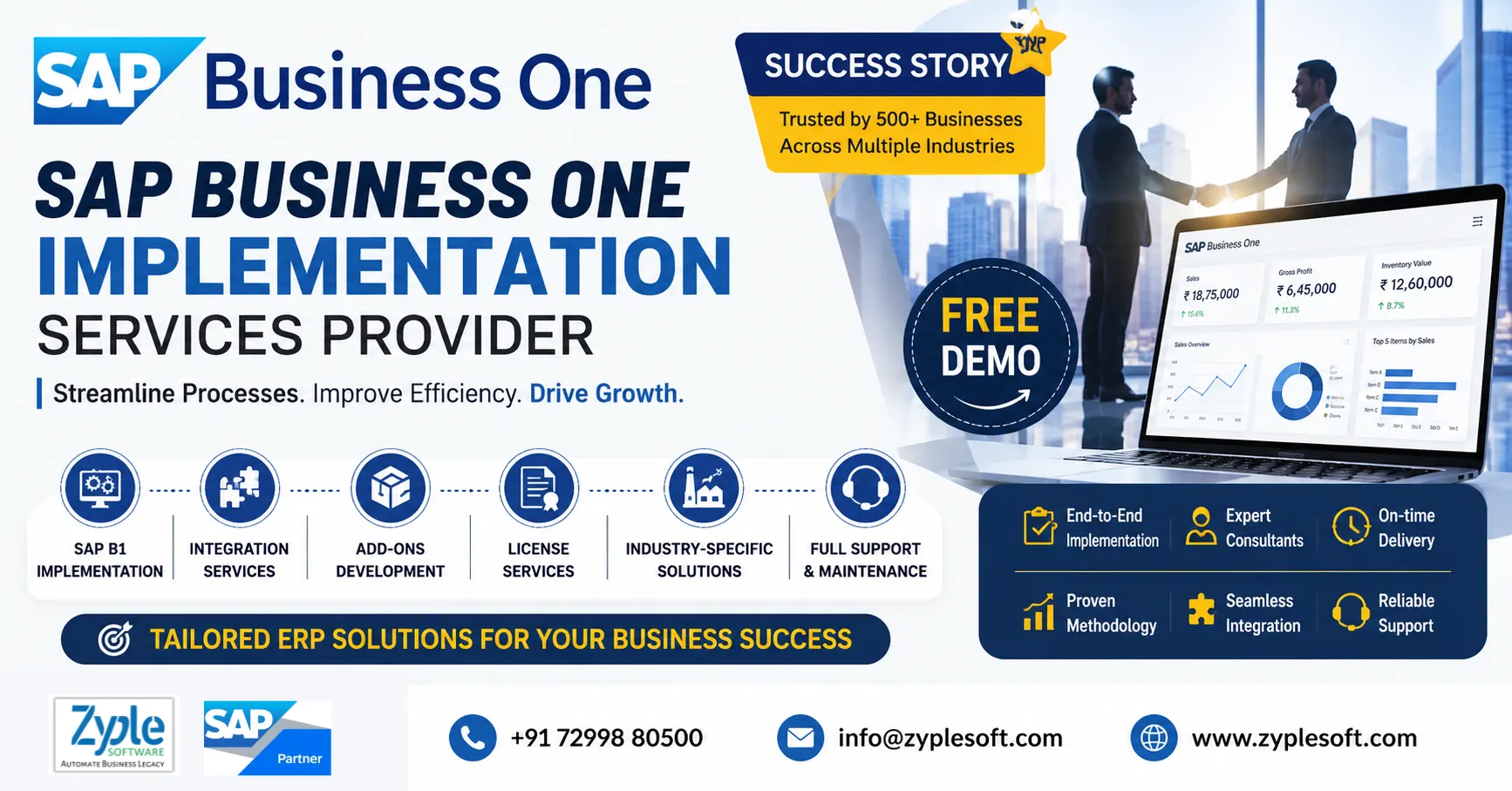
SAP Business One implementation services provider helping businesses deploy ERP software with consulting, integration, customization, migration, and ongoing support

Digital transformation is no longer optional for growing businesses. Companies need real-time visibility into finance, inventory, production, procurement, sales, and customer operations. This is where SAP Business One becomes one of the most trusted ERP solutions for small and medium-sized enterprises (SMEs).

However, purchasing ERP software alone is not enough. Success depends largely on selecting the right SAP Business One implementation services provider.

An experienced implementation partner ensures that your ERP is configured correctly, integrated seamlessly with existing systems, customized to match business processes, and supported long after go-live.

This comprehensive guide explains everything you need to know before selecting a SAP Business One implementation company.

What is SAP Business One?

SAP Business One is an integrated Enterprise Resource Planning (ERP) solution designed specifically for SMEs. It connects every department into a single platform including:

  • Financial Management
  • Sales & CRM
  • Purchasing
  • Inventory Management
  • Warehouse Management
  • Production Planning
  • Material Requirements Planning (MRP)
  • Project Management
  • Service Management
  • Business Intelligence
  • Analytics & Dashboards

Instead of using disconnected software and spreadsheets, businesses gain a centralized system for complete operational control.

Who is a SAP Business One Implementation Services Provider?

A SAP Business One implementation services provider is an authorized consulting company that helps organizations successfully deploy SAP Business One ERP.

Their responsibilities typically include:

  • Business process analysis
  • ERP consulting
  • Requirement gathering
  • Solution design
  • SAP Business One licensing
  • Installation & configuration
  • Master data migration
  • Customization
  • Add-on development
  • Third-party integrations
  • User training
  • Go-live support
  • Annual maintenance
  • Performance optimization

A professional SAP Business One partner minimizes risks while maximizing ROI.

Why Professional Implementation Matters?

Many ERP failures occur because organizations underestimate implementation complexity.

Professional implementation helps businesses avoid:

  • Incorrect financial setup
  • Poor inventory configuration
  • Data migration issues
  • User adoption problems
  • Reporting inaccuracies
  • Workflow disruptions
  • Cost overruns
  • Delayed implementation

A certified implementation partner follows proven methodologies to reduce project risks.

SAP Business One Implementation Process

1. Business Requirement Analysis

The project begins with understanding existing workflows.

Consultants evaluate:

  • Finance
  • Procurement
  • Sales
  • Inventory
  • Manufacturing
  • CRM
  • Supply Chain
  • Reporting

The objective is to identify operational gaps and automation opportunities.

2. Solution Design

Based on requirements, consultants create a roadmap including:

  • Module selection
  • Approval workflows
  • User roles
  • Business processes
  • Reports
  • Dashboards
  • Integrations

3. System Configuration

Implementation specialists configure SAP Business One according to business requirements.

Configuration includes:

  • Company setup
  • Financial settings
  • Tax configuration
  • Warehouses
  • Inventory valuation
  • Item groups
  • Pricing
  • Approval processes
  • Production settings

4. Data Migration

Historical business data is migrated carefully, including:

  • Customers
  • Vendors
  • Items
  • Opening balances
  • Bills of Materials
  • Assets
  • Transactions

Data validation ensures accuracy before go-live.

5. Integration Services

Businesses often integrate SAP Business One with:

  • E-commerce platforms
  • Banking systems
  • Barcode systems
  • CRM software
  • Payroll software
  • HRMS
  • Logistics platforms
  • Payment gateways
  • Business Intelligence tools
  • Government portals

6. User Training

Training ensures employees can effectively use the ERP.

Training typically covers:

  • Finance users
  • Purchase teams
  • Inventory staff
  • Production planners
  • Sales executives
  • Management users

7. Go-Live Support

After deployment, implementation consultants monitor:

  • System performance
  • User issues
  • Transaction accuracy
  • Reports
  • Data validation

8. Post Implementation Support

Long-term services include:

  • Performance tuning
  • Version upgrades
  • Feature enhancements
  • Technical support
  • Functional consulting
  • Process improvements

Industries Served by SAP Business One

SAP Business One supports multiple industries including:
  • Manufacturing
  • Construction
  • EPC Companies
  • Real Estate
  • Trading
  • Distribution
  • Retail
  • Pharmaceuticals
  • Food Processing
  • FMCG
  • Chemicals
  • Textile
  • Engineering
  • Electronics
  • Aerospace and Defense
  • Medical Devices
  • Packaging
  • Logistics
  • Agriculture
  • Mining
  • Renewable Energy
  • Solar EPC
  • Steel
  • Jewellery
  • Automotive Components

 Benefits of Choosing an Experienced SAP Business One Implementation Services Provider

Faster Deployment

Experienced consultants reduce implementation time using proven templates and best practices.

Lower Project Risk

Professional planning prevents implementation failures.

Business Process Optimization

Rather than simply installing software, experienced consultants improve operational efficiency.

Better ROI

Correct SAP implementation increases productivity while reducing operational costs.

Accurate Reporting

Management gains real-time dashboards and decision-making insights.

Regulatory Compliance

Implementation partners configure tax rules, GST, audit reports, and statutory requirements correctly.
 

Essential Implementation Services

A complete SAP Business One implementation company should provide:
  • ERP Consulting
  • GAP Analysis
  • Business Process Mapping
  • SAP Business One Licensing
  • Database Setup
  • HANA Migration
  • SQL Migration
  • Data Cleansing
  • Master Data Migration
  • Financial Setup
  • Production Configuration
  • Inventory Setup
  • Warehouse Configuration
  • CRM Configuration
  • Approval Workflows
  • Dashboard Development
  • Crystal Reports
  • Power BI Integration
  • Mobile Access
  • Add-ons
  • API Integration
  • User Training
  • Go-Live Support
  • Annual Maintenance
  • Remote Support
  • Onsite Support

 Features to Look for in an Implementation Partner

Choose a provider that offers:
  • Certified SAP Business One consultants
  • Industry-specific expertise
  • Proven implementation methodology
  • Strong customer references
  • Post-go-live support
  • Custom development capability
  • Integration expertise
  • Transparent pricing
  • Dedicated project manager
  • Local and remote support

Questions to Ask Before Hiring a SAP Business One Implementation Services Provider

  • How many SAP Business One implementations have you completed?
  • Do you specialize in our industry?
  • Are your consultants SAP certified?
  • What implementation methodology do you follow?
  • How do you handle data migration?
  • What integrations can you develop?
  • What is included in post-go-live support?
  • Can you provide customer references?
  • What is your average implementation timeline?
  • What ongoing maintenance services do you offer?

Future Trends in SAP Business One Implementation

Businesses increasingly expect ERP solutions that include:
  • AI-powered analytics
  • Predictive forecasting
  • Cloud deployment
  • Mobile ERP
  • IoT integration
  • Machine connectivity
  • Digital approvals
  • Automated workflows
  • Intelligent dashboards
  • Real-time business insights
Implementation partners who understand these technologies help businesses stay competitive.
 

Why Businesses Choose Experienced SAP Business One Partners?

The right implementation provider delivers more than software installation. For Example: Zyple Software is the best choice in SAP Business One partner. They become a long-term technology partner who understands your operations, aligns ERP with business goals, and supports continuous improvement.
 
Whether you operate in manufacturing, construction, distribution, retail, or professional services, investing in expert SAP Business One implementation services leads to better operational visibility, improved efficiency, and sustainable growth.
 

Why Choose Zyple Software as Your SAP Business One Implementation Services Provider?

When selecting a SAP Business One implementation partner, experience, industry knowledge, and long-term support are essential. Zyple Software is a trusted SAP Business One implementation services provider that helps small and medium-sized businesses streamline operations through tailored SAP solutions.
 
With extensive experience across industries such as construction, manufacturing, engineering, EPC, aerospace and defense, trading, distribution, retail, pharmaceuticals, food processing, jewellery, renewable energy, and project-based businesses, Zyple Software delivers implementations designed around each organization’s unique business processes rather than a one-size-fits-all approach

Conclusion

Selecting the right SAP Business One implementation services provider is one of the most important decisions in your ERP journey. A knowledgeable partner ensures a smooth implementation, faster user adoption, reliable reporting, and long-term business value.
 
Instead of focusing only on implementation cost, evaluate expertise, industry knowledge, support capabilities, integration experience, and customer success stories. A strategic implementation partner can transform SAP Business One into a powerful platform that supports your company’s growth for years to come.

Frequently Asked Questions (FAQs)

1. What does a SAP Business One implementation services provider do?

They manage the complete ERP deployment, including consulting, planning, installation, configuration, data migration, integration, user training, go-live assistance, and ongoing support.

Small businesses often complete implementation in 4–8 weeks, while larger or highly customized projects can take several months.

Manufacturing, construction, trading, retail, distribution, pharmaceuticals, food processing, aerospace and defense, jewellery, engineering, logistics, renewable energy, and many other industries use SAP Business One successfully.

Yes. It supports integrations with CRM systems, eCommerce platforms, banking software, payroll, HRMS, logistics solutions, barcode systems, payment gateways, and custom applications.

A skilled partner reduces project risks, shortens deployment time, improves user adoption, ensures accurate configuration, and maximizes the long-term return on your ERP investment.

Let us fill all details in contact form, Our team will contact soon with best solutions as per your business needs.
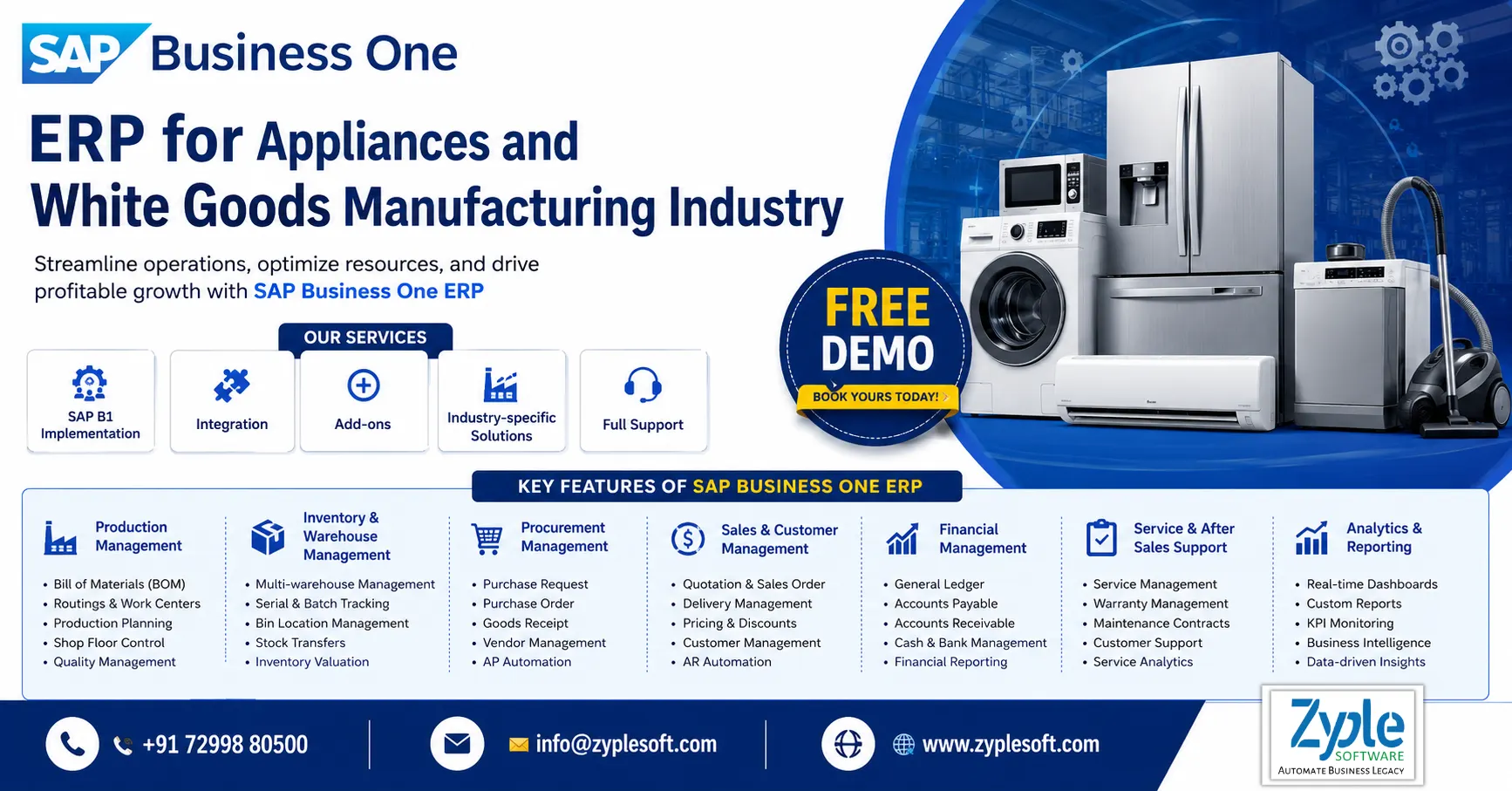
    SAP Business One ERP for Appliances and White Goods Manufacturing Industry

    SAP Business One for Appliances and White Goods Manufacturing Industry

    SAP Business One ERP for Appliances and White Goods Manufacturing industry

    SAP Business One ERP for Appliances and White Goods Manufacturing Industry

    As the appliances and white goods manufacturing industry grows exponentially, it has become tiresome and challenging to handle multiple operations all around the world, along with the business processes. Moreover, with a large industry like appliance and white goods manufacturing, integrating different departments and tackling any issues that occur also requires also requires so much time and effort. SAP Business One ERP for appliances and white goods manufacturing not only improves efficiency but also increases the quality of products of the appliances and white goods industry.

    Challenges Faced By The Appliances and White Goods Manufacturing Industry

    The appliances and white goods manufacturing industry faces significant operational and market hurdles, mainly driven by supply chain vulnerabilities, heavy import dependencies for essential components, and shrinking margins from fierce global competition. Manufacturers also struggle with a shortage of skilled labor, complex regulatory compliance, and quick technological shifts.

    1. High Import Dependence

    The industry relies heavily on international suppliers for essential components, such as semiconductors, high-end electronic chips, and specialized compressors. This dependency leaves supply chains highly vulnerable to geopolitical tensions and global shipping delays.

    2. Regulatory and Compliance Hurdles

    Navigating complex local and international regulations, including thorough testing and certification frameworks (like Bureau of Indian Standards in India), often causes production obstacles and increases manufacturing costs.

    3. Skilled Labor Shortage

    Modern appliance manufacturing involves highly trained personnel to operate, maintain, and program advanced automated machinery. A noticeable skills gap slows the adoption of cutting-edge production lines.

    4. Continuously Shifting Consumer Demands

    Consumers are demanding smarter, connected devices with shorter product lifecycles. To maintain economies of scale, manufacturers must frequently update product lines while keeping retail prices competitive.

    5. Inventory Management Issues

    Manual tracking, inaccurate stock forecasting, and handling high product variations lead to poor resource utilization and increased carrying costs.

    Features of SAP Business One ERP for Appliances and White Goods Manufacturing

    1. Financial Management and Cost Control

    • It includes general ledger, accounts payable and receivable, and journal entry automation.
    • It includes fixed asset management for plant machinery and equipment.
    • It includes real-time financial reporting and profitability analysis.
    • It helps manufacturers track product-wise margins and production costs.

    2. Sales and Customer Lifecycle Management

    • Lead and opportunity tracking, like dealer and distribution networks.
    • Sales quotation, order, and delivery to the invoicing cycle.
    • After-sales service is essential for appliance warranty.
    • It includes CRM with a complete customer and dealer database.
    • It supports service-heavy white goods business models.

    3. Purchasing and Supplier Management

    • It includes purchase requisitions, purchase orders, and GRNs.
    • It includes vendor evaluation and supplier performance tracking.
    • Multi-currency procurement is crucial for imported components.
    • It includes automated invoice matching and accounts payable.
    • It ensures smooth sourcing of electronics, compressors, motors, and more.

    4. Inventory and Warehouse Management

    • It includes real-time inventory tracking across multiple warehouses.
    • Batch and serial number tracking is essential for appliance parts.
    • It includes bin location and warehouse optimization.
    • It includes automatic stock updates with production and sales.
    • Minimizes stockouts and excess inventory.

    5. Bill of Materials (BOM) Management

    • Multi-level BOMs for complex appliances like PCB, motor, and casing.
    • It includes version control for product variants and models.
    • It includes engineering change management.
    • It ensures accurate product structure and costing.

    6. Production Planning and Control

    • Production order creation, like manual and automated.
    • It includes work order scheduling based on demand.
    • It includes shop-floor level tracking of production stages.
    • It includes real-time monitoring of work-in-progress (WIP).
    • It improves assembly-line efficiency and throughput efficiency.

    7. Material Requirements Planning (MRP)

    • It includes demand forecasting based on sales orders and history.
    • It includes auto-calculation of raw material requirements.
    • It includes procurement and production recommendations.
    • It includes capacity planning for machines and labor.
    • Prevents delays in production due to material shortages.

    8. Production Costing and Variance Analysis

    • It includes a standard vs. actual cost comparison.
    • It includes labor, machine, and overhead cost tracking.
    • It includes scrap and wastage monitoring.
    • It includes product-wise profitability.
    • Essential for cost-sensitive white goods manufacturing.

    9. Quality Control and Compliance

    • It includes incoming material quality checks.
    • In-process inspection like assembly line testing.
    • It includes finished goods quality assurance.
    • Compliance tracking like BIS, ISO, energy ratings, and more.
    • It ensures product reliability and regulatory compliance.

    10. Batch Production and Serial Tracking

    • Serial number tracking for appliances due to warranty and service.
    • It includes batch traceability and components.
    • It includes recall management.
    • Necessary for after-sales service and warranty claims.

    11. Sales and Distribution Management

    • Multi-channel distribution, like dealers, retailers, and e-commerce.
    • It includes pricing management and discount structures.
    • It includes delivery scheduling and logistics tracking.

    12. Demand Planning and Forecasting

    • It includes historical sales analysis.
    • Seasonal demand planning is crucial for ACs and refrigerators.
    • It includes automated replenishment.

    13. Import and Export Management

    • It includes documentation for international trade.
    • It includes customs, duties, and compliance tracking.
    • It includes multi-location and multi-currency operations.
    • Ideal for companies sourcing globally.

    14. Real-Time Dashboards and Reporting

    • It includes production efficiency dashboards.
    • It includes sales and inventory KPIs.
    • It includes financial and operational reports.
    • It includes drill-down analytics for decision-making.
    • Allows data-driven manufacturing decisions.

    15. Business Intelligence (BI)

    • It includes custom report creation.
    • It includes integration with Excel and analytics tools.
    • It includes predictive insights using historical data.

    16. Mobile and Web Access

    • It includes mobile apps for sales and management teams.
    • It includes remote monitoring of operations.
    • It includes web-based ERP access.
    • Handles operations anytime, anywhere.

    17. Workflow Automation

    • Approval workflows like purchase, production, and finance.
    • It includes alerts and notifications.
    • Minimized manual errors and faster processing.

    Benefits of SAP Business One ERP for Appliances and White Goods Manufacturing

    The ERP software, SAP Business One (SAP B1) system, benefits white goods and appliance manufacturing by connecting sales, procurement, and production into a unified platform. It improves material requirements planning (MRP) to prevent stockouts of essential components, ensures strict quality control and traceability, and delivers real-time cost-to-manufacture analysis to protect your profit margins.

    1. Advanced Material Requirements Planning (MRP)

    Automatically calculates exactly what raw materials like compressors, motors, and control boards are required based on sales forecasts and production schedules, ensuring Just-In-Time (JIT) availability while avoiding overstocking using SAP implementation.

    2. Real-Time Cost Recalculation

    Monitors real-time labor, machine, and material usage to recalculate production costs accurately. This is essential for margin analysis and smart pricing in a highly competitive appliance market.

    3. Quality Control and Compliance

    Integrates strict quality checkpoints throughout the assembly line to handle defect tracking, warranty compliance, and regulatory standards.

    4. Multi-Level Bill of Materials (BOM)

    Easily manages complex assemblies by linking sub-assemblies to the main finished appliance, enabling both standard builds and customizable product variations using SAP solutions.

    5. Supply Chain and Supplier Management

    Evaluates and compares vendors based on lead times and past performance, optimizing the procurement of bulk materials and reducing carrying costs.

    Conclusion of Appliances and White Goods Manufacturing ERP

    Zyple Software is a certified SAP Business One partner in India specializing in implementation, digital transformation, licensing, integration, add-on solutions, migration, and consulting for the semiconductor manufacturing industry. Better sales and more customers are the key goals of the appliances and white goods industry, and SAP software makes you achieve these goals easier and quicker.

    If you’re involved, arrange a demo of SAP Business One.

    Do you want the SAP B1 ERP solution for your business or industry?

    Finish all the details in the given contact form; our team will reach out to you.

      How can SAP Business One minimize operational costs in white goods manufacturing?

      SAP Business One helps minimize costs by optimizing inventory levels, reducing production waste, and improving procurement planning. With updated data insights, manufacturers can make smarter decisions that directly impact profitability.

      Yes, SAP Business One ERP is highly customizable. It can be designed for matching specific manufacturing processes, compliance requirements, and reporting needs of appliance and white goods companies, ensuring a perfect fit for your operations.

      The SAP B1 implementation timelines vary based on business size and complexity, but most small to medium-sized appliance manufacturers can go live within a few weeks to a few months with the right implementation partner.

      Absolutely. SAP Business One uses historical data and analytics to improve demand forecasting, helping manufacturers align production with market demand and prevent overstocking or stockouts.

      Getting started is simple: connect with the best SAP Business One partner, like Zyple Software, for a consultation, business assessment, and demo. This helps you understand how the solution can be customized for your appliance manufacturing needs.