Tag Archives: sap business one implementation

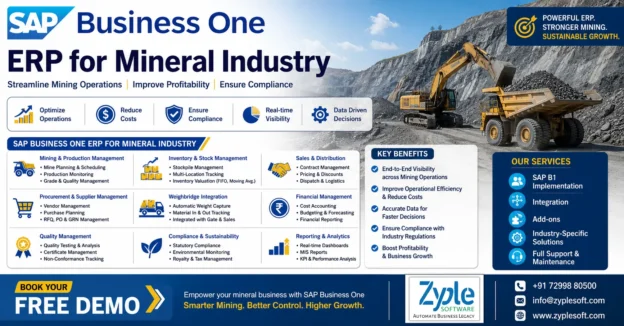
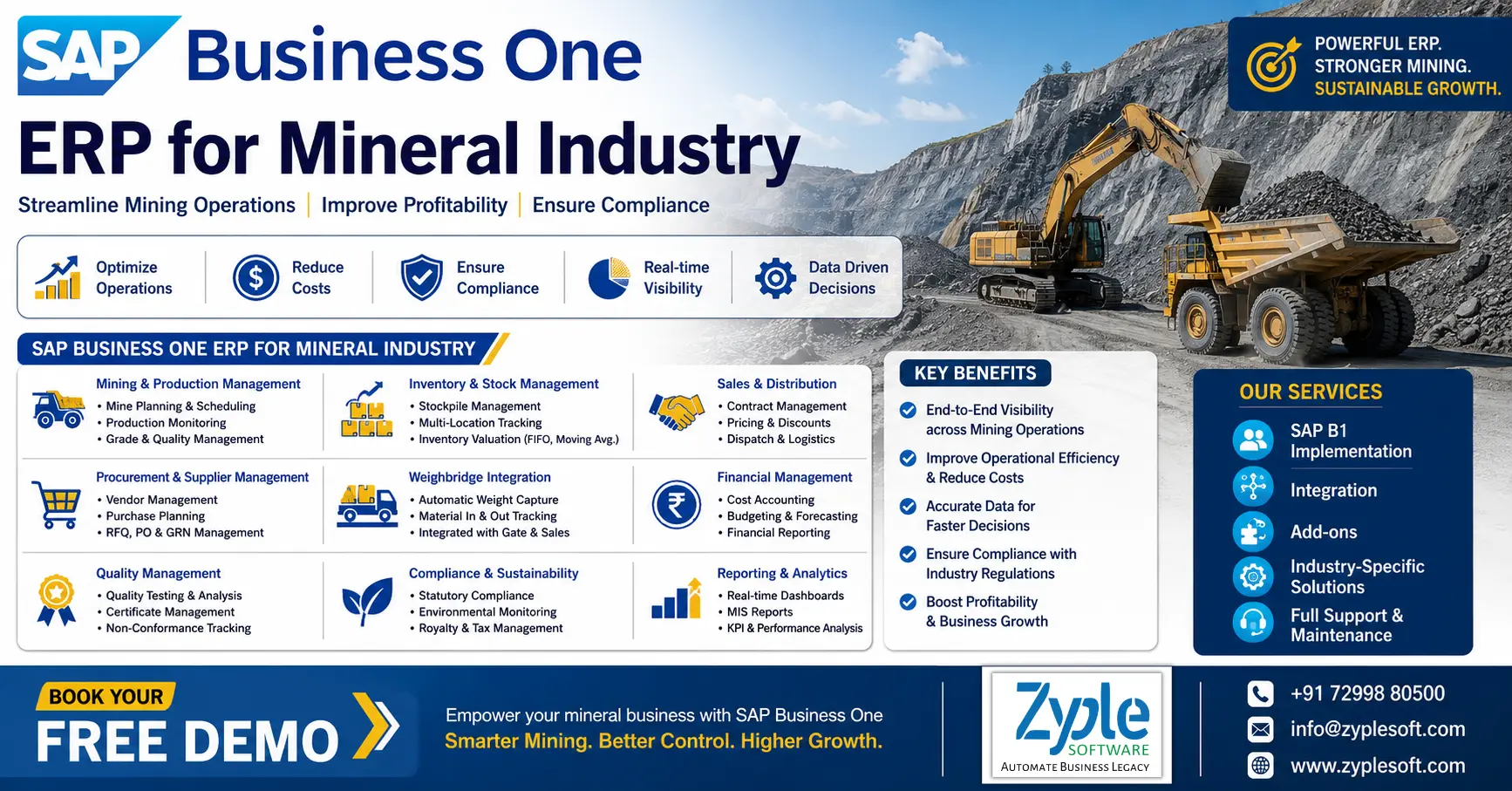
SAP Business One ERP for Mineral Industry
SAP Business One ERP for Mineral Industry

SAP Business One ERP for Mineral Industry

SAP Business One ERP for Mineral Industry

The mineral industry is fast-paced and depends heavily on data. Mineral companies handle drilling schedules, blasting records, fleet operations, fuel usage, quarry production, material movement, and environmental compliance, all while ensuring maximum output and worker safety. SAP Business One ERP for mineral industry helps mineral companies improve their operations and grow sustainably.

Challenges Faced By The Mineral Industry

The mineral industry is undergoing a massive transformation, largely driven by increasing demand for essential minerals required for the clean energy transition. Today, mineral companies face a complex web of environmental, operational, and geopolitical challenges that threaten both profitability and sustainability growth.

1. Environmental and Sustainability Demands

The sector is heavily scrutinized for its environmental impact, including land degradation, water contamination, and greenhouse gas emissions. Achieving strict sustainability standards and transitioning to green mining practices is a major, yet necessary, operational shift.

2. Declining Ore Grades and Cost Escalations

Naturally occurring ore grades are dropping, meaning companies must process more rock to extract the same amount of valuable minerals. This involves exploring in more remote locations, which increases project costs and ongoing operational expenses.

3. Geopolitical and Supply Chain Risks

Trade conflicts, shifting government policies, and global tensions directly interrupt the supply of raw materials and technology. Geopolitical shifts and resource shortages have heightened supply chain risks for essential commodities like lithium and rare earths.

4. The Skills Gap and Knowledge Loss

As veteran miners retire, the industry faces an ongoing shortage of experienced workers who understand complex, modern mining technologies. Operating in remote locations further aggravates the difficulty of attracting and retaining specialized talent.

5. Health, Safety, and Operational Hazards

Mining requires inherently hazardous working conditions and complex geological formations. Ensuring worker safety around heavy machinery, explosives, and confined spaces remains a major, non-negotiable priority.

6. Social License to Operate and Regulatory Compliance

Mining projects are increasingly delayed by complex regulatory permitting and community opposition. Companies must navigate evolving regulations while building trust with local communities and indigenous populations who are directly affected by land use.

Features of SAP Business One ERP for Mineral Industry

1. Exploration and Mine Planning Management

  • It includes geological data tracking and mineral resource estimation.
  • It includes long-term and short-term mine planning.
  • It includes budgeting for exploration and feasibility studies.
  • It includes integration with survey and drilling data.
  • It includes capital expenditure (CAPEX) planning for mining projects.
  • Helps handle the entire lifecycle from exploration to production.

2. Production and Extraction Management

  • It includes track drilling, blasting, excavation, and hauling.
  • Monitors ore extraction volumes and grades.
  • It includes crushing, screening, and beneficiation process tracking.
  • It includes production planning and scheduling.
  • It includes real-time production data collection.
  • SAP supports optimization of mining processes and production planning.

3. Inventory and Stockpile Management

  • It includes raw material (ore), processed minerals, and by-product tracking.
  • Batch-wise and location-wise inventory, like stockpiles, yards, and warehouses.
  • It includes quality and grade-based inventory classification.
  • It includes automatic stock updates from weighbridge integration.
  • It includes minimum and maximum stock level alerts.

4. Supply Chain and Logistics Management

  • End-to-end logistics from mine, plant, and port to customer.
  • It includes transport and fleet management.
  • It includes route planning and shipment tracking.
  • It includes bulk material handling and dispatch planning.
  • It includes vendor and contractor coordination.
  • It ensures a resilient supply chain and logistics optimization.

5. Financial and Cost Management

  • It includes mine-wise and project-wise costing.
  • It includes production cost per ton analysis.
  • It includes budget vs. actual comparisons.
  • It includes asset depreciation and capital tracking.
  • Multi-location financial integration.
  • It includes GST and tax compliance.
  • Allows real-time financial visibility and forecasting.

6. Asset and Equipment Management

  • Maintenenace scheduling, like preventive and breakdown.
  • It includes equipment lifecycle tracking.
  • It includes spare parts inventory management.
  • It includes machine downtime analysis.
  • It includes fuel consumption tracking.
  • Improves asset uptime and minimizes operational costs.

7. Workforce and Contractor Management

  • It includes employee scheduling and shift planning.
  • It includes contractor and labor management.
  • It includes attendance and payroll integration.
  • It includes safety certifications and compliance tracking.
  • It includes workforce productivity analysis.
  • It supports workforce optimization and safety culture.

8. Compliance, Safety, and Environmental Management

  • It includes mining permits and license tracking.
  • Environmental compliance, like pollution and land usage.
  • It includes safety incident reporting and audits.
  • It includes ESG (Environmental, Social, and Governance) reporting.
  • It includes regulatory documentation management.
  • Helps achieve strict mining regulations and sustainability goals.

9. Sales, Contracts, and Commodity Management

  • Mineral sales contracts and pricing, like grade-based pricing.
  • It includes customer order management.
  • It includes dispatch, billing, and invoicing automation.
  • It includes commodity trading and contract lifecycle management.
  • It includes customer relationship management (CRM).

10. Real-Time Analytics and Reporting

  • It includes real-time dashboards for production, finance, and logistics.
  • KPI tracking like cost per ton, output efficiency, and downtime.
  • It includes custom MIS and regulatory reports.
  • It includes data-driven decision-making.
  • Allows data-driven insights and performance optimization.

11. Integrated End-to-End ERP Platform

  • It includes a single system integrating finance, production, inventory, and sales.
  • Eliminates data storage across departments.
  • It includes cloud or on-premise deployment.
  • It includes integration with IoT, weighbridges, GPS, and third-party tools.
  • Delivers enterprise-wide planning, execution, and reporting.

Importance of SAP Business One ERP for Mineral Industry

The ERP software, SAP Business One, is essential for the mineral industry, as it unifies disconnected operations into a single platform. It delivers immediate value by handling heavy machinery assets, optimizing complex supply chains, ensuring strict regulatory compliance, and centralizing real-time data for accurate financial and production planning.

1. Integrated Financial Management

Delivers robust budgeting, audit-ready reporting, and precise fixed-asset tracking to manage heavy extraction equipment and depreciation with the SAP implementation process.

2. Supply Chain and Inventory Optimization

Maintains optimal stock levels for essential spare parts and mining supplies to prevent costly production downtimes.

3. Compliance and Safety

Facilitates documentation and auditable data to help mining companies effortlessly meet strict environmental and labor regulations.

4. Material Requirements Planning (MRP)

Improves resource utilization by intelligently handling raw materials and aligning procurement with production schedules using SAP solutions.

5. Real-Time Dashboards

Replaces scattered spreadsheets with centralized analytics, providing leaders a clear mine-to-market view of cost performance and operational efficiency.

Benefits of SAP Business One for Mining Industry

SAP Business One (SAP B1) facilitates capital-intensive mining operations by integrating core processes like extraction planning, heavy equipment maintenance, procurement, and financial tracking. It delivers real-time data to help mining companies control costs, optimize supply chains, and ensure strict regulatory and ESG compliance.

1. Financial Management and Cost Control

The SAP software accurately tracks real-time costs of fuel, labor, and machinery. It uses built-in budgeting and profitability analyses to monitor expenses across individual projects or specific mine sites.

2. Asset and Equipment Maintenance

Reduces costly unplanned downtime by scheduling predictive and preventive maintenance for heavy mining machinery. Tracks equipment lifecycles and evaluates repair histories efficiently.

3. Inventory and Supply Chain Orchestration

Maintains optimal stock levels of crucial consumables and spare parts using SAP B1 add-ons. Facilitates procurement processes from purchase requests to supplier contracts and payment management.

4. Regulatory and ESG Compliance

Simplifies reporting for stringent labor laws and environmental standards. Captures safety logs and sustainability metrics to ensure audit readiness.

5. Data-Driven Production Planning

Uses production planning and integrated analytics to optimize extraction schedules based on market demand and resource availability.

Conclusion of Mineral ERP

As a qualified SAP Business One partner, Zyple Software is delivering services like SAP B1 implementation, licensing, integration, add-ons, and support to different industries, like construction, manufacturing, solar, jewellery, food and beverage, aerospace, retail, pharma, and textiles. 

SAP Business One is an ERP customized for small and medium-sized businesses that connects finance, production, procurement, inventory, sales, CRM, and reporting into one platform. For mineral or any other companies, it can improve project costing, procurement, subcontractor billing, and inventory management.

If you’re adaptable, appoint a demo of SAP Business One.

Do you look for the SAP B1 ERP solution for your business or industry?

Finish all the details in the arranged contact form; our team will reach out to you.

    FAQs

    1.What is SAP Business One and how does it benefit the mineral industry?

    SAP Business One is an integrated ERP solution customized for small and midsize businesses. For the mineral industry, it helps handle mining operations, inventory, procurement, sales, finance, and compliance in one system, improving efficiency and reducing operational costs.

    Yes, SAP Business One delivers real-time inventory tracking, batch and serial number management, and warehouse control. It enables mineral businesses to handle stockpiles, track material movement, and reduce losses due to mismanagement or theft.

    SAP Business One supports production planning, resource allocation, and equipment utilization. It helps evaluate extraction processes, handle raw material usage, and optimize production cycles to improve output and profitability.

    Absolutely. The system helps maintain accurate records, generate compliance reports, and monitor environmental and safety regulations. This ensures your business stays adherent to industry standards and government policies.

    You can start by consulting a certified SAP Business One partner like Zyple Software who will evaluate your business needs, provide a demo, and guide you through implementation, customization, and support to ensure a smooth digital transformation.
    SAP Business One ERP for Doors, Windows, and Building Products industry by zyple software

    SAP Business One ERP for Doors, Windows, and Building Products Industry

    SAP Business One (B1) ERP for Doors, Windows, and Building Products Industry

    SAP Business One ERP for Doors, Windows, and Building Products industry by zyple software

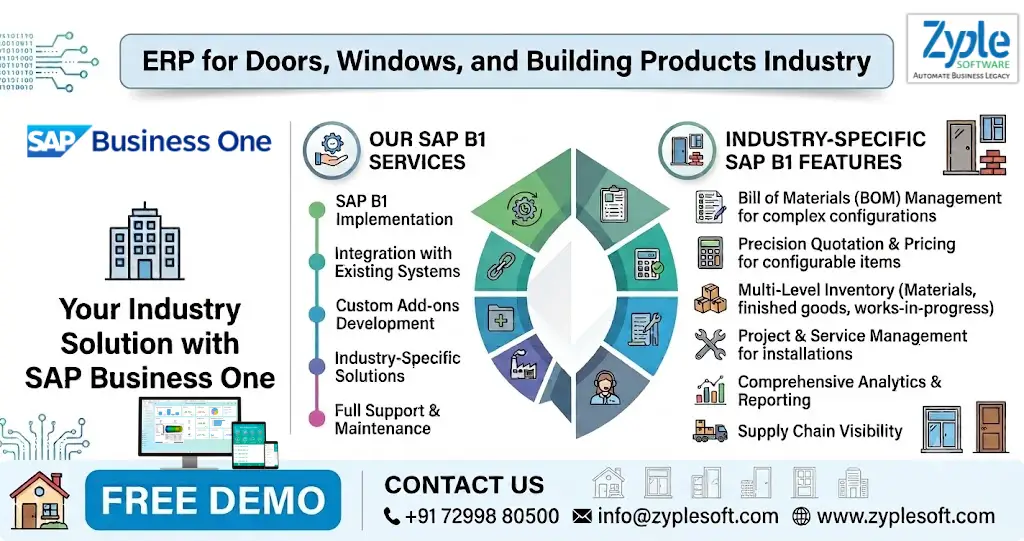
    The doors, windows, and building products industry, being a versatile sector in the world, goes through continuous development. Innovative software solutions are important for the doors, windows, and building products industry to maintain the huge and dynamic competition and also to integrate business processes effectively. SAP Business One ERP for doors, windows, and building products helps the doors, windows, and building products to handle every aspect of their business efficiently.

    Challenges Faced By The Doors, Windows, and Building Products Industry

    The doors, windows, and building products industry faces a confluence of chronic labor shortages, fluctuating raw material costs, and tightening energy-efficiency regulations. Companies must adjust to shifting consumer demands while handling supply chain disruptions and navigating the transition towards digitized, sustainable manufacturing.

    1. Chronic Labor and Skill Shortages

    Finding and retaining certified, skilled trainers remains a major obstacle. Improper sealing and installation of fenestration can lead to moisture infiltration, mold, and minimized thermal performance. An aging workforce paired with a lack of vocational training results in higher onboarding costs and inconsistent work quality on job sites. Labor deficits throughout the supply chain delay order fulfillment and minimize manufacturer flexibility to scale productivity.

    2. Material Volatility and Supply Chain Pressures

    The costs of necessary raw materials, such as aluminum, timber, and glass, remain highly unpredictable. The industry faces continuous pressure from import duties and an influx of cheap, lower-quality products, which forces local and organized manufacturers to continuously adjust their pricing models. Global trade uncertainities and shifting tariff structures complicate forecasting and inventory management.

    3. Stringent Energy and Environmental Regulations

    Governments are enforcing aggressive energy efficiency and zero-emission goals. This forces manufacturers to quickly phase out older, less efficient products like outdated aluminum frames in favor of thermally-broken systems. Achieving consumer and regulatory expectations for recycled, sustainably sourced, and highly recyclable materials such as uPVC and advanced fiberglass involves significant R&D investment.

    4. Technological Integration and Digitization

    Consumers increasingly require smart, connected features, including motorized blinds, automated locking systems, and integrated sensors. Manufacturing these products involves new technological capabilities and higher production costs. The shift towards digital transformation seperates industry winners from losers. Manufacturers and dealers must improve their digital presence, as many homeowners finish the majority of their buying journey and research prior to ever contacting a company. Building material manufacturers are increasingly challenged to switch from being simple component suppliers to complete systems providers, requiring heavy investments in software, digital planning, and supply chain integration.

    Features of SAP Business One ERP for Doors, Windows, and Building Products Industry

    1. Customer Relationship Management

    • It includes lead and opportunity management.
    • It includes customer inquiry tracking.
    • It includes dealer and distribution management.
    • It includes sales quotation management.
    • It includes customer communication history.
    • It includes after-sales service management.
    • It includes complaint and warranty tracking.

    2. Sales Management

    • It includes multi-level quotation creation.
    • It includes door and window configuration-based quotations.
    • It includes sales order processing.
    • It includes contract-based pricing.
    • It includes project-wise sales management.
    • It includes delivery scheduling.
    • It includes partial deliveries.
    • It includes sales returns management.
    • It includes credit limit management.

    3. Product Configuration

    • Configures doors and windows based on dimensions, material, frame type, glass type, hardware selection, color, and finish.
    • It includes automatic pricing based on configuration.
    • It includes custom product variants.
    • It includes engineering change management.

    4. Bill of Materials (BOM) Management

    • It includes multi-level BOM.
    • It includes configurable BOM.
    • It includes phantom BOM.
    • It includes revision control.
    • It includes component substitution.
    • It includes version management.
    • It includes cost roll-up.

    5. Production Planning

    • It includes production order management.
    • It includes make-to-order manufacturing.
    • It includes make-to-stock manufacturing.
    • It includes production scheduling.
    • It includes capacity planning.
    • It includes work center allocation.
    • It includes machine scheduling.
    • It includes resource planning.

    6. Inventory Management

    • It includes raw material inventory.
    • It includes finished goods inventory.
    • It includes work-in-progress (WIP) tracking.
    • It includes multi warehouse management.
    • It includes bin location management.
    • It includes stock transfer.
    • It includes stock reservation.
    • It includes inventory valuation.
    • It includes inventory counting.

    7. Material Requirements Planning (MRP)

    • It includes demand forecasting.
    • It includes raw material planning.
    • It includes purchase recommendations.
    • It includes production recommendations.
    • It includes shortage analysis.
    • It includes safety stock planning.
    • It includes automatic replenishment.

    8. Batch and Serial Number Tracking

    • It includes glass batch tracking.
    • It includes aluminium profile tracking.
    • It includes hardware traceability.
    • It includes finished product serial numbers.
    • It includes complete product genealogy.
    • It includes recall management.

    9. Warehouse Management

    • It includes barcode-enabled inventory.
    • It includes bin management.
    • It includes goods receipt.
    • It includes goods issue.
    • It includes picking lists.
    • It includes packing management.
    • It includes warehouse transfers.
    • It includes cycle counting.

    10. Procurement Management

    • It includes vendor management.
    • It includes purchase requisitions.
    • It includes purchase quotations.
    • It includes purchase orders.
    • It includes goods receipt PO (GRPO).
    • It includes vendor price comparison.
    • It includes supplier evaluation.
    • It includes blanket purchase agreements.

    11. Manufacturing Execution

    • It includes shop floor control.
    • It includes production issue and receipt.
    • It includes labor tracking.
    • It includes machine utilization.
    • It includes production variance analysis.
    • It includes scrap recording.
    • It includes rework management.
    • It includes yield monitoring.

    12. Quality Control

    • It includes incoming material inspection.
    • It includes in-process quality checks.
    • It includes final product inspection.
    • It includes glass quality verification.
    • It includes hardware quality testing.
    • It includes non-conformance management.
    • It includes quality certificates.
    • It includes CAPA tracking.

    13. Cost Management

    • It includes standard costing.
    • It includes actual costing.
    • It includes material cost analysis.
    • It includes labor costing.
    • It includes machine costing.
    • It includes job costing.
    • It includes product profitability.
    • It includes variance analysis.

    14. Project Management

    • It includes building project tracking.
    • It includes site-wise costing.
    • It includes installation scheduling.
    • It includes budget monitoring.
    • It includes resource allocation.
    • It includes milestone tracking.
    • It includes project profitability.
    • It includes contractor coordination.

    15. Installation Management

    • It includes Installation scheduling
    • It includes Technician assignment
    • It includes Site visit planning
    • It includes Installation status tracking
    • It includes Completion reports
    • It includes Customer sign-off
    • It includes Installation checklists

    16. Service Management

    • It includes warranty management.
    • It includes AMC management.
    • It includes service call management.
    • It includes repair tracking.
    • It includes replacement management.
    • It includes spare parts management.
    • It includes field service scheduling.

    17. Financial Management

    • It includes general ledger.
    • It includes accounts payable.
    • It includes accounts receivable.
    • It includes fixed assets.
    • It includes bank reconciliation.
    • It includes cash flow management.
    • It includes budget management.
    • It includes multi-currency accounting.

    18. GST and Tax Compliance

    • It includes GST-ready invoicin
    • It includes tax calculations.
    • It includes e-invoicing integration.
    • It includes e-way bill support.
    • It includes TDS/TCS management.
    • It includes compliance reporting.

    19. Supply Chain Management

    • It includes supplier collaboratio
    • It includes procurement planning.
    • It includes inventory optimization.
    • It includes logistics coordination.
    • It includes dispatch planning.
    • It includes shipment tracking.

    20. Pricing Management

    • It includes customer-specific pricing.
    • It includes dealer pricing.
    • It includes project pricing.
    • It includes volume discounts.
    • It includes promotional pricing.
    • It includes price lists.
    • It includes approval workflows.

    21. Document Management

    • It includes CAD drawing attachment.
    • It includes technical specifications.
    • It includes installation manuals.
    • It includes purchase documents.
    • It includes sales documents.
    • It includes quality certificates.
    • It includes customer contracts.

    22. Approval Workflows

    • It includes purchase approval.
    • It includes sales discount approval.
    • It includes credit approval.
    • It includes production approval.
    • It includes payment approval.
    • It includes expense approval.

    23. Business Intelligence and Dashboards

    • It includes sales dashboards.
    • It includes production dashboards.
    • It includes inventory dashboards.
    • It includes financial dashboards.
    • It includes procurement analytics.
    • It includes customer analytics.
    • It includes profitability reports.
    • It includes executive KPIs.

    24. Reporting

    • It includes sales reports.
    • It includes production reports.
    • It includes inventory reports.
    • It includes cost reports.
    • It includes profit analysis.
    • It includes purchase reports.
    • It includes GST reports.
    • It includes project reports.
    • It includes service reports.

    25. Mobile Access

    • It includes sales order entry.
    • It includes customer information.
    • It includes inventory lookup.
    • It includes approval management.
    • It includes service updates.
    • It includes dashboard access.
    • It includes mobile reporting.

    26. Multi-Branch Management

    • It includes branch-wise inventory.
    • It includes inter-branch transfers.
    • It includes consolidated financials.
    • It includes branch profitability.
    • It includes centralized reporting.

    27. Multi-Currency and International Business

    • It includes foreign currency transactions.
    • It includes export documentation.
    • It includes import management.
    • It includes exchange rate management.
    • It includes international tax support.

    28. Integration Capabilities

    • It includes CAD software integration.
    • It includes estimation software integration.
    • It includes e-commerce integration.
    • It includes barcode scanners.
    • It includes business intelligencetools.
    • It includes shipping providers.
    • It includes banking systems.
    • It includes Microsoft Office integration.

    29. Security and User Management

    • It includes role-based permissions.
    • It includes user authorization.
    • It includes audit trail.
    • It includes data securit
    • It includes approval hierarchy.
    • It includes electronic signatures.

    30. SAP Business One Web Client

    • It includes browser-based ERP access.
    • It includes sales document creation.
    • It includes approval workflows.
    • It includes dashboard access.
    • It includes activity management.
    • It includes real-time reportin

    Benefits of SAP Business One ERP for Doors, Windows, and Building Products

    The ERP software, SAP Business One system, delivers doors, windows, and building products companies with an integrated platform that connects sales, production, inventory, and finance. Key benefits include optimized material requirements planning (MRP) to minimize waste, automated custom-order processing, and real-time inventory tracking.

    1. Configurable Manufacturing

    Easily handles unique Bills of Materials (BOMs) and routings for custom-sized windows and doors, minimizing production bottlenecks and material waste with the SAP implementation process.

    2. Optimized Inventory and Procurement

    Uses MRP to forecast demand and automate purchasing. This helps prevent stock shortages of raw materials like lumber, glass, and aluminum, while reducing carrying costs.

    3. Facilitated Order-to-Cash

    Integrates your sales quotes directly to the shop floor and accounting. This accelerates the pricing, production, and delivery of custom building materials, leading to faster fulfillment with the SAP solutions process.

    4. Accurate Costing and Margin Analysis

    Connects labor, raw material usage, and overhead directly into the ledger, giving you a precise Cost of Goods Sold (COGS) to improve pricing strategies.

    5. Centralized CRM

    Handles leads, tracks interactions with contractors and architects, and provides robust post-sales support in one system using SAP B1 add-ons.

    6. Advanced Traceability

    Employs batch and serial number tracking for compliance with building codes and to allow faster, more controlled quality-control recalls if necessary.

    Conclusion of Doors, Windows, and Building Products ERP

    Best SAP Business One partner – Zyple Software is delivering services like SAP B1 implementation, integration, licensing, add-ons, and support to different industries, like construction, manufacturing, jewellery, food and beverage, retail, pharma, solar, aerospace, and textile industries. 

    SAP Business One is an ERP customized for small and medium-sized businesses that connects finance, procurement, sales, inventory, production, CRM, and reporting into a single platform. For doors, windows, and building products or any other companies, it can improve project costing, procurement, subcontractor billing, and inventory management.

    If you’re adaptable, reserve a demo in SAP Business One.

    Do you request the SAP B1 ERP software for your business or industry?

    Finish all the details in the designated contact form; our team will return to you.

      Frequently Asked Questions (FAQs)

      1.How can SAP Business One ERP improve profitability in doors and windows manufacturing?

      SAP Business One helps minimize material wastage, optimize production planning, and deliver real-time financial insights, allowing manufacturers to control costs and improve overall profitability.

      Yes, SAP Business One is specifically customized for SMEs. It scales with your business and can be designed to achieve the unique needs of doors, windows, and building product manufacturers.

      Yes, most SAP Business One partners provide personalized demos customized for your industry. The demo helps you understand how the system fits your business processes before making a decision.

      SAP B1 implementation timelines vary, but with the right partner like Zyple Software, most businesses can go live within a few weeks to a few months depending on complexity and customization needs.

      Look for a partner with experience in your industry like Zyple Software with proven implementation success and strong post-implementation support to ensure long-term value from your ERP investment.

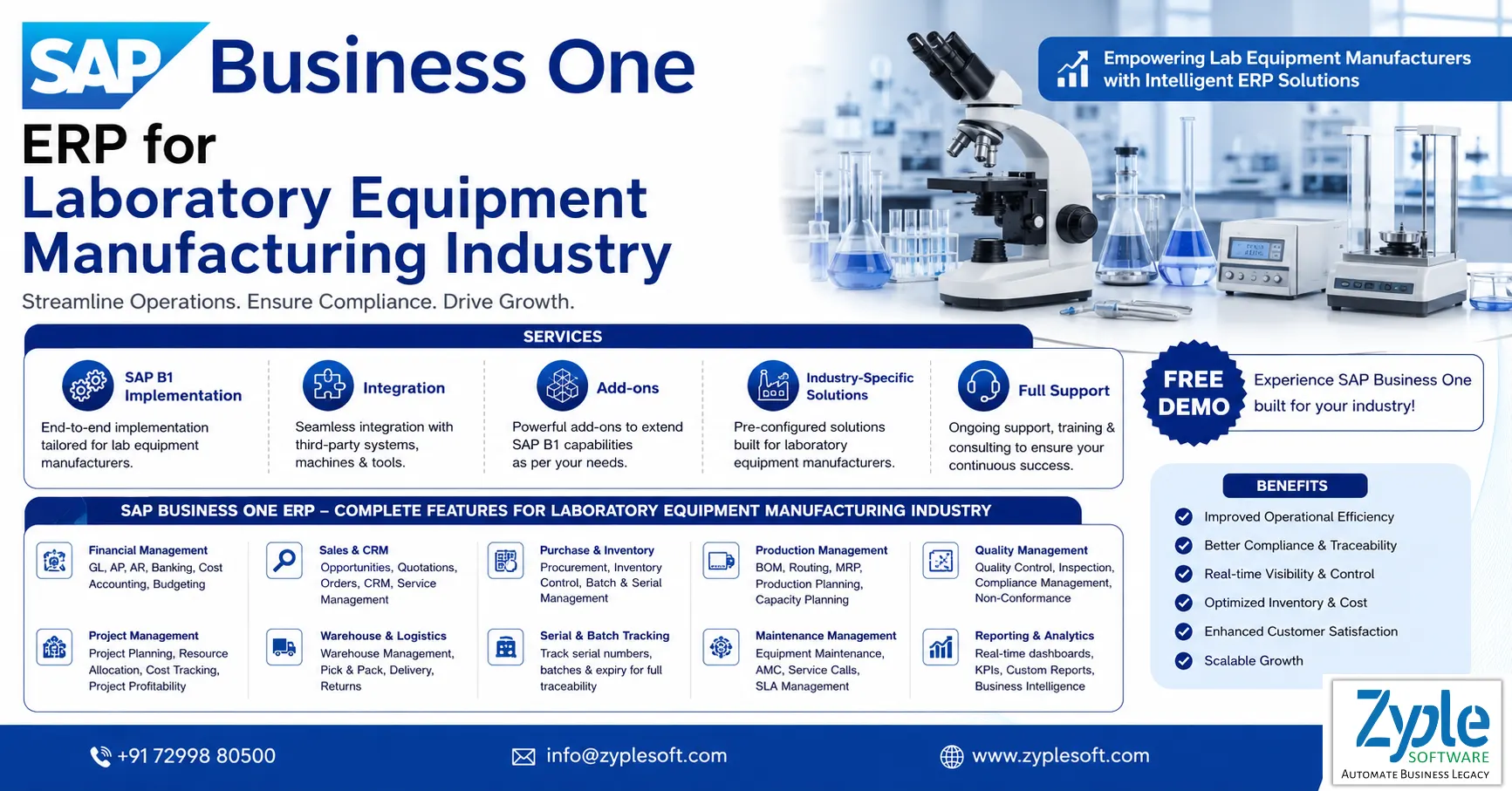
      SAP Business One ERP for Laboratory Equipment Manufacturing Industry infographic by Zyple Software featuring implementation, integration, add-ons, compliance, inventory, production, quality management, and analytics.

      SAP Business One ERP for Laboratory Equipment Manufacturing Industry

      SAP Business One ERP Software for Laboratory Equipment Manufacturing Industry

      SAP Business One ERP for Laboratory Equipment Manufacturing Industry infographic by Zyple Software featuring implementation, integration, add-ons, compliance, inventory, production, quality management, and analytics.

      The laboratory equipment manufacturing industry operates under strict quality standards, regulatory pressure, and rising competition. Manufacturers must handle complex production workflows, ensure complete traceability, and maintain consistent quality while scaling operations. SAP Business One ERP for laboratory equipment manufacturing delivers a structured ERP foundation to handle these challenges and support long-term growth without operational chaos.

      Challenges Faced By The Laboratory Equipment Manufacturing Industry

      The laboratory equipment manufacturing industry faces strict regulatory compliance, rapid technological obsolescence, and miniaturization demands. Companies struggle with supply chain disruptions, a shortage of skilled labor for complex mechatronic systems, and fierce global competition, all of which heavily squeeze profit margins and increase time to market.

      1. Strict Regulatory Compliance

      Manufacturers must handle evolving global standards such as GLP, GMP, and ISO certifications. Continuously updating designs to achieve these mandates creates massive administrative burdens.

      2. Component Shortages and Supply Chain

      The industry is heavily dependent on precise, specialized sub-components. Global supply chain volatility often results in prolonged lead times, inflating manufacturing and service costs.

      3. Skill Gaps in Development and Assembly

      Building complex mechatronic systems involves advanced specialist knowledge in software integration, automation, and electronics. Small and mid-scale manufacturers often lack the engineering manpower and high-end production infrastructure required to scale.

      4. Device Integration and Compatibility

      Laboratories frequently use instruments from different vendors. Disparate software systems, differing communication protocols, and the lack of universal standards hamper seamless data flow and integration.

      5. Equipment Downtime and Service Pressures

      Executives place huge pressure on equipment uptime to prevent costly research or sample losses. Extended resolution times for repairs and complex maintenance cycles severely affect operational efficiency and customer satisfaction.

      Features of SAP Business One ERP for Laboratory Equipment Manufacturing

      1. End-to-End Manufacturing Management

      • It includes bill of materials (BOM) for complex lab instruments.
      • It includes multi-level production orders and routing.
      • It includes production planning and control based on demand forecasts.
      • It includes batch and serial number tracking for precision components.
      • It includes real-time shop floor control and reporting.

      2. Quality Control and Compliance Management

      • It includes quality inspection at incoming, in-process, and final stages.
      • It includes non-conformance and corrective action tracking (CAPA).
      • It includes compliance with ISO, GMP, FDA, and calibration standards.
      • It includes audit trail and documentation management.
      • It includes calibration scheduling and tracking for lab equipment.

      3. Inventory and Warehouse Management

      • It includes real-time inventory tracking across warehouses.
      • It includes batch or lot traceability for service components.
      • It includes automated stock replenishment and reorder levels.
      • It includes handling of hazardous or sensitive materials.
      • It includes barcode and RFID integration.

      4. Product Lifecycle Management

      • It includes engineering change management.
      • It includes version control for product designs and specifications.
      • It includes integration with CAD systems.
      • It includes prototype and R&D cost tracking.

      5. Advanced Material Requirements Planning (MRP)

      • It includes demand-driven MRP for raw materials and components.
      • It includes forecasting based on historical sales and trends.
      • It includes supplier lead time management.
      • Reduces stockouts and excess inventory.

      6. Supplier and Procurement Management

      • It includes vendor evaluation and performance tracking.
      • It includes automated purchase requests and approvals.
      • It includes supplier pricing and contract management.
      • It includes integration with global supply chains.

      7. Financial Management and Cost Control

      • It includes real-time financial reporting and analytics.
      • Product costing like standard, moving average, and FIFO.
      • It includes budgeting and cost center tracking.
      • It includes multi-currency and multi-location support.
      • It includes GST compliance for India.

      8. Sales and Customer Relationship Management (CRM)

      • It includes lead and opportunity management.
      • It includes quotation and sales order automation.
      • It includes customer-specific pricing and contracts.
      • It includes after-sales service tracking for lab equipment.
      • It includes warranty and service contract management.

      9. Service and Maintenance Management

      • It includes installation and commissioning tracking.
      • It includes preventive and corrective maintenance scheduling.
      • It includes service call management.
      • It includes spare parts inventory integration.
      • It includes field service technician management.

      10. Business Intelligence and Reporting

      • It includes real-time dashboards and KPIs.
      • It includes custom reports for production, quality, and finance.
      • It includes predictive analytics for demand and maintenance.
      • It includes integration with Excel and analytics tools.

      11. Integration and Scalability

      • Seamless integration with third-party systems like LIMS, CAD, and MES.
      • It includes API-based connectivity.
      • It includes cloud and on-premise deployment options.
      • Adaptable for growing manufacturing businesses.

      12. Data Security and Regulatory Compliance

      • It includes role-based access control.
      • It includes data encryption and secure backups.
      • It includes compliance with industry regulations.
      • It includes full audit trails for traceability.

      13. Mobility and Remote Access

      • It includes remote access to dashboards and reports.
      • It includes real-time alerts and notifications.

      14. Customization and Industry-Specific Add-Ons

      • It includes customization workflows for laboratory equipment manufacturing.
      • It includes industry-specific SAP B1 add-ons for calibration and compliance.
      • It includes flexible user-defined fields and reports.

      15. Project Management Capabilities

      • Tracks R&D and custom equipment projects.
      • It includes budget vs. actual cost tracking.
      • It includes resource allocation and scheduling.
      • It includes milestone-based project monitoring.

      Importance of SAP Business One ERP for Laboratory Equipment Manufacturing

      The ERP software, SAP Business One (SAP B1) system, is essential for laboratory equipment manufacturers, as it unifies core processes, including finance, supply chain, and production, into a single source of truth. It allows highly precise manufacturing, strict regulatory compliance, and seamless tracking of expensive components, ultimately boosting operational efficiency and profit margins.

      1. Strict Regulatory Compliance

      The industry requires thorough quality control and traceability. SAP B1 automates quality checks, maintains audit-ready documentation, and monitors components so that manufacturers can easily adhere to global standards like ISO and FDA regulations.

      2. Precise Production Management

      Utilizing multi-level bill of materials (BOMs) and material requirements planning (MRP), the software helps handle complex assembly. It ensures you have the exact components needed to build precision instruments without holding excess stock using SAP implementation.

      3. Granular Traceability

      Every piece of lab equipment, from sensors to centrifuges, can be serialized. This enables manufacturers to trace the exact batch or serial number of an item from raw material procurement through to post-sales maintenance and service.

      4. Real-Time Financial and Inventory Visibility

      SAP B1 eliminates data silos. Real-time dashboards track machine utilization, labor costs, and project profitability, enabling leadership to make accurate, data-driven decisions.

      5. Supply Chain Optimization

      It reduces the risk of stock-outs or overstocking for specialized, often costly, materials required for lab equipment, ensuring on-time delivery and higher customer satisfaction using SAP solutions.

      Benefits of SAP Business One for Laboratory Equipment Manufacturing Industry

      SAP Business One (SAP B1) facilitates your lab equipment manufacturing by centralizing finance, supply chain, and production. It drives ROI through accurate BOM management, serial or batch traceability, and automated material requirements planning (MRP), minimizing carrying costs and ensuring strict industry compliance.

      1. Precision Manufacturing

      Utilizes powerful bill of materials (BOM) features to standardize production, control costs, and handle complex, multi-level assemblies required for sensitive scientific instruments.

      2. Total Traceability

      The SAP software tracks individual components, batches, and serial numbers from procurement to finished goods. This makes managing warranties and handling audits for ISO and regulatory compliance efficient.

      3. Optimized Inventory and Procurement

      The material requirements planning (MRP) system automatically computes purchasing and production needs based on forecasts and lead times, avoiding production delays and stockouts.

      4. Real-Time Analytics

      Unifies financial, sales, and operational data into customizable dashboards using SAP B1 add-ons. This allows data-driven decisions that immediately improve profit margins.

      5. Integrated CRM

      Strengthens customer relationships by managing leads, tracking after-sales service, and logging maintenance or calibration histories in a single platform.

      Conclusion of Laboratory Equipment Manufacturing ERP

      As a qualified SAP Business One partner, Zyple Software is providing services like SAP B1 implementation, integration, licensing, add-ons, and support to different industries like construction, manufacturing, retail, pharma, jewellery, solar, food and beverage, aerospace, and textile industries. SAP Business One is an ERP customized for small and medium-sized businesses that integrates finance, purchasing, sales, inventory, production, CRM, and reporting into a single platform. For solar panel and laboratory equipment manufacturing or any other companies, it can improve project costing, procurement, subcontractor billing, and inventory management.

      If you’re engaged, reserve a demo of SAP Business One.

      Do you necessitate the SAP B1 ERP system for your business or industry?

      Finish all the details in the described contact form; our team will get back to you.

        Frequently Asked Questions

        How can SAP Business One improve efficiency in my laboratory equipment manufacturing business?

        SAP Business One automates key processes like production planning, inventory control, and financial management, helping you minimize manual work, eliminate errors, and improve overall efficiency.

        Yes, SAP Business One is specifically designed for SMEs and growing manufacturers. It providesscalable features that adapt to your business size and complexity.

        The cost depends on factors like number of users, customization needs, and deployment type (like cloud or on-premises). We deliver customized pricing based on your requirements; reach out today for a free consultation and quote.

        The SAP B1 implementation timelines generallyrange from a few weeks to a few months, depending on your business processes. Speak with our team to get a clear project timeline customized for your needs.

        Absolutely! We provide live demos to help you understand how SAP Business One fits your laboratory equipment manufacturing processes.

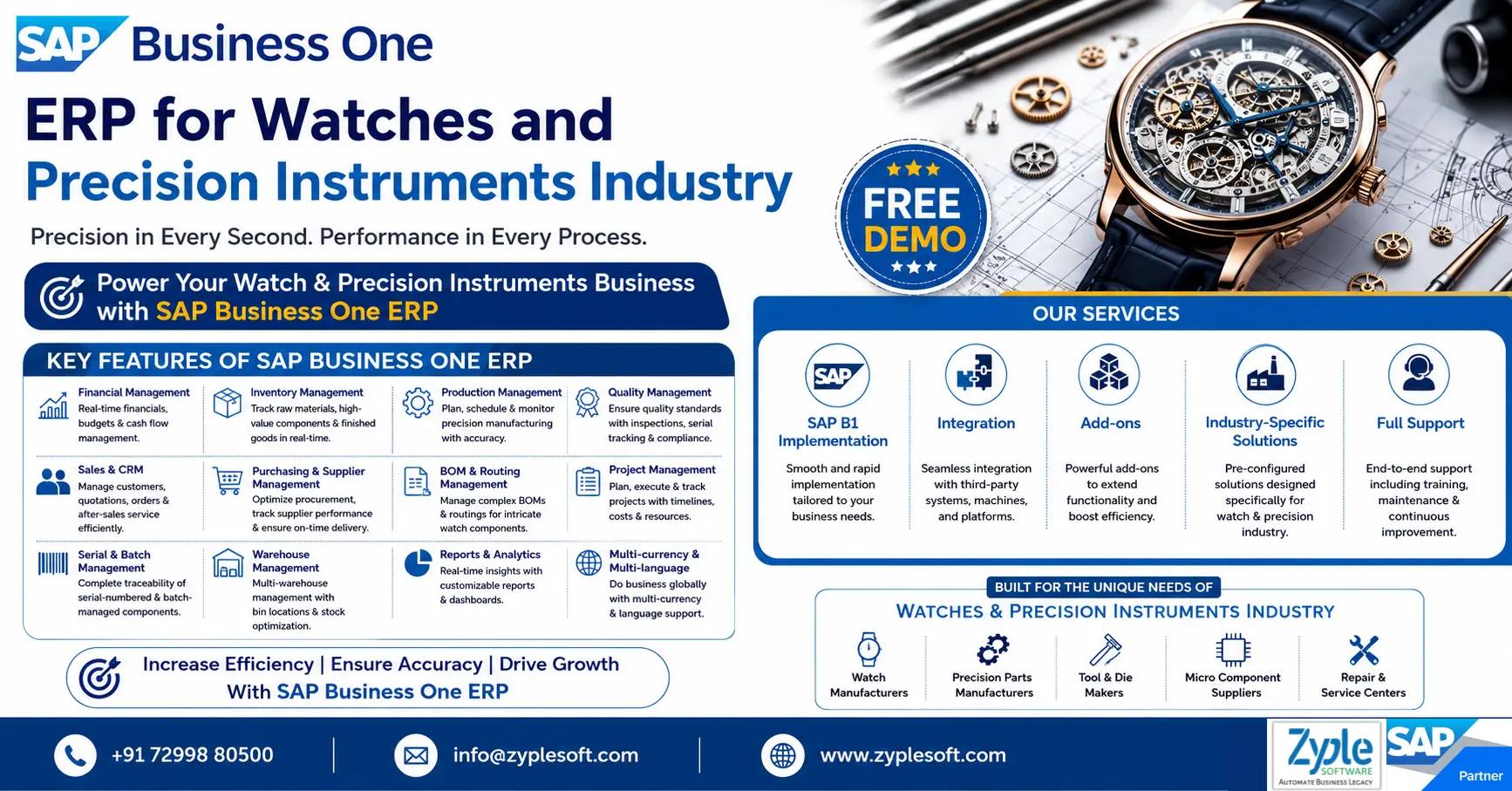
        Infographic of SAP Business One ERP for Watches and Precision Instruments Industry by Zyple Software featuring implementation, integration, add-ons, inventory management, production planning, quality control, serial tracking, CRM, finance, and free demo.

        SAP Business One ERP for Watches and Precision Instruments Industry

        SAP Business One (B1) ERP for Watches and Precision Instruments Industry

        Infographic of SAP Business One ERP for Watches and Precision Instruments Industry by Zyple Software featuring implementation, integration, add-ons, inventory management, production planning, quality control, serial tracking, CRM, finance, and free demo.

        The watches and precision instruments industry operates in a precision-driven environment where product quality, component traceability, and efficient assembly processes are essential. Manufacturers must handle a wide range of small and specialized components such as movements, dials, hands, cases, straps, and batteries while maintaining strict quality standards and design consistency. 

        Traditional systems and manual processes often create challenges in tracking component inventory, handling multi-level bills of materials, coordinating assembly operations, and ensuring product traceability. SAP Business One ERP for watches and precision instruments delivers an integrated platform that connects production planning, component inventory, procurement, quality control, sales, and financial management, providing real-time visibility and operational control across the watch manufacturing cycle.

        Challenges Faced By The Watches and Precision Instruments Industry

        The watches and precision instruments industry faces severe challenges, mainly driven by surging raw material costs (e.g., gold), restrictive geopolitical tariffs on exports, and aggressive competition from multifunctional watches. Consequently, traditional watchmakers are battling declining demand in mid-tier segments, falling secondary market inventories, and recent job contradictions across manufacturing.

        1. Macroeconomic Pressures and Trade Barriers

        International trade wars, including heavy tariffs on Swiss products entering the US, are forcing major shifts in inventory management and supply chain operations. Rising prices for precious metals like gold and platinum directly inflate manufacturing costs, squeezing profit margins, especially for mid-tier luxury and mechanical brands. The strength of the Swiss Franc remains a constant pressure, making exported traditional timepieces significantly more expensive for global buyers.

        2. Technological Shifts and Smartwatch Disruption

        Smartwatches and fitness trackers have evolved into digital health ecosystems, providing biometric tracking like ECG and SpO2, GPS, and phone connectivity. Younger generations are growing accustomed to the daily utility of connected wearables, seriously cutting into the entry-level and mass-market traditional watch segments. While smartwatches dominate, traditional instruments still hold the advantage of longevity. Smart devices suffer from quick battery drain and require daily charging.

        3. Market Saturation and Inventory Struggles

        The pre-owned and secondary markets are experiencing a surplus, causing waiting lists to shrink and secondary-market prices for previously high-demand watches to drop. Watches are remaining on retailer shelves and in dealer cases for much longer, reducing inventory turnover and revenue flow. There is a growing consensus that the market has too many brands chasing the same limited pool of high-net-worth consumers.

        4. Innovation vs. Trading

        Many established brands face criticism for taking extended periods to update designs or integrate modern clasps and bracelets, enabling newer, nimbler competitors to gain traction. While companies explore automated processes and industry 4.0 to scale production, true haute horlogerie depends on master artisans. Hand-finishing places a natural ceiling on production efficiency and output. Luxury watchmakers who attempt to create their own smartwatches or digital ecosystems have historically struggled with poor adoption and mixed results.

        5. Consumer Shifts and Sustainability

        Younger consumers desire highly personalized products and customizable components rather than mass-produced heritage pieces. There is an increased demand for sustainable and ethical sourcing of materials like conflict-free metals and vegan straps, forcing brands to adapt their supply chains.

        Features of SAP Business One ERP for Watches and Precision Instruments

        1. Core Manufacturing and Production Management

        • It includes multi-level BOMs for complex watch parts and instrument parties.
        • Plans, releases, and tracks batch or discrete manufacturing.
        • Defines machining, calibration, polishing, and assembly steps.
        • Optimizes machine utilization like CNC, micro-machining, and assembly lines.
        • Monitors partially assembled components.
        • Aligns production with demand and delivery timelines.
        • Handles production across multiple facilities.

        2. Inventory and Warehouse Management

        • It includes raw materials, components, and finished goods.
        • Essential for the traceability of precision instruments.
        • It includes efficient storage of small and high-value parts.
        • Handles distribution centers and production stores.
        • Avoids shortages of essential micro-components.
        • It includes cycle counting and stock audits.

        3. Quality Control and Compliance

        • Defines QC parameters for each stage.
        • Tracks calibration of instruments and tools.
        • Detects and handles defects.
        • It includes ISO, CE, and industry-specific standards.
        • It includes end-to-end tracking from raw material to finished product.

        4. Financial Management and Cost Control

        • Fully automated financial processes like general ledger, accounts payable, and accounts receivable.
        • It includes accurate costing for precision components and assemblies.
        • Monitors manufacturing expenses.
        • Suitable for global exports.
        • Handles high-value machinery and tools.
        • It includes product-wise and batch-wise margins.

        5. Procurement and Supplier Management

        • Maintains supplier data for precision parts.
        • Automates procurement cycles.
        • Evaluates vendor performance.
        • Facilitated procurement workflow.
        • Ideal for global sourcing.

        6. Sales, CRM, and After-Sales Service

        • Handles distributors, retailers, and OEM clients.
        • Sales order management from quotation to delivery cycle.
        • Essential for watches and instruments.
        • It includes after-sales service management.
        • It includes customer analytics and forecasting.

        7. Business Intelligence and Analytics

        • Real-time dashboards and KPIs for production, quality, and sales insights.
        • Drill-down analytics and custom reports for operations.
        • It includes demand forecasting and planning.
        • Excel integration for advanced reporting capabilities.

        8. Production Planning and MRP (Material Requirements Planning)

        • Demand forecasting is based on sales and historical data.
        • Automates material procurement and production planning.
        • Ensures timely availability of precision parts.
        • Minimizes inventory holding costs.

        9. Engineering and Product Lifecycle Support

        • Engineering change management to handle design revisions.
        • Version control for BOMs tracks changes in product design.
        • It includes integration with CAD and PLM systems.
        • It includes prototype and custom order handling.

        10. Mobility, Integration, and Automation

        • It includes mobile access to ERP on the go.
        • It connects CNC and testing equipment using IoT and machine integration.
        • Automated workflows and alerts reduce manual intervention.
        • Third-party integration with MES, e-commerce, and logistics.

        11. Industry-Specific Capabilities for Watches and Precision Instruments

        • It includes high-precision traceability for micro-components.
        • It includes strong quality assurance and calibration tracking.
        • It includes efficient batch and serial production handling.
        • It includes support for global supply chains and exports.
        • It includes improved time-to-market for new designs.

        Benefits of SAP Business One ERP for Watches and Precision Instruments

        The ERP software, SAP Business One (SAP B1) system, is an affordable ERP designed for SMEs. It connects financials, sales, purchasing, and manufacturing into one platform. For the watch and precision instruments industry, it avoids material waste, automates serialized tracking of microscopic components, and ensures thorough quality control.

        1. Serial Number and Batch Traceability

        Every movement, gear, and micro-component is individually tracked from procurement to final assembly using SAP implementation. This ensures product authenticity and rapid root-cause analysis in case of defects.

        2. Precision BOM Management

        Oversees multi-level bills of materials (BOM) that are common in high-complication watchmaking. This outlines exact requirements for precise, high-value components.

        3. Quality Control and Compliance

        Implements strict tolerance checks and quality control (QC) tracking throughout the production process to maintain high luxury and mechanical standards.

        4. Reduced Inventory Costs

        Reduces overstocking and stockouts using real-time data to forecast material demands and synchronize your warehouse using SAP solutions.

        5. Integrated Financials

        Automates key accounting and standardizes currency conversions for imported jewels, metals, and global parts distribution.

        Conclusion of Watches and Precision Instruments ERP

        Zyple Software is the official SAP Business One partner in India specializing in implementation, digital transformation, licensing, integration, add-on solutions, migration, and consulting for the watches and precision instruments industry. By implementing SAP software, watch manufacturers gain a centralized platform to handle production, component inventory, quality control, sales, and finance with complete transparency and control. This integrated approach improves operational efficiency, improves product traceability, and supports scalable growth in a competitive precision manufacturing market.

        If you’re active, reserve a demo of SAP B1 for your company.

        Do you require the SAP B1 ERP software for your business or industry?

        Finish all the details in the given contact form; our team will return to you.

          Frequently Asked Questions (FAQs)

          1.How can SAP Business One ERP help minimize production errors in precision manufacturing?

          SAP Business One improves accuracy through real-time data, automated workflows, and complete Bill of Materials (BOM). This reduces manual errors and ensures consistent quality, essential for precision instruments and watches.

          Yes, SAP Business One is designed specifically for SMEs, providing a cost-effective ERP solution with scalable pricing. Businesses can start with necessary modules and expand as they grow.

          SAP B1 implementation timelines vary based on complexity but generally range from a few weeks to months. With the right partner like Zyple Software, deployment can be fast and customized for your production needs.

          Absolutely. The system provides real-time dashboards and reporting tools that give full visibility into inventory levels, production status, and order tracking, helping you make faster, data-driven decisions.

          You can request a personalized demo from a certified SAP B1 partner like Zyple Software to see how the system fits your watch or precision instrument business. A consultation will help identify the suitable modules and implementation approach.

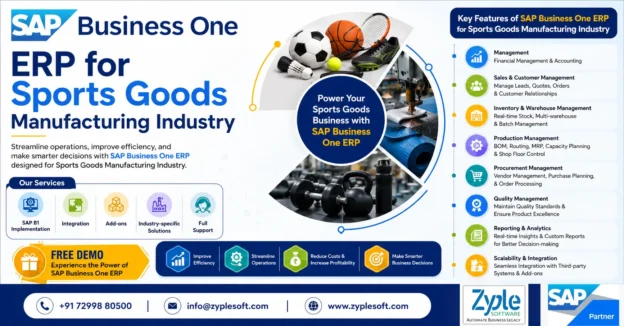
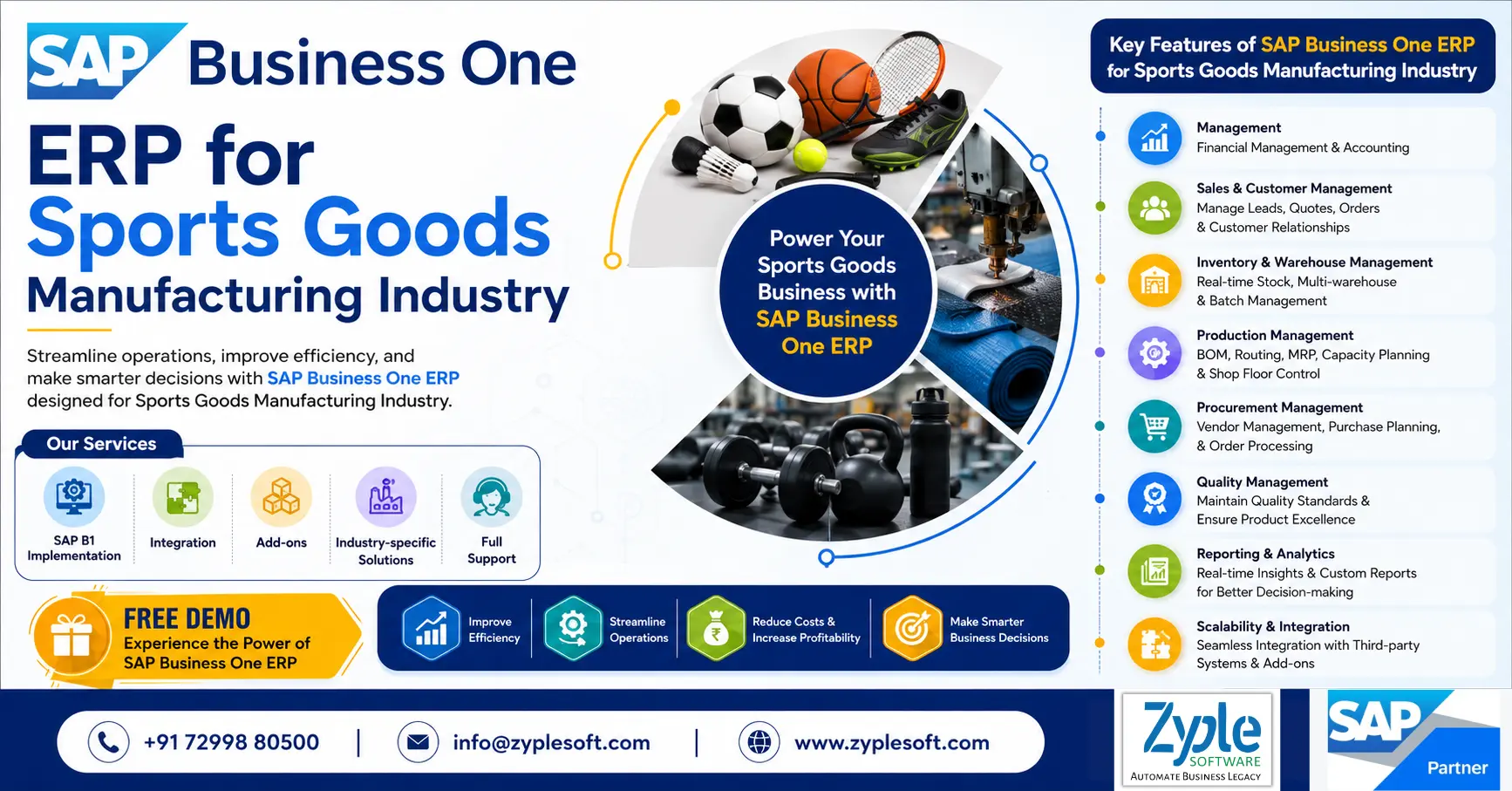
          SAP Business One ERP for Sports Goods Manufacturing industry

          SAP Business One for Sports Goods Manufacturing Industry

          SAP Business One ERP for Sports Goods Manufacturing Industry​

          SAP Business One ERP for Sports Goods Manufacturing industry

          The sports goods manufacturing sector is rapidly growing in India due to increasing domestic demand, global exports, fitness awareness, and expansion of sports infrastructure. Handling production, inventory, warehouse operations, dispatch tracking, and customer orders manually often creates operational ineffectiveness, inventory mismatches, production delays, and reporting inaccuracies. SAP Business One ERP for sports goods manufacturing helps sports goods manufacturing businesses centralize operations, automate workflows, and increase business visibility through a single platform.

          Issues Faced By The Sports Goods Manufacturing Industry

          The sports goods manufacturing industry faces significant challenges, including rising raw material costs, regulatory compliance burdens, and intense global price competition. Companies also struggle with shifting consumer expectations, technological upgrades, and supply chain inefficiencies that strain profitability, especially for smaller enterprises.

          1. High Input Costs and Supply Chain Constraints

          Sourcing high-performance materials like specialized polymers and carbon composites increases costs. High customs duties on imported materials compound this issue. Poor infrastructure and distance from large shipping ports increase freight costs and delay deliveries. Supply chain vulnerabilities, factory shutdowns, and shifting energy prices lead to production bottlenecks and inventory issues.

          2. Global Competition and Profit Margins

          Manufacturers face steep competition from low-cost production hubs, eroding domestic and global market share. Because consumers are sensitive to price hikes, manufacturers struggle to pass on increased production and labor costs, reducing profit margins.

          3. Compliance and Quality Standards

          High-performance gear involves thorough, expensive certifications from international sports bodies to compete globally. Achieving safety and ergonomic requirements involves advanced manufacturing tech, which many MSMEs lack the capital investment for.

          4. Branding and Market Shifts

          Smaller manufacturing hubs, specifically in clusters like Jalandhar and Meerut, often produce for larger anchor brands rather than developing their own labels, limiting global recognition. Buyers now expect sustainability, ethical sourcing, and integrated brand values, involving manufacturers in adapting their business models.

          Features of SAP Business One ERP for Sports Goods Manufacturing

          1. Bill of Materials (BOM) Management

          • Multi-level bill of materials (BOMs) for complex sports equipment like bicycles and gym machines.
          • It includes version control for design changes.
          • It includes component substitution for material flexibility.

          2. Production Planning and Scheduling

          • It includes forecast-based and order-based production planning.
          • It includes MRP (Materials Requirements Planning) for raw materials.

          3. Shop Floor Control

          • It includes real-time tracking of production stages.
          • It includes work order management.
          • It includes labor and machine time tracking.

          4. Real-Time Inventory Tracking

          • Tracks raw materials like rubbers, plastics, and metals and finished goods.
          • Batch and serial number tracking is essential for sports gear quality.

          5. Multi-Warehouse Management

          • Handles stock across multiple warehouses and retail outlets.
          • It includes automated stock transfers.

          6. Inventory Optimization

          • It includes safety stock levels.
          • It includes reorder point automation.
          • It includes demand-driven replenishment.

          7. Order Management

          • It includes sales quotations, orders, and invoicing.
          • It includes integration with distributors, dealers, and retailers.

          8. Pricing and Discount Management

          • It includes customer-specific pricing.
          • Seasonal discounts are essential for sports seasons and events.

          9. Returns and Warranty Handling

          • Handles product returns and replacements.
          • It includes warranty tracking for sports equipment.

          10. Accounting and Financial Control

          • It includes multi-currency support for exports.

          11. Cost Accounting

          • Tracks production costs per product.

          12. Quality Management

          • It includes defect tracking and corrective actions.

          13. Compliance and Certifications

          • Maintains compliance with industry standards like ISO and safety standards.
          • It includes an audit trail for traceability.

          14. Procurement Management

          • It includes vendor management.
          • It includes purchase requests, orders, and approvals.

          15. Supplier Performance Tracking

          • Evaluates vendors based on quality, delivery time, and cost.

          16. Logistics and Distributors

          • It includes shipment planning.
          • It includes integration with logistics providers.

          17. Real-Time Dashboards

          • It includes production KPIs, sales trends, and inventory levels.

          18. Advanced Analytics

          • It includes demand forecasting based on historical sales.
          • It includes seasonal trend analysis like cricket season spikes.

          19. Custom Reports

          • Customized reports for management decision-making.

          20. Customer Data Management

          • It includes centralized customer database.

          21. Sales Opportunity Tracking

          • It includes lead and opportunity management.

          22. After-Sales Service

          • It includes service contracts and customer support.

          23. Customization and Add-Ons

          • It includes industry-specific add-ons for sports manufacturing.
          • It includes user-defined fields and workflows.

          24. Integration Capabilities

          • It includes API-based integration with third-party tools.

          25. Mobile Apps

          • It includes sales and inventory access on mobile devices.

          26. Cloud Deployment

          • Available on the cloud for adaptability and remote access.

          27. Role-Based Authorization

          • Secures access control for different departments.

          28. Data Backup and Recovery

          • It includes automated backups and disaster recovery.

          Importance of SAP Business One for Sports Goods Manufacturing

          The ERP software, SAP Business One system, is essential for the sports goods manufacturing industry because it unites inventory control, production planning, and supply chain management into a single platform. It enables brands to facilitate complex production processes, minimize raw material waste, and quickly fulfill fluctuating global demands.

          1. Accurate Demand Forecasting

          Uses historic sales data and upcoming sporting event schedules to forecast the correct demand for seasonal gear and apparel, avoiding overstocking or stockouts using SAP implementation.

          2. Material Requirements Planning (MRP)

          Facilitates the procurement of specialized raw materials, like carbon fiber, synthetic leathers, and high-tech fabrics, based on precise lead times and real-time production requirements.

          3. Complex Bill of Materials (BOM) and Kitting

          Easily handles the production of discrete sports equipment like cricket gear, baseball bats, or tennis rackets, as well as grouped sports kits, tracking auto-batch generation and multi-item packaging using SAP solutions.

          4. Rigorous Quality Control

          Integrates quality control checkpoints across multiple production stages to ensure only safe, superior-quality athletic gear and protective equipment leave the factory.

          5. Global Compliance and Financials

          Handles multi-currency transactions and diverse regional tax compliances like GST billing efficiently across international borders.

          Benefits of SAP Business One ERP for Sports Goods Manufacturing

          SAP Business One ERP facilitates sports goods manufacturing by integrating production, inventory, and sales into one platform. It reduces material waste, accelerates order fulfillment through automated planning, ensures strict quality control for sports equipment, and delivers real-time financial visibility to drive profitability.

          1. Automated Material Requirements Planning (MRP)

          Automatically calculates exactly which raw materials like leather, carbon fiber, and rubber are required and when to purchase them based on sales orders and bill of materials (BOMs).

          2. Complex BOM and Scrap Management

          Handles multi-level BOMs efficiently while tracking and minimizing scrap or recycle waste commonly produced during cutting and molding processes.

          3. Quality Management and Compliance

          The SAP software sets strict quality control benchmarks and inspection checkpoints at individual stages of production to ensure safety and performance standards for athletes.

          4. Real-Time Inventory Tracking

          Delivers total visibility of stock levels, work-in-progress, and finished goods across multiple warehouses to prevent seasonal stockouts or overstocking.

          5. Integration Financials and GST

          Automatically ties every procurement and sales transaction to the general ledger, ensuring accurate costing, pricing insights, and compliant GST invoicing.

          Conclusion of Sports Goods Manufacturing ERP

          Zyple Software is the best SAP Business One partner in India specializing in implementation, digital transformation, licensing, integration, add-on solutions, migration, and consulting for the sports goods manufacturing industry. The SAP Business One system helps sports goods manufacturing businesses improve efficiency, inventory management, and long-term operational scalability.

          If you’re involved, reserve a demo of SAP Business One.

          Do you want the SAP B1 ERP system for your business or industry?

          Finish all the details in the given contact form; our team will get back to you.

            1.How quickly can SAP Business One be implemented for a sports goods manufacturing business?

            The SAP Business One implementation timelines generally range from a few weeks to months, depending on your business size and complexity. With the right partner like Zyple Software, you can achieve a smooth and fast deployment customized for your manufacturing needs.

            The cost of SAP B1 implementation varies based on the number of users, required modules, and customization. However, SAP Business One provides a cost-effective solution with a strong ROI by improving efficiency, reducing waste, and enhancing decision-making.

            Yes, SAP Business One is highly customizable. It can be customized for handling unique requirements such as seasonal demand, product variations, and specialized production workflows common in sports goods manufacturing.

            SAP Business One supports seamless integration with third-party applications like e-commerce platforms, CRM systems, and warehouse solutions, ensuring a unified business ecosystem without disrupting your current operations.

            You can request a personalized demo from an authorized SAP B1 partner like Zyple Software. A demo will showcase how SAP Business One can handle your specific challenges and help you evaluate its fit for your business before investing.

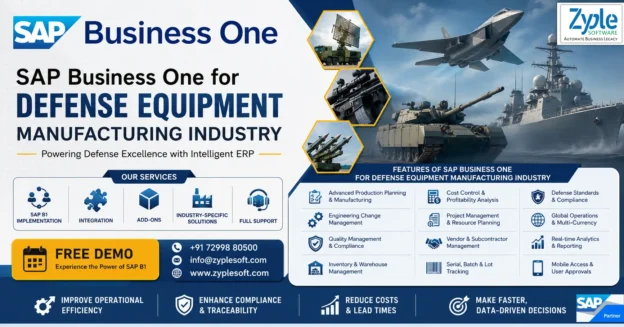
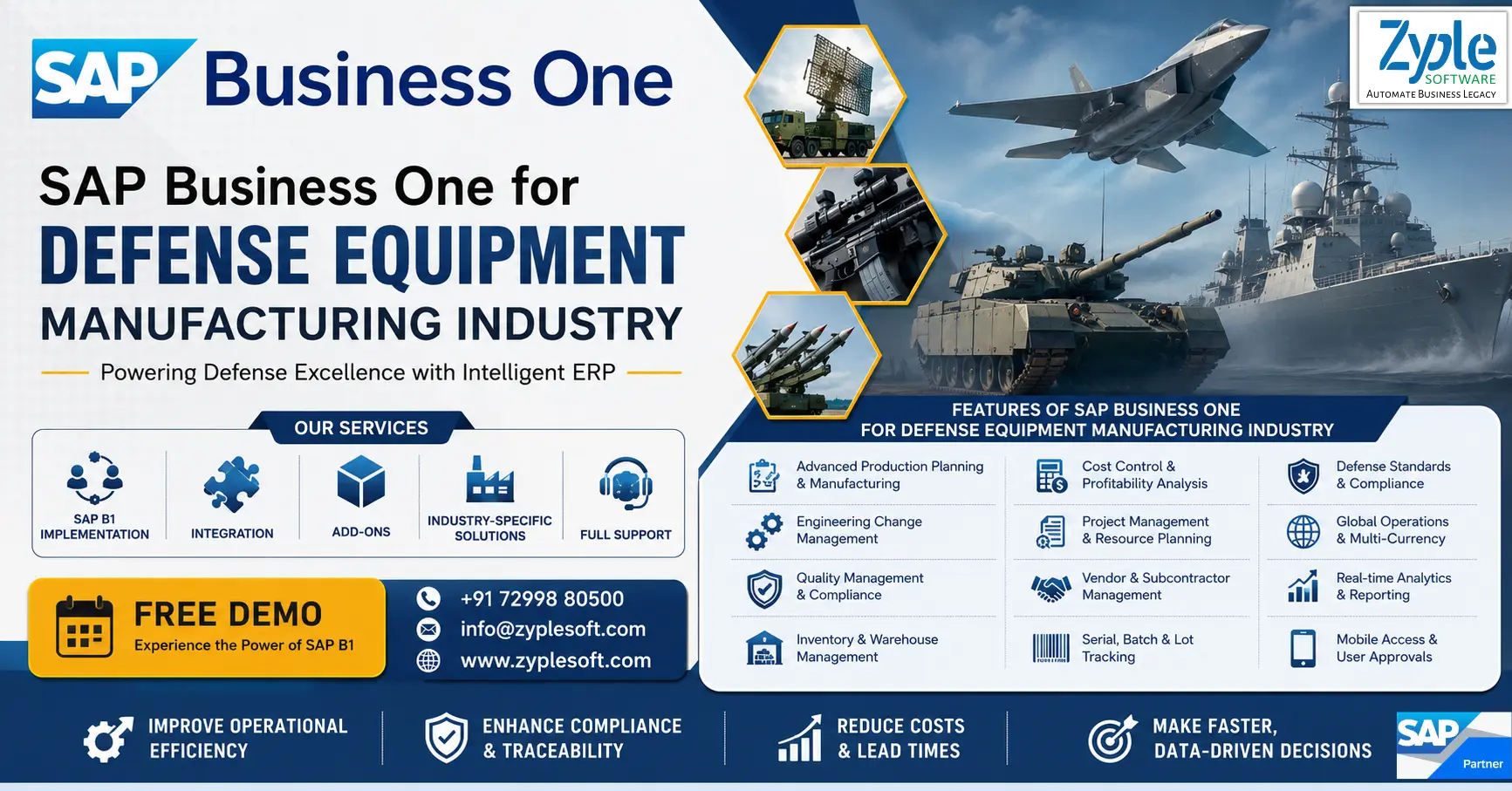
            SAP Business One ERP for Defense Equipment Manufacturing Industry

            SAP Business One for Defense Equipment Manufacturing Industry

            SAP Business One ERP for Defense Equipment Manufacturing Industry

            SAP Business One ERP for Defense Equipment Manufacturing Industry

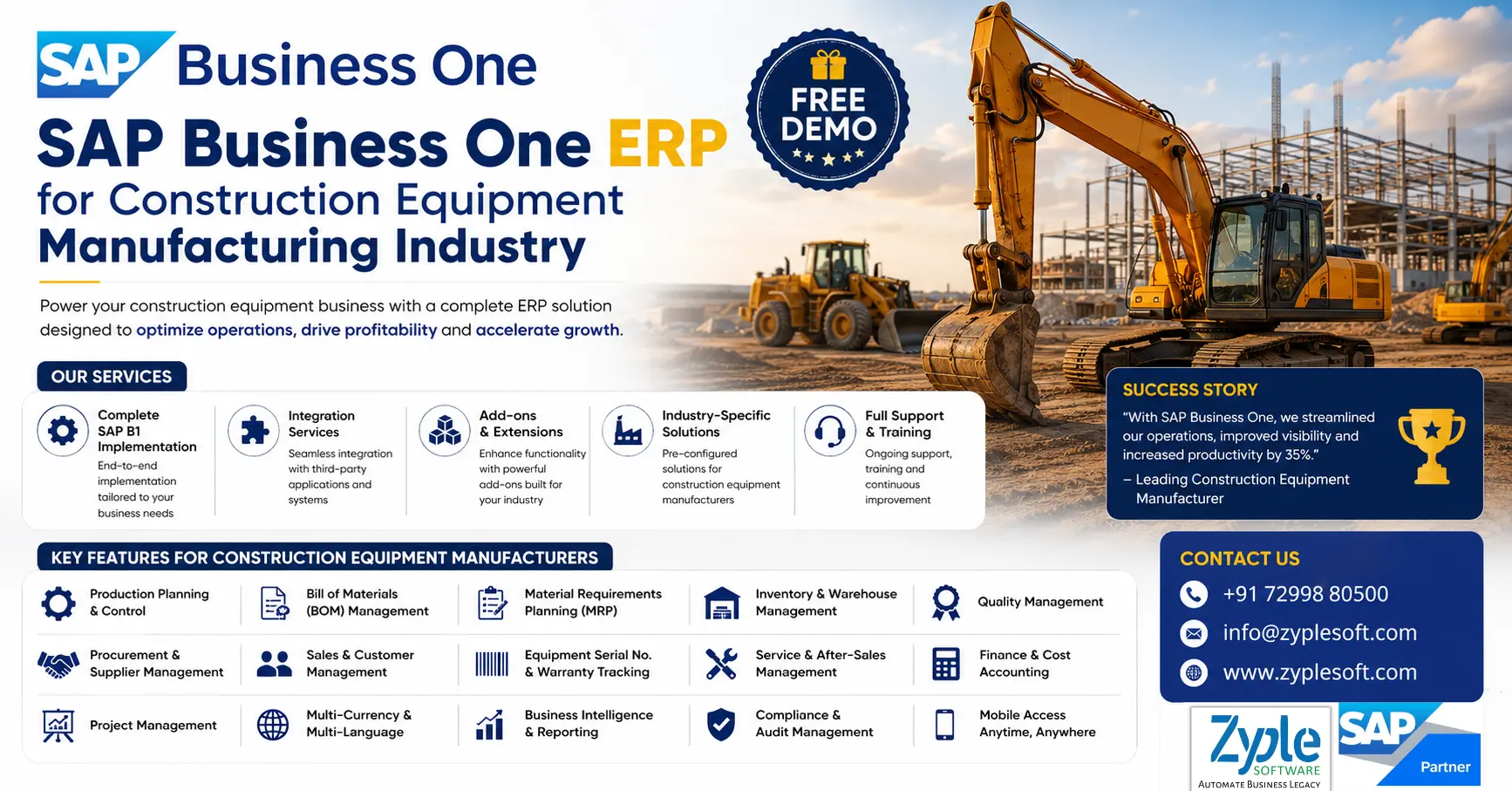
            The defense equipment manufacturing sector operates under extreme precision, tight regulations, and complex supply chains. Handling production timelines, compliance requirements, and cost control manually can lead to inefficiencies and risks. SAP Business One for defense equipment manufacturing industry allows businesses to facilitate operations, maintain compliance, and improve decision-making through real-time data.

            Challenges Faced By The Defense Equipment Manufacturing Industry

            The defense equipment manufacturing industry faces serious challenges, including volatile supply chain disruptions, slow adaptation of advanced technologies like semiconductors and AI, heavy bureaucratic compliance, and high dependence on foreign transfer of technology (ToT). These factors cause continuous project delays, cost overruns, and vulnerability to geopolitical risks.

            1. Supply Chain Fragility

            Many companies are heavily reliant on foreign original equipment manufacturers (OEMs) for raw materials, rare earth metals, and essential sub-systems.

            2. Technological and Innovation Gaps

            Domestic manufacturers struggle with the heart and brain technologies. High-end sensors, AI systems, aero-engines, and advanced semiconductors generally lag behind modern threat capabilities. Foreign OEMs often restrict the sharing of intellectual property and core material technologies, delivering limited assembly licenses instead of true technological independence.

            3. Bureaucracy and Procurement Obstacles

            The procurement cycle, from the initial Request for Proposal (RFP) to final induction, often spans over a decade, delaying modernization.

            4. Workforce and Skill Deficits

            The industry suffers from a shortage of qualified personnel capable of operating, handling, and maintaining ultra-precise and evolving digital-engineering workflows.

            Features of SAP Business One for Defense Equipment Manufacturing Industry

            1. Advanced Manufacturing and Production Management

            • It includes multi-level Bill of Materials (BOM) with revision control.
            • Engineering change management is essential for defense specs.
            • It includes production orders and shop floor control.
            • It includes discrete, batch, and mixed-mode manufacturing support.
            • It includes capacity planning and machine scheduling.
            • It includes scrap, rework, and yield tracking.
            • It ensures precision manufacturing for complex defense components.

            2. Material Requirements Planning (MRP)

            • It includes demand forecasting and planning.
            • It includes automated procurement suggestions.
            • It includes lead-time scheduling.
            • It includes shortage and excess inventory alerts.
            • It helps maintain uninterrupted supply chains in mission-critical production.

            3. Inventory and Warehouse Management

            • It includes real-time tracking of raw materials, WIP, and finished goods.
            • Batch and serial number tracking is necessary for defense traceability.
            • It includes bin location and quantity warehouse management.
            • It includes automated stock valuation and movements.
            • Allows full traceability of every component and assembly.

            4. Compliance, Quality, and Traceability

            • It includes quality control at every production stage.
            • It includes audit trails and documentation.
            • Regulatory compliance support like ISO and defense standards.
            • It includes certificate generation and inspection reports.
            • Essential for defense contracts and government audits.

            5. Financial and Cost Management

            • Integrated accounting like general ledger, accounts payable, and accounts receivable.
            • It includes project-based costing and budget control.
            • Cost breakdown like material, labor, and overhead.
            • It includes profitability analysis per project or contract.

            6. Project and Contract Management

            • Project lifecycle tracking from planning and execution to delivery.
            • It includes budget vs. actual cost monitoring.
            • It includes milestone-based billing.
            • It includes resource allocation.
            • Suitable for long-term government and defense contracts.

            7. Procurement and Supplier Management

            • It includes vendor evaluation and management.
            • It includes purchase order automation.
            • It includes export and import documentation handling.
            • It includes supplier compliance tracking.
            • It strengthens defense supply chain reliability.

            8. Sales and Customer Lifecycle Management

            • It includes tender and quotation management.
            • It includes opportunity and pipeline tracking.
            • It includes a contract-based sales process.
            • It includes after-sales service and maintenance tracking.
            • It supports defense OEMs and government clients.

            9. Service and Maintenance Management

            • It includes equipment servicing and maintenance contracts.
            • It includes field service management.
            • It includes warranty tracking.
            • It includes spare parts management.
            • Necessary for lifecycle support of defense equipment.

            10. Business Intelligence and Analytics

            • It includes real-time dashboards and KPIs.
            • It includes predictive analytics for demand and production.
            • It includes custom reporting for audits and compliance.
            • It includes drill-down analysis across departments.
            • Allows faster, data-driven decision-making.

            11. Mobility and Remote Access

            • It includes web-based ERP access.
            • Ideal for distributed defense operations.

            12. Integration and Scalability

            • It includes integration with MES, PLM, and IoT systems.
            • It includes add-ons for aerospace and defense.
            • It includes multi-location and multi-currency support.
            • Adaptable for growing defense manufacturers.
            • It supports modernization and digital transformation.
            13. Centralized Data and Automation

            • Single unified database without data storage.
            • It includes automated workflows and alerts.
            • It includes role-based access control for security.
            • It ensures secure and efficient operations across departments.
            These all features are offering by SAP B1 Consultant companies(Example- Zyple Software)

            Importance of SAP Business One for Defense Equipment Manufacturing Industry

            The ERP software, SAP Business One (SAP B1) system, is essential for defense equipment manufacturers because it replaces fragmented legacy systems with a single, highly secure, and compliant digital core. It ensures real-time cost control, strict adherence to defense regulations, and multi-level supply chain visibility.

            1. Strict Regulatory Compliance

            Defense manufacturing requires uncompromising adherence to stringent standards like AS9100 and strict safety guidelines. SAP B1 ERP supports required document controls, non-conformance tracking, and quality records directly within the workflow.

            2. Deep BOM and Engineering Control

            Defense equipment often demands massive, nested Bills of Materials (BOMs). SAP software provides complete version control and design change tracking so that engineering revisions are accounted for accurately at the shop floor level.

            3. End-to-End Lot and Serial Traceability

            Every raw material, sub-assembly, and finished tactical component can be identified. This ensures accountability across the supply chain, allowing instant audit trails and quality inspections.

            4. Material Requirements Planning (MRP)

            Defense supply chains have complex multi-tier reliances. SAP B1 automates MRP to ensure the right metals, electronics, and components are in stock without over-purchasing or facing expensive production delays.

            5. Secure Project-Based Costing

            SAP B1 ties production orders directly to financials to understand true costs per unit, job, or contract, reducing margin surprises.

            6. Secure Cloud and Multi-Site Visibility

            It provides secure, real-time visibility into operations across multiple plants, allowing manufacturers to monitor performance, manage vendors, and adjust to sudden demand shifts using SAP implementation.

            Benefits of SAP Business One ERP for Defense Equipment Manufacturing Industry

            The SAP Business One solution is a powerful, integrated ERP solution customized for defense manufacturing. It facilitates complex supply chains, automates production, and provides rigorous, multi-level traceability required to meet strict military and regulatory standards.

            1. End-to-End Traceability

            Maintains complete, digital records of every part and batch from creation to final shipment to ensure audit readiness and compliance with protocols.

            2. Strict Quality Control

            Integrates quality management workflows to evaluate engineering changes, record non-conformances, and maintain military-grade certifications.

            3. Complex BOM Management

            Manages nested, multi-level Bills of Materials (BOMs) with precise version control to eliminate errors.

            4. Real-Time Job-Based Costing

            Accurately calculates true costs per unit, milestone, or contract to protect profit margins and improve forecasting using SAP solutions.

            5. Supplier and Procurement Control

            Automates purchasing and manages multi-tier supply chains to prevent production obstacles.

            Conclusion of Defense Equipment Manufacturing ERP

            Zyple Software is a certified SAP Business One partner in India specializing in implementation, digital transformation, licensing, integration, add-on solutions, migration, and consulting for the defense equipment manufacturing industry. By unifying all essential business functions into a single, facilitated platform, SAP Business One ERP drives operational excellence, improves product quality, and delivers real-time insights for smarter decision-making.

            If you’re interested, reserve a demo of SAP Business One.

            Do you require the SAP B1 ERP system for your business or industry?

            Finish all the details in the provided contact form; our team will return to you.

              1.How can I get started with SAP Business One for my defense manufacturing business?

              Getting started with SAP Business One requires a consultation to understand your manufacturing processes, compliance needs, and business goals. A certified SAP B1 partner like Zyple Software will guide you through planning, customization, and implementation.

              Yes, SAP B1 partners like Zyple Software provide personalized demos of SAP Business One showcasing features like production planning, compliance tracking, and inventory management specific to defense manufacturing.

              The cost of SAP Business One depends on the number of users, deployment type (cloud or on-premise), level of customization, and integration requirements with the current defense systems.

              SAP Business One implementation timelines typically range from a few weeks to a few months, based on the complexity of operations and compliance requirements.

              Yes, SAP B1 partners like Zyple Software deliver ongoing support, system maintenance, and user training to ensure you get maximum value from SAP Business One and maintain smooth operations.

              Budget Management ERP Software - sap business one

              Budget Management ERP Software

              Budget Management ERP Software for Business

              Budget Management ERP Software - sap business one

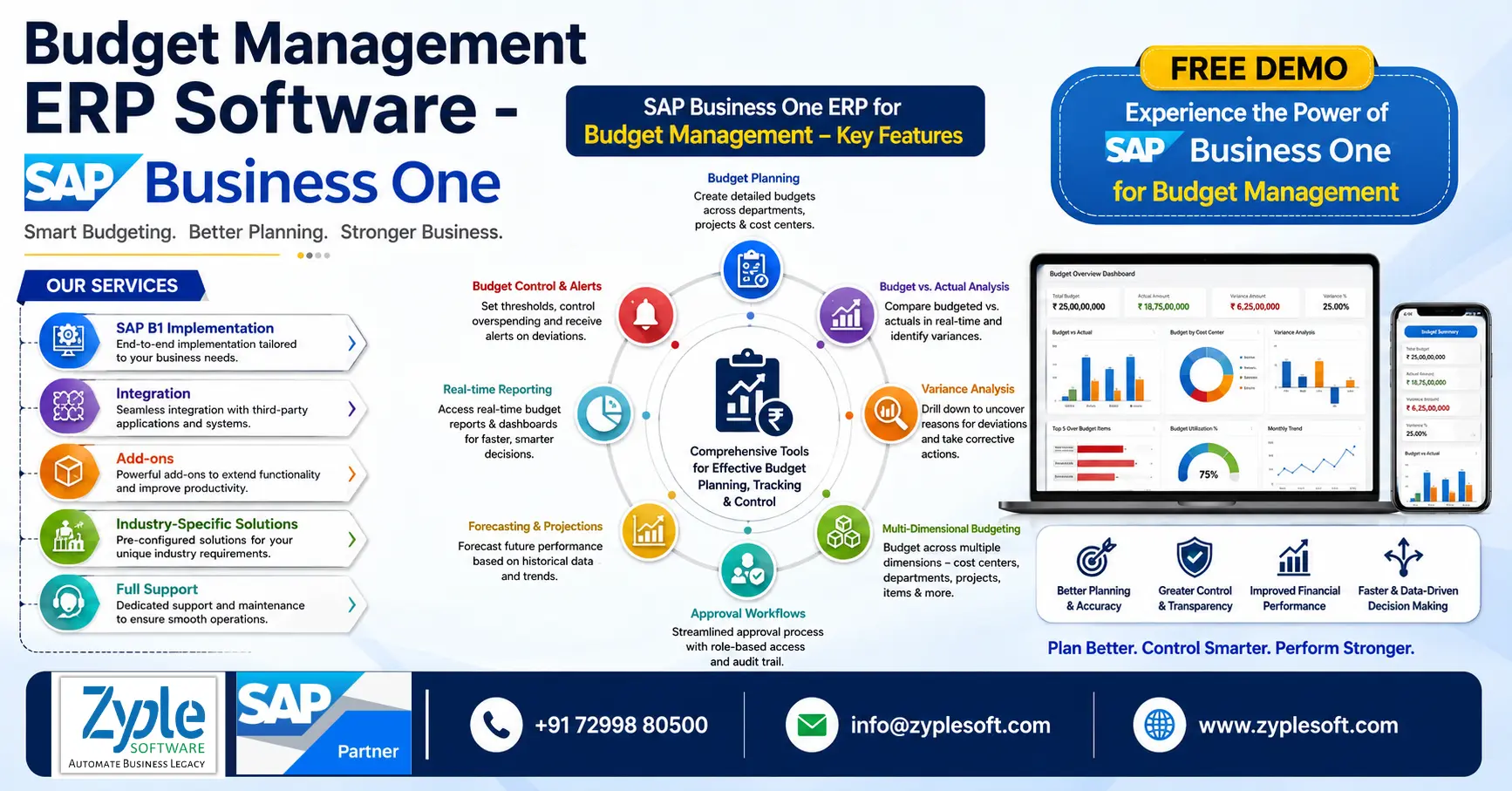
              Handling budgets and tracking expenses can be a difficult task, but the emergence of enterprise resource planning (ERP) has made it easier and more accessible. With the budget management ERP software, businesses can efficiently handle their finances and ensure efficient resource management. Also, this ERP software is designed to help businesses stay on top of their budgeting needs and all the necessary calculations.

              What is Budget Management Software?

              Budget management software is software that integrates financial planning, forecasting, and real-time expense tracking to control costs and prevent budget overruns.

              Which is the Best ERP Software for Budget Management?

              SAP Business One is the best ERP software for budget management. The SAP Business One system serves as a powerful ERP software for budget management, allowing small and medium-sized enterprises (SMEs) to define, track, and control budgets in real-time. It enables annual or monthly budgeting, automated distribution methods, and proactive budget alerts or blocking of transactions that exceed predefined limits, ensuring financial control.

              Features of Budget Management ERP Software

              Here are the features of SAP Business One as budget management software:

              1. Budget Planning and Scenario Definition

              • Creates budget scenarios for different financial plans (annual, quarterly, and project-based).
              • Assigns budgets to general ledger accounts, departments, or cost centers.
              • Defines distribution methods (equal, percentage-based, and seasonal allocation).

              2. Budget Allocation and Distribution

              • Allocates budgets across time periods (monthly or yearly) and business units or branches.
              • It includes flexibility to distribute funds based on business priorities or historical data.

              3. Budget Control and Enforcement

              • Strong control mechanisms to avoid overspending, like blocking transactions that exceed budget, warning alerts before exceeding limits, and enabling transactions without warning (if configured).
              • Applies to purchase requests and orders, goods receipt, and accounting entries (invoices and journal entries).

              4. Real-Time Budget Monitoring

              • Tracks budget vs. actual spending in real-time.
              • Instant visibility into over-utilized budgets and remaining balances.
              • It helps improve financial discipline and forecasting accuracy.

              5. Integration with Financial Management

              • Entirely integrated with general ledger, accounts payable and receivable, and cost accounting.
              • It ensures every financial transaction is automatically validated against the budget.

              6. Multi-Level Budgeting

              • It supports department-wise budgets, project-based budgets, and company-wide budgets.
              • Allows hierarchical budget control across multiple entities.

              7. Budget Revision and Adjustments

              • Modifies budgets through updates, transfers between accounts, and supplementary allocations.
              • Maintains flexible budgets for changing business conditions.

              8. Budget Reporting and Analytics

              • Creates reports, such as budget vs. actual reports, profit and loss accounts with budget comparison, and variance analysis.
              • Uses dashboards and analytics for data-driven decision-making.

              9. Alerts and Workflow Automation

              • Automated notifications for budget overruns and threshold breaches.
              • It includes workflow-based approvals for budget-related transactions.

              10. Project and Cost Control Integration

              • Links budgets with projects and cost centers.
              • Monitors project profitability and cost deviations effectively.

              11. Multi-Currency and Global Budgeting

              • Handles budgets across multiple currencies and international operations.
              • Suitable for companies operating in different regions.

              12. Audit Trail and Compliance

              • Full traceability of budget creation and changes and approvals.
              • It ensures financial transparency and compliance.

              Importance of Budget Management Software

              The enterprise resource planning (ERP) software, SAP Business One (SAP B1) solution, is essential for increasing financial accuracy, allowing real-time tracking, and automating forecasting, which helps businesses prevent overspending and align resources with strategic goals. By replacing manual spreadsheets, SAP B1 improves collaboration, delivers data-driven insights for decision-making, and increases overall financial efficiency.

              1. Increased Accuracy and Efficiency

              Automates data entry and calculations, eliminating human error inherent in manual budgeting processes using SAP implementation.

              2. Real-Time Monitoring and Control

              Delivers live, instant access to financial data and expenses, allowing teams to spot overspending immediately and make adjustments.

              3. Improved Forecasting and Planning

              Utilizes historical data and predictive analytics for accurate financial modeling and strategic planning, rather than depending on guesswork.

              4. Improved Collaboration

              The SAP Business One system allows multiple team members to work on a single, shared, and secure version of the budget, breaking down organizational storage.

              5. Strategic Resource Allocation

              SAP B1 helps managers identify areas of overspending and reallocate funds effectively to improve profitability and achieve business goals.

              6. Regulatory Compliance

              The SAP B1 solution ensures better documentation and reporting for auditing and regulatory purposes.

              Benefits of Budget Management ERP Software

              1. Increased Visibility and Control

              The SAP Business One software improves visibility and provides control to enterprises. With inbuilt real-time financial reporting, enterprises can find discrepancies or issues, which can help trigger immediate corrective action. Increased visibility and control also enable better decision-making, as finance teams can analyze financial data and make precise predictions about future spending.

              2. Time Saving

              Manual budgeting is a time-consuming process, but SAP Business One is fast and accurate and can also automate a number of repetitive and daily tasks. Users can quickly create budgets, evaluate expenses, and generate reports without manual interventions, freeing up strategic resources for essential tasks such as analysis and planning.

              3. Cost Savings

              The SAP Business One system can help enterprises create cost savings opportunities by identifying areas of overspending and reducing unnecessary expenses. SAP solutions also help procurement teams to negotiate better pricing with vendors and suppliers, further minimizing costs. Furthermore, SAP B1 also provides advanced features such as automated approvals and alerts, which can help enterprises avoid spending more than required and at the same time keep the budget management process on track.

              4. Improved Accuracy

              With automated processes and real-time reporting, the SAP B1 ERP system can eliminate many of the errors that can occur with manual budgeting, thereby improving accuracy and reducing the risk of financial discrepancies in reporting.

              5. Forecasting and Planning

              Most enterprises choose the SAP Business One system that can assist them with forecasting and planning. This software can analyze the enterprise’s historical spending patterns and identify trends and help the supply chain team to create accurate budget projections and ensure that financial resources are allocated appropriately. This can become accessible for companies with large and complex supply chains, where keeping track of budget and expenses can be a significant challenge.

              6. Enhanced Collaboration

              Other than keeping track of expenses, SAP software can help supply chain professionals to facilitate their workflows and improve supply chain collaboration. This software is capable of delivering a centralized platform for budget tracking and reporting, with which it virtually eliminates the need for multiple spreadsheets and documents. This can allow teams located across geographies to share data and insights in real time, exponentially increasing the scope for collaboration.

              7. Scalability

              What SAP Business One does is scale up with that growth, which makes such software a suitable tool for enterprises looking to expand their operations.

              Conclusion of Budget Management ERP

              Zyple Software is a trusted SAP B1 partner in India specializing in implementation, digital transformation, migration, licensing, integration, add-on solutions, and consulting for manufacturing, construction, real estate, agriculture, logistics, financial services, retail, technology, energy, healthcare, infrastructure, EPC, and professional services industries. It delivers increased visibility and control and  improved collaboration and forecasting and planning capabilities, as well as saves time, minimizes costs, and improves accuracy.

              If you’re active, book a demo of SAP Business One.

              Are you aiming to find the SAP Business One ERP software for your business or industry?

              Fill in all the details in the figured contact form; our team will reach out to you.

                SAP Business One ERP for Industrial Tools Manufacturing Industry with production management, inventory control, MRP, quality management, warehouse management, and business analytics by Zyple Software

                SAP Business One ERP for Industrial Tools Manufacturing

                SAP Business One ERP for Industrial Tools Manufacturing Industry

                SAP Business One ERP for Industrial Tools Manufacturing Industry with production management, inventory control, MRP, quality management, warehouse management, and business analytics by Zyple Software

                The industrial tools manufacturing industry faces huge pressure due to its large scope of work, which involves project management, heavy machinery loading, shipping, warehousing, and other responsibilities. The industrial tools manufacturing industry has logistics issues and needs a powerful ERP system that unifies the different company departments. SAP Business One ERP for industrial tools manufacturing unites processes and helps in boosting production and efficiency in the industrial tools manufacturing industry.

                Challenges Faced By The Industrial Tools Manufacturing Industry

                The industrial tools manufacturing industry faces significant challenges, including severe skilled labor shortages, volatile raw material costs, and complex supply chain disruptions. Also, the pressure to adopt expensive automated technologies and achieve strict global environmental standards forces companies to balance modernization with financial constraints.

                1. Skilled Labor Shortages

                A widening gap exists between the technical skills required to operate advanced CNC, robotic, and automated machinery and the available talent pool, severely affecting production efficiency.

                2. Supply Chain Vulnerabilities

                Depending on global sourcing for rare earth metals and specialty steel exposes manufacturers to geopolitical risks, fluctuating material costs, and shipping delays.

                3. Digital Transformation and Integration

                Upgrading legacy systems to include artificial intelligence (AI) and the Internet of Things (IoT) involves heavy capital investment and poses risks regarding data security and system interoperability.

                4. Rising Environmental and Compliance Costs

                Adapting to strict global sustainability mandates and emission standards requires manufacturers to redesign products and invest heavily in pollution control and energy-efficient facilities.

                5. Intense Global Competition

                The commoditization of standard tools and the influx of low-cost imports from international markets force domestic toolmakers to highly subsidize research and development (R&D) to stay competitive.

                6. Inventory and Profitability Management

                Balancing supply and demand to prevent overproduction or stockouts, while maintaining margins against high maintenance and operational costs, is a constant operational struggle without modern enterprise resource planning (ERP) software.

                Features of SAP Business One ERP for Industrial Tools Manufacturing

                1. End-to-End Production Planning and Control

                • It includes multi-level bill of materials (BOM) management.
                • It includes production order creation and tracking.
                • It includes capacity planning and resource allocation.
                • It includes shop floor control with real-time updates.
                • It includes routing and operation sequencing.
                • It includes production variance analysis.

                2. Inventory and Warehouse Management

                • It includes real-time inventory visibility across warehouses.
                • Batch and serial number tracking are essential for tools and components.
                • It includes bin location management.
                • It includes automatic stock replenishment.
                • Inventory valuation methods like FIFO, moving average, and standard cost.
                • It includes cycle counting and stock audits.

                3. Procurement and Supplier Management

                • It includes purchase request and approval workflows.
                • It includes supplier or vendor management.
                • It includes automated purchase orders.
                • It includes supplier performance tracking.
                • It includes price comparison and sourcing optimization.
                • It includes integration with MRP for material planning.

                4. Sales and Customer Relationship Management (CRM)

                • It includes lead and opportunity management.
                • It includes a quotation for sales order automation.
                • It includes customer order history tracking.
                • It includes pricing and discount management.
                • It includes after-sales service tracking.
                • It includes integration with production and inventory.

                5. Material Requirements Planning (MRP)

                • It includes demand forecasting.
                • It includes auto-generation of production and purchase recommendations.
                • It includes material shortage alerts.
                • It includes lead time management.
                • It includes what-if scenario planning.
                • It includes synchronization of supply and demand.

                6. Quality Control and Compliance

                • It includes defect tracking and root cause analysis.
                • It includes compliance with ISO and industry standards.
                • It includes quality certificates and documentation.
                • It includes non-conformance management.

                7. Financial Management and Cost Control

                • Cost accounting factors like machine, labor, and overhead.
                • It includes budgeting and financial forecasting.
                • It includes multi-currency and tax compliance.
                • It includes profitability analysis by product or customer.
                • It includes real-time financial reporting.

                8. Bill of Materials (BOM) and Engineering Data

                • It includes multi-level BOM with version control.
                • It includes engineering change management (ECM).
                • It includes product lifecycle tracking.
                • It includes component substitution handling.
                • It includes cost roll-up for finished goods.

                9. Service and Maintenance Management

                • It includes equipment and service tracking for tools sold.
                • It includes warranty and service contract management.
                • It includes preventive maintenance scheduling.
                • It includes field service management.
                • It includes spare parts management.

                10. Reporting, Analytics, and Business Intelligence

                • It includes real-time dashboards and KPIs.
                • It includes customizable reports.
                • It includes production and sales analytics.
                • It includes drill-down reporting capabilities.
                • It includes integration with Crystal Reports.

                11. Automation and Workflow Management

                • It includes approval workflows for purchasing, finance, and sales.
                • It includes automated alerts and notifications.
                • It includes task scheduling and reminders.
                • It includes reduced manual intervention.

                12. Integration and Scalability

                • It includes integration with CAD, PLM, and third-party systems.
                • It includes API-based connectivity.
                • It is scalable for growing manufacturing businesses.
                • It includes cloud and on-premise deployment options.

                13. Mobility and Remote Access

                • It includes mobile access to ERP data.
                • It includes sales and service team mobility.
                • It includes real-time updates from anywhere.
                • It includes role-based access control.

                Importance of SAP Business One ERP for Industrial Tools Manufacturing

                The ERP software, SAP Business One (SAP B1) system, enables the industrial tools manufacturing industry by centralizing production, inventory, financials, and supply chain management into a single system. It allows precise tracking of raw materials, optimizes bills of materials (BOMs), and automates procurement to minimize costs and prevent costly production delays.

                1. Precise Bill of Materials (BOM) Management

                Accurately defines multi-level BOMs enabling you to handle complex tool assemblies, sub-assemblies, and the exact raw materials required for production.

                2. Material Requirements Planning (MRP)

                This ensures you have the ideal metals, carbides, and components in stock without over-purchasing using SAP implementation.

                3. Real-Time Inventory Control

                Monitors stock levels of raw materials, work-in-progress (WIP), and finished tools across multiple warehouses in real-time.

                4. Quality Control and Compliance

                Integrates strict quality point checks throughout the manufacturing cycle, ensuring every tool achieves industry safety and performance standards.

                5. Shop Floor and Routing Control

                Delivers clear visibility into routing processes, machine utilization, and labor allocation to facilitate the manufacturing process from end to end using SAP solutions.

                6. Integrated Financial Management

                Integrates shop-floor operations directly to the general ledger, accounts payable, and accounts receivable. This delivers accurate, real-time product costing and profit margin analysis.

                Benefits of SAP Business One for Industrial Tools Manufacturing

                SAP Business One delivers industrial tool manufacturers with an integrated, end-to-end management platform. It optimizes complex production schedules, facilitates procurement of raw materials, tracks serialized tools for quality and warranty, and ultimately minimizes manufacturing costs and inventory waste.

                1. Accurate Materials Requirement Planning (MRP)

                Automatically calculates material needs based on sales forecasts, production lead times, and current stock to avoid costly production delays or over-purchasing.

                2. Bill of Materials (BOM) Management

                Standardizes the creation of complex BOMs, making it easier to handle multi-level assemblies, sub-assemblies, and alternative component substitutions.

                3. Serial Number and Batch Traceability

                The SAP software tracks individual tools or component batches from raw material procurement through to the finished product, which largely improves after-sales service and warranty management.

                4. Real-Time Inventory Visibility

                Gains complete control over warehouse transfers, work-in-progress (WIP) stock, and finished goods, significantly minimizing carrying costs.

                5. Shop-Floor Efficiency

                Connects design, engineering, and manufacturing data, optimizing machine utilization rates and workflow automation.

                6. Quality Control Integration

                Builds quality inspection checkpoints into the production cycle to minimize defects and ensure compliance with industry standards.

                7. Financial and Cost Accounting

                Direct integration between your production floor and finance departments enables accurate, real-time calculation of profit margins, production costs, and overheads.

                Conclusion of Industrial Tools Manufacturing ERP

                Zyple Software is an experienced SAP Business One partner in India specializing in implementation, digital transformation, licensing, integration, add-on solutions, migration, and consulting for the industrial tools manufacturing industry. SAP Business One ERP solves the real-world challenges faced by industrial tool manufacturing firms with a robust, scalable, and intelligent ERP system.

                If you’re adaptable, schedule a demo of SAP Business One.

                Do you seek the SAP Business One ERP software for your business or industry?

                Complete all the details in the designated contact form; our team will get back to you.

                  1.How can I get a demo of SAP Business One for my industrial tools manufacturing business?

                  You can request a free, personalized demo from the best SAP Business One partner like Zyple Software to see how the system fits your production, inventory, and financial workflows.

                  The cost depends on factors like number of users, deployment type (like cloud, on-premise, and hybrid), and customization requirements. Contact an SAP B1 partner like Zyple Software to get a tailored quote based on your business needs.

                  The SAP B1 implementation generally takes anywhere from a few weeks to a few months, depending on the complexity of your manufacturing processes and the level of customization required.

                  Yes, SAP Business One can be designed to match your industrial tools manufacturing workflows, including production planning, quality control, and inventory management.

                  SAP Business One provides end-to-end business management, real-time insights, scalability, and industry-specific capabilities, making it a suitable ERP solution for growing industrial tools manufacturers.

                  SAP Business One ERP for Construction Equipment Manufacturing industry

                  SAP Business One for Construction Equipment Manufacturing

                  SAP Business One ERP for Construction Equipment Manufacturing Industry

                  SAP Business One ERP for Construction Equipment Manufacturing industry

                  The construction equipment manufacturing industry faces huge pressure due to its large scope of work, which requires project management, construction equipment loading, shipping, warehousing, and other responsibilities. The construction equipment manufacturing industry has logistics issues and needs a system that unifies different company departments. SAP Business One ERP for construction equipment manufacturing unites processes and helps in boosting production and efficiency.

                  Challenges Faced By The Construction Equipment Manufacturing Industry

                  The construction equipment manufacturing industry faces a volatile landscape driven by shifting global trade policies, volatile interest rates, and the rapid shift towards green technologies. Manufacturers must simultaneously tackle skilled labor shortages, fragile supply chains, and high production costs while meeting demands for advanced, zero-emission machinery.

                  1. Supply Chain Volatility

                  Global supply chains remain highly unpredictable, making dependable component sourcing difficult and contributing to fluctuating material and manufacturing costs.

                  2. Strict Sustainability and Emission Norms

                  The push to replace traditional diesel equipment with electric and hybrid alternatives requires huge RandD spending. Manufacturers face challenges in building battery infrastructure, minimizing upfront costs, and meeting new environmental regulations.

                  3. Tariff and Policy Uncertainty

                  Shifting global trade policies and tariff uncertainty complexify long-term capacity planning, international distribution, and sourcing for heavy equipment.

                  4. Skilled Workforce Shortage

                  A deficit of qualified manufacturing technicians and skilled heavy-equipment operators slows production pipelines, drives up training costs, and requires investments in autonomous or semi-autonomous technology.

                  5. Macroeconomic Pressures

                  Persistent inflation and stubborn interest rates restrict capital investment and project financing, heavily affecting equipment sales and pushing construction firms towards equipment rentals.

                  6. Rising Variant Complexity

                  Customers increasingly require specialized, customized machinery with shorter lead times, forcing manufacturers to balance design complexity with production efficiency.

                  Features of SAP Business One ERP for Construction Equipment Manufacturing

                  1. Production Planning and Control

                  • It includes a multi-level bill of materials (BOM) for complex machinery.
                  • It includes production orders for heavy equipment like cranes, excavators, and loaders.
                  • It includes material requirements planning (MRP) for accurate procurement.
                  • It includes capacity planning for machines and workforce.
                  • It includes real-time production tracking and progress monitoring.

                  2. Inventory and Warehouse Management

                  • It includes batch and serial number tracking for traceability.
                  • It includes multiple warehouse and bin location management functions.
                  • Inventory valuation procedures like FIFO, moving average, and standard costing.
                  • It includes spare parts inventory optimization.

                  3. Procurement and Supplier Management

                  • It includes vendor evaluation and performance tracking.
                  • It includes supplier price comparison and contract management.
                  • It includes integration with MRP for demand-driven purchasing.

                  4. Sales and Customer Relationship Management (CRM)

                  • It includes lead and opportunity management.
                  • It includes quotation generation for large equipment deals.
                  • It includes customer-specific pricing and contracts.
                  • It includes sales forecasting for heavy machinery demand.
                  • It includes after-sales service tracking and AMC tracking.

                  5. Project Equipment for Custom Equipment

                  • Handles custom-built machinery projects.
                  • Tracks project costs, timelines, and resources.
                  • It includes integration with production and procurement.
                  • It includes milestone-based billing and delivery tracking.
                  • It includes a budget vs. actual cost analysis.

                  6. Quality Control and Compliance

                  • It includes non-conformance and corrective action tracking.
                  • It includes compliance with ISO and industry standards.
                  • It includes quality certificates and documentation management.
                  • It includes warranty and defect tracking.

                  7. Service Management (After-Sales Support)

                  • It includes equipment installation and commission tracking.
                  • It includes service contracts and warranty management.
                  • It includes field service management for onsite repairs.
                  • It includes spare parts replacement tracking.
                  • Maintenance scheduling like preventive and breakdown.

                  8. Financial Management and Costing

                  • It includes cost accounting for heavy equipment production.
                  • It includes budgeting and financial forecasting.
                  • It includes multi-currency and tax compliance.

                  9. Asset and Equipment Management

                  • Tracks company-owned machinery and tools.
                  • It includes depreciation and lifecycle management.
                  • It includes the maintenance history of production equipment.
                  • It includes asset utilization tracking.

                  10. Analytics and Reporting

                  • It includes real-time dashboards and KPIs.
                  • It includes production efficiency reports.
                  • It includes sales and revenue analytics.
                  • It includes inventory aging and turnover reports.
                  • It includes custom MIS reports for management.

                  11. Integration and Automation

                  • It includes API-based integration with third-party tools.
                  • It includes automated workflows and alerts.
                  • It includes mobile access for field teams.

                  12. Compliance and Documentation

                  • It includes GST compliance and e-invoicing.
                  • It includes document management for drawings, manuals, and certifications.
                  • It includes audit trails for all transactions.
                  • It includes regulatory compliance tracking.

                  13. Human Resource and Workforce Management

                  • It includes employee scheduling for production lines.
                  • It includes labor cost tracking per project.
                  • It includes time and attendance integration.

                  Importance of SAP Business One ERP for Construction Equipment Manufacturing

                  The ERP software, SAP Business One (SAP B1) system, is essential for the construction equipment manufacturing industry as it unifies complex engineer-to-order (ETO) and make-to-order (MTO) operations. It improves procurement, production scheduling, and after-sales service, allowing manufacturers to minimize costs, track heavy machinery inventory, and improve project profitability.

                  1. Precision Production and Planning

                  It uses material requirements planning (MRP) to ensure that the proper parts and raw materials are available for heavy machinery builds using the process of SAP implementation.

                  2. Accurate Cost Control

                  Calculates accurate project-wise margins by tracking labor, raw materials, and overheads across distinct equipment builds.

                  3. Robust Lifecycle and Service Management

                  Automatically creates equipment cards and serial numbers upon dispatch. This enables manufacturers to efficiently schedule preventive maintenance, track warranties, and handle ongoing field service calls.

                  4. Real-Time Supply Chain Visibility

                  Reduces carrying costs for expensive spare parts while entirely preventing production-halting stockouts using SAP solutions.

                  Benefits of SAP Business One for Construction Equipment Manufacturing

                  The SAP Business One (SAP B1) software facilitates construction equipment manufacturing by integrating complex production, inventory, and supply chain processes into one unified platform. It reduces carrying costs, optimizes machine utilization, and boosts profitability through real-time data tracking.

                  1. Optimized Production Planning (PP)

                  Supports heavy-duty manufacturing through engineer-to-order (ETO) and make-to-order (MTO) frameworks, allowing accurate bill of materials (BOM) management and assembly scheduling.

                  2. Real-Time Inventory Control

                  Tracks raw materials, work-in-progress (WIP), and finished parts to reduce carrying costs and eliminate costly out-of-stock situations.

                  3. Improved Profit and Cost Control

                  Delivers complete financial tracking tools, helping manufacturers calculate true product costs, handle vendor negotiations, and analyze profit margins.

                  4. Integrated Supply Chain

                  The SAP software facilitates procurement workflows, ensuring that essential heavy machinery components are ordered, received, and assembled accurately when needed.

                  5. Improved After-Sales Service

                  Creates equipment cards for individual serial numbers, enabling easy tracking of maintenance records, service calls, and warranty compliance.

                  Conclusion of Construction Equipment Manufacturing ERP

                  Zyple Software is a Top SAP Business One partner in India specializing in implementation, digital transformation, licensing, integration, add-on solutions, migration, and consulting for the construction equipment manufacturing industry. SAP Business One ERP helps the construction equipment manufacturing industry to improve productivity and customer service.

                  If you’re attentive, schedule a demo of SAP Business One.

                  Do you mandate the SAP Business One ERP software for your business or industry?

                  Complete all the details in the delivered contact form; our team will get back to you.

                    What is the cost of implementing SAP Business One for construction equipment manufacturers?

                    The cost varies depending on the number of users, deployment type (cloud or on-premise), and customization needs. For an accurate estimate, it’s best to request a personalized quote from a certified SAP B1 partner like Zyple Software.

                    SAP B1 implementation generally takes 8 to 16 weeks, depending on business complexity, data migration, and required integrations. The complete project plan is usually provided during the initial consultation.

                    Yes, most SAP partners offer free product demos customized for your business processes, helping you understand how the ERP will improve your operations before making a decision.

                    Yes, SAP Business One is available both in the cloud and on-premise. The cloud option enables you to access your system anytime, anywhere, while minimizing IT infrastructure costs.

                    Choose a partner like Zyple Software with proven experience in manufacturing ERP implementations, industry expertise, strong customer support, and a track record of successful deployments.

                    SAP Business One ERP for Rubber Products Manufacturing industry

                    SAP B1 ERP for Rubber Products Manufacturing Industry

                    SAP Business One ERP for Rubber Products Manufacturing Industry

                    SAP Business One ERP for Rubber Products Manufacturing industry

                    In today’s competitive rubber products manufacturing landscape, facilitating operations and optimizing costs are important for success. Rubber product manufacturers often struggle with disconnected systems across compounding, mixing, calendering, building, curing, inspection, inventory, and finance. These gaps result in poor traceability, inaccurate costing, production inefficiencies, and delayed decision-making. SAP Business One ERP for rubber products manufacturing delivers a unified platform that integrates production, formulation, inventory, quality, traceability, sales, and finance, providing real-time visibility and operational control across the rubber product manufacturing cycle.

                    Challenges Faced By The Rubber Products Manufacturing Industry

                    The rubber products manufacturing industry tackles volatile raw material prices, severe supply chain disruptions, rising energy costs, and stringent environmental regulations. These pressures force manufacturers to optimize formulations consistently and adopt precision-driven processes to maintain profitability.

                    1. Unstable Raw Material Prices and Supply Chain Disruptions

                    Prices are highly reliant on agricultural conditions, climate change, and geopolitical shifts, leading to unpredictable spot pricing. Synthetic alternatives depend heavily on crude oil prices. Geopolitical tensions or supply bottlenecks quickly inflate production and procurement expenes. In India, free imports and inverted duty structures undercut domestic manufacturers, reducing profit margins.

                    2. High Energy and Operational Expenses

                    Methods like polymer refinement and vulcanization consume a large amount of thermal and electrical energy. Rising global energy bills directly increase the cost of goods sold. Maintaining exact dimensional tolerances and handling mold wear involves consistent equipment calibration. Failing to do so causes expensive part defects and material waste.

                    3. Technical and Compounding Complexities

                    Selecting the right rubber compound is crucial, as different materials behave uniquely under high pressure and temperature. Misjudgements often result in poor mechanical properties, shrinkage, or curing failures. Because rubber service properties are highly specific, strict quality control and testing are mandatory to ensure products achieve performance standards.

                    4. Labor Shortages and Technical Expertise

                    Operating advanced injection molding and consistent extrusion machinery requires specialized technical expertise. The industry faces a growing shortage of skilled labor to handle modern equipment and complex quality systems.

                    5. Sustainability and Environmental Regulations

                    Rubber is extremely difficult to recycle. Manufacturers face increasing regulatory pressure to develop sustainable, eco-friendly rubber compounds and to reduce production waste.

                    6. Operational and Structural Hurdles

                    Especially in developing markets, a large portion of the sector consists of micro and small-scale units. These businesses often struggle with antiquated machinery, limited access to working capital, and insufficient technical advisory support.

                    Features of SAP Business One ERP for Rubber Products Manufacturing

                    1. Production and Manufacturing Management

                    • It includes bill of materials (BOM) with multi-level structures for rubber compounds and formulations.
                    • Production orders manual and auto-generated from sales or MRP.
                    • Batch or process manufacturing support for mixing, curing, and molding.
                    • It includes routing and stage-wise production tracking.
                    • It includes work-in-progress (WIP) tracking.

                    2. Formula and Batch Management

                    • It includes recipe or formula management for rubber compounds.
                    • Batch-wise production tracking for lot traceability.
                    • Raw material proportion control for chemicals, carbon black, and more.
                    • It includes version control for formulations.
                    • It includes shelf-life and expiry tracking.
                    • It includes batch consistency and repeatability.

                    3. Inventory and Warehouse Management

                    • It includes real-time inventory tracking like raw material, work-in-progress, and finished goods.
                    • It includes batch or lot and serial number tracking.
                    • It includes bin location management.
                    • It includes multi-warehouse management.
                    • It includes goods receipt, issue, and transfer.
                    • It includes minimum stock and reorder level planning.
                    • It includes barcode and RFID integration.
                    • It includes scrap and waste tracking.

                    4. Material Requirements Planning (MRP)

                    • It includes demand forecasting based on sales orders.
                    • It includes automatic generation of purchase and production orders.
                    • It includes lead time planning for raw materials.
                    • Capacity planning like machines and labor.
                    • Avoids stockouts and overstocking.
                    • It includes just-in-time (JIT) planning support.

                    5. Quality Control and Compliance

                    • It includes incoming, in-process, and final quality checks.
                    • Tests parameters, recording hardness, tensile strength, and more.
                    • It includes quality certificate generation.
                    • It includes compliance with ISO and industry standards.
                    • It includes nonconformance and corrective action tracking.
                    • It includes batch traceability for recalls.

                    6. Costing and Financial Management

                    • It includes standard and actual costing.
                    • It includes batch-wise and product-wise cost analysis.
                    • It includes profitability tracking per order or product.
                    • It includes integration with accounting like general ledger, accounts payable, and accounts receivable.
                    • It includes budgeting and expense control.
                    • It includes GST and tax compliance.

                    7. Procurement and Supplier Management

                    • It includes purchase requisitions and approvals.
                    • It includes vendor management and evaluation.
                    • It includes raw material procurement planning.
                    • It includes price comparison and supplier quotations.
                    • It includes import or export documentation.
                    • It includes automated purchase order creation.

                    8. Sales and Customer Relationship Management (CRM)

                    • It includes lead and opportunity management.
                    • It includes the sales quotation to invoice cycle.
                    • It includes customer order tracking.
                    • It includes pricing and discount management.
                    • It includes after-sales service and warranty management.
                    • It includes customer communication history.

                    9. Business Intelligence and Reporting

                    • It includes real-time dashboards and KPIs.
                    • It includes production efficiency reports.
                    • It includes inventory and stock aging reports.
                    • It includes cost and profitability analysis.
                    • It includes custom report creation.
                    • It includes drill-down analytics with Excel integration.

                    10. Supply Chain and Logistics Management

                    • It includes end-to-end supply chain visibility.
                    • It includes order-to-delivery tracking.
                    • It includes logistics and shipment planning.
                    • It includes demand-supply balancing.
                    • It includes multi-location distribution management.
                    • It includes vendor-to-customer integration.

                    11. Plant Maintenance and Asset Management

                    • It includes machine maintenance scheduling.
                    • It includes breakdown tracking.
                    • It includes spare parts inventory.
                    • It includes equipment lifecycle management.
                    • It includes preventive maintenance alerts.

                    12. Mobility and Integration

                    • It includes mobile access for sales and management.
                    • It includes integration with IoT and machines.
                    • It includes API-based third-party integrations.
                    • It includes e-commerce and MES integration.
                    • It includes cloud and on-premise deployment options.

                    13. Traceability and Compliance

                    • It includes batch genealogy tracking.
                    • It includes a recall management system.
                    • It includes regulatory compliance reporting.
                    • It includes audit trial for all transactions.

                    14. Customization and Add-Ons

                    • It includes industry-specific add-ons for rubber product manufacturing industry.
                    • It includes custom workflows and approvals.
                    • It includes user-defined fields and reports.
                    • It includes integration with weighing scales and lab systems.
                    • It includes localization for Indian compliance.

                    Benefits of SAP Business One ERP for Rubber Products Manufacturing

                    The ERP software, SAP Business One (SAP B1) system, is a complete ERP solution designed for rubber product manufacturing. It improves production planning, tracks batch-wise raw material inventory, and enforces stringent quality control.

                    1. Batch and Lot Traceability

                    Tracks rubber compounds, additives, and finished molded goods (like o-rings and seals) from procurement through production using SAP implementation. This guarantees full compliance and quick recalls if necessary.

                    2. Material Waste Reduction

                    Optimizes chemical recipes and raw material usage during mixing and extrusion processes to reduce scrap and reduce production costs.

                    3. Quality Control Management

                    Embeds thorough quality checks throughout the production lifecycle. Tracks defects, measures tolerances, and ensures all products achieve industry regulations before they leave the shop floor.

                    4. Real-Time Inventory Management

                    Prevents material shortages and surplus stock with real-time tracking across multiple warehouses. The SAP software ensures uninterrupted production lines by forecasting restocking needs based on historical data.

                    5. Facilitated Production Planning

                    Automates and improves the master production schedule. Handles complex multi-step manufacturing processes, from compounding to vulcanization and curing, efficiently.

                    6. Accurate Costing

                    Gain real-time visibility into actual vs. estimated costs, helping you understand profitability by specific product line, batch, or customer segment using SAP solutions.

                    Conclusion of Rubber Products Manufacturing ERP

                    Zyple Software is a certified SAP Business One partner in India specializing in implementation, digital transformation, licensing, integration, add-on solutions, migration, and consulting for the plastic product manufacturing industry. By seamlessly integrating production, inventory, finance, and customer management, the SAP B1 system enables businesses with real-time insights and smarter decision-making capabilities.

                    If you’re engaged, schedule a demo of SAP Business One.

                    Do you command the SAP Business One ERP solution for your business or industry?

                    Complete all the details in the defined contact form; our team will reach out to you.

                      FAQs

                      1.What are the main benefits of SAP Business One for rubber product manufacturers?

                      SAP Business One helps rubber manufacturers facilitate production planning, handle raw materials like polymers and chemicals, minimize wastage, and gain real-time visibility into operations. It increases quality control, batch traceability, and overall operational efficiency.

                      Yes, SAP Business One provides robust batch management features that enable manufacturers to track raw materials and finished goods. It ensures quality compliance by monitoring production stages and maintaining complete inspection records.

                      The system delivers real-time inventory tracking, automated stock updates, and demand forecasting. This helps prevent overstocking or shortages of essential materials like rubber compounds, additives, and chemicals.

                      Absolutely. SAP Business One is designed specifically for SMEs and can be customized to achieve the unique requirements of rubber manufacturers, offering scalability as the business grows.

                      By optimizing resource utilization, minimizing material waste, improving production scheduling, and automating manual processes, SAP Business One significantly reduces operational and production costs.

                      Zyple Software