SAP Business One ERP for Construction Equipment Manufacturing Industry
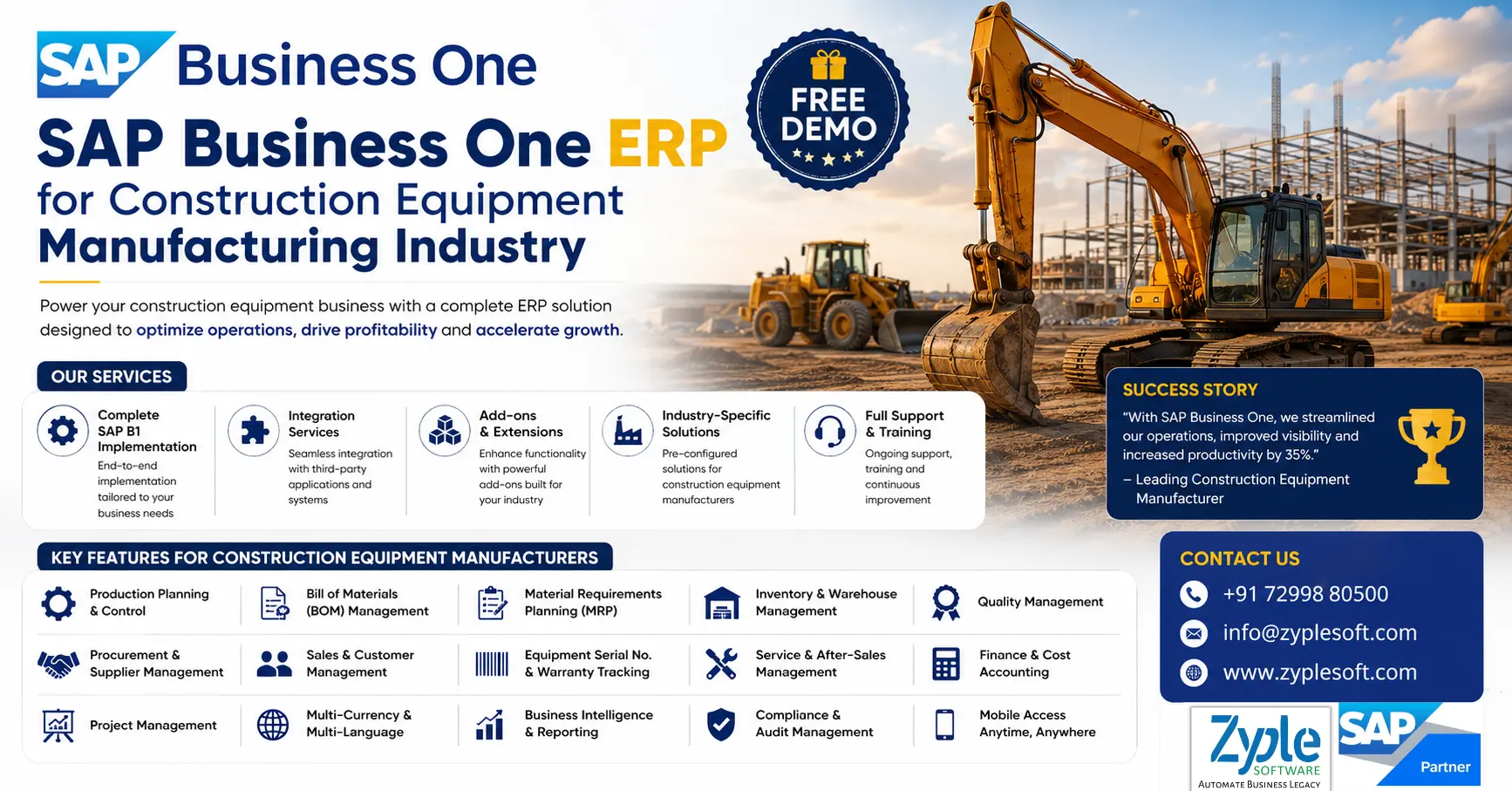
The construction equipment manufacturing industry faces huge pressure due to its large scope of work, which requires project management, construction equipment loading, shipping, warehousing, and other responsibilities. The construction equipment manufacturing industry has logistics issues and needs a system that unifies different company departments. SAP Business One ERP for construction equipment manufacturing unites processes and helps in boosting production and efficiency.
Challenges Faced By The Construction Equipment Manufacturing Industry
The construction equipment manufacturing industry faces a volatile landscape driven by shifting global trade policies, volatile interest rates, and the rapid shift towards green technologies. Manufacturers must simultaneously tackle skilled labor shortages, fragile supply chains, and high production costs while meeting demands for advanced, zero-emission machinery.
1. Supply Chain Volatility
Global supply chains remain highly unpredictable, making dependable component sourcing difficult and contributing to fluctuating material and manufacturing costs.
2. Strict Sustainability and Emission Norms
The push to replace traditional diesel equipment with electric and hybrid alternatives requires huge RandD spending. Manufacturers face challenges in building battery infrastructure, minimizing upfront costs, and meeting new environmental regulations.
3. Tariff and Policy Uncertainty
Shifting global trade policies and tariff uncertainty complexify long-term capacity planning, international distribution, and sourcing for heavy equipment.
4. Skilled Workforce Shortage
A deficit of qualified manufacturing technicians and skilled heavy-equipment operators slows production pipelines, drives up training costs, and requires investments in autonomous or semi-autonomous technology.
5. Macroeconomic Pressures
Persistent inflation and stubborn interest rates restrict capital investment and project financing, heavily affecting equipment sales and pushing construction firms towards equipment rentals.
6. Rising Variant Complexity
Customers increasingly require specialized, customized machinery with shorter lead times, forcing manufacturers to balance design complexity with production efficiency.
Features of SAP Business One ERP for Construction Equipment Manufacturing
1. Production Planning and Control
- It includes a multi-level bill of materials (BOM) for complex machinery.
- It includes production orders for heavy equipment like cranes, excavators, and loaders.
- It includes material requirements planning (MRP) for accurate procurement.
- It includes capacity planning for machines and workforce.
- It includes real-time production tracking and progress monitoring.
2. Inventory and Warehouse Management
- It includes batch and serial number tracking for traceability.
- It includes multiple warehouse and bin location management functions.
- Inventory valuation procedures like FIFO, moving average, and standard costing.
- It includes spare parts inventory optimization.
3. Procurement and Supplier Management
- It includes vendor evaluation and performance tracking.
- It includes supplier price comparison and contract management.
- It includes integration with MRP for demand-driven purchasing.
4. Sales and Customer Relationship Management (CRM)
- It includes lead and opportunity management.
- It includes quotation generation for large equipment deals.
- It includes customer-specific pricing and contracts.
- It includes sales forecasting for heavy machinery demand.
- It includes after-sales service tracking and AMC tracking.
5. Project Equipment for Custom Equipment
- Handles custom-built machinery projects.
- Tracks project costs, timelines, and resources.
- It includes integration with production and procurement.
- It includes milestone-based billing and delivery tracking.
- It includes a budget vs. actual cost analysis.
6. Quality Control and Compliance
- It includes non-conformance and corrective action tracking.
- It includes compliance with ISO and industry standards.
- It includes quality certificates and documentation management.
- It includes warranty and defect tracking.
7. Service Management (After-Sales Support)
- It includes equipment installation and commission tracking.
- It includes service contracts and warranty management.
- It includes field service management for onsite repairs.
- It includes spare parts replacement tracking.
- Maintenance scheduling like preventive and breakdown.
8. Financial Management and Costing
- It includes cost accounting for heavy equipment production.
- It includes budgeting and financial forecasting.
- It includes multi-currency and tax compliance.
9. Asset and Equipment Management
- Tracks company-owned machinery and tools.
- It includes depreciation and lifecycle management.
- It includes the maintenance history of production equipment.
- It includes asset utilization tracking.
10. Analytics and Reporting
- It includes real-time dashboards and KPIs.
- It includes production efficiency reports.
- It includes sales and revenue analytics.
- It includes inventory aging and turnover reports.
- It includes custom MIS reports for management.
11. Integration and Automation
- It includes API-based integration with third-party tools.
- It includes automated workflows and alerts.
- It includes mobile access for field teams.
12. Compliance and Documentation
- It includes GST compliance and e-invoicing.
- It includes document management for drawings, manuals, and certifications.
- It includes audit trails for all transactions.
- It includes regulatory compliance tracking.
13. Human Resource and Workforce Management
- It includes employee scheduling for production lines.
- It includes labor cost tracking per project.
- It includes time and attendance integration.
Importance of SAP Business One ERP for Construction Equipment Manufacturing
The ERP software, SAP Business One (SAP B1) system, is essential for the construction equipment manufacturing industry as it unifies complex engineer-to-order (ETO) and make-to-order (MTO) operations. It improves procurement, production scheduling, and after-sales service, allowing manufacturers to minimize costs, track heavy machinery inventory, and improve project profitability.
1. Precision Production and Planning
It uses material requirements planning (MRP) to ensure that the proper parts and raw materials are available for heavy machinery builds using the process of SAP implementation.
2. Accurate Cost Control
Calculates accurate project-wise margins by tracking labor, raw materials, and overheads across distinct equipment builds.
3. Robust Lifecycle and Service Management
Automatically creates equipment cards and serial numbers upon dispatch. This enables manufacturers to efficiently schedule preventive maintenance, track warranties, and handle ongoing field service calls.
4. Real-Time Supply Chain Visibility
Reduces carrying costs for expensive spare parts while entirely preventing production-halting stockouts using SAP solutions.
Benefits of SAP Business One for Construction Equipment Manufacturing
The SAP Business One (SAP B1) software facilitates construction equipment manufacturing by integrating complex production, inventory, and supply chain processes into one unified platform. It reduces carrying costs, optimizes machine utilization, and boosts profitability through real-time data tracking.
1. Optimized Production Planning (PP)
Supports heavy-duty manufacturing through engineer-to-order (ETO) and make-to-order (MTO) frameworks, allowing accurate bill of materials (BOM) management and assembly scheduling.
2. Real-Time Inventory Control
Tracks raw materials, work-in-progress (WIP), and finished parts to reduce carrying costs and eliminate costly out-of-stock situations.
3. Improved Profit and Cost Control
Delivers complete financial tracking tools, helping manufacturers calculate true product costs, handle vendor negotiations, and analyze profit margins.
4. Integrated Supply Chain
The SAP software facilitates procurement workflows, ensuring that essential heavy machinery components are ordered, received, and assembled accurately when needed.
5. Improved After-Sales Service
Creates equipment cards for individual serial numbers, enabling easy tracking of maintenance records, service calls, and warranty compliance.
Conclusion of Construction Equipment Manufacturing ERP
Zyple Software is a Top SAP Business One partner in India specializing in implementation, digital transformation, licensing, integration, add-on solutions, migration, and consulting for the construction equipment manufacturing industry. SAP Business One ERP helps the construction equipment manufacturing industry to improve productivity and customer service.
If you’re attentive, schedule a demo of SAP Business One.
Do you mandate the SAP Business One ERP software for your business or industry?
Complete all the details in the delivered contact form; our team will get back to you.
What is the cost of implementing SAP Business One for construction equipment manufacturers?
The cost varies depending on the number of users, deployment type (cloud or on-premise), and customization needs. For an accurate estimate, it’s best to request a personalized quote from a certified SAP B1 partner like Zyple Software.
How long does it take to implement SAP Business One in a construction equipment manufacturing company?
SAP B1 implementation generally takes 8 to 16 weeks, depending on business complexity, data migration, and required integrations. The complete project plan is usually provided during the initial consultation.
Can I get a free demo of SAP Business One for my construction equipment business?
Yes, most SAP partners offer free product demos customized for your business processes, helping you understand how the ERP will improve your operations before making a decision.
Is SAP Business One available on cloud for easy access?
Yes, SAP Business One is available both in the cloud and on-premise. The cloud option enables you to access your system anytime, anywhere, while minimizing IT infrastructure costs.
How do I choose the right SAP Business One implementation partner?
Choose a partner like Zyple Software with proven experience in manufacturing ERP implementations, industry expertise, strong customer support, and a track record of successful deployments.