Tag Archives: sap erp

What is ERP implementation – ERP implementation process, benefits, cost and best practices

What is ERP Implementation? A Complete Guide to ERP Implementation, Process, Cost, Benefits and Best Practices

What is ERP Implementation? A Complete Guide
What is ERP implementation – ERP implementation process, benefits, cost and best practices

ERP implementation is the process of planning, configuring, customizing, testing, deploying, and continuously supporting an Enterprise Resource Planning (ERP) system so that it fits an organization’s business processes and helps manage operations from a centralized platform.

For businesses evaluating ERP software, understanding what ERP implementation means, how the implementation process works, how much it costs, how long it takes, and what can cause an ERP project to fail is just as important as choosing the ERP product itself.

An ERP system can connect finance, sales, purchasing, inventory, production, projects, customer management, service, reporting, and other business functions. But buying ERP software alone does not create business value. The real value comes from implementing it correctly.

This guide explains ERP implementation from the perspective of business owners, CEOs, CFOs, CIOs, IT managers, and operational teams.

What is ERP Implementation?

ERP implementation is the structured process of introducing an ERP software system into a business and making it operational.

It typically includes:

  • Understanding current business processes
  • Defining ERP requirements
  • Selecting the appropriate ERP solution
  • Designing future business processes
  • Configuring the ERP system
  • Developing required customizations
  • Integrating other applications
  • Migrating existing data
  • Setting up users and permissions
  • Testing business processes
  • Training employees
  • Going live
  • Providing post-implementation support
  • Continuously improving the ERP environment

In simple terms:

ERP software is the technology. ERP implementation is the process of making that technology work for the business.

A successful ERP implementation should not simply replace spreadsheets or old software. It should improve how information flows through the organization.

Why is ERP Implementation Important?

As companies grow, information often becomes fragmented across spreadsheets, accounting software, CRM applications, emails, production systems, and department-specific tools.

This can create problems such as:

  • Duplicate data entry
  • Inaccurate reports
  • Inventory discrepancies
  • Delayed financial information
  • Poor visibility into profitability
  • Manual approvals
  • Difficulties tracking projects
  • Limited production visibility
  • Lack of real-time business information
  • Dependency on spreadsheets
  • Poor coordination between departments

ERP implementation addresses these problems by creating a connected business environment.

For example, when a sales order is entered into an ERP system, it can potentially affect inventory availability, purchasing requirements, production planning, delivery, invoicing, receivables, and financial reporting.

Instead of asking different departments for separate reports, management can work from a common source of business information.

How Does ERP Implementation Work?

Although every ERP project is different, a typical ERP implementation follows several stages.

1. Business Requirement Analysis

The implementation begins by understanding the organization.

The implementation team studies:

  • Company structure
  • Industries and business models
  • Existing applications
  • Current workflows
  • Approval processes
  • Reporting requirements
  • Financial processes
  • Inventory processes
  • Sales processes
  • Purchasing processes
  • Production requirements
  • Project management requirements
  • Integration requirements
  • Compliance requirements

The objective is to understand what the business actually needs, rather than simply configuring software based on assumptions.

2. ERP Planning and Project Definition

Once requirements are understood, the organization defines the implementation scope.

The project plan normally identifies:

  • Implementation objectives
  • Modules required
  • Locations and branches
  • Number of users
  • Data migration requirements
  • Integrations
  • Custom development
  • Project milestones
  • Responsibilities
  • Training requirements
  • Testing strategy
  • Go-live strategy
  • Support requirements

A clearly defined scope helps prevent uncontrolled expansion of the project.

3. ERP Configuration

ERP configuration involves setting up the system according to the organization’s approved business processes.

Configuration may include:

  • Company settings
  • Financial periods
  • Chart of accounts
  • Tax configuration
  • Warehouses
  • Items
  • Customers
  • Vendors
  • Price lists
  • Approval workflows
  • User roles
  • Numbering series
  • Inventory settings
  • Purchasing rules
  • Sales processes
  • Production parameters
  • Reporting structures

Good configuration uses the ERP’s standard capabilities wherever practical.

ERP Customization vs Configuration

One of the most important decisions during ERP implementation is determining what should be configured and what should be customized.

  1. Configuration: Configuration means using the existing ERP functionality to meet business requirements.
  2. Customization: Customization involves modifying or extending the standard ERP functionality through development, add-ons, extensions, or specialized solutions.

Businesses should avoid unnecessary customization.

A useful principle is:

Configure where possible. Customize where necessary.

Excessive customization can increase implementation cost, testing requirements, maintenance effort, and future upgrade complexity.

4. Data Migration

Data migration involves transferring relevant information from existing systems into the new ERP.

Typical data may include:

  • Customer master data
  • Vendor master data
  • Item master data
  • Opening balances
  • Inventory balances
  • Price lists
  • Bills of materials
  • Outstanding receivables
  • Outstanding payables
  • Fixed assets
  • Historical transactions where required

Data migration should not be treated as a simple copy-and-paste exercise.

Before importing data, organizations should:

  1. Identify required data.
  2. Remove duplicate records.
  3. Correct inaccurate information.
  4. Standardize formats.
  5. Validate mandatory fields.
  6. Map old fields to new ERP fields.
  7. Test the migration.
  8. Reconcile migrated information
  9. Poor-quality master data can damage an otherwise successful ERP implementation.

5. ERP Integration

Most modern businesses use multiple applications.

An ERP system may need to communicate with:

  • CRM systems
  • E-commerce platforms
  • Banking systems
  • Payroll applications
  • Manufacturing systems
  • Warehouse management systems
  • Point-of-sale systems
  • Payment gateways
  • Logistics platforms
  • Tax systems
  • Business intelligence tools
  • Mobile applications

ERP integration allows information to move between systems without unnecessary manual data entry.

For example, an e-commerce order could potentially flow into the ERP, where inventory, customer information, invoicing, and fulfillment processes are updated.

6. ERP Testing

Testing is one of the most critical stages of ERP implementation.

The objective is to verify that the system works correctly before employees depend on it for daily operations.

Testing may include:

  1. Unit Testing: Individual functions or configurations are tested.
  2. Integration Testing: Different modules and connected applications are tested together.
  3. User Acceptance Testing: Actual business users test real-world scenarios and confirm whether the system meets their requirements
  4. Data Validation: Migrated information is checked for accuracy and completeness.
  5. Performance Testing: The system is evaluated under expected operational conditions.

A practical ERP test should follow actual business scenarios rather than testing isolated screens only.

For example:

Quotation → Sales Order → Delivery → Invoice → Payment → Financial Reporting

This validates the complete business flow.

7. Employee Training

ERP implementation changes how employees perform their jobs.

Therefore, employee training should happen before go-live.

Training can cover:

  • Daily transactions
  • Approvals
  • Reporting
  • Inventory processes
  • Purchasing
  • Sales
  • Finance
  • Production
  • Project management
  • User roles
  • Error handling
  • Standard operating procedures

Training should be role-based.

A warehouse employee does not need the same training as a CFO.

8. ERP Go-Live

Go-live is the point at which the organization begins using the new ERP system for actual business operations.

There are several go-live approaches.

Big Bang

The organization moves to the new ERP across the business at one time.

Advantage: Faster transition.

Risk: Higher operational pressure if major problems occur.

Phased Implementation

Different departments, locations, or processes move to the ERP in stages.

Advantage: Lower transition risk.

Risk:The implementation can take longer.

Pilot Implementation

The ERP is first introduced in a limited business environment.

The organization learns from the pilot before expanding the implementation.

The right approach depends on business complexity, risk tolerance, locations, users, and project scope.

What Happens After ERP Go-Live?

ERP implementation does not end on the day of go-live.
 
The post-go-live period is often called hypercare.
 
During this period, the implementation team closely monitors:
  • User issues
  • Transaction errors
  • Reports
  • Integrations
  • Data problems
  • Performance
  • Workflow issues
  • Configuration gaps
After stabilization, the organization enters ongoing ERP support and optimization.
 
This may include:
  • System upgrades
  • New integrations
  • Additional reports
  • New add-ons
  • Process improvements
  • User training
  • Performance optimization
  • Security reviews

How Long Does ERP Implementation Take?

There is no universal ERP implementation timeline.
 
A small and relatively straightforward implementation may take a few months, while a complex multi-location or highly customized implementation can take significantly longer.
 
The timeline depends on factors such as:
  • Number of users
  • Number of branches
  • Number of warehouses
  • Modules required
  • Business complexity
  • Data volume
  • Data quality
  • Integrations
  • Customizations
  • Reporting requirements
  • User availability
  • Decision-making speed
  • Training requirements
  • Scope changes
A better approach than asking “How many months does ERP implementation take?” is to ask:
 
“What scope are we implementing, and what dependencies determine the timeline?”
 

How Much Does ERP Implementation Cost?

ERP implementation cost varies significantly from company to company.
 
The total investment can include:
  • ERP software licenses
  • Cloud subscription
  • Implementation services
  • Consulting
  • Data migration
  • Customization
  • Integration
  • Add-ons
  • Infrastructure
  • Training
  • Testing
  • Support
  • Annual maintenance
  • Future upgrades
Therefore, the ERP license price alone should not be considered the total ERP project cost.
 
A useful way to evaluate the investment is through Total Cost of Ownership (TCO).
 
ERP TCO can include:
 
Software + Implementation + Infrastructure + Integration + Customization + Training + Support + Upgrades
 
Businesses should compare the expected total cost with measurable business benefits.
 

What Are the Benefits of ERP Implementation?

A well-planned ERP implementation can provide several benefits.

1. Centralized Business Data

Instead of maintaining information across disconnected systems, organizations can work from a centralized business platform.

2. Better Financial Visibility

Management can gain improved visibility into:
  • Revenue
  • Expenses
  • Receivables
  • Payables
  • Cash flow
  • Budgets
  • Profitability

3. Improved Inventory Management

ERP can help businesses monitor:
  • Stock levels
  • Warehouse movements
  • Batch information
  • Serial numbers
  • Reorder requirements
  • Inventory valuation

4. Better Decision-Making

Management dashboards and reports can provide faster access to business information.

5. Reduced Manual Work

Automating repetitive processes can reduce unnecessary data entry.

6. Improved Process Control

Approval workflows and standardized processes can create better operational control.

7. Better Scalability

A properly implemented ERP can support business growth by creating standardized processes across departments and locations.

8. Improved Customer Service

Sales, inventory, delivery, invoicing, and customer information can be connected to improve customer visibility.
 

What Are the Biggest ERP Implementation Challenges?

ERP implementation can fail even when the software itself is capable.
 
Common challenges include:

1. Unclear Requirements

If the organization does not clearly define its requirements, the project can become difficult to control.

2. Poor Data Quality

Incorrect or duplicate master data can create problems after go-live.

3. Employee Resistance

Employees may resist changing familiar processes.

4. Excessive Customization

Too much customization can increase cost and complexity.

5. Lack of Management Involvement

ERP implementation is a business transformation project, not merely an IT project.

6. Scope Creep

Adding requirements continuously without adjusting the project plan can affect budget and timeline.

7. Inadequate Testing

Insufficient testing can cause operational problems after go-live.

8. Weak Training

Employees need to understand not only which buttons to click but also how the new processes work.
 

Who Should Be Involved in an ERP Implementation?

ERP implementation requires collaboration between business and technology teams.
 
A typical implementation team may include:
  • CEO or business sponsor
  • CFO or finance lead
  • CIO/IT manager
  • Project manager
  • Functional consultants
  • Technical consultants
  • Department heads
  • Key users
  • Data migration team
  • Integration specialists
  • ERP vendor/implementation partner
The most successful ERP projects have strong involvement from business users.
 

What Is the Role of an ERP Implementation Partner?

An ERP implementation partner helps the organization plan, configure, customize, test, deploy, and support the ERP system.
 
A good implementation partner like Zyple software should understand both:
 
ERP technology + the customer’s business processes.
 
Depending on the project, the partner may provide:
  • Requirement analysis
  • Solution design
  • ERP configuration
  • Customization
  • Integration
  • Data migration
  • Testing
  • Training
  • Go-live support
  • Post-go-live support
  • ERP optimization
When selecting a partner, businesses should evaluate experience, industry knowledge, implementation methodology, technical capabilities, support model, references, and long-term availability.
 

ERP Implementation Best Practices

The following practices can significantly improve ERP project outcomes.

1. Define measurable objectives

Do not implement ERP simply because competitors are using ERP.
 
Define business outcomes such as:
  • Reduce manual data entry
  • Improve inventory accuracy
  • Shorten reporting time
  • Improve project profitability visibility
  • Reduce order processing time

2. Get executive sponsorship

Senior management should actively support the project.

3. Keep requirements business-focused

Focus on business outcomes instead of requesting customization for every existing habit.

4. Clean data before migration

Do not move unnecessary problems from the old system into the new system.

5. Involve key users early

Key users can identify practical process issues before go-live.

6. Test real business scenarios

Testing should reflect actual operations.

7. Invest in training

User adoption is a major component of ERP success.

8. Control scope

Every new requirement should be evaluated for business value, cost, timeline, and risk.

9. Plan post-go-live support

Employees need support while they become comfortable with the new system.

10. Measure ERP performance

After implementation, track whether the project is producing the expected business improvements.
 

ERP Implementation for Different Industries

ERP implementation is not identical across industries.

Manufacturing

Manufacturing organizations may require:
  • Bill of materials
  • Production planning
  • MRP
  • Shop-floor processes
  • Quality management
  • Inventory management
  • Subcontracting
  • Production costing

Construction and EPC

Construction and EPC businesses may focus on:
  • Project-wise accounting
  • Budget management
  • Procurement
  • Subcontracting
  • Contractor billing
  • Material tracking
  • Project profitability
  • Site-wise expenses
  • Project reporting

Pharma and Process Industries

These organizations may require:
  • Batch management
  • Expiry tracking
  • Quality processes
  • Traceability
  • Inventory controls
  • Production planning
  • Compliance-oriented reporting

Trading and Distribution

Key requirements can include:
  • Inventory
  • Purchasing
  • Sales
  • Warehouse management
  • Pricing
  • Distribution
  • Customer management
  • Financial control
This is why an ERP implementation should be designed around the company’s industry and processes rather than using a one-size-fits-all approach.
 

What Is SAP Business One Implementation?

SAP Business One implementation is the process of deploying and configuring SAP Business One for small and midsize businesses.
 
SAP Business One can bring together business areas such as:
  • Financial Management
  • Sales and CRM
  • Purchasing
  • Inventory and Distribution
  • Production
  • MRP
  • Project Management
  • Service Management
  • Reporting and Analytics
An implementation can also include integrations, industry-specific solutions, add-ons, data migration, user training, and ongoing support.
 
For organizations evaluating SAP Business One, the implementation partner’s industry experience and understanding of business processes can be as important as the software itself.
 

ERP Implementation Checklist

Before going live, an organization should confirm:
  • Business requirements are documented
  • ERP scope is approved
  • Master data is cleaned
  • Data migration has been tested
  • User roles are configured
  • Workflows are tested
  • Integrations are working
  • Reports are validated
  • Business scenarios are tested
  • Users are trained
  • Opening balances are reconciled
  • Backup and recovery procedures are established
  • Support responsibilities are defined
  • Go-live plan is approved
  • Post-go-live support is available

How Do You Measure ERP Implementation Success?

ERP success should be measured using business outcomes rather than simply asking whether the software went live.
 
Useful KPIs include:
  • Inventory accuracy
  • Order processing time
  • Purchase cycle time
  • Month-end closing time
  • Report generation time
  • Accounts receivable days
  • Accounts payable processing time
  • Production efficiency
  • Forecast accuracy
  • Employee productivity
  • Customer response time
  • Project profitability visibility
For example, if management previously waited several days for consolidated reports and can now access reliable information much faster, that is a measurable ERP benefit.
 

ERP Implementation vs ERP Software: What’s the Difference?

These terms are often confused.
 
ERP Software ERP Implementation
The technology platform The process of deploying the platform
Provides functionality Makes functionality relevant to the business
Purchased or subscribed to Planned, configured, and deployed
Includes modules Includes configuration, migration, testing, and training
Can be standardized Must consider business-specific requirements

Buying ERP software is only the beginning. Implementation determines how effectively the organization can use it.

Final Conclusion: ERP Implementation is a Business Transformation Project

ERP implementation should not be treated as simply installing software.

It is a business transformation initiative that can affect finance, sales, procurement, inventory, manufacturing, projects, customer service, reporting, and management decision-making.

The best ERP implementations combine:

Right ERP + Clear Requirements + Clean Data + Practical Processes + Strong Implementation Partner + User Adoption + Continuous Improvement

Before selecting an ERP system, businesses should therefore evaluate not only “Which ERP should we buy?” but also:

“How will this ERP improve our business, and who will help us implement it successfully?”

For companies considering SAP Business One, a structured implementation assessment can help identify the right modules, integrations, industry-specific requirements, implementation approach, and expected business outcomes before the project begins.

Frequently Asked Questions About ERP Implementation

What is ERP implementation in simple words?

ERP implementation is the process of setting up an ERP system, moving business data into it, configuring business processes, training employees, testing the system, and putting it into daily use.

The timeline depends on company size, users, modules, locations, data, integrations, customization, and business complexity. There is no single timeline that applies to every organization.

Cost depends on software licensing or subscription, implementation services, customization, integrations, migration, training, infrastructure, and support.

Common causes include unclear requirements, poor data, weak project management, excessive customization, insufficient testing, inadequate training, scope creep, and lack of management involvement.

No. ERP affects multiple departments and business processes, so finance, operations, sales, procurement, management, IT, and other stakeholders should participate.

There is no single factor, but clear business requirements, strong executive sponsorship, clean data, user involvement, disciplined project management, and effective training are critical.

Customization should be used when there is a genuine business requirement that cannot be addressed effectively through standard configuration or suitable extensions.

Evaluate industry experience, ERP expertise, implementation methodology, project team, references, integration capability, customization approach, training, support model, and long-term service capability.

Looking for SAP Business One Implementation?

Zyple Software – SAP Business One Partner provides SAP Business One implementation, integration, migration, add-ons, industry-specific solutions, and ongoing support for businesses.

Book a Free SAP Business One Demo

Call: +91 72998 80500
Mail:  info@zyplesoft.com
website: www.zyplesoft.com

If you are intereted in ERP implementation for your business, fill your details in form, Zyple Software will contact you.
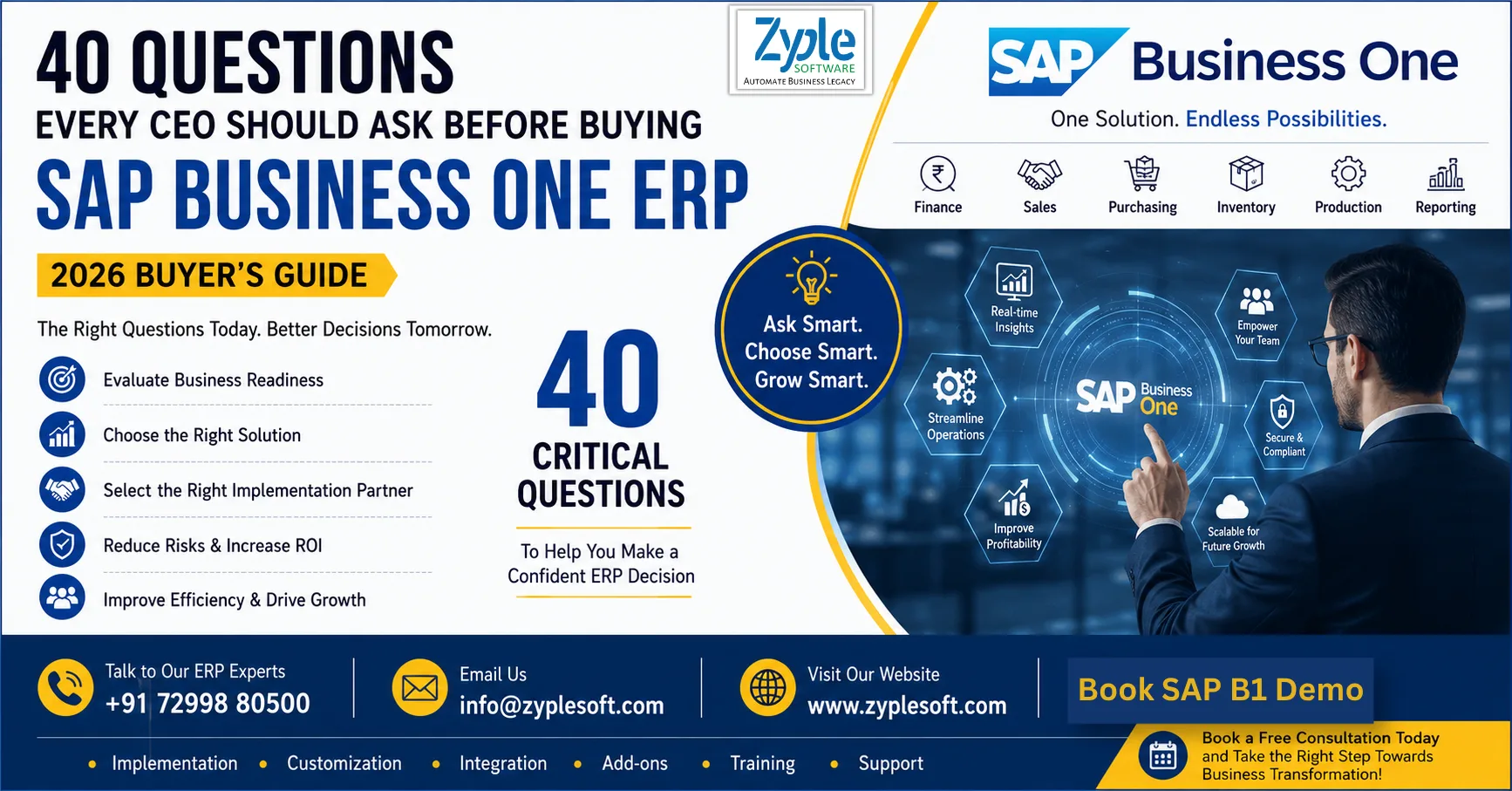
    CEO evaluating SAP Business One ERP implementation with 40 essential questions covering ERP selection, implementation, ROI, manufacturing, construction, and business growth.

    40 Questions Every CEO Should Ask Before Buying SAP Business One ERP (Complete Buyer’s Guide)

    40 Questions Every CEO Should Ask Before Buying SAP Business One ERP (2026 Buyer's Guide)

    CEO evaluating SAP Business One ERP implementation with 40 essential questions covering ERP selection, implementation, ROI, manufacturing, construction, and business growth.

    Thinking About Buying SAP Business One ERP? Read This First.

    Choosing an Enterprise Resource Planning (ERP) solution is one of the most important business decisions you’ll make. Unlike purchasing office software or hardware, an ERP system becomes the foundation of your company’s finance, sales, purchasing, inventory, manufacturing, projects, customer service, and reporting.

    A successful ERP implementation can improve efficiency, increase profitability, and provide complete visibility into your business. A poor implementation, however, can lead to cost overruns, low user adoption, delayed projects, and operational disruptions.

    While SAP Business One is one of the world’s leading ERP solutions for small and medium-sized businesses, success depends on asking the right questions before signing the contract, not after implementation begins.

    After working with companies across manufacturing, construction, engineering, trading, food processing, pharmaceuticals, and other industries, one thing becomes clear: organizations that evaluate their ERP investment carefully are more likely to achieve successful outcomes.

    This guide presents 40 practical questions every CEO should ask before buying SAP Business One ERP. These questions are designed to help you evaluate your business readiness, implementation strategy, vendor selection, costs, and long-term return on investment.

    Whether you’re replacing spreadsheets, upgrading from accounting software, or implementing SAP ERP for the first time, this guide will help you make a more informed decision.


    Why ERP Projects Succeed or Fail?

    Research and industry experience consistently show that ERP projects are more successful when organizations:

    • Define clear business objectives.
    • Involve leadership from the beginning.
    • Choose an implementation partner with relevant industry experience.
    • Prepare accurate master data.
    • Train users effectively.
    • Measure success using business KPIs.

    Conversely, projects often struggle when companies:

    • Focus only on software features.
    • Choose the lowest-cost implementation partner.
    • Underestimate change management.
    • Skip process documentation.
    • Rush implementation without proper planning.

    The following questions are intended to help you avoid these common pitfalls.


    Business Strategy and ERP Readiness

    Question 1. Why do we need an ERP system now?

    Before evaluating any software, define the business problem you’re trying to solve.

    Common reasons include:

    • Business growth has outpaced current systems.
    • Too many manual processes.
    • Inventory inaccuracies.
    • Delayed financial reporting.
    • Poor visibility into operations.
    • Multiple disconnected software applications.
    • Difficulty managing multiple branches or warehouses.

    If your only reason is “everyone else is implementing ERP,” reconsider. A successful ERP project starts with clear business objectives.


    Question 2. What business challenges should SAP Business One solve?

    ERP should solve measurable business problems – not simply replace existing software.

    Examples include:

    • Manual purchase approvals
    • Inventory mismatches
    • Slow order processing
    • Production delays
    • Project cost overruns
    • Duplicate data entry
    • Lack of real-time reporting

    List your top five operational challenges and prioritize them before evaluating ERP vendors.


    Question 3. What are our business goals over the next five years?

    Your ERP should support your future – not just your present.

    Ask yourself:

    • Will we open additional branches?
    • Will production capacity increase?
    • Will we export internationally?
    • Will we expand into new product lines?
    • Will we require better business analytics?
    • Will we increase our workforce?

    Choosing an ERP that can scale reduces future migration costs.


    Question 4. Are our existing systems limiting growth?

    Many SMEs rely on a combination of:

    • Excel spreadsheets
    • Accounting software
    • Standalone inventory systems
    • Manual production planning
    • Separate CRM solutions

    As businesses grow, these disconnected systems create duplicate work, inconsistent data, and delayed decision-making.

    Ask yourself:

    Are we managing our business or managing spreadsheets?


    Question 5. Which departments will benefit most from ERP?

    ERP is not just for finance.

    It should improve collaboration across:

    • Finance
    • Sales
    • Purchasing
    • Inventory
    • Warehouse
    • Manufacturing
    • Projects
    • Customer Service
    • Senior Management

    The broader the adoption, the greater the long-term business value.


    Business Process Evaluation

    Question 6. Which processes consume the most employee time?

    Time is money.

    Identify repetitive manual activities such as:

    • Purchase approvals
    • Invoice creation
    • Inventory reconciliation
    • Production scheduling
    • Sales reporting
    • Customer follow-ups

    These are often the first opportunities for automation.


    Question 7. Which business processes create the highest operational costs?

    Focus on activities that directly affect profitability.

    Examples:

    • Excess inventory
    • Material wastage
    • Production downtime
    • Delayed procurement
    • Manual reporting
    • Emergency purchasing
    • Rework due to inaccurate data

    Reducing these costs often delivers a measurable ERP ROI.


    Question 8. Can management access real-time information?

    Ask yourself:

    Can I see, right now,

    • Today’s sales?
    • Inventory availability?
    • Outstanding receivables?
    • Cash flow?
    • Production status?
    • Project profitability?

    If the answer is no, decision-making becomes reactive rather than proactive.

    One of the biggest strengths of SAP Business One is centralized, real-time business visibility.


    Question 9. Is our business data accurate?

    ERP is only as reliable as the data it contains.

    Review your:

    • Customer master
    • Vendor master
    • Item master
    • Price lists
    • Bills of Materials (BOM)
    • Warehouse records
    • Financial accounts

    Data cleansing before implementation reduces errors and accelerates go-live.


    Question 10. Are we relying too much on Excel?

    Excel is a valuable business tool but it should not run your business.

    Common risks include:

    • Formula errors
    • Multiple file versions
    • No audit trail
    • Manual consolidation
    • Limited collaboration
    • Inconsistent reporting

    If critical decisions depend on spreadsheets maintained by a few individuals, it’s a sign your business may benefit from an integrated ERP system.


    Leadership & Business Planning

    Question 11. What KPIs should improve after ERP implementation?

    ERP success should be measured using business outcomes.

    Examples include:

    • Inventory Accuracy
    • On-Time Delivery
    • Production Efficiency
    • Gross Profit Margin
    • Procurement Cycle Time
    • Cash Flow
    • Customer Satisfaction
    • Financial Closing Time

    Establish baseline metrics before implementation so you can measure improvement afterward.


    Question 12. What ROI do we expect from SAP Business One?

    Don’t focus only on implementation cost.

    Evaluate expected benefits such as:

    • Reduced inventory carrying costs
    • Lower operational expenses
    • Faster invoicing
    • Better procurement planning
    • Increased employee productivity
    • Improved customer service
    • Better management reporting

    A successful ERP investment should create long-term business value.


    Question 13. Are we prepared for organizational change?

    ERP implementation changes the way people work.

    Ask:

    • Are employees ready for new processes?
    • Do we have a training plan?
    • Have department heads been involved?
    • How will we communicate the change?

    Technology succeeds when people adopt it.


    Question 14. Do we have executive sponsorship?

    ERP implementation requires active leadership.

    The CEO should:

    • Define business objectives.
    • Approve major decisions.
    • Remove organizational barriers.
    • Monitor project progress.
    • Promote user adoption.

    Projects with visible executive involvement generally experience stronger alignment and accountability.


    Question 15. Who will own the ERP project internally?

    Every successful ERP implementation needs an internal project leader.

    This person should:

    • Coordinate departments.
    • Work closely with the implementation partner.
    • Track milestones.
    • Manage internal communication.
    • Escalate issues when needed.
    • Ensure project timelines remain on track.

    Without clear ownership, even well-planned ERP projects can lose momentum.

    Evaluating SAP Business One ERP

    Question 16. Is SAP Business One designed for businesses like ours?

    Not every ERP solution is built for every organization.

    SAP Business One is designed primarily for small and medium-sized enterprises (SMEs) that require enterprise-level capabilities while maintaining operational simplicity.

    Ask yourself:

    • Are we an SME planning to scale?
    • Do we need better financial visibility?
    • Are multiple departments using different software?
    • Do we require integrated reporting?
    • Will ERP support our growth for the next 7–10 years?

    Choosing software that matches your company’s size and complexity helps avoid unnecessary implementation costs and future migrations.


    Question 17. Does SAP Business One support our industry?

    Industry expertise matters.

    A manufacturing company has different requirements than a construction contractor or wholesale distributor.

    Before selecting SAP Business One, ask your implementation partner whether they have experience in your industry.

    Examples include:

    Manufacturing

    • Bill of Materials (BOM)
    • Material Requirement Planning (MRP)
    • Production Orders
    • Quality Control
    • Batch Management
    Companies evaluating SAP Business One Manufacturing ERP should verify support for production planning, Bill of Materials (BOM), MRP, shop floor reporting, quality management, and production costing.

    Construction & EPC

    • Project Costing
    • Budget Management
    • Contractor Billing
    • Work-in-Progress (WIP)
    • Equipment Tracking
    Organizations looking for SAP Business One Construction ERP should evaluate project costing, subcontractor billing, budget control, procurement, work-in-progress (WIP), and equipment management.

    Trading & Distribution

    • Multi-Warehouse Management
    • Inventory Planning
    • Procurement
    • Barcode Integration
    • Customer Pricing

    A partner who understands your industry can recommend proven workflows instead of unnecessary customizations.


    Question 18. Can SAP Business One grow with our business?

    Before making a decision, ask your implementation partner to explain how the SAP Business One Implementation process will be planned for your organization’s future growth. A structured implementation methodology reduces project risk and improves user adoption.

    Your ERP should support future expansion without requiring replacement.

    Evaluate whether it can handle:

    • Additional users
    • New branches
    • Multiple warehouses
    • Higher transaction volumes
    • New business units
    • International operations
    • Multiple legal entities

    A scalable ERP protects your investment as your organization grows.


    Question 19. Should we choose SAP Business One HANA or SQL?

    One of the first technical decisions involves selecting the database platform.

    SAP HANA

    Best suited for businesses that require:

    • Faster reporting
    • Real-time analytics
    • Large data processing
    • Advanced dashboards

    Microsoft SQL

    Often appropriate for businesses looking for:

    • Lower infrastructure investment
    • Familiar database technology
    • Reliable transactional performance

    The right choice depends on your reporting needs, IT strategy, budget, and expected business growth.


    Question 20. Should we choose Cloud or On-Premise deployment?

    Deployment strategy affects cost, security, accessibility, and IT management.

    Cloud Deployment

    Advantages include:

    • Lower infrastructure investment
    • Remote accessibility
    • Automatic backups
    • Easier scalability
    • Reduced IT maintenance

    On-Premise Deployment

    Advantages include:

    • Greater infrastructure control
    • Internal hosting
    • Organization-specific security policies
    • Integration with existing local systems

    Discuss both options with your implementation partner before making a decision.

    Never rely on a generic presentation. Request an industry-specific SAP Business One Demo using your own products, customers, and business workflows. A personalized demonstration helps management evaluate whether the solution fits real operational requirements.


    Functional Capabilities

    Question 21. Does SAP Business One cover all our core business processes?

    Create a checklist of every process your organization performs daily.

    Typical modules include:

    • Financial Management
    • Sales
    • Purchasing
    • Inventory Management
    • CRM
    • Production
    • Project Management
    • Service Management
    • Fixed Assets
    • Banking
    • Reporting

    Any missing functionality should be identified before implementation begins.


    Question 22. Can SAP Business One automate repetitive tasks?

    Automation reduces manual work and minimizes human error.

    Examples include:

    • Purchase approvals
    • Sales approvals
    • Inventory replenishment
    • Email notifications
    • Credit limit approvals
    • Payment approvals
    • Workflow alerts

    Automation improves productivity while increasing operational consistency.


    Question 23. Does SAP Business One provide real-time reporting?

    Executives should not wait until month-end to understand business performance.

    Ask whether the system provides dashboards for:

    • Sales
    • Inventory
    • Cash Flow
    • Accounts Receivable
    • Accounts Payable
    • Profitability
    • Production
    • Projects

    Real-time visibility enables faster and more informed decisions.


    Question 24. Can it integrate with our existing software?

    Many businesses extend SAP Business One with industry-specific SAP Business One Add-ons for payroll, contractor billing, weighbridge integration, WhatsApp, barcode systems, fleet management, and manufacturing execution systems (MES).

    Most businesses already use multiple applications.

    Examples include:

    • Payroll
    • HRMS
    • Banking
    • CRM
    • E-commerce
    • WhatsApp
    • Barcode Systems
    • Power BI
    • Microsoft 365
    • Manufacturing Execution Systems (MES)

    Understanding integration capabilities early helps avoid future surprises.


    Question 25. Can SAP Business One support mobile users?

    Business decisions no longer happen only from office desktops.

    Ask whether managers can:

    • Approve purchase requests
    • Review dashboards
    • Access customer information
    • Monitor inventory
    • View financial reports
    • Track project progress

    Mobile accessibility improves responsiveness and supports distributed teams.


    Security & Compliance

    Question 26. How secure is SAP Business One?

    Business information is one of your most valuable assets.

    Evaluate:

    • User permissions
    • Role-based security
    • Approval workflows
    • Audit trails
    • Password policies
    • Data backups
    • Disaster recovery

    A secure ERP helps protect sensitive financial and operational data.


    Question 27. Does SAP Business One support statutory compliance?

    For businesses operating in India or internationally, compliance is critical.

    Ask your implementation partner about support for:

    • GST
    • E-Invoicing
    • E-Way Bills
    • Tax reporting
    • Financial audits
    • Regulatory reporting

    Compliance requirements should be discussed before implementation – not after go-live.


    Question 28. Can we customize SAP Business One without creating upgrade issues?

    Every business has unique processes.

    However, excessive customization may increase implementation complexity and future maintenance.

    Ask:

    • Can this requirement be handled through configuration?
    • Is customization really necessary?
    • Will upgrades remain straightforward?

    The goal should be to use standard functionality wherever possible and customize only where it delivers clear business value.


    Technology & Future Readiness

    Question 29. Can SAP Business One support our digital transformation strategy?

    ERP should be more than a replacement for existing software.

    It should support future initiatives such as:

    • AI-powered reporting
    • Business Intelligence
    • IoT integrations
    • Paperless approvals
    • Digital workflows
    • Advanced analytics
    • Customer portals
    • Supplier portals

    A future-ready ERP enables continuous innovation.


    Question 30. What should we evaluate during a live SAP Business One demonstration?

    A product demonstration should focus on your business – not generic slides.

    Ask the consultant to demonstrate:

    • Sales Order to Delivery process
    • Purchase workflow
    • Inventory transactions
    • Production planning
    • Project costing
    • Financial reporting
    • Dashboard creation
    • Approval workflows
    • Mobile application
    • Industry-specific scenarios

    Whenever possible, request the demo using examples from your own business.

    This helps determine whether SAP Business One can support your actual operations rather than theoretical workflows.


    Choosing the Right SAP Business One Implementation Partner

    Question 31. Is the implementation partner experienced in our industry?

    This question is often more important than the software itself.

    Ask the implementation partner:

    • Have you implemented SAP Business One for businesses similar to ours?
    • Do you understand our manufacturing or construction processes?
    • Can you demonstrate industry workflows?
    • Can you explain common challenges?

    For example:

    A manufacturing company should expect demonstrations covering:

    • BOM
    • MRP
    • Production Orders
    • Production Costing
    • Quality Management

    A construction company should expect demonstrations covering:

    • Project Costing
    • Budget Control
    • BOQ
    • Contractor Billing
    • Equipment Management
    • Work-in-Progress

    Industry experience reduces project risks and shortens implementation time.


    Question 32. Can the partner provide real customer references?

    Ask to review SAP Business One Success Stories from businesses similar to yours. Case studies demonstrating measurable improvements in inventory accuracy, financial reporting, or production efficiency provide stronger evidence than marketing brochures alone.

    Every implementation partner claims they are experienced.

    Ask for proof.

    Request:

    • Customer case studies
    • Client references
    • Video testimonials
    • Industry-specific success stories
    • Go-live examples

    If possible, speak directly with an existing customer.

    Ask questions such as:

    • Was the implementation completed on time?
    • Was the budget maintained?
    • How responsive is support?
    • Would you choose the same partner again?

    These conversations often reveal more than a sales presentation.


    Question 33. What is included in the implementation cost?

    One of the biggest mistakes companies make is comparing only software prices. Understanding SAP Business One Pricing requires evaluating licenses, implementation services, training, integrations, support, and future scalability – not just the initial investment.

    ERP pricing should be transparent.

    Ask for a detailed proposal covering:

    • Software licenses
    • Implementation services
    • Data migration
    • User training
    • Reports
    • Dashboards
    • Integrations
    • Customization
    • Go-live support
    • Documentation

    Understanding the complete scope helps avoid misunderstandings later.


    Question 34. What ongoing support is available after Go-Live?

    Long-term success depends on reliable SAP Business One Support, including issue resolution, system health checks, user assistance, upgrades, and continuous process optimization.

    Go-live is the beginning of your ERP journey – not the end.

    Clarify:

    • Support hours
    • Response times
    • Issue escalation
    • Annual Maintenance Contract (AMC)
    • Version upgrades
    • User assistance
    • Remote support
    • On-site support (if required)

    Reliable post-implementation support is essential for long-term success.


    Question 35. How will success be measured?

    Many ERP projects finish on schedule but fail to improve business performance.

    Define measurable KPIs before implementation.

    Examples include:

    • Inventory Accuracy above 98%
    • Month-end closing reduced from 10 days to 3 days
    • Procurement approval time reduced by 60%
    • Production planning accuracy improved
    • Customer order processing time reduced
    • Improved cash flow visibility

    Measure business outcomes – not just project completion.


    Common Mistakes CEOs Make Before Buying ERP

    Even experienced business leaders sometimes underestimate ERP implementation.

    Here are ten common mistakes to avoid.

    Mistake 1

    Choosing the lowest-priced implementation partner instead of evaluating expertise and industry experience.


    Mistake 2

    Focusing only on software features rather than business objectives.


    Mistake 3

    Underestimating user training and change management.

    Employees need time, training, and support to adopt new systems successfully.


    Mistake 4

    Ignoring data quality before implementation.

    Incorrect master data leads to inaccurate reports and operational issues.


    Mistake 5

    Expecting ERP to solve inefficient business processes without process improvement.

    ERP supports good processes – it doesn’t automatically fix poor ones.


    Mistake 6

    Customizing everything instead of using standard functionality.

    Excessive customization increases complexity and future maintenance.


    Mistake 7

    Not involving department heads in the evaluation process.

    ERP impacts finance, purchasing, sales, warehouse, production, and management.

    Cross-functional involvement improves implementation success.


    Mistake 8

    Not defining measurable business goals.

    If success isn’t defined before implementation, it becomes difficult to measure ROI afterward.


    Mistake 9

    Selecting ERP without considering future business growth.

    Choose software that supports expansion, additional users, multiple branches, and new business opportunities.


    Mistake 10

    Treating ERP as an IT project instead of a business transformation initiative.

    Successful ERP projects are driven by business leadership—not just technology teams.


    CEO ERP Decision Checklist

    Before approving your SAP Business One investment, confirm the following.

    Business Readiness

    • Clear business objectives defined
    • Current operational challenges documented
    • Future growth plans identified
    • Executive sponsorship established

    Software Evaluation

    • SAP Business One fits our industry
    • Required modules are available
    • Integration requirements confirmed
    • Cloud or On-Premise deployment selected
    • Security requirements reviewed

    Implementation Planning

    • Implementation scope documented
    • Timeline agreed
    • Budget approved
    • Data migration strategy finalized
    • User training planned

    Partner Evaluation

    • Industry experience verified
    • Customer references checked
    • Support services reviewed
    • Implementation methodology understood
    • Long-term partnership evaluated

    Final Thoughts

    Buying SAP Business One ERP is not simply purchasing software but it’s investing in the future of your business.

    The right ERP can help you:

    • Improve operational efficiency
    • Increase profitability
    • Gain real-time business visibility
    • Standardize business processes
    • Support informed decision-making
    • Scale confidently as your organization grows

    However, software alone doesn’t guarantee success.

    The combination of clear business objectives, committed leadership, high-quality data, user adoption, and an experienced implementation partner has the greatest influence on project outcomes.

    By answering these 40 questions, CEOs can evaluate ERP opportunities more effectively, reduce implementation risks, and make decisions aligned with their long-term business strategy.

    Frequently Asked Questions

    Is SAP Business One suitable for manufacturing companies?

    Yes. SAP Business One supports manufacturing with features such as Bill of Materials (BOM), Material Requirements Planning (MRP), Production Orders, Batch Management, and Production Costing. Many manufacturers also extend it with industry-specific add-ons where required.


    Can SAP Business One manage construction projects?

    Yes. Construction and EPC companies commonly use SAP Business One for project costing, procurement, budgeting, contractor billing, inventory management, and financial reporting. Additional functionality may be provided through specialized add-ons depending on project requirements.


    How long does SAP Business One implementation take?

    Implementation time depends on company size, business complexity, and project scope. Many small to medium-sized projects are completed within a few months, while larger, multi-location implementations may require additional time.


    What is the biggest reason ERP projects fail?

    Common reasons include unclear business objectives, poor data quality, insufficient user training, limited executive involvement, and selecting an implementation partner without relevant industry experience.


    How do I choose the right SAP Business One implementation partner?

    Look for an authorized SAP partner with experience in your industry, proven customer references, a structured implementation methodology, transparent pricing, and reliable post-go-live support.


    Conclusion

    Selecting the right ERP is one of the most important strategic decisions for any growing business. Rather than focusing only on software features or pricing, CEOs should evaluate business readiness, implementation approach, long-term scalability, and partner expertise.

    SAP Business One can support finance, sales, purchasing, inventory, manufacturing, projects, and analytics within a single integrated platform. When combined with clear planning and an experienced implementation partner, it can help organizations improve operational performance and support sustainable growth.

    If you’re evaluating SAP Business One for your organization, use these 40 questions as a practical framework for discussions with your leadership team and potential implementation partners.


    About Zyple Software

    Zyple Software is an SAP Business One partner helping organizations streamline business operations through ERP solutions, industry-specific add-ons, system integration, implementation services, and ongoing support.

    Whether you’re in manufacturing, construction, engineering, trading, or another industry, the first step is understanding your business processes and identifying the ERP approach that best fits your goals.

    Book a Free SAP Business One Consultation

    During your consultation, you can:

    • Review your current business processes
    • Discuss ERP readiness
    • Explore industry-specific SAP Business One demonstrations
    • Understand implementation timelines
    • Review implementation considerations
    • Learn about relevant SAP Business One add-ons

    Contact Zyple Software

    If your organization is evaluating SAP Business One, fill your details in given form or schedule a consultation with Zyple Software. Whether you need SAP Business One Implementation, an industry-specific SAP Business One Demo, guidance on SAP Business One Pricing, expert SAP Business One Support, or advice on selecting the right SAP Business One Add-ons, our team can help you assess your requirements and plan your ERP journey.

      CEO ERP Evaluation Comparison Table

      Before investing in SAP Business One ERP, use this checklist to evaluate your organization's readiness and ensure you're asking the right questions during the selection process.

      Evaluation Area Question to Ask Why It Matters
      Business Goals Have we clearly defined why we need an ERP system? Ensures the ERP project aligns with business objectives instead of simply replacing existing software.
      Industry Fit Does SAP Business One support our industry-specific processes? Reduces unnecessary customization and speeds up implementation.
      Implementation Partner Does the implementation partner have proven experience in our industry? Experienced partners reduce project risks and improve implementation success.
      Deployment Should we choose Cloud or On-Premise deployment? Impacts infrastructure costs, accessibility, security, and long-term scalability.
      Integration Can SAP Business One integrate with our existing applications? Eliminates duplicate data entry and improves operational efficiency.
      Data Migration Is our business data clean and ready for migration? High-quality master data leads to smoother implementation and accurate reporting.
      User Adoption Have we planned user training and change management? Well-trained employees increase ERP adoption and maximize ROI.
      Implementation Cost Do we understand the complete implementation cost? Helps avoid unexpected expenses during the project lifecycle.
      Support What post-Go-Live support will we receive? Reliable support ensures long-term business continuity and continuous improvement.
      Return on Investment How will we measure ERP success after implementation? Defines measurable KPIs such as productivity, profitability, inventory accuracy, and reporting efficiency.
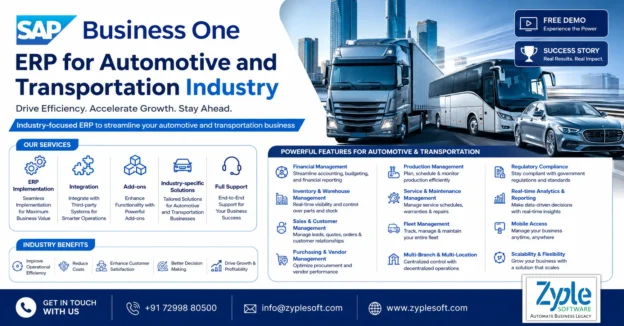
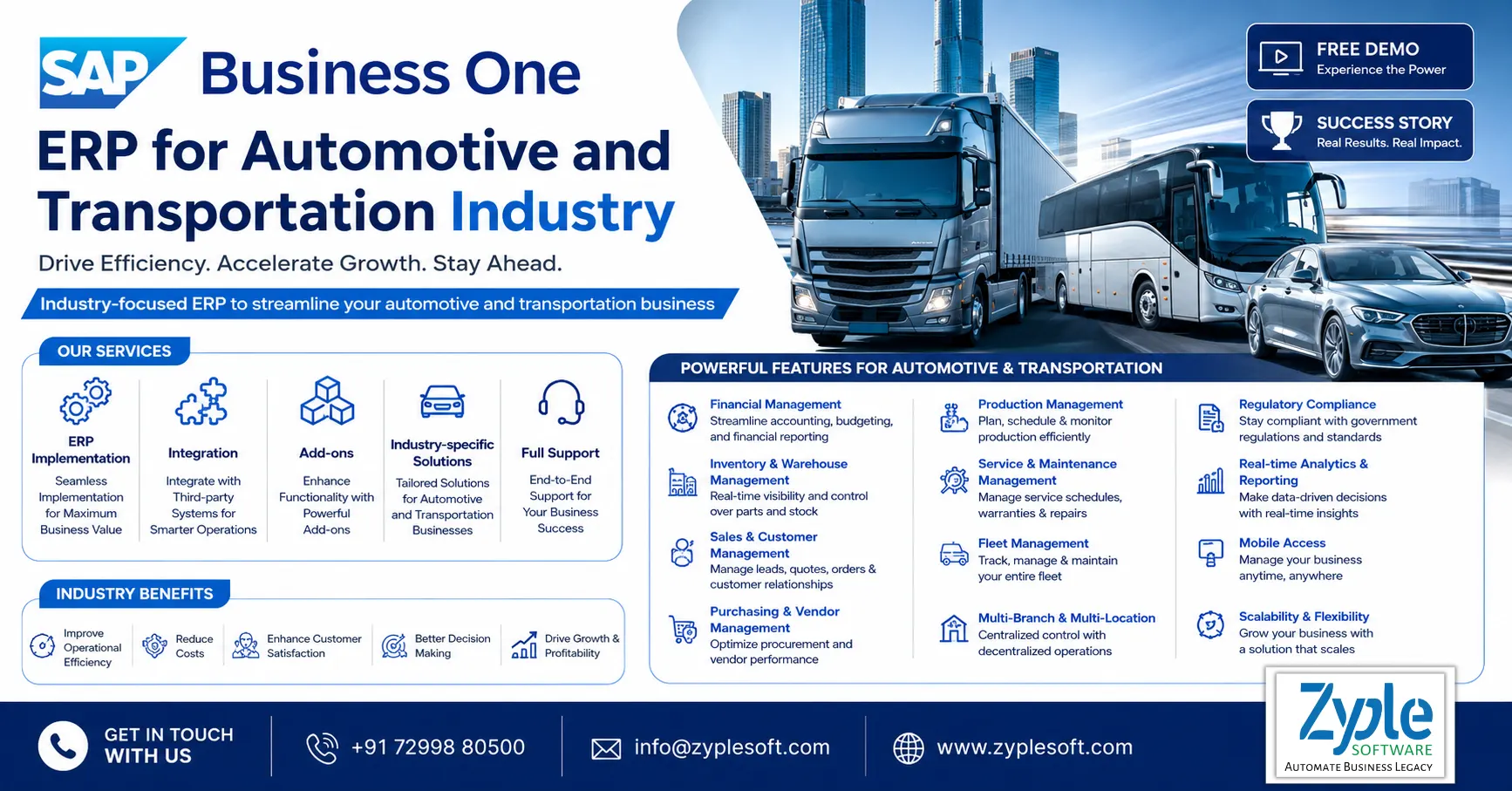
      SAP Business One for Automotive and Transportation industry

      SAP Business One for Automotive and Transportation

      SAP Business One for Automotive and Transportation Industry

      SAP Business One for Automotive and Transportation industry

      The automotive and transportation industry is evolving fast, and staying ahead involves innovative solutions. SAP Business One delivers a powerful ERP solution that helps manufacturers optimize operations, minimize costs, and boost customer satisfaction. SAP Business One for automotive and transportation facilitates supply chains, improves dealer collaboration, and increases marketing and sales processes.

      Challenges of the Automotive and Transportation Industry

      The automotive and transportation industry faces a tumultous landscape defined by the rapid shift to electric vehicles (EVs), supply chain vulnerabilities, and increasing cybersecurity threats. Key challenges include handling high production costs, adapting to software-driven vehicles, meeting strict emission regulations, and navigating shifting consumer demands toward shared mobility.

      1. EV Transition and Battery Costs

      The industry faces high production costs for electric vehicles, mainly due to expensive battery technologies, along with the need to develop infrastructure.

      2. Supply Chain Disruptions

      Continuous shortages of essential components (such as semiconductors) and fluctuating raw material prices threaten production schedules and inventory levels.

      3. Regulatory and Environmental Compliance

      Manufacturers are struggling to achieve global emission standards and sustainability goals while maintaining profitability.

      4. Cybersecurity Risks

      As vehicles become more connected, cybersecurity has become a foremost priority, with significant damages reported from cyber attacks on infrastructure and vehicles.

      5. Software-Defined Vehicles and Technology

      The rapid shift towards autonomous driving and advanced driver assistance systems (ADAS) involves massive investment and a workforce skilled in software, rather than just mechanical engineering.

      6. Shifting Customer Preferences

      Increased consumer demand for shared mobility and on-demand transportation (e.g., ride-hailing services) is decreasing the demand for personal vehicle ownership.

      7. Infrastructure and Workforce Shortages

      Limited EV charging infrastructure and a growing shortage of skilled technicians and drivers present significant operational challenges.

      Features of SAP Business One for Automotive and Transportation

      1. Production Planning and Bill of Materials (BOM)

      • Handles multi-level BOMs for complex automotive assemblies (engines, components, and spare parts).
      • Tracks sub-assemblies, labor, and machine resources.
      • Manages engineering changes and version control easily.
      • Suitable for auto component manufacturers and OEM suppliers.

      2. Material Requirements Planning (MRP) and Scheduling

      • Plans raw materials based on demand forecasts.
      • Optimizes production schedules and capacity planning.
      • Minimizes delays with advanced planning and scheduling (APS).
      • Suitable for just-in-time manufacturing and supply chain efficiency.

      3. Inventory and Warehouse Management

      • It includes real-time visibility of spare parts, components, and finished goods.
      • Tracks inventory across multiple warehouses and locations.
      • It includes bin-level tracking and automated stock updates.
      • It helps prevent stockouts and overstock situations.

      4. Supply Chain and Vendor Management

      • Handles suppliers, dealers, and distributors in one system.
      • Tracks procurement cycles from purchase order to payment.
      • Improves vendor performance and collaboration.
      • Essential for automotive supplier ecosystems.

      5. Quality Control and Traceability

      • Tracks batch or serial numbers for parts traceability.
      • Monitors quality checks and compliance.
      • Handles rejections, returns, and defect ranking.
      • Necessary for automotive compliance and safety standards.

      6. Sales, CRM, and Dealer Management

      • Handles dealer networks and customer relationships.
      • Tracks the entire sales lifecycle from lead, order, and delivery to service.
      • It includes support pricing, discounts, and promotions.
      • Suitable for automotive dealerships and distributors.

      7. After-Sales and Service Management

      • Handles warranty claims and service contracts.
      • Tracks service requests and maintenance schedules.
      • Allows faster issue resolution.
      • Important for customer satisfaction in the automotive sector.

      8. Transportation and Logistics Management

      • Tracks inbound and outbound shipments.
      • Handles dispatch, delivery, and logistics operations.
      • Monitors transportation costs and delivery timelines.
      • Suitable for logistics and fleet-based businesses.

      9. Financial and Cost Management

      • It includes entire financial control features like accounting, budgeting, and cash flow.
      • Tracks product costing, margins, and profitability.
      • Handles multi-currency and global operations.

      10. Business Intelligence and Real-Time Analytics

      • It includes real-time dashboards and KPIs.
      • Analyzes production efficiency, sales performance, and inventory.
      • Predicts demand and optimizes operations.
      • It supports data-driven decision-making.

      11. Integrated End-To-End ERP Platform

      • Single system including finance, production, inventory, CRM, and procurement.
      • It eliminates data storage and improves visibility.

      12. Mobility and Cloud Access

      • It includes access to the system via mobile apps.
      • It includes real-time updates for field sales and logistics teams.
      • It includes cloud or on-premise deployment options.

      Importance of SAP Business One for Automotive and Transportation

      The enterprise resource planning (ERP) software, SAP Business One system, is essential for automotive and transportation businesses by facilitating operations, optimizing inventory, and handling complex supply chains in real-time. It delivers 360-degree visibility across manufacturing, procurement, and logistics, enabling lower costs, improved quality compliance, and faster decision-making for manufacturers, dealers, and logistics providers.

      1. Inventory Optimization and Traceability

      Handles stock across multiple locations to avoid stock-outs and excess inventory, with inclusive traceability for spare parts.

      2. Production Planning and Quality Control

      Improves material resource planning (MRP) and advanced scheduling, ensuring quality standards are achieved.

      3. Transportation and Fleet Management

      Integrates with GPS or telematics to track vehicle location, monitor driver behavior, handle maintenance, and optimize routes using SAP implementation.

      4. Supplier and Supply Chain Collaboration

      Improves supplier management with automated procurement, sharing demand forecasts to minimize disruptions.

      5. Cost Reduction and Financial Control

      Automates accounting, tracks costs in real-time, and delivers analytics to improve ROI.

      6. Future-Ready Tech Adoption

      It supports the Internet of Things (IoT), electric vehicle management, and sustainability initiatives.

      Benefits of SAP Business One ERP for Automotive and Transportation

      The SAP Business One (SAP B1) system provides automotive and transportation companies a scalable, integrated ERP system that improves supply chain visibility, optimizes inventory with batch or serial tracking, and facilitates production scheduling. It allows real-time monitoring of fleet operations, improves compliance with quality standards, and delivers 360-degree data insights for faster decision-making.

      1. Inventory and Production Management

      Optimized inventory tracking, including batch management and serial numbers, minimizes holding costs and prevents stock-outs. Material requirements planning (MRP) matches raw material availability with production schedules using SAP solutions.

      2. Supply Chain and Supplier Management

      Improved tracking of vendor contracts, consignment stock, and deliveries to handle supplier relationships, including EDI integration.

      3. Quality and Compliance

      Powerful QC/QA modules for automated inspections, ensuring compliance with environmental and industry standards.

      4. Production Efficiency

      Advanced Planning and Scheduling (APS) improves the balance between raw materials and production capacity, increasing on-time delivery.

      5. Real-time Fleet Tracking

      Integration with GPS and telematics to monitor vehicle status, location, and speed from a central dashboard using SAP software.

      6. Route Planning and Optimization

      Automated tools to create efficient routes and handle multi-stop journeys, reducing fuel costs.

      7. Maintenance Optimization

      Preventive maintenance alerts for vehicles to minimize downtime and manage maintenance expenses.

      Conclusion of Automotive and Transportation ERP

      Zyple Software is an authorized and Trusted SAP Business One partner in India specializing in implementation, digital transformation, migration, licensing, integration, add-on solutions, and consulting for the automotive and transportation industry. ERP company Zyple Software is the trusted SAP Business One partner providing customized SAP B1 solutions for automotive and transportation companies across the world.

      If you’re organized, book a demo of SAP Business One.

      Do you require the SAP Business One ERP software for your business or industry?

      Complete all the details in the arranged contact form; our team will get back to you.

        How to Buy SAP B1 Software

        How to Buy SAP B1 Software?

        How to Buy SAP Business One (SAP B1) Software in India?

        How to Buy SAP B1 Software

        What is SAP Business One ERP?

        The ERP system, SAP Business One (SAP B1) ERP, is a cost-effective, integrated ERP software solution designed for small and medium-sized enterprises (SMEs) and fast-growing companies to manage key operations, including finance, sales, CRM, inventory, and production in one system. It facilitates workflows and delivers real-time analytics to improve decision-making, providing flexible, scalable deployment on-premises or in the cloud. Here, we will discuss how to buy SAP B1 software.

        How to Buy SAP B1 Software Online?

        The Process of buying SAP Business One (SAP B1) software online is primarily done through the official SAP store, where you can identify, configure, and purchase solutions directly. The process involves choosing the appropriate license type (professional or limited), modifying user counts, and integrating with Zyple Software for implementation.

        1. Visit the SAP Store

        Navigate to the SAP store and ensure your country/region is properly selected to see relevant pricing and partners like Zyple Software.

        2. Search and Select

        Use the search bar to find SAP Business One.

        3. Configuration of License

        Choose between a perpetual license or a subscription model based on user types (Professional vs. Limited).

        4. Buy or Integrate

        Click “Buy Now” to purchase directly or “Get It Now” to integrate with a partner like Zyple Software to discuss requirements and implementation.

        5. Payment & Access

        Finish the final payment process. For cloud-based options, you may receive access details directly, while on-premise solutions will involve coordination with Zyple.

        How to Buy SAP Business One Software in India?

        To buy SAP Business One (SAP B1) software in India, you must engage Zyple Software to conduct a needs evaluation, customize, and implement the software. The major steps include choosing a deployment model (cloud or on-premise) and selecting user licenses (professional or limited).

        1. Identify an Authorized Partner

        Contact Zyple Software, a certified SAP Business One partner in India, to receive customized quotes, as they manage sales, implementation, and support.

        2. Needs Evaluation and Demo

        Request an inclusive demonstration and a needs evaluation to define which modules (finance, CRM, and inventory) your business requires.

        3. Choosing a Licensing Model

        This includes two types of SAP B1 licensing models:

        • Professional Users: It is the type of SAP Business One licensing model where users have full access to all modules.
        • Limited Users: It is the type of SAP Business One licensing model where users have specific or limited access to modules like CRM, finance, and logistics.

        4. Choose Deployment Process

        Choose between on-premise (perpetual license) and cloud (subscription model).

        5. Installation & Full Support

        Work with Zyple to design the system to your requirements and set up continuous maintenance.

        Know About Customized SAP Business One Pricing India

        We understand that the SAP Business One price in India varies based on factors such as company size, user count, data complexity, and user needs. As your trusted SAP B1 partner in India, we specialize in licensing and crafting personalized blueprints to outline the exact SAP Business One pricing for your organization.

        With decades of experience, we navigate you through the complexities of SAP B1 software price and licensing costs, considering factors like purchasing process, database options (SAP B1 SQL or SAP B1 HANA), hosting preferences (cloud or on-premise), and necessary maintenance and support. If you’re concerned, book an SAP B1 demo.

        Whether you’re in manufacturing, construction, real estate, retail, pharmaceuticals, textiles, logistics, energy or any other sector, our customized approach ensures that the SAP Business One cost remains within budget and aligns perfectly with your unique business model and SAP B1 pricing.

        Not only licensing, but when it comes to SAP implementation, our company delivers excellent support and services to different industries like manufacturing, construction, real estate, retail, pharmaceutical, textile, professional services, aerospace and defense, and more to help them cater to their requirements with the growing competition.

        Key Factors That Impact SAP Business One Price in India

        1. Deployment Models like Cloud and On-Premise

        One of the biggest SAP B1 pricing factors is how you choose to launch SAP Business One like on-premise or the cloud.

        Every model has its own cost structure and long-term financial implications.

        2. Number of Users and License Types

        SAP Business One’s pricing differs based on

        • Number of users accessing the SAP B1 system.
        • Type of users (Professional and Limited).

        Businesses can improve costs by selecting the right type of user licenses instead of assigning full access to everyone.

        3. Business Size and Industry Requirements

        The overall cost depends largely on:

        • Size of the organization.
        • Industry-specific needs (manufacturing, construction, real estate, retail, pharmaceutical, textile, professional services, aerospace and defense, and more).

        Some industries may require additional configurations or compliance features, which can impact pricing.

        4. Customization and Add-On Development

        SAP Business One can be improved with:

        • Industry-specific add-ons.
        • Process automation and integrations.

        The level of customization directly impacts the final project cost.

        5. Implementation and Consulting Services

        SAP B1 ERP pricing is not only about SAP Business One licenses; SAP B1 implementation services play a crucial role in the following:

        • System modification.
        • Data migration.
        • User training.
        • Go-live support.

        A structured and expert-led implementation ensures improved ROI and long-term success.

        6. Support, Annual Maintenance Costs, and Managed Services

        Post-implementation costs include:.

        • Support.
        • System upgrades.
        • Performance optimization.
        • Continuous improvements.

        Choosing a reliable SAP partner, Zyple Software, helps reduce these costs while ensuring system stability.

        Types of SAP Business One Licenses

        Experience personalized guidance from experts to navigate SAP Business One price in India, along with maintenance, SAP support, and implementation. Select from a variety of SAP Business One licenses, including professional and limited licenses, designed for your business requirements.

        1. Professional License

        With professional SAP Business One licenses, you can gain the full spectrum of SAP Business One’s capabilities, allowing access to all modules or features. Select between flexible subscription or perpetual license options to match your business needs seamlessly by delivering the most affordable SAP Business One cost. It is the SAP B1 ERP license suitable for users who need complete access to the system, like managers and decision-makers.

        2. Limited License

        In SAP Business One limited licenses, the offerings deliver focused solutions across three areas, such as CRM, financial, and logistics. Every option provides a unique blend of modules and features to handle specific business needs. This type of SAP B1 license helps you to find the ideal fit for your requirements. It is the SAP B1 ERP license suitable for users who require access only to some modules in the SAP B1 system.

        Are you looking for SAP Business One Software for your any business or industry?

        Fill in all the details in the specified contact form; our team will reach out to you.

          Choose SAP ERP Implementation Partner

          Choose SAP ERP Implementation Partner

          How to Choose SAP ERP Implementation Partner?

          Choose SAP ERP Implementation Partner

          Selecting the right SAP ERP implementation partner is one of the most critical decisions your business will make.

          An ERP system like SAP Business One can transform operations but only if implemented correctly. The wrong partner can lead to delays, cost overruns, user resistance, and underutilized systems.

          How do you choose the right SAP ERP implementation partner?

          1. Check Industry-Specific Experience (Not Just SAP Knowledge)

          Many firms say they “implement SAP.” That’s not enough.

          A strong implementation partner should understand:

          • Your industry workflows
          • Compliance requirements
          • Operational bottlenecks
          • Reporting expectations
          • Growth challenges

          For example:

          1. Manufacturing requires BOM, production planning, and MRP expertise
          2. Retail needs POS integration and multi-branch consolidation
          3. Construction requires project cost tracking and milestone billing
          4. Pharma demands batch tracking and regulatory compliance

          ERP success depends on domain knowledge but not just technical setup.

          2. Verify SAP Authorization and Partnership Status

          Ensure the partner is officially aligned with SAP SE.

          Ask:

          • Are they an authorized SAP partner?
          • Do they have certified SAP consultants?
          • How many SAP projects have they completed?

          Certification ensures access to proper implementation methodologies, updates, and support standards.

          3️. Evaluate Implementation Methodology

          A professional SAP Business partner should follow a structured process:

          • Requirement study and gap analysis
          • Solution blueprint
          • System configuration
          • Data migration
          • User training
          • Go-live support
          • Post-implementation optimization

          If the partner can not clearly explain their methodology, that’s a red flag.

          4. Look for Industry Case Studies

          Real results matter more than promises.

          Ask for:

          • Case studies
          • Client references
          • Before-and-after performance improvements
          • ROI metrics

          Examples of measurable outcomes:

          • 20–30% inventory reduction
          • Improved working capital visibility
          • Faster month-end financial closing
          • Reduced manual errors

          A credible partner will have proof of success.

          5. Assess Customization and Add-On Capability

          Every business has unique processes.

          Your SAP ERP partner should:

          • Offer industry-specific add-ons
          • Provide integration capabilities
          • Customize reports & dashboards
          • Connect with third-party systems

          A one-size-fits-all approach rarely works.

          6. Understand Post-Implementation Support

          ERP implementation does not end at go-live.

          Ask:

          1. Do they offer ongoing support?
          2. What are their SLA terms?
          3. Is there a dedicated support team?
          4. Do they provide system optimization services?

          Strong post-go-live support determines long-term success.

          7. Evaluate Local & Regional Presence

          For Indian businesses especially, a partner with local market understanding offers advantages:

          • Knowledge of GST compliance
          • Indian taxation structure
          • Regional business practices
          • Faster on-site support

          If you’re operating in India, choosing a SAP ERP partner with strong Indian market experience is critical.

          8. Transparency in Costing

          Avoid vague pricing structures.

          A reliable SAP ERP implementation partner should clearly explain:

          • License cost
          • Implementation cost
          • Customization charges
          • Annual maintenance
          • Support fees

          Transparency prevents budget surprises.

          9. Scalability for Future Growth

          ERP is a long-term investment.

          Ensure the partner can support:

          • Multi-branch expansion
          • Multi-currency operations
          • Increased transaction volume
          • Advanced analytics
          • Industry compliance evolution

          The right partner prepares your ERP for the next 5–10 years.

          Why Choosing the Right SAP ERP Partner Matters?

          ERP implementation impacts:

          • Financial visibility
          • Operational efficiency
          • Inventory management
          • Compliance
          • Customer satisfaction

          The right partner like Zyple Software becomes a long-term strategic advisor  –  not just a software installer.

          Final Conclusion

          Choosing the right SAP ERP implementation partner is not about selecting the cheapest option.

          It’s about selecting:

          • Industry expertise
          • Proven methodology
          • Transparent pricing
          • Long-term support capability
          • Strong SAP ecosystem alignment

          If you’re evaluating SAP ERP for Manufacturing, Retail, Construction, Real estate, Pharma, Textile, or other industries in India, take time to assess your implementation partner carefully.

          A well-implemented SAP ERP system can transform your business.
          The right partner makes all the difference.

          Let us fill your detail in contact form. A right implementation partner will contact you soon as per your business needs.

            Expense Tracking Software

            Expense Tracking Software

            Expense Tracking Software for Business

            Expense Tracking Software

            What is Expense Tracking?

            Expense tracking means recording all your expenditures so you have a clear and precise understanding of your budget. This is usually done for a certain project or over a certain period, so you can stay on budget and make any necessary adjustments.

            For many small businesses, expense tracking may cover fixed expenses like rent and utilities as well as fluctuating costs like labor, product orders, and advertising. It’s especially necessary to record one-time and variable costs, as these aren’t always accounted for in the initial budget.

            What is Expense Tracking Software?

            It is also known as expense management software. It is a digital tool that helps businesses and individuals track, record, and process expenses, automating tasks like receipt scanning, expense report creation, and reimbursement processing, ultimately facilitating financial processes and improving accuracy.

            This software minimizes the need for paper, lowers the amount of time spent on handling expenses and reduces errors.

            Which is the best software for Expense Tracking?

            SAP Business One is the best software for expense tracking. It is software that helps businesses and individuals manage, record and analyze expenses, facilitating processes like expense reporting, reimbursement and auditing.

            Features of Expense Tracking Software

            1. Expense Categorization

            Expenses are categorized to give clarity and organization. Common categories include office supplies, rent, utilities, salaries, marketing, travel and entertainment, and so on.

            2. Expense Approval and Authorization

            Companies often develop approval workflows for expenses. In accordance with corporate policies, managers or other designated people examine and approve expense reports that employees submit.

            3. Receipt and Documentation Management

            Keeping receipts, invoices, and other supporting documents is necessary for expense verification and compliance with tax regulations. Many businesses have changed to digital document management for convenience and accessibility.

            4. Expense Reporting

            Businesses generate expense reports to analyze spending patterns, identify cost-saving opportunities, and make better financial decisions. Modern expense management tools often provide powerful reporting and analytics features. 

            5. Reimbursements and Payments

            Once expenses are approved, businesses require a process for reimbursing employees or paying vendors promptly. Automation can accelerate this process.

            6. Tax Compliance

            Expenses are closely linked to tax deductions. Ensuring accurate documentation and compliance with tax regulations can result in significant tax savings.

            7. Expense Optimization

            Expense management isn’t only about control but it’s also about finding ways to reduce expenses. This may involve handling better vendor contracts, optimizing travel expenses or finding more cost-effective suppliers.

            8. Auditing and Compliance Checks

            Regular audits help ensure expenses are managed according to established policies and procedures. Auditors may analyze expense reports, receipts, and financial records to identify irregularities.

            Types of Expense Management Systems

            There are different types of expense management software catering to different needs and preferences of businesses. Here are some common types of expense management systems:

            1. Desktop Software

            Traditional desktop expense management software is installed on a computer to help businesses input expense data, manage receipts and create reports directly on their desktop or laptop.

            2. Mobile Expense Apps

            Mobile expense apps are tailored for smartphones and tablets. They enable businesses to capture receipts, log expenses and track spending. Many of these apps are synchronized with cloud-based platforms for seamless integration.

            3. Enterprise Expense Management Systems

            These systems are designed for large organizations and often include features such as advanced approval workflows, policy enforcement, and integration with other enterprise software like ERP (Enterprise Resource Planning) systems.

            4. Small Business Expense Software

            Designed for small to medium-sized businesses, these systems offer basic expense software for tracking and reporting features at a cost-effective price point.

            5. Travel Expense Management Software

            This focuses on handling travel-related expenses, including booking flights, hotels and transportation for business travel.

            Benefits of Expense Tracking Software

            Here are the following benefits:

            1. Faster and Easy Processes

            Printing paper copies, adding receipts and delivering reports to managers—who would either approve them or send them back to the employee for revision—were the traditional methods of submitting expenses. But with SAP Business One, the workflow is automated. Once the employee clicks “submit,” the report is automatically routed to the appropriate person for approval. After approval, the amount to be reimbursed can be submitted automatically to payroll.

            2. Faster Employee Reimbursement

            With automated expense reimbursement, employees can submit expense reports and corresponding documentation without delay, and managers can quickly and easily examine and approve claims as notifications come in. Hence, these tools put cash back in employees’ bank accounts more quickly and eliminate the frustration that comes with errors and delays, thereby improving employee satisfaction.

            3. Fewer Delays and Errors

            In addition to minimizing the time it takes to reimburse employees, the automation features in SAP software improve accounting accuracy. For example, with manual expense reports, employees might make data-entry errors that could be further compounded when finance staff transcribe the information into spreadsheets. SAP B1 ERP can flag errors and duplicate entries and avoid over-payment or notify managers if the dollar figure seems too high. Additionally, the software has the ability to notify users when a report or payment is past due.

            4. Increased Operational Efficiency

            If you bill expenses directly to clients, employees’ reports must be timely and accurate to increase cash flow. Ideally, SAP Business One ERP is integrated with time tracking, project management, accounting, and enterprise resource planning (ERP) software. When this process is simple for the employees for tracking and the managers who are approving and reporting, your company could see enhanced cash flow.

            And because all employees spend less time on day-to-day, error-prone, and time-consuming manual expense reports, they’re not focused on the “input” portion of the input : output ratio. Rather than that, they can focus on the tasks and projects that bring value to the organization, whether that’s going on sales calls or preparing strategic budgets. This is one main reason that startups can greatly benefit from SAP implementation.

            5. Expense Policy Reinforcement

            Even the most accurate manager may not be up-to-date on every new expense policy and tax change. By enforcing custom rules designed for your business, SAP Business One flags out-of-policy travel expenses. For example, per day meal allowances may have increased per federal guidelines, but employees are submitting expense reports based on the old amounts. Or, an employee may be attempting to request reimbursement for a new addition to the policy, like an ergonomic keyboard, but is being blocked.

            6. Improved Visibility

            SAP B1 ERP includes a dashboard that compiles employee expense data and presents it in an easy-to-understand visual format using charts and other graphics. Metrics such as the average time it takes to approve expense reports or the amount spent by a company by employee or category are available to managers.

            7. Enhanced Fraud Prevention

            That report from the Association of Certified Fraud Examiners says 20.5% of businesses with less than 100 employees and 13.5% of larger organizations have reported fraudulent expense reimbursements. It’s understandable that busy finance teams and managers might manage well-camouflaged fake entries from trusted employees or contracts. Once that money has been paid, it’s painful to get back in. And, if an auditor spots a questionable entry, that raises a big flag and spurs more drilling.

            8. Simplified Reporting

            Reporting and analytics provide real-time insight into company expenditure. Reporting expense options include by employee, by project, and by category. SAP B1 makes it possible to integrate into a single report. Furthermore, companies can implement expense management best practices by:

            • Determining chronic rules violators, high-spending individuals, and each employee’s spending patterns over time.
            • Suggesting which national hotel, car rental, and even restaurant chain companies may want to approach for volume discounts.
            • Encouraging employees to help save money by connecting the dots between frugality and the ability to invest in growth. 

            Businesses can also use these data to pinpoint areas where their spending policies need to be clarified or enforced more effectively.

             9. Increase Compliance

            SAP B1 ERP helps companies stay on the right side of compliance with local, state, and federal tax agencies. Certain expenses, like the majority of entertainment and dues to country, golf, and athletic clubs, are no longer tax deductible, so include them could attract the IRS’s notice. However, businesses can classify expenses into categories like office, travel, and mileage and appropriately tag them. This ERP software also delivers easily accessible electronic copies of reports and receipts, which are helpful if the organization is audited.

            Conclusion of Expense Tracking Software

            Zyple Software provides SAP Business One, an all-inclusive platform that prevents you from using multiple apps. It provides you all the features and functionality you need to manage expense claims and settle under one hood.

            expense tracking - erp software services
            sap software

            What is SAP Software? Meaning, Uses and Examples

            What is SAP Software? Meaning, Uses, and Examples

            sap software

            In the world of enterprise resource planning (ERP), SAP software stands as a dominant solution, widely adopted by organizations globally to improve their business processes. But what exactly is SAP software? How does it function and what makes it a preferred choice for many companies? This article dives deep into the meaning, uses, and examples of SAP software and highlights a top offering by SAP partner Zyple Software, known for delivering best SAP solutions.

            What is SAP Software: Meaning and Definition

            SAP stands for Systems, Applications, and Products in Data Processing. Founded in 1972 in Germany, SAP SE has grown into a global leader in enterprise software, providing solutions that help businesses manage operations and customer relations efficiently.

            At its core, SAP software is an integrated suite of applications designed to help organizations manage their business processes in a unified system. It enables data sharing across departments, reducing redundancy and increasing productivity. Unlike standalone software that focuses on a single task, SAP integrates various business functions such as finance, human resources, supply chain, manufacturing, sales and customer service into one platform.

            SAP software operates on a client-server architecture and often runs on a database management system to store and retrieve data in real-time. This enables businesses to have access to up-to-date and accurate information for decision-making.


            Key Uses of SAP Software

            SAP software caters to a broad spectrum of business needs. Below are the primary uses that demonstrate why it is indispensable for many enterprises:
             

            1. Enterprise Resource Planning (ERP)

            SAP’s flagship product, SAP ERP, helps companies integrate core business functions like accounting, procurement, project management, supply chain operations, MRP and manufacturing. By centralizing these processes, businesses reduce errors and improve operational efficiency.
             

            2. Financial Management

            SAP’s financial modules provide tools for handling accounting, controlling, treasury and risk management. It automates financial reporting and ensures compliance with global accounting standards, helping organizations maintain financial health.
             

            3. Supply Chain Management (SCM)

            Efficient supply chain operations are important for any manufacturing or distribution company. SAP ERP software supports demand planning, procurement, logistics and inventory management, ensuring the right products reach customers on time.
             

            4. Human Capital Management (HCM)

            SAP offers modules to manage the entire employee lifecycle, from recruitment and onboarding to payroll and performance evaluation. This helps HR departments optimize workforce productivity and engagement.
             

            5. Customer Relationship Management (CRM)

            SAP CRM solutions enable companies to manage interactions with current and potential customers, improve sales strategies, and enhance customer service.
             

            6. Business Intelligence and Analytics

            SAP provides powerful data analytics tools that allow businesses to analyze trends, forecast outcomes and make data-driven decisions.

            Examples of SAP Software in Use

            1. Vijay Raja Group uses SAP Business One ERP to manage its company operations and production processes efficiently.
            2. Firefly integrates SAP B1 software to improve its manufacturing and finance operations across global locations.
            3. Vibhava Corporation leverages SAP to manage its diverse product portfolio and optimize marketing and sales.
            4. William Penn employs SAP B1 modules to ensure effective finance, project and inventory management worldwide.
            These examples highlight the versatility and robustness of SAP B1 software in handling complex, large-scale enterprise processes.
             

             How SAP Software Transforms Business Operations?

            The adoption of SAP ERP software offers several transformational benefits:
             
            • Improved Data Accuracy: With centralized data storage, organizations avoid duplication and discrepancies, ensuring consistency.
            • Enhanced Productivity: Automation of routine tasks frees employees to focus on strategic work.
            • Scalability: SAP solutions grow with the business, supporting expanding operations and new business models.
            • Regulatory Compliance: SAP incorporates compliance checks for tax laws, industry standards, and global regulations.
            • Real-Time Reporting: Businesses can make faster, informed decisions based on up-to-date information.
            • Customization and Integration: SAP can be tailored to meet specific industry needs and integrates with other software and platforms seamlessly.

            SAP Software Modules Breakdown

            To understand SAP better, it is essential to look at its core modules:
             
            • SAP FI (Financial Accounting): Manages financial transactions and accounting.
            • SAP CO (Controlling): Supports internal cost control and reporting.
            • SAP MM (Materials Management): Handles procurement and inventory.
            • SAP SD (Sales and Distribution): Manages sales processes and order fulfillment.
            • SAP PP (Production Planning): Oversees manufacturing processes.
            • SAP HCM (Human Capital Management): Manages employee data and HR processes.
            • SAP BW (Business Warehouse): Provides data warehousing and analytics.
            • SAP CRM (Customer Relationship Management): Focuses on customer interactions and sales.
             Each module is designed to cater to specific business functions but can also work together for a holistic business management system.
             

            SAP Cloud Solutions and Digital Transformation

            In recent years, SAP has shifted focus toward cloud-based solutions with SAP S/4HANA Cloud, a next-generation ERP suite designed for the digital age. This cloud platform leverages in-memory computing to process data faster and provide real-time insights. Cloud adoption reduces infrastructure costs and enhances flexibility, making SAP accessible for businesses of all sizes.
             

            Why Partnership with SAP Partners?

            Implementing SAP ERP software is a complex task that requires expert knowledge and experience. This is where SAP partners come in. Zyple Software is a renowned SAP partner that specializes in SAP implementation, customization and support services.
             
            Zyple Software helps businesses:
            • Assess and select the right SAP modules tailored to their unique needs.
            • Ensure smooth migration from legacy systems to SAP platforms.
            • Customize SAP solutions for industry-specific requirements.
            • Provide ongoing support and training to maximize SAP ROI.
            Their expertise ensures businesses can leverage the full potential of SAP ERP software, reduce implementation risks and accelerate digital transformation.
             

            Conclude regards SAP ERP Software for your Business

            SAP software remains a cornerstone for enterprise management in today’s competitive business environment. Its complete suite of applications supports diverse functions across industries, enabling companies to optimize operations, improve decision-making, and innovate continuously.
             
            For organizations looking to implement or upgrade SAP ERP software, partnering with experienced SAP providers like Zyple Software guarantees a strategic approach, smooth deployment and continued success in harnessing SAP’s capabilities.
             
            If you’re ready to transform your business with SAP solutions, contact Zyple Software—trusted SAP Business partners dedicated to helping you unlock efficiency, scalability and growth through customized SAP offerings.