SAP Business One (B1) ERP for Batteries and Energy Storage Equipment Industry
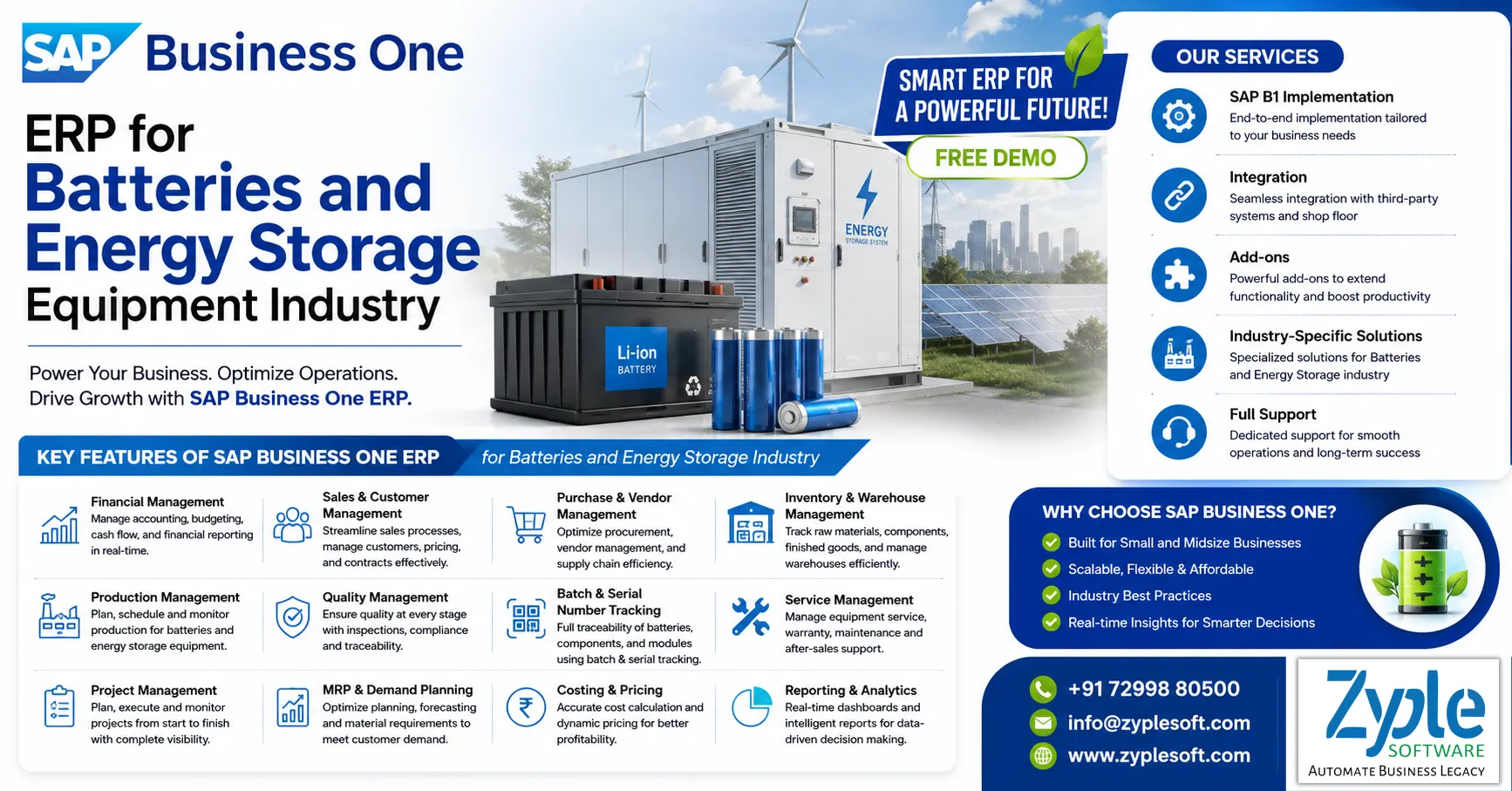
The batteries and energy storage equipment industry operates in a precision-driven and compliance-heavy environment. Even small gaps in production data or inventory tracking can lead to serious consequences like failed audits, delayed shipments, or costly rework. SAP Business One ERP for batteries and energy storage equipment unifies financials, multi-level bills of materials (BOMS), and supply chains into a single platform to accelerate production, track inventory, and maintain global safety compliance.
Challenges Faced By The Batteries and Energy Storage Equipment Industry
The battery and energy storage equipment industry faces significant challenges, including volatile raw material costs, supply chain vulnerabilities, and strict safety concerns. Furthermore, rapid technological degradation, regulatory uncertainities, and complex end-of-life recycling requirements continue to challenge large-scale global deployment.
1. Supply Chain Constraints and Material Sourcing
The industry depends heavily on essential materials like lithium, cobalt, nickel, and graphite. Geopolitical concentrations in mining and refining expose manufacturers to price volatility and supply disruptions.
2. Safety and Thermal Runaway
Large-scale battery and energy storage equipment systems present significant fire risks and thermal runaway, leading to insurance and zoning challenges. For instance, municipalities globally have occasionally installed moratoriums on lithium-ion facilities due to combustion and pollution.
3. Degradation and Lifespan
Batteries experience capacity fading and degradation over charge-discharge cycles. This demands frequent replacements and complex cell-balancing capabilities to ensure optimal pack performance over a 10-to-15-year operational span.
4. High Capital Costs and ROI Uncertainty
Despite falling cell prices, total auxiliary integration, engineering, and setup costs remain high. Investors face uncertainties regarding long-term profitability, specifically when participating in fluctuating energy arbitrage markets.
5. End-of-Life and Recycling
Handling discarded equipment is an escalating environmental issue. Recycling infrastructure for large utility-scale batteries becomes less potent, and improper disposal can lead to toxic chemical and heavy metal soil contamination.
6. Regulatory and Standard Gaps
A lack of uniform international codes, standardization across different chemistries, and clear grid-interconnection rules complicate smooth integration.
Features of SAP B1 ERP for Batteries and Energy Storage Equipment Business
1. Production and Manufacturing Management
- It includes multi-level bills of materials (BOM) for cells, modules, BMS, casing, and chemicals.
- It includes production orders and shop floor control for battery assembly and pack building.
- It includes material requirements planning (MRP) for raw materials like lithium, cobalt, and electrolytes.
- Batch production and formula management are essential for chemical mixing processes.
- It includes WIP (Work-in-Progress) tracking for multi-stage battery production.
- Yield, scrap, and rework management are essential for defect control.
- It includes capacity and resource planning for machines, labor, and production lines.
- Production costing, like standard vs. actual with real-time recalculation.
- It ensures efficient control over complex, multi-stage battery manufacturing.
2. Inventory and Warehouse Management
- It includes real-time tracking of raw materials, semi-finished, and finished goods.
- Batch and serial number tracking for traceability is essential for batteries.
- It includes multi-warehouse and bin location management.
- It includes expiry and shelf-life tracking for chemicals and cells.
- Stock valuation methods like FIFO, moving average, and standard costing.
- It includes automated stock movements during production and dispatch.
- It includes barcode and QR integration for warehouse operations.
- Important for safety, compliance, and traceability in battery manufacturing.
3. Quality Control and Compliance Management
- It includes incoming, in-process, and final quality inspections.
- It includes test result recording for voltage, capacity, and thermal stability.
- Quality certificates and compliance documentation like ISO, BIS, and IEC.
- It includes non-conformance and corrective action tracking.
- It includes audit trails for regulatory compliance.
- Helps achieve strict safety and environmental regulations.
4. Procurement and Supplier Management
- Vendor management for raw materials like lithium, nickel, separators, and more.
- It includes purchase planning based on MRP recommendations.
- It includes supplier price lists and contract management.
- It includes automated purchase orders and approvals.
- It includes import or export documentation handling.
- It includes supplier performance tracking.
- It includes stable sourcing in a volatile raw material market.
5. Sales, Distribution, and Customer Management
- End-to-end sales cycle from quotation, order, and delivery to invoice.
- OEM and B2B customer management for EV manufacturers, utilities, and more.
- After-sales service and warranty tracking are essential for batteries.
- It includes pricing management for bulk and contract sales.
- It includes demand forecasting for energy storage projects.
- CRM for handling long-term contracts and projects.
- It supports both industrial and project-based sales models.
6. Financial Management and Cost Control
- It includes general ledger, AP/AR, and banking integration.
- It includes project-based costing for energy storage installations.
- It includes budgeting and cost center tracking.
- Profitability per analysis per product, like battery type and capacity.
- It includes multi-currency support for global trade.
- Taxation and compliance like GST and international regulations.
- Helps handle thin margins and volatile input costs.
7. Advanced Analytics and Business Intelligence (BI)
- It includes real-time dashboards for production, inventory, and sales.
- KPI tracking like yield, efficiency, defect rate, and cost per unit.
- It includes predictive analytics for demand and procurement.
- It includes custom reports and drill-down analysis.
- It includes Excel integration for advanced reporting.
- Allows data-driven decision-making across operations.
8. Asset and Equipment Management
- It includes maintenance tracking for machinery and equipment.
- It includes downtime monitoring and preventive maintenance.
- It includes asset lifecycle management.
- It includes calibration tracking for testing equipment.
- Crucial for high-value battery production equipment.
9. Project Management
- It includes project planning for solar and storage or grid-scale deployments.
- It includes cost tracking per project.
- It includes resource allocation and scheduling.
- It includes milestone tracking and billing.
- Suitable for EPC companies and large-scale storage deployments.
10. Integration, Mobility, and Scalability
- It includes web client for remote access.
- It includes integration with IoT, BMS, and external systems.
- It includes cloud or on-premises deployment.
- It includes scalable architecture for a growing battery business.
Benefits of SAP Business One ERP for Batteries and Energy Storage Equipment Industry
The ERP software, SAP Business One (SAP B1) system, provides immense value to the battery and energy storage equipment industry by uniting engineering, procurement, production, and financials into one platform. It drives operational efficiency, improves complex supply chains, and ensures strict regulatory compliance and safety standards.
1. End-to-End Traceability
In the batteries and energy storage equipment industry, tracing individual components, chemical batches, and serial numbers is essential for safety and warranty management. SAP implementation tracks materials from supplier to customer, ensuring compliance and easy management of RMAs and recalls.
2. Intelligent Production and MRP
Material requirements planning (MRP) ensures you have the exact raw materials, like lithium, cell components, and inverters, required to meet production schedules without overstocking. This reduces idle time and optimizes the production ratio.
3. Real-Time Project and Job Costing
Engineering-to-order (ETO) companies can accurately estimate, track, and review profit margins. It delivers live visibility into labor, material overheads, and assembly costs, protecting profitability across large-scale energy projects using SAP solutions.
4. Stringent Quality Control
The system enables manufacturers to build incoming, in-process, and final quality checks directly into the routing operations. It documents testing procedures and blocks the movement or sale of non-compliant battery units.
5. Lifecycle and Service Management
The batteries and energy storage equipment industry involves ongoing evaluation. The SAP B1 system enables companies to track installed equipment, schedule preventive maintenance, and handle warranty lifecycles, minimizing downtime and reducing total cost of ownership.
Conclusion of Batteries and Energy Storage Equipment ERP
As an SAP Business One partner, Zyple Software is providing services like SAP B1 implementation, integration, licensing, add-ons, and support to different industries like construction, manufacturing, retail, pharma, aerospace, solar, jewellery, food and beverage, and textile industries. SAP Business One is an ERP designed for small and medium-sized businesses that integrates finance, purchasing, sales, inventory, production, CRM, and reporting into a single platform. For batteries and energy storage equipment or any other companies, it can improve project costing, procurement, subcontractor billing, and inventory management.
If you’re flexible, book a demo of SAP B1 ERP with Zyple Software team.
Do you demand the SAP B1 ERP software for your business or industry?
Finish all the details in the defined contact form; our team will get back to you.
Frequently Asked Questions
1.How can SAP Business One improve efficiency in my battery manufacturing business?
SAP Business One automates key processes like production planning, inventory management, and financial reporting. This reduces manual work, decreases errors, and improves overall operational efficiency, helping your business scale faster.
2.Is SAP Business One suitable for small and medium-sized energy storage companies?
Yes, SAP Business One is specifically customized for SMEs. It provides scalable features that grow with your business, making it ideal for startups and expanding battery and energy storage companies.
3.What kind of ROI can I expect from implementing SAP Business One?
Businesses generally see ROI through minimized operational costs, better inventory control, improved production efficiency, and faster decision-making with real-time insights.
4.Can I get a customized demo of SAP Business One for my battery business?
Yes, you can request a personalized demo customized for your manufacturing processes, helping you understand how the ERP fits your specific operational needs.
5.How do I get started with SAP Business One implementation?
You can begin by consulting a certified partner of SAP Business One like Zyple Software, who will evaluate your requirements, suggest the right solution, and guide you through implementation, training, and support.