40 Questions Every CEO Should Ask Before Buying SAP Business One ERP (2026 Buyer's Guide)
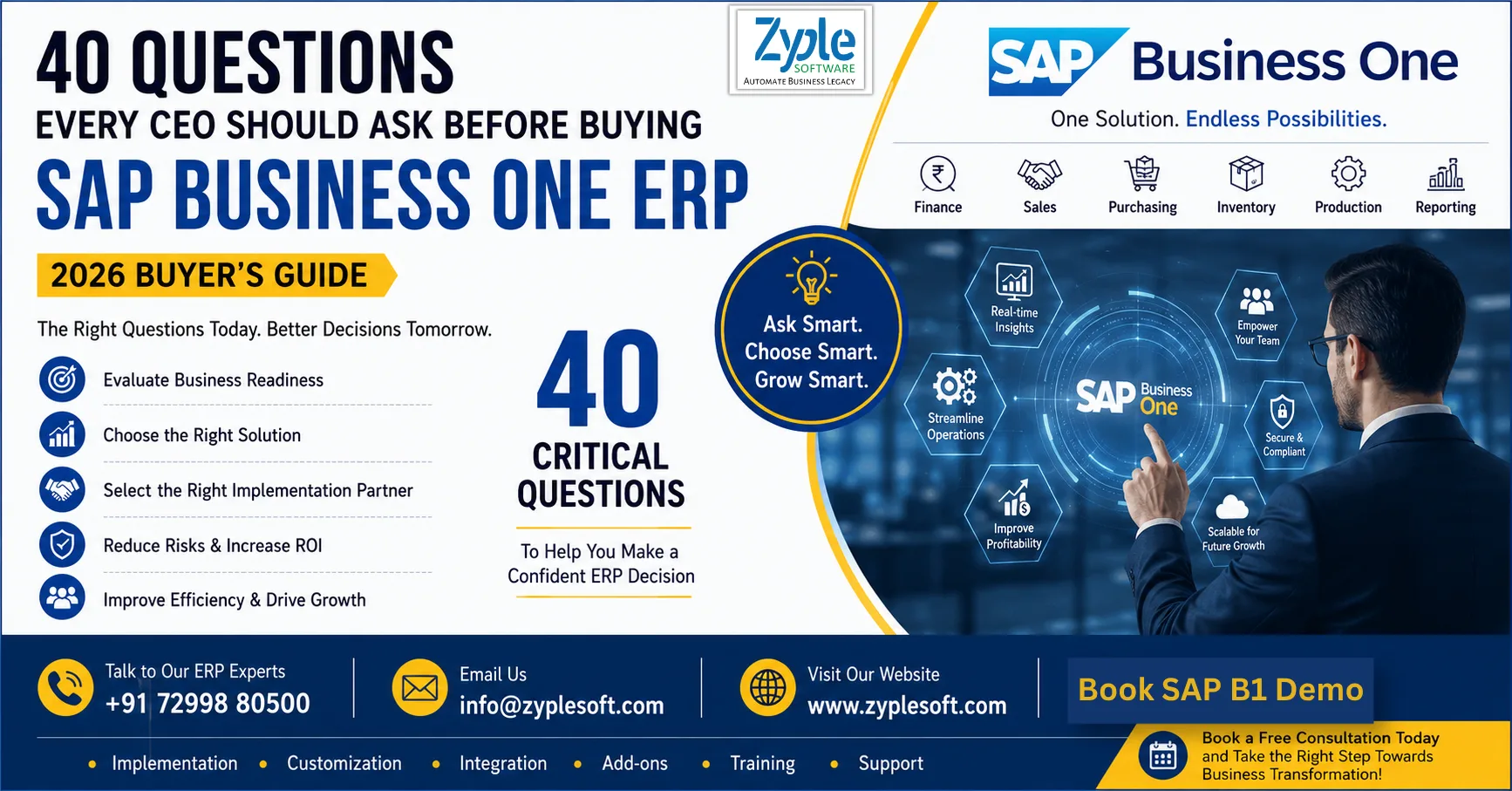
Thinking About Buying SAP Business One ERP? Read This First.
Choosing an Enterprise Resource Planning (ERP) solution is one of the most important business decisions you’ll make. Unlike purchasing office software or hardware, an ERP system becomes the foundation of your company’s finance, sales, purchasing, inventory, manufacturing, projects, customer service, and reporting.
A successful ERP implementation can improve efficiency, increase profitability, and provide complete visibility into your business. A poor implementation, however, can lead to cost overruns, low user adoption, delayed projects, and operational disruptions.
While SAP Business One is one of the world’s leading ERP solutions for small and medium-sized businesses, success depends on asking the right questions before signing the contract, not after implementation begins.
After working with companies across manufacturing, construction, engineering, trading, food processing, pharmaceuticals, and other industries, one thing becomes clear: organizations that evaluate their ERP investment carefully are more likely to achieve successful outcomes.
This guide presents 40 practical questions every CEO should ask before buying SAP Business One ERP. These questions are designed to help you evaluate your business readiness, implementation strategy, vendor selection, costs, and long-term return on investment.
Whether you’re replacing spreadsheets, upgrading from accounting software, or implementing SAP ERP for the first time, this guide will help you make a more informed decision.
Why ERP Projects Succeed or Fail?
Research and industry experience consistently show that ERP projects are more successful when organizations:
- Define clear business objectives.
- Involve leadership from the beginning.
- Choose an implementation partner with relevant industry experience.
- Prepare accurate master data.
- Train users effectively.
- Measure success using business KPIs.
Conversely, projects often struggle when companies:
- Focus only on software features.
- Choose the lowest-cost implementation partner.
- Underestimate change management.
- Skip process documentation.
- Rush implementation without proper planning.
The following questions are intended to help you avoid these common pitfalls.
Business Strategy and ERP Readiness
Question 1. Why do we need an ERP system now?
Before evaluating any software, define the business problem you’re trying to solve.
Common reasons include:
- Business growth has outpaced current systems.
- Too many manual processes.
- Inventory inaccuracies.
- Delayed financial reporting.
- Poor visibility into operations.
- Multiple disconnected software applications.
- Difficulty managing multiple branches or warehouses.
If your only reason is “everyone else is implementing ERP,” reconsider. A successful ERP project starts with clear business objectives.
Question 2. What business challenges should SAP Business One solve?
ERP should solve measurable business problems – not simply replace existing software.
Examples include:
- Manual purchase approvals
- Inventory mismatches
- Slow order processing
- Production delays
- Project cost overruns
- Duplicate data entry
- Lack of real-time reporting
List your top five operational challenges and prioritize them before evaluating ERP vendors.
Question 3. What are our business goals over the next five years?
Your ERP should support your future – not just your present.
Ask yourself:
- Will we open additional branches?
- Will production capacity increase?
- Will we export internationally?
- Will we expand into new product lines?
- Will we require better business analytics?
- Will we increase our workforce?
Choosing an ERP that can scale reduces future migration costs.
Question 4. Are our existing systems limiting growth?
Many SMEs rely on a combination of:
- Excel spreadsheets
- Accounting software
- Standalone inventory systems
- Manual production planning
- Separate CRM solutions
As businesses grow, these disconnected systems create duplicate work, inconsistent data, and delayed decision-making.
Ask yourself:
Are we managing our business or managing spreadsheets?
Question 5. Which departments will benefit most from ERP?
ERP is not just for finance.
It should improve collaboration across:
- Finance
- Sales
- Purchasing
- Inventory
- Warehouse
- Manufacturing
- Projects
- Customer Service
- Senior Management
The broader the adoption, the greater the long-term business value.
Business Process Evaluation
Question 6. Which processes consume the most employee time?
Time is money.
Identify repetitive manual activities such as:
- Purchase approvals
- Invoice creation
- Inventory reconciliation
- Production scheduling
- Sales reporting
- Customer follow-ups
These are often the first opportunities for automation.
Question 7. Which business processes create the highest operational costs?
Focus on activities that directly affect profitability.
Examples:
- Excess inventory
- Material wastage
- Production downtime
- Delayed procurement
- Manual reporting
- Emergency purchasing
- Rework due to inaccurate data
Reducing these costs often delivers a measurable ERP ROI.
Question 8. Can management access real-time information?
Ask yourself:
Can I see, right now,
- Today’s sales?
- Inventory availability?
- Outstanding receivables?
- Cash flow?
- Production status?
- Project profitability?
If the answer is no, decision-making becomes reactive rather than proactive.
One of the biggest strengths of SAP Business One is centralized, real-time business visibility.
Question 9. Is our business data accurate?
ERP is only as reliable as the data it contains.
Review your:
- Customer master
- Vendor master
- Item master
- Price lists
- Bills of Materials (BOM)
- Warehouse records
- Financial accounts
Data cleansing before implementation reduces errors and accelerates go-live.
Question 10. Are we relying too much on Excel?
Excel is a valuable business tool but it should not run your business.
Common risks include:
- Formula errors
- Multiple file versions
- No audit trail
- Manual consolidation
- Limited collaboration
- Inconsistent reporting
If critical decisions depend on spreadsheets maintained by a few individuals, it’s a sign your business may benefit from an integrated ERP system.
Leadership & Business Planning
Question 11. What KPIs should improve after ERP implementation?
ERP success should be measured using business outcomes.
Examples include:
- Inventory Accuracy
- On-Time Delivery
- Production Efficiency
- Gross Profit Margin
- Procurement Cycle Time
- Cash Flow
- Customer Satisfaction
- Financial Closing Time
Establish baseline metrics before implementation so you can measure improvement afterward.
Question 12. What ROI do we expect from SAP Business One?
Don’t focus only on implementation cost.
Evaluate expected benefits such as:
- Reduced inventory carrying costs
- Lower operational expenses
- Faster invoicing
- Better procurement planning
- Increased employee productivity
- Improved customer service
- Better management reporting
A successful ERP investment should create long-term business value.
Question 13. Are we prepared for organizational change?
ERP implementation changes the way people work.
Ask:
- Are employees ready for new processes?
- Do we have a training plan?
- Have department heads been involved?
- How will we communicate the change?
Technology succeeds when people adopt it.
Question 14. Do we have executive sponsorship?
ERP implementation requires active leadership.
The CEO should:
- Define business objectives.
- Approve major decisions.
- Remove organizational barriers.
- Monitor project progress.
- Promote user adoption.
Projects with visible executive involvement generally experience stronger alignment and accountability.
Question 15. Who will own the ERP project internally?
Every successful ERP implementation needs an internal project leader.
This person should:
- Coordinate departments.
- Work closely with the implementation partner.
- Track milestones.
- Manage internal communication.
- Escalate issues when needed.
- Ensure project timelines remain on track.
Without clear ownership, even well-planned ERP projects can lose momentum.
Evaluating SAP Business One ERP
Question 16. Is SAP Business One designed for businesses like ours?
Not every ERP solution is built for every organization.
SAP Business One is designed primarily for small and medium-sized enterprises (SMEs) that require enterprise-level capabilities while maintaining operational simplicity.
Ask yourself:
- Are we an SME planning to scale?
- Do we need better financial visibility?
- Are multiple departments using different software?
- Do we require integrated reporting?
- Will ERP support our growth for the next 7–10 years?
Choosing software that matches your company’s size and complexity helps avoid unnecessary implementation costs and future migrations.
Question 17. Does SAP Business One support our industry?
Industry expertise matters.
A manufacturing company has different requirements than a construction contractor or wholesale distributor.
Before selecting SAP Business One, ask your implementation partner whether they have experience in your industry.
Examples include:
Manufacturing
- Bill of Materials (BOM)
- Material Requirement Planning (MRP)
- Production Orders
- Quality Control
- Batch Management
Construction & EPC
- Project Costing
- Budget Management
- Contractor Billing
- Work-in-Progress (WIP)
- Equipment Tracking
Trading & Distribution
- Multi-Warehouse Management
- Inventory Planning
- Procurement
- Barcode Integration
- Customer Pricing
A partner who understands your industry can recommend proven workflows instead of unnecessary customizations.
Question 18. Can SAP Business One grow with our business?
Your ERP should support future expansion without requiring replacement.
Evaluate whether it can handle:
- Additional users
- New branches
- Multiple warehouses
- Higher transaction volumes
- New business units
- International operations
- Multiple legal entities
A scalable ERP protects your investment as your organization grows.
Question 19. Should we choose SAP Business One HANA or SQL?
One of the first technical decisions involves selecting the database platform.
SAP HANA
Best suited for businesses that require:
- Faster reporting
- Real-time analytics
- Large data processing
- Advanced dashboards
Microsoft SQL
Often appropriate for businesses looking for:
- Lower infrastructure investment
- Familiar database technology
- Reliable transactional performance
The right choice depends on your reporting needs, IT strategy, budget, and expected business growth.
Question 20. Should we choose Cloud or On-Premise deployment?
Deployment strategy affects cost, security, accessibility, and IT management.
Cloud Deployment
Advantages include:
- Lower infrastructure investment
- Remote accessibility
- Automatic backups
- Easier scalability
- Reduced IT maintenance
On-Premise Deployment
Advantages include:
- Greater infrastructure control
- Internal hosting
- Organization-specific security policies
- Integration with existing local systems
Discuss both options with your implementation partner before making a decision.
Never rely on a generic presentation. Request an industry-specific SAP Business One Demo using your own products, customers, and business workflows. A personalized demonstration helps management evaluate whether the solution fits real operational requirements.
Functional Capabilities
Question 21. Does SAP Business One cover all our core business processes?
Create a checklist of every process your organization performs daily.
Typical modules include:
- Financial Management
- Sales
- Purchasing
- Inventory Management
- CRM
- Production
- Project Management
- Service Management
- Fixed Assets
- Banking
- Reporting
Any missing functionality should be identified before implementation begins.
Question 22. Can SAP Business One automate repetitive tasks?
Automation reduces manual work and minimizes human error.
Examples include:
- Purchase approvals
- Sales approvals
- Inventory replenishment
- Email notifications
- Credit limit approvals
- Payment approvals
- Workflow alerts
Automation improves productivity while increasing operational consistency.
Question 23. Does SAP Business One provide real-time reporting?
Executives should not wait until month-end to understand business performance.
Ask whether the system provides dashboards for:
- Sales
- Inventory
- Cash Flow
- Accounts Receivable
- Accounts Payable
- Profitability
- Production
- Projects
Real-time visibility enables faster and more informed decisions.
Question 24. Can it integrate with our existing software?
Many businesses extend SAP Business One with industry-specific SAP Business One Add-ons for payroll, contractor billing, weighbridge integration, WhatsApp, barcode systems, fleet management, and manufacturing execution systems (MES).
Most businesses already use multiple applications.
Examples include:
- Payroll
- HRMS
- Banking
- CRM
- E-commerce
- Barcode Systems
- Power BI
- Microsoft 365
- Manufacturing Execution Systems (MES)
Understanding integration capabilities early helps avoid future surprises.
Question 25. Can SAP Business One support mobile users?
Business decisions no longer happen only from office desktops.
Ask whether managers can:
- Approve purchase requests
- Review dashboards
- Access customer information
- Monitor inventory
- View financial reports
- Track project progress
Mobile accessibility improves responsiveness and supports distributed teams.
Security & Compliance
Question 26. How secure is SAP Business One?
Business information is one of your most valuable assets.
Evaluate:
- User permissions
- Role-based security
- Approval workflows
- Audit trails
- Password policies
- Data backups
- Disaster recovery
A secure ERP helps protect sensitive financial and operational data.
Question 27. Does SAP Business One support statutory compliance?
For businesses operating in India or internationally, compliance is critical.
Ask your implementation partner about support for:
- GST
- E-Invoicing
- E-Way Bills
- Tax reporting
- Financial audits
- Regulatory reporting
Compliance requirements should be discussed before implementation – not after go-live.
Question 28. Can we customize SAP Business One without creating upgrade issues?
Every business has unique processes.
However, excessive customization may increase implementation complexity and future maintenance.
Ask:
- Can this requirement be handled through configuration?
- Is customization really necessary?
- Will upgrades remain straightforward?
The goal should be to use standard functionality wherever possible and customize only where it delivers clear business value.
Technology & Future Readiness
Question 29. Can SAP Business One support our digital transformation strategy?
ERP should be more than a replacement for existing software.
It should support future initiatives such as:
- AI-powered reporting
- Business Intelligence
- IoT integrations
- Paperless approvals
- Digital workflows
- Advanced analytics
- Customer portals
- Supplier portals
A future-ready ERP enables continuous innovation.
Question 30. What should we evaluate during a live SAP Business One demonstration?
A product demonstration should focus on your business – not generic slides.
Ask the consultant to demonstrate:
- Sales Order to Delivery process
- Purchase workflow
- Inventory transactions
- Production planning
- Project costing
- Financial reporting
- Dashboard creation
- Approval workflows
- Mobile application
- Industry-specific scenarios
Whenever possible, request the demo using examples from your own business.
This helps determine whether SAP Business One can support your actual operations rather than theoretical workflows.
Choosing the Right SAP Business One Implementation Partner
Question 31. Is the implementation partner experienced in our industry?
This question is often more important than the software itself.
Ask the implementation partner:
- Have you implemented SAP Business One for businesses similar to ours?
- Do you understand our manufacturing or construction processes?
- Can you demonstrate industry workflows?
- Can you explain common challenges?
For example:
A manufacturing company should expect demonstrations covering:
- BOM
- MRP
- Production Orders
- Production Costing
- Quality Management
A construction company should expect demonstrations covering:
- Project Costing
- Budget Control
- BOQ
- Contractor Billing
- Equipment Management
- Work-in-Progress
Industry experience reduces project risks and shortens implementation time.
Question 32. Can the partner provide real customer references?
Ask to review SAP Business One Success Stories from businesses similar to yours. Case studies demonstrating measurable improvements in inventory accuracy, financial reporting, or production efficiency provide stronger evidence than marketing brochures alone.
Every implementation partner claims they are experienced.
Ask for proof.
Request:
- Customer case studies
- Client references
- Video testimonials
- Industry-specific success stories
- Go-live examples
If possible, speak directly with an existing customer.
Ask questions such as:
- Was the implementation completed on time?
- Was the budget maintained?
- How responsive is support?
- Would you choose the same partner again?
These conversations often reveal more than a sales presentation.
Question 33. What is included in the implementation cost?
One of the biggest mistakes companies make is comparing only software prices. Understanding SAP Business One Pricing requires evaluating licenses, implementation services, training, integrations, support, and future scalability – not just the initial investment.
ERP pricing should be transparent.
Ask for a detailed proposal covering:
- Software licenses
- Implementation services
- Data migration
- User training
- Reports
- Dashboards
- Integrations
- Customization
- Go-live support
- Documentation
Understanding the complete scope helps avoid misunderstandings later.
Question 34. What ongoing support is available after Go-Live?
Long-term success depends on reliable SAP Business One Support, including issue resolution, system health checks, user assistance, upgrades, and continuous process optimization.
Go-live is the beginning of your ERP journey – not the end.
Clarify:
- Support hours
- Response times
- Issue escalation
- Annual Maintenance Contract (AMC)
- Version upgrades
- User assistance
- Remote support
- On-site support (if required)
Reliable post-implementation support is essential for long-term success.
Question 35. How will success be measured?
Many ERP projects finish on schedule but fail to improve business performance.
Define measurable KPIs before implementation.
Examples include:
- Inventory Accuracy above 98%
- Month-end closing reduced from 10 days to 3 days
- Procurement approval time reduced by 60%
- Production planning accuracy improved
- Customer order processing time reduced
- Improved cash flow visibility
Measure business outcomes – not just project completion.
Common Mistakes CEOs Make Before Buying ERP
Even experienced business leaders sometimes underestimate ERP implementation.
Here are ten common mistakes to avoid.
Mistake 1
Choosing the lowest-priced implementation partner instead of evaluating expertise and industry experience.
Mistake 2
Focusing only on software features rather than business objectives.
Mistake 3
Underestimating user training and change management.
Employees need time, training, and support to adopt new systems successfully.
Mistake 4
Ignoring data quality before implementation.
Incorrect master data leads to inaccurate reports and operational issues.
Mistake 5
Expecting ERP to solve inefficient business processes without process improvement.
ERP supports good processes – it doesn’t automatically fix poor ones.
Mistake 6
Customizing everything instead of using standard functionality.
Excessive customization increases complexity and future maintenance.
Mistake 7
Not involving department heads in the evaluation process.
ERP impacts finance, purchasing, sales, warehouse, production, and management.
Cross-functional involvement improves implementation success.
Mistake 8
Not defining measurable business goals.
If success isn’t defined before implementation, it becomes difficult to measure ROI afterward.
Mistake 9
Selecting ERP without considering future business growth.
Choose software that supports expansion, additional users, multiple branches, and new business opportunities.
Mistake 10
Treating ERP as an IT project instead of a business transformation initiative.
Successful ERP projects are driven by business leadership—not just technology teams.
CEO ERP Decision Checklist
Before approving your SAP Business One investment, confirm the following.
Business Readiness
- Clear business objectives defined
- Current operational challenges documented
- Future growth plans identified
- Executive sponsorship established
Software Evaluation
- SAP Business One fits our industry
- Required modules are available
- Integration requirements confirmed
- Cloud or On-Premise deployment selected
- Security requirements reviewed
Implementation Planning
- Implementation scope documented
- Timeline agreed
- Budget approved
- Data migration strategy finalized
- User training planned
Partner Evaluation
- Industry experience verified
- Customer references checked
- Support services reviewed
- Implementation methodology understood
- Long-term partnership evaluated
Final Thoughts
Buying SAP Business One ERP is not simply purchasing software but it’s investing in the future of your business.
The right ERP can help you:
- Improve operational efficiency
- Increase profitability
- Gain real-time business visibility
- Standardize business processes
- Support informed decision-making
- Scale confidently as your organization grows
However, software alone doesn’t guarantee success.
The combination of clear business objectives, committed leadership, high-quality data, user adoption, and an experienced implementation partner has the greatest influence on project outcomes.
By answering these 40 questions, CEOs can evaluate ERP opportunities more effectively, reduce implementation risks, and make decisions aligned with their long-term business strategy.
Frequently Asked Questions
Is SAP Business One suitable for manufacturing companies?
Yes. SAP Business One supports manufacturing with features such as Bill of Materials (BOM), Material Requirements Planning (MRP), Production Orders, Batch Management, and Production Costing. Many manufacturers also extend it with industry-specific add-ons where required.
Can SAP Business One manage construction projects?
Yes. Construction and EPC companies commonly use SAP Business One for project costing, procurement, budgeting, contractor billing, inventory management, and financial reporting. Additional functionality may be provided through specialized add-ons depending on project requirements.
How long does SAP Business One implementation take?
Implementation time depends on company size, business complexity, and project scope. Many small to medium-sized projects are completed within a few months, while larger, multi-location implementations may require additional time.
What is the biggest reason ERP projects fail?
Common reasons include unclear business objectives, poor data quality, insufficient user training, limited executive involvement, and selecting an implementation partner without relevant industry experience.
How do I choose the right SAP Business One implementation partner?
Look for an authorized SAP partner with experience in your industry, proven customer references, a structured implementation methodology, transparent pricing, and reliable post-go-live support.
Conclusion
Selecting the right ERP is one of the most important strategic decisions for any growing business. Rather than focusing only on software features or pricing, CEOs should evaluate business readiness, implementation approach, long-term scalability, and partner expertise.
SAP Business One can support finance, sales, purchasing, inventory, manufacturing, projects, and analytics within a single integrated platform. When combined with clear planning and an experienced implementation partner, it can help organizations improve operational performance and support sustainable growth.
If you’re evaluating SAP Business One for your organization, use these 40 questions as a practical framework for discussions with your leadership team and potential implementation partners.
About Zyple Software
Zyple Software is an SAP Business One partner helping organizations streamline business operations through ERP solutions, industry-specific add-ons, system integration, implementation services, and ongoing support.
Whether you’re in manufacturing, construction, engineering, trading, or another industry, the first step is understanding your business processes and identifying the ERP approach that best fits your goals.
Book a Free SAP Business One Consultation
During your consultation, you can:
- Review your current business processes
- Discuss ERP readiness
- Explore industry-specific SAP Business One demonstrations
- Understand implementation timelines
- Review implementation considerations
- Learn about relevant SAP Business One add-ons
Contact Zyple Software
- Website: www.zyplesoft.com
- Email: info@zyplesoft.com
- Phone: +91 72998 80500
CEO ERP Evaluation Comparison Table
Before investing in SAP Business One ERP, use this checklist to evaluate your organization's readiness and ensure you're asking the right questions during the selection process.
| Evaluation Area | Question to Ask | Why It Matters |
|---|---|---|
| Business Goals | Have we clearly defined why we need an ERP system? | Ensures the ERP project aligns with business objectives instead of simply replacing existing software. |
| Industry Fit | Does SAP Business One support our industry-specific processes? | Reduces unnecessary customization and speeds up implementation. |
| Implementation Partner | Does the implementation partner have proven experience in our industry? | Experienced partners reduce project risks and improve implementation success. |
| Deployment | Should we choose Cloud or On-Premise deployment? | Impacts infrastructure costs, accessibility, security, and long-term scalability. |
| Integration | Can SAP Business One integrate with our existing applications? | Eliminates duplicate data entry and improves operational efficiency. |
| Data Migration | Is our business data clean and ready for migration? | High-quality master data leads to smoother implementation and accurate reporting. |
| User Adoption | Have we planned user training and change management? | Well-trained employees increase ERP adoption and maximize ROI. |
| Implementation Cost | Do we understand the complete implementation cost? | Helps avoid unexpected expenses during the project lifecycle. |
| Support | What post-Go-Live support will we receive? | Reliable support ensures long-term business continuity and continuous improvement. |
| Return on Investment | How will we measure ERP success after implementation? | Defines measurable KPIs such as productivity, profitability, inventory accuracy, and reporting efficiency. |