Tag Archives: zyple software

SAP Business One ERP for Medical Device and Equipment industry

SAP Business One for Medical Device and Equipment Industry

SAP Business One ERP for Medical Device and Equipment Industry
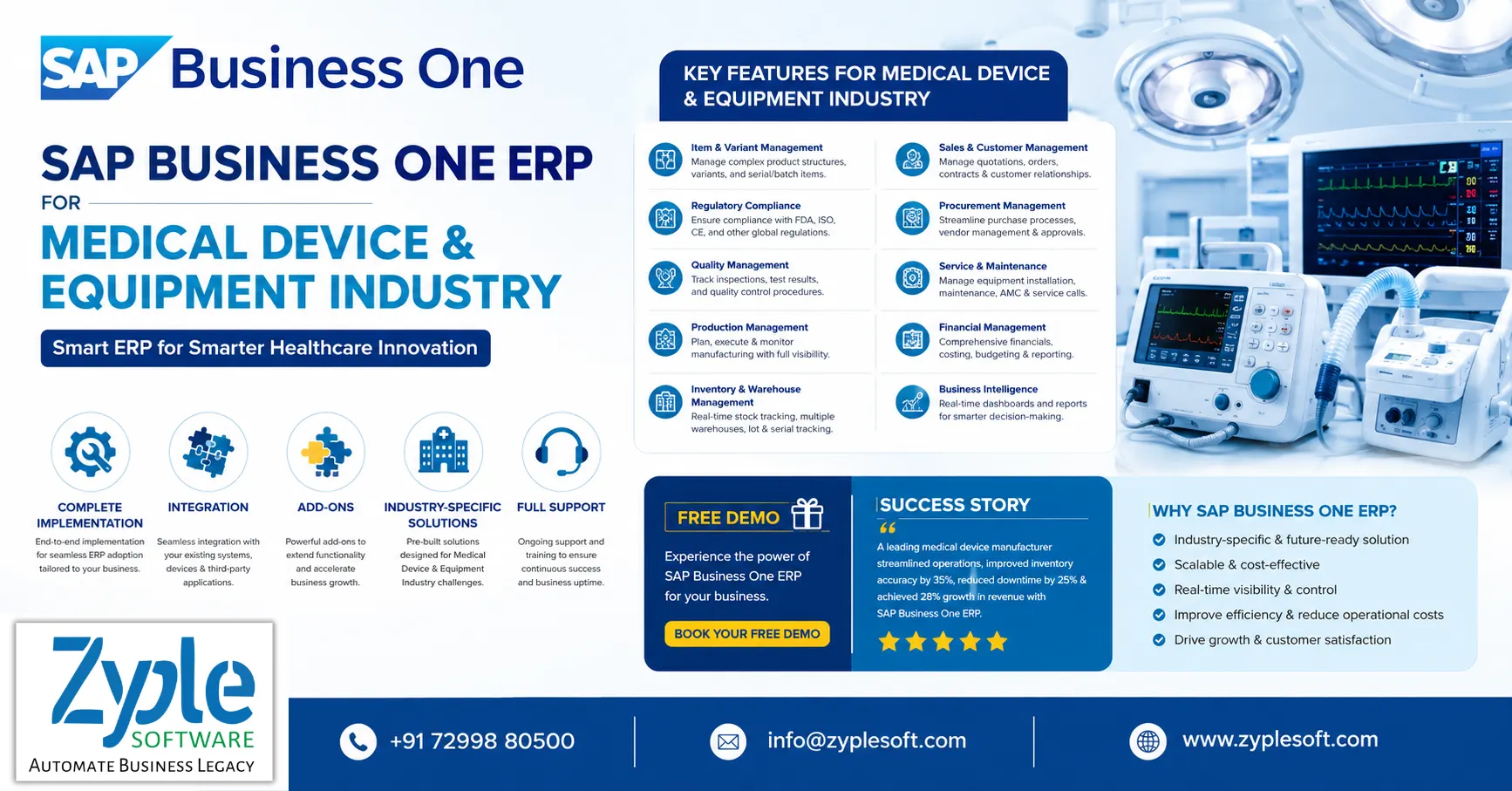
SAP Business One ERP for Medical Device and Equipment industry

The medical device and equipment industry has strict regulatory requirements that must be achieved in terms of product safety, documentation, and traceability. It is important that the medical device and equipment industry complies with the global standards such as FDA regulations, ISO certifications, and quality management standards. SAP Business One for medical device and equipment helps the medical device and equipment industry to operate effectively while ensuring full compliance and traceability.

Challenges Faced By The Medical Device and Equipment Industry

1. Strict Regulatory Compliance

Localizing products across different international markets increases the complexity and traceability burden.

2. Supply Chain and Sourcing Issues

The industry remains vulnerable to global supply chain disruptions and inflationary pressures, which significantly reduces profit margins. Also, many regions, including heavily importing markets in India, face high import duties on raw materials and a lack of local suppliers for specialized components.

3. Cybersecurity and Data Privacy

As medical devices increasingly connect with the software, internet connectivity, and electronic health records, they become prime targets for cyberattacks. Manufacturers are tasked with embedding powerful data security and HIPAA-compliant features to protect patient data while maintaining device functionality.

4. High Costs and Reimbursement Uncertainty

Developing practical, science-backed devices requires huge capital outlays for prototyping and clinical trials. Even after securing product clearance, manufacturers face obstacles in delivering cost-effectiveness to healthcare providers to ensure product reimbursement.

5. Rapid Technological Obsolescence

The fast-paced integration of artificial intelligence (AI), IoT, and big data into patient care creates pressure on manufacturers to continuously update, maintain, and upgrade computerized systems while preventing hardware or software failure.

Features of SAP Business One ERP for Medical Device and Equipment

1. Regulatory Compliance and Quality Management

  • It includes end-to-end quality control across procurement, production, and delivery.
  • It includes ISO and regulatory compliance support with audit trails and documentation.
  • It includes quality inspections and approvals at multiple stages.
  • It includes non-conformance and CAPA (Corrective Action) tracking.
  • It includes document management for SOPs and certifications.
  • It includes audit-ready reporting and traceability.
  • It ensures compliance with global medical standards and minimizes risk.

2. Batch, Serial, and End-to-End Traceability

  • It includes batch and serial number tracking for every component and finished device.
  • It includes full product genealogy (forward and backward traceability).
  • It includes “where-used” tracking for components and assemblies.
  • It includes expiry and shelf management.
  • It includes recall management with instant trace reports.
  • Allows complete transparency from raw material to patient delivery.

3. Product Lifecycle

  • It includes engineering change management (ECN or ECO).
  • It includes version and revision control for products.
  • It includes product lifecycle tracking from design and prototype to production.
  • It includes integration with CAD and PLM systems.
  • Helps handle innovation while maintaining compliance.

4. Production Planning and Manufacturing Control

  • It includes advanced planning and scheduling (APS).
  • It includes work order and shop floor control.
  • It includes capacity planning like machines, labor, and tools.
  • It includes real-time production tracking.
  • Costing methods like material, labor, and overhead.
  • It improves efficiency and minimizes production delays.

5. Project Management for Device Development

  • It includes budget tracking and cost control.
  • It includes milestone and stage tracking.
  • It ensures new product development stays on time and budget.

6. Inventory and Warehouse Management

  • It includes multi warehouse management.
  • It includes real-time stock visibility.
  • It includes bin or location management.
  • It includes batch-controlled inventory.
  • It includes automated replenishment and demand planning.
  • It includes integration with procurement and finance.
  • Minimizes stockouts, overstock, and expired inventory.

7. Procurement and Supplier Management

  • It includes vendor qualification and evaluation.
  • It includes purchase order automation.
  • It includes supplier performance tracking.
  • It includes approval workflows for procurement.
  • It includes compliance tracking for suppliers.
  • It maintains high-quality supplier networks.

8. Sales, Distribution, and CRM

  • It includes customer lifecycle management (CLM).
  • The entire sales cycle from quotation, order, and delivery to invoicing flows.
  • It includes contract and pricing management for hospitals and clinics.
  • It includes after-sales and warranty management.
  • It includes service calls and maintenance tracking.
  • Improves customer satisfaction and service quality.

9. Service and Equipment Maintenance Management

  • It includes installed base tracking (devices at customer locations).
  • It includes warranty and AMC (Annual Maintenance Contract) management.
  • It includes service scheduling and technician assignment.
  • It includes spare parts management.
  • It includes service history tracking.
  • It improves after-sales service and recurring revenue.

10. Financial Management and Cost Control

  • It includes cost accounting and product costing.
  • It includes budgeting and financial forecasting.
  • It includes multi-currency and global compliance.
  • It includes profitability analysis by product or device.
  • Delivers complete financial visibility and control.

11. Business Intelligence and Real-Time Analytics

  • It includes real-time dashboards and KPIs.
  • It includes custom reports and analytics.
  • It includes drill-down reporting.
  • It includes predictive insights for demand and production.
  • It helps management make faster, better decisions.

12. Integration and Automation Capabilities

  • It includes integration with CAD, PLM, MES, and IoT devices.
  • It includes machine and PLC integration.
  • It includes third-party system connectivity like e-commerce and logistics.
  • It includes workflow automation and alerts.
  • Allows digital transformation and smart factories.

13. Mobility and Cloud Access

  • It includes web-based access (anytime, anywhere).
  • It includes real-time approvals and alerts.
  • It keeps teams connected on the go.

Benefits of SAP Business One ERP for Medical Device and Equipment

The enterprise resource planning (ERP) software, SAP Business One (SAP B1) system, facilitates compliance, automates supply chains, and optimizes inventory. It delivers medical device and equipment companies with strict regulatory adherence (FDA/ISO) and end-to-end serial and lot traceability, allowing businesses to minimize operational costs and scale operations profitably.

1. Strict Regulatory Compliance

Provides built-in compliance and quality management tools to meet thorough FDA regulations and ISO standards. Eliminates manual errors by ensuring secure assessment of product versions, revisions, and compliance documentation.

2. End-to-End Traceability

Captures serial numbers and lot numbers for raw materials, sub-assemblies, and finished devices using SAP implementation. Traces every component forward and backward through the supply chain to execute rapid, targeted product recalls if an issue arises.

3. Advanced Inventory and Supply Chain Control

Monitors high-value components and devices in real-time across multiple warehouse locations. Automates reorder points and supplier management to prevent shortages of essential medical parts.

4. Financial Transparency and Growth

Unifies manufacturing, purchasing, sales, and financials into one system. Grows with the business, allowing expansion into new markets while maintaining cost control and profit margin visibility using SAP solutions.

Conclusion of Medical Device and Equipment ERP

Zyple Software is the best SAP Business One partner in India specializing in implementation, digital transformation, licensing, integration, add-on solutions, migration, and consulting for the medical device and equipment industry. By adopting a powerful ERP solution like SAP software, the organization can ensure compliance with regulatory norms, complete traceability of the product, and efficient operation of the manufacturing processes.

If you’re appointed, book a demo of SAP Business One.

Do you demand the SAP Business One ERP solution for your business or industry?

Complete all the details in the allotted contact form; our team will reach out to you.
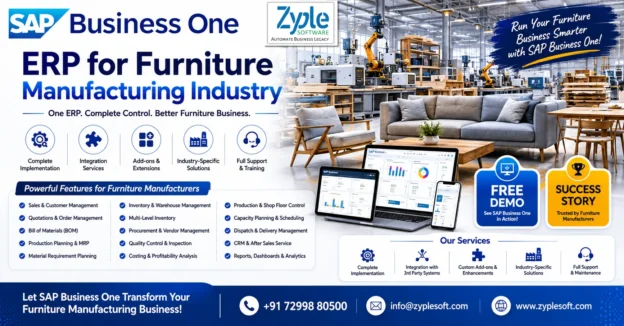
    SAP Business One ERP for Furniture Manufacturing Industry

    SAP Business One for Furniture Manufacturing Industry

    SAP Business One ERP for Furniture Manufacturing Industry

    SAP Business One ERP for Furniture Manufacturing Industry

    The furniture manufacturing industry is increasingly pressurized by price sensitivity, volatile raw material costs, labor demands, and customer requirements. The businesses in the furniture manufacturing industry need an ERP solution to overcome these challenges. SAP Business One ERP for furniture manufacturing bridges the gap in the furniture manufacturing industry by prompting innovation to grow sales and facilitate the supply chain.

    Challenges Faced By The Furniture Manufacturing Industry

    1. Fluctuating Material Prices

    Volatile pricing for timber, fabric, resin, and metal strains profitability and makes it difficult to maintain stable consumer pricing.

    2. Skilled Labor Shortages

    An aging workforce and a decline in vocational training have led to lack of skilled craftsmen, woodworkers, and upholsterers.

    3. Supply Chain Bottlenecks

    Heavy dependence on global shipping leaves manufacturers vulnerable to logistical delays and freight cost fluctuations.

    4. Shifting Consumer Demands

    Consumers expect faster delivery times, increased product customization, and seamless omnichannel buying experiences, putting pressure on typical inventory models.

    5. Intense Global Competition

    Local manufacturers face high competition from overseas markets that benefit from lower labor costs and government subsidiaries.

    Features of SAP Business One ERP for Furniture Manufacturing

    1. Production and Manufacturing Management

    • It includes multi-level BOM for components like wood, hardware, and upholestery with revision control.
    • Creates and tracks custom furniture orders (made-to-order or batch production).
    • Auto-calculates raw material needs based on demand forecasts.
    • Optimizes machine and labor usage.
    • Monitors real-time production progress and WIP.
    • Defines processes like cutting, polishing, and finishing.
    • Suitable for customized furnitures.
    • Minimizes wood wastage and optimizes material usage.

    2. Inventory and Warehouse Management

    • It includes raw materials, WIP, and finished goods.
    • Tracks wood batches, fittings, and finished items.
    • Handles multiple storage locations.
    • It includes efficient storage of wood panels and components.
    • Stock transfers between production units and warehouses.
    • Faster stock handling and picking using barcode integration.
    • Inventory valuation methods like FIFO, moving average, and standard costing.

    3. Procurement and Supplier Management

    • Automates raw material procurement.
    • Maintains vendor details for timber, hardware, and fabrics.
    • Optimizes procurement costs.
    • Handles incoming materials efficiently.
    • Manages imported materials and compliance.

    4. Financial Management and Cost Control

    • Complete accounting automation using a general ledger, accounts payable, and accounts receivable.
    • Tracks cost per furniture item (materials, labor, and overhead).
    • It includes budgeting and cash flow management.
    • Fixed asset management includes machines, tools, and factory equipment.
    • It includes banking and reconciliation.
    • It includes multi-currency and tax compliance (GST-ready).
    • Profitability analysis includes per product, project, and consumer.

    5. Sales and Customer Relationship Management (CRM)

    • Handles custom order furnitures.
    • Customer database includes store design preferences and past orders.
    • It includes pricing and discount management.
    • It includes order tracking and delivery scheduling.
    • It includes after-sales service and warranty management.
    • Marketing campaign management promotes furniture collections.

    6. Business Intelligence and Reporting

    • Real-time dashboards and KPIs for production, sales, and inventory insights.
    • Custom reports for sales trends, inventory aging, and production efficiency.
    • Interactive analytics for drilling down into operations.
    • It includes forecasting and demand planning.
    • It includes Excel integration for data analysis.

    7. Quality Control and Compliance

    • Quality inspection at each stage for raw material, production, and finishing.
    • It includes defect tracking and rework management.
    • Compliance management like industry and export standards.
    • It includes automated quality reports and certificates.

    8. Supply Chain and Logistics

    • It includes order fulfillment management.
    • It includes delivery and dispatch planning.
    • Logistics tracking from factory to showroom or customer.
    • It includes export documentation manager.
    • It includes demand-supply synchronization.

    9. Project Management (Custom Furniture Projects)

    • Project-based manufacturing for interior or bulk orders.
    • It includes cost and resource tracking per project.
    • It includes timeline and milestone management.
    • It includes integration with production and finance.

    10. Mobility and Integration

    • Mobile app access of sales, inventory, and approvals on-the-go.
    • It includes web client access.
    • E-commerce integration for online furniture sales.
    • Third-party add-ons for advanced furniture-specific needs.

    11. Furniture Industry-Specific Capabilities

    • Variant configurations like size, color, and material combinations.
    • Cutting optimization reduces wood wastage.
    • It includes upholstery and fabric tracking.
    • It includes design-to-production integration.
    • It includes a make-to-stock and make-to-order hybrid models.
    • It includes dealer and distribution management.
    • It includes showroom and retail integration.

    12. Automation and Workflow Management

    • Approval workflows for purchase, production, and finance.
    • Alerts and notifications for low stock, delays, and approvals.
    • Document management for drawings, invoices, and production sheets.
    • Process automation reduces manual errors and delays.

    Importance of SAP Business One ERP for Furniture Manufacturing

    The ERP software, SAP Business One (SAP B1) system, is an essential ERP solution for furniture manufacturers, centralizing core processes like inventory tracking, multi-level bills of materials (BOMs), and supply chain management. It improves resource allocation, minimizes material waste, and ensures smooth, made-to-order production scaling.

    1. Multi-Level Bill of Materials (BOM)

    Furniture manufacturing involves complex component tracking, from raw timber, hardware, and fabrics to sub-assemblies. SAP B1 handles these hierarchical BOMs seamlessly to ensure accurate material consumption and costing.

    2. Made-To-Order and Customization

    The furniture manufacturing industry heavily depends on custom orders and varying dimensions. SAP B1 tracks specific customer configurations, connecting sales orders directly to custom production tickets and purchasing.

    3. Material Requirements Planning (MRP)

    MRP automates purchasing decisions by analyzing lead times, fluctuating seasonal demands, and existing stock levels. This eliminates overstocking and prevents expensive production delays.

    4. Real-Time Inventory and Warehouse Management

    Gain granular, real-time visibility across multiple showrooms, workshops, and warehouses. This helps you track the movement of raw materials and finished goods, reducing surplus or shortages using SAP implementation.

    5. Shop Floor Control and Efficiency

    Facilitates routing, coordinates assembly and finishing processes, and tracks labor hours to ensure economical production cycles.

    6. Integrated CRM and After-Sales Cycle

    Handles the entire customer lifecycle, from initial showroom quotation and pricing analysis to delivery scheduling, installation tracking, and after-sales warranty support.

    Benefits of SAP Business One for Furniture Manufacturing

    SAP Business One drives efficiency in furniture manufacturing by facilitating complex processes like bills of materials (BOM), material requirements planning (MRP), and shop-floor routing. It helps manufacturers improve lumber and hardware inventory, minimize material waste, and accelerate production.

    1. Advanced Production Planning

    Easily handles complex product structures, tracking different types of wood, upholstery, hardware, and sub-assemblies. Schedules, tracks, and manages production steps from cutting and assembling to finishing and packaging. Integrates with shop floor machines and barcode systems to automate data capture and reduce human error.

    2. Facilitated Inventory and Procurement

    Automatically calculates material needs depending on sales orders, production schedules, and supplier lead times. Tracks stock levels of bulk materials, avoiding explosive raw material shortages or excess surpluses. Handles supplier relationships, automates purchase orders, and monitors raw material costs in real-time.

    3. Cost Control and Quality Management

    Optimizes raw material utilization (e.g., increasing wood yield) to directly reduce production costs. Maintains strict quality control checks, tracks defects, and enforces compliance standards throughout the production lifecycle.

    4. Real-Time Insights and Scalability

    Uses dashboards to track key performance indicators (KPIs) like production throughput, labor efficiency, and order backlogs using SAP solutions. Easily add new users, integrates with e-commerce platforms, or scale production capacity as your furniture business grows.

    Conclusion of Furniture Manufacturing ERP

    Zyple Software is a Top SAP Business One partner in India specializing in implementation, digital transformation, licensing, integration, add-on solutions, migration, and consulting for the furniture manufacturing industry. By implementing SAP software, furniture manufacturers gain a unified platform to manage sales, inventory, procurement, deliveries, finance, and customer relationships with complete visibility and control.

    If you’re interested, schedule a demo of SAP Business One.

    Do you demand the SAP Business One ERP system for your business or industry?

    Complete all the details in the allotted contact form; our team will return to you.

      SAP Business One ERP for Computer and IT Hardware industry

      SAP B1 for Computer and IT Hardware Industry

      SAP Business One ERP for Computer and IT Hardware industry

      SAP Business One ERP for Computer and IT Hardware industry

      As the computer and IT hardware industry grows exponentially, it has become tedious and challenging to handle multiple operations all around the world, along with the business processes. Moreover, with a large industry like computer and IT hardware, integrating different departments and tackling any issues that occurred also requires so much time and effort. SAP Business One ERP for computer and IT hardware not only increases efficiency but also helps to improve the quality of products in the computer and IT hardware industry. The key purpose of facilitating the complex and multiple business processes of the computer and IT hardware industry is smoothly handled with the SAP Business One ERP solution.

      Challenges Faced By The Computer and IT Hardware Industry

      The computer and IT hardware industry tackles geopolitical trade friction, semiconductor supply chain volatility, strict localization mandates (like BIS requirements in India), and cooling limitations. Furthermore, rapid obsolescence and surging cybersecurity demands force manufacturers to continuously adapt hardware-as-a-service (HaaS) and recycling ecosystems.

      1. Supply Chain Vulnerabilities and Geopolitics

      The average lead time for essential silicon components remains elongated, causing unpredictable manufacturing delays. Geopolitical pressure drives protective import duties. Regional compliance certifications (e.g., India’s BIS certification) add short-term supply chain and compliance hurdles to avoid customs delays.

      2. Physical and Technical Limits of Scaling

      Processors have hit physical limits, where manufacturers can no longer randomly increase clock speeds without causing hardware failure or risking dark silicon. With network hardware lifespan dropping, businesses face challenges maintaining the rapid technological leaps of modern AI workloads.

      3. Cybersecurity and Data Protection

      Older hardware often cannot support modern OS or advanced threat-detection software, leaving networks vulnerable to ransomware and malware. Hardware manufacturers face extreme risks from targeted cyberattacks on their supply chain partners, which can endanger proprietary data and manufacturing blueprints.

      4. Sustainability and E-Waste Management

      End-of-Life (EOL) systems no longer receive manufacturer support, resulting in breakdowns and compliance flaws. Improper disposal of electronic devices invites heavy regulatory fines. Companies face rising pressure to adopt responsible recycling processes.

      5. Evolving Business Needs

      Generally, once a product left the warehouse, manufacturers lose visibility into how users interacted with it. To tackle disconnections and retain customers, companies are being forced to switch from one-time sales to usage-based and subscription revenue models.

      Features of SAP Business One ERP for Computer and IT Hardware

      1. Financial Management and Cost Control

      • It includes general ledger, accounts payable and receivable, and multi-currency accounting.
      • It includes real-time profit and loss tracking by product, brand, or project.
      • Costing for assembled systems includes CPU builds, servers, networking kits, and more.
      • It includes budgeting and expense control for procurement-heavy businesses.
      • It includes bank reconciliation and GST or tx compliance.
      • Helps computer and IT hardware companies handle thin margins and high-volume transactions efficiently.

      2. Advanced Inventory and Warehouse Management

      • It includes multi-warehouse and bin location management.
      • It includes serial number and batch tracking (essential for hardware devices).
      • It includes real-time stock visibility across branches.
      • Inventory valuation methods like FIFO, moving average, and standard cost.
      • It includes automated stock transfers and replenishments.
      • Necessary for tracking laptops, servers, peripherals, and spare parts with precision.

      3. Production and Assembly (Light Manufacturing or System Manufacturing)

      • It includes bill of materials (BOM) for system configurations (e.g., custom PCs, servers).
      • It includes production orders for assembly and tracking.
      • It includes component issuance and finished goods receipt.
      • It includes labor and overhead cost tracking.
      • It includes production cost recalculation based on real usage.
      • Suitable for companies assembling custom IT hardware solutions or white-label systems.

      4. Material Requirements Planning (MRP)

      • It includes demand forecasting based on sales history.
      • It includes automatic generation of purchase and production orders.
      • It includes lead time planning for imported IT components.
      • Avoids stockouts and overstock situations.
      • It ensures just-in-time availability for CPUs, RAM, SSDs, and networking gear.

      5. Purchasing and Supplier Management

      • It includes vendor comparison and price tracking.
      • It includes purchase order automation and approval workflows.
      • It includes import and export documentation.
      • It includes landed cost calculation.
      • It includes supplier performance analysis.
      • Helps minimize procurement costs in a global IT hardware supply chain.

      6. Sales and Customer Relationship Management (CRM)

      • It includes lead and opportunity tracking for B2B deals.
      • Automation cycle from quotation, order, and delivery to invoice.
      • It includes customer-specific pricing (bulk IT buyers, resellers, and corporates).
      • It includes sales forecasting and pipeline visibility.
      • It includes after-sales service and AMC tracking.
      • It includes project-based IT sales and long sales cycles.

      7. Service and Warranty Management

      • It includes warranty tracking by serial number.
      • It includes service contract and AMC management.
      • It includes ticketing system for repairs and support.
      • It includes spare parts tracking for service operations.
      • It includes RMA (Return Merchandise Authorization) handling.
      • Essential for IT hardware businesses providing after-sales support and maintenance.

      8. Business Intelligence and Analytics

      • It includes interactive dashboards and KPI monitoring.
      • It includes sales performance by product, brand, or region.
      • It includes inventory aging and slow-moving stock analysis.
      • It includes profitability analysis per customer or product line.
      • It includes integration with Excel for advanced reporting.
      • Allows data-driven decisions in fast-moving hardware markets.

      9. Multi-Branch and Multi-Location Management

      • It includes centralized control of multiple warehouses or retail outlets.
      • It includes inter-branch stock transfers.
      • It includes integrated financial reporting.
      • It includes role-based access for different locations.
      • Ideal for IT hardware distributors with multiple offices or service centers.

      10. Integration and Scalability

      • It includes integration with e-commerce platforms (for online hardware sales).
      • It includes API-based integration with third-party logistics.
      • Compatible with SAP B1 HANA for high-speed analytics.
      • Easy add-on integration for industry-specific needs.
      • It supports scaling from small IT resellers to enterprise distributors.

      11. Mobility and Web Access

      • It includes mobile apps for sales and service teams.
      • It includes real-time updates on stock, orders, and customers.
      • Ideal for sales teams and service engineers.

      12. Compliance, Quality, and Traceability

      • It includes serial or batch traceability for audits.
      • It includes quality checks for incoming and outgoing hardware.
      • It includes regulatory compliance like GST and import or export rules.
      • It includes audit trails for all transactions.
      • It ensures compliance and accountability in high-value hardware transactions.

      Benefits of SAP Business One ERP for Computer and IT Hardware

      The enterprise resource planning (ERP) software, SAP Business One (SAP B1) system, facilitates the computer and IT hardware industry by eliminating disconnected systems. It connects inventory, supply chain, and financials to track serialized components, handle strict supplier lifecycles, and accelerate order-to-delivery workflows in real-time.

      1. Advanced Serial and Batch Tracking

      Handles individual IT components, motherboards, or finished devices using unique serial numbers. The system evaluates items from the manufacturer to the point of sale and throughout their warranty periods.

      2. Facilitated Supply Chain Management

      Automates procurement and supplier management to manage global supply chains, fluctuating component prices, and bulk IT hardware orders seamlessly using SAP implementation.

      3. Integrated Service and Warranty Management

      Tracks SLAs, handles repair tickets, and maintains complete histories of customer devices, part replacements, and warranty expirations in a unified CRM system.

      4. Real-Time Financial Control

      Integrates purchasing, sales, and banking into a single general ledger to track multi-currency transactions and handle varying profit margins on hardware and sales using SAP solutions.

      Conclusion of Computer and IT Hardware ERP

      Zyple Software is a certified SAP Business One partner in India specializing in implementation, digital transformation, licensing, integration, add-on solutions, migration, and consulting for the computer and IT hardware industry. The scalability of SAP software ensures that the computer and IT hardware businesses will continue to enjoy the benefits of it in the long term.

      If you’re designated, book a demo of SAP Business One.

      Do you demand the SAP Business One ERP software for your business or industry?

      Complete all the details in the allotted contact form; our team will get back to you.

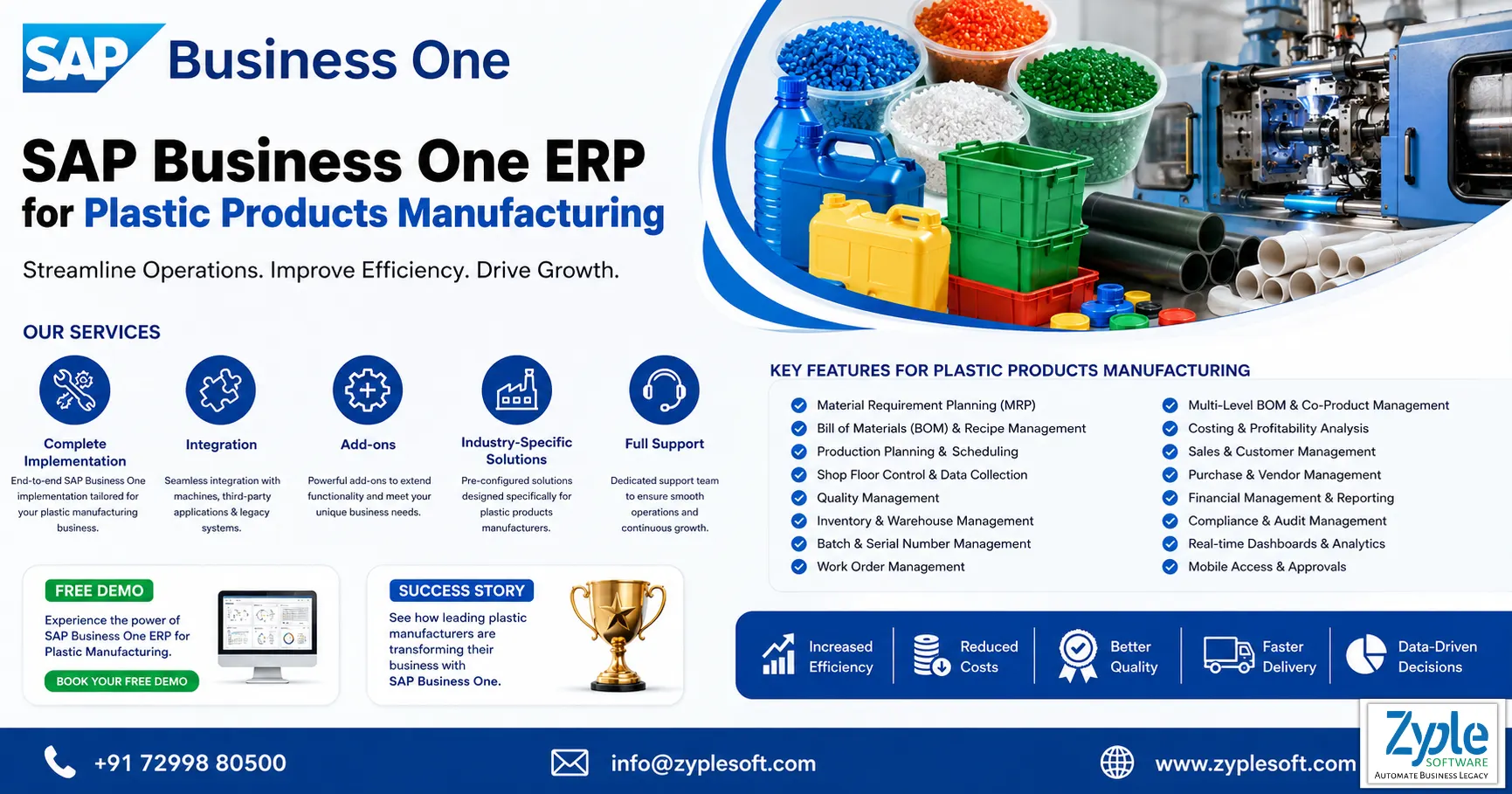
        SAP Business One ERP for Plastic Products Manufacturing industry

        SAP B1 ERP for Plastic Products Manufacturing

        SAP Business One ERP for Plastic Products Manufacturing Industry

        SAP Business One ERP for Plastic Products Manufacturing industry

        As the plastic products manufacturing industry exponentially grows, it has become tedious and difficult to handle multiple operations all around the world along with the business processes. Moreover, with large industries like plastic products, integrating different departments and tackling any issues that occurred also involves so much time and effort. SAP Business One ERP for plastic product manufacturing comes up as the possible option to increase the efficiency of the plastic products manufacturing industry.

        Challenges Faced By The Plastic Products Manufacturing Industry

        The plastic products manufacturing industry faces a series of challenges, including volatile petrochemical pricing, strict environmental regulations, shifting sustainability demands, and a widening skill gap. Combined with supply chain disruptions, these factors significantly affect profit margins and production efficiency.

        1. Volatile Raw Material Costs

        The sector is heavily reliant on fossil fuels for virgin resin, making production costs highly sensitive to global oil and gas price fluctuations, as well as inflation.

        2. Strict Regulatory Pressures

        Global governments are enforcing tougher anti-pollution laws, extended producer responsibility (EPR) schemes, and bans on single-use plastics. This forces manufacturers to quickly shift their product lines and manufacturing technologies.

        3. Shift Toward Circular Economy and Sustainability

        There is intense consumer and corporate demand for eco-friendly alternatives and recycled plastics. Changing to sustainable materials always requires redesigning molds and upgrading extrusion or molding facilities.

        4. Labor Shortages and Automation

        Finding and training a skilled workforce to operate complex, high-tech manufacturing equipment remains a significant challenge. Conversely, implementing automation to solve labor issues involves massive upfront capital.

        5. Supply Chain Bottlenecks

        The industry depends on a global web of supporters. Port congestions, shipping delays, and ingredient shortages continuously cause disruptions in production cycles.

        6. Process Variations and Quality Control

        In mass production, maintaining consistent quality metrics (e.g., melt flow rate, tensile strength, and uniform thickness) involves highly precise, standardized plastic testing instruments.

        Features of SAP Business One ERP for Plastic Products Manufacturing

        1. Production Planning and Control

        • It includes multi-level bill of materials (BOM) for formulations, molds, and assemblies.
        • Production orders for injection molding, extrusion, blow molding, and more.
        • Material requirements planning (MRP) for resin, additives, and colorants.
        • Capacity planning for machines like molding and extrusion lines.
        • Production scheduling based on demand and machine availability.

        2. Batch, Lot, and Traceability Management

        • Entire batch and lot traceability from raw materials to finished goods.
        • Tracks resin batches, additives, and regrind usage.
        • It includes serial number tracking for high-value plastic components.
        • It includes backward and forward traceability for quality recalls.
        • It includes shelf-life tracking for materials like chemicals and polymers.

        3. Inventory and Warehouse Management

        • Real-time visibility of raw materials, WIP, finished goods, and scrap.
        • It includes multi-warehouse and bin location management.
        • Automated stock movements like GRN, issue, and transfer.
        • It includes barcode integration for material handling.
        • Inventory valuation methods like FIFO, moving average, and standard cost.
        • Minimizes overstocking and stockouts.

        4. Procurement and Supplier Management

        • It includes purchase requisitions, RFQs, and purchase orders.
        • It includes vendor comparison and supplier performance tracking.
        • Raw material procurement includes granules, masterbatches, and chemicals.
        • It includes integration with inventory and production planning.
        • It includes automated accounts payable processes.

        5. Quality Control and Compliance

        • It includes incoming, in-process, and final quality inspection.
        • Defines quality control parameters like density, tensile strength, and melt flow index.
        • It includes quality certificates and reports generation.
        • It includes compliance with ISO, ASTM, and BIS standards.
        • Defines tracking and corrective actions.

        6. Subcontracting and Job Work Management

        • Handles outsourced operations like tooling and secondary finishing (printing and coating).
        • Tracks materials sent to subcontractors.
        • Monitors job work costs and timelines.
        • Integrates subcontracting into the production cycle.

        7. Costing and Profitability Analysis

        • Product costing includes material, labor, and machine costs.
        • Includes batch-wise and order-wise cost analysis.
        • It includes scrap and wastage cost tracking.
        • It includes real-time margin calculation.
        • It includes budget and variance analysis.

        8. Sales and Distribution Management

        • The entire sales cycle from quotation, order, and delivery to invoice.
        • It includes customer pricing, discounts, and contracts.
        • It includes demand forecasting for plastic products.
        • It includes dispatch planning and logistics tracking.
        • It includes export documentation.

        9. Financial Management and GST Compliance

        • It includes general ledger, accounts payable, and accounts receivable.
        • It includes GST, TDS, and TCS compliance.
        • It includes e-invoicing and e-way bill integration.
        • it includes cost center accounting.
        • It includes cash flow and profitability reports.

        10. CRM and Customer Lifecycle Management

        • It includes lead and opportunity management.
        • It includes customer order history and preferences.
        • It includes complaint and returns management.
        • It includes after-sales service tracking.
        • It includes marketing campaign management.

        11. Business Intelligence and Analytics

        • Real-time dashboards for production, inventory, and sales.
        • KPI tracking for machine utilization, rejection rate, and OEE.
        • It includes custom MIS reports.
        • It includes predictive insights for demand and production.
        • It includes Excel integration for analysis.

        12. Machine and Resource Utilization

        • Monitors machine efficiency and downtime.
        • Plans predictive maintenance.
        • Optimizes mold usage and lifecycle.
        • Improves production throughput.
        • Tracks labor productivity.

        13. Integration and Automation

        • Integration with weighing scales, PLC or machine data systems, and barcode or RFID systems.
        • Automated workflows like approvals and alerts.
        • Minimized manual errors and faster processing.

        14. Mobility and Remote Access

        • Mobile app for sales orders, inventory checks, and approvals.
        • It includes a web client for browser-based access.
        • It includes real-time decision-making from anywhere.

        15. Industry-Specific Capabilities for Plastics

        • Support for process and discrete manufacturing, especially in plastics.
        • Add-ons for injection molding and extrusion and compounding.
        • It includes regrind and scrap reuse tracking.
        • It includes mold lifecycle and maintenance management.
        • It includes demand-driven production planning.

        Importance of SAP Business One ERP for Plastic Products Manufacturing

        The ERP software, SAP Business One (SAP B1) system, is essential for the plastic products manufacturing industry because it facilitates complex operations like resin tracking, machine scheduling, and waste reduction. It centralizes essential data, allowing manufacturers to optimize inventory, improve on-time deliveries, and boost overall profitability.

        1. Material Requirements Planning (MRP)

        Accurately calculates the exact amount of raw materials (e.g., polymers, additives, and masterbatches) required based on historical data and upcoming sales orders, preventing stockouts and overstocking.

        2. Machine and Production Planning

        Integrates machine capacity and production scheduling to avoid obstacles and maximize equipment utilization during complex injection molding or extrusion processes using SAP implementation.

        3. Quality Control and Traceability

        Delivers strict batch and lot tracking to trace materials from raw resin supplier to finished product, ensuring compliance with industry safety and quality standards.

        4. Cost and Waste Reduction

        Monitors real-time raw material consumption and scrap or waste generation, helping you identify unproductive procedures and significantly reduce operating costs.

        Benefits of SAP Business One for Plastic Products Manufacturing

        SAP Business One (SAP B1) facilitates the plastic products manufacturing industry by optimizing raw material consumption, automating production scheduling, and enforcing strict quality control. It centralizes inventory, financials, and supply chain operations, allowing companies to minimize plastic waste, reduce lead times, and scale operations efficiently.

        1. Optimized Material Management

        Tracks raw material consumption (resin, masterbatches, and additives) in real-time. Accurately maps bills of materials (BOMs) to minimize scrap and control production costs using SAP solutions.

        2. Advanced Production Planning

        Utilizes material requirements planning (MRP) to forecast demand, schedule injection or extrusion machines, and automate purchasing so you never run out of stock.

        3. Quality Control and Traceability

        Maintains compliance and handles digital quality certificates. Executes granular lot and batch tracking to trace defective products back to their resin batches.

        4. Financial and Supply Chain Visibility

        The SAP software handles multi-branch operations, automates procurement, and integrates with CAD or CAM systems or e-commerce platforms to drive end-to-end synergy.

        5. Data-Driven Decisions

        Uses the SAP B1 HANA database to pull instant, accurate reports on machine efficiency, resource utilization, and key performance indicators.

        Conclusion of Plastic Products Manufacturing ERP

        Zyple Software is a certified SAP Business One partner in India specializing in implementation, digital transformation, licensing, integration, add-on solutions, migration, and consulting for the plastic products manufacturing industry. With Zyple Software, you’re not just implementing an SAP B1 ERP system; you’re setting the stage for improved productivity, facilitated operations, and sustained business growth.

        If you’re involved, schedule a demo of SAP Business One.

        Do you command the SAP Business One ERP software for your business or industry?

        Complete all the details in the defined contact form; our team will get back to you.

          FAQs

          1.How can SAP Business One ERP optimize efficiency in plastic manufacturing?

          SAP Business One facilitates production planning, inventory planning, and quality control, helping plastic manufacturers minimize downtime, reduce wastage, and improve overall operational efficiency.

          Yes, SAP Business One is developed for SMEs and provides scalable features designed for plastic manufacturers, making it an affordable solution for growing businesses.

          Definitely. SAP Business One delivers real-time visibility into raw materials, work-in-progress, and finished goods, ensuring better control over inventory and production processes.

          Implementation generally takes between 8 to 16 weeks, depending on business complexity, customization needs, and integration requirements.

          You can connect with the experienced SAP Business One partner Zyple Software to schedule a free demo, evaluate your business needs, and explore how the situation can be customized for your plastic manufacturing operations.

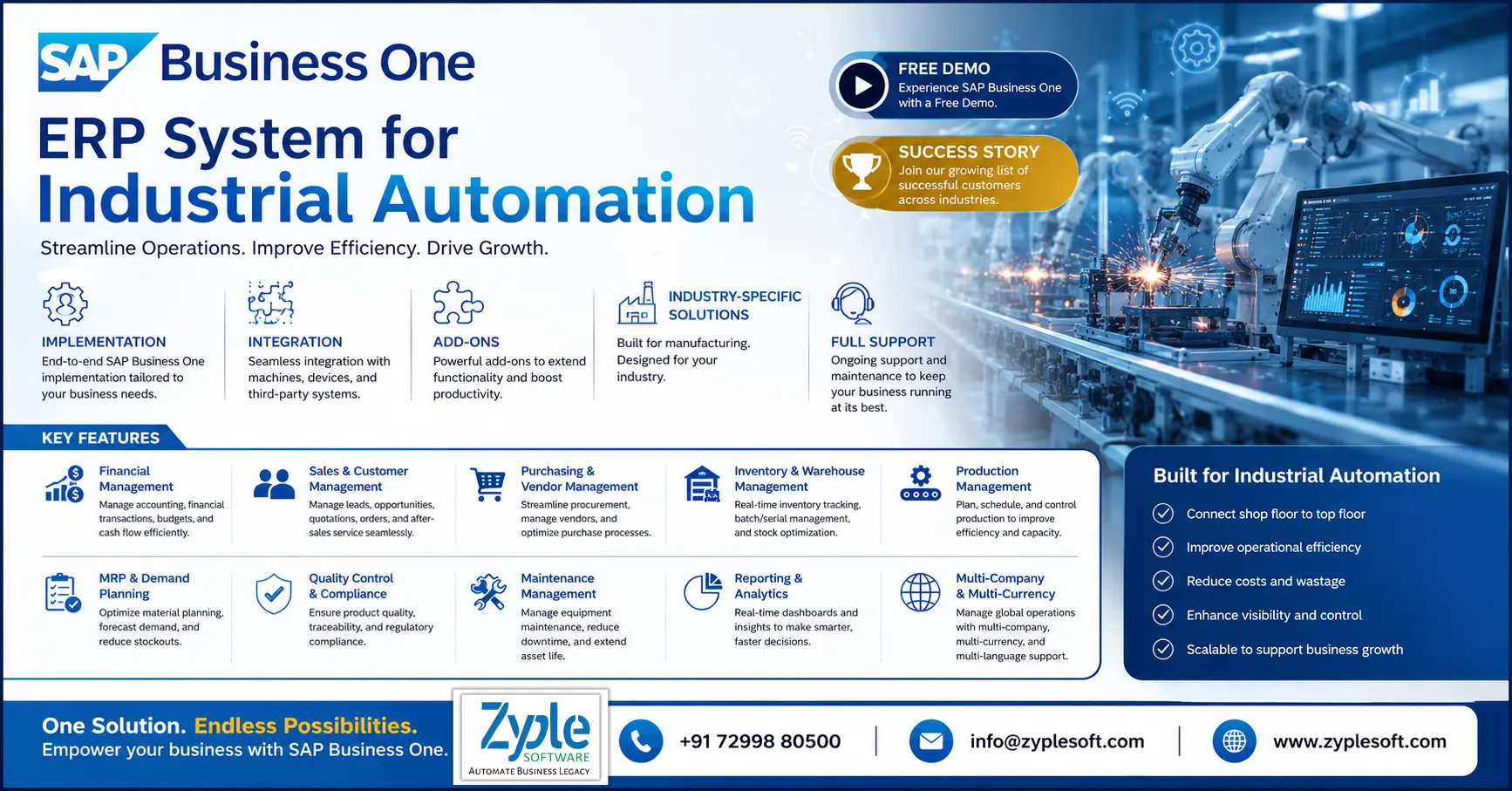
          ERP System for Industrial Automation

          ERP system for Industrial Automation

          SAP Business One ERP system for Industrial Automation

          ERP System for Industrial Automation

          Industrial automation can be challenging, but handling it doesn’t have to be. SAP Business One is the ultimate solution for entrepreneurs and production managers alike. It brings together everything you need, like inventory, quality control, and data and real-time analytics, into a single integrated system. Whether you’re a small business or a medium-sized company, SAP Business One is designed to meet your needs. In this blog, we’ll discuss the industrial automation system SAP B1 ERP.

          What is Industrial Automation Software?

          Industrial automation software is a digital tool-set that integrates, controls, and handles industrial machinery, sensors, and production workflows, turning factory floors into automated, efficient systems. It improves real-time data analysis, boosts productivity, and minimizes human error by automating repetitive tasks.

          Features of Industrial Automation System

          Here are the features of SAP Business One as industrial automation software:

          1. Integrated Production Planning and Automation

          • Based on demand forecasts, automated production planning can be done.
          • Online shop floor scheduling and capacity planning.
          • Work order generation and tracking are done automatically.
          • Connection with machine-level data for smarter planning.

          2. Machine and IoT Integration

          • Integrates with IoT devices and PLC machines.
          • Online machine performance monitoring.
          • From equipment, production data can be captured automatically.
          • Allows predictive insights using connected systems.

          3. Real-Time Data and Analytics

          • It includes live dashboards for production, quality, and operations.
          • KPIs can be customized for efficiency, downtime, and output.
          • With drill-down capabilities, reporting can be automated.
          • Using real-time insights, decision-making can be improved.

          4. Shop Floor Control and Monitoring

          • Monitors shop floor activities in real-time.
          • It includes barcode or RFID-based material movement tracking.
          • Tracks work-in-progress (WIP) and production stages.
          • Increases visibility across machines and operators.

          5. Inventory and Warehouse Management

          • From production and sales, inventory updates are automated.
          • Bin tracking can be done with smart warehouse management.
          • It includes barcode-enabled stock movement automation.
          • Minimizes manual errors and stock discrepancies.

          6. Quality Control Automation

          • Automated quality checks at different production phases.
          • Monitors defects, rejections, and compliance.
          • Inspection records and audit trials can be maintained.
          • It ensures consistent product quality.

          7. Maintenance Management (Preventive and Predictive)

          • Automatic scheduling of preventive maintenance.
          • It tracks machine breakdowns and service history.
          • Usage data can be used for preventive maintenance.
          • Reduces downtime and improves asset life.

          8. End-to-End Process Automation

          • Smooth integration across production, finance, sales, and procurement.
          • Eliminates data storage and manual data entry.
          • It ensures automated workflows across departments.
          • Improves operational efficiency.

          9. Mobile and Remote Monitoring

          • Access to real-time data via mobile apps and the web.
          • Monitors operations from anywhere.
          • Instant alerts for issues in production.
          • Increases responsiveness and control.

          10. Workflows Automation and Alerts

          • Approval workflows are automated.
          • It includes real-time alerts for delays, shortages, or machine issues.
          • Rule-based process automation can be done.
          • Minimizes manual intervention and improves speed.

          Importance of Industrial Automation System SAP B1 ERP

          The industrial automation system SAP Business One ERP modernizes manufacturing by providing a single source of truth that connects shop-floor machinery with back-office operations. This ERP software bridges the gap between automated hardware (robots, sensors) and management, transforming raw data into actionable insights for improved efficiency, lower operational costs, and higher accuracy in SME manufacturing environments.

          1. Improved Operational Efficiency and Productivity

          SAP B1 integrates procurement, production, inventory, and sales, eliminating data storage and minimizing the need for manual data entry, which removes errors. Automated material requirements planning (MRP) calculations ensure raw materials are available, minimizing production delays. Facilitated processes enable quicker product development cycles and faster responses to customer inquiries.

          2. Real-Time Visibility and Control

          Manufacturers can evaluate production in real-time, tracking job status, machine utilization, and work-in-progress. Real-time visibility into inventory levels helps avoid overstocking or stockouts. IIoT in the SAP B1 system allows machines to report status instantly, enabling predictive maintenance and minimizing unplanned downtime.

          3. Cost Optimization and Increased Profitability

          Automation of routine tasks minimizes labor costs and increases overall production efficiency using SAP implementation. Improved quality control, including AI-driven inspection systems integrated with SAP B1 ERP, can minimize rework expenses and material wastage. Real-time tracking of labor, material, and overhead costs ensures an accurate cost of goods sold (COGS) calculation.

          4. Quality Management and Regulatory Compliance

          The SAP B1 ERP system delivers full traceability from raw material procurement to finished goods delivery, which is essential for audits and recalls. The system helps align operations with industry-specific quality standards and regulatory requirements.

          5. Scalability and Future-Readiness

          SAP Business One ERP is designed specifically for small and medium-sized enterprises (SMEs), enabling them to grow confidently. Cloud deployment options minimize infrastructure costs and support remote access, allowing global collaboration. The system supports integration with AI, machine learning, and advanced analytics to improve inventory, increase demand forecasting, and enable decision-making.

          Benefits of Industrial Automation Software

          The enterprise resource planning (ERP) system, SAP Business One (SAP B1) software, improves manufacturing efficiency, product quality, and safety by controlling machinery without continuous human intervention. Main benefits include 24/7 production, reduced labor costs, improved data insights for decision-making, increased accuracy, and enhanced worker safety by decreasing human exposure to hazardous environments.

          1. Higher Productivity and Efficiency

          SAP B1 can operate 24/7 without fatigue or breaks, leading to faster production rates and improved output efficiency.

          2. Increased Quality and Consistency

          SAP software ensures consistent production cycles and precision, minimizing human error, variability, and defects in manufacturing.

          3. Reduced Operational Costs

          While initial investment is high, SAP B1 software minimizes labor costs, material waste, and maintenance costs over time.

          4. Improved Safety

          SAP Business One takes over dangerous, physically difficult, or repetitive tasks, minimizing worker injuries and improving overall safety standards.

          5. Data Collection and Better Decision-Making

          The SAP Business One system delivers real-time data analytics to optimize processes, improve maintenance scheduling, and ensure better decision-making.

          6. Ease of Use and Flexibility

          SAP Business One ERP software can easily adapt to evolving production needs, enabling quick reprogramming and minimized downtime during changeovers.

          7. Increased Cybersecurity and Reliability

          SAP solutions connect advanced IT security protocols to protect industrial networks from cyber attacks and ensure secure communication between devices.

          Conclusion of Industrial Automation ERP

          Zyple Software is an affiliate SAP Business One Partner in India specializing in implementation, consulting, licensing, integration, add-on solutions, migration, digital transformation, and support.

          SAP partner company – Zyple Software have expertise in SAP Business One implementation for various industries like manufacturing, construction, real estate, agriculture, financial services, healthcare, retail, technology, energy, logistics, infrastructure, EPC, and professional services. SAP Business One facilitates processes and drives growth seamlessly with industrial automation.

          If you’re engaged, book an SAP Business One demo.

          Are you exciting for the SAP B1 ERP system for your business or industry?

          Fill in all the details in the identified contact form; our team will return back to you.

            fleet management in logistics

            How To Manage Fleet in Logistics

            How To Manage Fleet in Logistics Business?

            fleet management in logistics

            What is fleet management in logistics?

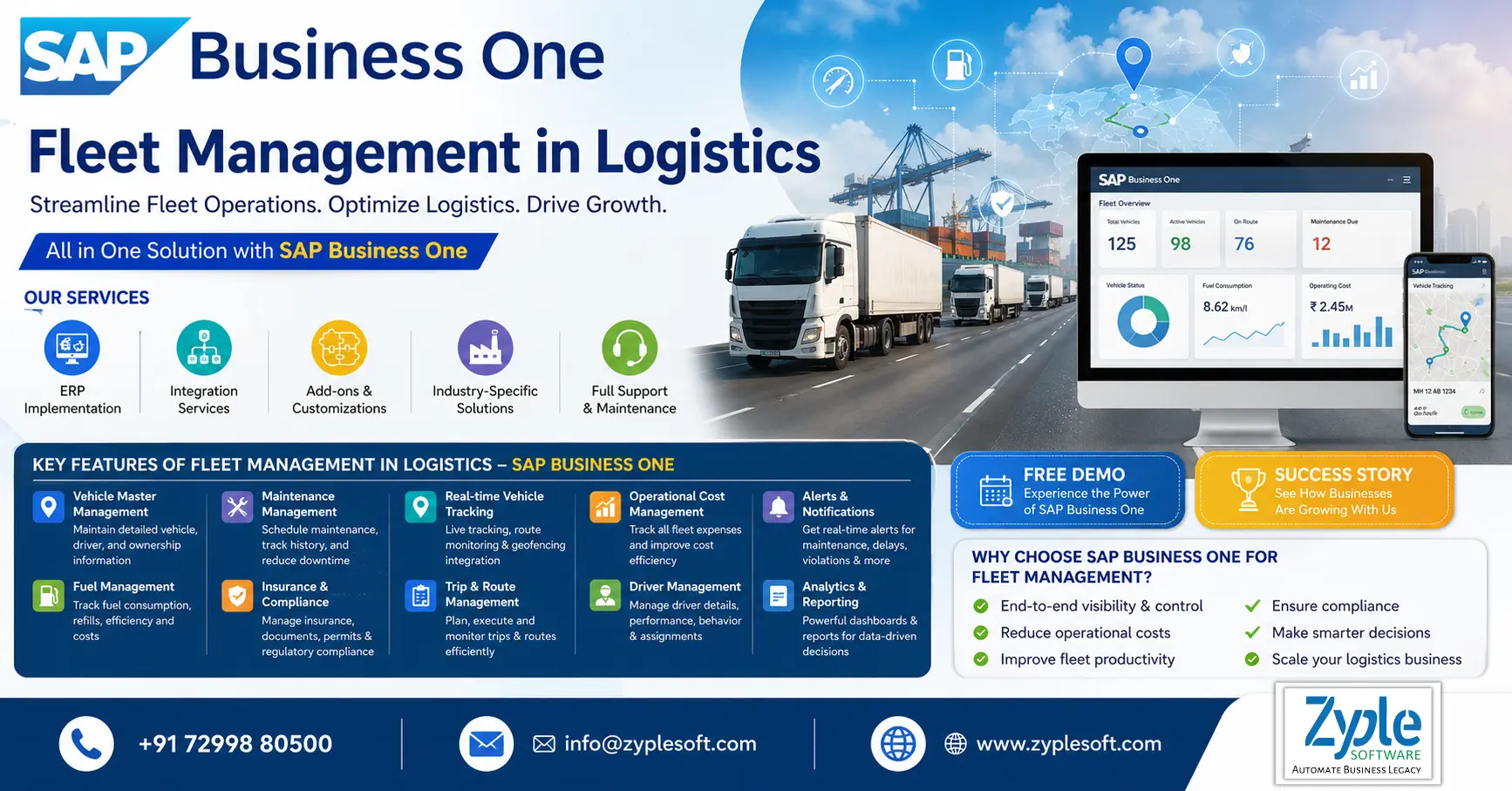
            Fleet management in logistics is the strategic oversight and administration of commercial vehicles, including trucks, vans, and ships, to increase efficiency, minimize costs, and ensure compliance throughout their operational lifecycle. It involves using technology for real-time tracking, maintenance scheduling, and driver management to improve safety and fuel consumption. Here, we’ll discuss how to manage fleet in logistics.

            Managing Fleet and Transportation in Logistics Using SAP Business One ERP

            In today’s fast-paced logistics industry, efficient fleet and transportation management is key to maintaining competitiveness and ensuring timely delivery. As businesses expand and global trade becomes more complex, logistics companies face increasing challenges related to handling fleet and transportation, optimizing routes, and controlling costs. This is where SAP Business One, an inclusive ERP solution, comes into play. SAP Business One ERP Software is designed to help small and medium-sized enterprises (SMEs) facilitate their operations. When integrated with logistics, it provides numerous tools to manage fleet operations, monitor vehicle performance, optimize routes, and improve delivery times.

            Understanding Fleet and Transportation Challenges in Logistics

            Fleet and transportation challenges in logistics revolve around rising costs (fuel, maintenance), severe driver shortages, and the immediate need for digital transformation to improve efficiency. Key operational obstacles include route optimization, maintaining visibility, last-mile delivery pressure from e-commerce regulatory compliance, and managing safety.

            1. Driver Shortages and Retention

            A global shortage of skilled drivers, combined with strict hiring screenings to handle safety compliance, has increased recruitment difficulty and labor costs.

            2. Rising Fuel and Maintenance Costs

            Fluctuating, high fuel prices and increased costs for spare parts and vehicle maintenance crush profit margins.

            3. Lack of Visibility and Technology Adoption

            Many companies still depend on manual operations, leading to poor real-time tracking, ineffective routing, and high inquiry volumes.

            4. Last-Mile Delivery and E-Commerce Demand

            Customer demands for faster, cheaper delivery create huge pressure to optimize routes and handle courier capacity effectively.

            5. Supply Chain Disruptions

            Natural disasters, political instability, and pandemic-related disruptions cause serious delays.

            6. Regulatory and Infrastructure Obstacles

            Complex, varied tax structures, toll booth delays, and poor road infrastructure hamper operational efficiency.

            7. Asset Management and Maintenance

            Unexpected vehicle breakdowns cause disruptions. There is an increased need for specialized equipment like cold chain.

            How SAP Business One Handles Fleet and Transportation in Logistics?

            SAP Business One delivers a powerful solution to overcome these challenges by providing end-to-end visibility into fleet and transportation operations.

            Here are the key features that make SAP Business One necessary in logistics:

            1. Fleet Tracking and Real-Time Monitoring

            One of the most crucial aspects of fleet and transportation is the ability to monitor vehicles in real-time. SAP Business One connects with GPS tracking systems to deliver a live view of your entire fleet. This data enables logistics companies to:

            • Track the correct location of the vehicles.
            • Evaluate driver behavior (e.g., speed, idling times).
            • Identify deviations from planned routes.
            • Respond faster to delays or accidents.

            With real-time tracking, logistics managers can make better decisions and provide accurate delivery updates to customers. This minimizes uncertainities and improves overall customer satisfaction.

            2. Route Optimization and Planning

            Route optimization is key to minimizing fuel consumption and improving delivery times. SAP Business One ERP delivers advanced route planning tools that analyze multiple variables, such as traffic conditions, fuel efficiency, delivery time windows, and vehicle load capacity. By automatically suggesting the most efficient routes, SAP Business One helps logistics companies reduce travel time and fuel costs. Also, SAP software can adjust routes in real-time if unexpected events, such as road closures or traffic congestion, occur.

            3. Vehicle Maintenance and Asset Management

            Fleet management also includes vehicle maintenance, which can be an expensive and time-consuming task if not handled properly. The SAP Business One system delivers a vehicle maintenance module that tracks the performance and condition of every vehicle in the fleet. This feature enables you to:

            • Schedule regular maintenance tasks depending on mileage or engine hours.
            • Maintain a detailed history of repairs and maintenance costs.
            • Receive automatic reminders for next service dates.
            • Monitor spare parts inventory and usage.

            With better visibility into vehicle health, logistics companies can avoid breakdowns, minimize downtime, and extend the lifespan of their fleet.

            4. Fuel and Cost Management

            Fuel is one of the biggest operating expenses in logistics. SAP Business One helps companies track fuel usage in real-time and compare it against estimated consumption based on routes. By this data evaluation, fleet managers can:

            • Find inefficient vehicles or drivers with higher-than-average fuel consumption.
            • Ensure that fuel is used properly by following the most efficient routes.
            • Evaluate fuel costs and identify areas where savings can be made.

            The SAP B1’s cost management features also enable logistics managers to monitor expenses related to repairs, labor, and spare parts. This data can be analyzed to identify ways to further minimize operational costs.

            5. Driver and Workforce Management

            Handling drivers is another essential component of transportation management. SAP implementation delivers an inclusive tool to assign drivers vehicles, track their working hours, and monitor their performance. Some key features include:

            • Driver Scheduling: Automatically allocates drivers based on vehicle availability, route requirements, and driver working hours.
            • Performance Monitoring: Evaluates key performance indicators (KPIs), such as on-time deliveries, fuel efficiency, and customer feedback.
            • Compliance Management: Ensures that drivers comply with local regulations, such as working hour limits and rest periods, by monitoring their schedules and shifts within the SAP Business One solution.

            This data can be used to improve driver performance, ensure compliance with labor regulations, and maximize overall operational efficiency.

            6. Reporting and Analytics

            One of the essential features of SAP Business One is its powerful reporting and analytics capabilities. SAP solutions deliver a suite of tools that generate reports on fleet performance metrics like fuel efficiency and delivery times, vehicle maintenance history and costs, route efficiency and travel times, and driver performance and customer feedback.

            These reports provide logistics managers valuable insights into the efficiency of their fleet and transportation operations. By analyzing this data, companies can identify obstacles, optimize processes, and make better decisions that drive efficiency and cost savings.

            Conclusion of Managing Fleet in Logistics Using SAP B1 ERP

            Zyple Software is an authorized SAP B1 partner in India specializing in implementation, digital transformation, migration, licensing, integration, add-on solutions, and consulting for logistics companies. SAP Business One ERP provides an inclusive suite of tools that simplify and improve fleet and transportation management in the logistics industry.

            If you’re fascinated, you can book a demo of SAP Business One.

            Are you soliciting the SAP Business One ERP system for your business or industry?

            Fill in all the details in the defined contact form; our team will return to you.

              SAP Business One for Automotive and Transportation industry

              SAP Business One for Automotive and Transportation

              SAP Business One for Automotive and Transportation Industry

              SAP Business One for Automotive and Transportation industry

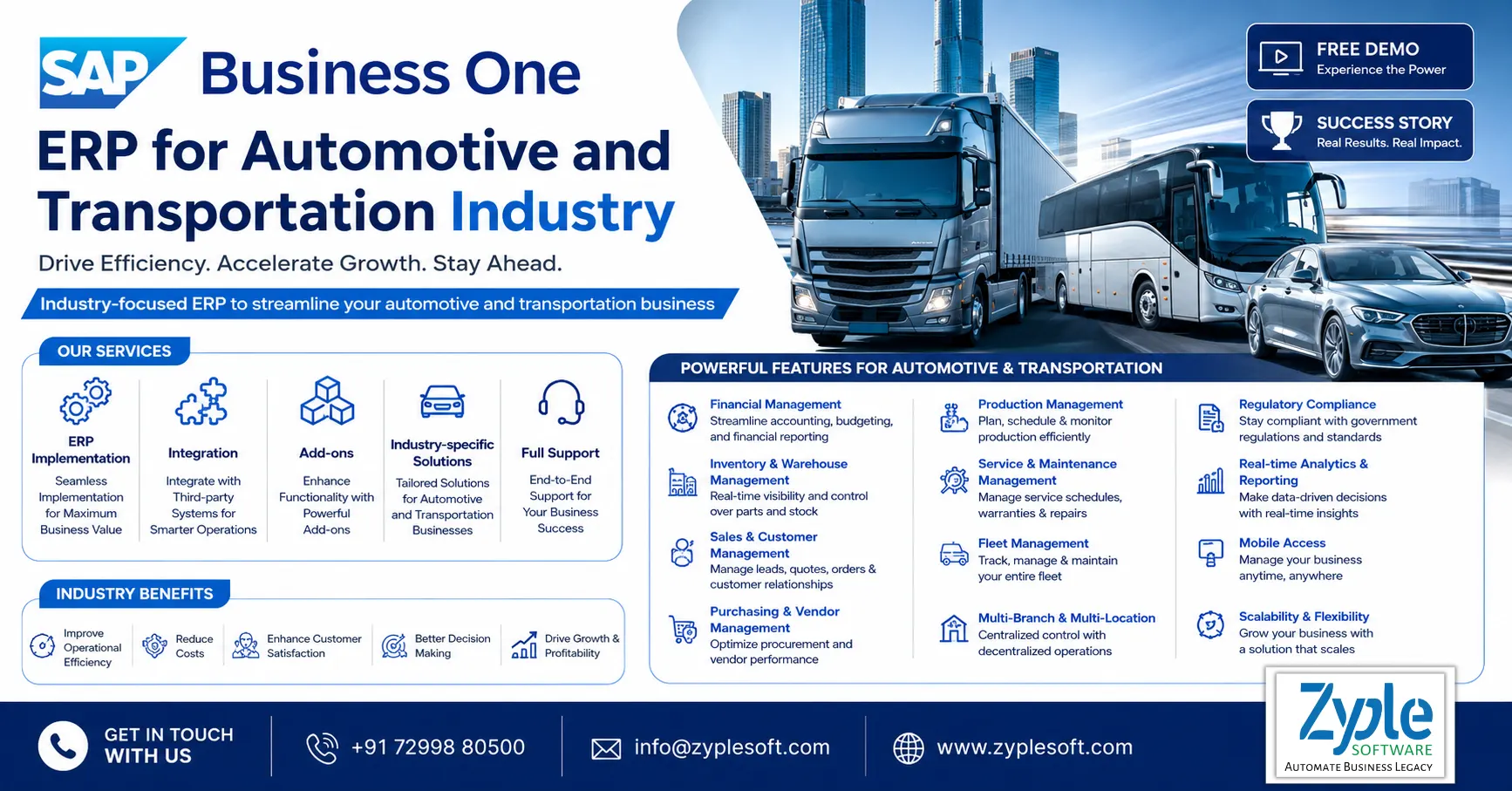
              The automotive and transportation industry is evolving fast, and staying ahead involves innovative solutions. SAP Business One delivers a powerful ERP solution that helps manufacturers optimize operations, minimize costs, and boost customer satisfaction. SAP Business One for automotive and transportation facilitates supply chains, improves dealer collaboration, and increases marketing and sales processes.

              Challenges of the Automotive and Transportation Industry

              The automotive and transportation industry faces a tumultous landscape defined by the rapid shift to electric vehicles (EVs), supply chain vulnerabilities, and increasing cybersecurity threats. Key challenges include handling high production costs, adapting to software-driven vehicles, meeting strict emission regulations, and navigating shifting consumer demands toward shared mobility.

              1. EV Transition and Battery Costs

              The industry faces high production costs for electric vehicles, mainly due to expensive battery technologies, along with the need to develop infrastructure.

              2. Supply Chain Disruptions

              Continuous shortages of essential components (such as semiconductors) and fluctuating raw material prices threaten production schedules and inventory levels.

              3. Regulatory and Environmental Compliance

              Manufacturers are struggling to achieve global emission standards and sustainability goals while maintaining profitability.

              4. Cybersecurity Risks

              As vehicles become more connected, cybersecurity has become a foremost priority, with significant damages reported from cyber attacks on infrastructure and vehicles.

              5. Software-Defined Vehicles and Technology

              The rapid shift towards autonomous driving and advanced driver assistance systems (ADAS) involves massive investment and a workforce skilled in software, rather than just mechanical engineering.

              6. Shifting Customer Preferences

              Increased consumer demand for shared mobility and on-demand transportation (e.g., ride-hailing services) is decreasing the demand for personal vehicle ownership.

              7. Infrastructure and Workforce Shortages

              Limited EV charging infrastructure and a growing shortage of skilled technicians and drivers present significant operational challenges.

              Features of SAP Business One for Automotive and Transportation

              1. Production Planning and Bill of Materials (BOM)

              • Handles multi-level BOMs for complex automotive assemblies (engines, components, and spare parts).
              • Tracks sub-assemblies, labor, and machine resources.
              • Manages engineering changes and version control easily.
              • Suitable for auto component manufacturers and OEM suppliers.

              2. Material Requirements Planning (MRP) and Scheduling

              • Plans raw materials based on demand forecasts.
              • Optimizes production schedules and capacity planning.
              • Minimizes delays with advanced planning and scheduling (APS).
              • Suitable for just-in-time manufacturing and supply chain efficiency.

              3. Inventory and Warehouse Management

              • It includes real-time visibility of spare parts, components, and finished goods.
              • Tracks inventory across multiple warehouses and locations.
              • It includes bin-level tracking and automated stock updates.
              • It helps prevent stockouts and overstock situations.

              4. Supply Chain and Vendor Management

              • Handles suppliers, dealers, and distributors in one system.
              • Tracks procurement cycles from purchase order to payment.
              • Improves vendor performance and collaboration.
              • Essential for automotive supplier ecosystems.

              5. Quality Control and Traceability

              • Tracks batch or serial numbers for parts traceability.
              • Monitors quality checks and compliance.
              • Handles rejections, returns, and defect ranking.
              • Necessary for automotive compliance and safety standards.

              6. Sales, CRM, and Dealer Management

              • Handles dealer networks and customer relationships.
              • Tracks the entire sales lifecycle from lead, order, and delivery to service.
              • It includes support pricing, discounts, and promotions.
              • Suitable for automotive dealerships and distributors.

              7. After-Sales and Service Management

              • Handles warranty claims and service contracts.
              • Tracks service requests and maintenance schedules.
              • Allows faster issue resolution.
              • Important for customer satisfaction in the automotive sector.

              8. Transportation and Logistics Management

              • Tracks inbound and outbound shipments.
              • Handles dispatch, delivery, and logistics operations.
              • Monitors transportation costs and delivery timelines.
              • Suitable for logistics and fleet-based businesses.

              9. Financial and Cost Management

              • It includes entire financial control features like accounting, budgeting, and cash flow.
              • Tracks product costing, margins, and profitability.
              • Handles multi-currency and global operations.

              10. Business Intelligence and Real-Time Analytics

              • It includes real-time dashboards and KPIs.
              • Analyzes production efficiency, sales performance, and inventory.
              • Predicts demand and optimizes operations.
              • It supports data-driven decision-making.

              11. Integrated End-To-End ERP Platform

              • Single system including finance, production, inventory, CRM, and procurement.
              • It eliminates data storage and improves visibility.

              12. Mobility and Cloud Access

              • It includes access to the system via mobile apps.
              • It includes real-time updates for field sales and logistics teams.
              • It includes cloud or on-premise deployment options.

              Importance of SAP Business One for Automotive and Transportation

              The enterprise resource planning (ERP) software, SAP Business One system, is essential for automotive and transportation businesses by facilitating operations, optimizing inventory, and handling complex supply chains in real-time. It delivers 360-degree visibility across manufacturing, procurement, and logistics, enabling lower costs, improved quality compliance, and faster decision-making for manufacturers, dealers, and logistics providers.

              1. Inventory Optimization and Traceability

              Handles stock across multiple locations to avoid stock-outs and excess inventory, with inclusive traceability for spare parts.

              2. Production Planning and Quality Control

              Improves material resource planning (MRP) and advanced scheduling, ensuring quality standards are achieved.

              3. Transportation and Fleet Management

              Integrates with GPS or telematics to track vehicle location, monitor driver behavior, handle maintenance, and optimize routes using SAP implementation.

              4. Supplier and Supply Chain Collaboration

              Improves supplier management with automated procurement, sharing demand forecasts to minimize disruptions.

              5. Cost Reduction and Financial Control

              Automates accounting, tracks costs in real-time, and delivers analytics to improve ROI.

              6. Future-Ready Tech Adoption

              It supports the Internet of Things (IoT), electric vehicle management, and sustainability initiatives.

              Benefits of SAP Business One ERP for Automotive and Transportation

              The SAP Business One (SAP B1) system provides automotive and transportation companies a scalable, integrated ERP system that improves supply chain visibility, optimizes inventory with batch or serial tracking, and facilitates production scheduling. It allows real-time monitoring of fleet operations, improves compliance with quality standards, and delivers 360-degree data insights for faster decision-making.

              1. Inventory and Production Management

              Optimized inventory tracking, including batch management and serial numbers, minimizes holding costs and prevents stock-outs. Material requirements planning (MRP) matches raw material availability with production schedules using SAP solutions.

              2. Supply Chain and Supplier Management

              Improved tracking of vendor contracts, consignment stock, and deliveries to handle supplier relationships, including EDI integration.

              3. Quality and Compliance

              Powerful QC/QA modules for automated inspections, ensuring compliance with environmental and industry standards.

              4. Production Efficiency

              Advanced Planning and Scheduling (APS) improves the balance between raw materials and production capacity, increasing on-time delivery.

              5. Real-time Fleet Tracking

              Integration with GPS and telematics to monitor vehicle status, location, and speed from a central dashboard using SAP software.

              6. Route Planning and Optimization

              Automated tools to create efficient routes and handle multi-stop journeys, reducing fuel costs.

              7. Maintenance Optimization

              Preventive maintenance alerts for vehicles to minimize downtime and manage maintenance expenses.

              Conclusion of Automotive and Transportation ERP

              Zyple Software is an authorized and Trusted SAP Business One partner in India specializing in implementation, digital transformation, migration, licensing, integration, add-on solutions, and consulting for the automotive and transportation industry. ERP company Zyple Software is the trusted SAP Business One partner providing customized SAP B1 solutions for automotive and transportation companies across the world.

              If you’re organized, book a demo of SAP Business One.

              Do you require the SAP Business One ERP software for your business or industry?

              Complete all the details in the arranged contact form; our team will get back to you.

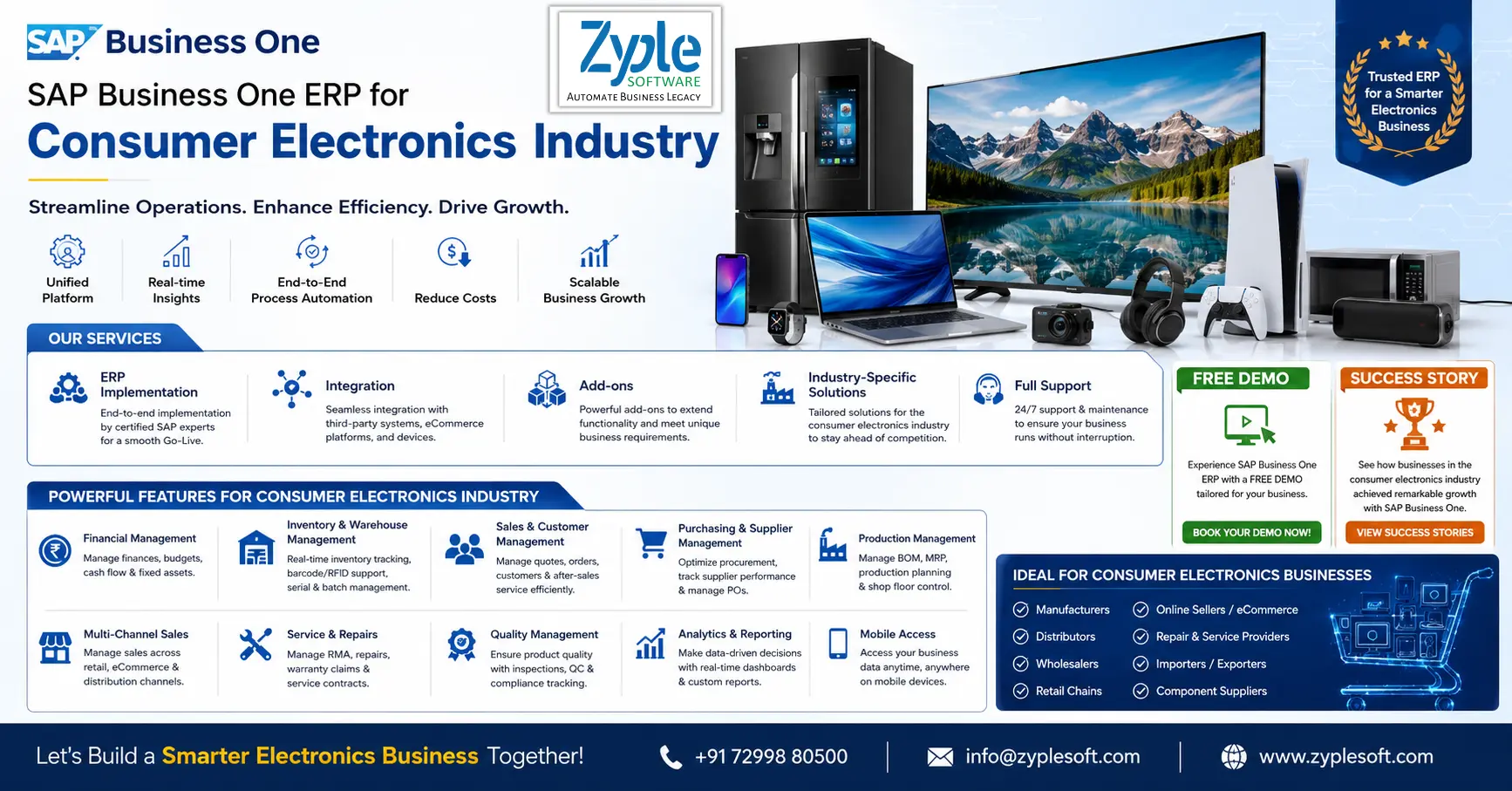
                SAP Business One ERP for Consumer Electronics Industry

                SAP B1 ERP for Consumer Electronics Industry

                SAP Business One ERP for Consumer Electronics Industry

                SAP Business One ERP for Consumer Electronics Industry

                The consumer electronics industry, a foundation of modern innovation, succeeds on rapid technological advancements, dynamic market demands, and precision-driven operations. However, handling such a fast-paced industry comes with its own set of challenges, from inventory control and production scheduling to achieving strict compliance standards. SAP Business One ERP for consumer electronics industry helps small and medium-sized consumer electronics businesses to achieve the business needs of the sector.

                Challenges Faced By the Consumer Electronics Industry

                1. Complex Supply Chain Management

                Consumer electronics manufacturing requires complex supply chains with multiple vendors, global sourcing, and time-sensitive deliveries.

                2. Inventory Overload or Stockouts

                Balancing inventory to achieve demand without overstocking or understocking remains a serious challenge.

                3. Stringent Compliance Requirements

                Complying with international standards, such as RoHS and WEEE, demands powerful documentation and tracking systems.

                4. Fast-Paced Innovation Cycles

                Consumer electronics products often have short life cycles, requiring quick scalability to market trends.

                5. Cost Management

                Rising costs of raw materials, labor, and logistics can significantly affect profitability.

                Handling these challenges requires a solution that integrates operations, improves visibility, and ensures flexibility, all of which SAP Business One delivers seamlessly.

                Features of SAP Business One ERP for Consumer Electronics Industry

                1. Financial Management

                • It includes general ledger, accounts payable, and accounts receivable.
                • It includes budgeting, cost accounting, and cash flow tracking.
                • It includes multi-currency and multi-branch financial integration.
                • It includes real-time financial reporting and profitability analysis.
                • It helps consumer electronics companies handle thin margins and high inventory costs.

                2. Sales and Customer Relationship Management (CRM)

                • It includes lead and opportunity tracking.
                • It includes the entire sales cycle from quotation, order, and delivery to invoicing.
                • It includes customer lifecycle and service history tracking.
                • It includes after-sales service and support management.
                • It includes marketing campaign management.
                • Essential for handling distributors, retailers, and direct customers.

                3. Purchasing and Supplier Management

                • It includes vendor management and procurement planning.
                • It includes purchase orders, GRPO, returns, and invoicing.
                • It includes supplier price lists and evaluation.
                • It includes import or export and multi-currency purchasing.
                • Necessary due to global sourcing of consumer electronic components.

                4. Inventory and Warehouse Management

                • It includes real-time inventory tracking across warehouses.
                • It includes batch and serial number tracking.
                • It includes stock transfer and bin location management.
                • It includes automated reordering and stock level optimization.
                • Avoids stockouts of fast-moving consumer electronics and overstocking of obsolete items.

                5. Business Intelligence and Analytics

                • It includes real-time dashboards and KPIs.
                • It includes sales forecasting and trend analysis.
                • It includes inventory turnover and aging reports.
                • It includes custom report generation with drill-down capabilities.
                • Allows faster decisions in a rapidly evolving consumer electronics market.

                6. Production and Assembly Management

                • It includes bill of materials (BOM) for multi-level assemblies.
                • It includes assembly, kitting, and disassembly processes.
                • It includes production planning and scheduling.
                • It includes shop floor control.
                • Suitable for products like TVs, mobiles, appliances, and accessories.

                7. Demand Planning and Forecasting

                • It includes sales forecasting based on trends and seasonality.
                • It includes procurement planning aligned with demand.
                • Crucial due to short product lifecycles and seasonal demand spikes.

                8. Serial Number and Traceability Management

                • Tracks each product by serial number.
                • It includes full traceability from procurement to sale.
                • It includes recall and defect training.
                • Essential for warranty claims and quality compliance.

                9. Warranty and Service Management

                • It includes warranty tracking and validation.
                • It includes repair and replacement management.
                • It includes service contract management.
                • It includes AMC (Annual Maintenance Contract) handling.
                • Necessary for after-sales service in consumer electronics.

                10. Supply Chain and Logistics Management

                • It includes end-to-end supply chain visibility.
                • It includes distribution network dealers (dealers and retailers).
                • It includes logistics and shipment tracking.
                • It includes integration with third-party logistics.
                • Helps handle complex multichannel distribution.

                11. Quality Control and Compliance

                • It includes inspection plans and quality checks.
                • It includes defect tracking and corrective actions.
                • It includes compliance with electronics standards.
                • It ensures product reliability and regulatory adherence.

                12. Multi-Channel Sales Integration

                • It includes retail, e-commerce, and distributor integration.
                • It includes POS (Point of Sale) integration.
                • It includes real-time stock sync across channels.
                • It supports omnichannel consumer electronics sales.

                13. Product Lifecycle Management

                • It includes new product introduction (NPI) tracking.
                • It includes version and revision control.
                • It includes phase-out management for obsolete products.
                • Essential due to rapid innovation cycles in consumer electronics.

                14. Mobility and Remote Access

                • It includes mobile apps for sales and service teams.
                • It includes real-time access to inventory and sales orders.

                15. Cloud and Integration Capabilities

                • It includes deployment on the cloud or on-premise.
                • It includes integration with IoT devices, e-commerce platforms, and CRM tools.
                • It includes API-based third-party integrations.

                Importance of SAP Business One ERP for Consumer Electronics Industry

                The ERP software, SAP Business One (SAP B1) system, is essential for the consumer electronics industry because it centralizes operations, facilitates complex supply chains, and automates multi-stage manufacturing. It enables fast-growing companies to minimize production waste, track complex electronic components, and ensure global regulatory compliance in real-time.

                1. Precision Inventory and Traceability

                Tracks electronic components, serial numbers, and batch lots to eliminate stockouts, avoid overstocking, and ensure rapid quality control.

                2. Facilitated Production Planning and Material Requirements Planning (MRP)

                Supports intelligent manufacturing schedules, improving material requirement planning (MRP) to align seamlessly with fluctuating consumer demand.

                3. Regulatory Compliance

                Automatically monitors materials to ensure adherence to strict industry mandates like RoHS (Restriction of Hazardous Substances) and WEEE (Waste Electrical and Electronic Equipment).

                4. Integrated Financials

                Unifies accounting, multi-currency transactions, and budgeting directly with operational data, providing businesses a crystal-clear picture of their profitability using SAP implementation.

                5. Customer Relationship Management (CRM)

                Captures customer interactions, tracks sales opportunities, and analyzes buying behavior to improve post-sales service and support.

                Benefits of SAP Business One for Consumer Electronics Industry

                1. Improved Operational Efficiency

                Automating repetitive tasks and connecting key processes saves time and minimizes errors.

                2. Improved Decision-Making

                With centralized data and powerful analytics, leaders can make better decisions quickly using SAP solutions.

                3. Regulatory Compliance Simplified

                Tracks and documents compliance-related activities seamlessly to prevent penalties and delays.

                4. Increased Agility

                Quickly adjusts to market changes and new technological advancements.

                5. Cost Savings

                Improved resource planning and minimized waste translate to significant cost reductions.

                6. Better Customer Satisfaction

                Delivers on commitments with accurate order tracking and improved delivery timelines.

                Conclusion of Consumer Electronics ERP

                Zyple Software is a certified SAP Business One partner in India specializing in implementation, digital transformation, licensing, integration, add-on solutions, migration, and consulting for the consumer electronics industry. From facilitating operations to ensuring compliance and improving customer satisfaction, the features and benefits of SAP software help in empowering consumer electronics businesses.

                If you’re assigned, book a demo of SAP Business One.

                Do you necessitate the SAP Business One ERP system for your business or industry?

                Complete all the details in the defined contact form; our team will return to you.

                  SAP Software Price for Company

                  SAP Software Price for Company

                  SAP Software Price for Company in India – Complete SAP Business One Pricing Guide by Zyple Software

                  SAP Software Price for Company

                  Businesses across India are rapidly investing in ERP software to improve operational efficiency, automate workflows, and achieve better control over finance, inventory, manufacturing, and sales processes. One of the most preferred ERP solutions for small and medium-sized businesses is SAP Business One.

                  If you are searching for SAP software price for company, this guide explains SAP Business One pricing, implementation costs, licensing structure, factors affecting ERP cost, and why businesses choose Zyple Software as their SAP Business One implementation partner in India.

                  What is SAP Business One ERP?

                  SAP Business One (SAP B1) is an integrated ERP software designed for growing businesses and enterprises. It helps companies manage:

                  • Financial Accounting
                  • Inventory Management
                  • Sales & CRM
                  • Purchasing
                  • Production Planning
                  • Warehouse Management
                  • Supply Chain Operations
                  • Business Analytics
                  • Project Management

                  SAP Business One is widely used by industries such as manufacturing, retail, construction, pharma, renewable energy, textile, food processing, aerospace, EV, solar, jewellery, and infrastructure companies.

                  SAP Software Price for Company in India

                  The price of SAP Business One ERP depends on several business requirements including users, deployment type, customization, integrations, and industry-specific modules.

                  Estimated SAP Business One Cost in India

                  Estimated SAP Business One Cost in India

                  Business Size Approximate SAP ERP Cost
                  Small Business ₹3 Lakhs – ₹8 Lakhs
                  Medium-Sized Company ₹8 Lakhs – ₹25 Lakhs
                  Large Enterprise ₹25 Lakhs+

                  The above pricing may vary depending on:

                  • SAP license type
                  • Number of ERP users
                  • Cloud or on-premise setup
                  • Add-ons and customization
                  • Industry requirements
                  • Data migration scope
                  • Integration complexity

                  SAP Business One License Cost

                  SAP Business One offers different license options based on business usage.

                  Professional User License

                  Suitable for management teams requiring complete ERP access including finance, CRM, inventory, purchasing, and production modules.

                  Limited User License

                  Ideal for employees needing restricted ERP functionality.

                  Indirect Access & Integration Licensing

                  Used for third-party integrations and external systems.

                  Businesses can choose between:

                  • Perpetual licensing
                  • Subscription-based cloud ERP licensing

                  Factors Affecting SAP Software Price

                  1. Number of ERP Users

                  ERP licensing cost increases based on the number of users accessing the system.

                  Example:

                  • 5-user ERP implementation cost differs significantly from a 100-user enterprise deployment.

                  2. Cloud vs On-Premise ERP

                  Cloud ERP

                  • Lower infrastructure investment
                  • Subscription-based pricing
                  • Remote accessibility
                  • Faster deployment

                  On-Premise ERP

                  • Higher initial investment
                  • Dedicated servers required
                  • Greater infrastructure control

                  3. Industry-Specific ERP Customization

                  Industries often require specialized workflows and modules.

                  Examples:

                  • Manufacturing ERP with MRP
                  • Construction project management ERP
                  • Pharma batch tracking
                  • Textile production planning
                  • Jewellery inventory tracking
                  • Solar project management ERP

                  Customization impacts the total ERP implementation cost.

                  4. SAP Add-ons & Integrations

                  Additional integrations may include:

                  • E-commerce platforms
                  • Mobile applications
                  • Barcode systems
                  • Biometric integration
                  • CRM integration
                  • Banking integration
                  • GST & e-invoicing systems

                  5. Data Migration & Training

                  Migrating old business data and employee ERP training are important implementation activities influencing overall cost.


                  Industries Using SAP Business One ERP

                  Zyple Software SAP Solutions provides industry-specific ERP implementation for:

                  Construction & Infrastructure

                  • Builders
                  • Contractors
                  • Real Estate Developers
                  • Civil Engineering Companies
                  • Ready-Mix Concrete (RMC)

                  Manufacturing Industries

                  • Industrial Machinery
                  • Auto Components
                  • Aerospace
                  • Electronics Manufacturing
                  • Textile & Garment

                  Renewable Energy Sector

                  • Solar Companies
                  • EV Manufacturers
                  • Battery Manufacturing
                  • Renewable Energy Businesses

                  Retail & Distribution

                  • Wholesale Distribution
                  • Retail Chains
                  • Trading Businesses

                  Pharma & Healthcare

                  • Pharmaceutical Manufacturing
                  • Medical Devices
                  • Healthcare Distribution

                  Food & Beverage Industry

                  • Dairy
                  • Food Processing
                  • Beverage Manufacturing

                  Jewellery Industry

                  • Jewellery Manufacturing
                  • Retail Jewellery Stores

                  Benefits of SAP Business One ERP for Companies

                  Real-Time Business Visibility

                  Track business operations through centralized dashboards and analytics.

                  Better Inventory Management

                  Avoid stock shortages and improve warehouse efficiency.

                  Production Planning & MRP

                  Manufacturers can optimize raw material planning and production scheduling.

                  Financial Control

                  Manage accounting, GST, taxation, and compliance in a single ERP system.

                  Sales & CRM Automation

                  Improve customer management and sales tracking.

                  Scalability for Growing Companies

                  SAP Business One grows along with your business expansion.


                  Why Choose Zyple Software for SAP Business One ERP?

                  Zyple Software is a trusted SAP Business One partner offering complete ERP implementation services across industries.

                  Services Offered by Zyple Software

                  • SAP Business One Licensing
                  • ERP Implementation
                  • SAP B1 HANA Deployment
                  • ERP Customization
                  • Third-Party Integration
                  • SAP Add-ons
                  • Cloud ERP Solutions
                  • Data Migration
                  • User Training
                  • AMC & Support

                  Advantages of Working with Zyple Software

                  Industry Expertise

                  Experienced ERP consultants for multiple industries.

                  Faster ERP Deployment

                  Structured implementation methodology for quick go-live.

                  Affordable ERP Pricing

                  Cost-effective ERP solutions for SMEs and enterprises.

                  Dedicated Support Team

                  Technical and functional ERP support after implementation.

                  Custom ERP Solutions

                  Tailored workflows and business process automation.


                  How to Choose the Right SAP ERP Package for Your Company

                  Before implementing SAP, businesses should evaluate:

                  • Current business challenges
                  • Number of ERP users
                  • Industry-specific requirements
                  • Future scalability needs
                  • Budget for ERP implementation
                  • Integration requirements

                  A proper ERP consultation helps businesses select the right SAP Business One package.


                  Let’s go for Conclusion

                  SAP Business One is one of the best ERP software solutions for companies looking to automate operations, improve productivity, and achieve digital transformation. The SAP software price for a company depends on factors such as users, customization, deployment type, and industry requirements.

                  With extensive industry expertise, Zyple Software helps businesses implement SAP Business One ERP efficiently with complete support, customization, integration, and training services.

                  Whether you operate in manufacturing, construction, retail, pharma, renewable energy, EV, solar, textile, food processing, or infrastructure sectors, SAP Business One can help improve your business operations and support long-term growth.

                  If you are interested in this ERP for your company, Contact with Zyple Software team for Free SAP B1 Demo as per your requirement.

                  Fill your details in below contact form, Our team will reach you back with a better solution.

                    SAP Business One ERP for Auto Components and Spare Parts industry

                    SAP Business One ERP for Auto Components and Spare Parts Industry

                    SAP Business One ERP for Auto Components and Spare Parts Industry

                    SAP Business One ERP for Auto Components and Spare Parts industry

                    The auto components and spare parts industry requires precise inventory management, cost tracking, and facilitated processes. The continuously changing market dynamics of the auto components and spare parts sector have always presented a series of challenges to cope with. SAP Business One ERP for auto component and spare part plays an important role in helping auto components and spare parts businesses implement a cost-effective ERP solution designed for these needs.

                    Challenges Faced By the Auto Components and Spare Parts Industry

                    The auto components and spare parts industry faces serious challenges, mainly driven by rapid technology shifts towards electric vehicles (EVs), supply chain volatility, and high raw material costs. Key hurdles include handling complex inventory, navigating strict regulatory compliance, managing counterfeiting, and investing in new technology for automation and electrification.

                    1. Technology Transition (EV Shift)

                    The transition to electric vehicles involves huge investment, as EVs have fewer moving parts than internal combustion engines, making many traditional components obsolete.

                    2. Supply Chain Disruptions

                    Shortages of essential components like semiconductors, raw material fluctuations, and logistics delays impede production schedules.

                    3. Inventory Management and Diversity

                    Manufacturers struggle with the high diversity of parts, resulting in high storage costs, risk of obsolescence, and the need for complex inventory management systems.

                    4. Counterfeit Products

                    A massive influx of fake, lower-quality products affects revenue and damages brand reputation.

                    5. Regulatory Compliance

                    Navigating strict international and local regulations on safety, emissions, and importing or exporting components.

                    6. Cost Pressures

                    High inflation, rising labor costs, and competitive pricing pressures minimize profit margins.

                    7. Skilled Labor Shortages

                    Growing difficulty in finding skilled technicians to manage advanced electronics and diagnostic technologies.

                    Features of SAP Business One ERP for Auto Components and Spare Parts

                    1. Production Planning and Bill of Materials (BOM)

                    • Handles multi-level BOMs for complex auto components (assemblies, sub-assemblies, and spare kits).
                    • Tracks raw materials, machining processes, and labor costs.
                    • Manages job work or subcontracting (common in auto component manufacturing).
                    • Optimizes production scheduling.
                    • Ideal for industries producing parts like brake systems, engine components, fasteners, and more.

                    2. Inventory and Spare Parts Management

                    • It includes real-time stock visibility across warehouses.
                    • Handles batch and serial number tracking (essential for traceability).
                    • Manages fast-moving and slow-moving spare parts efficiently.
                    • Supports multi-warehouse and bin location management.

                    3. Procurement and Vendor Management

                    • Handles multiple suppliers and price lists.
                    • Tracks vendor performance and quality.
                    • Ensures timely procurement of raw materials and spare parts.
                    • Essential for auto industries relying on multiple-tier suppliers.

                    4. Sales and Distribution Management

                    • The entire order-to-cash cycle from quotation, order, and delivery to invoice.
                    • It includes customer-specific pricing and discounts.
                    • It includes dealer and distributor management.
                    • It includes sales forecasting and pipeline tracking.
                    • It includes integration with CRM and marketing campaigns.
                    • Multi-channel sales, including retail, wholesale, and e-commerce integration.
                    • Necessary for spare parts wholesalers and automotive distributors.

                    5. Material Requirements Planning (MRP)

                    • It includes an automated MRP wizard to plan procurement and production.
                    • Demand forecasting subject to sales orders and historical data.
                    • Auto-generation of purchase orders and production orders.
                    • It includes lead-time scheduling for suppliers.
                    • Helps prevent stockouts and overstocking in spare parts distribution.
                    • Essential for handling thousands of spare parts.

                    6. Spare Parts Traceability and Compliance

                    • It includes batch or serial traceability for each component.
                    • Tracks parts from the supplier and warehouse to the customer.
                    • It includes quality inspection and rejection handling.
                    • It includes compliance with automotive standards.
                    • It includes recall management support.
                    • Essential for safety-critical components.

                    7. Quality Control Management

                    • It includes incoming, in-process, and final inspection.
                    • It includes quality test parameters for parts.
                    • It includes non-conformance tracking.
                    • It includes vendor quality analysis.
                    • It includes integration with production.
                    • It ensures consistent product quality in manufacturing.

                    8. Service and Warranty Management

                    • It includes warranty tracking and claim management.
                    • It includes service contracts and AMC management.
                    • It includes service call logging and resolution.
                    • It includes spare parts consumption during service.
                    • It includes after-sales service tracking.
                    • Essential for dealers, service centers, and OEMs.

                    9. Financial Management and Accounting

                    • It includes general, accounts payable, accounts receivable, and taxation.
                    • It includes cost accounting for production.
                    • It includes profitability analysis by product or consumer.
                    • It includes budgeting and cash flow management.
                    • It includes multi-currency and multi-branch accounting.
                    • Delivers full financial control over operations.

                    10. Business Intelligence and Reporting

                    • It includes real-time dashboards and KPIs.
                    • It includes sales, inventory, and production analytics.
                    • It includes custom reports and Excel integration.
                    • It includes demand vs. supply analysis.
                    • It includes profitability reports.
                    • Allows data-driven decision-making.

                    11. Multi-Branch and Multi-Location Management

                    • Handles multiple warehouses, plants, and branches.
                    • Integrated reporting across locations.
                    • It includes inter-branch transactions.
                    • Ideal for automotive companies with multiple depots.

                    12. Integration and Automation

                    • Integration with CRM systems, e-commerce platforms, and logistics and payment gateways.
                    • It includes automated workflows and approvals.
                    • It includes API-based integrations.

                    13. Mobile and Web Access

                    • It includes mobile apps for sales and service teams.
                    • It includes real-time access everywhere.

                    14. Industry-Specific Automotive Capabilities

                    • It includes parts lifecycle management from procurement and sale to service.
                    • It includes vendor and dealer collaboration.
                    • It includes aftermarket spare parts management.
                    • It includes demand planning for seasonal parts.
                    • It includes logistics and distribution optimization.
                    • Support for OEM suppliers, tier-1 or tier-2 manufacturers, and spare parts distributors.

                    Importance of SAP Business One ERP for Auto Components and Spare Parts

                    The enterprise resource planning (ERP) software, SAP Business One (SAP B1) system, is essential for the auto components and spare parts industry by delivering end-to-end operational visibility, real-time inventory management, and facilitated production tracking. It allows manufacturers to handle complex supply chains, maintain precise compliance, and minimize stockouts, directly increasing profitability and efficiency.

                    1. Real-Time Inventory and Warehouse Management

                    Automates stock tracking, minimizes carrying costs, and eliminates overstocking through accurate demand forecasting and barcode scanning.

                    2. Improved Production Planning

                    Connects shop floor processes to optimize production, identify obstacles in real-time, and improve overall manufacturing efficiency.

                    3. Complete Supply Chain Control

                    Gives visibility from initial supplier procurement to final dealer delivery, ensuring timely delivery of raw materials using SAP implementation.

                    4. Quality Control and Compliance

                    Allows precise tracking of parts, lots, and serial numbers, necessary for strict automotive quality regulations and reducing recall risks.

                    5. Financial Accuracy and Reporting

                    Provides integrated financial management for monitoring margins, tracking supplier costs, and handling complex, multi-currency transactions.

                    6. Customer and Dealer Management

                    Facilitates sales processes, allowing customized pricing, discount management, and improved customer service, which increases satisfaction using SAP solutions.

                    Benefits of SAP Business One for Auto Components and Spare Parts

                    SAP Business One (SAP B1) delivers auto component manufacturers and spare part dealers an integrated, scalable ERP solution to optimize supply chains, handle complex inventory, and improve profitability. It allows real-time tracking of parts, improves production planning, and ensures compliance with industry standards, leading to improved customer satisfaction and lower operational costs.

                    1. Facilitated Inventory Management

                    Real-time visibility and barcode scanning optimize stock levels, minimizing carrying costs and reducing stockouts.

                    2. Improved Production and Planning

                    Allows efficient material requirements planning (MRP), handling production schedules, and tracking raw materials to finished components.

                    3. Complete Supply Chain Visibility

                    Integrates suppliers, manufacturers, and customers, allowing accurate, timely deliveries and forecasting.

                    4. Quality Control and Compliance

                    The SAP software ensures compliance with ISO standards and supports electronic data interchange (EDI) to handle high-quality standards and vendor communication.

                    5. Integrated Financials and CRM

                    Automates financial processes and delivers complete insights into profitability, pricing, and sales performance.

                    Conclusion of Auto Components and Spare Parts ERP

                    Zyple Software is a certified SAP Business One partner in India specializing in implementation, digital transformation, migration, licensing, integration, add-on solutions, and consulting for the auto component and spare parts industry. The SAP Business One solution is customized to benefit auto components and spare parts companies in different ways including effective inventory management, materials requirement planning, quality control, and supply chain management.

                    If you’re proficient, book a demo of SAP Business One.

                    Do you demand the SAP Business One ERP system for your business or industry?

                    Complete all the details in the provided contact form; our team will return to you.