SAP Business One ERP for Computer and IT Hardware industry
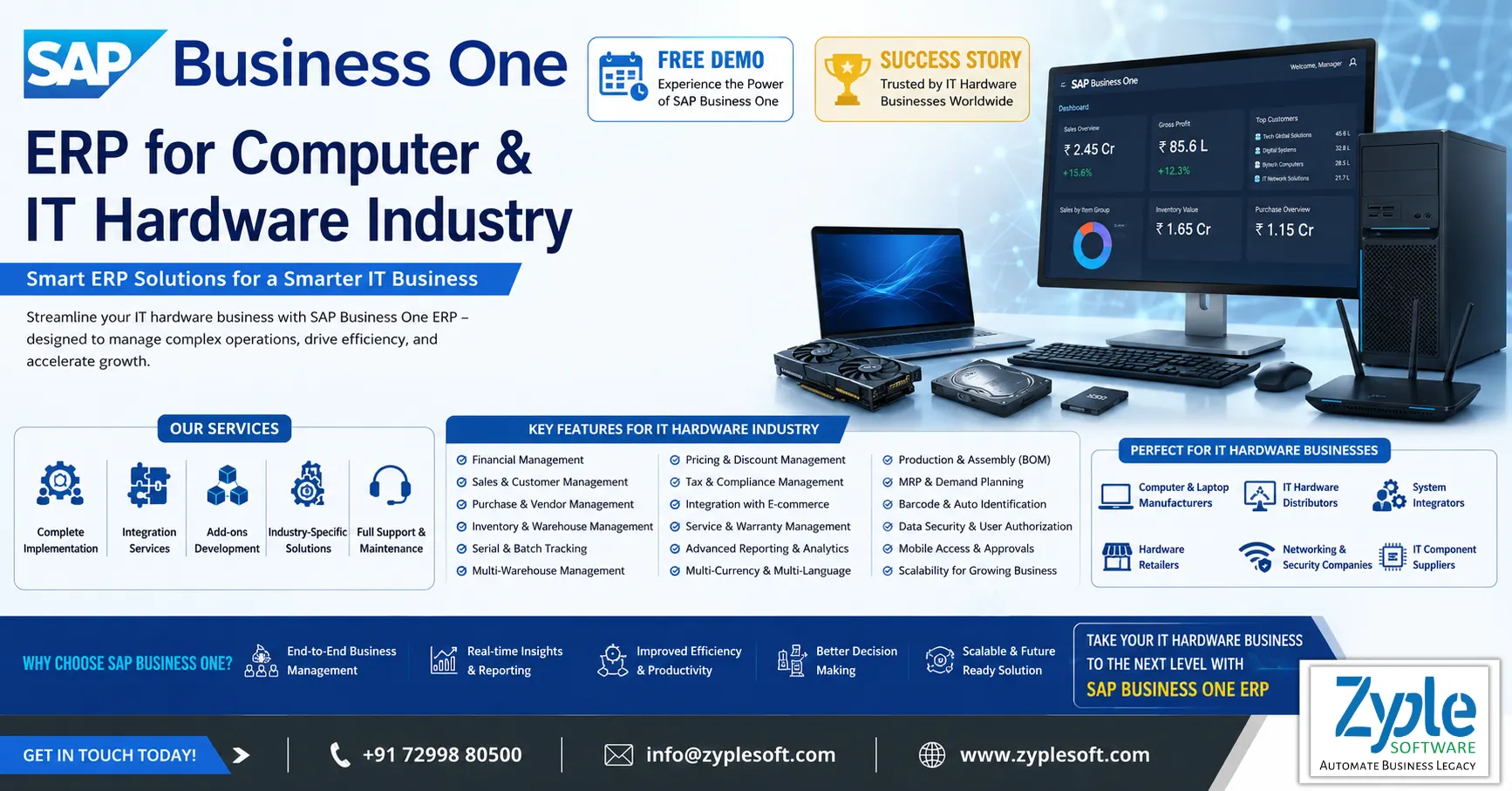
As the computer and IT hardware industry grows exponentially, it has become tedious and challenging to handle multiple operations all around the world, along with the business processes. Moreover, with a large industry like computer and IT hardware, integrating different departments and tackling any issues that occurred also requires so much time and effort. SAP Business One ERP for computer and IT hardware not only increases efficiency but also helps to improve the quality of products in the computer and IT hardware industry. The key purpose of facilitating the complex and multiple business processes of the computer and IT hardware industry is smoothly handled with the SAP Business One ERP solution.
Challenges Faced By The Computer and IT Hardware Industry
The computer and IT hardware industry tackles geopolitical trade friction, semiconductor supply chain volatility, strict localization mandates (like BIS requirements in India), and cooling limitations. Furthermore, rapid obsolescence and surging cybersecurity demands force manufacturers to continuously adapt hardware-as-a-service (HaaS) and recycling ecosystems.
1. Supply Chain Vulnerabilities and Geopolitics
The average lead time for essential silicon components remains elongated, causing unpredictable manufacturing delays. Geopolitical pressure drives protective import duties. Regional compliance certifications (e.g., India’s BIS certification) add short-term supply chain and compliance hurdles to avoid customs delays.
2. Physical and Technical Limits of Scaling
Processors have hit physical limits, where manufacturers can no longer randomly increase clock speeds without causing hardware failure or risking dark silicon. With network hardware lifespan dropping, businesses face challenges maintaining the rapid technological leaps of modern AI workloads.
3. Cybersecurity and Data Protection
Older hardware often cannot support modern OS or advanced threat-detection software, leaving networks vulnerable to ransomware and malware. Hardware manufacturers face extreme risks from targeted cyberattacks on their supply chain partners, which can endanger proprietary data and manufacturing blueprints.
4. Sustainability and E-Waste Management
End-of-Life (EOL) systems no longer receive manufacturer support, resulting in breakdowns and compliance flaws. Improper disposal of electronic devices invites heavy regulatory fines. Companies face rising pressure to adopt responsible recycling processes.
5. Evolving Business Needs
Generally, once a product left the warehouse, manufacturers lose visibility into how users interacted with it. To tackle disconnections and retain customers, companies are being forced to switch from one-time sales to usage-based and subscription revenue models.
Features of SAP Business One ERP for Computer and IT Hardware
1. Financial Management and Cost Control
- It includes general ledger, accounts payable and receivable, and multi-currency accounting.
- It includes real-time profit and loss tracking by product, brand, or project.
- Costing for assembled systems includes CPU builds, servers, networking kits, and more.
- It includes budgeting and expense control for procurement-heavy businesses.
- It includes bank reconciliation and GST or tx compliance.
- Helps computer and IT hardware companies handle thin margins and high-volume transactions efficiently.
2. Advanced Inventory and Warehouse Management
- It includes multi-warehouse and bin location management.
- It includes serial number and batch tracking (essential for hardware devices).
- It includes real-time stock visibility across branches.
- Inventory valuation methods like FIFO, moving average, and standard cost.
- It includes automated stock transfers and replenishments.
- Necessary for tracking laptops, servers, peripherals, and spare parts with precision.
3. Production and Assembly (Light Manufacturing or System Manufacturing)
- It includes bill of materials (BOM) for system configurations (e.g., custom PCs, servers).
- It includes production orders for assembly and tracking.
- It includes component issuance and finished goods receipt.
- It includes labor and overhead cost tracking.
- It includes production cost recalculation based on real usage.
- Suitable for companies assembling custom IT hardware solutions or white-label systems.
4. Material Requirements Planning (MRP)
- It includes demand forecasting based on sales history.
- It includes automatic generation of purchase and production orders.
- It includes lead time planning for imported IT components.
- Avoids stockouts and overstock situations.
- It ensures just-in-time availability for CPUs, RAM, SSDs, and networking gear.
5. Purchasing and Supplier Management
- It includes vendor comparison and price tracking.
- It includes purchase order automation and approval workflows.
- It includes import and export documentation.
- It includes landed cost calculation.
- It includes supplier performance analysis.
- Helps minimize procurement costs in a global IT hardware supply chain.
6. Sales and Customer Relationship Management (CRM)
- It includes lead and opportunity tracking for B2B deals.
- Automation cycle from quotation, order, and delivery to invoice.
- It includes customer-specific pricing (bulk IT buyers, resellers, and corporates).
- It includes sales forecasting and pipeline visibility.
- It includes after-sales service and AMC tracking.
- It includes project-based IT sales and long sales cycles.
7. Service and Warranty Management
- It includes warranty tracking by serial number.
- It includes service contract and AMC management.
- It includes ticketing system for repairs and support.
- It includes spare parts tracking for service operations.
- It includes RMA (Return Merchandise Authorization) handling.
- Essential for IT hardware businesses providing after-sales support and maintenance.
8. Business Intelligence and Analytics
- It includes interactive dashboards and KPI monitoring.
- It includes sales performance by product, brand, or region.
- It includes inventory aging and slow-moving stock analysis.
- It includes profitability analysis per customer or product line.
- It includes integration with Excel for advanced reporting.
- Allows data-driven decisions in fast-moving hardware markets.
9. Multi-Branch and Multi-Location Management
- It includes centralized control of multiple warehouses or retail outlets.
- It includes inter-branch stock transfers.
- It includes integrated financial reporting.
- It includes role-based access for different locations.
- Ideal for IT hardware distributors with multiple offices or service centers.
10. Integration and Scalability
- It includes integration with e-commerce platforms (for online hardware sales).
- It includes API-based integration with third-party logistics.
- Compatible with SAP B1 HANA for high-speed analytics.
- Easy add-on integration for industry-specific needs.
- It supports scaling from small IT resellers to enterprise distributors.
11. Mobility and Web Access
- It includes mobile apps for sales and service teams.
- It includes real-time updates on stock, orders, and customers.
- Ideal for sales teams and service engineers.
12. Compliance, Quality, and Traceability
- It includes serial or batch traceability for audits.
- It includes quality checks for incoming and outgoing hardware.
- It includes regulatory compliance like GST and import or export rules.
- It includes audit trails for all transactions.
- It ensures compliance and accountability in high-value hardware transactions.
Benefits of SAP Business One ERP for Computer and IT Hardware
The enterprise resource planning (ERP) software, SAP Business One (SAP B1) system, facilitates the computer and IT hardware industry by eliminating disconnected systems. It connects inventory, supply chain, and financials to track serialized components, handle strict supplier lifecycles, and accelerate order-to-delivery workflows in real-time.
1. Advanced Serial and Batch Tracking
Handles individual IT components, motherboards, or finished devices using unique serial numbers. The system evaluates items from the manufacturer to the point of sale and throughout their warranty periods.
2. Facilitated Supply Chain Management
Automates procurement and supplier management to manage global supply chains, fluctuating component prices, and bulk IT hardware orders seamlessly using SAP implementation.
3. Integrated Service and Warranty Management
Tracks SLAs, handles repair tickets, and maintains complete histories of customer devices, part replacements, and warranty expirations in a unified CRM system.
4. Real-Time Financial Control
Integrates purchasing, sales, and banking into a single general ledger to track multi-currency transactions and handle varying profit margins on hardware and sales using SAP solutions.
Conclusion of Computer and IT Hardware ERP
Zyple Software is a certified SAP Business One partner in India specializing in implementation, digital transformation, licensing, integration, add-on solutions, migration, and consulting for the computer and IT hardware industry. The scalability of SAP software ensures that the computer and IT hardware businesses will continue to enjoy the benefits of it in the long term.
If you’re designated, book a demo of SAP Business One.
Do you demand the SAP Business One ERP software for your business or industry?
Complete all the details in the allotted contact form; our team will get back to you.