How To Manage Fleet in Logistics Business?
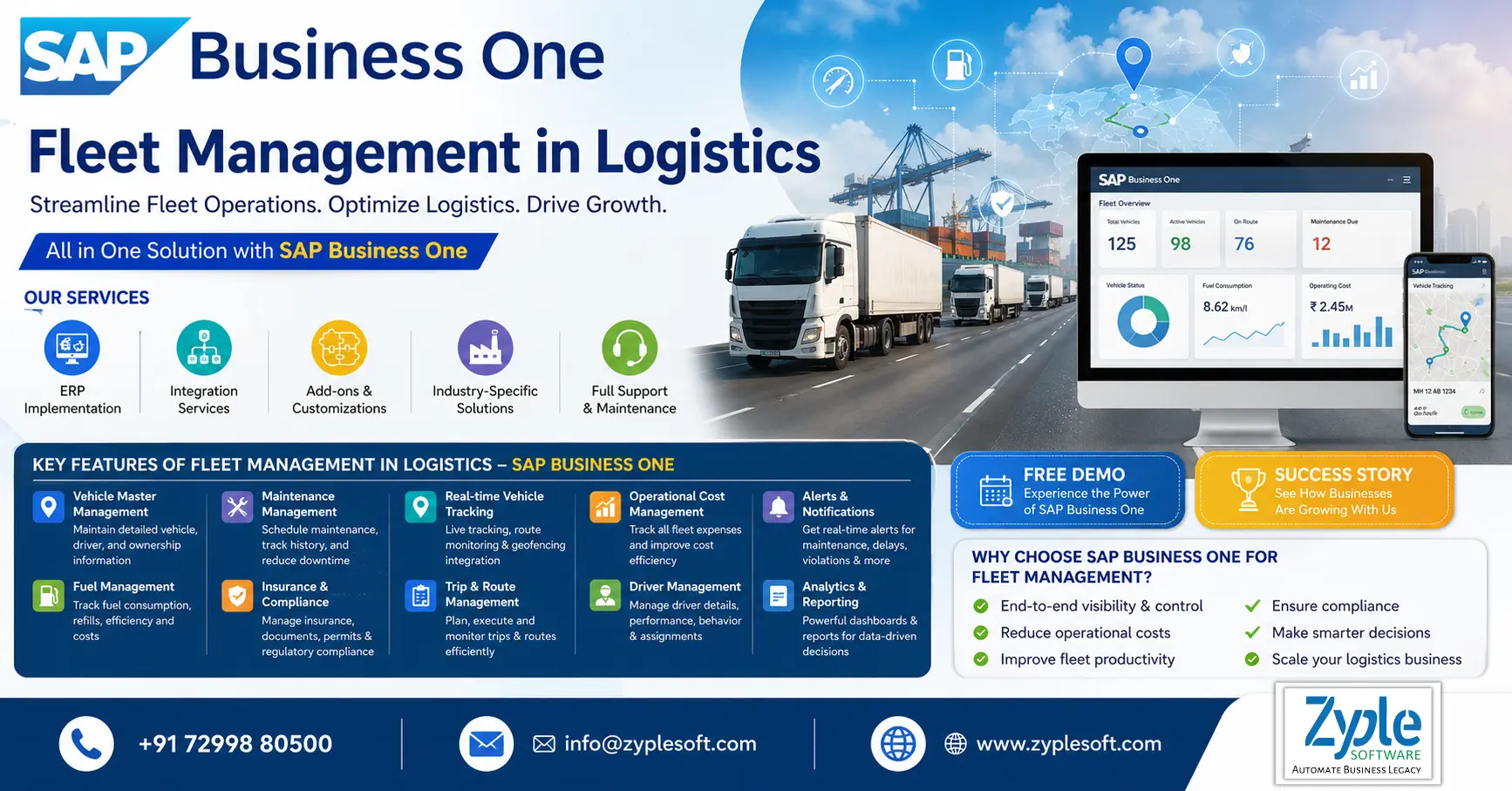
What is fleet management in logistics?
Fleet management in logistics is the strategic oversight and administration of commercial vehicles, including trucks, vans, and ships, to increase efficiency, minimize costs, and ensure compliance throughout their operational lifecycle. It involves using technology for real-time tracking, maintenance scheduling, and driver management to improve safety and fuel consumption. Here, we’ll discuss how to manage fleet in logistics.
Managing Fleet and Transportation in Logistics Using SAP Business One ERP
In today’s fast-paced logistics industry, efficient fleet and transportation management is key to maintaining competitiveness and ensuring timely delivery. As businesses expand and global trade becomes more complex, logistics companies face increasing challenges related to handling fleet and transportation, optimizing routes, and controlling costs. This is where SAP Business One, an inclusive ERP solution, comes into play. SAP Business One ERP Software is designed to help small and medium-sized enterprises (SMEs) facilitate their operations. When integrated with logistics, it provides numerous tools to manage fleet operations, monitor vehicle performance, optimize routes, and improve delivery times.
Understanding Fleet and Transportation Challenges in Logistics
Fleet and transportation challenges in logistics revolve around rising costs (fuel, maintenance), severe driver shortages, and the immediate need for digital transformation to improve efficiency. Key operational obstacles include route optimization, maintaining visibility, last-mile delivery pressure from e-commerce regulatory compliance, and managing safety.
1. Driver Shortages and Retention
A global shortage of skilled drivers, combined with strict hiring screenings to handle safety compliance, has increased recruitment difficulty and labor costs.
2. Rising Fuel and Maintenance Costs
Fluctuating, high fuel prices and increased costs for spare parts and vehicle maintenance crush profit margins.
3. Lack of Visibility and Technology Adoption
Many companies still depend on manual operations, leading to poor real-time tracking, ineffective routing, and high inquiry volumes.
4. Last-Mile Delivery and E-Commerce Demand
Customer demands for faster, cheaper delivery create huge pressure to optimize routes and handle courier capacity effectively.
5. Supply Chain Disruptions
Natural disasters, political instability, and pandemic-related disruptions cause serious delays.
6. Regulatory and Infrastructure Obstacles
Complex, varied tax structures, toll booth delays, and poor road infrastructure hamper operational efficiency.
7. Asset Management and Maintenance
Unexpected vehicle breakdowns cause disruptions. There is an increased need for specialized equipment like cold chain.
How SAP Business One Handles Fleet and Transportation in Logistics?
SAP Business One delivers a powerful solution to overcome these challenges by providing end-to-end visibility into fleet and transportation operations.
Here are the key features that make SAP Business One necessary in logistics:
1. Fleet Tracking and Real-Time Monitoring
One of the most crucial aspects of fleet and transportation is the ability to monitor vehicles in real-time. SAP Business One connects with GPS tracking systems to deliver a live view of your entire fleet. This data enables logistics companies to:
- Track the correct location of the vehicles.
- Evaluate driver behavior (e.g., speed, idling times).
- Identify deviations from planned routes.
- Respond faster to delays or accidents.
With real-time tracking, logistics managers can make better decisions and provide accurate delivery updates to customers. This minimizes uncertainities and improves overall customer satisfaction.
2. Route Optimization and Planning
Route optimization is key to minimizing fuel consumption and improving delivery times. SAP Business One ERP delivers advanced route planning tools that analyze multiple variables, such as traffic conditions, fuel efficiency, delivery time windows, and vehicle load capacity. By automatically suggesting the most efficient routes, SAP Business One helps logistics companies reduce travel time and fuel costs. Also, SAP software can adjust routes in real-time if unexpected events, such as road closures or traffic congestion, occur.
3. Vehicle Maintenance and Asset Management
Fleet management also includes vehicle maintenance, which can be an expensive and time-consuming task if not handled properly. The SAP Business One system delivers a vehicle maintenance module that tracks the performance and condition of every vehicle in the fleet. This feature enables you to:
- Schedule regular maintenance tasks depending on mileage or engine hours.
- Maintain a detailed history of repairs and maintenance costs.
- Receive automatic reminders for next service dates.
- Monitor spare parts inventory and usage.
With better visibility into vehicle health, logistics companies can avoid breakdowns, minimize downtime, and extend the lifespan of their fleet.
4. Fuel and Cost Management
Fuel is one of the biggest operating expenses in logistics. SAP Business One helps companies track fuel usage in real-time and compare it against estimated consumption based on routes. By this data evaluation, fleet managers can:
- Find inefficient vehicles or drivers with higher-than-average fuel consumption.
- Ensure that fuel is used properly by following the most efficient routes.
- Evaluate fuel costs and identify areas where savings can be made.
The SAP B1’s cost management features also enable logistics managers to monitor expenses related to repairs, labor, and spare parts. This data can be analyzed to identify ways to further minimize operational costs.
5. Driver and Workforce Management
Handling drivers is another essential component of transportation management. SAP implementation delivers an inclusive tool to assign drivers vehicles, track their working hours, and monitor their performance. Some key features include:
- Driver Scheduling: Automatically allocates drivers based on vehicle availability, route requirements, and driver working hours.
- Performance Monitoring: Evaluates key performance indicators (KPIs), such as on-time deliveries, fuel efficiency, and customer feedback.
- Compliance Management: Ensures that drivers comply with local regulations, such as working hour limits and rest periods, by monitoring their schedules and shifts within the SAP Business One solution.
This data can be used to improve driver performance, ensure compliance with labor regulations, and maximize overall operational efficiency.
6. Reporting and Analytics
One of the essential features of SAP Business One is its powerful reporting and analytics capabilities. SAP solutions deliver a suite of tools that generate reports on fleet performance metrics like fuel efficiency and delivery times, vehicle maintenance history and costs, route efficiency and travel times, and driver performance and customer feedback.
These reports provide logistics managers valuable insights into the efficiency of their fleet and transportation operations. By analyzing this data, companies can identify obstacles, optimize processes, and make better decisions that drive efficiency and cost savings.
Conclusion of Managing Fleet in Logistics Using SAP B1 ERP
Zyple Software is an authorized SAP B1 partner in India specializing in implementation, digital transformation, migration, licensing, integration, add-on solutions, and consulting for logistics companies. SAP Business One ERP provides an inclusive suite of tools that simplify and improve fleet and transportation management in the logistics industry.
If you’re fascinated, you can book a demo of SAP Business One.
Are you soliciting the SAP Business One ERP system for your business or industry?
Fill in all the details in the defined contact form; our team will return to you.