SAP Business One ERP for Fire and Safety Equipment Manufacturing
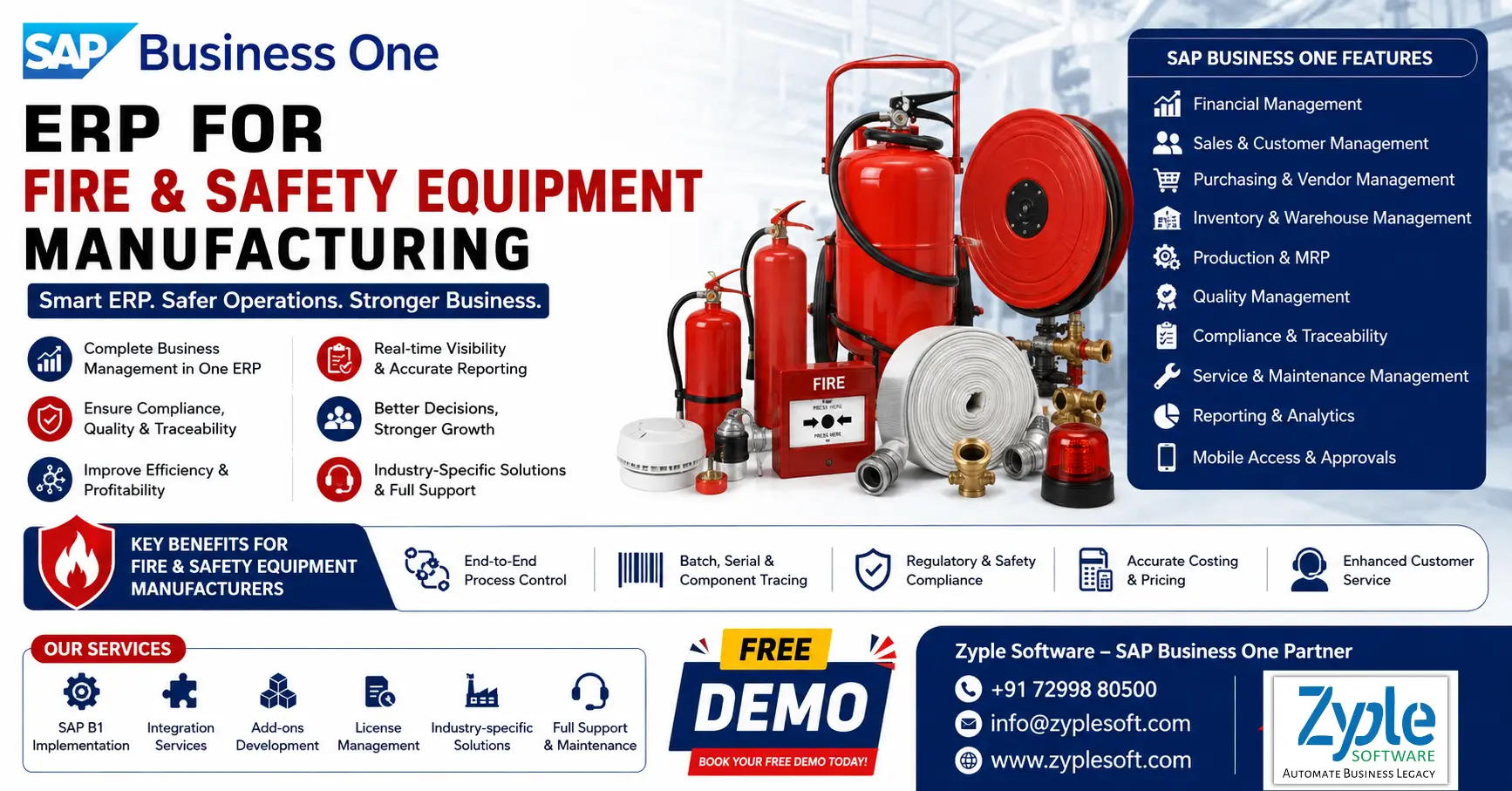
The fire and safety equipment manufacturing industry faces huge pressure due to its large scope of work, which involves project management, heavy machinery loading, shipping, warehousing, and other responsibilities. Due to growing logistics issues, fire and safety equipment manufacturing businesses need a system that unifies different company departments. SAP Business One ERP for fire and safety equipment manufacturing unites processes and helps in boosting production and efficiency.
Challenges Faced By the Fire and Safety Equipment Manufacturing Industry
The fire and safety equipment manufacturing industry faces serious challenges, primarily driven by fluctuating supply chains, rapidly evolving international safety regulations, and the high cost of R&D for IoT-integrated systems. These challenges demand that manufacturers continuously adapt to survive in a highly compliance-driven market.
1. Stringent and Evolving Regulations
Manufacturers must navigate continuously shifting global standards (such as updated ISO 16112 and NFPA 2112 certifications) for flame-resistant clothing and active fire systems. Maintaining compliance involves ongoing testing and heavy financial investment.
2. Supply Chain Volatility
The production of fire suppression agents (such as foam, clean agents, and chemical flame retardants) and electronic components heavily depends on global supply chains. Disruptions lead to fluctuating raw material costs and production delays.
3. Cost Sensitivity vs. Advanced Tech
Customers, especially small-to-medium enterprises (SMEs), often prioritize low-cost, traditional equipment over modern, IoT-integrated, or AI-based detection systems. This makes it difficult for manufacturers to recover the costs of building premium, high-tech safety gear.
4. Shifting Environmental Madates
Regulations regarding the environmental impact of safety chemicals are becoming strict. A notable example is the phase-out and restriction of certain FPAS (per- and polyfluoroalkyl substances) in firefighting foams, forcing manufacturers to research and develop eco-friendly alternatives without compromising effectiveness.
5. Counterfeit Competition
The market is often flooded with cheaper, non-certified imitation products. These counterfeits undercut legitimate manufacturers, reduce profit margins, and pose massive risks to end-users.
Let’s discuss some features with SAP B1 modules for fire and safety equipment manufacturing industry.
Features of SAP Business One ERP for Fire and Safety Equipment Manufacturing
1. Core Manufacturing and Production Management
- It includes multi-level BOMs for extinguishers, alarms, PPE kits, and more, with version control.
- Optimizes batch production of cylinders, valves, and hoses.
- Auto-calculates raw material needs based on demand forecasts.
- Tracks manufacturing orders, rework, and maintenance tasks.
- It includes real-time monitoring of operations, labor, and machine usage.
- It includes visibility into partially completed fire safety products.
- It balances workloads across machines and production lines.
2. Production Engineering and Equipment
- Configures custom fire safety systems like hydrant systems and alarm panels.
- Tracks design updates for safety compliance.
- Handles multiple product variants like sizes, pressure ratings, and certifications.
- Handles components like valves, nozzles, and sensors.
3. Inventory and Warehouse Management
- Real-time inventory tracking for raw materials, WIP, and finished goods.
- Batch and serial number tracking is essential for fire safety compliance and traceability.
- Bin location management helps in efficient warehouse organization.
- Stock replenishment automation avoids shortages of essential safety components.
- It includes accurate costing for each product line.
- Goods receipt and dispatch integration helps in seamless logistics flow.
4. Quality Management and Compliance
- It includes incoming, in-process, and final quality inspections.
- Defect and non-conformance tracking identify faults and corrective actions.
- Regulatory compliance management supports ISO, BIS, and NFPA standards.
- Complete traceability for safety audits.
- Lot traceability tracks every unit for recalls or service history.
5. Procurement and Supply Chain Management
- Supplier management handles vendors for cylinders, chemicals, and electronics.
- Purchase order automation facilitates the procurement cycle.
- Demand forecasting predicts demand for fire safety.
- Supply chain visibility tracks materials from supplier to production.
- It includes multi-location warehouse management.
6. Financial Management and Cost Control
- Integrated accounting like general ledger, accounts payable, accounts receivable, and journal entries.
- Tracks production costs per batch or product.
- It includes budgeting and financial planning.
- It includes cash flow management.
- Fixed asset management like machines and testing equipment.
- Profitability analysis like product-wise margin tracking.
7. Business Intelligence and Reporting
- Real-time dashboards and KPIs for production, sales, and inventory insights.
- Customized reports for safety compliance and operations.
- Predictive analytics for demand and production forecasting.
- Drill-down analysis identifies inefficiencies quickly.
8. Sales, CRM, and Service Management
- Lead and opportunity management to track B2B clients, like industries and construction firms.
- It includes quotation and order management.
- It includes customer lifecycle management.
- It includes AMC contracts for fire equipment servicing.
- Warranty tracking for extinguishers, alarms, and safety systems.
- Service call management for maintenance and inspections.
9. Maintenance and Asset Management
- Preventive maintenance scheduling for machines and testing equipment.
- It includes breakdown and maintenance tracking.
- It includes asset lifecycle management.
- Downtime analysis reduces production interruptions.
10. Integration and Smart Manufacturing (Industry 4.0)
- MES integration helps in connecting ERP with shop floor systems.
- IoT integration to monitor machines and production lines.
- API and third-party integration with CRM, logistics, and compliance systems.
- It includes cloud and on-premise deployment options.
11. Mobility and Access
- Mobile apps for sales, inventory, and approvals on the go.
- Web client access for browser-based ERP usage.
- It includes real-time alerts and notifications.
12. Security and Compliance
- It includes role-based access control.
- It includes data security and encryption.
- It includes audit logs and regulatory compliance.
- It includes multi-branch and multi-currency support.
Importance of SAP Business One ERP for Fire and Safety Equipment Manufacturing
The ERP software, SAP Business One (SAP B1) system, is a purpose-built ERP that facilitates fire and safety manufacturing by centralizing core processes, such as inventory, procurement, and financials. It improves production, increases strict quality control, and ensures compliance with industry-specific safety standards.
1. Strict Regulatory Compliance
Fire and safety equipment must achieve thorough safety and quality benchmarks (e.g., CE, UL, ISO, or ISI marks in India). SAP Business One evaluates batch numbers and serial numbers, ensuring end-to-end component traceability. This allows seamless auditing and compliance management.
2. Automated Material Requirements Planning (MRP)
The platform accurately calculates raw materials based on exact production orders and sales forecasts. This prevents component shortages while reducing excess holding costs for expensive metals, chemicals, and electronic sensors using SAP implementation.
3. Bill of Materials (BOM) Management
Safety equipment requires complex, multi-level assemblies. SAP B1 centralizes BOMs, enabling manufacturers to define exact quantities of raw materials and sub-assemblies required, minimizing manufacturing errors and material waste.
4. Quality Control Integration
The system enforces strict quality checks across every stage of production, from inspecting to testing final output (e.g., pressure testing extinguishers).
5. Supply Chain and Inventory Control
Real-time tracking of warehouse inventory ensures that essential safety parts are always on hand. It helps prevent stockouts of specialized components that could otherwise delay the fulfillment of life-saving equipment using SAP solutions.
6. Equipment and Asset Maintenance
Ensures that the manufacturing machinery and testing equipment themselves remain calibrated, safe, and completely operational to comply with manufacturing mandates.
Benefits of SAP Business One for Fire and Safety Equipment Manufacturing
SAP Business One facilitates the fire and safety equipment manufacturing industry by integrating essential operations like inventory, production, and financials. It ensures life-saving equipment meets strict regulatory standards, optimizes supply chains, and allows material requirements planning (MRP) to prevent shortages of essential raw materials.
1. Strict Regulatory Compliance and Traceability
Fire safety products (e.g., extinguishers, fire alarms, and sprinkler systems) require strict compliance with industry and quality regulations. SAP software tracks products through serial numbers and batch tracking, making it easy to recall parts, handle warranty claims, and pass government audits.
2. Advanced BOM (Bill of Materials) Management
Fire systems involve complex assembly. SAP B1’s BOM management enables manufacturers standardize production and control costs by precisely mapping out sub-assemblies, labor, and materials.
3. Real-Time Inventory Visibility
Handles components, such as metal, valves, chemicals, and electronic sensors, across multiple warehouses. Real-time tracking minimizes carrying costs and ensures essential parts are never out of stock when building life-saving equipment using SAP B1 add-ons.
4. Supply Chain and Production Planning
Aligns your purchasing directly with sales forecasts and production schedules. This ensures you always have the right components in stock to fulfill both standard orders and custom Engineer-to-Order (ETO) specifications.
5. Financial Control and Costing
Centralizes financial management to track expenses, identifies cost-saving opportunities, and calculates profit margins on specific fire safety products or large-scale contract bids.
Conclusion of Fire and Safety Equipment Manufacturing ERP
As a qualified SAP Business One partner, Zyple Software is providing services like SAP B1 implementation, integration, licensing, add-ons, and support to different industries like construction, manufacturing, retail, pharma, aerospace, jewellery, solar, food and beverage, and textile industries. SAP Business One is an ERP designed for small and medium-sized businesses that integrates finance, purchasing, sales, inventory, production, CRM, and reporting into a single platform. For solar panel and fire and safety equipment manufacturing or any other companies, it can improve project costing, procurement, subcontractor billing, and inventory management.
If you’re involved, reserve a demo of SAP Business One.
Do you demand the SAP B1 ERP system for your business or industry?
Finish all the details in the defined contact form; our team will return to you.
FAQs
Is SAP Business One the right ERP for my fire and safety equipment manufacturing business?
SAP Business One is ideal for small and medium-sized manufacturers looking to facilitate operations, improve compliance, and gain real-time visibility. A quick consultation can help evaluate if it fits your specific business needs.
What is the cost of implementing SAP Business One for fire safety equipment manufacturers?
The cost depends on factors like number of users, customization, and deployment type (like cloud or on-premises). Request a personalized quote to get an accurate estimate customized for your business requirements.
How quickly can SAP Business One be implemented in my company?
SAP B1 implementation timelines generally range from a few weeks to a few months depending on complexity. The complete project plan can be shared after understanding your current processes.
Can SAP Business One be customized for fire and safety equipment manufacturing workflows?
Yes, SAP Business One can be customized to support industry-specific needs like compliance tracking, batch management, service contracts, and safety inspections. Book a demo to see how it works for your operations.
Do Zyple Software deliver support and training after SAP Business One implementation?
Yes, ongoing support, user training, and system optimization services are delivered to ensure smooth adoption and long-term success.