SAP Business One ERP for Plastic Products Manufacturing Industry
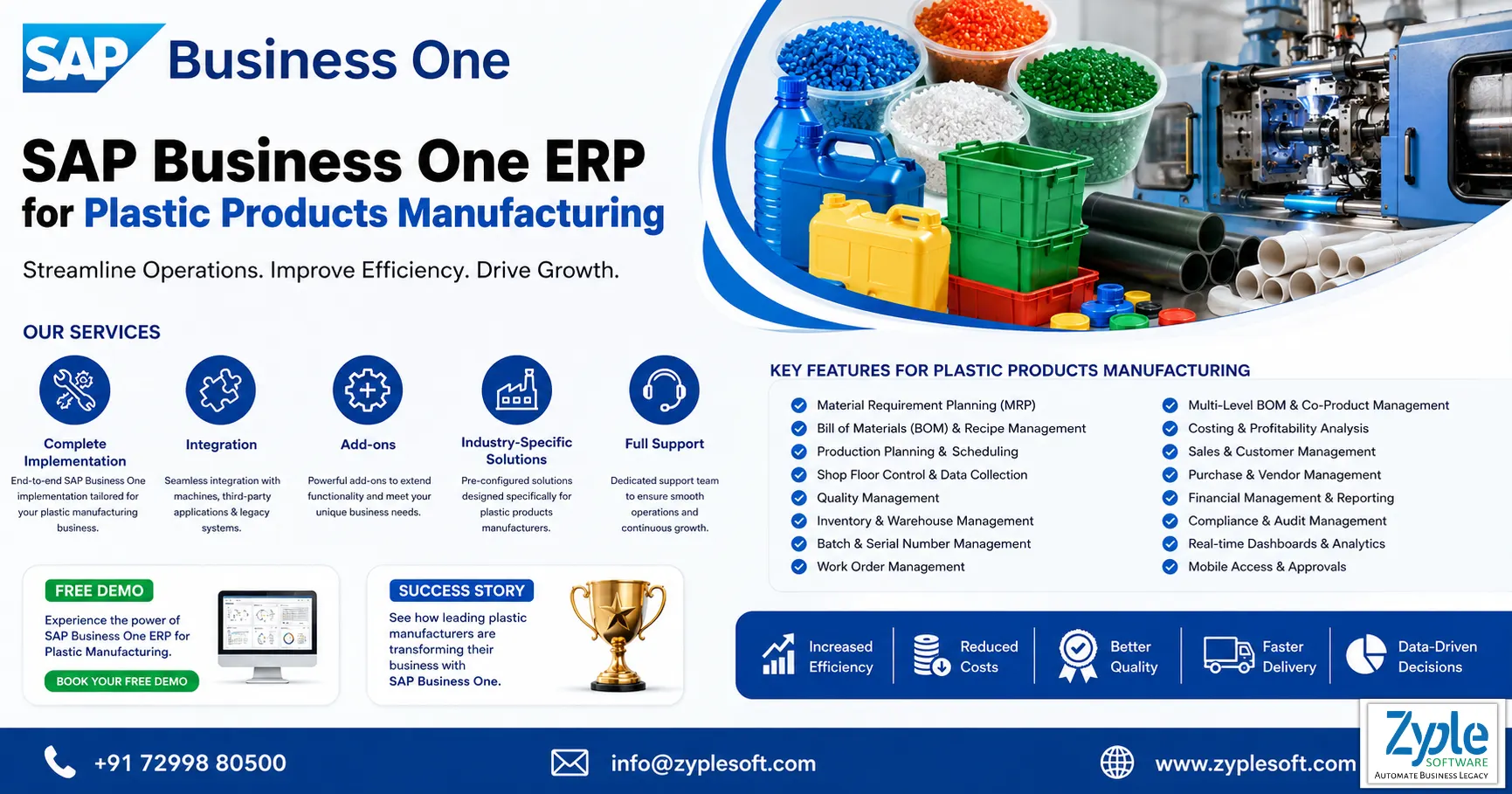
As the plastic products manufacturing industry exponentially grows, it has become tedious and difficult to handle multiple operations all around the world along with the business processes. Moreover, with large industries like plastic products, integrating different departments and tackling any issues that occurred also involves so much time and effort. SAP Business One ERP for plastic product manufacturing comes up as the possible option to increase the efficiency of the plastic products manufacturing industry.
Challenges Faced By The Plastic Products Manufacturing Industry
The plastic products manufacturing industry faces a series of challenges, including volatile petrochemical pricing, strict environmental regulations, shifting sustainability demands, and a widening skill gap. Combined with supply chain disruptions, these factors significantly affect profit margins and production efficiency.
1. Volatile Raw Material Costs
The sector is heavily reliant on fossil fuels for virgin resin, making production costs highly sensitive to global oil and gas price fluctuations, as well as inflation.
2. Strict Regulatory Pressures
Global governments are enforcing tougher anti-pollution laws, extended producer responsibility (EPR) schemes, and bans on single-use plastics. This forces manufacturers to quickly shift their product lines and manufacturing technologies.
3. Shift Toward Circular Economy and Sustainability
There is intense consumer and corporate demand for eco-friendly alternatives and recycled plastics. Changing to sustainable materials always requires redesigning molds and upgrading extrusion or molding facilities.
4. Labor Shortages and Automation
Finding and training a skilled workforce to operate complex, high-tech manufacturing equipment remains a significant challenge. Conversely, implementing automation to solve labor issues involves massive upfront capital.
5. Supply Chain Bottlenecks
The industry depends on a global web of supporters. Port congestions, shipping delays, and ingredient shortages continuously cause disruptions in production cycles.
6. Process Variations and Quality Control
In mass production, maintaining consistent quality metrics (e.g., melt flow rate, tensile strength, and uniform thickness) involves highly precise, standardized plastic testing instruments.
Features of SAP Business One ERP for Plastic Products Manufacturing
1. Production Planning and Control
- It includes multi-level bill of materials (BOM) for formulations, molds, and assemblies.
- Production orders for injection molding, extrusion, blow molding, and more.
- Material requirements planning (MRP) for resin, additives, and colorants.
- Capacity planning for machines like molding and extrusion lines.
- Production scheduling based on demand and machine availability.
2. Batch, Lot, and Traceability Management
- Entire batch and lot traceability from raw materials to finished goods.
- Tracks resin batches, additives, and regrind usage.
- It includes serial number tracking for high-value plastic components.
- It includes backward and forward traceability for quality recalls.
- It includes shelf-life tracking for materials like chemicals and polymers.
3. Inventory and Warehouse Management
- Real-time visibility of raw materials, WIP, finished goods, and scrap.
- It includes multi-warehouse and bin location management.
- Automated stock movements like GRN, issue, and transfer.
- It includes barcode integration for material handling.
- Inventory valuation methods like FIFO, moving average, and standard cost.
- Minimizes overstocking and stockouts.
4. Procurement and Supplier Management
- It includes purchase requisitions, RFQs, and purchase orders.
- It includes vendor comparison and supplier performance tracking.
- Raw material procurement includes granules, masterbatches, and chemicals.
- It includes integration with inventory and production planning.
- It includes automated accounts payable processes.
5. Quality Control and Compliance
- It includes incoming, in-process, and final quality inspection.
- Defines quality control parameters like density, tensile strength, and melt flow index.
- It includes quality certificates and reports generation.
- It includes compliance with ISO, ASTM, and BIS standards.
- Defines tracking and corrective actions.
6. Subcontracting and Job Work Management
- Handles outsourced operations like tooling and secondary finishing (printing and coating).
- Tracks materials sent to subcontractors.
- Monitors job work costs and timelines.
- Integrates subcontracting into the production cycle.
7. Costing and Profitability Analysis
- Product costing includes material, labor, and machine costs.
- Includes batch-wise and order-wise cost analysis.
- It includes scrap and wastage cost tracking.
- It includes real-time margin calculation.
- It includes budget and variance analysis.
8. Sales and Distribution Management
- The entire sales cycle from quotation, order, and delivery to invoice.
- It includes customer pricing, discounts, and contracts.
- It includes demand forecasting for plastic products.
- It includes dispatch planning and logistics tracking.
- It includes export documentation.
9. Financial Management and GST Compliance
- It includes general ledger, accounts payable, and accounts receivable.
- It includes GST, TDS, and TCS compliance.
- It includes e-invoicing and e-way bill integration.
- it includes cost center accounting.
- It includes cash flow and profitability reports.
10. CRM and Customer Lifecycle Management
- It includes lead and opportunity management.
- It includes customer order history and preferences.
- It includes complaint and returns management.
- It includes after-sales service tracking.
- It includes marketing campaign management.
11. Business Intelligence and Analytics
- Real-time dashboards for production, inventory, and sales.
- KPI tracking for machine utilization, rejection rate, and OEE.
- It includes custom MIS reports.
- It includes predictive insights for demand and production.
- It includes Excel integration for analysis.
12. Machine and Resource Utilization
- Monitors machine efficiency and downtime.
- Plans predictive maintenance.
- Optimizes mold usage and lifecycle.
- Improves production throughput.
- Tracks labor productivity.
13. Integration and Automation
- Integration with weighing scales, PLC or machine data systems, and barcode or RFID systems.
- Automated workflows like approvals and alerts.
- Minimized manual errors and faster processing.
14. Mobility and Remote Access
- Mobile app for sales orders, inventory checks, and approvals.
- It includes a web client for browser-based access.
- It includes real-time decision-making from anywhere.
15. Industry-Specific Capabilities for Plastics
- Support for process and discrete manufacturing, especially in plastics.
- Add-ons for injection molding and extrusion and compounding.
- It includes regrind and scrap reuse tracking.
- It includes mold lifecycle and maintenance management.
- It includes demand-driven production planning.
Importance of SAP Business One ERP for Plastic Products Manufacturing
The ERP software, SAP Business One (SAP B1) system, is essential for the plastic products manufacturing industry because it facilitates complex operations like resin tracking, machine scheduling, and waste reduction. It centralizes essential data, allowing manufacturers to optimize inventory, improve on-time deliveries, and boost overall profitability.
1. Material Requirements Planning (MRP)
Accurately calculates the exact amount of raw materials (e.g., polymers, additives, and masterbatches) required based on historical data and upcoming sales orders, preventing stockouts and overstocking.
2. Machine and Production Planning
Integrates machine capacity and production scheduling to avoid obstacles and maximize equipment utilization during complex injection molding or extrusion processes using SAP implementation.
3. Quality Control and Traceability
Delivers strict batch and lot tracking to trace materials from raw resin supplier to finished product, ensuring compliance with industry safety and quality standards.
4. Cost and Waste Reduction
Monitors real-time raw material consumption and scrap or waste generation, helping you identify unproductive procedures and significantly reduce operating costs.
Benefits of SAP Business One for Plastic Products Manufacturing
SAP Business One (SAP B1) facilitates the plastic products manufacturing industry by optimizing raw material consumption, automating production scheduling, and enforcing strict quality control. It centralizes inventory, financials, and supply chain operations, allowing companies to minimize plastic waste, reduce lead times, and scale operations efficiently.
1. Optimized Material Management
Tracks raw material consumption (resin, masterbatches, and additives) in real-time. Accurately maps bills of materials (BOMs) to minimize scrap and control production costs using SAP solutions.
2. Advanced Production Planning
Utilizes material requirements planning (MRP) to forecast demand, schedule injection or extrusion machines, and automate purchasing so you never run out of stock.
3. Quality Control and Traceability
Maintains compliance and handles digital quality certificates. Executes granular lot and batch tracking to trace defective products back to their resin batches.
4. Financial and Supply Chain Visibility
The SAP software handles multi-branch operations, automates procurement, and integrates with CAD or CAM systems or e-commerce platforms to drive end-to-end synergy.
5. Data-Driven Decisions
Uses the SAP B1 HANA database to pull instant, accurate reports on machine efficiency, resource utilization, and key performance indicators.
Conclusion of Plastic Products Manufacturing ERP
Zyple Software is a certified SAP Business One partner in India specializing in implementation, digital transformation, licensing, integration, add-on solutions, migration, and consulting for the plastic products manufacturing industry. With Zyple Software, you’re not just implementing an SAP B1 ERP system; you’re setting the stage for improved productivity, facilitated operations, and sustained business growth.
If you’re involved, schedule a demo of SAP Business One.
Do you command the SAP Business One ERP software for your business or industry?
Complete all the details in the defined contact form; our team will get back to you.
FAQs
1.How can SAP Business One ERP optimize efficiency in plastic manufacturing?
SAP Business One facilitates production planning, inventory planning, and quality control, helping plastic manufacturers minimize downtime, reduce wastage, and improve overall operational efficiency.
2.Is SAP Business One ideal for small and medium-sized plastic manufacturing enterprises?
Yes, SAP Business One is developed for SMEs and provides scalable features designed for plastic manufacturers, making it an affordable solution for growing businesses.
3.Can SAP Business One monitor raw materials and finished products in real-time?
Definitely. SAP Business One delivers real-time visibility into raw materials, work-in-progress, and finished goods, ensuring better control over inventory and production processes.
4.How long does it take to implement SAP Business One for plastic manufacturing business?
Implementation generally takes between 8 to 16 weeks, depending on business complexity, customization needs, and integration requirements.
5.How can I get a demo for SAP Business One ERP?
You can connect with the experienced SAP Business One partner Zyple Software to schedule a free demo, evaluate your business needs, and explore how the situation can be customized for your plastic manufacturing operations.