Production Management ERP Software for Business
What is ERP in Production Management?
Enterprise resource planning (ERP) is a software system that helps organizations facilitate their key business processes, including finance, HR, manufacturing, supply chain, sales, and procurement, with a unified view of activity and delivers a single source of truth. In this blog, we’ll discuss production management ERP software.
What is Production Management Software?
It is a software that facilitates manufacturing operations by integrating planning, scheduling, inventory, and quality control into a single platform. These systems allow manufacturers to improve shop floor efficiency, optimize traceability, and minimize human error, increasing overall profitability.
Which Is the Best ERP Software for Production Management?
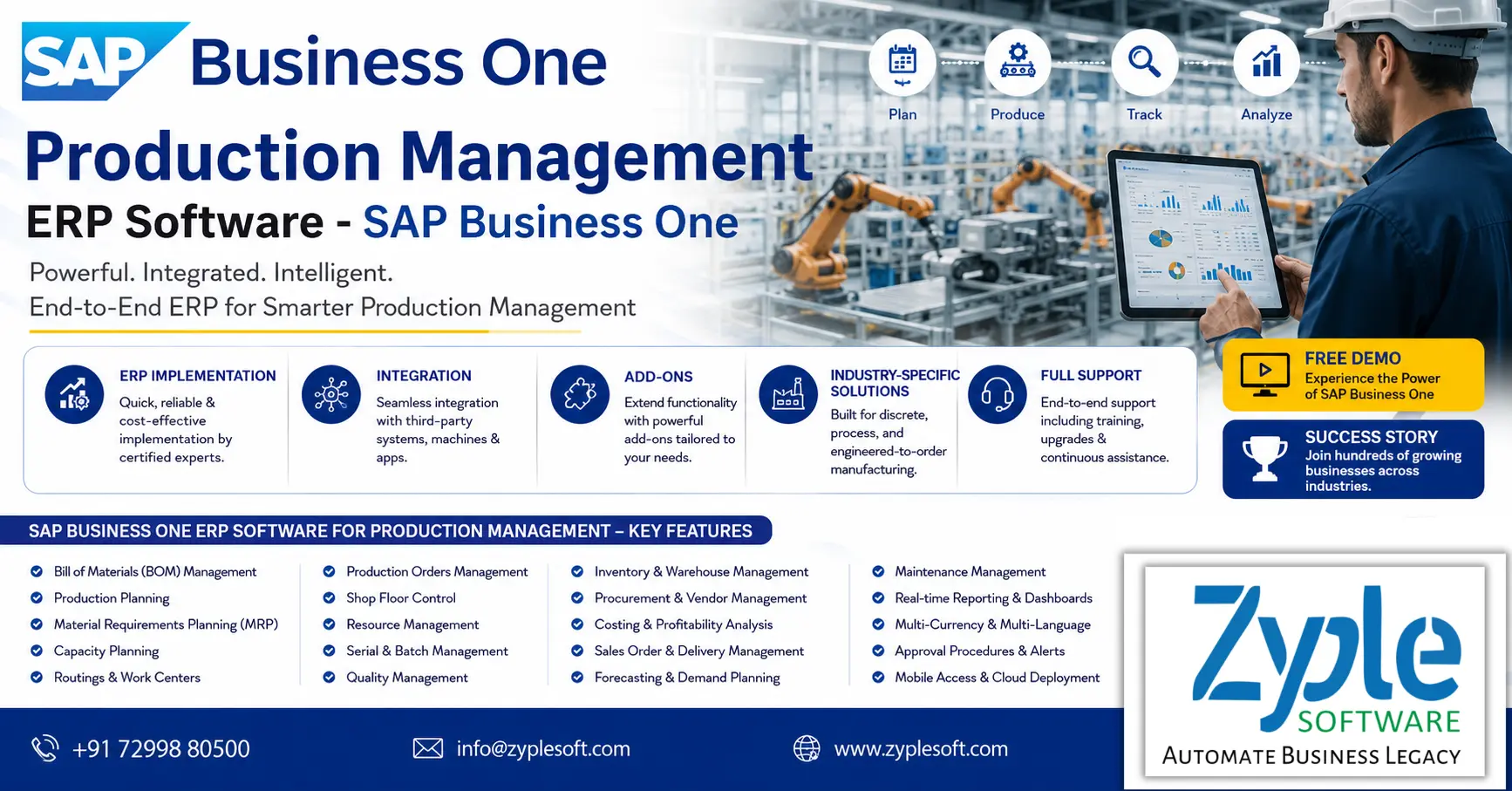
SAP Business One is the best ERP software for production management. It is an inclusive, affordable solution designed for small and medium-sized manufacturers, delivering integrated production planning, material requirements planning (MRP), inventory control, and shop floor management. It facilitates manufacturing workflows from order-to-cash, providing real-time visibility, cost tracking, and improved operational efficiency.
Features of Production Management ERP Software
Here are the features of SAP B1 as production management software:
1. Bill of Materials (BOM) Management
- Creates multi-level BOMs defining raw materials, components, and resources required for production.
- Hierarchical structures, sub-assemblies, and revisions are supported.
- Accurate production planning and standardization are ensured.
2. Production Order Management
- Creates production orders manually or automatically from sales or MRP recommendations.
- Tracks raw material consumption, labor and overhead costs, and production progress.
- Handles the entire lifecycle from release to completion.
3. Material Requirements Planning (MRP)
- Automatically calculates material demand based on sales orders, forecasts, and inventory levels.
- Creates purchase orders and production orders.
- Helps prevent stock shortages and overstocking.
4. Production Planning and Scheduling
- Plans and handles production schedules and workflows.
- Supports capacity planning, work center allocation, and lead-time optimization.
- Allows better on-time delivery and resource utilization.
5. Shop Floor Control
- Real-time tracking of work-in-progress (WIP), production stages, and machine and labor activity.
- Records scrap and rework and operation times.
- Enhances visibility into shop-floor operations.
6. Inventory and Warehouse Integration
- Seamless integration with inventory like raw materials, work-in-progress (WIP), and finished goods.
- Automatic stock updates when materials are issued and finished goods are received.
- It supports multi-warehouse and bin management.
7. Resource and Capacity Management
- Defines and handles resources such as machines, labor, and tools.
- Assigns resource capacity to production orders.
- Analyzes capacity utilization and production obstacles.
- Helps balance workload effortlessly.
8. Production Costing and Variance Analysis
- Defines standard production costs (materials, labor, and overhead).
- Calculates actual production costs during execution.
- Analyzes cost variance and profitability per product/order.
9. Work-in-Progress (WIP) Tracking
- Real-time tracking of semi-finished goods and production stages.
- It includes automatic WIP accounting updates.
- It helps monitor production efficiency and delays.
10. Production Routing and Process Control
- Defines production routes and operation sequences.
- Handles process steps, machine usage, and time estimation.
- It ensures standardized and optimized production flow.
11. Subcontracting and External Processing
- Handles outsourced production processes.
- Tracks materials sent to vendors and received goods.
- Maintains cost and process visibility.
12. Quality and Compliance Support
- Integrates quality checks within production stages.
- Ensures compliance with industry standards.
- Minimizes defects and rework.
13. Real-Time Reporting and Analytics
- It includes production dashboards and KPIs.
- Reports on production, efficiency, and delays and obstacles.
- Allows data-driven decision-making.
14. End-to-End Production Integration
- Fully integrated with finance, procurement, sales, and inventory.
- Delivers complete visibility from raw material to finished goods.
Importance of Production Management Software
The enterprise resource planning (ERP) software, SAP Business One (SAP B1) system, is essential for modern manufacturing, driving efficiency, minimizing costs, and improving product quality through automation and real-time visibility. It increases resource allocation, facilitates workflows, and reduces obstacles, enabling SMEs and large manufacturers to improve productivity and meet strict deadlines.
1. Improved Efficiency and Productivity
Automates routine tasks and scheduling, allowing employees to focus on strategic initiatives. It minimizes downtime by optimizing machine and labor utilization.
2. Cost Reduction and Waste Management
Reduces waste, scraps, and excess inventory through better planning, minimizing operational costs and improving profitability.
3. Increased Planning and Scheduling
Provides real-time visibility into production schedules, helping handle capacity and meet customer deadlines.
4. Quality Control and Traceability
Allows real-time monitoring of production to ensure consistent quality and compliance, reducing the risks of human errors.
5. Data-Driven Decision-Making
Delivers analytics and tracking for KPIs, enabling faster and better decision-making.
Benefits of Production Management System
SAP software improves efficiency by automating workflows, increasing real-time visibility, minimizing waste, and optimizing resource scheduling. Main benefits include accelerated delivery times, improved quality control, accurate data-driven decisions, and minimized operating costs. It facilitates operations from inventory to shop floor for increased profitability.
1. Improved Productivity and Efficiency
Facilitates manufacturing processes to maximize output while minimizing idle time for machines and staff.
2. Increased Real-Time Visibility
Delivers inclusive tracking of production progress, enabling managers to identify obstacles, track KPIs, and make better, immediate decisions.
3. Optimized Planning and Scheduling
Allows better resource allocation and scheduling, enabling flexible, fast adjustments to orders and preventing obstacles.
4. Quality Control and Waste Reduction
Reduces defects through monitoring and maintains consistent quality standards, minimizing rework and material waste.
5. Inventory Management
Allows better management of inventory levels and material movement, minimizing carrying costs and preventing stock shortages.
6. Analytical Decision-Making
Collects and evaluates production data to provide insights into performance, costs, and opportunities for process improvement.
7. Better Supply Chain Management
Strengthens supplier management and automates procurement processes, ensuring prompt arrival of materials.
8. Lower Production Costs
Improves the entire manufacturing chain, leading to minimized overall costs and higher profitability.
9. Increased Customer Satisfaction
Ensures timely delivery by keeping production on schedule and increasing product quality.
10. Scalability for Growth
Supports business expansion through simulation tools and flexible, cloud-based systems that adapt to larger production volumes.
Conclusion of Production Management ERP
Zyple Software is an official SAP B1 Partner in India specializing in implementation, consulting, licensing, integration, add-on solutions, migration, digital transformation, and support.
Zyple Software company has expertise in SAP Business One implementation for different industries like manufacturing, construction, real estate, agriculture, financial services, healthcare, retail, infrastructure, technology, energy, logistics, EPC, and professional services. SAP Business One facilitates processes and drives growth seamlessly with production management.
If you’re excited, book an SAP Business One demo.
Are you exciting for the SAP B1 ERP solution for your business or industry?
Fill in all the details in the dispensed contact form; our team will get back to you.