SAP Business One Integration Services for Industries
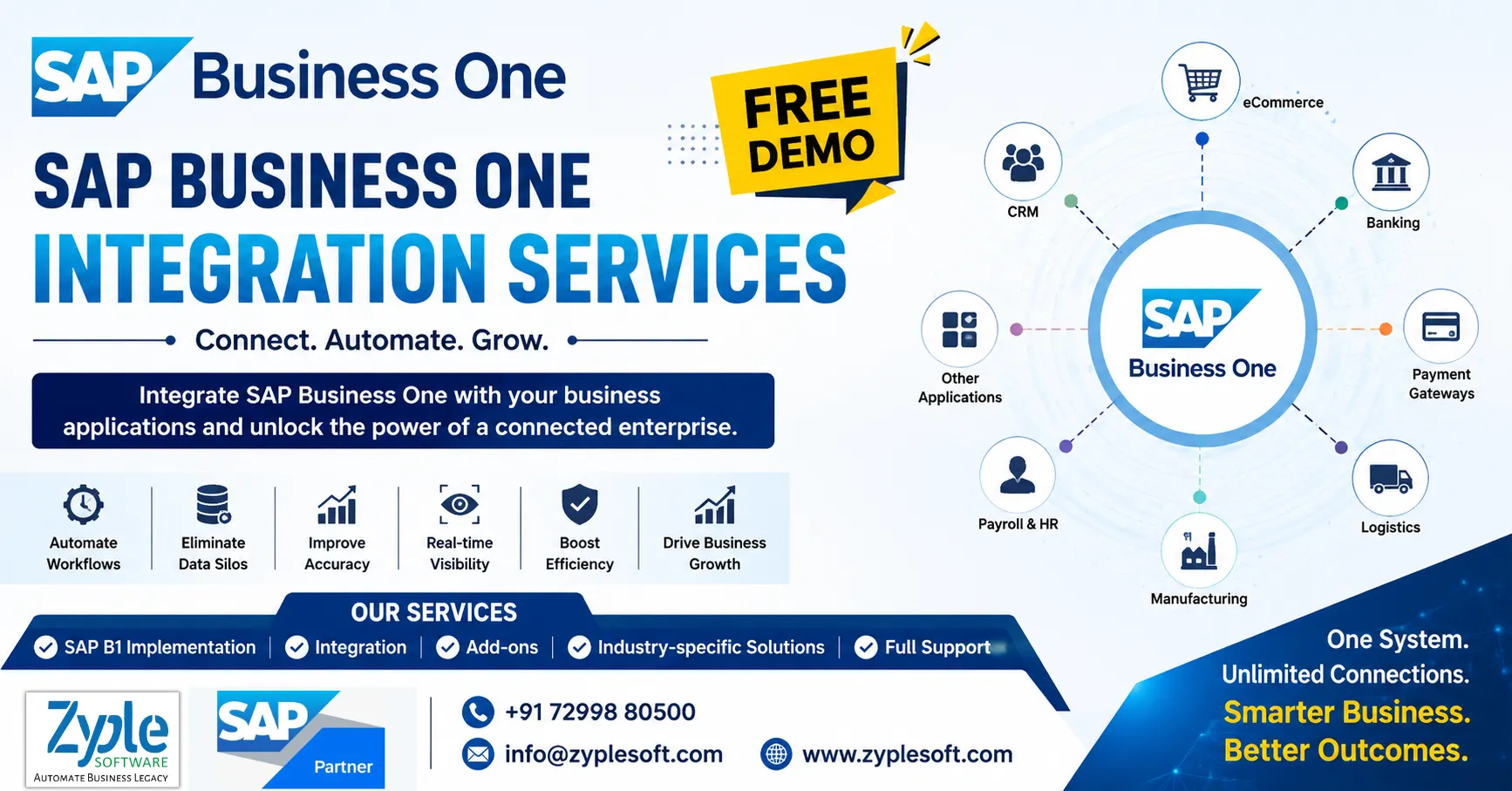
SAP Business One Integration enables businesses to connect their ERP system with the applications, platforms, databases, and operational systems they use every day. Zyple Software provides SAP Business One integration services to help organizations create a connected digital ecosystem where business information can move accurately and efficiently between SAP Business One and third-party applications.
From eCommerce and CRM platforms to payment gateways, payroll systems, manufacturing solutions, logistics applications, banking platforms, and custom software, our team helps businesses integrate SAP Business One with the systems that support their operations.
With the right integration strategy, businesses can reduce duplicate data entry, improve data accuracy, automate workflows, and gain better visibility across departments.
Looking for SAP Business One integration for your business? Talk to Zyple Software for a customized integration assessment and SAP Business One demo.
What Is SAP Business One Integration?
SAP Business One Integration is the process of connecting SAP Business One ERP with external software, applications, databases, websites, or business platforms so that information can be exchanged between systems.
For example, when a customer places an order through an eCommerce website, integration can automatically transfer the order information to SAP Business One. Similarly, inventory, customer information, invoices, payment status, and shipment details can be synchronized between connected systems.
Instead of maintaining separate information in multiple applications, integration creates a connected flow of data.
A typical SAP Business One integration can connect:
- SAP Business One with CRM software
- SAP Business One with eCommerce websites
- SAP Business One with WooCommerce
- SAP Business One with payment gateways
- SAP Business One with banking systems
- SAP Business One with payroll software
- SAP Business One with manufacturing applications
- SAP Business One with warehouse management systems
- SAP Business One with logistics and transportation systems
- SAP Business One with third-party APIs
- SAP Business One with mobile applications
- SAP Business One with custom business applications
Why Integrate SAP Business One With Other Systems?
Key benefits include:
Reduce Manual Data Entry
Improve Data Accuracy
Automate Business Processes
Improve Real-Time Visibility
Connect Different Departments
Increase Operational Efficiency
Support Business Growth
SAP Business One Integration Services by Zyple Software
1. SAP Business One API Integration
- Customer synchronization
- Product and item synchronization
- Sales order integration
- Purchase order integration
- Inventory synchronization
- Invoice integration
- Payment updates
- Business partner information
- Shipment information
- Custom workflows
2. SAP Business One eCommerce Integration
3. SAP Business One WooCommerce Integration
- Product master synchronization
- Customer synchronization
- Stock availability
- Sales orders
- Order status
- Pricing
- Tax information
- Invoices
- Shipping information
- Payment status
4. SAP Business One CRM Integration
- Leads
- Customers
- Contacts
- Opportunities
- Sales activities
- Quotations
- Orders
- Customer communication data
5. SAP Business One Payment Gateway Integration
6. SAP Business One Banking Integration
- Bank transaction synchronization
- Payment processing
- Collection information
- Bank reconciliation
- Customer payment updates
- Vendor payment information
7. SAP Business One Payroll and HRMS Integration
- Employee information
- Salary-related accounting information
- Attendance data
- Payroll transactions
- Department information
- Cost centers
8. SAP Business One Manufacturing Integration
- Production orders
- Bill of Materials
- Material consumption
- Production status
- Inventory
- Work-in-progress
- Machine or production data
- Quality information
9. SAP Business One Warehouse and Logistics Integration
- Inventory movements
- Goods receipt
- Goods issue
- Stock transfers
- Barcode information
- Delivery status
- Shipment information
- Vehicle or fleet information
- Warehouse transactions
SAP Business One Integration for Different Industries
Manufacturing
Construction & Infrastructure
EPC
Trading & Distribution
Retail
Pharmaceutical
Food and Beverage
Textile
SAP Business One Integration Process
Step 1: Business Requirement Analysis
Step 2: System & Data Assessment
Step 3: Integration Architecture
Step 4: Development & Configuration
Step 5: Data Mapping
Step 6: Testing
Step 7: Deployment
Step 8: Support & Optimization
SAP Business One Integration With APIs
- Authentication
- Authorization
- Data mapping
- Request and response handling
- Error management
- Data validation
- Synchronization frequency
- Logging
- Security
- Scalability
SAP Business One Integration With SAP HANA
Custom SAP Business One Integration
- Custom API connectivity
- Industry-specific workflows
- Legacy system integration
- Custom application integration
- Multi-system data synchronization
- Specialized reporting integration
- Automated business workflows
- Mobile application integration
SAP Business One Integration Challenges We Help Solve
- Duplicate data entry
- Disconnected business applications
- Manual order processing
- Inventory synchronization issues
- Delayed financial information
- Multiple customer databases
- Manual invoice creation
- Lack of system-to-system automation
- Data inconsistencies
- Legacy software limitations
- Difficulty connecting custom applications
- Limited visibility across business processes
Why Choose Zyple Software for SAP Business One Integration?
- SAP Business One implementation
- SAP Business One integration
- SAP B1 API integration
- SAP Business One customization
- SAP Business One add-on development
- Third-party application integration
- Data migration
- ERP process automation
- Industry-specific solutions
- SAP Business One support
SAP Business One Integration FAQs
What is SAP Business One integration?
SAP Business One integration connects the ERP with external applications, platforms, databases, websites, APIs, and business systems so that information can be exchanged between them.
Why does a business need SAP Business One integration?
Businesses use integration to reduce manual data entry, automate workflows, improve information accuracy, connect different applications, and create better visibility across operations.
Can SAP Business One integrate with eCommerce?
Yes. SAP Business One can be integrated with eCommerce platforms to exchange information such as products, customers, orders, inventory, invoices, payments, and shipping information.
Can SAP Business One integrate with WooCommerce?
Yes. A customized WooCommerce and SAP Business One integration can synchronize relevant online-store and ERP information based on the business requirements.
Can SAP Business One integrate with CRM?
Yes. CRM integration can connect leads, customers, contacts, opportunities, quotations, sales orders, and other relevant information between systems.
Can you integrate SAP Business One with custom software?
Yes. Zyple Software can design custom integration solutions for proprietary applications, legacy systems, industry-specific software, and other business platforms.
Do you provide SAP Business One integration support?
Yes. Zyple Software provides integration implementation, customization, troubleshooting, maintenance, and ongoing SAP Business One support.
Build a Connected Business With SAP Business One
Your ERP should not operate as an isolated system.
By connecting SAP Business One with CRM, eCommerce, banking, payroll, warehouse, manufacturing, logistics, payment, and custom applications, your organization can create a more connected and automated business environment.
Zyple Software helps businesses plan, develop, implement, and support SAP Business One integration solutions based on their technology environment and industry requirements.
Ready to Integrate SAP Business One With Your Business Applications?
Book a Free SAP Business One Integration Consultation with Zyple Software.
Zyple Software – SAP Business One Partner
Call Us: +91 72998 80500
Mail: info@zyplesoft.com
Website: www.zyplesoft.com
Services: SAP Business One Implementation | Integration | Add-ons | Customization | Industry Solutions | Support
Are you looking for any SAP Business One Integration? Kindly fill your details in below given form; Our team will contact you with better solutions.