Tag Archives: sap business one

SAP Business One erp for Electrical Industry

SAP Business One for Electrical

SAP Business One ERP for Electrical Industry
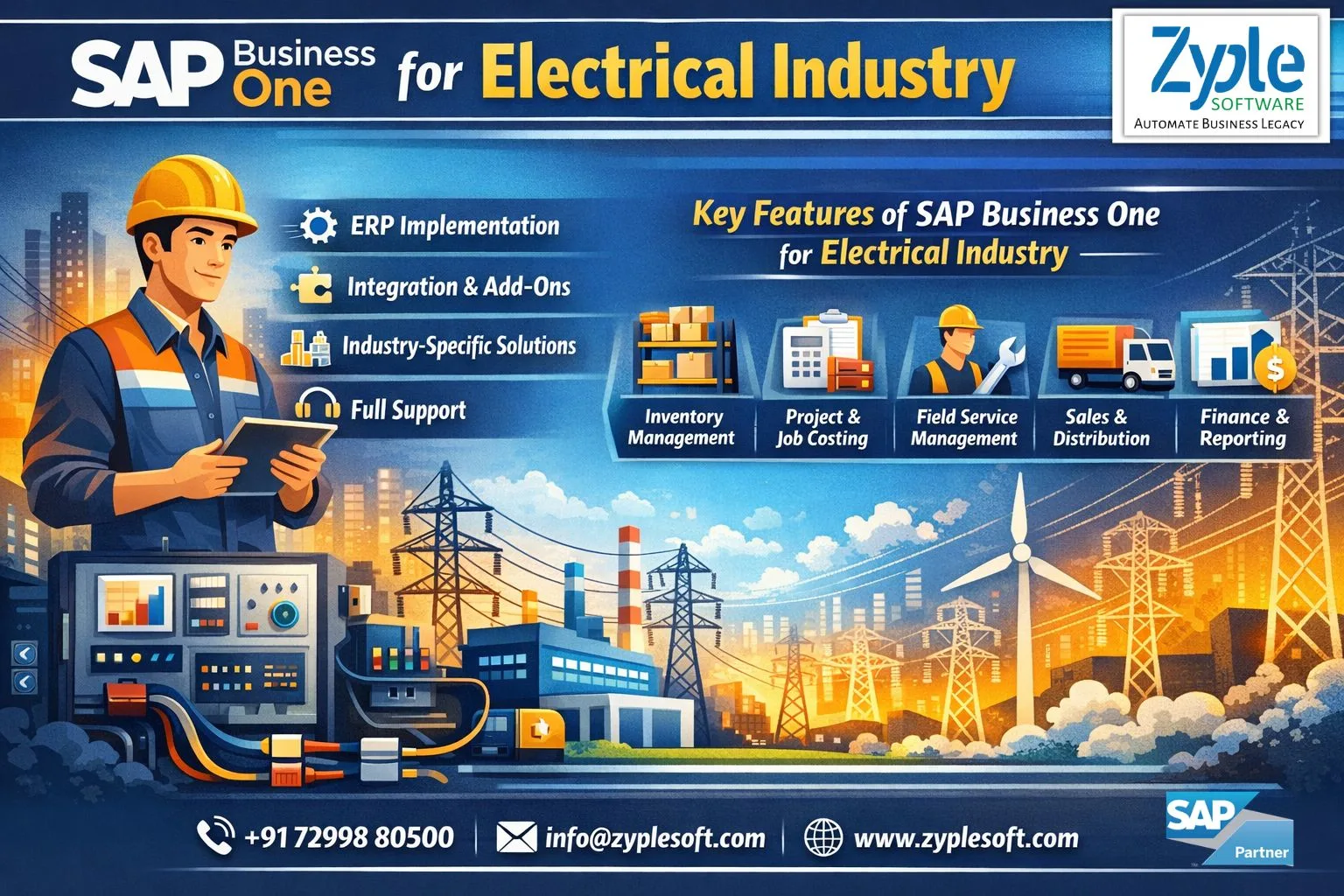
SAP Business One erp for Electrical Industry

The electrical industry is rapidly evolving, driven by innovation, sustainability goals, and growing market demand. Electrical businesses must handle complex products like batteries, motors, controllers, electronics, and software components while ensuring strict quality standards, regulatory compliance, and supply chain coordination.

Many electrical businesses operate with disconnected systems across engineering, production, procurement, quality, and finance, leading to limited traceability, cost overruns, production delays, and inefficient decision-making. SAP Business One for electrical industry delivers a unified platform that integrates production planning, inventory, procurement, quality management, project tracking, and finance, providing real-time visibility and operational control across the electrical manufacturing lifecycle.

Challenges of the Electrical Industry

The electrical industry faces significant challenges, including connecting variable renewable energy into aging grids, maintaining safety in complex industrial environments, and navigating rapid technological changes. Main issues also include preventing equipment failures from loose connections or moisture, managing high capital costs for infrastructure, and handling cybersecurity threats.

1. Grid Modernization and Renewable Integration

Connecting large amounts of variable renewable energy (wind or solar) requires balancing the grid and updating outdated infrastructure.

2. Safety and Maintenance

Industrial electrical projects are high-risk, requiring strict safety protocols to avoid shocks, fires, and arc flash incidents. Common electrical failures are driven by loose connections, moisture, and insulation failure.

3. Infrastructure and Supply Chain

The need for significant investment in transmission and distribution to manage higher loads and renewable energy input.

4. Cybersecurity Risks

Increased digitalization of electrical grids results in vulnerabilities to cyber-attacks.

5. Workforce Challenges

A demand for skilled labor to handle modern technologies and complex installations.

6. Environmental Regulations

There is pressure to adopt green energy and eco-friendly practices, requiring firms to upgrade materials and technologies.

7. Complex Operational Environments

Industrial contractors experience challenges with high-elevation work, hazardous environments, and the need for specialized, heavy-duty materials.

8. Cost Management

Managing high costs for materials and labor while attempting to improve energy efficiency and minimize operational expenses.

Features of SAP Business One for Electrical Industry

1. Bill of Materials (BOM) and Production Management

  • It includes multi-level BOM management for electrical components and assemblies.
  • It includes production planning and scheduling for cables, panels, transformers, and more.
  • It supports make-to-order or assemble-to-order manufacturing.
  • It tracks raw materials, WIP, and finished goods in real-time.

2. Component and Inventory Management

  • It includes real-time tracking of electrical parts, spares, and components.
  • Batch and serial number tracking (essential for electrical goods).
  • It includes inventory aging, stock valuation, and demand forecasting.
  • It includes barcode and bin-location-based warehouse management.

3. Procurement and Supplier Management

  • It includes vendor comparison and purchase planning.
  • It includes automated purchase orders based on demand (MRP).
  • Evaluates supplier performance and pricing.
  • Minimizes stock shortages and excess inventory.

4. Sales and Distribution Management

  • It includes the end-to-end sales cycle, from quotation, order, and delivery to invoice.
  • It includes multi-channel sales (distributors, dealers, and retail).
  • Price list and discount scheme management (crucial for electrical distribution).
  • It includes sales forecasting and territory-wise performance tracking.

5. Service and Warranty Management

  • Handles product warranties, repairs, and replacements.
  • It tracks serial numbers for service history.
  • Manages customer complaints and service requests efficiently.
  • It improves after-sales support for electrical products.

6. Quality Control and Compliance

  • It includes inspection and quality checks at production stages.
  • It ensures safety compliance with electrical safety standards.
  • Evaluates defective components and returns.

7. Financial Management

  • It includes complete accounting aspects like general ledger, accounts payable, accounts receivable, banking, and fixed assets.
  • It includes cost tracking for materials, labor, and overhead.
  • It includes profitability analysis by product, project, or customer.
  • It includes real-time financial reporting and dashboards.

8. Material Requirements Planning (MRP)

  • Forecasts demand for electrical components.
  • Optimizes procurement and production schedules.
  • Avoids shortages in essential components.

9. Product Lifecycle Management

  • Handles product design to end-of-life.
  • Tracks cost changes and revisions.
  • It helps innovate and launch new electrical products faster.

10. Business Intelligence and Real-Time Analytics

  • It includes real-time dashboards for production, sales, and inventory.
  • It includes custom reports for performance monitoring.
  • It helps in data-driven decision-making with KPIs.

11. Multi-Branch and Multi-Currency Support

  • Suitable for electrical companies with multiple warehouses or regions.
  • It supports global operations with multiple currencies and tax systems.

12. Integration and Automation

  • Connection with IoT devices or shop-floor systems (via add-ons).
  • Integrates finance, inventory, production, and sales in one platform.
  • Minimizes manual work and improves operational efficiency.

Importance of SAP Business One for Electrical Industry

The enterprise resource planning (ERP) software, SAP Software solution, is essential for the electrical industry by providing integrated, real-time management of complex BOMs (bills of materials), regulatory compliance, and inventory tracking for components. It boosts operational efficiency through automated MRP, production planning, and quality control, minimizing waste and strengthening supply chains for manufacturers and distributors.

1. Complex BOM Management

Allows multi-level BOM support, crucial for complex electrical assemblies, subassemblies, and wire/cable components.

2. Real-Time Inventory and Traceability

Delivers precise tracking of raw materials (e.g., copper, insulation) and finished goods, providing full serial/batch traceability for warranties and compliance.

3. Regulatory Compliance and Quality Control

Facilitates adherence to safety standards, tracking quality control checks throughout the production process to reduce defects.

4. Facilitated Procurement (MRP)

Uses automated material requirements planning (MRP) to manage procurement, avoiding material shortages and optimizing stock levels for production.

5. Improved Production Scheduling

Aligns machines, labor, and resources, allowing better production planning and increased manufacturing agility.

6. Comprehensive Financials and Analytics

Centralizes data for accurate costing, variance analysis, and real-time reporting to improve profitability.

Benefits of SAP Business One ERP for Electrical Industry

SAP Business One (SAP B1) provides electrical manufacturers and distributors an inclusive, scalable ERP solution to facilitate production, manage inventory, and improve customer service. It specifically helps the electrical industry manage complex, high-volume manufacturing with features like bill of materials (BOM) management, quality control, and real-time inventory control.

1. Optimized Inventory and Production

Facilitates production processes and handles inventory across multiple locations, preventing stockouts and improving material requirements planning (MRP) using SAP implementation.

2. Production Planning and Traceability

Tracks items, handles version control for product designs, and ensures quality with built-in checks and audit trials for compliance using SAP solutions.

3. Robust Cost Management

Allows access to last-price reports for high-value components, tracks production costs, and maintains accurate financial records.

4. Improved Sales and Delivery

Integrates sales directly into production schedules to improve order-to-cash processes, with tracking for on-time delivery to customers.

5. Advanced Data Analysis

Uses the SAP B1 HANA database for high-speed transaction processing and real-time data analysis via dashboards.

6. Customization and Scalability

Designs the platform to meet specific needs of electrical manufacturing, such as handling and scaling operations for growth.

7. Cost-Effective and Flexible

SAP B1 software provides affordable pricing to minimize initial capital expenditure, making it accessible for small and medium-sized enterprises.

Conclusion of Electrical ERP

Zyple Software is an authorized SAP Business one partner in India specializing in implementation, digital transformation, migration, licensing, add-on solutions, integration, and consulting for the electrical industry. SAP Business One ERP for electrical industry delivers complete operational visibility, precise cost control, streamlined production, and built-in compliance support. With SAP B1 ERP, businesses are well-equipped to scale confidently, meet market demands, and stay competitive in a fast-evolving manufacturing landscape.

If you’re involved, you can book a demo of SAP Business One.

Are you endeavoring to find the SAP Business One ERP solution for your business or industry?

Fill in all the details in the decided contact form; our team will reach out to you.
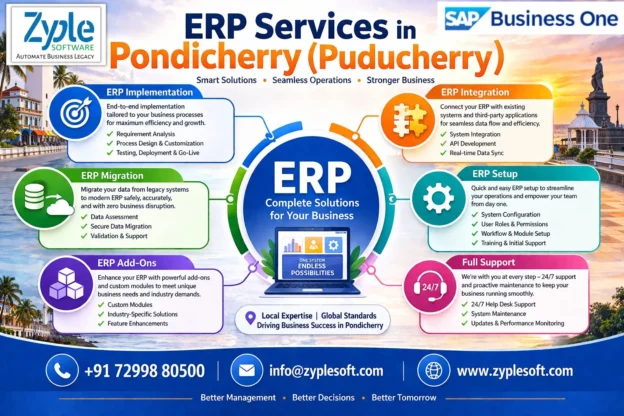
    erp services in pondicherry

    ERP Services in Pondicherry (Puducherry)

    ERP Services in Pondicherry (Puducherry) for Business

    erp services in pondicherry

    The enterprise resource planning (ERP) software is rapidly becoming an important tool for businesses to facilitate operations, improve accuracy, and optimize efficiency. From managing seasonal inventory surplus to handling complex inventory and supply chain logistics, companies in Pondicherry (Puducherry) need an integrated, powerful ERP system. Zyple Software is an accredited SAP Business One (SAP B1) partner delivering ERP services in Pondicherry (Puducherry) to bring immense value.

    There are many industries in Pondicherry (Puducherry), such as manufacturing, engineering, textiles, chemicals, pharmaceuticals, food processing, tourism, construction, real estate, aerospace and defense, jewellery manufacturing, and more.

    Why SAP Business One for Businesses in Pondicherry (Puducherry)?

    The enterprise resource planning (ERP) system, SAP Business One (SAP B1) software, is an ideal, cost-effective, and scalable ERP solution for small and medium-sized enterprises (SMEs) in Pondicherry, providing real-time, end-to-end management of finance, sales, inventory, and production. It facilitates operations for industries like manufacturing, tourism, and construction to minimize errors and improve productivity.

    1. Designed for Growth

    SAP B1 is designed for SMEs, enabling them to move away from disconnected systems like Tally or spreadsheets to a unified, scalable platform.

    2. Cost-Effective

    It delivers big-enterprise functionality at a price suitable for smaller businesses.

    3. Industry-Specific Solutions

    It supports local industries, including manufacturing, construction, real estate, and tourism, and with options for on-premise or cloud, helps with inventory, production, and supply chain needs.

    4. Real-Time Decision-Making

    With built-in business intelligence and analytics, businesses can analyze KPIs and create reports instantly to make better decisions.

    5. Improved Efficiency

    Businesses in the region have fewer shipping delays, significantly leading to faster invoicing and higher client retention.

    6. Local Support

    Zyple Software company provides implementation, add-on development, integration, migration, support, consulting, licensing, and digital transformation to industries in Pondicherry (Puducherry) like manufacturing, construction, real estate, and tourism.

    Top SAP B1 ERP Services in Pondicherry (Puducherry)

    1. Implementation

    The complete SAP implementation cycle includes installing, modifying, and customizing the SAP Business One ERP system.

    2. Add-On Development

    Creating custom add-ons for industry verticals, such as WhatsApp integration, health and safety, CCTV camera, and more.

    3. Integration

    The SAP B1 ERP system can be connected with third-party applications or platforms to enable automatic data flow between them.

    4. Migration

    The process of transferring current business data from legacy platforms to the new SAP B1 HANA platform.

    5. Support and Training

    It includes continuous support, system maintenance, troubleshooting, and training to ensure seamless operations.

    6. Consulting

    They are the professional advisory services delivered by SAP experts to help businesses plan, implement, and optimize the SAP B1 ERP system.

    7. Licensing

    It is the legal authorization that enables a company to use the SAP Business One software.

    8. Digital Transformation

    The process of using the SAP Business One ERP system to modernize and digitize a company’s business operations.

    9. Other Services

    Apart from the SAP Business One ERP system, we deliver MES (Manufacturing Execution System), HRMS, and payroll system.

    Industry Coverage Relevant to Pondicherry (Puducherry)

    1. Manufacturing

    Production, material requirements planning (MRP), sales and CRM, purchasing, and financials to improve the efficiency of manufacturing businesses.

    2. Engineering

    Project management, inventory, sales and CRM, financials, and quality control to facilitate the operations of engineering businesses.

    3. Textiles

    Financials, inventory, sales and CRM, production, and analytics and reporting benefit textile businesses.

    4. Chemicals

    Production, inventory, sales and CRM, financials, and material requirements planning (MRP) improve the efficiency of chemical businesses.

    5. Pharmaceuticals

    Purchasing, inventory, quality control, production, and asset management to facilitate the operations of pharmaceutical businesses.

    6. Food Processing

    Inventory, production, sales and CRM, quality control, and analytics and reporting benefit food processing businesses.

    7. Tourism

    Financial management, asset management, sales and CRM, service management, and analytics and reporting to improve the efficiency of tourism businesses.

    8. Construction

    Project management, inventory, sales and CRM, purchasing, and analytics and reporting facilitate the operations of construction businesses.

    9. Real Estate

    Contract management, project management, sales and CRM, financial management, and analytics and reporting to benefit real estate businesses.

    10. Aerospace and Defense

    Production, inventory, sales and CRM, financials, and project management improve the efficiency of aerospace and defense businesses.

    11. Jewellery Manufacturing

    Purchase, sample receipt, sales, karigar outward process, and repair issue process to facilitate the operations of jewellery manufacturing businesses.

    Why is Zyple Accepted for SAP ERP Services in Pondicherry (Puducherry)?

    Zyple Software is a leading SAP Business One Partner in India specializing in implementation, integration, add-on solutions, and support for manufacturing, healthcare, technology, hospitality and tourism, construction, real estate, agriculture, retail, financial services, energy, logistics, and professional services industries. Our company is highly accepted as an SAP ERP service provider in Pondicherry (Puducherry) due to its status as a certified SAP Business One ERP partner delivering specialized, cost-effective solutions designed for SMEs in sectors like manufacturing, construction, and real estate. They are recognized for end-to-end implementation, including local GST compliance, 24/7 support, and expertise in migration to SAP B1 HANA.

    1. Certified Expertise

    As a recognized SAP B1 partner, they deliver high-quality, reliable implementation, including SAP B1 HANA migrations.

    2. Designed Solutions for SMEs

    They design customized SAP solutions for local businesses, focusing on cost-effectiveness and scalability.

    3. Industry-Specific Functionality

    Our company delivers specialized modules for manufacturing, financial services, healthcare, technology, hospitality and tourism, construction, real estate, agriculture, retail, energy, logistics, and professional services, including BOM (Bill of Materials) and real-time production tracking using SAP software.

    4. End-to-End Support

    They provide a full service lifecycle, including implementation, consulting, integration, migration, add-on development, 24/7 support, licensing, and digital transformation.

    5. Local Compliance

    They ensure systems are modified to meet local Indian regulatory requirements, such as the GST and TDS.

    ERP Implementation Process Overview

    An ERP implementation process is the structured approach used to plan, implement, configure, and and launch an enterprise resource planning (ERP) system across an organization. It ensures that the ERP system aligns with business processes, such as finance, sales, purchasing, inventory, and production.

    1. Planning

    Here, the organization identifies its business needs and goals for implementing ERP software. Teams review current processes, assign project scope, set timelines, and allocate resources. Appropiate planning helps avoid delays and ensures the ERP system fits the company’s operational requirements.

    2. Designing

    An ERP system is modified based on the company’s workflows and requirements. Business processes are outlined, modules are chosen, and system architecture is designed. Customizations or integrations with current systems are also planned.

    3. Development and Customization

    If the organization needs additional features, developers create add-ons, reports, or integrations with other platforms. The ERP system is designed for supporting industry-specific processes and business operations.

    4. Data Migration

    Current data from legacy systems, such as customer records, financial data, and inventory details, is cleaned, validated, and moved to the new ERP system. Accurate data migration ensures the system begins with reliable information.

    5. Testing

    Before full deployment, the ERP system undergoes various testing stages, such as unit testing, system integration testing (SIT), and user acceptance testing (UAT). This ensures that all the modules work properly and the system meets business requirements.

    6. Training and Change Management

    Employees are trained on how to use the new ERP system effectively. Change management helps staff adjust to new processes and technologies, ensuring a seamless transition.

    7. Deployment (Go-Live)

    The ERP system is officially deployed and becomes operational across the organization. During this stage, the system replaces old processes and begins managing real business transactions.

    8. Support and Maintenance

    After implementation, continuous support is provided to resolve issues, update the system, and improve performance. Consistent improvements ensures the system evolves with the business needs.

    Business Outcomes for Industries in Pondicherry (Puducherry)

    • Real-time inventory tracking eliminates stockouts and overstocking.
    • Automated accounting, tax compliance (GST), and e-way bill generation ensure compliance, while inclusive cost tracking increases profit margins.
    • Businesses can handle the entire sales cycle, from lead to service, leading to better customer retention and faster response times.
    • Real-time dashboards and analytics enable businesses to make fast, better decisions to respond to market changes.
    Know more about: ERP Services

    Are you requesting SAP Business One ERP software for your business or industry?

    Fill in all the details in the provided contact form; our team will get back to you.

      Facility Management with sap business one erp

      Manage Facility in Industry with ERP

      How SAP Business One Transitions Facility Management for SMEs

      Facility Management with sap business one erp

      In today’s fast-paced business landscape, facility management has changed from a support role to an essential organization function. Effective facility management ensures seamless day-to-day operations, develops employee efficiency, and drives cost optimization. This is where SAP Business One comes. It is a powerful enterprise resource planning (ERP) solution customized specifically for small and medium-sized enterprises. With its designed features, SAP B1 transforms facility management practices, enabling organizations to overcome modern challenges and stay ahead. Here, we’ll discuss how to manage facility in industry using SAP Business One ERP.

      What is Facility Management?

      Facility management includes a wide range of disciplines and services aimed at ensuring the functionality, comfort, safety, and efficiency of a built environment. This includes:

      • Maintenance of equipment and infrastructure.
      • Space management.
      • Asset tracking.
      • Energy management.
      • Vendor and contract management.

      Facility managers often juggle multiple responsibilities, making it essential to have a unified system that integrates these activities for better control and efficiency.

      Why Choose SAP Business One To Manage Facility in Industry

      The enterprise resource planning (ERP) system, SAP Business One (SAP B1) software, is chosen for industrial facility management to centralize operations, automate maintenance scheduling, and deliver real-time asset tracking. It improves efficiency by forecasting equipment failures through predictive maintenance and optimizing resource usage (water, energy, materials), ultimately minimizing costs and downtime.

      1. Asset Management and Maintenance

      Allows automatic scheduling of maintenance tasks and work orders to minimize unexpected failures and extend equipment lifespan. Delivers tools for real-time tracking of facility assets. Uses data to forecast equipment failure, reducing downtime.

      2. Operational Efficiency

      Automates routine tasks to reduce manual effort, speed up operations, and minimize errors. Monitors energy, water, and material usage to optimize resources and reduce waste. Integrates data from procurement, inventory, finance, and production into a single system for end-to-end visibility.

      3. Financial and Strategic Control

      Centralizes operations to reduce costs while maintaining service quality. Provides real-time data and advanced analytics to help managers identify trends and predict issues. The modular design enables businesses to add functionalities as they grow, making it a future-proof investment.

      Features of Managing Facility in Industry Using SAP Business One ERP

      1. Asset and Equipment Management

      • Tracks all facility assets such as machinery, tools, and infrastructure.
      • Maintains inclusive asset master data (location, condition, warranty, and more).
      • Schedules preventive maintenance to minimize downtime.

      2. Maintenance Management

      • Plans and handles preventive and corrective maintenance activities.
      • Generates maintenance work orders automatically.
      • Monitors maintenance history and costs for each asset.

      3. Inventory and Spare Parts Control

      • Handles spare parts inventory across warehouses.
      • Tracks stock levels in real-time.
      • Automates reordering of essential maintenance materials.

      4. Work Order and Service Management

      • Creates and assigns facility-related work orders.
      • Tracks progress, labor hours, and completion status.
      • Improves accountability and transparency.

      5. Real-Time Monitoring and Reporting

      • Access real-time dashboards for facility performance.
      • Generates reports on maintenance costs, downtime, and asset utilization.
      • Allows data-driven decision-making.

      6. Vendor and Contract Management

      • Handles external service providers and contractors.
      • Tracks contracts, service agreements, and billing.
      • Evaluates vendor performance.

      7. Compliance and Safety Management

      • Ensures adherence to safety regulations and standards.
      • Maintains audit trials and compliance records.
      • Schedules inspections and safety checks.

      8. Integration With Core Business Functions

      • Seamlessly connects with finance, procurement, and HR modules.
      • Tracks facility-related expenses directly in accounting.
      • Aligns facility management with overall business operations.

      9. Multi-Location Facility Management

      • Handles multiple plants, warehouses, or offices from a single system.
      • Standardizes processes across locations.
      • Monitors performance centrally.

      10. Scheduling and Resource Planning

      • Allocates manpower and resources efficiently.
      • Prevents conflicts and delays in maintenance schedules.
      • Optimizes workforce productivity.

      11. Mobility and Remote Access

      • Accessing facility data from mobile devices.
      • Updates work orders and maintenance tasks on the go.
      • Improves responsiveness of field times.

      12. Cost Control and Budgeting

      • Tracks facility-related operational costs.
      • Compares actual vs. planned maintenance budgets.
      • Identifies cost-saving opportunities.

      Importance of Managing Facility in Industry Using SAP Business One ERP

      Managing facilities with SAP Business One ERP improves industrial efficiency by automating maintenance schedules, optimizing resource allocation, and tracking real-time asset performance. This centralized approach reduces downtime through predictive maintenance while ensuring regulatory compliance and minimizing operational costs.

      1. Predictive Maintenance and Asset Tracking

      SAP B1 uses real-time data to forecast equipment failures, reducing unexpected downtime and ensuring seamless performance. It delivers tools for tracking assets and scheduling maintenance, which prevents unnecessary expenditures.

      2. Automated Processes and Workflows

      Routine tasks such as work orders and maintenance scheduling are automated, freeing up personnel for strategic initiatives and improving overall efficiency using SAP implementation.

      3. Resource and Budget Optimization

      The system enables accurate tracking of energy, water, and material usage, helping to minimize waste. By centralizing operations, businesses can reduce costs while maintaining service quality.

      4. Improved Decision-Making and Analytics

      Managers gain real-time visibility into operations, allowing them to identify trends, predict issues, and make data-driven decisions.

      5. Regulatory Compliance

      SAP software helps businesses adhere to industry-specific regulations, safety standards, and environmental requirements, minimizing the risk of fines and reputational damage.

      Benefits of Managing Facility in the Industry Using SAP B1 ERP

      1. Centralized Facility Management

      SAP Business One connects all facility-related operations, such as maintenance, assets, utilities, and vendor management, into a single platform. This eliminates data storage and delivers a unified view of your infrastructure.

      2. Improved Asset Utilization

      Evaluates machinery, equipment, and infrastructure in real-time. With better visibility, industries can increase asset usage, minimize idle time, and extend asset lifecycle through timely maintenance.

      3. Preventive Maintenance Planning

      The system allows scheduling of preventive maintenance activities, helping avoid unexpected breakdowns. This minimizes downtime and improves overall operational efficiency.

      4. Cost Control and Budgeting

      SAP B1 delivers inclusive insights into maintenance costs, repair costs, and facility-related spending. This helps businesses control budgets, minimize unnecessary expenses, and improve financial planning.

      5. Real-Time Monitoring and Reporting

      With real-time dashboards and reports, facility managers can track performance metrics, maintenance status, and asset health, allowing faster and smarter decision-making.

      6. Improved Vendor and Contract Management

      Handles service providers, AMC contracts, and vendor performance efficiently. This ensures timely service delivery and better negotiation with suppliers.

      7. Scalability For Growing Industries

      As your business expands, SAP solutions can scale with your facility management needs, supporting multiple locations, plants, and complex operations.

      Conclusion of Managing Facility in Industry Using SAP B1 ERP

      Zyple Software is an authorized SAP Business One partner in India specializing in implementation, digital transformation, migration, licensing, integration, add-on solutions, and consulting for the facility management industry. Facility management is a complex and dynamic field that demands innovative solutions. SAP Business One stands out as a game-changer, empowering organizations to streamline operations, reduce costs, and make data-driven decisions.

      If you’re curious, you can book a demo of SAP Business One.

      Are you seeking the SAP Business One ERP solution for your business or industry?

      Fill in all the details in the defined contact form; our team will return to you.

        Customized ERP Software

        Customized ERP Software

        Customized ERP Software for Business

        Customized ERP Software

        Customized ERP is an enterprise resource planning (ERP) platform built from the ground up to achieve the business needs, goals, and industry-specific requirements of a specific company. ERP software is a type of enterprise software that helps businesses handle different aspects of the operations, such as accounting, human resources, customer relationship management, and supply chain management. With designed functional modules and integrations, customized ERP software for business is flexible and easier to adopt and scale.

        What is ERP software?

        ERP software is the mainstay of any business. It is a system that integrates all the business processes to make sure everything runs seamlessly, from customer relationship management, inventory, and supply chain management, finance, and accounting to CRM.

        ERP software is used by organizations of all sizes, from small businesses to large enterprises. It is customized to help organizations improve their efficiency and effectiveness.

        Reasons Why You Should Develop a Customized ERP Software for Business

        An enterprise resource planning (ERP) system, SAP Business One consists of various digital modules for business management. The SAP B1 ERP system can provide an overview of all daily operations across different departments of your company using a set of modules.

        Here are the main reasons why your organization needs customized ERP software:

        1. Ease of Use

        SAP Business One is designed with future growth in mind. As your business expands, the SAP B1 system can scale accordingly, supporting more users, handling larger data volumes, and connecting new business units or locations. Unlike ready-made software, which may require expensive upgrades or add-ons, custom ERP software like SAP B1 grows with your business, ensuring long-term value.

        2. Flexibility

        Every business evolves, and its processes change over time. SAP Business One ERP provides the flexibility to adapt to these changes. New modules, workflows, and features can be added without disrupting operations. This adaptability means SAP B1 ERP remains relevant as your business grows, adjusts to market trends, and introduces new products or services.

        3. Seamless Integration

        A common challenge with ready-made ERP solutions is compatability with current systems. Custom ERP software like SAP Business One, however, is designed to integrate seamlessly with your current tools and databases. This eliminates data storage, ensuring smooth information flow across departments. Seamless integration improves collaboration, speeds up processes, and delivers a unified view of your operations using SAP solutions.

        4. Addressing Industry-Specific Challenges

        Industries like manufacturing, retail, construction, real estate, pharmaceutical, logistics, and healthcare often have specialized needs. SAP Software can be designed for these industries to meet these specific needs, delivering features and workflows that ready-made solutions can not. Whether it is project management for a construction company, inventory management for a manufacturing company, lease management for a real estate company, or patient records for a healthcare company, custom ERP like SAP B1 ensures your system works for you.

        The Process of Customized ERP Development

        Developing customized ERP software is a structured and inclusive process that involves multiple stages, each ensuring that the final product meets business needs and delivers value. Here are the key steps of customized ERP software development:

        1. Requirement Gathering and Analysis

        This is the most essential step in customized ERP software development services, as it sets the foundation for the entire project. It involves collaborating with stakeholders to understand business processes, challenges, and goals. During this stage, inclusive workflows, user roles, and system requirements are documented to ensure the ERP software is aligned with business needs.

        2. Designing an Architecture

        Once requirements are collected, the system architecture is designed. This includes creating a blueprint for databases, user interfaces, modules, and integrations. The architecture is built to ensure adaptability, security, and performance. It is the mainstay of the ERP system, ensuring all components work together seamlessly.

        3. Development, Testing, and Deployment

        The actual development stage involves coding and building the ERP system based on the approved architecture. Once developed, the software undergoes thorough testing to identify and fix bugs, ensure security, and verify performance. After successful performance, the ERP system is deployed into the business environment, and users are trained on how to use it effectively.

        4. Ongoing Maintenance and Support

        The development process does not end with launching. Consistent maintenance and support are essential to ensure the ERP system remains efficient and up-to-date. Regular updates, security patches, and system improvements are implemented to maintain the software aligned with evolving business needs.

        Benefits of Customized ERP Software for Business

        SAP Business One solution provides several advantages that ready-made solutions cannot match. Here are the key benefits of custom ERP software:

        1. Improved Operational Efficiency

        The SAP Business One system facilitates workflows by automating repetitive tasks and optimizing processes. This minimizes manual errors, accelerates decision-making, and improves overall productivity. The result is a seamless, more efficient operation that saves time and resources.

        2. Designed Functionality

        Unlike ready-made solutions, the SAP Business One solution is designed to handle the specific needs of your business. It includes modules and features designed for your workflows, which means every component of the system is beneficial and relevant to your operations. This customization improves productivity and minimizes the need for third-party applications using SAP implementation.

        3. Competitive Advantage

        A well-implemented customized ERP software like SAP B1 ERP can give your business a significant edge over competitors. By facilitating processes, improving customer service, and providing real-time insights, the SAP Business One ERP system helps businesses respond quickly to market changes and customer needs.

        4. Scalability and Easy Operations

        SAP Business One can grow with the business. As operations expand, this ERP software can support new products, locations, teams, or customer needs without major changes. This makes it easier to analyze while keeping control over processes and performance.

        5. Industry-Specific Applications

        Industries like manufacturing, construction, real estate, retail, healthcare, and logistics often have unique operational requirements. Custom ERP solutions like SAP Business One can be built to handle these specific challenges directly. For example, a manufacturing ERP can include real-time inventory tracking, a construction ERP includes project management, and a healthcare ERP can handle patient records securely.

        Conclusion of Custom ERP Software for Business

        Zyple Software is an authorized SAP B1 partner in India specializing in implementation, digital transformation, migration, licensing, integration, add-on solutions, and consulting for manufacturing, construction, real estate, agriculture, logistics, financial services, healthcare, retail, technology, energy, infrastructure, EPC, and professional services industries. The most successful outcomes come from planning thoroughly, aligning with every feature with business priorities, and staying flexible as requirements evolve by using SAP software.

        If you’re exciting about ERP, you can book a demo of SAP Business One.

        Are you searching the SAP Business One ERP system for your business or industry?

        Fill in all the details in the described contact form; our team will reach out to you.
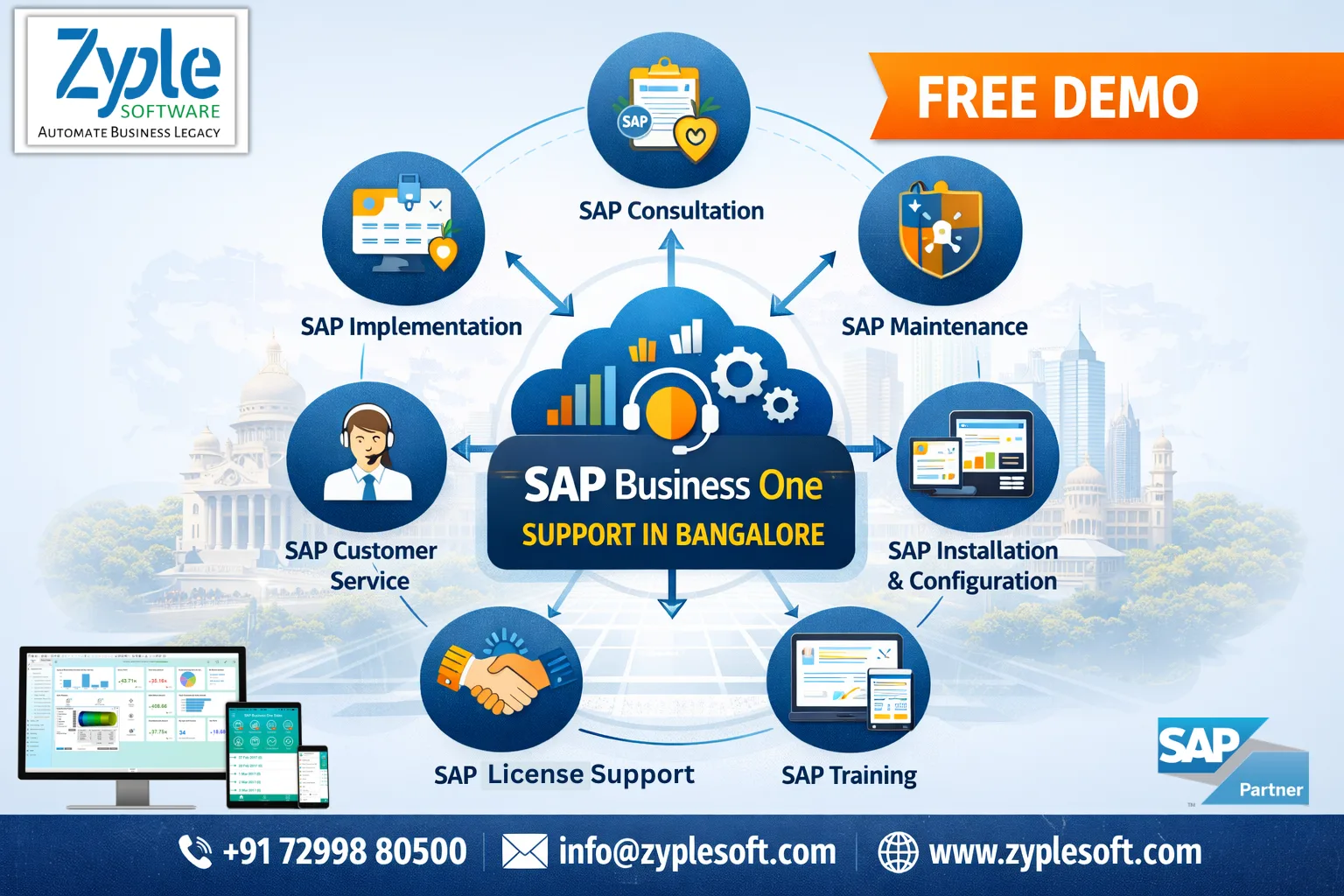
          SAP Business One Support in Bangalore

          SAP Business One Support in Bangalore

          SAP Business One (B1) Support in Bangalore

          SAP Business One Support in Bangalore

          What is SAP Business One Support for SMEs?

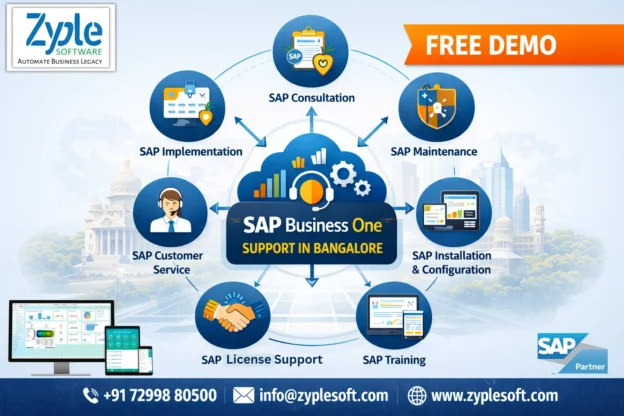
          SAP Business One support is a structured service designed to ensure the stability, performance, and long-term reliability of SAP Business One systems for small and medium-sized businesses in Bangalore. With professional SAP Business One support in Bangalore, businesses receive expert assistance to keep their ERP running seamlessly everyday.

          For SMEs in Bangalore, SAP Business One plays an essential role in minimizing operational risk. It includes functional and technical issue resolution, system monitoring, and continuous maintenance, helping businesses prevent downtime, data inconsistencies, and workflow disruptions.

          As businesses grow, their ERP environment becomes more inticrate. SAP Business One support ensures your system remains adaptable and future-ready, supporting new users, processes, integrations, and upgrades while maintaining performance and security.

          SAP Business One support allows SMEs in Bangalore to operate with confidence, knowing their ERP system is consistently monitored, maintained, and improved to support long-term business success.

          Why SAP Business One Support Is the Right Choice for Your Company in Bangalore?

          SAP Business One support delivers businesses in Bangalore with a reliable and future-ready framework to keep their ERP system stable, secure, and fully operational. More than just technical assistance, SAP Business One support ensures consistency across finance, sales, inventory, and operations, day after day.

          Whether your team is working from the office, remotely, or across multiple locations, SAP Business One ERP support in Bangalore ensures uninterrupted access to accurate business data. With expert monitoring, prompt issue resolution, and structured maintenance, your system remains performant and reliable at all times.

          By choosing expert SAP Business One support, businesses in Bangalore gain the confidence to scale, adapt to processes, and adopt processes, knowing their ERP environment is consistently maintained and supported by certified SAP experts. If you’re focused, book demo of SAP b1.

          SAP Business One Support Services Provided by Zyple in Bangalore

          1. 24/7 Technical and Functional Support

          • Dedicated support team to rectify system issues and user queries.
          • Consistent monitoring to ensure SAP B1 ERP system stability.
          • Faster response via support portals and helpdesk services.

          2. Post-Implementation Support

          • Assistance after SAP B1 ERP go-live to ensure seamless operations.
          • It includes bug fixing, troubleshooting, and performance optimization.
          • Consistent improvements and system fine-tuning.

          3. SAP Business One System Maintenance and Monitoring

          • It includes health system health checks and preventive maintenance.
          • Performance monitoring to prevent downtime.
          • Ensures high availability and safe SAP environment.

          4. Functional and Technical Support

          • It includes functional support for modules like finance, sales, inventory, and production.
          • Technical support covering database, server, and backend issues.
          • Support for both SAP B1 SQL and SAP B1 HANA.

          5. Upgrades and Patch Movement

          • It includes support for SAP Business One ERP version upgrades.
          • Add-on updates and collaboration management.
          • Ensures your system stays current and safe.

          6. User Training and Guidance

          • It includes on-site and remote training sessions for end-users.
          • Documentation and best practices for effortless system usage.
          • Helps increase user adoption and ROI.

          7. Add-On and Integration Support

          • Support for custom SAP Business One add-ons and third-party integrations.
          • Troubleshooting integration issues with external platforms.
          • Continuous improvement of business workflows.

          8. Data Management and Migration Support

          • Support with data corrections and management.
          • Migration support (e.g., SAP B1 SQL to SAP B1 HANA).
          • Data accuracy and integrity are ensured.

          9. Cloud and Infrastructure Support

          • It includes managed cloud hosting services.
          • Support for SAP B1 ERP infrastructure and server environments.
          • Ensures secure and adaptable SAP B1 ERP operations.

          10. Consulting and Continuous Improvement

          • Ongoing consulting to improve business processes.
          • Suggestions for SAP Business One ERP utilization.
          • Helps align SAP B1 with changing business needs.

          Importance of SAP Business One Support in Bangalore

          SAP Business One (SAP B1) support in Bangalore is important for ensuring seamless, localized ERP operations for SMEs and growing enterprises. Zyple Software has expertise in providing  implementation, consulting, add-on development, licensing, integration, migration, and support services to industries like manufacturing, construction, real estate, agriculture, financial services, healthcare,technology, energy, logistics, retail, infrastructure, EPC, and professional services in Bangalore.

          1. Regional Compliance and Expertise

          In Bangalore, Zyple has in-depth knowledge of local regulations, such as GST and other statutory requirements in India.

          2. Customized Implementation and Support

          Zyple assists in designing SAP Business One for specific workflows, providing both implementation and post-implementation assistance using SAP software.

          3. Rapid Problem Resolution

          Zyple ensures quick response times for technical support, reducing operational downtime and ensuring business continuity.

          4. Specialized Expertise

          Support teams in Zyple provide specialized services including SAP B1 SQL to SAP B1 HANA migration, cloud deployment, and system optimization to improve business efficiency.

          5. Industry-Specific Solutions

          Localized support enables implementing industry-specific modules, such as manufacturing, retail, construction, real estate, and logistics in the Bangalore region.

          Benefits of SAP Business One Support in Bangalore

          SAP Business One ERP support in Bangalore provides local expertise for manufacturing, retail, construction, real estate, and IT firms to improve, customize, and maintain their ERP systems. Main benefits include real-time decision-making, automated financial management, optimized supply chains, and improved regulatory compliance. Specialized local support ensures adaptability to support business growth.

          1. Local Industry Expertise

          Zyple provides specialized support for local industries in Bangalore, including manufacturing, retail, construction, real estate, logistics, EPC, and IT, with customized solutions for localized challenges.

          2. Improved Operational Efficiency

          Support services help businesses improve operations by integrating key functions, like finance, purchasing, and inventory, into one system, minimizing manual errors using SAP implementation.

          3. Real-Time Data and Analytics

          With support from Zyple, businesses can use SAP B1 HANA for real-time visibility into operations, allowing better, faster decision-making.

          4. Customization and Integration

          Zyple provides custom SAP solutions and integration with tools like CRM, HRMS, and banking systems, ensuring the software fits specific business workflows.

          5. Regulatory Compliance

          SAP B1 support helps companies like Zyple Software stay adherent to local Indian regulatory requirements and reporting standards.

          6. Scalability for Growth

          SAP Business One support ensures the ERP system expands with the company, adjusting new users and operations without interrupting workflows.

          Conclusion of SAP Business One ERP Support in Bangalore

          Zyple provides an array of support services, where companies can quickly update the program, select a plan for additional automation, and ensure the effective execution of upcoming projects.

          Are you looking for SAP B1 support in Bangalore for your business or industry? Contact with SAP Business One Partners in Bangalore near by you. (Example: Zyple Software)

          Fill in all the details in the dispensed contact form; our team will reach out to you.
            Infrastructure Management Software

            Infrastructure Management Software

            Infrastructure Management ERP Software

            Infrastructure Management Software

            What is Infrastructure Management System?

            It is a software system that delivers centralized control over IT components, such as servers, networks, storage, and data centers, to optimize performance, availability, and energy efficiency. Infrastructure management software improves asset tracking, monitoring, and automated provisioning, supporting physical, virtual, and cloud environments.

            Which is the Best Software for Infrastructure Management?

            SAP Business One is the best software for infrastructure management. It serves as an inclusive ERP for infrastructure management, specifically in construction, real estate, infrastructure, industrial, EPC, and facility management sectors. It handles project lifecycles, maintenance, and resources; supports asset and equipment master tracking, predictive maintenance, and project estimation; ensuring efficient resource allocation and cost savings.

            Types of Infrastructure Management Software

            1. IT Infrastructure Monitoring (ITIM) System

            This type of software focuses on performance evaluation, fault detection, and network management.

            2. Data Center Infrastructure Management (DCIM) System

            This type of software monitors and handles physical data center infrastructure, including power and cooling.

            3. Cloud Infrastructure Management System

            This type of software handles public or hybrid cloud resources.

            Key Components of an Infrastructure Management System

            1. Network Management

            This involves monitoring and handling the organization’s network infrastructure to ensure optimal performance and connectivity. It includes tasks like modifying network devices, handling bandwidth, and ensuring network security.

            2. Server Management

            Servers are the mainstay of an IT infrastructure. Server management includes installing, configuring, and maintaining servers to ensure they operate efficiently and safely. This also involves handling server resources, such as CPU, memory, and storage.

            3. Storage Management

            As data continues to grow exponentially, storage management becomes increasingly essential. This involves handling data storage systems, ensuring data availability, and optimizing storage resources to meet business demands.

            4. Cloud Infrastructure Management

            With the growing adoption of cloud computing, managing cloud resources is an essential aspect of infrastructure management. This includes handling cloud-based services, ensuring data security, and managing cloud costs.

            5. Security Management

            Protecting the IT infrastructure from cyber threats is the key priority. Security management involves implementing and handling security measures, such as firewalls, intrusion detection systems, and encryption protocols, to safeguard this infrastructure.

            6. Automation and Monitoring

            Automation tools and monitoring systems are important for proactively managing the infrastructure. These tools help in automating routine tasks, evaluating system performance, and detecting potential issues before they escalate.

            Features of Infrastructure Management ERP Software

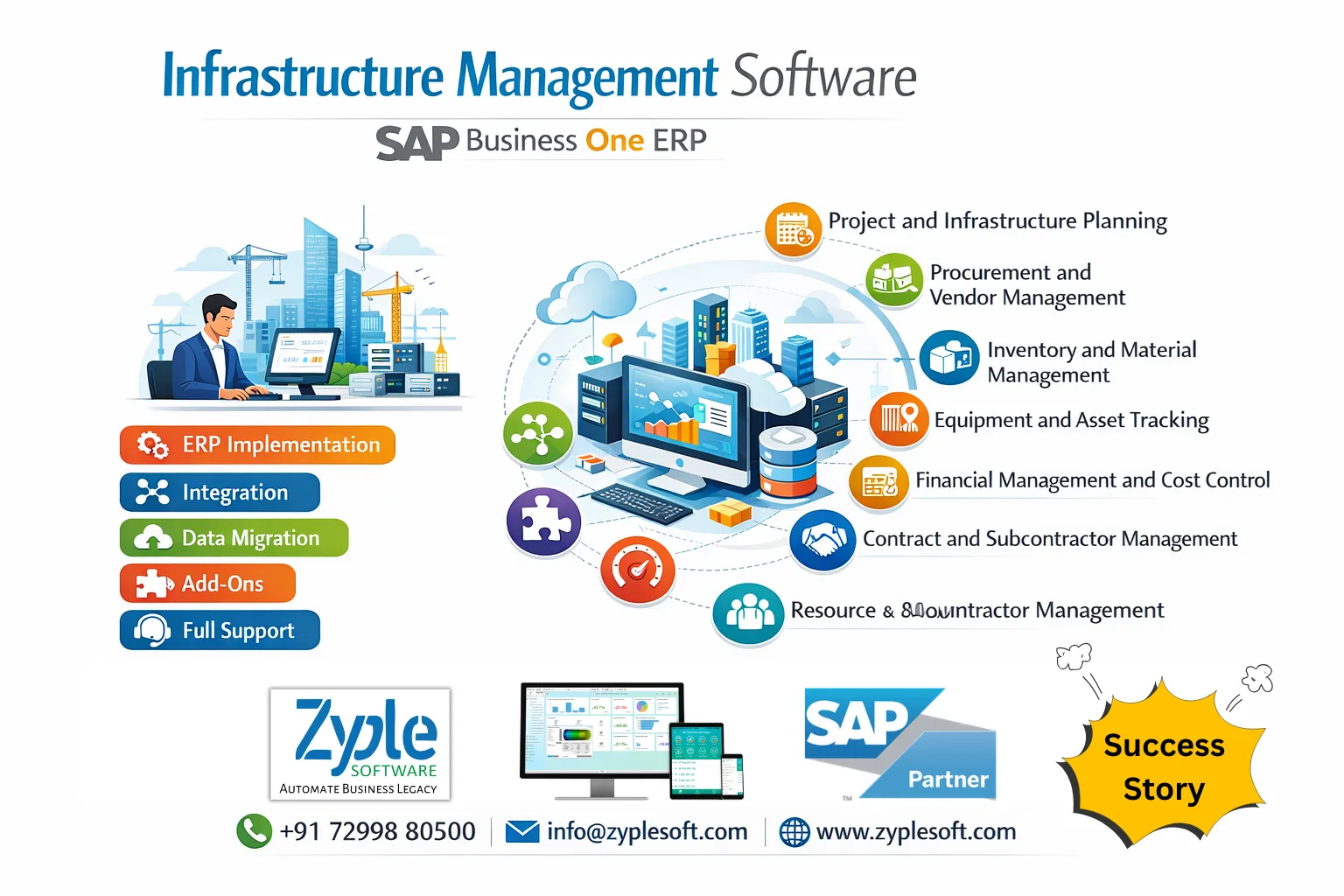
            Here are the features of SAP B1 as infrastructure management ERP software:

            1. Project and Infrastructure Planning

            • Defines and handles infrastructure projects with budgets, timelines, and resources.
            • It includes a work breakdown structure (WBS) for large-scale infrastructure projects.
            • Tracks project progress, milestones, and dependencies in real-time.

            2. Procurement and Vendor Management

            • Improved procurement for raw materials, machinery, and services.
            • It includes vendor comparison, selection, and performance tracking.
            • Automates purchase requests, approvals, and purchase orders.

            3. Inventory and Material Management

            • Online tracking of construction materials and equipment.
            • Multi-warehouse management for various project sites.
            • Batch and serial number tracking for essential assets.

            4. Equipment and Asset Tracking

            • Tracks infrastructure assets like machinery, vehicles, and tools.
            • Schedules preventive maintenance and service activities.
            • Monitors the asset lifecycle from acquisition to disposal.

            5. Financial Management and Cost Control

            • Budget allocation and cost tracking for every project.
            • Online financial reporting and profitability analysis.
            • Connecting accounts payable, receivable, and general ledger.

            6. Contract and Subcontractor Management

            • Handles contracts, subcontracts, and billing schedules.
            • Tracks subcontractor performance and payments.
            • Monitors compliance with contractual terms.
            • Allocates labor, equipment, and materials efficiently.
            • Tracks workforce productivity and utilization.
            • Handles timesheets and labor costs.

            7. Compliance and Documentation

            • Maintains regulatory compliance documents and approvals.
            • It includes centralized document management for blueprints, permits, and contracts.
            • Audit trails can be done for all transactions and changes.

            8. Reporting and Analytics

            • Real-time dashboards for project performance and KPIs.
            • Online insights into cost overruns and delays.
            • Creates MIS reports for decision-making.

            9. Integration and Mobility

            • Connection with third-party tools like CAD, IoT, and project management systems.
            • It includes mobile access for on-site teams to update data in real-time.
            • Cloud deployment can be done for remote accessibility.

            Importance of Infrastructure Management Software

            1. Business Continuity

            A well-managed infrastructure ensures that essential IT systems are available and operational, reducing downtime and ensuring business continuity. This is especially crucial in industries where even a small disruption can lead to significant financial losses.

            2. Cost Efficiency

            SAP Business One ERP helps improve resource utilization, minimizing operational costs. By automating routine tasks and efficiently handling IT resources, organizations can reduce their infrastructure expenses.

            3. Security and Compliance

            With the increasing threat of cyberattacks, SAP B1 ERP is necessary to protect sensitive data and ensure compliance with regulatory requirements. Appropriate management helps in identifying vulnerabilities and implementing necessary security measures.

            4. Scalability

            As business grows, the IT infrastructure needs to adapt accordingly. The SAP Business One system ensures that systems are scalable and can manage increased workloads without compromising performance.

            5. Performance Optimization

            Regular monitoring and management of IT infrastructure ensure that systems perform at their best using SAP implementation.

            Benefits of Infrastructure Management ERP Software

            The SAP Business One solution improves IT operations by increasing system performance, optimizing security, and minimizing costs through automation. It boosts business continuity by minimizing downtime, delivers scalable resources for growth, and allows proactive monitoring of hardware and software, freeing up staff for strategic tasks.

            1. Cost Efficiency and Resource Optimization

            The SAP B1 system identifies underutilized resources, avoiding over-provisioning and reducing operational expenses.

            2. Improved Security and Compliance

            Automated monitoring and patch management help identify vulnerabilities, protect sensitive data, and implement compliance with industry standards.

            3. Increased Reliability and Uptime

            Real-time monitoring and proactive alerting detect issues before they cause downtime, ensuring high system accessibility using SAP solutions.

            4. Operational Automation

            Routine tasks, including server administration, software updates, and backups, are automated, improving efficiency and minimizing manual errors.

            5. Ease of Use and Flexibility

            SAP software enables IT teams to quickly adapt and scale resources to meet changing business demands.

            6. Optimized Performance

            By monitoring and improving IT components, SAP B1 software ensures fast, efficient, and consistent performance for users.

            Conclusion of Infrastructure Management ERP

            Zyple Software is an official SAP B1 partner in India specializing in implementation, consulting, migration, licensing, integration, add-on solutions, digital transformation, and support.

            ERP Company, Zyple Software has expertise in SAP Business One implementation for different industries like construction, real estate, EPC, infrastructure, facility management, and industrial sectors. SAP Business One facilitates processes and drives growth seamlessly with infrastructure management.

            If you’re committed, book an SAP Business One demo.

            Are you requiring the SAP B1 ERP solution for your business or industry?

            Read more: https://www.zyplesoft.com/infra-construction/

            Fill in all the details in the dispensed contact form; our team will return to you.

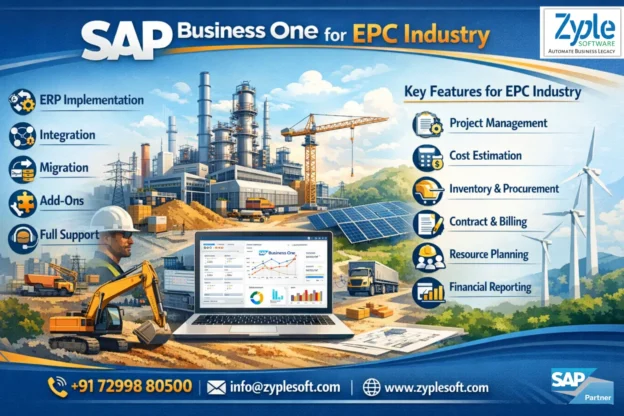
              SAP Business One for EPC Industry

              SAP Business One for EPC Industry

              SAP Business One ERP for EPC Industry

              SAP Business One for EPC Industry

              The engineering, procurement, and construction (EPC) industry faces multiple challenges, including project management complexities, strict regulatory requirements, and the need for precise coordination across multiple disciplines. To effectively handle these issues, companies in the EPC sector need a powerful enterprise resource planning (ERP) solution. SAP Business One for EPC industry stands out as a powerful tool that can facilitate operations, improve project management, and drive overall efficiency.

              Challenges of the EPC Industry

              The engineering, procurement, and construction (EPC) industry faces significant challenges, mainly driven by cost overruns, schedule delays, and complex risk management. Primary issues include supply chain disruptions, skilled labor shortages, rapid technological shifts, and strict regulatory compliance. These factors are intensified by poor coordination between design and construction teams, leading to rework and financial strain.

              1. Cost Overruns and Inaccurate Forecasting

              Increasing raw material prices, design changes, and inaccurate early estimates often cause severe budget overruns.

              2. Project Delays and Scheduling Obstacles

              Most of the EPC projects experience delays due to poor planning, slow regulatory approvals, and misaligned engineering/procurement timelines.

              3. Supply Chain Disruptions

              Shortages of materials, equipment, and logistical failures can cause devastating project delays.

              4. Skilled Labor Shortage

              An aging workforce and lack of specialized talent result in lower productivity and site management issues.

              5. Contractual Disputes and Risk

              Confusing contract terms, poor scope definitions, and subcontractor mismanagement lead to legal battles and disputes.

              6. Technological Adoption Challenges

              Slow adoption of digital tools and poor integration of data from site to office cause inefficiencies and blind spots.

              7. Environmental and Safety Compliance

              Increasingly thorough environmental regulations and the need for high safety standards create logistical and financial hurdles.

              Features of SAP Business One for EPC Industry

              1. Project Management and Control

              • End-to-end project lifecycle management (from planning to execution to closure).
              • Tracks project timelines, milestones, and progress.
              • Handles multiple projects simultaneously.
              • Helps EPC companies deliver projects promptly and within budget.

              2. Engineering and Resource Planning

              • Defines bill of quantities (BOQ) and bill of materials (BOM).
              • Allocates labor, machinery, and subcontractors.
              • Improves resource utilization across projects.
              • Forecasts material and manpower requirements.

              3. Procurement and Vendor Management

              • It includes end-to-end procurement cycle automation.
              • Handles vendor quotations, contracts, and approvals.
              • Tracks material delivery schedules.
              • Ensures timely availability of construction materials.
              • Improves supply chain coordination and minimizes delays.

              4. Inventory and Warehouse Management

              • Online inventory tracking across sites.
              • Warehouse management across different locations.
              • Controls material consumption at project sites.
              • Avoids overstocking or shortages.

              5. Financial Management and Cost Control

              • It includes integrated project-wise accounting.
              • Monitors cash flow, budgets, and expenses.
              • Tracks cost overruns in real-time.
              • Handles billing, invoicing, and revenue recognition.
              • Ensures powerful financial control and profitability.

              6. Contract and Subcontractor Management

              • Handles contracts, tenders, and variations.
              • Tracks subcontractor billing and payments.
              • Monitors contract performance and compliance.

              7. Real-Time Reporting and Analytics

              • Real-time dashboards for project performance.
              • KPI tracking includes cost, timelines, and productivity.
              • Drill-down reports are useful for decision-making.
              • Predicts risks using data insights.
              • Allows faster, data-driven decisions.

              8. Integrated Document Management

              • Stores and handles drawings, contracts, and approvals.
              • It includes centralized access for all stakeholders.
              • Engineering documents are used for version control.

              9. Compliance and Risk Management

              • Ensures regulatory compliance (tax, audit, and safety).
              • Tracks project risks and issues.
              • Maintains audit-ready documentation.
              • Minimizes legal and operational risks.

              10. CRM and Stakeholder Management

              • Handles client relationships and project communications.
              • Tracks leads, tenders, and opportunities.
              • Enhances customer satisfaction and transparency.

              11. Unified Data and Collaboration

              • Single platform for connecting engineering, procurement, finance, and construction.
              • Online data sharing across departments.
              • Eliminates data storage and improves collaboration.

              12. User-Friendliness and Customization

              • Adaptable for small and medium-sized EPC firms.
              • Industry-specific add-ons and customization are supported.

              Importance of SAP Business One for EPC Industry

              The enterprise resource planning solution, the SAP Business One (SAP B1) system, is essential for the engineering, procurement, and construction (EPC) industry by integrating project management, finance, procurement, and inventory into one system. It allows real-time tracking of budgets, costs, and project progress, ensuring compliance and improving decision-making for small and medium-sized EPC firms.

              1. Real-Time Project Control

              Allows tracking of project costs, revenues, and progress, helping identify overruns early for corrective action.

              2. Integrated Procurement and Supply Chain

              Facilitates purchasing by integrating vendor data with project requirements, minimizing lead times, and ensuring materials are available on time.

              3. Improved Financial Management

              Delivers in-depth reporting and automation of tasks like invoicing and financial reporting, improving efficiency using SAP implementation.

              4. Improved Collaboration and Data Centralization

              Integrates engineering, procurement, and site teams with a single source of truth, minimizing errors and improving decision-making.

              5. Scalability and Flexibility

              Designed to achieve the unique needs of small and medium-sized EPC firms, with the flexibility to grow with the business.

              Benefits of SAP Business One ERP for EPC Industry

              SAP Business One (SAP B1) software for the EPC industry delivers a unified, real-time platform to manage complex projects, improving efficiency through automated procurement, precise cost control, and integrated financial management. Main benefits include facilitated project management, optimized resource allocation, improved regulatory compliance, and increased cross-departmental collaboration, all of which minimize project delays and costs.

              1. Integrated Project Management and Visibility

              Centralizes all project data, including engineering, procurement, and construction stages, providing a single source of truth for tracking project performance in real-time.

              2. Improved Cost Control and Budgeting

              Delivers powerful tools for accurate job costing, budget tracking, and forecasting, enabling managers to monitor project expenses against budgets proactively and avoid overruns.

              3. Facilitated Procurement and Inventory

              Automates procurement cycles and improves inventory levels, ensuring materials are available when needed (using MRP) while decreasing carrying costs and minimizing wastage using SAP solutions.

              4. Real-Time Decision-Making

              Provides instant access to reports and insights on project progress, financial health, and resource utilization, allowing data-driven decisions to prevent risks.

              5. Efficient Resource Allocation

              Improves the usage of manpower, machinery, and materials across multiple projects, leading to improved productivity.

              6. Compliance and Risk Management

              Helps ensure compliance with industry standards, safety, and regulatory requirements, reducing the risks of penalties and legal issues.

              7. Improved Collaboration

              Allows seamless data exchange between departments, minimizing obstacles between engineering, purchasing, and on-site construction teams.

              8. Ease of Use

              Provides a flexible solution that can be designed for the growing needs of expanding EPC businesses.

              Conclusion of EPC ERP

              Zyple Software is an SAP Business One partner in India providing SAP B1 ERP solution that can significantly benefit the EPC industry. By improving project management, facilitating procurement, increasing financial management, and ensuring regulatory compliance, SAP software helps EPC companies optimize their operations and achieve long-term success.

              Are you pursuing the SAP Business One software for your business or industry?

              Fill in all the details in the allocated contact form; our team will get back to you.

                SAP Business One ERP for Interior Design

                SAP Business One for Interior Design Industry

                SAP Business One ERP for Interior Design Industry

                SAP Business One ERP for Interior Design

                The interior design industry is getting competitive with every passing day. Variants like raw material cost, labor demands, customers’ requirements, and more are changing on a rapid basis, and an ERP system is required that can handle all such challenges and present an interface that helps in the seamless integration of all processes. SAP Business One for interior design industry helps small and medium-sized interior design businesses with simple processes and improves their efficiency.

                Challenges of the Interior Design Industry

                The interior design industry faces significant challenges, including handling client expectations within tight budgets, sourcing quality materials, navigating complex regulatory compliance, and adapting to rapid technological changes like 3D visualization. Intense competition, skilled labor shortages, and continuous design trend updates add to the pressure.

                1. Client Management and Expectations

                Balancing client desires with budget constraints, handling frequent design changes (revisions), and reducing communication gaps are primary challenges.

                2. Budget and Time Constraints

                Providing high-quality, personalized designs while sticking to strict budgetary limits and tight project timelines.

                3. Sourcing and Logistics

                Identifying unique, high-quality furniture, dealing with limited product availability, and managing supply chain delays.

                4. Operational and Technical Issues

                Keeping up with rapidly changing trends, mastering new technology (3D technology, rendering), and ensuring accurate space planning.

                5. Professional Challenges

                High competition from online retailers, lack of standardized pricing, and lack of awareness about the value of professional designers are the key challenges.

                6. Regulatory Compliance

                Handling complex local building codes, safety regulations, and legal requirements.

                7. Labor and Execution

                Sourcing skilled labor (carpenters, painters) and ensuring that the final project matches the planned design.

                Features of SAP Business One for Interior Design Industry

                1. Project and Job Management

                • Handles multiple interior projects (residential, commercial, turnkey).
                • Tracks project budgets, timelines, and profitability.
                • Allocates designers, contractors, and resources effortlessly.
                • Monitors project-wise costing (material and labor).
                • Helps interior design companies control execution from concept to completion.

                2. Inventory and Material Management

                • Real-time tracking of furniture, fabrics, lighting, decor items, wood laminates, and fittings can be done.
                • Handles multiple warehouses and site locations.
                • Prevents stock shortages or overstocking with accurate inventory data.
                • Essential for handling site-based material movement.

                3. Estimation and Quotation Management

                • Creates detailed quotations with item-wise costing, design-based pricing, and custom packages.
                • Manages complex pricing (discounts, contracts, custom designs).
                • Improves accuracy in client proposals and minimizes revenue errors.

                4. Product Customization and Variant Configuration

                • Handles custom furniture and interior components.
                • Configures sizes, colors, materials, and finishes.
                • Maintains a structured catalog of design variants.
                • Suitable for advanced interior design projects.

                5. Production and Execution Planning

                • Plans and schedules modular furniture production and site installation activities.
                • Tracks work-in-progress (WIP) and job stages.
                • Improves resource utilization and timelines.
                • Ensures appropriate project delivery.

                6. Financial Management and Cost Control

                • Full control over accounts receivable/payable and budgeting and cash flow.
                • Tracks project-wise profitability and expenses.
                • It includes automated financial reporting and compliance.
                • Crucial for maintaining margins in design projects.

                7. Purchasing and Vendor Management

                • Handles suppliers for raw materials, furniture vendors, and contractors.
                • Automates procurement and approvals.
                • Compares vendor pricing and delivery timelines.
                • Ensures effortless sourcing and cost optimization.

                8. CRM (Customer Relationship Management)

                • Tracks leads, inquiries, and client preferences.
                • Maintains client history, design discussions, and feedback.
                • Improves customer engagements and follow-ups.
                • Helps develop long-term client relationships.

                9. Real-Time Reporting and Analytics

                • Dashboards for project status, sales performance, and cost analysis.
                • Creates custom reports and KPIs instantly.
                • Allows faster, data-driven decision-making.

                10. Mobility and On-Site Access

                • Access data from mobile devices like site updates, inventory updates, and approvals.
                • Real-time collaboration between office and site teams.
                • Suitable for on-site interior execution teams.

                11. Integrated Business Processes

                • Single system to handle sales, design, procurement, execution, and billing.
                • Reduces data duplication and manual errors.
                • Increases operational efficiency across departments.

                12. Interior-Specific Capabilities

                • Color and design modification tools.
                • Handles catalog for decorproducts.
                • Estimates cost for flooring, wall coverings, and fittings.
                • Service specification outline for design execution.
                • Designed specifically for interior decor workflows.

                Importance of SAP Business One for Interior Design Industry

                The enterprise resource planning (ERP) solution SAP software is essential for the interior design industry by centralizing disconnected processes, design, procurement, inventory, and finance, into one system ensuring accurate project costing and inventory control. It improves profitability by automating material management, minimizing procurement waste, and managing complex client requirements, making it ideal for interior design firms.

                1. Project Costing and Financial Control

                It provides accurate tracking of expenses related to specific design projects, helping in cost estimation and increasing profitability.

                2. Inventory and Supplier Management

                Enables tracking of specialized materials, furniture, and fixtures, ensuring optimal inventory levels and managing returns or exchanges effectively.

                3. Improved Customer Experience

                Connects CRM functionality to manage customer interactions and project requirements, leading to faster, more responsive customer service using SAP implementation.

                4. Real-Time Data and Analytics

                Delivers actionable insights through dashboards, allowing better decision-making on design revisions or procurement delays.

                5. Facilitated Workflows

                Integrates sales, purchasing, and finance, which minimizes manual errors and improves operational efficiency.

                Benefits of SAP Business One ERP for Interior Design Industry

                The SAP Business One (SAP B1) system facilitates interior design businesses by integrating design, purchasing, inventory, and finance into one system. It allows precise project costing, inventory management for furniture/materials, and efficient handling of design revisions. Main benefits include improved accuracy, enhanced customer service, and increased profitability through automated workflows and real-time insights.

                1. Optimized Project Costing and Purchasing

                Simplifies the generation of inclusive cost quotes, manages vendor purchasing, and tracks material costs to avoid budget overruns.

                2. Integrated Inventory Management

                Tracks materials and furniture, helping minimize shortages and overstocking.

                3. Design Change Tracking

                Handles revisions and associated costs seamlessly, which is important for design changes during projects using SAP solutions.

                4. Improved Customer Experience

                Provides robust CRM capabilities to handle client records, service history, and communication, ensuring prompt delivery and increased satisfaction.

                5. Data-Driven Decision-Making

                Provides real-time analytics and financial reports, allowing designers to focus on creative tasks rather than administrative obstacles.

                6. Scalability

                Grows with the business, providing flexible modules suited for small and medium-sized interior design firms.

                Conclusion of Interior Design ERP

                Zyple Software is a leading SAP Business One partner in India specializing in implementation, integration, add-on solutions, and support for the interior design industry. Our company has helped modernize many interior design businesses with SAP software for automating routine tasks, strengthening customer connection, and driving profitability.

                Are you demanding the SAP Business One ERP software system for your business or industry?

                Fill in all the details in the delivered contact form; our team will return to you.

                  SAP Business One for Spice Industry

                  SAP Business One for Spice Industry

                  SAP Business One ERP for Spice Industry

                  SAP Business One for Spice Industry

                  The spice industry operating within the broader food manufacturing sector has its own set of compliance and regulations enforced by the government. Spice businesses face strict regulations throughout the process, from extracting spices to finally making them available for sale. SAP Business One for spice industry helps spice businesses to make their own recipes, develop customized private label seasoning blends, and produce bulk spices or portion-pack seasonings.

                  Challenges of the Spice Industry

                  The spice industry faces serious challenges, including strict global food safety regulations regarding pesticide residues, rampant adulteration, and significant supply chain instability due to climate change. Key problems also include low productivity, lack of traceability, and intense competition, which require upgrading to sustainable, high-tech farming and processing techniques.

                  1. Quality and Safety Standards

                  The biggest challenge is meeting food safety standards, particularly regarding pesticide residues and the detection of ethylene oxide.

                  2. Adulteration and Contamination

                  Adulteration with cheap fillers and contamination of equipment/utensils endangers product quality and brand reputation.

                  3. Climate Change Impact

                  Rising temperatures and unpredictable monsoons are negatively impacting crop yields and quality, requiring the development of climate-resistant varieties.

                  4. Supply Chain and Traceability

                  Lack of effective traceability makes it difficult to track contamination, which is needed by global standards.

                  5. Low Productivity and High Costs

                  Inefficient agricultural practices and outdated farming techniques lead to low productivity, while high production costs minimize competitiveness.

                  6. Intense Competition

                  Intense competition from other countries puts pressure on exports.

                  7. Low Value Addition

                  A significant portion of exports includes raw spices rather than high-value products like extracts or seasonings, limiting overall revenue.

                  8. Regulatory Hurdles

                  Varying and strict international import regulations make it difficult to maintain consistent market access.

                  Features of SAP Business One for Spice Industry

                  1. Recipe and Bill of Materials (BOM) Management

                  • Handles spice blends and formulations (e.g., masala mixtures).
                  • Oversees ingredient qualities, production instructions, and cost per batch.
                  • Automatically updates raw material requirements when recipes change.

                  2. Batch and Lot Traceability

                  • Monitors spices by batch or lot number from procurement to final product.
                  • Identify which supplier delivered raw spices and which customers received each batch.
                  • Quick product recalls and quality tracking can be done.

                  3. Expiry and Shelf-Life Management

                  • Evaluates manufacturing date, expiry date, and shelf life of spice products.
                  • Supports FEFO (First-Expire-First-Out) to minimize spoilage and wastage.

                  4. Quality Control and Compliance

                  • Quality checks for raw spices, grinding, blending, and packaging stages can be done.
                  • Maintains records for compliance with food safety standards.

                  5. Production Planning and MRP

                  • Plans grinding, roasting, blending, and packaging operations.
                  • Material Requirements Planning (MRP) ensures raw spices are available when required.

                  6. Inventory and Warehouse Management

                  • Real-time review of raw spices, semi-processed, and finished goods.
                  • Handles multiple warehouses, storage conditions, and stock aging.

                  7. Procurement and Supplier Management

                  • Handles purchase orders for raw spices from farmers or suppliers.
                  • Monitors supplier performance, pricing, and delivery schedules.

                  8. Sales and Distribution Management

                  • Manages sales orders, invoices, and distribution to retailers or wholesalers.
                  • Handles pricing, discounts, and customer relationships.

                  9. Financial Management

                  • General ledger, accounts payable/receivable, and cost accounting are included.
                  • Monitors production cost per spice batch and profitability.

                  10. Analytics and Reporting

                  • Online dashboards for sales, production, inventory, and profitability.
                  • Helps management make faster, data-driven decisions.

                  Importance of SAP Business One for Spice Industry

                  SAP Business One (SAP B1) software is important for spices industry, allowing companies to manage, unify, and automate essential operations like recipe management, inventory tracking, and quality control. It improves regulatory compliance through batch tracking, boosts production efficiency, and delivers real-time insights for cost reduction, making it ideal for small and medium-sized spice manufacturers.

                  1. Batch and Lot Traceability

                  Allows full end-to-end tracing from raw materials (e.g., raw peppercorns) to finished goods, ensuring rapid, efficient, and accurate recalls and improved quality control using SAP implementation.

                  2. Formula and Recipe Management

                  Securely handles bill of materials (BOM) and production formulas, enabling consistent output and controlled, accurate changes to seasoning mixes.

                  3. Regulatory Compliance

                  Simplifies compliance with food safety, FDA, and ISO standards by delivering, auditing, and maintaining accurate, real-time documentation and reports.

                  4. Inventory and Shelf-Life Control

                  Tracks inventory levels, manages ingredients with short shelf lives, minimizes waste, and automates reordering for spices and raw materials.

                  5. Production Optimization

                  Optimizes production planning and resource utilization (weighing, mixing) to improve overall output.

                  6. Cost Management

                  Provides accurate, batch-level costing that considers raw materials, labor, overheads, and by-products to ensure profitability.

                  7. Real-Time Visibility

                  Delivers a 360-degree view of business operations, including sales, procurement, and warehouse management, enabling faster decision-making.

                  Benefits of SAP Business One ERP for Spice Industry

                  SAP Business One (SAP B1) delivers essential benefits to the spice industry by allowing full, end-to-end traceability of raw materials from supplier to finished product, ensuring compliance with food safety regulations. It improves management via FIFO/LIFO methods for perishable goods, facilitates production with batch management, and provides accurate yield calculation, which minimizes waste and boosts profitability.

                  1. Batch and Lot Traceability

                  Delivers complete visibility into the shelf life and batch history of spices, enabling rapid tracking and recall if necessary.

                  2. Inventory Optimization

                  Handles raw material, work-in-progress (WIP), and finished goods across multiple warehouses using FIFO/LIFO, reducing spoilage.

                  3. Production and Formula Management

                  Handles complex bills of materials (BOMs), enabling manufacturers to maintain consistent quality and track variations in raw material usage using SAP solutions.

                  4. Regulatory Compliance and Quality Control

                  Allows audit-ready data and complies with food safety, packaging, and nutrition labeling standards.

                  5. Real-Time Analytics

                  Provides inclusive dashboards for monitoring key performance indicators (KPIs) like batch-level costing, supplier performance, and year-to-date sales.

                  6. Supply Chain and Procurement

                  Automates procurement processes using material requirements planning (MRP) to ensure optimal stock levels and minimize material shortages.

                  7. Improved Profitability

                  Minimizes operational costs by facilitating workflows and decreasing manual documentation and inventory waste.

                  Conclusion of Spice ERP

                  With over decades of experience or SAP Business One Partner, Zyple Software provides SAP B1 software for spice manufacturers to improve the overall production processes of spice business and drive to provide innovative flavors as well as quickly introduce new products to maintain a competitive edge in the volatile markets.

                  Are you requesting an SAP Business One ERP software system for your business or industry?

                  Fill in all the details in the provided contact form; our team will return to you.

                    How to Buy SAP B1 Software

                    How to Buy SAP B1 Software?

                    How to Buy SAP Business One (SAP B1) Software in India?

                    How to Buy SAP B1 Software

                    What is SAP Business One ERP?

                    The ERP system, SAP Business One (SAP B1) ERP, is a cost-effective, integrated ERP software solution designed for small and medium-sized enterprises (SMEs) and fast-growing companies to manage key operations, including finance, sales, CRM, inventory, and production in one system. It facilitates workflows and delivers real-time analytics to improve decision-making, providing flexible, scalable deployment on-premises or in the cloud. Here, we will discuss how to buy SAP B1 software.

                    How to Buy SAP B1 Software Online?

                    The Process of buying SAP Business One (SAP B1) software online is primarily done through the official SAP store, where you can identify, configure, and purchase solutions directly. The process involves choosing the appropriate license type (professional or limited), modifying user counts, and integrating with Zyple Software for implementation.

                    1. Visit the SAP Store

                    Navigate to the SAP store and ensure your country/region is properly selected to see relevant pricing and partners like Zyple Software.

                    2. Search and Select

                    Use the search bar to find SAP Business One.

                    3. Configuration of License

                    Choose between a perpetual license or a subscription model based on user types (Professional vs. Limited).

                    4. Buy or Integrate

                    Click “Buy Now” to purchase directly or “Get It Now” to integrate with a partner like Zyple Software to discuss requirements and implementation.

                    5. Payment & Access

                    Finish the final payment process. For cloud-based options, you may receive access details directly, while on-premise solutions will involve coordination with Zyple.

                    How to Buy SAP Business One Software in India?

                    To buy SAP Business One (SAP B1) software in India, you must engage Zyple Software to conduct a needs evaluation, customize, and implement the software. The major steps include choosing a deployment model (cloud or on-premise) and selecting user licenses (professional or limited).

                    1. Identify an Authorized Partner

                    Contact Zyple Software, a certified SAP Business One partner in India, to receive customized quotes, as they manage sales, implementation, and support.

                    2. Needs Evaluation and Demo

                    Request an inclusive demonstration and a needs evaluation to define which modules (finance, CRM, and inventory) your business requires.

                    3. Choosing a Licensing Model

                    This includes two types of SAP B1 licensing models:

                    • Professional Users: It is the type of SAP Business One licensing model where users have full access to all modules.
                    • Limited Users: It is the type of SAP Business One licensing model where users have specific or limited access to modules like CRM, finance, and logistics.

                    4. Choose Deployment Process

                    Choose between on-premise (perpetual license) and cloud (subscription model).

                    5. Installation & Full Support

                    Work with Zyple to design the system to your requirements and set up continuous maintenance.

                    Know About Customized SAP Business One Pricing India

                    We understand that the SAP Business One price in India varies based on factors such as company size, user count, data complexity, and user needs. As your trusted SAP B1 partner in India, we specialize in licensing and crafting personalized blueprints to outline the exact SAP Business One pricing for your organization.

                    With decades of experience, we navigate you through the complexities of SAP B1 software price and licensing costs, considering factors like purchasing process, database options (SAP B1 SQL or SAP B1 HANA), hosting preferences (cloud or on-premise), and necessary maintenance and support. If you’re concerned, book an SAP B1 demo.

                    Whether you’re in manufacturing, construction, real estate, retail, pharmaceuticals, textiles, logistics, energy or any other sector, our customized approach ensures that the SAP Business One cost remains within budget and aligns perfectly with your unique business model and SAP B1 pricing.

                    Not only licensing, but when it comes to SAP implementation, our company delivers excellent support and services to different industries like manufacturing, construction, real estate, retail, pharmaceutical, textile, professional services, aerospace and defense, and more to help them cater to their requirements with the growing competition.

                    Key Factors That Impact SAP Business One Price in India

                    1. Deployment Models like Cloud and On-Premise

                    One of the biggest SAP B1 pricing factors is how you choose to launch SAP Business One like on-premise or the cloud.

                    Every model has its own cost structure and long-term financial implications.

                    2. Number of Users and License Types

                    SAP Business One’s pricing differs based on

                    • Number of users accessing the SAP B1 system.
                    • Type of users (Professional and Limited).

                    Businesses can improve costs by selecting the right type of user licenses instead of assigning full access to everyone.

                    3. Business Size and Industry Requirements

                    The overall cost depends largely on:

                    • Size of the organization.
                    • Industry-specific needs (manufacturing, construction, real estate, retail, pharmaceutical, textile, professional services, aerospace and defense, and more).

                    Some industries may require additional configurations or compliance features, which can impact pricing.

                    4. Customization and Add-On Development

                    SAP Business One can be improved with:

                    • Industry-specific add-ons.
                    • Process automation and integrations.

                    The level of customization directly impacts the final project cost.

                    5. Implementation and Consulting Services

                    SAP B1 ERP pricing is not only about SAP Business One licenses; SAP B1 implementation services play a crucial role in the following:

                    • System modification.
                    • Data migration.
                    • User training.
                    • Go-live support.

                    A structured and expert-led implementation ensures improved ROI and long-term success.

                    6. Support, Annual Maintenance Costs, and Managed Services

                    Post-implementation costs include:.

                    • Support.
                    • System upgrades.
                    • Performance optimization.
                    • Continuous improvements.

                    Choosing a reliable SAP partner, Zyple Software, helps reduce these costs while ensuring system stability.

                    Types of SAP Business One Licenses

                    Experience personalized guidance from experts to navigate SAP Business One price in India, along with maintenance, SAP support, and implementation. Select from a variety of SAP Business One licenses, including professional and limited licenses, designed for your business requirements.

                    1. Professional License

                    With professional SAP Business One licenses, you can gain the full spectrum of SAP Business One’s capabilities, allowing access to all modules or features. Select between flexible subscription or perpetual license options to match your business needs seamlessly by delivering the most affordable SAP Business One cost. It is the SAP B1 ERP license suitable for users who need complete access to the system, like managers and decision-makers.

                    2. Limited License

                    In SAP Business One limited licenses, the offerings deliver focused solutions across three areas, such as CRM, financial, and logistics. Every option provides a unique blend of modules and features to handle specific business needs. This type of SAP B1 license helps you to find the ideal fit for your requirements. It is the SAP B1 ERP license suitable for users who require access only to some modules in the SAP B1 system.

                    Are you looking for SAP Business One Software for your any business or industry?

                    Fill in all the details in the specified contact form; our team will reach out to you.