SAP Business One ERP for Spice Industry
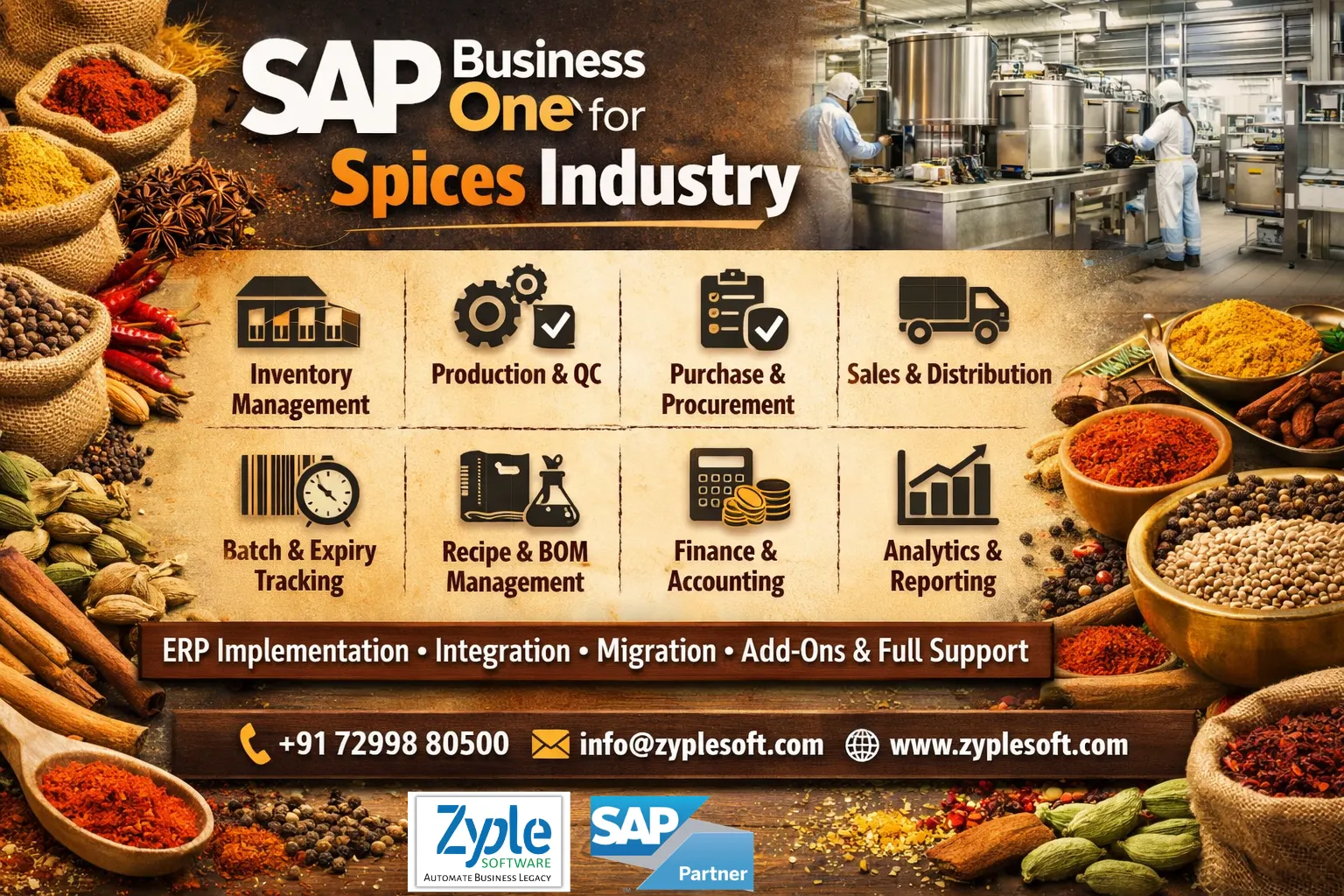
The spice industry operating within the broader food manufacturing sector has its own set of compliance and regulations enforced by the government. Spice businesses face strict regulations throughout the process, from extracting spices to finally making them available for sale. SAP Business One for spice industry helps spice businesses to make their own recipes, develop customized private label seasoning blends, and produce bulk spices or portion-pack seasonings.
Challenges of the Spice Industry
The spice industry faces serious challenges, including strict global food safety regulations regarding pesticide residues, rampant adulteration, and significant supply chain instability due to climate change. Key problems also include low productivity, lack of traceability, and intense competition, which require upgrading to sustainable, high-tech farming and processing techniques.
1. Quality and Safety Standards
The biggest challenge is meeting food safety standards, particularly regarding pesticide residues and the detection of ethylene oxide.
2. Adulteration and Contamination
Adulteration with cheap fillers and contamination of equipment/utensils endangers product quality and brand reputation.
3. Climate Change Impact
Rising temperatures and unpredictable monsoons are negatively impacting crop yields and quality, requiring the development of climate-resistant varieties.
4. Supply Chain and Traceability
Lack of effective traceability makes it difficult to track contamination, which is needed by global standards.
5. Low Productivity and High Costs
Inefficient agricultural practices and outdated farming techniques lead to low productivity, while high production costs minimize competitiveness.
6. Intense Competition
Intense competition from other countries puts pressure on exports.
7. Low Value Addition
A significant portion of exports includes raw spices rather than high-value products like extracts or seasonings, limiting overall revenue.
8. Regulatory Hurdles
Varying and strict international import regulations make it difficult to maintain consistent market access.
Features of SAP Business One for Spice Industry
1. Recipe and Bill of Materials (BOM) Management
- Handles spice blends and formulations (e.g., masala mixtures).
- Oversees ingredient qualities, production instructions, and cost per batch.
- Automatically updates raw material requirements when recipes change.
2. Batch and Lot Traceability
- Monitors spices by batch or lot number from procurement to final product.
- Identify which supplier delivered raw spices and which customers received each batch.
- Quick product recalls and quality tracking can be done.
3. Expiry and Shelf-Life Management
- Evaluates manufacturing date, expiry date, and shelf life of spice products.
- Supports FEFO (First-Expire-First-Out) to minimize spoilage and wastage.
4. Quality Control and Compliance
- Quality checks for raw spices, grinding, blending, and packaging stages can be done.
- Maintains records for compliance with food safety standards.
5. Production Planning and MRP
- Plans grinding, roasting, blending, and packaging operations.
- Material Requirements Planning (MRP) ensures raw spices are available when required.
6. Inventory and Warehouse Management
- Real-time review of raw spices, semi-processed, and finished goods.
- Handles multiple warehouses, storage conditions, and stock aging.
7. Procurement and Supplier Management
- Handles purchase orders for raw spices from farmers or suppliers.
- Monitors supplier performance, pricing, and delivery schedules.
8. Sales and Distribution Management
- Manages sales orders, invoices, and distribution to retailers or wholesalers.
- Handles pricing, discounts, and customer relationships.
9. Financial Management
- General ledger, accounts payable/receivable, and cost accounting are included.
- Monitors production cost per spice batch and profitability.
10. Analytics and Reporting
- Online dashboards for sales, production, inventory, and profitability.
- Helps management make faster, data-driven decisions.
Importance of SAP Business One for Spice Industry
SAP Business One (SAP B1) software is important for spices industry, allowing companies to manage, unify, and automate essential operations like recipe management, inventory tracking, and quality control. It improves regulatory compliance through batch tracking, boosts production efficiency, and delivers real-time insights for cost reduction, making it ideal for small and medium-sized spice manufacturers.
1. Batch and Lot Traceability
Allows full end-to-end tracing from raw materials (e.g., raw peppercorns) to finished goods, ensuring rapid, efficient, and accurate recalls and improved quality control using SAP implementation.
2. Formula and Recipe Management
Securely handles bill of materials (BOM) and production formulas, enabling consistent output and controlled, accurate changes to seasoning mixes.
3. Regulatory Compliance
Simplifies compliance with food safety, FDA, and ISO standards by delivering, auditing, and maintaining accurate, real-time documentation and reports.
4. Inventory and Shelf-Life Control
Tracks inventory levels, manages ingredients with short shelf lives, minimizes waste, and automates reordering for spices and raw materials.
5. Production Optimization
Optimizes production planning and resource utilization (weighing, mixing) to improve overall output.
6. Cost Management
Provides accurate, batch-level costing that considers raw materials, labor, overheads, and by-products to ensure profitability.
7. Real-Time Visibility
Delivers a 360-degree view of business operations, including sales, procurement, and warehouse management, enabling faster decision-making.
Benefits of SAP Business One ERP for Spice Industry
SAP Business One (SAP B1) delivers essential benefits to the spice industry by allowing full, end-to-end traceability of raw materials from supplier to finished product, ensuring compliance with food safety regulations. It improves management via FIFO/LIFO methods for perishable goods, facilitates production with batch management, and provides accurate yield calculation, which minimizes waste and boosts profitability.
1. Batch and Lot Traceability
Delivers complete visibility into the shelf life and batch history of spices, enabling rapid tracking and recall if necessary.
2. Inventory Optimization
Handles raw material, work-in-progress (WIP), and finished goods across multiple warehouses using FIFO/LIFO, reducing spoilage.
3. Production and Formula Management
Handles complex bills of materials (BOMs), enabling manufacturers to maintain consistent quality and track variations in raw material usage using SAP solutions.
4. Regulatory Compliance and Quality Control
Allows audit-ready data and complies with food safety, packaging, and nutrition labeling standards.
5. Real-Time Analytics
Provides inclusive dashboards for monitoring key performance indicators (KPIs) like batch-level costing, supplier performance, and year-to-date sales.
6. Supply Chain and Procurement
Automates procurement processes using material requirements planning (MRP) to ensure optimal stock levels and minimize material shortages.
7. Improved Profitability
Minimizes operational costs by facilitating workflows and decreasing manual documentation and inventory waste.
Conclusion of Spice ERP
With over decades of experience or SAP Business One Partner, Zyple Software provides SAP B1 software for spice manufacturers to improve the overall production processes of spice business and drive to provide innovative flavors as well as quickly introduce new products to maintain a competitive edge in the volatile markets.
Are you requesting an SAP Business One ERP software system for your business or industry?
Fill in all the details in the provided contact form; our team will return to you.