SAP Business One ERP for Electrical Industry
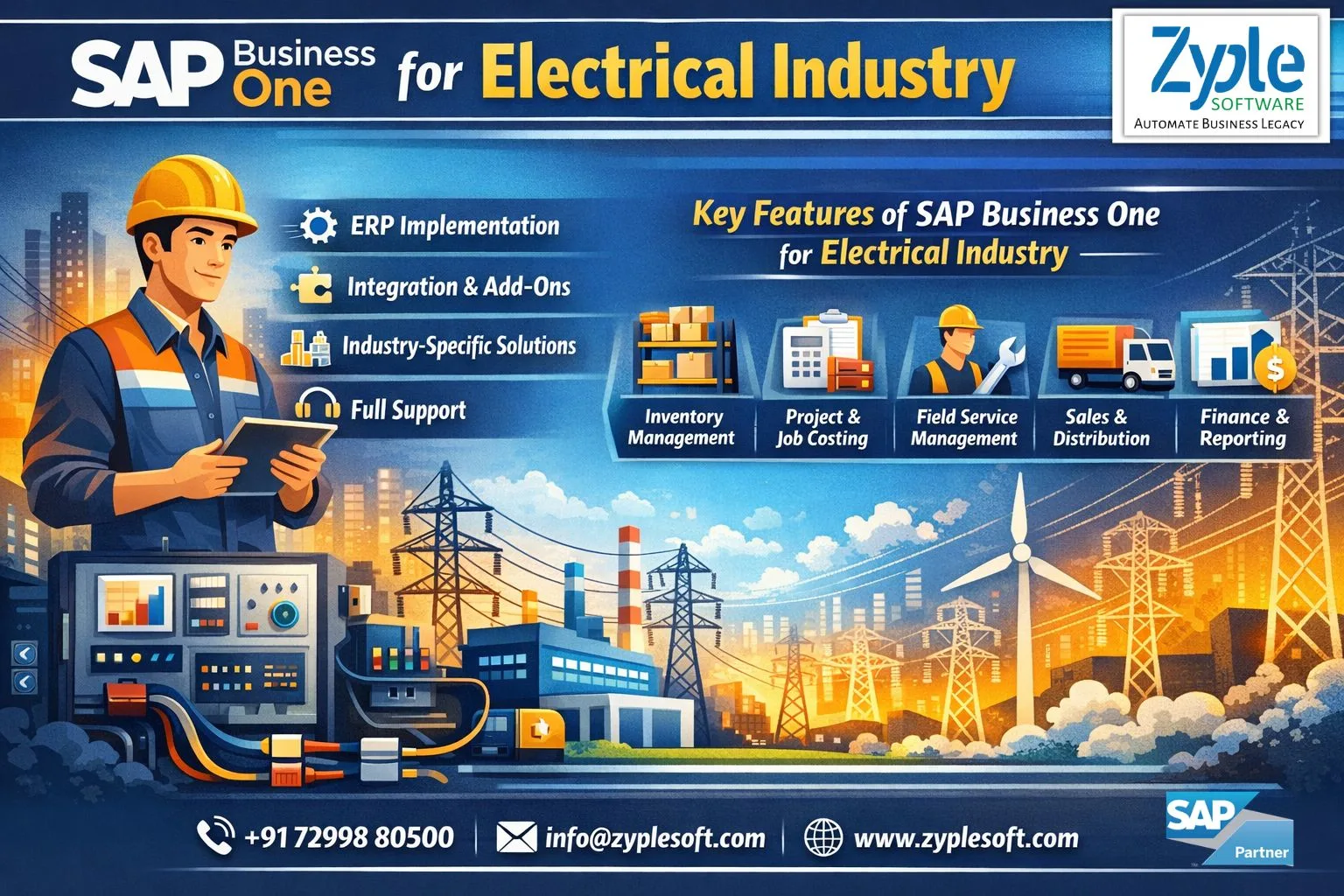
The electrical industry is rapidly evolving, driven by innovation, sustainability goals, and growing market demand. Electrical businesses must handle complex products like batteries, motors, controllers, electronics, and software components while ensuring strict quality standards, regulatory compliance, and supply chain coordination.
Many electrical businesses operate with disconnected systems across engineering, production, procurement, quality, and finance, leading to limited traceability, cost overruns, production delays, and inefficient decision-making. SAP Business One for electrical industry delivers a unified platform that integrates production planning, inventory, procurement, quality management, project tracking, and finance, providing real-time visibility and operational control across the electrical manufacturing lifecycle.
Challenges of the Electrical Industry
The electrical industry faces significant challenges, including connecting variable renewable energy into aging grids, maintaining safety in complex industrial environments, and navigating rapid technological changes. Main issues also include preventing equipment failures from loose connections or moisture, managing high capital costs for infrastructure, and handling cybersecurity threats.
1. Grid Modernization and Renewable Integration
Connecting large amounts of variable renewable energy (wind or solar) requires balancing the grid and updating outdated infrastructure.
2. Safety and Maintenance
Industrial electrical projects are high-risk, requiring strict safety protocols to avoid shocks, fires, and arc flash incidents. Common electrical failures are driven by loose connections, moisture, and insulation failure.
3. Infrastructure and Supply Chain
The need for significant investment in transmission and distribution to manage higher loads and renewable energy input.
4. Cybersecurity Risks
Increased digitalization of electrical grids results in vulnerabilities to cyber-attacks.
5. Workforce Challenges
A demand for skilled labor to handle modern technologies and complex installations.
6. Environmental Regulations
There is pressure to adopt green energy and eco-friendly practices, requiring firms to upgrade materials and technologies.
7. Complex Operational Environments
Industrial contractors experience challenges with high-elevation work, hazardous environments, and the need for specialized, heavy-duty materials.
8. Cost Management
Managing high costs for materials and labor while attempting to improve energy efficiency and minimize operational expenses.
Features of SAP Business One for Electrical Industry
1. Bill of Materials (BOM) and Production Management
- It includes multi-level BOM management for electrical components and assemblies.
- It includes production planning and scheduling for cables, panels, transformers, and more.
- It supports make-to-order or assemble-to-order manufacturing.
- It tracks raw materials, WIP, and finished goods in real-time.
2. Component and Inventory Management
- It includes real-time tracking of electrical parts, spares, and components.
- Batch and serial number tracking (essential for electrical goods).
- It includes inventory aging, stock valuation, and demand forecasting.
- It includes barcode and bin-location-based warehouse management.
3. Procurement and Supplier Management
- It includes vendor comparison and purchase planning.
- It includes automated purchase orders based on demand (MRP).
- Evaluates supplier performance and pricing.
- Minimizes stock shortages and excess inventory.
4. Sales and Distribution Management
- It includes the end-to-end sales cycle, from quotation, order, and delivery to invoice.
- It includes multi-channel sales (distributors, dealers, and retail).
- Price list and discount scheme management (crucial for electrical distribution).
- It includes sales forecasting and territory-wise performance tracking.
5. Service and Warranty Management
- Handles product warranties, repairs, and replacements.
- It tracks serial numbers for service history.
- Manages customer complaints and service requests efficiently.
- It improves after-sales support for electrical products.
6. Quality Control and Compliance
- It includes inspection and quality checks at production stages.
- It ensures safety compliance with electrical safety standards.
- Evaluates defective components and returns.
7. Financial Management
- It includes complete accounting aspects like general ledger, accounts payable, accounts receivable, banking, and fixed assets.
- It includes cost tracking for materials, labor, and overhead.
- It includes profitability analysis by product, project, or customer.
- It includes real-time financial reporting and dashboards.
8. Material Requirements Planning (MRP)
- Forecasts demand for electrical components.
- Optimizes procurement and production schedules.
- Avoids shortages in essential components.
9. Product Lifecycle Management
- Handles product design to end-of-life.
- Tracks cost changes and revisions.
- It helps innovate and launch new electrical products faster.
10. Business Intelligence and Real-Time Analytics
- It includes real-time dashboards for production, sales, and inventory.
- It includes custom reports for performance monitoring.
- It helps in data-driven decision-making with KPIs.
11. Multi-Branch and Multi-Currency Support
- Suitable for electrical companies with multiple warehouses or regions.
- It supports global operations with multiple currencies and tax systems.
12. Integration and Automation
- Connection with IoT devices or shop-floor systems (via add-ons).
- Integrates finance, inventory, production, and sales in one platform.
- Minimizes manual work and improves operational efficiency.
Importance of SAP Business One for Electrical Industry
The enterprise resource planning (ERP) software, SAP Software solution, is essential for the electrical industry by providing integrated, real-time management of complex BOMs (bills of materials), regulatory compliance, and inventory tracking for components. It boosts operational efficiency through automated MRP, production planning, and quality control, minimizing waste and strengthening supply chains for manufacturers and distributors.
1. Complex BOM Management
Allows multi-level BOM support, crucial for complex electrical assemblies, subassemblies, and wire/cable components.
2. Real-Time Inventory and Traceability
Delivers precise tracking of raw materials (e.g., copper, insulation) and finished goods, providing full serial/batch traceability for warranties and compliance.
3. Regulatory Compliance and Quality Control
Facilitates adherence to safety standards, tracking quality control checks throughout the production process to reduce defects.
4. Facilitated Procurement (MRP)
Uses automated material requirements planning (MRP) to manage procurement, avoiding material shortages and optimizing stock levels for production.
5. Improved Production Scheduling
Aligns machines, labor, and resources, allowing better production planning and increased manufacturing agility.
6. Comprehensive Financials and Analytics
Centralizes data for accurate costing, variance analysis, and real-time reporting to improve profitability.
Benefits of SAP Business One ERP for Electrical Industry
SAP Business One (SAP B1) provides electrical manufacturers and distributors an inclusive, scalable ERP solution to facilitate production, manage inventory, and improve customer service. It specifically helps the electrical industry manage complex, high-volume manufacturing with features like bill of materials (BOM) management, quality control, and real-time inventory control.
1. Optimized Inventory and Production
Facilitates production processes and handles inventory across multiple locations, preventing stockouts and improving material requirements planning (MRP) using SAP implementation.
2. Production Planning and Traceability
Tracks items, handles version control for product designs, and ensures quality with built-in checks and audit trials for compliance using SAP solutions.
3. Robust Cost Management
Allows access to last-price reports for high-value components, tracks production costs, and maintains accurate financial records.
4. Improved Sales and Delivery
Integrates sales directly into production schedules to improve order-to-cash processes, with tracking for on-time delivery to customers.
5. Advanced Data Analysis
Uses the SAP B1 HANA database for high-speed transaction processing and real-time data analysis via dashboards.
6. Customization and Scalability
Designs the platform to meet specific needs of electrical manufacturing, such as handling and scaling operations for growth.
7. Cost-Effective and Flexible
SAP B1 software provides affordable pricing to minimize initial capital expenditure, making it accessible for small and medium-sized enterprises.
Conclusion of Electrical ERP
Zyple Software is an authorized SAP Business one partner in India specializing in implementation, digital transformation, migration, licensing, add-on solutions, integration, and consulting for the electrical industry. SAP Business One ERP for electrical industry delivers complete operational visibility, precise cost control, streamlined production, and built-in compliance support. With SAP B1 ERP, businesses are well-equipped to scale confidently, meet market demands, and stay competitive in a fast-evolving manufacturing landscape.
If you’re involved, you can book a demo of SAP Business One.
Are you endeavoring to find the SAP Business One ERP solution for your business or industry?
Fill in all the details in the decided contact form; our team will reach out to you.