Tag Archives: digital transformation

SAP Business One erp for Maritime Industry

SAP Business One for Maritime Industry

SAP Business One ERP for Maritime Industry
SAP Business One erp for Maritime Industry

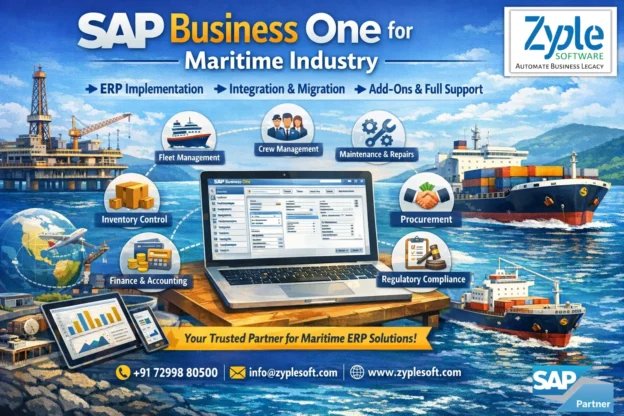
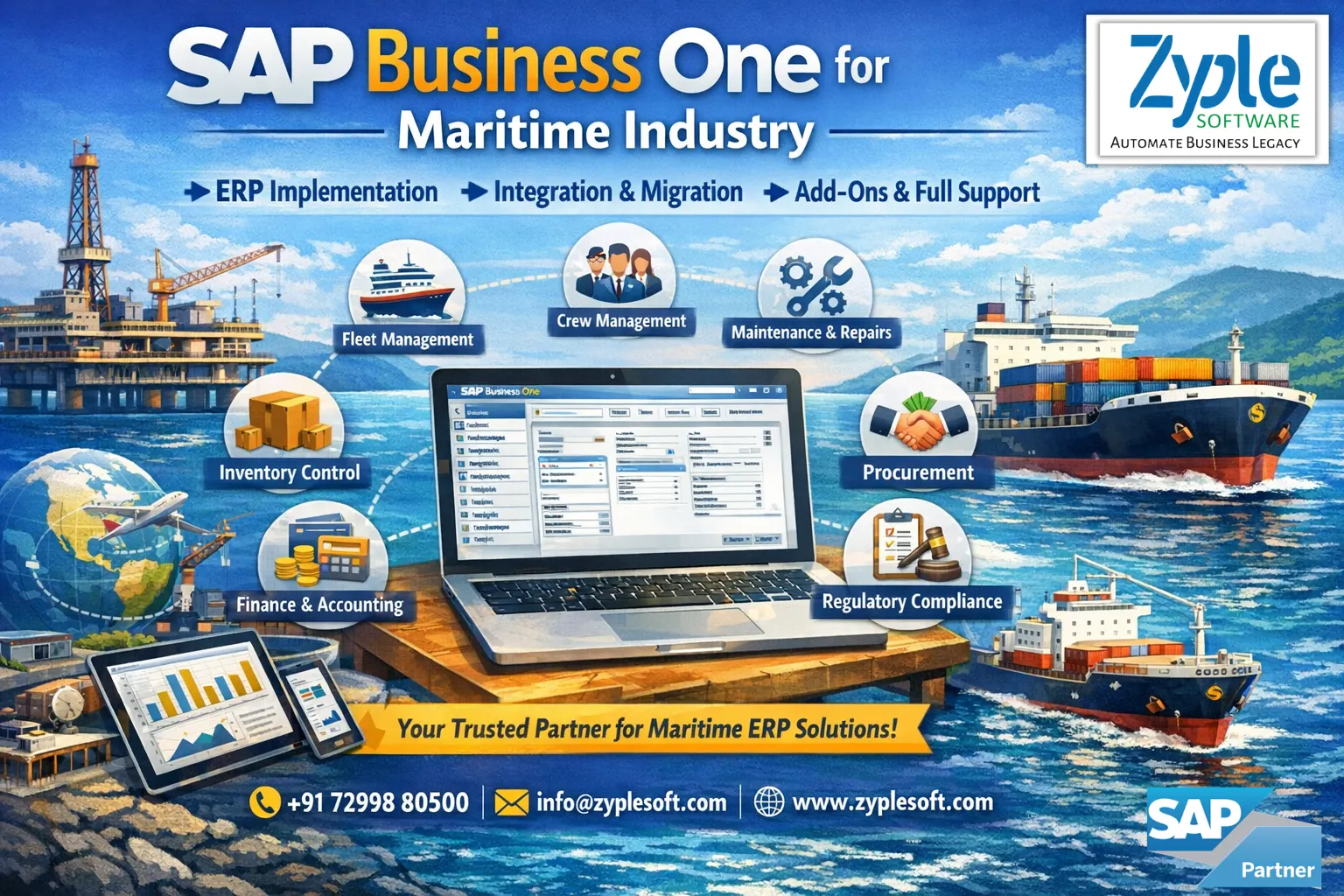
The maritime industry plays an important role in global trade, requiring accuracy and efficiency at every step. SAP Business One for maritime industry helps handle challenges like fleet management, regulatory compliance, and rising operational costs. SAP Business One ERP delivers designed solutions to facilitate logistics, improve customer relationships, and increase supply chain efficiency. With SAP B1 implementation, maritime companies can gain real-time insights, minimize operational costs, and boost performance.

Key Challenges in the Maritime Industry

The maritime industry is struggling with the range of challenges that require forward-thinking solutions for growth and efficiency. Companies must handle issues such as fleet optimization, rising operational costs, and compliance with stringent environmental regulations. The rapid pace of technological change, along with the need for smooth data integration, intensifies the pressure to remain competitive. To succeed, maritime businesses must focus on improving operational workflows, increasing customer experience, and adopting innovative digital tools. 

Here are the key challenges confronting the maritime sector:

1. Rising Operational Costs

Rising fuel prices damage budgets, forcing maritime operators to seek innovative strategies for cost management and efficiency improvements.

2. Supply Chain Disruptions

Unforeseen disruptions in global supply chains can obstruct timely operations, necessitating flexible strategies to reduce impacts on maritime logistics.

3. Safety and Security Risks

Ensuring the safety of personnel and vessels amid rising security threats requires thorough risk management and training programs.

4. Increased Competition

The maritime industry is highly competitive, demanding businesses to innovate and deliver value-added services to stay ahead.

Features of SAP Business One for Maritime Industry

1. Fleet Management

Tracking, managing, and improving vehicle operations, including maintenance, fuel consumption, driver performance, and leasing.

2. Finance and Accounting

Automating key financial processes like general ledger, journal entries, budgeting, and bank reconciliation.

3. Production

Handling the end-to-end manufacturing process, including bills of materials (BOM) management, production orders, resource planning, and goods movements.

4. Purchasing

Handling the entire lifecycle of acquiring goods and services, from vendor selection to final payment.

5. Operation Management

Facilitating core processes, such as inventory, purchasing, production, and sales, into one system.

6. Manufacturing Integration

Integrating the ERP system with shop-floor systems, such as Manufacturing Execution Systems (MES), PLCs, and IoT devices, to synchronize production data, automate inventory updates, and gain real-time visibility.

7. Customized Report

It is a designed data analysis tool customized to display specific business metrics, KPIs, or information not available in standard, out-of-the-box reports.

8. Business Intelligence and Analytics

Real-time data analysis allows small and medium-sized enterprises (SMEs) to monitor performance, visualize data via dashboards, and make better decisions.

9. Forecasting

Predicting future customer demand, allowing businesses to optimize inventory levels, production schedules, and purchasing to avoid stockouts or excess stock.

10. Cost Management

Tracking, allocating, and analyzing expenses and revenues across different business units, departments, or projects to monitor profitability.

11. Sales and CRM

Handling the entire customer lifecycle, from initial lead, through sales opportunities, to quotations and orders.

12. Cash Flow Management

Real-time tracking and forecasting of incoming and outgoing money to maintain liquidity and guarantee financial stability.

13. Business Planning

Facilitating core processes to allow data-driven decision-making through real-time reporting, supporting on-premise or cloud deployment.

14. Bank Integrations

Secure, automated connection between the ERP system and banking platforms, allowing seamless, direct exchange of financial data.

15. Business Partners

Represents the master data for all external identities in a company interacts with customers, vendors (suppliers), and leads.

16. Add-Ons

Extensions that connect directly into the core ERP system to deliver specialized, industry-specific, or improved functionality.

Importance of SAP Business One for Maritime Industry

SAP Business One (SAP B1) is important for the maritime industry, providing an integrated, real-time ERP solution that facilitates shipbuilding, inventory, and supply chain operations. It improves project management, minimizes costs through automation, and ensures compliance with maritime regulations. Important reasons include improved data visibility, optimized resource management, and scalable, accurate financial reporting for shipyards and marine services using SAP implementation.

1. Integrated Project Management

Handles complex ship construction projects from planning to delivery, tracking milestones and costs in real-time.

2. Operational Efficiency and Automation

Automates procurement, inventory management, and supplier communication, minimizing manual workload and errors.

3. Improved Resource Management

Allows accurate, real-time monitoring of resources (materials, labor, and machinery) to avoid waste and minimize operational costs.

4. Financial Control and Compliance

Delivers accurate, audit-ready financial data and helps in managing industry-specific regulatory standards, minimizing penalties.

5. Real-Time Analytics and Reporting

Provides powerful dashboards for analyzing KPIs, helping managers make data-driven decisions on production and sales.

6. Scalability for Growth

Supports the expanding requirements of maritime businesses, including improved project complexity, through a scalable, flexible platform.

7. Supply Chain Optimization

Facilitates logistics by coordinating procurement and warehousing, improving overall profitability.

Benefits of SAP Business One ERP for Maritime Industry

SAP Business One (SAP B1) provides maritime companies a centralized, scalable SAP solutions to optimize fleet operations, manage complex shipbuilding projects, and improve supply chain efficiency. Core benefits include real-time financial oversight, improved inventory control, automated procurement, and regulatory compliance, ensuring increased profitability, minimized downtime, and faster on-time deliveries.

1. Operational Capabilities and Digital Transformation

Facilitates processes from order-to-cash, including purchase order generation from sales orders, minimizing manual inaccuracies and accelerating workflows.

2. Inventory and Logistics Management

Optimizes inventory levels for shipyards, preventing overstocking, and improves supply chain visibility for logistics, including tracking BP catalog numbers (vendor or customer part numbers).

3. Improved Fleet and Maintenance Control

Allows scheduling of preventive maintenance and real-time monitoring of vessel status to reduce costly downtime.

4. Financial and Contract Management

Allows tracking of freight contracts and supplier agreements, delivering detailed profitability analysis, financial reporting, and automated payment scheduling.

5. Real-Time Data and Reporting

Delivers 360-degree visibility into operations via interactive dashboards, allowing better, faster decision-making for managing complex, long-term projects.

6. Ease of Use and Integration

Grows with the business, enabling the addition of users and functionalities, ensuring a future-proof investment.

Conclusion of Maritime ERP

As a certified SAP Business One partner, Zyple Software brings unparalleled expertise and dedication to businesses seeking seamless SAP Business One services.

Do you pursue ERP software for your business or industry?

Fill in all the details in the allocated form; our team will get back to you.

    How to Buy SAP B1 Software

    How to Buy SAP B1 Software?

    How to Buy SAP Business One (SAP B1) Software?

    How to Buy SAP B1 Software

    What is SAP Business One ERP?

    The ERP system, SAP Business One (SAP B1) ERP, is a cost-effective, integrated ERP software solution designed for small and medium-sized enterprises (SMEs) and fast-growing companies to manage key operations, including finance, sales, CRM, inventory, and production in one system. It facilitates workflows and delivers real-time analytics to improve decision-making, providing flexible, scalable deployment on-premises or in the cloud. Here, we will discuss how to buy SAP B1 software.

    How to Buy SAP B1 Software Online?

    The Process of buying SAP Business One (SAP B1) software online is primarily done through the official SAP store, where you can identify, configure, and purchase solutions directly. The process involves choosing the appropriate license type (professional or limited), modifying user counts, and integrating with Zyple Software for implementation.

    1. Visit the SAP Store

    Navigate to the SAP store and ensure your country/region is properly selected to see relevant pricing and partners like Zyple Software.

    2. Search and Select

    Use the search bar to find SAP Business One.

    3. Configuration of License

    Choose between a perpetual license or a subscription model based on user types (Professional vs. Limited).

    4. Buy or Integrate

    Click “Buy Now” to purchase directly or “Get It Now” to integrate with a partner like Zyple Software to discuss requirements and implementation.

    5. Payment & Access

    Finish the final payment process. For cloud-based options, you may receive access details directly, while on-premise solutions will involve coordination with Zyple.

    How to Buy SAP Business One Software in India?

    To buy SAP Business One (SAP B1) software in India, you must engage Zyple Software to conduct a needs evaluation, customize, and implement the software. The major steps include choosing a deployment model (cloud or on-premise) and selecting user licenses (professional or limited).

    1. Identify an Authorized Partner

    Contact Zyple Software, a certified SAP Business One partner in India, to receive customized quotes, as they manage sales, implementation, and support.

    2. Needs Evaluation and Demo

    Request an inclusive demonstration and a needs evaluation to define which modules (finance, CRM, and inventory) your business requires.

    3. Choosing a Licensing Model

    This includes two types of SAP B1 licensing models:

    • Professional Users: It is the type of SAP Business One licensing model where users have full access to all modules.
    • Limited UsersIt is the type of SAP Business One licensing model where users have specific or limited access to modules like CRM, finance, and logistics.

    4. Choose Deployment Process

    Choose between on-premise (perpetual license) and cloud (subscription model).

    5. Installation & Full Support

    Work with Zyple to design the system to your requirements and set up continuous maintenance.

    Know About Customized SAP Business One Pricing India

    We understand that the SAP Business One price in India varies based on factors such as company size, user count, data complexity, and user needs. As your trusted SAP B1 partner in India, we specialize in licensing and crafting personalized blueprints to outline the exact SAP Business One pricing for your organization.

    With decades of experience, we navigate you through the complexities of SAP B1 software price and licensing costs, considering factors like purchasing process, database options (SAP B1 SQL or SAP B1 HANA), hosting preferences (cloud or on-premise), and necessary maintenance and support. If you’re concerned, book an SAP B1 demo.

    Whether you’re in manufacturing, construction, real estate, retail, pharmaceuticals, textiles, logistics, energy or any other sector, our customized approach ensures that the SAP Business One cost remains within budget and aligns perfectly with your unique business model and SAP B1 pricing.

    Not only licensing, but when it comes to SAP implementation, our company delivers excellent support and services to different industries like manufacturing, construction, real estate, retail, pharmaceutical, textile, professional services, aerospace and defense, and more to help them cater to their requirements with the growing competition.

    Key Factors That Impact SAP Business One Price in India

    1. Deployment Models like Cloud and On-Premise

    One of the biggest SAP B1 pricing factors is how you choose to launch SAP Business One like on-premise or the cloud.

    Every model has its own cost structure and long-term financial implications.

    2. Number of Users and License Types

    SAP Business One’s pricing differs based on

    • Number of users accessing the SAP B1 system.
    • Type of users (Professional and Limited).

    Businesses can improve costs by selecting the right type of user licenses instead of assigning full access to everyone.

    3. Business Size and Industry Requirements

    The overall cost depends largely on:

    • Size of the organization.
    • Industry-specific needs (manufacturing, construction, real estate, retail, pharmaceutical, textile, professional services, aerospace and defense, and more).

    Some industries may require additional configurations or compliance features, which can impact pricing.

    4. Customization and Add-On Development

    SAP Business One can be improved with:

    • Industry-specific add-ons.
    • Process automation and integrations.

    The level of customization directly impacts the final project cost.

    5. Implementation and Consulting Services

    SAP B1 ERP pricing is not only about SAP Business One licenses; SAP B1 implementation services play a crucial role in the following:

    • System modification.
    • Data migration.
    • User training.
    • Go-live support.

    A structured and expert-led implementation ensures improved ROI and long-term success.

    6. Support, Annual Maintenance Costs, and Managed Services

    Post-implementation costs include:.

    • Support.
    • System upgrades.
    • Performance optimization.
    • Continuous improvements.

    Choosing a reliable SAP partner, Zyple Software, helps reduce these costs while ensuring system stability.

    Types of SAP Business One Licenses

    Experience personalized guidance from experts to navigate SAP Business One price in India, along with maintenance, SAP support, and implementation. Select from a variety of SAP Business One licenses, including professional and limited licenses, designed for your business requirements.

    1. Professional License

    With professional SAP Business One licenses, you can gain the full spectrum of SAP Business One’s capabilities, allowing access to all modules or features. Select between flexible subscription or perpetual license options to match your business needs seamlessly by delivering the most affordable SAP Business One cost. It is the SAP B1 ERP license suitable for users who need complete access to the system, like managers and decision-makers.

    2. Limited License

    In SAP Business One limited licenses, the offerings deliver focused solutions across three areas, such as CRM, financial, and logistics. Every option provides a unique blend of modules and features to handle specific business needs. This type of SAP B1 license helps you to find the ideal fit for your requirements. It is the SAP B1 ERP license suitable for users who require access only to some modules in the SAP B1 system.

    Are you looking for SAP Business One Software for your any business or industry?

    Fill in all the details in the specified contact form; our team will reach out to you.

      Choose SAP ERP Implementation Partner

      Choose SAP ERP Implementation Partner

      How to Choose SAP ERP Implementation Partner?

      Choose SAP ERP Implementation Partner

      Selecting the right SAP ERP implementation partner is one of the most critical decisions your business will make.

      An ERP system like SAP Business One can transform operations but only if implemented correctly. The wrong partner can lead to delays, cost overruns, user resistance, and underutilized systems.

      How do you choose the right SAP ERP implementation partner?

      1. Check Industry-Specific Experience (Not Just SAP Knowledge)

      Many firms say they “implement SAP.” That’s not enough.

      A strong implementation partner should understand:

      • Your industry workflows
      • Compliance requirements
      • Operational bottlenecks
      • Reporting expectations
      • Growth challenges

      For example:

      1. Manufacturing requires BOM, production planning, and MRP expertise
      2. Retail needs POS integration and multi-branch consolidation
      3. Construction requires project cost tracking and milestone billing
      4. Pharma demands batch tracking and regulatory compliance

      ERP success depends on domain knowledge but not just technical setup.

      2. Verify SAP Authorization and Partnership Status

      Ensure the partner is officially aligned with SAP SE.

      Ask:

      • Are they an authorized SAP partner?
      • Do they have certified SAP consultants?
      • How many SAP projects have they completed?

      Certification ensures access to proper implementation methodologies, updates, and support standards.

      3️. Evaluate Implementation Methodology

      A professional SAP Business partner should follow a structured process:

      • Requirement study and gap analysis
      • Solution blueprint
      • System configuration
      • Data migration
      • User training
      • Go-live support
      • Post-implementation optimization

      If the partner can not clearly explain their methodology, that’s a red flag.

      4. Look for Industry Case Studies

      Real results matter more than promises.

      Ask for:

      • Case studies
      • Client references
      • Before-and-after performance improvements
      • ROI metrics

      Examples of measurable outcomes:

      • 20–30% inventory reduction
      • Improved working capital visibility
      • Faster month-end financial closing
      • Reduced manual errors

      A credible partner will have proof of success.

      5. Assess Customization and Add-On Capability

      Every business has unique processes.

      Your SAP ERP partner should:

      • Offer industry-specific add-ons
      • Provide integration capabilities
      • Customize reports & dashboards
      • Connect with third-party systems

      A one-size-fits-all approach rarely works.

      6. Understand Post-Implementation Support

      ERP implementation does not end at go-live.

      Ask:

      1. Do they offer ongoing support?
      2. What are their SLA terms?
      3. Is there a dedicated support team?
      4. Do they provide system optimization services?

      Strong post-go-live support determines long-term success.

      7. Evaluate Local & Regional Presence

      For Indian businesses especially, a partner with local market understanding offers advantages:

      • Knowledge of GST compliance
      • Indian taxation structure
      • Regional business practices
      • Faster on-site support

      If you’re operating in India, choosing a SAP ERP partner with strong Indian market experience is critical.

      8. Transparency in Costing

      Avoid vague pricing structures.

      A reliable SAP ERP implementation partner should clearly explain:

      • License cost
      • Implementation cost
      • Customization charges
      • Annual maintenance
      • Support fees

      Transparency prevents budget surprises.

      9. Scalability for Future Growth

      ERP is a long-term investment.

      Ensure the partner can support:

      • Multi-branch expansion
      • Multi-currency operations
      • Increased transaction volume
      • Advanced analytics
      • Industry compliance evolution

      The right partner prepares your ERP for the next 5–10 years.

      Why Choosing the Right SAP ERP Partner Matters?

      ERP implementation impacts:

      • Financial visibility
      • Operational efficiency
      • Inventory management
      • Compliance
      • Customer satisfaction

      The right partner like Zyple Software becomes a long-term strategic advisor  –  not just a software installer.

      Final Conclusion

      Choosing the right SAP ERP implementation partner is not about selecting the cheapest option.

      It’s about selecting:

      • Industry expertise
      • Proven methodology
      • Transparent pricing
      • Long-term support capability
      • Strong SAP ecosystem alignment

      If you’re evaluating SAP ERP for Manufacturing, Retail, Construction, Real estate, Pharma, Textile, or other industries in India, take time to assess your implementation partner carefully.

      A well-implemented SAP ERP system can transform your business.
      The right partner makes all the difference.

      Let us fill your detail in contact form. A right implementation partner will contact you soon as per your business needs.

        manufacturing erp

        Manufacturing ERP for Industry

        Manufacturing ERP Software for Companies

        manufacturing erp

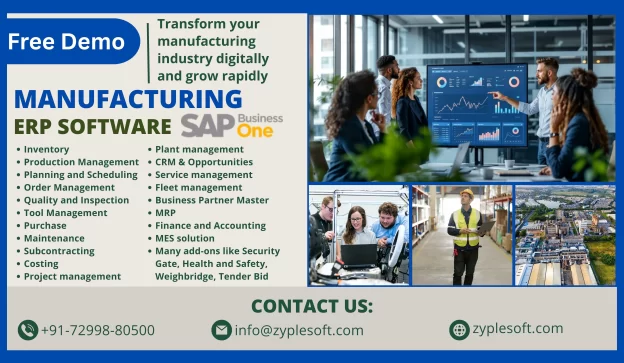
        It is a specialized software system designed to help manufacturers manage and integrate different business processes, including production planning, supply chain management, and inventory management, into a single, unified platform. It facilitates operations, improves efficiency, and provides real-time insights into metrics, ultimately boosting productivity and profitability.

        Best ERP Software for Manufacturing in India

        SAP Business One is a comprehensive ERP software for manufacturing in India, specifically for small to medium-sized enterprises (SMEs). It provides a comprehensive suite of tools for managing various aspects of a manufacturing business, from production planning to sales and financials, all within a single integrated system.

        Features of Manufacturing ERP

        1. Inventory

        Gain real-time visibility into stock levels, minimizing overstock and stockouts while optimizing inventory costs.

        2. Production Management

        Facilitate your workflows and reduce manual tasks to improve efficiency and focus on strategic initiatives.

        3. Planning and Scheduling

        Improve operational efficiency with detailed work order tracking and production timeline management.

        4. Order Management

        Track orders from creation to fulfillment, ensuring on-time delivery and increased customer satisfaction.

        5. Quality and Inspection

        Digitize quality checks, covering inward, in-process, and final inspections, for real-time tracking.

        6. Tool Management

        Expand the lifespan of tools with detailed tracking of usage and maintenance schedules.

        7. Purchase

        Facilitate processes with automated workflows and vendor management for timely purchasing.

        8. Maintenance

        Analyze downtime to identify patterns and execute corrective measures, boosting efficiency.

        9. Subcontracting

        Oversee outsourced production smoothly with real-time visibility into every stage of the process.

        10. Costing

        Understanding expenses at every stage of manufacturing is crucial for profitability and efficiency.

        Types of ERP Software in the Manufacturing Industry

        Different types of ERP systems are available today to cater to the requirements of a manufacturing company based on their size and functionality. The best manufacturing ERP solution is the one that supports adaptive manufacturing enterprises and can adjust to change and thus provides a competitive advantage to the business.

        On-Premise Software

        This type of manufacturing ERP software on implementation needs support, control, and ownership of the system, including the risk and cost related to managing hardware and system infrastructure for manufacturers.

        Cloud-Based ERP Software

        Manufacturers having this type of software have a flexible yet inclusive system with consistent updates, support, training, and even customization options.

        Hybrid ERP

        Setting up a hybrid ERP provides manufacturers with a fusion of on-premise and cloud-based hosting and deployment services. This system provides users the flexibility to migrate between delivery models or integrate benefits that do not come with the existing implementations.

        Benefits of Manufacturing ERP Software

        This ERP software improves business processes, provides accurate real-time data, and reduces costs. Here are some of the key benefits of an ERP system for manufacturers.

        Real-Time Data

        Real-time data has revolutionized the manufacturing industry by evolving how shops are managed and goods are manufactured. Real-time data provided by manufacturing ERP systems lets you know which of your production processes, machines, work centers, and product lines are operating at high levels of quality and efficiency, which enables you to make changes quickly and fix any issues before they get out of hand.

        Real-time lets you continuously track, control, and fine-tune your shop for maximum efficiency. With this, you can manage your shop floor schedule, consistently improve product quality, and maintain your equipment to create a high-performing manufacturing plant.

        Improved Efficiency

        Manufacturing ERP systems help maximize your shop’s efficiency by facilitating your business processes. All shops use QR codes on all items to facilitate inventory tracking, making it easy to scan items in and out and maintain accurate records. Inventory management has significantly improved with SAP Business One ERP, helping to improve efficiency and expand production. This ERP software facilitates your tasks and business processes so you can do things quicker, greater, and more consistently.

        Improved Operational Efficiency

        Spend and invest wisely and see the results. ERP systems provide integrated financial insights that recognize areas where costs can be reduced. These systems are customized with tools that support accurate budgeting and financial forecasting. Identify the most profitable product lines and find the suitable pricing strategies to increase revenue.

        Better Supply Chain Visibility

        Manage resources more efficiently. SAP solutions provide a comprehensive view of supplier performance and procurement needs and monitor inventory levels to ensure they remain at the right levels. This avoids any holding costs or stockouts. The demand planning features align production with demand forecasts to prevent any overproduction or missed sales opportunities.

        Regulatory Compliance and Quality Control

        Stay ahead of possible issues across the board. ERP systems minimize legal risks or compliance issues by continuously monitoring production processes. They keep comprehensive and accurate records of operations to avoid any potential challenges around audits or compliance checks. Companies use the software to stay within the bounds of regulatory frameworks.

        How to Choose the Best Manufacturing ERP System

        To choose the best manufacturing ERP system, business leaders must understand what they need. By considering these steps, leaders can assess potential ERP systems based on what would benefit their operation, rather than evaluating a one-size-fits-all list of criteria.

        1. Understand Your Business Needs

        A business can’t build and implement an ERP system without having a clear understanding of what the system will need to do. Many manufacturers start this process by collaborating with different stakeholders to create a list of must-have ERP features. They do this by deciding what data to track, what processes to facilitate, and what reports and monitoring will be required to continuously improve operations. This process involves identifying the enterprise’s operational strengths and weaknesses, growth strategies, and specific inventory and production requirements.

        2. Assess Features and Functionalities

        Once a business has arranged its needs and goals, these can be met with the features of an ERP solution. If a manufacturer plans to facilitate inventory management, it should seek an ERP system with advanced inventory functionalities, such as product sorting, order tracking, and warehouse controls. They should also assess the ease of use, integration capabilities with existing systems, and long-term scalability. Scalability is important because it ensures that the type of ERP system chosen can adapt and grow alongside the business, accommodating future expansion and evolving requirements. This foresight can help reduce downtime and frustration during the transition as the business evolves.

        3. Assess Vendors

        Manufacturers must also consider such factors as the vendor’s reputation, its experience in the manufacturing industry, and its customer service capabilities. For instance, it’s important to select a vendor that, in addition to providing a robust ERP system, also provides comprehensive support during SAP implementation and beyond. Also, manufacturers might want to consider the vendor’s financial stability, how long its product has been on the market, and whether it’s committed to updating or improving their ERP system from both a technology and security standpoint.

        4. Assess Total Cost of Ownership

        The total cost of ownership (TCO) of an ERP includes the initial purchase price and all costs associated with the system, such as implementation, training, operation, maintenance, and upgrades. Therefore, manufacturers must plan and budget for direct costs, like software licenses and hardware, and indirect costs, like the cost of temporarily shifting staff from their usual jobs to roles focused on establishing the ERP system during its rollout.

        5. Assess Technological Advancements

        Advanced technologies, including cloud computing, artificial intelligence (AI), machine learning, and internet of things (IoT) devices, can offer significant advantages in terms of user-friendliness, real-time data analysis, predictive maintenance, and more.

        6. Manage Implementation and change

        The time and resources required to implement an ERP system should be primarily considered when weighing alternatives. Once the ERP solution is fully integrated, business leaders can use the system to break down traditionally stored processes, such as order processing, financials, and inventory management, to facilitate operations and provide a detailed sight of the company.

        7. Evaluate ROI

        Evaluating possible return on investment (ROI) involves comparing the financial gains resulting from implementing the ERP system against the total cost of ownership. Given the significant investment generally associated with implementing an ERP solution, manufacturers must carefully calculate ROI to determine the value of the system as a whole, its specific features, and the modules that will prove most valuable.

        8. Consider Legal and Compliance Issues

        For many manufacturers, especially those providing diverse or sensitive products, tracking the legal and compliance requirements associated with their products can be a challenge. To overcome this, manufacturers should select an ERP system that allows them to customize compliance requirements to reflect all relevant industry regulations, standards, and laws, and create reliable records showing this compliance.

        Conclusion of Manufacturing ERP Software

        Zyple Software provides SAP Business One ERP services, where manufacturers gain a comprehensive platform for managing complex business processes that cater to the manufacturing industry. It is customizable to help manufacturers handle their industry’s specific and unique challenges, with the flexibility required to continue to adapt as the business grows and the industry evolves, either of which can cause a company to require new tools and features in the long run.

        Read more: SAP Business One for Manufacturing 

        If you are looking for Manufacturing ERP, then fill your details in contact form. we will contact you.

          sap b1 implementation for vijay raja group

          Zyple Software’s Triumph: Vijay Raja Group Embraces SAP B1 HANA with Resounding Success

          Zyple Software’s Triumph: Vijay Raja Group Embraces SAP B1 HANA with Resounding Success

          sap b1 hana successful implemented for vijay raja group

          Chennai, Tamil Nadu – June 2025 – Zyple Software proudly celebrates a transformative milestone as Vijay Raja Group embarks on a successful SAP Business One HANA implementation. In a heartfelt gathering featured on YouTube, Mr. Chendilnathan, Head of Customer Experience at Vijay Raja, expressed his gratitude.

          “We congratulate and thank every member of the Vijay Raja Group wholeheartedly for this grand achievement and the trust in Zyple Software.”

          The Journey of SAP B1 HANA Implementation for Vijay Raja Group

          This initiative marks a major leap for Vijay Raja Group—modernizing core systems, boosting real-time insights and uniting fragmented business units into a single, agile platform. The face-to-face testimonial brings warmth and authenticity.

          • Empowerment Through Technology: SAP B1 HANA enables real-time dashboards across finance, operations and inventory.
          • Partnership and Trust: Zyple’s role as both strategic guide and technical partner deepened collaboration and built confidence at every level.

          Voices From the Frontline

          “Congrats and thank you” wasn’t just ceremonial but it was a genuine reflection of trust placed in Zyple’s team. Behind those words lies hours of training, user adoption workshops and fine-tuning to fit each division’s rhythm.

          Why It Matters

          For Vijay Raja, this isn’t just tech adoption—it’s a business metamorphosis:

          • Operational Efficiency: Cloud‑like speed integrated with enterprise‑grade stability.
          • Scalable Growth: Ready to take on new markets and products without overhauling IT systems.
          • Efficient Decision‑Making: Clean data and insights for sharper forecasts and smarter strategy.

          What’s Next

          Looking ahead, Zyple Software will:

          1. Roll out advanced analytics and AI-powered reporting.
          2. Extend SAP HANA capabilities—adding finance automation, IoT insights and mobile access.
          3. Scale this transformation to other mid‑sized enterprises in South Asia, leveraging Vijay Raja’s success as a blueprint.

          About Zyple Software

          Zyple Software is a global technology consultancy specializing in digital transformation for mid‑market firms. With deep roots in Tamil Nadu and outreach across Asia, Zyple champions SAP, cloud intelligence and intelligent automation—helping businesses evolve with speed, intelligence and vision.

          About Vijay Raja Group

          In 1963, the group diversified into the construction industry, In 1983, under the astute leadership of Mr. Chendhilnathan as Chairman cum Managing Director, Vijay Raja Group embarked on a journey into diverse business segments and headquartered in Chennai,  Vijay Raja Group stands as one of the pioneering and oldest backward integrated companies in South India, its presence in the healthcare, construction and hospitality sectors boasting a dedicated team of over 500+ on-roll staff and employing more than 3000+ direct laborers, Known for innovation and quality, the group continues to strengthen its market presence with strategic technology investments.

          SAP B1 Experience Share by Mr. Chendilnathan – Vijay Raja Group

          In this video, customer experience shared about SAP Business One ERP implemented by Zyple software team.
          CORPORATE OFFICE

          Zyple Software Solutions Pvt. Ltd.

          No. 8 and 15, Royal Classic Layout - II, Lakshmipura Road, behind AMC Engineering College, Kalkere, Bangalore 560083

          BRANCHES

          Kochi, Chennai, Kolhapur, Goa, Abu Dhabi(UAE)

          +91 7299880500