Tag Archives: sap business one partner

Budget Management ERP Software - sap business one

Budget Management ERP Software

Budget Management ERP Software for Business
Budget Management ERP Software - sap business one

Handling budgets and tracking expenses can be a difficult task, but the emergence of enterprise resource planning (ERP) has made it easier and more accessible. With the budget management ERP software, businesses can efficiently handle their finances and ensure efficient resource management. Also, this ERP software is designed to help businesses stay on top of their budgeting needs and all the necessary calculations.

What is Budget Management Software?

Budget management software is software that integrates financial planning, forecasting, and real-time expense tracking to control costs and prevent budget overruns.

Which is the Best ERP Software for Budget Management?

SAP Business One is the best ERP software for budget management. The SAP Business One system serves as a powerful ERP software for budget management, allowing small and medium-sized enterprises (SMEs) to define, track, and control budgets in real-time. It enables annual or monthly budgeting, automated distribution methods, and proactive budget alerts or blocking of transactions that exceed predefined limits, ensuring financial control.

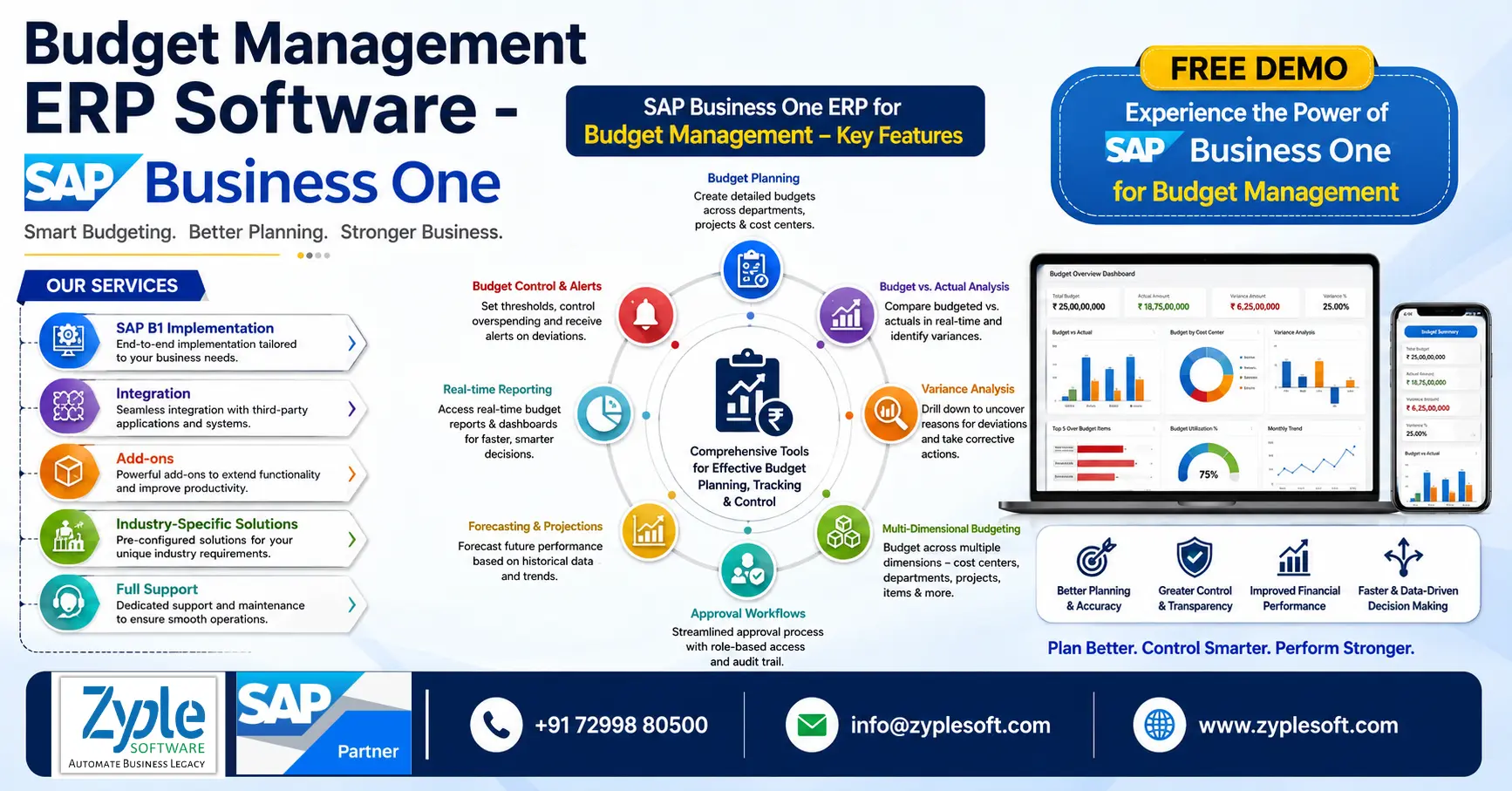
Features of Budget Management ERP Software

Here are the features of SAP Business One as budget management software:

1. Budget Planning and Scenario Definition

  • Creates budget scenarios for different financial plans (annual, quarterly, and project-based).
  • Assigns budgets to general ledger accounts, departments, or cost centers.
  • Defines distribution methods (equal, percentage-based, and seasonal allocation).

2. Budget Allocation and Distribution

  • Allocates budgets across time periods (monthly or yearly) and business units or branches.
  • It includes flexibility to distribute funds based on business priorities or historical data.

3. Budget Control and Enforcement

  • Strong control mechanisms to avoid overspending, like blocking transactions that exceed budget, warning alerts before exceeding limits, and enabling transactions without warning (if configured).
  • Applies to purchase requests and orders, goods receipt, and accounting entries (invoices and journal entries).

4. Real-Time Budget Monitoring

  • Tracks budget vs. actual spending in real-time.
  • Instant visibility into over-utilized budgets and remaining balances.
  • It helps improve financial discipline and forecasting accuracy.

5. Integration with Financial Management

  • Entirely integrated with general ledger, accounts payable and receivable, and cost accounting.
  • It ensures every financial transaction is automatically validated against the budget.

6. Multi-Level Budgeting

  • It supports department-wise budgets, project-based budgets, and company-wide budgets.
  • Allows hierarchical budget control across multiple entities.

7. Budget Revision and Adjustments

  • Modifies budgets through updates, transfers between accounts, and supplementary allocations.
  • Maintains flexible budgets for changing business conditions.

8. Budget Reporting and Analytics

  • Creates reports, such as budget vs. actual reports, profit and loss accounts with budget comparison, and variance analysis.
  • Uses dashboards and analytics for data-driven decision-making.

9. Alerts and Workflow Automation

  • Automated notifications for budget overruns and threshold breaches.
  • It includes workflow-based approvals for budget-related transactions.

10. Project and Cost Control Integration

  • Links budgets with projects and cost centers.
  • Monitors project profitability and cost deviations effectively.

11. Multi-Currency and Global Budgeting

  • Handles budgets across multiple currencies and international operations.
  • Suitable for companies operating in different regions.

12. Audit Trail and Compliance

  • Full traceability of budget creation and changes and approvals.
  • It ensures financial transparency and compliance.

Importance of Budget Management Software

The enterprise resource planning (ERP) software, SAP Business One (SAP B1) solution, is essential for increasing financial accuracy, allowing real-time tracking, and automating forecasting, which helps businesses prevent overspending and align resources with strategic goals. By replacing manual spreadsheets, SAP B1 improves collaboration, delivers data-driven insights for decision-making, and increases overall financial efficiency.

1. Increased Accuracy and Efficiency

Automates data entry and calculations, eliminating human error inherent in manual budgeting processes using SAP implementation.

2. Real-Time Monitoring and Control

Delivers live, instant access to financial data and expenses, allowing teams to spot overspending immediately and make adjustments.

3. Improved Forecasting and Planning

Utilizes historical data and predictive analytics for accurate financial modeling and strategic planning, rather than depending on guesswork.

4. Improved Collaboration

The SAP Business One system allows multiple team members to work on a single, shared, and secure version of the budget, breaking down organizational storage.

5. Strategic Resource Allocation

SAP B1 helps managers identify areas of overspending and reallocate funds effectively to improve profitability and achieve business goals.

6. Regulatory Compliance

The SAP B1 solution ensures better documentation and reporting for auditing and regulatory purposes.

Benefits of Budget Management ERP Software

1. Increased Visibility and Control

The SAP Business One software improves visibility and provides control to enterprises. With inbuilt real-time financial reporting, enterprises can find discrepancies or issues, which can help trigger immediate corrective action. Increased visibility and control also enable better decision-making, as finance teams can analyze financial data and make precise predictions about future spending.

2. Time Saving

Manual budgeting is a time-consuming process, but SAP Business One is fast and accurate and can also automate a number of repetitive and daily tasks. Users can quickly create budgets, evaluate expenses, and generate reports without manual interventions, freeing up strategic resources for essential tasks such as analysis and planning.

3. Cost Savings

The SAP Business One system can help enterprises create cost savings opportunities by identifying areas of overspending and reducing unnecessary expenses. SAP solutions also help procurement teams to negotiate better pricing with vendors and suppliers, further minimizing costs. Furthermore, SAP B1 also provides advanced features such as automated approvals and alerts, which can help enterprises avoid spending more than required and at the same time keep the budget management process on track.

4. Improved Accuracy

With automated processes and real-time reporting, the SAP B1 ERP system can eliminate many of the errors that can occur with manual budgeting, thereby improving accuracy and reducing the risk of financial discrepancies in reporting.

5. Forecasting and Planning

Most enterprises choose the SAP Business One system that can assist them with forecasting and planning. This software can analyze the enterprise’s historical spending patterns and identify trends and help the supply chain team to create accurate budget projections and ensure that financial resources are allocated appropriately. This can become accessible for companies with large and complex supply chains, where keeping track of budget and expenses can be a significant challenge.

6. Enhanced Collaboration

Other than keeping track of expenses, SAP software can help supply chain professionals to facilitate their workflows and improve supply chain collaboration. This software is capable of delivering a centralized platform for budget tracking and reporting, with which it virtually eliminates the need for multiple spreadsheets and documents. This can allow teams located across geographies to share data and insights in real time, exponentially increasing the scope for collaboration.

7. Scalability

What SAP Business One does is scale up with that growth, which makes such software a suitable tool for enterprises looking to expand their operations.

Conclusion of Budget Management ERP

Zyple Software is a trusted SAP B1 partner in India specializing in implementation, digital transformation, migration, licensing, integration, add-on solutions, and consulting for manufacturing, construction, real estate, agriculture, logistics, financial services, retail, technology, energy, healthcare, infrastructure, EPC, and professional services industries. It delivers increased visibility and control and  improved collaboration and forecasting and planning capabilities, as well as saves time, minimizes costs, and improves accuracy.

If you’re active, book a demo of SAP Business One.

Are you aiming to find the SAP Business One ERP software for your business or industry?

Fill in all the details in the figured contact form; our team will reach out to you.
    SAP Business One ERP for Lighting Products Manufacturing Industry

    SAP Business One for Lighting Products Manufacturing Industry

    SAP Business One ERP for Lighting Products Manufacturing Industry

    SAP Business One ERP for Lighting Products Manufacturing Industry

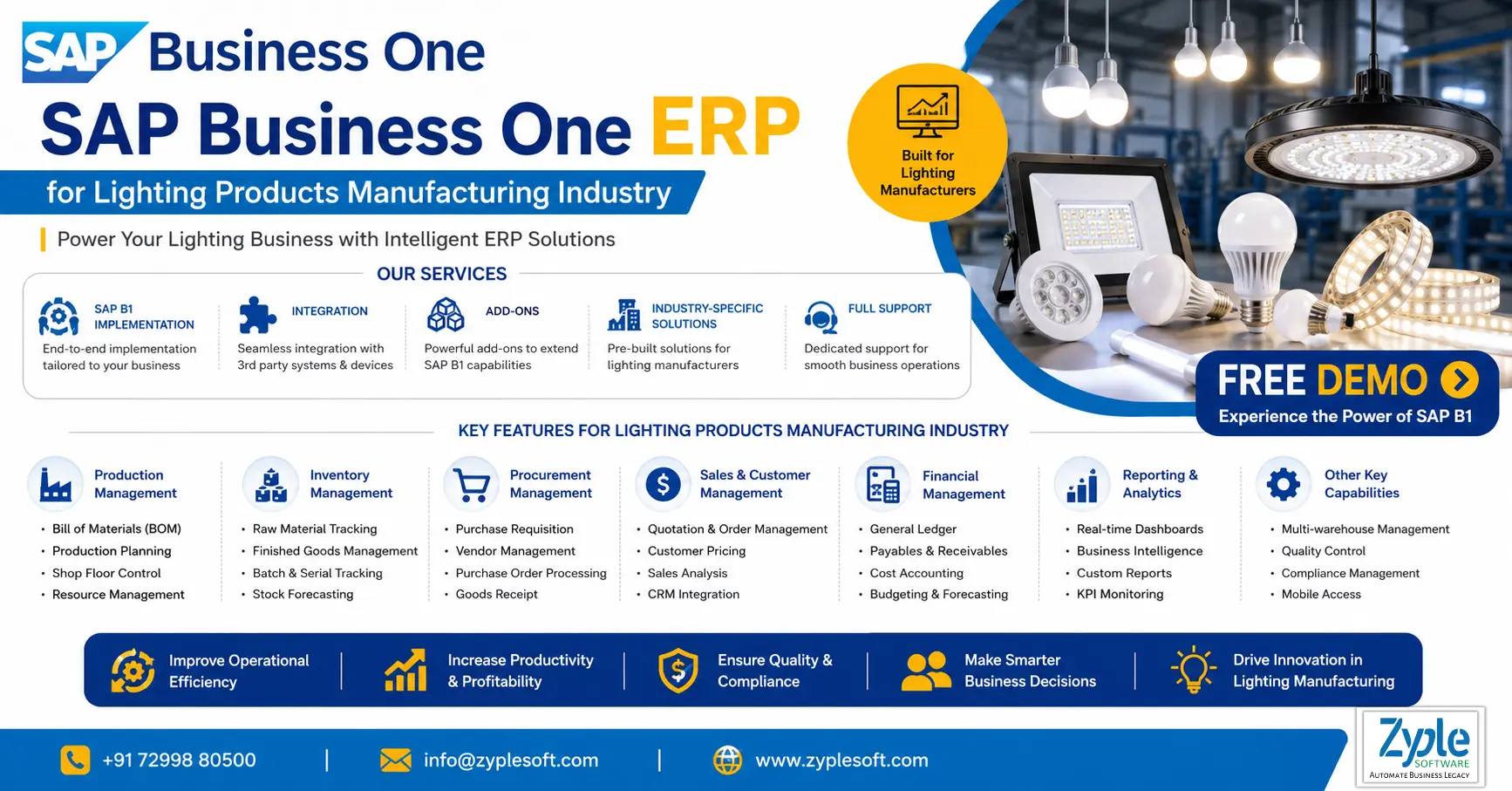
    The lighting products manufacturing industry is at the forefront of the global shift towards energy-efficient and enivironmentally friendly lighting solutions. The lighting technology has rapidly gained popularity for its energy-saving capabilities and long-lasting performance, making it an important part of modern lighting solutions for homes, businesses, and industries. SAP Business One ERP for lighting products manufacturing can significantly improve efficiency, cost control, quality management, and overall business performance in the lighting products manufacturing industry.

    Challenges Faced By The Lighting Products Manufacturing Industry

    1. Supply Chain and Raw Material Volatility

    Heavy dependence on global electronic components leaves manufacturers vulnerable to semiconductor and LED chip shortages. Geopolitical shifts and transportation obstacles frequently drive up freight costs and extend lead times. Pricing instability for necessary raw materials like aluminium, copper, and plastics squeezes profit margins.

    2. Market Pressures and Fierce Competition

    Local manufacturers struggle, as the market is flooded with low-cost, mass-produced lighting products, specifically from overseas competitors. High taxation rates can lead to revenue leakage, while evolving global efficiency standards involve continuous redesigns and recertification.

    3. Technological Shifts and Product Evolution

    Developing IoT-enabled, integrated smart lights is resource-intensive. Consumers now require high a Color Rendering Index (CRI) and flicker-free performance, forcing manufacturers to upgrade quality control measures. Industrial applications involve specialized fixtures built to withstand extreme temperatures, moisture, and corrosive chemicals, increasing manufacturing complexity.

    4. Sustainability and the Circular Economy

    There is a growing demand for products customized for easy repair, modularity, and recyclability. Compliance with environmental regulations regarding electronic waste involves modifying traditional production lines.

    5. Labor and Automation Constraints

    As lighting technology becomes more complex, finding technicians and engineers capable of handling advanced manufacturing processes is challenging. Companies face pressure to invest in robotics and lights out manufacturing to minimize human error and labor costs, though the initial capital expenditure remains a barrier for many.

    Features of SAP Business One ERP for Lighting Products Manufacturing

    1. Core Financial Management

    • It includes general ledger and accounts payable and receivable.
    • Cost center accounting for product lines like LED bulbs, panels, and fixtures.
    • It includes fixed asset management for machinery and tooling.
    • It includes bank reconciliation and GST compliance.
    • Tracks profitability per lighting product, project, or distribution channel.

    2. Sales and Customer Relationship Management (CRM)

    • Lead and opportunity management, like projects, distributors, and contractors.
    • It includes a quotation for order management.
    • Pricing management like bulk, dealer, and project-based.
    • It includes after-sales service and warranty tracking.
    • It includes customer lifecycle management.
    • Handles B2B sales for real estate, infrastructure, and retail lighting projects.

    3. Purchasing and Vendor Management

    • It includes supplier quotation comparison.
    • It includes purchase order automation.
    • It includes vendor evaluation and performance tracking.
    • It includes multi-currency procurement.
    • It includes import and export documentation support.
    • It includes efficient sourcing of LED chips, drivers, housing, and electronic components.

    4. Inventory and Warehouse Management

    • Batch and serial number tracking is essential for LED components.
    • It includes multi-warehouse and bin location management.
    • It includes stock valuation and ageing analysis.
    • It includes automated reorder levels.

    5. Bill of Materials (BOM) Management

    • It includes multi-level BOMs for complex lighting assemblies.
    • It includes version control and engineering change management.
    • It includes sub-assembly and phantom BOM support.
    • Handles BOM for LED panel lights, street lights, or smart lighting systems.

    6. Production Planning and Control

    • It includes production order management.
    • It includes material requirements planning (MRP).
    • It includes demand forecasting and scheduling.
    • Capacity planning for machines and labor.
    • It includes shop floor control.
    • Plans production for seasonal demand like festive lighting and infrastructure projects.

    7. Manufacturing Execution and Shop Floor Management

    • It includes routing and operations tracking.
    • It includes work-in-progress (WIP) tracking.
    • It includes machine utilization monitoring.
    • It includes real-time production updates.
    • Monitors assembly lines for LED bulbs, drivers, and fixtures.

    8. Quality Control and Compliance

    • Test result recording like lumen output, voltage, and heat resistance.
    • It includes compliance with BIS and ISO standards.
    • It includes automated quality documentation.

    9. Product Costing and Profitability

    • It includes standard and actual costing.
    • It includes margin analysis per product.
    • It includes cost simulation for new designs.
    • It calculates the exact cost of LED fixtures and optimizes pricing.

    10. Warehouse and Logistics Management

    • It includes goods receipt and dispatch management.
    • It includes pick, pack, and ship processes.
    • It includes delivery route planning.
    • It includes integration with logistics providers.
    • It includes efficient distribution to dealers, retailers, and project sites.

    11. Business Intelligence (BI) and Analytics

    • It includes real-time dashboards and KPIs.
    • It includes sales, production, and real-time analytics.
    • It includes drill-down reporting.
    • It includes Excel integration and visualization tools.
    • Identifies top-selling lighting products and demand trends.

    12. Project Management (Lighting Projects)

    • It includes project costing and budgeting.
    • It includes resource allocation.
    • It includes timeline tracking.
    • It includes integration with sales and procurement.
    • Handles turnkey lighting projects like commercial projects and smart cities.

    13. Service Management and Warranty Tracking

    • It includes service contract management.
    • It includes warranty tracking for lighting products.
    • It includes complaint and repair management.
    • It includes field service scheduling.
    • Handles warranty claims for LED lights and fixtures.

    14. Mobility and Web Access

    • It includes mobile apps for sales and service teams.
    • It includes web-based access for remote operations.
    • It includes real-time updates on inventory and updates.
    • Sales teams can evaluate stock and place orders on-site.

    15. Integration and Scalability

    • Integration with SAP B1 HANA.
    • It includes API integration with e-commerce and IoT devices.
    • It includes add-ons for industry-specific needs.
    • It includes cloud or on-premise deployment.
    • Integrates smart lighting systems or IoT-enabled products.

    16. Production Cost Optimization and Planning

    • It includes machine planning and scheduling.
    • It includes just-in-time (JIT) production.
    • It includes FIFO inventory management.
    • It includes resource optimization.
    • Minimizes wastage in LED manufacturing and optimizes production cycles.

    17. Batch Production and Traceability

    • It includes batch and lot tracking for components.
    • It includes full traceability from raw material to finished goods.
    • It includes recall management.
    • Tracks defective batches of LED drivers or chips quickly.

    Benefits of SAP Business One ERP for Lighting Products Manufacturing

    The ERP software, SAP Business One (SAP B1) system, delivers specialized modules tailored for lighting and LED manufacturers. It optimizes production planning, inventory tracking, and supply chain management to reduce operational costs and waste. By connecting shop-floor actions to financials, it generates real-time reports to ensure compliance and improve overall profit margins.

    1. Accurate Bill of Materials (BOM) and Routing

    Lighting fixtures often require complex sub-assemblies like LED drivers, heat sinks, housings, and diffusers. SAP implementation handles multi-level BOMs, standardizing production and helping manufacturers track exact material usage while cutting down on scrap and rework.

    2. Facilitated Material Requirements Planning (MRP)

    The MRP engine automatically evaluates sales forecasts, current stock, and lead times to calculate exactly when and how much raw material to purchase. This avoids over-purchasing while ensuring you never face stockouts during large production runs.

    3. Complete Traceability and Quality Control

    Components like LED chips and drivers must comply with safety and performance certifications. SAP B1 supports strict lot and serial number tracking, allowing end-to-end traceability from raw material to finished product, which simplifies warranty management and defect root-cause analysis.

    4. Real-Time Inventory and Cost Management

    SAP solutions deliver continuous visibility into warehouse operations, managing stock levels of raw materials, work-in-progress (WIP), and finished goods. By linking material usage, labor, and overhead directly to the general ledger, it calculates accurate Cost of Goods Sold (COGS), which is essential for smart pricing and margin analysis.

    5. Compliance and Regulatory Alignment

    The lighting industry frequently adjusts to energy efficiency and environmental mandates like RoHS, CE, and BIS. SAP B1 helps businesses evaluate regulatory documentation and compliance-related activities within a centralized and audit-ready system.

    Conclusion of Lighting Products Manufacturing ERP

    Zyple Software is a certified SAP Business One partner in India specializing in implementation, digital transformation, licensing, integration, add-on solutions, migration, and consulting for the lighting products manufacturing industry. SAP software is an out-of-the-box solution and is developed by keeping in mind the specific requirements and complexities of lighting products manufacturing businesses.

    If you’re engaged, arrange a demo of SAP Business One.

    Do you want the SAP B1 ERP software for your business or industry?

    Finish all the details in the given contact form; our team will return to you.

      1.How can SAP Business One improve efficiency in my lighting manufacturing business?

      SAP Business One facilitates your entire operation, from procurement of components like LEDs and drivers to production, inventory, and sales. It eliminates manual processes, minimizes errors, and gives real-time visibility, helping you increase productivity and reduce operational costs.


      Unlike generic ERP systems, SAP Business One provides built-in manufacturing, inventory, and financial management in one platform. It is scalable, cost-effective for SMEs, and can be designed specifically for lighting product assembly and component tracking.

      Most lighting manufacturers start seeing measurable ROI within a few months through better inventory control, minimized wastage, improved production planning, and faster order fulfillment.

      Yes, SAP Business One ERP has an intuitive interface and role-based dashboards, making it easy for shop floor workers, warehouse staff, and management to adopt with minimal training.

      You can connect with an authorized SAP B1 partner, like Zyple Software, who will evaluate your requirements, provide a customized demo, and guide you through pricing, implementation, and support options.

      SAP Business One Implementation Cost for Construction Company

      How Much Does an SAP Business One Implementation Cost for a Construction Company?

      SAP Business One Implementation Cost for Construction Company

      SAP Business One Implementation Cost for Construction Company

      The construction industry operates in a highly competitive environment where managing project costs, procurement, equipment, subcontractors, inventory, and financials efficiently is essential for profitability. Many growing construction companies are turning to SAP Business One (SAP B1) to gain complete visibility and control over their operations.

      One of the most common questions construction business owners ask is:

      “How much does an SAP Business One implementation cost for a construction company?”

      The answer depends on several factors, including company size, number of users, customization requirements, and deployment model. In this article, we’ll break down the costs involved and explain what construction companies should expect when planning an SAP Business One implementation.

      Why Construction Companies Choose SAP Business One?

      Construction businesses often struggle with disconnected systems, manual spreadsheets, project cost overruns, and delayed reporting. SAP Business One helps overcome these challenges by integrating all business processes into a single ERP platform.

      Some Key benefits of SAP Business One (B1) for Construction:

      • Project cost tracking
      • Budget management
      • Procurement control
      • Inventory and material management
      • Equipment and asset tracking
      • Contractor and vendor management
      • Financial accounting
      • Real-time reporting and analytics
      • Mobile access for project managers
      Zyple Software is a leading SAP Business One Partner in India offering all SAP B1 features for construction with implementation and support in an affordable price.

      Factors That Affect SAP Business One Implementation Costs

      1. Number of Users

      SAP Business One licensing costs are largely determined by the number of users who require access.
       
      Typical users include:
      • Project Managers
      • Site Engineers
      • Procurement Teams
      • Finance Teams
      • Store Managers
      • Management Executives
      A company with 10 users will have significantly lower costs than a company with 100 users.

      2. Deployment Option

      Construction companies can choose between:
       
      Cloud Deployment
      • Lower upfront infrastructure investment
      • Monthly or annual subscription model
      • Easier scalability
      On-Premise Deployment
      • Higher initial investment
      • Full control over infrastructure
      • Suitable for companies with internal IT teams

      3. Implementation Scope

      The more business processes included, the higher the implementation effort.
       
      Common construction ERP modules include:
      • Financial Management
      • Project Management
      • Purchasing
      • Inventory Management
      • Equipment Management
      • Sales and CRM
      • Production Planning (if applicable)
      • Reporting and Dashboards

      4. Customization Requirements

      Construction companies often require industry-specific features such as:
      • Project-wise profitability analysis
      • BOQ (Bill of Quantities) tracking
      • Job costing
      • Material consumption monitoring
      • Contractor billing
      • Retention management
      • Progress billing
      Additional customization increases implementation costs.

      5. Third-Party Integrations

      Many construction companies integrate SAP Business One with:
      • Payroll systems
      • Attendance systems
      • Project management tools
      • GPS tracking systems
      • Document management solutions
      • Vendor portals
      Integration complexity directly impacts the project budget.

      6. Data Migration

      Migrating historical data from Excel sheets, legacy software, or accounting systems requires planning and effort.
       
      Data migration may include:
      • Customer records
      • Vendor records
      • Project history
      • Inventory balances
      • Financial transactions
      • Asset information

      Estimated SAP Business One Cost for Construction Companies

      While actual pricing varies by region and implementation partner, the following ranges provide a general guideline.

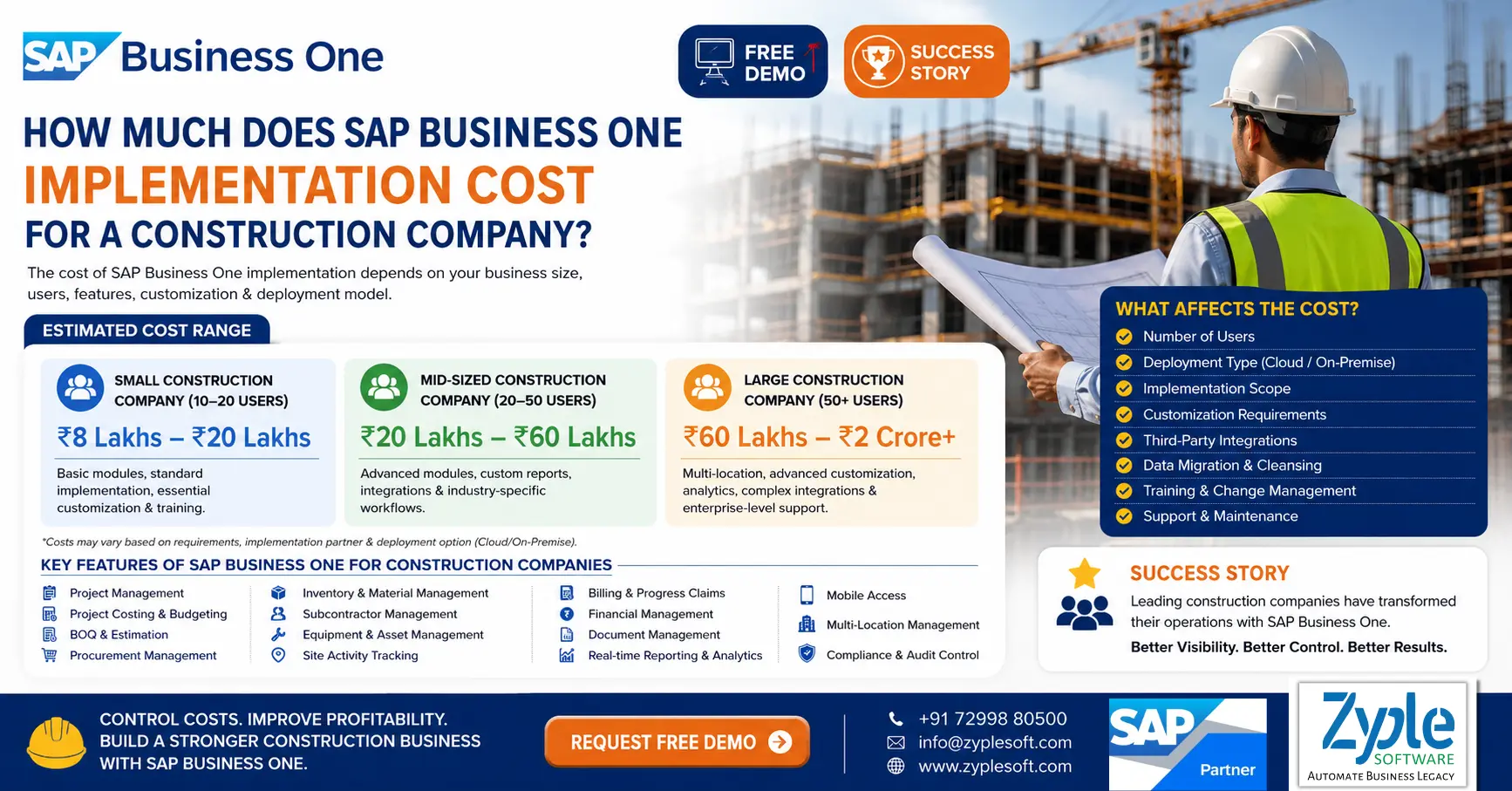
      Small Construction Company (10–20 Users)

      Estimated Investment:
      Approximate Budget: ₹8 Lakhs – ₹20 Lakhs

      Mid-Sized Construction Company (20–50 Users)

      Estimated Investment:
      • Advanced Project Management
      • Custom Reports
      • Additional Integrations
      • Industry-Specific Workflows
      Approximate Budget: ₹20 Lakhs – ₹60 Lakhs

      Large Construction Company (50+ Users)

      Estimated Investment:
      • Multiple Locations
      • Extensive Customizations
      • Advanced Analytics
      • Integration Ecosystem
      Approximate Budget: ₹60 Lakhs – ₹2 Crore+

      Hidden Costs to Consider

      When budgeting for an ERP project, construction companies should also account for:
      • Annual maintenance
      • Cloud hosting fees
      • User training programs
      • Additional user licenses
      • Add-ons and extensions
      • Future customizations
      • Business process consulting
      A well-planned implementation minimizes unexpected expenses later.
       

      How to Reduce SAP Business One Implementation Costs?

      Start with Core Processes

      Implement essential modules first:
      • Finance
      • Purchasing
      • Inventory
      • Project Management
      Additional features can be added later.

      Choose an Experienced SAP Partner

      A partner with construction industry expertise can:
      • Reduce implementation time
      • Avoid costly mistakes
      • Recommend industry best practices
      • Deliver faster ROI

      Standardize Processes

      The closer your processes align with SAP Business One standard functionality, the lower your implementation costs.

      Invest in User Training

      Proper training increases adoption rates and reduces operational disruptions after go-live.
       

      What ROI Can Construction Companies Expect?

      Most construction companies see benefits such as:
      • Improved project profitability
      • Reduced material wastage
      • Better procurement control
      • Faster project reporting
      • Enhanced cash flow visibility
      • Reduced manual work
      • Accurate project costing
      Many organizations achieve measurable returns within 12–24 months after implementation.
       

      Conclusion

      The cost of implementing SAP Business One for a construction company depends on business size, user count, required functionality, and customization needs. While the initial investment can range from ₹8 Lakhs to over ₹2 Crore, the long-term benefits of improved project control, operational efficiency, and profitability often outweigh the cost.
       
      For construction companies looking to scale operations, improve project visibility, and make data-driven decisions, SAP Business One provides a powerful and future-ready ERP solution.
       
      Partnering with Zyple Software an experienced SAP Business One implementation provider ensures a smooth deployment, faster ROI, and a system tailored to the unique demands of the construction industry.

      Read more about SAP Business One for Construction: https://www.zyplesoft.com/infra-construction/

      Fill your details in below contact form, our team will contact you soon with better solution.
       

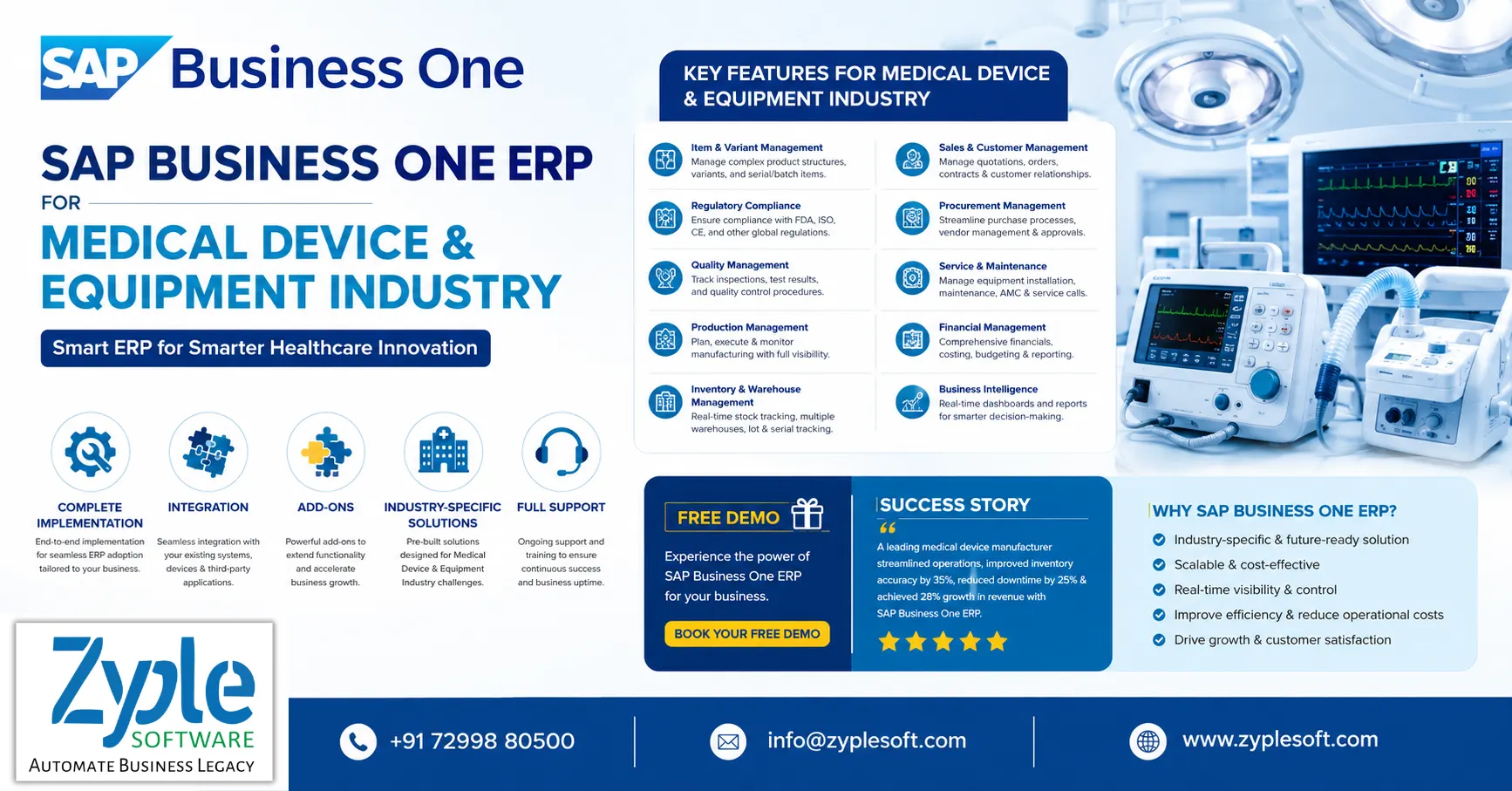
        SAP Business One ERP for Medical Device and Equipment industry

        SAP Business One for Medical Device and Equipment Industry

        SAP Business One ERP for Medical Device and Equipment Industry

        SAP Business One ERP for Medical Device and Equipment industry

        The medical device and equipment industry has strict regulatory requirements that must be achieved in terms of product safety, documentation, and traceability. It is important that the medical device and equipment industry complies with the global standards such as FDA regulations, ISO certifications, and quality management standards. SAP Business One for medical device and equipment helps the medical device and equipment industry to operate effectively while ensuring full compliance and traceability.

        Challenges Faced By The Medical Device and Equipment Industry

        1. Strict Regulatory Compliance

        Localizing products across different international markets increases the complexity and traceability burden.

        2. Supply Chain and Sourcing Issues

        The industry remains vulnerable to global supply chain disruptions and inflationary pressures, which significantly reduces profit margins. Also, many regions, including heavily importing markets in India, face high import duties on raw materials and a lack of local suppliers for specialized components.

        3. Cybersecurity and Data Privacy

        As medical devices increasingly connect with the software, internet connectivity, and electronic health records, they become prime targets for cyberattacks. Manufacturers are tasked with embedding powerful data security and HIPAA-compliant features to protect patient data while maintaining device functionality.

        4. High Costs and Reimbursement Uncertainty

        Developing practical, science-backed devices requires huge capital outlays for prototyping and clinical trials. Even after securing product clearance, manufacturers face obstacles in delivering cost-effectiveness to healthcare providers to ensure product reimbursement.

        5. Rapid Technological Obsolescence

        The fast-paced integration of artificial intelligence (AI), IoT, and big data into patient care creates pressure on manufacturers to continuously update, maintain, and upgrade computerized systems while preventing hardware or software failure.

        Features of SAP Business One ERP for Medical Device and Equipment

        1. Regulatory Compliance and Quality Management

        • It includes end-to-end quality control across procurement, production, and delivery.
        • It includes ISO and regulatory compliance support with audit trails and documentation.
        • It includes quality inspections and approvals at multiple stages.
        • It includes non-conformance and CAPA (Corrective Action) tracking.
        • It includes document management for SOPs and certifications.
        • It includes audit-ready reporting and traceability.
        • It ensures compliance with global medical standards and minimizes risk.

        2. Batch, Serial, and End-to-End Traceability

        • It includes batch and serial number tracking for every component and finished device.
        • It includes full product genealogy (forward and backward traceability).
        • It includes “where-used” tracking for components and assemblies.
        • It includes expiry and shelf management.
        • It includes recall management with instant trace reports.
        • Allows complete transparency from raw material to patient delivery.

        3. Product Lifecycle

        • It includes engineering change management (ECN or ECO).
        • It includes version and revision control for products.
        • It includes product lifecycle tracking from design and prototype to production.
        • It includes integration with CAD and PLM systems.
        • Helps handle innovation while maintaining compliance.

        4. Production Planning and Manufacturing Control

        • It includes advanced planning and scheduling (APS).
        • It includes work order and shop floor control.
        • It includes capacity planning like machines, labor, and tools.
        • It includes real-time production tracking.
        • Costing methods like material, labor, and overhead.
        • It improves efficiency and minimizes production delays.

        5. Project Management for Device Development

        • It includes budget tracking and cost control.
        • It includes milestone and stage tracking.
        • It ensures new product development stays on time and budget.

        6. Inventory and Warehouse Management

        • It includes multi warehouse management.
        • It includes real-time stock visibility.
        • It includes bin or location management.
        • It includes batch-controlled inventory.
        • It includes automated replenishment and demand planning.
        • It includes integration with procurement and finance.
        • Minimizes stockouts, overstock, and expired inventory.

        7. Procurement and Supplier Management

        • It includes vendor qualification and evaluation.
        • It includes purchase order automation.
        • It includes supplier performance tracking.
        • It includes approval workflows for procurement.
        • It includes compliance tracking for suppliers.
        • It maintains high-quality supplier networks.

        8. Sales, Distribution, and CRM

        • It includes customer lifecycle management (CLM).
        • The entire sales cycle from quotation, order, and delivery to invoicing flows.
        • It includes contract and pricing management for hospitals and clinics.
        • It includes after-sales and warranty management.
        • It includes service calls and maintenance tracking.
        • Improves customer satisfaction and service quality.

        9. Service and Equipment Maintenance Management

        • It includes installed base tracking (devices at customer locations).
        • It includes warranty and AMC (Annual Maintenance Contract) management.
        • It includes service scheduling and technician assignment.
        • It includes spare parts management.
        • It includes service history tracking.
        • It improves after-sales service and recurring revenue.

        10. Financial Management and Cost Control

        • It includes cost accounting and product costing.
        • It includes budgeting and financial forecasting.
        • It includes multi-currency and global compliance.
        • It includes profitability analysis by product or device.
        • Delivers complete financial visibility and control.

        11. Business Intelligence and Real-Time Analytics

        • It includes real-time dashboards and KPIs.
        • It includes custom reports and analytics.
        • It includes drill-down reporting.
        • It includes predictive insights for demand and production.
        • It helps management make faster, better decisions.

        12. Integration and Automation Capabilities

        • It includes integration with CAD, PLM, MES, and IoT devices.
        • It includes machine and PLC integration.
        • It includes third-party system connectivity like e-commerce and logistics.
        • It includes workflow automation and alerts.
        • Allows digital transformation and smart factories.

        13. Mobility and Cloud Access

        • It includes web-based access (anytime, anywhere).
        • It includes real-time approvals and alerts.
        • It keeps teams connected on the go.

        Benefits of SAP Business One ERP for Medical Device and Equipment

        The enterprise resource planning (ERP) software, SAP Business One (SAP B1) system, facilitates compliance, automates supply chains, and optimizes inventory. It delivers medical device and equipment companies with strict regulatory adherence (FDA/ISO) and end-to-end serial and lot traceability, allowing businesses to minimize operational costs and scale operations profitably.

        1. Strict Regulatory Compliance

        Provides built-in compliance and quality management tools to meet thorough FDA regulations and ISO standards. Eliminates manual errors by ensuring secure assessment of product versions, revisions, and compliance documentation.

        2. End-to-End Traceability

        Captures serial numbers and lot numbers for raw materials, sub-assemblies, and finished devices using SAP implementation. Traces every component forward and backward through the supply chain to execute rapid, targeted product recalls if an issue arises.

        3. Advanced Inventory and Supply Chain Control

        Monitors high-value components and devices in real-time across multiple warehouse locations. Automates reorder points and supplier management to prevent shortages of essential medical parts.

        4. Financial Transparency and Growth

        Unifies manufacturing, purchasing, sales, and financials into one system. Grows with the business, allowing expansion into new markets while maintaining cost control and profit margin visibility using SAP solutions.

        Conclusion of Medical Device and Equipment ERP

        Zyple Software is the best SAP Business One partner in India specializing in implementation, digital transformation, licensing, integration, add-on solutions, migration, and consulting for the medical device and equipment industry. By adopting a powerful ERP solution like SAP software, the organization can ensure compliance with regulatory norms, complete traceability of the product, and efficient operation of the manufacturing processes.

        If you’re appointed, book a demo of SAP Business One.

        Do you demand the SAP Business One ERP solution for your business or industry?

        Complete all the details in the allotted contact form; our team will reach out to you.