
Tag Archives: ERP Implementation

SAP Business One erp for Maritime Industry

SAP Business One for Maritime Industry

SAP Business One ERP for Maritime Industry
SAP Business One erp for Maritime Industry

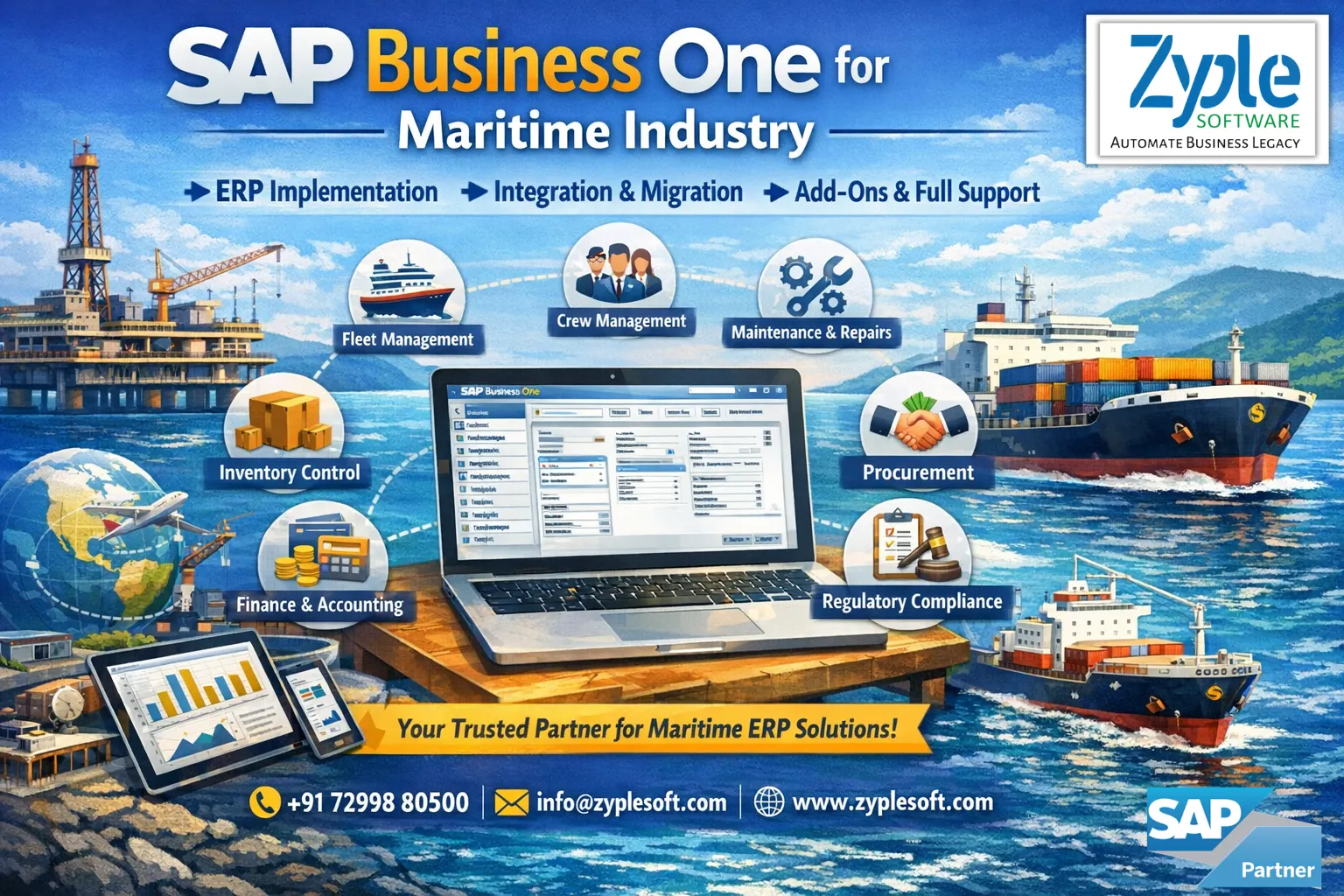
The maritime industry plays an important role in global trade, requiring accuracy and efficiency at every step. SAP Business One for maritime industry helps handle challenges like fleet management, regulatory compliance, and rising operational costs. SAP Business One ERP delivers designed solutions to facilitate logistics, improve customer relationships, and increase supply chain efficiency. With SAP B1 implementation, maritime companies can gain real-time insights, minimize operational costs, and boost performance.

Key Challenges in the Maritime Industry

The maritime industry is struggling with the range of challenges that require forward-thinking solutions for growth and efficiency. Companies must handle issues such as fleet optimization, rising operational costs, and compliance with stringent environmental regulations. The rapid pace of technological change, along with the need for smooth data integration, intensifies the pressure to remain competitive. To succeed, maritime businesses must focus on improving operational workflows, increasing customer experience, and adopting innovative digital tools. 

Here are the key challenges confronting the maritime sector:

1. Rising Operational Costs

Rising fuel prices damage budgets, forcing maritime operators to seek innovative strategies for cost management and efficiency improvements.

2. Supply Chain Disruptions

Unforeseen disruptions in global supply chains can obstruct timely operations, necessitating flexible strategies to reduce impacts on maritime logistics.

3. Safety and Security Risks

Ensuring the safety of personnel and vessels amid rising security threats requires thorough risk management and training programs.

4. Increased Competition

The maritime industry is highly competitive, demanding businesses to innovate and deliver value-added services to stay ahead.

Features of SAP Business One for Maritime Industry

1. Fleet Management

Tracking, managing, and improving vehicle operations, including maintenance, fuel consumption, driver performance, and leasing.

2. Finance and Accounting

Automating key financial processes like general ledger, journal entries, budgeting, and bank reconciliation.

3. Production

Handling the end-to-end manufacturing process, including bills of materials (BOM) management, production orders, resource planning, and goods movements.

4. Purchasing

Handling the entire lifecycle of acquiring goods and services, from vendor selection to final payment.

5. Operation Management

Facilitating core processes, such as inventory, purchasing, production, and sales, into one system.

6. Manufacturing Integration

Integrating the ERP system with shop-floor systems, such as Manufacturing Execution Systems (MES), PLCs, and IoT devices, to synchronize production data, automate inventory updates, and gain real-time visibility.

7. Customized Report

It is a designed data analysis tool customized to display specific business metrics, KPIs, or information not available in standard, out-of-the-box reports.

8. Business Intelligence and Analytics

Real-time data analysis allows small and medium-sized enterprises (SMEs) to monitor performance, visualize data via dashboards, and make better decisions.

9. Forecasting

Predicting future customer demand, allowing businesses to optimize inventory levels, production schedules, and purchasing to avoid stockouts or excess stock.

10. Cost Management

Tracking, allocating, and analyzing expenses and revenues across different business units, departments, or projects to monitor profitability.

11. Sales and CRM

Handling the entire customer lifecycle, from initial lead, through sales opportunities, to quotations and orders.

12. Cash Flow Management

Real-time tracking and forecasting of incoming and outgoing money to maintain liquidity and guarantee financial stability.

13. Business Planning

Facilitating core processes to allow data-driven decision-making through real-time reporting, supporting on-premise or cloud deployment.

14. Bank Integrations

Secure, automated connection between the ERP system and banking platforms, allowing seamless, direct exchange of financial data.

15. Business Partners

Represents the master data for all external identities in a company interacts with customers, vendors (suppliers), and leads.

16. Add-Ons

Extensions that connect directly into the core ERP system to deliver specialized, industry-specific, or improved functionality.

Importance of SAP Business One for Maritime Industry

SAP Business One (SAP B1) is important for the maritime industry, providing an integrated, real-time ERP solution that facilitates shipbuilding, inventory, and supply chain operations. It improves project management, minimizes costs through automation, and ensures compliance with maritime regulations. Important reasons include improved data visibility, optimized resource management, and scalable, accurate financial reporting for shipyards and marine services using SAP implementation.

1. Integrated Project Management

Handles complex ship construction projects from planning to delivery, tracking milestones and costs in real-time.

2. Operational Efficiency and Automation

Automates procurement, inventory management, and supplier communication, minimizing manual workload and errors.

3. Improved Resource Management

Allows accurate, real-time monitoring of resources (materials, labor, and machinery) to avoid waste and minimize operational costs.

4. Financial Control and Compliance

Delivers accurate, audit-ready financial data and helps in managing industry-specific regulatory standards, minimizing penalties.

5. Real-Time Analytics and Reporting

Provides powerful dashboards for analyzing KPIs, helping managers make data-driven decisions on production and sales.

6. Scalability for Growth

Supports the expanding requirements of maritime businesses, including improved project complexity, through a scalable, flexible platform.

7. Supply Chain Optimization

Facilitates logistics by coordinating procurement and warehousing, improving overall profitability.

Benefits of SAP Business One ERP for Maritime Industry

SAP Business One (SAP B1) provides maritime companies a centralized, scalable SAP solutions to optimize fleet operations, manage complex shipbuilding projects, and improve supply chain efficiency. Core benefits include real-time financial oversight, improved inventory control, automated procurement, and regulatory compliance, ensuring increased profitability, minimized downtime, and faster on-time deliveries.

1. Operational Capabilities and Digital Transformation

Facilitates processes from order-to-cash, including purchase order generation from sales orders, minimizing manual inaccuracies and accelerating workflows.

2. Inventory and Logistics Management

Optimizes inventory levels for shipyards, preventing overstocking, and improves supply chain visibility for logistics, including tracking BP catalog numbers (vendor or customer part numbers).

3. Improved Fleet and Maintenance Control

Allows scheduling of preventive maintenance and real-time monitoring of vessel status to reduce costly downtime.

4. Financial and Contract Management

Allows tracking of freight contracts and supplier agreements, delivering detailed profitability analysis, financial reporting, and automated payment scheduling.

5. Real-Time Data and Reporting

Delivers 360-degree visibility into operations via interactive dashboards, allowing better, faster decision-making for managing complex, long-term projects.

6. Ease of Use and Integration

Grows with the business, enabling the addition of users and functionalities, ensuring a future-proof investment.

Conclusion of Maritime ERP

As a certified SAP Business One partner, Zyple Software brings unparalleled expertise and dedication to businesses seeking seamless SAP Business One services.

Do you pursue ERP software for your business or industry?

Fill in all the details in the allocated form; our team will get back to you.

    Choose SAP ERP Implementation Partner

    Choose SAP ERP Implementation Partner

    How to Choose SAP ERP Implementation Partner?

    Choose SAP ERP Implementation Partner

    Selecting the right SAP ERP implementation partner is one of the most critical decisions your business will make.

    An ERP system like SAP Business One can transform operations but only if implemented correctly. The wrong partner can lead to delays, cost overruns, user resistance, and underutilized systems.

    How do you choose the right SAP ERP implementation partner?

    1. Check Industry-Specific Experience (Not Just SAP Knowledge)

    Many firms say they “implement SAP.” That’s not enough.

    A strong implementation partner should understand:

    • Your industry workflows
    • Compliance requirements
    • Operational bottlenecks
    • Reporting expectations
    • Growth challenges

    For example:

    1. Manufacturing requires BOM, production planning, and MRP expertise
    2. Retail needs POS integration and multi-branch consolidation
    3. Construction requires project cost tracking and milestone billing
    4. Pharma demands batch tracking and regulatory compliance

    ERP success depends on domain knowledge but not just technical setup.

    2. Verify SAP Authorization and Partnership Status

    Ensure the partner is officially aligned with SAP SE.

    Ask:

    • Are they an authorized SAP partner?
    • Do they have certified SAP consultants?
    • How many SAP projects have they completed?

    Certification ensures access to proper implementation methodologies, updates, and support standards.

    3️. Evaluate Implementation Methodology

    A professional SAP Business partner should follow a structured process:

    • Requirement study and gap analysis
    • Solution blueprint
    • System configuration
    • Data migration
    • User training
    • Go-live support
    • Post-implementation optimization

    If the partner can not clearly explain their methodology, that’s a red flag.

    4. Look for Industry Case Studies

    Real results matter more than promises.

    Ask for:

    • Case studies
    • Client references
    • Before-and-after performance improvements
    • ROI metrics

    Examples of measurable outcomes:

    • 20–30% inventory reduction
    • Improved working capital visibility
    • Faster month-end financial closing
    • Reduced manual errors

    A credible partner will have proof of success.

    5. Assess Customization and Add-On Capability

    Every business has unique processes.

    Your SAP ERP partner should:

    • Offer industry-specific add-ons
    • Provide integration capabilities
    • Customize reports & dashboards
    • Connect with third-party systems

    A one-size-fits-all approach rarely works.

    6. Understand Post-Implementation Support

    ERP implementation does not end at go-live.

    Ask:

    1. Do they offer ongoing support?
    2. What are their SLA terms?
    3. Is there a dedicated support team?
    4. Do they provide system optimization services?

    Strong post-go-live support determines long-term success.

    7. Evaluate Local & Regional Presence

    For Indian businesses especially, a partner with local market understanding offers advantages:

    • Knowledge of GST compliance
    • Indian taxation structure
    • Regional business practices
    • Faster on-site support

    If you’re operating in India, choosing a SAP ERP partner with strong Indian market experience is critical.

    8. Transparency in Costing

    Avoid vague pricing structures.

    A reliable SAP ERP implementation partner should clearly explain:

    • License cost
    • Implementation cost
    • Customization charges
    • Annual maintenance
    • Support fees

    Transparency prevents budget surprises.

    9. Scalability for Future Growth

    ERP is a long-term investment.

    Ensure the partner can support:

    • Multi-branch expansion
    • Multi-currency operations
    • Increased transaction volume
    • Advanced analytics
    • Industry compliance evolution

    The right partner prepares your ERP for the next 5–10 years.

    Why Choosing the Right SAP ERP Partner Matters?

    ERP implementation impacts:

    • Financial visibility
    • Operational efficiency
    • Inventory management
    • Compliance
    • Customer satisfaction

    The right partner like Zyple Software becomes a long-term strategic advisor  –  not just a software installer.

    Final Conclusion

    Choosing the right SAP ERP implementation partner is not about selecting the cheapest option.

    It’s about selecting:

    • Industry expertise
    • Proven methodology
    • Transparent pricing
    • Long-term support capability
    • Strong SAP ecosystem alignment

    If you’re evaluating SAP ERP for Manufacturing, Retail, Construction, Real estate, Pharma, Textile, or other industries in India, take time to assess your implementation partner carefully.

    A well-implemented SAP ERP system can transform your business.
    The right partner makes all the difference.

    Let us fill your detail in contact form. A right implementation partner will contact you soon as per your business needs.

      SAP B1 Consultant

      What is an SAP B1 Consultant and Why Your Business Need One

      What is an SAP B1 Consultant and Why Your Business Might Need One

      SAP B1 Consultant

      All sizes Companies are looking for ways to improve their operations, improve decision-making, and scale efficiently. One of the most powerful tools available to small and mid-sized enterprises (SMEs) is SAP Business One (SAP B1). It is an integrated enterprise resource planning (ERP) solution designed specifically for growing businesses. But while SAP B1 is powerful, implementing and optimizing it requires expertise. That’s where an SAP B1 Consultant becomes necessary.

      Who is an SAP B1 Consultant?

      An SAP B1 Consultant is a professional who specializes in the implementation, customization, and support of the SAP Business One software. These consultants are experts in both the technical and functional aspects of the system. They bridge the gap between a business’s unique processes and the capabilities of the SAP B1 platform, ensuring that the software aligns seamlessly with operational goals.
       
      SAP B1 Consultants can work independently, as part of a consulting firm, or be employed in-house by companies using SAP Business One. Their primary role is to help businesses implement the software effectively, minimize disruptions, and provide continuous support for optimal performance.

      Key Responsibilities of an SAP B1 Consultant

      An SAP B1 Consultant wears many hats throughout the software lifecycle. Their responsibilities typically include:
      1. Requirements Gathering: Understanding the client’s business processes, objectives and current pain points.
      2. Solution Design: Mapping business needs to SAP B1 features, and designing tailored workflows.
      3. Implementation and Configuration: Installing and configuring the system, ensuring compatibility with business processes.
      4. Customization: Developing custom reports, dashboards, or add-ons to meet unique requirements.
      5. Data Migration: Transferring legacy data to SAP B1 without losing accuracy or consistency.
      6. Training: Educating end-users and administrators on how to use the software effectively.
      7. Support and Maintenance: Troubleshooting issues, upgrading systems, and offering technical support post-implementation.

      Skills and Expertise of an SAP B1 Consultant

      To be effective, an SAP B1 Consultant must possess a blend of technical knowledge and business acumen. Key skills include:
      • Deep understanding of ERP principles and how they apply to SMEs.
      • Proficiency in SAP B1 modules such as finance, inventory, sales, CRM, and production.
      • Technical skills in SQL, SAP Crystal Reports, and SDK (Software Development Kit).
      • Strong communication and project management abilities.
      • Experience in change management and end-user training.

      Benefits of Hiring an SAP B1 Consultant

      A Successful SAP implementation is a significant investment, and a skilled consultant can ensure a high return on that investment. Here’s how businesses benefit from hiring an SAP B1 consultant:
      1. Faster Implementation: Consultants bring proven methodologies that reduce the time required to go live.
      2. Reduced Risk: Mistakes during implementation can be costly. A consultant helps you avoid common pitfalls.
      3. Custom Fit: They tailor the system to meet the specific needs of your business, rather than forcing you to adapt to generic settings.
      4. Training and Support: Ensures your team knows how to use the system effectively, increasing user adoption and satisfaction.
      5. Scalability: Consultants design systems that grow with your business, reducing the need for future overhauls.

      When Should You Hire an SAP B1 Consultant?

      Hiring an SAP B1 Consultant is advisable when:
      • You are planning your first ERP implementation.
      • You are migrating from another ERP or legacy system.
      • You are struggling with underutilized features or inefficient workflows.
      • You need to integrate third-party apps or customize reports.
      • Your in-house IT team lacks specialized SAP B1 knowledge.

      Choosing the Right SAP B1 Consultant

      Not all consultants are created equal. When selecting an SAP B1 Consultant, consider:
      • Certifications: Are they SAP-certified or have proven credentials?
      • Experience: Have they worked with ERP in your industry or of a similar size?
      • References: Can they provide client testimonials or case studies?
      • Communication: Are they able to explain complex ideas in simple terms?
      • Support Plans: Do they offer ongoing SAP support after implementation?

      SAP B1 Consultant Vs SAP B1 Partner

      While SAP B1 Consultants are individuals or small teams, SAP B1 Partners (Best Example: Zyple Software) are official resellers and implementers recognized by SAP. A consultant can work independently or as part of a partner network. For smaller companies, a freelance consultant might offer a more cost-effective solution. For larger projects, a certified SAP partner with a team of consultants may be more appropriate.

      Last Words

      The success of any ERP system hinges not just on the software itself, but on how well it is implemented and adopted. An SAP B1 Consultant ensures that your SAP software solution is aligned with your unique business needs, enabling you to automate workflows, gain real-time insights, and make smarter decisions.
       
      Whether you are starting from scratch or optimizing an existing setup, the right consultant can be the difference between a smooth transformation and a costly misstep. Investing in an SAP B1 Consultant is not just about adopting software but it’s about setting your business up for long-term success.
       
       
      If you are looking for consultant for your business. then fill you details in form. We will contact you soon.