How To Manage Subcontractor Bill in SAP Business One?
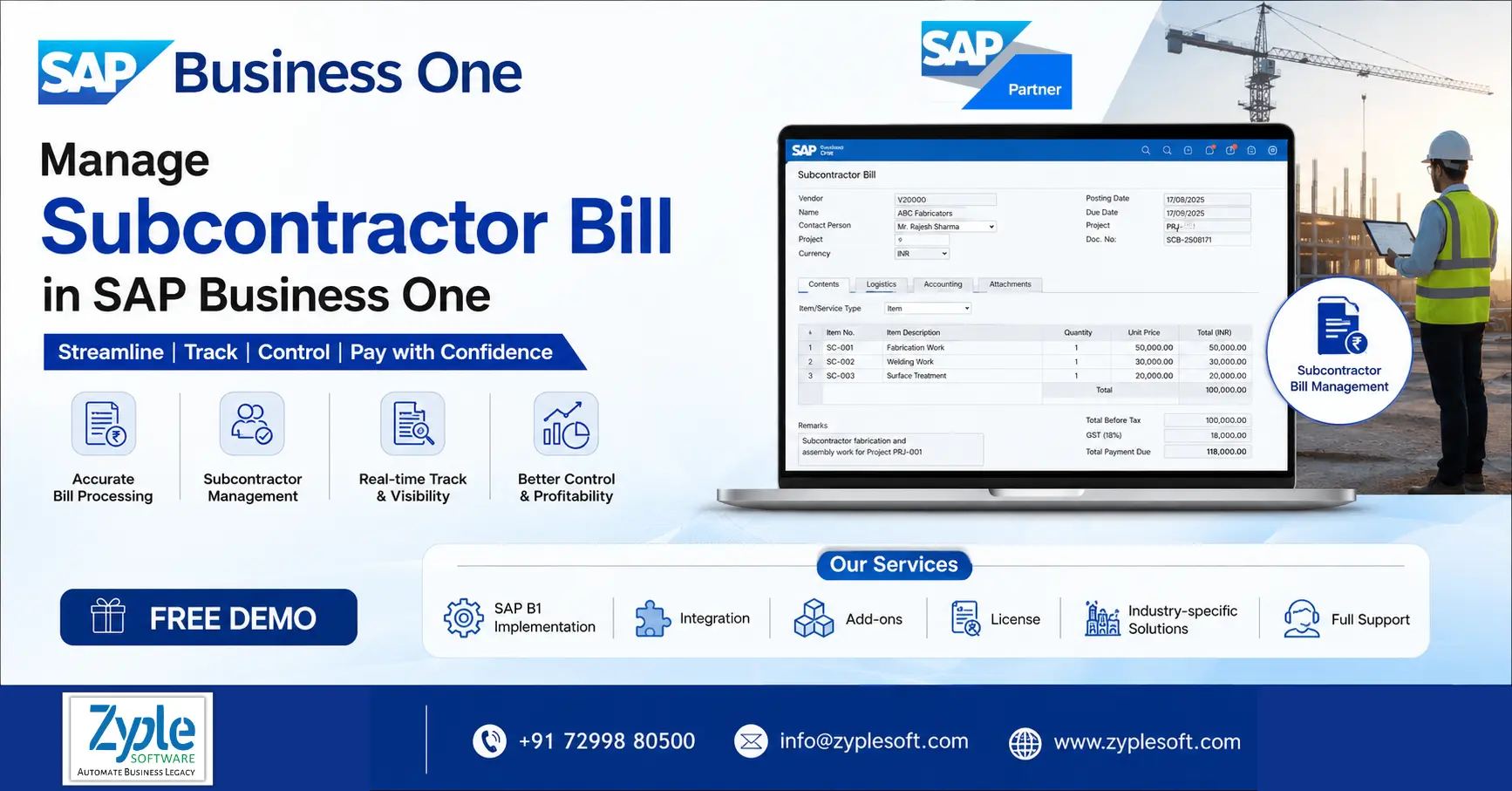
Subcontracting is a common practice in the manufacturing and construction industries, driven by different factors such as limited in-house capacity, lack of specialized processing technology, or a need for affordable solutions. However, handling the subcontractor bill, especially in a regulatory environment like India, can be a complex and paperwork-intensive task. To handle these challenges and empower manufacturing and construction companies to use SAP Business One while seamlessly managing their subcontractor bills, a dedicated subcontracting add-on has been developed. Here, we’ll discuss how to manage subcontractor bill in SAP Business One.
The Complexity of Subcontracting in India
In India, the subcontracting work is subject to excise rules, which involve complete documentation. Subcontractors must maintain records of different aspects, including:
- Which materials were sent to which subcontractor.
- The purpose of subcontracting.
- Document numbers associated with every transaction.
- The quantity of materials processed and returned by the subcontractor.
- The tenure for which the subcontracting document remains open.
Maintaining such records manually is not only tiresome but also prone to errors, making it essential for manufacturing and construction companies to find a reliable and efficient solution. This is where the subcontracting add-on for SAP Business One ERP comes into play.
Features of Managing Subcontractor Bill in SAP Business One
SAP Business One can help businesses handle subcontractor-related purchasing, services, costs, invoices, and payments within an integrated ERP environment. Major features include:
1. Subcontractor Master Data Management
Maintains subcontractor details, tax information, payment terms, contact details, and purchasing history in one place.
2. Purchase Order Management
Creates purchase orders for subcontracted services, jobs, materials, or project activities and monitors commitments against approved orders.
3. Subcontractor Bill Recording
Records subcontractor invoices and service bills with proper quantities, rates, taxes, discounts, and other charges.
4. Purchase Invoice Integration
Posts subcontractor bills through the purchasing process and automatically reveals the financial impact in accounting.
5. Project-Wise Bill Tracking
Associates subcontractor expenses with specific projects, contracts, cost centers, or activities to evaluate project-level expenditure.
6. Work Order and Service Tracking
Monitors subcontracted work or services against the relevant purchase documents and project requirements.
7. Bill Verification and Approval
Establishes approval procedures for subcontractor purchase orders, invoices, and related transactions before posting or payment.
8. Quantity and Rate Verification
Compares ordered quantities and agreed rates with billed quantities and rates to identify discrepancies with the SAP implementation process.
9. Retention Amount Management
Tracks retention amounts where it is applicable to construction or project-based subcontracting arrangements.
10. Tax and GST Management
Calculates and records applicable taxes and GST components based on configured tax rules and transaction details.
11. Withholding Tax Management
Supports applicable withholding-tax requirements when processing subcontractor payments and invoices.
12. Advance Payment Tracking
Records advances paid to subcontractors and tracks their adjustment against subsequent bills.
13. Bill-to-Payment Tracking
Follows the complete lifecycle from purchase order, receipt, and service confirmation and invoice to payment.
14. Credit Note Management
Processes subcontractor credit notes for returns, billing corrections, rate adjustments, or other discrepancies.
15. Purchase Invoice Matching
Matches contractor invoices with relevant purchase orders and receipts where the business process demands document-level validation.
16. Expense Allocation
The SAP software allocates subcontractor costs to appropriate projects, departments, cost centers, or other dimensions for better cost visibility.
17. Project Cost Monitoring
Evaluates subcontractor expenses alongside other projects to identify budget overruns and cost deviations.
18. Budget vs. Actual Analysis
Compares planned project or department budgets with actual subcontractor expenses.
19. Accounts Payable Integration
Subcontractor bills automatically contribute to accounts payable balances, delivering finance teams with an integrated view of outstanding liabilities.
20. Payment Due-Date Tracking
Monitors payment terms, invoice due dates, outstanding balances, and overdue subcontractor bills.
21. Vendor Statement Management
Reviews subcontractor account balances and transaction histories to reconcile payment amounts.
22. Purchase Analytics and Reporting
Analyzes subcontractor spending by vendor, project, period, item, service, department, or other relevant dimensions.
23. Document Traceability
Maintains links between related purchasing and accounting documents, making it easier to trace a bill back to its originating transaction.
24. Approval Workflow Automation
Uses the approval process to control transactions that exceed predefined amounts, budgets, or authorization limits using SAP Business One solutions.
25. Audit Trail and Transaction History
Maintains transaction records that help organizations analyze who created, changed, approved, or posted relevant documents.
26. Multi-Branch and Multi-Company Support
Ideal configurations can help organizations handle subcontractor transactions across different branches or company entities.
27. Foreign Currency Transactions
Handles subcontractor transactions in supported foreign currencies when dealing with international vendors.
28. Real-Time Financial Impact
Subcontractor purchasing and billing transactions can flow into the accounting system, minimizing the need for separate manual financial updates.
29. Cash Flow Planning
Outstanding contractor bills and payment schedules can contribute to cash flow planning and payable management.
30. Custom Reports and Dashboards
Businesses can create customized reports and dashboards to evaluate subcontractor bills, outstanding payments, project costs, and vendor performance.
Benefits of Managing Subcontractor Bill in SAP Business One
Managing subcontractor bills in SAP Business One automates the link between external vendor services, material consumption, and project accounting. Major benefits include automated 3-way matching of purchasing orders, receipts, and invoices, real-time tracking of project labor and material costs, and error-free statutory and tax compliance.
1. Automated 3-Way Matching
Cross-checks subcontractor bills against purchase orders and goods or service receipts to avoid overpayment.
2. Accurate Cost of Goods Sold (COGS)
Seamlessly adds labor and processing charges to raw material costs for accurate product or project costing.
3. Reduced Human Error
Eliminates manual data entry mistakes and duplicate billing cycles.
4. Real-Time Budget Monitoring
Updates project cost codes and stage budgets instantly as bills are posted.
5. Facilitated Reconciliation
Simplifies tracking of issued components versus processed output or scrap returned by contractors using SAP B1 implementation.
6. Liability Tracking
Delivers clear, centralized visibility into open vendor liabilities and upcoming cash flow outflows.
7. Statutory Tax Compliance
Automatically handles local tax requirements such as GST, TDS, or TCS on vendor payments.
8. Audit Readiness
Maintains a consolidated digital audit trail linking operational challans, receipts, and final invoices.
Conclusion of Subcontractor Bill Management in SAP Business One
As a certified SAP Business One partner, Zyple Software is delivering services like SAP B1 implementation, integration, migration, licensing, add-ons, digital transformation, and support to different industries, like construction, manufacturing, solar, food and beverage, aerospace, oil and gas, healthcare, retail, jewellery, pharma, and textiles.
SAP Business One is an ERP software customized for small and medium-sized enterprises that connects finance, production, inventory, material requirements planning (MRP), procurement, sales, CRM, and reporting into one platform. For manufacturing and construction businesses, it can improve project costing, procurement, subcontractor billing, and inventory management.
If you’re free, register a SAP Business One demo.
Do you insist on the SAP B1 ERP solution for your business or industry?
Finish all the details in the classified contact form; our team will reach out to you.
FAQs
1.Can SAP Business One automate subcontractor bill management?
Yes. SAP Business One can facilitate subcontractor bill recording, approval, cost allocation, tax calculation, and payment tracking, reducing manual work and improving financial control.
2.How can SAP Business One help construction enterprises track subcontractor costs?
SAP Business One can link subcontractor expenses with projects, cost centers, and budgets, helping construction enterprises monitor actual costs, identify overruns, and improve project profitability.
3.Can SAP Business One connect subcontractor bills with purchase orders?
Yes. Businesses can integrate purchasing documents and supplier invoices to improve bill verification and ensure that subcontractor charges align with approved orders and agreed costs.
4.Can SAP Business One deliver real-time reports on subcontractor payments?
Yes. SAP Business One delivers financial and accounts-payable reporting that helps management monitor outstanding subcontractor bills, payment due dates, vendor balances, and project-related expenses.
5.How can I implement SAP Business One for subcontractor bill management?
An experienced SAP Business One implementation partner like Zyple Software can configure workflows, project costing, purchasing, accounts payable, taxation, approvals, and reporting according to your business processes. This can help create a centralized system for handling subcontractor billing from invoice receipt through payment.
Read Also: SAP Business One for Construction Industry