SAP Business One (B1) ERP for Pumps and Valves Manufacturing Industry
The pumps and valves manufacturing industry has the most complex and thorough structure of work. The core nature of operations in the pumps and valves manufacturing industry often faces challenges and is looking for ways to sustain itself in the market while competing at its best. SAP Business One ERP for pumps and valves manufacturing delivers a unified ERP platform that integrates engineering, production, inventory, procurement, quality control, service management, and finance, providing real-time operational visibility and control across the pumps and valves manufacturing life cycle.
Challenges Faced By The Pumps and Valves Manufacturing Industry
The pumps and valves manufacturing industry faces significant challenges driven by complex product configurations, talent shortages, and strict global sustainability regulations. Manufacturers must balance demanding lead times with the need to integrate smart IoT technologies into traditional fluid-handling systems.
1. Complex Quoting and Configuration
Creating accurate technical quotes involves validating factors like flow rates, pressure, and compliance. Manual quoting processes often cause delays and errors, forcing many to adopt dedicated manufacturing software like SAP Business One.
2. Material and Production Constraints
Manufacturers continuously deal with the volatility of raw material costs and source specialized alloys (e.g., stainless steel, Inconel, and titanium) necessary for high-pressure and corrosive environments.
3. Stringent Environmental Regulations
With an increasing shift towards sustainability and renewable energy, manufacturers face pressure to produce highly efficient equipment with zero or near-zero leakage, minimized pressure loss, and advanced sealing technologies.
4. The Engineering Skill Gap
The industry involves a highly technical workforce capable of operating complex CNC machinery and understanding IoT or smart sensor integration. Finding and retaining skilled engineers remains difficult as automation grows.
5. Supply Chain Disruptions
Sourcing parts globally, fluctuating logistics costs, and shifting trade regulations complicate the supply chain, making it difficult for smaller, less adaptable companies to maintain inventory balances and avoid stockouts.
6. Counterfeit Products
Especially in developing markets, the proliferation of low-cost, low-quality counterfeit pumps and valves presents a major threat to brand credibility and end-user safety.
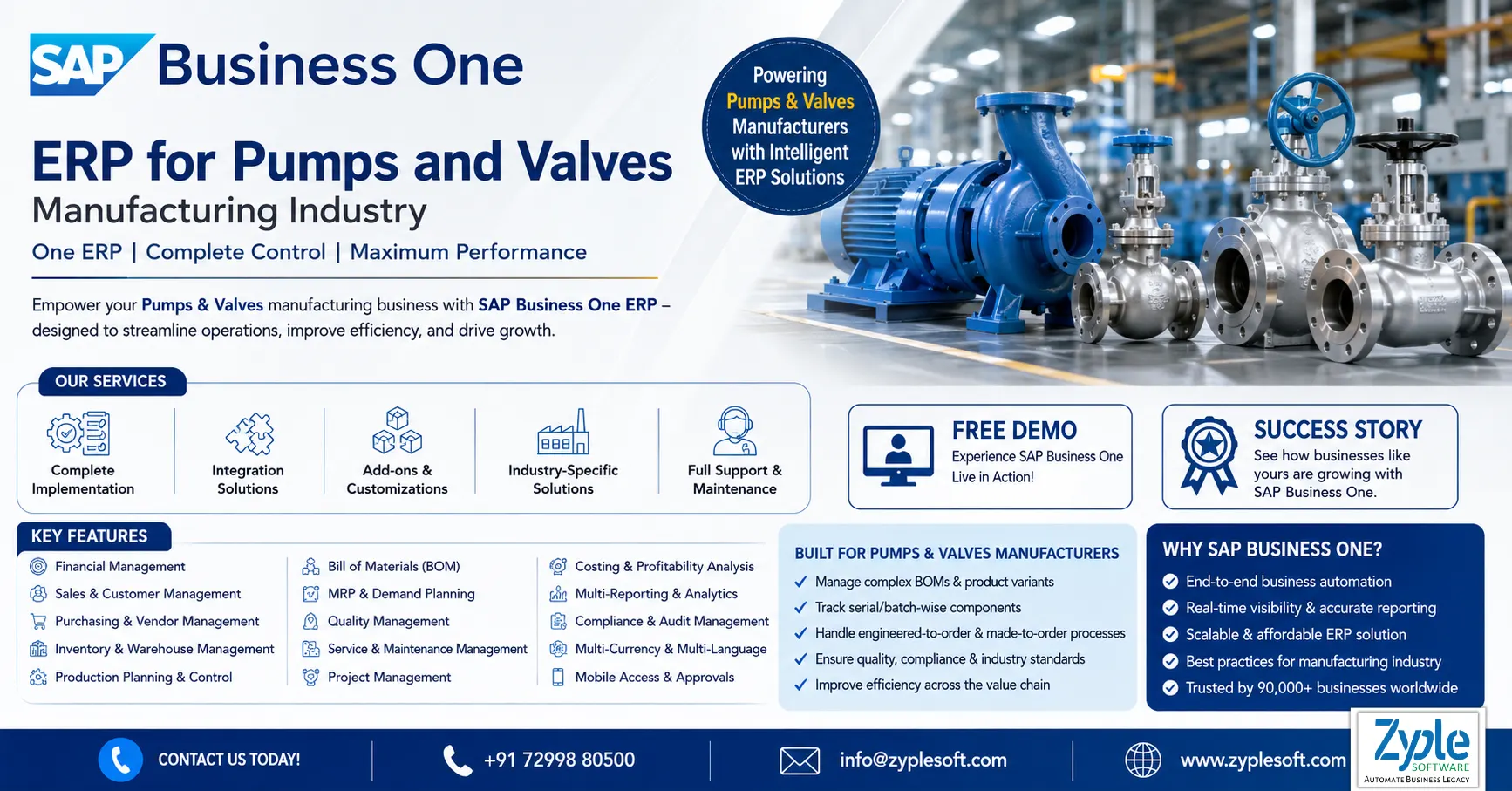
Features of SAP Business One ERP for Pumps and Valves Manufacturing
1. Financial Management and Cost Control
- It includes general ledger, accounts payable, and accounts receivable automation.
- It includes cost center and profit center accounting.
- It includes product-wise and batch-wise profitability analysis.
- It includes budgeting, cash flow tracking, and financial forecasting.
- It includes multi-currency and tax compliance.
- Fixed asset management like machines, tools, and molds.
- It helps pump and valve manufacturers control thin margins and high material costs.
2. Production Planning and Control
- Multi-level bill of materials (BOM) for assemblies like pump units and valve components.
- Production orders like manual and automated.
- It includes routing and stage-wise production tracking.
- It includes work-in-progress (WIP) monitoring.
- Resource planning like machine and labor.
- It includes subcontracting and outsourcing management.
- It ensures accurate machining, casting, assembly, and testing workflows.
3. Material Requirements Planning (MRP)
- It includes demand forecasting based on sales orders.
- It includes auto-generation of purchase and production orders.
- Lead time planning for raw materials like castings, seals, and shafts.
- It includes capacity planning for machines.
- Minimizes stockouts and overstocking.
- Essential for long lead-time components and custom orders.
4. Inventory and Warehouse Management
- Real-time inventory tracking like raw material, WIP, and finished goods.
- Batch and serial number tracking are crucial for valve and pump traceability.
- It includes bin location and multi warehouse management.
- It includes stock aging and slow-moving inventory analysis.
- It improves traceability and compliance for industrial components.
5. Procurement and Supplier Management
- It includes vendor comparison and evaluation.
- It includes Goods Receipt PO (GRPO) and invoice matching.
- It includes supplier performance tracking.
- It includes export and import documentation handling.
- It ensures timely sourcing of metals, castings, and precision parts.
6. Sales and Customer Relationship Management (CRM)
- It includes lead and opportunity management.
- Quotation, sales order, and delivery to invoice cycle.
- It includes customer-specific pricing and contracts.
- It includes after-service and AMC management.
- It includes warranty tracking for pumps and valves.
- It supports project-based and repeat industrial sales cycles.
7. Quality Control and Compliance
- It includes incoming, in-process, and final inspection tracking.
- Quality parameter definitions like pressure, leakage, and tolerance.
- It includes non-conformance and corrective action tracking.
- It includes quality certificates and documentation generation.
- Important for ISO or API standards in valve and pump manufacturing.
8. Product Costing and Profitability Analysis
- It includes standard and actual cost calculation.
- It includes raw material, labor, and overhead cost tracking.
- Variance analysis like planned vs. actual cost.
- Helps improve cost-intensive engineered products.
9. Engineering and BOM Management
- It includes multi-level BOMs for complex assemblies.
- It includes engineering change management (ECM).
- It includes version control for product designs.
- Integration with CAD or PLM (via add-ons).
- Suitable for custom pump designs and valve configurations.
10. Supply Chain and Logistics Management
- It includes order fulfillment and dispatch planning.
- It includes shipment tracking and logistics coordination.
- It includes demand-supply synchronization.
- It includes export documentation support.
- It improves on-time delivery for industrial clients.
11. Maintenance Management
- It includes preventive maintenance scheduling for machines.
- It includes breakdown tracking and downtime analysis.
- It includes spare parts inventory management.
- Minimizes machine downtime in machining and assembly units.
12. Business Intelligence (BI) and Analytics
- Real-time dashboards for production, sales, and finance.
- KPI tracking like OEE, rejection rate, and delivery performance.
- It includes custom MIS reports.
- It includes Excel integration and drill-down analytics.
- Allows data-driven decision-making.
13. Mobility and Web Access
- It includes mobile apps for sales, inventory, and approvals.
- It includes web-based access for remote operations.
- It includes real-time alerts and workflow approvals.
- Suitable for plant managers and field sales teams.
14. Integration and Scalability
- It includes integration with MES, IoT, CAD, and third-party systems.
- It includes API-based connectivity.
- Cloud, on-premise, or hybrid deployment.
- Adaptable for multi-plant operations.
- It supports digital transformation in manufacturing.
15. Project and Job Work Management
- Project-based manufacturing like custom pumps and valves.
- It includes job costing and milestone tracking.
- It includes resource allocation per project.
- Suitable for EPC and industrial contract manufacturing.
Benefits of SAP Business One ERP for Pumps and Valves Manufacturing
The ERP software, SAP Business One (SAP B1) system, facilitates the pumps and valves manufacturing industry by integrating design, production, and financials. It optimizes material requirements planning (MRP) for complex Bills of Materials (BOMs), ensures thorough quality compliance, tracks component traceability, and delivers real-time reporting to minimize operational costs.
1. Complex Bill of Materials (BOM) Management
Handles multi-level BOMs required for complex pumps and valves, ensuring accurate resource planning and avoiding material shortages using SAP implementation.
2. Strict Quality Control and Compliance
Maintains testing records, serial or batch traceability, and quality checklists to adhere to heavy-duty industry standards like ISO and API.
3. Precise Costing and Profitability
Delivers complete cost tracking, including raw materials (castings, forgings), machining, labor, and overhead, to accurately calculate margins on custom or mass-produced parts.
4. Robust Inventory Control
Optimizes stock levels of spare parts and components, avoiding overstocking while ensuring fast retrieval to fulfill urgent customer service and maintenance requests.
5. Integrated Supply Chain
Connects sales, procurement, and production, allowing for automated purchasing based on real-time order forecasting using SAP solutions.
6. Real-Time Analytics and KPIs
Provides customizable dashboards that track production bottlenecks, machine utilization, and financial performance at a glance.
Conclusion of Pumps and Valves Manufacturing ERP
Zyple Software is a Top SAP Business One partner in India specializing in implementation, digital transformation, licensing, integration, add-on solutions, migration, and consulting for the pumps and valves manufacturing industry.
1.How can SAP Business One improve efficiency in pumps and valves manufacturing?
SAP Business One facilitates production, inventory, procurement, and finance in one system. This minimizes manual work, eliminates errors, and improves overall operational efficiency, helping manufacturers deliver orders faster and more accurately.
2.Is SAP Business One suitable for small and medium-sized pump and valve manufacturers?
Yes, SAP Business One is customized specifically for SMEs. It provides scalable features that grow with your business, making it a cost-effective ERP solution for both emerging and established manufacturers.
3.How quickly can SAP Business One be implemented in my manufacturing business?
SAP B1 implementation timelines generally range from a few weeks to a few months, depending on your business complexity. With the right SAP B1 implementation partner, the process can be fast, seamless, and minimally disruptive.
4.Can SAP Business One be customized for my pumps and valves manufacturing processes?
Absolutely. SAP Business One can be designed to match your specific workflows, including production planning, quality control, and inventory management, ensuring it fits your exact business needs.
5.How do I get started with SAP Business One for my company?
Connect with a certified SAP Business One partner like Zyple Software for a consultation, business assessment, and demo. This helps you understand how the SAP B1 solution can be aligned with your manufacturing goals and ROI expectations.